
The Taverny Triangle
Around 7:45 PM on January 4, 2010, a lone pedestrian in Taverny, a commuter town of the Val-d'Oise department roughly 21 kilometers northwest of central Paris, was intrigued by a large dark triangular shape crossing the sky from east to west, carrying faint yellow-orange lights at each of its extremities. The witness, who described himself to investigators as very accustomed to observing aircraft and who sized the object against an Airbus A320 for comparison, watched it in complete silence for what he judged to be 10 to 15 seconds, at an estimated distance of around 500 meters, before it continued on and was lost from view. No other witness ever came forward. GEIPAN's own investigation confirmed and refined the witness's account, found real credit in his testimony, and concluded the sighting resembled neither a classic optical misidentification nor the passage of a commercial airliner — a possibility the witness's own familiarity with aircraft made especially unlikely. The agency calculated that the object's reported profile could theoretically match a scale model or drone of roughly 2.5 meters flying at about 150 meters' altitude, at 35 to 150 km/h, low enough to sit beneath the radar coverage of nearby Paris–Charles de Gaulle Airport — only to judge that hypothesis itself implausible on its own terms, absent any other supporting evidence, for a device of that kind to be flown over a populated town, at night, on a winter evening. GEIPAN's own case file, registered under case ID 2010-01-02498, closes the sighting as Class D1: a strange phenomenon of medium consistency, unexplained.
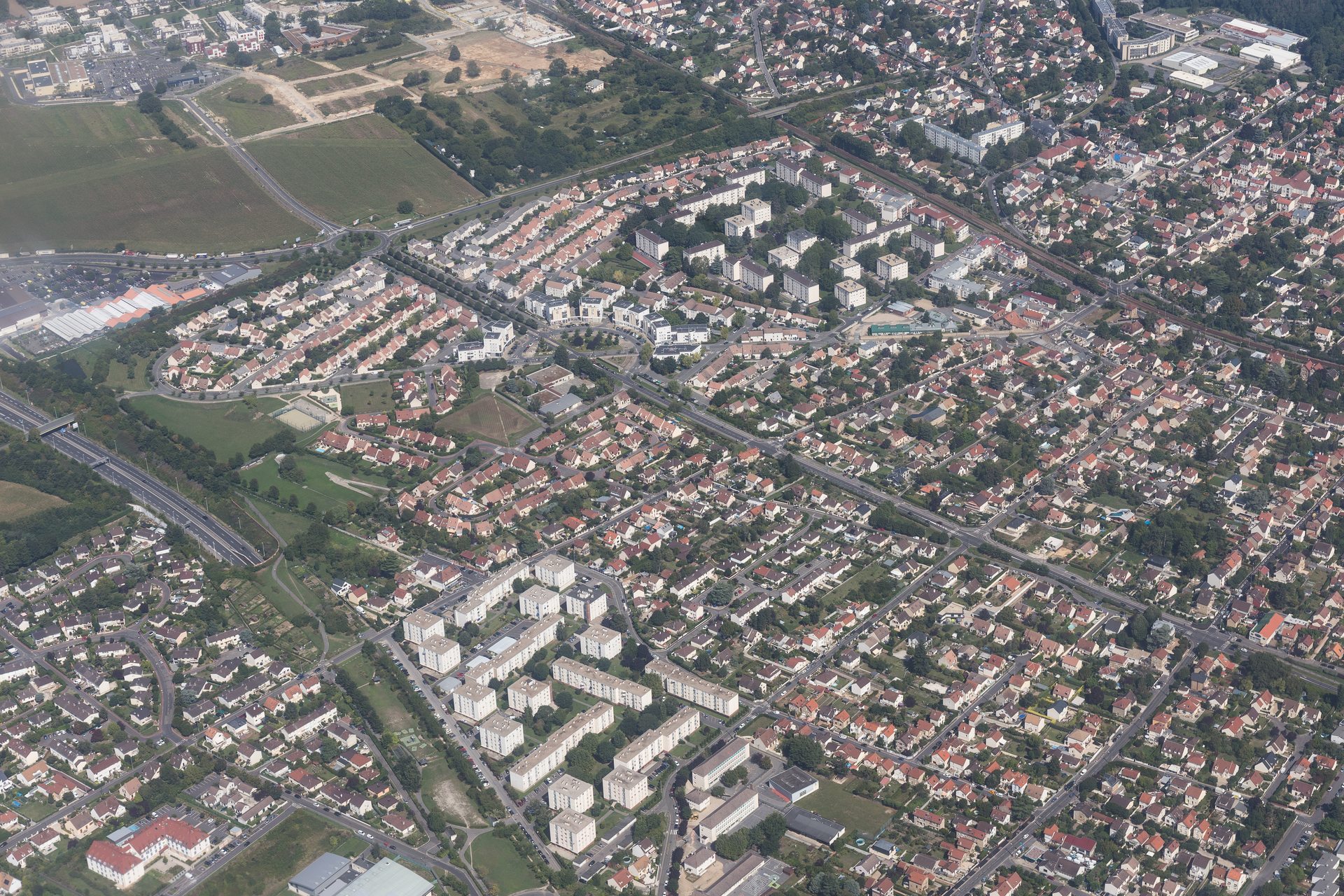
Pictured: an aerial photograph of Taverny, Val-d'Oise, taken August 24, 2019 during a commercial flight between Orly and Paris–Charles de Gaulle airports — a genuine coincidence given this case's own connection to CDG's radar coverage, not a photograph staged to illustrate that link. This is not a photograph of the actual sighting, the object itself, or the specific street the witness was walking on when he saw it; no photograph, video, or other direct visual recording of the phenomenon is known to exist anywhere, only GEIPAN's own written testimony record and its later reconstruction diagrams. Photo by Wikimedia Commons contributor Pymouss (2019), released under CC BY-SA 4.0.
Theoretical Alignment
This case draws the most conservative alignment of the two GEIPAN files published in this research round, for reasons specific to what actually exists in the record. The observation itself was brief (10–15 seconds), came from a single witness, and consisted of little more than a dark silhouette carrying two faint lights — a genuinely thin evidentiary base compared to a close-range, multi-minute, multi-witness sighting of a structured craft. Psycho-Social framing draws the largest share of weight specifically because a nighttime silhouette sighting of this brevity is a recognized category where misperception of an unlit or minimally-lit conventional object (a small aircraft, a drone, even in principle a distant bird or debris catching ambient light at an unusual angle) is a live possibility that GEIPAN's own investigation could not rule out with the same confidence it ruled out a passenger airliner. That said, PSH is capped well short of a majority share by two specific facts working the other direction: the witness's own explicitly stated familiarity with aircraft, which GEIPAN's investigators treated as a real credibility asset rather than a discardable detail, and the agency's own explicit judgment that its single closest-fitting conventional candidate — a drone or scale model — was itself implausible given the where, when, and how of the sighting. Extraterrestrial framing retains modest support mainly from the object's reported total silence and its size, described by the witness as at least comparable to an airliner; Interdimensional framing has the least direct support in this specific file, drawing only on the case's total absence of any radar or photographic corroboration, the same non-specific "left no trace" pattern IDH proponents apply broadly rather than any detail unique to this sighting.
Background
Two separate threads of context bear directly on how this sighting should be read: the ordinary, unremarkable commuter town the witness was walking through that evening, and the far less ordinary military history buried beneath it — a history GEIPAN's own investigators invoked directly when they reached for Paris–Charles de Gaulle Airport's radar coverage as the basis for their leading (if ultimately rejected) hypothesis.
Taverny: A Val-d'Oise Commuter Town
Taverny is a commune of roughly 27,600 residents (per Insee's most recent published count) in the Val-d'Oise department of Île-de-France, sitting about 21 kilometers northwest of central Paris on the edge of the Forêt de Montmorency. Its residents are known locally as Tabernaciens. By 2010, Taverny was a fully residential and commercial commuter town served by two stations on the Transilien Paris-Nord suburban rail line, with nothing in its surface-level character to distinguish it from dozens of other towns ringing the French capital. The witness's walk that evening, on whatever residential street or park path he happened to be on when the object crossed overhead, was in every visible respect an ordinary evening in an ordinary town.
What Sits Underneath: Six Decades as France's National Air-Defense Command Post
Taverny's actual distinguishing feature is invisible from the street. Beneath the town, carved into gypsum quarries first excavated in 1815 and expanded by the occupying German military between 1941 and 1944, sits Base aérienne 921 (BA921) — for close to half a century, the physical seat of French national air-defense command. The Centre d'Opérations de la Défense Aérienne (CODA) was established there in 1957; the general staff of the Commandement Air des Forces de Défense Aérienne (CAFDA) joined it in 1961; the base itself was formally created in 1963; and by 1967 the underground complex also housed the Centre des Opérations des Forces Aériennes Stratégiques (COFAS) — the operations center for the command overseeing France's airborne nuclear deterrent forces. At its operational peak, the Taverny complex fused radar data from ten regional stations into a single national air picture, linked to equivalent air-defense systems in neighboring countries, covering an area the French Air Force itself described as roughly nine times the size of metropolitan France, with the underground facility built for ten days of total autonomy in the event of an attack on the surface. This is, in short, one of the most significant pieces of Cold War-era air-defense infrastructure in Western Europe, sitting directly beneath the town where this sighting took place.
A Base Already Mid-Wind-Down by January 2010
It would be a mistake, however, to read this sighting as having occurred beneath an active national command post at the height of its power, and this site's research is explicit about the timeline to avoid that impression. CODA and CAFDA were dissolved in 1994, replaced by the Commandement de la Défense Aérienne et des Opérations Aériennes (CDAOA) and its own Centre de Conduite des Opérations Aériennes (CCOA), both of which continued operating from Taverny for over a decade more. But on September 1, 2007 — roughly two and a half years before this sighting — the CCOA relocated to BA942 Lyon-Mont Verdun, the CDAOA itself moved to BA117 Paris, and the associated intelligence center transferred to BA128 Metz-Frescaty. A 2008 military modernization plan announced under Prime Minister François Fillon then scheduled BA921's own closure for 2011, and the base was formally dissolved on July 5, 2011 — affecting over 1,000 personnel and roughly 650 lodging rooms in the department — before being reduced to an "élément air rattaché" (EAR) under BA110 Creil. It would not return to active military use until a 2024 reactivation restored Forces Aériennes Stratégiques command functions to the site. In other words: by the evening of January 4, 2010, Taverny's single most historically significant institutional role — as the literal command post fusing France's entire national radar picture — had already ended, and the base itself was less than eighteen months from a formally announced closure. Whatever residual staff, administrative functions, or subordinate units remained on-site at the time, BA921 was in every practical sense already a base in decline, not the operational nerve center of French air defense it had been for the preceding half-century.
Two Different Radars, Not One: Untangling GEIPAN's Own CDG Reference
This distinction matters directly for understanding GEIPAN's own analysis of this sighting, and it is worth being precise about it rather than letting two separate things blur together. Taverny's own historical radar significance — CODA, CAFDA, and later CDAOA — concerned a military air-defense fusion center: a command post that aggregated data from a national network of regional detection and control centers (CDCs) into a single strategic picture, not a radar installation of its own sited at Taverny. GEIPAN's own investigation into this sighting, by contrast, does not invoke BA921's air-defense network at all. Its actual technical hypothesis — that a small drone or model aircraft flying at roughly 150 meters' altitude might sit beneath detectable coverage — refers explicitly to the surveillance radar coverage of Paris–Charles de Gaulle Airport, a separate, civilian air-traffic-control radar system roughly 24 kilometers away by straight-line distance (and closer to 36 kilometers by road), covering CDG's own approach and departure corridors rather than the wider national air-defense picture BA921 was built to fuse. This site's research found no indication in GEIPAN's published file that the agency ever actually requested or reviewed radar logs from either system for the evening in question; its reasoning about the "radar cone" is a stated theoretical compatibility calculation — an object flying that low, that far from CDG's own approach paths, would plausibly fall beneath what CDG's radar would routinely register — not a confirmed negative result from an actual log pulled and checked, the way this site's Fauville-Évreux Radar Sighting case file documents a real, checked (and in that case positive) radar cross-reference. Both of these facts — that BA921's own historic radar role is a different system entirely from the one GEIPAN's hypothesis actually invokes, and that the CDG reference itself appears to be calculation rather than a confirmed records check — are worth holding in mind before treating this sighting's location as somehow more radar-adjacent than it actually is.
Complete Timeline
| Date | Event |
|---|---|
| 1815 | Gypsum quarrying begins at the site later occupied by Base aérienne 921, Taverny. |
| 1941–1944 | The occupying German military expands the quarry tunnels for industrial/military use during the Second World War. |
| 1957 | The Centre d'Opérations de la Défense Aérienne (CODA) is established at Taverny. |
| 1961 | The CAFDA (Commandement Air des Forces de Défense Aérienne) general staff relocates to Taverny. |
| 1963 | Base aérienne 921 (BA921) is formally established. |
| 1967 | The underground complex additionally houses COFAS, the operations center for France's strategic (nuclear) air forces command. |
| 1994 | CODA and CAFDA are dissolved and replaced by the CDAOA and its CCOA, both remaining at Taverny. |
| September 1, 2007 | The CCOA relocates to BA942 Lyon-Mont Verdun and the CDAOA to BA117 Paris; Taverny ceases to be the seat of national air-defense command. |
| 2008 | A national military modernization plan schedules BA921's closure for 2011. |
| January 4, 2010, approx. 7:45 PM | Sighting begins. A lone pedestrian in Taverny watches a large dark triangular form with dim yellow-orange lights at each end cross the sky east to west in complete silence, at an estimated range of 500 meters, for 10–15 seconds. |
| Following days | The witness's report reaches GEIPAN; a technical questionnaire and formal witness testimony are recorded. No other witness or press report is ever identified. |
| July 5, 2011 | BA921 is formally dissolved, becoming an air element attached to BA110 Creil. |
| September 4, 2024 | BA921 is reactivated, restoring Forces Aériennes Stratégiques command functions to the site. |
| Case status as maintained | Final classification. GEIPAN records the case as Class D1: a strange phenomenon of medium consistency, unexplained, with its own best-fitting drone/model-aircraft hypothesis explicitly judged implausible. |
Detailed Narrative
An Ordinary Winter Walk, Then a Silent Shape Overhead
According to GEIPAN's own archived synthesis of the case, the witness was out walking that evening — the case file gives no further detail about his route, destination, or why he happened to be outside at that hour, only that he was "en promenade," on a walk, when something in the sky caught his attention. What he reported watching, over the course of roughly 10 to 15 seconds, was a large, dark triangular shape moving from east to west on a level, unhurried, constant-speed heading. At each of the shape's extremities — its own word choice, suggesting the witness perceived distinct, separated points or ends rather than a single unbroken silhouette — he made out faint, low-intensity lights, described as yellow-orange in color. He estimated the object's distance from him at roughly 500 meters, and, in a detail this site's research found nowhere else replicated so directly among the other GEIPAN cases already published here, he anchored the object's apparent size using a specific comparative reference: it seemed, in his own words, at least equivalent in size to an Airbus A320 — a commercial narrow-body airliner roughly 37 meters long with a wingspan just under 36 meters. Throughout the sighting, he reported hearing nothing: no engine noise, no rotor noise, no particular sound of any kind, despite what he judged to be a fairly close and clearly visible passage.
A Witness Investigators Explicitly Treated as Aviation-Literate
GEIPAN's own case synthesis draws specific, deliberate attention to one detail about the witness that shaped how the agency weighed his account: that he described himself, and was assessed by investigators, as very accustomed to observing aircraft. This is not incidental color. A witness who watches planes regularly, whether recreationally, professionally, or simply by virtue of living near enough to a flight path to have internalized what ordinary air traffic looks and sounds like, brings a materially different baseline to a sighting report than a witness with no comparable frame of reference: he is less likely to mistake the mundane for the anomalous, and, when he does report something as genuinely unfamiliar, that judgment carries more evidentiary weight precisely because it comes from someone who had every opportunity to recognize a normal aircraft and did not. GEIPAN's own investigation leaned directly on this distinction in ruling out one of the two most obvious conventional candidates for the sighting: it treated the account as flatly incompatible with the passage of a commercial airliner, a judgment the case file explicitly connects to the witness's own aviation familiarity rather than treating as a bare assertion.
A Genuine Investigation, Confirmed Testimony, and a Rejected Best-Fit Hypothesis
GEIPAN's synthesis is direct about the outcome of its own field investigation: rather than simply logging an unverifiable light report, the agency states that its enquiry "allowed the confirmation of the witness's account, its refinement, and gave credit to the witness's statement." That is a meaningfully stronger conclusion than the agency reaches for many single-witness files, where testimony is typically recorded without any explicit statement of confirmed credibility. Having established that baseline, GEIPAN's investigators then worked through what conventional explanation, if any, could account for a large, dark, silent, constant-speed triangular shape crossing a populated town at low altitude on a winter evening. A commercial airliner was rejected outright, for the reasons above. The agency's own calculations turned instead to a scale model aircraft or drone: working from the witness's own size, distance, and speed impressions, GEIPAN computed that an object of roughly 2.5 meters, flying at approximately 150 meters' altitude, at a speed of 35 to 150 km/h, would fit the reported observation — and would, at that altitude and that distance from Charles de Gaulle Airport, plausibly sit below the airport's own radar coverage, explaining the total absence of any corroborating instrumented detection. Having built that hypothesis, however, GEIPAN's own investigators declined to adopt it: they judged it "very unlikely" that a device of that kind would be flown in an urban area, at night, on a winter evening, absent any other evidence (no reported drone operator, no permit application, no comparable local drone activity, no witness report of a ground-based operator) to actually support it. The agency's own language is precise on this point: the drone hypothesis "could be compatible" with the observation on its physical parameters alone, but was "not retained, for lack of other probative elements" — a genuinely honest, and genuinely unresolved, verdict that leaves the case open rather than quietly closed under a technically-possible-but-unsupported label.
Not to Be Confused With: The "Landing at Taverny" Covered in Top Secret Magazine
Readers researching this case independently may encounter a separate piece of French UFO media coverage titled, in French, "L'atterrissage de Taverny" — "The Taverny Landing" — published as a feature investigation by Georges Metz in issue 36 of the French mystery magazine Top Secret. It is worth being explicit, in the same spirit as this site's other GEIPAN case files, that this site's own research could not confirm any connection between that feature and the January 2010 sighting documented here, and every detail this site was able to establish about it — a title referring to a landing, a dedicated long-form magazine investigation, and its own separate publication history — points toward an unrelated, and likely much older, incident rather than a second name for the same case. GEIPAN's own published file for this sighting describes a brief, silent overflight witnessed by a single pedestrian, with no landing, no site investigation, and no physical trace of any kind — nothing resembling the sort of on-the-ground "landing" investigation a dedicated magazine feature under that title would imply. This site was not able to independently verify the Top Secret feature's own actual content or date directly (its retail listings do not specify), and it is flagged here specifically so that a reader who encounters that title elsewhere does not mistakenly assume it describes the same event as the one investigated in this file.
Key Witnesses
Taverny Primary Witness (identity withheld per GEIPAN's standard anonymization practice)
Out walking in Taverny on the evening of January 4, 2010, this witness watched a large, dark, silent triangular shape with dim yellow-orange lights at each extremity cross the sky from east to west over 10 to 15 seconds, at an estimated range of roughly 500 meters. He sized the object against an Airbus A320 for scale and reported no sound of any kind. GEIPAN's own investigation explicitly credits his account, and treats his self-described aviation familiarity as a specific reason to rule out a conventional airliner. No other witness to this sighting was ever identified.
The Five Observables Assessment
The Five Observables framework, developed by the Pentagon's Advanced Aerospace Threat Identification Program to describe performance characteristics beyond known conventional technology, is applied here for comparative consistency across the site's case files. This case registers a single genuine "Present" rating, reflecting both the brevity of the sighting and the limited detail a 10–15 second, single-witness silhouette observation can support.
Assessment: This is a genuinely thin Five Observables profile by the standards of this site's better-documented GEIPAN files, and that thinness is itself informative rather than merely a data gap. A brief, single-witness, silhouette-only sighting of a constant-speed object simply does not generate the kind of behavioral detail — sudden acceleration, sustained hover, or an unambiguous absence of any physical means of propulsion — that a longer or closer observation can support. What this file does register clearly is total silence at an estimated 500-meter range, from a witness explicitly credited by investigators as aviation-literate enough to recognize what an ordinary aircraft (however quiet a specific model might be at altitude) sounds and looks like. That single data point carries real weight specifically because of who is reporting it, even as the case's overall Five Observables signature remains, honestly, one of the least distinctive in this site's published GEIPAN archive.
Evidence Assessment
Supporting an Anomalous Origin
- GEIPAN's own investigation explicitly states it confirmed the witness's account, refined its details, and credited his statement — a materially stronger conclusion than a bare, unverified testimony record
- The witness's self-described familiarity with aircraft, treated by investigators as a genuine credibility factor, directly supports ruling out a conventional airliner as the source
- GEIPAN's own best-fitting conventional candidate — a small drone or scale model — was explicitly judged implausible by the agency's own investigators, given the sighting's urban, nighttime, winter-evening context and the total absence of any corroborating evidence (no identified operator, no permit record, no comparable local drone activity)
- The object's reported total silence at an estimated range of roughly 500 meters is a poor match for any conventional powered aircraft at that distance
Supporting a Conventional/Mundane or Inconclusive Origin
- This is a single, uncorroborated witness account; no other testimony was ever collected despite the object's reported size and low-altitude passage over an inhabited town
- The observation lasted only 10 to 15 seconds, among the briefest sightings in this site's published GEIPAN archive, sharply limiting how much reliable behavioral or structural detail can be drawn from it
- No photograph, video, or physical trace of any kind exists; the entire evidentiary record consists of a single witness's own verbal account, reconstructed afterward into a technical questionnaire and an investigator-produced diagram
- GEIPAN's own drone/model-aircraft hypothesis, while ultimately not adopted, was judged physically compatible with the sighting's basic parameters (size, altitude, speed) — its rejection rests on contextual plausibility judgment (why fly one there, then) rather than on any specific fact that rules the possibility out entirely
- This site's research found no indication that GEIPAN, or any other body, ever actually pulled and reviewed radar logs from Charles de Gaulle Airport or the regional air-defense network for the relevant evening; the "beneath the radar cone" reasoning in the case file is a stated theoretical calculation, not a confirmed negative records check
Why "Open"
This case is stamped Open because GEIPAN's own investigation reached a genuinely unresolved, honestly-stated conclusion — explicit confirmation of witness credibility, an outright rejection of the obvious mundane candidate (a passenger aircraft), and an explicit, reasoned rejection of its own next-best candidate (a small drone or model) — without ever landing on any accepted explanation at all. That is a real, substantive result, not a shrug. The case's core strength is the specific combination of an aviation-literate witness and an agency willing to say plainly that its own best-fitting conventional hypothesis did not hold up: GEIPAN did not simply default to "probably a drone" because that explanation was physically compatible; it went further and asked whether that explanation actually made sense given where, when, and how the sighting occurred, and concluded it did not, absent any supporting evidence a real drone flight would ordinarily leave behind.
Weighing against that strength are several real and significant limitations that keep this case well below the middle of this site's published GEIPAN archive. It rests on a single, entirely uncorroborated witness, observing for only 10 to 15 seconds — among the shortest windows of observation in this site's files, sharply limiting how much can be concluded about the object's structure or behavior beyond a dark silhouette and two dim lights. No photograph, video, or physical trace exists in any form. And critically, this site's own research found no evidence that the theoretical "beneath the radar cone" reasoning central to GEIPAN's drone hypothesis was ever actually tested against real logged data from CDG or the regional air-defense network for that evening — a genuinely testable claim that, as far as the published record shows, was never actually tested. Taken together, this case earns a score toward the lower end of this site's published GEIPAN files: a real, honestly-investigated, and honestly-left-open sighting, whose evidentiary thinness — one witness, one brief window, zero instrumented or physical corroboration — is the primary reason it scores below better-corroborated or better-documented cases in this same archive, even as its witness's aviation literacy and the agency's own explicit rejection of its best conventional candidate keep it from scoring at the very bottom.
Sensor & Instrumentation Detection Profile
No photograph, video, or live sensor recording of any kind captured this phenomenon. The closest thing to an instrumented record in this case's file is analytical rather than observational: GEIPAN's own investigators produced a panoramic reconstruction image and trajectory-modeling materials based on the witness's verbal description, distance estimate, and reported heading — a genuine piece of analytical reconstruction work, comparable in spirit to a forensic scene diagram, but built entirely from testimony rather than from any independent recording device. This site's research found no indication that any actual, logged radar data — from Charles de Gaulle Airport's own civilian air-traffic-control system, from the regional military air-defense network historically fused through Taverny's own BA921, or from any other source — was ever pulled and reviewed for the specific evening of January 4, 2010. GEIPAN's own "beneath the radar cone" reasoning is, on the published record, a stated theoretical compatibility calculation about what an object of the hypothesized size and altitude would plausibly register as, not a confirmed result from an actual records check. That is a meaningful gap relative to this site's other, more instrumented GEIPAN files (compare, for instance, the Fauville-Évreux Radar Sighting, where a real regional radar log was checked and did return a corroborating faint echo) — and one this site flags honestly rather than implying a radar check happened when the published file gives no indication that it did.
It is also worth noting what modern GEIPAN instrumentation this case predates, since several of this site's other, more recently filed French cases benefit from tools this 2010 file could not have used even if investigators had wanted to. GEIPAN's own automated meteor and fireball camera network, FRIPON (Fireball Recovery and InterPlanetary Observation Network), only launched officially in May 2016, six years after this sighting, and would in any case have been of limited use here given the object's reported altitude and behavior are inconsistent with a meteor or bolide. IPACO (Ingestion et Post-traitement Automatisé des Clichés Ovnis), GEIPAN's own dedicated image and video analysis toolkit for photographic UAP evidence, has nothing to process in a case with no photograph or video in the first place. Both absences are structural rather than investigative failures — the case simply has no imagery or fireball-relevant profile for either tool to apply to — but they underline how much of this file's evidentiary weight rests specifically on the credibility of a single testimony, worked through by traditional witness-interview methodology, rather than on any of the instrumented cross-checks this site's more recent GEIPAN files are increasingly able to draw on.
Environmental & Geospatial Context
GEIPAN's own published case summary does not record weather conditions for the evening of January 4, 2010, and no independent meteorological reconstruction is available in the case file. Early January in the Île-de-France region typically brings long nights and, on any given evening, a real possibility of overcast or partly overcast skies; without a specific recorded observation, this site's own research can establish only the ordinary seasonal baseline rather than the conditions on this particular evening, and does not speculate beyond that.
Geographically, the sighting occurred within the built-up residential area of Taverny itself, a dense commuter town on the edge of the Forêt de Montmorency, roughly 21 kilometers northwest of central Paris. The town sits within the wider ring of airspace around two major aviation facilities: Charles de Gaulle Airport, roughly 24 kilometers to the east-northeast by straight-line distance, and, historically, the underground air-defense command complex of BA921 directly beneath the town itself, though as discussed above that facility had already ceased its national command role some two and a half years before this sighting and had no active radar installation of its own at the surface. No specific drone-restricted zone, industrial facility, or other locally-based candidate light or noise source is identified anywhere in GEIPAN's published file for this case.
The broader Val-d'Oise department, of which Taverny forms a part, is a mixed commuter-suburban and rural department on the northwestern edge of the Paris metropolitan area, its skies subject to the ordinary civil and general aviation traffic typical of the outer Paris basin, including regular traffic patterns associated with CDG, Paris–Le Bourget, and several smaller regional aerodromes. None of that ordinary traffic pattern, per GEIPAN's own investigation, offers a ready explanation for a silent, dark, triangular object judged incompatible with a conventional airliner by a witness the agency itself credits as aviation-literate.
Observer Credibility & Occupational Profile
The witness's occupation is not disclosed in GEIPAN's published case file, consistent with the agency's standard anonymization practice. What is recorded, and what this site's research treats as the single most consequential credibility detail in the entire file, is that GEIPAN's own investigators specifically noted his familiarity with aircraft and drew directly on it in their analysis — both in ruling out a conventional airliner and, implicitly, in taking his size and distance estimates (anchored against a named, specific commercial aircraft type) more seriously than an equivalent estimate from a witness with no comparable frame of reference. GEIPAN's stated conclusion that its investigation "confirmed," "refined," and "gave credit to" his account reflects a real, positive credibility judgment by the agency's own field investigators, not merely a passive recording of an unverified claim.
At the same time, this site's analysis treats the case's single-witness structure as a genuine and unresolved limitation, separate from any question about this particular witness's honesty or competence. A single account, however credible the witness, cannot by itself rule out an idiosyncratic misperception specific to that one observer — a momentary trick of low ambient light, an unusual viewing angle on a genuinely conventional object, or some other one-off perceptual event that a second, independently-positioned witness might have resolved by seeing (or not seeing) the same thing from a different vantage point. GEIPAN's own investigation appears to have made a genuine effort to locate corroborating witnesses or press coverage — the case synthesis notes plainly that "no other testimony of observation will be collected" — and came back empty. That outcome is consistent with either a genuinely localized, easily-missed phenomenon (a small, dark, unlit-except-for-two-dim-lights object at night is not something every nearby resident would necessarily notice or look up in time to see) or with an event that, for whatever reason, only registered to one specific observer. This site's own analysis treats both possibilities as live rather than favoring one, which is precisely why the case remains scored toward the lower end of its published GEIPAN archive despite the witness's own creditable account.
Physical & Material Assays
No physical trace evidence exists in this case, and none was ever sought: the object was airborne throughout the entire reported observation, at an altitude high enough (whatever its exact value) that no landing, low hover, or ground-level approach of any kind was ever described. Accordingly, this case has no soil, vegetation, or material sample of any kind associated with it, and no metallurgical, isotopic, or trace-chemical assay was performed or would have been applicable given the nature of the sighting as reported.
Historical Precedents & Archive Matches
This case's most useful points of comparison on this site are the other published GEIPAN files describing large, dark, triangular craft — a genuinely recurring morphology in French UAP reporting that this sighting both resembles closely in one respect and diverges from in another.
Villers-lès-Luxeuil: The Closest Structural Match on This Site
The Villers-lès-Luxeuil Triangle (Open, case #252) describes a "large, dark, silent triangular structure" observed at low altitude near a French Air Force base in Haute-Saône — language that, read side by side with this case's own "large dark triangular form," is the single closest morphological match anywhere in this site's published archive. The two cases diverge meaningfully in behavior, however: Villers-lès-Luxeuil's object was reported quasi-stationary at low altitude, carrying one strong forward white light and one fixed red light, while this Taverny sighting describes a constant-speed, level, cross-sky passage with two faint yellow-orange lights at its extremities rather than any hover phase. Villers-lès-Luxeuil also benefited from a direct, checked cross-reference against a real, GEIPAN-confirmed Mirage 2000-5F training exercise flying from nearby BA116 that same general period — a records check GEIPAN ultimately found did not match the witnesses' account, but a check this Taverny file's own drone hypothesis notably lacks: no equivalent effort to check air-traffic, drone-registration, or hobbyist-flight records for the Taverny area on the evening in question appears in the published file.
Douai: The Same Broad Shape Family, a Genuinely Different Sub-Type
The Douai Prison-Adjacent Sighting (Open, case #253) is this site's other published French triangular-craft case, but it belongs to a visually distinct sub-family within the broader "triangle" morphology: a sharp-edged, actively luminous coral/pink-orange equilateral triangle with small lights along its own leading edges, rather than a dark silhouette with lights only at its extremities. Read together, Taverny, Villers-lès-Luxeuil, and Douai sketch out what looks like at least two genuinely separate recurring triangular morphologies in this site's own French GEIPAN archive: a dark, largely unlit body with lights only at discrete points (Taverny, and to a lesser extent Villers-lès-Luxeuil's fixed red/white lights), and a fully luminous, edge-lit structured triangle (Douai). Whether that distinction reflects two genuinely different phenomena, two different lighting configurations on similar underlying technology (conventional or otherwise), or simply the limits of what a single brief nighttime sighting can reliably convey about an object's true lighting scheme, is a question this site's current archive cannot resolve — but the pattern itself, drawn directly from three independently-investigated GEIPAN files, is a genuine and worth-noting structural observation.
A Recurring Investigative Pattern: The Aviation-Literate Witness
This case also joins a small but genuine pattern within this site's GEIPAN archive of investigations that lean specifically on a witness's own aviation background to rule out conventional aircraft. The Fauville-Évreux Radar Sighting's primary witness was an on-duty French Air Force officer, whose professional familiarity with both aircraft and the base's own radar scope was central to how that case's investigation proceeded. This Taverny file's civilian witness plays a structurally similar role on a smaller scale: not a professional credential, but a self-described, investigator-credited familiarity with ordinary air traffic that GEIPAN explicitly used to rule out the single most common conventional explanation before turning to its own drone hypothesis.
Material Analysis
As with the Physical & Material Assays section above, this case involves no physical or trace evidence of any kind. The object remained airborne throughout the entire observation, and no landing, hover, or ground-level approach was ever reported that could have produced a testable trace.
Supporting Non-Terrestrial Origin
- No confirmed physical evidence exists to test in the first place, so no terrestrial material-composition finding contradicts an anomalous interpretation either
- The object's reported total silence, dark coloring, and constant-speed level flight over 10–15 seconds do not correspond to GEIPAN's own primary conventional candidate (a passenger airliner), a conclusion the agency's own investigators reached directly
Supporting Terrestrial Origin
- GEIPAN's own investigators identified a physically compatible conventional candidate — a small drone or scale model flying at roughly 150 meters' altitude — that would account for the object's reported size, distance, speed, and silence; the agency's decision not to adopt that hypothesis rests on contextual plausibility rather than any fact that physically excludes it
- No radar, air-traffic, or drone-registration records appear to have been actually checked against the sighting, leaving the drone hypothesis neither confirmed nor genuinely ruled out on the evidence available
The Conventional Explanation Candidate: Airliner, Drone/Model Aircraft, and Misperception of a Distant Light Source
GEIPAN's own published synthesis for this case is unusually explicit about walking through, and then explicitly rejecting, its own leading conventional candidates in sequence — a genuinely useful structure to follow directly, since the agency's own stated reasoning does most of the analytical work here better than a reconstruction after the fact could.
Conventional Airliner or Commercial Aircraft
GEIPAN's own file states plainly that the sighting is "not compatible with the observation of the passage of an airliner," a conclusion the case synthesis directly connects to the witness's own strong familiarity with watching aircraft. A witness who reliably recognizes ordinary commercial air traffic, and who explicitly did not identify this object as one despite its airliner-scale size estimate, is a materially stronger basis for ruling this out than an unverified assumption. This site's own analysis finds no basis to second-guess that judgment on the published record.
Small Drone or Scale-Model Aircraft
This is the candidate GEIPAN's own investigators worked hardest to evaluate, and the one this site's analysis treats as the most genuinely live possibility, even though GEIPAN itself ultimately declined to adopt it. The agency's own calculation — a roughly 2.5-meter object at approximately 150 meters' altitude, moving at 35 to 150 km/h — is physically compatible with the witness's reported size, distance, and speed impressions, and would also explain the total absence of radar corroboration by putting the object beneath Charles de Gaulle Airport's own routine surveillance coverage. What keeps this from being adopted as the case's actual explanation is not any specific fact that rules it out, but GEIPAN's own explicit contextual judgment that flying a device of that kind over a populated residential town, at night, in winter, is unlikely absent some other reason to think it happened — and no such reason (an identified hobbyist, a permit record, a matching local report of ground-based drone activity) exists anywhere in the published file. This site's analysis treats that as an honest, defensible judgment call rather than a settled fact, and notes again that no radar or drone-registration records appear to have actually been checked to test it either way.
It is also worth adding a piece of technological context GEIPAN's own published file does not itself discuss, which this site's research surfaced independently and which cuts, on balance, further against the drone hypothesis rather than toward it. In January 2010, France had no civil regulatory framework for drones of any kind — the country's first such regulation, the arrêté du 11 avril 2012 issued by the Direction Générale de l'Aviation Civile, was still more than two years away, meaning there was no permit, registration, or authorization process for a civilian drone flight to have left a record of in the first place, whatever GEIPAN's investigators might have looked for. More strikingly still, the consumer drone market itself was, quite literally, being born in the same week as this sighting: the Parrot AR.Drone — widely credited as the first mass-market, smartphone-controlled civilian quadcopter, and built by Parrot, a French company headquartered in Paris — was unveiled at the Consumer Electronics Show in Las Vegas on January 5, 2010, one day after this sighting, and did not actually reach retail shelves until that September. A capable, affordable, off-the-shelf civilian drone of the kind that could later have made GEIPAN's own hypothesis routine to consider was not yet a purchasable product anywhere in the world at the moment of this sighting, let alone widely available to a random hobbyist in a Val-d'Oise commuter town. None of this rules out a scale model aircraft of some other, non-drone kind (radio-controlled fixed-wing or multi-rotor hobbyist aircraft existed well before 2010, if in a smaller and more specialist hobbyist community than the drone boom that followed), but it meaningfully undercuts the specific, casual "probably somebody's drone" framing the sighting might otherwise invite from a modern reader, and it is a genuine, verifiable piece of period context this site's research adds to GEIPAN's own analysis rather than a claim GEIPAN itself made.
Misperception of a Distant Conventional Light Source
A residual possibility not explicitly addressed as its own named hypothesis in GEIPAN's published synthesis, but worth considering given the sighting's brevity, is that the witness observed some other conventional light source — a distant vehicle, an unusual reflection, or a genuinely unfamiliar but mundane object — under viewing conditions (darkness, a brief window, an unfamiliar angle) that produced an inaccurate impression of shape, size, or silence. This site's analysis rates this as a real, non-trivial possibility precisely because the observation was so brief and the witness so alone in observing it, even while noting that GEIPAN's own investigators, working directly with the witness and his stated aviation background, evidently did not find this explanation persuasive enough to adopt either, closing the case unexplained rather than defaulting to a vague misperception label.
Conventional Airliner
ImplausibleExplicitly ruled out by GEIPAN's own investigation, directly connected to the witness's own credited aviation familiarity.
Small Drone / Scale-Model Aircraft
InconclusivePhysically compatible with the reported size, altitude, and speed per GEIPAN's own calculation, but judged contextually unlikely by the agency itself and never tested against any actual records.
Misperception of a Distant Conventional Light Source
InconclusiveNot explicitly addressed as a named hypothesis by GEIPAN; a real residual possibility given the sighting's brevity and single-witness structure, but not clearly favored over the agency's own analysis either.
Related Cases
Confirmed Documents & Official Records
The official French government case summary: the witness's account, GEIPAN's investigation, the rejected airliner and drone hypotheses, and the Class D1 determination.
GEIPAN's structured summary of the witness's own testimony, including his A320 size comparison, estimated distance, and reported silence.
GEIPAN's own published definitions, including the D1 category ("strange phenomena of medium consistency... associated with a single witness, without photo or video recording") applied to reach this case's rating.
GEIPAN's own account of its institutional lineage, the same modern investigative framework applied to this 2010 case.
Background on CODA, CAFDA, CDAOA, and COFAS at Taverny, and the base's 2007 command relocation, 2011 dissolution, and 2024 reactivation.
Further Reading — Recommended Literature
Passport to Magonia: On UFOs, Folklore, and Parallel Worlds
Vallée's foundational catalog of centuries of French and international sightings offers direct background for reading this case within a much longer national tradition of reported anomalous aerial phenomena.
Triangular UFOs: An Estimate of the Situation
A dedicated survey of triangular-craft reports worldwide, directly relevant to weighing this sighting's own dark-triangle morphology against the wider global pattern of similar reports.
UFOs and Government: A Historical Inquiry
Includes a dedicated chapter on French government UAP investigation, directly relevant to the GEIPAN institutional framework that investigated this case.
Identified Flying Objects: A Multidisciplinary Scientific Approach to the UFO Phenomenon
A methodologically-focused work useful for weighing witness credibility, comparative-size estimation, and the limits of single-witness testimony, all directly relevant to how this case was actually investigated.
UFOs and the National Security State: Chronology of a Coverup, 1941–1973
A U.S.-focused history of military and national-security institutions handling UAP reports, a useful comparative lens for a case investigated in the shadow of France's own (by-then-relocated) national air-defense command post.
Essential Viewing
No Videos Available
Sources
- GEIPAN (CNES), "TAVERNY (95) 04.01.2010", Case 2010-01-02498 — official case summary
- GEIPAN (CNES), Témoignage, TAVERNY (95) 04.01.2010 — witness testimony summary
- GEIPAN (CNES), official case archive & public portal — geipan.fr
- GEIPAN (CNES), Glossaire du GEIPAN — official classification definitions, A/B/C/D/D1/D2
- GEIPAN (CNES), Son histoire — institutional history: GEPAN (1977), SEPRA (1988), GEIPAN (2005)
- Wikipédia (français), "Base aérienne 921 Taverny" — history of CODA, CAFDA, CDAOA, COFAS at Taverny, 1957–2024
- Wikipedia (English), "Taverny" — commune geography, population, and Base aérienne 921 summary
- Wikipedia (English), "Commandement de la Défense Aérienne et des Opérations Aériennes" — CDAOA institutional background and 2007 relocation from Taverny
- Insee, Dossier complet — Commune de Taverny (95607) — official French national statistics for the commune
- France 3 Régions / France Info, "OVNI : 9 cas 'inexpliqués' en région parisienne" — regional press coverage citing this case among nine unexplained Île-de-France GEIPAN files (title/content independently confirmed via search; direct fetch blocked by the outlet's own access controls)
- CarteOvni.fr, "OVNI triangulaires : observations et enquêtes du GEIPAN" — independent cataloguing of this and other GEIPAN triangular-craft cases
- Légifrance, Arrêté du 11 avril 2012 (drone design/use/operator regulation) — official text establishing France's first civil drone regulatory framework, over two years after this sighting
- Wikipedia (English), "Parrot AR.Drone" — January 5, 2010 CES unveiling and September 2010 retail launch of the first mass-market civilian quadcopter
- Top Secret magazine, issue 36, "L'atterrissage de Taverny" by Georges Metz — a separate, unrelated Taverny-titled feature flagged in this file's own narrative to avoid confusion with the 2010 sighting documented here
- Wikimedia Commons, File: Taverny - vue aérienne 20190824.jpg, photo by Pymouss (2019), CC BY-SA 4.0 — licensing and attribution
- Wikimedia Commons, Category: Taverny — image archive for the commune
- This site, case-files/villers-les-luxeuil-triangle.html — comparative GEIPAN case, closest morphological match (large, dark, silent triangle)
- This site, case-files/douai-prison-adjacent-sighting.html — comparative GEIPAN case, a distinct fully-luminous triangular sub-type
- This site, case-files/fauville-evreux-radar-sighting.html — comparative GEIPAN case with an aviation-literate witness and an actually-checked radar cross-reference
- This site, key-figures.html, entry on Claude Poher — GEPAN founding and early institutional history
- This site, locations/index.html, entry on Toulouse — CNES/GEPAN/SEPRA/GEIPAN institutional headquarters
See something inaccurate? Have additional information or sources?
Suggest an Edit →Last Updated: August 2026