
The Douai Prison-Adjacent Sighting
At 9:30 PM on March 27, 2022, a man letting his dogs out into his garden in Douai, Nord, noticed an unidentified aerial phenomenon (PAN) sitting just to the right of his neighbor's roof antenna, moving on a straight path. He looked down briefly to find his footing, breaking his observation for a moment — and when he looked back up, the object had shifted further right, now framed between his neighbor's antenna and his own, and had resolved into a sharp-edged equilateral triangle in a luminous color he struggled to pin down: pink, orange, or coral. Small, lighter lights of an indeterminate number ran along the triangle's two front edges. It moved steadily and silently along an axis tracking the street behind his property before vanishing, after somewhere between ten and twenty seconds, behind a line of tall fir trees marking his neighbor's boundary. The witness reported the sighting to GEIPAN the very next day, and investigators rated his account "good" for consistency. Because the witness's house sits close to the Maison d'Arrêt de Douai, the town's remand prison, GEIPAN's field investigation during 2023 gave serious, sustained consideration to a drone conducting reconnaissance or surveillance near the facility — contacting local drone operators, consulting a Marine Nationale drone instructor on military lighting configurations, and running distance/size calculations against real drone hardware — before closing the case Class D: unidentified after investigation, with the surveillance-drone hypothesis neither confirmed nor conclusively ruled out.
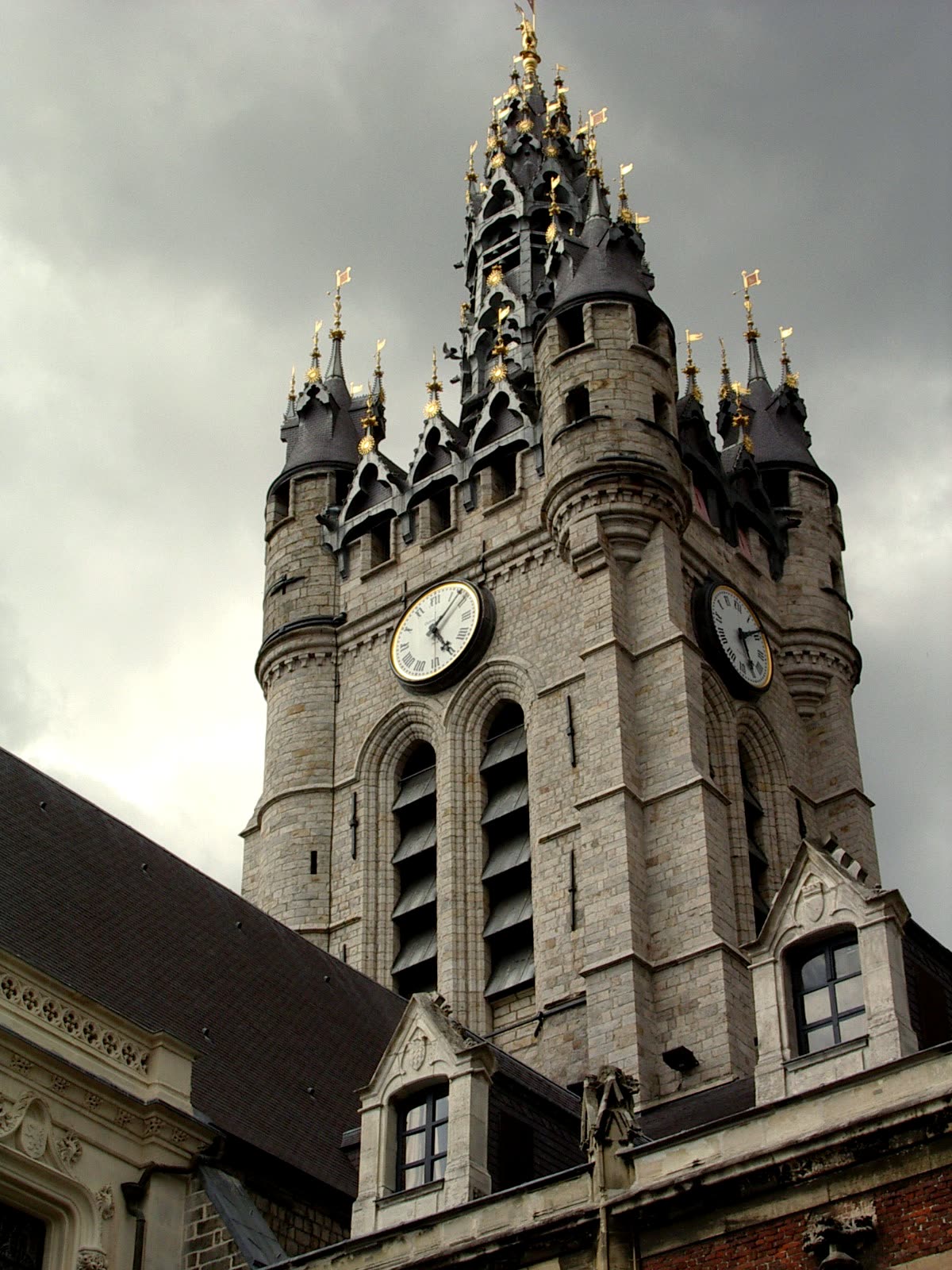
Pictured: the Beffroi de Douai (belfry), a UNESCO World Heritage-listed Gothic watchtower in the center of Douai, Nord, France — the town where the sighting took place. This is not a photograph of the phenomenon itself, nor of the witness's specific garden or the nearby Maison d'Arrêt de Douai, whose exact location relative to the sighting GEIPAN's published summary does not disclose in detail; no photograph or video of the coral-colored triangle is known to exist. Photo by Wikimedia contributor HUOT Jean-Louis, released into the public domain (CC0) via Wikimedia Commons.
Theoretical Alignment
This case aligns most strongly with the Extraterrestrial Hypothesis among the frameworks this site tracks, on the strength of a classic "dark/structured triangle" morphology: a sharp-edged, geometrically regular equilateral shape with organized leading-edge lighting, moving under what reads as controlled, silent flight along a level, deliberate path — the same broad craft-like profile associated with other well-known European triangle cases. Interdimensional alignment is comparatively weak here specifically because the object's departure was entirely mundane: rather than any instantaneous vanishing, phase-out, or unexplained disappearance, it simply passed behind a real, physical line of fir trees, the most ordinary way any distant light source can leave a witness's field of view. Psycho-Social framing carries more weight than in some comparable cases because of two specific, self-reported perceptual details: the witness's own inability to settle on a single color for the object (variously describing it as pink, orange, or coral) and the brief interruption in his observation — looking down to steady his footing — between his first, indistinct impression of "something beside the antenna" and his second, far more detailed look. A short break in continuous observation, followed by a resolution into a much more specific shape, is exactly the kind of sequence perceptual psychology flags as worth weighing carefully, without this alone remotely constituting a debunking.
Background
Weighing why a single, next-day-reported account triggered a field investigation, direct outreach to commercial drone operators, and a formal consultation with a French Navy drone specialist requires understanding both the specific character of Douai and the specific, sensitive facility standing near the witness's own property.
Douai: A Fortified Flemish Town Remade by Coal, Then by Renault
The commune of Douai, a sub-prefecture of some 40,000 residents on the Scarpe river in the Nord department, traces its origins to a Roman-era fortress, Duacum, and spent the medieval period as a prosperous textile and administrative center under the counts of Flanders and, successively, the dukes of Burgundy, the Habsburgs, and Spain, before Louis XIV's troops captured it in 1667 and the 1668 Treaty of Aix-la-Chapelle formally ceded it to France. Its Gothic belfry, the Beffroi de Douai, begun in 1380 and completed by 1410, still dominates the town's skyline at eighty meters, its sixty-two-bell carillon inscribed on UNESCO's World Heritage List in 2005 as part of the Belfries of Belgium and France. Douai's more recent history includes a formative role in early aviation — the nearby La Brayelle airfield hosted one of the world's first organized aeronautical meetings in 1909 and later served as a base for the German ace Manfred von Richthofen during the First World War — and, in the twentieth century, a shift from coal mining toward automotive manufacturing, with Renault operating a major assembly plant in the area that today produces electric vehicles. The La Brayelle meeting of 1909, staged only a few years after the Wright brothers' first powered flights, drew a significant crowd of early aviation enthusiasts and pilots to watch some of the era's most advanced flying machines demonstrate powered flight, cementing Douai's small but genuine place in aviation history well before the concept of an unidentified aerial phenomenon existed in the modern sense. During the First World War, the same airfield's later use by Manfred von Richthofen — the "Red Baron," one of the conflict's most famous fighter pilots — placed Douai briefly at the center of the emerging discipline of military aerial combat, a discipline that would eventually produce both the radar and transponder infrastructure GEIPAN's investigators drew on, in however limited a form, when assessing the aircraft hypothesis in this exact case more than a century later.
Economically, Douai's twentieth century followed a trajectory common to much of the Nord-Pas-de-Calais coal basin: coal mining sustained the wider region through the interwar period and into the postwar decades, only to decline sharply from the 1960s onward as reserves depleted and cheaper imported energy undercut domestic production. Renault's decision to establish a major automotive assembly plant in the Douai area helped absorb some of that economic transition, and the plant's more recent pivot toward electric vehicle production reflects the same broader shift toward lower-emission manufacturing seen across the European auto industry. None of that industrial or aviation history bears directly on the March 2022 sighting, but it establishes Douai as a real, historically significant, moderately-sized town with an ordinary mix of civilian infrastructure — not a rural backwater, and not, on its own, an obviously military-adjacent location in the way a naval air base or missile range would be. The one genuine exception to that otherwise ordinary civilian character is the specific facility discussed next.
The Maison d'Arrêt de Douai: The Facility That Shaped the Investigation
What does distinguish this case is the specific proximity of the witness's own property to the Maison d'Arrêt de Douai, a French remand prison on Rue de Cuincy built in 1907, occupying nearly seven hectares in a distinctive star-shaped layout, and currently rated to hold 368 detainees across a male adult detention wing, a semi-liberty unit, and an intake area. The facility carries a specific, if grim, historical distinction: it was the site of the June 23, 1977 guillotine execution of Jerôme Carrein, the second-to-last judicial execution ever carried out in France and the last involving a French national, shortly before the country's final execution (of a foreign national, in Marseille) and France's eventual abolition of capital punishment in 1981. That history has no direct bearing on a 2022 aerial sighting, but the facility's ordinary, present-day operational reality does: a functioning remand prison, holding several hundred detainees, is exactly the kind of site where an unexplained aerial object observed nearby reasonably raises the question of deliberate surveillance — whether by a curious civilian operator testing what a drone can see over prison walls, by a criminal actor scouting the facility, or, in a narrower and more speculative vein, by a state or penitentiary authority itself conducting undisclosed monitoring.
GEIPAN's Investigative Machinery, Applied to a Security-Adjacent Case
GEIPAN, based at the Centre National d'Études Spatiales (CNES) campus in Toulouse and tracing its institutional lineage back to GEPAN, the unit Claude Poher founded within CNES in 1977, and later reorganized as SEPRA under Jean-Jacques Velasco before adopting its current name and structure, runs on a small permanent staff of two core CNES positions plus limited administrative support, multiplied through a network of around twenty trained volunteer field investigators and roughly fifteen outside scientific experts. GEIPAN's own published figures put its annual intake at approximately 500 witness contacts, with around 200 proceeding to a fully investigated, published case file, and only around 10% of those receiving direct field investigation. This case received that fuller treatment, beginning with a remote, desk-based review and continuing into field investigations conducted over the course of 2023 — the year following the sighting — a delay considerably shorter than several other single-witness GEIPAN files already published on this site, consistent with the witness's own comparatively fast, next-day initial report.
What makes this case investigatively distinctive is not its timeline but its subject matter: rather than the more typical mix of aircraft, drone, and astronomical hypotheses seen across most GEIPAN files, this case required investigators to weigh a security and law-enforcement dimension alongside the usual technical analysis — whether an unidentified aerial object near a functioning prison represented, however speculatively, a genuine surveillance or reconnaissance attempt. That required reaching beyond GEIPAN's usual aviation and meteorological experts to contact commercial drone operators directly and to consult a named military drone specialist on lighting configurations specific to defense platforms, an investigative reach broader than most single-witness cases on this site receive.
This is not an entirely novel category of concern for French correctional facilities. French prisons have documented a real, growing problem with unauthorized drone overflights in recent years, most commonly involving attempts to deliver contraband — mobile phones, drugs, or small tools — over perimeter walls to inmates in exercise yards, a tactic the French prison administration has responded to with counter-drone detection systems at a subset of high-security facilities. GEIPAN's investigators would have been aware of this broader pattern when weighing whether the Douai sighting fit a similar profile, even though the object's reported behavior — a level, steady transit along a street rather than any observable descent toward the prison's own walls or exercise yards — does not obviously match the typical contraband-delivery flight profile documented elsewhere. That mismatch is itself a modest point against the most alarming version of the surveillance hypothesis, without ruling out a more passive reconnaissance or simple curiosity-driven overflight of the kind that would leave a similar visual signature.
Complete Timeline
| Date | Event |
|---|---|
| 1907 | The Maison d'Arrêt de Douai is built on Rue de Cuincy, in its distinctive star-shaped layout. |
| June 23, 1977 | Jérôme Carrein is guillotined in the facility's courtyard — the second-to-last judicial execution in French history and the last of a French national. |
| 1977 | GEIPAN's predecessor, GEPAN, is founded within CNES in Toulouse under Claude Poher. |
| March 27, 2022, 9:30 PM | Sighting begins. Letting his dogs out into his garden in Douai, the witness notices an unidentified aerial phenomenon slightly right of his neighbor's roof antenna, moving on a straight path. |
| March 27, 2022 (continuing) | The witness briefly looks down to steady his footing, interrupting his observation for a moment. |
| March 27, 2022 (continuing) | Looking back up, the witness finds the object shifted further right, now framed between his neighbor's antenna and his own, and resolved into a sharp-edged equilateral triangle, luminous pink, orange, or coral in color, with small lighter lights of indeterminate number along its two front edges. |
| March 27, 2022 (approx. 10–20 seconds total) | The PAN disappears. Moving steadily and silently along an axis tracking the street behind the witness's property, with no change in appearance or behavior throughout, the object passes behind a line of tall fir trees marking the neighboring property's boundary and is not seen again. |
| March 28, 2022 | The witness reports the sighting to GEIPAN the day after the event — a comparatively fast turnaround among the single-witness cases on this site. |
| Initially | GEIPAN conducts a remote, desk-based review, formulating the case's leading hypotheses: a conventional aircraft and one or more drones. |
| During 2023 | Field investigations are conducted, including outreach to multiple local companies operating drones and a consultation with a Marine Nationale/Aéronavale drone specialist regarding military drone lighting configurations. |
| During the investigation | The aircraft hypothesis is set aside except for a judged "highly improbable" scenario involving a small aircraft flying at very low altitude, silently, and without a transponder. |
| During the investigation | The civilian drone hypothesis, including a possible curved flight path and the facility's proximity, is developed; investigators calculate that only large drones (≥1 meter) could have been visible at the minimum possible witness distance (approximately 28 meters, placing the PAN at the level of the witness's own roofline) — but large multicopters of that size do not visually match the reported shape and should have been audible, which no witness reported. |
| During the investigation | Investigators contact several local drone-operating companies; only one responds, stating no knowledge of any operation matching the sighting. |
| During the investigation | A public-authority drone (penitentiary administration or armed forces) is considered but not confirmed; a Marine Nationale/Aéronavale drone instructor states no known military lighting configuration matches the one reported, and that military drones on exercise are designed to minimize sound and visual detectability. |
| Following the full investigation | Final classification. GEIPAN concludes that no hypothesis satisfactorily identifies the phenomenon and classifies the case « D », catalogued as case ID 2022-03-51336. |
Detailed Narrative
A Shape Beside the Antenna
The witness's account, as GEIPAN recorded it, opens with an ordinary evening routine: letting his dogs out into the garden of his own home in Douai at half past nine at night. Looking up, he noticed something beside his neighbor's roof-mounted television antenna — not immediately identifiable, but positioned and moving in a way that caught his attention: an unidentified aerial phenomenon sitting slightly to the right of the antenna, already tracking along a straight, rectilinear path. Before he could examine it more closely, he looked down for a moment to steady his footing in the garden — an entirely mundane, understandable break in observation, but one that GEIPAN's investigators had to weigh carefully, since it separates the witness's brief, indistinct first impression from the much more detailed description that followed.
When he looked back up, the object had moved further to the right, now positioned between his neighbor's antenna and his own, and had resolved — in his account — into a clearly defined shape: a triangle with sharp, clean edges, equilateral in proportion, glowing in a color he found genuinely difficult to pin down precisely, describing it variously as pink, orange, or coral. Running along the two sides adjacent to the triangle's leading point, he could make out a number of smaller, lighter lights — he could not say exactly how many — distinct from the triangle's main body coloring.
A Silent, Regular Transit Along the Rear Street
From that point, the witness's description settled into a single, consistent behavior: the triangle moved at a steady, unhurried pace, entirely without sound, tracking an axis that ran roughly along the level of the street behind his property. GEIPAN's file is explicit that no change of any kind — in speed, altitude, color, shape, or lighting — occurred at any point during this phase of the observation. This regularity is itself a meaningful evidentiary detail: an object maintaining a single, unwavering course and appearance for the better part of the sighting's ten-to-twenty-second duration is consistent with either a deliberately piloted or programmed craft (human, drone, or otherwise) or, in principle, a distant light source whose motion is largely an artifact of the witness's own head or eye movement — a distinction GEIPAN's investigators could not resolve definitively from the testimony alone, though the specific, structured, sharp-edged triangular shape described argues against a simple point-light illusion.
The sighting ended in the most mundane way possible: rather than any dramatic acceleration, dimming, or disappearance, the object simply passed behind a line of tall fir trees delineating the boundary of the neighboring property, and was not seen again. This detail matters directly for weighing the case against other, more dramatic GEIPAN files on this site: unlike the Crozon or Hem cases, where the objects' departures were themselves anomalous (an instant vanishing, a disappearance "in place"), this object's disappearance behind real, physical trees requires no anomalous explanation at all — the only genuinely unresolved question is what, exactly, passed behind them in the first place.
The Prison Question
The witness's proximity to the Maison d'Arrêt de Douai is not something GEIPAN's investigators introduced speculatively; it follows directly from the geography of the sighting itself, and it shaped the entire subsequent drone investigation. A facility holding several hundred detainees, secured by walls, fencing, and controlled access, is an obvious potential target for unauthorized aerial surveillance — whether to photograph the grounds, attempt to locate blind spots in perimeter coverage, or, in the kind of incident French prisons have occasionally documented elsewhere, to attempt contraband delivery via drone. GEIPAN's investigators took this possibility seriously enough to pursue it through multiple independent channels: contacting commercial drone operators active in the area to ask whether any had flown a matching mission, and separately consulting a military drone specialist to rule in or out an armed-forces or penitentiary-administration platform. Both lines of inquiry returned genuinely inconclusive rather than confirming results, discussed in full in the Conventional Explanation Candidate section below.
It is worth stating plainly what the investigation did and did not establish on this point, since the "surveillance drone near a prison" framing invites overstatement in either direction. GEIPAN did not find evidence confirming that a surveillance drone was responsible for the sighting; no drone operator, civilian or military, was identified as having flown the object described, and no camera, radio, or radar evidence of an actual drone was recovered. But GEIPAN also did not rule the possibility out: the physical constraints its own investigators calculated (a large drone, ≥1 meter, would have been necessary to be visible at the minimum plausible distance) argue against an ordinary consumer drone, without eliminating a larger, purpose-built, or state-operated platform outright. The honest state of the record is exactly what the Class D classification says: unidentified after a genuine investigation, not confirmed as any specific kind of surveillance activity.
What the Case File Does Not Contain
It is worth being explicit about what GEIPAN's published summary does not include, since the gaps are themselves informative. The file does not name the exact street or precise address involved, consistent with the agency's standard anonymization and location-generalization practice rather than any indication of a thinner or less-documented file. It does not disclose the witness's occupation, nor whether he had any prior familiarity with drones, aircraft, or aviation that might have sharpened or dulled his ability to identify a conventional explanation on sight. It does not specify which local drone-operating companies were contacted, how many in total, or why only one replied — a detail that would matter for weighing how thoroughly that particular line of inquiry was actually exhausted versus how much its negative result should be read as a genuine absence of a matching local operation. And it does not describe whether investigators sought any input directly from the prison administration itself about its own security camera coverage, drone-detection equipment, or awareness of unusual aerial activity that evening — an institutional check that, had it existed and returned a result either way, would have been directly comparable to the naval-base confirmation obtained in the Crozon case elsewhere on this site. Readers weighing this case's "prison surveillance" angle should weigh it against these specific, acknowledged gaps rather than assuming GEIPAN's investigation was as exhaustive on the security dimension as it clearly was on the physical and technical drone-hardware dimension.
Key Witnesses
The Douai Primary Witness (identity withheld per GEIPAN's standard anonymization practice)
A resident of Douai, living near the town's Maison d'Arrêt, who observed a sharp-edged, coral-colored triangle with small lights along its two front edges glide silently past his roofline for roughly ten to twenty seconds on the evening of March 27, 2022, while letting his dogs into his garden. He reported the sighting to GEIPAN the very next day, and investigators rated his account "good" for consistency — a notably fast and well-preserved report relative to most single-witness cases on this site. GEIPAN's file specifically credits the account's level of detail, including the witness's own honest uncertainty over the object's exact color (pink, orange, or coral) and his candid disclosure of a brief interruption in his observation, both of which GEIPAN's investigators treated as signs of a careful, non-embellished retelling rather than a liability.
The Five Observables Assessment
The Five Observables framework, developed by the Pentagon's Advanced Aerospace Threat Identification Program to describe performance characteristics beyond known conventional technology, is applied here for comparative consistency across the site's case files. This case registers a notably restrained profile: its object displayed no extreme performance characteristics at all, its entire evidentiary weight resting instead on its structured shape and the absence of any conventional match for that shape and its lighting.
Assessment: Unlike several other GEIPAN cases on this site, this file registers no confident positive match on any of AATIP's five canonical observables, and its evidentiary interest lies almost entirely outside that framework — in the specific, unmatched combination of a sharp-edged triangular shape, an ambiguous but distinctly warm-toned color, structured leading-edge lighting, total silence, and a sensitive nearby facility, rather than in any extreme kinematic performance. Low Observability is rated speculative rather than present or absent because GEIPAN's own dismissal of a "silent, transponder-less, very-low-flying aircraft" as merely "highly improbable" (rather than impossible) suggests investigators considered, at least informally, the kind of transponder and traffic-data cross-check that would apply to a genuine stealth-aircraft scenario, without this rising to the level of a documented, published radar reconstruction of the kind seen in fully radar-checked cases elsewhere on this site.
Evidence Assessment
Supporting an Anomalous Origin
- A detailed, next-day-reported single-witness account rated "good" for consistency — a notably fast, well-preserved report relative to comparable single-witness cases on this site
- No known civilian drone model visually matches the sharp-edged, clean-triangle shape described, even allowing for custom LED modifications
- Distance/size calculations show that only unusually large drones (≥1 meter) could have produced the reported apparent size at the minimum plausible range — and such large multicopters do not visually match the described shape and should have been audible, which no witness reported
- Multiple local commercial drone operators were contacted directly; the one that responded had no knowledge of any matching operation
- A named Marine Nationale/Aéronavale drone specialist found no known military lighting configuration matches the reported appearance
- The aircraft hypothesis was set aside except for a scenario GEIPAN itself judged "highly improbable"
Supporting a Conventional/Mundane or Inconclusive Origin
- This remains a single, uncorroborated witness account with no second observer, no photograph, and no video of the phenomenon itself
- The witness's observation included a brief, self-reported interruption — looking down to steady his footing — between an initial vague impression and the much more detailed description that followed
- The witness's own uncertainty over the object's precise color (pink, orange, or coral) reflects a genuinely ambiguous, imprecise visual impression rather than a crisp, unambiguous observation
- A public-authority drone (penitentiary administration or armed forces) cannot be totally excluded, and only one of several contacted drone-operating companies responded at all
- The object's disappearance behind a real, physical line of trees requires no anomalous explanation whatsoever — the object could, in principle, have been an ordinary drone or aircraft that was simply never identified rather than one that behaved anomalously
Why "Open"
This case is stamped Open rather than Credible, Disputed, or Debunked because GEIPAN's own investigation reached precisely that unresolved state, but reached it through an unusually thorough process for a single-witness file. The witness's fast, next-day report and "good" consistency rating put this account on firmer footing than several other single-witness GEIPAN cases already published on this site, which more typically carry reporting delays of months to years and correspondingly lower consistency ratings. GEIPAN's investigation went well beyond a routine aircraft/drone elimination: it specifically worked the drone hypothesis's physical constraints (the ≥1-meter minimum size needed for visibility at the shortest plausible range, and the expected but unheard motor noise at that range), directly contacted multiple commercial drone operators rather than assuming an answer, and secured a named military specialist's professional opinion on drone lighting — a level of institutional outreach comparable to, though organized around a different set of questions than, the naval-base and drone-instructor consultations seen in the Crozon case elsewhere on this site.
Set against that, "Credible" would overstate what a single, uncorroborated account with no photograph or video can support, however well-reported. And the case's own most publicly compelling angle — a possible surveillance drone near a functioning prison — is exactly the element GEIPAN's own investigation left most unresolved rather than most confirmed: no drone operator, civilian or military, was ever positively identified, no equipment was recovered, and the physical size/distance calculations argue against an ordinary consumer drone without ruling out a larger or non-civilian one. A case whose most detailed, best-supported witness testimony on this site's GEIPAN roster nonetheless ends with its most consequential hypothesis neither confirmed nor eliminated is exactly the state "Open" is built to describe — sitting, appropriately, closer to the middle of this site's comparable GEIPAN files than to either extreme, meaningfully above the site's weaker single-witness GEIPAN files while still well short of the level of corroboration a Credible designation would require.
Sensor & Instrumentation Detection Profile
This case's instrumented record is real but limited in scope. GEIPAN's dismissal of a stealthy, transponder-less, very-low-altitude aircraft as merely "highly improbable" rather than definitively excluded suggests investigators drew on available civil air-traffic and transponder data as part of their aircraft-hypothesis analysis, though the published file does not describe a full, dedicated radar reconstruction of the kind documented in the Montluel case elsewhere on this site. In place of a radar-centric approach, this case's investigators substituted direct outreach to human sources: multiple commercial drone-operating companies contacted about their own activity in the area, and a named Marine Nationale/Aéronavale drone instructor consulted specifically on military lighting configurations — an institutional-verification approach structurally similar to, though organized around a different question than, the direct naval-base contact GEIPAN made in the Crozon case. No photograph, video, or audio recording of the phenomenon itself exists; the sighting rests entirely on one witness's unaided visual observation from his own garden.
Environmental & Geospatial Context
GEIPAN's published case file does not specify the meteorological conditions at the time of the sighting, an honest gap in the record this site does not attempt to fill with invented detail. What is documented with more precision is the sighting's spatial geometry: investigators calculated a minimum plausible witness-to-object distance of approximately 28 meters, a range that would place the PAN at roughly the height of the witness's own roofline — a genuinely close, low-altitude encounter if the estimate holds, and one of the more tightly geometrically constrained sightings on this site as a result.
Geographically, the sighting's most consequential feature is its proximity to the Maison d'Arrêt de Douai, a functioning remand prison holding several hundred detainees. That proximity cuts in two directions for evaluating this case, much as the Crozon peninsula's dense naval infrastructure did for that file: it makes a genuine security or reconnaissance motive for an aerial object a serious possibility any investigator must weigh, which is exactly why GEIPAN's investigators pursued the drone hypothesis as deeply as they did — but it also means the facility itself became a natural, checkable point of institutional reference, even though, unlike Crozon's direct base confirmation, no comparable single institutional source returned a clean, dated negative result here. French civil aviation rules restrict both night drone flights and overflight of security-sensitive sites of this kind, meaning any drone matching this description, civilian or otherwise, would represent a genuine violation rather than a routine, legally sanctioned local activity.
The prison's own physical footprint is itself a relevant environmental fact: nearly seven hectares laid out in a star-shaped plan dating to 1907, with a perimeter substantial enough that an object approaching from any of several directions could plausibly be described as passing "near" it without necessarily overflying the secure interior at all. GEIPAN's published summary does not specify exactly how close the witness's own property sits to the prison's perimeter wall, nor which direction the facility lies relative to the witness's garden and the rear street the object appeared to track — a level of geographic precision the agency's anonymization practice generally withholds regardless of the case. That gap matters for calibrating just how directly this sighting actually bears on the prison itself, as opposed to being a sighting that happened to occur somewhere in the same town as a sensitive facility without necessarily approaching it at all.
Observer Credibility & Occupational Profile
The witness's occupation is not disclosed in GEIPAN's published case file, consistent with the agency's standard anonymization practice. What the file does document is a comparatively strong behavioral credibility profile: a report filed the very day after the sighting, rated "good" for consistency, and containing the kind of specific, sometimes self-undermining detail — an honest inability to settle on a single exact color, a candid admission of a brief interruption in continuous observation — that GEIPAN's methodology treats as evidence of careful, non-embellished reporting rather than a liability. A witness constructing an exaggerated or fabricated account has every incentive to describe a crisp, unambiguous color and an unbroken, continuous observation; this witness volunteered the opposite on both counts.
The case's structural limitation remains the one shared by the large majority of single-witness UAP reports generally: however fast, detailed, and internally honest one account is judged to be, it cannot by itself carry the same evidentiary weight as a second independent witness, a photograph, or an instrumented record. That limitation is not compounded here, as it is in several other GEIPAN files on this site, by a long reporting delay or a lower consistency rating — if anything, this witness's promptness and the "good" rating GEIPAN assigned represent one of the stronger single-witness profiles among the GEIPAN cases this site has published, even as the file's most consequential open question (the prison-surveillance angle) remains genuinely unresolved regardless of the witness's own credibility.
There is also a subtler credibility dimension worth naming directly: the witness's own account effectively self-limits its strongest claims. He did not assert with confidence that the object was performing surveillance of the prison, that it was definitively a drone, or even that he was certain of its exact color — he reported what he actually perceived, including the parts he could not resolve, and left the interpretive leap to investigators rather than making it himself. This kind of restraint is a positive, if informal, credibility signal: witnesses who overstate their own certainty, particularly about loaded interpretive questions like "was this spying on the prison," are more likely to be shading their account toward a preferred narrative than one who reports a specific, geometrically detailed shape and lighting pattern while leaving the security implications to the professionals investigating it.
Historical Precedents & Archive Matches
This case's most useful comparisons on this site fall into two groups: other "dark/structured triangle" sightings where a drone hypothesis was tested and failed, and the site's other prominent GEIPAN drone-hypothesis case built around a distinctive, undocumented lighting configuration.
Villers-lès-Luxeuil (2019) — Two Different Triangle-vs-Drone Arguments
The Villers-lès-Luxeuil Triangle (Open, 50/100) is this case's closest structural analog: another French sighting of a large, dark, geometrically regular triangular shape, moving silently and at low altitude, where GEIPAN's investigators specifically tested and rejected both a manned aircraft (there, a real Mirage 2000 from a confirmed nearby exercise) and a drone hypothesis. The two cases reached their drone-hypothesis conclusions from different directions: at Villers-lès-Luxeuil, the object's large apparent size and two independent witnesses driving separate cars argued against any drone being able to produce a matching sighting; here, the drone hypothesis foundered instead on a specific shape-and-lighting mismatch (no known civilian drone matches a clean equilateral triangle with leading-edge lighting) compounded by an acoustic problem (a drone large enough to be visible at the calculated minimum range should have been audible, and was not). Read together, the two cases show GEIPAN applying serious, case-specific scrutiny to the "dark triangle" morphology rather than reflexively assuming a drone explanation for every report of that shape.
The Hem Ring-Light Triangle (2022) — The Same Investigative Question, a Different Lighting Puzzle
The Hem Ring-Light Triangle (Open, 34/100), also from Nord and from the same year, offers the most direct structural parallel among this site's GEIPAN files: another triangular-arrangement sighting where the specific lighting configuration described — there, three separate toroidal ("ring") lights; here, small leading-edge lights along a solid triangular body — could not be matched to any documented drone product, civilian or military. The two cases differ sharply in their underlying evidentiary strength: Hem's account carried only "medium" consistency and a year-long reporting delay, while this case's next-day report and "good" consistency rating place it on considerably firmer ground. That difference is reflected directly in this site's own credibility scoring, and illustrates a broader point about the GEIPAN drone-hypothesis pattern across this site's published cases: a lighting configuration with no documented real-world match is a meaningfully strong piece of negative evidence regardless of how strong or weak the underlying witness testimony happens to be, but it is not, by itself, sufficient to overcome a genuinely weak account the way it can support an already well-reported one.
Crozon Peninsula (2020) — Institutional Outreach as a Model, Applied to a Different Question
The Crozon Peninsula Red Rectangles (Open, 45/100) demonstrates the same investigative instinct seen here — reaching directly to institutional and military sources rather than relying solely on desk-based analysis — applied to a different underlying question. Crozon's investigators contacted a naval air base directly to rule out its own aircraft and drones; this case's investigators contacted commercial drone operators and a military drone specialist to assess an entirely different possibility: not "was this a known local operator's routine flight," but "could this have been deliberate surveillance of a sensitive civilian facility." Both approaches reflect the same underlying GEIPAN practice of testing a hypothesis against real institutional knowledge wherever a plausible institutional source exists, rather than treating "no obvious explanation" as license to stop investigating.
The comparison also highlights a genuine asymmetry in how completely each case's institutional outreach could resolve its central question. At Crozon, a single, clearly-defined institution — the Lanvéoc-Poulmic naval air base — was in a position to give a comprehensive, dated answer about its own aircraft and drone activity, because any relevant flight would necessarily have originated from that one base. This case's own institutional landscape is more diffuse: an unknown number of commercial drone operators could, in principle, have been active anywhere in or near Douai that evening, and only one of those contacted actually responded, meaning the "no known matching operation" result covers, at most, a small and self-selected fraction of everyone who might plausibly have been flying a drone in the area. That is not a flaw in GEIPAN's approach so much as an unavoidable structural difference between a case with one obvious institutional gatekeeper and a case without one — but it does mean this file's negative institutional findings should be read as suggestive rather than as comprehensive as Crozon's.
Sainte-Foy-de-Peyrolières (2018) — A Different Kind of Interrupted Observation
The Sainte-Foy-de-Peyrolières Five-Phase Sighting (Open, 47/100) offers a useful comparison on a narrower, more methodological point: how GEIPAN's investigators weigh an account that unfolds across multiple distinct phases of observation, some more detailed than others, rather than as one single continuous look. That case's witness experienced five separate phases of an evolving encounter over several minutes; this case's witness experienced a much shorter, two-part observation — an initial vague glimpse, a brief self-interrupted gap, and a second, far more detailed look — compressed into ten to twenty seconds. Both cases required investigators to weigh how much interpretive weight a later, more detailed impression should carry relative to an earlier, less resolved one, and in both cases GEIPAN ultimately treated the fuller, later description as the account's evidentiary core rather than discounting it merely for having followed a less clear initial impression.
Material Analysis
This case involves no physical or trace evidence of any kind — no landing marks, no recovered material, no soil or vegetation sample, and no biological or physiological effect on the witness beyond his own visual observation. The object never approached the ground or the witness's immediate reach at any point in the account; it remained airborne throughout its brief transit before passing behind the neighboring property's trees. There is accordingly nothing to sample, test, or physically examine after the fact — only the witness's own next-day description and GEIPAN's own outreach-based verification efforts with drone operators and a military specialist.
Supporting Non-Terrestrial Origin
- No physical evidence exists to test in the first place, so no terrestrial material-composition finding contradicts an anomalous interpretation either
- The object's reported clean equilateral triangular shape, ambiguous warm-toned coloring, structured leading-edge lighting, and total silence, if accurately perceived, do not correspond to any conventional aircraft or documented drone GEIPAN's investigators were able to identify
Supporting Terrestrial Origin
- The complete absence of any physical trace is itself consistent with a purely distant, airborne phenomenon that never approached the ground closely enough to leave one
- No mechanical, electromagnetic, or biological secondary effect on the witness or any nearby structure is recorded anywhere in the file
The Conventional Explanation Candidate: Aircraft, Civilian Drone, and the Surveillance-Drone Question
GEIPAN's own file organizes its analysis around a conventional aircraft and, in greater depth, a drone hypothesis further split between an ordinary civilian operator and a possible public-authority (penitentiary or military) platform tied to the nearby prison. None, in GEIPAN's own final assessment, conclusively identifies the phenomenon.
Conventional Aircraft
Set aside except for one narrow, judged-improbable scenario: a small aircraft flying at very low altitude, entirely silently, and without an active transponder. GEIPAN itself characterized this specific possibility as "highly improbable" rather than formally impossible, reflecting the genuine, if small, residual chance that some non-standard or malfunctioning aircraft could account for the sighting, while still leaving the hypothesis unable to explain the object's specific sharp-triangle shape and structured leading-edge lighting.
Civilian Drone with Custom LED Lighting
The primary hypothesis developed in depth, including consideration of a curved flight path. No civilian drone model documented in GEIPAN's research visually matches a clean, sharp-edged equilateral triangle, even allowing that a drone owner could add custom LED lighting to an otherwise standard airframe. Working from real drone hardware dimensions, investigators calculated that only unusually large drones (1 meter or more) could have produced the reported apparent size at the minimum plausible witness distance of roughly 28 meters — but drones of that size are typically large multicopters (four, six, or eight rotors) intended for professional or military use, whose visual appearance does not match a clean triangular shape, and which should have been audible at that range, which no witness reported. A civilian drone flight under these conditions — at night, and in restricted airspace near a security-sensitive facility — would itself constitute a legal offense; of several local drone-operating companies contacted, only one responded, stating no knowledge of any matching operation.
Public-Authority Drone (Penitentiary Administration or Armed Forces)
Considered specifically because of the sighting's proximity to the Maison d'Arrêt de Douai, but not confirmed. GEIPAN's investigators noted that such a device would normally be identified, formally authorized, and equipped with regulatory lighting rather than an unmatched, ad hoc configuration. A Marine Nationale/Aéronavale drone instructor, consulted specifically on military drone lighting schemes, found no known configuration matching the one reported, and noted that military drones operating on exercise are specifically designed to minimize both sound and visual detectability — working against, though not definitively eliminating, a military origin for an object this visually conspicuous. The penitentiary administration itself represents a narrower, distinct sub-possibility within this same category: a prison operating its own drone for perimeter security or surveillance purposes would, in principle, need no external authorization beyond its own internal security protocols, but would still be expected to use standard, recognizable equipment rather than an unusual, custom-lit triangular airframe, and GEIPAN's file gives no indication that this specific possibility was checked directly with the facility's own administration.
Conventional Aircraft
Highly ImprobableOnly a silent, transponder-less, very-low-altitude aircraft could fit, a scenario GEIPAN itself calls highly improbable; it also cannot explain the sharp triangular shape and leading-edge lighting.
Civilian Drone (Custom LEDs)
InconclusiveNo documented drone matches the clean triangular shape; size/distance math requires an unusually large, audible drone that no witness heard; only one contacted operator responded, with no matching knowledge.
Public-Authority / Military Drone
UnresolvedCannot be totally excluded given the prison's proximity, but no known military lighting configuration matches the report, and such a platform would normally be authorized and properly lit.
Related Cases
Confirmed Documents & Official Records
The official French government investigation summary: the witness's full account, the aircraft/drone hypotheses tested, the outreach to drone operators and a Marine Nationale drone instructor, and the final Class D determination.
GEIPAN's full field investigation report, including the technical questionnaire response, the aircraft/drone hypothesis analysis, and the drone-instructor and operator consultations.
The French Ministry of Justice's own directory listing for the prison referenced in this case, including its address, capacity, and facility type.
GEIPAN's own published definitions for classifications A, B, C, D, D1, and D2.
Further Reading — Recommended Literature
UFOs: Generals, Pilots, and Government Officials Go on the Record
Kean's survey of credentialed witness testimony and official investigative bodies worldwide offers useful comparative context for weighing GEIPAN's own institution-driven investigative approach, including its outreach to drone operators and a military specialist in this exact case.
Wonders in the Sky: Unexplained Aerial Objects from Antiquity to Modern Times
A catalog of historical aerial anomaly reports useful for weighing how this case's structured triangular morphology fits within the broader historical pattern of "dark triangle" sightings.
The UFO Evidence
The foundational documentary approach to cataloging and cross-referencing witness testimony that GEIPAN's own case-file methodology, including its formal consistency ratings, descends from in spirit.
The UFO Experience: A Scientific Inquiry
Hynek's own multi-hypothesis evaluation framework anticipates the aircraft/civilian-drone/military-drone elimination methodology GEIPAN applied to this exact case.
The Close Encounters Man: How One Man Made the World Believe in UFOs
A biography of Hynek documenting the emergence of rigorous, elimination-based case investigation methodology, directly reflected in GEIPAN's multi-hypothesis analysis of this case.
Essential Viewing
No Videos Available
Sources
- GEIPAN (CNES), "DOUAI (59) 27.03.2022", Case 2022-03-51336 — official case summary
- GEIPAN (CNES), Compte Rendu d'Enquête, DOUAI (59) 27.03.2022 — full investigation report (PDF)
- GEIPAN (CNES), official case archive & public portal — geipan.fr
- GEIPAN (CNES), Glossaire du GEIPAN — official classification definitions, A/B/C/D/D1/D2
- GEIPAN (CNES), "Missions, méthodes et résultats" — investigative structure and statistical case outcomes
- Ministère de la Justice (France), Maison d'Arrêt de Douai, official facility directory — address, capacity, and facility type
- France Info, "Livraison de téléphones ou de stupéfiants... Comment la police tente de lutter contre les drones aux abords des établissements pénitentiaires" — national context on drone contraband deliveries and anti-drone systems at French prisons
- Wikipédia (français), "Maison d'arrêt de Douai" — facility history, architecture, and the 1977 execution of Jérôme Carrein
- Wikipedia (English), "Douai" — commune history, geography, and the Beffroi de Douai
- Wikimedia Commons, File: Beffroi de douai 2009.JPG, photo by "HUOT Jean-Louis," CC0 1.0 — licensing and attribution
- Wikimedia Commons, Category: Beffroi de Douai — image archive for the belfry
- This site, case-files/villers-les-luxeuil-triangle.html — comparative GEIPAN "dark triangle" case with both aircraft and drone hypotheses ruled out
- This site, case-files/hem-ring-light-triangle.html — comparative GEIPAN case with no matching drone lighting found for a structured multi-light PAN
- This site, case-files/crozon-peninsula-red-rectangles.html — comparative GEIPAN case with direct institutional (naval base) outreach
- This site, case-files/sainte-foy-de-peyrolieres-five-phase-sighting.html — comparative single-witness GEIPAN Class D case
- This site, key-figures.html, entry on Claude Poher — GEPAN founding and early institutional history
- This site, key-figures.html, entry on Jean-Jacques Velasco — SEPRA leadership and methodology evolution
- This site, locations/index.html, entry on Toulouse — CNES/GEPAN/SEPRA/GEIPAN institutional headquarters
See something inaccurate? Have additional information or sources?
Suggest an Edit →Last Updated: August 2026