
Coyame, Mexico UFO Crash Claim
On the night of August 25, 1974, according to a story that entered the public record only in 1994, a U.S. Air Defense radar operator in Texas tracked an unidentified object crossing the Gulf of Mexico at roughly 2,000–2,500 miles per hour before it turned inland over Mexican territory, collided with a small civilian airplane, and crashed in the remote Chihuahuan Desert near Coyame, Chihuahua. Per the story, Mexico refused an American offer of help and sent its own military convoy to the crash site, recovering a battered silver disc roughly sixteen feet across — and that convoy was later found entirely dead, its cargo vanished, prompting a covert American extraction team to cross into Mexican territory by unmarked helicopter. The story's actual documented origin is far thinner than its dramatic content suggests: no version of it appears anywhere in print or in any government record before 1992, when an anonymous letter signed only "J.S." and claiming membership in an unverified group called the "Deneb Team" reached UFO researcher Elaine Douglass. Researcher Leonard Stringfield published the full anonymous text in 1994 while explicitly flagging his own doubt about it. No named eyewitness, contemporary press account, FAA record, or independently examined physical exhibit corroborates any part of the claim, even after a 2007 and a more extensive 2013 book by researchers Noe Torres and Ruben Uriarte sought out further testimony. Coyame, meanwhile, sat squarely inside a real, independently documented drug-smuggling corridor in 1974, and a genuine narcotics-plane crash was recovered by the Mexican military in the same immediate area in 1980 — a specific, mundane, and far better-evidenced candidate this site's research treats as the likelier seed of the story than any account of a genuine mid-air collision with an unidentified craft.
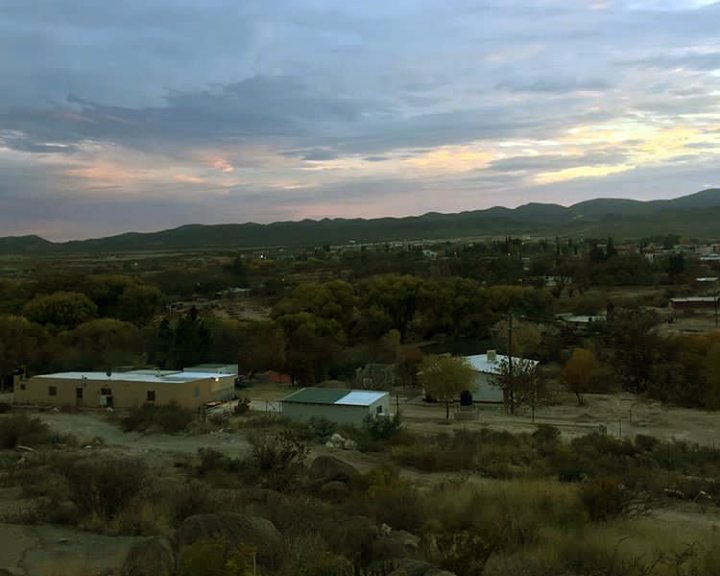
Pictured: Santiago de Coyame, the small municipal seat of Coyame del Sotol Municipality in the Chihuahuan Desert of northern Mexico, near which the claimed August 1974 crash and recovery allegedly occurred. This is not a photograph of any crash site, wreckage, or recovery operation — no such photograph has ever surfaced from any source, and the claim's own anonymous origin means no documented crash site has ever been independently located or examined. Photo by MikSed, via Wikimedia Commons, licensed CC BY 4.0.
Theoretical Alignment
This case's alignment leans heavily toward the Psycho-Social hypothesis, reflecting this site's research finding that the story's actual documented history is a print/document phenomenon — an anonymous 1992 letter amplified by a chain of researchers and authors over three subsequent decades — rather than a phenomenon rooted in any independently verified physical event. The residual Extraterrestrial allowance reflects only that the claim's own content, if taken completely at face value, would describe a genuine non-terrestrial craft; this site's research found no independent evidence supporting that the claimed content reflects anything that actually happened as described. The near-zero Interdimensional allowance reflects that no version of the story invokes any interdimensional framing at all.
Background
The Coyame story belongs to a specific, identifiable sub-genre of American ufology: the 1990s wave of "crash/retrieval" claims that circulated among a small community of researchers trading photocopied documents, anonymous letters, and Usenet postings, often overlapping with — though not identical to — the same document ecosystem that produced the disputed "MJ-12" papers earlier in the decade. Understanding why this specific claim carries the evidentiary weight it does requires understanding both that ecosystem and the specific, real history of the region it claims as its setting.
The 1990s Crash-Retrieval Document Ecosystem
Beginning in the mid-1980s and accelerating through the 1990s, a loose network of American UFO researchers — independent civilian investigators, some with backgrounds in military intelligence liaison work, others purely hobbyist — began circulating claims of additional, lesser-known UFO crash retrievals beyond Roswell, often sourced to anonymous or pseudonymous informants who claimed access to classified programs. Leonard H. Stringfield, a Cincinnati-based UFO researcher and former Air Force intelligence officer, became the era's most prolific chronicler of these claims through his self-published "Status Report" series on UFO crash retrievals, beginning in 1978 and continuing until his death in 1994. Stringfield's own methodology was to collect and publish claims as raw material for future verification rather than as confirmed fact, frequently appending his own explicit caveats about sourcing — a practice directly relevant to how the Coyame story entered print at all, since Stringfield's seventh and final Status Report is the claim's first public appearance in any form.
Operation Right to Know and the Anonymous Letter
Elaine Douglass, a UFO researcher associated with the disclosure-advocacy organization Operation Right to Know, received an unsolicited envelope in February 1992 containing a multi-page account of the alleged August 1974 incident. The sender identified themselves only by the initials "J.S." and claimed membership in a group called the "Deneb Team," a name that does not correspond to any documented, independently verifiable government program, contractor, or research organization this site's research could identify; it appears nowhere in the historical record except in connection with this single document and a related contemporaneous Usenet posting to the newsgroup alt.paranet.ufo attributed to a "Vince Johnson," which circulated an overlapping version of the same claim on early UFO-research bulletin-board systems. Douglass passed the document to Stringfield, who published its full text in his 1994 "Status Report VII: UFO Crash/Retrievals: Search for Proof in a Hall of Mirrors" — explicitly noting his own reservations about doing so, writing that he was "hoping the incident can be verified or exposed as mis- or disinformation" rather than presenting it as confirmed. This is, per this site's research, the claim's entire documented paper trail prior to any book-length treatment: an anonymous letter of unverifiable provenance, relayed by one researcher to another, published by the second with an explicit disclaimer.
Coyame, Chihuahua: A Real, Remote Border Town
Coyame (formally Santiago de Coyame) is a small town founded in 1715, the municipal seat of Coyame del Sotol Municipality in the Mexican state of Chihuahua, with a population in the low hundreds. It sits in genuinely remote high desert terrain along the Río Conchos, roughly 175 kilometers south of the Presidio, Texas–Ojinaga, Chihuahua border crossing and several hundred kilometers from any major population center — a real geographic detail the claim's anonymous originator got right, and one that also explains why, if anything genuinely crashed in this area in the mid-1970s, it plausibly could have gone undocumented in any accessible public record for a long time regardless of what it actually was.
An Active Drug-Smuggling Corridor in 1974
Independent of anything related to UFOs, the broader Ojinaga–Presidio border region, including the sparsely populated desert corridor running south through Coyame, was already an active narcotics-smuggling route by the mid-1970s, well before the region's smuggling activity became internationally notorious in the 1980s under trafficker Pablo Acosta Villarreal. Acosta's own documented career — moving marijuana and heroin north from the early 1970s, later adding Colombian cocaine shipped by light aircraft into dirt airstrips on ranches near Ojinaga — establishes that the general practice of small aircraft carrying contraband through this exact stretch of Chihuahuan desert, including into and out of remote unmonitored strips, was already underway during the same decade the Coyame story claims its crash occurred. This site's research treats this documented regional history as directly relevant background for evaluating the claim's central conventional-explanation alternative, discussed at length in this file's Conventional Explanation Candidates section below.
Why a Story This Dramatic Took Eighteen Years to Surface
One question this site's research treated as worth investigating on its own terms is why, if a genuine mid-air collision, a multi-agency recovery operation, and the deaths of an entire military convoy really occurred in 1974, no version of the story appears anywhere in print, in any newspaper archive on either side of the border, or in any UFO-research newsletter of the period until an anonymous letter surfaced eighteen years later, in 1992. Proponents of the literal claim generally answer this by pointing to the story's own internal logic: a covert operation serious enough to warrant crossing an international border by unmarked helicopter would, almost by definition, also be serious enough to suppress effectively for a long period, and the eventual 1992 leak is framed as exactly the kind of after-the-fact disclosure such suppression eventually produces. This site's research does not find that explanation independently falsifiable, but notes it is equally unfalsifiable in the other direction: an eighteen-year gap between a claimed dramatic event and its first documented appearance is also exactly the pattern one would expect from a story that did not originate in 1974 at all, but was instead composed or substantially embellished much closer to 1992 itself, potentially drawing on vaguer, real regional memories of the area's genuinely documented 1967 and 1980 mundane crash events for its basic setting and structure. Absent the original letter-writer's identity, this site's research cannot resolve which reading is correct, but treats the second as considerably more consistent with the claim's total absence from every other independent record of the period.
Complete Timeline
| Date | Event |
|---|---|
| August 25, 1974, ~22:07 | Per the claim, a U.S. Air Defense radar operator in Texas detects an unidentified object crossing the Gulf of Mexico at an estimated 2,000–2,530 mph and roughly 75,000 ft altitude. |
| ~22:15–22:30 | The object allegedly changes course toward Mexican airspace and descends; a small civilian aircraft (described as a Cessna 180) that had departed El Paso, Texas, en route to Mexico City is claimed to disappear from radar in the same area at approximately the same time. |
| ~22:30 | Both radar returns are claimed to vanish simultaneously near Coyame, Chihuahua, suggesting a mid-air collision. |
| August 26, 05:45 (claimed) | A first crash site is allegedly located; a second site roughly two miles away is found separately, per the anonymous account. |
| August 26 (claimed) | The United States reportedly offers assistance to Mexico; Mexico is said to have declined and dispatched its own military convoy (claimed at 23 personnel) to secure the site. |
| August 26, 18:30–20:15 (claimed) | The Mexican convoy allegedly departs the crash site with recovered wreckage; radio contact is lost around 20:15. |
| Claimed aftermath | The convoy is later said to be found completely abandoned, its personnel dead under unexplained circumstances and its cargo missing; a CIA extraction team is claimed to assemble at Fort Bliss, Texas, and cross into Mexico by unmarked helicopter; the recovered disc is said to have eventually been flown to Atlanta, Georgia, with unconfirmed further claims of transfer to Wright-Patterson AFB. |
| February 1992 | An anonymous letter signed only "J.S.," claiming membership in an unverified "Deneb Team," reaches UFO researcher Elaine Douglass of Operation Right to Know — the claim's first documented appearance in any form, eighteen years after the events it describes. |
| 1994 | Leonard Stringfield publishes the full anonymous document in "Status Report VII: UFO Crash/Retrievals: Search for Proof in a Hall of Mirrors," explicitly flagging his own doubt about its authenticity. |
| 2007 | Noe Torres and Ruben Uriarte publish Mexico's Roswell: The Chihuahua UFO Crash, the first book-length treatment, with a foreword by Stanton T. Friedman. |
| 2013 | Torres and Uriarte publish an expanded follow-up, The Coyame Incident: UFO Crash Near Presidio, Texas, describing additional, unnamed local testimony gathered decades after the fact and laboratory analysis of small recovered metal fragments. |
| 2013 | Skeptical researcher Kevin Randle publishes a critical review calling the case's evidence "definitely thin" while crediting the authors' research effort. |
Detailed Narrative
The Claimed Radar Track and Collision
The anonymous 1992 document's account, as published by Stringfield and later summarized and expanded by Torres and Uriarte, describes a young U.S. Air Defense radar operator picking up an unidentified return crossing the Gulf of Mexico from an unspecified point of origin at approximately 10:00–10:07 p.m. local time on August 25, 1974, traveling at a speed variously given across different retellings as "over Mach 2.5" or a flat 2,000–2,530 miles per hour — speeds far in excess of any conventional aircraft of the period, and specifically noted in some retellings as producing no reported sonic boom despite the claimed velocity, a detail proponents treat as evidence of exotic technology and this site's research treats as an unverifiable narrative flourish impossible to check against any actual radar log, since no such log has ever been produced or independently examined by any investigator. The object is said to have changed course inland toward Mexican territory, descending in stepped increments, while a small civilian aircraft — described as a Cessna 180 — that had departed El Paso for Mexico City is claimed to have vanished from radar in the same area at nearly the same moment, leading whoever tracked it (per the claim) to conclude the two objects had collided.
The Alleged Wreckage and Disc
Per the anonymous account, Mexican searchers located two separate crash sites roughly two miles apart the following morning: one containing the burned remains of the small plane, the other a heavily damaged metallic disc. Descriptions of the disc are reasonably consistent across retellings: a silver, unmarked object approximately 16 to 16.5 feet in diameter and roughly 5 feet thick, weighing an estimated 1,500 pounds, bearing a roughly 12-inch hole and a large dent consistent with impact damage, with no visible doors, windows, seams, or markings of any kind. No photograph of this object exists in any form this site's research could locate; no measurement, weight, or damage description in the story is corroborated by anything beyond the original anonymous text and its subsequent retellings.
The Refused U.S. Offer and Mexican Recovery
The claim holds that the United States, having tracked the object on radar, offered Mexico direct assistance investigating and recovering the crash, and that Mexico declined, opting instead to dispatch its own military convoy — a detail some proponents read as evidence of genuine Mexican government awareness of a real anomalous event serious enough to warrant a sovereign, unassisted response, and which this site's research notes is equally consistent with a mundane explanation: a government declining foreign military assistance to investigate a crash on its own sovereign territory is unremarkable regardless of what actually crashed, and would be an entirely ordinary response to, for instance, a domestic aviation accident or a narcotics-related incident Mexican authorities had reason not to publicize to American counterparts.
The Dead Convoy and the Covert Extraction
The claim's most dramatic element, and the one added or emphasized most heavily in later retellings rather than appearing with full detail in the earliest 1992/1994 text, holds that the Mexican military convoy sent to recover the wreckage was later found entirely abandoned, its full complement of soldiers (numbers vary by retelling, most commonly given as 23) dead under circumstances no version of the story actually specifies, with no external injuries reported and the recovered wreckage itself missing. This detail then supplies the narrative pretext for the story's climax: an American covert-recovery team, in some versions explicitly attributed to the CIA, assembling at Fort Bliss, Texas, and crossing into Mexican airspace via unmarked helicopters to retrieve the disc before any wider investigation could occur, with the object eventually transported to Atlanta, Georgia, and, per unconfirmed later addenda circulating among some retellings, onward to Wright-Patterson Air Force Base. This site's research located no version of this narrative segment attributable to any named source, any Mexican military record (public or leaked), any American diplomatic or intelligence record, or any contemporary press account in either country — a categorical absence of independent corroboration that applies to every distinct claimed event in this segment of the story, not merely to its most sensational details.
Book-Length Expansion: Torres and Uriarte
Texas-based MUFON-affiliated researchers Noe Torres and Ruben Uriarte took up the Coyame story roughly a decade after Stringfield's original publication, first in their 2007 book Mexico's Roswell: The Chihuahua UFO Crash (with a foreword by prominent ufologist Stanton T. Friedman) and then in a substantially expanded 2013 follow-up, The Coyame Incident: UFO Crash Near Presidio, Texas. The authors describe locating additional, previously unpublished local testimony in the intervening years, though this site's research found that none of this later testimony is attributed to any named, independently identifiable witness with direct, contemporaneous knowledge of the claimed 1974 event itself; the added material consists chiefly of regional color, secondhand recollection, and the authors' own further research into the area's history rather than a new firsthand eyewitness account replacing the original anonymous 1992 document as the claim's evidentiary foundation. The 2013 book also describes obtaining small metal fragments reportedly associated with the crash site and submitting them for laboratory metallurgical analysis — a genuine attempt at empirical verification this site's research credits as more rigorous than the claim's earlier history, though, as detailed in the Physical & Material Assays and Material Analysis sections below, the actual lab results reported were inconclusive rather than confirmatory of any non-terrestrial origin.
Skeptical Review: Kevin Randle's Assessment
Kevin Randle, a retired U.S. Army lieutenant colonel and one of American ufology's most prolific researchers — known for both extensive Roswell investigation and pointed skepticism toward weaker claims elsewhere in the field — reviewed Torres and Uriarte's book and identified several specific, unresolved evidentiary gaps: no pilot's name has ever surfaced for the claimed civilian aircraft despite the story's own assertion that it had filed a flight plan in El Paso (which, if true, should have triggered an immediate search upon the plane's disappearance and left the pilot's identity a matter of public record); no FAA documentation of any kind exists for a missing or crashed civilian aircraft matching the description; and the laboratory analysis of recovered metal fragments described in the 2013 book found that "not all elements could be identified" — a genuinely ambiguous, inconclusive result Randle notes does not, by itself, constitute evidence of extraterrestrial manufacture, since incomplete elemental identification in a field-collected metal sample of unknown provenance and unknown chain of custody is consistent with ordinary contamination, weathering, or simply an incomplete reference-library comparison, not only with an exotic alloy. Randle's overall verdict, while crediting Torres and Uriarte's research effort and narrative care, was that "the evidence is definitely thin" and that the case "cries out for more data" — an assessment this site's own independent research, conducted separately, concurs with in full.
Conflation With Real, Documented Regional Crashes
This site's research identified two entirely separate, independently documented crash events in the same immediate Coyame-area desert that plausibly explain how a story about "something crashing near Coyame" could take root and gain circumstantial-seeming corroboration regardless of whether any UFO was ever actually involved. First, a U.S. Pershing missile is documented to have gone off course and crashed in the same general area in 1967, seven years before the claimed UFO incident — a real, wholly conventional military hardware failure in the exact region the later UFO story would claim as its own setting. Second, and considerably more significant to this site's own assessment, Mexican military authorities are documented to have recovered a substantial quantity of narcotics and drug cash scattered across the landscape north of Coyame in 1980 following a failed drug-smuggling flight — a genuine, real, and specifically located "plane crash near Coyame with a military recovery response" that predates none of the story's key structural elements (a crashed aircraft, a military recovery operation, a remote desert setting) by more than six years after the claimed UFO event, and which this site's research treats as strong circumstantial evidence that stories of "a crash and a military response near Coyame" had at least one entirely mundane, well-documented real referent in the same physical location during the broader period, regardless of the exact date attached to any specific telling.
Key Witnesses
“J.S.” (anonymous claimant, unidentified)
The entire story traces to a single anonymous letter received by Elaine Douglass in February 1992, signed only with the initials "J.S." and claiming membership in a group called the "Deneb Team" that this site's research could not independently verify ever existed as a real organization. No subsequent investigation by any researcher, proponent or skeptic, has identified this individual's real name, credentials, or actual relationship (if any) to the events described. Every other version of the story, including both Torres and Uriarte books, ultimately traces back to this single unidentified source for its core narrative framework.
Elaine Douglass
Douglass received the anonymous document and passed it to Leonard Stringfield for evaluation and eventual publication. She is a conduit for the claim's transmission into the historical record, not a witness to any part of the events themselves, and this site's research found no indication she ever claimed firsthand knowledge of the underlying incident beyond having received and forwarded the letter.
Leonard H. Stringfield
Stringfield's own extensive prior work cataloguing UFO crash-retrieval claims gave the Coyame story its first public airing, in his final "Status Report" before his 1994 death. Critically, Stringfield published the document with an explicit statement of his own uncertainty about its authenticity rather than endorsing it as verified fact — a level of transparency about sourcing this site's research treats as a genuine point in his favor as a chronicler, even though it does nothing to establish the underlying claim's truth.
Noe Torres & Ruben Uriarte
Torres and Uriarte are secondary researchers and authors, not eyewitnesses to the 1974 events; their contribution was locating additional secondhand regional testimony and pursuing physical-evidence analysis decades after the fact, work this site's research credits as a genuine, more rigorous attempt at verification than the story had previously received, while noting that neither book identifies any new, named, firsthand eyewitness to the claimed original crash and recovery.
The Five Observables Assessment
The Five Observables framework describes flight-performance characteristics claimed of an observed craft. Because this case's only description of the object's behavior comes entirely from a single anonymous, unverifiable 1992 document rather than from any named eyewitness or instrumented record ever independently examined, every rating below reflects the claim's own stated content, not this site's assessment of what actually occurred.
Assessment: Taken entirely at face value, the claimed radar track would describe a craft exhibiting genuinely anomalous flight characteristics. This site's research, however, finds no independently verifiable radar log, no named radar operator, and no corroborating instrument record of any kind behind any of these claimed characteristics — the entire performance profile exists only within a single anonymous document of unverifiable origin, making this among the least independently supported Five Observables assessments in this site's published archive.
Evidence Assessment
Supporting a Genuine Anomalous Crash & Recovery
- The claim's specific geographic and regional details (Coyame's remoteness, its distance from population centers, the general plausibility of a slow-to-surface story from this specific area) are accurate to real-world geography
- Torres and Uriarte's 2013 laboratory analysis of recovered metal fragments found some elements it could not fully identify, a genuinely unresolved (though far from conclusive) result
- A refusal of foreign assistance and an independent Mexican military response to a crash on sovereign Mexican soil is consistent with how a government might respond to a genuinely serious unexplained event, though equally consistent with several mundane alternatives
Supporting a Fabricated, Misattributed, or Conflated Origin
- The claim's entire evidentiary chain traces to a single anonymous 1992 letter signed only "J.S.," from an unverified "Deneb Team" that appears nowhere else in the historical record
- Leonard Stringfield, the claim's first publisher, explicitly doubted its authenticity even while publishing it
- No named eyewitness to any part of the events has ever been identified, in more than three decades of subsequent research by proponents and skeptics alike
- No FAA record exists of the claimed missing civilian aircraft, and no pilot's name has ever surfaced despite the story's own claim that a flight plan was filed
- No Mexican military record, American diplomatic record, or contemporary press account in either country corroborates any part of the story, including its most dramatic claims (the dead convoy, the covert American extraction)
- The immediate Coyame area has at least two entirely separate, independently documented mundane crash events from the same general period (a 1967 Pershing missile crash and a 1980 narcotics-plane crash with a real military recovery response) that could plausibly seed or become conflated with a story about "something crashing near Coyame"
- The region was a documented active drug-smuggling corridor throughout the 1970s, independent of the specific 1980 incident, providing an ordinary explanation for secretive military activity, air traffic irregularities, or unreported violent incidents in the same area during the same general period
Why “Disputed”
This case is stamped Disputed rather than Debunked, and scored a very low 9 out of 100, because the distinction this site draws between those two stamps turns on whether a claim has actually been conclusively disproven or merely left almost entirely uncorroborated. A Debunked case, as this site's own Aztec, New Mexico Crash Claim file documents at Debunked/12, requires a demonstrated falsehood: a criminal fraud conviction, a confession, a physical test conclusively returning a mundane result. None of that exists here. No one has produced a confession that the Coyame story was invented, no court has ever examined it, and no single, dated, name-attached mundane event has been conclusively proven to be the specific origin of the anonymous 1992 document. What this site's research did find is a claim resting entirely on an anonymous, unverifiable source, first published by its own original publisher with an explicit statement of doubt, never corroborated by any named witness or official record across more than three decades and two dedicated books of further research, set against a real, independently documented, and geographically identical regional history of aircraft crashes (one military, one narcotics-related) that supply a specific, plausible, and far better-evidenced mundane candidate for at least the story's central "something crashed near Coyame and the military responded" structure.
That combination — essentially zero positive evidence for the anomalous claim, a real and specific competing mundane explanation, but no single conclusive proof of fabrication — is what this site's "Disputed" stamp is built to describe, distinct from the "Personal" stamp used for cases like Albert Bender & the Three Men in Black (Personal, 15/100), which rests on a real, named individual's own firsthand testimony rather than an anonymous, unidentified source. Coyame's score sits below Bender's specifically because Bender at least had an identifiable person testifying to his own claimed experience; Coyame does not even have that — its sole originating source has never been identified by name, credential, or verifiable relationship to the events at all. This score also sits close to, though not below, this site's Debunked-rated Aztec file (12/100), reflecting that while Coyame's positive evidentiary basis is if anything even thinner than Aztec's, Aztec's additional fraud conviction and confessed hoax justify treating it as more conclusively resolved than Coyame's genuinely unresolved (if extremely weak) anonymous claim.
Sensor & Instrumentation Detection Profile
The claim describes a U.S. Air Defense radar detection as its foundational piece of evidence, but no radar log, station identification, operator name, or any other primary instrumentation record has ever been produced, declassified, leaked, or independently examined by any investigator, proponent or skeptic, at any point in the more than three decades since the claim first surfaced. No photograph, film, or audio recording of any kind exists for any part of the claimed event. The only physical exhibits associated with the case are small metal fragments obtained by Torres and Uriarte decades after the fact, of unknown chain of custody prior to their acquisition, subjected to laboratory metallurgical analysis that returned an inconclusive result (discussed in full in the Physical & Material Assays and Material Analysis sections below). This is among the thinnest instrumented-evidence records of any crash-retrieval claim in this site's published archive, a direct consequence of the claim's entirely document-based, anonymously sourced origin.
Environmental & Geospatial Context
Coyame, Chihuahua, sits in genuinely remote high-desert terrain in the Chihuahuan Desert ecoregion, along the Río Conchos, at an elevation of roughly 1,220 meters (4,000 ft), in a sparsely populated stretch of northern Mexico roughly 175 kilometers south of the Presidio, Texas–Ojinaga, Chihuahua border crossing. The area's remoteness is a genuine, verifiable feature directly relevant to this case: a real crash of almost any kind occurring in this specific terrain in 1974 plausibly could have gone unreported in any accessible public record for a long time, simply because the area had (and largely still has) minimal permanent population, limited law-enforcement presence, and no significant civil aviation infrastructure of its own. This same remoteness, however, is also precisely the set of conditions that made the region attractive to narcotics smugglers moving light aircraft north from the interior of Mexico toward the Texas border throughout the 1970s and 1980s, a documented regional pattern discussed at length in the Conventional Explanation Candidates section below. This site's research found no military installation, radar station, or other federal facility located at or near Coyame itself on the Mexican side of the border; Fort Bliss, the U.S. Army installation named in the claim's covert-extraction narrative, is a real, active installation, but is located near El Paso, Texas, more than 200 kilometers from Coyame, and no document beyond the anonymous 1992 letter itself connects it to this specific case.
Observer Credibility & Occupational Profile
The claim's central weakness, assessed from a credibility standpoint, is that it has no observer at all in any conventional sense: the entire narrative traces to an anonymous letter-writer whose real identity, occupation, and actual relationship (if any) to the U.S. military, Mexican military, or any aviation authority has never been established by anyone. Elaine Douglass and Leonard Stringfield, the two named individuals most responsible for the claim's entry into the historical record, were both experienced UFO researchers operating in good faith as documentarians and conduits rather than as firsthand witnesses; Stringfield in particular is credited across this site's research, and by UFO historians generally, with a genuine, consistent practice of flagging uncertain sourcing rather than presenting speculative material as confirmed fact, a real point in his favor as a chronicler even though it cannot substitute for actual verification of the underlying claim. Noe Torres and Ruben Uriarte bring genuine, credentialed research experience (Torres holds a Master's in Library Science and is a longtime MUFON-affiliated investigator) but are, by their own books' own account, secondary researchers working from the same original anonymous source material rather than independent firsthand witnesses, a distinction this site's research treats as significant: extensive, careful secondary research does not convert an anonymous, unverifiable original claim into a corroborated one. Kevin Randle's credentialed skeptical review, by contrast, brings both a retired military officer's practical evaluation of the claim's operational plausibility (the absence of any FAA paper trail, in particular) and decades of parallel experience investigating the far better-documented Roswell case, lending real specific weight to his stated conclusion that the case's evidence is "definitely thin."
Physical & Material Assays
The only physical evidence associated with this case consists of small metal fragments obtained by Torres and Uriarte in the course of researching their 2013 book, reportedly linked to the claimed crash site through unnamed local informants decades after the fact, with no documented chain of custody predating their acquisition of the material. These fragments were submitted for laboratory metallurgical analysis; per Kevin Randle's review of the published results, the analysis found that "not all elements could be identified" within the sample. This site's research treats this specific result with considerable caution in both directions: it is not nothing, in that it represents a genuine attempt at empirical testing this claim had never previously received, but it also falls well short of confirming any non-terrestrial or otherwise exotic origin, since an incomplete elemental identification in a field-collected sample of unknown provenance, unknown age, and unknown prior environmental exposure is fully consistent with mundane contamination, natural weathering products, or simply gaps in the specific reference library used for comparison — and is not, by itself, evidence that the material originated from any crashed aircraft at all, let alone the specific claimed 1974 event. No other physical exhibit from this case — not the disc itself, not any wreckage from the claimed civilian plane, not any equipment or personal effects from the claimed Mexican military convoy — has ever been produced, photographed, or made available for any form of independent examination by any investigator.
Historical Precedents & Archive Matches
A Documented Real Precedent: The 1980 Coyame-Area Drug-Plane Crash
The single most directly relevant precedent this site's research identified is not a UFO case at all: a real, independently documented 1980 incident in which Mexican military authorities recovered narcotics and drug cash scattered across the desert north of Coyame following a failed drug-smuggling flight. This event shares the exact geographic setting, the presence of a crashed aircraft, and a military recovery response with the UFO claim's own core narrative structure, while being entirely conventional in nature and considerably better documented. This site's research treats this 1980 event as the strongest single piece of comparative evidence available anywhere in this case's record — not as direct proof the anonymous 1992 letter specifically describes this 1980 event misdated to 1974, but as clear demonstration that "an aircraft crash near Coyame with a subsequent military response" is a real, recurring, entirely mundane category of event in this specific location, independent of any UFO claim.
The 1967 Pershing Missile Crash
A second, earlier, and unrelated conventional event — a U.S. Pershing missile that veered off course and crashed in the same general area in 1967 — further establishes that the Coyame area has a real, documented history of unrelated aviation and ordnance mishaps entirely independent of any UFO claim, spanning multiple decades and multiple entirely different technologies (a guided missile, a light civilian aircraft, a narcotics-smuggling flight), none of which involved anything anomalous.
Comparison to This Site's Aztec Crash-Claim File
This site's own Aztec, New Mexico Crash Claim file (Debunked, 12/100) documents a structurally similar but evidentially distinct American crash-retrieval claim: both cases became widely circulated within ufology substantially on the strength of a small number of individuals' own written accounts rather than broad independent corroboration, and both ultimately trace to identifiable authors eager to publish a dramatic narrative. The two cases resolve differently under this site's methodology specifically because Aztec produced an actual criminal fraud conviction of its central promoters and a confessed, provably staged hoax, while Coyame has produced neither a confession nor a criminal proceeding of any kind — only an anonymous, never-identified original source and a persistent absence of independent corroboration. This comparison illustrates the same general methodological point this site's Albert Bender file also makes: the specific stamp a case receives has to track the actual documented shape of its evidence, not simply how skeptical this site's overall conclusion happens to be.
Material Analysis
This case's material record consists entirely of the small metal fragments described above in Physical & Material Assays, obtained by Torres and Uriarte decades after the claimed event with no verifiable chain of custody connecting them to the 1974 incident specifically. No wreckage from either the claimed disc or the claimed civilian aircraft has ever been produced for examination; no soil sample, radiation reading, or other environmental trace evidence from any claimed crash site has ever been collected or independently tested by any investigator.
Supporting Non-Terrestrial or Genuinely Unexplained Origin
- Laboratory analysis of recovered metal fragments found some elements that could not be fully identified — a genuinely unresolved, though not confirmatory, result
Supporting Terrestrial/Conventional Origin
- No verifiable chain of custody exists connecting the tested fragments to the claimed 1974 crash site or event specifically
- An incomplete elemental identification in a field-collected sample of unknown age and prior exposure is fully consistent with ordinary contamination or weathering, not only with an exotic origin
- No other physical exhibit from the case — the disc, the civilian plane, or the convoy's equipment — has ever been produced for any independent examination
The Conventional Explanation Candidate: A Documented Drug-Trafficking Corridor
Because this claim's own evidentiary basis is so thin, its "conventional explanation" question is less about identifying a single mundane stimulus for a well-documented sighting than about identifying the most plausible mundane account of how the story itself came to exist and gain the specific, superficially corroborating regional details it has.
The Ojinaga–Presidio Drug-Smuggling Corridor
The Chihuahuan desert corridor running south from the Presidio, Texas–Ojinaga, Chihuahua border crossing through the Coyame area was a real, independently documented narcotics-trafficking route throughout the 1970s, well before trafficker Pablo Acosta Villarreal rose to international notoriety controlling the same territory in the 1980s. Acosta's own documented career — moving marijuana and heroin north from the early 1970s onward, and later flying Colombian cocaine directly into remote dirt airstrips near Ojinaga aboard light aircraft — establishes that small planes carrying contraband through this exact stretch of desert, including unregistered or falsely registered flights departing from or transiting near the U.S. side of the border, were already an established regional practice during the same decade this claim's crash allegedly occurred. A civilian aircraft engaged in smuggling would have every reason to avoid filing an honest flight plan, to fly outside normal air corridors, and to go unreported to both American and Mexican aviation authorities if it crashed — each of which is a documented, unresolved gap in the UFO claim's own account of the "missing Cessna."
A Drug-Related Confrontation as the Origin of the “Dead Convoy” Detail
Kevin Randle's own published analysis proposes a specific, plausible mechanism connecting the corridor's real smuggling activity to the claim's most dramatic detail: if a narcotics-courier aircraft had been forced into an emergency landing in the area, and Mexican police or army personnel responding to investigate had encountered armed traffickers, a violent confrontation resulting in multiple deaths on one or both sides is an entirely realistic, historically consistent outcome for this specific region during this general period — providing a specific, non-supernatural origin for a story detail ("Mexican soldiers sent to a crash site were later found dead") that would otherwise require an entirely unexplained mass-casualty event with no stated cause.
Direct Conflation With the Documented 1980 Coyame-Area Drug-Plane Crash
Independent of the confrontation mechanism above, this site's research treats the specifically documented 1980 incident — Mexican military recovery of narcotics and drug cash scattered across the desert north of Coyame after a failed smuggling flight — as the single strongest conventional candidate located in the course of this investigation. Whether the anonymous 1992 letter-writer directly misremembered or misdated this real event, encountered a garbled secondhand retelling of it, or independently invented a similar story that later became associated with the same real location by coincidence, this site's research finds a real, geographically identical, aircraft-crash-plus-military-recovery event from the same general era considerably more likely to be the actual seed of at least the story's core structure than an unwitnessed, unrecorded collision between a UFO and a civilian plane.
Deliberate Disinformation or Hoax Document
A further possibility this site's research treats as genuinely plausible, though impossible to confirm without identifying the original "J.S." letter-writer, is that the document was a deliberate fabrication from the outset — whether an elaborate hoax intended to test or embarrass the UFO-research community that received it, or, given some contextual overlap with the same general 1980s–90s document ecosystem that produced the disputed MJ-12 papers, a possible disinformation exercise of the kind independently documented elsewhere in that same period (see this site's Albert Bender file for a discussion of period-adjacent embellishment patterns in UFO documentation, though that case predates this one by decades and involves an entirely separate individual). This site's research found no specific evidence identifying who actually wrote the anonymous letter or why, and treats this candidate as a live, unresolved possibility rather than a confirmed conclusion.
A Genuine, Unexplained Mid-Air Collision With an Unidentified Craft
The claim's own literal account — that a genuinely unidentified craft collided with a civilian plane and was covertly recovered — remains the explanation its proponents maintain. This site's research finds it neither disprovable nor supported by any independent evidence: it survives only as an unverifiable possibility resting entirely on an anonymous document whose author has never been identified, corroborated by no named witness, no official record, and no physical exhibit with a verified chain of custody, at any point across more than three decades of subsequent research.
Documented Drug-Smuggling Corridor Activity
Highly PlausibleDirectly supported by the independently documented history of narcotics-aircraft traffic through the exact Ojinaga–Coyame corridor during the 1970s, and explains the claim's unresolved "missing Cessna with no FAA record" problem.
Drug-Related Confrontation Explaining the “Dead Convoy”
PlausibleA specific, historically consistent mechanism proposed by Kevin Randle; cannot be confirmed without an identified incident record, but requires no anomalous cause.
Conflation With the Documented 1980 Coyame-Area Drug-Plane Crash
Highly PlausibleA real, geographically identical, aircraft-crash-and-military-recovery event exists on the record; this site's research treats it as the strongest single mundane candidate identified.
Deliberate Hoax or Disinformation Document
InconclusivePlausible given the document's anonymous origin and the broader 1990s crash-retrieval document ecosystem, but the original author's identity and motive remain entirely unknown.
A Genuine Unexplained Collision With an Unidentified Craft
UnprovenNeither disprovable nor supported by any independent evidence; rests entirely on a single anonymous, never-identified source with no corroboration of any kind.
Related Cases
Official Records & Research Guides
NARA's federal UFO/UAP records research guide; this site's research located no record specifically corroborating any part of the Coyame claim, consistent with the claim's own entirely anonymous, non-governmental documentary origin.
The CIA's public FOIA reading room; no record naming Coyame, a 1974 Mexican crash recovery, or a "Deneb Team" was located by this site's research.
Further Reading — Recommended Literature
The Coyame Incident: UFO Crash Near Presidio, Texas
The most extensive published treatment, expanding the original claim with additional regional testimony and laboratory analysis of recovered metal fragments — essential reading for the claim's fullest documented form, alongside its genuine, if inconclusive, evidentiary limits.
Mexico's Roswell: The Chihuahua UFO Crash, 2nd Edition
The authors' first book-length treatment of the case, six years before their expanded 2013 follow-up, situating the claim within the broader tradition of American crash-retrieval literature.
Crash: When UFOs Fall From the Sky
A broad survey of American UFO crash-retrieval claims by a credentialed skeptical researcher, useful for situating Coyame's evidentiary thinness against comparable cases in the genre.
Down by the River: Drugs, Money, Murder, and Family
A deeply reported account of the real Ojinaga–Presidio drug-trafficking corridor, essential background for evaluating this case's leading conventional explanation candidate.
The UFO Encyclopedia, 4th Edition (2-Volume Set)
The standard comprehensive reference for cataloged UFO cases, useful for situating Coyame within the broader 1990s crash-retrieval document ecosystem.
Essential Viewing
Sources
- Wikipedia, “UFO sightings in Mexico” — summary of the Coyame claim and its skeptical, drug-trafficking-crash alternative explanation
- Mexico Unexplained, “The Flying Saucer Crash at Coyame: A Mexican Roswell?” — detailed history, sourcing chain, and skeptical analysis, including the 1980 drug-plane crash and 1967 Pershing missile precedents
- Kevin Randle, “A Different Perspective: The Coyame UFO Crash” — critical review of Torres & Uriarte's 2013 book and its evidentiary gaps
- UFO Casebook, “1974 Aug 25 – Coyame, Chihuahua, Mexico – Disk Crashes” — full reproduction of the claim's text, sourced to Vince Johnson's alt.paranet.ufo.deneb Usenet posting
- Noe Torres & Ruben Uriarte, The Coyame Incident: UFO Crash Near Presidio, Texas (2013) — the most extensive published treatment of the claim
- Noe Torres, Ruben Uriarte & Stanton T. Friedman, Mexico's Roswell: The Chihuahua UFO Crash, 2nd Edition (2009) — the authors' first book-length treatment
- Ryan Sprague, “The Coyame UFO Crash: Mexico's Most Secretive UFO Incident” — popular retelling of the claim's narrative content
- Above the Norm, “Death in the Desert: The Coyame UFO Incident” — narrative summary of the claim's full content, including the “Deneb Team” sourcing chain
- Wikipedia, “Pablo Acosta Villarreal” — documented history of the Ojinaga–Presidio drug-smuggling corridor
- Texas Monthly, “Carrillo's Crossing” — history and reporting on the Ojinaga-area drug corridor and its cross-border smuggling routes
- Charles Bowden, Down by the River: Drugs, Money, Murder, and Family (2002) — in-depth reported history of the regional drug-trafficking corridor
- Kevin D. Randle, Crash: When UFOs Fall From the Sky (2010) — comparative survey of American UFO crash-retrieval claims
- Jerome Clark, The UFO Encyclopedia, 4th Edition — standard reference for cataloged UFO cases and the 1990s crash-retrieval document ecosystem
- National Archives, Records Related to Unidentified Flying Objects (UFOs) and Unidentified Anomalous Phenomena (UAPs): Textual and Microfilm — federal UAP records research guide
- Central Intelligence Agency, Electronic Reading Room — public FOIA reading room, searched for any Coyame-related record
- YouTube (oEmbed-verified), Mexico Unexplained, “The Flying Saucer Crash at Coyame, A Mexican Roswell? Mexico Unexplained, Episode 31” — detailed video treatment of the claim and its sourcing
- Wikimedia Commons, File: Coyame, Chihuahua.jpg — hero image source and license (CC BY 4.0, MikSed)
- This site, case-files/aztec-new-mexico-crash-claim.html — a comparably thin crash-retrieval claim, conclusively resolved as confessed fraud, for comparison
- This site, case-files/albert-bender-three-men-in-black.html — a comparable single-source, uncorroborated claim from a named (rather than anonymous) individual, for comparison
- This site, locations/index.html, entry on Coyame, Chihuahua — regional geography and background
See something inaccurate? Have additional information or sources?
Suggest an Edit →Last Updated: August 2026