
Aztec, New Mexico Crash Claim
In late 1949, oil promoter Silas Newton and a self-described government scientist he introduced only as "Dr. Gee" — in reality Phoenix electronics dealer Leo A. GeBauer — told Variety humor columnist Frank Scully that the U.S. government had secretly recovered a 99.99-foot flying saucer and sixteen dead humanoid crewmen from a mesa near Aztec, New Mexico, in March 1948. Scully repeated the story in two 1949 Variety columns and then expanded it into his 1950 bestseller Behind the Flying Saucers, which sold roughly 60,000 copies and became one of the first mass-market "crashed saucer with bodies" narratives in American UFO literature — a full generation before the Roswell incident, itself dormant and largely forgotten between 1947 and the mid-1970s, was revived into the story now most familiar to the public. San Francisco journalist J.P. Cahn spent much of 1952 tracing the story to its source for True magazine, and found that Newton and GeBauer were confidence men using the crashed-saucer tale to sell fraudulent magnetic "doodlebug" devices, falsely claimed to detect underground oil, gas, and mineral deposits, to investors and desperate wildcatters. A sample of the supposedly extraterrestrial metal Newton produced for skeptics tested as ordinary aluminum. Newton and GeBauer were arrested in October 1952 and convicted of fraud and conspiracy in a Denver courtroom in December 1953, in a case tied directly to the same swindle the saucer story was built to support. This site's own research, consistent with the finding of nearly every serious UFO researcher and historian who has examined the case since 1952, treats the Aztec claim as a fully resolved, deliberately fabricated fraud rather than a genuine unexplained event, while still documenting in full why the story mattered so much to the early history of American UFO belief.

Pictured: a downtown street in Aztec, New Mexico, the small San Juan County town that gave the hoax its name. This is not a photograph of Hart Canyon or of any physical evidence — no crash ever occurred, no craft was ever recovered, and no rights-clear photograph of the claimed site exists because the claimed event itself is fabricated. Photo by Flickr user timlewisnm (2009), via Wikimedia Commons, licensed CC BY-SA 2.0.
Theoretical Alignment
This case aligns almost entirely with the Psycho-Social hypothesis, and even that alignment requires a specific qualification: PSH ordinarily describes how genuine misperceptions, cultural anxieties, or ambiguous stimuli get shaped into UFO narratives, whereas Aztec involved no ambiguous stimulus at all — it was invented from nothing by two men who needed a credibility-lending origin story for a device fraud. What PSH does explain well is why the fabrication worked: a public primed by two years of flying-saucer press coverage, a showman with a national entertainment-industry column and a genuine (if credulous) fascination with Fortean phenomena, and a total absence at the time of any organized skeptical fact-checking apparatus for saucer claims. The negligible ETH/IDH alignment reflects only that Newton and GeBauer's invented narrative asserted a Venusian origin and magnetic interplanetary propulsion, not that this site's research found any corroborating physical evidence for those claims.
Background
Understanding why this particular fabrication succeeded as well as it did, for as long as it did, requires understanding the three men most responsible for it and the media and cultural environment they exploited.
Silas Newton, the Failed Oilman
Silas Mason Newton (1887–1972) presented himself publicly as a wealthy, successful geophysicist and oilman, and press coverage of the Aztec story leaned heavily on that reputation for credibility. His actual drilling record, reconstructed in detail decades later by mining-fraud historian Dan Plazak, tells a very different story: a string of dry holes across Kansas, California, Wyoming, and Arizona, and a disastrous, decade-long investment at the Rangely oil field in Colorado, where Newton purchased roughly 3,000 acres of leases in 1942 for $250,000 (much of it never actually paid), abandoned his first well after seventeen months without reaching the target sandstone, and by Plazak's estimate lost more than a million dollars overall. Plazak's research notes one particularly telling detail: Rangely had produced 71 successful oil wells in a row before Newton's own company arrived and drilled the field's first dry hole, an inauspicious start to a project Newton nonetheless continued to promote publicly as a success for years afterward. By the late 1940s Newton was fending off multiple lawsuits from unpaid creditors and investors — a Bockhold group suing for $67,000 in 1950, a Denver couple suing for $31,862 in 1951, Stanolind Oil suing for $23,120 in well expenses in 1949 — and federal investigators had already examined him for suspected wire fraud as early as September 1938. Newton's very first arrest dated back to 1931. None of this appeared in Scully's book, which instead billed Newton as one of the nation's leading oil-locating experts, a credential Newton had been quietly failing to earn for over a decade.
Leo GeBauer, the Man Behind “Dr. Gee”
The book's ostensible primary source, an anonymous "magnetics" scientist Scully called only "Dr. Gee," was in fact Leo Arnold Julius GeBauer (born February 25, 1903), a Phoenix, Arizona dealer in radio and television parts who had worked during the 1940s as a laboratory chief at the Air Research Manufacturing Company. GeBauer had no advanced scientific degrees, held no verifiable government security clearance, and was not, by any record located in this site's research, one of the eight rotating "top scientists" Scully's book claimed had jointly briefed Newton under the "Dr. Gee" pseudonym. GeBauer also operated under numerous aliases over his career — including Harry A. Grebauer, Harry A. Gebauer, and Arnold Julius Leopold Gebauer — a pattern consistent with a long-running confidence operator rather than a legitimate researcher working under a single, disclosed pseudonym for security reasons.
Frank Scully, the Credulous Columnist
Frank Scully (1892–1964) was an established entertainment-industry humor columnist for Variety, a committed follower of Fortean writer Charles Fort's collections of anomalous phenomena, and, by the independent later assessment of both his chief exposer and a sympathetic 2012 skeptical reviewer, a genuine, sincere believer in the story rather than a co-conspirator in the underlying fraud. Scully first heard the Aztec story from Newton, whom he had met socially in Hollywood, and who in turn credited "Dr. Gee" as his own source. Scully published the claim first as two Variety columns in October–November 1949, then as the centerpiece of his 1950 book Behind the Flying Saucers, which described a 99.99-foot lenticular craft whose every dimension was "divisible by nine," powered by magnetic propulsion along "Magnetic Lines of Force which originate in the sun," carrying sixteen small humanoid crew dressed in 1890s-style clothing, stocked with "concentrated food wafers" and "heavy water," and probably originating from Venus. The book sold roughly 60,000 copies and made Scully, for a brief period, one of the most visible popular voices in American UFO literature — entirely on the strength of two men's invented story.
A National Press Primed for the Story
By 1949, American newspapers had spent two years covering the flying-saucer phenomenon Kenneth Arnold's June 1947 sighting had launched, and a national audience already understood "flying saucer" as a live, newsworthy category. Wire services had carried hundreds of individual sighting reports in 1947 alone, the Air Force's own Project Sign and its successor Project Grudge were both already publicly known to be investigating the phenomenon, and popular magazines had run a steady stream of speculative pieces on what an actual recovered craft might look like. Newton's own account, per papers in the Frank Scully Collection at the University of Wyoming's American Heritage Center, originally described not one but three separate recovered saucers — a detail that would resurface, garbled through at least one additional layer of secondhand retelling, in an internal March 1950 FBI memo discussed in Declassified Government Records below. A story combining a national security cover-up, extraterrestrial visitors, and recovered alien technology was, in this media environment, close to unfalsifiable common currency rather than an extraordinary claim requiring extraordinary scrutiny, and no outlet subjected it to serious independent verification until Cahn began his own investigation nearly three years after Newton first told it to Scully.
Complete Timeline
| Date | Event |
|---|---|
| March 1948 | The claimed crash date, per later proponent retellings; Frank Scully's own 1950 book never specifies a precise date, itself a notable gap in a story otherwise rich with invented specificity. |
| Oct.–Nov. 1949 | Scully publishes two Variety columns relaying Silas Newton's claim of a recovered flying saucer and dead crew near Aztec, New Mexico. |
| March 22, 1950 | FBI Special Agent Guy Hottel forwards Director J. Edgar Hoover a secondhand report describing "three so-called flying saucers" recovered in New Mexico with small humanoid crews — a claim matching Newton's own story, later released as the so-called "Hottel Memo." |
| September 1950 | Scully's book Behind the Flying Saucers is published by Henry Holt and Company; it goes on to sell roughly 60,000 copies. |
| June 15, 1952 | Scully drafts a "Private and Confidential Memo on J.P. Cahn," accusing J.P. Cahn of attempted blackmail, as Cahn's investigation closes in on Newton and GeBauer. |
| September 1952 | Cahn publishes "The Flying Saucers and the Mysterious Little Men" in True magazine, identifying "Dr. Gee" as Leo GeBauer and exposing the doodlebug fraud scheme behind the crash story. |
| October 14, 1952 | Newton and GeBauer are arrested in connection with the fraudulent sale of "doodlebug" devices to Denver industrialist Herman A. Flader. |
| March 30, 1953 | Newton and GeBauer appear in Denver district court and plead not guilty to conspiracy and confidence-game charges. |
| November 10, 1953 | The fraud trial, postponed from an original June 9, 1953 date, finally begins in Denver. |
| December 1953 | Conviction. Newton and GeBauer are convicted of fraud and conspiracy in Denver; both are granted probation conditioned on restitution to Flader and payment of court costs, with no jail time imposed. |
| August 1956 | Cahn publishes a six-page follow-up, "Flying Saucer Swindlers," in True, documenting additional victims and the case's aftermath. |
| 1955 | Newton violates his probation by failing to pay fines and leaving the state without permission. |
| 1963 | Scully, unrepentant, reaffirms his belief in the Aztec crash in his own autobiography, In Armour Bright. |
| April 30, 1969 | Newton pleads guilty to a separate fraud charge over the "salting" of the Buckhorn Mine near Silver City, New Mexico. |
| 1970 | Newton pleads guilty in Los Angeles to illegal securities sales; the plea is later withdrawn after he makes restitution to the investor. |
| 1972 | Newton dies at age 85, apparently still on probation from one or more of his fraud convictions. |
| 1987 | Researcher William Steinman and co-author Wendelle Stevens publish UFO Crash at Aztec, the first attempt to rehabilitate the story; it receives little support even among UFO proponents. |
| 1997–2011 | An annual Aztec UFO Symposium runs as a fundraiser for the Aztec Public Library before being discontinued for lack of continued interest. |
| 2012 | Scott and Suzanne Ramsey, Frank Thayer, and Frank Warren publish The Aztec Incident, arguing Newton was framed by Cahn; skeptic Robert Sheaffer publishes a detailed rebuttal in Skeptical Inquirer. |
| 2013 | The 1950 Hottel Memo circulates widely online after digitization; the FBI publicly states it was "a second- or third-hand claim that we never investigated." |
Detailed Narrative
The Story as Told
According to Newton and GeBauer's account as Scully recorded it, a flying saucer roughly 99.99 feet in diameter crashed on a mesa in a rocky, high plateau area near Aztec, New Mexico, in March 1948, its hull intact enough that investigators could recover sixteen dead crew members, each small in stature and dressed in what witnesses to the (nonexistent) recovery supposedly described as 1890s-style clothing. The craft's every structural dimension, Scully's book claimed, was evenly "divisible by nine," and it operated on a magnetic-propulsion principle traveling along "Magnetic Lines of Force which originate in the sun and revolve around their planets and their moons, keeping the universe in magnetic balance" — a description that reads, in retrospect, less like physics than like a pitch for the same "magnetic" oil-detection technology Newton and GeBauer were simultaneously selling to investors. The craft's occupants, per the story, were stocked with "concentrated food wafers" and "heavy water," and the vessel was said to have originated from Venus. A later, more elaborate version circulated by 2012-era proponents dates the discovery to March 25, 1948, describes oil workers stumbling on the site while fighting a supposed brush fire, and claims up to 200 people took part in a two-week secret recovery operation — details found nowhere in Scully's own original 1950 text, illustrating how much the story continued to accumulate specificity for decades after its supposed source material had already been publicly discredited.
Newton's Introduction to Scully
Newton met Scully socially in the Hollywood entertainment circles both men moved in, and, by Scully's own later account, arrived at Scully's house with GeBauer to relay stories about crashed saucers, including Aztec, while the two were reportedly testing one of their own magnetic "doodlebug" prospecting devices in the area. Scully found the story irresistible: he had spent years writing about, and apparently sincerely believing in, Charles Fort's catalogs of unexplained phenomena, and Newton presented himself with exactly the kind of oilman's practical, technical authority that made an outlandish claim feel grounded. Newton, in turn, credited an anonymous "Dr. Gee" — described as one of a rotating group of roughly eight scientists who had briefed him under strict security — as his own original source, a layer of unfalsifiable secondhand attribution that shielded the story's real originators from direct scrutiny for nearly three years.
The Real Purpose: Selling Doodlebugs
The crashed-saucer story was never an end in itself. Newton and GeBauer's actual business, both before and throughout the period the Aztec story circulated, was selling so-called "doodlebug" devices — portable instruments claimed to use magnetism and "cosmic ray" detection to locate underground oil, gas, gold, and mineral deposits from the surface. When Cahn's investigation eventually obtained and examined the devices, they proved to be built from surplus military radio parts at a manufacturing cost of roughly $3.50 apiece, with no demonstrated capability to detect anything at all. The claim that these devices incorporated technology reverse-engineered from a recovered alien saucer was not a colorful embellishment; it was the entire marketing pitch, lending an aura of exotic, cutting-edge legitimacy to instruments that were, in physical reality, nearly worthless assemblages of surplus electronics. Newton's letter-writing readers who wrote to Scully expressing interest in the saucer story were, by Cahn's later account, in some cases specifically forwarded to Newton and GeBauer as prospective doodlebug customers — the crashed-saucer narrative functioning as a lead-generation funnel for the fraud.
J.P. Cahn's Investigation
San Francisco Chronicle reporter J.P. Cahn convinced the editors of True magazine that Scully's saucer story was, in Cahn's own framing, either the greatest event or the greatest hoax of modern times, and spent much of 1952 tracing it to its source. Cahn's most consequential single piece of physical investigation was disarmingly simple: he requested a sample of the supposedly "indestructible" alien metal Newton had been showing to potential investors and skeptics as physical proof, and had it analyzed. It was ordinary aluminum. Cahn also identified "Dr. Gee" definitively as Leo GeBauer, tracing GeBauer's actual background as a Phoenix radio-and-television-parts dealer with no verifiable scientific credentials, and documented the doodlebug fraud scheme the crashed-saucer story existed to support. His resulting article, "The Flying Saucers and the Mysterious Little Men," appeared in True's September 1952 issue and effectively ended the crashed-saucer story's credibility within the UFO research community of the day; a six-page follow-up, "Flying Saucer Swindlers," appeared in the magazine's August 1956 issue documenting the fraud case's legal aftermath and additional victims.
Scully's Retaliation and Cahn's Own View
As Cahn's investigation closed in, Scully — almost certainly acting under his attorney's direction rather than independently — drafted a "Private and Confidential Memo on J.P. Cahn" dated June 15, 1952, accusing Cahn of attempting "blackmail" and calling him "a louse in the blouse of journalism, a dangerous man." Cahn's own later, considerably more measured recollection, recorded in an interview with the Bay Area Skeptics and cited by skeptic Robert Sheaffer, was that Scully "turned out to be an absolutely super guy," genuinely and sincerely "outraged" that Cahn would question the story — the reaction, Sheaffer notes, of a true believer confronting incredulity rather than a knowing hoaxer confronting exposure. Cahn consistently maintained that Scully himself had been hoaxed rather than complicit in the underlying fraud, a distinction this site's own research treats as well-supported: no evidence located in this site's research connects Scully directly to the doodlebug scheme's financial fraud, and he was never charged alongside Newton and GeBauer.
Arrest, Trial, and Conviction
Newton and GeBauer were arrested on October 14, 1952, in connection with the fraudulent sale of doodlebug devices to Denver industrialist Herman A. Flader, who had invested roughly $50,000 based on the pair's claims (other retrospective accounts describe Flader's total exposure across the broader scheme, including promised partnership interests, as considerably higher). A second named victim, Denver optometrist Dr. Alfred D. Kleyhauer, lost approximately $15,000 in a related transaction. The two men appeared in Denver district court on March 30, 1953, and pleaded not guilty to conspiracy and confidence-game charges; trial, originally set for June 9, 1953, was postponed and finally began on November 10, 1953. In December 1953, both men were convicted of fraud and conspiracy. The court granted probation rather than imposing jail time, conditioned on restitution to Flader and payment of court costs — a resolution notably lenient in retrospect, but one that nonetheless represents an actual criminal fraud conviction directly tied to the same scheme the Aztec crash story was fabricated to support, a stronger and more legally documented resolution than most cases in this site's debunked category can claim.
A Habitual Offender's Later Career
The Denver conviction did not end Newton's criminal history. He violated his probation by 1955, failing to pay court-ordered fines and leaving the state without permission. In 1969 he pleaded guilty to a separate fraud charge involving the "salting" of the Buckhorn Mine near Silver City, New Mexico — a classic mining-fraud technique of artificially planting ore samples to deceive prospective investors, consistent with a decades-long pattern this site's research found no reason to treat as an aberration. In 1970 he pleaded guilty in Los Angeles to illegal securities sales, later withdrawing the plea after making restitution. He was, according to a 2012 Skeptical Inquirer review of the case, still under investigation for an alleged New Mexico mining fraud at the time of his death in 1972 at age 85, and the FBI reportedly continued withholding over 200 pages of its own Newton file as of that review's publication.
The Story Refuses to Die
Despite Cahn's thorough 1952 exposure, the Aztec story never entirely disappeared from UFO proponent literature, and it resurfaced in earnest starting in the late 1980s. Researcher William Steinman, working with co-author Wendelle Stevens, published UFO Crash at Aztec in 1987, arguing the crash was genuine and the fraud conviction a smear. The book won little support even within proponent circles; physicist and prominent UFO researcher Stanton Friedman, who initially dismissed it over what he considered Stevens's own absurd claims elsewhere, later said he regretted having been too quick to reject it outright without engaging Steinman's specific evidentiary claims on their own terms — a nuance this site's research notes without treating as an endorsement of the book's central argument, since Friedman's regret concerned his own review process rather than any new evidence rehabilitating the underlying claim. A more sustained revival came from Scott and Suzanne Ramsey, working with Frank Thayer and Frank Warren, who spent more than $500,000 of their own money over 25 years, traveled to 27 states, and collected over 55,000 documents for their 2012 book The Aztec Incident, published with a foreword by Stanton Friedman. The Ramseys argue Newton was "pretty much framed" by Cahn out of "envy and a relentless vendetta," and that Cahn's own accusations to the FBI produced a "malicious prosecution." Skeptic Robert Sheaffer's contemporaneous review in Skeptical Inquirer credits the Ramseys' documentary industriousness while firmly rejecting their conclusions, noting that no version of their argument explains why anyone should trust the word of "obvious liars like Newton and Gebauer" over an investigation whose central factual findings — the doodlebugs were worthless, the "indestructible" metal was aluminum, "Dr. Gee" was an unqualified electronics dealer — the Ramseys' own book does not actually dispute.
Key Witnesses
Silas Newton
Newton, not any independent eyewitness, is the actual origin point of the entire Aztec story. His real career was a long, undistinguished string of dry oil wells and unpaid debts rather than the successful geophysicist reputation he presented publicly, and he had a documented history of fraud allegations reaching back to at least 1938. Convicted of fraud and conspiracy in Denver in December 1953, he continued similar schemes into the late 1960s.
Leo GeBauer
Posing as an anonymous top government "magnetics" scientist, GeBauer supplied the technical color — propulsion theories, dimensional numerology, alien biology details — that gave Newton's story its persuasive specificity. He held no verifiable advanced scientific credentials and operated under at least half a dozen documented aliases across his career.
Frank Scully
A committed Fortean believer rather than a co-conspirator in the underlying financial fraud, Scully repeated Newton and GeBauer's claims in good faith, in print, to a national audience of roughly 60,000 book buyers. He never retracted the story and reaffirmed his belief in it as late as his own 1963 autobiography, In Armour Bright.
J.P. Cahn
Cahn's investigation is the single most consequential piece of work in this case's entire history: his aluminum-sample test and his identification of "Dr. Gee" as GeBauer directly enabled the criminal investigation that led to Newton and GeBauer's 1953 conviction. Cahn was never credibly accused of fabricating any element of his reporting, and his own factual findings about the doodlebugs and the aluminum sample are not disputed even by the story's most dedicated later proponents.
Herman A. Flader
Flader's roughly $50,000 investment in Newton and GeBauer's doodlebug scheme, and his subsequent complaint to authorities, directly produced the October 1952 arrests that led to the pair's criminal conviction — making Flader, not any UFO investigator, the person most directly responsible for the case's formal legal resolution.
Dr. Alfred D. Kleyhauer
Kleyhauer lost approximately $15,000 to a related doodlebug transaction with Newton and GeBauer. His loss, documented independently of Flader's larger complaint, corroborates that the fraud scheme targeted multiple victims across the Denver business community rather than a single isolated dispute.
The Five Observables Assessment
The Five Observables framework describes flight-performance characteristics of an observed craft. This case presents a limiting case for the framework: no independent party ever observed any craft at all, and the specifications attributed to it — dimensions, propulsion mechanism, planet of origin — originate entirely with two men later convicted of an unrelated fraud built on this same claim.
Assessment: Every one of the Five Observables requires a genuinely observed craft as its starting premise. This case has none: the craft's every characteristic, including its dimensions and propulsion system, was invented by two men with a specific, subsequently proven financial motive to invent exactly this kind of story. This site's methodology does not manufacture performance ratings for a craft that exists solely as testimony from confessed and convicted fraudsters.
Evidence Assessment
Supporting an Anomalous Origin
- The story's internal detail — precise (if invented) dimensions, a specific propulsion theory, a described crew — gave it surface plausibility to a lay readership in 1949–1950
- A garbled version of Newton's story, describing multiple recovered saucers with small humanoid crews, reached the FBI itself via the March 1950 Hottel Memo, showing the claim had circulated widely enough to reach federal attention
- The book's commercial success (roughly 60,000 copies) demonstrates the story was, for a period, taken seriously by a meaningful segment of the public
Supporting a Fabricated/Fraudulent Origin
- A metal sample presented as "indestructible" alien material tested as ordinary aluminum
- The story's two originators, Newton and GeBauer, were both criminally convicted of fraud and conspiracy in a case directly tied to the same claim
- GeBauer, presented as one of the nation's top magnetics scientists, held no verifiable advanced degree and worked as a radio-parts dealer under numerous documented aliases
- Newton's public reputation as a successful oilman/geophysicist was, per independently reconstructed drilling and legal records, false; his actual record was one of consistent financial failure and prior fraud allegations dating to 1938
- No physical wreckage, official record, contemporaneous local news report, or named on-site witness of any kind exists for the claimed 1948 crash itself
- No serious UFO research organization active at the time — including groups explicitly interested in documenting genuine crash-retrieval evidence — ever obtained independent corroboration of the claim
Why “Debunked”
This case is stamped Debunked and scored a very low 12 out of 100 because it satisfies the strongest possible standard of resolution this site applies anywhere in its archive: not merely a well-documented mundane explanation, but an actual criminal fraud conviction of the claim's own originators, obtained in a court of law, directly tied to the financial scheme the claim was invented to serve. This is a fundamentally different and stronger form of resolution than a matched radar log or a dated balloon launch record explaining away a genuine, honestly-reported sighting; here, the people who told the story were themselves adjudicated, under oath and evidentiary standards, to be fraudsters operating a related scheme, and one of their own supposed physical exhibits — the "indestructible" metal — was independently tested and found to be an ordinary material. Every subsequent attempt to rehabilitate the story, including two book-length efforts spanning 1987 and 2012, has left this core evidentiary structure untouched: neither book disputes that the doodlebugs were worthless, that the aluminum sample tested as aluminum, or that "Dr. Gee" was an unqualified electronics dealer using an assumed technical authority he did not possess.
This site's score is not lower still because the case retains genuine, if narrow, historical significance independent of its truth value: it is widely credited among UFO historians, proponent and skeptical alike, as one of the founding "crashed saucer with recovered bodies" narratives in American UFO literature, predating by nearly three decades the point at which the Roswell incident — itself essentially dead as a public story between 1947 and the mid-1970s — was revived and eventually eclipsed it as the culture's dominant crash-retrieval myth. A small residual score above this site's absolute floor reflects that documented cultural influence, not any surviving doubt about the claim's underlying truth.
Set against this site's own calibration of comparable resolved-hoax cases — the Maury Island Incident (Debunked, 14/100, an FBI-concluded hoax without a matching criminal fraud conviction specifically over the UFO claim itself) and the Mutilation of Snippy the Horse (Debunked, 18/100, resolved by veterinary examination and an informal, undocumented confession) — Aztec sits at or slightly below the bottom of that group, reflecting the added evidentiary weight of a documented court conviction over informal confessions or agency conclusions alone.
Sensor & Instrumentation Detection Profile
No instrumented data of any kind exists for this case, and none ever could, since the claimed event itself never occurred. No radar track, gun-camera footage, seismograph record, or any other sensor log has ever been located by any researcher, proponent or skeptical, in more than seventy years of subsequent investigation. The only instrument reading in the entire case's history is Cahn's own laboratory test of Newton's metal sample — which returned a definitively mundane result (ordinary aluminum) rather than any ambiguous or anomalous one.
Environmental & Geospatial Context
Aztec itself was, and remains, an unremarkable small agricultural and ranching town, incorporated in 1890 and named — inaccurately — for the nearby Aztec Ruins, a set of Ancestral Puebloan structures built centuries before any Aztec civilization existed, a misattribution 19th-century American settlers made repeatedly across the Southwest. The town's own most notable pre-1948 claim to fame was the American Hotel, a modest historic lodging house on Main Street; nothing in the town's own documented civic or business history connects it to Newton, GeBauer, or any recovered aircraft. Aztec, in San Juan County in the high desert of northwestern New Mexico, sits roughly 16 miles from Farmington, in a region later associated with a genuinely documented, unrelated mass sighting: the March 1950 Farmington Saucer Armada, in which hundreds of residents across three days reported dozens of maneuvering objects, an event this site's own separate research treats as considerably better attested than Aztec, despite Scully's own promotional framing having become entangled with Farmington's popular reputation at the time. The proponent-claimed crash site, a mesa in Hart Canyon roughly 12 to 16 miles northeast of Aztec, is geographically real but evidentially empty: no crash debris, ground scarring, radiation signature, or any other physical trace consistent with a 99-foot crashed craft has ever been documented there by any investigator, proponent or skeptical, despite the area's easy accessibility and decades of subsequent visits by UFO tourists following the story's periodic revivals. This site's research found no military installation, radar station, or other federal facility in the immediate area in 1948 that could plausibly correspond to any element of the claimed cover-up and recovery operation.
Observer Credibility & Occupational Profile
Every named figure most central to originating this claim carries a directly disqualifying credibility problem, documented independently of this site's own research. Silas Newton presented himself as a successful geophysicist while privately fending off multiple creditor lawsuits and a drilling record consisting almost entirely of dry holes, and had already drawn federal fraud scrutiny more than a decade before the Aztec story surfaced. Leo GeBauer posed as an anonymous top-tier government scientist while holding no verifiable advanced credential and operating under numerous documented aliases. Both men were subsequently convicted, under ordinary criminal evidentiary standards in an American court, of fraud and conspiracy directly tied to this same claim — the single strongest form of institutional negative-credibility finding this site's methodology recognizes anywhere in its archive.
Cahn's own investigative method is itself worth noting as a credibility factor: rather than approaching Newton and GeBauer directly, where he could expect a rehearsed and defensive response, Cahn first cultivated a relationship with Scully himself, who in his own eagerness to defend and further publicize the story willingly introduced Cahn to Newton in person — giving Cahn direct access to observe Newton's own sales presentation, including the aluminum sample demonstration, under conditions Newton believed were friendly rather than adversarial. This indirect approach, working outward from the story's unwitting publicist toward its actual originators, is a considerably more rigorous investigative posture than simply accepting or rejecting the published claim at face value, and it is the specific reason Cahn was able to obtain a genuine sample for testing rather than a prepared substitute.
Frank Scully occupies a genuinely different, more sympathetic position: he was a professional journalist and published author with a real public reputation to protect, and both his contemporaneous conduct (defending the story loyally under what appears to be attorney-directed pressure during Cahn's investigation) and his later conduct (reaffirming his belief as late as 1963, well after every incentive to quietly abandon a discredited position had already taken hold) are more consistent with sincere, if credulous, belief than with knowing complicity in the underlying fraud. J.P. Cahn, by contrast, brought the era's strongest available form of investigative rigor to the case: a professional newspaper reporter's fact-checking standards, a direct physical test of the case's one purported physical exhibit, and a resulting body of factual findings that neither of the case's two later proponent-authored rehabilitation attempts has ever actually disputed on the merits.
Physical & Material Assays
Exactly one physical exhibit exists across this case's entire documented history: a sample of metal Newton represented to skeptics and potential investors as an indestructible, otherworldly alloy recovered from the crashed craft. Newton reportedly demonstrated the sample's supposed indestructibility by challenging onlookers to scratch, cut, or dent it, a showman's presentation rather than a laboratory protocol. J.P. Cahn obtained a sample through his own investigation and had it professionally tested; the result was ordinary aluminum, a common, easily sourced terrestrial material with no anomalous properties of any kind, chemical composition, or unusual density. No other physical evidence — wreckage fragment, soil sample, biological specimen, or instrument component — has ever been produced, preserved, or independently examined by any party in this case's history, proponent or skeptical, including the Ramseys' own 25-year, $500,000, 55,000-document research effort, which by its own authors' account never turned up a single physical fragment of the claimed craft itself. This is a materially different, and considerably weaker, evidentiary position than cases where genuine physical trace evidence exists but remains disputed in its interpretation; here, the single physical exhibit that was ever actually tested returned an unambiguous, mundane result, and the most exhaustive later research effort still could not locate any second exhibit to test.
Historical Precedents & Archive Matches
Comparison to Maury Island and Snippy the Horse
This site's Maury Island Incident file (Debunked, 14/100) is Aztec's closest published precedent: both cases involve a deliberately fabricated claim rather than a genuine misperception, and both were resolved by formal investigation (FBI, in Maury Island's case) rather than by a competing eyewitness account. Aztec's resolution is marginally stronger still, in this site's own calibration, because it produced an actual criminal fraud conviction of the claim's originators rather than an agency's internal investigative conclusion alone. The Mutilation of Snippy the Horse (Debunked, 18/100) offers a useful contrast in the other direction: that case's resolution rests on a veterinarian's physical examination and an informal, undocumented confession from two unnamed college students, a real but comparatively less rigorously documented resolution than a formal court conviction.
Comparison to the Farmington Saucer Armada
This site's Farmington Saucer Armada file, covering a March 1950 mass sighting roughly sixteen miles from Aztec, illustrates a genuinely important methodological point this site's research applies consistently: geographic proximity between a discredited hoax and a separately documented, better-attested sighting does not retroactively taint the latter. Farmington's own named, on-the-record witnesses (Clayton Boddy, Harold Thatcher, and others) have no documented connection to Newton, GeBauer, or the Aztec story, and this site's Farmington file treats Scully's own promotional entanglement of the two stories as a legitimate reason for caution about Farmington's popular narrative specifically, not as grounds for doubting its independently-sourced witness testimony.
Aztec's Place in Crash-Retrieval Mythology
Perhaps the single most important historical fact about this case, independent of its truth value, is chronological: Scully's book reached a national audience in 1950, a full generation before the Roswell incident — largely forgotten by the public between the initial July 1947 press cycle and Charles Berlitz and William Moore's 1980 book The Roswell Incident — became the culture's dominant crashed-saucer narrative. For much of the 1950s and 1960s, Aztec, not Roswell, was the most widely known "government has recovered an alien craft and bodies" story in American popular culture, and this site's research treats that historical fact as directly relevant to understanding how thoroughly a single, later-proven fraud can shape decades of subsequent belief and expectation about what a "real" crash-retrieval case ought to look like.
The Aztec UFO Symposium and Enduring Local Interest
Despite the story's thorough professional discrediting, local and proponent interest in Aztec never fully disappeared. An annual UFO conference, run as a fundraiser for the Aztec Public Library, operated from the late 1990s through 2011 before being discontinued for lack of continued attendance and sponsor interest — itself a small, honest data point about how far the claim's active popular following had declined by the early 2010s, shortly before the Ramseys' 2012 book briefly revived broader attention. This site's research treats the symposium's existence as evidence of the story's lasting local and subcultural resonance, not as evidence bearing on the claim's underlying truth, which the symposium's own organizers and speakers were not in a position to independently adjudicate.
Material Analysis
This case's material record is unusually simple to assess precisely because it is so thin: exactly one physical exhibit was ever produced, and it was tested. No metallurgical, isotopic, or biological sample from any claimed crew member, wreckage fragment, or site soil test exists anywhere in the documented record, because no genuine crash site, wreckage, or remains were ever available for any party to collect a sample from in the first place. The single test that was performed — Cahn's aluminum identification — is unambiguous and has never been disputed, including by the story's own most dedicated later proponents.
Supporting Non-Terrestrial or Genuinely Unexplained Origin
- None identified. No physical sample tested in this case's history has returned an anomalous or unexplained result of any kind.
Supporting Terrestrial/Fabricated Origin
- The case's one physical exhibit, presented as an indestructible alien alloy, tested as ordinary aluminum
- No wreckage, crew remains, or site trace evidence of any kind was ever produced for independent examination, consistent with no crash having actually occurred
- The claim's originators were criminally convicted of an unrelated but directly connected fraud scheme built on this same claim
The Conventional Explanation Candidate: A Deliberate Fraud Built to Sell Worthless Oil-Detection Devices
Unlike most cases in this site's archive, where the leading conventional explanation involves a genuine misperception of a real, if mundane, stimulus, Aztec's leading explanation involves no misperception at all: this site's research, consistent with every serious independent investigation conducted since 1952, finds the claim was consciously and deliberately invented by Newton and GeBauer for direct financial gain.
Deliberate Fraud, Confirmed by Criminal Conviction
The strongest possible evidentiary standard available to this site's methodology — an actual criminal conviction, obtained under ordinary courtroom evidentiary rules — directly supports this explanation. Newton and GeBauer were convicted in December 1953 of fraud and conspiracy tied to the doodlebug scheme the Aztec story existed to promote; the specific mechanism (an invented advanced-technology backstory lending false credibility to a worthless product) is a well-documented pattern in the broader history of oil and mineral prospecting fraud, independent of any UFO angle, per mining-fraud historian Dan Plazak's own research into Newton's career specifically.
Scully's Own Credulity and Promotional Instincts
A secondary, complementary explanation concerns not the fraud's design but its national reach: Scully's own sincere Fortean enthusiasm, his professional platform as a nationally syndicated Variety columnist, and the general publishing industry's appetite in 1950 for a sensational flying-saucer book combined to carry a two-man confidence scheme to a audience of roughly 60,000 book buyers, at no point subjected to serious independent fact-checking until Cahn's investigation nearly three years later. This candidate does not require positing that Scully was complicit in the underlying fraud, only that his own genuine credulity and professional incentives made him an unusually effective, if entirely unwitting, distribution channel for it.
The “Framed Newton” Revival Theory
A third candidate, advanced most fully by the Ramseys' 2012 book, holds that Cahn's investigation and the resulting prosecution were themselves the product of a personal vendetta, and that the underlying crash-retrieval claim was genuine. The Ramseys point to the fact that the FBI, per its own released file index, continued withholding more than 200 pages of its Newton file as of their research, and argue this reflects an ongoing cover-up rather than routine, decades-old privacy or investigative-technique redactions of the kind the Bureau applies to countless closed fraud files unrelated to any UFO claim. This site's research finds the candidate unsupported: the Ramseys' own book does not dispute Cahn's core factual findings (the doodlebugs' worthlessness, the aluminum test result, GeBauer's lack of scientific credentials), and no version of the revival theory offers an account of why a genuine government crash-retrieval cover-up would have specifically selected two subsequently convicted fraud artists, rather than any more credible party, as its public messengers.
Deliberate Fraud to Sell Doodlebug Devices
ConfirmedDirectly supported by Newton and GeBauer's own 1953 criminal fraud conviction and by the independently tested aluminum sample; the leading and, in this site's assessment, fully sufficient explanation.
Scully's Sincere Credulity as Distribution Mechanism
Highly PlausibleFully explains how a two-man local confidence scheme reached a national audience of tens of thousands, independent of any complicity in the underlying financial fraud.
“Framed Newton” Cover-Up Revival Theory
ImplausibleAdvanced most fully by 2012's The Aztec Incident; does not dispute Cahn's core factual findings and offers no account of why a genuine cover-up would rely on two subsequently convicted fraudsters as its messengers.
Related Cases
Official Records & Research Guides
The FBI's own released file on Newton's fraudulent activities between 1951 and 1970, describing him as "a wealthy oil producer and con-man who claimed that he had a gadget that could detect minerals and oil."
The FBI's own explanatory page on the widely-circulated 1950 memo describing "three so-called flying saucers" recovered in New Mexico, a garbled secondhand version of Newton's story; the Bureau states plainly it was "a second- or third-hand claim that we never investigated."
NARA's federal UFO/UAP records research guide; no record specifically corroborating the Aztec crash claim was located in this site's research.
Further Reading — Recommended Literature
Behind the Flying Saucers: The Truth About the Aztec UFO Crash
An annotated modern reprint of Scully's original 1950 bestseller — the primary source for the entire claim this file investigates, presented here alongside later critical commentary.
The Aztec UFO Incident
The most extensively researched modern attempt to rehabilitate the crash claim; included here for balance against this file's own skeptical conclusion, though this site's research finds its central argument unsupported.
The UFO Encyclopedia, 4th Edition (2-Volume Set)
The standard comprehensive reference for cataloged UFO cases, useful for situating Aztec's place within the broader early history of American crashed-saucer claims.
Watch the Skies!: A Chronicle of the Flying Saucer Myth
A rigorously researched, skeptically inclined cultural history of American UFO reporting, useful context for weighing both Scully's promotional role and the broader media environment that made his book a bestseller.
The Report on Unidentified Flying Objects: The Original 1956 Edition
Written by the first head of Project Blue Book, offering a contemporaneous insider's view of how the Air Force and civilian researchers alike regarded the Scully/Newton claims during the same early-1950s period this case unfolded in.
Essential Viewing
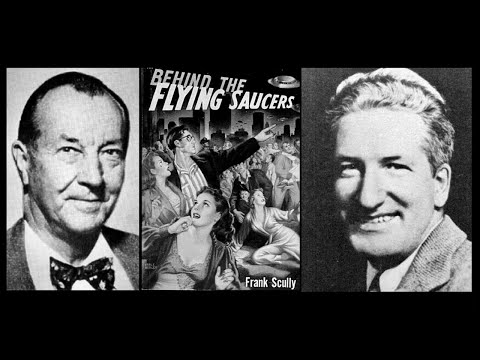
Sources
- Wikipedia, “Aztec crashed saucer hoax” — detailed case history, claims, and exposure
- Denver Public Library Special Collections & Archives, “Of Flying Saucers and Fraud: The Silas M. Newton Story” — victims, sentencing, and later fraud history
- Robert Sheaffer, “Aztec Saucer Crash Story Rises from the Dead?”, Skeptical Inquirer, Nov/Dec 2012 — detailed review of the 2012 revival attempt and case history
- Dan Plazak (guest post), “Facts About Silas Newton's Claimed ‘Successful’ Oil Discoveries,” Bad UFOs blog — Newton's real drilling record and financial history
- Robert Sheaffer, The Frank Scully “Crashed UFO” Hoax — summary of Cahn's investigation and Scully's reaction
- American Heritage Center, University of Wyoming, “Frank Scully and Flying Saucers” — the Frank Scully Collection and book sales figures
- J.P. Cahn, “The Flying Saucers and the Mysterious Little Men,” True, September 1952 (scanned reproduction) — original True magazine exposé
- J.P. Cahn, “Flying Saucer Swindlers,” True, August 1956 (scanned reproduction) — follow-up True magazine exposé
- Federal Bureau of Investigation, “UFOs and the Guy Hottel Memo” — the FBI's own account of the 1950 memo and its relationship to Newton's claims
- FBI Records: The Vault, Silas M. Newton files — released FOIA records, 1951–1970
- FBI Records: The Vault, Guy Hottel files — the original March 1950 memo
- National Archives, Records Related to Unidentified Flying Objects (UFOs) and Unidentified Anomalous Phenomena (UAPs): Textual and Microfilm — federal UAP records research guide
- Wikipedia, “Frank Scully” — biography and later career
- KB42.info, “Silas Newton and Leo Gebauer — The Aztec UFO Principals” — biographical detail on GeBauer's aliases and background
- YouTube (oEmbed-verified), Eyes On Cinema, “Frank Scully, Silas M. Newton and the case of the 1948 Aztec, New Mexico, UFO crash” — archival case material
- Wikimedia Commons, File: Down town (3700746166).jpg — hero image source and license (CC BY-SA 2.0, timlewisnm)
- This site, case-files/farmington-saucer-armada.html — the genuinely documented, evidentially unconnected 1950 mass sighting near Aztec
- This site, case-files/maury-island-1947.html — comparative confirmed-hoax case for scoring calibration
- This site, case-files/the-mutilation-of-snippy-the-horse.html — comparative resolved-hoax case for scoring calibration
- This site, locations/index.html, entry on Aztec, New Mexico — regional geography and background
See something inaccurate? Have additional information or sources?
Suggest an Edit →Last Updated: August 2026