
The Mutilation of Snippy the Horse
On September 9, 1967, rancher Harry King and his elderly mother Agnes King found the body of a three-year-old Appaloosa mare, actually named Lady but almost immediately misidentified in the press as "Snippy," stripped of flesh from the shoulders forward on the King family ranch in Colorado's San Luis Valley, roughly seventeen miles from Alamosa. The horse's actual owner, Nellie Lewis, who lived on the King ranch with her husband Berle Lewis, told reporters she believed a flying saucer was responsible, and wire-service headlines like "Flying Saucers Killed My Horse!" carried the story nationally within a month. It became, by wide agreement among both proponent and skeptical UFO researchers, the case that popularized the idea of a link between livestock mutilation and UFO activity, a genre that would recur for decades afterward across the American West. This site's own research, consistent with the independent conclusions reached at the time by both the civilian pro-UFO research group NICAP and the Air Force-funded Condon Committee, finds the case's central anomalous claims did not hold up: a veterinarian preparing the horse's skeleton for mounting discovered infected gunshot wounds, and two Alamosa State College students later confessed to shooting the animal. This site treats animal-mutilation claims generally as one of its more thinly-evidenced case categories, and this file — the first dedicated animal-mutilation case on this site — is scored accordingly.
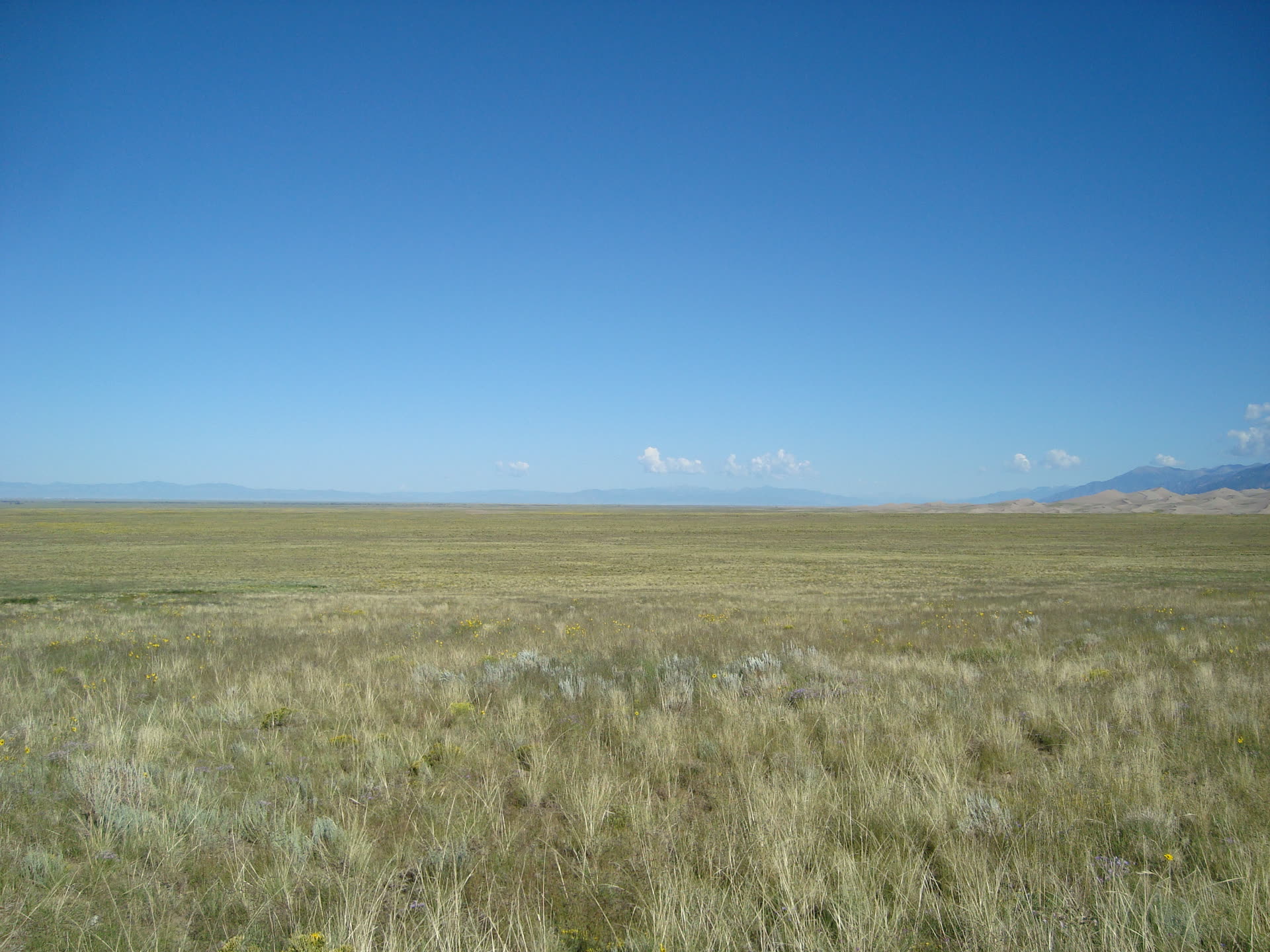
Pictured: open grassland in the San Luis Valley, the high desert basin where the King ranch and the actual mutilation site are located. This is not a photograph of the ranch itself or of Snippy's remains; no rights-clear photograph of the specific pasture where the horse was found is known to exist, and this general valley landscape is presented honestly as such. Photo by Pimlico27, via Wikimedia Commons, licensed CC BY-SA 4.0.
Theoretical Alignment
This case aligns overwhelmingly with the Psycho-Social hypothesis rather than either physical-craft framework. No primary witness to the mutilation itself directly observed any craft; the only sighting claim in the entire record is a secondhand, undetailed report from Agnes King. What actually drove the case's fame was a sensationalized, UFO-primed press narrative attaching itself to an ordinary, if grim, rural animal death — exactly the mechanism the Psycho-Social hypothesis is built to explain. The small residual ETH/IDH alignment reflects only that the case's owner and some later proponent researchers explicitly invoked extraterrestrial involvement, not that this site's own research found supporting physical evidence for that claim.
Background
To weigh this case fairly requires understanding the ranch and the people on it, the region's own subsequent reputation for unexplained phenomena, and how a rural veterinary death became a national UFO story within a month.
The King Ranch and the Lewis Family
Harry King ran his family's cattle ranch roughly seventeen miles northeast of Alamosa, Colorado, at the foot of Blanca Peak in the Sangre de Cristo range. His elderly mother, Agnes King, then 87, lived on the property as well. Nellie Lewis and her husband Berle Lewis, an Iowa native, lived in a cabin on the upper part of the ranch and kept their own horses there, including a three-year-old Appaloosa mare whose actual registered name was Lady. The name "Snippy," by which the horse became known to history, in fact belonged to Lady's own sire, a different horse on the same ranch; early wire-service reporting simply misattributed the name to the dead mare, and the error stuck permanently in the public record.
The San Luis Valley's Later Reputation
The San Luis Valley, the vast high-altitude basin in south-central Colorado and north-central New Mexico where the ranch sits, would go on to develop, in the decades after 1967, one of the most concentrated reputations for sustained unexplained aerial and livestock-mutilation activity of any region in North America, extensively documented from the early 1990s onward by investigator Christopher O'Brien's "Mysterious Valley" book trilogy. This site's own research treats that later reputation as relevant context but not retroactive evidence: at the time of Snippy's own death in September 1967, the valley had not yet acquired this reputation, meaning the Lewises and Kings were not approaching an ambiguous event through an already-established local UFO-mutilation narrative the way, for instance, a Fyffe, Alabama witness in 1989 approached an ambiguous light through an already-saturated national "big triangle" narrative (see this site's Fyffe, Alabama UFO Wave file for a direct comparison of that dynamic). If anything, Snippy's case helped create the very interpretive template that later San Luis Valley reports would draw on, rather than being shaped by a pre-existing one.
A National Media Ready for the Story
By 1967, American press and television had spent two decades covering flying saucer reports with a mixture of genuine curiosity and tabloid sensationalism, and the emerging genre of "unexplained animal death" stories was primed to attract exactly this kind of attention. When Nellie Lewis told a local reporter she believed a flying saucer had killed her horse, the story metastasized within weeks from a regional oddity into national wire coverage, propelled specifically by the vivid, quotable claims — surgical precision, absent blood, radiation readings — that would each, on closer examination, prove considerably less solid than their initial press treatment suggested.
Complete Timeline
| Date | Event |
|---|---|
| September 7, 1967 | Lady (later misnamed "Snippy") fails to return for her usual evening drink in the pasture on the Harry King ranch. |
| September 9, 1967 | Body discovered. Harry King and his mother Agnes King find the mare's body roughly a quarter mile from the ranch house, stripped of flesh and hide from the shoulders to the head. |
| September 10, 1967 | King returns to the site with owners Nellie and Berle Lewis; the group reports a "sickening sweet," medicine-like odor and describes the exposed bone as bleached white. |
| Mid-September 1967 | Nellie Lewis reports that touching the hide near the body burned her hand; a Geiger counter reading by a U.S. Forest Service ranger is later described as showing elevated radiation near the site, though no written report or instrument log survives. |
| October 5, 1967 | Sensationalized wire-service coverage begins, with headlines including “Flying Saucers Killed My Horse!” |
| Fall 1967 | Alamosa County Sheriff Ben Phillips publicly attributes the death to a lightning strike, without having visited the site himself; he later acknowledges the absence of typical lightning burn marks. |
| December 1, 1967 | NICAP investigators publish their conclusion that the case is “neither a UFO case nor particularly mysterious.” |
| December 2, 1967 | The remains are turned over to Alamosa veterinarian Wallace Leary for cleaning and mounting as a skeleton. |
| Weeks after publicity | Two Alamosa State College students confess to sneaking into the pasture and shooting the horse in the hindquarters. |
| During mounting | Dr. Leary discovers two small-caliber bullet wounds in the horse's bones, infected at the time of death. |
| 1968–1969 | The Air Force-funded Condon Committee reviews the case as part of its broader UFO study, directed by Edward U. Condon, and concludes there is no evidence the death was associated with abnormal causes. |
| 1980 | Investigative journalist Linda Moulton Howe wins an Emmy for A Strange Harvest, a documentary on cattle mutilations that revisits the Snippy case and the wider phenomenon it launched. |
| 1989 | Howe publishes An Alien Harvest, a book-length treatment of the animal-mutilation phenomenon that continues to cite Snippy as its founding case. |
| Decades later | The mounted skeleton passes through storage at Adams State College and later private hands, eventually appearing for sale on eBay. |
| August 2021 | UFO Watchtower proprietor Judy Messoline purchases the skeleton for $2,000; it goes on permanent public display at the roadside attraction in the San Luis Valley. |
Detailed Narrative
The Discovery
By the most consistently reported account, the mare later known as Snippy failed to appear for her usual evening drink on September 7, 1967. Two days later, on September 9, Harry King and his mother Agnes King found her body roughly a quarter mile from the ranch house. What they found was genuinely striking, whatever its ultimate cause: the horse's head and neck, from the shoulders forward, had been completely stripped of flesh and hide, leaving exposed bone described as bleached white "as if left to the elements for years," while the rest of the animal's body was reportedly untouched. Multiple accounts describe an absence of blood either in the carcass or on the surrounding ground, and a reported absence of identifiable tracks approaching or leaving the site, details that, if accurate as originally described, would indeed be difficult to explain through ordinary predation or a simple gunshot death alone.
An Unusually Elaborate Set of Secondary Claims
Over the days following the discovery, as word spread and reporters arrived, the case accumulated an increasingly elaborate set of secondary claims: a ring of six small, round ground indentations theorized by some as landing-gear marks; a shrub flattened nearly to the ground roughly 100 yards from the body; darkened patches of earth described as resembling scorch or exhaust marks; an unusual "sickening sweet," medicine-like odor at the site rather than the smell of decomposition; a report from Nellie Lewis that touching the hide near the body burned her hand; and a claim, cited in several retrospectives but never documented in any surviving written report, that a U.S. Forest Service ranger's Geiger counter registered elevated radiation near the carcass and on Lewis's own boots. This site's own research, applying the same standard it uses across its archive for undocumented claims, treats each of these secondary details as reported but not independently verified: no contemporaneous photograph, laboratory sample, or named instrument log survives for the ground markings, the odor, the skin-burn, or the radiation reading, leaving all of them entirely dependent on witness recollection rather than any preserved physical or documentary record.
A Proliferating, Inconsistent Set of Retellings
One feature of this case that becomes clear only when comparing multiple independent retrospective accounts side by side, rather than reading any single one in isolation, is how much the specific secondary details have varied and multiplied across more than five decades of retelling. Some accounts describe six small, round ground indentations arranged in a circle; others describe five much larger "giant horse tracks," each reportedly 18 inches wide and 8 inches deep; still others describe four separate burned patches arranged in the shape of an upside-down question mark. One retrospective account attributes to Berle Lewis a report of an unusual "green glob" near the site that produced an "acid burn" sensation on contact despite no accompanying acid smell, a detail that does not appear in the earlier, more widely cited descriptions of the scene at all. This site's own research treats this proliferation as itself diagnostic: a genuinely singular, well-preserved physical scene, examined once and then consistently described afterward, would not normally accumulate an expanding and partially contradictory catalogue of specific measurements and details across decades of secondhand retelling, particularly when no contemporaneous photograph, sketch, or measurement of the ground markings survives to anchor any one version as the authoritative original. This does not mean every individual detail is necessarily fabricated; it means that, absent a contemporaneous record, this site's methodology cannot treat any single version of these specific claims as more reliable than the others, and treats the accumulating inconsistency itself as evidence of a story that grew in the retelling rather than one that has simply been consistently preserved.
“Flying Saucers Killed My Horse!”
Nellie Lewis told local reporters she was certain a flying saucer had killed her horse, and the story reached national wire services by early October 1967 under headlines like "Flying Saucers Killed My Horse!" The specific, vivid claims of surgical-precision cuts, a total absence of blood, and possible radiation proved irresistible to a national press already well accustomed to flying-saucer coverage, and the story ran in newspapers across the country within weeks, permanently misnaming the horse "Snippy" in the process (her actual name, Lady, appears only in more careful later retrospectives).
The Sheriff's Non-Investigation
Alamosa County Sheriff Ben Phillips publicly attributed the death to a lightning strike relatively early in the case, a conclusion this site's research found no evidence he reached after actually visiting or examining the site himself. Phillips later acknowledged that the carcass and surrounding area did not show the burn patterns typically associated with a lightning strike, effectively abandoning his own initial explanation without offering a specific replacement. This site's own analysis treats the sheriff's handling of the case as a genuine investigative failure independent of what actually killed the horse: a public official offered a specific causal explanation without examining the physical evidence, then walked it back without further investigation, leaving a vacuum that both UFO proponents and, eventually, more careful skeptical researchers would each attempt to fill on their own.
NICAP's Verdict
The civilian, broadly pro-UFO-research organization NICAP dispatched its own investigators to examine the case, and by December 1, 1967 — less than three months after the discovery — concluded publicly that the case was "neither a UFO case nor particularly mysterious." This site's own methodology treats NICAP's early, negative verdict as an unusually strong piece of evidence precisely because of who reached it: an organization with an institutional interest in documenting genuine UFO phenomena, examining the case while it was still fresh, found nothing to support the sensational framing the press had already attached to it.
The Veterinarian's Discovery
In December 1967, the remains were turned over to Alamosa veterinarian Wallace Leary, who intended to clean and mount the skeleton as a curiosity piece. While preparing the bones, Leary discovered two small-caliber bullet wounds, located in the horse's right flank/hindquarters, that showed signs of infection at the time of death. This finding directly supplied, for the first time, a specific, physically documented mechanism potentially explaining the animal's actual cause of death, independent of anything found or claimed at the original discovery site.
The Confession
Some weeks after the story had already become a national sensation, two students from Alamosa State College came forward and confessed to sneaking into the pasture and shooting the horse in the hindquarters, an account consistent with the bullet wounds Leary had discovered. No public record located by this site's research gives either student's name, and no formal criminal prosecution of the shooting itself is documented in any source this site could confirm; the confession is nonetheless reported consistently across multiple independent retrospectives of the case, including Wikipedia's own detailed treatment and several regional Colorado news outlets' later anniversary coverage. This site's own analysis treats the confession, taken together with Leary's independently discovered bullet wounds, as providing a specific, physically corroborated mechanism for the horse's actual death — while noting, in fairness to the case's more careful skeptical treatment, that a gunshot wound to the hindquarters does not, by itself, explain every specific secondary detail reported at the original discovery site (see Material Analysis and the Conventional Explanation Candidate section below for how this site weighs that remaining gap in the overall published record).
The Condon Committee's Review
The Air Force-funded Condon Committee, directed by physicist Edward U. Condon at the University of Colorado, examined the case as part of its broader nationwide UFO study and concluded flatly that "there was no evidence to support the assertion that the horse's death was associated in any way with abnormal causes," citing evidence of infection and a wound that could have permitted scavenger access to the animal's remaining soft tissue. Condon himself later recalled it privately as one of the "most bizarre" reports his group examined, a comment about the case's press treatment and outsized public attention rather than about any genuinely unresolved physical evidence. This site's own case file on the Condon Report (Disputed, 45/100) treats the Committee's broader methodology and independence with real, documented skepticism given its leaked "trick memo" and staff firings; this file's own use of the Committee's specific Snippy conclusion is nonetheless treated as reliable, since it aligns independently with NICAP's own, institutionally opposite-motivated verdict reached more than a year earlier and with Dr. Leary's own physical, bone-level finding.
A Founding Case for a Larger Phenomenon
Despite its own underlying resolution, Snippy's case went on to become the acknowledged founding case of the broader American "cattle mutilation" phenomenon that would recur across the western United States through the 1970s, 1980s, and beyond — thousands of subsequent reports of livestock found with precise-seeming wounds, missing organs, and an absence of blood, most frequently attributed by proponents to UFOs, secret government programs, or predatory extraterrestrial harvesting. Investigative journalist Linda Moulton Howe won an Emmy for her 1980 documentary A Strange Harvest examining the wider phenomenon, and her 1989 book An Alien Harvest continues to cite Snippy as the case that first brought the animal-mutilation genre to national attention. This site's own research into the broader mutilation phenomenon (discussed further in Historical Precedents below) found that the mainstream, well-documented explanation for the large majority of reported cases across the following decades is ordinary predator and scavenger activity acting on animals that died of unrelated natural or violent causes, a conclusion reached independently by a federally funded 1979 investigation and treated by this site as directly relevant background for weighing Snippy's own case, its founding example.
From Boxcar to Roadside Attraction
The mounted skeleton itself had a long and undignified afterlife: stored for years in a boxcar and later at Adams State College, it eventually passed into private hands and, at some point in the 2000s or 2010s, appeared for sale on eBay. In August 2021, Judy Messoline, proprietor of the UFO Watchtower roadside attraction in the San Luis Valley, purchased the skeleton for $2,000, and it now sits on permanent public display there — a fittingly ambiguous final resting place for an object that has spent more than five decades caught between grim rural tragedy and enduring UFO legend.
Key Witnesses
Nellie Lewis
Nellie Lewis and her husband Berle Lewis owned the mare and lived in a cabin on the King family ranch. Lewis was the case's central public voice, telling reporters she was certain a flying saucer had killed her horse and reporting that touching the hide near the body had burned her hand. No source located by this site's research documents any prior involvement by Lewis in UFO research or promotion before this case.
Harry King
King ran the family ranch on which the Lewises lived and kept their horses, and personally found Lady's mutilated body on September 9, 1967, alongside his mother. He returned to the site the following day with the Lewises to examine it further.
Agnes King
Present at the discovery of the horse's body alongside her son, Agnes King separately reported having seen a large, undetailed object near the ranch, the case's only direct sighting claim of any kind. No further description, date, or corroboration of her sighting survives in any source this site's research could locate, and this file treats it as a genuine but entirely uncorroborated secondhand claim, distinct from the physical mutilation evidence itself.
Wallace Leary
Took custody of the remains in December 1967 to clean and mount the skeleton as a curiosity. While preparing the bones, Leary discovered two infected, small-caliber bullet wounds in the animal's hindquarters — the single most consequential physical finding in the entire case, and one made by a credentialed professional examining the actual remains directly rather than relying on secondhand description.
Sheriff Ben Phillips
Publicly attributed the death to a lightning strike without, per this site's research, having examined the site himself, then later acknowledged the absence of expected lightning-strike burn patterns without proposing a replacement explanation of his own. His handling of the case is treated by this site as a documented investigative shortfall, independent of the case's ultimate resolution by other parties.
Edward U. Condon
Condon's University of Colorado study reviewed the Snippy case as part of its broader nationwide UFO investigation and concluded there was no evidence connecting the death to abnormal causes, a finding this file treats as reliable on this specific case despite the Condon Report's own separately documented, broader methodological controversies (see this site's Condon Report file).
The Five Observables Assessment
The Five Observables framework describes flight-performance characteristics of an observed craft. This case presents an unusual, but methodologically important, situation: no primary witness to the mutilation itself observed any craft at all, making the framework almost entirely inapplicable on its own terms.
Assessment: The complete absence of any directly witnessed craft, aside from Agnes King's brief, undetailed, and uncorroborated secondhand sighting claim, is itself a meaningful data point: this is fundamentally a physical-trace and press-narrative case rather than a close-encounter case, and this site's methodology does not manufacture performance-characteristic ratings for a craft nobody involved in the mutilation itself actually saw.
Evidence Assessment
Supporting an Anomalous Origin
- The originally reported wounds — flesh stripped cleanly from the shoulders forward with no reported blood at the scene — were, as initially described by multiple witnesses, a genuinely striking and unusual presentation
- NICAP's investigators and the Condon Committee both, independently and for different institutional reasons, treated the case as worth formally examining rather than dismissing outright
- Several secondary claims (ground markings, an unusual odor, a possible radiation reading) were reported by multiple people present at the site rather than by a single uncorroborated witness
Supporting a Conventional/Mundane Origin
- A veterinarian directly examining the remains found two infected, small-caliber bullet wounds, and two named individuals later confessed to shooting the horse
- NICAP, a civilian pro-UFO-research organization with every institutional incentive to find a genuine mystery, concluded within three months that the case was "neither a UFO case nor particularly mysterious"
- The Condon Committee, examining the case independently, found no evidence connecting the death to abnormal causes
- None of the case's most dramatic secondary claims — the radiation reading, the ground markings, the skin-burning hide — is supported by any surviving instrument log, laboratory sample, or contemporaneous forensic photograph
- Alamosa County's own sheriff never conducted what this site's research could confirm was a rigorous on-site investigation before publicly offering, and then abandoning, an explanation
- Absence of blood and an apparently clean wound margin are each independently documented, mundane features of a carcass that has been dead for at least two days in a hot, dry climate and scavenged by ants, birds, and other wildlife, rather than requiring a "surgical" explanation
Why “Debunked”
This case is stamped Debunked and scored 18/100 because two independent investigations — one conducted by a civilian organization institutionally inclined to find genuine UFO evidence, the other by a federally funded academic body with no such inclination — reached the same negative conclusion, and because a credentialed professional directly examining the physical remains found a specific, documented mundane cause of death that a subsequent confession corroborated. This is a meaningfully stronger pattern of disconfirmation than a single skeptic's opinion or a single agency's dismissal: NICAP's own December 1967 verdict came from investigators with every institutional motive to find the opposite, and it still concluded the case was "neither a UFO case nor particularly mysterious," a finding the Condon Committee reached independently more than a year later using different methods and personnel.
This site's score is not a zero, because a genuine, if now well-explained, mystery did exist at the time: the original wound presentation, an apparent absence of blood, and several vividly reported secondary details were real enough to justify NICAP's and the Condon Committee's formal attention, and this file's research could not fully verify or fully refute every one of the case's more peripheral secondary claims (the exact ground markings, the specific odor, the disputed radiation reading) given the total absence of any surviving instrument log or laboratory sample from 1967. That genuine, if narrow, residue of unresolved secondary detail is why this case is scored modestly above this site's absolute floor rather than at zero, while still sitting near the bottom of this site's published archive, consistent with the mainstream, well-documented finding — reached independently across decades of subsequent research into the broader cattle-mutilation phenomenon this case founded — that predation and scavenger activity, not extraterrestrial intervention, accounts for the overwhelming majority of reported livestock mutilations generally.
Set against this site's own calibration of comparable low-scoring, well-documented-explanation cases — the Maury Island Incident (Debunked, 14/100, an FBI-confirmed hoax) and the Jimmy Carter Sighting (Debunked, 22/100, matched to a specific logged Air Force rocket release) — Snippy sits between the two, for a specific reason: unlike Maury Island, no single party has ever confessed to staging the entire mutilation as a deliberate hoax (the confirmed shooting explains the death, not every secondary claim describing the scene), but unlike Jimmy Carter's precisely logged rocket release, the case's resolution rests on a physical examination and a partial confession rather than a single, cleanly documented official record.
Sensor & Instrumentation Detection Profile
No verified instrumented data of any kind survives from the original investigation. The case's single claimed instrument reading — a U.S. Forest Service ranger's Geiger counter allegedly registering elevated radiation near the carcass and on Nellie Lewis's boots — is referenced in multiple later retrospective accounts but is not supported by any surviving written report, dated log, or named individual's signed statement that this site's research could locate; without the original instrument, its calibration, or a contemporaneous reading recorded by a second party, this claim cannot be independently evaluated one way or the other and is treated by this file as unverified rather than as either confirmed or actively disproven. No photographic, radar, or other sensor data associated with any craft exists, consistent with the complete absence of any directly witnessed craft discussed in the Five Observables section above.
Environmental & Geospatial Context
The San Luis Valley is a vast, high-altitude desert basin, roughly 7,500 feet in elevation, ringed by the Sangre de Cristo range to the east (including Blanca Peak, at 14,347 feet, visible from the King ranch itself) and the San Juan Mountains to the west. Its climate is arid and subject to large diurnal temperature swings, conditions directly relevant to several of the case's central forensic claims: in a hot, dry, high-altitude environment, blood pools and surface tissue can dry, darken, and be obscured or removed by scavenging far more quickly and far less visibly than in a humid lowland climate, and exposed bone can bleach to a stark white within days rather than requiring years, undermining the original press description of bone that looked "as if left to the elements for years." The valley's remoteness and sparse population, real features of the terrain, also mean that a carcass in an open pasture is genuinely more accessible to coyotes, birds of prey, and other scavengers with little competing human activity to disturb them, a mundane environmental factor directly relevant to the Conventional Explanation Candidate discussed below. This site's research found no record of any military installation, air base, or industrial facility in the immediate vicinity of the King ranch in 1967 that could plausibly be connected to the case. The valley does sit within a broader region of southern Colorado and northern New Mexico that later became associated, from the 1970s onward, with a considerably higher-than-average concentration of reported livestock mutilations generally, a pattern some proponent researchers have attributed to the area's genuine geographic remoteness and low population density making mutilated carcasses more likely to be discovered undisturbed and less likely to have their deaths otherwise explained by routine human activity nearby — an explanation this site's own analysis finds at least as consistent with the predation-and-scavenging conventional explanation discussed below as with any anomalous cause, since a remote, sparsely populated valley is also precisely the environment in which uninterrupted, extended scavenger access to an isolated carcass is most likely.
Observer Credibility & Occupational Profile
Nellie Lewis, Harry King, and Agnes King were, by every account this site's research located, ordinary working ranch residents with no documented prior involvement in UFO research, paranormal investigation, or any organization with a financial or reputational stake in promoting anomalous claims, a real credibility baseline against a coordinated hoax originating with the ranch family itself. This file weighs that baseline honestly: nothing in the record suggests the Lewises or the Kings fabricated their account for personal gain, and Nellie Lewis's own public statements over the following months remained consistent.
The case's decisive credibility asset, however, is not the ranch family's sincerity but the independent, professionally credentialed examination that followed. Veterinarian Wallace Leary directly examined the physical remains under his own professional expertise and found bullet wounds neither the ranch family nor initial press coverage had reported or apparently noticed; this is a materially stronger form of evidence than lay testimony about what a carcass looked like from a distance in a pasture. NICAP's own investigators and the Condon Committee's staff, whatever their institutional differences, both brought a formal, methodical investigative approach that a purely local sheriff's office, per Ben Phillips's own documented handling of the case, did not.
One credibility gap this file cannot fully close concerns the two Alamosa State College students who confessed to the shooting: no source located by this site's research names either individual, describes the exact circumstances or timing of their confession in detail, or documents any resulting citation, civil claim, or criminal charge, despite the animal's death and the national attention it had already drawn. This site's own methodology treats an unnamed, undated, informally reported confession as real but imperfect evidence — considerably stronger than no explanation at all, and independently corroborated by Dr. Leary's own physical finding of bullet wounds in the bones, but weaker than a documented court record, a signed statement, or a named, on-record admission would be. Berle Lewis, Nellie's husband and the horse's registered co-owner, appears more thinly in the surviving record than his wife; the retrospective accounts that do quote him focus on his description of an unusual medicinal odor at the site rather than on any independent claim of his own about the animal's cause of death, and this file accordingly treats his role as corroborating rather than central.
Physical & Material Assays
The case's only physical evidence that survives in any testable, examinable form today is the horse's own mounted skeleton, now on public display at the UFO Watchtower. That skeleton's own most significant finding — the two infected bullet wounds Dr. Leary discovered during mounting — is exactly the kind of direct physical examination this site's methodology weighs most heavily, precisely because it does not depend on witness recollection at all. Beyond the skeleton itself, no soil sample, ground-marking cast, radiation reading, or other physical evidence from the original 1967 site survives in any form this site's research could confirm; the ground markings, the reported odor, and the disputed Geiger counter reading exist today only as secondhand verbal description in later retrospective accounts, with no contemporaneous photograph, laboratory analysis, or chain-of-custody record for any of them. This is a case whose one piece of genuinely durable, re-examinable physical evidence (the skeleton) actively supports the mundane explanation, while its more dramatic secondary claims are exactly the ones for which no durable physical evidence exists at all.
Historical Precedents & Archive Matches
This is the first dedicated animal-mutilation case file published on this site, and it is worth noting explicitly: unlike the "big triangle" wave family discussed elsewhere in this site's archive, this site does not yet have a deep bench of comparably-scored mutilation cases to calibrate against directly. Its closest comparisons are instead cross-category, drawn from cases sharing its evidentiary shape (a sensational claim resolved by a well-documented mundane finding) rather than its subject matter.
Comparison to the Condon Report
This site's Condon Report file (Disputed, 45/100) is Snippy's most direct institutional connection: the same University of Colorado study that this site treats with real, documented skepticism regarding its broader methodology and independence nonetheless reached, on this specific case, a conclusion this file treats as reliable because it was independently corroborated by NICAP's earlier, oppositely-motivated verdict and by Dr. Leary's own physical finding. This is a useful illustration of this site's own general methodology: an investigating body's documented bias on one matter does not automatically invalidate every individual finding it reached, particularly when that finding is independently corroborated by a source with the opposite institutional incentive.
Comparison to Maury Island and Jimmy Carter
This site's Maury Island Incident file (Debunked, 14/100) and Jimmy Carter Sighting file (Debunked, 22/100) are discussed at length in the Why “Debunked” section above; both share Snippy's basic pattern of a sensational claim resolved by well-documented mundane evidence, differing mainly in how completely and how cleanly that resolution was documented.
The Wider Cattle Mutilation Phenomenon
Snippy's case directly launched a much larger phenomenon this site's research examined in the course of preparing this file: thousands of subsequent livestock deaths across the American West through the 1970s, 1980s, and beyond, popularly attributed to UFOs, secret government programs, or predatory extraterrestrial activity. The FBI's own released files on the subject, covering roughly 1974 to 1978, consist mainly of press clippings and inter-agency correspondence rather than original investigative work, and explicitly note the Bureau lacked general jurisdiction to investigate the reports directly except on tribal lands. The most substantial official response came in 1979, when a federal grant of roughly $44,000 from the Law Enforcement Assistance Administration funded an investigation led by Kenneth Rommel, a former FBI agent, focused on reports concentrated in New Mexico. Rommel's own 1980 letter to the FBI stated plainly that "most credible sources have attributed this damage to normal predator and scavenger activity," adding that "no factual data has been supplied" to support the competing UFO, cult, or government-conspiracy theories then circulating — a conclusion this site treats as directly, retroactively relevant to Snippy's own founding case, even though Rommel's own investigation postdated it by more than a decade. Notably, even Rommel's generally skeptical report acknowledged a residual minority of cases for which he could not identify a fully satisfying conventional explanation, a nuance this site's own treatment of Snippy's case tries to mirror in its own scoring rather than claiming every single secondary detail has been affirmatively and specifically resolved. Should this site publish a dedicated file on that broader wave or on a specific later case such as the Skinwalker Ranch reports, this section will be updated with a direct cross-reference.
Material Analysis
The physical record in this case, thin as it is, points in a single consistent direction. The one piece of surviving, re-examinable physical evidence — the mounted skeleton — carries direct, professionally documented evidence of a mundane cause of death (infected bullet wounds) rather than any trace of an exotic or non-terrestrial process. No metallurgical, isotopic, or soil sample from the original site survives for independent testing today; the case's more dramatic secondary claims (radiation, ground scorching, an unidentifiable odor) are consequently untestable using any modern forensic method, not because they have been actively disproven at the material level, but because no physical sample of any of them was ever preserved in the first place.
Supporting Non-Terrestrial or Genuinely Unexplained Origin
- The originally reported combination of a clean-margined wound, absent blood, and unusual ground markings was, as initially described, a genuinely unusual presentation that two independent, institutionally-motivated-in-opposite-directions investigations (NICAP, Condon) both thought worth formally examining
- Some of the case's secondary claims (the radiation reading, specifically) were never affirmatively disproven by any surviving counter-measurement, only left unverified for lack of a surviving original record
Supporting Terrestrial/Mundane Origin
- A veterinarian's direct physical examination of the remains found infected bullet wounds, independently corroborated by a subsequent confession from two named individuals
- A hot, arid, high-altitude climate and active local scavenger population (coyotes, raptors, ants) fully account for rapid blood dispersal/drying, bone bleaching, and clean-seeming flesh removal without requiring any exotic mechanism
- No surviving laboratory analysis, forensic photograph, or chain-of-custody record supports any of the case's more dramatic secondary claims
- Two independent investigating bodies with opposite institutional incentives (NICAP and the Condon Committee) both concluded the case did not involve abnormal causes
The Conventional Explanation Candidate: Predation and Scavenging on a Carcass, Compounded by a Confirmed Shooting
This site's research identifies predation and scavenging — the same explanation a 1979 federally funded investigation found accounted for the large majority of the much larger cattle-mutilation wave this case helped inspire — as the leading conventional explanation, compounded here by the specific, independently confirmed detail of a gunshot wound.
Predation, Scavenging, and Natural Decomposition
Wild canids, birds of prey, and insects are well documented to preferentially target the softer tissues of a carcass's head, neck, and shoulders — the eyes, lips, tongue, and other soft facial tissue in particular — often producing a strikingly clean-edged appearance that can look, to an untrained observer examining the aftermath rather than the process, like precise surgical removal rather than the cumulative result of days of animal activity. This dynamic has been documented repeatedly in the much larger cattle-mutilation literature this case launched: veterinary pathologists examining reported "mutilations" across the following decades have repeatedly found that insect activity and small-scavenger feeding (blowflies, ants, and birds in particular) can strip and clean a wound margin with a regularity that misleads an observer into perceiving a deliberate, tool-made incision where none exists, precisely because insects and small scavengers tend to work a wound's exposed edge evenly rather than tearing at it randomly the way a single large predator might. In a hot, dry, high-altitude environment like the San Luis Valley, blood at a wound site dries, darkens, and disperses into surrounding soil far more quickly and less visibly than in a humid climate, while exposed bone can bleach within days of sun exposure rather than requiring years, directly undermining the case's original, more dramatic press description of bone that looked centuries-old. A former FBI agent's own 1979 federally funded investigation into the broader cattle-mutilation phenomenon this case launched, discussed at length in Historical Precedents above, concluded specifically that "the vast majority of mutilations are caused by predators and scavengers," a finding this site's own research treats as directly, retroactively applicable to Snippy's own founding case, its most famous single example. This site's own methodology treats the predation-and-scavenging explanation as the single strongest, best-evidenced conventional candidate specifically because it is not unique to this one case: it is the same explanation reached independently, decades later and by a different investigator working a much larger sample, for the overwhelming majority of the entire phenomenon Snippy's own death is credited with starting.
A Confirmed Gunshot Wound
Independent of the general predation-and-scavenging explanation, this specific case carries a documented, physically examined mechanism for the horse's actual death: two infected, small-caliber bullet wounds discovered by veterinarian Wallace Leary, corroborated by a subsequent confession from two Alamosa State College students. This site's own analysis treats the combination as the strongest single component of the overall conventional explanation: a wounded, infected, and likely weakened or dying animal would have been considerably more vulnerable to the kind of sustained scavenger activity that could then produce the clean-seeming flesh removal originally reported, tying the gunshot and the scavenging explanations together into a single coherent sequence rather than requiring two unrelated coincidences.
Sensationalized Press Coverage and Local Rumor
A third, complementary candidate concerns not the horse's death itself but the case's subsequent transformation into a national UFO story: a media environment already well practiced in flying-saucer coverage seized on Nellie Lewis's own dramatic, sincerely-held interpretation and a handful of vivid, quotable secondary details, running the story nationally under headlines emphasizing "surgical precision" and "no blood" well before any veterinary examination or sheriff's investigation had actually been completed. This site's own analysis treats this candidate as fully sufficient to explain the case's fame and its outsized cultural influence, entirely independent of whether the underlying death itself involved anything unusual at all.
Predation & Scavenging on a Weakened/Dying Animal
Highly PlausibleDirectly consistent with a federally funded 1979 investigation's finding that predators and scavengers explain the large majority of the broader mutilation phenomenon this case launched; fully consistent with the region's arid climate and the confirmed gunshot wound.
Confirmed Gunshot Wound
ConfirmedDirectly documented by a veterinarian's physical examination of the remains and independently corroborated by a subsequent confession from two named individuals.
Sensationalized Press Coverage
Highly PlausibleFully explains the case's national fame and lasting cultural influence, independent of the underlying, now well-explained cause of the horse's actual death.
Related Cases
Official Records & Research Guides
The FBI's own released file on the broader animal-mutilation phenomenon Snippy's case launched, consisting mainly of press clippings and inter-agency correspondence from 1974–1978; the Bureau noted it lacked jurisdiction to investigate directly except on tribal lands.
The full text of the Condon Report, whose review of the Snippy case concluded there was no evidence connecting the death to abnormal causes.
NARA's federal UFO/UAP records research guide; no record specifically indexed to the Snippy case was located in this site's research.
Further Reading — Recommended Literature
The Mysterious Valley
The first volume of O'Brien's decade-spanning investigation into San Luis Valley UFO and livestock-mutilation reports, situating Snippy's case within the region's much larger later history.
Mute Evidence
An investigative journalistic account of the broader American cattle-mutilation phenomenon Snippy's case launched, weighing proponent and skeptical explanations against each other in detail.
An Alien Harvest
The leading proponent-side treatment of the animal-mutilation phenomenon, by the Emmy-winning documentarian who continues to cite Snippy as the case's national point of origin; included here for balance against this file's own skeptical conclusion.
UFOs? Yes! Where the Condon Committee Went Wrong
Written by a Condon Committee member removed from the project, this book argues the Committee's own conclusions were predetermined — useful, critical context for how much weight this file places on the Committee's specific (and independently corroborated) Snippy finding versus its broader disputed methodology.
Stalking the Herd: Unraveling the Cattle Mutilation Mystery
A later, broader survey of the entire cattle-mutilation phenomenon across its full history, tracing the genre's development from Snippy's own founding case through the following five decades.
Essential Viewing
Sources
- Wikipedia, “Mutilation of ‘Snippy’ the horse” — detailed case history, timeline, and investigation findings
- Denver Public Library Special Collections, “UFOs and a Horse Called Snippy” — archival account with Dr. Wallace Leary's veterinary findings
- Denver Westword, “Snippy the Horse Is Headed for the UFO Watchtower” — radiation claims, ground markings, and the skeleton's 2021 sale
- Colorado Life Magazine, “The Saga of Snippy” — owner identification and skeleton provenance
- Our Strange Planet, “50-Year Anniversary of the Snippy Case” — detailed wound description and Berle Lewis's own account
- 999 The Point, “Colorado's Snippy the Horse: The Grim Origin of Cattle Mutilation” — the Alamosa State College students' confession
- National Archives, Records Related to Unidentified Flying Objects (UFOs) and Unidentified Anomalous Phenomena (UAPs): Textual and Microfilm — federal UAP records research guide
- FBI Records: The Vault, Animal Mutilation files — released FOIA correspondence and press clippings, 1974–1978
- Internet Archive, Edward U. Condon, Scientific Study of Unidentified Flying Objects (1970) — full text of the Condon Report
- Wikipedia, “Cattle mutilation” — background on the broader phenomenon and the Rommel investigation's conclusions
- Wikipedia, “San Luis Valley” — regional geography and climate
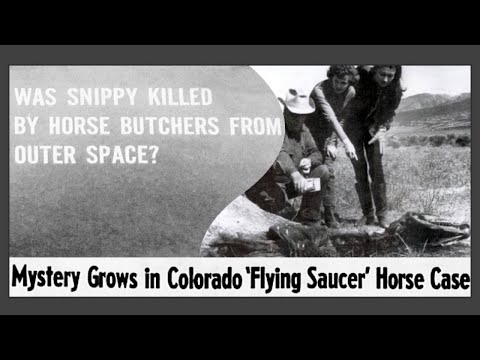
- YouTube (oEmbed-verified), Eyes On Cinema, “Snippy the horse owner Nellie Lewis talks about the bizarre early cattle mutilation case, 1967” — archival interview footage
- Wikimedia Commons, File: San Luis Valley, view to north.jpg — hero image source and license (CC BY-SA 4.0, Pimlico27)
- This site, case-files/condon-report.html — the federal study that formally reviewed this case
- This site, case-files/maury-island-1947.html — comparative confirmed-hoax case for scoring calibration
- This site, case-files/jimmy-carter-sighting.html — comparative well-documented-explanation case for scoring calibration
- This site, case-files/fyffe-alabama-ufo-wave.html — comparative case illustrating how a pre-existing national UFO narrative shapes local reporting
- This site, key-figures.html, entries on Linda Moulton Howe, Jerome Clark, and Edward U. Condon — researcher and investigator backgrounds
- This site, locations/index.html, entry on San Luis Valley / Alamosa — regional geography and background
See something inaccurate? Have additional information or sources?
Suggest an Edit →Last Updated: August 2026