
Fyffe, Alabama UFO Wave
Over two nights in February 1989, more than fifty residents of Fyffe, a farming town of roughly 1,300 people atop DeKalb County's Sand Mountain plateau, reported a large, silent, triangular craft with bright lights hovering and maneuvering low over the surrounding countryside. What set the case apart from an ordinary rash of nighttime light reports was who did the reporting: Fyffe police chief Charles “Junior” Garmany and assistant chief Fred Works chased the object by patrol car along County Road 43, an officer from neighboring Crossville and the police chief of nearby Geraldine separately reported unusual objects the same nights, and Alabama state troopers were dispatched to the area in response. A disputed Polaroid photograph, more than one hundred news organizations, and thousands of curious tourists followed within weeks, and the Alabama Legislature proclaimed Fyffe the state's official “UFO Capital,” an identity the town still celebrates every August with its own UFO Days festival. This file weighs the case's genuine credentialed-witness strength against its equally genuine problems: wildly inconsistent descriptions of the object's shape, no radar or instrumented corroboration of any kind, a photograph of undetermined authenticity, and a wave that arrived already primed by a decade of nationally publicized triangle sightings.
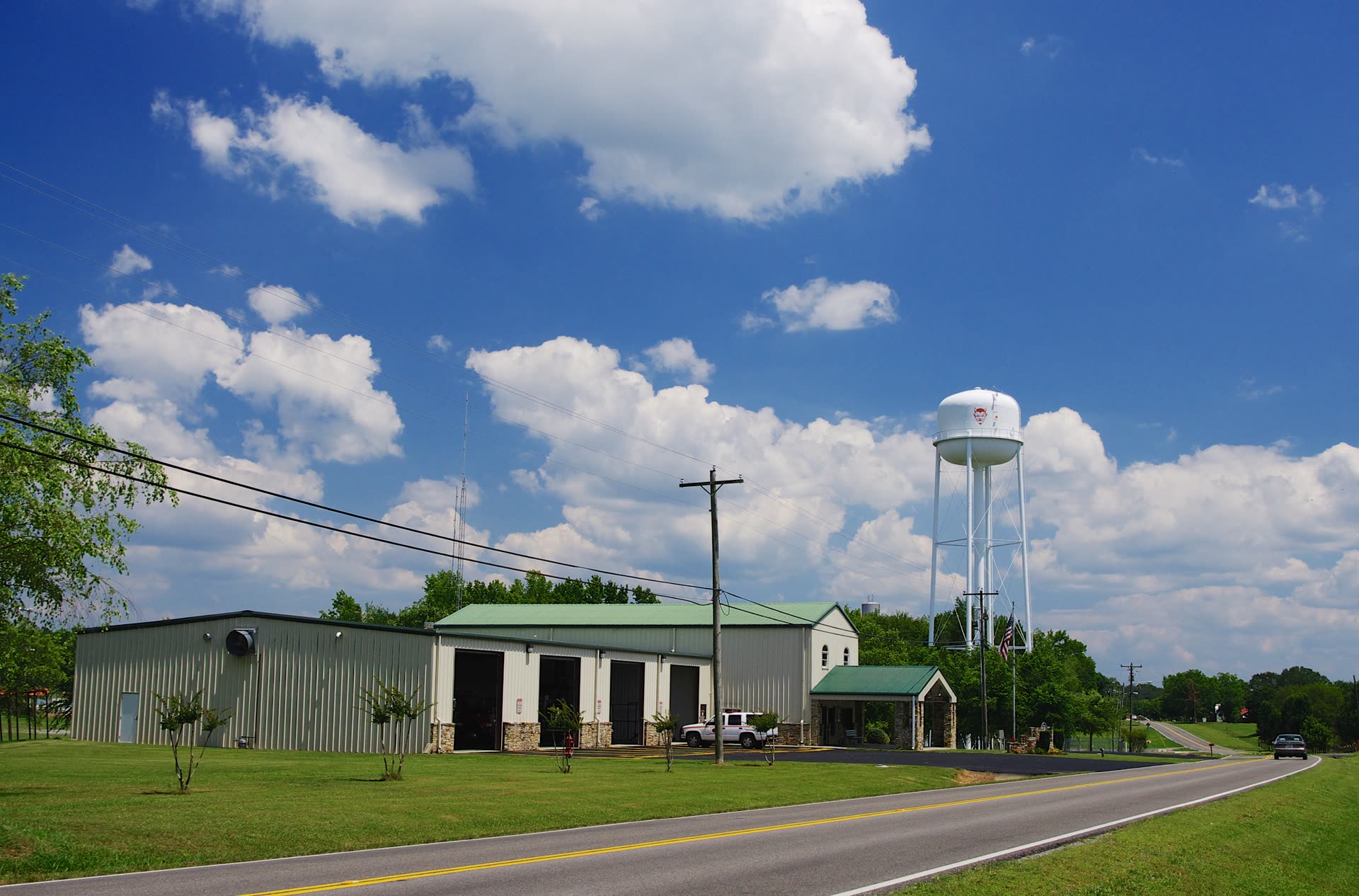
Pictured: Fyffe's town hall, the civic center of the small DeKalb County farming community atop Sand Mountain. This is not a photograph of the disputed 1989 sighting or of Ted Oliphant's disputed Polaroid; no rights-clear photograph of the actual sighting site along County Road 43 on the nights in question is known to exist, and this general town photograph is presented honestly as such. Photo by Brian Stansberry, via Wikimedia Commons, licensed CC BY 4.0.
Theoretical Alignment
Fyffe sits at an unusual intersection of two frameworks. The presence of multiple, independently positioned, occupationally credentialed witnesses — several of them law enforcement officers with training in dispassionate observation and no obvious motive to fabricate a report likely to invite ridicule — gives the case a floor of seriousness that pushes its ETH alignment above this site's baseline for a purely civilian light-in-the-sky report. But the wave's own internal record works against a single coherent physical object: witnesses described the same nights' phenomenon as a rigid triangle, a wide delta, a blimp, and a banana, a level of morphological disagreement that is difficult to reconcile with one craft and easier to explain as several independent stimuli, rumor-amplified expectation, and a fast-moving national media cycle acting on an already UFO-primed rural community. That disagreement, combined with the total absence of any instrumented corroboration despite direct calls to two Air Force installations and a NASA center, is why this file weights the Psycho-Social hypothesis highest of the three.
Background
Understanding what happened in Fyffe requires three pieces of context: the town and county the sightings occurred in, the national UFO climate of the late 1980s that primed both witnesses and the press to interpret an ambiguous nighttime light as a "big triangle," and the specific people who happened to be on duty the nights in question.
Fyffe and DeKalb County
Fyffe is a small incorporated town in DeKalb County, in Alabama's northeastern corner, sitting atop Sand Mountain, a broad sandstone plateau of the southern Cumberland Plateau that rises above the surrounding river valleys and gives the area unusually long, unobstructed sightlines across open farmland. Founded in the 1880s and incorporated in 1956, Fyffe had a population of roughly 1,300 to 2,000 residents at the time of the 1989 sightings (later census counts put the town nearer 1,000–1,400), built around a small-town economy of poultry farming, row crops, and light industry typical of the Sand Mountain region. The town lies along Alabama State Route 75 a short distance west of Fort Payne, the DeKalb County seat, and is bordered by several similarly small farming communities — Crossville, Geraldine, and Rainsville among them — whose own police departments would, within days, find themselves fielding calls about the same phenomenon. Before February 1989, Fyffe had no particular reputation for UFO activity and no evident local subculture of sighting reports; nothing in the available record suggests DeKalb County was already primed by a pre-existing local wave the way, for instance, England's Pennine hills were before Todmorden's 1980 police encounter.
A Decade of Triangles
What Fyffe's witnesses lacked in local precedent, the national UFO conversation of the 1980s more than supplied. The Hudson Valley, New York/Connecticut area had, beginning New Year's Eve 1982, produced thousands of reports of a large, silent, boomerang- or V-shaped craft moving low over the region, chronicled by astronomer J. Allen Hynek and investigator Philip Imbrogno in the widely read 1987 book Night Siege. Less than a decade earlier, Belgium had experienced its own nationally significant wave of large, silent, triangular-craft reports beginning in November 1989 — a case this site catalogues separately (see Historical Precedents below) — though that wave began nine months after Fyffe's own sightings, making Fyffe, if anything, an early rather than a copy-cat entry in the pattern rather than the reverse. By early 1989, "large, silent, triangular or boomerang-shaped craft with lights" had become a recognizable template in American popular culture, reinforced by tabloid coverage, UFO-themed television specials, and a saturated market of paperback UFO books; several skeptical researchers examining Fyffe afterward have specifically pointed to this template as a ready-made interpretive frame available to any DeKalb County resident who glimpsed an ambiguous nighttime light in February 1989, independent of whether anything genuinely anomalous was in the sky at all.
The Officers on Duty
Charles “Junior” Garmany was Fyffe's police chief in February 1989, with Fred Works serving as his assistant chief. Both men had years of ordinary small-town police experience and no documented prior involvement with UFO reporting, paranormal investigation, or any organization with an interest in promoting anomalous claims — a genuinely relevant credibility baseline, since it means neither man had an existing motive or track record that would make a fabricated or exaggerated report more likely. Garmany died some years before the case's later 30th-anniversary retrospectives; Works remained available to journalists into the 2020s and gave a detailed, largely consistent account of the events in a 2021 interview, discussed at length in the Detailed Narrative and Observer Credibility sections below.
A Town of Shifting Population, Fixed Memory
Fyffe's own reported population has varied considerably across the sources describing the 1989 wave — contemporary 1989 press accounts described a town of roughly 1,300 to 2,000 residents, while the town's actual decennial census figures show 967 residents in 2020 and figures in a broadly similar range in the decades before and after. This site's own research treats the discrepancy as an ordinary feature of small-town reporting rather than as evidence of anything unusual about the case itself: wire-service articles frequently rounded or estimated a rural town's size loosely, and DeKalb County's own incorporated-versus-unincorporated boundaries around Fyffe shifted somewhat over the following decades. What did not shift was the town's own account of what happened in February 1989; Garmany's and Works's core description of a large, silent, low-hovering object remained consistent across every interview either man gave, from the original 1989 wire coverage through Works's own detailed 2021 retrospective, even as the peripheral, uninstrumented details (size, speed) grew more specific and more dramatic with each retelling, a pattern discussed further in Observer Credibility below. The wave also left a mark well beyond DeKalb County's own borders: comedian Bill Hicks referenced Fyffe's UFO reputation in one of his own nationally distributed comedy specials, a small but genuine measure of how far the story traveled beyond the initial wire coverage.
Complete Timeline
| Date | Event |
|---|---|
| 1880s | Fyffe is founded atop DeKalb County's Sand Mountain plateau; incorporated in 1956. |
| New Year's Eve 1982 | The Hudson Valley UFO Wave begins in New York and Connecticut, popularizing the "large, silent, boomerang-shaped craft" template nationally. |
| 1987 | J. Allen Hynek, Philip Imbrogno, and Bob Pratt publish Night Siege: The Hudson Valley UFO Sightings. |
| February 10, 1989, evening | First report. A Fyffe woman calls police to report a strange light in the sky; officers, including Fred Works, subsequently report a large, silent, lighted object passing overhead. |
| February 11, 1989, evening | Mass sighting begins. Numerous residents call the Fyffe Police Department; Chief Junior Garmany and Assistant Chief Fred Works respond, follow reports outside town limits, and personally observe a large, silent, wide triangular object along County Road 43. Works radios the Geraldine police chief, who separately reports an object he compares to a blimp. |
| February 12, 1989, evening | Second mass sighting. Over fifty additional residents report sightings; an officer from neighboring Crossville and Alabama state troopers are drawn into the response. Descriptions vary: triangular, banana-shaped, blimp-shaped. |
| Same period | Residents and officers place calls to the Birmingham and Huntsville airports, NASA's Marshall Space Flight Center, Maxwell Air Force Base, and the National Weather Service seeking an explanation; no agency reports a matching, identified object. |
| Shortly after | A Polaroid photograph, later associated with Fyffe police officer and amateur filmmaker Ted Oliphant, begins circulating; its authenticity and exact origin are never conclusively established. |
| Within days | An announced, well-publicized night draws roughly 4,000 tourists to the town of 1,300; clouds and rain prevent any sighting, and national media coverage turns partly to mockery of the "banana UFO." |
| Within weeks | More than 100 news organizations cover the story; the Alabama Legislature proclaims Fyffe the state's "UFO Capital." |
| March 6, 1989 | National wire coverage, including a brief item in The New York Times, notes Fyffe "got on the UFO circuit" and that sightings continued to be reported. |
| 1993 | The syndicated series Sightings features Fyffe's UFO wave and interviews Ted Oliphant as a Fyffe police officer. |
| 2004 | Then-mayor Larry Lingerfelt founds the annual Fyffe UFO Days festival to commemorate the town's history. |
| Early 1990s | Additional, smaller UFO sighting reports occur in the Fyffe area, per later local retrospectives. |
| 2021 | Fred Works gives a detailed retrospective interview describing the events of February 1989 in his own words, on the occasion of renewed national UAP attention following the Pentagon's UAP report. |
Detailed Narrative
The First Night
By the most consistent published accounts, the wave began on the evening of February 10, 1989, when a Fyffe woman called police to report a strange light in the sky. Assistant Chief Fred Works has described the initial impression as unremarkable at first glance: "It looked like a streetlight in the distance, but it was out of place." Officers who responded to the call subsequently reported a large, lighted object passing silently overhead, an account that, unlike much of what followed, involved only a small number of direct police witnesses and did not yet draw the kind of townwide attention the following two nights would bring.
The Chase Along County Road 43
The wave's defining event came the following night, February 11. As the department fielded a growing volume of calls, Chief Garmany and Works followed reports of an object well outside Fyffe's city limits and positioned themselves on County Road 43, where both men say they directly observed a large object hovering and moving without any accompanying sound. Garmany later described the encounter in terms he used consistently for the rest of his life: "What I saw the first time was like nothing I ever saw before. It was not a helicopter, it was not a plane. Not a sound." Works, describing the same object, called it "a thick craft," recalling in a 2021 interview that it appeared to be traveling at roughly 300 miles per hour and estimated its width at between 2,000 and 3,000 feet — a scale that, if taken literally, would make the object nearly half a mile wide, several times larger than the largest aircraft ever built, and dramatically larger than his own and Garmany's original, more restrained 1989 comparisons to something "bigger than a jumbo jet." This site's own analysis treats that specific figure as a likely product of three decades of retelling rather than a measurement made in the moment; no instrument was used to estimate the object's size or speed at the time, and Works's own earlier, contemporaneous language was considerably more modest. What both men agreed on immediately, in 1989 and in every account since, is the absence of sound: "We kept waiting to hear the sound," Works said. "We never heard anything."
Neighboring Departments Join In
Still on the radio, Works contacted the police chief of neighboring Geraldine, who independently reported seeing an object of his own that night, though he described it differently, comparing it to "a blimp." An officer from the nearby town of Crossville also reported an unusual object the same general period. This site's own methodology treats this same-night, multi-department pattern as a genuine, if imperfect, corroborating signal: several trained law-enforcement observers, working from different vantage points and without an opportunity to coordinate a story in advance, independently reported something unusual in the sky over the same general area on the same nights. It is imperfect precisely because the descriptions did not converge on a single consistent shape — a wide triangle to Garmany and Works, a blimp to the Geraldine chief — raising the live possibility that officers were describing genuinely different stimuli (aircraft, astronomical objects, or unrelated lights) rather than a single shared craft.
The Second Mass Sighting and the Banana Report
February 12 brought the wave's largest single burst of activity: over fifty additional residents called the Fyffe Police Department to report sightings, a scale of reporting that quickly drew Alabama state troopers into the search. Descriptions collected that night varied more widely than the police officers' own accounts: witnesses described bright lights at the top, bottom, and center of the object, its curvature "outlined in green," and, most famously, at least one witness who thought the object resembled a banana. That single comparison, seized on by wire services and late-night television, did more than perhaps any other detail to shape how the outside world would remember Fyffe, generating a wave of ridicule (entrepreneurial vendors sold banana-shaped earrings in town within days) that existed in obvious tension with the sober, non-sensational language Garmany and Works used throughout. This site's own analysis treats the shape disagreement as informative on its own terms: a genuinely uniform physical object, closely observed by dozens of people under good viewing conditions, would be expected to produce far more consistent shape descriptions than "wide triangle," "blimp," and "banana" actually represent.
Calls to the Authorities
In the days that followed, Fyffe residents and officials placed calls seeking an explanation to the Birmingham and Huntsville municipal airports, NASA's Marshall Space Flight Center in Huntsville, Maxwell Air Force Base near Montgomery, and the National Weather Service. No agency is documented as having reported a matching, positively identified object, military exercise, or aircraft movement over DeKalb County on the nights in question; nor, on the other hand, is any agency documented as having affirmatively ruled out ordinary aircraft or astronomical activity through a specific, checked radar log. This site's research found the absence more instructive than any presence: a genuinely unidentified large object maneuvering over rural Alabama airspace, if it had been detected on any civilian or military radar scope, would represent exactly the kind of instrumented data this site treats as strong evidence when it exists elsewhere in its archive (see, for comparison, the radar-corroborated RAF Boulmer Sighting); its total absence here, despite direct outreach to two aviation authorities and an Air Force base, is a real evidentiary gap rather than a neutral non-finding.
The Oliphant Polaroid
At some point during or shortly after the wave, a Polaroid photograph purporting to show the object began to circulate, later associated in press retrospectives with Ted Oliphant, identified in some accounts as a Fyffe-area police officer and amateur filmmaker who was separately reported to be investigating cattle mutilations in the region around the same period. Oliphant appeared as himself, credited as a police officer from Fyffe, on the syndicated paranormal-investigation series Sightings in a 1993 episode devoted partly to UFO hot spots and partly to cattle mutilation and hoaxing. This site's own research, consistent with the Hero Image Sourcing Protocol's caution against unverified disputed photographs, could not locate any independent photographic or forensic analysis of the Oliphant Polaroid establishing either its authenticity or the date, location, and circumstances of its capture; no named photo analyst, laboratory, or peer-reviewed examination of the image surfaced in any source this site could confirm. Its exact chain of custody — who took it, on what specific night, and under what viewing conditions — is not independently documented in any source available to this site. Absent that analysis, this file treats the photograph as a real, circulating artifact of the case whose evidentiary value cannot currently be assessed one way or the other, rather than as either confirmed genuine or confirmed fake.
Skeptical Explanations Offered Locally
Not every proposed explanation for the wave has held up under scrutiny. At least one man has claimed over the years that he and others used "ropes and pulleys" to rig a prank light display that dazzled residents on one of the nights in question; local reporting on this claim has treated it skeptically, noting that no one has ever demonstrated a rope-and-pulley rig capable of producing a large, silent, actively maneuvering light source visible simultaneously to observers positioned miles apart, including two armed police officers following it by car along a rural highway. This site's own analysis agrees that the specific "ropes and pulleys" claim, as reported, does not scale to explain the reported geographic spread or the credentialed law-enforcement observations, though it does not rule out that a genuine, smaller-scale prank (a kite, a lantern, a remote-controlled model) may have contributed to one or more of the many individual reports collected across two separate nights and dozens of witnesses, some of which almost certainly describe unrelated stimuli.
Tourists, Tabloids, and the UFO Capital of Alabama
Word of the sightings spread fast enough that, within roughly a week, an announced "watch night" drew an estimated 4,000 visitors to a town of barely 1,300 residents, only for clouds and rain to prevent any sighting at all — a detail this site's own analysis flags as a genuinely useful piece of context on the expectation and suggestion dynamics then operating in Fyffe, since a town primed to see something, gathered specifically to look for it, saw nothing on the one night conditions did not cooperate. More than 100 news organizations worldwide are reported to have covered the story at its peak, and the Alabama Legislature formally proclaimed Fyffe the state's "UFO Capital" that same year. The identity proved durable rather than fleeting: beginning in 2004 under then-mayor Larry Lingerfelt, the town has held an annual "Fyffe UFO Days" festival every August, drawing several thousand visitors for arts, crafts, hot air balloon rides, and Civil War re-enactments alongside its UFO theme, a rare case of a UFO wave becoming a durable, self-embraced piece of civic identity rather than a source of lasting local embarrassment.
Key Witnesses
Charles “Junior” Garmany
Fyffe's police chief in February 1989, Garmany personally pursued and observed the object along County Road 43 alongside Assistant Chief Fred Works. He described the object consistently for the rest of his life as unlike any aircraft he had ever seen, emphasizing above all its total silence. He had no documented prior involvement in UFO research or reporting before this case. Garmany died in the years before the case's 30th-anniversary retrospectives.
Fred Works
Garmany's assistant chief and the officer who radioed the neighboring Geraldine police chief during the pursuit, Works remained available to journalists for decades afterward and gave the case's most detailed retrospective account in a 2021 interview. His core description — a large, silent, wide triangular object — was consistent across three decades, though his later size and speed estimates (2,000–3,000 feet wide, roughly 300 mph) are treated by this site as likely embellished relative to his own more modest contemporaneous 1989 language, an instructive example of memory drift discussed further in Observer Credibility below.
The Geraldine Police Chief
Contacted by radio during the County Road 43 pursuit, Geraldine's own police chief reported having separately observed an unusual object that night, though he described it as resembling "a blimp" rather than the wide triangle Garmany and Works described. No source located by this site's research gives this officer's name; he is nonetheless a genuine, credentialed, independent same-night law-enforcement witness, and his differing description is treated in this file as evidence for multiple distinct stimuli rather than a single, shared object.
Ted Oliphant
Identified in press retrospectives as a Fyffe-area police officer, Oliphant is associated with the "UFO Polaroid" that circulated during and after the wave and was separately reported to be investigating regional cattle mutilations around the same period. He appeared as himself on the syndicated series Sightings in 1993. This site's research could not locate any independent authentication of his photograph or a detailed, dated account of exactly when and how he captured it, and this file treats both the image and his own role in the case with corresponding caution.
The Five Observables Assessment
The Five Observables framework, developed to describe flight-performance characteristics beyond known conventional technology, is applied here to the core police-witnessed sighting along County Road 43, the best-documented single episode within the wider wave.
Assessment: The single performance characteristic every account agrees on, and the one this site's research treats as the wave's single most genuinely interesting anomaly, is acoustic: a large object, described by multiple credentialed observers as bigger than conventional aircraft, producing no detectable engine, rotor, or airflow noise at close range. That detail sits outside the AATIP Five Observables framework itself (which concerns flight performance, not acoustics) but is a recurring feature of many of this site's strongest close-encounter cases. On the framework's own five criteria, Fyffe registers only a modest, largely unremarkable profile: a described low hover with no other exotic performance characteristic reported by any witness.
Evidence Assessment
Supporting an Anomalous Origin
- Multiple independent, occupationally credentialed law-enforcement witnesses across at least three separate DeKalb County departments (Fyffe, Geraldine, Crossville) reported unusual objects on the same general nights, without a documented prior history of promoting anomalous claims
- The core police witnesses, Garmany and Works, personally pursued the object by patrol car and observed it for a sustained period at comparatively close range, rather than glimpsing a brief, ambiguous light
- Every witness account, from the police chief to ordinary residents, agrees on the object's total silence despite its reported large size, a detail inconsistent with any conventional aircraft of the size described
- The scale of public reporting (50+ callers across two nights) rules out a purely isolated, single-witness misperception as a complete explanation for the wave as a whole
- The witnesses had no evident financial or reputational incentive to fabricate a report that in fact subjected the town to national ridicule (the "banana UFO" coverage) rather than acclaim
Supporting a Conventional/Mundane Origin
- Witness descriptions of the object's basic shape are seriously inconsistent — a wide triangle, a blimp, and a banana were all reported on the same two nights, difficult to reconcile with a single physical craft
- No radar, photographic, or other instrumented corroboration exists despite direct outreach to two airports, a NASA center, and an Air Force base
- The one circulating photograph (the Oliphant Polaroid) has never been subjected to any independent, published forensic or photo-analytic examination this site could locate
- The wave occurred squarely within a national media and popular-culture climate already saturated with reports of exactly this kind of "large, silent, triangular craft," a template capable of shaping ambiguous nighttime observations independent of any underlying anomalous stimulus
- At least one later witness's size and speed estimates (2,000–3,000 feet wide, 300 mph) grew dramatically between the original 1989 reporting and a 2021 retrospective interview, a documented pattern of memory embellishment over time
- A town-wide "watch night" gathering drew thousands of expectant observers who, when weather actually prevented visibility, reported no sighting at all — consistent with expectation and suggestion playing a real role in what residents believed they saw on the nights conditions did permit observation
Why “Disputed”
This case is stamped Disputed and scored 47/100 because it sits genuinely between this site's stronger multi-witness credentialed cases and its weaker purely-anecdotal ones, without cleanly resembling either. On the positive side of the ledger: Fyffe offers multiple independent, occupationally credentialed law-enforcement witnesses spanning at least three separate town departments, a sustained close-range pursuit by two officers rather than a fleeting glimpse, and a consistent, specific acoustic anomaly (total silence from a reportedly large object) that every account agrees on regardless of how the object's shape is described. That combination places Fyffe meaningfully above a purely anecdotal, single-witness civilian light report.
Working substantially against a higher score are three real, unresolved problems. First, the wave's own witnesses never converged on a consistent description of the object's basic shape — wide triangle, blimp, and banana were all reported within the same 48 hours by observers who, in the case of the police officers, were specifically trying to identify what they were looking at. Second, despite direct calls to two commercial airports, a NASA spaceflight center, and an Air Force base, no radar, flight-plan, or other instrumented record has ever been produced connecting any specific known or unknown object to the reported sightings; this is a case with genuinely credentialed witnesses but zero corroborating hard data of any kind. Third, the case's one piece of physical evidence, the Oliphant Polaroid, has never been authenticated by any independent photo analysis this site could locate, leaving it exactly as consistent with a genuine anomalous photograph as with a mundane light source, a double exposure, or an outright fabrication.
Set against this site's own calibration of comparable multi-witness "big triangle" wave cases — the Belgian UFO Wave (Verified, 91/100, built on tens of thousands of reports and an F-16 intercept with a documented radar lock) and the Hudson Valley UFO Wave (Disputed, 50/100, thousands of civilian witnesses over several years but no instrumented corroboration) — Fyffe sits close to Hudson Valley's own score, for similar reasons: real, non-trivial witness credibility (arguably stronger than Hudson Valley's, given Fyffe's law-enforcement witnesses) offset by a total absence of the radar or photographic corroboration that separates Belgium's case from both. It sits modestly below Hudson Valley specifically because of the internal shape inconsistency within Fyffe's own two-night wave, a problem Hudson Valley's own reporting, drawn from a much larger and more geographically dispersed sample over several years, did not exhibit to the same degree within any single 48-hour period.
Sensor & Instrumentation Detection Profile
No radar, photographic (beyond the single disputed Polaroid), infrared, or other instrumented detection of the object has ever been published or confirmed by this site's research. Residents and officials placed direct calls to the Birmingham and Huntsville municipal airports, NASA's Marshall Space Flight Center, and Maxwell Air Force Base seeking confirmation or an explanation; no agency is documented in any source this site located as having reported a positively matching radar return, logged aircraft movement, or military exercise over DeKalb County on the nights in question. Alabama state troopers were dispatched to the area specifically to attempt visual confirmation but, per available reporting, did not themselves report a definitive, independently corroborating sighting of their own. This is a case built entirely on unaided human visual observation, made unusual only by the number and occupational credentials of the observers involved, with a complete absence of the kind of cross-checked instrumented data (radar, gun-camera film, FLIR) that distinguishes this site's strongest military and aviation cases.
Environmental & Geospatial Context
Fyffe sits atop Sand Mountain, a broad, relatively flat sandstone plateau of the southern Cumberland Plateau at roughly 1,280 feet elevation, considerably higher than the river valleys immediately below it. That terrain is directly relevant to the case in two ways: it provided the kind of long, unobstructed rural sightlines across open farmland that make a distant light or aircraft easy to see clearly and track for a sustained period, which helps explain how so many separate residents and officers across several communities could report watching the same general nighttime sky; and it also means ordinary aircraft lighting, distant vehicle headlights on elevated rural roads, or agricultural and utility lighting could, in principle, be visible from unusually long distances and unusual angles compared to a more enclosed, hilly, or urban setting. DeKalb County borders both Georgia and, a short distance further, the Tennessee state line, placing Fyffe within reach of several regional civil and general-aviation airfields; this site's research did not identify any specific, positively logged aircraft movement over the area on the nights in question, but notes that the region's airspace is not empty. NASA's Marshall Space Flight Center and Redstone Arsenal in Huntsville lie roughly fifty miles to the west, well within a plausible range for aircraft, weather balloons, or other conventional aerospace activity originating there to have been visible from Sand Mountain under the right conditions, though again no specific activity from either facility has been documented as connected to this case. Nationally, February 1989 fell within a period of heightened public interest in "black," classified military aircraft — the Air Force had publicly acknowledged the previously secret F-117A stealth fighter's existence only three months earlier, in November 1988, while its actual shape and flight characteristics remained closely guarded — a climate this site's research treats as a real, if circumstantial, contributing factor to how an unfamiliar nighttime silhouette might be interpreted, without asserting that any specific classified aircraft was in fact overhead.
Observer Credibility & Occupational Profile
Fyffe's case for credibility rests almost entirely on its law-enforcement witnesses, and this site's methodology weighs that occupational credential seriously: police chief Junior Garmany and assistant chief Fred Works were both experienced, on-duty officers responding to an actual public-safety call volume, not private citizens reporting a personal experience; the Geraldine police chief and the Crossville officer add two further, independent departmental perspectives; and Alabama state troopers were dispatched specifically to investigate, adding a state-level law-enforcement presence to the response. None of these officers is documented to have had any prior involvement with UFO research, paranormal investigation, or any organization with a financial or reputational interest in promoting anomalous claims, which argues against a coordinated hoax and in favor of the officers genuinely believing they saw something they could not identify.
Against that baseline, this file weighs two specific credibility concerns. The first is the internal inconsistency in shape description discussed throughout this file: officers explicitly attempting to identify an aircraft, working from a law-enforcement frame of reference that would normally favor precise, comparative description, still produced a "wide triangle" from Garmany and Works and a "blimp" from the Geraldine chief for what contemporary press treated as the same phenomenon. The second is the documented growth in Fred Works's own size and speed estimates between his original 1989 statements and his 2021 retrospective interview — from "bigger than a jumbo jet" to a specific 2,000-to-3,000-foot width and 300 mph speed, figures with no instrumented basis at either point. This site's standard treatment of long-delayed witness elaboration, applied consistently across its archive, is to credit the earliest, most contemporaneous version of a witness's account most heavily and to treat later, more specific or more dramatic elaborations as likely reconstructions rather than as more accurate memories; Works's 1989 language is accordingly weighted more heavily in this file's overall assessment than his 2021 figures.
Physical & Material Assays
No soil sample, ground trace, metallurgical residue, or other physical evidence associated with the object itself was collected, tested, or is claimed to exist in any source this site's research could locate. The case's only candidate physical evidence is the Oliphant Polaroid photograph, discussed at length in the Detailed Narrative and Material Analysis sections of this file, which has never been subjected to any independent, published photo-analytic or forensic examination establishing its date, location, or authenticity. This is, in short, a case with no physical evidence in the ordinary forensic sense at all — a significant limitation this site's methodology weighs directly against the case's score, consistent with how a comparable absence is treated elsewhere in this site's archive (see, for instance, the Physical & Material Assays discussion in the Todmorden Police Encounter file, where documented but unpreserved trace evidence at least existed to describe, unlike Fyffe's total absence of any physical trace claim beyond the disputed photograph).
Historical Precedents & Archive Matches
Fyffe belongs to a recognizable family of "big triangle" mass-sighting cases that recur across this site's archive, and comparing it directly to its closest relatives is informative about both its real strengths and its real limitations.
Comparison to the Belgian UFO Wave
This site's Belgian UFO Wave file (Verified, 91/100) is the strongest member of this family: a much larger sample of well over 13,000 reports gathered over more than a year, and, critically, a documented F-16 intercept with a genuine radar lock on an unidentified target. That combination of scale and instrumented, cross-checked military corroboration is precisely what Fyffe's two-night, witness-testimony-only wave lacks, and is the single largest reason this site's scale places Belgium so much higher than Fyffe despite both cases sharing a large, silent, triangular-craft template and credible official witnesses.
Comparison to the Hudson Valley UFO Wave
This site's Hudson Valley UFO Wave file (Disputed, 50/100) is Fyffe's closest American analogue: a large, silent craft reported by thousands of civilian witnesses across New York and Connecticut over several years, with no radar or instrumented corroboration ever definitively tying a specific unidentified object to the reports. Fyffe's own witness pool is far smaller but arguably more occupationally credentialed on a per-witness basis (multiple police chiefs and officers, rather than predominantly civilian observers), a genuine relative strength; Hudson Valley's own advantage is scale and duration, with a much larger cumulative sample gathered across a longer period. The two cases' near-identical scores reflect this site's judgment that these particular strengths and weaknesses roughly offset one another.
Comparison to Stephenville and Phoenix
This site's Stephenville Lights Sighting file (Disputed, 45/100) offers another small-town, multi-witness American parallel, including a credentialed pilot-witness and a claimed radar track, though the radar data itself remained contested; Fyffe, by contrast, has no radar claim of any kind, positive or contested, which is why this file scores it only slightly above rather than below Stephenville. This site's Phoenix Lights file (Verified, 72/100) sits well above both, benefiting from an on-record gubernatorial acknowledgment and a much larger, more diverse witness pool including trained military observers — illustrating what additional official, on-record corroboration can do for a mass-sighting case's overall score relative to Fyffe's more modest, purely local law-enforcement response.
A Note on the St. Clair County, Illinois Parallel
Alert readers of this site's own case queue will note a striking American parallel not yet published as its own file: five on-duty police officers across several St. Clair County, Illinois towns near Scott Air Force Base independently tracked a massive, silent triangular craft by radio relay in the pre-dawn hours of January 5, 2000, a case later examined by Robert Bigelow's National Institute for Discovery Science. Structurally, that case and Fyffe share the same core evidentiary shape: multiple independent, on-duty police departments, radio-relayed same-night corroboration, and a large, silent triangular object, with no radar or instrumented corroboration in either case. This file will be updated with a direct case-to-case comparison once that file is itself published.
Material Analysis
As discussed above, this case has no physical trace evidence of the kind this site's Material Analysis sections typically assess — no soil sample, no metallurgical residue, no ground scorching or physical damage attributed to the object. Its only candidate physical artifact is the Oliphant Polaroid photograph. Photographic evidence occupies an unusual middle ground in this site's own evidentiary hierarchy: unlike a laboratory-testable physical sample, a photograph's evidentiary value depends almost entirely on independent verification of its chain of custody, negative or original file integrity, and expert photo-analytic examination, none of which this site's research could confirm exists for the Oliphant photograph in any published, citable form.
Supporting Non-Terrestrial or Genuinely Unexplained Origin
- The photograph, whatever its ultimate status, has circulated publicly and been associated with a named, identifiable individual (Ted Oliphant) rather than remaining anonymous, which is at minimum a more traceable starting point for potential future analysis than many disputed UFO photographs
- No skeptical source this site located has published a specific, positive identification of the photograph as a hoax, double exposure, or misidentified mundane object; its status remains genuinely unresolved rather than affirmatively debunked
Supporting Terrestrial/Mundane Origin
- No independent, published photo-analytic or forensic examination of the image exists in any source this site's research could confirm, leaving its authenticity entirely unverified in either direction
- The photograph's exact date, location, and capturing circumstances are not clearly and consistently documented across the sources describing it
- Ted Oliphant's own contemporaneous involvement in investigating regional cattle mutilations, and his later 1993 appearance on the tabloid-oriented series Sightings, place him within a media ecosystem that had a commercial incentive to present ambiguous material as more conclusive than it was
The Conventional Explanation Candidate: Misidentified Aircraft, Mass Suggestion, or an Undisclosed Test Flight
This site's research identifies three genuinely distinct conventional explanations for different portions of the Fyffe wave, none of which is individually a complete, positively confirmed account of everything reported over the three nights.
Misidentified Conventional or Military Aircraft
The simplest candidate is that one or more witnesses observed ordinary, if unfamiliar, aircraft — a low-flying cargo or military transport, a formation of aircraft lights merging visually into a single shape at a distance, or a slow-moving agricultural or utility aircraft — misidentified under nighttime conditions on an elevated, sparsely lit rural plateau. This candidate struggles specifically with the acoustic detail every witness agreed on: aircraft of the size described by Garmany and Works are not silent at the close range both men described observing it from a moving patrol car. It also does not explain the total absence of any radar return despite direct inquiries to two airports and an Air Force base, though this site's research notes that absence of a radar record is not the same as proof no aircraft was present, since general-aviation traffic in rural airspace is not always continuously tracked or logged in a way easily retrieved decades later.
Mass Suggestion and Media-Amplified Expectation
A second candidate holds that a small number of genuinely ambiguous initial stimuli (a bright planet, a distant aircraft, an agricultural light) combined with rapid word-of-mouth and media amplification to produce a townwide expectation that primed dozens of subsequent witnesses to interpret ordinary nighttime skies through an already-circulating "big triangle" template, drawn from a national media environment saturated with Hudson Valley coverage and UFO paperbacks. This candidate is strongly supported by the internal inconsistency in shape descriptions (triangle, blimp, banana) and by the failed "watch night" gathering, in which thousands of primed observers reported no sighting at all once weather actually prevented visibility — exactly the pattern expectation-driven misperception would predict, since it shows witnesses were not simply reporting anything they saw regardless of conditions. It is a less complete explanation for the specific, sustained, close-range pursuit conducted by two experienced police officers, who would be expected to bring more disciplined observational habits to the event than an excited crowd gathered specifically to look for a UFO.
An Undisclosed Military or Experimental Test Flight
A third candidate, favored by some proponent researchers, holds that the object was a genuine, physical, human-made but undisclosed aircraft — a classified test vehicle or an early large remotely piloted platform — operating in Alabama airspace without public acknowledgment, consistent with the broader 1988–89 "black aircraft" climate surrounding the F-117A's recent partial disclosure. This site's own research found no specific, named program, aircraft type, or documented flight-test record placed over DeKalb County on the nights in question, and no official U.S. government acknowledgment, contemporaneous or subsequent, connecting any classified program to the Fyffe reports; this candidate is accordingly treated as a live but entirely unproven possibility rather than an established finding.
Misidentified Conventional or Military Aircraft
InconclusivePlausible for some individual reports, but does not comfortably explain the universally reported total silence at close range or the sustained, close pursuit by two police officers.
Mass Suggestion / Media-Amplified Expectation
Highly PlausibleStrongly supported by the internal shape-description inconsistency and the failed, rained-out "watch night," though it explains the wider civilian wave more completely than the two officers' own sustained, close-range pursuit.
Undisclosed Military or Experimental Test Flight
UnprovenA live but entirely speculative possibility; no specific program, aircraft, or flight record has ever been identified or acknowledged as connected to this case.
Related Cases
Official Records & Research Guides
NARA's own research guide to federal UFO/UAP-related holdings; this site's research found no record within these collections specifically indexed to the February 1989 Fyffe reports, consistent with the case never having been formally forwarded to a federal investigating body.
The Department of Defense's current UAP investigative office; no published AARO historical case review this site could locate specifically addresses the Fyffe wave.
Further Reading — Recommended Literature
The UFO Encyclopedia, 3rd Edition
The standard reference work on the history of American UFO cases, useful for situating Fyffe within the broader chronology of 1980s mass-sighting waves.
Night Siege: The Hudson Valley UFO Sightings
The definitive account of the "big triangle" wave that established the interpretive template many researchers argue shaped how Fyffe's own witnesses and the national press described the 1989 sightings two years later.
Watch the Skies! A Chronicle of the Flying Saucer Myth
A skeptically-minded social history of American UFO waves, including the 1980s triangle-craft reports, useful context for the mass-suggestion candidate discussed in this file's Conventional Explanation Candidate section.
UFOs and Government: A Historical Inquiry
A documentary history of how U.S. government agencies have handled civilian UFO reporting, relevant background for understanding why calls from Fyffe to two airports, NASA, and an Air Force base produced no public record of an investigation.
Skunk Works: A Personal Memoir of My Years at Lockheed
A first-hand account of the F-117 stealth fighter's development and its 1988 partial disclosure, the "black aircraft" climate directly relevant to this file's third conventional-explanation candidate.
Essential Viewing
Sources
- The UFO Chronicles, “UFO Sightings in Fyffe, Alabama Make National Headlines — 25th Anniversary” — retrospective with witness quotes and timeline
- Landmarks of DeKalb County, Alabama, “Fyffe” — local historical society account, including Garmany and Works's direct quotes
- Encyclopedia of Alabama, “Fyffe” — town history, geography, and 1989 sightings summary
- Alabama Public Radio, “Small town flair: Fyffe celebrates otherworldly history with premier summer festival” — festival history and 1989 details, including calls to Marshall Space Flight Center and Maxwell AFB
- Yahoo News / Anniston Star wire, “As the Pentagon releases its report on UAPs, we revisit Fyffe, the UFO Capital of Alabama” — 2021 Fred Works retrospective interview
- UFO Casebook, “25 Years Ago, Tourists Descended on Tiny Alabama Town” — timeline, witness quotes, and national media response details
- Wikipedia, “Fyffe, Alabama” — population, geography, and incorporation history
- National Archives, Records Related to Unidentified Flying Objects (UFOs) and Unidentified Anomalous Phenomena (UAPs): Textual and Microfilm — federal UAP records research guide
- AARO (All-domain Anomaly Resolution Office), official site — current U.S. government UAP investigative body
- IMDb, “Sightings” UFO Hot Spots/Hoaxing/Cattle Mutilation/Space Growth (1993) — Ted Oliphant's credited appearance as a Fyffe police officer
- National Security Journal, “The F-117 Nighthawk Was the Unstoppable 'Stealth Fighter'” — F-117A disclosure timeline, November 1988
- Air & Space Forces Magazine, “The F-117 and the Future of Stealth” — stealth-aircraft disclosure context, 1988–1990
- YouTube (oEmbed-verified), WDEF News 12, “From The Archives: UFO Hunting in Fyffe Alabama” — archival local news footage
- This site, case-files/hudson-valley-ufo-wave.html — comparative American "big triangle" mass-witness wave case
- This site, case-files/belgian-wave.html — comparative radar/intercept-corroborated "big triangle" wave case
- This site, case-files/stephenville-lights-2008.html — comparative small-town multi-witness American sighting
- This site, case-files/phoenix-lights.html — comparative mass sighting with official acknowledgment
- This site, case-files/todmorden-police-encounter.html — comparative credentialed-police-witness case, for Physical & Material Assays methodology
- This site, case-files/raf-boulmer-1977.html — comparative radar-corroborated case, cited for contrast in Detailed Narrative
- This site, locations/index.html, entry on Fyffe — town geography and background
- This site, key-figures.html, entries on Charles “Junior” Garmany and Fred Works — witness backgrounds
See something inaccurate? Have additional information or sources?
Suggest an Edit →Last Updated: August 2026