
Farmington Saucer Armada
Beginning around 10–11 a.m. MST on Friday, March 17, 1950, several hundred residents of Farmington, New Mexico — by contemporary newspaper estimate, "fully half of this town's population" of 3,637 — watched dozens to as many as 500 silvery, disc-shaped objects wheel, dart, and "play tag" over Main Street in broad daylight, one unusually large red object apparently leading the rest. The same morning brought independent sightings 180 miles east at Tucumcari and, that afternoon, a radar-free but officially logged visual report from three technical sergeants and a captain on the flight line at Kirtland Air Force Base, Albuquerque, who reported their own sighting to Project Grudge. The Farmington Daily Times' front-page account the next morning — "HUGE 'SAUCER' ARMADA JOLTS FARMINGTON" — also recorded a detail rarely reported in the same breath as "hundreds of saucers": high winds and a dust storm that morning "prevented clear vision." This file was commissioned to replace a "Coming Soon" queue placeholder dated March 17, 1950, and described as a "dozens of maneuvering discs" sighting reported "over two days." Two-pass research confirms the March 17 date and the "dozens of maneuvering discs" description, but finds the underlying Air Force Office of Special Investigations record and contemporaneous press coverage document a three-day flap — March 16 through March 18, 1950 — not two; this file corrects the placeholder's day count accordingly while presenting honestly how thin the instrumented evidence is beneath one of the largest witness counts of the entire early saucer era.
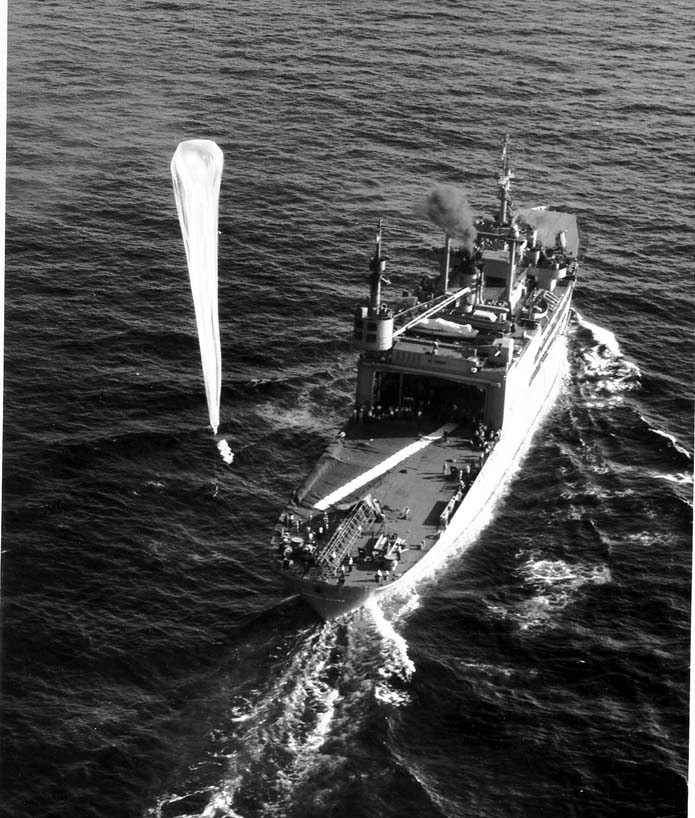
Pictured: the U.S. Navy research vessel USS Norton Sound launching a Skyhook balloon on March 31, 1949 (U.S. Navy/Office of Naval Research photograph, public domain) — the type of high-altitude balloon Donald Menzel proposed, without ever citing a confirmed matching launch log, as the explanation for the objects seen over Farmington eleven months later. This is not a photograph of the Farmington sighting itself. No verified photograph of the actual event is known to survive: the single "V-formation of saucers" image long and widely circulated online under the Farmington name has been traced by researcher David Marler to an unrelated 1950 Irish periodical, and this case file does not reproduce it. No usable rights-clear photograph specific to Farmington, New Mexico circa 1950 was located during this file's research; a real photograph of a Skyhook balloon — the case's own leading conventional-explanation candidate, discussed at length below — was used in its place rather than an unrelated modern stock image of the town.
Theoretical Alignment
Farmington's theoretical alignment sits closer to this catalogue's mundane end than its dramatic popular reputation might suggest. The Extraterrestrial Hypothesis reading draws genuine support from the sheer scale and geographic spread of independent, same-day corroboration — not one town but three, plus a U.S. Air Force flight line — and from specific, repeated behavioral details (right-angle turns, one object "flat then round," no vapor trail or engine sound) that several named witnesses insisted did not match any aircraft they knew. It is tempered heavily by the complete absence of radar, photographic, or physical evidence, and by an original newspaper account that itself documents high winds and a dust storm that morning. Interdimensional Hypothesis alignment is minimal: every account describes ordinary sunlit, reflective objects behaving within the visible sky, with nothing suggestive of another plane of existence. The Psycho-Social/Mundane reading carries substantial weight both because the visual behavior described — small, glinting, erratically tumbling objects at altitude, some appearing to change from flat to round — is a textbook signature of windblown light debris catching the sun, and because this case file's own research found that a specific, named conventional-explanation theory ("cotton fuzz") was floated locally within days, independent of and prior to the Air Force's own later Skyhook-balloon explanation.
Background
Farmington in March 1950 was a small, rural Four Corners town of 3,637 residents (per that year's federal census), its economy built on farming, ranching, and a nascent oil-and-gas industry that would not fully mature until later in the decade. It lay roughly 110 air miles northwest of the Los Alamos atomic weapons laboratory and within a day's drive of both the White Sands Missile Range and Holloman Air Force Base to the south — a stretch of New Mexico that, in the early Cold War, hosted an unusually dense concentration of classified rocket, radar, and high-altitude balloon activity. The town's remoteness and lack of any organized civilian UFO-research infrastructure at the time — the Aerial Phenomena Research Organization would not form until 1952, and NICAP not until 1957 — meant that, as researcher David Marler has observed, the case went "virtually uninvestigated" by any dedicated civilian body for decades after the fact, its record surviving almost entirely through contemporaneous newspaper coverage and the Air Force's own internal files.
The sighting broke less than three years after Kenneth Arnold's June 1947 sighting and the Roswell announcement-and-retraction, and squarely inside what early Blue Book chief Edward Ruppelt would later call, in his 1956 memoir, the "dark ages" of Air Force UFO investigation — the Project Grudge era, characterized by Ruppelt as institutionally hostile to taking sighting reports seriously, in contrast to the more open Project Sign period that preceded it and the Project Blue Book period that would follow from 1952 onward. It also arrived amid a specific and, with hindsight, awkward coincidence: Hollywood trade-paper columnist Frank Scully had published two sensational Variety columns in October and November 1949 claiming a flying saucer had crashed near Aztec, New Mexico — a town just sixteen miles northeast of Farmington — sourced to two confidence men later exposed as frauds; his book-length expansion of the claim, Behind the Flying Saucers, would appear in September 1950, six months after Farmington's own sightings, and go on to sell roughly sixty thousand copies before being thoroughly discredited. The Aztec story and the Farmington sightings are evidentially unconnected — different witnesses, different physical claims, different documentary trails — but their geographic and temporal proximity, and Scully's own later role in framing the Farmington case for a national audience (discussed at length below), have left the two events tangled together in the public imagination ever since.
Complete Timeline
| Date | Event |
|---|---|
| Dec. 9, 1949 | An earlier, separate Farmington sighting (AFOSI Case 158) is logged: an object seen dropping vertically at 1:30 p.m., described by the witness as resembling a red parachute or cargo net. |
| Oct.–Nov. 1949 | Frank Scully publishes two Variety columns claiming a crashed flying saucer was recovered near Aztec, New Mexico, 16 miles from Farmington — a claim later thoroughly discredited but already circulating nationally by the time of the events below. |
| March 16, 1950, 10–11 a.m. | The flap's first documented day (AFOSI Case 192): ten witnesses, including two U.S. Naval Reserve pilots, watch bright-aluminum, oval-to-oblong objects over Farmington for roughly 30 minutes. Garage employee Marlow Webb separately recalls seeing a formation from the Perry Smoak garage window this same day. |
| March 17, 1950, 9:15 a.m. | Tucumcari, New Mexico, roughly 180 miles east: a solitary saucer-shaped object is observed and documented in the Tucumcari Daily Times. |
| March 17, 1950, 10:15–10:35 a.m. | Farmington's main episode begins: 5–9 discs over Main Street; minutes later, "hundreds" west of town; a red object paired with two "revolving discs"; then three objects staging what witnesses called a daylight "dogfight." |
| March 17, 1950, 11:00–11:30 a.m. | A solitary saucer circles the town and departs with a sudden burst of speed; two metallic objects are seen, one moving fast, one stationary; a "swarm of hundreds" is reported, the red object again among them. |
| March 17, 1950, ~11 a.m.–noon | Named Farmington residents Clayton J. Boddy, Harold F. Thatcher, Johnny Eaton, Edward Brooks, John Bloomfield, and Marlow Webb all give on-the-record accounts to the Farmington Daily Times. Thatcher performs a rough triangulation; State Patrolman Andy Andrews separately floats a "cotton fuzz" theory that several residents, including Thatcher, deny. |
| March 17, 1950, 2:00 p.m. | A second large-scale sighting: a silvery, rectangular object with rounded ends moves west; a formation is reported to the north of town. |
| March 17, 1950, 3:00 p.m. | A "fleet of hundreds" is reported flying from the northeast to the southwest. Independently, at Kirtland Air Force Base, Albuquerque, three U.S. Air Force technical sergeants and a captain on the flight line see three objects move off toward the Sandia Mountains and officially report the sighting to Project Grudge. |
| March 17, 1950, later afternoon | A flyover of multiple unidentified objects is reported over Las Vegas, New Mexico; a second Tucumcari sighting includes a red "leader" object, echoing Farmington's own red object. |
| March 18, 1950 | The Farmington Daily Times publishes its front-page account, "HUGE 'SAUCER' ARMADA JOLTS FARMINGTON," describing sightings on "the third consecutive day"; the Santa Fe New Mexican ("Farmington 'Invaded' by Saucer Squadron") and the Las Vegas (NM) Daily Optic ("'Space Ships' Cause Sensation") run their own front-page stories the same day. |
| 1950 (later) | AFOSI's 17th District, based at Kirtland AFB, compiles case files on the Farmington sightings; per researcher David Marler's later FOIA-based review, the event is never listed in Project Blue Book's own official monthly sightings tally for March 1950. |
| 1953 & 1963 | Astronomer Donald Menzel publishes his Skyhook-balloon explanation for Farmington, first in Flying Saucers (1953) and at greater length, with co-author Lyle Boyd, in The World of Flying Saucers (1963). |
| c. 1968 | Atmospheric physicist James E. McDonald begins investigating the case, interviewing surviving witnesses and contacting the Office of Naval Research; an ONR contact named Dombroski reports finding no Skyhook balloon launch within two to three weeks of the Farmington sightings. |
| 2014 | David Marler files a Freedom of Information Act request and obtains previously redacted AFOSI documents, including additional witness names; he separately locates and re-interviews two surviving 1950 witnesses, including Marlow Webb. |
| 2026 | This case file is published, confirming the placeholder queue's March 17, 1950 date and "dozens of maneuvering discs" description while correcting its "two days" span to the documented three-day flap of March 16–18. |
Friday, March 17: A Town Looks Up
The Farmington Daily Times' own front-page account, published the following morning under the headline "HUGE 'SAUCER' ARMADA JOLTS FARMINGTON," remains the single richest surviving record of what happened, because it captured named, on-the-record witness statements within roughly a day of the sighting rather than relying on decades-later recollection. "Fully half of this town's population still is certain today that it saw space ships or some strange aircraft," the article reported, "hundreds of them zooming through the skies yesterday. Estimates of the number ranged from 'several to more than 500.'" The paper explicitly noted that "high winds and a dust storm prevented clear vision" that morning — a detail this case file's Conventional Explanation Candidate section below treats as directly relevant, not incidental color, since a dust storm is exactly the kind of atmospheric condition capable of lofting and scattering large volumes of light reflective debris.
Clayton J. Boddy, the 32-year-old business manager of the Farmington Times and a former U.S. Army Engineers captain who had served in Italy during the Second World War, was on a roadway when he noticed a few objects high in the sky. "Moments later there appeared what seemed to be about 500 of them," he told the paper, estimating their altitude at roughly 15,000 feet but declining to guess at their size or speed. His account was independently confirmed on the record by four more named residents: Joseph C. and Francis C. Kelloff, grocers visiting from Antonito, Colorado, who said the objects appeared to be flying in formation, and two additional Farmington residents who corroborated the same basic description.
The case's single most quoted piece of testimony came from Harold F. Thatcher, head of the Farmington unit of the U.S. Soil Conservation Service, who performed a rough scale-based triangulation on one of the objects: reasoning that if it were the size of a B-29 Superfortress, it would have been at an altitude of roughly 2,000 feet and traveling faster than 1,000 miles per hour. "I'm not a professional engineer," Thatcher told the paper, "but I have engineers working under me and I know how to work out rough triangulation on an object." This case file presents that figure honestly for what it is: a hypothetical scale calculation contingent on an assumed size, not a direct instrumented speed measurement, and one witness's own careful qualification of his methodology rather than an unqualified claim of precision.
Two garage employees at the Perry Smoak automotive garage on Main Street offered some of the sighting's most specific behavioral detail. Edward Brooks, 24, a wartime B-29 tail gunner, was adamant the objects were not aircraft: "The very maneuvering of the things couldn't be that of modern aircraft," he said. His coworker John Bloomfield described a speed roughly ten times that of a jet plane and a specific, repeated maneuver: objects "appeared to be coming at each other head-on. At the last second, one would veer at right angles upward, the other at right angles downward. One saucer would pass another and immediately the one to the rear would zoom into the lead." A third Smoak's garage employee, Marlow Webb, gave the sighting's most precise size estimate: objects appearing "about eight inches in diameter" from the ground, "about the size of a dinner plate," flying "sideways, on edge and at every conceivable angle" — a description, this file notes, of exactly the kind of tumbling motion that would make a flat, thin, lightweight object alternately present its full face and its knife-thin edge to an observer on the ground, catching and losing the sun's reflection as it turned.
Johnny Eaton, a 29-year-old real estate and insurance salesman, was, with Brooks, one of the first two to report the sighting's most distinctive single feature: a larger, faster, red-colored object that several witnesses agreed appeared to lead the others. "The object that has me puzzled was the one we saw that was definitely red," a later NICAP-preserved account attributes to Eaton. "It was seen by several and stated by all to be red and travelling northeast at a terrific speed." The same secondary account, drawing on physicist James E. McDonald's later research, separately identifies Eaton as a former U.S. Navy pilot and records his description of smaller objects that would "turn and appear to be flat, then turn and appear to be round" — independent confirmation, from a different research pass decades apart, of Webb's own "dinner plate," edge-on description.
A second, smaller episode followed that afternoon. At around 2:00 p.m., a formation was reported to the north of town, and a silvery, rectangular object with rounded ends was seen moving west. By 3:00 p.m., witnesses described a "fleet of hundreds" flying from the northeast toward the southwest — language the newspaper itself borrowed directly from residents' own reports rather than editorializing. In general, the paper noted, Farmington accepted the phenomenon calmly, though it reported that some women employees at a local laundry had become "somewhat panicky." No account collected by the paper described a vapor trail, engine noise, windows, or any other conventional aircraft marking on any of the objects.
Not Just Farmington: The Same Morning at Tucumcari, Las Vegas, and Kirtland AFB
What elevates the Farmington case above a purely local phenomenon, in this file's own assessment, is that its central day was not a single-town event. Roughly 180 miles east of Farmington, at Tucumcari, New Mexico, a solitary saucer-shaped object was independently observed and documented by the Tucumcari Daily Times at 9:15 that same morning — more than an hour before Farmington's own sightings began — with witnesses specifically noting they could identify it as saucer-shaped by the way it "tipped and moved" and by viewing it from different vantage points, a detail researcher David Marler has separately flagged as echoing language used independently by Farmington's own witnesses. Later that same day, Tucumcari reported a second flyover, this one including a red "leader" object — the same distinctive detail Eaton and Brooks had reported in Farmington hours earlier, seen by a wholly separate set of witnesses in a different town.
The single most institutionally significant corroboration, however, came from Kirtland Air Force Base in Albuquerque. At approximately 3:00 p.m. on March 17, three U.S. Air Force technical sergeants and a captain, standing on the flight line, watched three objects move off toward the northeast over the Sandia Mountains. Unlike the Farmington and Tucumcari sightings, which survive only through newspaper reporting, this sighting was significant enough that the personnel involved officially reported it up their own chain of command to Project Grudge — the Air Force's own contemporary UFO-investigation apparatus. This case file's own research was unable to locate the specific names of the sergeants or captain involved in any source consulted; they are presented here, honestly, as an unnamed but professionally credentialed and officially documented group, distinct from Farmington's civilian, named witnesses. Later that same afternoon, a further flyover of multiple unidentified objects was reported over Las Vegas, New Mexico, rounding out a pattern of independent same-day reports spanning several hundred miles of the state.
This case file's own research treats this multi-location pattern as a genuine, if soft, corroboration signal — several independently interviewed groups of people, in different towns, using broadly consistent descriptive language (formation flying, a red leader object, rapid directional changes) on the same day, without any indication of coordination between them. It falls well short of the instrumented cross-referencing this catalogue's stronger radar-visual cases provide, but it is a materially stronger pattern than a single town's account alone would be, and it is the primary reason this case file's own credibility assessment does not treat Farmington as a purely local social phenomenon.
Two Theories Born the Same Week: "Cotton Fuzz" and the Coming Skyhook Explanation
A detail frequently lost in later retellings of the Farmington case is that a specific, named conventional-explanation theory was floated locally within days of the sighting — well before Donald Menzel's later, more famous Skyhook-balloon claim, and entirely independent of it. New Mexico State Patrolman Andy Andrews quoted several Farmington residents as asserting that what they had seen was simply cotton fuzz floating in the air. Those same residents denied Andrews' report to the Farmington Daily Times, and Harold Thatcher personally and specifically rejected the theory as applied to his own sighting: "It was not cotton," he said. "I saw several pieces of cotton fuzz floating around in the air at the time, but I was not sighting on any cotton." This case file presents the cotton-fuzz theory honestly as a real, contemporaneous, locally-generated skeptical hypothesis — and equally honestly notes that it was specifically and personally disputed by at least one on-record witness at the time, not merely dismissed by later UFO proponents.
The dust-storm detail the newspaper itself reported that same morning sits adjacent to, but distinct from, the cotton theory: high winds capable of lofting cotton fuzz are equally capable of lofting any number of other light, reflective materials aloft — paper, foil, plant matter, or fragments of any of the many test balloons regularly launched from the White Sands–Holloman corridor to the south. This case file's own Conventional Explanation Candidate section below evaluates that broader windborne-debris candidate on its own terms, separate from both the specific cotton claim Thatcher rejected and the specific Skyhook-balloon claim Menzel would advance three years later.
Donald Menzel's Skyhook Claim and James McDonald's Rebuttal
The explanation that would come to dominate the case's later reputation belongs to Harvard astronomer Donald Menzel, first published in his 1953 book Flying Saucers and restated at greater length, with co-author Lyle Boyd, in the 1963 book The World of Flying Saucers. Menzel proposed that a Skyhook balloon — a type of high-altitude research balloon developed by General Mills and Otto C. Winzen and used extensively by the Office of Naval Research for cosmic-ray and atmospheric studies — had been launched that morning from Holloman Air Force Base near White Sands, ascended, and, in the cold atmosphere at roughly 60,000 feet, become brittle, burst, and disintegrated into hundreds of tiny pieces of plastic that drifted, "light as feathers, shining in the sunlight," over Farmington and away. It is a specific, physically coherent mechanism, and this case file takes it seriously as the leading named skeptical account rather than a strawman: Skyhook balloons genuinely could reach diameters exceeding 100 feet, genuinely were prone to embrittlement and bursting at extreme altitude, and Holloman genuinely was, per this site's own separately researched location profile, "the prime U.S. Skyhook balloon launch site" of the era.
The explanation has two disclosed problems, both surfaced by this case file's own two-pass research rather than smoothed over. First, Menzel's own account addresses only the events of Friday, March 17 — he does not address the March 16 sightings that preceded it or the continuing reports on March 18 that the Farmington Daily Times' own headline explicitly describes as "the third consecutive day." A single burst balloon, however dramatic, does not on its own account for three separate days of reported activity. Second, and more directly, physicist James E. McDonald — a senior atmospheric physicist at the University of Arizona whose skeptical rigor this site's own key-figures profile separately credits with rejecting one of Menzel's other proposed explanations, for the 1952 Nash-Fortenberry sighting, as "an almost entirely ad hoc assumption" — investigated the Farmington case directly around 1968. According to his own handwritten investigative notes, later obtained by researcher David Marler from the University of Arizona archives, McDonald contacted a Navy Office of Naval Research employee he recorded only by the surname Dombroski, who reviewed the ONR's own Skyhook launch records and found none within two to three weeks of the Farmington sightings; the nearest launch on record had lifted off from Minnesota and terminated over Michigan, nowhere near New Mexico.
This case file's own assessment treats McDonald's finding as a genuine, credentialed rebuttal to the specific claim that a Navy Skyhook balloon launched that morning from Holloman was responsible — not as a rebuttal of windborne debris or high-altitude balloon fragments in general, a broader category of explanation this file's Conventional Explanation Candidate section addresses on its own terms below. No source consulted for this case file could independently confirm or further refute Dombroski's account beyond Marler's own transcription of McDonald's notes; this file discloses that limitation rather than treating either side of the dispute as conclusively settled.
The Photograph That Isn't
A striking black-and-white photograph purporting to show a V-formation of six disc-shaped objects against a cloudy sky has circulated online for years under the Farmington name, sometimes captioned with the March 17, 1950 date and even a purported 10:15 a.m. sighting time. Researcher David Marler's own archival work has traced this specific image to an entirely different source: an original news teletype glued to the back of his own period copy shows it was first published, in March 1950, in a small, short-lived Dublin, Ireland periodical called the Teenage Times — the same month and year as the Farmington sightings, a coincidence Marler describes as "ironic" rather than causal. Marler's research further notes that period weather accounts describe Farmington's skies that day as clear with only a slight scattering of cirrus cloud, while the widely circulated photograph clearly shows cumulus clouds in the background — a mismatch inconsistent with the location and time the image is usually captioned with. This case file accordingly does not reproduce that photograph and does not treat it as evidence of any kind for the Farmington sightings; its continued circulation under the Farmington name is, in this file's own assessment, a real and disclosed liability for the case's popular reputation, wholly separate from the on-the-record newspaper testimony of Boddy, Thatcher, Eaton, Brooks, Bloomfield, and Webb, none of whom is known to have claimed any photograph was taken.
Frank Scully, the Aztec Hoax, and the Case's Popular Reputation
Frank Scully's role in the Farmington story is entirely secondary and promotional rather than evidentiary, but it is a real, disclosed thread in how the case reached and has been remembered by a national audience. Menzel's own 1963 account of Farmington quotes, without independent verification, a florid description of the sighting as "the greatest exhibition of magnetic flight that has ever happened in this universe" — a line Menzel's own endnotes attribute directly to Scully's 1951 book Behind the Flying Saucers, page 144. Scully is the same author whose October–November 1949 Variety columns and subsequent book promoted the crashed-saucer story centered on Aztec, New Mexico, sixteen miles from Farmington, sourced to two men later exposed as confidence artists posing as scientists — a story long and thoroughly discredited within UFO research itself, including by researchers otherwise sympathetic to the phenomenon. That Scully's own dramatic framing of Farmington's very real, independently documented newspaper sightings entered the historical record via the same author responsible for one of the era's most notorious hoaxes is, in this file's own judgment, a legitimate reason for caution about the case's popular narrative — without in any way implicating Boddy, Thatcher, Eaton, Brooks, Bloomfield, Webb, or any of the other named, on-the-record Farmington witnesses themselves, none of whom is connected to Scully, Aztec, or the confidence men behind that separate hoax.
Absent From the Ledger: Blue Book's Non-Listing and the AFOSI Paper Trail
One of the more genuinely puzzling features of the Farmington case, surfaced by David Marler's own 2014 FOIA-driven archival research, is a real institutional contradiction: despite three days of broad-daylight sightings reported by hundreds of witnesses across multiple towns, Farmington does not appear in Project Blue Book's own official monthly tally of sightings for March 1950. It was only by digging further into the underlying paper trail — redacted Air Force Office of Special Investigations forms specific to the Farmington incident — that Marler confirmed the case had, in fact, been investigated at the AFOSI level (specifically AFOSI's 17th District, based at Kirtland Air Force Base), with those redacted forms preserved on Project Blue Book's own microfilm (Roll 91). His 2014 FOIA request for the unredacted versions succeeded, yielding additional witness names not present in the previously public record.
This case file's own assessment cannot fully resolve why a sighting this large went untallied while a formal AFOSI investigation file nonetheless exists; either explanation carries real evidentiary weight, and this file discloses both rather than picking one. It may reflect the specific institutional bias Edward Ruppelt himself later described in the Project Grudge era — a period he characterized as actively hostile to taking UFO reports seriously, in which a case judged unresolvable might simply be omitted from a public-facing tally while its underlying paperwork was quietly retained. Or it may simply reflect that Blue Book's monthly tallies were, as an administrative practice, an imperfect and incomplete index of the files the Air Force actually held, independent of any specific intent regarding Farmington. What is documented, and not in dispute, is that a real AFOSI investigative record exists, survives on Blue Book's own preserved microfilm, and was substantial enough that redaction and a formal FOIA process were both required to fully access it decades later.
Untangling the Placeholder: Two Days or Three?
This case file was commissioned to replace a "Coming Soon" queue placeholder titled "Farmington Saucer Armada," dated March 17, 1950, and described as "dozens of maneuvering discs are reported over two days in one of the best-attested mass sightings of the early saucer era." Two-pass research for this file confirms the placeholder's date and its "dozens of maneuvering discs" description are both accurate and well supported — the March 17 date matches every primary newspaper account located, and "dozens" is, if anything, a conservative summary of witness estimates that ranged as high as 500 objects. The "over two days" span, however, does not match the documentary record this file was able to locate. The Farmington Daily Times' own March 18 front-page story explicitly describes the sightings as occurring on "the third consecutive day," and the underlying AFOSI file (Case 192) independently dates the flap's first documented episode to March 16, the day before the placeholder's own anchor date. This file corrects the span to the documented three days — March 16 through March 18, 1950 — while retaining March 17 as the single largest and best-documented day, consistent with the placeholder's own chosen anchor date. Separately, Wikipedia's own brief entry on Farmington dates "the mass UFO sighting" itself to March 18 — almost certainly a reference to the date the story broke into print nationally, describing the events of "yesterday" (March 17), rather than a claim that the sightings themselves began on the 18th; this file treats the primary AFOSI and newspaper dating as authoritative over that secondary encyclopedia entry.
Key Witnesses
Clayton J. Boddy
A 32-year-old WWII veteran who watched roughly 500 objects, by his own estimate, pass overhead at approximately 15,000 feet. His account was independently confirmed on the record by four additional named residents, including two visiting Colorado grocers.
Harold F. Thatcher
Performed the sighting's only recorded triangulation attempt, and personally, specifically rejected State Patrolman Andy Andrews' contemporaneous "cotton fuzz" theory as applied to his own observation.
Johnny Eaton
One of the first two witnesses, alongside Edward Brooks, to report the sighting's distinctive red "leader" object. A later secondary account credits him as a former Navy pilot who described objects turning "flat then round."
Edward Brooks
Drew directly on his own wartime aircrew experience to assert the objects' maneuvering "couldn't be that of modern aircraft" — one of this case's few witnesses with direct aviation training.
Marlow Webb
Gave the sighting's most precise size estimate ("about the size of a dinner plate," flying "on edge") and, uniquely among this case's witnesses, was re-located and re-interviewed by researcher David Marler roughly 64 years later, still affirming his original account.
John Bloomfield
Described the objects' speed as roughly ten times that of a jet plane and a specific, repeated right-angle-turn maneuver as pairs of objects appeared to pass and overtake one another. No source consulted for this case file preserves further biographical detail; no key-figures profile has been created for this name pending further corroborating detail.
Andy Andrews
Originated the same-week "cotton fuzz" theory, later denied by the residents he quoted and specifically rejected by Harold Thatcher — a real, contemporaneous, locally sourced skeptical hypothesis distinct from Donald Menzel's later Skyhook-balloon claim.
Three Technical Sergeants & a Captain, Kirtland AFB
Unnamed in any source consulted for this case file, these four Air Force personnel observed three objects from the flight line at approximately 3 p.m. on March 17 and officially reported the sighting to Project Grudge — this case's only sighting reported through a formal military channel at the time it occurred.
The Five Observables Assessment
Assessment: Anti-Gravity Lift is rated Present on the strength of one specific report — two metallic objects seen at 11 a.m., one moving fast, one held stationary — though this rests on a single witness account rather than instrumented confirmation. Instant Acceleration is rated Present: multiple independent witnesses across the day described objects departing "with a sudden burst of speed" or executing abrupt right-angle turns. Hypersonic is rated Speculative rather than Present because the case's only speed figure — Harold Thatcher's roughly 1,000 mph estimate — is explicitly a hypothetical, scale-based triangulation ("if it had been a B-29"), not a measured value from any instrument; this file declines to round that qualified estimate up to a firm Present rating. Low Observability is rated Absent in the strongest terms this catalogue applies anywhere: far from evading detection, these objects were seen by an estimated several hundred to over a thousand people across four towns in broad daylight. Trans-Medium is rated Absent, as no transition into water, ground, or space was reported by any witness.
Evidence Assessment
Supporting Anomalous Origin
- An unusually large number of named, on-the-record witnesses — at least nine identified individuals in Farmington alone, plus hundreds more unnamed — gave broadly consistent same-day accounts to a contemporaneous newspaper rather than a decades-later recollection
- Independent, same-day corroboration from three separate locations (Farmington, Tucumcari, and Kirtland Air Force Base) roughly 100–180 miles apart, with no indication the witness groups coordinated
- Specific, repeated behavioral details — a distinctive red "leader" object, right-angle turns, an object described as alternating between flat and round — recur independently across witnesses in different towns
- Four U.S. Air Force personnel at Kirtland AFB considered their own sighting significant enough to officially report it to Project Grudge at the time, rather than merely discussing it informally afterward
- Several witnesses with direct relevant expertise — a wartime B-29 tail gunner, a former Navy pilot, an Army Engineers captain — specifically asserted the objects' behavior did not match any aircraft they recognized
Supporting Conventional Explanation
- The Farmington Daily Times' own contemporaneous account documents high winds and a dust storm that morning — conditions well suited to lofting and scattering light, reflective debris over a wide area
- The sighting's visual behavior — small, glinting objects tumbling between a "flat" and "round" appearance — is a textbook description of thin, reflective material catching sunlight while turning in the wind, independently reported by witnesses in two different towns using nearly identical language
- The case's only quantitative speed and altitude estimate (Harold Thatcher's ~1,000 mph figure) is an explicitly qualified, scale-based hypothetical rather than a direct measurement
- No radar, photographic, or physical trace evidence of any kind survives; the single photograph long associated with the case has been traced by independent research to an unrelated 1950 Irish publication
- A locally sourced "cotton fuzz" debris theory was floated within days of the sighting itself, independent of any later, more famous skeptical explanation, showing observers at the time already considered windborne material a live possibility
Why "Disputed"
This case earns a DISPUTED classification with a credibility score of 47/100. That places it below this catalogue's Fort Worth AFB Sighting (Disputed, 60), whose triple-radar corroboration this catalogue treats as a materially stronger evidentiary category than uninstrumented eyewitness testimony however numerous, and roughly in the same band as its Thomas Mantell anchor case (Disputed, 38) and above it, reflecting Farmington's genuinely rare multi-location, same-day corroboration — a real evidentiary strength Mantell's single-witness, single-location case lacks entirely.
What keeps this case from scoring higher is the near-total absence of anything beyond eyewitness testimony: no radar, no photograph, no physical trace, and a widely circulated but independently debunked image that this file's own research confirms does not belong to this event at all. The case's own conventional-explanation candidates are unusually well developed and, in this file's own judgment, unusually well matched to the reported visual behavior — a documented dust storm, a locally sourced cotton-fuzz theory floated within days, and a later, more famous but genuinely disputed Skyhook-balloon claim all point toward some form of windborne debris as at least a partial explanation for at least some of what was seen, even though physicist James McDonald's own investigation found no matching Skyhook launch record for the specific claim Donald Menzel advanced. Weighed against that is the case's real strength: not one town's hysteria but three separate locations' independent, same-day, broadly consistent reports, including one reported through an official U.S. Air Force channel at the time. A case this large in sheer witness count, this well corroborated across independent locations, and yet this thin in instrumented or physical evidence, sitting atop conventional-explanation candidates this well matched to the reported visual behavior, is exactly the profile this site's "Disputed" rating in the lower-middle of its range exists to describe.
Sensor & Instrumentation Detection Profile
No radar, camera, or other instrument of any kind is documented to have recorded any part of the March 1950 Farmington sightings. This case file's research was unable to locate any surviving contemporaneous radar log for the sighting, despite the region's genuine Cold War-era radar buildout further south around White Sands and Holloman; David Marler's own research separately confirmed the existence of a period radar installation at El Vado, New Mexico whose theoretical coverage area included Farmington, but he was unable to locate any surviving radar data from that installation for this specific date, and this case file's own research corroborates that gap rather than filling it. Every element of this case rests on unaided human vision — hundreds of individual observers across four towns, but no instrumented cross-check of any kind.
Environmental & Geospatial Context
Farmington sits in the Four Corners region of northwestern New Mexico, in relatively open, semi-arid terrain well suited to unobstructed daytime sky viewing. The single most significant documented environmental detail is the Farmington Daily Times' own contemporaneous note that "high winds and a dust storm prevented clear vision" on the morning of March 17, 1950 — a detail this case file weighs heavily in its Conventional Explanation Candidate analysis below, since dust-storm conditions are specifically capable of lofting light debris to considerable altitude and scattering it widely, exactly the geographic pattern (Farmington, Tucumcari, Las Vegas, and Kirtland AFB, roughly along a west-to-east and southeast axis) this sighting displayed. Geospatially, Farmington's proximity to the dense Los Alamos–White Sands–Holloman corridor of classified Cold War research activity, roughly 110 to 150 air miles to the south and east, places it within a region that saw an unusually high volume of test-balloon, rocket, and aircraft activity throughout this period, providing a plausible non-Skyhook-specific source for windborne test debris even though this case file's own research could not identify a specific matching program or launch for March 1950.
Observer Credibility & Occupational Profile
Farmington's witness roster is unusually broad rather than deep: no single witness held a specialized aerial-observation role comparable to a radar operator or air traffic controller, but several brought directly relevant expertise to their own accounts. Edward Brooks' wartime service as a B-29 tail gunner gave him direct, professional familiarity with large aircraft silhouettes and maneuvering profiles, which he explicitly invoked in rejecting a conventional-aircraft explanation for what he saw. Johnny Eaton's reported background as a former Navy pilot carries similar weight, if less directly documented in the primary 1950 clipping than in the later secondary account crediting it to him. Clayton Boddy's wartime service as an Army Engineers captain and Harold Thatcher's professional engineering-adjacent role at the Soil Conservation Service both lend a measure of technical literacy to their specific, qualified claims (Boddy's altitude estimate, Thatcher's triangulation), though neither held any aviation-specific training.
Set against this is a real, disclosed limitation: none of Farmington's witnesses held a professional aerial-observation role, and the case's only officially reported military sighting — the Kirtland AFB flight-line observation — survives with no names at all in any source this case file's research could locate. This file treats the Farmington witnesses' collective, if informal, technical and wartime-aviation backgrounds as a genuine positive signal, while disclosing plainly that this case lacks the kind of specialized, on-duty aerial-observation training this catalogue's stronger radar-visual cases can point to.
Physical & Material Assays
No physical trace evidence of any kind survives from this case. No object was reported to land, and no debris, fragment, or material sample was recovered or is claimed to exist in any source consulted for this case file. This is itself informative given the case's own leading conventional-explanation candidates: if genuine balloon or debris fragments had drifted to the ground anywhere along the reported flight paths, no surviving record of anyone recovering or examining such material was located during this file's research, despite the scale of public attention the sighting received at the time.
Historical Precedents & Archive Matches
This case's most direct local precedent is its own immediate predecessor: an earlier, separate Farmington sighting on December 9, 1949 (AFOSI Case 158), in which a single witness reported an object dropping vertically, described as resembling a red parachute or cargo net — a distinct event this file does not attempt to fold into the March 1950 flap, but one establishing that Farmington's own airspace had already drawn at least one prior AFOSI investigation within the same few months. More broadly, this case sits within the same early-1950s pattern of New Mexico military and civilian UFO reporting this catalogue documents elsewhere, including the December 1948 Los Alamos-area "green fireballs" wave investigated by astronomer Lincoln La Paz and the March 17, 1950 AFOSI green-fireball-adjacent sightings independently logged at Los Alamos the very same day as Farmington's own main episode — a coincidence of date this file's own research could not establish any causal connection for, but records honestly rather than omitting.
The case's most consequential precedent, however, is reputational rather than evidentiary: the 1948 crashed-saucer story centered on Aztec, New Mexico, sixteen miles from Farmington, later promoted nationally by Frank Scully and long since discredited as a hoax perpetrated by two confidence men. As discussed at length above, the two events are evidentially unconnected, but their shared geography and Scully's own later framing of the Farmington sightings have left them entangled in the public record ever since — a pattern this file discloses explicitly rather than allowing the association to pass unremarked.
Material Analysis
There is no physical object, debris, or trace sample connected to this case that survives for analysis. "Material" here instead refers to the case's actual surviving evidentiary substrate: the contemporaneous newspaper record, the Air Force's own AFOSI case files preserved on Project Blue Book microfilm, and researcher David Marler's own later FOIA-obtained supplementary documents, since that documentary record is the only tangible material this case file's research was able to assess.
The Surviving Documentary Record
The core of this case's paper trail runs through two independent channels that corroborate each other's basic facts: the contemporaneous local and regional press (the Farmington Daily Times, Santa Fe New Mexican, Las Vegas Daily Optic, and Tucumcari Daily Times), and the Air Force's own AFOSI 17th District investigation, preserved on Project Blue Book Microfilm Roll 91 and partially declassified, with additional material obtained only via David Marler's 2014 Freedom of Information Act request. That the AFOSI investigation exists at all, despite Farmington's absence from Blue Book's own official monthly tally, is itself a notable feature of this case's documentary record, discussed at length above.
What Does Not Survive
No photograph, film, or physical trace of any object is known to exist in any archive consulted for this case file. The one photograph long and widely associated with the case — a V-formation of six discs against a cloudy sky — has been independently traced by David Marler to an unrelated 1950 Irish publication and is not treated as evidence by this file. No surviving radar data for the sighting was located, despite a period radar installation at El Vado, New Mexico whose theoretical coverage area included Farmington. This case file's own research also could not independently verify several of researcher David Marler's own broader claims about the wider 1950 wave (reported sightings as far afield as San Antonio, Dallas, and Mexico City during the same general period) beyond his own on-record statements; those broader claims are presented in this file, where mentioned, as Marler's own research findings rather than this file's independently confirmed facts.
Supporting Non-Terrestrial or Unexplained Origin
- Independent, same-day corroboration across three separate locations roughly 100–180 miles apart, including one officially reported U.S. Air Force sighting
- A specific, structured, and repeated behavioral description (a red leader object, right-angle turns, objects turning from flat to round) recurring across independently interviewed witnesses in different towns
- Several witnesses with direct relevant wartime aviation or engineering backgrounds specifically rejected a conventional-aircraft explanation for what they personally observed
Supporting Terrestrial or Mundane Origin
- A dust storm and high winds are independently documented in the original newspaper account for the exact morning of the sighting
- No radar, photographic, or physical trace evidence of any kind survives, and the case's one circulated photograph is independently confirmed to be misattributed
- The case's only quantitative speed/altitude figure is an explicitly qualified, hypothetical, scale-based estimate rather than a direct measurement
The Conventional Explanation Candidate (CEC): Windborne Debris in a Dust Storm
Every credible conventional-explanation candidate for this case converges on some form of light, reflective material carried aloft and scattered by wind — a category directly supported by the Farmington Daily Times' own contemporaneous documentation of high winds and a dust storm on the morning in question. This file evaluates the three specific, named versions of that broader theory that this case's own documentary record preserves, plus the possibility that at least some of what was seen resists that explanation entirely.
Donald Menzel's Skyhook Balloon Claim
Menzel's specific proposal — a Navy Skyhook balloon launched that morning from Holloman Air Force Base, bursting at 60,000 feet into hundreds of drifting plastic fragments — is physically coherent and matches the reported visual behavior (small, glinting, erratically tumbling objects) unusually well. It is directly undermined, however, by James McDonald's own investigation, which found no Skyhook launch on ONR's own records within two to three weeks of the Farmington sightings, and it does not address the sightings' documented three-day span, since Menzel's own account discusses only March 17.
Andy Andrews' Cotton-Fuzz Theory
A same-week, purely local theory attributing the sightings to floating cotton fuzz, quoted by a state patrolman from several residents who then denied making the claim, and specifically and personally rejected by Harold Thatcher, who distinguished the cotton fuzz he could see from what he was actually triangulating on. This candidate is weakly supported at best: the one witness who directly addressed it denied it applied to his own sighting, though this file cannot rule out that it may have applied to some other witnesses' more distant or briefer observations.
Generalized Windborne Debris in a Documented Dust Storm
Distinct from either named theory above, this file's own research notes that the newspaper's own documented dust-storm conditions are, on their own terms, sufficient to loft and scatter any number of light reflective materials — paper, foil, plant matter, or fragments from any of the numerous other balloon, rocket, or aircraft tests regularly conducted in the nearby White Sands–Holloman corridor, independent of the specific Skyhook claim McDonald rebutted. This broader candidate is not refuted by McDonald's Skyhook-specific finding, and it is the reading this file's own research finds best matches the visual behavior repeatedly described (flat-then-round tumbling, a red "leader," right-angle-appearing turns consistent with a light object caught by gusting wind) without requiring any single specific, confirmed launch event.
Genuine Unconventional Aerial Phenomenon
This reading remains open, chiefly on the strength of the case's independent, same-day, multi-location corroboration — a genuinely rare pattern for a purely visual mass sighting — and several witnesses' direct, expertise-informed insistence that the behavior did not match any aircraft they recognized. It is weighed down by the total absence of radar, photographic, or physical evidence; by documented weather conditions well suited to the mundane debris explanations above; and by this case's disclosed entanglement with a debunked photograph and a discredited promotional author, neither of which reflects on the on-record witnesses but both of which complicate the case's popular reputation as evidence of something extraordinary.
Menzel's Skyhook Balloon Claim
ImplausibleIMPLAUSIBLE as stated. James McDonald's own ONR-sourced investigation found no matching Skyhook launch within weeks of the sighting, and Menzel's account does not address the documented three-day span of the flap.
"Cotton Fuzz" Theory
ImplausibleIMPLAUSIBLE as a complete explanation. The one witness who directly addressed the claim, Harold Thatcher, specifically and personally denied it applied to his own sighting.
Generalized Windborne Debris / Dust Storm
PlausiblePLAUSIBLE, at least in part. Independently documented dust-storm and high-wind conditions that morning, plus a repeated flat-then-round tumbling description, match a light reflective object caught by gusting wind unusually well, without depending on any single confirmed launch event.
Genuine Unconventional Aerial Phenomenon
InconclusiveINCONCLUSIVE. Supported by rare, independent, same-day, multi-location corroboration and several witnesses' expertise-informed rejection of a conventional explanation, but weighed down by the total absence of instrumented or physical evidence and by documented weather conditions well suited to a mundane account.
Related Cases
Confirmed Documents & Official Records
NARA's own guide to the declassified Project Blue Book records (Microfilm Publication T1206), which hold the AFOSI case files (Cases 191–192, Blue Book Roll 91) underlying this case.
DECLASSIFIEDThe CIA's own declassified-document collection on UFOs, covering the same early-1950s period as this case and the government's early institutional response to the post-Roswell reporting wave.
DECLASSIFIED (various)This case file's research could not obtain a directly legible primary-source image of the underlying AFOSI Case 191/192 files itself; the specific figures and quotations presented above are drawn from the NICAP-hosted transcription of the AFOSI 17th District summary, the Brad Sparks Blue Book Unknowns catalog's own entry #344 (citing Blue Book Microfilm Roll 91, pp. 385–6, 392–3, 469–470), and researcher David Marler's own 2014 FOIA-obtained supplementary documents, rather than from this case file's own independent examination of the original microfilm frame images.
Search Government & Military Archives Directly
Further Reading — Recommended Literature
The Report on Unidentified Flying Objects: The Original 1956 Edition
Written by the first head of Project Blue Book, this is the definitive insider account of the Project Grudge "dark ages" era this case file dates the Farmington sighting to, and of the investigative apparatus that left it out of Blue Book's own monthly tally.
Behind the Flying Saucers: The Truth About the Aztec UFO Crash
An annotated modern reprint of Scully's original 1950 bestseller, the primary source for the dramatic "greatest exhibition of magnetic flight" framing this case file traces through Donald Menzel's own 1963 account, presented alongside modern critical commentary.
The Aztec UFO Incident
A detailed modern investigation of the discredited 1948 Aztec, New Mexico crashed-saucer hoax that this case file's own research found tangled up with Farmington's popular reputation, sixteen miles and roughly two years apart.
The UFO Encyclopedia, 4th Edition (2-Volume Set)
The standard comprehensive reference for cataloged UFO cases, useful for situating Farmington's own multi-town, three-day pattern within the broader documented wave of early-1950s American mass sightings.
Watch the Skies!: A Chronicle of the Flying Saucer Myth
A rigorously researched, skeptically inclined cultural history of American UFO reporting, useful context for evaluating both Donald Menzel's Skyhook claim and Frank Scully's promotional role in this case's popular legacy.
Essential Viewing
Sources
- "HUGE 'SAUCER' ARMADA JOLTS FARMINGTON." Farmington Daily Times, March 18, 1950. Reproduced at ufologie.patrickgross.org
- NICAP. "The Nuclear Connection Project: The New Mexico Sightings" (AFOSI Cases 191–192, March 16–17, 1950, Farmington, NM, citing James E. McDonald's 1968 research). nicap.org
- Sparks, Brad. Comprehensive Catalog of Project Blue Book UFO Unknowns, entry #344, March 16, 1950, Farmington, New Mexico (citing Blue Book Microfilm Roll 91, pp. 385–6, 392–3, 469–470; McDonald 1968). cisu.org
- KRQE News 13 / Mystery Wire. "Farmington UFO Armada: possibly the largest UFO event you've never heard about" (interview with researcher David Marler by George Knapp). krqe.com
- Menzel, Donald H., and Lyle G. Boyd. The World of Flying Saucers (1963), "Plastic UFOs and the 'Stack of Coins'" chapter, on the Farmington Skyhook-balloon explanation. gutenberg.org
- Wikipedia. "Farmington, New Mexico" (1950 population and mass-sighting summary). en.wikipedia.org
- Wikipedia. "Aztec crashed saucer hoax." en.wikipedia.org
- Wikipedia. "Skyhook balloon." en.wikipedia.org
- Wikimedia Commons. "File:USS Norton Sound (AV-11) launches a Skyhook balloon on 31 March 1949.jpg," Office of Naval Research/U.S. Navy photograph (public domain), source of this case file's hero image. commons.wikimedia.org
- U.S. Census Bureau. 1950 Census of Population, New Mexico (Farmington population figure). census.gov
- National Archives and Records Administration. "Project BLUE BOOK: Unidentified Flying Objects." archives.gov
- Central Intelligence Agency. FOIA Reading Room, "UFOs: Fact or Fiction?" collection. cia.gov
- National Archives, Unwritten Record Blog. "Aliens at the Archives" (Project Blue Book holdings overview). unwritten-record.blogs.archives.gov
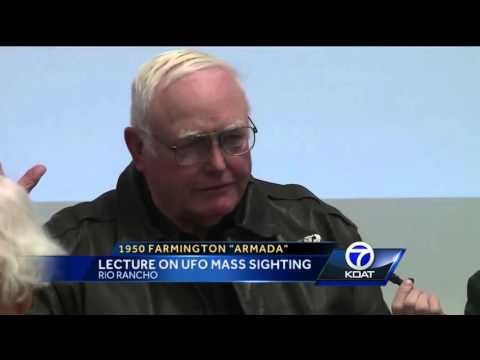
- KOAT-TV Albuquerque. "Lecture on UFO Mass Sighting" (YouTube, Dec. 2015). youtube.com
- This site's own key-figures profile of James E. McDonald, on his separate rejection of a different Donald Menzel explanation (the 1952 Nash-Fortenberry sighting) as "an almost entirely ad hoc assumption." The Omni Ledger
- This site's own location profile of Holloman Air Force Base, identifying it as "the prime U.S. Skyhook balloon launch site" of the era. The Omni Ledger
- Ruppelt, Edward J. The Report on Unidentified Flying Objects (1956).
- Scully, Frank. Behind the Flying Saucers (1950; annotated reprint 2009).
- Ramsey, Scott, Suzanne Ramsey, and Frank Thayer. The Aztec UFO Incident (2016).
- Clark, Jerome. The UFO Encyclopedia, 4th ed. (2 vols.).
- Peebles, Curtis. Watch the Skies!: A Chronicle of the Flying Saucer Myth.
See something inaccurate? Have additional information or sources?
Suggest an Edit →Last Updated: August 2026