
The Dalnegorsk Height 611 Crash
On the night of January 29, 1986, more than a hundred residents of Dalnegorsk, a remote lead-zinc mining town in the Soviet Far East, watched a luminous reddish-orange sphere cross the sky, "jerk" as if faltering, and descend onto a nearby hillside known locally as Height 611 (Mount Izvestkovaya), where it burned for close to an hour. Days later, field investigator Valeri Dvuzhilny of the regional Far Eastern Committee for Anomalous Atmospheric Phenomena climbed the hill and collected an odd assortment of physical evidence — fine metallic mesh, glassy lead-bearing beads, and scorched rock and vegetation — that he then routed through a genuinely unusual channel for Soviet-era ufology: not a single lab, but a chain of roughly eleven research institutes and three academic centers of the USSR Academy of Sciences. Some of those analyses returned findings their own authors called anomalous — elements that seemed to disappear and reappear under vacuum heating, a mesh structure some specialists could not identify as any known industrial or natural process, and gold concentrations far beyond anything economically present in local ore. Other analyses cut the other way: a lead isotope signature traced to a real, known Siberian ore deposit hundreds of miles away, and a hands-on 1990 examination by the skeptical French-American scientist Jacques Vallée that concluded the material was "an ordinary piece of human technology." Nicknamed "the Soviet Roswell" in the Western press once journalist George Knapp brought samples out of Russia in the 1990s — some of which are now displayed at the National Atomic Testing Museum in Las Vegas — Dalnegorsk remains a genuinely contested case: real witnesses, a real, sustained state-scientific investigation, and, thirty-plus years on, no explanation for either the aerial phenomenon or every detail of the recovered material that has satisfied everyone who has examined it.
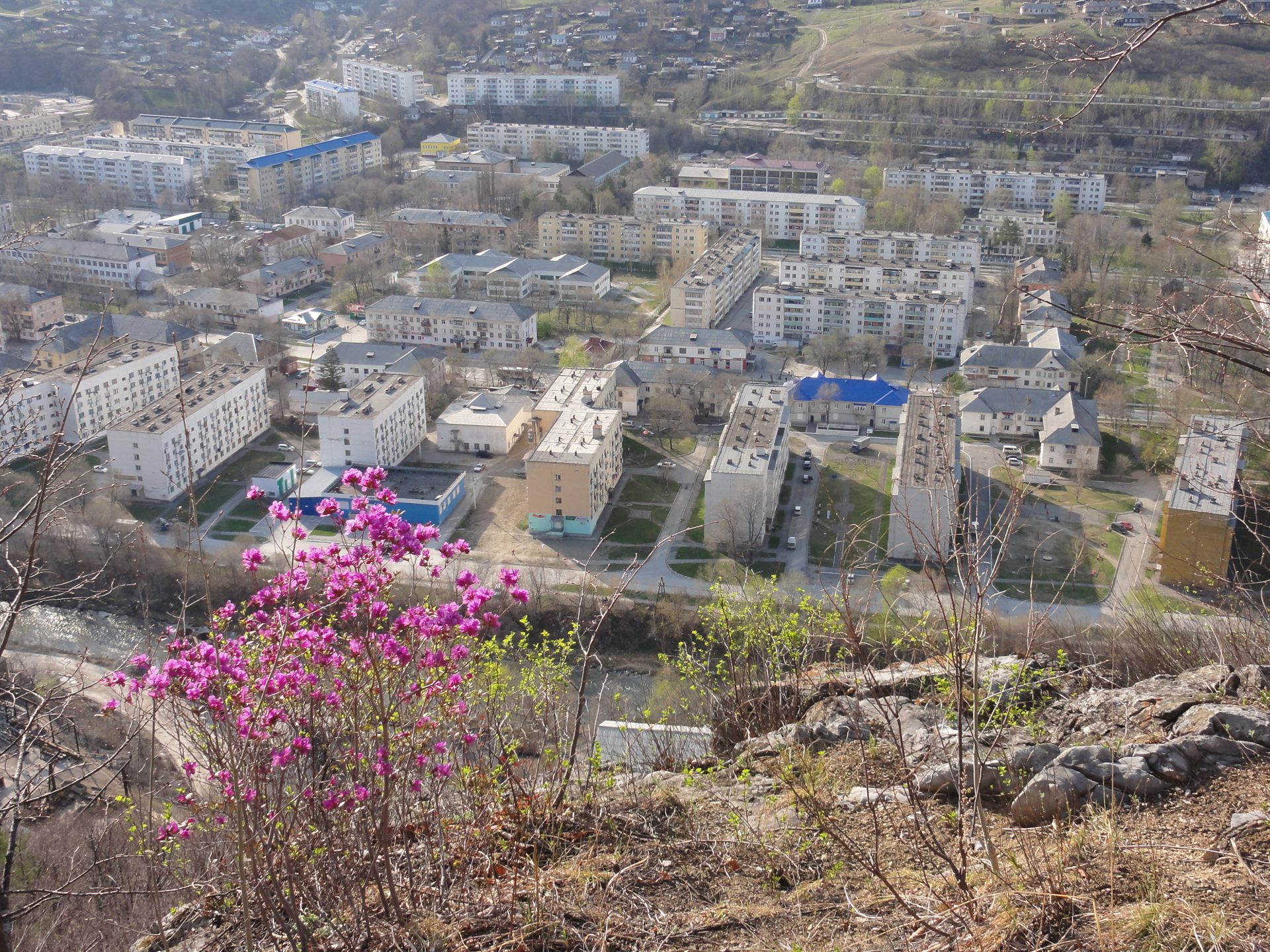
Pictured: the central district of Dalnegorsk, Primorsky Krai, in springtime — not a photograph of the actual January 29, 1986 object, the crash site on Height 611, or the recovered material itself. No verified, freely licensed photograph of the event or the debris in the field is known to exist; the only widely circulated crash-site images online are unverified stock photography and screen captures from later documentary footage, none suitable for this file under its sourcing standard. This image instead documents the real town more than a hundred of whose residents witnessed the object that night.
Theoretical Alignment
Dalnegorsk earns a real, if modest, Extraterrestrial Hypothesis alignment not because any craft, occupant, or intelligent maneuver was ever documented, but because a genuine, multi-institute material analysis chain produced findings — the apparent disappearance and reappearance of elements under vacuum heating, an unidentified glass-carbon mesh structure, anomalous gold concentrations — that several credentialed Soviet specialists were, on the record, unable to explain by any process known to them at the time. That is a materially different starting point than a purely visual sighting. The Psycho-Social score reflects the genuine difficulty of separating what more than a hundred townspeople actually saw from what the story became after a decade of Soviet and then Western press coverage, contactee-adjacent embellishment, and Cold War-era institutional distrust on both sides of the analysis; it is not a claim that the crowd hallucinated. The Interdimensional Hypothesis finds essentially no support: nothing in the record describes a transition, portal, or reality-shift effect, only a falling luminous object and its recovered debris.
Background
Dalnegorsk was founded in 1897 as Tetyukhe, a lead and zinc mining settlement established under a concession to the Swiss-Russian industrialist Julius Brýner — whose grandson, born in the same town decades later, would become the Hollywood actor Yul Brynner. Renamed Dalnegorsk in 1973 as part of a broader Soviet effort to replace Chinese-derived place names in the Far East, the town remained, through the Soviet period, a remote, heavily industrial company town organized around its lead-zinc-boron mines and smelters, the Dalpolimetall and Bor combines, isolated by the Sikhote-Alin range from the region's larger cities. It was not, on paper, a plausible setting for the Soviet Union's most scientifically documented UFO case — and that isolation is itself part of why the story took years to reach the West.
Soviet UFO research existed in this period in a strange, semi-tolerated space quite unlike the American Project Blue Book model. There was no single standing state investigative body for most of the Cold War; instead, individual scientists such as Felix Ziegel, a Moscow Aviation Institute cosmology lecturer, built informal civilian and academic networks after his November 1967 national television appeal for witness reports made him, almost overnight, the recognized founder of Soviet ufology. Officialdom's posture shifted only in 1978, when the Academy of Sciences authorized "Setka-AN," a centralized, multi-institute reporting and evaluation network under physicist Yuli Platov of IZMIRAN, that operated until 1990 and examined thousands of reports with a strong institutional bias toward finding conventional, and especially aerospace-related, explanations. Regional figures like Valeri Dvuzhilny, who headed a Far Eastern Committee for Anomalous Atmospheric Phenomena, operated in a looser orbit around this ecosystem — credentialed enough to route physical samples into real state laboratories, but personally more of a committed regional investigator than a fixture of the Moscow scientific establishment. It was against this backdrop, six years after Setka-AN's founding and nineteen years after Ziegel's television broadcast had first legitimized public UFO reporting in the USSR, that Dalnegorsk's luminous sphere appeared.
Complete Timeline
| Date | Event |
|---|---|
| 1897 | Dalnegorsk is founded as the mining settlement of Tetyukhe under a lead-zinc concession to Julius Brýner, grandfather of actor Yul Brynner. |
| November 10, 1967 | Felix Ziegel delivers a national Soviet television report on UFO sightings, effectively founding organized Soviet ufology and soliciting thousands of witness accounts. |
| 1973 | Tetyukhe is renamed Dalnegorsk as part of a Soviet campaign to replace Chinese-derived Far Eastern place names. |
| 1978 | The USSR Academy of Sciences authorizes "Setka-AN," a nationwide, roughly twenty-institute UFO evaluation program directed by Yuli Platov of IZMIRAN. |
| January 28, 1986 | The U.S. Space Shuttle Challenger disintegrates shortly after launch — an unrelated event later, and unpersuasively, floated by one commentator as connected to the following night's Dalnegorsk sightings. |
| January 29, 1986, ~7:55–8:00 PM | More than 100 Dalnegorsk residents observe a reddish-orange luminous sphere, roughly 3 m in diameter, cross the town at an estimated 700–800 m altitude and roughly 15 m/s before "jerking" and descending onto Height 611 (Mt. Izvestkovaya). |
| Late January – early February 1986 | Valeri Dvuzhilny leads the first expedition to the crash site, documenting a roughly 2×2 meter zone of intense heat damage, black ash, and scorched, snow-free ground, and collecting metallic mesh, beads, and rock and vegetation samples. |
| February 8, 1986, ~8:30 PM | Two additional yellowish luminous spheres are reported approaching from the north, circling the Height 611 crash site four times before departing northward. |
| 1986–1987 | Recovered material is distributed for independent analysis to a chain ultimately described as roughly eleven Soviet research institutes and three academic centers, including facilities of the Far Eastern Branch of the USSR Academy of Sciences and IZMIRAN. |
| November 28, 1987, ~11:24 PM | A regional wave of 32–33 luminous objects is reported across five districts of Primorsky Krai in a single night; several reportedly converge on and illuminate the Height 611 site, and witnesses (including some military and civilian personnel) report interference with television, telegraph, and computer equipment. |
| 1988 | A geological expedition led by V. Skavinsky of the Institute of Geology and Geophysics, Siberian Branch of the USSR Academy of Sciences, conducts further chemical and physical testing of rock samples from the site. |
| 1989 | A further landing claim is reported roughly 200 meters from the original crash site. |
| 1990 | Jacques Vallée, visiting the USSR and examining a sample displayed at Moscow's "Cosmos" UFO exhibition, assesses the material as "an ordinary piece of human technology." |
| July 1991 | Researcher Alexander Rempel publishes an analysis of the case in the Soviet popular-science journal Priroda. |
| December 1991 | Journalist Y. Vasilyev publishes an account in the regional newspaper Ribak Primorya, broadening domestic awareness of the case. |
| 1993 | Gennady Belimov publishes an alternative analysis proposing the object was a classified Soviet remotely piloted probe rather than an extraterrestrial craft, citing the terrestrial Kholodninskoye lead-isotope match. |
| 1995 | Dvuzhilny presents his findings at the International UFO Congress in California; the U.S. television program Sightings airs a segment on the case on April 3, 1995. |
| 1996 | KLAS-TV (Las Vegas) investigative reporter George Knapp travels to Dalnegorsk, becoming among the first American journalists to visit the site, and broadcasts a series of reports on Russian UFO material that April; he subsequently obtains samples of the recovered debris through his Russian contacts. |
| 1998–2000 | Further independent examination of fragments continues, including reported interest from Japanese and South Korean researchers; long-term ecological effects at the crash site (reduced vegetation and insect activity) are still being informally documented by local investigators through this period. |
| March 26, 2012 | The Smithsonian-affiliated National Atomic Testing Museum in Las Vegas opens its "Area 51: Myth or Reality" exhibit, featuring an "Authentic Alien Artifact" case of Dalnegorsk material provided by George Knapp. |
| 2016 & ongoing | Thirtieth-anniversary retrospectives (including Pravda.Ru's two-part feature) revisit the case; it continues to circulate in both UFO-research and skeptical literature without a settled consensus explanation. |
The Night of January 29, 1986: A Sphere Over the Mining Town
Accounts converge on a start time of roughly 7:55 to 8:00 PM local time on January 29, 1986, when residents across Dalnegorsk began noticing a bright, reddish-orange spherical object entering the town's airspace from the southeast. Descriptions were strikingly consistent for an unplanned, unrecorded civilian event: a near-perfectly round object with no visible projections, seams, or cavities, roughly three meters in diameter, its surface likened by more than one observer to "burning" or "burnished stainless steel." Witness V. Kandakov, whose account is among the most frequently quoted in secondary sources, estimated its altitude at 700 to 800 meters and its speed at roughly 15 meters per second — about 54 kilometers per hour, a detail that matters a great deal to the case's later scientific debate, since it is dramatically slower than any conventional meteor or bolide, which typically enters the atmosphere at kilometers per second. The object crossed a portion of the town flying parallel to the ground, silently, with no sound of engines, rushing air, or sonic disturbance reported by anyone. Some witnesses described it ascending and descending gradually as it moved, its glow intensifying on the rise and softening on the descent; others recalled discrete pulses of brightness. As it approached Height 611 at the edge of town, multiple witnesses independently used the same word: the object "jerked," a sudden, discontinuous change in its motion, before it fell "like a rock" onto the hillside.
The Crash on Height 611
The object struck the rocky upper slope of Height 611, also known locally as Mount Izvestkovaya (Limestone Mountain), a modest hill on the edge of town whose 611-meter elevation gave the incident its enduring nickname. A number of witnesses reported hearing an impact, though accounts differ on whether it was a sharp report or a more diffuse crash, and most described what followed rather than the impact itself: an intense, sustained fire or glow at the crash point that burned, by different accounts, anywhere from a few minutes to roughly an hour. When investigators reached the site days later, they documented a compact zone of severe thermal damage — variously reported as two to three meters across — with rock surfaces splintered and blackened, a nearby tree stump burned in a manner some investigators judged consistent with temperatures well above 1,000°C, and, notably, the immediate crash area bare of snow despite substantial snow cover on the surrounding hillside during a Far Eastern winter. No debris field of an intact structure was ever found; nothing resembling a hull, engine, or fuselage was recovered, only the scattered metallic mesh, beads, and altered rock and vegetation described throughout this file. Dvuzhilny himself proposed, without offering direct physical proof, that the object may have been damaged rather than destroyed, briefly "repaired" itself using the observed fire as an energetic process, and then departed — an explanation this file treats as speculative interpretation layered onto the physical evidence rather than something the evidence independently demonstrates.
Dvuzhilny's Expedition and the First Physical Evidence
Valeri Dvuzhilny, head of the regional Far Eastern Committee for Anomalous Atmospheric Phenomena, was among the first outside investigators to reach the crash site, arriving within days — some accounts say two days, others place his formal expedition in early February 1986. What he documented at the site became the physical foundation for everything that followed: the compact, intensely heated impact zone; loose, silvery metallic droplets scattered across the burned ground, some no larger than a few millimeters; fine mesh-like fragments whose threads, some reported as thin as 17 micrometers, were interwoven in places with what analysts later identified as gold wire; and glassy, dark beads that field investigators initially assumed might be ordinary slag before laboratory analysis complicated that assumption. Dvuzhilny also collected samples of the scorched rock itself and of vegetation from the margins of the burn zone, intending from the outset to have the material tested rather than simply described. This is the detail on which Dalnegorsk's evidentiary claim principally rests: unlike many crash-retrieval stories built entirely on secondhand testimony, a named investigator with a documented presence at the site collected physical samples within days of the event and immediately began routing them into a formal analytical chain, rather than allowing the case to exist only as oral history.
Eleven Institutes: The Soviet Scientific Analysis
What happened next is, by the standards of Soviet-era ufology, genuinely unusual. Rather than the material being assessed once, informally, by a single interested party, samples were distributed across what multiple independent sources — including the National Atomic Testing Museum's own exhibit description of the material it later displayed — describe as roughly eleven research institutes and three academic centers, spanning fields from spectroscopy and metallurgy to geology and terrestrial magnetism. Named contributors to this analytical chain include Doctor of Chemical Sciences V. Vysotsky; Alexey Kulikov, a carbon specialist at the Far Eastern Branch of the Academy of Sciences' Chemistry Institute; geologist V. Skavinsky of the Institute of Geology and Geophysics, Siberian Branch, who led a further 1988 site expedition; and researchers at IZMIRAN, the Institute of Terrestrial Magnetism, Ionosphere and Radio Wave Propagation — the same institute later associated with the more skeptical, centralized "Setka-AN" program. Techniques applied across this chain reportedly included emission spectroscopy, electron-beam microprobe analysis, and vacuum-melting trials, with at least some testing conducted at the town's own Dalpolimetall and Bor industrial-mining laboratories — a detail worth sitting with, since it means some of the "anomalous" material was analyzed using the same regional industrial chemistry infrastructure that produced Dalnegorsk's own ordinary lead-zinc-boron output, and skeptics have reasonably asked whether provincial 1986 industrial labs, however well-intentioned, were equipped to rule out contamination or misidentification as rigorously as a dedicated materials-science facility would be.
The Anomalous Findings — and Their Limits
The findings that made Dalnegorsk famous are genuinely striking on their face. Several analysts reported that the fine mesh fragments could not be cut with ordinary steel tools and yielded only to a diamond blade. Vacuum-heating trials on some samples were reported to cause gold, silver, and nickel content to diminish or vanish, while molybdenum appeared in results where none had been detected beforehand — a result Dvuzhilny and Doctor of Chemical Sciences V. Vysotsky both characterized, in terms quoted across multiple secondary sources, as inconsistent with any manufacturing process known to them. Carbon specialist Alexey Kulikov described the mesh as resembling "glass carbon" while stating explicitly that he could not identify the conditions that would produce it and that ordinary combustion could not explain it. Gold concentrations reported in some fragments — figures around 1,100 grams per metric ton appear repeatedly across sources — vastly exceed anything economically present in regional ore, a detail proponents read as ruling out simple contamination from known local deposits. None of these claims, however, come from a single peer-reviewed, English-language scientific publication with full raw data, reproducible methodology, and independent replication — the standard later achieved, for instance, in the 2022 peer-reviewed isotope re-analysis of the Ubatuba magnesium fragments. What exists instead is a set of individually credible-sounding statements, largely secondhand or translated, attributed to named Soviet specialists working across a decentralized, provincial analytical chain during the final years of a collapsing state, with no single consolidated technical report ever published in a form Western researchers have been able to fully audit.
The 1987 Wave and Later Sightings
Height 611 did not go quiet after 1986. On February 8, 1986, barely a week after the crash, two additional yellowish luminous spheres were reported approaching the site from the north, circling it four times before departing — behavior witnesses and investigators alike read as some kind of return visit, though this file notes that "circling a known crash site" is also exactly the pattern one might expect from curious secondary observers or, under a natural-phenomenon reading, from a recurring local atmospheric or electromagnetic effect tied to a fixed geographic feature such as the region's mapped geological fault. Far more dramatic was the night of November 28, 1987, when a wave of 32 to 33 luminous objects was reported across five districts of Primorsky Krai within a matter of hours, with witnesses including both civilian and, per some accounts, military personnel; several objects were reported converging on and illuminating Height 611 itself, while others were blamed for interference with television, telegraph, and early computer equipment across the affected districts. A further landing claim near the original site followed in 1989. This recurring activity is part of what elevated Dalnegorsk beyond a single-night sighting into a sustained regional phenomenon that Soviet, and later Russian, investigators tracked for years — but it is also, this file notes, exactly the kind of extended, self-reinforcing local UFO-flap pattern documented at other fixed-location "window areas" worldwide, including Norway's Hessdalen valley, where a genuine, still only partially explained natural light phenomenon has been directly linked to local geology and electrical activity rather than to any single anomalous craft.
From Soviet Secret to "Russian Roswell"
For nearly a decade, Dalnegorsk remained almost entirely a domestic Soviet and then Russian story, circulating through regional newspapers like Ribak Primorya and popular-science outlets like Priroda rather than any Western channel. That changed through two separate but connected routes in the 1990s. First, Jacques Vallée, the French-American computer scientist and longtime UFO researcher, visited the Soviet Union in 1990 and personally examined a sample on display at Moscow's "Cosmos" UFO exhibition, later characterizing it in terms this file treats as a serious, credentialed skeptical data point precisely because Vallée was not a reflexive debunker: he concluded the object he examined was "an ordinary piece of human technology," containing lead and corrosion-resistant metallic components alongside glass fibers and gold wiring, without finding anything that, in his professional judgment, warranted an extraterrestrial conclusion. Second, and more consequentially for the case's popular profile, KLAS-TV investigative journalist George Knapp — already well known in American ufology for his earlier reporting on Bob Lazar and Area 51 — traveled to Russia and, in April 1996, broadcast a series of reports drawing on newly opened post-Soviet contacts, becoming among the first American journalists to visit Dalnegorsk itself. Knapp subsequently obtained physical samples of the recovered material through his Russian contacts, material that a 2012 "Area 51: Myth or Reality" exhibit at the National Atomic Testing Museum in Las Vegas would go on to display as an "Authentic Alien Artifact," alongside the museum's own paraphrased summary of the Soviet analysis: that the material's atomic spacing differed from ordinary iron and that it did not reflect radar in the way conventional metal would. It was this chain — Vallée's skeptical firsthand assessment on one hand, Knapp's popularizing journalism and museum display on the other — that transformed a regional Soviet mining-town story into the internationally recognized "Soviet Roswell" or "Russian Roswell" it is known as today.
The Skeptical Counter-Case
Set against the anomalous readings of the material is a genuinely serious body of skeptical analysis, not merely dismissal. Geologist V. Berliozov, revisiting the site with Dvuzhilny in February 1986, argued the crash traces were consistent with a cosmic, meteoritic origin rather than a craft — though this file notes that the object's reported ~15 m/s speed and "jerking" motion sit awkwardly with a classical bolide, which enters the atmosphere at kilometers per second and does not decelerate to a near-walking pace before impact; several Russian commentators have made exactly this point in explaining why the meteorite hypothesis, though occasionally floated, has never been the dominant skeptical reading of this particular case. A more frequently cited natural-phenomenon candidate comes from physicist Yuri Rylkin of Tomsk Polytechnic Institute, who proposed the object was a plasmoid — a self-contained, electromagnetically structured ball of plasma, a phenomenon related to (though scientifically distinct from and better studied than) so-called ball lightning — generated by the geological fault documented beneath Height 611, potentially in combination with nearby high-voltage transmission infrastructure. Separately, Gennady Belimov and journalist V. Psalomschikov each argued in the early-to-mid 1990s that the debris was consistent with a classified Soviet remotely piloted vehicle or aerospace test article from the 1970s, pointing to the Kholodninskoye lead-isotope match as evidence the raw material, at least, was mundane and Soviet-sourced rather than exotic. IZMIRAN's Yuli Platov, whose "Setka-AN" program treated the great majority of the roughly 3,000 Soviet UFO reports it examined between 1978 and 1990 as explainable by ordinary aerospace and atmospheric activity, is on record linking the broader 1986–1987 Primorsky Krai wave to mundane technical causes rather than endorsing an anomalous origin for Dalnegorsk specifically. None of these skeptical accounts fully accounts for every reported material anomaly — the vacuum-heating element changes and the unidentified glass-carbon mesh structure remain the two findings this file considers genuinely unresolved rather than explained away — but together they represent a coherent, multi-hypothesis natural-and-terrestrial reading of the case argued by named, credentialed researchers, not merely a generic wave of the hand.
Key Researchers
- Valeri Dvuzhilny — Head of the Far Eastern Committee for Anomalous Atmospheric Phenomena and the case's central field investigator, who collected the original physical samples and routed them into the multi-institute Soviet analytical chain.
- Felix Ziegel (1920–1988) — Moscow Aviation Institute cosmology lecturer whose 1967 televised appeal effectively founded organized Soviet ufology, establishing the civilian research culture Dvuzhilny's regional committee operated within.
- Yuli Platov — IZMIRAN physicist who directed the USSR Academy of Sciences' centralized "Setka-AN" UFO evaluation program (1978–1990) and is on record favoring conventional aerospace and technical explanations for the broader Primorsky Krai wave.
- Jacques Vallée (b. 1939) — Astronomer and computer scientist whose 1990 firsthand examination of a Dalnegorsk sample concluding it was "ordinary human technology" remains the case's single most credentialed skeptical assessment.
- Gennady Belimov — Russian ufologist whose 1993 analysis proposed a classified Soviet remotely piloted vehicle explanation, citing the terrestrial lead-isotope match.
- George Knapp (b. 1953) — KLAS-TV investigative journalist whose 1996 reporting trip to Dalnegorsk and subsequent acquisition of physical samples brought the case to Western attention and, in 2012, to public display at the National Atomic Testing Museum.
Key Witnesses
V. Kandakov
Among the most frequently quoted eyewitnesses in secondary accounts of the case, Kandakov estimated the object's altitude at 700–800 meters and its speed at roughly 15 meters per second, describing its gradual ascent and descent and the "jerking" motion immediately before it fell onto Height 611. His account anchors the case's low-speed, non-ballistic description of the object's flight — the single detail most cited against a simple meteor explanation.
Valeri Dvuzhilny
The case's central investigator rather than a witness to the object itself, Dvuzhilny reached the crash site within days, documented the burn pattern, and collected the metallic mesh, beads, and scorched rock and vegetation samples that anchor the entire material-evidence record. He arranged for the material's distribution across roughly eleven research institutes and three academic centers, concluded the object was likely a malfunctioning non-terrestrial probe, and remained the case's most persistent advocate for decades, presenting his findings internationally in 1995.
V. Korotko
As editor of the town's own newspaper, Korotko was positioned to gather and cross-check local witness accounts in the immediate aftermath of the sighting, helping establish that the object had been seen simultaneously from multiple points across Dalnegorsk rather than by an isolated individual or small group — an important corroborating detail given how much of the case's credibility depends on independent convergence among ordinary townspeople rather than a single uncorroborated report.
The Five Observables Assessment
The Five Observables framework, developed by former AATIP director Luis Elizondo, is used to classify UAP encounters by performance characteristics exceeding known technology of their era. Applied to Dalnegorsk, the framework returns a mixed result that cuts directly against the classic "fast meteor" reading of the case while offering little support for exotic propulsion claims either:
Assessment: Anti-Gravity Lift is rated speculative only insofar as the object's slow, level flight and gradual ascent/descent are consistent with some form of sustained lift rather than pure ballistic fall — though a natural plasmoid or ball-lightning-type phenomenon can produce very similar apparent motion without invoking propulsion at all. Instant Acceleration is rated speculative on the strength of the "jerking" motion multiple witnesses independently described immediately before the object crashed — a genuinely odd detail for either a meteor or a drifting natural plasma phenomenon, though not conclusively inconsistent with either. Hypersonic Velocity is rated absent: at an estimated 15 m/s, the object was moving many orders of magnitude slower than any classical bolide or meteor, which is precisely why the meteorite hypothesis has never been the leading skeptical explanation for this case. Low Observability is rated absent: the object was bright, conspicuous, and reportedly seen by more than a hundred residents across the town. Trans-Medium travel is rated absent; no transition between air, water, or space was ever reported. Taken together, the Five Observables data undercuts the simplest conventional explanation (a fast-moving meteor) more than it supports an exotic one — which is exactly why this file treats natural plasma phenomena and terrestrial hardware, not a classical bolide, as Dalnegorsk's most serious conventional rivals to an anomalous origin.
Evidence Assessment
Supporting Anomalous Origin
- More than 100 independent civilian witnesses converged on the same general trajectory, altitude, speed, and crash location for the January 29, 1986 object, a substantial degree of corroboration for an unplanned nighttime event.
- The object's reported ~15 m/s speed and mid-flight "jerking" motion are inconsistent with a classical fast-moving meteor or bolide, undercutting the single most obvious conventional explanation.
- Multiple named, credentialed Soviet specialists — Doctor of Chemical Sciences V. Vysotsky and carbon specialist Alexey Kulikov among them — stated on the record that specific material properties (vacuum-heating element changes; the unidentified glass-carbon mesh structure) could not be explained by any process known to them at the time.
- Material was distributed across roughly eleven independent Soviet research institutes and three academic centers rather than assessed by a single interested party, a genuinely unusual degree of institutional distribution for a Cold War-era case.
- No Soviet rocket, satellite, or missile-test launch has ever been documented for the evening of January 29, 1986, weakening the most obvious aerospace-debris explanation.
Supporting Conventional Explanation
- Jacques Vallée, a credentialed and far from reflexively skeptical UFO researcher, personally examined a sample in 1990 and concluded it was "an ordinary piece of human technology."
- Lead recovered at the site has been isotopically traced to the real, known Kholodninskoye ore deposit in the northern Baikal region, meaning the base material itself was mundane, terrestrial, Soviet-sourced lead rather than anything exotic.
- Dalnegorsk is itself a major Soviet lead-zinc-boron mining and smelting town, and at least some of the "anomalous" material was analyzed at the town's own industrial mining laboratories, a plausible avenue for contamination or misidentification that provincial 1986 testing was not necessarily equipped to rule out.
- No photograph or film of the object survives despite reportedly over 100 witnesses; the only two rolls of period film taken reportedly came back blank, more consistent with ordinary handling or exposure error than with any anomalous effect.
- Named specialists offered multiple independent, non-exotic explanations without invoking anomalous origin: geologist V. Berliozov proposed a cosmic/meteoritic reading, physicist Yuri Rylkin proposed a natural plasmoid tied to a documented local geological fault, and Gennady Belimov and V. Psalomschikov each proposed a classified Soviet aerospace test article.
- No single consolidated, peer-reviewed technical report with full raw data has ever been published in a form Western scientists could fully audit or replicate, unlike some other physical-trace UFO cases this catalogue documents.
Why "Disputed"
This file rates Dalnegorsk DISPUTED because it is a case where an unusually rich body of genuine physical evidence and an unusually broad civilian witness pool pull toward taking it seriously, while an equally genuine, named, and credentialed body of skeptical analysis has never been fully answered by proponents, nor proponents' strongest findings fully answered by skeptics. What is not seriously in dispute: something real happened over Dalnegorsk on the night of January 29, 1986, witnessed independently by well over a hundred residents; a named investigator reached the crash site within days and collected physical samples through a documented chain of custody; and those samples were genuinely analyzed by multiple named specialists across a wide network of real Soviet scientific institutions, not manufactured after the fact for a Western audience. What remains genuinely open is substantial: the object's own reported behavior (a ~15 m/s "jerking" descent) fits neither a classical meteor nor an obvious piece of aerospace hardware particularly well; the material's most striking claimed properties — elements changing under vacuum heating, an unidentified glass-carbon mesh — have never been independently replicated or published in a peer-reviewed venue Western scientists can audit; and a credentialed, non-reflexively-skeptical researcher who personally handled the material concluded it was ordinary human technology, a verdict that has never been squarely reconciled with the anomalous-property claims made by the original Soviet analysts. A case with this much real evidence on both sides of the ledger, and no single, fully documented resolution on either, is exactly what this site's "Disputed" rating exists to describe.
Sensor & Instrumentation Detection Profile
No radar, military sensor, or trained-observer instrumentation captured the object in flight. Dalnegorsk in 1986 was a provincial mining town with no air-defense radar coverage of its own, and nothing in the Soviet or later Russian record indicates any military installation logged the object on its own systems, despite the region's proximity to sensitive Far Eastern Pacific defenses. Two rolls of film reportedly taken by townspeople that night came back blank when developed — a detail proponents have read as anomalous and skeptics have read as ordinary handling or exposure error under chaotic, subzero, after-dark conditions with 1980s Soviet consumer film stock. The case's real instrumentation record begins only after the event, in the laboratory: emission spectroscopy, electron-beam microprobe work, vacuum-melting trials, and (per several secondary accounts) neutron activation-style techniques were applied to the recovered material at institutes including the Far Eastern Branch of the USSR Academy of Sciences, the Institute of Geology and Geophysics of the Siberian Branch, and IZMIRAN (the Institute of Terrestrial Magnetism, Ionosphere and Radio Wave Propagation), the same institute later associated with Yuli Platov's skeptical national UFO program. That is a genuinely unusual amount of post-hoc instrumentation for a Cold War-era case with no live tracking data at all.
Environmental & Geospatial Context
Dalnegorsk sits in the Sikhote-Alin mountain range of Primorsky Krai in the Russian Far East, a heavily forested, sparsely populated corridor between the Sea of Japan and the Chinese and North Korean borders, roughly 500 km northeast of Vladivostok. The town's entire economy in 1986 revolved around large-scale lead, zinc, and boron mining and smelting — the Dalpolimetall and Bor industrial combines — a detail this file treats as directly relevant to the material-evidence debate below, since an open-air hillside beside a decades-old heavy-metals mining district is not a geochemically neutral place to recover unusual metal fragments. The night was clear and bitterly cold, typical for the Sikhote-Alin winter, with general regional snow cover; investigators specifically noted that the small crash-site patch on Height 611 itself was bare of snow despite the surrounding hillside being covered, which proponents cite as evidence of intense, sustained heating and skeptics note is also consistent with a smaller, more mundane fire or impact event scorching a locally confined area. No contemporaneous data on lunar phase, solar activity, or geomagnetic conditions was recorded by any investigator at the time, a real gap in the documentary record this file does not attempt to fill after the fact. Geologically, several investigators — including Dvuzhilny himself — noted that Height 611 sits near a mapped geological fault line, a detail that features prominently in one of the case's leading natural-phenomenon explanations, discussed in the Conventional Explanation Candidate section below.
Observer Credibility & Occupational Profile
The eyewitness pool is broad but untrained: more than a hundred ordinary residents of a Soviet provincial mining town, not military personnel, pilots, or scientists, observing an unexpected nighttime aerial event with no advance preparation and no standardized interview protocol comparable to a Western air force's. That does not make the sightings worthless — independent, simultaneous testimony from a large civilian population, converging on the same general trajectory, altitude, and crash location, is itself a meaningful form of corroboration this catalogue takes seriously elsewhere (compare the equally untrained but numerous witness pool in the Phoenix Lights case) — but it is a materially weaker evidentiary foundation than a credentialed, on-duty observer. The case's stronger credibility claim rests instead on the analytical chain that followed: samples passed through named specialists at real Soviet state institutions, including chemist Valeri Dvuzhilny, Doctor of Chemical Sciences V. Vysotsky, carbon specialist Alexey Kulikov of the Far Eastern Branch of the Academy of Sciences, and geologist V. Skavinsky of the Institute of Geology and Geophysics. Even so, this file flags a genuine, unresolved ambiguity: Russian-language sources describe Dvuzhilny inconsistently — sometimes as a biologist, sometimes as a "Doctor of Sciences," sometimes simply as a committed regional ufologist — and no single authoritative curriculum vitae for him has surfaced in English-language research. That ambiguity does not disqualify his work, but it means his personal scientific authority carries less independent weight than the institutional analyses his samples were later subjected to.
Physical & Material Assays
Dalnegorsk is fundamentally a physical-evidence case, and the material recovered from Height 611 is unusually extensive for Soviet-era ufology: roughly 70 grams of lead-bearing material, on the order of 5 grams of fine metallic mesh fragments containing threads reported as thin as 17 micrometers with interwoven gold wire, and around 40 grams of small glassy or metallic beads composed chiefly of lead, silicon, and iron with varying trace elements (zinc, bismuth, nickel, chromium, manganese, cobalt, tungsten, molybdenum, and rare-earth elements reported across different samples and different labs). Reported properties ranged from mundane to genuinely strange: several specialists noted the mesh resisted cutting by ordinary steel tools and could only be sectioned with a diamond blade; vacuum-heating trials were reported to cause some elements (gold, silver, nickel) to diminish or disappear from a sample while molybdenum appeared where none had been detected before, a finding Doctor of Chemical Sciences V. Vysotsky called technologically inexplicable at the time. Carbon specialist Alexey Kulikov described the mesh's structure as resembling "glass carbon" but stated plainly that the conditions required to produce it were unknown to him and that an ordinary fire could not have produced it. Against this, a lead-isotope analysis is reported to have matched the recovered lead to the real, known Kholodninskoye deposit in the northern Lake Baikal region — meaning at least the base metal itself was ordinary, geologically traceable, terrestrial lead, not an exotic or untraceable material. Both of these findings are true simultaneously, and reconciling them is the central unresolved question this file returns to throughout the Material Analysis section below.
Historical Precedents & Archive Matches
Dalnegorsk sits in a small but recurring category this catalogue tracks separately from purely visual sightings: cases anchored by a physical sample subjected to real laboratory analysis, alongside the 1957 Ubatuba magnesium fragments in Brazil and the metallic debris recovered at Roswell in 1947 — comparisons Western press coverage made explicitly and immediately once the case became known outside the USSR, hence the "Soviet Roswell" label. Within Soviet ufology specifically, Dalnegorsk is the best-documented entry in a research tradition that began with astronomer Felix Ziegel's 1967 television appeal for witness reports and matured into "Setka-AN," the roughly twenty-institute national UFO evaluation program Yuli Platov directed for the Academy of Sciences between 1978 and 1990 — a program some Western researchers have called the largest official government UFO investigation ever conducted, examining on the order of 3,000 reports nationwide. Dalnegorsk itself triggered a documented local wave: on November 28, 1987, more than thirty luminous objects were reported over five districts of Primorsky Krai in a single night, several of which reportedly converged on the Height 611 site itself, a pattern of recurring activity at a single geographic point echoed at other long-studied "window areas" worldwide, such as the Hessdalen valley in Norway.
Material Analysis
Dalnegorsk's material record is the most extensive of any Soviet-era UFO case and one of the more extensive in this entire catalogue: roughly 70 grams of lead-bearing material, 5 grams of fine metallic mesh with threads as thin as 17 micrometers and interwoven gold wire, and 40 grams of glassy or metallic beads composed principally of lead, silicon, and iron, with trace zinc, bismuth, nickel, chromium, manganese, cobalt, tungsten, molybdenum, and rare-earth elements reported across different fragments and different laboratories. The material passed through a chain described as roughly eleven Soviet research institutes and three academic centers between 1986 and the early 2000s, using techniques including emission spectroscopy, electron-beam microprobe analysis, and vacuum-melting trials. The most frequently cited anomalous findings are three: mesh fragments reportedly cuttable only with a diamond blade; a mesh microstructure carbon specialist Alexey Kulikov described as resembling "glass carbon" whose formation conditions he stated were unknown to him and could not have resulted from ordinary combustion; and vacuum-heating trials in which gold, silver, and nickel content in some samples reportedly diminished or vanished while previously undetected molybdenum appeared, a result Doctor of Chemical Sciences V. Vysotsky called technologically inexplicable at the time. Set against these is the material's most significant counter-finding: lead recovered at the site has been isotopically traced to the real, known Kholodninskoye deposit in the northern Lake Baikal region, meaning the base metal was ordinary, terrestrial, geologically traceable Soviet lead rather than anything of unidentified origin — and Jacques Vallée's own 1990 hands-on examination concluded the sample he handled was "an ordinary piece of human technology." No single consolidated, peer-reviewed technical report with full raw data has ever been published for Western scientists to independently audit or replicate, a genuine and lasting limitation on how confidently any reading of the material — anomalous or conventional — can be asserted more than three decades later.
Supporting Non-Terrestrial Origin
- Multiple named, credentialed Soviet chemists and materials specialists independently reported properties (vacuum-heating element changes, an unidentified glass-carbon mesh microstructure, diamond-only cutting resistance) they explicitly stated could not be explained by any manufacturing process known to them at the time.
- Gold concentrations reported in some fragments (on the order of 1,100 g/metric ton in one commonly cited figure) vastly exceed anything economically present in regional ore deposits, arguing against simple local contamination as a complete explanation.
- The material was distributed across a genuinely wide, independent institutional network rather than assessed by a single interested investigator, reducing (though not eliminating) the risk that the anomalous findings reflect one lab's error or bias.
Supporting Terrestrial Origin
- Lead isotope analysis traced the recovered lead to the real, known Kholodninskoye ore deposit, meaning the base material itself was ordinary terrestrial, Soviet-sourced metal.
- Jacques Vallée — a credentialed researcher with no reputation for reflexive skepticism — personally examined a sample and concluded it showed nothing warranting an extraterrestrial reading.
- Dalnegorsk's own economy was built on large-scale lead-zinc-boron mining and smelting, and some material was analyzed at the town's own industrial laboratories, a plausible, non-exotic contamination pathway that provincial 1986 testing infrastructure was not clearly equipped to rule out with modern rigor.
- No consolidated, peer-reviewed publication with raw data has ever made the anomalous claims independently verifiable or reproducible by outside scientists.
The Conventional Explanation Candidate: Natural Plasma Phenomenon (Plasmoid / Ball-Lightning-Type Event)
The explanation this file treats as the strongest single conventional candidate for the aerial phenomenon itself — as distinct from the separate question of the recovered material's origin — is a natural, geophysically generated plasma phenomenon, as proposed by physicist Yuri Rylkin of Tomsk Polytechnic Institute. Rylkin argued the object was a plasmoid, a self-contained, electromagnetically structured mass of ionized gas, potentially generated or sustained by the documented geological fault running beneath Height 611, possibly interacting with nearby electrical infrastructure. This candidate deserves serious weight because it is the only leading explanation that naturally accounts for the object's most distinctive reported behavior — its unusually slow (~15 m/s), silent, level flight with gradual brightness changes and a sudden "jerk" immediately before descent — without requiring either a classical meteor moving at kilometers per second or an intelligently controlled craft. It also plausibly accounts for the recurring activity at the same fixed location in 1986, 1987, and 1989, a pattern consistent with documented natural "window area" phenomena such as Norway's Hessdalen lights, which share a similar geology-linked, recurring-luminosity profile.
Where the Plasmoid Theory Falls Short
Its central weakness is that ball-lightning and plasmoid phenomena, while scientifically documented, are not fully understood even in well-studied cases, and no rigorous energy-balance or spectroscopic analysis of the Dalnegorsk object itself was ever performed while it was in flight — the theory explains the motion qualitatively but has never been quantitatively tested against the specific altitude, size, and duration reported by witnesses. It also does not, on its own, explain the recovered material's more striking claimed properties, such as the vacuum-heating element changes reported by Soviet chemists; a plasma event scorching rock and vegetation does not obviously produce interwoven gold wire or an unidentified glass-carbon mesh structure, leaving a real explanatory gap between the aerial phenomenon and the debris field even under this reading.
Terrestrial Hardware / Contamination
A second serious candidate, argued in different forms by Gennady Belimov, journalist V. Psalomschikov, and implicitly supported by Jacques Vallée's own assessment, holds that the recovered debris is explainable as classified Soviet aerospace hardware, industrial slag, or ordinary contamination from Dalnegorsk's own heavy-metals mining and smelting industry, rather than as evidence of any anomalous craft. The terrestrial lead-isotope match to the real Kholodninskoye deposit is this candidate's strongest single piece of support. It struggles, however, to explain the aerial phenomenon itself: no declassified Soviet military program has ever been publicly confirmed to match the object's reported appearance and flight behavior, and "ordinary industrial contamination" does not obviously account for why more than a hundred residents independently reported a discrete, silently flying, luminous sphere crossing the town before the debris was ever collected.
Classical Meteor / Bolide
A meteor or bright bolide is the most commonly assumed default explanation for any nighttime luminous-object crash report, and it is worth stating plainly why this file, along with most Russian commentators who have examined the case closely, rates it as the weakest of the three candidates rather than the strongest. Classical meteors and bolides enter the atmosphere at several kilometers per second, accompanied by a visible ionization trail, often an audible sonic boom or crackling sound, and a rapid, continuous deceleration — none of which matches the witness testimony here, which describes silent, level flight at roughly 15 m/s (about 54 km/h) with a discrete "jerk" rather than a smooth ballistic arc. No seismic event consistent with a meteorite impact was recorded for the date. This is precisely the combination of details that has led Russian-language commentary on the case to favor a ball-lightning or plasmoid reading over a literal meteorite when a natural explanation is preferred, even though "bolide" and "meteor" remain the terms most often reached for by English-language secondary sources summarizing the skeptical position.
Natural Plasma Phenomenon (Plasmoid)
Plausible InconclusivePlausible: the best fit for the object's reported flight behavior. Inconclusive as an explanation for the recovered material.
Terrestrial Hardware / Contamination
Plausible InconclusivePlausible: the strongest fit for the material's lead-isotope signature. Inconclusive as an explanation for the witnessed aerial event.
Classical Meteor / Bolide
ImplausibleContradicted by the object's reported speed and flight behavior.
Related Cases
Confirmed Documents & Official Records
A declassified CIA digest of Soviet press coverage of the era's UFO reporting wave, part of the same 1986–1990 window as the Dalnegorsk case and the broader Primorsky Krai sighting activity it fed into.
UNCLASSIFIED (declassified)A declassified CIA report documenting Soviet and Chinese scientific cooperation on UFO evaluation in the same period Setka-AN and Dvuzhilny's regional committee were both active, illustrating the wider institutional context around the Dalnegorsk analysis.
UNCLASSIFIED (declassified)Search Government Archives Directly
Further Reading — Recommended Literature
Russia's Roswell Incident: And Other Amazing UFO Cases from the Former Soviet Union
The definitive English-language book on the Dalnegorsk case specifically, written by the founder of the Russian Ufology Research Center and a longtime British UFO researcher, covering the material analysis and the case's parallels to the 1908 Tunguska Event in full detail.
UFO Chronicles of the Soviet Union: A Cosmic Samizdat
Written by the same researcher who personally examined Dalnegorsk material in 1990, this book draws on Vallée's direct interviews with Soviet scientists, officials, and a cosmonaut to document the strange, semi-tolerated world of Soviet-era UFO research that produced the Dalnegorsk investigation.
Confrontations: A Scientist's Search for Alien Contact
Vallée's account of personally investigating forty international UFO cases, documenting the field methodology — and the skepticism — behind assessments like the one he reached examining Dalnegorsk material at Moscow's "Cosmos" exhibition in 1990.
Hunt for the Skinwalker: Science Confronts the Unexplained at a Remote Ranch in Utah
Co-authored by the KLAS-TV journalist whose 1996 Russia reporting trip and subsequent acquisition of Dalnegorsk material brought the case to Western audiences and, later, to the National Atomic Testing Museum; useful context for Knapp's investigative methods and standing in the field.
The UFO Encyclopedia, 4th Edition
The definitive UFO reference work, with a cited entry situating Dalnegorsk within the broader history of Soviet-era ufology and physical-trace UFO cases worldwide.
Essential Viewing

The Height 611 UFO Crash in Dalnegorsk (Eyes On Cinema)
A detailed narrative walkthrough of the January 29, 1986 sighting, the crash, and the material analysis from a reputable, case-focused UFO history channel.
Russia's Roswell: The Dalnegorsk UFO Crash, with Paul Stonehill & Noe Torres
A long-form interview with Paul Stonehill, founder of the Russian Ufology Research Center and co-author of the definitive English-language book on the case, discussing the investigation firsthand.
The Crash at Height 611, with George Knapp
Coverage centered on journalist George Knapp's own reporting trip to Dalnegorsk and his role bringing recovered material to Western attention.
The Best-Documented UFO Crash in History: The 1986 Dalnegorsk Crash
An overview of the case's evidentiary chain, tracing why Dalnegorsk is often cited as the most thoroughly laboratory-tested physical-evidence UFO case to emerge from the Soviet Union.
Sources
- Pravda.Ru. "The Dalnegorsk UFO Crash: Roswell Incident of the Soviet Union" (Part I). english.pravda.ru
- Pravda.Ru. "Dalnegorsk UFO Crash: Roswell Incident of the Soviet Union" (Part II). english.pravda.ru
- UFO Insight. "The 1986 'Height 611' Dalnegorsk UFO Crash." ufoinsight.com
- Roswell UFO Museum. "The Height 611 UFO Incident." roswellufomuseum.com
- Exonews. "Dalnegorsk Incident: 'Best Documented UFO Crash in History.'" exonews.org
- HandWiki (archival mirror). "Height 611 UFO Incident." handwiki.org
- UFOAC. "The 1986 Dalnegorsk UFO Disaster." ufoac.com
- Wikipedia (Italian). "Incidente di Dal'negorsk." it.wikipedia.org
- Wikipedia (French). "Incident de Dalnegorsk." fr.wikipedia.org
- HuffPost. "Russian Roswell UFO Debris Is Part Of Area 51 Exhibit At National Atomic Testing Museum." huffpost.com
- Project 1947 / Fran Ridge. "Preliminary Catalogue of Analysis of Alleged 'Fragments'" (Dalnegorsk entry, incl. Jacques Vallée's 1990 assessment). project1947.com
- The Moscow Times. "Little Green Men: A Look at the Official Soviet X-Files Investigation," March 31, 2016. themoscowtimes.com
- Wikipedia. "Dalnegorsk." en.wikipedia.org
- ASIRP Journal (Substack). "Knapp's 'Russian UFO Files' Are Mostly Old News, Even in 1993 Russia." asirpjournal.substack.com
- Sprague, Ryan. "The Dalnegorsk UFO Crash: A Mysterious Encounter in Soviet Russia," Medium. ryan-sprague51.medium.com
- Archived research compilation. "Dalnegorsk_01" (detailed chronology incl. Belimov, Psalomschikov, Rylkin, and Platov alternative-explanation theories), hosted via StealthSkater.com (Word document). stealthskater.com
- Central Intelligence Agency, FOIA Electronic Reading Room. "USSR: Media Report Multitude of UFO Sightings" (declassified, PDF). cia.gov
- Central Intelligence Agency, FOIA Electronic Reading Room. "USSR, PRC Scientists in Joint Study of UFO's" (declassified). cia.gov
- Wikimedia Commons. "Dalnegorsk center.jpg" (public domain, photographer Романвер / Romanver, 2012). commons.wikimedia.org
- Wikipedia. "Felix Ziegel." en.wikipedia.org
- Vallée, Jacques. UFO Chronicles of the Soviet Union: A Cosmic Samizdat, Ballantine Books, 1992.
- Stonehill, Paul & Mantle, Philip. Russia's Roswell Incident: And Other Amazing UFO Cases from the Former Soviet Union, CreateSpace, 2012.
See something inaccurate? Have additional information or sources?
Suggest an Edit →Last Updated: August 2026