
The Fatima Miracle of the Sun
Shortly after midday on October 13, 1917, a crowd commonly estimated at 30,000 to 100,000 people — gathered at a muddy field called Cova da Iria outside the village of Fatima, Portugal, after months of reported apparitions to three shepherd children who had promised a "miracle" for that date — watched the sun appear to spin, change color, and "dance" in the sky. What makes this case file unusual is not the crowd's religious framing of the event but its press record: Avelino de Almeida, chief editor of Lisbon's leading anticlerical daily O Século, arrived expecting to mock a peasant delusion and instead filed a front-page account of the crowd witnessing something real. This case file treats the event on the same evidentiary footing as any other mass-witnessed anomalous phenomenon on this site: the contemporary press record, the Catholic Church's own thirteen-year canonical investigation, the specific UAP-lens re-analysis by Portuguese historians Joaquim Fernandes and Fina d'Armada, and the leading skeptical explanations, weighed against each other without deference to either a devotional or a debunking template.
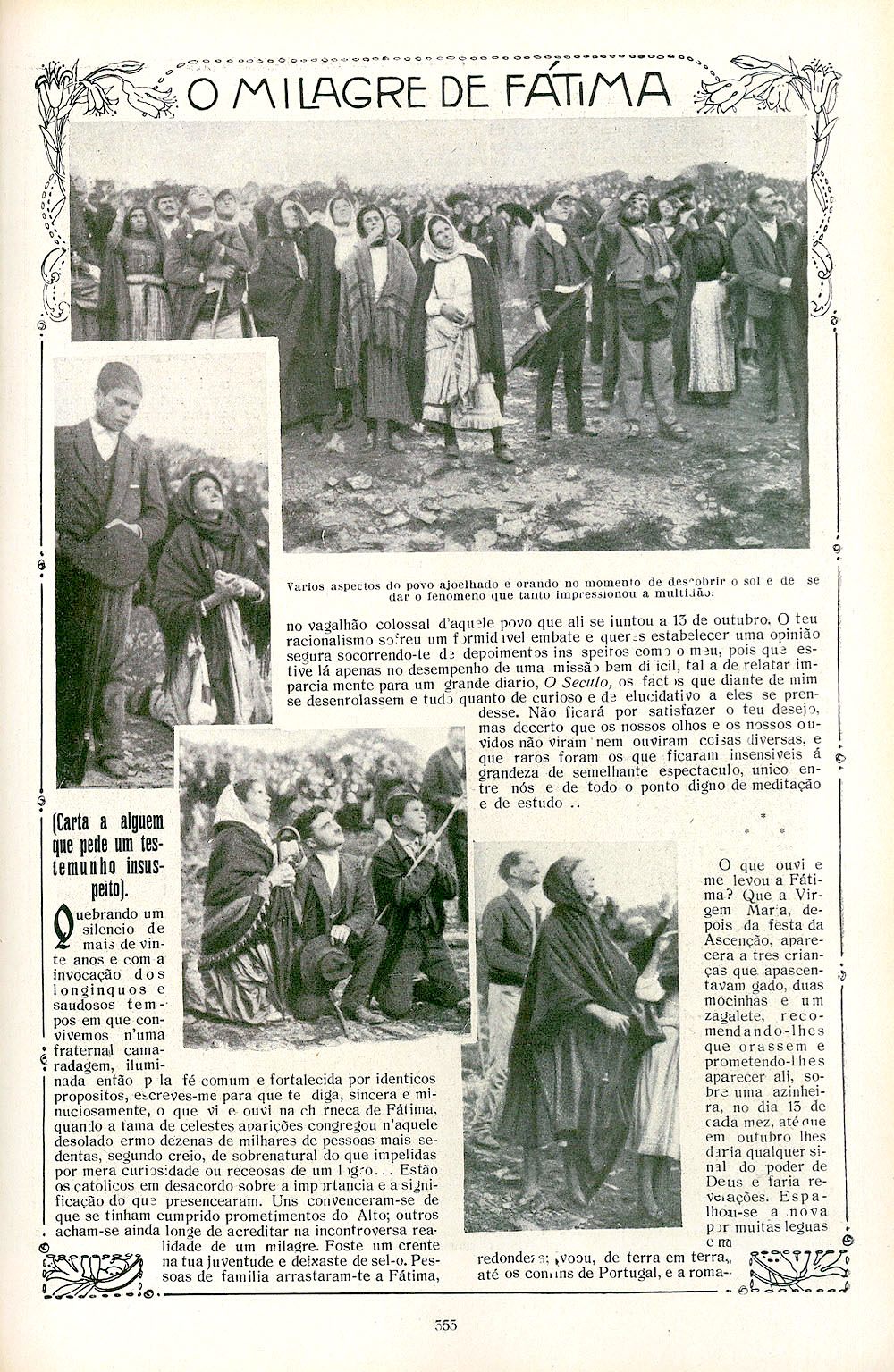
Pictured: a page from the Lisbon illustrated weekly Ilustracao Portuguesa, issue no. 610 (October 29, 1917), showing the crowd at Cova da Iria looking skyward — published just sixteen days after the event, with text by O Seculo correspondent Avelino de Almeida. This is a genuine period photograph of the crowd itself, not of the solar phenomenon, which no camera of the era is known to have captured; a widely circulated "photo of the Miracle of the Sun" showing a much larger and different crowd is a documented misattribution — it was actually taken by photographer Alfredo Cunha da Silva Santos on May 13, 1921, at a pilgrimage near Torres Novas, and was mistakenly published as an authentic 1917 photograph by the Vatican's own L'Osservatore Romano in 1951 before being corrected the following year.
Theoretical Alignment
No witness at Cova da Iria described a discrete craft, occupants, or any technological artifact — only the sun itself appearing to move and change color, plus, in a minority of accounts, an "egg-shaped" luminous object near the apparition tree. That absence of a described vehicle keeps this case's alignment with a literal Extraterrestrial Hypothesis low; even Fernandes and d'Armada's own UAP-lens reading argues for an unidentified atmospheric/aerial phenomenon witnessed alongside a Marian vision, not for a spacecraft. The Interdimensional Hypothesis scores higher because the case's core structure — a visionary experience granted to specific percipients, followed by a public sign witnessed far more broadly — is closer to the phenomenology this site's IDH framework was built to describe than to a conventional craft encounter. The Psycho-Social Hypothesis scores highest of the three: a crowd primed for months by rumor and prophecy, staring directly at the midday sun after being told to look, is close to a textbook precondition for the retinal and suggestion-driven effects the skeptical literature proposes, and this case file's own Conventional Explanation Candidate section below finds that reading genuinely competitive with, though not clearly superior to, the anomalous ones.
Background
Fatima in 1917 was a small parish in the rural Ourem council of Portugal's Santarem District, roughly 110 kilometers north of Lisbon, in a country convulsed by the aftermath of its 1910 republican revolution. The new First Republic had disestablished the Catholic Church, expelled religious orders, secularized education, and in 1911 diminished the Diocese of Leiria (in whose territory Fatima sat) to a titular see with no resident bishop — a policy environment openly hostile to the kind of popular Marian devotion the events of 1917 would generate. Portugal had also entered the First World War on the Allied side in March 1916, deploying its Corpo Expedicionario Portugues of roughly 55,000 men to the Western Front in Flanders, where the corps suffered heavy losses, most severely at the Battle of the Lys in April 1918. Conscription, wartime food shortages, and a steady flow of Portuguese casualties formed the immediate backdrop against which rural Catholic communities — whose sons were among those being conscripted and killed in a war fought for reasons largely opaque to a peasant parish like Fatima's — interpreted any reported sign from heaven with particular urgency, a context this case file treats as relevant to why the crowd's expectation on October 13 was as large and as emotionally charged as contemporary accounts describe.
Against that backdrop, three shepherd children from the hamlet of Aljustrel — ten-year-old Lucia dos Santos and her younger cousins Francisco Marto (age 9) and Jacinta Marto (age 7) — reported a series of apparitions while tending family sheep. The children had already described three earlier apparitions, in 1915 and 1916, of a being they later called the "Angel of Portugal," before the first apparition they identified as the Virgin Mary occurred at Cova da Iria on May 13, 1917. Lucia reported that the figure asked the children to return to the same field on the 13th of each following month, and by the third or fourth of these monthly apparitions, word had spread widely enough that hundreds and then thousands of pilgrims from across central Portugal began accompanying the children. On August 13, 1917, the local civil administrator of Ourem, Artur de Oliveira Santos — an avowed Freemason and militant anticlerical who edited the local newspaper Ourience — intercepted the children en route to Cova da Iria, jailed them for two days, and, according to Lucia's later testimony, threatened to have them boiled alive in oil unless they revealed the content of a "secret" they said the apparition had entrusted to them. The children did not recant, and the episode — itself independently documented through Santos's own public role and later historical accounts — hardened rather than dampened the growing public following.
By September 1917, Lucia was telling pilgrims that the apparition had promised a visible "miracle" on October 13 "so that all may believe." That promise, publicized in advance through word of mouth and increasingly through the Lisbon press, is the single detail that most distinguishes this case from an ordinary retrospectively-reported vision: whatever happened on October 13 happened in front of a crowd that had gathered specifically because it had been told, in advance, on which date and at which hour something would be visible. That advance publicity is also precisely why a genuinely hostile, non-devotional press was present at all — editors sent correspondents not to cover a miracle they expected to happen, but to document what they widely assumed would be a public failure or a mass delusion worth mocking in print.
Complete Timeline
| Date | Event |
|---|---|
| 1915–1916 | Lucia dos Santos, Francisco Marto, and Jacinta Marto report three earlier apparitions of a figure they call the "Angel of Portugal" near Aljustrel. |
| May 13, 1917 | The children report the first apparition they identify as the Virgin Mary at Cova da Iria; five further monthly apparitions are reported through October. |
| August 13, 1917 | Ourem civil administrator Artur de Oliveira Santos detains and threatens the three children in an unsuccessful attempt to force disclosure of their reported "secret." |
| August 1917 | O Seculo chief editor Avelino de Almeida publishes a satirical article on the Fatima reports, intending to cover what he expects will be a public non-event in October. |
| September 13, 1917 | At the fifth monthly apparition, witnesses report a dimming of daylight and a shower of what some described as luminous white petals; Lucia announces the apparition's promise of an October miracle "so that all may believe." |
| October 13, 1917 (morning) | A crowd variously estimated at 30,000 to 100,000 gathers at Cova da Iria in heavy overnight and morning rain. |
| October 13, 1917, c. 12:00–13:30 | Lucia reports the sixth and final 1917 apparition; the rain stops and skies clear or thin; a large portion of the assembled crowd reports the sun appearing to spin, change color, and "dance," with some describing it plunging toward the earth. |
| October 15, 1917 | Avelino de Almeida's first eyewitness account, "Coisas Incriveis," runs on the front page of O Seculo. |
| October 17, 1917 | Almeida publishes a longer, more detailed follow-up account in O Seculo; Lisbon's O Dia independently publishes its own correspondent's eyewitness description of a "silver sun" ringed with color. |
| 1918 | The suppressed Diocese of Leiria is formally re-erected by the Holy See, restoring a resident bishop with jurisdiction over Fatima for the first time since 1911. |
| April 1919 | Construction begins on the small Chapel of the Apparitions at Cova da Iria, funded by pilgrim donations. |
| February and April 1920 | Francisco and Jacinta Marto die of complications from the 1918–1920 influenza pandemic, ages 10 and 9. |
| May 3, 1922 | Newly installed Bishop Jose Alves Correia da Silva of Leiria formally opens the diocesan canonical process to investigate the apparitions. |
| 1917–1950s | Approximately 60 individual eyewitness depositions and interviews are progressively compiled by the diocesan commission and later by researcher John Haffert, forming the core surviving testimonial record. |
| October 13, 1930 | Bishop da Silva issues a pastoral letter declaring the apparitions "worthy of belief" and formally authorizing devotion to Our Lady of Fatima — the close of the 13-year canonical process. |
| 1935–1941 | Lucia dos Santos, by then a nun, writes four memoirs at her bishop's request, providing far more narrative and theological detail than any of her 1917 depositions had contained. |
| 1977–1980 | Historians Joaquim Fernandes and Fina d'Armada gain research access to the Fatima shrine's own archive of original 1917-era depositions while researching an unrelated project. |
| 1995 | Fernandes and d'Armada publish As Aparicoes de Fatima e o Fenomeno OVNI, the first book-length argument for reading the 1917 events through a UAP/anomalous-phenomena lens. |
| 1999 | Physicist-priest Stanley L. Jaki publishes God and the Sun at Fatima, proposing a thin-cloud atmospheric-lens explanation. |
| 2000 | Pope John Paul II beatifies Francisco and Jacinta Marto at Fatima. |
| 2003 | Physicist Auguste Meessen presents a retinal/optical-illusion analysis at a Porto academic forum. |
| 2005 | Sister Lucia dos Santos dies at her Carmelite convent in Coimbra, age 97. |
| 2009 | Skeptic researcher Joe Nickell publishes "The Real Secrets of Fatima" in Skeptical Inquirer, arguing the reported solar position is inconsistent with the sun's actual azimuth and elevation that day. |
| May 13, 2017 | Pope Francis canonizes Francisco and Jacinta Marto at Fatima on the apparitions' 100th anniversary. |
The September Precursor: A Globe of Light Witnessed by 25,000
October 13 was not the only monthly apparition at which the assembled crowd, rather than only the three children, reported witnessing something unusual in the sky. At the fifth apparition on September 13, 1917 — by which point 25,000 to 30,000 pilgrims are estimated to have gathered at Cova da Iria — multiple independent witness accounts describe a sudden cooling of the air, a dimming of the midday sun severe enough that some witnesses reported being able to see stars, and a fall of pale, iridescent, petal- or snowflake-like particles that appeared to dissolve before reaching the ground or the crowd's outstretched hands. Separately, and more directly relevant to this case file's UAP-lens treatment, numerous witnesses that day reported a distinct luminous globe moving slowly and deliberately across the sky from east to west, and then, as the apparition concluded, back in the opposite direction — a specific, directional, repeatable-seeming motion that later researchers have treated as the closest thing in the documented record to a discrete, controlled aerial object rather than a purely solar effect. The Bishop of Leiria's own commission later described the September 13 phenomenon as "humanly speaking inexplicable" in its official assessment. This case file treats the September precursor event as important corroborating context: it establishes that the crowd-witnessed sky phenomena at Cova da Iria were not confined to the single, most-famous October date, and that at least one earlier instance involved a discrete moving light source distinguishable from the sun itself, a detail Fernandes and d'Armada cite directly in support of their broader anomalous-phenomenon reading of the entire apparition sequence.
What the Crowd Reported
The surviving testimonial record for October 13, 1917 is unusually large for an event of this age, though it was assembled unevenly over several decades rather than gathered all at once by a single investigator. Roughly sixteen depositions came from the diocesan commission's own parish-level inquiries beginning in the 1920s; a further several came from the formal canonical process itself; and the largest single block — 27 separate accounts — was collected decades later, in the 1950s, by American lay researcher John M. Haffert, who tracked down surviving 1917 pilgrims and recorded their recollections. Compiling across these sources, independent researchers have identified roughly 60 usable first-hand accounts, of which only two are unambiguously negative (reporting that the witness saw nothing unusual) and a further three are ambiguous or noncommittal — meaning the substantial majority of everyone whose account survives at all reported witnessing some part of the phenomenon, though what exactly they reported varied considerably.
The most commonly repeated elements across these accounts are that the sun appeared to lose its normal blinding intensity, becoming a pale, silvery, or opaque disc that could be looked at directly without pain; that it appeared to spin or rotate, with several witnesses comparing the effect to a "wheel of fire" or a catherine-wheel firework; that it threw off or was surrounded by shifting bands of color — yellow, red, green, blue, and purple were all separately reported, though witnesses disagreed on the exact sequence; and that, for a significant subset of witnesses, the sun appeared to "dance," zigzag, or plunge toward the earth in a way that reportedly frightened part of the crowd into believing the world was ending. A smaller number of witnesses, including several children, described something closer to a discrete luminous object — in a few accounts explicitly egg-shaped and trailing a tail-like light — approaching the small holm oak tree where the apparitions were said to occur, rather than describing the sun itself as the thing that moved. Separately, a number of pilgrims — soaked from the morning's heavy rain — reported that their clothing dried unexpectedly quickly in the phenomenon's immediate aftermath, a specific ancillary claim that features in some skeptical rebuttals precisely because it does not follow naturally from any purely optical explanation of what people thought they saw in the sky.
Crucially, reports of an unusual solar appearance on October 13, 1917 were not confined to Cova da Iria itself. Corroborating accounts describing similar effects have been collected from witnesses in several other Portuguese towns at varying distances from Fatima, and even, in a handful of disputed reports repeated in later popular literature, from further afield in Iberia. These distant-witness claims are one of the more contested elements of the record: they are central to arguments that the phenomenon was not a purely localized crowd effect, but they rest on testimony collected well after the fact, are fewer and less rigorously documented than the Cova da Iria accounts themselves, and have not been independently verified against contemporary meteorological or astronomical records for those specific locations.
The Press Record: A Hostile Newspaper Changes Its Story
The single fact that most distinguishes this case from an ordinary retrospectively-compiled religious testimony is its contemporary, independently motivated press coverage. Avelino de Almeida was, in October 1917, the chief editor of O Seculo, then Portugal's largest-circulation daily and an organ closely identified with the anticlerical, secular values of the First Republic. Almeida had already published a satirical piece on the Fatima reports in August 1917, plainly expecting the promised October "miracle" to be a public embarrassment for the credulous. He traveled to Cova da Iria on October 13 to document exactly that outcome. Instead, his article "Coisas Incriveis" ("Incredible Things"), published on O Seculo's front page on October 15, and a longer, more detailed follow-up on October 17, described a crowd of tens of thousands watching the sun appear to spin and throw off color — an account that made no claim about the vision's supernatural authenticity but did not deny that something genuinely unusual had occurred in the sky above a very large, independently observing crowd.
Almeida was not the only secular journalist present. The Lisbon daily O Dia ran its own special correspondent's account on October 17, 1917, independently describing what that reporter called a "silver sun" enveloped in shifting color — a second, editorially separate newsroom corroborating the basic visual claim even though O Dia had no institutional stake in validating a Catholic apparition either. A third account came from Dr. Domingos Pinto Coelho, an ophthalmologist who wrote for the periodical Ordem and specifically noted, from his own professional vantage point on eye physiology, that he was able to look at the sun directly without the pain or afterimage that normally accompanies staring at it — an observation cited by both sides of the later debate, since it is consistent with the sun's disc genuinely appearing dimmed (a point skeptics use to argue for a straightforward optical/atmospheric explanation) while also being cited by believers as evidence the phenomenon was not merely each individual's private retinal artifact. Notably, and unlike Almeida's own later conversion to Catholicism, none of this initial press corroboration required or implied any religious conclusion: the newspapers reported a crowd witnessing an unusual sky event, leaving its cause and meaning entirely open.
The Church's Thirteen-Year Canonical Process
The Catholic Church's own institutional response to Fatima was considerably slower and more cautious than popular memory now often assumes. The Diocese of Leiria, within whose territory Fatima sits, had been reduced to a titular see with no resident bishop under Portugal's anticlerical 1911 legislation and was not formally re-erected by the Holy See until 1918. Only after Jose Alves Correia da Silva was installed as Leiria's new bishop in 1920 did the Church have a diocesan authority in a position to formally investigate the events at all. Bishop da Silva opened the canonical process on May 3, 1922 — nearly five years after the reported apparitions — convening a commission that interviewed surviving witnesses, gathered documentary and press materials, and assessed the theological content of the messages the children reported.
That investigation ran for eight further years. On October 13, 1930 — deliberately chosen as the thirteenth anniversary of the final 1917 apparition — Bishop da Silva issued a pastoral letter declaring the visions "worthy of belief" (digna de credito) and formally authorizing "the cult of Our Lady of Fatima" within his diocese. It is important to this case file's evidentiary treatment to be precise about what that declaration actually asserts: digna de credito is the Church's standard canonical formula for private-revelation approval, meaning the faithful may, without doctrinal error, believe the apparitions occurred as reported and derive spiritual benefit from associated devotion — it is explicitly not a claim of doctrinal infallibility, nor a scientific finding about what physically happened in the sky on October 13, and the Church's own canon law has never treated it as such. The Vatican's own subsequent institutional engagement, however, was substantial and sustained: Pope Pius XII invoked Fatima repeatedly in the 1940s and personally performed an act of consecration referencing the apparitions' reported message in 1942 and again in 1952; Pope John Paul II, who survived an assassination attempt on May 13, 1981 — the anniversary of the first apparition — credited Our Lady of Fatima's intercession, visited the shrine three times, and beatified Francisco and Jacinta Marto there in 2000; and Pope Francis canonized both children at Fatima on the apparitions' centenary in May 2017. This case file treats that sustained institutional investment as strong evidence of how seriously the Church came to regard the case, without treating it as independent confirmation of any specific physical account of the sun's behavior, which remains outside the competence the Church's own canonical process claims for itself.
The Portuguese Historians' UAP-Lens Re-Analysis
The most direct source for this case file's UAP-adjacent framing is the extended research project of Portuguese historians Joaquim Fernandes and Fina d'Armada. Fernandes, a professor at the University Fernando Pessoa in Porto who holds the first doctoral thesis on extraterrestrial themes in Portuguese culture awarded at a Portuguese university, co-founded and later chaired two of Portugal's principal ufological research bodies, CEAFI (Centro de Estudos Astronomicos e Fenomenos Insolitos) and CNIFO (Comissao Nacional de Investigacao do Fenomeno OVNI). Fina d'Armada — born Josefina Teresa Fernandes Moreira, a University of Porto–trained historian and schoolteacher who died in 2014 — gained her own access to the relevant material between 1977 and 1980 while researching an unrelated history of Portuguese women during the First Republic, a project that brought her into contact with archival material connected to the Fatima shrine.
Fernandes and d'Armada's central published claim, developed across a trilogy of books — Heavenly Lights: The Apparitions of Fatima and the UFO Phenomenon (Portuguese original 1995), Celestial Secrets: The Hidden History of the Fatima Incident, and the multi-author volume Fatima Revisited: The Apparition Phenomenon in Ufology, Psychology, and Science — is that the earliest surviving depositions from 1917 through the early 1920s describe an aerial phenomenon with features they argue are closer to a modern close-encounter report than to a purely visionary or hallucinatory experience: a discrete, luminous, sometimes explicitly egg-shaped object exhibiting apparently controlled movement, observed by both the children and (for the October 13 solar effect specifically) tens of thousands of independent adult witnesses simultaneously. They argue that Lucia dos Santos's own much more elaborate and explicitly theological later memoirs — written in the 1930s and 1940s, under close guidance from her religious superiors, roughly two decades after the events they describe — substantially reshaped the public narrative toward a purely Marian devotional framing, and that this later reshaping, rather than the earliest testimony itself, is primarily responsible for foreclosing the phenomenon's anomalous-aerial dimension from serious historical consideration. Their thesis explicitly does not deny that a genuinely extraordinary event occurred, nor does it claim the children were lying; it argues instead that both the children's own experience and the crowd's shared solar sighting are better explained as encounters with a real, unidentified physical phenomenon than as either a purely subjective vision or a purely psychological crowd effect.
This thesis is a genuine minority position, rejected by the Catholic Church (which maintains its own Marian theological framing) and treated skeptically by most professional historians of the apparitions, who generally regard Fernandes and d'Armada's reading of the archival material as a reinterpretation driven by a prior UFO-research commitment rather than as the most parsimonious account the documents themselves support; a 2000 profile in the mainstream Lisbon daily Publico, for instance, covered Fernandes's thesis with open skepticism about whether "Our Lady was an ET." This case file presents the Fernandes/d'Armada research on its own terms, as a specific, named, professionally credentialed body of scholarship that this site's readers should be able to evaluate directly, while being explicit that it remains a contested minority interpretation rather than an established finding, on either the Church's or the mainstream historical record's own terms.
Key Witnesses
Because the event was witnessed by tens of thousands of people, no case file of this length can profile more than a small, representative sample. The witnesses below are selected specifically because each is independently named, identifiable, and professionally or institutionally significant to how the event entered the historical record — not because they are necessarily the single "best" witnesses among the roughly 60 whose accounts survive.
Lucia dos Santos
The eldest of the three shepherd children and the only one to survive past 1920, Lucia was the primary source for the apparitions' reported content, including the announcement of an October "miracle." Her earliest 1917-era depositions are comparatively spare; her far more detailed later memoirs, written from the 1930s onward under Church guidance, are the source of most of the narrative and theological detail associated with the case today — a gap in time and detail that is itself central to the Fernandes/d'Armada reinterpretation discussed above. She died in 2005 at her Carmelite convent in Coimbra, Portugal, at age 97.
Francisco and Jacinta Marto
Lucia's younger cousins, aged 9 and 7 respectively in October 1917, were present throughout the apparitions and the solar event. Both died within three years of the influenza pandemic that swept Portugal at the close of the First World War — Francisco in April 1920 and Jacinta in February 1920 — and so left no adult retrospective testimony comparable to Lucia's later memoirs, a fact that limits independent corroboration of the youngest witnesses' own account beyond their initial, brief depositions.
Avelino de Almeida
A senior figure at Portugal's largest and editorially anticlerical daily newspaper, Almeida arrived at Cova da Iria expecting to document a failed prophecy and instead published a front-page eyewitness account, on October 15 and again on October 17, 1917, describing the crowd witnessing the sun's unusual behavior. His institutional position — a hostile secular journalist with no devotional incentive to embellish — is the single fact most frequently cited by researchers on both sides of this case as evidence the event was not simply invented after the fact by religious authorities. Almeida later converted to Catholicism, dying in 1932.
Dr. Domingos Pinto Coelho
A trained eye physician who was present at Cova da Iria and wrote his own account for the periodical Ordem, Pinto Coelho specifically noted that he was able to look directly at the dimmed solar disc without the pain a healthy eye normally experiences staring at the sun — a clinically informed observation cited by later researchers on both the anomalous-phenomena and skeptical sides of the debate over what physically happened to the sun's apparent brightness that day.
The Five Observables Assessment
The Five Observables framework, built around discrete craft performance characteristics, applies awkwardly to a case in which no witness described a maneuvering vehicle — only the sun itself appearing to move, plus a minority of accounts describing a separate small luminous object near the apparition tree. The assessment below reflects that mismatch honestly rather than forcing a fit.
Assessment: On the Five Observables' own terms, this case registers almost entirely as absent, and the one "speculative" mark (apparent sudden directional change) is exactly the feature the leading skeptical explanations — retinal afterimage, involuntary eye movement while avoiding a fixed gaze, and expectation-driven suggestion — are specifically designed to account for. This case's evidentiary interest for this catalogue lies less in matching a craft-performance profile than in the scale and independence of its witness corroboration, which the sections below assess on their own terms.
Evidence Assessment
Supporting a Genuine, Non-Fabricated Anomalous Event
- An anticlerical, editorially hostile newspaper's own chief editor (Avelino de Almeida) independently corroborated the crowd's basic visual experience in print within two days of the event, with no institutional incentive to validate a Catholic apparition.
- A second, editorially separate Lisbon daily (O Dia) published an independent correspondent's account describing comparable phenomena the same week.
- The promised date and approximate hour of the phenomenon were publicized in advance, meaning the crowd's expectation was set by a specific prior prediction rather than reconstructed after an ambiguous event had already occurred.
- Of roughly 60 surviving individual depositions collected across four decades, only two are unambiguously negative, indicating broad (though not universal) convergence on witnessing some anomalous solar effect.
- A credentialed ophthalmologist present at the scene (Dr. Domingos Pinto Coelho) reported a clinically specific observation — painless direct viewing of the solar disc — independent of any devotional framing.
Supporting a Conventional Optical, Atmospheric, or Psychological Origin
- No photograph, film, or instrumented recording of the solar phenomenon itself exists from October 13, 1917, despite photographers being present at Cova da Iria that day and capturing the crowd.
- Witness descriptions vary substantially in color sequence, duration, and whether the sun "descended," undermining the claim of a single, objectively consistent physical event witnessed identically by all observers.
- No astronomical observatory or meteorological station outside the immediate Fatima region recorded any anomalous solar behavior that day, despite the sun being simultaneously visible to a much wider area of Iberia and beyond.
- The crowd had gathered specifically because of a widely publicized advance prediction and had spent hours staring expectantly at the sky after emerging from heavy rain — conditions skeptical researchers identify as strongly conducive to retinal afterimage effects and suggestion-driven perception.
- Researcher Joe Nickell has argued the reported position of the phenomenon in several witness accounts is inconsistent with the sun's true astronomical azimuth and elevation for that date, time, and location.
Why "Disputed"
This case file assigns a DISPUTED stamp on an axis specific to this case's own evidentiary shape, distinct from the witness-credibility framework this site applies to individual sighting reports. The event itself — that a very large crowd, including editorially hostile secular journalists with no incentive to fabricate corroboration, witnessed some genuinely unusual solar phenomenon on October 13, 1917 — is about as well-attested as a crowd phenomenon from this era can be, and this case file does not dispute that something real and widely shared was observed. What remains genuinely, unresolved-ly disputed is the phenomenon's nature and cause: the Catholic Church's own canonical finding is explicitly a judgment about the credibility of a private religious revelation, not a physical claim about the sun; Fernandes and d'Armada's anomalous-phenomena reading is a serious, professionally credentialed body of research but remains a minority position rejected by both the Church and most mainstream historians; and the leading skeptical explanations (retinal effects, atmospheric optics, expectation-driven suggestion) are individually well-supported by controlled experimental analogues but, as this case file's Conventional Explanation Candidate section below argues in detail, none of them cleanly accounts for every reported element — particularly the reported drying of soaked clothing and the degree of convergence across a crowd this large.
A score in the medium tier reflects that balance directly: strong, multiply-sourced, contemporaneous corroboration of the underlying event pulls the score up from where a single-witness or purely devotional account would sit, while the absence of any physical trace, instrumented recording, or astronomically corroborated anomaly, combined with well-documented and individually plausible conventional mechanisms for at least the core visual experience, keeps the score well short of the high tier this site reserves for cases with instrumented or physical confirmation. This is, deliberately, not a generic "credible witness" score; it is an assessment of how much genuine, still-open evidentiary tension the documentary record actually contains.
Sensor & Instrumentation Detection Profile
No sensor or instrumentation of any kind recorded the October 13, 1917 phenomenon. Photography existed and was present at Cova da Iria that day — the surviving Ilustracao Portuguesa photographs of the crowd prove cameras were on site and operating — but no photographer is known to have successfully captured the sun's reported behavior itself, whether because the effect was a subjective/retinal phenomenon invisible to a camera, because contemporary film stock and lenses of the era could not resolve a rapid change in a source as bright as the midday sun, or simply because no photographer attempted or preserved such a shot. No meteorological instrument, seismograph, or any other scientific recording device is known to have been operating at or near Cova da Iria that day, and this case file could not locate any surviving observatory log from Lisbon, Coimbra, or any other Portuguese astronomical station reporting anomalous solar activity for October 13, 1917.
Environmental & Geospatial Context
Cova da Iria sits in Portugal's Estremadura region at roughly 300 meters elevation, in rolling agricultural terrain typical of the Ourem council. Contemporary accounts agree the morning of October 13, 1917 brought heavy, sustained rain, leaving the assembled crowd and the field itself thoroughly soaked; multiple witnesses describe the rain easing or the sky clearing around the time of the reported apparition and solar phenomenon near midday. At that time of year and latitude (approximately 39.6 degrees North), the sun in mid-October at midday over central Portugal sits at a moderate elevation angle well above the horizon rather than near it — a detail relevant to skeptical arguments (discussed in the Conventional Explanation Candidate section below) that some witnesses may have been describing an atmospheric effect near a lower, hazier solar position inconsistent with the true midday elevation. No corroborating instrumented meteorological record (barometric pressure, humidity, or verified cloud-cover observations) specific to the Ourem/Fatima area on that date has been located in the course of this case file's research; period accounts of "thin clouds" or a "veil" over the sun rest on witness description alone.
Observer Credibility & Occupational Profile
The witness population for this case spans an unusually wide occupational and social range for a single event of this era: three young, illiterate rural shepherd children with no formal education; tens of thousands of pilgrims, overwhelmingly rural Portuguese Catholics traveling specifically in expectation of a religious sign; and a smaller but evidentially disproportionate group of urban, professionally credentialed, and in several cases explicitly non-devotional observers, including two separate senior newspaper journalists (Almeida of O Seculo, and O Dia's unnamed special correspondent) and a trained ophthalmologist (Pinto Coelho) whose account carries specific clinical weight on the narrow question of the sun's apparent brightness. This case file weights the professional, non-devotional witnesses' corroboration more heavily than the devotional pilgrim majority's testimony precisely because they had the least motive to invent or exaggerate a religious miracle, while still recognizing that none of the surviving witnesses — devotional or otherwise — had any scientific training in solar observation or any instrument more sophisticated than the naked eye.
Physical & Material Assays
No physical or material trace evidence of any kind is associated with this event, and no serious researcher on any side of the debate has claimed otherwise. There is no soil sample, no recovered debris, no metallurgical or isotopic residue, and no biological trace beyond the anecdotal claim — itself untested by any period or later material analysis — that rain-soaked clothing dried unexpectedly quickly in the phenomenon's immediate aftermath. This case file states that absence explicitly rather than treating it as a gap to be explained away: whatever occurred on October 13, 1917, it left no physical trace that any subsequent investigator, devotional or skeptical, has ever been able to test.
Historical Precedents & Archive Matches
The Fatima solar phenomenon sits within a broader, sparsely cataloged tradition of reported mass sky-observation events with religious or quasi-religious framing, a category this site treats with the same evidentiary standard applied here rather than filing such cases separately from its core UAP catalogue. Reports of unusual solar or celestial behavior witnessed by large crowds in a devotional context recur intermittently across the historical and modern record, and this specific case has become, in turn, a reference point cited by researchers examining later reports of similar mass sky phenomena, precisely because of its unusually strong contemporary press corroboration relative to most pre-20th-century mass-witness events. Within the specific UFO/UAP research literature, this case is also the foundational example cited by the broader "ultraterrestrial" and psycho-physical research tradition that treats certain apparition-adjacent phenomena as potentially sharing a causal mechanism with more conventional UAP reports — the interpretive tradition Fernandes and d'Armada's work sits within, whatever its reception elsewhere. This site's own catalogue includes several other mass-witnessed sky phenomena that similarly straddle a devotional-versus-anomalous evidentiary line — the disc-shaped-formation reports collected during the New Zealand Airship Wave of 1909 and the mass overnight sky display recorded in the 1663 Robozero Incident are both, like Fatima, cases where a very large, geographically concentrated population reported a shared, unexplained celestial event that left no physical trace, making cross-case comparison of witness-convergence patterns and reporting timelines a genuinely useful analytical tool even where the underlying phenomena themselves may be entirely unrelated.
Material Analysis
As already established under Physical & Material Assays above, there is no physical or trace material connected to this case for any laboratory or forensic analysis to examine. This section restates that finding in the specific terrestrial-versus-non-terrestrial framework this site applies to material evidence elsewhere in its catalogue, because the absence is itself informative to that framework rather than a section to be skipped.
Supporting Non-Terrestrial or Anomalous Physical Origin
- No physical evidence exists that could be tested at all, meaning no laboratory finding has ever contradicted an anomalous-origin reading either.
- The reported rapid drying of soaked clothing, if accurately reported, is not straightforwardly explained by any of the leading purely optical/retinal skeptical theories, which address only what witnesses saw rather than any physical effect on the surrounding environment.
Supporting a Purely Terrestrial/Perceptual Origin
- The complete absence of any recovered physical trace, after more than a century of documented public and Church interest in the site, is itself the pattern one would expect from a purely perceptual or atmospheric event rather than a physical craft or object.
- No verified photograph, film, or instrument reading from October 13, 1917 documents anything beyond the crowd's own posture and behavior, consistent with the phenomenon being confined to what individual observers subjectively perceived rather than an externally recordable physical event.
The Conventional Explanation Candidate: Retinal & Optical Effects
The most frequently cited skeptical explanation holds that the crowd, having been told in advance to expect a sign and having just emerged from hours of rain into clearing skies, spent an extended period gazing toward the sun — producing a well-documented range of retinal phenomena: photobleaching of retinal photopigments producing the perceived dimming and color shifts, afterimages producing the sense of a persisting "dance," and involuntary saccadic eye movement (small rapid eye movements made specifically to avoid the pain of a fixed direct gaze at a bright source) producing an illusory sense of the source itself moving. Physicist Auguste Meessen of the Catholic University of Louvain formalized this argument most rigorously, conducting his own controlled self-experiments viewing the low-angle sun and reporting comparable subjective effects — a serious, methodologically transparent piece of research this case file treats as a genuinely strong candidate mechanism for at least the core visual experience reported by most witnesses.
Atmospheric Optics and the Jaki "Air-Lens" Theory
A related but distinct explanation, advanced most substantially by physicist-priest Stanley L. Jaki in his 1999 book God and the Sun at Fatima, proposes that a thin, uneven layer of high cloud or atmospheric moisture acted as an irregular lens or diffraction medium, refracting sunlight into the reported colors and creating the appearance of a dimmer, more clearly bounded solar disc, without requiring any purely subjective retinal mechanism. Jaki, whose research involved firsthand interviews and archival visits to Portugal, argued the natural mechanism was real but that the coincidence of its occurrence at the precise predicted hour was itself the case's genuinely remarkable feature. This candidate explanation accounts reasonably well for the shared, roughly simultaneous color and dimming reports across a large crowd viewing the same actual sky, but like the retinal explanation, it does not obviously account for the reported rapid drying of soaked clothing, nor for the minority of accounts describing a discrete, separately located luminous object rather than an effect centered on the sun itself.
Mass Suggestion and Expectation-Driven Perception
A third candidate treats the event primarily as a socially and psychologically primed perceptual experience: a crowd that had traveled specifically because of a well-publicized advance prediction, standing for hours in anticipation, was highly susceptible to interpreting an ambiguous shared visual stimulus (any of the genuine optical/atmospheric effects above) through the lens of the expected miracle, with individual accounts subsequently converging through conversation and shared retelling in the days and weeks after the event, before most formal depositions were even recorded. This explanation is consistent with the genuine variation across witness accounts (color sequence, duration, and the presence or absence of a "descent") that a single, objectively uniform physical stimulus would be less likely to produce, but researcher critiques of pure mass-hallucination theories note that true synchronized mass hallucination — as opposed to a shared perceptual response to a real, if optically or atmospherically ambiguous, external stimulus — has little support in the broader psychological and medical literature, making "suggestion acting on a real optical stimulus" a more defensible version of this candidate than "collective hallucination of something not physically present at all."
Retinal & Optical Effects
PlausibleWell-supported by Meessen's own controlled self-experiments and consistent with the sun-staring behavior of most witnesses, though it does not clearly explain the reported clothing-drying claim or the minority "discrete object" accounts.
Atmospheric Optics (Jaki's "Air-Lens")
InconclusiveA genuine natural mechanism with real precedent, but resting on witness-described "thin clouds" rather than any verified instrumented meteorological record from October 13, 1917.
Mass Suggestion on a Real Optical Stimulus
PlausibleConsistent with genuine variation across witness accounts and the crowd's strong advance priming, though pure synchronized hallucination unsupported by any real external stimulus has little independent psychological-literature support.
Unidentified Physical/Anomalous Phenomenon (Fernandes & d'Armada)
InconclusiveNot disproven by the surviving record, and specifically motivated by the minority "discrete luminous object" accounts and the unexplained clothing-drying claim, but a minority scholarly position rejected by the Church and most mainstream historians, resting on a contested reading of archival depositions rather than independently testable physical evidence.
Related Cases
Confirmed Archival Records
The Catholic Church's own institutional record-keeper for the apparitions and the 1922–1930 canonical process, and the ongoing custodian of the shrine's archival holdings.
The official Lisbon city council digital archive of historical Portuguese newspapers and periodicals, the primary public repository for verifying period press coverage of the Fatima events.
The Holy See's own official commemorative page situating Fatima within the Church's institutional calendar and history.
Search Archival Records Directly
Further Reading — Recommended Literature
Heavenly Lights: The Apparitions of Fatima and the UFO Phenomenon
The foundational English-language statement of this case file's UAP-lens research thread, developed from the authors' own access to the Fatima shrine's original 1917-era archival depositions.
Celestial Secrets: The Hidden History of the Fatima Incident
The second volume of the authors' Fatima Trilogy, arguing that Lucia dos Santos's later, Church-guided memoirs reshaped the earliest archival record toward a purely Marian framing.
Fatima Revisited: The Apparition Phenomenon in Ufology, Psychology, and Science
The trilogy's concluding volume, subjecting the case to explicitly multidisciplinary scientific scrutiny and presenting the strongest available counterarguments alongside the authors' own thesis.
God and the Sun at Fatima
A physicist-priest's own archival-research-based atmospheric-optics explanation, representing the most rigorous purely naturalistic account examined in this case file's Conventional Explanation Candidate section.
Our Lady of Fatima
The classic mainstream historical account, based on the author's own 1946 interviews with Sister Lucia, providing the devotional/Church-aligned narrative this case file weighs against the anomalous-phenomena and skeptical readings.
Essential Viewing
Sources
- Wikipedia, "Miracle of the Sun" — used lightly for orientation and cross-checking dates against the primary press and archival sources below.
- Wikipedia, "Our Lady of Fatima".
- Sanctuary of Fatima (official shrine website), fatima.pt.
- Vatican State, "May 13: Our Lady of Fatima", official commemorative page.
- The Fatima Center, "Approval by the Bishop (1930)", on Bishop Jose Alves Correia da Silva's pastoral letter and the canonical process.
- Joaquim Fernandes & Fina d'Armada, Heavenly Lights: The Apparitions of Fatima and the UFO Phenomenon (Anomalist Books, 2007), foreword by Jacques F. Vallee.
- Joaquim Fernandes & Fina D'Armada, Celestial Secrets: The Hidden History of the Fatima Incident (Anomalist Books, 2007).
- Fernando Fernandes, Joaquim Fernandes & Raul Berenguel, Fatima Revisited: The Apparition Phenomenon in Ufology, Psychology, and Science (Anomalist Books, 2008).
- Academia.edu, Joaquim Fernandes, Curriculum Vitae, University Fernando Pessoa.
- Exopolitica Portugal, "Fina D'Armada (1945–2014)", biographical obituary.
- Publico, "Ovnilogista tenta provar que Nossa Senhora era um ET", June 27, 2000 — mainstream Portuguese press coverage and reception of Fernandes's thesis.
- Auguste Meessen, "Apparitions and Miracles of the Sun," paper presented at the International Forum "Science, Religion and Conscience," Porto, October 23–25, 2003 (summarized at testreligion.com).
- Joe Nickell, "The Real Secrets of Fatima", Skeptical Inquirer, November/December 2009.
- Skeptical Inquirer, "Fatima Miracle Claims All Wet", May 2019.
- Stanley L. Jaki, God and the Sun at Fatima (Real View Books, 1999).
- Scott Alexander, "The Fatima Sun Miracle: Much More Than You Wanted To Know", Astral Codex Ten.
- ChurchPop, "Is This Really a Photo of Fatima's 'Miracle of the Sun'? The Truth Behind the Viral Image" — documentation of the widely circulated 1921 photograph misattribution.
- Wikimedia Commons, "Newspaper fatima 353.jpg" (Ilustracao Portuguesa, no. 610, October 29, 1917) — source of this case file's hero image.
- Wikimedia Commons, Category: Miracle of the Sun, period photograph archive.
- Camara Municipal de Lisboa, Hemeroteca Digital de Lisboa, digitized historical Portuguese newspaper archive.
- Wikipedia, "Artur de Oliveira Santos" — on the August 1917 detention of the three shepherd children.
- Wikipedia, "Jose Alves Correia da Silva" — on the bishop who opened and closed the canonical process.
- Wikipedia, "Cova da Iria".
- William Thomas Walsh, Our Lady of Fatima (Macmillan, 1947) — based on the author's 1946 interviews with Sister Lucia dos Santos.
- National Catholic Register, "Marvels Mark Fatima's September 13 Apparition" — on the September 1917 precursor luminous-globe phenomenon.
See something inaccurate? Have additional information or sources?
Suggest an Edit →Last Updated: August 2026