
The Sheerness Phantom Airship Incident
On the evening of October 14, 1912, between roughly 6:30 and 7:00 PM, multiple people in and around the Royal Navy's Sheerness dockyard on the Isle of Sheppey — one of Britain's most strategically sensitive naval bases, guarding the mouth of the Thames — heard an aircraft engine and, per at least some accounts, saw a light passing overhead. Among the witnesses, per the historians who have investigated the case in the most depth, was a serving Royal Navy lieutenant. A telephone call to the nearby Eastchurch naval aerodrome led to flares being lit in an attempt to guide the aircraft to a landing that never came. Six weeks later, questioned twice in the House of Commons, First Lord of the Admiralty Winston Churchill confirmed on the record that "an unknown aircraft" had genuinely been present and was "not one of our own airships" — a rare, still-quotable piece of formal government acknowledgment that predates even the U.S. Air Force's Project Sign by thirty-six years. The incident became the opening event of the much larger 1912-13 British "phantom airship scare," in which comparable reports spread across the country amid genuine, well-documented public anxiety about German Zeppelin espionage in the years immediately before the First World War — a scare whose New Zealand-based predecessor, three years earlier, is the subject of this catalogue's companion New Zealand Airship Wave of 1909 file. This file treats the case honestly: no photograph, film, or physical trace of the object exists, the leading contemporary theory (a covert German Zeppelin reconnaissance flight) is directly undercut by the one airship's own surviving flight records, and the wider scare it triggered has been shown by peer-reviewed historical research to be substantially explainable as a media-amplified collective phenomenon — without that conclusion erasing the fact that multiple named-category witnesses, including a naval officer, reported something specific on one particular night, and that a sitting Cabinet minister confirmed it in Parliament.
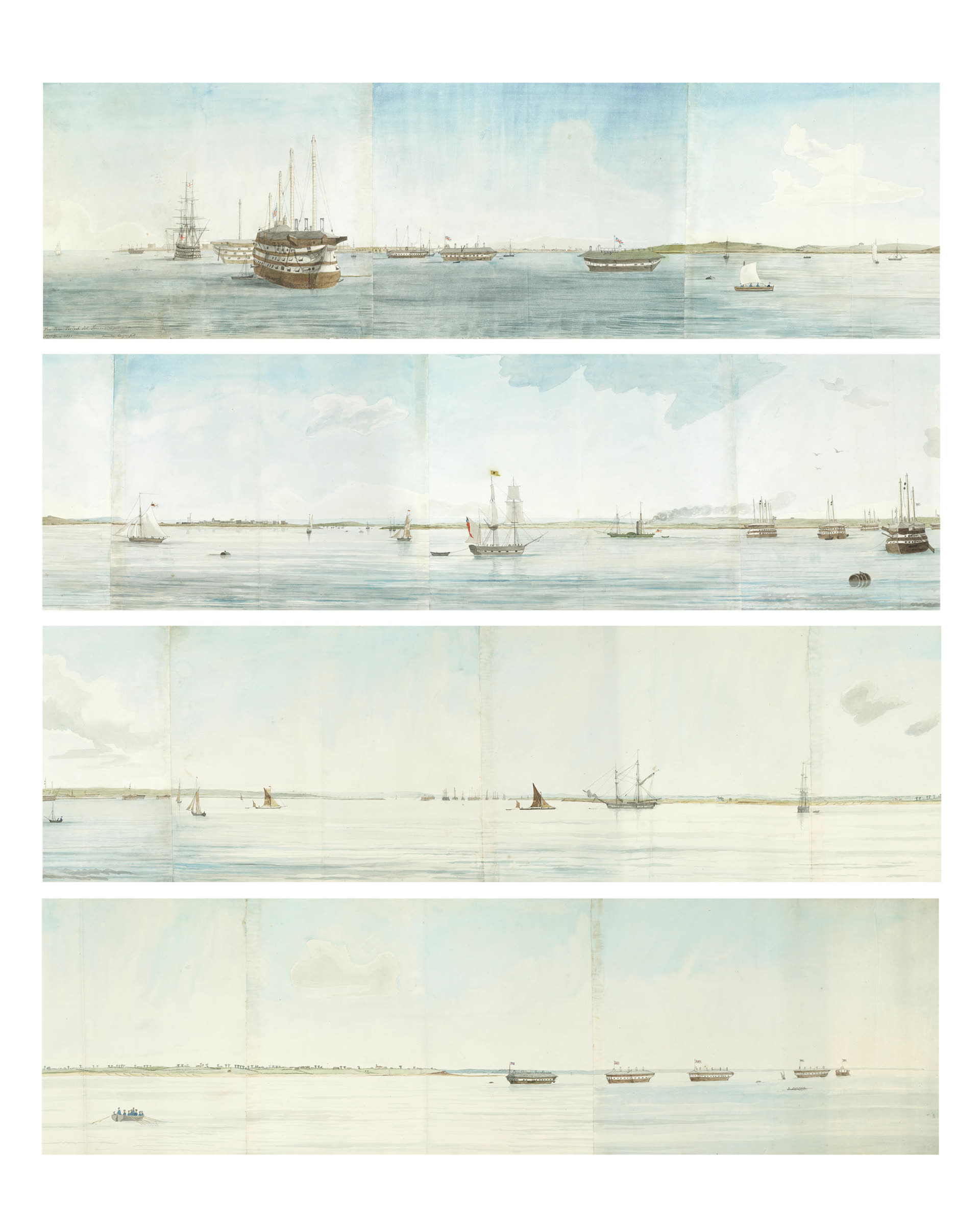
Pictured: an 1831 panoramic view of the Royal Navy's Sheerness Dockyard, with HMS Temeraire in the foreground — a genuine period depiction of the same dockyard, but from 81 years before the 1912 sighting, not a photograph from the incident's own era. No period (1912) photograph of Sheerness Dockyard specifically, and no photograph or film of the object itself, is known to survive; no witness ever claimed to have photographed it. Public domain (published before 1931), sourced via Wikimedia Commons from a Bonhams auction listing.
Theoretical Alignment
This file's theoretical alignment differs from this catalogue's other "phantom airship" wave files in one important respect: the Sheerness incident itself is not primarily a Psycho-Social case in the way the wider 1912-13 scare it triggered demonstrably was. The specific October 14 event rests on a small number of witnesses, including a serving naval officer, reporting a genuine engine sound and, per some accounts, a light, on one particular evening at one particular sensitive military site — a narrower, more concrete claim than the hundreds of ambiguous nighttime lights that followed it nationwide over the next several months. The Psycho-Social share here reflects primarily the wider scare's own well-documented dynamics (peer-reviewed by historian Brett Holman) rather than the Sheerness event specifically, alongside this file's own judgment that unaided, engine-sound-led testimony in the dark carries real, ordinary risk of misidentifying a conventional aircraft. The Extraterrestrial Hypothesis registers only a token share: nothing about the case's own record, government handling, or later historical scholarship this file's research located ever seriously proposed non-human origin for this specific incident, which was from the outset a story about suspected foreign (German) human technology, not an anomalous craft. The Interdimensional Hypothesis is essentially unclaimed.
Background
By October 1912, Britain and Germany were roughly midway through the Anglo-German naval arms race, a period of intense public and governmental anxiety about German military technology that had already produced the "dreadnought" battleship-building competition and was, by 1912, extending into the air. Germany's Zeppelin program was the world's most advanced rigid-airship effort by a wide margin: the German Army and Navy between them operated a small number of naval, military, passenger, and experimental rigid airships, and German commercial Zeppelin passenger service (DELAG) had already begun regular flights over German cities. Britain, by contrast, possessed no comparable rigid airship of its own, a gap Winston Churchill himself would concede bluntly in the House of Commons weeks after the Sheerness sighting. Sheerness itself, on the Isle of Sheppey at the mouth of the Thames Estuary, was one of the Royal Navy's oldest and most strategically important dockyards, guarding the approach to London and the Medway naval anchorage; nearby Eastchurch, roughly four miles away, hosted one of Britain's earliest naval aviation establishments, making the immediate area a genuine, plausible target for foreign aerial reconnaissance in a way most of the British sightings that followed over the coming winter were not.
No British government body in October 1912 had any established, systematic protocol for investigating or publicly confirming unidentified aircraft sightings; the Air Ministry itself would not be created until 1918, and Britain's own military aviation apparatus in 1912 was still new, small, and organizationally split between the Army's Royal Flying Corps and the Navy's own separate air arm. What did exist, uniquely among every case in this catalogue's "phantom airship" trio, was a functioning national legislature willing to put a formal question to a sitting Cabinet minister within weeks of a sighting, and a minister — Churchill, then First Lord of the Admiralty — willing to give a substantive, on-record answer rather than simply declining to comment. This file treats that specific institutional response as one of the case's most genuinely distinctive features relative to every other file in this catalogue's early "phantom airship" cluster.
The cultural soil this specific sighting fell on had itself been prepared over the preceding decade by a substantial and commercially successful genre of British invasion-scare fiction, a genuine, verifiable literary phenomenon rather than incidental background color. Erskine Childers's 1903 novel The Riddle of the Sands had already dramatized a fictional German plan to invade Britain by sea; William Le Queux's 1906 The Invasion of 1910, serialized first in the Daily Mail with Lord Roberts's public endorsement, sold roughly a million copies and was translated into multiple languages; and H.G. Wells's 1908 novel The War in the Air specifically imagined a German aerial assault using airships years before Zeppelins had any genuine strategic bombing capability. British popular culture had also already produced its own cinematic response to precisely this anxiety: the 1909 silent film The Airship Destroyer, one of the earliest science-fiction films to depict aerial bombardment of Britain, was in wide circulation only three years before the Sheerness sighting. This file's own research treats this specific, well-documented decade of invasion-scare fiction and early aerial-warfare cinema as directly relevant to why a genuinely ambiguous nighttime engine sound over a sensitive naval dockyard was so readily and rapidly interpreted, by press and Parliament alike, through the specific frame of deliberate German aerial reconnaissance rather than any of the several more mundane alternatives this file's own Conventional Explanation Candidate section considers below.
The Sheerness sighting did not occur in isolation. Historian David Clarke, together with researchers Nigel Watson and Granville Oldroyd, has traced the same recurring phantom-airship pattern back to a smaller cluster of British sightings earlier in 1909 — the same calendar year as this catalogue's own New Zealand Airship Wave file, on the opposite side of the world — making 1912's Sheerness sighting the third documented British episode in a genuinely international, recurring phenomenon rather than a first, isolated event.
Complete Timeline
| Date | Event |
|---|---|
| 1909 | A smaller cluster of "phantom airship" sightings occurs across Britain, later documented in David Clarke's own scholarly chapter on the period — the direct British precursor to the 1912-13 scare, and contemporaneous with the New Zealand wave covered in this catalogue's companion file. |
| Oct. 14, 1912, c. 6:30–7:00 PM | Multiple people at Sheerness dockyard and nearby Queenborough, Isle of Sheppey, hear an aircraft engine and, per some accounts, see a light passing overhead; witnesses include a serving Royal Navy lieutenant. |
| Oct. 14, 1912, same evening | A telephone call from Sheerness alerts the naval aerodrome at Eastchurch, roughly four miles away; flares are lit as a landing signal, but no aircraft lands, and nothing is sighted at the aerodrome itself despite the reported engine sound. |
| Nov. 18, 1912 | MP William Joynson-Hicks asks the Secretary of State for War, Colonel J.E.B. Seely, in the House of Commons whether "a Zeppelin dirigible" passed over Sheerness on the night of October 14. Seely replies the Admiralty has "no definite information"; Churchill, as First Lord of the Admiralty, states he is "not aware that any reports have been received, but inquiries will be made." |
| Nov. 27, 1912 | In a fuller Commons debate on airships, Churchill confirms on the record: "An unknown aircraft was heard over Sheerness about 7 p.m. on the evening of 14th October," that flares were lit at Eastchurch as a precaution, that the aircraft did not land, that "there is nothing in the evidence to indicate the nationality," and, when pressed, that it was "not one of our own airships." In the same debate, Churchill states Britain possesses no rigid airship comparable to a German Zeppelin, and that Germany already operates one naval, one military, two passenger, and one experimental rigid airship, calling German pre-eminence in the type well established; he adds that a rigid airship takes roughly eighteen months to build. |
| Dec. 6, 1912 | In a private Committee of Imperial Defence meeting, Churchill states there is "very little doubt" the Sheerness aircraft was a German vessel — a private assessment considerably more definite than anything he said on the public record. |
| 1913, Jan.–Apr. | The wider "phantom airship scare" spreads across Britain, with dozens of further sightings concentrated in a belt running roughly from Liverpool to Hull, and further clusters around Cardiff, peaking in intensity and geographic spread around Selby (Feb. 21-22) and drawing crowds reported in the thousands at Cardiff and Hull. |
| 1913–1915 | The Admiralty's Inspecting Captain of Aircraft at Sheerness maintains an ongoing office generating correspondence on airship-related matters at the station, later preserved at the UK National Archives. |
| 1987–1988 | Researchers Nigel Watson, David Clarke, and Granville Oldroyd jointly publish The 1912-1913 British Phantom Airship Scare, the first dedicated historical study of the case, through the Fund for UFO Research. |
| 1998 | Robert E. Bartholomew and George S. Howard situate the Sheerness sighting and the wider 1912-13 scare within the broader comparative history of pre-Roswell mass sighting waves in UFOs & Alien Contact: Two Centuries of Mystery. |
| 2007 | Historian Brett Holman publishes "The Sheerness Incident" on his research blog Airminded, the first detailed modern reconstruction of the October 14 event drawing directly on the Hansard record. |
| 2013 | Holman publishes "Mapping the 1913 Phantom Airship Scare," a geographic analysis of the roughly one hundred sightings that followed Sheerness across Britain over the following winter and spring. |
| 2016 | Holman publishes "The Phantom Airship Panic of 1913: Imagining Aerial Warfare in Britain before the Great War" in the peer-reviewed Journal of British Studies, the fullest scholarly treatment of the scare's causes and cultural significance to date. |
What Happened at Sheerness
The Sighting Itself
On the evening of Monday, October 14, 1912, between roughly 6:30 and 7:00 PM, multiple people in Sheerness and in nearby Queenborough, about two miles to the south, reported hearing a sound resembling an aeroplane engine passing overhead in the darkness. At least some witnesses also reported seeing a light — described variously across secondary accounts as a red light or a searchlight-like beam passing back and forth over the town — though this file's own research found the surviving record clearer and more consistent on the engine sound than on the visual details, a genuine limitation on how confidently any specific craft type can be inferred. Among the witnesses, per the historians who have investigated the case in the greatest depth, was a serving Royal Navy lieutenant, whose military background gives his report somewhat more evidentiary weight than an unspecified civilian bystander's, though this file's research was unable to locate his name in any source consulted. No other individual civilian witness is named in any source this file located, a real and disclosed gap relative to, for instance, the named schoolchildren and adults in this catalogue's New Zealand 1909 file.
The Eastchurch Response
A telephone call from Sheerness that same evening alerted the Royal Naval Air Service station at Eastchurch, roughly four miles away on the same island — one of Britain's earliest and most active naval aviation establishments, and a natural first point of contact given the reported engine sound's apparent direction. Flares were lit at Eastchurch as a landing signal, a standard period technique for guiding an aircraft to a night landing, but no aircraft ever landed, and no aircraft was reportedly sighted at the aerodrome itself despite the earlier report of an engine sound in the vicinity. This is, on its own terms, a genuine and disclosed puzzle this file's research could not resolve: if a real aircraft had been over Sheerness only minutes before, its complete absence from Eastchurch's own airspace shortly afterward is difficult to explain if the aircraft was behaving as a lost or disoriented flier genuinely seeking to land, and somewhat easier to explain if the object was never actually attempting to land at all — whether because it was a foreign reconnaissance flight with no intention of doing so, or because no real aircraft was present in the first place.
A Small, Disclosed Timing Discrepancy
This file's own research found a minor but genuine discrepancy in the surviving record worth disclosing rather than smoothing over: the original November 18, 1912 parliamentary question, put by MP William Joynson-Hicks, describes the sighting as occurring "about 8 p.m.," while Churchill's own fuller November 27 statement and most secondary historical accounts place it at approximately 7:00 PM, and other summaries describe a window as early as 6:30 PM. This file treats the discrepancy as a small, ordinary artifact of witness and secondhand reconstruction difficulty rather than evidence the incident did not occur, consistent with how contemporaneous reports of a brief nighttime event in 1912, reaching Parliament secondhand five weeks later, would be expected to accumulate minor timing drift — but it is disclosed here rather than silently resolved in favor of whichever time makes the narrative cleanest.
The Parliamentary Record
November 18, 1912: The First Question
The Sheerness sighting first reached Parliament five weeks after the fact, when Conservative MP William Joynson-Hicks asked the Secretary of State for War, Colonel J.E.B. Seely, "whether a Zeppelin dirigible passed over Sheerness on the night of the 14th October, about 8 p.m." Seely's initial reply was cautious: he had "communicated with the Admiralty with regard to this matter" and understood "they have no definite information." Pressed further, he added, "We have made investigations into the matter, but we have no definite information as to whether the fact is as stated or not." Winston Churchill, answering in his own capacity as First Lord of the Admiralty, stated only that he was "not aware that any reports have been received, but inquiries will be made" — a notably more guarded answer than the fuller statement he would give nine days later.
November 27, 1912: Churchill's Fuller Confirmation
In a more extensive Commons debate on British and German airship capability on November 27, Churchill gave a considerably more detailed public account. Asked again about Sheerness, he stated for the record: "An unknown aircraft was heard over Sheerness about 7 p.m. on the evening of 14th October." He confirmed flares had been lit at Eastchurch as a precaution, that "the aircraft did not make a landing," and that "there is nothing in the evidence to indicate the nationality" of the craft. When pressed specifically on whether it might have been British, he confirmed it was "not one of our own airships" — the specific phrase this incident is most often remembered for, and one of the very few instances anywhere in this catalogue of a sitting government minister formally confirming, on an official parliamentary record, that a genuinely unidentified aircraft had been present over a specific site on a specific date. In the same debate, responding to Joynson-Hicks's broader question about relative British and German airship strength, Churchill was strikingly candid: asked directly whether Britain possessed anything comparable to a German Zeppelin or capable of 60 miles per hour, he answered simply, "No, Sir." He went on to detail Germany's existing rigid-airship fleet — one naval, one military, two passenger, and one experimental vessel — acknowledging that "Germany has won a great pre-eminence" in the type, and noted that constructing a comparable British rigid airship would take roughly eighteen months.
The Private Admission
Ten days after his public Commons statement, on December 6, 1912, Churchill addressed the Committee of Imperial Defence — a closed-door strategic planning body, not a public forum — and stated there was "very little doubt that the airship reported recently to have passed over Sheerness was a German vessel." This is a materially more definite claim than anything Churchill said publicly, where he consistently declined to name a nationality; this file's own research treats the discrepancy as a genuine, historically significant window into how the government privately assessed the incident's likely explanation while publicly maintaining, for entirely understandable diplomatic reasons in the run-up to a war neither country had yet declared, that "there is nothing in the evidence to indicate the nationality." It is not, on its own, proof that Churchill's private assessment was correct.
The Wider 1912-13 British Phantom Airship Scare
The Sheerness sighting became the opening, most institutionally documented event of a much larger phenomenon that unfolded across Britain over the following winter and spring. Historian Brett Holman's peer-reviewed geographic analysis identifies dozens of further sightings between January and April 1913, concentrated in a belt running roughly from Liverpool in the west to Hull in the east, with further notable clusters around Cardiff (visited, per contemporary reports, on four separate occasions) and a particularly dense episode around Selby on February 21-22, 1913 involving roughly a dozen separate locations. At their peak, some of these later sightings were witnessed, per contemporary press accounts, by crowds numbering in the hundreds or even thousands at Cardiff and Hull — a scale of collective observation this file's own research notes is difficult to reconcile with genuine covert foreign reconnaissance, which would gain no obvious military value from repeatedly overflying the same well-populated civilian areas in a way calculated to draw the largest possible audience.
Contemporary press coverage overwhelmingly interpreted the wider scare through the lens of German Zeppelin espionage, a reading Holman's research attributes directly to the same Anglo-German naval anxiety that had already produced years of invasion-scare fiction and dreadnought-crisis journalism; the conservative press in particular, per Holman's analysis, "read between the lines" of Churchill's deliberately non-committal public Sheerness statement and used the incident as de facto proof that Germany had both the capability and the intent to conduct aerial reconnaissance over Britain. This file's own research, consistent with Holman's published conclusion, treats the wider scare's sheer scale, its concentration in specific press-attentive regions rather than uniformly across the country, and its escalation despite the complete absence of any confirmed genuine foreign airship sighting anywhere in Britain during this period, as strong evidence that the 1913 wave as a whole was substantially a media-amplified social phenomenon — a conclusion that does not, on its own, resolve what specifically happened at Sheerness five months before that wider wave began.
Holman's geographic mapping of the roughly one hundred subsequent 1913 sightings also identifies a specific, disclosed pattern this file's own research treats as further evidence against a genuine, coordinated foreign reconnaissance campaign: the reported sightings cluster heavily around specific industrial and port cities with locally active newspapers willing to solicit and print reader reports (Hull, Cardiff, Liverpool, and the area around Selby chief among them) rather than tracing anything resembling a single coherent flight corridor a real aircraft, of any nationality, might plausibly have followed repeatedly across an entire winter. Cardiff alone reportedly received phantom airship visits on four separate occasions per contemporary press coverage, a repetition rate this file's own research finds far more consistent with a specific local newspaper's own sustained editorial interest in the story, actively soliciting further reader reports after each printed account, than with any genuine aircraft's repeated operational interest in the same South Wales port. This same self-reinforcing dynamic — local press coverage generating further local reports, which in turn generate further local coverage — is the identical mechanism this catalogue's other wave-scale "phantom airship" files (the 1896-97 American wave and the 1909 New Zealand wave) each independently document driving their own much larger sighting totals.
Key Witnesses and Figures
The Sheerness Naval Lieutenant
Identified only by rank in every source this file's research located, this serving naval officer was among the witnesses at Sheerness dockyard who heard the aircraft engine and, per some accounts, saw a light passing overhead. His military background and presumed familiarity with contemporary aircraft sound and silhouette lend his report somewhat more evidentiary weight than an unspecified civilian bystander's, though this file could not establish his name, exact vantage point, or a first-hand quoted account beyond secondhand historical description.
Winston Churchill
Then a Liberal Cabinet minister and head of the Royal Navy, Churchill gave the House of Commons its fullest account of the incident on November 27, 1912, confirming an "unknown aircraft" had been present and was "not one of our own airships," while declining to name a nationality publicly. Privately, before the Committee of Imperial Defence on December 6, he stated he had "very little doubt" the aircraft was German — a materially more definite private assessment than his public statement.
William Joynson-Hicks, MP
Put the first parliamentary question about the Sheerness sighting to the Secretary of State for War on November 18, 1912, asking specifically whether "a Zeppelin dirigible" had passed over the dockyard, and pressed Churchill further on relative British and German airship capability during the fuller November 27 debate.
Colonel J.E.B. Seely
Responding to Joynson-Hicks's initial November 18, 1912 question, Seely stated the War Office had "communicated with the Admiralty" and had "no definite information" confirming or denying the sighting, a notably more cautious response than Churchill's own fuller statement nine days later.
The Five Observables Assessment
Assessment: The Sheerness incident is a genuinely low-scoring case on this catalogue's Five Observables framework, and this file treats that honestly rather than inflating it. No witness, contemporary account, or the Hansard record itself claims anything resembling anti-gravity lift, sudden acceleration, or hypersonic speed; the object, whatever it was, behaved throughout entirely within the performance envelope of an ordinary 1912-era aircraft. The one item rated above Absent, Low Observability, reflects a genuinely disclosed and unresolved puzzle rather than any exotic capability: witnesses at Sheerness heard an engine and, per some accounts, saw a light, yet no aircraft was reportedly sighted at Eastchurch aerodrome despite its proximity and the flares lit specifically to attract it. This file rates that gap Speculative rather than Present because the most likely mundane explanations — the aircraft never actually approached Eastchurch, changed course, or was simply not visible against the October night sky from the aerodrome's own vantage point — are all fully consistent with ordinary period aircraft behavior and require no unusual detection-evading capability whatsoever.
Evidence Assessment
Supporting a Genuine, Unresolved Sighting
- The sighting is independently confirmed, in its basic outline, by a sitting Cabinet minister on an official parliamentary record — Churchill's November 27, 1912 statement that "an unknown aircraft was heard over Sheerness" is itself a form of institutional corroboration this catalogue's other pre-WWII "phantom airship" files entirely lack.
- Among the witnesses was a serving Royal Navy officer, whose presumed familiarity with contemporary aircraft engine sound gives the sighting somewhat more occupational credibility than an anonymous civilian report alone would carry.
- A genuine institutional response — a telephone call to Eastchurch and flares lit as a landing signal — was undertaken the same evening, indicating contemporary authorities themselves treated the report as credible enough to act on in real time, not merely as a rumor to be dismissed.
- Sheerness was a genuinely plausible target for real foreign aerial reconnaissance in a way most of the roughly one hundred sightings that followed nationwide over the coming winter were not, given its status as an active, strategically sensitive Royal Navy dockyard near London.
Supporting Conventional or Unresolved Mundane Origin
- Zeppelin L1, Germany's principal naval rigid airship in late 1912 and the leading contemporary suspect, is not placed over Sheerness by its own surviving flight records for the night of October 14 — a real, disclosed problem for the era's dominant public theory.
- No German rigid airship in 1912 had the demonstrated range, weather tolerance, or operational secrecy to make a covert round trip from a German base to the Thames Estuary and back undetected, a basic technological constraint this file's own research found no source seriously dispute.
- No aircraft was sighted at Eastchurch aerodrome, four miles away, despite flares being lit specifically to attract it — consistent with either a conventional aircraft that changed course or was never actually near Eastchurch, or with the original engine sound being misattributed to a nonexistent aircraft altogether.
- The much larger 1912-13 scare this incident triggered has been shown by Brett Holman's peer-reviewed historical research to be substantially explainable as a media-amplified collective phenomenon, tracking press attention and regional social conditions far more closely than any credible pattern of genuine foreign overflights would.
- No named ordinary civilian witness, physical trace, photograph, or instrumented reading of any kind survives from the incident itself; the entire case rests on secondhand press description and a government minister's own necessarily cautious, diplomatically constrained parliamentary language.
Why "Disputed"
This case earns a DISPUTED classification with a credibility score of 42/100. That score sits meaningfully above this catalogue's own Thomas Mantell file (Disputed, 38) and well below Coyne Helicopter (Credible, 81), and this file argues the specific placement directly rather than by analogy alone. Mantell's file scores in the high 30s because it is a real, multiply-witnessed event with a strong, well-documented mundane candidate (a specific, datable Skyhook balloon launch) that falls only narrowly short of a full, airtight match. Sheerness inverts that structure: its leading contemporary mundane candidate — a covert German Zeppelin reconnaissance flight — is not merely unconfirmed but actively undercut by that airship's own surviving flight records and by the basic technological limits of 1912 rigid-airship range and secrecy, meaning the era's own dominant explanation is weaker, not stronger, than Mantell's balloon. That absence of a strong mundane candidate pushes this file's score above Mantell's.
What holds this file well below Coyne's 81, and below any case in this catalogue's upper tier generally, is the near-total absence of the specific corroborating structure Coyne possesses: no radar contact, no instrument reading of any kind, no photograph, and — most significantly — not a single named ordinary witness anywhere in the surviving record, only an unnamed naval lieutenant and an unspecified number of unnamed civilians at Sheerness and Queenborough. Churchill's own parliamentary confirmation is real and genuinely significant as institutional acknowledgment, but it confirms only that something was heard and, ambiguously, seen — not what it was, and Churchill himself, both publicly and (per the Committee of Imperial Defence minutes) privately, never claimed more certainty than "not one of our own airships" and "very little doubt" it was German, a private assessment this file's own research could not verify as correct given L1's own flight records. A genuinely unresolved single-night sighting at a strategically sensitive site, formally acknowledged by government but never explained, resting on thin individual witness documentation and zero instrumented evidence, is exactly the evidentiary profile a low-40s Disputed score exists to describe honestly — more evidentially open than a case with a strong mundane explanation, considerably less than a case with real corroborating instrumentation.
Sensor & Instrumentation Detection Profile
No sensor or instrumentation data of any kind survives from this incident. Functional radar did not exist anywhere in the world until the 1930s, roughly two decades later; Britain's own military aviation apparatus in October 1912 consisted of visual observation and telephone reporting between sites, exactly the response actually deployed (the Sheerness-to-Eastchurch telephone call and flare signal). No photograph of the object was ever claimed by any witness, and no contemporary British military or naval log entry beyond the general Sheerness air-station correspondence preserved today at the UK National Archives has been located by this file's research documenting the specific October 14 event in operational detail. The complete absence of any instrumented corroboration, even at a site as institutionally significant as an active Royal Navy dockyard with an aerodrome four miles away, is itself a disclosed evidentiary limitation central to this file's scoring.
Environmental & Geospatial Context
Sheerness sits at the mouth of the Thames Estuary on the Isle of Sheppey, a genuinely strategic location guarding the naval approach to both the Medway anchorage and, further upriver, London itself — a location this file's research treats as directly relevant to why a sighting here, rather than at any of the dozens of less sensitive sites the wider 1913 scare would go on to touch, escalated all the way to a formal parliamentary question and ministerial response within five weeks. The wider 1912-13 scare's own documented geographic pattern — concentrated in a belt from Liverpool to Hull, with further clusters at Cardiff, rather than spread uniformly across the country — is, per Brett Holman's published geographic analysis, more consistent with regional variation in press attention and local social conditions than with any single flight path a genuine foreign aircraft might have followed, a pattern directly relevant to this file's own skepticism about the wider scare while leaving the specific, geographically distinct Sheerness event itself less directly addressed by that broader analysis.
Observer Credibility & Occupational Profile
The Sheerness incident's witness pool is, by this catalogue's usual standards, thinly documented: a serving Royal Navy lieutenant, whose military background gives real if unquantifiable occupational weight to his report, alongside an unspecified number of unnamed civilian residents of Sheerness and Queenborough. No named ordinary witness, occupation, or first-hand quoted testimony beyond secondhand historical description survives in any source this file's research located — a genuine, disclosed limitation relative to this catalogue's other "phantom airship" wave files, where at least some witnesses (Sacramento's deputy sheriff and district attorney in the American 1896-97 wave; Kelso's individually interrogated schoolchildren in the New Zealand 1909 wave) are named and their specific circumstances documented. The case's real evidentiary weight instead rests substantially on its institutional corroboration — the Eastchurch telephone response and Churchill's own parliamentary confirmation — rather than on the ordinary witness documentation this catalogue's other cases typically lean on most heavily.
Physical & Material Assays
No physical evidence of any kind survives from this incident. No wreckage, mechanical component, or trace material was ever recovered at Sheerness, Queenborough, or Eastchurch in connection with the October 14, 1912 sighting, and no contemporary investigator is recorded as having attempted any physical recovery. This file's Material Analysis section below addresses the incident's surviving documentary record, the closest thing to physical evidence that survives.
Historical Precedents & Archive Matches
Within this site's own catalogue, this incident is the direct opening event of a wave-scale phenomenon in miniature, occupying a position analogous to the Sacramento sighting that opened the American 1896-97 wave and to the Kaitangata sighting that opened the New Zealand 1909 wave documented in this catalogue's companion file — in each case, a single, comparatively well-documented episode that kicked off a much larger, more diffuse regional or national pattern of reports over the following months. It is also, per historian David Clarke's own published research situating it within a longer British sequence beginning with the smaller 1909 sightings and continuing into further rumored 1914 airship activity, the middle event of a specifically British three-part phantom-airship chronology. Within this catalogue's broader roster of cases resting on formal government or military acknowledgment, Sheerness's closest analogue is the Lakenheath-Bentwaters incident — a case David Clarke also helped re-investigate decades later — in that both rest significantly on official, on-record institutional corroboration (a Ministry of Defence radar log summary in Lakenheath-Bentwaters' case, a Cabinet minister's own Hansard statement in this one) rather than primarily on ordinary civilian witness testimony.
Material Analysis
As with this catalogue's other early "phantom airship" files, "material" here refers to the incident's surviving documentary substrate rather than any recovered physical object: the official Hansard parliamentary record of the November 18 and 27, 1912 Commons debates, contemporary British press coverage, and the UK National Archives' own preserved correspondence file from the Admiralty's Inspecting Captain of Aircraft at Sheerness, covering 1913-1915.
The Hansard Record
The two Hansard transcripts are, by a wide margin, the strongest single piece of documentary evidence in this case: an official record of a sitting Cabinet minister confirming, under direct parliamentary questioning, that a real, unidentified aircraft had been present over a specific military site on a specific date. This file's own research treats the record's evidentiary value honestly on both sides: it is genuine, verifiable, and unusually early institutional acknowledgment of an unexplained aerial sighting, but Churchill's own language throughout is carefully, deliberately non-committal about the object's actual nature ("nothing in the evidence to indicate the nationality"), and his own later, more definite private statement to the Committee of Imperial Defence demonstrates that his public Hansard language was itself shaped by diplomatic caution rather than representing the full extent of the government's own internal assessment.
The National Archives Correspondence File
The UK National Archives holds a file of correspondence and papers connected to the Admiralty's Inspecting Captain of Aircraft, Sheerness office, covering 1913-1915 (catalogue reference AIR 1/352/15/227/7), touching on air stations at Farnborough, Felixstowe, and Calshot as well as "airship accidents, oil and petrol, etc." This file's own research was not able to confirm this specific record contains direct operational detail about the October 14, 1912 sighting itself, since its catalogued date range begins the following year, but it is cited here as the closest genuine institutional documentary trace of Sheerness's own contemporary air-defense administration, and as a legitimate avenue for further primary-source research beyond this file's own scope.
Supporting Non-Terrestrial or Unexplained Origin
- A sitting Cabinet minister formally confirmed, on an official parliamentary record, that a genuinely unidentified aircraft had been present over a specific site on a specific date — rare institutional corroboration this catalogue's comparable early "phantom airship" files entirely lack.
- The leading contemporary mundane candidate (a German Zeppelin reconnaissance flight) is directly undercut, rather than merely unconfirmed, by that airship's own surviving flight records and by the basic technological limits of the type in 1912.
- A witness with genuine, relevant occupational background (a serving Royal Navy lieutenant) was among those who reported the sighting.
Supporting Terrestrial or Mundane Origin
- No named ordinary witness, physical trace, photograph, or instrumented reading of any kind survives from the incident itself.
- No aircraft was sighted at Eastchurch aerodrome despite flares lit specifically to attract one, consistent with a conventional aircraft that changed course, was never actually nearby, or with the original engine sound being misattributed altogether.
- The much larger scare this incident triggered has been shown by peer-reviewed historical research (Holman, 2016) to be substantially explainable as a media-amplified collective phenomenon.
- Churchill's own private, more definite assessment (a probable German airship) was never independently verified and is directly contradicted by the specific German airship's own surviving flight records.
The Conventional Explanation Candidate (CEC): Multiple Competing Terrestrial Hypotheses
Because the incident's own contemporary record and later historical scholarship have produced several distinct candidate explanations, this section evaluates each in turn against what the surviving Hansard and press record actually supports, rather than defaulting to whichever theory the contemporary press most loudly favored.
A Genuine German Zeppelin Reconnaissance Flight
This was the era's own dominant public theory, and privately, per the Committee of Imperial Defence minutes, Churchill's own preferred explanation. It is directly undercut, rather than merely unconfirmed, on two independent grounds this file's research treats as jointly decisive: Zeppelin L1, Germany's principal operational naval rigid airship in late 1912, is not placed over Sheerness by its own surviving flight records for the night in question, and no German rigid airship of the period had the demonstrated range, weather tolerance, or operational secrecy to make a covert round trip from a German base to the Thames Estuary and back undetected. This candidate's continued public currency at the time is better explained by contemporary political anxiety than by any positive technical evidence supporting it.
A Genuine British Aircraft, Unofficially Logged or Misidentified as Unfamiliar
Eastchurch itself was a genuine, active hub of very early British naval and civilian aviation experimentation in 1912, making an unlogged or informally conducted British test flight a real, non-trivial possibility this file's research could not rule out; if such a flight occurred, it would straightforwardly explain both the reported engine sound and the aircraft's failure to land at Eastchurch (since it would have had no reason to treat the flares as a landing signal directed at itself). No specific flight record or named pilot supporting this candidate was located by this file's research, leaving it a plausible but unconfirmed possibility rather than an established explanation.
Straightforward Misidentification of a Conventional Aircraft or Ambient Noise
Given the small number of witnesses and the predominantly auditory rather than visual nature of most reports, ordinary misidentification of a distant conventional aircraft, or of ambient nighttime industrial or maritime noise at an active dockyard misattributed to an aircraft engine, remains a plausible partial explanation this file's research could not exclude, though it does not obviously account for the specific, coordinated telephone response to Eastchurch, which implies witnesses were confident enough in an aircraft interpretation to act on it in real time rather than dismiss it as ambient noise.
Deliberate Hoax or Fabricated Report
No specific named hoaxer or confirmed fabrication mechanism, comparable to the American 1896-97 wave's Collins-Benjamin claim or Alexander Hamilton's cattle-lasso story, has been identified for the Sheerness incident by this file's research. Given that one of the witnesses was a serving Royal Navy officer with an ongoing professional record to protect, and that the report prompted a genuine, immediate institutional response rather than being dismissed at the time, this file rates deliberate hoaxing as an implausible primary explanation for the initial October 14 event specifically, while noting it remains a live candidate for some fraction of the roughly one hundred later, much less institutionally verified sightings in the wider 1913 scare.
Media-Driven Collective Delusion (Applies Primarily to the Wider Scare, Not This Specific Event)
Brett Holman's peer-reviewed analysis makes a strong case that the broader 1912-13 scare, as a hundred-sightings-strong national phenomenon, is substantially explainable through media amplification and regional social conditions rather than any pattern of genuine foreign overflights. This file's own judgment is that this candidate applies with real force to the wider scare's later sightings but does not, on its own, fully resolve the specific, geographically distinct, institutionally corroborated Sheerness event that preceded and triggered it by several months.
Genuine German Zeppelin Reconnaissance
ImplausibleIMPLAUSIBLE. The era's dominant public and Churchill's own private theory, but directly undercut by Zeppelin L1's own surviving flight records and by the basic range/secrecy limits of 1912 German rigid-airship technology.
Unofficial British Test Flight
InconclusiveINCONCLUSIVE. Eastchurch's genuine role as an active early aviation hub makes this a real possibility, and it would explain the aircraft's absence from Eastchurch's own airspace, but no specific flight record or pilot has been identified.
Misidentification of a Conventional Aircraft or Ambient Noise
InconclusiveINCONCLUSIVE. Plausible given the predominantly auditory nature of the reports, but does not fully explain the specific, coordinated real-time institutional response to Eastchurch.
Deliberate Hoax
ImplausibleIMPLAUSIBLE for the specific October 14 event, given a serving naval officer's involvement and the genuine, immediate institutional response it prompted; no confirmed hoax mechanism has been identified.
Media-Driven Collective Delusion
Highly Plausible (Wider Scare Only)HIGHLY PLAUSIBLE as the primary explanation for the roughly one hundred later sightings across Britain in 1913, per peer-reviewed research, but does not on its own resolve the specific, institutionally corroborated Sheerness event that triggered the wider scare.
Related Cases
The Hansard Record and the National Archives Correspondence File
Unlike most of this catalogue's pre-WWII cases, this incident has a genuine, primary official government record: the verbatim Hansard transcript of Winston Churchill's own parliamentary statements. No dedicated modern declassification effort (comparable to the National Archives' post-WWII UFO files release) applies to a 1912 case, since the Hansard record was never classified in the first place — it was public from the moment it was spoken in the Commons. The UK National Archives separately holds general Sheerness air-station correspondence from the years immediately following the sighting.
Churchill's fullest public statement on the incident, including the "not one of our own airships" confirmation and his comparison of British and German airship capability.
PUBLIC OFFICIAL PARLIAMENTARY RECORDThe original parliamentary question from MP William Joynson-Hicks and the first government responses from Colonel Seely and Churchill.
PUBLIC OFFICIAL PARLIAMENTARY RECORDCorrespondence and papers relating to the Admiralty's Inspecting Captain of Aircraft at Sheerness, covering air stations at Farnborough, Felixstowe, and Calshot and airship-related matters; the closest surviving institutional documentary trace of Sheerness's own contemporary air-defense administration.
PUBLIC NATIONAL ARCHIVE (UK)Search Government Archives Directly
Further Reading — Recommended Literature
UFOs & Alien Contact: Two Centuries of Mystery
Situates the British 1912-13 phantom airship panic directly alongside the American 1896-97 wave, New Zealand's 1909 scare, and Sweden's 1946 ghost rockets within a single comparative collective-delusion framework.
UFOs of the First World War
A survey of phantom airship and mystery-aeroplane reports across the years immediately before and during the First World War, including detailed coverage of the Sheerness sighting and the wider 1912-13 British scare.
The Scareship Mystery: A Survey of Phantom Airship Scares, 1909-1918
A dedicated survey of the "scareship" phenomenon that treats Sheerness and the wider 1912-13 panic as its central British case study.
The Next War in the Air: Britain's Fear of the Bomber, 1908-1941
By the historian whose peer-reviewed research on the 1913 phantom airship panic underpins much of this file's own assessment of the wider scare, situating Sheerness within Britain's broader early-20th-century fear of aerial attack.
The UFO Files: The Inside Story of Real-Life Sightings
By the Sheffield Hallam University historian who co-authored the first dedicated study of the 1912-13 British phantom airship scare, drawing on declassified UK government files across more than a century of British sightings.
Essential Viewing
No Videos Available
This file's research located no genuinely dedicated, primarily-about-this-case video from a channel meeting this catalogue's reputable-source standard. Reasonable searching identified relevant written scholarship (Brett Holman's Airminded research blog, David Clarke's published work) but no verified YouTube coverage focused specifically on the Sheerness incident itself; readers are directed instead to the written sources below.
Sources
- UK Parliament. "Zeppelin Airships (Sheerness)." Hansard, House of Commons, 18 November 1912. api.parliament.uk
- UK Parliament. "Airships." Hansard, House of Commons, 27 November 1912. api.parliament.uk
- Holman, Brett. "The Sheerness Incident." Airminded, 14 October 2007. airminded.org
- Holman, Brett. "Mapping the 1913 Phantom Airship Scare." Airminded, 3 May 2013. airminded.org
- Holman, Brett. "The Phantom Airship Panic of 1913: Imagining Aerial Warfare in Britain before the Great War." Journal of British Studies 55, no. 1 (January 2016): 99-119. cambridge.org
- Holman, Brett. The Next War in the Air: Britain's Fear of the Bomber, 1908-1941. Ashgate, 2014.
- Watson, Nigel; Clarke, David; & Oldroyd, Granville. The 1912-1913 British Phantom Airship Scare. Fund for UFO Research (FUFOR), 1988 (revised as a chapter in Fortean Studies 6, alongside Clarke's own chapter on Britain's 1909 sightings).
- Watson, Nigel. UFOs of the First World War: Phantom Airships, Balloons, Aircraft and Other Mysterious Aerial Phenomena. The History Press, 2015.
- Watson, Nigel. The Scareship Mystery: A Survey of Phantom Airship Scares, 1909-1918. IllustratedPress, 2000.
- Clarke, David. The UFO Files: The Inside Story of Real-Life Sightings. The National Archives / The History Press, 2009.
- Bartholomew, Robert E. & Howard, George S. UFOs & Alien Contact: Two Centuries of Mystery. Prometheus Books, 1998.
- Mysterious Britain & Ireland. "Sheerness UFO (1912)." mysteriousbritain.co.uk
- Spooky Kent. "The Sheerness UFO Incident: Britain's First Great Aerial Mystery." spookykent.com
- History News Network. "The Scareship Age." historynewsnetwork.org
- UK National Archives, Kew. "Inspecting Captain of Aircraft, Sheerness Office — correspondence and papers" (AIR 1/352/15/227/7). beta.nationalarchives.gov.uk
- UK National Archives Discovery Catalogue (search portal). discovery.nationalarchives.gov.uk
- UK Parliament. Hansard (current search portal). hansard.parliament.uk
- Wikimedia Commons. "File: Panoramic view of the Royal Navy's Sheerness Dockyard, with H.M.S. Temeraire in the foreground - 4 parts.jpg" (source of this case file's hero image, public domain). commons.wikimedia.org
- This site's own case file: The New Zealand Airship Wave of 1909, this catalogue's comparable earlier international "phantom airship" file, used for cross-case scoring calibration.
- This site's own case file: The Great Airship Wave of 1896-1897, this catalogue's comparable American wave-file.
- This site's own case file: Lakenheath-Bentwaters, this catalogue's other major case resting substantially on official government/military corroboration, also re-investigated in part by David Clarke.
- This site's own case file: Thomas Mantell, used for cross-case scoring calibration.
- National Archives and Records Administration (US). Online Catalog (general comparison reference). catalog.archives.gov
- All-domain Anomaly Resolution Office (AARO), U.S. Department of Defense. aaro.mil
See something inaccurate? Have additional information or sources?
Suggest an Edit →Last Updated: August 2026