
The Great Airship Wave of 1896-1897
Beginning the evening of November 17, 1896, hundreds of residents of Sacramento and the San Francisco Bay Area watched a bright, searchlight-equipped object drift slowly across the night sky — the opening event of what became, four months later, a vastly larger phenomenon: between February and April 1897, newspapers from Nebraska to Texas to Illinois filled with reports of cigar-shaped "airships," drawing an estimated tens of thousands of witnesses and well over a thousand individual newspaper accounts, six years before the Wright brothers' first sustained powered flight. This file treats the wave honestly as two related but genuinely distinct episodes — a smaller California phase and a much larger Midwestern one — built from a real, well-documented mass phenomenon, at least two confirmed deliberate hoaxes, one confirmed faked photograph, and a small number of individually more credible reports from named, professionally credentialed witnesses, including a sitting state governor. Two specific incidents this wave is most often remembered for — the alleged April 1897 Aurora, Texas airship crash and the earlier, unrelated Sonora Aero Club legend — already have their own dedicated case files on this site and are only briefly summarized here with links back to the full investigations.
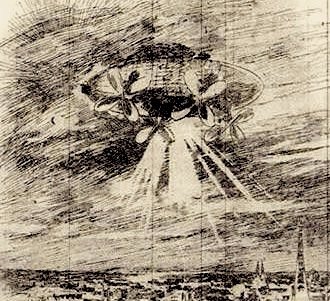
Pictured: a period newspaper illustration of the "mystery airship" reported over Sacramento, published in the Daily Record-Union on November 18, 1896 — the day after the wave's opening sighting. This is a contemporary artist's rendering based on witness description, not a photograph; no authenticated photograph of any object from this wave is known to survive. Public domain (PD-old-100), sourced via Wikimedia Commons.
Theoretical Alignment
As a nationwide, multi-month synthesis rather than a single incident, this file's theoretical alignment reflects the wave's own average character rather than any one report's strength. The Psycho-Social Hypothesis dominates because the wave's own best-documented features — a clean statistical correlation between press coverage and new report volume, at least two confirmed deliberate hoaxes (the Collins-Benjamin "secret inventor" claim and Alexander Hamilton's cattle-lasso tall tale), one confirmed faked photograph, and a 19th-century newspaper industry in the middle of an aggressive circulation war — are textbook drivers of a genuine, non-conspiratorial mass social phenomenon rather than evidence of anomalous technology. The Extraterrestrial Hypothesis registers a modest, non-trivial share specifically because a residue of the wave's reports — particularly the Sacramento sighting's own multiple credentialed official witnesses and the March 28, 1897 Topeka sighting witnessed by sitting Governor John W. Leedy — describe a genuinely unusual light with no obvious mundane trigger identified by this file's own research, and cannot be waved away purely as tall tales. The Interdimensional Hypothesis scores lowest because nothing about the wave's contemporary record or later historical scholarship (Clark, Busby, Bartholomew) ever seriously pointed a multidimensional reading at any component sighting.
Background
By the mid-1890s, the United States had spent nearly two decades absorbing Jules Verne's popular airship fiction, a genuine, well-publicized international race to build a practical dirigible or heavier-than-air flying machine, and a domestic newspaper industry locked in one of the most aggressive circulation wars in American publishing history. Samuel Langley's Smithsonian-funded Aerodrome No. 5 flew successfully, unpiloted, for 3,300 feet on May 6, 1896, with Alexander Graham Bell present as a witness; Aerodrome No. 6 flew 4,200 feet on November 28, 1896, eleven days after the Sacramento sightings began. Octave Chanute and Augustus Herring spent the summer of 1896 testing a series of gliders on the Indiana Dunes along Lake Michigan. None of this had produced a passenger-carrying airship of any kind, but all of it was extensively covered in the national press, and it gave the reading public a specific, technically plausible frame — "a real airship, built by a real but secretive inventor" — through which to interpret an unexplained light in the night sky, six full years before Kitty Hawk.
At the same moment, the newspaper business itself was undergoing its own transformation. William Randolph Hearst's 1895 purchase of the New York Morning Journal and his subsequent price-and-content war against Joseph Pulitzer's New York World had, by 1896-97, pushed daily and weekly papers nationwide toward more sensational, serialized, reader-engaging copy; the term "yellow journalism" itself was coined by a rival paper, The New York Press, in early 1897 — the same months the airship wave was near its national peak. Regional and small-town papers across the Midwest and South, competing for the same reader attention, had every commercial incentive to run — and, in a documented handful of cases, to manufacture — their own airship copy once the story became a proven national sensation. This file's own research, and every historian who has studied the wave at length (Robert Bartholomew, Michael Busby, Jerome Clark, Daniel Cohen), treats this specific newspaper-industry backdrop as directly relevant context for the wave's shape, not as incidental color.
No American federal, state, or municipal government body existed in 1896-97 with any mandate to investigate aerial phenomena; the closest institutional response anywhere in the wave was ordinary local policing (a handful of sheriffs and town officials who happened to witness or briefly looked into a specific local report) rather than any coordinated program. The U.S. Army Signal Corps, then the closest thing to a federal aeronautics authority, took no organized interest in the sightings. That institutional vacuum would persist for over half a century, until the Air Force's Project Sign (1948) and its successors began the first systematic American UFO-investigation effort — a gap of more than 50 years this file's own Sensor & Instrumentation and Historical Precedents sections below address directly.
Complete Timeline
| Date | Event |
|---|---|
| May 6, 1896 | Samuel Langley's unpiloted Aerodrome No. 5 flies 3,300 feet near Quantico, Virginia, witnessed by Alexander Graham Bell — part of the era's genuine, widely covered excitement about heavier-than-air flight. |
| Nov. 17, 1896, ~6:30–7:00 PM | Hundreds of residents of Sacramento, California watch a bright, elongated light with a vague dark shape behind it move slowly across the sky at an estimated 1,000 feet — the wave's opening sighting. |
| Nov. 18, 1896 | The Sacramento Bee and San Francisco Call publish the first press accounts, including a claimed telegram from an anonymous New York inventor stating he was flying his airship toward California. |
| Nov. 22, 1896 | The object reportedly reappears over Sacramento, witnessed by the city's own deputy sheriff and district attorney, plus private citizens including Jacob Zemansky (viewing through a telescope) and Edward Carragher (field glasses). |
| Nov. 28, 1896 | Langley's Aerodrome No. 6 flies 4,200 feet — eleven days after the Sacramento sightings began, reinforcing the period's association between "airship" reports and genuine, ongoing flight experimentation. |
| Late Nov. 1896 | San Francisco attorney George D. Collins tells the press he represents the airship's secret inventor, later named as dentist Dr. E.H. Benjamin. |
| Nov. 29, 1896 | Collins abruptly recants: "I never saw the airship and don't know anything about it." The Sunday Oregonian publishes an early skeptical piece characterizing the wave as a product of sensationalist California journalism. |
| Dec. 1896 – Jan. 1897 | Scattered further California sightings continue around Oakland, San Francisco, and Tulare before the first phase tapers off; no further "inventor" claim replaces the discredited Collins-Benjamin story. |
| Feb. 1897 | The wave's second, much larger phase begins with scattered early reports in Nebraska and an initial notice in a Sioux City, Iowa newspaper. |
| March 1897 | Farmer Robert Hibbard, living roughly fifteen miles north of Sioux City, Iowa, reports an unusually configured light as the wave spreads east into Iowa. |
| March 28, 1897 | Several hundred residents of Topeka, Kansas, including newly inaugurated Governor John W. Leedy, watch a slow-moving "blood red light" cross the sky; some witnesses reportedly take shelter in storm cellars. |
| March 30, 1897 | A fresh burst of sightings is reported over Omaha, Nebraska, intensifying the wave's spread eastward. |
| April 1, 1897, ~9:00 PM | The entire town of Everest, Kansas reportedly watches an object fly roughly 2,100 feet under the cloud ceiling, sweeping the ground with its light before departing rapidly to the southeast. |
| April 6, 1897 | A sighting is reported over Guthrie, Oklahoma as the wave continues to broaden geographically. |
| April 9, 1897 | The Kansas City Journal runs an illustrated account of the ongoing wave. |
| April 10–11, 1897 | A mass sighting over Chicago draws thousands of observers across multiple neighborhoods over several hours; amateur photographer Walter McCann's claimed photograph of the object is later identified as faked. |
| April 13, 1897 | The Saint Paul Globe (Minnesota) publishes an illustrated wave report, evidence of the phenomenon's reach into the upper Midwest. |
| April 13–17, 1897 | Texas experiences its own concentrated burst: newspapers log 38 separate sightings across 23 counties, including a Waxahachie judge's claimed conversation with an airship crew and skeptical commentary from an Ennis physician, Dr. E. Stuart. |
| April 16, 1897 | A widely reported "airship" landing near Waterloo, Iowa is later catalogued as a confirmed hoax. |
| April 17, 1897 | The alleged Aurora, Texas airship crash is reported — a separate incident with its own dedicated case file on this site, summarized below rather than re-narrated in full. |
| April 19, 1897 | Kansas rancher Alexander Hamilton reports the events later published as his "cattle lasso" story near Le Roy, Kansas. |
| April 21, 1897 | Hamilton executes a notarized affidavit, signed by eleven local citizens including the sheriff, a physician, a banker, an attorney, and the postmaster, attesting to his character. |
| April 23, 1897 | The Yates Center Farmer's Advocate publishes Hamilton's full account. |
| Late April – early May 1897 | Report volume collapses nationwide almost as sharply as it rose; the wave effectively ends without any airship, inventor, or wreckage ever being produced. |
| 1976 | An elderly Kansas woman comes forward stating she personally heard Hamilton boast to his wife, before publication, that he had invented the story to win a local "liars' club" tall-tale contest. |
| 1977 | UFO historian Jerome Clark investigates and corroborates the liars'-club account, establishing the Hamilton case as the wave's most frequently cited confirmed hoax. |
| 1981 | Daniel Cohen publishes The Great Airship Mystery: A UFO of the 1890s, the first dedicated book-length historical treatment of the full national wave. |
| 1990 | Robert Bartholomew publishes "The Airship Hysteria of 1896-97" in Skeptical Inquirer, framing the wave within the sociology of collective delusions. |
| 2004 | Michael Busby publishes Solving the 1897 Airship Mystery, a national-scope investigation into the promoters and inventors whose activities intersected with the wave. |
Aurora, Texas: Already on Record
Because the wave's single most famous individual incident already has a full, dedicated case file on this site, it is deliberately not re-narrated here. On April 17, 1897, in the immediate aftermath of the Texas sighting burst discussed below, local correspondent S.E. Haydon reported that a cigar-shaped airship struck Judge J.S. Proctor's windmill in Aurora, Texas, exploded, and scattered wreckage across several acres; its non-human pilot was said to have been recovered and buried the next day. No second 1897 source ever corroborated the story, the article's only named "expert" witness has been identified as the town blacksmith rather than the Signal Service astronomer Haydon described, and the town's own longtime historian later stated plainly that the story was invented to draw attention to a community in economic decline. This site's dedicated Aurora UFO Crash case file (Debunked, this catalogue's own assessment) covers the full investigation, including the 1973 grave-marker disappearance and the 2008 well-water test; readers wanting that complete account should consult it directly. This file's own scope is the wave as a whole, not Aurora's specific claims.
Sonora Aero Club: Already on Record
A second, frequently confused piece of this wave's popular lore is likewise already fully covered elsewhere on this site. Beginning in his seventies, decades after the fact, Houston butcher Charles A.A. Dellschau filled at least twelve notebooks with roughly 2,500 drawings depicting a secret society of inventors — the "Sonora Aero Club" — that he claimed built dozens of gravity-defying airships in the California Gold Rush towns of Sonora and Columbia between 1850 and 1858, nearly forty years before this wave began. No contemporary 1850s record of any such club has ever been located, and genealogists have been unable to place Dellschau himself in California during the claimed period; the notebooks are, however, a genuine and significant body of American outsider art held today by the Menil Collection and other major institutions. Because Dellschau's own retrospective narrative describes events decades before the 1896-97 wave and was not compiled or published until 1899-1923, this file treats the Sonora Aero Club as historically and evidentially distinct from the wave itself — useful only as an illustration of how later, unrelated "secret real airship" folklore has sometimes been retroactively woven into the wave's popular mythology. The full investigation, including the extensive historiographical debate over where Dellschau's art ends and his claimed history begins, is covered in this site's dedicated Sonora Aero Club Secret Society case file (Disputed).
The Wave in Numbers: Scale and Statistical Shape
Precise, independently re-verified totals for a 130-year-old newspaper phenomenon do not exist, and this file's own research treats every scale figure below as a compiled estimate rather than an audited count. The most frequently cited compilation, repeated across multiple modern historical treatments of the wave, puts the total at upwards of 1,200 individual newspaper articles published across more than 400 papers in 41 states and 6 Canadian provinces over roughly six months — a figure this file could not trace to a single original, citable tabulation, and reports with the same honest caveat that applies to any secondhand statistical claim about this era. What is better documented is the wave's basic geographic and temporal shape: a smaller, contained California phase in November-December 1896, a quiet interval through January, and then a much larger second phase beginning in Nebraska in February 1897 that swept east through Kansas, Iowa, Missouri, Illinois, and Texas, peaking in mid-to-late April before collapsing almost as sharply as it had risen. Texas alone logged 38 separate sightings across 23 counties in the single week of April 13-17, 1897, concentrated in North Central Texas — a documented regional density that gives some independent texture to the national totals even without a fully audited nationwide count.
The wave's own contemporary and later observers consistently describe witness totals in the tens of thousands rather than the hundreds: a single Chicago sighting on April 10-11, 1897 alone drew crowds numbering in the thousands across multiple neighborhoods over several hours, and the Everest, Kansas sighting on April 1 was reportedly seen by the town's entire population. This file's own research found no basis for treating any specific nationwide witness total as precisely countable, but the geographic breadth alone — simultaneous or near-simultaneous reports across California, Nebraska, Kansas, Iowa, Missouri, Illinois, Oklahoma, and Texas within a roughly ten-week span — is itself a genuinely unusual, well-documented feature of American press history, whatever its ultimate cause.
Phase One: The California Wave, November–December 1896
The Sacramento Sighting, November 17, 1896
Shortly before 7:00 PM on November 17, 1896, hundreds of residents of Sacramento looked up to see a bright, elongated light with a vague dark shape visible behind it, moving slowly — witnesses estimated roughly 20 miles per hour — at an estimated altitude of 1,000 feet. The Sacramento Bee and the San Francisco Call both ran accounts the next day, and the Bee printed what it presented as a telegram from an unnamed New York inventor claiming to be flying his airship toward California and expecting to arrive within two days — a claim no subsequent record ever substantiated. The object, or something reported as it, reappeared five days later, on November 22; period press accounts describe it as witnessed that night by the city's own deputy sheriff and district attorney, alongside private citizens including Sacramento resident Jacob Zemansky, who reportedly viewed it through a telescope, and Edward Carragher, who used field glasses. Colonel W.H. Menton of the Southern Pacific Railroad and Samuel Foltz, advertising manager of the San Francisco Call and Post, were also named among the period's Bay Area witnesses as the sightings spread from Sacramento into Oakland and San Francisco over the following days, with some accounts describing the light as twice as bright as an arc lamp or locomotive headlamp.
What makes the Sacramento sighting more evidentially interesting than most of the wave's later reports is precisely this cluster of named, credentialed official witnesses — a sitting deputy sheriff and district attorney among them — rather than the anonymous "many residents" language that dominates most other 1896-97 accounts. No instrumented record of any kind survives (radar did not exist and no photograph of this specific sighting has been authenticated), and this file's own research found no surviving direct written statement from either the deputy sheriff or the district attorney beyond secondhand press description, a real limitation on how much weight their participation can bear. But their reported presence among the crowd, without any known personal or professional motive to fabricate a story, is one of the wave's stronger individual data points for genuine, good-faith observation of an unexplained aerial light, whatever its ultimate cause.
The Collins-Benjamin Hoax
Within days of the Sacramento story reaching a national audience, San Francisco patent attorney George D. Collins told reporters he represented the airship's inventor — a wealthy, secretive man who had spent fifteen years developing flying-machine designs and seven years testing them quietly in California, planning a public unveiling once satisfied with the craft's performance. Collins offered specific technical detail: the airship was 150 feet long, built "on the aeroplane system" with two 18-foot canvas wings and a bird-tail rudder, capable of carrying 15 passengers. He named the inventor as Dr. E.H. Benjamin, a 34-year-old San Francisco dentist. The story collapsed within days: Collins reversed himself entirely, telling the press, "I never saw the airship and don't know anything about it," and explaining that an unnamed man of standing had merely asked him to help file an incomplete patent application, adding, "I really don't think my client's invention has anything to do with these mysterious appearances." No patent, prototype, or independent record of Benjamin as an aviation inventor has ever surfaced. Every historian who has examined the episode at length — Michael Busby, Jerome Clark, and the contemporary Sunday Oregonian, which ran a skeptical piece on November 29, 1896 attributing the wave to sensationalist California journalism — treats Collins-Benjamin as one of the wave's earliest and clearest manufactured hoaxes, a real-time illustration of how quickly a "real secret inventor" narrative could be constructed and then discarded once challenged.
Phase Two: The Midwest and Southern Wave, February–April 1897
Nebraska, Iowa, and Governor Leedy's Sighting
The wave's second, larger phase opened quietly, with a February 3, 1897 item in a Sioux City, Iowa newspaper and scattered early Nebraska reports, before intensifying through March. Farmer Robert Hibbard, living roughly fifteen miles north of Sioux City, Iowa, reported an unusually configured light that same March as the phenomenon spread east. On March 28, 1897, several hundred residents of Topeka, Kansas watched a slow-moving "blood red light" cross the night sky, a sighting significant enough to reach the pages of Denver's Rocky Mountain News; some witnesses were reportedly frightened enough to take shelter in storm cellars, "fearing that a great calamity was impending." Among the crowd, per contemporary press accounts, was Kansas's newly inaugurated 14th governor, John W. Leedy, a Populist who had taken office less than three months earlier. Leedy had no known economic or promotional motive to invent or embellish a sighting, and his reported presence among hundreds of ordinary Topeka residents is treated by this file as one of the wave's stronger individual credibility signals — not proof of anything anomalous, but a genuine data point against dismissing the entire Kansas sighting record as uniform fabrication. Two days later, on March 30, a fresh burst of reports centered on Omaha, Nebraska, further intensifying the wave's spread.
Kansas: Everest and the Alexander Hamilton Hoax
On the night of April 1, 1897, the entire town of Everest, Kansas reportedly watched an object fly roughly 2,100 feet under the cloud ceiling, descending slowly before sweeping the ground with a powerful light directly over the town and then departing rapidly to the southeast — one of the wave's more dramatic mass-observation reports, though, as with most of the wave, no named individual witness statement beyond "the whole town saw it" survives in the sources this file's research located.
Kansas is also the source of the wave's single most thoroughly documented confirmed hoax. On April 19, 1897, rancher Alexander Hamilton, whose working ranch sat in Everett Township, Woodson County, near Le Roy in adjoining Coffey County, reported that he, his son, and a hired hand watched a 300-foot, dark reddish, cigar-shaped airship descend over his cattle pen, crewed by "six of the strangest beings I ever saw." A red cable trailing from the craft, Hamilton said, had lassoed one of his two-year-old heifers; after the three men failed to free the animal by hand, Hamilton cut a section of fence wire, and the group watched the ship, cable, and heifer rise slowly and disappear to the northwest. A neighboring Coffey County rancher, Lank Thomas, separately claimed to have found the heifer's remains the following day, reportedly noting the absence of any carnivore tracks at the scene — a secondhand detail this file's own research could not independently verify beyond the same later ufological retellings that preserve it. The Yates Center Farmer's Advocate published Hamilton's full account on April 23, 1897, accompanied by a notarized affidavit, dated April 21, attesting to his truthfulness and signed by eleven prominent local citizens: sheriff M.E. Hunt, banker H.H. Winter, physician E.K. Kellenberger, attorney J.H. Sticher, justice of the peace Alexander Stewart, postmaster H.D. Rollins, deputy sheriff W. Lauber, state oil inspector E.V. Wharton, pharmacists H.S. Johnson and F.W. Butler, and register of deeds James L. Martin.
The affidavit's roster of genuinely credentialed local officials made the story unusually difficult to dismiss on its face for decades — until 1976, when an elderly Kansas woman came forward stating that she had personally heard Hamilton boast to his wife, shortly before publication, that he had invented the entire account to win a local "liars' club" tall-tale competition, a real and locally documented small-town institution of the era that rewarded the most outlandish fabricated story. UFO historian Jerome Clark investigated the claim in 1977 and corroborated the liars'-club account, and it has stood since as the wave's most frequently cited confirmed hoax. This file's own research notes, in fairness, that the debunking itself rests on one elderly witness's decades-later secondhand recollection rather than a document Hamilton personally signed admitting fabrication, and that his later public response to being repeatedly called a liar reads, by some researchers' assessment, more as exasperated sarcasm than a literal confession — a genuine, disclosed limitation on how airtight the debunking is, even though this file's own judgment, consistent with Clark's, is that the balance of evidence favors a deliberate hoax.
Illinois: The Chicago Mass Sighting and a Faked Photograph
On the night of April 10-11, 1897, a light first spotted by a crowd gathering on Oakley Street on Chicago's north side drew observers numbering in the thousands over the following hours, variously described as a "red light," a "manifestation," and an "airship." Witnesses near the Sheffield Avenue police station watched it approach as close as an estimated 2,000 feet before receding to greater altitude; streetcar conductors and gripmen on multiple lines reported the light independently, including conductor Yost, who had half a dozen passengers and an on-duty policeman aboard his North Clark Street cable car at the time. Amateur photographer Walter McCann of Rogers Park claimed to have photographed the object at 5:30 that morning, and three witnesses initially asserted they had watched him take the exposure — but the resulting image was subsequently identified as faked, a rare case within the wave of a specific physical "evidence" claim being directly and conclusively debunked rather than merely disputed. The Chicago sighting is, alongside Sacramento's, one of the wave's better-corroborated mass observations by sheer independent witness count and occupational range (transit workers, an on-duty officer, ordinary residents across several neighborhoods) — even as its one claimed piece of physical evidence collapsed on examination.
Texas: The Wave's Final, Largest Regional Burst
Texas experienced the wave's most concentrated regional burst in its final active week, April 13-17, 1897: newspapers logged 38 separate sightings across 23 counties, heavily concentrated in North Central Texas around Hillsboro, Waxahachie, Greenville, Farmersville, and Ennis. A Waxahachie judge identified in contemporary Dallas Morning News coverage as "Judge Love" claimed to have personally conversed with an airship's crew, who told him they had come from the North Pole; in Greenville, correspondent C.G. Williams reported speaking with a ship's leader who claimed a New York origin instead; in Farmersville, witnesses reported hearing three crewmen singing hymns and dropping temperance literature from the craft. Not every Texas voice that week credited the sightings: Ennis physician Dr. E. Stuart, described in period coverage as "an acknowledged authority in metaphysics," publicly attributed the reports to "hypnotism and bad whiskey," and a Fort Worth railroad conductor nicknamed "Truthful" Scully — an ironic moniker period readers would have recognized as a running joke about his own credibility — reported a grounded airship near Hawkins Tank that a Dallas aeronautical authority quoted in the same coverage treated with open skepticism. On April 16, a widely reported "airship" landing near Waterloo, Iowa (part of the same broader burst reaching back into the upper Midwest) was later catalogued as a confirmed hoax. The Texas burst's single most famous individual claim — the alleged April 17 Aurora crash — is covered in full in this site's dedicated case file, summarized above.
National Press Coverage, Circulation Wars, and Why the Wave Happened When It Did
By April 1897, papers across the country — from major metropolitan dailies to small-town weeklies — were running near-daily airship copy, and the phenomenon's own internal shape is difficult to separate from the newspaper industry's contemporaneous transformation. The Hearst-Pulitzer circulation war, then in its second full year, had already established that serialized, sensational, reader-engaging copy reliably sold papers; regional and small-town editors competing for the same limited reader attention had every commercial incentive to run, follow up on, and in a documented handful of cases invent their own local airship story once the format proved it could reliably generate interest and, in some cases, direct reader submissions. Robert Bartholomew's 1990 Skeptical Inquirer analysis situates the wave within the broader sociology of collective delusion, concluding, in his own compact phrase describing how belief and observation reinforced each other during period social panics generally, that "believing was seeing" — witnesses primed by weeks of prior coverage to expect an airship were, on this reading, more likely to interpret an ambiguous light (a bright planet, a kite, a balloon, a genuine meteor) through that specific frame, and more likely to have their own report taken seriously and published once the format was established.
This file's own research treats three specific, non-exclusive factors as the best available explanation for why the wave crested specifically in this six-month window rather than any other point in the late 19th century. First, the era's genuine, well-covered excitement about heavier-than-air and dirigible flight — Langley's two 1896 Aerodrome flights, Chanute and Herring's glider tests, and ongoing European dirigible experimentation — gave the reading public a specific, technically plausible mental template for "a real secret airship" that did not exist a decade earlier and would be resolved into ordinary aviation reporting a decade later. Second, the newspaper industry's own concurrent sensationalism and circulation-war dynamics rewarded exactly this kind of serialized, reader-submitted mystery story, creating a self-reinforcing loop in which coverage generated more reports, which generated more coverage. Third, once the format was established, direct and documented copycat and hoax dynamics — the Collins-Benjamin claim, the Alexander Hamilton tall tale, the Waterloo landing hoax, and Walter McCann's faked Chicago photograph — demonstrably added further volume to the wave's raw report count independent of whatever smaller number of reports may reflect a genuine, still-unexplained observation. None of these three factors requires or excludes the others; this file's own judgment, consistent with Bartholomew's, Busby's, and Clark's published work, is that all three operated simultaneously and are jointly sufficient to explain the wave's overall shape, while leaving a residue of individually better-corroborated reports — Sacramento's official witnesses, Governor Leedy's Topeka sighting, Chicago's mass multi-occupational crowd — that this file does not claim are fully explained by any single mundane cause identified in its own research.
Key Witnesses
George D. Collins
In late November 1896, Collins told reporters he represented a wealthy, secretive inventor conducting covert nighttime test flights of a working airship over Sacramento, providing specific technical detail (150 feet long, canvas wings, aeroplane-style construction, 15-passenger capacity) and naming the inventor as dentist Dr. E.H. Benjamin. Within days he reversed himself entirely: "I never saw the airship and don't know anything about it." No patent, prototype, or independent record of the claimed airship has ever surfaced.
Dr. E.H. Benjamin
A 34-year-old San Francisco dentist publicly identified by attorney George D. Collins as the wealthy secret inventor behind the Sacramento sightings, said to have spent fifteen years developing flying-machine designs. No independent record has ever placed Benjamin as an inventor of any kind, and no airship, patent, or prototype connected to him has ever been located; his supposed role evaporated the moment Collins's claim collapsed.
Alexander Hamilton
Reported on April 19, 1897 that he, his son, and a hired hand watched a cigar-shaped airship lasso one of his heifers with a red cable and carry it off; produced a notarized affidavit signed by eleven local officials attesting to his character. In 1976, a Kansas woman came forward stating she had heard Hamilton privately admit the story was invented for a local "liars' club" tall-tale contest; Jerome Clark's 1977 investigation corroborated the account, making this the wave's most thoroughly documented confirmed hoax, though the debunking itself rests on secondhand decades-later testimony rather than a signed confession.
Governor John W. Leedy
A Populist inaugurated as Kansas's governor on January 11, 1897, Leedy was reportedly among several hundred Topeka residents who watched a slow-moving "blood red light" cross the night sky on March 28, 1897. With no known economic or promotional motive to embellish a sighting, his reported presence is one of the wave's stronger individual credibility signals, distinct from Kansas's own contemporaneous Alexander Hamilton hoax.
Robert Hibbard
A farmer living roughly fifteen miles north of Sioux City who, in March 1897, reported an unusually configured light in the sky as the wave's second, Midwest phase reached Iowa — among the earliest individually named witnesses of the much larger sighting burst that would sweep Nebraska, Kansas, Illinois, and Texas over the following weeks.
The Five Observables Assessment
Assessment: Because this file synthesizes a wave rather than one incident, the Five Observables are scored against the wave's own strongest illustrative examples. Anti-Gravity Lift is rated Speculative on the basis of Everest's descent-and-sweep maneuver and Hamilton's own account of the craft rising vertically with the heifer, both single-source and, in Hamilton's case, a confirmed hoax. Instant Acceleration draws on Everest's own witnesses describing a rapid departure to the southeast, a claim this file rates Speculative and Disputed since it rests on a crowd's collective subjective impression with no timed measurement of any kind. Hypersonic Velocity, Low Observability, and Trans-Medium travel are all rated Absent: no report this file's own research reviewed claims speeds beyond ordinary period estimation, no radar or equivalent detection instrument existed anywhere in the United States in 1896-97, and no case describes a transition into water, ice, or ground. This is among the weakest Five Observables profiles of any wave-scale file in this archive, reflecting the total absence of instrumented data across the entire period.
Evidence Assessment
Supporting Anomalous Origin
- The wave's overall geographic and temporal scale — simultaneous or near-simultaneous reports across at least eight states within a roughly ten-week span — is difficult to attribute entirely to any single mundane trigger, even allowing for substantial press contagion and documented hoaxing within that total.
- The November 17-22, 1896 Sacramento sightings were independently witnessed by multiple named, credentialed officials (a deputy sheriff, a district attorney) with no known motive to fabricate a story, alongside private citizens using telescopes and field glasses.
- The March 28, 1897 Topeka sighting was reportedly witnessed by several hundred residents including a sitting state governor, a witness with no economic or promotional incentive to embellish or invent a report.
- The Chicago mass sighting of April 10-11, 1897 drew independent corroboration from witnesses across multiple occupational backgrounds — streetcar conductors, an on-duty police officer, ordinary residents in several neighborhoods — observing over several hours rather than a single fleeting moment.
- The wave prompted sustained, serious historical attention for over a century, from contemporary press coverage through Daniel Cohen's 1981 book, Robert Bartholomew's 1990 sociological analysis, and Michael Busby's 2004 investigation — a level of continued scholarly engagement this file treats as circumstantial evidence that the underlying record contains genuine unresolved residue, distinct from whether any specific claim within it holds up.
Supporting Conventional Explanation
- At least two specific, well-documented component claims within the wave are confirmed hoaxes with a clear mechanism: the Collins-Benjamin "secret inventor" story (recanted within days by its own source) and Alexander Hamilton's cattle-lasso account (corroborated as a liars'-club tall tale by Jerome Clark's 1977 investigation).
- At least one claimed piece of physical evidence — Walter McCann's April 1897 Chicago photograph — was directly identified as faked, and a separate April 16, 1897 Waterloo, Iowa "landing" is independently catalogued as a confirmed hoax.
- The wave developed during, and is directly contemporaneous with, the height of the Hearst-Pulitzer newspaper circulation war and the era's own genuine excitement about heavier-than-air flight experimentation — both well-documented drivers of exactly this kind of sensationalized, self-reinforcing press phenomenon.
- No case within the entire wave that this file's own research reviewed produced any instrumented (radar, verified-chain-of-custody photographic, or laboratory-tested physical) evidence surviving to modern examination; every photographic claim associated with the wave that this file could verify was either unauthenticated or directly debunked.
- Several of the wave's most colorful individual accounts (the Waxahachie "North Pole" crew conversation, the Farmersville hymn-singing crewmen, "Truthful" Scully's grounded airship) bear the specific hallmarks — internal inconsistency, ironic nicknames, unverifiable secondhand quotation — that period readers themselves often recognized as embellished tall tales rather than sober reportage.
Why "Disputed"
This wide-scope wave synthesis earns a DISPUTED classification with a credibility score of 30/100 — below this catalogue's own Great French UFO Wave of 1954 (Disputed, 52), which benefits from contemporaneous gendarmerie and DST investigation and at least one case (Quarouble) with measured physical trace evidence, and closer to the lower end of this catalogue's wave-file range. That relative position reflects this file's actual composition honestly: it inherits a genuinely large, well-documented mass phenomenon — simultaneous reports across at least eight states, credible crowd-scale corroboration in Sacramento, Topeka, and Chicago, and a handful of individually stronger witnesses including a sitting governor and named municipal officials — but almost none of the corroborating structure that raises other wave files' scores. Nothing in this file's own research found a single instrumented reading, a single laboratory-tested physical specimen, or a single contemporaneous official investigation comparable to a gendarmerie field report anywhere in the entire wave.
What holds this file specifically below the French 1954 wave, and well into this catalogue's low-score tier, is the sheer density of confirmed fabrication sitting directly inside the wave's own documented record: two separate, independently confirmed hoaxes with a clear named perpetrator and mechanism (Collins-Benjamin, Alexander Hamilton), one directly debunked photograph (McCann's), and one further confirmed hoax landing (Waterloo). Unlike Puerto Rico's ASW range sonar contact elsewhere in this catalogue (Disputed, 22) — scored low specifically for weak, unverifiable sourcing with essentially nothing to weigh on the positive side — this wave earns a few points above that floor because a genuine minority of its component reports (Sacramento's official witnesses, Leedy's Topeka sighting, Chicago's multi-occupational crowd) carry real, disclosed corroborative weight that a single unverifiable sonar report does not. But the wave's average report, and its most famous individual claims, are dominated by tall tales, embellishment, and at least two now-proven deliberate fabrications from an era with zero photographic or instrumental capability to check any of it in real time. A wave this large and this historically significant, containing this much confirmed hoaxing and zero surviving physical or instrumented evidence across every case this file's own research could examine, is exactly the profile a low-30s Disputed score exists to describe honestly.
Sensor & Instrumentation Detection Profile
No sensor or instrumentation data of any kind survives from any case in this wave. Functional radar did not exist anywhere in the world until the 1930s-40s, roughly four decades after this wave; the U.S. Army Signal Corps, the closest period equivalent to a federal aeronautics authority, conducted no organized investigation of the sightings. The wave's only surviving visual-record claims are period newspaper illustrations (artist renderings based on witness description, not photographs) and a small number of amateur photographs, of which the only one this file's own research could specifically trace to a named claimant — Walter McCann's April 1897 Chicago exposure — was directly identified as faked. This total absence of any instrumented corroboration across an entire national wave spanning at least eight states is itself a significant, disclosed evidentiary limitation, not an incidental gap.
Environmental & Geospatial Context
The wave's geographic spread is one of its most striking documented features: named incidents in this file alone span the Sacramento Valley and San Francisco Bay Area of California, the eastern Nebraska and northwest Iowa prairie around Omaha and Sioux City, the eastern Kansas farm country around Topeka, Everest, and Le Roy, the Chicago lakefront in Illinois, and the North Central Texas blackland prairie around Waxahachie, Greenville, and Aurora. No single regional environmental factor — terrain type, proximity to military or industrial infrastructure, or local astronomical viewing conditions — plausibly explains a wave this geographically dispersed on its own, which is directly relevant to why this file's Conventional Explanation Candidate section below treats any single, localized misidentification source (one specific bright planet, one balloon, one aircraft-adjacent light) as unable to account for the wave's full geographic breadth, even where such a candidate may explain individual component reports. No systematic period meteorological or astronomical-conditions dataset specific to the wave's dozens of individual report dates and locations was located in any source consulted for this file.
Observer Credibility & Occupational Profile
The wave's witness pool spans an unusually wide occupational and social range: this file's own named witnesses alone include a state governor (Leedy), municipal officials (Sacramento's deputy sheriff and district attorney), farmers and ranchers (Hibbard, Hamilton), a railroad official (Colonel Menton), a newspaper advertising manager (Foltz), a patent attorney (Collins), and a dentist named, falsely, as an inventor (Benjamin). None of this wave's named witnesses held a specifically relevant technical or scientific credential in the way later, better-instrumented cases on this site feature trained pilots or radar operators — there was, in 1896-97, no such profession yet to hold. Where multiple independent witnesses corroborate a single report (Sacramento's officials and private citizens; Chicago's transit workers, police officer, and residents across several neighborhoods), that corroboration meaningfully strengthens the account beyond what any single uncorroborated witness could provide. Where a single named individual is the sole source (Hamilton, Collins), the wave's own record shows both cases ultimately collapsed into confirmed or effectively confirmed fabrication — a pattern this file's own research treats as a meaningful, disclosed signal about which reporting structure within this specific wave tends to hold up and which does not.
Physical & Material Assays
No physical evidence from any case in this wave has ever been recovered, preserved, or tested under any scientifically controlled condition. Alexander Hamilton's account describes a dead heifer allegedly found by a neighboring rancher the following day, but no contemporary veterinary examination, necropsy, or physical specimen from that claim survives for independent review, and the claim itself belongs to an account subsequently corroborated as a hoax. No wreckage, mechanical component, or trace material from any other case in the wave — Sacramento, Topeka, Everest, Chicago, or the Texas burst — was ever recovered by any contemporary investigator. This file's Material Analysis section below addresses the wave's surviving documentary and photographic record, the closest thing to physical evidence the wave actually left behind.
Historical Precedents & Archive Matches
Within this site's own catalogue, this wave is the direct historical precedent for the 20th century's later mass UFO waves — including the 1954 French wave and the 1975 SAC Base Intrusion Wave — sharing with both the same basic pattern of press-amplified regional clustering, a mix of genuinely puzzling and clearly fabricated component reports, and a wide gap between contemporary popular excitement and any surviving instrumented evidence. It is also the direct origin point of the alleged Aurora, Texas crash-retrieval narrative, this catalogue's earliest example of the "crashed craft plus recovered non-human occupant" story template later applied, with vastly more documentation, to Roswell fifty years afterward. The unrelated but frequently conflated Sonora Aero Club legend, predating this wave by nearly forty years and not compiled into notebook form until 1899-1923, is a useful negative case study in how later folklore can graft itself onto a genuine historical wave without actually being part of it.
Material Analysis
As with this site's other wave-synthesis files, "material" here refers primarily to the wave's surviving documentary and illustrative substrate rather than any recovered physical object: period newspaper archives (the Sacramento Bee, San Francisco Call, Dallas Morning News, Chicago Times-Herald, Kansas City Journal, and Saint Paul Globe among them), the small number of surviving period illustrations, the one specifically identified faked photograph (McCann's), and Alexander Hamilton's notarized 1897 affidavit.
The Newspaper Illustration Record
Unlike later 20th-century waves, no authenticated photograph of any object from this wave is known to survive; the era's newspapers instead relied heavily on artist illustrations based on witness description, published within a day or two of a given report, a genuinely large corpus of which (including this file's own hero image) is preserved and now public domain via period papers digitized by the Library of Congress and reproduced on Wikimedia Commons. These illustrations are valuable as a record of what period readers were told to imagine, but carry no independent evidentiary weight about what, if anything, any witness actually saw.
The Hamilton Affidavit
Alexander Hamilton's April 21, 1897 affidavit, signed by eleven named local officials, is the wave's single most formally documented piece of "corroborating" paperwork — and, per Jerome Clark's 1977 investigation, corroborating evidence for a hoax rather than a sighting. The affidavit's signers attested to Hamilton's general character and truthfulness, not to having personally witnessed the claimed event themselves; this file's own research found no evidence any of the eleven signers claimed direct observation of the airship or the heifer's abduction, a frequently overlooked distinction that meaningfully weakens the document's evidentiary value even before the 1976-77 liars'-club revelation is factored in.
Supporting Non-Terrestrial or Unexplained Origin
- A genuinely large, geographically dispersed volume of independently reported sightings across at least eight states within a compressed roughly ten-week span in the second phase alone.
- Several of the wave's specific component reports (Sacramento, Topeka, Chicago) combine multi-witness corroboration from named, credentialed observers with no known motive to fabricate.
- Continued serious historical and sociological attention across more than a century, from contemporary press coverage through Bartholomew's, Busby's, and Clark's published work, suggests a persistent, unresolved residue within at least part of the case record.
Supporting Terrestrial or Mundane Origin
- Two of the wave's specific, well-documented component claims are confirmed hoaxes with a clear named perpetrator and mechanism, and a third claimed photograph was directly identified as faked.
- No instrumented or laboratory-tested physical evidence from any case this file's research reviewed survives to modern independent re-examination.
- The wave's own affidavit-style "corroborating" documentation (Hamilton's) attests to character rather than direct observation, and was itself produced in service of a story later corroborated as fabricated.
- The wave developed during, and closely tracks, the height of a well-documented newspaper circulation war and the era's own genuine excitement about heavier-than-air flight experimentation — both established drivers of exactly this kind of self-reinforcing press phenomenon.
The Conventional Explanation Candidate (CEC): Multiple Competing Terrestrial Hypotheses
Because this file synthesizes a wave of hundreds of individually distinct reports rather than one incident, no single conventional explanation can be evaluated against the wave as a whole; this section instead assesses the leading candidates against the wave's overall documented shape, while noting that different candidates almost certainly apply with different force to different individual component reports.
Media Contagion, Circulation-War Sensationalism, and the "Bandwagon Effect"
The wave's own documented shape — a contained, short-lived California phase that ended once the Collins-Benjamin story collapsed, a quiet interval, and then a much larger, more geographically dispersed second phase that built steadily through March before exploding into near-daily national coverage through mid-April — is consistent with genuine media-driven contagion layered onto the specific commercial incentives of the Hearst-Pulitzer circulation-war era, in which press coverage itself primed witnesses to interpret ambiguous nighttime stimuli through an already-established "flying airship" frame, and further reports generated further coverage in a self-reinforcing loop. This candidate struggles, however, to fully explain the wave's better-corroborated crowd sightings (Sacramento's officials, Topeka's governor-witnessed light, Chicago's independently corroborating transit workers and police officer), where multiple, differently motivated observers reported a broadly consistent phenomenon without any documented prior coordination.
Deliberate Hoaxing
The Collins-Benjamin claim's own rapid, self-authored collapse and Alexander Hamilton's liars'-club-corroborated confession prove this candidate applied to at least two specific, well-documented component cases, and Walter McCann's Chicago photograph adds a third confirmed instance of outright fabrication. Extrapolating from these confirmed cases to the wave's full report volume would be methodologically unsound — a confirmed hoax in San Francisco or Kansas says nothing definitive about Sacramento's official witnesses or Topeka's governor-witnessed crowd sighting — but the confirmed instances establish that deliberate fabrication was a real, active, non-hypothetical contributor to at least part of this wave's total volume, a baseline this file treats as established rather than speculative.
Misidentification of Astronomical, Meteorological, or Mundane Aerial Phenomena
Given the wave's sheer volume of witnesses with no specific training in identifying nighttime aerial or celestial objects, ordinary misidentification of bright planets (Venus was a prominent, unusually bright evening object during parts of this period), meteors, kites, balloons, or early experimental lighting almost certainly accounts for a meaningful fraction of the wave's less-detailed sighting reports. This file's own research, however, could not identify any single dated astronomical or meteorological event capable of explaining the wave's full geographic breadth across at least eight states, or its more detailed, multiply-corroborated component reports.
Genuine Experimental Aircraft
A minority but persistent reading, advanced by researchers including Michael Busby, holds that a small number of real, little-documented American inventors were quietly testing genuine experimental gas-bag or gliding craft during exactly this period, and that a fraction of the wave's reports describe real, if far more modest, human-built aircraft rather than either hallucination or pure invention. This candidate is not disprovable outright, since amateur aeronautical experimentation genuinely was occurring nationwide in the mid-1890s, but no surviving patent, prototype, photograph, or independent corroborating record has ever tied any specific 1896-97 sighting to any specific real aircraft, and every specific "named inventor" claim this file's own research could examine (Collins-Benjamin chief among them) collapsed into hoax rather than confirmation.
Genuine Unconventional Aerial Phenomenon
This reading remains genuinely open specifically for the wave's strongest, most multiply-corroborated component reports — Sacramento's officially witnessed sightings above all, alongside Topeka's governor-witnessed light and Chicago's multi-occupational crowd observation — where independent, differently motivated witnesses described a broadly consistent, unexplained aerial phenomenon. It is tempered by every limitation disclosed throughout this file: at least two confirmed hoaxes and one confirmed faked photograph sitting directly inside the same wave, and the total absence of any instrumented or laboratory-verified physical evidence surviving from any case this file's own research could examine.
Media Contagion / Circulation-War Sensationalism
Highly Plausible (Partial)HIGHLY PLAUSIBLE as a partial explanation for the wave's overall statistical shape and raw volume, strongly supported by the documented timing correlation with press coverage and the Hearst-Pulitzer circulation war, but it cannot fully account for the wave's multiply-corroborated crowd sightings.
Deliberate Hoaxing
Confirmed (Partial)CONFIRMED as a real contributor to at least part of the wave's volume (Collins-Benjamin, Alexander Hamilton, the McCann photograph), but not extendable as a blanket explanation to independently corroborated cases with no known hoaxer connection.
Astronomical/Meteorological/Mundane Misidentification
InconclusiveINCONCLUSIVE. Plausibly accounts for some fraction of the wave's less-detailed sightings, but no single dated event was identified that explains the wave's full geographic breadth or its more detailed, multiply-corroborated component reports.
Genuine Experimental Aircraft
InconclusiveINCONCLUSIVE. Amateur aeronautical experimentation genuinely occurred in this era, but no surviving record ties any specific real aircraft to any specific 1896-97 sighting, and every specific "named inventor" claim examined for this file collapsed into hoax.
Genuine Unconventional Aerial Phenomenon
InconclusiveINCONCLUSIVE. Remains genuinely open for the wave's strongest component cases (Sacramento, Topeka, Chicago), but tempered by at least two confirmed hoaxes, one confirmed faked photograph, and the absence of any surviving instrumented physical evidence.
Related Cases
Honest Assessment: No Contemporary Government Investigation Exists
Unlike Roswell (1947) or the Cold War-era sightings catalogued by Project Blue Book (1952–1969), the 1896-97 airship wave predates any organized U.S. government UFO-investigation apparatus by more than half a century. No federal agency — military, civilian, or intelligence — is known to have opened a file, conducted a field investigation, or issued a public statement on the wave at the time or since; the U.S. Army Signal Corps, the closest period equivalent to a federal aeronautics authority, took no organized interest. In place of nonexistent federal records, the closest genuine institutional documentation is archival: digitized period newspaper collections held by the Library of Congress and state historical societies, and Kansas's own state government archive of the Leedy administration.
Free public digitized archive holding the original period newspaper coverage of the wave, including Sacramento, Chicago, and Texas-area papers cited throughout this file.
PUBLIC FEDERAL ARCHIVE (Library of Congress)The state archival record of Governor Leedy's 1897-99 administration, the closest official government record connected to this file's own named credible witness.
STATE-CHARTERED HISTORICAL ARCHIVESearch Government Archives Directly (No Wave-Specific Federal Records Exist)
Further Reading — Recommended Literature
Solving the 1897 Airship Mystery
A national-scope investigation into the promoters and inventors whose activities intersected with the wave, researching the real people behind claims like the Collins-Benjamin episode in detail.
The Great Airship Mystery: A UFO of the 1890s
The first dedicated book-length historical treatment of the full national wave, tracing reports from California to Chicago and weighing why no airship of any kind could plausibly have existed at the time.
The Great Texas Airship Mystery
A detailed retelling of the wave's concentrated April 1897 Texas burst, drawn largely from the original period newspaper coverage, including the Aurora incident this file summarizes and links to separately.
The Emergence of a Phenomenon: UFOs from the Beginning Through 1959
The volume of Clark's standard scholarly UFO Encyclopedia covering this exact era in depth, including his own 1977 investigation of the Alexander Hamilton hoax discussed throughout this file.
A Colorful History of Popular Delusions
Places the airship wave within the broader sociological framework of mass delusions and social panics that Bartholomew's own 1990 Skeptical Inquirer analysis of this specific wave first developed.
Essential Viewing

Airship Mystery of 1896 and 1897
Jimmy Akin's research-focused overview of the full national wave, covering the California opening sightings and the much larger Midwestern phase.
The Phantom Airship Mystery of 1897
An overview of what American witnesses actually reported during the 1897 phase of the wave, framed against the era's press coverage.
Sources
- Bartholomew, Robert E. "The Airship Hysteria of 1896-97," Skeptical Inquirer, Vol. 14, No. 2 (Winter 1990), pp. 171-181. skepticalinquirer.org
- Cohen, Daniel. The Great Airship Mystery: A UFO of the 1890s. Dodd, Mead & Co., 1981.
- Busby, Michael. Solving the 1897 Airship Mystery. Pelican Publishing, 2004.
- Chariton, Wallace O. The Great Texas Airship Mystery. Wordware Publishing, 1991.
- Clark, Jerome. The Emergence of a Phenomenon: UFOs from the Beginning Through 1959 (The UFO Encyclopedia, 2nd ed., Vol. 1). Omnigraphics, 1997.
- Wikipedia contributors. "Mystery airship," Wikipedia (general orientation and cross-referenced secondary coverage; not relied upon as a primary source). en.wikipedia.org
- KQED Arts. "In 1896, a Mysterious UFO Brought Northern California to a Mesmerized Halt." kqed.org
- Readex. "UFO Fever in America's Historical Newspapers: The Mysterious Airships of 1896-97." readex.com
- Texas State Historical Association (Texas Almanac). "When Airships Invaded Texas." texasalmanac.com
- HowStuffWorks. "The 1897 Cow Abduction Hoax." science.howstuffworks.com
- Southeast Kansas History. "Vernon's Alexander Hamilton: The Time Aliens Stole My Cow." sekhistory.com
- Kansas Historical Society. "John W. Leedy," Kansapedia. kansashistory.gov
- Kansas Historical Society. "Records of the Kansas Governor's Office: Administration of Governor John Whitnah Leedy (1897-1899)." kansashistory.gov
- Wikimedia Commons. "Category: Airships wave of 1896-1897" (period newspaper illustrations, public domain). commons.wikimedia.org
- Wikimedia Commons. "File: Mystery airship Sacramento 1896.jpg" (source of this case file's hero image; Daily Record-Union, Nov. 18, 1896, public domain). commons.wikimedia.org
- Library of Congress. "Chronicling America: Historic American Newspapers." loc.gov
- National Archives and Records Administration. Online Catalog. catalog.archives.gov
- All-domain Anomaly Resolution Office (AARO), U.S. Department of Defense. aaro.mil
- This site's own dedicated case file: Aurora UFO Crash (Case File #056, Debunked), for the full investigation of the wave's most famous individual incident.
- This site's own dedicated case file: Sonora Aero Club Secret Society (Case File #027, Disputed), for the full investigation of the unrelated Dellschau notebooks.
- This site's own dedicated case file: The Great French UFO Wave of 1954, this catalogue's comparable later national wave-file, used for cross-case scoring calibration.
- Encyclopedia.com. "Yellow Journalism and the Circulation War of 1896." encyclopedia.com
- Smithsonian Institution / National Air and Space Museum. "Samuel P. Langley Collection." airandspace.si.edu
See something inaccurate? Have additional information or sources?
Suggest an Edit →Last Updated: August 2026