
The Great French UFO Wave of 1954
Between August and November 1954, France experienced the largest concentrated UFO wave any country had produced up to that time: press estimates and later statistical compilations both point to somewhere in the range of 800 to over 1,000 reports nationwide, including roughly 200–250 close encounters — landings, occupant sightings, and physical-trace cases — concentrated overwhelmingly in a six-week span from mid-September through late October. This file is the wave's country-wide synthesis, not a repeat of any single incident already covered elsewhere on this site: the wave's most famous individual case, Marius Dewilde's September 10, 1954 encounter at Quarouble, already has its own full, dedicated case file (The Marius Dewilde Sighting) and is only briefly summarized here with a link back to it. What follows instead is the material a single-incident file cannot cover: the wave's real scale and statistics, its national press coverage and a magazine's million-franc bounty for a genuine photograph, the gendarmerie and DST investigations that followed dozens of reports, several other specific, named 1954 encounters beyond Dewilde's, Aimé Michel's famous and ultimately discredited "orthoteny" straight-line theory, and how the French government's own later UFO-study office, GEPAN/GEIPAN (founded 1977), came to treat this pre-existing wave as a historical case load it inherited rather than one it investigated in real time.
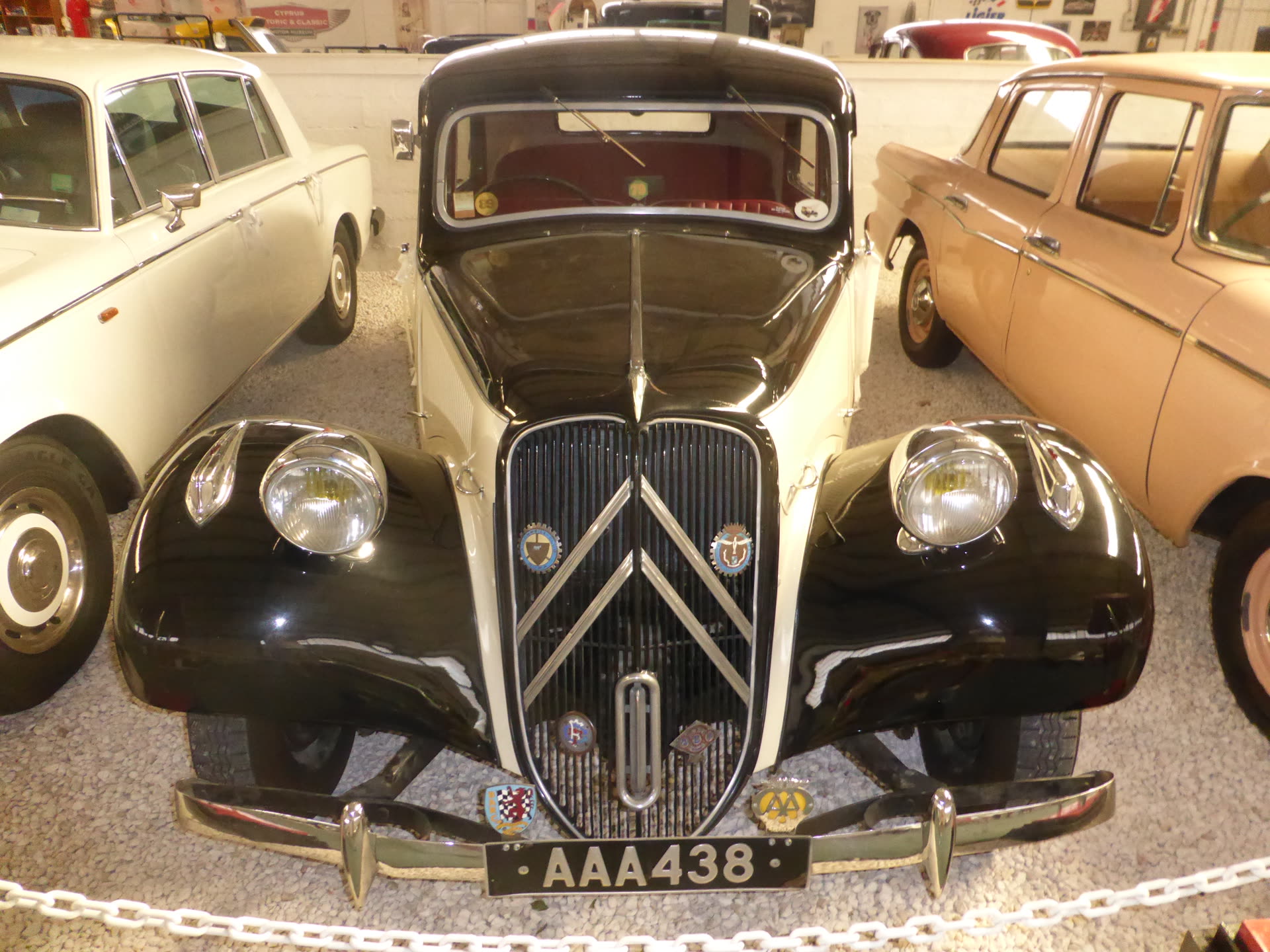
Pictured: a Citroën Traction Avant, the model of car most widely used by French gendarmerie and police investigators during the 1950s (photographed at a classic-car museum in Cyprus in 2017, well after its working life) — representative of the vehicles investigators used to reach report sites across France in 1954, not a photograph from any specific incident described in this file. No photograph of any investigating gendarme, DST agent, or vehicle from the actual 1954 wave is known to survive in the public domain; this wave's only surviving photographic evidence consists of a handful of disputed amateur photographs (see Material Analysis below) that remain under their photographers' or publishers' copyright.
Theoretical Alignment
As a nationwide, multi-month synthesis rather than a single incident, this file's theoretical alignment reflects a wave-wide average rather than any one report's own strength. The Extraterrestrial Hypothesis draws what support it has from the wave's genuine core of multiply-witnessed, contemporaneously investigated close encounters — Quarouble, Marcilly-sur-Vienne, and a scattering of others below — where independent witnesses described structurally similar landed-craft, humanoid-occupant scenarios within weeks of one another without any obvious means of coordinating their stories. The Psycho-Social Hypothesis scores highest of the three frameworks specifically because of what a wave of this exact shape looks like from the outside: a national press eager for saucer copy, a popular magazine offering real money for a photograph, a statistically documented "bandwagon" pattern of sightings clustering immediately after regional press coverage began, at least one confirmed later-admitted hoax (Bélesta, below), and a theory — Aimé Michel's orthoteny — built from this same corpus that later, careful statistical reanalysis showed was substantially an artifact of chance and selective case inclusion. The Interdimensional Hypothesis scores lowest because nothing about the wave's own contemporary investigation or later scholarship ever seriously pointed a multidimensional reading at any of its component cases.
Background
By 1954, France was a decade removed from Liberation and still absorbing a string of disorienting national shocks: a rotating cast of short-lived governments, a currency and reconstruction economy still finding its footing, the humiliating May 1954 fall of Diên Biên Phû and the resulting collapse of French Indochina, and the first stirrings of what would become the Algerian War later that same November. Some later academic treatments of the wave — including a structured statistical study by aviation-and-defense researcher analysts writing decades afterward — have specifically floated the possibility that a "flying saucer" panic offered the French public and press a welcome, non-political distraction from a genuinely difficult political and colonial moment, a psychosocial reading this file discusses further in its Evidence Assessment and Conventional Explanation Candidate sections below rather than treating as either proven or dismissed here.
The American "flying saucer" phenomenon itself was only seven years old, dating to Kenneth Arnold's June 1947 sighting, and France had experienced its own smaller, earlier flying-disc reports throughout the late 1940s and early 1950s without ever approaching the scale of a true national wave. Nothing in the summer of 1954 signaled what was coming. A handful of scattered reports through the spring and early summer — including one placeholder-listed case on this site's own "Coming Soon" queue, a claimed January 4, 1954 airport landing at Marignane, near Marseille, which predates this wave's main autumn concentration by some eight months and is treated on this site as a distinct, separate matter reserved for its own future case file rather than folded into this synthesis — gave little indication of the scale to follow. The first genuinely wave-defining reports began accumulating in late August and early September, then intensified sharply through the second half of September before exploding into a near-daily national phenomenon throughout October.
No French governmental body existed in 1954 with any mandate to investigate aerial phenomena in a systematic way; the gendarmerie and, in a small number of cases near sensitive border or industrial areas, the DST (France's domestic counter-intelligence service) handled individual reports as ordinary local police matters, filing statements and occasionally inspecting physical sites, but with no central coordinating office, no standing scientific review panel, and no mechanism for cross-referencing reports between departments. That institutional vacuum would not be filled until CNES, France's national space agency, created GEPAN — the Groupe d'Étude des Phénomènes Aérospatiaux Non-identifiés, later renamed GEIPAN — on March 23, 1977, a full 23 years after this wave crested. When GEPAN was created, its own historical framing situated the 1954 wave (alongside a smaller number of scattered reports going back to 1937) as part of a long "incubation period" of pre-institutional French UFO history that its own later work would eventually have to catch up on, rather than as the event that directly triggered its founding; that more immediate institutional trigger was a fresh wave of French sightings in the mid-1970s, discussed further below.
Complete Timeline
| Date | Event |
|---|---|
| Jan. 4, 1954 | A claimed airport landing at Marignane, near Marseille, predates this wave's main autumn concentration by roughly eight months; this site treats it as a separate, earlier matter reserved for its own future case file, not part of this wave's own timeline. |
| Aug. 22–23, 1954, ~1:00 AM | Bernard Miserey, a 25-year-old Vernon (Eure) tradesman, reports a huge, motionless, cigar-shaped object hovering over the Seine, from which five smaller reddish discs successively detach and depart at high speed; two on-duty police officers and an army chemical engineer traveling nearby separately report corroborating lights the same night. |
| Early–mid Sept. 1954 | Scattered reports accumulate across several departments; regional press begins running short items, priming public attention ahead of the wave's main autumn surge. |
| Sept. 10, 1954, ~10:20 PM | Marius Dewilde encounters a landed craft and two humanoid figures on the railway line at Quarouble, Nord — the wave's single most famous case. Full account: this site's dedicated Marius Dewilde case file. |
| Sept. 24, 1954 | Nine sightings reported in the French press on a single day; Aimé Michel later identifies six of them — at Bayonne, Lencouacq, Tulle, Ussel, Gelles, and Vichy — as falling along a single geometric line he names "BAVIC" (Bayonne–Vichy), the founding case of his orthoteny theory. |
| Sept. 30, 1954, ~4:30 PM | Construction foreman Georges Gatay and seven quarry workers near Marcilly-sur-Vienne, Indre-et-Loire, report a close encounter with a small, helmeted humanoid figure standing before a hovering, glowing dome; all eight men later report headaches, appetite loss, and insomnia. |
| Oct. 1–9, 1954 | The wave's daily report volume climbs sharply; NICAP's later compiled figures record 84 separate UFO/humanoid sightings on October 3 alone, 76 of them in France. |
| Oct. 3 & Oct. 15, 1954 | The wave's two single-day statistical peaks, each with roughly 80 European sightings recorded in the UFOCAT catalogue, the overwhelming majority in France. |
| Oct. 7, 1954 | Twenty-eight separate French localities report sightings on a single day; near Bordeaux, witness Armel Aubert reports luminous globes following a rail line before accelerating away and vanishing — a case Aimé Michel later maps as part of his most famous orthoteny alignment chart. |
| Oct. 10, 1954 | Dewilde and his young son report a second, markedly different encounter at Quarouble. Full account: the dedicated Dewilde case file. |
| Oct. 14, 1954 | The Paris weekly Samedi-Soir publishes its dramatic feature on the Dewilde case, sharply amplifying national press attention on the wave as a whole. |
| Oct. 16, 1954, ~9:30 PM | Dozens of residents at Bélesta, Ariège, report "luminous balls" maneuvering in formation for roughly 35 minutes — a sighting later confirmed, in 2009, to have been an elaborate hoax staged with a bicycle wheel, fork, and lamps by a group of local young men. |
| Oct. 17, 1954 | The Paris weekly magazine Radar announces a one-million-franc reward for an authentic photograph of a flying saucer, prompting a flood of amateur photographs — nearly all subsequently identified by the magazine's own jury as hoaxes, double exposures, or misidentified objects. |
| Oct. 24, 1954, ~5:00 PM | SNCF railway inspector Émile Turpin photographs a metallic, disc-shaped object twice near Ambleteuse, Pas-de-Calais, while photographing a Neolithic tomb; the images make national headlines and remain among the wave's most-reproduced (and most disputed) amateur photographs. |
| Late Oct.–Nov. 1954 | Report volume declines steeply through the second half of October and into November; UFOCAT's compiled statistics show roughly 193 European sightings in November, down sharply from October's 961. |
| 1958 | Aimé Michel publishes Mystérieux Objets Célestes (English: Flying Saucers and the Straight-Line Mystery), his book-length study of the wave and the first full statement of orthoteny. |
| Early-to-mid 1960s | Astronomer Donald H. Menzel publishes a rigorous statistical refutation of orthoteny in Flying Saucer Review, showing Michel's celebrated alignments are statistically indistinguishable from chance; Michel and Menzel's exchange becomes a defining, bad-tempered controversy of the era. |
| 1963 | Michel Carrouges publishes Les Apparitions de Martiens, a detailed study of the wave's humanoid-encounter cases, including Quarouble. |
| Late 1960s | Jacques Vallée and Pierre Guérin extend the statistical critique of orthoteny, attributing most remaining alignments to chance and dating/location errors in Michel's own source material; Michel himself increasingly distances from strong claims for the theory. |
| 1985 | Sociologist Bertrand Méheust publishes Soucoupes volantes et folklore, situating the 1954 wave's narrative motifs within a broader "lived folklore" and cultural-contagion framework. |
| March 23, 1977 | CNES creates GEPAN (later GEIPAN), France's official UAP study office — 23 years after this wave, and prompted primarily by a separate, fresh wave of sightings in the mid-1970s rather than by 1954 directly. |
| April 2015 | GEIPAN announces it has published its analysis of 21 of its oldest inherited case files, spanning 1937–1959, explicitly excluding 1954 — which it calls "particulièrement fertile" (particularly prolific) — for a dedicated separate publication. |
| Later 2015 | GEIPAN follows through, publishing its own case-by-case analysis of the great majority of its inherited 1954 files. |
| 2009 | The Bélesta hoaxers publicly confess, 55 years after the fact, in regional press coverage. |
Quarouble, Already on Record: A Brief Summary
Because the wave's single most famous case already has a full, dedicated, deeply researched case file on this site, it is deliberately not re-narrated here. On the night of September 10, 1954, Marius Dewilde, a 34-year-old metalworker living beside the railway line at Quarouble, Nord, reported a dark, silent, landed craft with two small humanoid figures nearby; a blinding beam of light briefly paralyzed him before the object departed. Gendarmes, French air police, and DST agents documented five deep, symmetrical marks pressed into the wooden rail sleepers within about 18 hours, and a second, markedly stranger encounter followed a month later, on October 10, when Dewilde and his young son reported seven humanoid figures at the same site. The case became a national and then international press sensation — most famously via the Paris weekly Samedi-Soir's October 14, 1954 feature — and Quarouble's timing, roughly at the wave's own inflection point between a scattering of regional reports and a genuine national phenomenon, makes a strong case that the press storm around Dewilde's story was itself one of the wave's own accelerants. Readers wanting the full witness statement, the site investigation, the second encounter, and this site's own credibility assessment of that specific case (Disputed) should consult the dedicated Marius Dewilde case file directly; this file's own scope and originality lie entirely in the material below.
The Wave in Numbers: Scale and Statistical Shape
Separating the 1954 French wave's real, documented scale from decades of round-number folklore ("a thousand sightings," "hundreds of landings") requires going back to the two most careful quantitative treatments available: the UFOCAT catalogue's country-by-country, month-by-month tally, and a separate compilation (frequently attributed to researcher Michael D. Johnson) breaking October's reports down by Hynek close-encounter category. Neither source is perfect — both depend on how conservatively or liberally a given report was originally logged by contemporary investigators, and this file's own research could not independently re-verify every underlying case — but the two are broadly consistent with each other and with the general shape described by contemporary press coverage, which is itself a meaningful cross-check.
UFOCAT's own totals record 3,015 UFO sightings worldwide for the full calendar year 1954, with roughly 58% of that global total occurring in Europe. The autumn buildup follows a clean bell curve: September logged roughly 305 European sightings, October alone accounted for 961, and by November the total had fallen back to roughly 193. Of October's 961 European reports, 750 — a striking 78% — occurred specifically in France, confirming that whatever was driving the wave elsewhere in Europe, France was overwhelmingly its epicenter. Within that October surge, two single days stand out sharply: October 3 and October 15 each produced roughly 80 European sightings on their own, effectively acting as the wave's two statistical peaks. NICAP's own later compiled figures corroborate the October 3 peak specifically, recording 84 total UFO and humanoid sightings that day, 76 of them French.
The close-encounter breakdown is, if anything, more striking than the raw sighting count. The Johnson compilation's tally of October's close encounters across France and Belgium together records 96 CE1 (close encounters with no physical interaction), 53 CE2 (encounters with physical trace effects), and 78 CE3 (encounters involving reported occupants) — 227 total close encounters in a single month, a volume of high-strangeness reporting that dwarfs almost any other documented wave in this catalogue's coverage. Even allowing for significant over-inclusion, misidentification, and contagion effects within that total (discussed directly in this file's Evidence Assessment and Conventional Explanation Candidate sections below), a wave that produced this many independently reported close encounters within a single autumn, across a single country, remains a genuinely unusual event in the documented history of the phenomenon — which is precisely why it has drawn sustained scholarly attention for seven decades, from Aimé Michel's own contemporaneous compilation through Bertrand Méheust's 1985 folklore analysis to GEIPAN's own 2015 institutional review.
Named Incidents Beyond Quarouble
A wave of this scale necessarily contains far more individually documented incidents than any single case file could responsibly cover; this section presents a small, deliberately representative sample of specific, named, contemporaneously reported cases — chosen because each is independently well-documented in period press and later ufological compilation — rather than an attempt at a complete catalogue.
Vernon, Eure — August 22–23, 1954
Bernard Miserey, a 25-year-old Vernon tradesman, reported seeing a huge, motionless, cigar-shaped object — by his estimate roughly 100 meters long — hovering some 300 meters above the Seine's north bank shortly after 1:00 AM. From the underside of the cigar, five disc-shaped objects successively detached, each showing a reddish glow with a bright halo, falling briefly before leveling into horizontal flight and departing north at what Miserey described as prodigious speed; the fifth and lowest disc passed close enough to a nearby bridge for him to make out its circular shape and glowing red center clearly. The display lasted roughly 45 minutes. Two police officers on patrol and an army chemical engineer traveling the same stretch of road separately reported corroborating lights the same night, and police recorded Miserey's statement the following day; the Paris daily Libération ran a short item on August 25. Aimé Michel personally investigated the case and documented the corroborating witnesses in his own subsequent research, though at least one period newspaper account also noted — skeptically — that Miserey had "a strong imagination well known in the region," a specific, disclosed credibility caveat this file does not attempt to resolve either way given the roughly seven decades since and the absence of any surviving physical evidence.
Marcilly-sur-Vienne, Indre-et-Loire — September 30, 1954
At around 4:30 PM, Georges Gatay, foreman of an eight-man masonry crew working near Marcilly-sur-Vienne, separated briefly from his workers and reported a sudden onset of drowsiness before encountering, at a distance of less than ten meters, a small humanoid figure wearing a glass-visored helmet and a grey coverall, holding an object resembling either a revolver or a metal bar, with what Gatay described as a light-projecting device on its chest. Behind the figure, a large, luminous, dome-shaped object hovered roughly 90 centimeters above the ground. A loud whistling sound, audible even over the crew's own excavation equipment, accompanied the object's departure: it reportedly rose in a series of vertical jumps before vanishing into a blue-tinted haze. All seven other workers, summoned by Gatay's account, corroborated the general shape of his story, and all eight men subsequently reported physical after-effects — severe headaches, loss of appetite, and insomnia — a detail this file treats as a genuinely notable multi-witness physiological correlate, while noting that no contemporary medical examination or toxicological workup of the crew is known to survive to allow independent verification of cause.
Boulogne-sur-Mer Area, Pas-de-Calais — October 24, 1954
SNCF railway inspector Émile Turpin, then 34, had traveled to La Pointe aux Oies, a coastal spot near Ambleteuse roughly 7 kilometers from Boulogne-sur-Mer, specifically to photograph a Neolithic tomb. While framing his shot, Turpin reported seeing a light-metallic, disc-shaped object with a central bulge in the sky and, without adjusting his camera's focus setting (which he later noted should have been set for a much closer distance), took two photographs of it in quick succession. Police recorded his statement, and the resulting images circulated widely in the national press as some of the wave's few surviving photographic exhibits. This file's own research could not locate any surviving technical photo-analysis of the Turpin images comparable to the frame-by-frame photogrammetric work applied to other disputed UFO photographs elsewhere in this catalogue (e.g. the McMinnville Trent photographs); absent that kind of independent analysis, the Turpin photographs are presented here as a real, documented, period exhibit of unresolved authenticity, not as verified physical evidence.
Bélesta, Ariège — October 16, 1954: A Confirmed Hoax
Dozens of Bélesta residents reported watching luminous spheres maneuver in the sky above the nearby Millet massif for roughly 35 minutes on the evening of October 16, and the case entered ufological literature as a minor but frequently cited example of a multi-witness aerial display. Fifty-five years later, in 2009, the perpetrators — Jean and André Sibra, René Lagarde, Gérard Pibouleau, and Gérard Coléra — publicly confessed to regional press that the entire display had been an elaborate prank: a bicycle wheel, fork, and handlebars fitted with powerful lamps (some wrapped in colored candy paper), spun and maneuvered from a distance to simulate the appearance of luminous aerial objects. One of the group later explained their motive with disarming simplicity: bored on a Saturday evening and aware of the public's appetite for saucer sightings, they decided to manufacture one. This file presents Bélesta not as representative of the wave as a whole — the great majority of the wave's reports have no comparable confession attached to them, in either direction — but as a genuine, well-documented data point establishing that at least some fraction of the wave's total report volume is attributable to deliberate hoaxing rather than misperception, contagion, or a genuine anomaly, a fact directly relevant to this file's own Conventional Explanation Candidate analysis below.
The Radar Magazine Photo Contest
On October 17, 1954, at the height of the wave, the Paris weekly magazine Radar announced a reward of one million francs for anyone who could supply an authentic photograph of a flying saucer. The magazine's October 24 issue published several of the submissions it had received, evaluated by a jury that included Jules Chéreau, delegate-general of the congress for scientific progress, and master photographer Marcel Natkin, who was quoted declaring he would challenge anyone to produce a trick photograph his jury could not detect. Among the submissions was one from a Mr. Couthure, whose photograph — on close examination — turned out to depict children's toys arranged to resemble a spacecraft and its crew; Couthure did not win the million francs, and the photograph resurfaced decades later, in 2004, as a specifically catalogued example of a UFO photographic hoax in Spanish ufologist Juan-Vicente Ballester-Olmos's compiled photo catalogue. The contest itself is a useful, concrete illustration of just how commercially and culturally saturated the wave had become by mid-October: a mainstream popular magazine judged it worthwhile to offer real money for photographic proof, and the submissions it received — uniformly identified by its own jury as hoaxes, misidentifications, or simple fabrications — are themselves a small, self-contained case study in how much fabricated material a genuine wave of public interest can generate alongside whatever real reports underlie it.
National Press Coverage and the Public Mood
By October 1954, national dailies including France-Soir, Le Figaro, and L'Aurore, alongside a dense network of regional papers (La Voix du Nord, Nord-Éclair, La Dépêche du Midi, and many others), were running near-daily coverage of new sightings, sketches submitted by witnesses, and, following the Dewilde case's October 14 Samedi-Soir feature, an increasingly dramatized tone. Witnesses came from every walk of life — farmers, teachers, shopkeepers, housewives, civil servants, railway workers, and children among them — and contemporary accounts describe a public mood that ranged from simple curiosity to genuine unease: some residents in affected regions reportedly avoided going out after dark, and isolated incidents of mistaken, fearful confrontations between frightened locals and ordinary passersby are recorded in period coverage. Radar magazine's million-franc photo contest, launched at the height of the coverage, is only the most vivid single illustration of how thoroughly the wave had become a genuine mass-media event rather than a quiet undercurrent of regional reports; the "bandwagon effect" this generated — press coverage prompting further reports, which generated further press coverage in turn — is treated directly in this file's Conventional Explanation Candidate section below as a serious, non-dismissive candidate contributor to at least part of the wave's raw report volume, without this file asserting it explains the whole of it.
Official reaction, by contrast, was muted and uncoordinated by design rather than deliberate concealment: with no dedicated federal investigative body yet in existence, the gendarmerie's and, in isolated border-adjacent or industrially sensitive cases, the DST's involvement amounted to ordinary local policing — taking statements, inspecting sites when a report seemed to warrant it (as at Quarouble), and filing paperwork through normal channels rather than any centralized UFO-specific reporting structure. This file's own research found no evidence of any unified 1954 governmental statement, inquiry, or policy response to the wave as a national phenomenon; that kind of institutional engagement would not exist until GEPAN's creation 23 years later, discussed in full below.
Aimé Michel and the Orthoteny Theory
Aimé Michel, a French science journalist who had begun cataloguing wave reports as they accumulated through the autumn of 1954, noticed something that struck him as too orderly to be coincidence: plotting a subset of same-day sighting reports on a map of France, several appeared to fall along, or very near, perfectly straight lines. His most famous example, discussed above in the Timeline, drew from September 24, 1954's nine reported sightings: six of them — at Bayonne, Lencouacq, Tulle, Ussel, Gelles, and Vichy — appeared to align along a single line he named "BAVIC," after its two endpoint cities, Bayonne and Vichy. Michel proposed that lines like this represented actual flight corridors: real, geometrically consistent paths that whatever craft or intelligence lay behind the reports had traveled, all sightings from a single 24-hour period sharing one great-circle line across the map. He named the broader pattern "orthoteny," from the Greek for "straight," and developed the idea at length in his 1958 book Mystérieux Objets Célestes, published in English that same year as Flying Saucers and the Straight-Line Mystery. The theory drew wide, serious attention within international ufology through the late 1950s and 1960s, in part because it promised something rare in the field: a testable, falsifiable, quantitative claim about the geography of UFO reports, rather than another qualitative witness narrative.
That very testability is what ultimately undid orthoteny. In the mid-1960s, Harvard astronomer Donald H. Menzel — already a prominent, frequently combative UFO skeptic elsewhere in this catalogue's coverage — worked out a rigorous statistical framework for calculating exactly how many chance alignments should be expected to appear on a map already dense with hundreds of randomly scattered points. Menzel's method defined a "corridor" of a given width around any candidate line and calculated, using a binomial probability model, what fraction of a map's total points would be expected to fall inside that corridor purely by chance, given the total number of points and the corridor's width relative to the map's area. Applying this model directly to one of Michel's own most celebrated alignment maps — the October 7, 1954 sightings Michel had presented as his strongest orthoteny evidence — Menzel found, in his own words, that "the only remarkable fact about this table is the unexpectedly close agreement between the theoretical and observed numbers": in plain terms, the number of sightings falling near straight lines was statistically indistinguishable from what pure random chance would produce on a map with that many total points. Menzel's conclusion was blunt: orthoteny, he wrote, "has failed and must be thrown out." He also noted that Michel's own maps appeared to have selectively highlighted alignments that fit the pattern while passing over equally plausible-looking alignments elsewhere on the same map that did not support the theory — a form of confirmation bias in case selection distinct from, but compounding, the underlying statistical problem.
Menzel and Michel's exchange in the pages of Flying Saucer Review became one of the era's most bad-tempered public controversies in ufology, but Menzel was not orthoteny's only serious critic. By the late 1960s, both Jacques Vallée and Pierre Guérin — the latter a credentialed CNRS astrophysicist who took UFO reports seriously enough to personally investigate select cases, including the 1965 Valensole encounter — independently extended the statistical critique, attributing most of orthoteny's remaining apparent alignments either to further chance clustering or to specific dating and location errors traceable to the underlying, sometimes second-hand press reports Michel's case corpus was built from. Michel himself, by most accounts, gradually distanced himself from strong claims for the theory through the 1960s, effectively conceding it had not survived serious statistical scrutiny, even as he continued to discuss the BAVIC line specifically in later writing. This file's own honest assessment, having reviewed both the original claim and its subsequent statistical treatment, is unambiguous: orthoteny was a real, historically significant, and genuinely creative attempt to bring quantitative rigor to a field that had almost none at the time, but it did not survive contact with careful statistical analysis, and treating it today as an established or even a live open question would misrepresent the settled state of that specific debate. Its lasting significance is historiographical rather than evidentiary — it remains one of the clearest documented examples in this catalogue's coverage of how a hypothesis can look compelling from inside a hand-selected dataset and collapse once subjected to a rigorous null-hypothesis test, a cautionary case this file considers directly relevant to how any wave-wide pattern claim, in any era, ought to be evaluated.
GEPAN, GEIPAN, and the Institutional Retrospective
France's creation of GEPAN — the world's first standing, government-affiliated office dedicated to studying UFO/UAP reports — on March 23, 1977, under CNES director general Yves Sillard, is a landmark in the institutional history of ufology, but this file's own research found it important to state precisely what did and did not motivate that creation. The immediate, proximate trigger was a fresh wave of French sightings accumulating through the mid-1970s, not the 1954 wave directly; contemporary accounts of GEPAN's founding, including reporting on the office's own institutional history, consistently identify the 1970s wave, not the two-decades-earlier 1954 one, as the specific catalyst that brought the question to CNES's attention. Some retrospective scholarly treatments of the CNES program's full 30-year run instead frame 1954–1977 as a single "incubation period" — the two decades during which French ufology developed the case backlog, informal research networks (including the unofficial GEPA research group that a young Claude Poher, GEPAN's eventual first head, briefly belonged to in the late 1960s), and public visibility that made an eventual official body politically and institutionally possible, even though 1954 itself was not the direct cause.
What GEPAN's successor GEIPAN did do, decades after the fact, was inherit the 1954 wave as part of a genuine institutional backlog of case files submitted to it by various government bodies shortly after its 1977 founding — reports referring to sightings that were already decades old by the time GEPAN received them, the oldest dating back to 1937. In April 2015, GEIPAN announced it had completed and published its own case-by-case classification analysis (using its standard A-through-D reliability scale, where D1 denotes a case that remains genuinely unexplained after serious investigation) of 21 of these oldest inherited cases, spanning 1937 through 1959 — explicitly excluding 1954 itself, which the announcement specifically described as "particulièrement fertile" (particularly prolific) and stated would be the subject of its own dedicated, separate publication in the months to follow. GEIPAN followed through later that same year, publishing its own retrospective analysis of the great majority of its inherited 1954 case files. This file's own research could not locate a single, definitive statistical summary from GEIPAN itself stating what overall fraction of its reviewed 1954 cases landed in each reliability category, but the office's broader published pattern across its full case history — roughly 15–20% of cases in the unexplained "D" category in GEPAN's earliest years, declining to roughly 3% by the 2020s as investigative technique and conventional-explanation identification improved — provides useful context for how skeptically, and how seriously, GEIPAN's professional investigators have approached this entire category of older, harder-to-verify historical case file, 1954's own inherited cases very much included. Toulouse, home to CNES's own headquarters, has housed GEPAN/SEPRA/GEIPAN continuously across all three of the office's successive names since 1977.
Key Witnesses
Marius Dewilde's own full witness profile is covered in depth in this site's dedicated Dewilde case file rather than repeated here; the entries below cover this file's own additional named witnesses.
Bernard Miserey
A 25-year-old Vernon businessman who reported a large cigar-shaped object releasing five smaller discs over the Seine in the early hours of August 22–23, 1954, one of the wave's earliest well-documented reports, corroborated the same night by two police officers and an army chemical engineer traveling nearby. A period newspaper account separately noted, skeptically, that Miserey had "a strong imagination well known in the region" — a specific, disclosed credibility caveat this file does not attempt to resolve.
Georges Gatay
Foreman of an eight-man masonry crew who reported a close-range encounter with a small, helmeted humanoid figure and a hovering, glowing dome-shaped object on September 30, 1954; his account was corroborated in general shape by his seven co-workers, all of whom subsequently reported headaches, appetite loss, and insomnia.
Émile Turpin
A 34-year-old railway inspector who photographed a disc-shaped object twice near Ambleteuse on October 24, 1954, while photographing an unrelated Neolithic tomb; his two images remain among the wave's most-reproduced amateur photographs, of unresolved authenticity.
Jean and André Sibra, René Lagarde, Gérard Pibouleau, and Gérard Coléra
A group of local young men who staged the October 16, 1954 Bélesta "luminous spheres" display using a lamp-fitted bicycle wheel, fork, and handlebars, and who publicly confessed to the hoax in regional press coverage 55 years later, in 2009 — a rare case in this wave with a confirmed, on-record admission rather than an inference either way.
The Five Observables Assessment
Assessment: Because this file synthesizes a wave rather than one incident, the Five Observables are scored against the wave's own strongest illustrative examples. Anti-Gravity Lift is rated Present specifically on Marcilly-sur-Vienne's and Quarouble's reported vertical departures from a stationary hover, rather than any conventional takeoff roll or approach vector. Instant Acceleration draws on Vernon's own account of discs departing "at prodigious speed" immediately after detaching from the parent object, a claim this file rates Present but Disputed since it rests entirely on a single witness's subjective impression rather than any timed or instrumented measurement. Hypersonic Velocity is rated Speculative for the same underlying reason across the whole wave: 1954 France had no radar-tracking or timed-photography capability applied to any of these reports, so every velocity claim in this file's own research is a witness estimate, not a measured value. Low Observability and Trans-Medium travel are both rated Absent, since no case reviewed for this file reports either radar-evasion behavior (no radar data exists for any of it) or any transition into water, ice, or ground.
Evidence Assessment
Supporting Anomalous Origin
- The wave's overall scale — hundreds of individual sightings and, by the Johnson compilation's own count, 227 close encounters in October alone across France and Belgium — is difficult to attribute entirely to any single mundane cause, even allowing for significant media contagion and hoaxing within that total
- Several of the wave's specific close-encounter reports (Quarouble, Marcilly-sur-Vienne) independently describe structurally similar landed-craft, small-humanoid, physiological-aftereffect scenarios, reported by geographically separated, apparently unconnected witnesses within roughly three weeks of one another
- Multiple witnesses at both Vernon and Marcilly-sur-Vienne independently corroborated their reports' primary observers — police officers and a military engineer at Vernon, seven fellow workers at Marcilly-sur-Vienne — a stronger evidentiary shape than a single, uncorroborated witness account
- Contemporary gendarmerie and, in at least the Quarouble case, DST investigation occurred within roughly a day of several reports, rather than resting purely on delayed, memory-dependent recollection
- The wave's timing and shape prompted seven decades of continued, serious scholarly attention — from Aimé Michel's own contemporaneous work through Bertrand Méheust's 1985 sociological study to GEIPAN's own 2015 institutional review — a level of sustained interest this file's own research treats as circumstantial evidence that something genuinely unresolved remains in at least part of the underlying case record, distinct from whether any specific theory (orthoteny included) about that record has held up
Supporting Conventional Explanation
- The wave's own most quantitatively ambitious analytical framework — Aimé Michel's orthoteny — was directly built from this same case corpus and did not survive Donald Menzel's, Jacques Vallée's, and Pierre Guérin's independent statistical scrutiny, a documented instance of over-interpretation of this specific dataset
- At least one specific, well-documented case within the wave (Bélesta) is a confirmed hoax, with the perpetrators' own on-record 2009 confession — direct proof that a nontrivial fraction of the wave's raw report volume is attributable to deliberate fabrication rather than misperception or a genuine anomaly
- Radar magazine's own million-franc photo contest generated a flood of amateur photographic submissions that its own jury identified, without exception among the examples this file's research could verify, as hoaxes or misidentifications — direct contemporary evidence of how much fabricated material a wave of this size and media saturation can generate
- The wave's own documented statistical shape — a sharp rise immediately following the Quarouble case's own press explosion, a peak coinciding with the most intense press coverage, and a steep decline once press attention waned — is consistent with a genuine media-contagion or "bandwagon" dynamic contributing meaningfully to the raw report count, independent of whether any individual report within that count is itself accurate
- No case within the wave that this file's own research reviewed produced any instrumented (radar, photographic with verified chain of custody, or physical-trace laboratory) evidence surviving to modern-day independent re-examination; every photograph associated with the wave remains of disputed or unverified authenticity
- The wave coincided precisely with a period of acute French political instability (falling governments, the Indochina defeat, the opening of the Algerian War), a timing correlation some later academic treatments have specifically proposed as a plausible psychosocial contributing factor, without this file treating that proposal as proven
Why "Disputed"
This wide-scope wave synthesis earns a DISPUTED classification with a credibility score of 52/100 — positioned below this site's own dedicated Marius Dewilde file and below the 1975 SAC Base Intrusion Wave (Disputed, 65) within this catalogue's own broader wave-file scoring, closer to Farmington (Disputed, 47). That relative position reflects this file's actual composition honestly: it inherits real, documented statistical scale — hundreds of reports and, within October alone, 227 close encounters by the best available compiled count — and several individually well-corroborated, contemporaneously investigated component cases (Quarouble, Marcilly-sur-Vienne, Vernon). None of that is invented or exaggerated; it is genuinely one of the largest documented mass-sighting events in this catalogue's coverage.
What holds this file below the stronger single-incident and multi-base wave files elsewhere on this site is a set of real, disclosed limitations specific to a wave of this exact shape. The wave's own signature analytical contribution — Aimé Michel's orthoteny theory — was built from this same corpus and has not survived serious statistical scrutiny, a genuine negative finding this file reports plainly rather than soft-pedaling. At least one specific component case (Bélesta) is a confirmed hoax with an on-record perpetrator confession, and a popular magazine's own contest generated a documented flood of further fabricated material during the same weeks. No instrumented or laboratory-verified physical evidence from any component case reviewed for this file survives to modern re-examination, and the wave's own statistical shape is consistent, at least in part, with a genuine media-contagion dynamic layered on top of whatever real reports underlie it. A wave this large, this historically significant, and this thoroughly studied for seven decades — yet containing a confirmed hoax, a debunked flagship theory built from its own data, and zero surviving instrumented physical evidence across every case this file's own research could examine — is exactly the profile this site's "Disputed" rating in the low-50s exists to describe: genuinely unresolved in aggregate, without any single component strong enough on its own to anchor a higher score, and with specific, documented reasons for real skepticism sitting directly alongside the parts that remain honestly unexplained.
Sensor & Instrumentation Detection Profile
No radar, photographic-with-verified-chain-of-custody, or other instrumented sensor data survives from any case this file's own research reviewed. France in 1954 had no civilian or military radar infrastructure dedicated to, or systematically cross-referenced with, UFO reporting, and no case in this wave — including Quarouble, per that file's own dedicated Sensor & Instrumentation section — produced a radar return of any kind. The wave's only surviving visual-instrument records are a small number of amateur photographs (Turpin's near Ambleteuse; a scattering of others submitted to the Radar magazine contest), none of which this file's own research could locate an independent modern photogrammetric or forensic analysis for, unlike, for example, the frame-by-frame technical study applied to the McMinnville Trent photographs elsewhere in this catalogue. This absence of any instrumented corroboration across an entire national wave of this scale is itself a significant, disclosed evidentiary limitation, not an incidental gap.
Environmental & Geospatial Context
The wave's geographic spread is itself one of its most striking features: named incidents in this file alone span Normandy (Vernon), the Nord industrial belt (Quarouble), the Loire valley (Marcilly-sur-Vienne), the Pyrenees foothills (Bélesta), and the Channel coast (Ambleteuse), with the statistically compiled totals showing meaningful report density in nearly every French department by October's peak. No single regional environmental factor — terrain type, proximity to military or industrial infrastructure, or local astronomical viewing conditions — plausibly explains a wave this geographically dispersed on its own, which is part of why this file's Conventional Explanation Candidate section below treats a purely local misidentification source (a specific bright planet, a specific balloon program, a specific aircraft type) as unable to account for the wave's full geographic breadth, even where it may explain individual component reports. No systematic period meteorological or astronomical-conditions dataset specific to the wave's dozens of individual report dates and locations was located in any source consulted for this file; where a specific incident's own weather is documented (as at Quarouble), that detail belongs to that incident's own dedicated file rather than this synthesis.
Observer Credibility & Occupational Profile
The wave's witness pool spans an unusually wide occupational range for a single event: this file's own named witnesses alone include a tradesman (Miserey), a construction foreman and his masonry crew (Gatay and seven co-workers), a railway safety inspector (Turpin), on-duty police officers and a military engineer (Vernon's corroborating witnesses), and, in the separately filed Dewilde case, a metalworker. None of this wave's witnesses, in any case this file's own research reviewed, held a specifically relevant technical credential — no pilots, radar operators, or trained scientific observers feature among this wave's primary witnesses in the way they do in, for example, this site's Coyne Helicopter or 1975 SAC Base Wave files, a meaningful point of contrast this file discloses directly rather than glossing over. Where multiple witnesses corroborate a single report (Vernon's police officers and military engineer; Marcilly-sur-Vienne's seven co-workers), that corroboration meaningfully strengthens the account beyond what any single uncorroborated witness could provide, though corroboration among co-workers or neighbors who may have discussed the event with one another before giving separate statements carries less independent evidentiary weight than corroboration among witnesses with no opportunity to compare accounts beforehand — a distinction this file's own research could not always resolve case-by-case given how far removed from any of these incidents in time this file's own research necessarily sits.
Physical & Material Assays
Quarouble's own physical trace evidence — the measured rail-sleeper marks — is documented in full in this site's dedicated Dewilde case file and not repeated here. Beyond that single case, no physical trace evidence (soil disturbance, recovered material, or documented biological effect beyond witness-reported headaches and insomnia) from any other case in this file's own research is known to have received contemporary scientific testing of any kind; Marcilly-sur-Vienne's reported physiological aftereffects among all eight workers are a genuinely notable multi-witness correlate, but no contemporary medical examination or toxicological record of that crew is known to survive for independent verification. See Material Analysis below for this wave's surviving documentary record in full.
Historical Precedents & Archive Matches
The most directly relevant historical precedent to this wave, within this site's own catalogue, is the earlier, smaller pattern of scattered French and international "flying disc" reports following Kenneth Arnold's June 1947 sighting — a pattern this wave dwarfs in both scale and press saturation. Within France's own later ufological history, GEPAN's 1977 founding and its subsequent, much better-instrumented case files (including the 1967 Cussac and 1981 Trans-en-Provence cases, both discussed elsewhere on this site) represent the methodological standard this 1954 wave's own contemporary investigation never had access to, making direct evidentiary comparison across eras difficult by design rather than by any flaw specific to 1954's own witnesses or investigators. The already-noted, still-unpublished "Coming Soon" placeholder for a claimed January 4, 1954 Marignane airport landing is a second, important non-match this file addresses directly in its Background section above: that claimed incident's date sits some eight months before this wave's own main autumn concentration, and this file treats it as a distinct matter reserved for its own future research rather than folding it into this synthesis.
Material Analysis
As with this site's other wave-synthesis files, "material" here refers primarily to this wave's surviving documentary and photographic substrate rather than any single recovered physical object: period press archives, the small number of surviving amateur photographs (Turpin's near Ambleteuse; the Radar magazine contest submissions), Aimé Michel's own contemporaneous case compilation (later published as Mystérieux Objets Célestes), and GEIPAN's own 2015 retrospective case-by-case review of its inherited 1954 files.
The Photographic Record
Émile Turpin's two October 24, 1954 photographs near Ambleteuse remain the wave's single most widely reproduced photographic exhibit, but this file's own research could not locate any independent modern photogrammetric or forensic re-analysis of the original negatives comparable to work performed on other disputed UFO photographs elsewhere in this catalogue. Every other photograph associated with the wave that this file's research could identify — principally the submissions to Radar magazine's October 1954 photo contest — was identified as a hoax, misidentification, or fabrication by the magazine's own contemporary jury, a rare case of a wave's own photographic record being subjected to real-time scrutiny by qualified reviewers (a science-fiction-literature jury president and a professional master photographer) rather than only decades-later retrospective analysis.
What Does Not Survive, and What Could Not Be Confirmed
No original gendarmerie, air police, or DST case file from any incident in this wave beyond Quarouble's own (partially preserved and described in that file's dedicated case page) was directly examined by this file's own research; every specific date, witness quotation, and detail presented above traces back to period press archives and later ufological compilations (principally Patrick Gross's extensively documented, case-by-case French-language archive of the 1954 wave), not to this file's own direct examination of an original police or DST document image. This file's own research was likewise unable to locate a single authoritative, GEIPAN-published statistical summary breaking down its full 1954 case review by reliability category, though the office's broader published pattern across its full case history (roughly 15–20% "D"/unexplained in its earliest years, declining over subsequent decades) provides useful surrounding context. Readers should treat every statistical figure in this file — the UFOCAT and Johnson-compiled totals especially — as the best currently available compiled estimates rather than a fully independently re-verified count; this file's own research could not re-audit the underlying case-by-case data behind either compilation.
Supporting Non-Terrestrial or Unexplained Origin
- A genuinely unusual volume of independently reported close encounters (227 in October alone, per the Johnson compilation) across a geographically dispersed area within a single autumn
- Several of this wave's specific component cases (Quarouble, Marcilly-sur-Vienne) combine multi-witness corroboration with contemporaneous, same-week official investigation rather than resting on delayed recollection alone
- Continued serious scholarly attention across seven decades, from Aimé Michel's own contemporaneous work through GEIPAN's 2015 institutional retrospective, suggests a persistent, unresolved residue within at least part of the case record
Supporting Terrestrial or Mundane Origin
- This wave's own flagship analytical framework (orthoteny) was built from this same data and failed a rigorous, independently replicated statistical test
- At least one confirmed hoax (Bélesta) and one magazine contest's worth of confirmed fabricated photographs sit directly inside this wave's documented report volume
- No instrumented or laboratory-tested physical evidence from any case this file's research reviewed survives to modern independent re-examination
- The wave's own statistical shape — rising sharply alongside press coverage, peaking with it, and collapsing once it waned — is consistent, at least in part, with genuine media-contagion dynamics layered on top of whatever real reports underlie it
The Conventional Explanation Candidate (CEC): Multiple Competing Terrestrial Hypotheses
Because this file synthesizes a wave of hundreds of individually distinct reports rather than one incident, no single conventional explanation can be evaluated against the wave as a whole; this section instead assesses the leading candidates against the wave's overall documented shape, while noting that different candidates almost certainly apply with different force to different individual component cases.
Media Contagion and the "Bandwagon Effect"
The wave's own statistical shape — a slow build through August and early September, a sharp rise immediately following the Quarouble case's own October 14 press explosion, twin peaks (Oct. 3, Oct. 15) coinciding with the period of most intense national coverage, and a steep decline through November as press attention waned — is a textbook signature of genuine media-driven contagion, where press coverage itself primes witnesses to interpret ambiguous nighttime stimuli through an already-established "flying saucer" frame, and further reports generate further coverage in a self-reinforcing loop. Radar magazine's own million-franc photo contest is direct, undisputed evidence that at least some fraction of the wave's raw report volume was actively, commercially incentivized during the very weeks the wave was near its peak. This candidate struggles, however, to fully explain the wave's genuinely multi-witness, contemporaneously investigated close-encounter cases (Quarouble, Marcilly-sur-Vienne), where corroborating witnesses were present at the moment of the sighting itself rather than reporting independently after seeing press coverage of someone else's account.
Deliberate Hoaxing
Bélesta's confirmed 2009 confession proves this candidate applied to at least one specific, well-documented component case, and the Radar magazine contest's own jury identified every photographic submission this file's research could verify as either a hoax or a misidentification. Extrapolating from these confirmed instances to the wave's full report volume would be methodologically unsound — a confirmed hoax at Bélesta says nothing definitive about Vernon, Marcilly-sur-Vienne, or Quarouble, each of which involved corroborating witnesses with no known connection to any confessed hoaxer — but the confirmed cases establish that hoaxing was a real, active, non-hypothetical contributor to at least part of this wave's total volume, a baseline this file treats as established rather than speculative.
Misidentification of Astronomical or Meteorological Phenomena
Given the wave's sheer volume of witnesses with no specific training in identifying aerial or celestial objects, ordinary misidentification of bright planets, meteors, aircraft lights, or weather phenomena almost certainly accounts for some meaningful fraction of the wave's less-detailed sighting reports, consistent with the general pattern this site's own research has documented in numerous other, better-instrumented cases where a specific mundane candidate was later identified. This file's own research, however, could not identify any single dated astronomical or meteorological event capable of explaining the wave's own geographic breadth or its specific close-encounter subset (landed craft, humanoid occupants, physical traces), which by definition fall outside what a distant misidentified light source can produce.
Genuine Unconventional Aerial Phenomenon
This reading remains genuinely open specifically for the wave's strongest, most multiply-corroborated, contemporaneously investigated component cases — Quarouble above all, alongside Marcilly-sur-Vienne and, with somewhat less corroborative strength, Vernon — where independent witnesses described structurally similar or otherwise hard-to-dismiss encounters within a compressed timeframe. It is tempered by every limitation disclosed throughout this file: the debunked orthoteny theory built from this same data, the confirmed Bélesta hoax and the Radar contest's confirmed fabricated photographs sitting inside the same wave, and the total absence of any instrumented or laboratory-verified physical evidence surviving from any case this file's own research could examine.
Media Contagion / Bandwagon Effect
Highly Plausible (Partial)HIGHLY PLAUSIBLE as a partial explanation for the wave's overall statistical shape and raw volume, strongly supported by the timing correlation with press coverage and the Radar magazine contest, but it cannot fully account for the wave's multiply-corroborated, contemporaneously investigated close-encounter cases.
Deliberate Hoaxing
Confirmed (Partial)CONFIRMED as a real contributor to at least part of the wave's volume (Bélesta's 2009 confession; the Radar contest's fabricated photographs), but not extendable as a blanket explanation to corroborated cases with no known hoaxer connection.
Astronomical/Meteorological Misidentification
InconclusiveINCONCLUSIVE. Plausibly accounts for some fraction of the wave's less-detailed sightings, but no single dated event was identified that explains the wave's geographic breadth or its landed-craft/humanoid close-encounter subset.
Genuine Unconventional Aerial Phenomenon
InconclusiveINCONCLUSIVE. Remains genuinely open for the wave's strongest component cases (Quarouble, Marcilly-sur-Vienne, Vernon), but tempered by the debunked orthoteny theory, the confirmed Bélesta hoax, and the absence of any surviving instrumented physical evidence.
Related Cases
Confirmed Documents & Official Records
GEIPAN's own announcement of its published classification review of its oldest inherited case files (1937–1959), explicitly excluding 1954 as its own separate, dedicated publication.
PUBLISHED (Official Institutional Record)GEIPAN's follow-up publication of its retrospective classification review of its inherited 1954 case files, referenced throughout this file's GEPAN/GEIPAN section.
PUBLISHED (Official Institutional Record)The CIA's own declassified-document collection on UFOs, within which period U.S. intelligence commentary on the European 1954 wave, where it exists, is held.
DECLASSIFIED (various)This file's research could not obtain directly legible primary-source images of any original 1954 French gendarmerie or DST case file beyond Quarouble's own (see the dedicated Dewilde file); the specific details and quotations presented above are drawn from period press archives and later ufological compilations, principally Patrick Gross's extensively documented, case-by-case French-language archive of the wave, not from this file's own examination of original police documents.
Search Government & Military Archives Directly
Further Reading — Recommended Literature
Flying Saucers and the Straight-Line Mystery
The primary source for this entire wave: Michel's own contemporaneous compilation of 1954 reports and the original, book-length statement of his orthoteny theory, discussed and critically assessed at length in this file.
Passport to Magonia: From Folklore to Flying Saucers
Includes Vallée's own later statistical critique of orthoteny and situates the 1954 wave's humanoid-encounter cases within a broader folkloric and historical framework.
Les Apparitions de Martiens
A detailed contemporary study of the wave's humanoid-encounter cases, including Quarouble, focused on comparing and cross-checking witness testimony for internal consistency.
Soucoupes volantes et folklore
A serious sociological and anthropological analysis of the 1954 wave's narrative motifs as "lived folklore," essential background for this file's own media-contagion and cultural-context discussion.
The UFO Encyclopedia: The Phenomenon from the Beginning
A comprehensive reference entry on the 1954 French wave situated within the broader international history of UFO waves, useful for cross-checking dates and case names against other independent compilations.
Essential Viewing
Les ovnis : La vague 1954
A dedicated overview of the 1954 French UFO wave as a whole, covering its scale and best-known cases.
OVNIs et Rencontres rapprochées : l'étrange vague de 1954
NURÉA TV's discussion with researcher Ludovic Bonin specifically on the wave's close-encounter cases.
OVNIS 1954 : Une vague historique
A dedicated historical discussion of the wave with researchers Jonathan Giné and Annie Joigneaux.
OVNIS en France : vagues de soucoupes volantes (partie 1)
Belgian public broadcaster RTBF's own documentary segment, opening directly with the Dewilde case and covering the 1954 wave's early development.
Sources
- GEIPAN. "Publication des plus anciens cas d'observation soumis au GEPAN." cnes-geipan.fr
- GEIPAN. "Poursuite de la publication des cas de 1954." cnes-geipan.fr
- Slate.fr. "Aux origines du Geipan, l'organisme français dédié à l'étude des ovnis." slate.fr
- Observatoire zététique. "Les OVNI du CNES, trente ans d'études officielles (1977-2007)." zetetique.fr
- Patrick Gross. "UFOs at Close Sight: The 1954 French Flap, September 10, Quarouble, Nord." ufologie.patrickgross.org
- Patrick Gross. "UFOs at Close Sight: The 1954 French Flap, August 22-23, Vernon, Eure." ufologie.patrickgross.org
- Patrick Gross. "Les OVNIS vus de près: France 1954, 30 septembre, Marcilly-sur-Vienne, Indre-et-Loire." ufologie.patrickgross.org
- Patrick Gross. "Les OVNIS vus de près: France 1954, 16 octobre 1954, Belesta, Ariège." ufology.patrickgross.org
- Patrick Gross. "Les OVNIS vus de près: Photographies d'amateurs en France." ufologie.patrickgross.org
- Patrick Gross. "The 1954 French Flap Sightings Catalogue." ufologie.patrickgross.org
- Wikipédia (français). "Vague d'observations de l'automne 1954." fr.wikipedia.org
- Parasociology. "The 1954 French UFO Wave" (UFOCAT/Johnson statistical compilation, Model of Pragmatic Information analysis). parasociology.blogspot.com
- Magonia (Pelicanist Blog). "First Read: Aimé Michel and the Straight Line Mystery." pelicanist.blogspot.com
- Menzel, Donald H. "Orthoteny – A Lost Cause: Part 2" (republished). cantab.net
- ovnis-armee.org. "17. Étude de la vague d'ovnis de 1954 (France)." ovnis-armee.org
- IBTimes UK. "'Martians Are Here!' Inside France's 1954 UFO Frenzy With Humanoids and Face-To-Face Encounters." ibtimes.co.uk
- Michel, Aimé. Flying Saucers and the Straight-Line Mystery (1958).
- Vallée, Jacques. Passport to Magonia: From Folklore to Flying Saucers (1969).
- Carrouges, Michel. Les Apparitions de Martiens (1963).
- Méheust, Bertrand. Soucoupes volantes et folklore (1985).
- Clark, Jerome. The UFO Encyclopedia: The Phenomenon from the Beginning (2-volume set).
- YouTube oEmbed API verification for video ID nVYAbFFtsOU (title, author, and thumbnail confirmed live). youtube.com
- YouTube oEmbed API verification for video ID xTHTNRMPh7w (title, author, and thumbnail confirmed live). youtube.com
- YouTube oEmbed API verification for video ID E8nR_8AcIpw (title, author, and thumbnail confirmed live). youtube.com
- YouTube oEmbed API verification for video ID dQsMN2YEJiY (title, author, and thumbnail confirmed live). youtube.com
- Wikimedia Commons. "Citroën Traction Avant (1952)" (Andrew Bone, CC BY 2.0), source of this case file's hero image. commons.wikimedia.org
See something inaccurate? Have additional information or sources?
Suggest an Edit →Last Updated: August 2026