
The New Zealand Airship Wave of 1909
Beginning on the evening of July 11, 1909, when residents of Kaitangata reported a bobbing light over the Wangaloa Hills, New Zealand experienced its own version of the era's international "phantom airship" phenomenon — a roughly ten-week wave of cigar- and egg-shaped lighted objects reported across Otago and Southland, most famously in a broad-daylight sighting at the tiny West Otago township of Kelso, where a small group of schoolchildren, individually and independently interrogated by a visiting newspaper reporter, produced six sketches a contemporary account called "nothing short of dumb-founding to all sceptics" in their mutual resemblance. From Otago the wave spread north through Dunedin and Gore, crossed to the North Island by early August, and was reported to have continued on into Australia by September — a genuinely international sequence that, only three years later, would repeat itself over the English Channel and the Royal Navy's own dockyards, the subject of this catalogue's companion file on the Sheerness Phantom Airship Incident. This file treats the wave honestly: it corrects a popularly repeated but unverifiable claim about the Kelso sighting's exact witness count and a named teacher, for which this file's own research could locate no supporting primary source, and it gives full weight to the strong, published skeptical case — misidentified stars, planets, kites, fire balloons, and flocking birds, argued most thoroughly by sociologist Robert E. Bartholomew — without dismissing the wave's own most carefully documented episode as a simple fabrication.
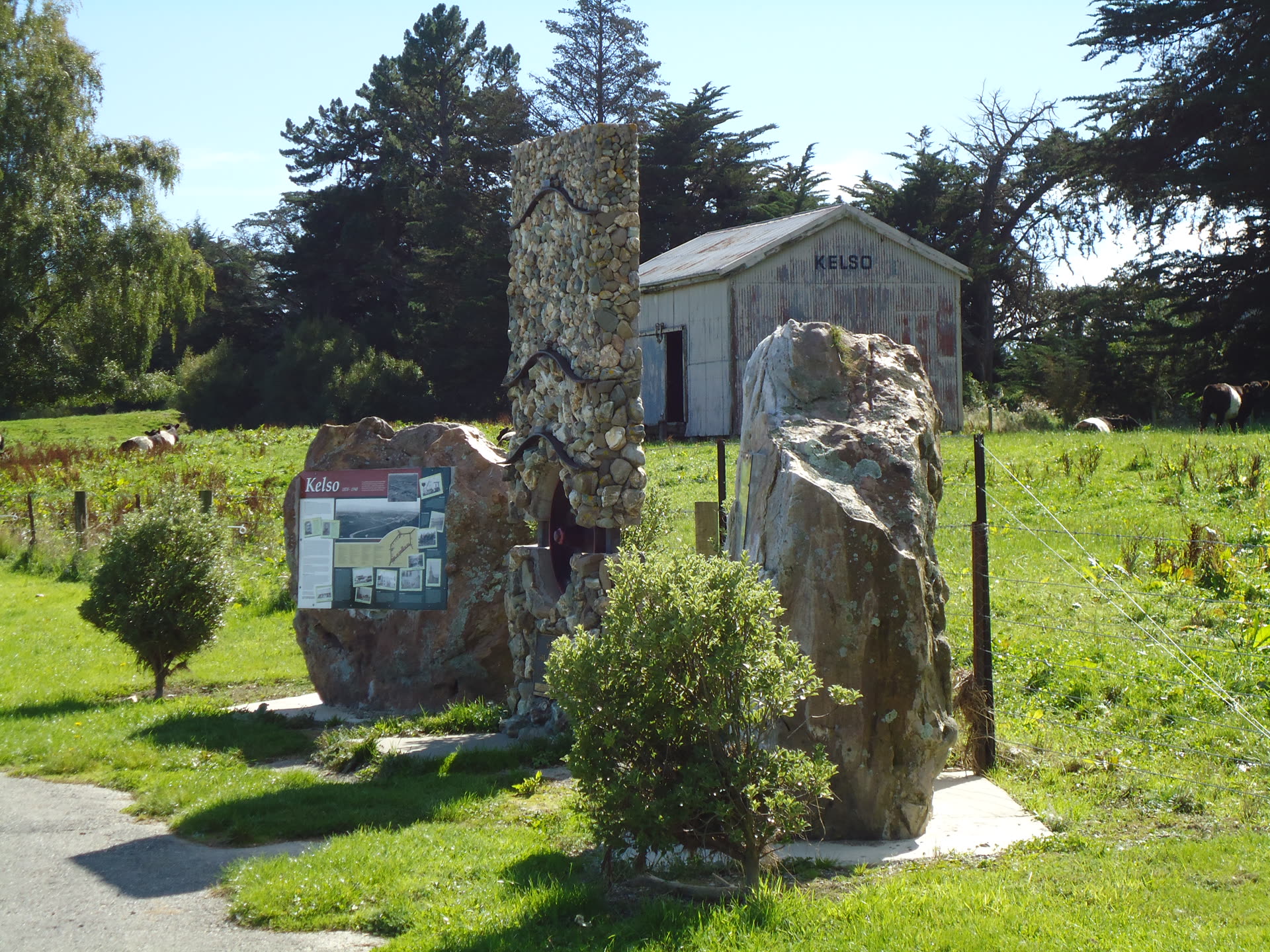
Pictured: the Kelso Monument, a modern stone memorial standing at the site of the West Otago township of Kelso — not a period photograph of the 1909 sighting, and not the schoolyard itself, which along with the rest of the original township was abandoned and largely dismantled after catastrophic Clutha River flooding in 1978 and 1980. No period (1909) photograph of Kelso or of any object from this wave is known to survive, and no photograph or film of the sighting itself was ever claimed by any witness; this file's own research found no rights-clear image of the township as it stood in 1909. Photograph by Wikimedia Commons contributor Daveosaurus, licensed CC BY-SA 3.0.
Theoretical Alignment
As a nationwide, ten-week synthesis rather than a single incident, this file's theoretical alignment reflects the wave's own average character. The Psycho-Social Hypothesis dominates because the wave's best-documented features — a wave of reports that visibly tracked newspaper coverage rather than preceded it, a proposed and independently corroborated "autokinetic effect" (the tendency of a genuinely stationary point of light to appear to move in a dark, featureless sky), a documented spike in kite and fire-balloon sales during exactly this period, and at least one well-argued misidentification of migrating starling flocks at the wave's own final Gore sightings — are precisely the signature Robert E. Bartholomew's published sociological analysis identifies for a genuine collective delusion, not evidence of anomalous technology. The Extraterrestrial Hypothesis registers a modest, non-trivial share specifically because the wave's single most carefully documented episode — the July 23, 1909 daylight sighting at Kelso, where multiple children were interrogated singly and independently by a visiting reporter and produced sketches this file's own research could not find any contemporary source dismissing as coordinated — describes a specific, consistent, silent object with no obvious mundane trigger this file's research could identify with confidence. The Interdimensional Hypothesis scores lowest because nothing in the wave's contemporary record, nor in any later historical treatment this file's research located, ever seriously pointed a multidimensional reading at any component sighting.
Background
By July 1909, New Zealand had been a self-governing Dominion of the British Empire for barely two years, and the era's genuine, rapidly accelerating excitement about powered flight was reaching the country almost entirely through newspaper reports of events happening on the other side of the world. Louis Blériot's crossing of the English Channel — the first flight of a heavier-than-air aircraft across open water, and among the most widely reported technological events of the decade — took place on July 25, 1909, just two days after the Kelso sighting; contemporary New Zealand press coverage of the wave explicitly drew the comparison, with some readers noting, seemingly without irony, that the locally reported craft appeared "faster, quieter, and more robust" than Blériot's own state-of-the-art monoplane. Germany's Zeppelin program was likewise a matter of ongoing international press interest, and the Anglo-German naval and aerial arms race — the same anxiety that would drive Britain's own 1912-13 phantom airship scare, discussed in this catalogue's companion Sheerness file — was already a live topic in New Zealand's own newspapers as a Dominion within the British Empire. No New Zealand government body of any kind, military or civilian, existed in 1909 with any mandate to investigate aerial phenomena; the country's own first sustained military aviation involvement was still five years away, beginning only with the outbreak of the First World War in 1914.
At the same time, Dunedin's two competing daily newspapers, the Otago Daily Times and the Evening Star, were engaged in the ordinary commercial rivalry of the period's provincial press, and this file's own research, consistent with every historical treatment it could locate, treats that competitive backdrop as directly relevant context rather than incidental color: by late July 1909, the space devoted to wave coverage in both papers was, by one modern researcher's estimate, "easily equivalent to full front page coverage in modern newspaper layout." The wave also arrived amid a wider, genuinely international pattern: New Zealand researcher Tony Brunt's own compiled account of the wave describes it as preceded by a smaller cluster of British sightings earlier in 1909 and followed, after New Zealand's own reports ceased in September, first by reports crossing into Australia and later by a comparable American wave beginning in December 1909. New Zealand's 1909 wave was not an isolated national event but one link in a documented chain of "phantom airship" scares recurring across the English-speaking and European world between 1896 and 1913 — a chain this catalogue's own Great Airship Wave of 1896-1897 and Sheerness Phantom Airship Incident case files document on either side of it.
Historian David Clarke, a senior lecturer in journalism at Sheffield Hallam University whose own scholarly chapter on Britain's smaller 1909 sightings appears alongside Nigel Watson's and Granville Oldroyd's chapters on the later 1912-13 and 1914 British scares in a jointly authored study first published for the Fund for UFO Research, situates the New Zealand wave's own moment — 1909 — as the specific year the phenomenon first became genuinely global rather than confined to any one country, a framing this file's own research treats as directly applicable to the Kelso sighting's place in the wider record.
Complete Timeline
| Date | Event |
|---|---|
| Mar.–May 1909 | A smaller cluster of "airship" sightings is reported across Britain, per researcher Tony Brunt's own compiled account — the immediate international precursor to New Zealand's own wave later that year. |
| July 11, 1909, evening | Residents of Kaitangata report a light bobbing in and out of view for roughly 30 minutes over the Wangaloa Hills to the east — the wave's opening sighting, per the Otago Daily Times. |
| July 13, 1909 | The Clutha Free Press (Balclutha) publishes the wave's first press report, describing sightings near Stirling. |
| c. July 19–22, 1909 | Further reports reach Oamaru and Kaka Point; witnesses George Smith and a Mr. Poulter observe an object with a dark superstructure and multiple lights through powerful night glasses from the Kaka Point beach. |
| July 23, 1909, Friday, noon | A small group of schoolchildren and at least one adult, Mrs. James Russell, watch a cigar- or boat-shaped object approach from the direction of the Blue Mountains, circle over Kelso School, and depart — the wave's single most carefully documented daylight sighting. |
| July 24, 1909 | An object, reportedly the same or a similar craft, is seen again near Kelso by roughly a dozen tradesmen working six miles away, who watch it through telescopes and field glasses; they describe a cigar shape with a suspended carriage and a large headlight. |
| July 26, 1909 | Dunedin's Otago Daily Times and Evening Star begin running substantially expanded coverage as the wave intensifies; the first Auckland-area reports reach the North Island around this date. |
| July 27, 1909 | Allen Mitchell and Alex Riach report a boat-shaped craft roughly 2.5 miles distant near the Pomahaka River, Lambourne; the same day, the Wanganui Chronicle republishes a wave summary under the heading "An Otago Airship Mystery." |
| July 28, 1909 | An Otago Daily Times reporter travels to Kelso and, per the paper's own published account, interrogates the scholars who saw the object "singly and independently," asking each to sketch what they had seen. |
| July 29, 1909 | The Bruce Herald names John Boyd as the original July 11 Kaitangata witness; the same day, the Clutha Leader publishes a letter from Balclutha surveyor Robert Grigor proposing that the objects represent a "visitation from another world" and urging a government search using searchlights and wireless telegraphy. |
| July 29–31, 1909 | Coverage in both Dunedin dailies reaches its most extensive point, described by one modern researcher as equivalent to full front-page treatment in a modern paper. |
| c. July 30, 1909 | Dredge winchman F. Green reports a narrow, boat-shaped craft near the Syndicate No. 2 dredge in the Waikaka Valley, near Gore, in the early morning. |
| Late July 1909 | Residents of Clinton and Port Molyneux report additional sightings, including claims of hearing voices from the object — among the wave's least independently corroborated reports, and treated by this file with corresponding caution. |
| Aug. 2, 1909 | The New Zealand Times publishes a cabled national wrap-up under the headline "The Southern Airship Mystery." |
| Aug. 3, 1909 | A horseman near Waipawa reports a grey, torpedo-shaped craft with three visible occupants, one of whom reportedly shouts in an unfamiliar language; the same day, a Dargaville farm manager reports a cigar-shaped object roughly five miles offshore for about 15 minutes, and two young men in Whanganui report a sighting near Mosston. |
| Aug. 3–4, 1909 | A witness on Whanganui's Town Bridge reports an airship with wings producing a "hissing sound," flying from Aramoho toward Castlecliff at roughly 200 feet. |
| Aug. 5, 1909 | A further Whanganui sighting describes the object crossing the river at an estimated speed of roughly 90 miles per hour, well beyond any period aircraft's demonstrated capability. |
| Aug. 9, 1909 | An elderly woman in Waihi reports a large cigar-shaped object with bluish-green lights and a trail she compares to the aurora. |
| Aug. 10–11, 1909 | Whanganui telephone-exchange staff report lights over Durie Hill; in the early hours of Aug. 11, Charlie Baker of Taylorville reports a well-lit airship traveling from Maxwell, corroborated by a milkman making his own rounds nearby. |
| Aug. 1909 | The Otago Daily Times runs a standing section titled "The Airship Mystery"; further scattered reports reach Riwaka on Tasman Bay and passengers aboard a train near Greymouth on the West Coast. |
| Sept. 1–2, 1909 | A final cluster of sightings occurs at Gore, later attributed by contemporary and modern sources alike to repeated flights of thousands of migrating starlings; New Zealand reports cease shortly afterward. |
| Sept. 1909 onward | Comparable "mystery airship" reports begin appearing in Australian newspapers, and the contemporary "back-country inventor" theory is largely abandoned once the phenomenon is seen moving beyond New Zealand's own borders. |
| Dec. 1909–1910 | A comparable wave of airship reports begins in the northeastern United States, part of the same recurring international pattern. |
| 1912–1913 | Britain experiences its own, much larger phantom airship scare, opening with the October 14, 1912 sighting at Sheerness — the subject of this catalogue's companion case file. |
| 1967 | Tony Brunt, then convener of the Auckland University UFO Research Group, publishes an early compiled historical account of the 1909 wave drawing directly on period newspaper sources. |
| c. 1969 | Sixty years after the sighting, Kelso witness George McDuff reportedly tells an interviewer the sighting reflected "imagination, based on what we were reading at the time" — a partial, secondhand retrospective doubt this file discusses in full below, alongside its real limitations as a debunking. |
| 1998 | Robert E. Bartholomew publishes "The Great Zeppelin Scare of 1909" in the New Zealand Skeptic, and, with George S. Howard, situates the New Zealand wave within the broader comparative history of pre-Roswell mass sighting waves in UFOs & Alien Contact: Two Centuries of Mystery. |
| c. 1995–2020 | Researcher Bryan Dickeson, drawing on roughly 6,500 digitized New Zealand sighting records originally compiled by his parents Fred and Phyllis Dickeson, spends some 25 years reconstructing the wave's original Clutha Free Press reporting for the UFOCUS NZ Research Network. |
| 2020 | UFOCUS NZ republishes detailed modern reconstructions of the wave and the Kelso sighting specifically, drawing directly on Papers Past's digitized newspaper record. |
The Wave in Numbers: Scale and Statistical Shape
New Zealand in 1909 had a total population of roughly one million people, spread across a country with a far smaller and more provincial newspaper industry than the United States had commanded during its own 1896-97 wave; this file's own research treats the New Zealand wave's absolute report volume as correspondingly smaller, while its geographic and temporal shape closely parallels the earlier American pattern. Named incidents in this file alone span at least a dozen distinct locations — Kaitangata, Stirling, Oamaru, Kaka Point, Kelso, Lambourne, Waikaka Valley, Clinton, Port Molyneux, Dunedin, Auckland, Dargaville, Waipawa, Whanganui, Palmerston North, Waihi, Riwaka, and Gore — across a compressed roughly seven-week span in the South Island alone, before the wave crossed to the North Island in early August and, per contemporary and later accounts alike, continued into Australia after New Zealand's own reports ceased in early September.
Unlike the 1896-97 American wave, no frequently cited compiled total of individual New Zealand newspaper articles or estimated total witness count has been published by any source this file's research located; Bryan Dickeson's own decades-long reconstruction effort, digitizing roughly 6,500 New Zealand UFO sighting records compiled originally by his parents, gives some independent texture to the scale of the surviving record without amounting to an audited wave-specific total. What is well documented is the wave's basic shape: an opening, contained cluster of Otago and Southland reports through mid-to-late July, a peak of national press attention in the last days of July and first week of August coinciding with the wave's spread to Dunedin and then the North Island, and a rapid falloff by early September — the same rise-peak-collapse pattern this catalogue's other wave-scale files (the 1896-97 American wave, and the 1912-13 British scare discussed in the Sheerness file) each independently exhibit.
Phase One: Otago and Southland Origins
Kaitangata and the Wangaloa Hills, July 11
On the evening of July 11, 1909, several residents of Kaitangata, a small coal-mining town in Otago, reported watching what the Otago Daily Times described as the mysterious light of a possible airship bobbing in and out of view for roughly 30 minutes to the east, over the Wangaloa Hills. The Clutha Free Press in nearby Balclutha ran the wave's first press notice two days later, on July 13, describing similar reports near Stirling. The July 11 witness was not publicly named until July 29, when the Bruce Herald identified him as John Boyd, who reportedly described the light as moving "with as much ease, and even grace, as a bird on the wing" — language this file's own research notes is consistent with either a genuinely smooth, controlled aerial object or with the kind of retrospectively polished phrase a period newspaper account might apply to an ambiguous, fleeting nighttime observation. Bryan Dickeson's own decades-long research effort was directed in significant part at recovering this specific original Clutha Free Press report, which he found had been comparatively neglected by earlier researchers who focused more heavily on the wave's later North Island sightings.
Kaka Point and the Spread Through West Otago
Over the following ten days, further reports reached Oamaru and Kaka Point on the Otago coast. At Kaka Point, witnesses George Smith and a Mr. Poulter reportedly watched an object roughly two miles away through powerful night glasses, describing a dark superstructure equipped with a powerful headlight and two smaller lights — among the wave's more detailed early instrumented (if only optically assisted) observations. The Oamaru Mail, notably, was also among the wave's earliest skeptical voices, later noting the apparent paradox that these reportedly crude, back-country New Zealand "airships" seemed to demonstrate superior control and stability compared with the well-documented instability of contemporary, professionally engineered Zeppelins — a specific, period-contemporary skeptical observation this file's research treats as a genuinely useful early data point rather than mere reflexive dismissal.
Phase Two: The Kelso Daylight Sighting, July 23–24
What Was Reported
Shortly before noon on Friday, July 23, 1909, a small group of schoolchildren at Kelso School, in the West Otago goldfields district roughly ten kilometers north of Tapanui, reported watching a cigar- or boat-shaped object, pointed at each end, approach from the direction of the Blue Mountains, circle over the school playground, and then depart. At least one adult, Mrs. James Russell of Kelso, was also named among the witnesses in contemporary press accounts, and a Mr. Gibson separately telephoned a report to the Otago Daily Times the following day. Witnesses described a pontoon-shaped structure above the main hull, a short pole or mast, and, per some accounts, lateral supports or "sails" on each side and a rapidly revolving wheel or propeller at the rear; the object was reported flying "very easily, and had no trouble in turning." On July 24, an object described in similar terms — cigar-shaped, with a carriage suspended beneath it and a large headlight — was reportedly seen again near Kelso by roughly a dozen tradesmen working some six miles away, who watched it through telescopes and field glasses in the early evening.
The Otago Daily Times Investigation and the Six Sketches
On July 28, five days after the sighting, an Otago Daily Times reporter traveled to Kelso specifically to investigate, and the paper's own subsequent account describes interrogating the children who had seen the object "singly and independently" and asking each to draw what they remembered. The result, per the paper's own words, was six drawings whose "degree of resemblance and unanimity" was, in the reporter's phrase, "nothing short of dumb-founding to all sceptics." This file's own research was able to establish the names of several of the children involved through secondary compilations of the original account: Thomas Jenkins, Thomas McDonald, Alice Falconer, Cyril Falconer, Agnes Falconer, and George McDuff. The children's sketches consistently depicted a cigar- or boat-shaped hull, pointed at both ends, with lateral fin-like structures visible from beneath and a rapidly revolving rear propeller; one boy, positioned directly under the object's flight path, was reportedly able to sketch its underside in addition to the more common side profile others drew. The reporter's own interrogation specifically established, per the published account, that none of the children had previously drawn a similar diagram, nor had any expressed a prior interest in airships before the sighting — a detail meant, in the period reporting itself, to rule out simple copying from an existing published illustration.
A Necessary Correction: No "23 Schoolchildren and Their Teacher" in the Surviving Record
A popular modern summary of this case — repeated in secondary compilations and, before this file's own research, in this catalogue's own coming-soon queue entry — states that twenty-three schoolchildren and their teacher together produced the Kelso sketches. This file's own research, drawing directly on the Otago Daily Times' own July 1909 reporting as preserved and quoted by multiple independent modern compilations (Ufocus NZ's reconstruction among them), found no primary source supporting either the specific figure of twenty-three or the presence of a named teacher among the witnesses. What the surviving record actually and consistently supports is a smaller group of children, individually interrogated, who produced six independently drawn sketches; no teacher is named in any account this file's research could locate, and this file's own attempts to identify Kelso School's 1909 teacher by name through New Zealand educational and newspaper archives were unsuccessful. Readers should treat the "twenty-three schoolchildren and their teacher" figure as unverified rather than established, and this file reports the sighting according to what the contemporary press record actually documents rather than the more dramatic, popularly repeated version.
George McDuff's Later Doubt
Roughly sixty years after the sighting, one of the named Kelso witnesses, George McDuff, is reported by Robert Bartholomew's own published research to have told an interviewer that the sighting reflected "imagination, based on what we were reading at the time" rather than a genuine observation of an unknown object. This file treats McDuff's later account as a real, disclosed data point against treating the Kelso sighting as straightforwardly anomalous, while also noting its real evidentiary limits: it is a single participant's own decades-later retrospective judgment about the group's collective state of mind at the time, not a claim that he and the other children fabricated or coordinated their sketches, and it does not, on its own, explain why children individually and separately interrogated by a professional reporter within days of the event produced sketches a contemporary observer found strikingly consistent. Unlike Alexander Hamilton's 1897 "cattle lasso" hoax in the American wave, corroborated by a specific secondhand eyewitness account of Hamilton privately boasting of fabrication, no comparably direct evidence of deliberate invention at Kelso has been located by this file's research; McDuff's account reads more plausibly, in this file's own judgment, as an adult's retrospective psychological explanation for a childhood experience shaped by contemporary press excitement, consistent with Bartholomew's own broader "collective delusion" framework, than as a confession of hoaxing.
Phase Three: Robert Grigor's Letter and the Wave's Peak Coverage
On July 29, 1909, the same day the Bruce Herald named John Boyd as the wave's opening witness, the Clutha Leader published a letter from Robert Grigor, a surveyor based in Balclutha, proposing that the reported objects represented a "visitation from another world" by "beings of superior intellect," and specifically urging the government to attempt to locate and communicate with the craft using searchlights and wireless telegraphy. Researcher Bryan Dickeson has described Grigor's letter as, to his own knowledge, the earliest published newspaper proposal of what would later be called the Extraterrestrial Hypothesis anywhere associated with an aerial phenomenon — a claim this file's own research could not independently verify as a global first, but one it treats as a genuinely notable early data point regardless: a professionally trained surveyor, someone with real relevant technical background in distance and angle estimation, was willing to propose non-human origin in print under his own name within days of the wave's peak. Over the following two days, July 29-31, the two competing Dunedin dailies gave the story what one modern researcher describes as coverage "easily equivalent to full front page coverage in modern newspaper layout," and the New Zealand Times ran a cabled national summary on August 2 under the headline "The Southern Airship Mystery."
Phase Four: Gore, the Waikaka Valley, and the Starling Explanation
As the wave's South Island phase reached its final stage in late July and early August, dredge winchman F. Green reported a narrow, boat-shaped craft near the Syndicate No. 2 dredge in the Waikaka Valley outside Gore in the early morning hours, describing what he took to be two occupant figures aboard and, in one account, a moment when the object's propeller appeared to reverse before it executed a sharp turn. Reports from nearby Clinton and Port Molyneux during the same period included claims of hearing voices, or occupants speaking, from an overhead object — among the wave's least corroborated claims, resting on secondhand or single-witness accounts this file's research could not trace to any surviving named primary source, and treated here accordingly as unverifiable color rather than established fact. The wave's very last reported cluster, on September 1-2, again centered on Gore; both contemporary skeptical commentary and Robert Bartholomew's later analysis attribute this final cluster specifically to repeated flights of large flocks of migrating starlings, a mundane candidate this file's own research found no strong reason to dispute given the reports' timing, location, and description.
Phase Five: The North Island and the Move to Australia
By early August 1909, the wave had crossed to the North Island. A horseman near Waipawa reported a grey, torpedo-shaped craft on August 3 with three visible occupants, one of whom reportedly called out in an unfamiliar language; the same day, a Dargaville farm manager described a cigar-shaped object roughly five miles offshore for some 15 minutes, and two young men reported a sighting near Mosston, Whanganui. Over the following week, Whanganui produced some of the wave's more detailed North Island reports: a witness on the town's bridge described an object with wings that produced a distinct "hissing sound" crossing the river from Aramoho toward Castlecliff at roughly 200 feet on August 3-4, and a further sighting on August 5 estimated the object's speed at roughly 90 miles per hour — a figure well beyond any aircraft's genuinely demonstrated period capability, and, this file's research notes, almost certainly an untrained witness's rough impression of an object's apparent angular movement across the sky rather than a measured airspeed. On August 9, an elderly Waihi woman described a large cigar shape with bluish-green forward lights and a trailing luminous effect she compared to the aurora; on August 10-11, Whanganui telephone-exchange staff reported lights over Durie Hill, and Charlie Baker of Taylorville reported a well-lit airship traveling from Maxwell in the early hours, a sighting corroborated independently by a milkman making his own rounds nearby — one of the wave's few genuinely independent two-witness corroborations outside Kelso itself. Scattered further reports reached Riwaka on Tasman Bay and a train near Greymouth on the West Coast before New Zealand's own reports ceased after the final Gore cluster on September 1-2. Consistent with the pattern documented in Tony Brunt's own compiled account, comparable "mystery airship" reports then began appearing in Australian newspapers, and the New Zealand press's own contemporary "back-country inventor" theory — the idea that a real but secretive local tinkerer had built a working airship — was largely abandoned once the phenomenon was observed moving beyond New Zealand's own borders, since no domestic inventor could plausibly explain sightings recurring in a different country.
National Press Coverage and Why the Wave Happened When It Did
Robert E. Bartholomew's own 1998 New Zealand Skeptic analysis, "The Great Zeppelin Scare of 1909," applies the same sociological framework he and other researchers have used for comparable waves elsewhere, including this catalogue's own American 1896-97 file: psychologist Muzafer Sherif's 1936 research on the "autokinetic effect," in which a genuinely stationary point of light, viewed against a dark and otherwise featureless night sky with no fixed reference points, will reliably appear to an observer to move, sometimes dramatically. Bartholomew's own compact summary of the underlying principle — that "human perception is highly unreliable, subject to error, and pre-conditioned by the observer's frame of reference" — applies directly to the majority of this wave's reports, which describe ambiguous nighttime lights rather than the kind of detailed daylight structural observation reported at Kelso. Bartholomew's analysis further notes a real, physically verifiable proxy for rising public excitement and expectation during the wave: a documented increase in local kite and fire-balloon sales during exactly this period, consistent with an environment in which more ambiguous nighttime lights were both being generated by ordinary recreational objects and being reported, misidentified, as airships by a public primed to expect them.
This file's own research treats three specific, non-exclusive factors as jointly sufficient to explain why the wave crested in this particular ten-week window. First, the era's genuine, rapidly escalating global excitement about heavier-than-air and dirigible flight — Blériot's Channel crossing landing just two days after Kelso, ongoing German Zeppelin development, and the broader Anglo-German aerial-and-naval anxiety that would shortly produce Britain's own, much larger 1912-13 scare — gave the New Zealand reading public a specific, technically plausible mental frame through which to interpret an ambiguous nighttime light, in a way that would not have applied a decade earlier. Second, the competitive Dunedin newspaper market's own commercial incentives rewarded exactly this kind of serialized, reader-engaging mystery story once its early reports proved capable of generating sustained public interest, a self-reinforcing loop of coverage generating further reports which in turn generated further coverage. Third, once the story was established nationally, straightforward misidentification of stars, planets, kites, fire balloons, and, at the wave's tail end, migrating starling flocks almost certainly accounts for a meaningful share of the wave's less-detailed nighttime reports, exactly the pattern Bartholomew's autokinetic-effect analysis predicts. None of these three factors excludes the others, and this file's own judgment, consistent with Bartholomew's published conclusions, is that all three operated simultaneously across the wave as a whole — while leaving the Kelso daylight sighting specifically as a genuine, still-disclosed residue this file's research could not confidently resolve into any single one of the three.
Key Witnesses
The Kelso Schoolchildren
A small group of schoolchildren, including named witnesses Thomas Jenkins, Thomas McDonald, Alice Falconer, Cyril Falconer, Agnes Falconer, and George McDuff, watched a cigar-shaped object circle over their school at noon on July 23, 1909. Interrogated singly and independently by an Otago Daily Times reporter five days later, they produced six sketches a contemporary account described as strikingly consistent. No source located by this file's research supports the popularly repeated claim of twenty-three total witnesses or a named teacher among them.
Mrs. James Russell
One of the few named adult witnesses at Kelso, reported alongside the schoolchildren in contemporary Otago Daily Times coverage of the July 23, 1909 daylight sighting.
John Boyd
Publicly named on July 29, 1909 by the Bruce Herald as the source of the wave's opening report on July 11, describing a light bobbing over the Wangaloa Hills that moved "with as much ease, and even grace, as a bird on the wing."
Robert Grigor
A professionally trained surveyor whose July 29, 1909 letter in the Clutha Leader proposed the sightings represented a "visitation from another world" and urged a government search using searchlights and wireless telegraphy — described by researcher Bryan Dickeson as among the earliest published newspaper proposals of non-human origin for an aerial phenomenon.
F. Green
Reported a narrow, boat-shaped craft with two apparent occupant figures near the Syndicate No. 2 dredge in the early morning hours in late July or early August 1909, including a claimed moment of the object's propeller reversing before a sharp turn.
Charlie Baker
Reported a well-lit airship traveling from Maxwell in the early hours of August 11, 1909, a sighting independently corroborated by a milkman making his own rounds nearby — one of the wave's few genuinely independent two-witness corroborations outside Kelso.
The Five Observables Assessment
Assessment: Because this file synthesizes a nationwide wave rather than one incident, the Five Observables are scored against the wave's own strongest illustrative examples. Anti-Gravity Lift is rated Speculative on the basis of Kelso's own reported silent, effortless circling maneuver and repeated wave-wide descriptions of objects flying "with no trouble in turning," all single-source newspaper accounts with no instrumented corroboration. Instant Acceleration draws Speculative on the Waikaka Valley dredge sighting's claimed propeller-reversal-and-sharp-turn, a single witness's own subjective impression. Hypersonic Velocity is rated Absent: even the wave's single fastest claimed speed, the roughly 90 mph estimated for the August 5 Whanganui sighting, sits far below any meaningful hypersonic threshold and is itself almost certainly an untrained witness's rough angular impression rather than a measured airspeed. Low Observability and Trans-Medium travel are both rated Absent: no radar or equivalent detection instrument existed anywhere in the world in 1909, and no case this file's research reviewed describes any transition into water, ice, or ground. This is among the weakest Five Observables profiles of any wave-scale file in this archive, consistent with the total absence of instrumented data across the entire period.
Evidence Assessment
Supporting Anomalous Origin
- The Kelso sighting's own investigative methodology — a reporter interrogating multiple children singly and independently, five days after the event, before any of them could have coordinated a story — produced six sketches a contemporary observer, and this file's own research, found genuinely consistent in specific structural detail (pointed hull, lateral fins visible from beneath, a rapidly revolving rear propeller).
- Charlie Baker's August 11 Whanganui sighting was independently corroborated by a second witness, a milkman making his own separate rounds, without any documented prior coordination between them.
- The wave's overall geographic breadth — South Island reports crossing to the North Island within roughly three weeks, and reports crossing into Australia after New Zealand's own reports ceased — is difficult to attribute to any single localized mundane trigger, even allowing for substantial press-driven contagion within that total.
- Robert Grigor, a professionally trained surveyor with real relevant technical background in distance and angle estimation, was willing to propose and publish a non-human explanation under his own name at the wave's peak, with no apparent economic or promotional motive to fabricate.
- The wave prompted sustained modern historical and skeptical attention, from Tony Brunt's 1967 compiled account through Robert Bartholomew's 1998 sociological analysis and Bryan Dickeson's decades-long archival reconstruction — a level of continued engagement this file treats as circumstantial evidence that the underlying newspaper record contains genuine unresolved residue.
Supporting Conventional Explanation
- Kelso witness George McDuff's own retrospective account, roughly sixty years after the sighting, attributes the event to "imagination, based on what we were reading at the time" — a real, disclosed doubt from one of the event's own named participants, even though it falls well short of a confirmed hoax confession comparable to Alexander Hamilton's in the American 1896-97 wave.
- Robert Bartholomew's published sociological analysis identifies the "autokinetic effect" — the well-documented tendency of a genuinely stationary light to appear to move against a dark, featureless sky — as a strong candidate explanation for the majority of the wave's nighttime reports, which are overwhelmingly less detailed than the Kelso daylight sighting.
- A documented contemporary increase in kite and fire-balloon sales during the wave's peak weeks is a real, physically verifiable proxy for a public primed to both generate and misidentify ambiguous aerial objects during exactly this period.
- The wave's own final reported cluster, at Gore on September 1-2, is well explained by both contemporary and modern accounts as repeated flights of migrating starling flocks, a mundane candidate this file's research found no strong reason to dispute.
- No case within the entire wave that this file's own research reviewed produced any instrumented, physical, or independently verified photographic evidence surviving to modern examination; the wave's strongest surviving artifact, the six Kelso sketches, exists only as period newspaper description, with no known surviving original drawings this file's research could locate.
Why "Disputed"
This wave-scale synthesis earns a DISPUTED classification with a credibility score of 28/100 — close to, but marginally below, this catalogue's own Great Airship Wave of 1896-1897 (Disputed, 30), and well above this catalogue's own lower-scoring, thinly sourced single-report files. That relative position reflects this file's actual composition honestly: it inherits a real, well-documented mass sighting wave with genuine geographic breadth (South Island to North Island to Australia within roughly ten weeks) and one specifically well-investigated component sighting — Kelso's independently interrogated children producing convergent sketches — that this file's own research could not resolve into a clean conventional explanation with full confidence. It scores marginally below the American 1896-97 wave specifically because it lacks that file's strongest individual corroborating data points: no credentialed municipal or state official (a governor, a sheriff, a district attorney) is named among this wave's witnesses, and its strongest single corroboration outside Kelso — Charlie Baker's Whanganui sighting, backed by an independent milkman — is thinner than Sacramento's or Chicago's multi-occupational crowd sightings in the American file.
What holds this file specifically in the high-20s rather than pushing it toward the American wave's own moderate 30, or higher, is the presence of a genuine, disclosed retrospective doubt directly inside the wave's own best-documented episode: George McDuff's own account, whatever its evidentiary limits, is a named Kelso participant himself expressing doubt about the group's collective perception, a data point this catalogue's American wave file has no direct equivalent for within its own strongest sighting (Sacramento's official witnesses left no comparable later retraction on record). Combined with Bartholomew's well-argued autokinetic-effect and starling-flock explanations for the wave's weaker, more numerous nighttime reports, and the total absence of any surviving instrumented or physical evidence across the entire ten-week period, this file's own judgment is that a high-20s Disputed score describes the wave's actual evidentiary balance honestly: a genuine, internationally contextualized mass phenomenon with one still-unresolved, carefully investigated daylight sighting, sitting inside a much larger body of reports this file's own research believes is substantially explained by ordinary misidentification and press-driven collective expectation.
Sensor & Instrumentation Detection Profile
No sensor or instrumentation data of any kind survives from any case in this wave. Functional radar did not exist anywhere in the world until the 1930s-40s, roughly three decades after this wave; New Zealand possessed no government body with any mandate or capability to investigate aerial phenomena in 1909, five years before the country's first sustained military aviation involvement began with the outbreak of the First World War. The wave's only surviving optically assisted observations are Kaka Point's witnesses using "powerful night glasses" and the dozen Kelso-area tradesmen using telescopes and field glasses on July 24 — genuine period optical aids, but none capable of producing any surviving recorded image or measurement. No photograph of any object from this wave is known to survive or to have ever been claimed by any witness this file's research located; the wave's only surviving visual record of any kind is the period newspaper description of the six Kelso children's sketches, themselves not known to survive as physical artifacts.
Environmental & Geospatial Context
The wave's geographic spread is one of its most striking documented features for a country of New Zealand's size: named incidents in this file span the Otago and Southland goldfields and farming districts around Kaitangata, Balclutha, and Kelso, the Dunedin urban area, Gore and the Waikaka Valley, and, in the North Island, Auckland, Dargaville, Waipawa, Whanganui, Palmerston North, and Waihi — a span of well over 500 kilometers from the wave's southernmost to northernmost named locations. No single regional environmental factor — terrain type, proximity to any military or industrial infrastructure (New Zealand had essentially none relevant to aviation in 1909), or local astronomical viewing conditions — plausibly explains a wave this geographically dispersed on its own, directly relevant to why this file's Conventional Explanation Candidate section below treats any single, localized misidentification source as unable to account for the wave's full breadth, even where such a candidate may explain individual component reports. No systematic period meteorological or astronomical-conditions dataset specific to the wave's dozens of individual report dates and locations was located in any source consulted for this file.
Observer Credibility & Occupational Profile
The wave's witness pool spans a genuinely wide occupational and age range: this file's own named witnesses alone include schoolchildren (the Kelso group), farmers and tradesmen, a coal-mining town resident (Boyd), a professionally trained surveyor (Grigor), dredge workers (Green), telephone-exchange staff, and a milkman corroborating a separate resident's sighting. None of this wave's named witnesses held a specifically relevant technical or scientific credential in aviation or optical instrumentation in the way later, better-instrumented cases on this site feature trained pilots or radar operators — there was, in 1909, no such profession yet to hold, and New Zealand in particular had essentially no domestic aviation industry of any kind at the time. Grigor's surveying background gives him some genuine, relevant technical grounding in distance and angle estimation not shared by most of the wave's other named witnesses. Where multiple independent witnesses corroborate a single report (Kelso's independently interrogated children; Baker's Whanganui sighting backed by the milkman), that corroboration meaningfully strengthens the account beyond what any single uncorroborated witness could provide; where a report rests on a single named individual with no independent corroboration (Boyd's opening Kaitangata sighting; Green's Waikaka Valley report), this file treats it as a real, weaker data point, consistent with how this catalogue's other wave-scale files weigh single-witness versus multiply-corroborated reports.
Physical & Material Assays
No physical evidence from any case in this wave has ever been recovered, preserved, or tested under any scientifically controlled condition. No wreckage, mechanical component, or trace material from any named location in this file — Kaitangata, Kelso, Waikaka Valley, Waipawa, Whanganui, or Waihi — was ever recovered by any contemporary investigator, and no New Zealand government body existed with the mandate or capability to conduct any such recovery in 1909. This file's Material Analysis section below addresses the wave's surviving documentary record, the closest thing to physical evidence the wave actually left behind.
Historical Precedents & Archive Matches
Within this site's own catalogue, this wave sits directly between the two other "phantom airship" waves this archive has fully investigated: it followed the American Great Airship Wave of 1896-1897 by roughly twelve years, sharing with it the same basic pattern of press-amplified regional clustering, a small number of genuinely well-investigated component reports set against a much larger body of weaker nighttime accounts, and a wide gap between contemporary popular excitement and any surviving instrumented evidence; and it preceded, by only three years, the much larger British scare investigated in this catalogue's Sheerness Phantom Airship Incident file, which arose from precisely the same recurring international phenomenon under different geopolitical circumstances (Anglo-German naval rivalry rather than New Zealand's comparatively mild Dominion-era anxieties). Historian David Clarke's own published chapter specifically addressing Britain's own smaller 1909 sightings situates that same calendar year as the moment the phantom airship phenomenon first became genuinely international rather than confined to any single country's press — a framing this file's own research treats as directly supported by the New Zealand wave's own documented spread into Australia after its domestic reports ceased.
Material Analysis
As with this site's other wave-synthesis files, "material" here refers primarily to the wave's surviving documentary substrate rather than any recovered physical object: period newspaper archives (the Otago Daily Times, Evening Star, Clutha Free Press, Clutha Leader, Bruce Herald, New Zealand Times, and Wanganui Chronicle among them, all digitized today via Papers Past), the period description of the six Kelso children's sketches, and Robert Grigor's July 29, 1909 published letter.
The Kelso Sketches
No original drawing from the six Kelso children's sketches is known to survive as a physical artifact; the sketches are known today only through the Otago Daily Times' own contemporary published description of their content and mutual consistency. This is a genuine, disclosed limitation on how independently this file's own research — or any modern researcher's — can verify the reporter's own characterization of the drawings' resemblance; readers are relying, ultimately, on one period journalist's own editorial judgment about six children's individual sketches, filtered through the newspaper's own institutional incentive to report a compelling story, rather than on the original artifacts themselves.
Robert Grigor's Letter
Grigor's July 29, 1909 letter to the Clutha Leader, proposing extraterrestrial visitation and a government search using searchlights and wireless telegraphy, survives as a genuine period document reflecting how at least one professionally trained local resident interpreted the wave at its peak. It is, however, an argument and a proposal rather than a first-hand sighting report in its own right, and this file's research found no indication Grigor personally witnessed any of the wave's reported objects himself; his letter is evidence of contemporary public interpretation and reaction to the wave, not independent corroborating testimony about what was actually seen.
Supporting Non-Terrestrial or Unexplained Origin
- The Kelso sighting's own investigative record — children interrogated singly and independently, producing sketches described by a contemporary observer as strikingly consistent in specific structural detail — is a genuinely stronger evidentiary structure than most of the wave's other, single-witness nighttime reports.
- The wave's overall international context — a documented, recurring phantom airship phenomenon touching the United States, New Zealand, Australia, Britain, and elsewhere across roughly two decades — suggests a persistent, cross-cultural pattern that Bartholomew's and Clarke's own published historical work treats as worth taking seriously as a sociological phenomenon, even where any single component sighting resists full resolution.
- Charlie Baker's independently corroborated Whanganui sighting demonstrates the wave contained at least some multiply-witnessed reports beyond Kelso itself.
Supporting Terrestrial or Mundane Origin
- No original physical artifact from any case in this wave — including the Kelso sketches themselves — is known to survive; every surviving record is secondhand newspaper description.
- George McDuff's own later account, from inside the Kelso sighting itself, explicitly attributes the group's experience to "imagination, based on what we were reading at the time."
- Robert Bartholomew's published sociological analysis identifies well-documented mundane candidates — the autokinetic effect, migrating starling flocks, kites, and fire balloons — for the majority of the wave's less-detailed nighttime reports.
- The wave developed during, and closely tracks, a period of genuine international excitement about heavier-than-air flight (Blériot's Channel crossing, two days after Kelso) and rising Anglo-German aerial anxiety, both well-documented drivers of exactly this kind of self-reinforcing press phenomenon elsewhere in this catalogue's own wave-scale files.
The Conventional Explanation Candidate (CEC): Multiple Competing Terrestrial Hypotheses
Because this file synthesizes a wave of dozens of individually distinct reports rather than one incident, no single conventional explanation can be evaluated against the wave as a whole; this section instead assesses the leading candidates against the wave's overall documented shape, while noting that different candidates almost certainly apply with different force to different individual component reports.
The Autokinetic Effect and Astronomical Misidentification
Robert Bartholomew's published analysis identifies the autokinetic effect — the well-documented tendency of a genuinely stationary point of light to appear to move against a dark, featureless night sky — as a strong candidate for the majority of the wave's ambiguous nighttime reports, a category that covers most of this file's named incidents outside Kelso itself. Stars, planets, and, per some contemporary skeptical commentary, Mars specifically were also proposed at the time as candidates for individual sightings. This candidate is well suited to single-witness, brief, low-detail nighttime reports, but struggles to explain sightings involving detailed structural description (a suspended carriage, a revolving propeller, lateral fins) or genuine multi-witness corroboration such as Charlie Baker's Whanganui sighting.
Kites, Fire Balloons, and Ordinary Recreational Objects
A documented contemporary increase in local kite and fire-balloon sales during the wave's peak weeks, identified in Bartholomew's own research, is a genuine, physically verifiable proxy for a public both more likely to be flying such objects and more likely to misidentify them, or others', as airships once the story was established. This candidate plausibly explains a meaningful share of the wave's more casual nighttime light reports, though it does not obviously account for the Kelso sighting's specific daytime structural detail or the wave's several claimed multi-occupant sightings.
Bird Flocks
The wave's final reported cluster, at Gore on September 1-2, 1909, is well explained by both contemporary and modern accounts as repeated flights of large flocks of migrating starlings, and a comparable "black swans" theory was contemporaneously proposed for the Kelso sighting itself, though this file's own research found that specific candidate does not find much favor among the sources it consulted, given the level of structural detail (a mast, lateral fins, a rear propeller) the Kelso witnesses reported that a bird flock would not straightforwardly produce.
Deliberate Hoaxing or Retrospective Fabrication
Unlike the American 1896-97 wave's confirmed Collins-Benjamin and Alexander Hamilton hoaxes, no comparably direct evidence of deliberate fabrication has been located by this file's research for any single component sighting in the New Zealand wave. George McDuff's own sixty-years-later account attributing the Kelso sighting to "imagination" is a genuine, disclosed data point, but it describes a retrospective psychological reassessment of the group's collective perception rather than a confession of coordinated invention, and it does not explain why the other named Kelso witnesses' sketches, produced independently within days of the event, were described by a contemporary reporter as closely consistent.
A Real, Genuinely Secretive Inventor
The contemporary "back-country inventor" theory — a real but secretive New Zealand tinkerer quietly testing a working airship — was seriously entertained in period press coverage, but was effectively abandoned once the wave's reports began recurring in Australia after New Zealand's own sightings ceased, since no single domestic inventor could plausibly explain sightings in a different country. No patent, prototype, or independent record of any such New Zealand aircraft or inventor has ever surfaced in any source this file's research located.
Genuine Unconventional Aerial Phenomenon
This reading remains genuinely open specifically for the wave's single most carefully documented report, the Kelso daylight sighting, where multiple children, individually and independently interrogated within days of the event, produced sketches a contemporary observer described as strikingly consistent in specific structural detail this file's research could not confidently resolve into any single one of the candidates above. It is tempered by George McDuff's own later disclosed doubt and by the total absence of any instrumented or physical evidence surviving from any case in the wave.
Autokinetic Effect / Astronomical Misidentification
Highly Plausible (Partial)HIGHLY PLAUSIBLE as a partial explanation for the majority of the wave's brief, low-detail nighttime reports, per Bartholomew's published sociological analysis, but it struggles to explain Kelso's detailed daylight structural description and Baker's independently corroborated Whanganui sighting.
Kites, Fire Balloons & Recreational Objects
Plausible (Partial)PLAUSIBLE for a meaningful share of the wave's casual nighttime light reports, supported by a documented contemporary spike in local kite and fire-balloon sales, but does not obviously account for the wave's more structurally detailed or multi-occupant claims.
Bird Flocks
Plausible (Gore Only)PLAUSIBLE specifically for the wave's final September 1-2 Gore cluster, well supported by contemporary and modern accounts of migrating starling flocks, but does not find much favor as an explanation for Kelso's own more structurally detailed daylight sighting.
Deliberate Hoaxing
InconclusiveINCONCLUSIVE. No confirmed hoax comparable to the American wave's Collins-Benjamin or Hamilton cases has been established; George McDuff's later doubt reads more plausibly as retrospective reassessment than a fabrication confession.
A Genuine Secretive Inventor
ImplausibleIMPLAUSIBLE. Seriously entertained at the time, but effectively disproven by the wave's own documented spread into Australia after New Zealand's reports ceased, and no patent, prototype, or inventor record has ever surfaced.
Genuine Unconventional Aerial Phenomenon
InconclusiveINCONCLUSIVE. Remains genuinely open specifically for the Kelso daylight sighting, but tempered by George McDuff's own later disclosed doubt and the complete absence of surviving instrumented or physical evidence anywhere in the wave.
Related Cases
Honest Assessment: No Contemporary Government Investigation Exists
New Zealand in 1909 possessed no government body, military or civilian, with any mandate to investigate aerial phenomena; this file's own research, including a direct search of the New Zealand Parliament's own Historical Hansard record, located no record of any parliamentary question or debate concerning the wave, in sharp contrast to the British government's own formal parliamentary acknowledgment of the 1912 Sheerness sighting discussed in this catalogue's companion file. In place of any government investigative record, the closest genuine institutional documentation is archival: the National Library of New Zealand's own digitized period newspaper collection, and Archives New Zealand's general historical holdings from the Dominion period.
Free public digitized archive holding the original period newspaper coverage of the wave, including the Otago Daily Times, Bruce Herald, Clutha Leader, and New Zealand Times accounts cited throughout this file.
PUBLIC NATIONAL LIBRARY ARCHIVENew Zealand's national archive; this file's own research found no wave-specific government record held here, consistent with the complete absence of any contemporary government investigation.
NATIONAL GOVERNMENT ARCHIVESearch Government Archives Directly (No Wave-Specific Records Exist)
Further Reading — Recommended Literature
UFOs & Alien Contact: Two Centuries of Mystery
Situates New Zealand's 1909 "zeppelin scare" directly alongside the American 1896-97 wave, Canada's phantom balloon wave, and Britain's 1912-13 panic within a single comparative collective-delusion framework.
UFOs of the First World War
A survey of the international "phantom airship" and mystery-aeroplane reports spanning the years immediately before and during the First World War, including the wider Pacific and Southern Hemisphere sightings of this era.
The Scareship Mystery: A Survey of Phantom Airship Scares, 1909-1918
A dedicated survey of the international "scareship" phenomenon beginning in exactly the year of the New Zealand wave, tracing its recurrence across multiple countries through the end of the First World War.
A Colorful History of Popular Delusions
Places the wave within the broader sociological framework of mass delusions and social panics that Bartholomew's own 1998 New Zealand Skeptic analysis of this specific wave first developed.
The Emergence of a Phenomenon: UFOs from the Beginning Through 1959
The volume of Clark's standard scholarly UFO Encyclopedia covering the pre-Roswell era in depth, situating the New Zealand wave within the same international "phantom airship" chronology as the American and British waves.
Essential Viewing
No Videos Available
This file's research located no genuinely dedicated, primarily-about-this-case video from a channel meeting this catalogue's reputable-source standard. A reasonable round of searching turned up only a single obscure, unverifiable small channel's video on the topic, which this file declines to cite rather than pad the section with questionable-provenance content; readers are directed instead to the written sources below, particularly the UFOCUS NZ and Airminded research linked throughout this file.
Sources
- Bartholomew, Robert E. "The Great Zeppelin Scare of 1909." New Zealand Skeptic (NZ Skeptics), 1998. articles.skeptics.nz
- Bartholomew, Robert E. & Howard, George S. UFOs & Alien Contact: Two Centuries of Mystery. Prometheus Books, 1998.
- Bartholomew, Robert E. & Hassall, Peter. A Colorful History of Popular Delusions. Prometheus Books, 2015.
- Brunt, Tony. "The New Zealand 'UFO' Wave of 1909" (1967), republished via Paranormal NZ / Haunted Auckland. hauntedauckland.com
- Dickeson, Bryan / UFOCUS NZ. "The New Zealand UFO Wave of 1909." ufocusnz.org.nz
- Dickeson, Bryan / UFOCUS NZ. "The '1909 Kelso Airships' of New Zealand." ufocusnz.org.nz
- Otago Daily Times. "Mysterious Flying Object Observed" (From the Files, reprinting 26 July 1909 coverage). odt.co.nz
- New Zealand Times. "The Southern Airship Mystery," 2 August 1909. Papers Past, National Library of New Zealand. paperspast.natlib.govt.nz
- Wanganui Chronicle (reprinted). "An Otago Airship Mystery," 27 July 1909. Papers Past, National Library of New Zealand. paperspast.natlib.govt.nz
- Papers Past — National Library of New Zealand, digitized historic newspaper archive (homepage). paperspast.natlib.govt.nz
- New Zealand Herald. "Museum Notebook: When the Mystery Airship Came to Town." nzherald.co.nz
- Archives New Zealand / Te Rua Mahara o te Kāwanatanga (homepage). archives.govt.nz
- New Zealand Parliament. Historical Hansard (searched directly for this file; no wave-specific record located). parliament.nz
- Watson, Nigel. UFOs of the First World War: Phantom Airships, Balloons, Aircraft and Other Mysterious Aerial Phenomena. The History Press, 2015.
- Watson, Nigel. The Scareship Mystery: A Survey of Phantom Airship Scares, 1909-1918. IllustratedPress, 2000.
- Watson, Nigel; Clarke, David; & Oldroyd, Granville. The 1912-1913 British Phantom Airship Scare. Fund for UFO Research (FUFOR), 1988 (revised as a chapter in Fortean Studies 6, including Clarke's own chapter on Britain's 1909 sightings).
- Clark, Jerome. The Emergence of a Phenomenon: UFOs from the Beginning Through 1959 (The UFO Encyclopedia, 2nd ed., Vol. 1). Omnigraphics, 1997.
- Wikipedia contributors. "Kelso, New Zealand" (general orientation on the modern, now-abandoned township; not relied upon as a primary source for the 1909 sighting itself). en.wikipedia.org
- Wikimedia Commons. "File: Kelso Monument.JPG" (source of this case file's hero image, CC BY-SA 3.0). commons.wikimedia.org
- This site's own case file: The Sheerness Phantom Airship Incident, this catalogue's comparable later international wave-file, used for cross-case scoring calibration.
- This site's own case file: The Great Airship Wave of 1896-1897, this catalogue's comparable earlier wave-file, used for cross-case scoring calibration.
- National Archives and Records Administration. Online Catalog (general U.S. comparison reference for wave-scale case files). catalog.archives.gov
- All-domain Anomaly Resolution Office (AARO), U.S. Department of Defense. aaro.mil
See something inaccurate? Have additional information or sources?
Suggest an Edit →Last Updated: August 2026