
Fox Lake / Yukon Giant Craft Sighting
On the evening of December 11, 1996, motorists on the Klondike Highway near Fox Lake, Yukon, began reporting an enormous, silent object covered in rows of colored lights, moving slowly northward at low altitude. Over the next hour the same object — or something that looked exactly like it — was independently reported by residents of Carmacks, Pelly Crossing, and Mayo, strung out along nearly 200 kilometers of highway. Yukon engineer Martin Jasek spent much of 1999 tracking down and interviewing the scattered witnesses, eventually documenting 31 individual accounts and publishing a detailed, trigonometry-based investigation that made the case one of the most celebrated mass-witness UFO sightings of the decade — praised in the 2007 documentary Best Evidence: Top 10 UFO Sightings by nuclear physicist Stanton Friedman and Center for UFO Studies researcher Michael Swords, and later commemorated on an official 2022 Royal Canadian Mint collector coin. In April 2012, at the request of British astronomer Ian Ridpath, satellite-tracking analyst Ted Molczan matched the sighting — to the hour and the flight path — with the reentry of the second-stage rocket booster that had placed the Russian satellite Cosmos 2335 into orbit earlier that same day, an identification independently confirmed by German reentry specialist Harro Zimmer and popularized by skeptic Robert Sheaffer's 2012 Skeptical Inquirer column declaring the case "Busted." This file documents both halves of that record on their own terms: the genuinely rich, multiply-corroborated witness testimony Jasek assembled, and the specific, checkable orbital-mechanics case against it.
Pictured: the Klondike Highway near Five Finger Rapids, just south of Carmacks, Yukon — one of the four communities along the December 1996 sighting corridor — not a photograph of the object or event itself. No photograph, video frame, or other image of the 1996 sighting is known to exist in any public archive: none of the 31 witnesses is recorded as having successfully photographed the object, and the only surviving visual record consists of investigator Martin Jasek's 14 witness sketches and his own composite reconstruction drawings.
Theoretical Alignment
This file's alignment scores reflect a case where a specific, checkable conventional stimulus exists and matches the reported timing and flight path unusually closely. The Extraterrestrial Hypothesis retains only modest support: the case's genuine strength — 31 independent witnesses across four communities describing a broadly consistent object — is real and substantial, but the object's core reported behavior (a huge, silent, light-covered mass moving slowly and steadily across the sky) is also exactly what a large piece of tumbling, sunlit-then-shadowed rocket debris disintegrating on reentry can produce when viewed from roughly 230 km away with no fixed reference point. The Psycho-Social Hypothesis scores highest of the three, not because any witness is thought to have fabricated their account, but because the specific claims that resist the conventional explanation most stubbornly — sustained close-range hovering, an object "reacting" to a flashlight beam, dimming car electronics and a slowing tape deck — are precisely the class of perceptual embellishment that controlled research on eyewitness testimony under conditions of genuine surprise and unfamiliar stimuli would predict, and that even the case's leading skeptical analyst concedes his own orbital-mechanics identification does not, by itself, explain away. The Interdimensional Hypothesis finds no support anywhere in the record: no witness describes a portal, an occupant, or any phenomenon beyond a light source and, in one account, a light beam.
Background
The Yukon in December offers close to 18 hours of darkness a day, and the roughly 540-kilometer Klondike Highway between Whitehorse and Dawson City is, outside its handful of small communities, one of the most sparsely populated, unlit long-distance drives in North America — a two-lane road running through boreal forest and past frozen lakes with no ambient light pollution at all once a vehicle's own headlights are the only illumination for kilometers in either direction. It is exactly the kind of environment in which a bright light low in the night sky has no competing visual reference: no city glow to judge it against, no other aircraft lights nearby for comparison, and often no other vehicle in sight for many minutes at a stretch. Both the case for and the case against an anomalous explanation in this file trade heavily on that same fact.
Canada's government had, by 1996, no active, centralized civilian mechanism for receiving or investigating a report like this one. From 1950 to 1954, the Department of Transport had run Project Magnet under engineer Wilbert B. Smith, and from 1952 to 1954 the Defence Research Board's Project Second Storey had standardized UFO reporting forms across the Canadian military, ultimately concluding that the phenomenon "neither posed a security threat, nor were of scientific interest." Responsibility then passed to the National Research Council, whose Herzberg Institute of Astrophysics maintained a "Non-Meteoric Sightings" collection department astronomer Peter Millman oversaw from 1967 onward — but the NRC formally stopped collecting new UFO reports in 1995, one year before the Fox Lake sighting, transferring its roughly 15,000 pages of accumulated files to Library and Archives Canada, where they remain publicly searchable today as the "Canada's UFOs: The Search for the Unknown" database. A 2025 review by the Office of the Chief Science Advisor of Canada, the Sky Canada Project, later described the resulting landscape bluntly: with no single agency responsible after 1995, Canada had "no cohesive and standardized system" for the public to report a sighting like the one about to unfold along the Klondike Highway. That institutional vacuum is the specific, verifiable reason no RCMP, Canadian Forces, or federal science-agency investigation of the December 1996 sighting exists in any public record this file's research could locate: there was, at the time, no body actively positioned to receive one. The investigation that did eventually happen came instead from a private citizen, nearly three years later.
Martin Jasek, a professional engineer living in the Yukon, began that investigation in February 1999 after hearing secondhand accounts of the sighting. Over the following months he tracked down and personally interviewed 19 of the 22 witnesses then known to him, eventually expanding the documented total to 31 individuals across the four communities as further witnesses came forward. His work — posted online in October 1999, updated in February 2000, and released in a 43-page expanded print version in June 2000 — remains the single source for nearly every detailed account in this file, including all direct quotations from witnesses below.
Complete Timeline
| Time (Dec. 11, 1996) | Event |
|---|---|
| ≈19:00 | Four men driving north on the Klondike Highway toward Carmacks (witnesses CRM1–4) first notice a group of lights to the northwest roughly 3 km south of the village; they pull over 1.6 km south of Carmacks, near the community dump, and watch the object emerge slowly from behind a mountain. |
| 20:23 | Witnesses FOX4 and FOX5, a couple driving north with their two-year-old son, spot "two very long rows of rectangular lights" moving west to east over Fox Lake; FOX5 initially mistakes it for a truck before realizing there is no road over the lake. |
| ≈20:25 | Witness FOX1, driving alone, watches three rows of rectangular lights drift and disappear behind a hill; he stops immediately afterward at Braeburn Lodge and describes the sighting, with sketches, to owner Steve Watson. |
| ≈20:30 | Witnesses FOX2 and FOX3, traveling in a two-vehicle convoy, watch a huge, high-domed object with rows of rectangular and orange lights pass nearly overhead; FOX3 attempts to use a two-way radio and gets only static, then reaches for a disposable camera as the object accelerates away to the southeast. |
| ≈20:30 (secondhand) | Witness FOX6 reports a red glow on her dashboard, then a multicolored arrangement of lights overhead; her account describes the vehicle's interior lights dimming and her tape deck slowing before the lights "went out one by one." |
| ≈20:30–21:00 | Several residents of Pelly Crossing, roughly two hours north of Fox Lake by road, independently report the same phenomenon, including named witness Don Trudeau, out on his trapline northeast of the village. |
| Overnight | Additional, less-detailed reports are later attributed to observers as far as Mayo; this file's research could not independently corroborate the Mayo reports to the same evidentiary standard as the Fox Lake, Carmacks, and Pelly Crossing accounts. |
| Dec. 12, 1996 | CBC radio reportedly attributes the overnight reports to a meteor shower, a characterization witness FOX5 explicitly rejects ("That was no meteor shower that I saw last night"); separately, FOX3 telephones Whitehorse Air Traffic Control, which reports no unusual air-traffic activity in the area the previous evening. |
| Feb.–Sept. 1999 | Martin Jasek interviews 19 of the 22 witnesses then identified, collecting drawings from 14 of them. |
| Oct. 1999 | Jasek posts his initial investigative report online at ufobc.ca. |
| Feb. 3, 2000 | Jasek publishes an updated version of the report. |
| June 2000 | Jasek releases a 43-page expanded hard-copy report, bringing the documented witness total to 31 and adding trigonometric size and altitude calculations. |
| Oct. 2000 | Jasek organizes a public UFO conference in Whitehorse that draws 304 paid attendees, more than double the number organizers expected. |
| 2007 | The documentary Best Evidence: Top 10 UFO Sightings ranks the case eighth among the "top ten" UFO sightings of all time, featuring commentary from Stanton Friedman and Michael Swords. |
| April 4, 2012 | British astronomer Ian Ridpath emails a group of UFO skeptics asking for input on the case; James Oberg, unable to help immediately, later forwards the case details to satellite-tracking analyst Ted Molczan. |
| April 2012 | Molczan identifies the sighting as the reentry of the Cosmos 2335 second-stage rocket booster (catalog no. 1996-069B/24671), which reentered the atmosphere on the same date; German reentry specialist Harro Zimmer independently confirms the identification with a more precise decay-trajectory recalculation. |
| Sept./Oct. 2012 | Robert Sheaffer publishes "'Top Ten' UFO Case: Yukon, Canada, 1996—Busted!" in the "Psychic Vibrations" column of Skeptical Inquirer, laying out the stimulus/response case against the sighting's anomalous interpretation. |
| 2022 | The Royal Canadian Mint issues a glow-in-the-dark 1 oz. silver coin, "Canada's Unexplained Phenomena: The Yukon Encounter," commemorating the sighting. |
The Corridor: Carmacks, Fox Lake, and Pelly Crossing
Unlike a single-site sighting, the Fox Lake case is fundamentally a corridor event: the same reported phenomenon appears, roughly in sequence, at four points strung out along nearly 200 kilometers of highway over the better part of two hours — a structure this file's Evidence Assessment and Conventional Explanation sections both treat as centrally important, since it is exactly the observational signature a single object crossing a long arc of sky at extreme distance and altitude would produce, and considerably harder (though not impossible) to reconcile with a genuinely local, low-altitude craft that would need to have covered the same ground at a walking-to-driving pace for two full hours.
Carmacks: The Earliest Reports
The evening's earliest documented sighting came from four men (witnesses CRM1 through CRM4) driving north on the Klondike Highway toward Carmacks at around 19:00. One first noticed a cluster of lights to the northwest when the vehicle was roughly 3 kilometers south of the village; by the time they reached a point 1.6 kilometers south, near the Carmacks community dump, all four had seen it and pulled over. They watched the object emerge slowly from behind a mountain to the northwest, describing it in terms consistent with the Fox Lake witnesses roughly ninety minutes later: a massive, silent presence covered in rows of lights, moving with no perceptible engine noise. A separate cluster of witnesses (CRM5 through CRM9) added further corroborating detail from the same general area and window.
Fox Lake: The Highway Convoy Sightings
At 20:23, a couple driving north with their two-year-old son — witnesses FOX4 and FOX5 — spotted what FOX5 first took for "a long truck on a road in the distance" before catching herself: "That's the middle of the lake, there is no road up there!" FOX4 described two long rows of rectangular, red-and-yellow-tipped lights moving west to east at an estimated 10–20 mph, with a bright white beam shining down from the object's front that FOX5 described as "scanning the ground" with an "eerie" quality. The couple debated whether to stop the car with their son aboard before continuing on and comparing notes with other witnesses further up the highway.
Minutes later and in the same area, a solo motorist (FOX1) watched three rows of rectangular lights slowly drift and disappear behind a hill to the east, later comparing the sensation to "when you see the Enterprise on Star Trek do a slow close pass by the camera" and describing an "exhilarating feeling" rather than fear. He stopped immediately at Braeburn Lodge, where owner Steve Watson listened to his account and watched him sketch the object — the beginning of an informal witness-gathering point, as other drivers who had seen the same thing that evening independently converged on the lodge over the following hours to compare stories.
A two-vehicle convoy (FOX2 and FOX3) watched the object approach until it passed almost directly overhead, close enough that FOX3 recalled, "we could see our shadows" from its brightness. FOX3 described a high-domed craft with small diffused white lights, two rows of large rectangular lights resembling windows, and three stacked orange rectangular lights along its sides. FOX2 attempted to signal with his headlights, then stopped; FOX3 retrieved a disposable camera from the vehicle but the object had already begun to brighten and then accelerate away to the southeast in a zig-zag pattern at what FOX3 called "fantastic speed," too quickly to photograph. During the encounter FOX2 tried his two-way radio and received only static. The following day, FOX3 telephoned Whitehorse Air Traffic Control directly and was told no unusual air-traffic activity had been logged in the area the previous evening — a detail this file's Sensor & Instrumentation section treats as informative in both directions: it rules out a conventional aircraft on a filed flight plan, while being fully consistent with an unscheduled, uncontrolled reentry event that air traffic control would have had no reason to log at all.
A sixth Fox Lake-area account, relayed secondhand through another witness and independently confirmed by a third party, described a red glow appearing on a driver's dashboard before she looked up to see a large, multicolored arrangement of lights directly overhead; her account adds that the car's interior lights dimmed, the tape deck's playback slowed, and the object's own lights extinguished one by one as it departed. Because this witness (FOX6) was never directly interviewed by Jasek, her account carries less evidentiary weight in this file than the directly-interviewed testimony above, though it independently echoes a detail — electrical interference — that recurs in several other unrelated UFO cases and that this file's Conventional Explanation section addresses directly rather than passing over.
Pelly Crossing: Don Trudeau's Close Encounter
Roughly two hours' drive north of Fox Lake by highway, several residents of Pelly Crossing — a Selkirk First Nation community on the Klondike Highway — independently reported the same general phenomenon in the same rough window. The most detailed and most frequently cited single account in the entire case belongs to Don Trudeau, at the time the Assistant Director of Self-Government for the Selkirk First Nation, who was out checking his trapline northeast of the village when he saw a huge, silent row of lights come over a hill. Trudeau estimated roughly 100 individual lights across the object's width, with a separate row of about seven lights positioned higher up, and described a greenish, phosphorescent-toned beam sweeping the ground once directly beneath the object. He is the sole witness among all 31 documented in this case who agreed to be publicly identified by name; every other account in Jasek's report is attributed only to a coded witness designation (FOX, PEL, or CRM followed by a number) at the individual's own request.
Trudeau's account contains the case's single most dramatic and most contested claim: he stated that when his flashlight beam happened to fall on the object, it accelerated toward him, closing from its original distance to somewhere between 250 and 300 meters before coming to a stop, close enough that, in his own words, "I had to turn my head from one side to the other to take it all in." He estimated the object's total length at roughly half a mile (about 1.2 kilometers). This file's Conventional Explanation section addresses the flashlight-reaction claim directly rather than either dismissing or endorsing it uncritically: a genuine causal reaction to a handheld flashlight beam over a distance of hundreds of meters would be difficult to reconcile with any known physical mechanism, terrestrial or otherwise, and the timing of a bright, silently disintegrating object's own natural brightening and apparent-motion changes relative to an observer's own head and hand movements offers a more parsimonious account — though this file does not claim that account is proven, only that it is available and ordinary.
The Investigation and Its Public Reception
What separates this case from countless other unremarkable mass "light in the sky" reports is less the sighting itself than the unusually thorough, methodical investigation Martin Jasek conducted nearly three years after the fact. Beginning in February 1999, Jasek used his own position as a Yukon resident with an engineering background to systematically track down witnesses across four widely separated communities, ultimately interviewing 19 of the 22 individuals then known to him in person and collecting drawings from 14. His central analytical contribution was a triangulation-based approach to estimating the object's true size: using witnesses' independently reported angular-size estimates (commonly measured, in a technique typical of civilian ufological fieldwork of the era, against a held-up object like a coin or a matchbook at arm's length) combined with their estimated distance to the object, Jasek calculated a range of possible dimensions across different witness pairs and vantage points — from roughly 0.88 kilometers up to 1.8 kilometers in one Fox Lake calculation set, and up to 2.0 kilometers using a Pelly Crossing witness's comparison of the object's width to the Big Dipper. Every one of these calculations, however, depends entirely on the accuracy of the underlying distance estimate supplied by the witness, since angular size alone cannot determine an object's true dimensions without an independently known distance — a mathematical dependency this file's Conventional Explanation section returns to directly, since it is the exact point on which the anomalous and mundane interpretations of the case diverge most sharply.
Jasek's report circulated within ufological circles through 1999 and 2000, culminating in an October 2000 public conference he organized in Whitehorse that drew 304 paid attendees, more than double the roughly 150 the organizers had expected — a turnout Jasek himself characterized as evidence that Yukoners who had quietly held onto their own sighting experiences, sometimes for years, welcomed an open, non-ridiculing venue to discuss them. The case reached a considerably wider audience in 2007, when the documentary Best Evidence: Top 10 UFO Sightings ranked it eighth among the "top ten" UFO cases of all time. In that film, nuclear physicist and longtime ETH proponent Stanton Friedman called the case "emblematic of what a good case should be," emphasizing that "multiple independent witnesses lasting a long time, describing something that's way outside the norm" made it impossible to write off as a misidentified airliner. Center for UFO Studies researcher Michael Swords, while noting he did not personally know Jasek and could not "stand up in court" on the case, called it "possibly one of the best cases ever" based on everything he had read about the investigator's methodology. Both endorsements were made before the 2012 satellite-reentry identification discussed below, and this file presents them as a real, contemporaneous record of how seriously the case was taken by credentialed researchers at the time — not as a verdict this file either affirms or overturns on its own authority.
The case's continued cultural resonance in Canada is reflected in the Royal Canadian Mint's 2022 release of a glow-in-the-dark 1 oz. silver collector coin, part of its "Canada's Unexplained Phenomena" series, titled "The Yukon Encounter." The Mint's own product description characterizes the sighting as involving "a large white beam coming from the centre of an object the size of a football stadium" and "a row of lights" moving eastward through the night sky — official commercial recognition, from a federal Crown corporation, of the case's place in Canadian popular culture, distinct from and not equivalent to any government scientific or security assessment of what was actually seen.
Key Witnesses
Don Trudeau
The only publicly named witness among the 31 documented in this case. While checking his trapline northeast of Pelly Crossing, Trudeau watched a massive, silent, light-covered object come over a nearby hill; he reported it closing distance sharply after his flashlight beam fell on it, ultimately halting between 250 and 300 meters away — the case's single most detailed close-range account, and the basis for one of its most frequently repeated but hardest-to-verify claims.
FOX1 (identity withheld)
Watched three rows of rectangular lights drift and disappear behind a hill, comparing the experience to a slow starship flyby in a science-fiction film and describing an "exhilarating" rather than frightening reaction. Stopped immediately afterward at Braeburn Lodge, where his sketches and account to owner Steve Watson helped establish that multiple, independent witnesses had seen the same thing that same evening.
FOX2 & FOX3 (identities withheld)
Watched a high-domed object with rows of rectangular and orange lights pass nearly overhead, bright enough to cast visible shadows, before it accelerated away to the southeast in a zig-zag pattern. FOX2's attempt to signal with headlights drew no response; FOX3's attempt to use a two-way radio produced only static, and her follow-up call to Whitehorse Air Traffic Control the next day found no logged air-traffic activity for the area that evening.
FOX4 & FOX5 (identities withheld)
A couple traveling with their two-year-old son who watched two long rows of rectangular lights move west to east over the frozen lake, with a bright white beam scanning the ground beneath the object. FOX5 explicitly rejected the next day's CBC radio characterization of the incident as a meteor shower.
FOX6 (identity withheld; account relayed secondhand)
Reported a red dashboard glow followed by a multicolored light array overhead, alongside dimming interior lights and a slowed tape deck. Never directly interviewed by investigator Martin Jasek, so this file weighs her account as corroborating but less rigorously verified than the directly interviewed testimony above.
Martin Jasek, M.Sc., P.Eng.
Not a witness to the sighting itself, but the person responsible for the case's entire evidentiary record: he personally tracked down and interviewed 19 of the 22 witnesses then known between February and September 1999, collected drawings from 14, and applied trigonometric triangulation to the witnesses' own angular-size and distance estimates to produce the case's widely cited size calculations.
The Five Observables Assessment
The Five Observables framework is applied here to the object's reported performance characteristics across the strongest individual accounts (FOX2/FOX3's overhead pass and Don Trudeau's close-range Pelly Crossing observation):
Assessment: Multiple witnesses (FOX3, Trudeau) described sudden acceleration and a rapid, zig-zagging departure, and no witness anywhere in the record described the object as hypersonic — every account describes slow, steady movement at an estimated 10–20 mph, with acceleration confined to the object's final departure. That perceived profile is itself one of this file's most genuinely interesting details: if the leading Conventional Explanation Candidate is correct, the true object was in fact traveling at orbital reentry speed — on the order of 7 kilometers per second, genuinely hypersonic by any definition — and its apparent slow, ordinary motion was an artifact of extreme distance (Molczan's own analysis puts the true range at roughly 233 km) rather than a real absence of hypersonic velocity. No radar station covered the area, so "low observability" reflects the total absence of any attempted instrumented tracking rather than a demonstrated stealth capability, and no witness described the object entering or interacting with water or any other medium at any point.
Evidence Assessment
Supporting Anomalous Origin
- Thirty-one individually documented witnesses across four separate communities, most with no means of having communicated with one another before their own sighting, described a broadly consistent object — rows of lights on a large, dark, silent mass.
- Several witness groups (FOX2/FOX3, the Carmacks CRM group, Don Trudeau at Pelly Crossing) independently reported the object's apparent great size, an impression that recurred across widely separated vantage points.
- Investigator Martin Jasek's trigonometric triangulation, applied consistently across multiple independent witness pairs, produced broadly convergent (though not identical) large-size estimates.
- Two credentialed researchers — nuclear physicist Stanton Friedman and CUFOS's Michael Swords — publicly assessed the investigation's methodology as unusually rigorous for a civilian mass-witness case.
- Several accounts (FOX2's radio static, FOX6's electrical interference) describe effects beyond simple visual observation, adding to the case's overall texture even where individually difficult to verify.
Supporting Conventional Explanation
- Satellite-tracking analysts Ted Molczan and, independently, Harro Zimmer matched the sighting's timing and geographic path to the confirmed, dated, catalogued reentry of the Cosmos 2335 second-stage rocket booster on the same evening.
- Every witness's angular-size-based size estimate depends entirely on an assumed distance that no witness had any independent means of verifying; at Molczan's calculated true distance of roughly 233 km, the same angular size corresponds to an object many kilometers across rather than hundreds of meters — a range difference the human eye cannot resolve on its own.
- No photograph, video frame, or other image of the object exists from any of the 31 witnesses, despite at least two attempted photography efforts (FOX3's disposable camera).
- Whitehorse Air Traffic Control confirmed no unusual or unscheduled aircraft activity was logged in the area that evening — consistent with an uncontrolled, unscheduled reentry event rather than any powered craft.
- The claimed direct causal reactions to human action at long range — the object "responding" to a flashlight beam, car electronics dimming, a tape deck slowing — have no established physical mechanism connecting a distant light source to nearby electronics, and are individually consistent with ordinary misattribution under conditions of genuine surprise.
Why "Disputed"
This case earns a DISPUTED classification with a credibility score of 30/100 — below the Mantell Incident (Disputed, 38), reflecting a conventional explanation that is, if anything, more tightly matched to the specific event than Mantell's Skyhook-balloon identification ever was. Where the Mantell case's strong Skyhook explanation is held back specifically by the lack of one dated launch-log entry tying a balloon to the exact time and place, the Fox Lake/Yukon case's Cosmos 2335 identification comes with an equivalent of that missing piece already supplied: a specific, catalogued rocket body (1996-069B/24671) with a confirmed reentry date of December 11, 1996, independently recalculated by two separate satellite-tracking specialists whose figures for the object's decay trajectory agree. What keeps the case in the Disputed category rather than dropping it to Debunked (the stamp this catalogue reserves for cases like the Vancouver Starlink Satellite Train Sighting, where a conventional match is comparably strong but essentially uncontested) is that the Fox Lake case retains real, still-unresolved friction the Starlink case does not: credentialed researchers publicly endorsed it as one of ufology's strongest cases specifically because of its investigative rigor, not merely its witness count, and the leading skeptical analysis itself — by its own author's admission — does not fully account for every specific claim in the record, particularly the reported hovering, the flashlight-reaction, and the electrical-interference details. Those unresolved specifics are exactly why this file does not treat Molczan and Zimmer's identification as a closing of the case, only as the single most evidentially grounded explanation currently available for what the great majority of the 31 witnesses actually saw.
Sensor & Instrumentation Detection Profile
No radar station covered the relevant stretch of the Yukon in 1996, and no witness or investigator in this case claims any instrumented detection of the object by any means. The single closest thing to an instrumented check in the entire record is negative: witness FOX3's follow-up telephone call to Whitehorse Air Traffic Control the day after the sighting, in which controllers confirmed no unusual or unscheduled aircraft activity had been logged for the area the previous evening. That confirmation cuts in a specific, disclosed direction rather than toward the anomalous interpretation: it rules out a conventional, flight-plan-filed aircraft as the stimulus, but it is equally consistent with — and arguably predicted by — an unscheduled orbital reentry event, which air traffic control has no mechanism to track or log at all. No photograph or video recording exists from any of the case's 31 witnesses; the only photography attempt on record, FOX3's reach for a disposable camera during the FOX2/FOX3 sighting, was abandoned once the object began accelerating away. The case's only claimed instrumented effects — two-way radio static (FOX2), dimming car interior lights and a slowed tape deck (FOX6) — are testimonial rather than recorded, with no surviving physical artifact (no radio recording, no vehicle inspection report) available for independent examination.
Environmental & Geospatial Context
All reported sightings occurred during a clear, cold Yukon winter night with no precipitation on record at any of the four reporting locations, conditions that this file's research found no reason to treat as impeding visibility in any direction. The Yukon in mid-December receives only a few hours of daylight; every sighting in this case occurred well after dark, in the kind of unlit, low-ambient-light rural highway environment discussed in this file's Background section — a genuine double-edged evidentiary condition, since it removes ordinary daytime misidentifications (aircraft, birds, balloons in daylight) from consideration while also removing any comparison object that might have let witnesses judge the true distance, and therefore true size, of an unfamiliar light source. This file's own research located no meteor-shower activity genuinely coincident with December 11, 1996 that would independently corroborate the CBC radio broadcast's contemporaneous "meteor shower" characterization; the Geminids, the most prominent mid-December meteor shower, typically peaks a few days later in the month, and this file treats the CBC's same-week attribution as a plausible but unconfirmed early guess by broadcast staff rather than a verified alternative explanation in its own right. The one specific space-environment factor this file's research did independently confirm is the reentry of the Cosmos 2335 second-stage rocket booster on the same date, discussed in full in the Conventional Explanation Candidate section below.
Observer Credibility & Occupational Profile
The witness pool spans a genuine cross-section of Yukon residents rather than a single social or occupational group: motorists of varying occupations traveling the highway for personal or family reasons (FOX1 through FOX6), a group of four men traveling together near Carmacks (CRM1–4, with a further five corroborating witnesses CRM5–9), and, at Pelly Crossing, a Selkirk First Nation government official (Don Trudeau) checking his trapline in the ordinary course of his own subsistence and land-use activities. This diversity is itself an evidentiary asset noted throughout the record: the witnesses did not know each other beforehand, had no obvious shared incentive to coordinate a story, and many of them (per investigator Martin Jasek's own account of the informal witness-gathering that occurred at Braeburn Lodge that same evening) discovered they had seen the same thing only by comparing notes with strangers in the hours immediately following their own individual sighting — a real, disclosed detail that argues against pure independent invention while saying nothing one way or the other about whether the underlying stimulus was itself anomalous. Investigator Jasek's own professional engineering background lent the case an unusually rigorous documentary standard for a civilian ufological investigation, reflected in his methodical, individually-interviewed approach and his willingness to apply quantitative (if necessarily assumption-dependent) triangulation methods rather than relying on witness impression alone. On the skeptical side, satellite analyst Ted Molczan and reentry specialist Harro Zimmer both bring specific, verifiable technical qualifications in exactly the domain (orbital mechanics and reentry-decay calculation) their identification depends on, and their figures were independently derived and cross-checked against one another rather than one simply endorsing the other's prior work.
Physical & Material Assays
No physical trace evidence of any kind — no landing marks, no recovered debris, no soil or vegetation anomaly — is claimed anywhere in this case, and no witness reported any physiological effect from their sighting. No fragment of the disintegrating Cosmos 2335 booster is known to have been recovered from Yukon soil either, which this file notes as a genuine, if unremarkable, gap on the conventional-explanation side of the ledger: large rocket-body reentries frequently burn up completely or scatter debris across enormous, often oceanic or unpopulated areas, so the absence of a recovered fragment over the sparsely populated central Yukon is not itself surprising or diagnostic in either direction. This file's research located no soil, water, or biological sampling ever conducted at any of the four reporting locations in connection with this case.
Historical Precedents & Archive Matches
The Fox Lake/Yukon case belongs to a specific, recurring category of UFO report this catalogue has documented before: a genuine, unscheduled artificial-satellite or rocket-body reentry misperceived by ground observers as a structured, controlled craft. The most direct parallel on this site is the Vancouver Starlink Satellite Train Sighting of August 2022, in which hundreds of witnesses across Metro Vancouver and Vancouver Island photographed a silent line of lights subsequently matched to a specific, dated 53-satellite Starlink launch — a case this catalogue stamps Debunked precisely because, unlike Fox Lake, its conventional match faced essentially no serious ufological pushback once published. The broader phenomenon of satellite and rocket-body reentries generating UFO reports is well-documented internationally, including the widely cited 1968 Zond 4 reentry and comparable European reentry-driven waves in 1990 and 1994, each involving multiple independent witness groups describing dramatic, structured "craft" behavior later matched to a specific tracked object.
Within Canada specifically, this file's research into official government UAP-handling history (detailed in the Background section above) surfaces a directly relevant institutional precedent: the Defence Research Board's 1952–1954 Project Second Storey had already concluded, more than four decades before Fox Lake, that Canadian UFO reports "neither posed a security threat, nor were of scientific interest" — a conclusion that, whatever its own merits, meant no standing military mechanism existed by 1996 to treat a report like this one as anything requiring an active investigation, independent of whatever the true stimulus turned out to be. This is worth stating plainly for readers expecting to find a distinct official response in this file: the December 1996 sighting itself received none, and the reasons why are institutional and verifiable rather than a gap in this file's own research effort. Readers should also take care not to confuse this file's subject with the unrelated Yukon UAP Shootdown of February 11, 2023, in which a USAF F-22 downed an unidentified object over the same territory during the broader North American "high-altitude object" intercept wave that also produced the Chinese surveillance-balloon incident — a distinct event, 26 years later, that did receive an immediate, high-level NORAD/Canadian Armed Forces response precisely because it involved an object under active radar track rather than an after-the-fact civilian report.
Material Analysis
Because no physical object, fragment, or trace was ever recovered or claimed anywhere in this case, there is no metallurgical, isotopic, or soil-chemistry analysis to report, and this file's research found no record of any party ever attempting one. The case's evidentiary record consists entirely of testimonial and documentary material: witness accounts, Martin Jasek's 14 collected witness drawings and his own composite reconstruction images, and, on the conventional-explanation side, Ted Molczan and Harro Zimmer's orbital decay calculations for the Cosmos 2335 booster — themselves a form of documentary physical-science evidence, though derived from tracking data and mathematical modeling rather than from any sample recovered at the Yukon sighting sites themselves.
Supporting Non-Terrestrial Origin
- The scale of object implied by several witnesses' own distance estimates (several hundred meters to over a kilometer, at the close ranges those same witnesses believed they were observing from) would be extraordinary for any known terrestrial aircraft of the era.
- No debris or wreckage is required by the sighting reports themselves, since no crash or landing is claimed — consistent with, though not proof of, an intact object that departed the area under its own control.
Supporting Terrestrial (or Extraterrestrial-but-Mundane) Origin
- No physical evidence of any kind was ever recovered, examined, or preserved from any of the four sighting locations, despite more than a quarter-century of subsequent public interest in the case.
- The witnesses' own size estimates are mathematically dependent on distance estimates none of them had any independent means of verifying — the exact vulnerability the Conventional Explanation Candidate section below exploits directly, using a real, dated, catalogued object (Cosmos 2335's booster) at a confirmed true distance of roughly 233 km.
The Conventional Explanation Candidate: The Cosmos 2335 Rocket Booster Reentry
The leading conventional explanation, first proposed in April 2012 by Canadian satellite-tracking analyst Ted Molczan and independently confirmed the same month by German reentry specialist Harro Zimmer, is that the entire December 11, 1996 sighting corridor — Carmacks, Fox Lake, and Pelly Crossing alike — was generated by a single real, dated, catalogued event: the atmospheric reentry and breakup of the second-stage rocket booster (international designator 1996-069B, NORAD catalog number 24671) that had placed the Russian military satellite Cosmos 2335 into orbit earlier that same day. The chain of events that produced the identification began with British skeptic and astronomer Ian Ridpath, who emailed a group of active UFO skeptics on April 4, 2012 asking whether anyone had researched the case; former NASA Johnson Space Center engineer James Oberg, unable to help immediately because he was traveling with an NBC News team to North Korea, later passed the case details to Molczan, whom Robert Sheaffer's own account of the episode describes as "probably the world's top civilian expert on observing Earth satellites and calculating satellite orbits." Molczan's resulting orbital analysis, posted to the SeeSat-L satellite-observer mailing list, concluded that "the observed phenomena were due to the reentry of the second stage of the rocket that placed Cosmos 2335 into orbit earlier the same day." Zimmer's subsequent, independent recalculation using his own reentry-decay modeling method refined the booster's position and velocity estimates further, and, in Sheaffer's words, "fully confirms Molczan's identification."
This explanation deserves the same serious, specific evaluation this catalogue applies to every other dated conventional candidate, rather than a vague appeal to "some space debris or other": it names an exact object, an exact reentry date matching the sighting to the day, and it comes with two independently derived sets of orbital-mechanics calculations that agree with one another. A large rocket booster breaking apart on reentry does not fall as a single point of light; it sheds an irregular, extended train of burning debris that can remain visible for minutes, moving across a wide arc of sky and passing over an enormous ground track in a short time — a genuinely close match to a corridor event spanning nearly 200 km and roughly two hours, in a way that a single, conventional, low-altitude craft would struggle to replicate without an implausible, sustained slow crawl the entire distance.
The Distance-Dependent Size Illusion
The single mechanism doing the most explanatory work in this identification is what Molczan himself, in his own closing remarks on the case, called a matter of ordinary and near-universal human perceptual fallibility rather than any individual witness's dishonesty or carelessness: "Depth perception can play tricks, such that something 200 km away, 100 km long, and moving at 7 km/s, seems to be just 200 m away, 100 m long, and moving 7 km/h — the angular velocity is roughly the same." Applied to this case, Molczan's calculated true distance to the reentering booster of roughly 233 kilometers (145 miles) means that the identical angular size and angular speed reported by Fox Lake and Pelly Crossing witnesses alike is mathematically consistent with an object vastly larger, faster, and farther away than any witness could have judged without an independent distance reference — exactly the "no comparison object nearby" condition this file's Background section identifies as characteristic of the unlit Klondike Highway corridor at night. Robert Sheaffer's own 2012 Skeptical Inquirer analysis makes the same point in blunter terms, presenting a "stimulus/response" comparison: the reported "many rows of lights" corresponds, in his reading, to an irregular debris train perceived as an orderly pattern on a solid object; a reported hover at "three hundred yards" corresponds to an object actually 233 km away that at no point stopped moving; and reported size estimates of "up to half a mile" become, in Sheaffer's phrase, simply "impossible to estimate" once the true distance is accounted for, since apparent size cannot be separated from distance without an independent reference.
The Unexplained Residue: Hovering, the Flashlight, and Electrical Interference
This file does not treat the Cosmos 2335 identification as resolving every specific claim in the record, and neither, on close reading, does its own leading proponent. Sheaffer's own column explicitly flags what the analysis leaves out: "He left out the part where the observers reported the object hovering, the electrical interference, etc. Not 'a pretty good job' of observing in my book." Three claims in particular resist the reentry explanation on its own terms: Don Trudeau's account of the object closing distance in apparent response to his flashlight beam and then coming to a full stop; witness FOX6's report of dimming car electronics and a slowed tape deck; and the general sense, recurring across several accounts, that the object hovered or moved unusually slowly for an extended period rather than simply transiting the sky once. None of these has an established physical mechanism connecting a reentering object 233 km away to a nearby vehicle's electrical systems or to a witness's own handheld light source, and this file's own research located no scientific literature supporting such a mechanism at any comparable distance. The most parsimonious accounting available — consistent with, though not proven by, the same well-documented human perceptual fallibility Molczan invokes for the size and distance claims — treats these specific details as misattributed coincidence or embellishment under conditions of genuine, disorienting surprise, rather than as independent phenomena requiring their own separate explanation. That remains an inference rather than a demonstration, and this file discloses it as such rather than treating the conventional explanation as airtight on every individual claim.
The CBC "Meteor Shower" Report
Separately from the Molczan/Zimmer identification, witness FOX5 recalled that CBC radio coverage the following day attributed the overnight reports to a meteor shower — a characterization she rejected outright ("That was no meteor shower that I saw last night"). This file's own research found no meteor shower with a confirmed, well-documented peak precisely coincident with December 11, 1996 in the Yukon; the Geminids, the most prominent shower active around that date, typically peak a few days later in mid-December. This file treats the broadcast attribution as most likely an early, unconfirmed guess by news staff working from incomplete information on the night the story broke, rather than as a competing scientifically-supported explanation in its own right, and does not weigh it as evidence for or against the later, far more specific Cosmos 2335 identification.
Cosmos 2335 Rocket Booster Reentry
Highly PlausibleHIGHLY PLAUSIBLE as the primary stimulus for the great majority of the sighting corridor's core reports (the rows of lights, the object's great apparent size, its slow apparent drift, and its final rapid, brightening departure), on the strength of two independently derived, mutually confirming orbital-decay calculations matching the sighting's exact date and flight path.
Misperceived Hovering / Close-Range Approach (Trudeau)
InconclusiveINCONCLUSIVE. Plausibly explained as an artifact of the same distance-dependent angular-velocity illusion underlying the broader identification, but this specific claim — an apparent close-range reaction to a flashlight beam — is not directly addressed by either Molczan's or Zimmer's published calculations, which the case's own leading skeptical proponent acknowledges.
Car Electronics / Tape Deck Interference (FOX6)
UnprovenUNPROVEN. No established physical mechanism connects a reentering object roughly 233 km distant to nearby vehicle electronics, and this secondhand-relayed account was never directly interviewed by investigator Jasek, leaving it the case's weakest individual claim on both grounds.
CBC "Meteor Shower" Attribution
ImplausibleIMPLAUSIBLE as a genuine competing scientific explanation. No confirmed meteor shower peaked precisely on December 11, 1996 in the Yukon; this file treats the broadcast claim as an early, uninformed guess rather than a serious rival to the later, dated, orbital-mechanics-based identification.
Related Cases
Confirmed Documents & Official Records
The official federal archive of roughly 15,000 pages of UFO-related records collected by the National Research Council (via the Herzberg Institute of Astrophysics) between 1967 and 1995, before that collection role ended — one year before the Fox Lake/Yukon sighting occurred, and the specific institutional reason no federal investigation of this case exists in any government record.
A 2025 federal review of how Canada has handled (and currently handles) public UAP reporting, tracing the history from Project Magnet and Project Second Storey through the National Research Council era to today's fragmented, multi-agency landscape — the direct institutional context for why this case received no government follow-up in 1996 or since.
Search Government Archives Directly
Further Reading — Recommended Literature
Bad UFOs: Critical Thinking About UFO Claims
Collects Sheaffer's "Psychic Vibrations" columns, including his original "Busted!" analysis of this exact case, alongside his broader methodology for evaluating mass-witness UFO reports against checkable conventional stimuli.
UFOs and Government: A Historical Inquiry
By CUFOS researcher Michael Swords, one of the case's most prominent proponents in the 2007 Best Evidence documentary; a comprehensive survey of official government responses (and non-responses) to UFO reports, directly relevant to this file's own examination of Canada's fragmented civilian UAP-reporting history.
Top Secret/Majic: Operation Majestic-12 and the United States Government's UFO Cover-up
By the nuclear physicist who called this case "emblematic of what a good case should be" in the 2007 documentary; his broader case for the evidentiary weight of multiply-witnessed sightings provides direct context for the ETH-favorable reading of this file's witness testimony.
The UFO Encyclopedia: The Phenomenon from the Beginning
A comprehensive general reference useful for cross-checking this case's dates, witness counts, and investigative history against independent compilations of 1990s UFO reports.
Watch the Skies! A Chronicle of the Flying Saucer Myth
A history of UFO waves and their conventional explanations, including earlier satellite- and reentry-driven sighting waves (Zond 4, 1968) directly comparable to the mechanism proposed for this case.
Essential Viewing
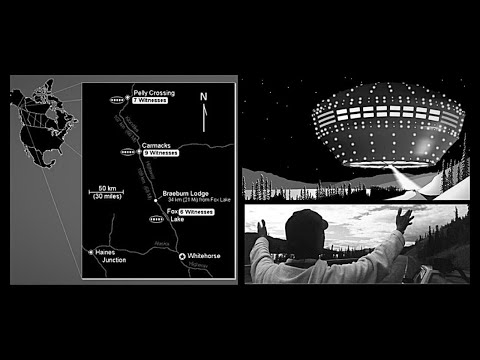
This case was also covered in the 2007 documentary Best Evidence: Top 10 UFO Sightings and reportedly in Discovery Canada's Close Encounters series, but this file's research could not locate a legitimate, oEmbed-verifiable YouTube upload of either broadcast segment itself; per this site's video verification standard, neither is linked here without direct confirmation.
Sources
- Jasek, Martin. "22+ Witnesses Observe a UFO Larger than a Football Stadium, Yukon Territory, Canada." Case 22 Event Summary. ufobc.ca
- Jasek, Martin. Case 22 Index and Investigation Overview. ufobc.ca
- Jasek, Martin. Witness Testimony: FOX 1. ufobc.ca
- Jasek, Martin. Witness Testimony: FOX 2 and 3. ufobc.ca
- Jasek, Martin. Witness Testimony: FOX 4 and 5. ufobc.ca
- Jasek, Martin. Witness Testimony: FOX 6. ufobc.ca
- Jasek, Martin. Witness Testimony: PEL 1 (Don Trudeau), Image and Drawing. ufobc.ca
- Jasek, Martin. "Calculation of UFO Size." Case 22. ufobc.ca
- Jasek, Martin. Case 22 FAQs. ufobc.ca
- Whitehorse Star. "Yukon UFO Conference" coverage, October 16, 2000 (reproduced). ufobc.ca
- Sheaffer, Robert. "'Top Ten' UFO Case: Yukon, Canada, 1996—Busted!" Skeptical Inquirer, Vol. 36, Issue 5 (Sept./Oct. 2012), "Psychic Vibrations" column, p. 22–23. skepticalinquirer.org
- Sheaffer, Robert. "'Top Ten' UFO Case — Yukon, Canada, 1996 — BUSTED!" Bad UFOs blog, April 2012. badufos.blogspot.com
- Royal Canadian Mint. "1 oz. Pure Silver Glow-in-the-Dark Coin — Canada's Unexplained Phenomena: The Yukon Encounter" (2022). mint.ca
- Office of the Chief Science Advisor of Canada. "Management of Public Reporting of Unidentified Aerial Phenomena in Canada." Sky Canada Project, 2025. science.gc.ca
- Library and Archives Canada. "ARCHIVED — Canada's UFOs: The Search for the Unknown." collectionscanada.gc.ca
- Eyes On Cinema. "A Giant UFO was witnessed by 31 people in the Yukon region, Canada, December 11, 1996." YouTube. youtube.com
- Wikipedia. "Klondike Highway." Used lightly, for general highway-corridor geography and mileage context only. en.wikipedia.org
- Government of Yukon. "Fox Lake Campground." Outdoor Recreation and Wildlife (GPS coordinates and highway-kilometer reference). yukon.ca
- Wikimedia Commons. "Klondike Highway near Five Finger Rapids.JPG" (Janothird, CC BY-SA 3.0), source of this case file's hero image. commons.wikimedia.org
See something inaccurate? Have additional information or sources?
Suggest an Edit →Last Updated: August 2026