
Hopeh Province Sighting
Sometime in the middle decades of the 20th century — the precise year is itself unresolved and disputed — a street photographer working in Tientsin (modern Tianjin), in China's Hopeh Province (modern Hebei), produced a single souvenir print showing a crowd of pedestrians on a busy commercial street, several gazing and pointing upward at a dark, conical or hat-like object apparently hovering in the sky above the rooftops. Decades later, a Japanese man named Masujiro Kiru found the print while going through his late father's photo album and learned, according to the family's own account, that his father had purchased it years earlier as a curiosity from a Tientsin sidewalk photographer. That secondhand chain-of-custody story — not a witnessed encounter, not a filed report, not a named observer's testimony — is the entirety of the "Hopeh Incident." The image itself survives only as a heavily reproduced, multi-generation copy; no original negative has ever surfaced. Sources disagree, without resolution, on whether the photograph dates to 1911 or to 1942, during the Japanese wartime occupation of the region, and disagree further on who actually took it and what, exactly, it shows: proposed identifications include a hat, a bird in flight, and a streetlight or lens artifact. English Wikipedia's own article on the case was deleted in 2014 for failing to clear the encyclopedia's baseline sourcing standard. The Omni Ledger treats Hopeh honestly for what the record actually supports: a single, provenance-disputed, date-disputed photograph, with no independent corroboration of any kind.
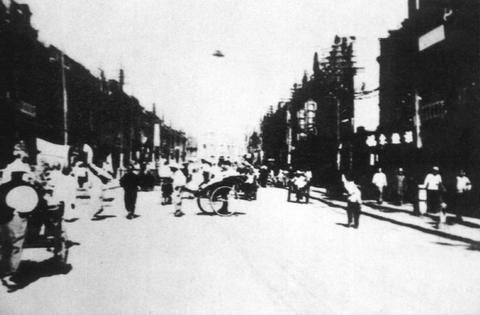
Pictured: the sole surviving image at the center of the entire case — a street in Tientsin (Tianjin), China, with pedestrians gazing and pointing up at a dark object above the rooftops. This is not a documentary print made by a credentialed photojournalist on assignment; it is a souvenir street photograph of disputed date (1911 or 1942) and disputed authorship, reproduced here from the public-domain scan hosted on Wikimedia Commons (source attribution: Masujiro Kiru). No original negative, higher-resolution master print, or institutional archival holding of the original photograph is known to exist anywhere — every version in circulation, including this one, is a copy of a copy.
Theoretical Alignment
Hopeh is not, at its core, a "what flew over the city" case in the way Basel or Nuremberg are — it is a "what actually happened to this photograph" case. The single strongest, best-evidenced pattern in the record is not a specific misidentified object but the steady drift and multiplication of contradictory retellings: different sources disagree about the date by three decades, about the location's exact street name, about who took the picture, about who first owned it, and about whether the "witness" who supposedly identified it as a hat was a street photographer, an American serviceman, or nobody at all. A specific mundane misidentification (hat, bird, or streetlight) remains plausible for the object itself, but the case's dominant, most robustly attested feature is the instability of its own origin story.
Background
Tianjin (rendered "Tientsin" in the English-language convention of the period, using the older Wade-Giles-derived romanization; the surrounding province, then called "Hopeh," is likewise an older Wade-Giles romanization of what is today spelled Hebei) was opened as a treaty port in 1860 under the Convention of Peking that concluded the Second Opium War. Over the following decades it developed into one of the most internationally partitioned cities in China: by the early 20th century, nine separate foreign concessions — British, French, Japanese, German, Russian, Belgian, Italian, and Austro-Hungarian, plus a short-lived, never-formally-conceded American zone that was folded into the British concession after 1902 — ringed the old walled Chinese city along the banks of the Hai River. Each concession operated its own municipal administration, police force, and often its own street-naming convention, producing exactly the kind of dense, colonnaded, multiethnic commercial streetscape visible in the Hopeh photograph. Commercial and street photography had been an established trade in Tientsin's concession districts since at least the 1870s and 1880s, serving both a growing Chinese urban clientele interested in portraiture and self-fashioning through the new medium, and the foreign merchant, military, and diplomatic community that made up a significant fraction of the city's spending power — sidewalk and studio photographers selling inexpensive souvenir prints to passersby, exactly the transaction described in every version of the Hopeh story, were a normal and unremarkable feature of treaty-port commercial life for at least sixty years before, during, and after either of the case's two disputed dates.
If the earlier proposed date is correct, the photograph belongs to one of the most turbulent years in the city's modern history. 1911 was the year of the Xinhai Revolution, the uprising that overthrew the Qing dynasty and established the Republic of China; Tientsin, sitting astride the rail and telegraph lines linking Beijing to the coast, was a genuine center of anti-Qing revolutionary organizing in the months surrounding the uprising, and in January 1912 an "Emergency Meeting of Representatives of Northern Revolutionary Associations" convened inside the city's French concession — a piece of real, documented regional history entirely independent of the photograph, but one that at least establishes 1911 Tientsin as a plausible, populous, photographically active setting rather than an arbitrary invented backdrop.
If the later proposed date is correct, the photograph instead belongs to the middle of the Japanese wartime occupation of North China. Japanese forces bombed and occupied the Chinese-administered portions of Tientsin on July 29–30, 1937, in the opening weeks of the Second Sino-Japanese War, while — in a diplomatic peculiarity of the period — initially continuing to respect the formal legal status of the various foreign concessions rather than occupying them outright. That arrangement eroded steadily over the following four years: Japan blockaded the British and French concessions in 1939 in retaliation for anti-Japanese demonstrations, and finally moved to occupy the British and American concession areas directly on December 7–8, 1941, immediately following the attack on Pearl Harbor and Japan's simultaneous declaration of war on the United States and Britain. A small United States Marine Corps detachment — part of the "North China Marines" contingent of the 4th Marine Regiment, roughly 200 officers and men split between the American legation guard in Beijing and the Marine compound in Tientsin (occupied by the Marines from March 1938 onward) — had already been ordered withdrawn from China on November 10, 1941; the remaining Tientsin detachment was scheduled to sail for the United States on December 10, but Japan's December 8 ultimatum overtook them, and they surrendered without a fight, spending the rest of the war as prisoners until Japan's surrender in August 1945. This detail matters directly to how the "American serviceman" version of the Hopeh story should be read: if that detail is accurate at all, it fits a date before December 8, 1941, far better than it fits 1942, since no American military personnel remained "on duty" anywhere in Japanese-occupied Tientsin at any point during 1942 — they were, for the entire year, prisoners of war.
This is the essential difficulty of the Hopeh case in miniature: both proposed dates sit inside a real, independently documented, and eventful period of Tientsin's history, and neither can be ruled out on purely contextual grounds. What is missing, in both directions, is anything that actually anchors the photograph itself — a dated negative sleeve, a newspaper publication record, a named photographer's studio stamp, a diary entry — to one specific year rather than the other.
Complete Timeline
| Date | Event |
|---|---|
| 1860 | Tientsin is opened as a treaty port under the Convention of Peking; foreign concessions begin to be established along the Hai River. |
| 1870s–1880s | Commercial studio and street photography becomes an established trade within Tientsin's foreign concession districts. |
| 1911 (disputed) | One dating tradition places the Hopeh photograph in this year, amid the Xinhai Revolution that overthrew the Qing dynasty; some retellings attribute the photograph to a Japanese journalist. No primary source for this date has been identified. |
| January 1912 | An "Emergency Meeting of Representatives of Northern Revolutionary Associations" convenes in Tientsin's French concession, documented regional context for the 1911 dating tradition. |
| July 29–30, 1937 | Japanese forces occupy the Chinese-administered portions of Tientsin at the outset of the Second Sino-Japanese War, while initially continuing to respect the formal status of the foreign concessions. |
| March 1938 | The U.S. Marine "North China" detachment (4th Marine Regiment) takes over the Marine compound at Tientsin. |
| 1939 | Japan blockades the British and French concessions in Tientsin in response to anti-Japanese demonstrations. |
| 1941 (disputed) | A separate dating tradition — reflected in some circulating stock-photo captions — places the photograph in this year, prior to the American concession's occupation and prior to the U.S. Marine detachment's capture. |
| November 10, 1941 | The U.S. Marine detachment in China, including the Tientsin garrison, is ordered withdrawn. |
| December 7–8, 1941 | Japan attacks Pearl Harbor and simultaneously moves to occupy the British and American concession zones in Tientsin; the Tientsin Marine detachment, awaiting evacuation, surrenders and is taken prisoner rather than withdrawn. |
| 1942 (disputed; working date used by this case file) | The date given by Wikimedia Commons' own file metadata and by the majority of modern secondary sources for the Hopeh photograph and Masujiro Kiru's alleged discovery of it in his father's wartime scrapbook. Throughout this year, no American servicemen remained "on duty" anywhere in Japanese-occupied Tientsin, a detail in tension with the "American serviceman" version of the story if that version is meant to apply to this date. |
| 1983 | Chinese ufologist Shi Bo's La Chine et les extraterrestres and Lt. Col. Wendelle C. Stevens & Paul Dong's UFOs Over Modern China are published, among the earliest identifiable print sources to catalog a Hopeh/Tientsin "black hat" or cone-shaped object sighting; both frame the case in a 1940s wartime context rather than 1911. |
| August 15, 1945 | Japan surrenders, ending its wartime occupation of Tientsin; the captured Marine garrison, held since December 1941, is liberated. |
| 2007 (February 14) | The photograph is uploaded to Wikimedia Commons as File:Hopeh incident 1.jpeg, sourced to "Masujiro Kiru," dated 1942, and tagged public domain in China. |
| 2007 (October 4) | Futility Closet publishes "The Hopeh Incident," summarizing the discovery story and noting the object could be "a bird... a hat... or man-lizards from Aldebaran." |
| May 29, 2014 | English Wikipedia's article on the "Hopeh Incident" is deleted following a formal deletion discussion that found the case failed the encyclopedia's notability and reliable-sourcing standards. |
| 2015 | A request is made to userfy (privately restore) the deleted Wikipedia article's content; a version briefly exists outside the main encyclopedia namespace. |
| 2023 (July) | A related redirect for "Hopeh Incident" is discussed and removed from English Wikipedia, per that year's redirects-for-discussion log. |
| Present day | The Hopeh photograph continues to circulate online and through stock-photo agencies under inconsistent captions (1911, 1941, and 1942 all still appear), with no institution known to hold an original print or negative and no resolution of the underlying dating dispute. |
The Photograph Itself
Every version of this case, however it differs on dates and names, agrees on the basic content of the image. It shows a wide street lined on both sides with multi-story colonnaded buildings, in a style typical of Tientsin's foreign concession commercial districts. The street is busy with pedestrians, several rickshaws, and what appears to be at least one other wheeled vehicle, photographed from ground level looking down the thoroughfare. A number of the people in the frame are looking upward, and at least two are clearly pointing toward the sky, where a small, dark, roughly conical or hat-shaped silhouette appears to hover above the rooftop line, off-center in the frame. The object reads as a solid, opaque, dark shape against a bright sky — consistent with backlighting, with a distant out-of-focus object, or with a nearby object photographed at a fast enough shutter speed to render it as a sharp-edged silhouette, depending on which explanation one favors. No scale reference exists in the frame that would allow a reliable size or altitude estimate, and no second photograph from a different angle or moment is known to exist.
The print itself is of modest technical quality even in its best-circulated versions: contrast is heavy, fine detail in the upper portion of the frame (exactly where the object sits) is limited, and the overall image bears the visual signature of a copy made from a copy rather than a scan of a well-preserved original negative — grain clumping, a slight softness, and tonal compression are all consistent with successive photographic or photomechanical reproduction rather than a single clean digitization. The version hosted on Wikimedia Commons under the filename Hopeh incident 1.jpeg, used as this case file's hero image, was uploaded on February 14, 2007, sourced simply to "Masujiro Kiru," dated 1942 in the file's own metadata, and tagged with the {{PD-China}} public-domain license template — reflecting the fact that, under Chinese copyright law, an anonymous-author photographic work enters the public domain 50 years after its first publication, a threshold cleared decades ago under either the 1911 or the 1942 dating.
The Dating Discrepancy: 1911 or 1942?
This is the case's central, unresolved problem, and The Omni Ledger treats it as exactly that rather than silently picking one date. Two dates recur across the secondary literature describing this photograph: 1911, in Tianjin, sometimes attributed to a Japanese journalist; and 1942 (occasionally rendered 1941), in Tientsin/Hopeh Province, during the period of Japanese wartime occupation. No source reviewed for this case file cites a primary, dateable artifact — a dated negative sleeve, a contemporary newspaper publication, a studio stamp, or an archival accession record — for either date. Both figures appear to rest entirely on secondhand retelling.
Several lines of reasoning favor 1942 as the better-supported date, without fully resolving the question. First, the earliest identifiable print sources to treat this photograph as a discrete "case" worth cataloging — Chinese ufologist Shi Bo's 1983 book La Chine et les extraterrestres and Lt. Col. Wendelle C. Stevens and Paul Dong's 1983 UFOs Over Modern China — both frame the sighting in a 1940s wartime context, not 1911; the "1911, Japanese journalist" variant appears to be a later addition to the story's circulation, and no source has been found that traces it back to an original citation. Second, the chain-of-custody narrative common to nearly every version of the story — Kiru finding the print in his father's photo album while researching his father's own World War II–era "China Campaign" service — only coheres cleanly with an acquisition sometime during the Japanese occupation of North China (1937–1945); if the elder Kiru acquired the print specifically as a memento of his own wartime posting, a 1911 photograph would have to have already been decades-old secondhand stock at the time he bought it, which is not impossible (souvenir photographers did resell older stock images) but is a less direct, less parsimonious reading of the story as it is actually told. Third, Wikimedia Commons' own file metadata, entered at the time of the 2007 upload, likewise gives 1942.
Working against a clean resolution in favor of 1942, however, is the case's other major recurring claim: that the photographer was "an American man on duty" who personally identified the object as a hat. As detailed in the Background and Timeline sections above, no American military personnel remained on active duty anywhere in Japanese-occupied Tientsin at any point during 1942 — the U.S. Marine garrison there had been captured and interned on December 8, 1941, and remained prisoners of war for the rest of the conflict. If the "American serviceman" detail is accurate at all, it fits 1941 (before Pearl Harbor) considerably better than it fits 1942 specifically — which is itself the date given on at least one commercial stock-photo caption for this same image (Alamy image ID MC86DP, captioned "Tientsien, Hopeh, China, in 1941... purchased by a Japanese General," a provenance detail that agrees with neither the "Kiru's father" story nor the "American serviceman" story). Rather than resolving the dating question, this only compounds it: at least three different years (1911, 1941, 1942) and at least three different photographer/purchaser identities (an anonymous Tientsin street photographer selling to Kiru's father; an American serviceman photographing his own sighting; a "Japanese General" acquiring the print) circulate for what is presented, in every telling, as a single photograph and a single event.
The Omni Ledger's editorial judgment, consistent with the Wikimedia Commons file record and the earliest identifiable print sources, is to use 1942 as this case file's working date while stating plainly that the question is not settled: no primary artifact exists to confirm it, a credible internal objection (the American-serviceman detail) points toward 1941 instead if that detail is accurate, and the 1911 alternative, while less well-supported by the earliest sources, cannot be conclusively excluded given the complete absence of an examinable original print or negative. Readers should treat every date attached to this case, including the one used here, as provisional.
Witnesses and the Chain of Testimony
Masujiro Kiru
The only named individual in this case, and a figure whose role is frequently blurred or overstated in secondary retellings that describe him as a "witness." He is not: every account agrees that Kiru found an already-existing photograph while going through his father's photo album, years or decades after whatever event the image depicts, and he is never described as having personally seen the object in the sky. His documented contribution to the case is entirely as the person who rediscovered the print, asked his father about its origin, and (in at least one retelling) received the explanation that his father had purchased it from a Tientsin street photographer as a souvenir. No birth date, death date, nationality beyond "Japanese," or biographical detail beyond this single anecdote has been established for him in any source reviewed for this case file; some sources romanize his surname as "Kiryu" rather than "Kiru."
Kiru's Father (Unnamed)
Described across most versions of the story as a Japanese man who served in China during the period covered by his own wartime photo album (the "China Campaign" framing used by several secondary sources implies service during the Second Sino-Japanese War), and who purchased the Hopeh photograph from a street photographer in Tientsin as a curiosity or souvenir. Like his son, he is never described as having witnessed the object himself — his entire documented role is as a buyer of an already-printed photograph, with no more direct a relationship to the underlying event than anyone who has ever bought a postcard. He is not named in any source reviewed for this case file, and no independent record of his military service, unit, or dates in China has been located.
The Tientsin Street Photographer (Unidentified)
In the most commonly repeated version of the story, an anonymous sidewalk or pavement photographer working a Tientsin commercial street took the picture and later sold a print of it to Kiru's father as a souvenir — an entirely ordinary transaction for the treaty-port photography trade of the period. This figure is never named, and no attempt to identify a specific working street photographer active in Tientsin during either candidate year has been documented. Because this version has the photographer selling a pre-existing print rather than being asked about the object directly, it does not, by itself, supply any interpretation of what the object was.
"An American Man on Duty" (Unnamed, Contested Account)
A materially different figure appears in Chinese ufologist Shi Bo's 1983 account: an unnamed American serviceman who, while on duty in a town in North China, personally saw "a black hat silently flying above the street" and photographed it himself, believing he had captured the first photograph of a UFO in China. This version conflicts with the "street photographer sold it to Kiru's father" version on the basic question of who took the picture and under what circumstances, and — as discussed above under the Dating Discrepancy — is difficult to reconcile chronologically with a 1942 date specifically, since no American servicemen remained on active duty in Japanese-occupied Tientsin during that year. No name, rank, or unit has ever been attached to this figure in any source reviewed for this case file.
The Street Crowd (Anonymous)
The only people who can be said with any confidence to have actually looked at whatever was in the sky that day are the anonymous pedestrians captured in the photograph itself, several of whom are visibly gazing or pointing upward. None of them has ever been identified, interviewed, or quoted in any source. Their reaction — interest and pointing, rather than visible alarm or flight — is sometimes cited by proponents of a genuine sighting as evidence the moment was noteworthy, and just as easily read by skeptics as consistent with a crowd noticing an ordinary but momentarily curious sight, such as a bird, a hat blown from someone's head, or a street fixture caught awkwardly in a passerby's frame.
The Paleocontact / Ufological Interpretation
Within ufological literature, Hopeh occupies a minor and largely uncritical niche: it is reproduced in general-interest "strangest UFO photos" listicles and stock-photo catalogs (Alamy licenses at least one period-attributed reproduction under the caption discussed above), and it appears as a data point in a handful of dedicated China-UFO-phenomenon books, most notably Lt. Col. Wendelle C. Stevens and Paul Dong's 1983 UFOs Over Modern China, which catalogs several hundred Chinese UFO case reports, and Paul Dong's later solo volume China's Major Mysteries. None of the sources reviewed for this case file offer any independent verification of the underlying story beyond repeating the same secondhand discovery anecdote in varying detail; no ufological investigator is on record as having traced the photograph to an original print, interviewed a Kiru family member directly, or obtained a higher-resolution scan than the version already in public circulation. Shi Bo's 1983 account is unusual within this literature for a specific reason worth noting explicitly: even the earliest print source to promote the case as a "first UFO photograph of China" simultaneously reports that the photographer himself thought the object looked like a hat — meaning the case's own foundational ufological text already contains its leading skeptical explanation embedded within it, rather than that explanation being a later debunking layered on top of an originally unambiguous sighting claim.
The Skeptical Interpretation: Hat, Bird, or Streetlight
Three competing mundane explanations for the object recur across the secondary literature, and none of them can be tested directly against the original photograph because no institution holds it and no forensic photographic examination of an original print has ever been documented. The most frequently repeated explanation, and the one embedded in the earliest identifiable print source (Shi Bo, 1983), is that the object was simply a hat — either windblown from a pedestrian's head or, in the "American serviceman" version of the story, mistaken by the photographer himself for something more remarkable in the instant before or after he recognized it. A hat, particularly a dark, broad-brimmed or conical style common to both Chinese and Western dress in the period, tumbling or briefly airborne against a bright sky, would readily photograph as a dark, roughly conical silhouette with no obvious means of propulsion or support — a close visual match to the object as described.
A second, independently proposed explanation is a bird in flight, caught by the camera's shutter at a moment and wing position that rendered it as a solid, compact, non-birdlike silhouette rather than a recognizably feathered shape — a well-documented photographic effect in an era of slower shutter speeds and lower film resolution, and one that has produced comparable "solid disc" or "solid object" misidentifications in numerous other 20th-century photographic UFO cases. A third proposed explanation treats the object as an artifact of the photographic or reproduction process itself rather than anything genuinely present in the sky at the moment of exposure — a streetlight, lamp fixture, or other fixed urban object positioned to appear, in the two-dimensional projection of the photograph, as though it were floating above the rooftops, compounded by the generational copying and reprinting that has degraded every surviving version of the image and could plausibly have introduced or exaggerated a smudge, light leak, or retouching artifact somewhere along the chain of reproduction.
None of these three explanations can be confirmed or ruled out with the evidence currently available, precisely because the evidence currently available is itself the problem: a photograph several generations removed from any original, with no accompanying technical data, examined by no named forensic photo analyst, and housed in no institutional archive. What can be said with confidence is that the object's appearance — a small, dark, solid, roughly conical silhouette with no visible means of support, filling a small portion of the frame, and lacking any structural detail — is fully consistent with any of the three explanations and offers no positive feature (no lights, no defined edges suggesting a manufactured object, no consistent shape across multiple frames) that would argue specifically for a genuinely anomalous or structured craft over a misidentified mundane object.
Comparative Analysis: Hopeh Among Photograph-Only UFO Cases
Photograph-centric UFO cases form a recognizable sub-category within ufology, and Hopeh sits near the weakest end of that sub-category by almost every available measure. The best-documented examples — the 1950 McMinnville (Trent) photographs chief among them — are built around named, repeatedly interviewed photographers; surviving original negatives that have been examined by named photo analysts using documented methodologies; and a specific, undisputed date and location. Hopeh has none of these. It has no named photographer under any single, agreed version of the story; no surviving negative or original print available for examination by anyone; and not even a settled date, let alone a settled account of who purchased or first published the image. Where McMinnville's central evidentiary debate concerns competing technical analyses of a real, examinable artifact (shadow geometry, wire-suspension hypotheses, film grain analysis), Hopeh's central evidentiary debate concerns whether the underlying story is even internally consistent from one retelling to the next. This is not a minor distinction: it is the difference between a case where experts disagree about what a real piece of evidence shows, and a case where no one can agree what the evidence itself even is.
Cultural & Scholarly Legacy
The photograph's afterlife has been almost entirely a phenomenon of low-stakes internet and stock-photography circulation rather than serious historical or scientific study. Futility Closet's brief October 2007 post treating it as a curiosity ("it could be a bird, it could be a hat, it could be man-lizards from Aldebaran. You decide.") is characteristic of how the case has generally been handled: acknowledged as visually striking, never subjected to sustained investigation. The clearest institutional verdict on the case's evidentiary weight came not from a ufological body but from English Wikipedia's own community moderation process. A "Hopeh Incident" article existed on English Wikipedia for years (and, per Wikidata's record, was translated into Spanish, Italian, Romanian, Asturian, and Chinese Wikipedia editions) before being nominated for deletion under the encyclopedia's fringe-content notability guideline; the deletion discussion's participants noted that "independent sources commenting on this 'incident' are not forthcoming," that the only mainstream press citation was a "news of the weird"-style photo gallery entry, and that the case was "notable in fringe circles but definitely does not meet WP notability." The article was deleted on May 29, 2014. A 2015 request to preserve its content via userfication followed, and a related redirect was itself removed from the encyclopedia in a 2023 cleanup discussion. This is, in effect, an independent, non-ufological editorial community's considered judgment that the case cannot clear even a baseline "has this been covered by reliable, independent sources" bar — a genuinely useful, citable data point for calibrating this case file's own credibility rating, discussed further below.
The Five Observables Assessment
The Five Observables framework, developed decades later by former AATIP director Luis Elizondo to classify modern UAP performance characteristics that exceed known technology, is included here for structural consistency with the rest of The Omni Ledger's case files, but it is almost entirely inapplicable to a single, static, undated photograph with no flight-path, speed, or duration data of any kind.
Assessment: Four of the five categories cannot be assessed at all from a single still photograph with no second frame, no motion data, and no altitude reference; they are marked N/A rather than "absent" in the strict sense of having been ruled out. "Low Observability" receives a speculative mark only because the object's dark, indistinct silhouette offers no internal structural detail to analyze — a description equally consistent with an object genuinely difficult to resolve optically and with an ordinary object (hat, bird, lamp) rendered featureless by distance, backlighting, or reproduction loss. The Five Observables framework, designed around modern multi-sensor military and radar data, is simply the wrong analytical tool for a single undated street photograph, and its inclusion here should not be read as suggesting genuine performance evidence exists.
Evidence Assessment
Supporting a Genuine Anomalous Phenomenon
- A real, circulating period photograph exists, showing a crowd's apparent, spontaneous reaction (looking up, pointing) to something in the sky, rather than a staged or posed composition
- The setting (a real, historically documented treaty-port street, either in 1911 or during the 1937–1945 occupation) is grounded in verifiable local history rather than an invented backdrop
- The image has been reproduced and discussed in dedicated China-UFO-phenomenon literature (Stevens & Dong, 1983; Shi Bo, 1983; Paul Dong's later work) rather than existing in total isolation
- No named analyst has published a specific, documented forgery finding against the image
Supporting a Natural / Documentary / Uncertain-Provenance Explanation
- No named eyewitness to the object exists in any version of the story; every named or partially-named figure is a secondhand purchaser, discoverer, or disputed photographer
- The date is unresolved by roughly three decades, with no primary source establishing any candidate year
- At least three mutually inconsistent accounts of who took the photograph and how it was acquired circulate simultaneously
- No original negative or first-generation print has ever been examined by anyone; no forensic photographic analysis has ever been performed
- The case's own earliest print source (Shi Bo, 1983) already frames the object as resembling a hat
- English Wikipedia's community deletion process found, after formal review, that independent reliable sourcing for the case does not exist
Why "Disputed"
Hopeh receives a DISPUTED classification, at the very bottom of this site's credibility range, rather than a flat "Debunked" label, for a specific reason: no single conventional explanation among the hat, bird, and streetlight/artifact candidates has been proven to the standard of, for example, a dated balloon launch log or a confirmed astronomical event tied to a specific known date — the kind of evidence that earns a case an outright "Debunked" stamp elsewhere on this site. What is not in dispute is almost everything else about the case's weakness: there is no named eyewitness to the object at any point in its history; the date is unresolved across a genuine, roughly three-decade span with no primary source settling it; at least three mutually inconsistent accounts exist of who photographed the object and how the print was acquired; no original negative or examinable first-generation print has ever surfaced, meaning no forensic photographic analysis has ever been possible; and English Wikipedia's own community review process concluded, after formal deliberation, that independent reliable sourcing for the case simply does not exist. Even the case's own earliest promotional source, Shi Bo's 1983 account, already frames the object as resembling a hat rather than presenting an unambiguous sighting claim. Weighed together, this is among the thinnest evidentiary foundations of any case in The Omni Ledger's catalog: not a witnessed-and-reported encounter with a contested explanation, but a single, disputed-date, disputed-authorship photograph whose own chain of custody cannot be told the same way twice.
Sensor & Instrumentation Detection Profile
There is no instrumentation of any kind associated with this case, and there never has been. The sole "sensor" is a single hand-held camera, of unknown make and unknown operator, exposed once, at an unknown moment, by an unknown photographer. No radar, no independent second photograph, no film footage, and no measuring instrument of any description exists. Even the photograph's own basic technical parameters — the type of camera, the film stock, the focal length, the shutter speed — are unrecorded, because no institution or archive has ever taken custody of an original print or negative to examine. Every reproduction circulating today, including the version hosted on Wikimedia Commons and used as this case file's hero image, is a copy at several removes from whatever the original negative once showed, with the loss of fine detail, contrast, and grain structure that implies. The South China Morning Post's own summary of the case is blunt about the consequence: Kiru himself, the man who found the print, "had no way of knowing if it was a forgery."
Environmental & Geospatial Context
Tianjin sits at approximately 39.084°N, 117.201°E on China's North China Plain, roughly 70 miles (110 km) southeast of Beijing, at the confluence of the Hai River system and historically the primary maritime gateway to the capital. The photograph shows what appears to be a wide, colonnaded commercial thoroughfare lined with two- and three-story buildings, rickshaws, and pedestrians in a mix of Western and Chinese dress — a streetscape entirely consistent with Tientsin's foreign concession districts, which by the early 20th century numbered nine distinct national concessions (British, French, Japanese, German, Russian, Belgian, Italian, Austro-Hungarian, and a short-lived American zone) layered across the city following its 1860 opening as a treaty port. Cast shadows visible in the image indicate the photograph was taken in daylight, but no more precise time of day, season, or weather condition can be established from the surviving copies, and no meteorological or astronomical record can be cross-checked against an event with no confirmed date. This is the single largest practical obstacle separating Hopeh from every other pre-instrumentation case on this site: Basel and Nuremberg's broadsheets are wrong about many things, but both carry a specific, stated date that can be checked against eclipse tables and solar geometry. Hopeh's surviving record cannot even supply that.
Observer Credibility & Occupational Profile
No named individual in this case is established as a person who actually saw the object with their own eyes and left a firsthand account. Masujiro Kiru, the only named figure in the entire chain, is on every version of the story a photo-discoverer, not a witness — he found an already-existing print in a family album, by most accounts years or decades after it was taken, and is not claimed to have been present at the scene at any point. His unnamed father, who purportedly purchased the print from a Tientsin street photographer, is likewise not described as having seen the object; he is only ever described as a buyer of an already-finished photograph, exactly the same passive, secondhand relationship to the event that a modern person would have buying a postcard. The street photographer who supposedly took the picture is never named in any version of the story reviewed for this case file. A separate, competing account — traced to Chinese ufologist Shi Bo's 1983 book La Chine et les extraterrestres — substitutes an entirely different figure: "an American man on duty" who allegedly saw a "black hat silently flying above the street" and photographed it himself. These two accounts (an anonymous Chinese/local pavement photographer selling a souvenir print vs. an American serviceman personally capturing his own sighting) are not the same story and are difficult to reconcile without simply assuming one of them is a corrupted retelling of the other. No occupational, military, or professional credential has ever been verified for any party associated with this photograph.
Physical & Material Assays
As detailed above under Material Analysis, no physical or trace evidence of any kind — metallurgical, isotopic, chemical, or otherwise — exists for this case, and none has ever been claimed; no landing, crash, or ground trace was ever reported. The single physical object connected to the case, the photographic print itself, has never undergone any documented scientific materials testing: no paper-stock dating, no silver-halide grain analysis, no chemical assay of any surviving print, because no institution has ever taken custody of an original to test. This is a meaningfully different situation from cases like the Basel or Nuremberg broadsheets, where the surviving period artifact itself is securely archived, dated, and available for inspection even though the sky event it describes cannot be independently verified; here, even the paper document is unavailable for assay, leaving this case with a weaker material record than almost any other historical photograph or document catalogued on this site.
Historical Precedents & Archive Matches
Within The Omni Ledger's own catalog, Hopeh's closest structural relative is the McMinnville (Trent) photographs of 1950 — another case where the entire evidentiary record is a small number of photographic prints rather than a witnessed-and-reported encounter, and where questions of negative custody, reproduction generations, and photographic analysis dominate the case's evidentiary debate in exactly the way they do here. Hopeh is considerably thinner than McMinnville in every respect that matters: McMinnville has two original negatives that were examined by named photo analysts and a named couple (Paul and Evelyn Trent) who gave consistent, repeated interviews about what they saw; Hopeh has no surviving negative at all, no named eyewitness, and a discoverer whose own account of the photograph's origin does not agree with the alternative version found in the earliest print source to discuss the case. Outside this site, the photograph is occasionally grouped in general listicle and stock-photography coverage of "historic UFO photographs" alongside the Trent photos, the 1950 Great Falls (Nick Mariana) film frames, and the McMinnville case, but it has never received a dedicated, book-length investigation comparable to what exists for any of those better-documented cases.
Material Analysis
The photograph is, unusually for this site, simultaneously the case's entire body of evidence and the case's central point of dispute. There is no metal, no soil sample, no recovered fragment, and no physical trace evidence of any conventional kind — the object in question was never claimed to have landed, crashed, or left any mark. The sole physical artifact is the print itself, and even that no longer exists in an examinable original form: every version reviewed for this case file, including the Wikimedia Commons scan used as this page's hero image, shows the visual signature of multi-generation photographic or photomechanical reproduction (heavy contrast, softened fine detail, and grain patterns inconsistent with a clean scan of an untouched original negative). No institution, archive, museum, or private collector is documented as currently holding an original print or negative, which means none of the standard techniques of photographic forensic analysis — the kind described in reference works such as Hany Farid's Photo Forensics, including examination of film grain structure, paper stock and chemistry dating, shadow and perspective geometry, and lighting-consistency analysis — has ever been applied to this case, because there has never been a first-generation artifact available to apply them to. This absence is itself the most important finding of any "material analysis" this case file can honestly offer: the evidentiary record has degraded past the point where modern forensic photography could resolve the case even if a qualified analyst were to attempt it today.
Supporting the Photograph's Basic Authenticity
- The image displays no obvious digital manipulation artifacts, consistent with an origin predating digital photo editing (though this says nothing about possible period darkroom techniques, such as double exposure or retouching, which leave different and harder-to-detect signatures)
- The streetscape, clothing, rickshaws, and architecture are all consistent with an early-to-mid-20th-century Chinese treaty-port setting, with no anachronistic detail identified in any source reviewed for this case file
- Commercial street photography of exactly this kind (candid crowd scenes sold as souvenirs) was a well-documented, ordinary trade in Tientsin's concession districts for decades, meaning the claimed circumstances of the photograph's creation are mundane and plausible on their own terms, independent of what the object turns out to be
- The image has been in public circulation since at least 2007 without a specific, documented forgery detection or manipulation finding being published against it by any named analyst
Undermining Confidence in the Photograph as Reliable Evidence
- No original negative or first-generation print has ever been located, examined, or held by any institution — every surviving copy is several generations removed from the original exposure
- No forensic photographic analysis of any kind has ever been performed, because no examinable original has ever been made available for one
- The chain-of-custody story exists in mutually inconsistent versions regarding who took the photograph and how it was acquired (an anonymous Tientsin street photographer selling to Kiru's father vs. an American serviceman personally photographing his own sighting vs. an unnamed Japanese General's acquisition, per a circulating stock-photo caption)
- The date of the photograph is unresolved by a margin of roughly three decades (1911 vs. 1941 vs. 1942), with no primary source establishing any of the three
- The South China Morning Post's own summary explicitly states that Kiru "had no way of knowing if it was a forgery" — an acknowledgment from within the case's own most mainstream press coverage that authenticity was never actually established
- The photograph's own earliest print source (Shi Bo, 1983) reports that the object was thought, by the person who photographed it, to resemble a hat
Conventional Explanation Candidates
Because Hopeh is simultaneously a "what was in the sky" question and a "what actually happened to this photograph" question, its Conventional Explanation Candidates (CEC) evaluate both the object itself and the surrounding story. Five candidates are assessed below.
Misidentified Hat
PlausibleThe explanation embedded in the case's own earliest print source (Shi Bo, 1983), in which the photographer himself reportedly thought the object resembled a hat. A dark, broad or conical hat briefly airborne against a bright sky would photograph as exactly the kind of featureless dark silhouette visible in the image, with no visible means of propulsion or support — a strong visual match, though impossible to confirm without an examinable original print.
Bird in Flight
Possible / UnconfirmedA bird caught by the camera's shutter at a wing position and distance that obscured its feathered structure would similarly render as a solid, compact silhouette, a well-documented photographic effect in other historical UFO photo cases from the same technological era. Nothing in the surviving image specifically confirms or excludes this reading.
Streetlight / Lens or Reproduction Artifact
Possible / UnconfirmedA fixed urban object (a lamp fixture or similar street furniture) misread through the photograph's two-dimensional projection, or a smudge, light leak, or retouching mark introduced somewhere across the image's many generations of reproduction, remains a live possibility precisely because no original print exists to rule it out.
Provenance Confusion & Folklore Drift
Highly PlausibleThis candidate explains the story rather than the object: at least three incompatible accounts of who took the photograph and how it was acquired, and at least three candidate dates spanning roughly three decades, circulate simultaneously for what is presented in every telling as a single event. This pattern is far better explained by an anecdote that has been retold, translated, and re-captioned many times over decades — accumulating small, unreconciled variations at each step — than by a single, stable, accurately transmitted account of one real occurrence.
Genuine Unidentified Aerial Phenomenon
UnprovenIncluded for completeness, per this site's standard framework. No positive evidence — no structural detail, no consistent multi-source account, no examinable original artifact — supports a literal non-terrestrial or otherwise genuinely anomalous reading over the four candidates above. The case for it rests almost entirely on the photograph's visual ambiguity and its decades of low-scrutiny circulation in listicle and stock-photo contexts, not on any documented investigation.
Related Cases
Confirmed Archival Holdings
The file-level record for the photograph used as this case file's hero image: source attribution "Masujiro Kiru," date 1942, {{PD-China}} public-domain license tag. The closest thing to an institutional record this case possesses.
PUBLIC DOMAIN (freely accessible)The full community deletion discussion, closed "Delete" by administrator Joe Decker, finding the case failed Wikipedia's notability guideline for fringe topics due to a lack of independent, reliable sourcing beyond a newspaper "weird news" photo gallery.
PUBLICLY ACCESSIBLE DISCUSSION RECORDThe administrative log recording the article's 2014 deletion, a 2015 userfication-related restoration, and a 2023 redirect removal — the full lifecycle of the case's only encyclopedia-standard editorial review.
PUBLICLY ACCESSIBLE ARCHIVESearch Primary Archives Directly
Further Reading — Recommended Literature
UFOs Over Modern China
One of the earliest English-language catalogs to treat Chinese UFO reports systematically, including cases from the wartime and immediate pre/postwar period that overlap directly with the Hopeh photograph's disputed timeframe.
China's Major Mysteries: Paranormal Phenomena and the Unexplained in the People's Republic
A later solo volume from one of the co-authors of UFOs Over Modern China, covering the broader landscape of Chinese paranormal and UFO claims this case sits within.
The UFO Encyclopedia, 4th Edition
The standard modern reference work for cross-checking historical UFO cases against the wider documented literature, useful for placing a thin, disputed case like Hopeh in proper context alongside better-evidenced reports.
UFO Sightings: The Evidence
A rigorous skeptical framework for evaluating UFO photographs and sightings against scientific and evidentiary standards, directly relevant to weighing the hat, bird, and artifact explanations discussed in this case file.
Photo Forensics
The standard academic reference on authenticating and analyzing photographs, explaining exactly the kind of forensic examination — grain analysis, lighting consistency, reproduction-generation detection — that has never been possible for the Hopeh photograph, since no original print has ever surfaced.
Essential Viewing
No Videos Available
Sources
- "The Hopeh Incident." Futility Closet, October 4, 2007. futilitycloset.com
- "File: Hopeh incident 1.jpeg." Wikimedia Commons (file metadata, source attribution, and PD-China licensing record). commons.wikimedia.org
- "China's X-files." South China Morning Post. scmp.com
- Shi, Bo. La Chine et les extraterrestres. Robert Laffont, 1983. (Earliest identified print source attributing the object to "a black hat" per an American witness's own account.)
- Stevens, Wendelle C. & Dong, Paul. UFOs Over Modern China. UFO Photo Archives, 1983.
- "Tianjin, Hebei, China UFO." The UFO Database. theufodatabase.com
- "Tsientsien?, Hebei, China, Asia." LUFORU (case summary citing Shi Bo and Wendelle Stevens). luforu.org
- "Wikipedia:Articles for deletion/Hopeh Incident." English Wikipedia (formal deletion discussion and rationale). en.wikipedia.org
- Deletion log for "Hopeh Incident." English Wikipedia. en.wikipedia.org
- "Hopeh Incident" (Q5899860). Wikidata (cross-language article record). wikidata.org
- "Incidente ovni de Hopeh." Spanish Wikipedia. es.wikipedia.org
- "Avvistamento di Hopeh." Italian Wikipedia. it.wikipedia.org
- "Tianjin — History." Encyclopaedia Britannica. britannica.com
- "Second Sino-Japanese War." Encyclopaedia Britannica. britannica.com
- "Foreign concessions in Tianjin." Wikipedia (concession establishment/occupation timeline, cross-checked against Britannica). en.wikipedia.org
- "China Marines." Wikipedia (4th Marine Regiment North China detachment, Tientsin garrison, and December 1941 capture). en.wikipedia.org
- "UFO — unidentified flying object hovering over a street in Tientsien, Hopeh, China, in 1941." Alamy (stock image ID MC86DP; cited here only as evidence of a divergent circulating provenance caption, not as a primary source). alamy.com
- Clark, Jerome. The UFO Encyclopedia, 4th ed. Visible Ink Press, 2023.
- Dong, Paul. China's Major Mysteries: Paranormal Phenomena and the Unexplained in the People's Republic. China Books & Periodicals, 2000.
- Sheaffer, Robert. UFO Sightings: The Evidence. Prometheus Books, 1998.
- Farid, Hany. Photo Forensics. MIT Press, 2016.
- "Masujiro Kiru." The Omni Ledger Key Figures. key-figures.html
See something inaccurate? Have additional information or sources?
Suggest an Edit →Last Updated: August 2026