
Ilkley Moor Incident
On the morning of December 1, 1987, a retired police officer using the pseudonym Philip Spencer photographed what he described as a small, greenish humanoid figure while crossing Ilkley Moor in West Yorkshire — a blurred, four-foot silhouette that became one of the most reproduced alleged "alien photographs" in British ufology. Spencer also reported a compass that had inexplicably reversed polarity and roughly two hours of unaccounted-for time. Three and a half months later, under hypnotic regression, he described a full abduction: paralysis, levitation aboard a craft, a medical-style examination, and apocalyptic imagery. The case remains permanently frozen for independent re-investigation, since the photographer's real identity was never disclosed.
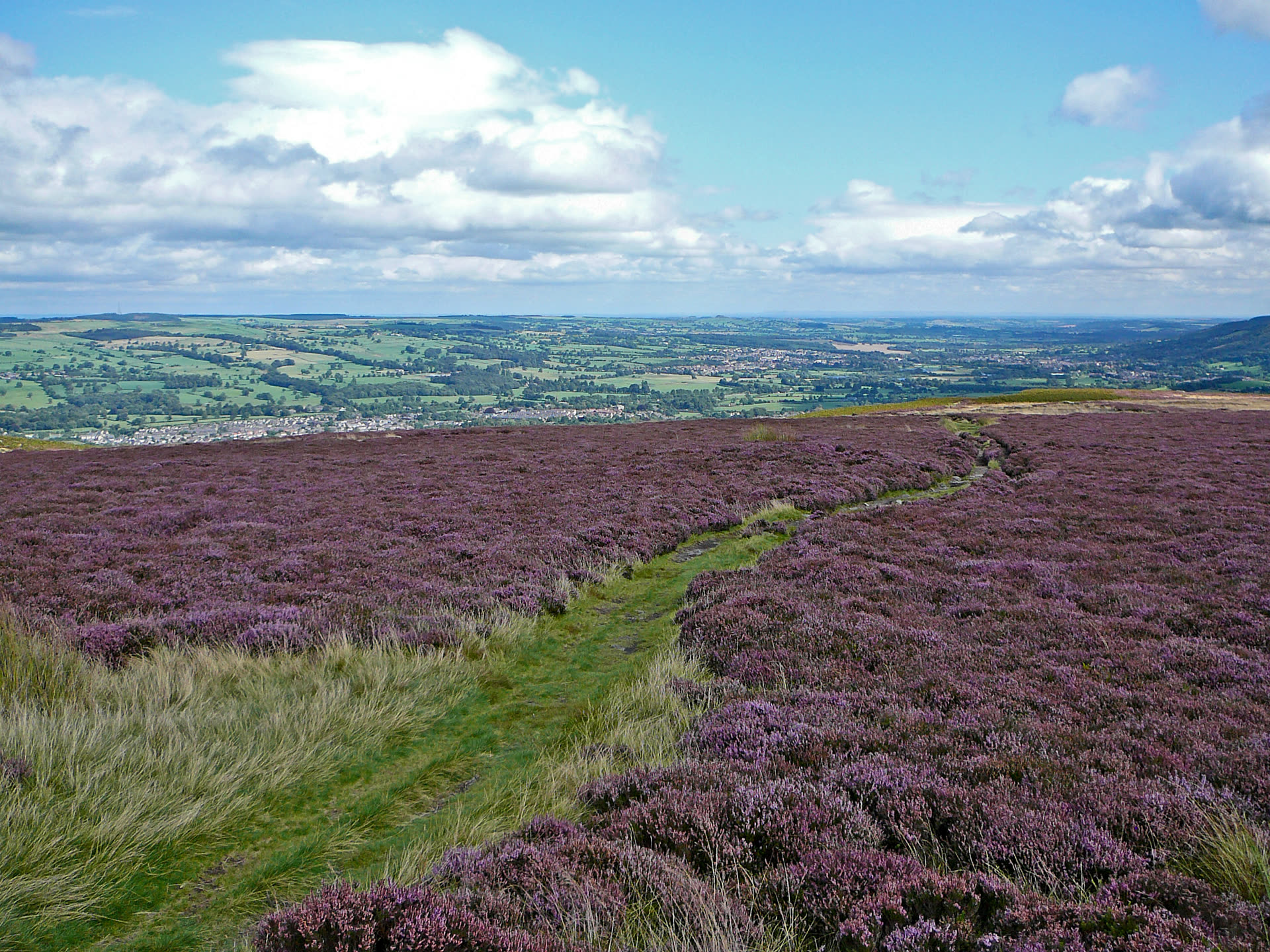
Pictured: heather moorland on Ilkley Moor, West Yorkshire, looking down over the town of Ilkley toward Wharfedale — the location where the encounter was reported, not the disputed 1987 photograph itself. Spencer's original photograph remains the copyrighted property of researcher Peter Hough, to whom the witness formally assigned rights in early 1988, and no rights-clear reproduction of it is known to exist; it can be viewed via the Google Images link above.
Theoretical Alignment
The case aligns most strongly with the Psycho-Social Hypothesis: a single, permanently anonymous witness; a photograph that is consistent with either a genuine anomaly or a staged/misidentified figure; a compass anomaly that a qualified electrical engineer confirmed could be produced by mundane means; and, most tellingly, a dramatic escalation of the narrative (paralysis, levitation, medical examination, apocalyptic imagery) that surfaced only under hypnotic regression more than three months after the event — the classic signature of confabulation rather than recovered memory. The Extraterrestrial and Interdimensional hypotheses cannot be ruled out on the available evidence, but neither is supported by anything beyond the witness's own testimony.
Background
By December 1987, Britain was roughly a decade into a modern wave of "close encounter" reporting that had been shaped heavily by American abduction narratives — Whitley Strieber's Communion had been published just months earlier, in January 1987, and brought the specific imagery of grey-skinned, large-eyed beings and hypnotically recovered abduction memories into mainstream popular culture on both sides of the Atlantic. British ufology in this period was dominated by a small, close-knit circle of investigators, chief among them Jenny Randles and Peter Hough, both prolific authors who had already built reputations investigating British sighting waves and who would go on to co-author several UFO reference works together.
The witness at the center of this case — publicly known only by the pseudonym Philip Spencer, at his own insistence — was a retired police officer who had moved to West Yorkshire from further south in England with his wife and young child. Little else about his background has ever been published, a deliberate choice respected by every researcher who has written about the case since 1987, from Hough and Randles through to Nick Redfern decades later. On the morning of December 1, 1987, Spencer set out on foot across Ilkley Moor, intending to walk from his home to the village of East Morton, near Keighley, where his father-in-law lived. Anticipating mist on the open moorland, he carried a compass to help hold his bearing, and — hoping to photograph the moor's atmospheric early-morning light — a camera loaded with fast, high-ASA film suited to low-light conditions.
Nothing in Spencer's stated purpose that morning was unusual: crossing the moor on foot between the Wharfedale and Airedale sides was, and remains, an ordinary walking route for local residents, and fog on Rombalds Moor in early winter is common enough that carrying a compass was a sensible, habitual precaution rather than a sign anything extraordinary was anticipated.
British ufology in December 1987 operated in a very specific institutional climate. The Ministry of Defence's small UFO desk had been quietly receiving and logging civilian sighting reports for decades under a series of internal designations, largely without public comment, and would not gain its best-known public face until civil servant Nick Pope joined the desk (Sec(AS)2a) on July 29, 1991 — nearly four years after this case. In the absence of any official public engagement, independent civilian groups such as BUFORA (the British UFO Research Association) and a loose network of freelance investigators like Randles, Hough, and Arthur Tomlinson did almost all of the fieldwork on cases like this one, operating with no government funding, no subpoena power, and no ability to compel a witness to disclose more than he chose to. This structural reality is important context for the case's central weakness: there was no institutional mechanism in 1987 Britain that could have required Philip Spencer to identify himself, and no institution has gained one since.
Complete Timeline
| Date | Event |
|---|---|
| Jan 1987 | Whitley Strieber's Communion is published in the U.S. and quickly reaches British readers, popularizing the modern grey-alien abduction narrative and hypnotic-regression testimony months before Spencer's encounter. |
| Dec 1, 1987 (early morning) | Retired police officer "Philip Spencer" sets out on foot across Ilkley Moor toward East Morton, carrying a compass and a camera loaded with fast film, expecting a roughly 45–75 minute walk in misty conditions. |
| Dec 1, 1987 (during the crossing) | In the mist, Spencer sees a figure he initially mistakes for another walker, then perceives as "unnatural" — a small, greenish humanoid roughly four feet tall with an oversized head and long, thin arms, thirty to fifty feet away. He photographs it before it flees. |
| Dec 1, 1987 (moments later) | Spencer says he pursued the fleeing figure toward a hollow in the moor, then witnessed a whitish, dome-topped craft — described as two lenticular sections stacked one on the other, with a pale square atop the dome — rise from the ground with a loud hum and vanish into low cloud. |
| Dec 1, 1987 (~10:00 a.m.) | Spencer arrives at Menston/East Morton roughly two hours later than his expected walking time, discovers his compass now points south instead of north, and later that morning has the film developed in nearby Keighley — the print shows the blurred humanoid figure. |
| Dec 1987 (days following) | Word of Spencer's photograph reaches Jenny Randles and Peter Hough, who make contact with Spencer and begin an investigation on the condition that his identity remain confidential. |
| Dec 1987 (~6 weeks in) | According to ufologist Nick Redfern's later account, two men identifying themselves as "Jefferson" and "Davis" and claiming to be RAF Intelligence officers visit Spencer's home seeking the photograph; the RAF later denies any personnel by those names or any such visit. |
| Early 1988 | Spencer declines all offers of payment for his story and formally signs over copyright of the photograph to Peter Hough, removing his own financial stake in its reproduction. |
| Feb 10, 1988 | Spencer informs Hough of the reversed compass reading, prompting Hough to arrange for it to be examined by a Manchester University electrical engineer. |
| Mar 16, 1988 | Clinical psychologist Dr. Jim Singleton conducts a hypnotic regression session with Spencer, with journalist Mathew Hill operating the tape recorder. Under hypnosis, Spencer describes paralysis, levitation aboard the craft, a medical-style examination, a guided "tour," and apocalyptic imagery apparently shown to him as a warning; the session also produces the claim that the photograph was actually taken after, not before, the alleged abduction. |
| 1994 | Randles and Hough publish "The Alien on Ilkley Moor" as a chapter in their book World's Best "True" UFO Stories, bringing the case to a wider international readership. |
| 1998 | The Telegraph & Argus revisits the case with a retrospective feature on a further computer-enhanced analysis of the decade-old photograph, describing it as one of the best-known British UFO images. |
| 2018 | Nick Redfern publishes Top Secret Alien Abduction Files, detailing the alleged Ministry of Defence intimidation visit and situating the case within a broader pattern of alleged government interest in abductees. |
| 2025 | Folklore historian David Clarke, discussing the case publicly for the first time in decades, states that meaningful modern re-investigation remains blocked because the photographer's identity was never disclosed and was "protected from independent scrutiny" by the original investigators. |
The Encounter on the Moor
Every surviving account of what happened on the moor itself traces back to Spencer's own testimony, relayed first to Hough and Randles and later reproduced with only minor variation across the case's subsequent retellings. Walking through drifting mist, Spencer said he first took the shape ahead of him for an ordinary fellow walker — until, closing the distance, he realized it was "something un-natural and strange." Descriptions of the figure itself are fairly consistent across sources: roughly four to four-and-a-half feet tall, with a dark green or blue-green tint to its skin, an oversized head, and unusually long, thin arms. Some retellings add that the figure appeared to gesture at him — either waving its arms or motioning for him not to approach — shortly before Spencer raised his camera and took a single photograph. The being then fled.
Pursuit and the Craft
Spencer said he ran after the fleeing figure toward a dip or hollow in the moor's surface, losing sight of it as it disappeared from view. Moments later, he described watching a whitish or silver craft — variously described as dome-topped, with "two saucer-shaped parts attached lenticularly, one on top of the other" and a pale square marking atop the dome — rise from the ground accompanied by a low hum, before it climbed rapidly and disappeared into the low cloud cover. He did not manage to photograph the craft itself, a detail skeptics have repeatedly singled out: an object rising into the sky in full daylight, they argue, would have been considerably easier to capture clearly on film than a stationary figure in fog, and its absence from the photographic record is at minimum a missed opportunity for the strongest possible corroborating evidence.
The Return Journey: Missing Time and the Reversed Compass
Continuing his walk, Spencer arrived at Menston, near his father-in-law's home in East Morton, and realized that considerably more time had passed than his walking pace should have required — accounts differ on the exact margin, with figures ranging from roughly ninety minutes to nearly two hours and forty-five minutes cited across different retellings, but all describe a walk that should have taken well under an hour stretching to two hours or more. Checking his compass, which he had used to hold his bearing through the mist, Spencer found that it now pointed south where it should have pointed north — a complete reversal of polarity rather than a simple miscalibration. He had the film developed at a shop in nearby Keighley roughly two hours after arriving, and the resulting print showed the blurred but apparently solid figure he had photographed on the moor.
Investigators Arrive
Within days, news of the photograph reached Jenny Randles and Peter Hough, two of the most established investigators working in British ufology at the time, who were later joined in the fieldwork by researcher Arthur Tomlinson. Spencer agreed to cooperate on the strict condition that his real name never be published, a condition his investigators honored completely — a decision that protected the witness's privacy but has also meant that no later researcher, however equipped with modern analytical tools, has ever been able to independently trace, interview, or cross-check the man at the center of the case. Hough personally came away from meeting Spencer describing him as sincere and uninterested in fame or money, an assessment reinforced when Spencer refused every offer of payment for his story and formally assigned copyright of the photograph to Hough in early 1988.
The Hypnotic Regression Session and Its Escalation
On March 16, 1988 — three and a half months after the encounter — clinical psychologist Dr. Jim Singleton conducted a hypnotic regression session with Spencer, with journalist Mathew Hill present to operate the tape recorder. What emerged under hypnosis was a substantially larger and more dramatic narrative than anything Spencer had reported in his original, conscious account: he described becoming paralyzed the instant he saw the being, being lifted and floated aboard the craft, undergoing a medical-style examination in which small instruments were inserted near his nose and mouth, being given a guided tour of the vessel's interior, and being shown disturbing imagery — nuclear explosions, famine, and floods — apparently intended as an ecological warning. Under hypnosis he also elaborated on the being's physical appearance well beyond his original waking account, describing pointed ears, large dark eyes, oversized hands with three fingers each, and distinctly V-shaped feet — specific anatomical detail entirely absent from his original, consciously recalled description of a simple dark-green humanoid figure. He also recalled being told, or warned, not to discuss the existence of a second roll of film, which he never subsequently produced or discussed further. Investigators seized on one particular hypnosis-derived detail to resolve a nagging inconsistency in the case: the lighting and shadow conditions visible in the photograph did not obviously match the time Spencer believed he had taken it, and the regression narrative proposed that the photograph had actually been taken after, not before, the alleged abduction — meaning his conscious memory of the sequence of events was itself unreliable even in his own telling.
Singleton's own clinical assessment of the session, after testing, was that Spencer was "telling the truth as he knew it." That phrase is a more careful and more limited claim than it is often taken to be: it speaks to Spencer's sincerity, not to the external accuracy of what he described. This distinction matters enormously for how this case file weighs the hypnosis-derived material. Since at least the early 1980s, a large body of published cognitive-science and clinical-psychology research on hypnotic regression has established that hypnosis reliably increases a subject's confidence in recovered memories without increasing their accuracy, and that leading or suggestive questioning during a session (even unintentional) can actively implant confabulated detail that the subject experiences as a genuine memory. None of this proves Spencer's hypnosis testimony is false. It does mean that the dramatic abduction narrative — the paralysis, the levitation, the medical examination, the doomsday imagery — rests on exactly the kind of evidence that methodological skepticism treats as the least reliable in the entire UFO-abduction literature, and this case file weighs it accordingly: as a sincerely reported internal experience, not as corroborated fact standing alongside the original, consciously recalled sighting.
The Alleged Ministry of Defence Visit
Writing decades later, ufologist Nick Redfern reported that approximately six weeks into the investigation, two men identifying themselves only as "Jefferson" and "Davis," and claiming to be RAF Intelligence officers, visited Spencer's home asking to see the photograph and, according to Redfern's account, implicitly discouraging further publicity. When later queried, the RAF stated it had no record of any personnel matching those names or any authorized visit to Spencer. Redfern presents this as evidence the Ministry of Defence had opened its own file on the case and used informal intimidation to manage it — a claim consistent with a broader pattern Redfern has documented in his research into alleged government contact with UFO witnesses, but one that, in this specific instance, rests entirely on Redfern's own published account and Spencer's relayed recollection, without any surviving documentary record, FOI-released MoD file, or independent witness to the visit itself. It is reported here as a notable but uncorroborated allegation, not an established fact.
Public Reception and Later Coverage
Word of the photograph reached the local and national press within days of the encounter, though initial coverage was cautious and, in at least one instance, actively mischievous: a contemporaneous newspaper item floated the idea that the figure was nothing more than an insurance salesman cycling across the moor in a reflective blue anorak — a specific "explanation" that was itself later revealed to have been a journalistic joke rather than a considered theory, illustrating both how quickly the press reached for mundane framing and how unreliable some of that early framing actually was. The case gained a more lasting foothold in the UFO literature in 1994, when Randles and Hough included a full chapter, "The Alien on Ilkley Moor," in their book World's Best "True" UFO Stories, cementing the investigators' own account as the definitive version nearly every subsequent retelling has drawn from. In 1998, the Telegraph & Argus revisited the case with a retrospective piece describing a further round of computer-enhanced analysis of the by-then decade-old photograph; the enhancement did not produce a new consensus different from the original Kodak and Maccabee findings, but the coverage itself is evidence of the photograph's staying power in regional memory. By the 2010s, some retrospective pieces were describing the case as one of the "Top 10" most significant alleged alien photographs in British UFO history — a characterization that speaks to its cultural prominence and reproduction, not to any strengthening of its underlying evidence, which has not materially changed since 1988.
A Case Frozen in Time
In a rare piece of modern engagement with the case, folklore historian and former National Archives UFO-files curator David Clarke was asked directly, in a 2025 online exchange, whether the case merited fresh analysis using modern techniques. Clarke's answer was that it likely does deserve revisiting in principle, but that in practice progress has been permanently hindered because "the photographer's identity never emerged and was protected from independent scrutiny by a pair of ufologists" — a pointed, if measured, criticism of the very confidentiality arrangement that made the original investigation possible. It is a genuine methodological tension at the heart of this case: protecting a witness's anonymity may have been the only way to secure his cooperation in 1987, but it has also permanently foreclosed the kind of independent, checkable re-investigation — locating the real Philip Spencer, verifying his police service record, re-interviewing him with current forensic photo-analysis tools — that could otherwise have resolved the case's central questions decades later.
Key Witnesses
"Philip Spencer" (pseudonym)
The only witness to the events of December 1, 1987. A retired police officer who had moved to West Yorkshire from further south in England with his wife and child, Spencer insisted on total anonymity as a condition of cooperating with investigators, and his real identity has never been published. He reported the initial sighting, the pursuit, the craft, the reversed compass, and the missing time entirely on his own, with no second witness present at any stage. He refused payment for his story, signed away copyright of his photograph, and — according to those who met him — showed no evident interest in publicity. His credibility rests almost entirely on the character assessment of the two investigators he chose to work with, since his stated occupation and background cannot be independently verified without knowing who he actually is.
Peter Hough
The British ufologist and psychology graduate who, together with Jenny Randles, conducted the primary investigation, arranged the Kodak and British Journal of Photography analyses, had the compass tested at Manchester University, and ultimately received copyright of the photograph from Spencer. Hough's assessment of Spencer as sincere and uninterested in fame is the single most-cited piece of character evidence in the case, though it is, by its nature, a subjective judgment from an investigator who was not himself a disinterested party.
Dr. Jim Singleton
Conducted the March 16, 1988 hypnosis session that produced the case's abduction narrative. His stated conclusion — that Spencer was "telling the truth as he knew it" — is a careful clinical hedge about sincerity, not a claim that the recovered memories were externally accurate, and this file treats it accordingly.
The Five Observables Assessment
The Five Observables framework is applied to the performance characteristics reported in this case:
Assessment: Spencer's account describes a stationary encounter followed by a craft that rose vertically and departed — behavior that, if accepted at face value, is not inconsistent with unconventional lift, but nothing in the testimony describes instant acceleration, hypersonic velocity, or trans-medium travel of any kind, and no instrumentation of any kind recorded the craft's flight profile. Low observability is marked speculative only because Spencer says he could not photograph the departing craft before it vanished into cloud — a claim consistent with an ordinary aircraft or object obscured by low cloud just as easily as with genuine sensor-defeating technology. Four of the five observables are simply absent from the record entirely.
Evidence Assessment
Supporting Anomalous Origin
- Kodak's laboratory analysis found no evidence of double-exposure or superimposition on the original negative
- A wildlife expert consulted on the photograph concluded the figure matched no known animal
- The compass reversal, while reproducible by mundane means, is nonetheless a genuine, physically documented anomaly rather than a purely subjective claim
- Investigator Peter Hough, who met the witness personally, assessed him as sincere and financially disinterested — he refused payment and signed away copyright of his own photograph
- Dr. Jim Singleton's clinical assessment found no evidence Spencer was consciously fabricating his account
- The case has remained internally consistent across nearly four decades of retellings by its original investigators
Supporting Conventional Explanation
- There is exactly one witness, and he has never been independently identified, interviewed by outside researchers, or cross-examined by anyone outside the original investigating pair
- Neither Kodak's nor the British Journal of Photography's nor Dr. Bruce Maccabee's analysis could confirm what the photograph actually depicts; all three explicitly stopped short of authentication
- The reversed compass has a documented, achievable mundane cause per Manchester University's own testing
- Spencer did not photograph the departing craft, despite it being described as the far easier target to capture clearly
- The case's most extraordinary content — paralysis, levitation, a medical exam, apocalyptic imagery — appeared only under hypnotic regression three and a half months later, a pattern strongly associated with confabulation rather than accurate memory recovery
- Folklore historian David Clarke, one of the few contemporary UK researchers to comment on the case, states plainly that independent modern re-investigation remains blocked by the witness's permanent, investigator-protected anonymity
Why "Disputed"
The Ilkley Moor Incident is classified DISPUTED rather than credible or debunked because neither side of the case has been definitively proven. The photograph has not been shown to be a hoax, a costume, or a cardboard cutout — but neither has it been authenticated as depicting a genuine unknown entity; every technical analysis commissioned, from Kodak's laboratory to Dr. Bruce Maccabee's optical review, explicitly stopped at "not proven to be tampered with," never reaching "proven genuine." What tips this file toward the lower end of the disputed range rather than the middle is the accumulation of specific, structural weaknesses: a single witness whose real identity and occupational background can never be checked; a compass anomaly with a demonstrated mundane cause; a missing craft photograph precisely where corroborating evidence would have been easiest to obtain; and, most significantly, a hypnotic-regression session that manufactured the case's most extraordinary claims months after the fact, in exactly the manner cognitive-science research on hypnosis warns is prone to confabulation rather than genuine recall. None of this proves Spencer lied or hallucinated the entire episode. It does mean the case, as it stands, cannot rise above a low-confidence "disputed" rating — and, per folklore historian David Clarke's own 2025 assessment, likely never will, because the one avenue that could resolve it — identifying and re-interviewing the real man behind the pseudonym — was permanently closed off by design in 1987. This file's numeric score reflects that ceiling: it sits toward the lower end of the disputed range, well below multiply-witnessed, instrumentally corroborated cases in this catalog, but above an outright debunked rating, because no analyst has ever actually demonstrated the photograph to be fraudulent — the honest verdict, four decades on, remains genuinely unresolved rather than conclusively negative.
Sensor & Instrumentation Detection Profile
No radar, FLIR, magnetometer, or any other instrumented sensor recorded the event. The only physical instrumentation involved was Spencer's own analog wristwatch and a pocket compass, both of which are witness-controlled devices rather than independent sensor data. The single photograph was taken on conventional consumer film loaded with a high-ASA (fast) emulsion chosen for low-light conditions — a choice that, while sensible for a foggy moor at dawn, also produces the coarse film grain that both British Journal of Photography analyst Geoffrey Crawley and U.S. Navy optical physicist Dr. Bruce Maccabee later cited as the specific reason neither could reach a definitive conclusion about the image. This is a genuine technical bind rather than an excuse: fast film achieves usable exposure in low light by using larger, more light-sensitive silver-halide grains, and those same larger grains set a hard floor on how much a print or negative can be enlarged or digitally sharpened before the image dissolves into grain noise rather than resolving finer edge or texture detail — precisely the information needed to distinguish a costume seam, a toy's proportions, or a genuine unknown subject from one another.
Environmental & Geospatial Context
Ilkley Moor is part of the larger Rombalds Moor, an expanse of heather moorland roughly 400 metres above sea level separating the Wharfedale and Airedale valleys in West Yorkshire. Early winter mornings on the moor are frequently overcast and prone to low mist and fog rolling off the surrounding hills, exactly the conditions multiple accounts describe for the morning of December 1, 1987 — conditions that both explain why Spencer was navigating with a compass in the first place and why any figure encountered at a distance of thirty to fifty feet would have been difficult to resolve clearly, whether it was anomalous or entirely mundane. The moor sits roughly 10–12 miles east of RAF Menwith Hill, a large joint UK–U.S. signals-intelligence installation opened in 1954 and taken over operationally by the NSA in 1966, whose distinctive white radome "golf balls" and alleged role in the global ECHELON interception network have made it a recurring subject of speculation, protest, and conspiracy theory in West Yorkshire for decades. The base is also around 10 miles from Leeds Bradford Airport. Investigators researching the case at the time, and researchers revisiting it since, have both noted both facilities as theoretically capable of producing unusual lights, aircraft activity, or radar-adjacent phenomena in the wider area, though neither has ever been tied to this specific sighting by any documented flight, radar, or signals record, and Spencer's account describes a close-range entity encounter in dense fog rather than a distant light or aircraft — a scenario Menwith Hill's own operations, which are electronic rather than aerial, do not obviously explain in any case.
Observer Credibility & Occupational Profile
Philip Spencer (a pseudonym; his real identity has never been publicly disclosed) was, by the consistent account of every researcher who worked with him, a retired police officer who had relocated to West Yorkshire from further south with his wife and child. A law-enforcement background is often cited by proponents as a mark of observational training and resistance to fabrication for attention, and investigator Peter Hough — who met Spencer personally — described him as "a man of integrity" who sought no publicity and no payment. Working against this, however, is the fact that his occupational credential cannot be independently verified at all, precisely because his identity was withheld: unlike a named police officer whose service record could be checked, "retired police officer" here is a description supplied by the witness and relayed by his chosen investigators, not a documented, checkable fact. Sheffield Hallam University folklore historian David Clarke has specifically flagged this as the case's central, permanent evidentiary weakness. By contrast, the two named investigators who vouch for Spencer's character are themselves independently checkable public figures with decades-long, reviewable track records: Jenny Randles and Peter Hough are established, named authors whose broader investigative work (including on cases like the Berwyn Mountains Incident and West Freugh) can be, and has been, scrutinized by other researchers. Their credibility does not transfer automatically to Spencer's underlying claims, but it is a meaningfully different category of evidence than an anonymous witness's own self-report, since it is at least their own professional reputations, rather than an unverifiable stranger's, on the line.
Physical & Material Assays
The only physical items examined were the photographic negative and the witness's own compass; no soil samples, trace residue, burn marks, or biological samples were ever collected or tested. Kodak's own laboratory in Hemel Hempstead, working from the original negative, reported no evidence that the frame had been double-exposed or otherwise tampered with — a finding that rules out one specific darkroom technique but does not establish what the figure in front of the camera actually was, since a physical prop, costume, or person positioned in the scene at the moment of exposure would produce an identical, untampered negative. Manchester University electrical engineer Dr. Spooner examined the compass and confirmed that a sufficiently strong applied or pulsed magnetic field — including one improvised, if dangerously, from ordinary household electricity — could reverse a compass needle's polarity exactly as described, meaning the anomaly, while consistent with an exotic field, does not by itself exclude a mundane or self-induced cause. A separately consulted wildlife expert examined the photograph itself and concluded that the figure did not correspond to any known bird, mammal, or other animal native to the Yorkshire moors, but was explicit that this method of exclusion — ruling out known fauna — could not on its own determine whether the subject was animate at all, let alone establish it as something beyond a costume, doll, or other inanimate prop positioned in the scene.
Historical Precedents & Archive Matches
Ilkley Moor's Bronze Age rock art (including the "Swastika Stone," the Badger Stone, and dozens of cup-and-ring carvings scattered across the hillside) and its Twelve Apostles stone circle already made it one of Yorkshire's most storied moors long before 1987, and local folklore about strange lights and figures on the moor in fog predates the UFO era by generations — the region's own folk song, "On Ilkla Moor Baht 'at," is itself a testament to how thoroughly the moor is woven into local imagination. The town below the moor had its own well-documented reputation for the unusual long before 1987 in a very different register: Ilkley developed into a fashionable Victorian hydropathic spa town from the 1840s onward, with the open-air White Wells cold-water baths and the grand Wells House hydro drawing visitors who believed in the site's supposed curative properties — Charles Darwin himself was a patient undergoing the water cure at Wells House in 1859, the same year On the Origin of Species was published. The juxtaposition is a genuinely local one: the same moorland slopes above the same small Yorkshire town have, at different points in its history, been associated with cold-water miracle cures, ancient rock carvings whose original purpose is still debated by archaeologists, and, in 1987, an alleged alien encounter. Within The Omni Ledger's own catalog, the case's closest analogue for methodology rather than content is The Zanfretta Incident (Torriglia, Italy, 1978), in which a security guard's initial sighting was likewise dramatically expanded under repeated hypnotic regression into a multi-year contact narrative — a pattern memory researchers consider a general risk of the technique rather than a coincidence specific to either case. For sheer institutional corroboration, the contrast with the Rendlesham Forest Incident (Suffolk, 1980) is instructive: multiple on-duty USAF security personnel, contemporaneous written logs, and a taped radio transcript exist for Rendlesham, none of which has any counterpart here.
The single closest precedent for the photograph itself, however, sits outside this site's own catalog: the 1964 "Solway Firth Spaceman" photograph, taken by Carlisle firefighter Jim Templeton on Burgh Marsh overlooking the Solway Firth, roughly 90 miles northwest of Ilkley. Templeton's photograph, like Spencer's, shows an ambiguous, humanoid-shaped background figure that became one of Britain's most reproduced "unexplained" images and likewise generated an alleged visit from unidentified men shortly afterward. Notably, the same David Clarke who has assessed the Ilkley Moor case also investigated Solway Firth directly, tracing the figure to Templeton's own wife standing with her back to the camera in an overexposed blue dress that photographed as ghostly white, and finding a contemporary 1964 newspaper quote in which Templeton himself told the Cumberland News, "It all looks like a leg-pull to me. I'm sure the men were not security agents" — a remark that directly contradicts the more dramatic "men in black" version of his story that circulated in later decades. Clarke's own explicit conclusion was that "fact has become entangled with fantasy" through media amplification and retrospective reinterpretation. Whether or not the same specific mechanism applies to Ilkley Moor, the Solway Firth case demonstrates that ambiguous background-figure photographs generating escalating "men in black" folklore is a documented, recurring pattern in British ufology, not a one-off feature of this case alone.
Material Analysis
The Ilkley Moor Incident produced no soil samples, trace residue, vegetation damage, or any collectible physical specimen from the reported encounter site — that absence is itself a meaningful data point, since the case rests entirely on two intangible-adjacent items: a single photographic negative and a handheld compass. Both were subjected to genuine, named technical analysis rather than being taken purely on faith.
The Photographic Negative
Kodak Ltd's laboratory in Hemel Hempstead examined Spencer's original negative and reported no evidence of double-exposure or superimposition — the figure was present on the same, single exposure as the rest of the frame. Geoffrey Crawley of the British Journal of Photography attempted further computer/densitometric enhancement but found the image's coarse film grain (a consequence of the fast, high-ASA film Spencer had loaded for low-light conditions) resistant to clarification. Dr. Bruce Maccabee, brought in for his prior experience analyzing the McMinnville and Gulf Breeze photographs, reached the same conclusion from the U.S. side: "I had great hopes that this case would prove definitive. Sadly circumstances prevent it from being so." A further, decade-later computer-enhanced pass reported by the Telegraph & Argus in 1998 did not produce a different consensus. In short: every named analyst who examined the negative confirmed it had not been faked in the specific sense of darkroom double-exposure, while none of them could say what it actually depicted.
The Compass
Investigator Peter Hough had the compass tested for radiation (none was found) and examined by a Manchester University electrical engineering specialist, Dr. Spooner, who confirmed a reversed magnetic polarity exactly as Spencer described, and further confirmed that such a reversal could be produced by a sufficiently strong applied or pulsed magnetic field — including, if handled carelessly, one improvised from ordinary domestic mains electricity. This finding cuts both ways: it establishes the anomaly was a real, physically measurable property of the instrument rather than a subjective claim, while simultaneously identifying a specific, achievable mundane mechanism that does not require any unconventional technology.
Supporting Non-Terrestrial Origin
- The negative shows no darkroom-style tampering by Kodak's own laboratory standard
- The compass reversal is a genuine, physically confirmed instrument anomaly, not merely a witness claim
Supporting Terrestrial Origin
- No analyst — Kodak, the British Journal of Photography, or Maccabee — was able to confirm the photograph depicts a genuine unknown entity rather than a staged or misidentified subject
- The specific mechanism needed to reverse the compass's polarity was independently confirmed as achievable through mundane (if unsafe) means
- No physical trace evidence of any kind was recovered from the actual encounter site
The Conventional Explanation Candidate: A Staged or Misidentified Figure
The leading conventional explanation is that the photographed "entity" was a staged prop, a small figure or costume, or an ordinary person briefly misperceived at a distance through fog — not a deliberate, sinister hoax necessarily, but the kind of low-light, fast-film, foggy-moor photograph that is exceptionally difficult to either fake convincingly or debunk conclusively, because grain and haze obscure exactly the details (edges, texture, proportion) that would settle the question either way. This candidate deserves serious weight because it requires no unverified technology or unusual physics, it is consistent with every named analyst's actual finding (no tampering detected, but no confirmation of an anomalous subject either), and a contemporaneous newspaper's own floated explanation — a cyclist in a reflective blue anorak, later revealed to be a journalistic joke rather than a serious lead — shows how readily observers of the era reached for exactly this kind of mundane misidentification. The 1964 Solway Firth Spaceman photograph, ultimately traced by David Clarke to Templeton's own wife standing with her back to the camera in an overexposed dress, is a documented real-world example of precisely this failure mode: an ambiguous background figure in a genuine, untampered photograph, misread as anomalous for decades before a mundane explanation was finally, and specifically, identified. No equivalent breakthrough identification has yet been made for the Ilkley Moor photograph, but the Solway precedent establishes that this class of misidentification is a real, recurring phenomenon in British ufology rather than a hypothetical one.
Self-Induced or Exaggerated Compass and Time Effects
A second candidate holds that the reversed compass and the "missing time" were not evidence of an exotic craft at all, but either an innocent misjudgment of walking pace and route through heavy fog (compounded, after the fact, by the witness's own growing conviction that something anomalous had happened) or, at the more skeptical end, a deliberately or accidentally self-induced magnetic effect on the compass of exactly the kind Dr. Spooner confirmed was achievable. This candidate is strengthened by the fact that the specific mundane mechanism needed has been independently verified as physically possible, but weakened by the absence of any direct evidence Spencer actually did expose his compass to such a field, or that his time discrepancy exceeded what genuinely disorienting fog on unfamiliar moorland terrain could produce on its own. Disorientation in fog is itself a well-documented hazard on open, feature-poor moorland of exactly this kind, where walkers without a fixed landmark can unknowingly veer off a direct line and lengthen a routine crossing considerably, particularly if their only navigation aid was, by that point, giving a false reading.
Confabulation Under Hypnotic Regression
A third candidate concerns not the original sighting but the case's subsequent escalation: that the abduction narrative recovered under Dr. Jim Singleton's March 1988 hypnosis session was not a genuine unlocking of suppressed memory but a confabulated elaboration, shaped by suggestive questioning and by the surrounding cultural moment (Whitley Strieber's Communion, with its now-iconic abduction imagery, had been published less than a year earlier). This explanation is strongly supported by the broader scientific literature on hypnotic regression, which by the late 1980s already showed hypnosis increases confidence in recovered memories without increasing their accuracy. The most directly relevant peer-reviewed evidence postdates this specific case but generalizes to it well: a 2002 study in the Journal of Abnormal Psychology by Susan Clancy, Richard McNally, and colleagues found that individuals reporting alien abduction experiences showed significantly elevated rates of false recall and false recognition on standard memory tests compared to control subjects, and identified hypnotic suggestibility itself as one of the strongest predictors of that effect. Applied to Spencer's case, this body of research does not prove his hypnosis testimony was invented, but it does establish that the specific method used to obtain it — regression hypnosis conducted months after an ambiguous initial event, in a cultural moment saturated with a newly popular abduction template — is exactly the combination of factors the scientific literature associates with confabulated rather than genuinely recovered memory. It does not, however, explain the original photograph or the compass reversal, both of which predate the hypnosis session by more than three months and were reported by Spencer entirely on his own, in his ordinary waking state, without any hypnotic prompting.
Staged or Misidentified Figure
InconclusiveINCONCLUSIVE — consistent with every technical analysis performed, but not proven; no analyst could positively identify the photographed subject as a person, prop, or costume.
Self-Induced/Exaggerated Compass & Time Effects
PlausiblePLAUSIBLE — the specific mechanism required was independently confirmed as physically achievable by mundane means, though no direct evidence proves it happened this way.
Confabulation Under Hypnotic Regression
Highly Plausible (for the abduction narrative only)HIGHLY PLAUSIBLE as an explanation for the hypnosis-derived abduction content specifically, per established cognitive-science findings on hypnotic confabulation; does not address the original photograph or compass anomaly, which preceded the hypnosis session.
Related Cases
Official Records & Search Resources
No specific Ministry of Defence UFO file for the Ilkley Moor Incident has been located in the released National Archives tranches. The MoD's UFO desk (S4f, later DI55) received and logged thousands of civilian sighting reports during this exact period, and its released files are searchable directly below. Ufologist Nick Redfern's claim of an informal MoD/RAF Intelligence contact with the witness (see Timeline, ~6 weeks post-encounter) has no corresponding released document and is not independently verifiable through this or any other public archive.
Search Government Archives Directly
Further Reading — Recommended Literature
World's Best "True" UFO Stories
Contains "The Alien on Ilkley Moor," written by the two investigators who worked directly with Spencer, arranged the photo and compass testing, and are the primary source for nearly every later account of this case.
The Complete Book of UFOs: 50 Years of Alien Contacts and Encounters
The same investigating pair's broader reference work, useful for placing the Ilkley Moor case in the context of the wider British UFO cases they covered across their careers.
Top Secret Alien Abduction Files: What the Government Doesn't Want You to Know
The source for the alleged post-encounter visit from men claiming RAF Intelligence credentials, situated within Redfern's wider research into government contact with UFO abductees.
How UFOs Conquered the World: The History of a Modern Myth
Essential skeptical-historical context from the folklore historian and former National Archives UFO-files curator who has publicly identified the anonymity of Ilkley Moor's central witness as the case's defining evidentiary problem.
The Real Men in Black: Evidence, Famous Cases, and True Stories of These Mysterious Men and Their Connection to the UFO Phenomena
Broader background on the "men in black" intimidation pattern Redfern places the alleged post-Ilkley-Moor visit within, useful for evaluating how typical or atypical that specific claim is within the wider literature.
Essential Viewing
The Ilkley Moor Alien Photograph – A Basic OSINT Investigation
An open-source investigation walking through the case's chronology, the photo-analysis history, and the specific evidentiary gaps that keep the case unresolved.
Ilkley Moor Alien – Location of THAT Photo!
An on-location visit to Ilkley Moor identifying the moorland terrain where Spencer's photograph was reportedly taken, useful for grounding the case's geography.
Sources
- Gross, Patrick. "UFOs at Close Sight: The Ilkley Moor Encounter of the Third Kind, 1987" — detailed compiled case history with chronology, analyst findings, and named investigators. ufologie.patrickgross.org
- "Ilkley Moor UFO incident," Wikipedia — general orientation summary with source list. en.wikipedia.org
- Yorkshire Post. "Picture Post: When Ilkley Moor Became an Alien Landing Site." yorkshirepost.co.uk
- Telegraph & Argus. 1998 retrospective report on a further computer-enhanced analysis of Spencer's photograph, a decade after the original encounter.
- "Ilkley Moor UFO Abduction (1987)," Mysterious Britain & Ireland. mysteriousbritain.co.uk
- "The 1987 Ilkley Moor Alien Photograph," Ghost Theory, March 13, 2015. ghosttheory.com
- "1987 — The Ilkley Moor Alien," UFO Casebook Files. ufocasebook.com
- "The Ilkley Moor Alien," Real Yorkshire Blog. realyorkshireblog.com
- Clarke, David. Response to reader inquiry about the Ilkley Moor case, including the assessment that the photographer's protected anonymity blocks independent modern re-investigation. drclarke.substack.com, Jan–Jun 2025.
- Clancy, Susan A.; McNally, Richard J.; Schacter, Daniel L.; Lenzenweger, Mark F.; Pitman, Roger K. "Memory Distortion in People Reporting Abduction by Aliens," Journal of Abnormal Psychology, Vol. 111, No. 3 (2002), pp. 455–461 — peer-reviewed study establishing that abduction-reporting subjects show elevated false-memory rates, directly relevant to evaluating this case's hypnosis-derived testimony. pubmed.ncbi.nlm.nih.gov
- Randles, Jenny & Hough, Peter. "The Alien on Ilkley Moor," in World's Best "True" UFO Stories, Sterling Publishing, 1994.
- Randles, Jenny & Hough, Peter. The Complete Book of UFOs: 50 Years of Alien Contacts and Encounters, Piatkus Books, 1997.
- Redfern, Nick. Top Secret Alien Abduction Files: What the Government Doesn't Want You to Know, Red Wheel/Weiser, 2018 — primary source for the alleged post-encounter RAF Intelligence visit.
- Clarke, David. How UFOs Conquered the World: The History of a Modern Myth, Aurum Press, 2015.
- Redfern, Nick. The Real Men in Black: Evidence, Famous Cases, and True Stories of These Mysterious Men and Their Connection to the UFO Phenomena, New Page Books, 2011.
- Strieber, Whitley. Communion: A True Story, William Morrow, 1987 — cited for cultural/timing context on the modern abduction narrative circulating just before Spencer's hypnosis session.
- "David Clarke (journalist)," Wikipedia — background on Clarke's role as former National Archives UFO-files curator and Sheffield Hallam University lecturer. en.wikipedia.org
- Countryfile (BBC magazine). "Day Out: Ilkley Moor, West Yorkshire" — geography and ancient-monument context for the moor. countryfile.com
- Isaac Koi. "Hough, Peter" — UFO Personalities biographical reference. isaackoi.com
- "Nick Redfern," Wikipedia — biographical background on the researcher who documented the alleged MoD/RAF Intelligence intimidation claim.
- Maccabee, Bruce. Published photo-analysis casework methodology (McMinnville, Gulf Breeze, and related cases), cited by this file's existing Bruce Maccabee profile as the basis for his involvement in the Ilkley Moor photo analysis.
See something inaccurate? Have additional information or sources?
Suggest an Edit →Last Updated: August 2026