
The Killian Sighting
At 8:20 PM on February 24, 1959, American Airlines Captain Peter W. Killian, flying Flight 139 (a DC-6B) from Newark, New Jersey toward Detroit, Michigan, spotted three unusually bright, color-shifting lights off his left wingtip near Williamsport, Pennsylvania. For roughly forty-five minutes, with First Officer James Dee, thirty-five passengers, and two flight attendants watching alongside him, the objects paced the airliner — brightening "brighter than any star," fading out, shifting from yellow-orange to brilliant blue-white, and occasionally pulling ahead before drifting back into formation. Killian kept a constant watch on his own onboard radar the entire time; it never showed a return. Two more American Airlines crews confirmed the same lights by radio, a United Airlines crew tracked them independently for thirty minutes on a nearly identical heading, control-tower personnel at Pittsburgh reported seeing them, ground radar at Youngstown, Ohio also came up empty, and roughly a dozen civilians near Akron, Ohio reported the same phenomenon within the same twenty-minute window. The Air Force's investigation shifted explanations three times in three weeks — the Belt of Orion, then unspecified witness unreliability, then a KC-97/B-47 aerial refueling mission near Bradford, Pennsylvania — before settling on the refueling account despite geometry that several independent analysts, most rigorously Dr. Willy Smith of the UNICAT Project in 1992, have argued does not fit the reported angles, distances, or the four-into-three aircraft-count mismatch. NICAP's New York City affiliate produced one of the most detailed investigation files in the organization's history, and Richard Hall featured it prominently in The UFO Evidence (1964) as one of the strongest multi-witness commercial-aviation cases on record.
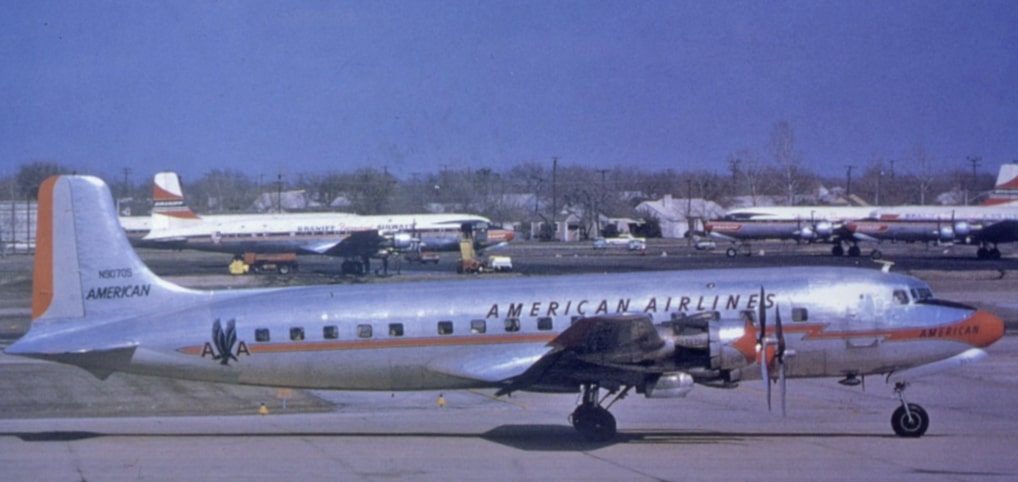
Pictured: an American Airlines Douglas DC-6 in the same model and livery flown as Flight 139, photographed at Dallas Love Field on March 13, 1958 — not the specific aircraft Captain Killian was piloting on the night of February 24, 1959, for which no photograph tied to that exact tail number is known to survive.
Theoretical Alignment
Killian scores modestly on the Extraterrestrial Hypothesis for the same reason it scores heavily on the Psycho-Social side: the entire forty-five-minute record consists of unaided visual observation of distant light sources, exactly the category of evidence most vulnerable to honest misperception of mundane phenomena — stars, aircraft position lights, and, on this specific night, a real and documented aerial refueling operation somewhere in the same general region. What keeps the ETH component from collapsing to near zero, as it would for a single uncorroborated light report, is the sheer breadth of independent same-evening corroboration: four separate flight crews, at least one ground control tower, a negative radar check at a second airport, and roughly a dozen civilian observers near Akron all described functionally the same three-light, color-shifting, formation-holding phenomenon within the same one-hour window across two states. The Interdimensional Hypothesis finds essentially no support in a case built entirely on conventional optical observation with no reported physiological, temporal, or dimensional anomaly of any kind.
Background
By February 1959, American commercial aviation was in the middle of a rapid transition from piston-engine airliners like the Douglas DC-6B to the first generation of jets, and the U.S. Air Force's Project Blue Book — then headquartered at Wright-Patterson Air Force Base and staffed by a small rotating team of officers — was fielding a steady trickle of pilot and ground-observer reports without the intense public spotlight of the record 1952 wave. Against that backdrop, Peter W. Killian, a veteran American Airlines captain with roughly two decades and several million miles of commercial flying experience, was at the controls of Flight 139, a nonstop DC-6B run from Newark, New Jersey to Detroit, Michigan, which departed at 7:10 PM Eastern Standard Time carrying thirty-five passengers, two hostesses (Edna Le Gate and Beverly Pingree, per contemporary press accounts), and First Officer James Dee in the right seat.
Three weeks earlier, on February 2, 1959, a University of Michigan professor and his wife had independently reported an unusual yellow object — described as having "an upper part much like the top of a sphere, while the lower part was rather level or flat," and departing alongside the silhouette of what appeared to be a conventional aircraft heading the opposite direction — near Sandusky, Ohio, well within the same general regional corridor the Killian sighting would traverse. The report was routed through the FBI's Detroit field office, where Special Agent S. A. Coghlan forwarded it to the Strategic Air Command on February 4, and it eventually reached the Air Technical Intelligence Center (ATIC) at Wright-Patterson on February 25 — one day after the Killian sighting, placing the two reports in close temporal and geographic proximity even though no formal investigative connection between them was ever established.
At 8:20 PM, roughly seventy minutes into the flight and about thirteen miles west of Williamsport, Pennsylvania, cruising at 8,500 feet on a heading of 295 degrees, Killian's attention was drawn to three bright lights off the airliner's left wingtip.
Complete Timeline
| Date | Event |
|---|---|
| February 2, 1959 | A University of Michigan professor and his wife report an unusual yellow, dome-topped object near Sandusky, Ohio, within the same regional air corridor. |
| February 4, 1959 | FBI Detroit Special Agent S. A. Coghlan forwards the Sandusky report through Air Force channels toward the Strategic Air Command. |
| February 24, 1959 — 7:10 PM EST | American Airlines Flight 139, a DC-6B captained by Peter W. Killian with First Officer James Dee, departs Newark, New Jersey for Detroit, carrying 35 passengers and 2 hostesses. |
| 8:20 PM | Approximately 13 miles west of Williamsport, Pennsylvania, at 8,500 ft on a heading of 295°, Killian spots three bright lights off the left wingtip, initially mistaking them for the Belt of Orion before realizing Orion is separately visible overhead. |
| ~8:20–8:40 PM | Killian radios two other nearby American Airlines flights — one near the "Dolphin" checkpoint on Lake Erie's northern shore, another near Sandusky, Ohio — both of whose crews independently confirm seeing the same lights, positioned to the south of their own flight paths. |
| 8:40 PM | Air traffic control tower personnel at Pittsburgh report observing the same lights. |
| 8:40–9:10 PM | United Airlines Flight 937, captained by A. D. Yates with Flight Engineer L. E. Baney, independently tracks three objects between Lock Haven, Pennsylvania and Youngstown, Ohio. |
| ~8:45 PM | Ground radar operators at Youngstown airport check for a return on the reported objects and find nothing, matching the negative result Killian is separately recording on his own onboard radar. |
| ~9:05–9:10 PM | The lights fade from Killian's view after roughly 45 minutes of intermittent observation. |
| 9:15–9:20 PM | Approximately nine to twelve civilian ground observers in the Akron, Ohio area independently report three lights moving east to west. |
| 9:30 PM | United Flight 937 lands at Akron; Capt. Yates and Eng. Baney file their report. |
| 10:52 PM | American Airlines Flight 139 lands in Detroit as scheduled. |
| February 25, 1959 | Wire-service accounts of "flying saucers" escorting a Detroit-bound airliner run in newspapers nationwide, including the Indiana Evening Gazette; ATIC separately receives the forwarded February 2 Sandusky report the same day. Dr. Orren C. Mohler of the McMath-Hulbert Observatory states publicly: "There is no astronomical explanation of the reported sightings." |
| February 28, 1959 | The Air Force's first public explanation attributes the sighting to the Belt of Orion. |
| March 1, 1959 | The New York Herald Tribune (byline Ralph Chapman) reports continuing Air Force study of the case; an anonymous Air Force spokesman separately makes insinuations questioning the sobriety of UFO witnesses generally. |
| March 2, 1959 | Internally, USAF Capt. William D. Hostutler documents a telephone call confirming three B-47s conducted a refueling mission near Pittsburgh at 20:40 hours (8:40 PM) on February 24 — information the Air Force does not yet release publicly. |
| March 16, 1959 | The Air Force publicly releases its KC-97/B-47 aerial-refueling explanation for the sighting. |
| March 19, 1959 | USAF Maj. Lawrence J. Tacker, Public Information Division, sends a letter to Fred A. Kirsch reiterating the refueling explanation and noting KC-97 tankers operate at roughly 17,000 feet and 230 knots true airspeed. |
| Spring 1959 | George Popowitch's Akron-based UFO Research Committee compiles and circulates a detailed report on the sightings from the American and United airline crews. |
| May 6, 1959 | Maj. Gen. W. P. Fisher, USAF Director of Legislative Liaison, writes to Senator Harry Flood Byrd reaffirming the refueling explanation in response to a Senate inquiry. |
| June 24, 1959 | Maj. Tacker sends a further letter to Frances Ryan again defending the refueling explanation. |
| August 14, 1959 | USAF Maj. R. F. Werkmeister documents a telephone conversation recording Killian's estimate that the lights appeared "the size of a quarter at arm's length." |
| 1964 | NICAP investigator Richard Hall publishes The UFO Evidence, featuring the Killian case as one of the organization's best-documented commercial-aviation reports. |
| November 10, 1992 | Dr. Willy Smith of the UNICAT Project publishes a detailed trigonometric reanalysis, "Blue Book Pearls: Capt. Killian's Case," concluding the refueling explanation is "almost certainly not" correct and the case should be classified Unexplained. |
| 2020s | The case remains cataloged in NICAP's online archive and cited by UFO historians as one of the most thoroughly documented multi-witness airline sightings of the early Space Age; it has never been resolved to universal satisfaction. |
A Note on the Flight Number
Many later popular retellings of this case — podcasts, blog summaries, and social-media posts — identify Killian's aircraft as "American Airlines Flight 937." That number does appear throughout the primary record, but it belongs to a different aircraft: United Airlines Flight 937, captained by A. D. Yates, was the independently corroborating flight that tracked the objects from Lock Haven to Youngstown between 8:40 and 9:10 PM. Killian's own aircraft is identified as American Airlines Flight 139 throughout the declassified Project Blue Book documentation, Richard Hall's original NICAP investigation report, and Dr. Willy Smith's 1992 reanalysis, all three of which explicitly reference "Flight 139" in connection with Killian and Dee. This file uses Flight 139 as the primary-source-verified designation for Killian's aircraft and treats "Flight 937" as referring specifically to the separate United Airlines aircraft — the two numbers appear to have been conflated in later secondhand accounts.
Three Lights Off the Left Wing
Killian's first instinct, as he later described it, was entirely mundane: three bright points of light in a loose row looked, for a moment, exactly like the three stars forming the Belt of Orion. That explanation collapsed almost immediately, because the actual constellation Orion was independently visible elsewhere in the clear night sky, higher overhead — meaning Killian was looking at two different things at once, the real Orion and something else entirely lower on the horizon that merely resembled it. The three lights held a loose, roughly horizontal formation off the airliner's nine o'clock position, and over the following minutes began doing things ordinary stars do not do: flashing "brighter than any star" before fading out completely, with no discernible rhythm to the brightening and dimming, and shifting in hue from a warm yellow-orange at their dimmest to a hard, brilliant blue-white at their brightest. One of the three periodically broke from the group, drifting independently back and forth relative to the other two before rejoining the loose formation. On at least one occasion the entire trio appeared to pull ahead of the airliner's own progress, hold a new relative position for a period, and then fall back into its original bearing — behavior that, if the lights were a fixed and stationary phenomenon, would have to be explained by the DC-6B's own changing speed and heading rather than any motion of the lights themselves, a distinction that matters directly to how one weighs the refueling-mission explanation discussed later in this file.
Unsure whether he was imagining the display, Killian did something a less careful pilot might not have bothered with: he radioed two other American Airlines flights he knew to be operating nearby to ask, in the self-deprecating phrasing later widely quoted in press accounts, whether he might simply be "seeing lightning bugs in the cockpit." Both crews came back within minutes to confirm they were seeing the same three lights, positioned to the south of their own respective flight paths — one aircraft reporting from the vicinity of the "Dolphin" radio checkpoint on Lake Erie's northern shore, the other from near Sandusky, Ohio. That immediate, independent, radio-relayed confirmation from professional colleagues flying different aircraft on different headings, minutes into the sighting and before any of the crews had time to coordinate a story, is one of the case's more evidentially significant details: it rules out the possibility that Killian alone was experiencing an isolated hallucination or a cockpit-internal light artifact, and it does so through a real-time cross-check rather than a report gathered secondhand after the fact.
Forty-Five Minutes Over Two States
The sighting, all told, ran for approximately forty-five minutes as Flight 139 continued westbound — an unusually long duration for a UFO report of any era, and one that any single, momentary misidentification (a meteor, a flare, a reflection) simply cannot account for on its own. Dr. Willy Smith's later technical reanalysis pins the core observation window closer to forty minutes, with the fuller forty-five-minute figure reflecting the combined span across all the aircraft that reported the lights at various points along the route; either figure describes a sighting long enough that thirty-five ordinary airline passengers, not primed in advance to expect anything unusual, had ample time to notice, discuss, and watch the display develop with their captain and crew. Killian's own contemporaneous memo, transmitted through American Airlines to investigators, is notably restrained in its language: he committed to a horizontal-angle description — "the altitude of the objects was 30 deg. above my horizon" — while explicitly declining to commit to a firm distance estimate, writing that "distance away is unknown." Pressed further in later interviews, he offered two different comparative size impressions that Smith would go on to use as the basis for his 1992 calculations: at one point the lights appeared "like the apparent size of the moon," and separately, using a different comparison, "the size of a quarter at arm's length." Killian was also candid about how his own confidence in the objects' proximity shifted over the course of the sighting: "At first, I estimated that the objects were not over a mile from us. This was just an impression; I believe now that they were not that close." That kind of self-correcting caution — a witness actively second-guessing his own early impression rather than locking onto the most dramatic possible interpretation — is precisely the sort of testimonial detail investigators weigh heavily when assessing a report's reliability.
Confirmation From the Air: United Flight 937
The most significant independent corroboration came from an aircraft belonging to a different airline entirely. Captain A. D. Yates and Flight Engineer L. E. Baney, flying United Airlines Flight 937, independently tracked three objects for roughly thirty minutes, from about 8:40 to 9:10 PM, along a stretch of their own route running from Lock Haven, Pennsylvania toward Youngstown, Ohio. Their description matched Killian's crew closely on the essential points — three light sources, a loose formation, unusual and unpatterned changes in brightness — while adding independent detail from their own vantage point along a different, though roughly parallel, stretch of airspace. NICAP's investigation file also records a further exchange with the crew of United Flight 321, discussed by radio during the same general window, adding a fourth aircraft's worth of professional aviation testimony to a sighting that, within the space of roughly an hour, had generated confirmation from four separate flight crews operating two different airlines' equipment on three separate but geographically overlapping routes. Yates and Baney landed their aircraft at Akron at 9:30 PM and filed their own account, which was later folded into George Popowitch's compiled report for the Akron-based UFO Research Committee, titled, with characteristic period bluntness, "Report on UFOs observed Feb. 24, 1959 by American-United airline pilots."
Ground Corroboration: Pittsburgh, Youngstown, and Akron
Corroboration was not limited to the air. At 8:40 PM — the same moment Yates and Baney's sighting began and roughly twenty minutes into Killian's own observation — on-duty control-tower personnel at Pittsburgh reported independently observing the same lights, giving the case its first ground-based, professionally trained observation to sit alongside the airborne testimony. A short time later, roughly a dozen civilian residents of the Akron, Ohio area — NICAP's file cites approximately nine individual reports — independently described three lights moving from east to west between about 9:15 and 9:20 PM, a description and timing consistent with the same phenomenon continuing to drift westward along the same general path the airborne witnesses had already tracked it on. It was this cluster of local reports that prompted George Popowitch, who ran a small civilian UFO Research Committee out of Akron, to systematically gather statements from both the ground witnesses and the corroborating airline crews into a single compiled report — a document later reproduced in full within the Project Blue Book case file and cited by Dr. Willy Smith as a key piece of the case's evidentiary record decades afterward.
A Constant Watch on an Empty Radar Screen
Perhaps the single most analytically interesting fact in the entire case is what did not happen: at no point during the forty-five-minute encounter did any radar screen — airborne or ground-based — show a return corresponding to the three lights. Killian's own memo is explicit that he "kept watch on the radar screen but saw nothing on it" for the duration of the sighting, meaning this was not a case of radar simply not being consulted; a trained flight crew was actively monitoring an operating radar set while visually tracking objects close enough to appear to pace their aircraft, and the set registered nothing. Ground radar operators at Youngstown airport, contacted during the same general window, checked their own scope and likewise "could not pick them up," per NICAP's investigation record. This dual radar-null result cuts two ways for the case's interpretation. Skeptics have reasonably noted that it is consistent with the objects being distant, small, or simply not solid radar-reflective targets at all — exactly what one would expect if the phenomenon were, in fact, ordinary bright stars or a distant light source rather than nearby physical aircraft. Proponents counter that it is equally, if not more, difficult to reconcile with the Air Force's own eventual explanation: a KC-97 tanker and three B-47 bombers are large metal aircraft that should have registered clearly on either a modern ground radar installation or an airborne weather-radar set if they were genuinely close enough — at Killian's reported 30-degree elevation angle — to be visually resolved as three distinct, formation-flying light sources.
The Air Force's Shifting Explanation
The Air Force's public handling of the case evolved through at least three distinct stages over roughly three weeks, a shifting-explanation pattern that NICAP investigators and later researchers have both flagged as itself evidence of an investigation searching for any workable answer rather than following the data toward a single, carefully reasoned conclusion. The first explanation offered, on February 28, attributed the sighting to the Belt of Orion — an explanation Killian had already independently ruled out for himself on the night of the sighting, since he could see the actual constellation elsewhere in the sky at the same time. On March 1, the New York Herald Tribune, in a piece bylined by Ralph Chapman, reported that the Air Force was continuing to study the case, while an anonymous Air Force spokesman separately made insinuations about the general reliability and sobriety of UFO witnesses — comments Dr. Willy Smith's later analysis characterized bluntly as "a beautiful example of the underhanded techniques used by the Air Force to discredit reliable witnesses," pointedly noting there was no suggestion of impairment involving a commercial airline captain, his first officer, two additional flight crews, on-duty tower personnel, and a university astronomer.
Internally, the Air Force's position had already shifted well before its public statements caught up: a March 2 memo from USAF Capt. William D. Hostutler documents a telephone call confirming that three B-47 bombers had indeed conducted a refueling mission near Pittsburgh at 20:40 hours — 8:40 PM, the same moment corroborating witnesses were reporting the lights over Pittsburgh and along the Youngstown corridor — on February 24. That internal information did not become the Air Force's public explanation for another two weeks, released on March 16, and formally reiterated in writing by Maj. Lawrence J. Tacker of the Public Information Division on March 19 and again on June 24, and by Maj. Gen. W. P. Fisher, the Air Force's Director of Legislative Liaison, in a May 6 letter responding to a formal inquiry from Senator Harry Flood Byrd. The final account held that a KC-97 tanker and three B-47 bombers had conducted an aerial refueling operation in the general vicinity of Bradford, Pennsylvania, at approximately 17,000 feet and 230 knots true airspeed, for roughly one hour — and that Killian, his crew, and every other witness that night had simply observed this ordinary, if visually striking, military exercise.
The Refueling Explanation and Its Geographic Problem
Captain Killian rejected the refueling explanation immediately and specifically, on professional rather than emotional grounds: "If the Air Force wants to believe that, it can. But I know what a B-47 looks like and I know what a KC-97 tanker looks like, and I know what they look like in operation at night. And that's not what I saw." NICAP's investigators, working from air navigation charts and the reported bearings, flagged a more basic geographic problem with the same explanation: Bradford sits to the north of the flight path Killian and the corroborating crews were describing, while every witness that night placed the lights to the south of their own respective positions. Triangulating the various reported bearings against known aircraft positions, NICAP's analysis concluded the lights did not conform to the altitude and location the Air Force had given for the refueling operation. American Airlines pilots who checked with air traffic control that same night were told no three-aircraft formation and no jet refueling tankers were operating in the reported area at all — a real-time negative that predates the Air Force's own eventual explanation by weeks.
Willy Smith's Trigonometry
The most rigorous technical challenge to the refueling explanation came more than three decades later, when physicist Dr. Willy Smith of the UNICAT Project undertook a detailed quantitative reanalysis of the case for NICAP's archive, published November 10, 1992, as "Blue Book Pearls: Capt. Killian's Case." Smith began from two facts he considered genuinely undisputed: Killian's own statement that "the altitude of the objects was 30 deg. above my horizon," and the well-established operating altitude of a KC-97 tanker, roughly 17,000 feet. Working the trigonometry across a range of possible elevation angles, Smith calculated that for a refueling operation over Bradford to be visible simultaneously at Killian's reported 30-degree elevation from his position near Williamsport and be independently reported by Pittsburgh tower operators at essentially the same time, the source would need to sit nearly 104 nautical miles — almost 120 statute miles — from both observation points at once, a geometric arrangement Smith flatly termed implausible for a single localized event.
Smith then turned to a second, independent line of analysis: human visual resolution. Applying a standard resolution threshold of roughly 0.25 milliradians to the reported viewing geometry, and using the real, documented wingspans of the aircraft involved — 116 feet for a B-47, 141 feet for a KC-97 — Smith calculated that at any distance consistent with the witnesses' reported viewing angle, "the lights of the planes would have been resolved and the aircraft positively identified," meaning observers should have seen four distinct airframes with separated navigation lights, not three unified, formation-holding points of light. He drove the same point home with a simpler observation: "we are told of three lights, not four, although there were four aircraft" in the Air Force's own account — a tanker plus three bombers. Smith further tested Killian's two comparative size estimates against the numbers: a "size of the moon" comparison implied an apparent diameter of roughly 316 feet at an estimated 5.6 nautical miles, while the "quarter at arm's length" comparison implied a considerably larger 987 feet — both, in Smith's assessment, unreasonably large for a genuine aircraft-refueling formation at any distance consistent with the rest of the sighting's reported geometry. Smith's own conclusion was direct: "the incident described by Capt. Killian was almost certainly not a refueling mission, although it is easy to understand the irresistible appeal that such a solution had for the Air Force analysts, in their ignorance of the possible methods for testing its viability." He recommended the case be formally reclassified: "The official explanation is therefore untenable, and the proper classification for this incident should have been 'UNEXPLAINED.'"
It bears noting explicitly what Smith's analysis does and does not establish. It is a serious, quantitatively grounded objection to one specific conventional explanation, built on Killian's own reported numbers rather than a hostile reconstruction — but it does not, on its own, positively establish an exotic origin for the lights, and Smith himself stopped short of endorsing any particular alternative explanation, extraterrestrial or otherwise, beyond arguing that the case earned an honest "Unexplained" rather than a forced "Solved."
Pressure, Silence, and Aftermath
The case's aftermath carried a quieter, more institutional dimension beyond the public back-and-forth over explanations. According to Killian's own wife, in remarks later relayed through investigators, pressure was exerted on American Airlines by outside parties, and the airline in turn instructed Captain Killian to stop discussing the sighting publicly — an instruction he complied with. An unsigned statement later circulated, attributed to Killian, appeared to soften his position by conceding a jet-tanker refueling operation as a possible alternative explanation, while separately noting he had never personally observed such an operation at night and could not verify the aircraft types, speeds, or lighting configurations actually involved — a document NICAP's investigators treated with some caution given it broke from Killian's earlier, more forceful on-the-record rejections and was never independently confirmed as his own unedited language. The broader effect was that one of the best-corroborated commercial airline sightings of the decade produced its primary witness's public silence rather than a sustained media campaign, even as the underlying NICAP investigation file continued to grow behind the scenes.
Circumstantial Evidence
- A veteran American Airlines captain with roughly two decades and several million miles of commercial experience, corroborated in real time by his own first officer, gave immediate and repeatedly consistent testimony over a forty-five-minute observation period.
- Two additional American Airlines flight crews confirmed the same lights by radio within minutes of Killian's own initial sighting, before any opportunity to coordinate a shared account.
- A separate United Airlines crew, Capt. A. D. Yates and Eng. L. E. Baney, independently tracked three objects along a different but overlapping stretch of airspace for roughly thirty minutes.
- On-duty control-tower personnel at Pittsburgh and roughly a dozen civilian ground observers near Akron reported the same phenomenon within the same general one-hour window.
- Killian maintained continuous, active watch on his own onboard radar throughout the sighting and obtained no return; Youngstown's ground radar independently checked and likewise found nothing.
- An independent professional astronomer, Dr. Orren C. Mohler of the McMath-Hulbert Observatory, publicly stated there was no astronomical explanation for the reported objects.
- The Air Force's own public explanation shifted three times across three weeks — Orion's belt, then unspecified witness unreliability, then a KC-97/B-47 refueling mission — before settling on an account its own internal documentation shows it had already privately reached weeks before disclosing it.
- Dr. Willy Smith's 1992 quantitative reanalysis, using Killian's own reported figures, concluded the refueling explanation fails on both distance-triangulation and visual-resolution grounds, and recommended the case be reclassified Unexplained.
Key Researchers
- Donald Keyhoe — NICAP's founding director during the era of the Killian investigation; NICAP's New York City affiliate produced one of the organization's most detailed contemporaneous case files for this sighting.
- Richard Hall — NICAP investigator and author of The UFO Evidence (1964), which featured the Killian case as one of the organization's strongest documented commercial-aviation reports, drawing on the New York City affiliate's original investigation.
- Dr. Willy Smith — Physicist and founder of the UNICAT Project, whose 1992 trigonometric reanalysis remains the most rigorous quantitative challenge to the Air Force's refueling explanation.
- George Popowitch — Civilian investigator who organized the Akron-based UFO Research Committee and compiled statements from both the ground witnesses and corroborating airline crews.
- Maj. Lawrence J. Tacker — USAF Public Information Division officer who authored the Air Force's written defenses of the refueling explanation through 1959, later author of the 1960 book Flying Saucers and the U.S. Air Force.
Key Witnesses
Capt. Peter W. Killian
Peter W. Killian was a veteran American Airlines captain with roughly two decades and several million miles of commercial flying experience by 1959. He first spotted the three lights off his DC-6B's left wingtip near Williamsport, kept continuous watch on his own radar throughout the sighting without ever obtaining a return, radioed two other AA crews for real-time confirmation, gave a detailed contemporaneous memo to investigators, and publicly and specifically rejected the Air Force's refueling explanation before American Airlines instructed him to stop discussing the case.
First Officer James Dee
James Dee occupied the right seat alongside Killian and independently confirmed the sighting from his own vantage point, corroborating his captain's account of the objects' position, coloration, and behavior over the roughly forty-five-minute observation period.
Capt. A. D. Yates & Flight Engineer L. E. Baney
A. D. Yates and L. E. Baney, flying a separate United Airlines aircraft, independently tracked three objects for roughly thirty minutes between Lock Haven, Pennsylvania and Youngstown, Ohio, landing at Akron at 9:30 PM and filing a corroborating account later folded into George Popowitch's compiled civilian report.
George Popowitch
George Popowitch ran a small civilian research organization in Akron, Ohio, and personally gathered and compiled statements from both the corroborating airline crews and roughly a dozen local ground witnesses into a single report, later reproduced in full within the Project Blue Book case file.
Dr. Orren C. Mohler
Orren C. Mohler, a professional astronomer, publicly stated in the days after the sighting that "there is no astronomical explanation of the reported sightings," adding, "I know of nothing that occurred in the skies last night that could account for the objects described" — an independent expert ruling out the Air Force's initial Orion-misidentification theory from a scientific rather than eyewitness perspective.
Dr. Willy Smith
Willy Smith, a physicist who founded the UNICAT Project to apply quantitative analysis to well-documented UFO cases, published the most rigorous reanalysis of the Killian case in 1992, using Killian's own reported angles and comparative size estimates to argue the Air Force's refueling explanation could not survive basic trigonometric and visual-resolution scrutiny.
The Five Observables Assessment
The Five Observables framework, developed by former AATIP director Luis Elizondo, is used to classify UAP encounters by performance characteristics exceeding known technology of their era:
Assessment: Anti-Gravity Lift is rated absent: no witness described any visible propulsion, structure, or lift mechanism — only three light sources holding and occasionally breaking formation. Instant Acceleration is rated speculative rather than present, because the described behavior (one light pulling ahead, then falling back into position) is consistent with either genuine rapid repositioning or, just as plausibly, the airliner's own changing speed and heading relative to a distant, effectively stationary light source — the record does not allow the two to be distinguished with confidence. Hypersonic Velocity is rated absent: nothing in the forty-five-minute encounter implies velocities beyond what a conventional aircraft, or an optical phenomenon with no real velocity at all, could produce. Low Observability is rated speculative — the case's single most genuinely unusual data point is that the objects were visually conspicuous to at least eight independent parties across two states while registering on neither Killian's actively monitored onboard radar nor Youngstown's ground radar at any point, a radar-silent/visually-loud profile that is unusual regardless of whether the underlying cause is exotic, atmospheric, or a genuine but distant conventional aircraft operation too far away for radar resolution. Trans-Medium travel is rated absent; no transition between air, water, or space was ever reported.
Evidence Assessment
Supporting Anomalous Origin
- A veteran, several-million-mile American Airlines captain and his first officer gave immediate, mutually consistent testimony over a full forty-five-minute observation window, actively cross-checking their own perceptions against radar and against two other flight crews in real time.
- Independent corroboration arrived from a separate airline's crew, a ground control tower, and roughly a dozen civilian observers, spanning two states within about an hour — a breadth of corroboration unusual even among this site's best-documented cases.
- An independent professional astronomer publicly and specifically ruled out the Air Force's own first proposed explanation.
- The Air Force's public explanation shifted three times in three weeks, with its own internal records showing the eventual public explanation had already been privately reached and then withheld for roughly two weeks.
- Dr. Willy Smith's 1992 quantitative reanalysis, built from Killian's own reported figures rather than a hostile reconstruction, found the refueling explanation could not survive distance-triangulation or visual-resolution scrutiny.
- Radar coverage, both airborne and ground-based, was actively sought and consistently absent throughout the encounter, a pattern the final official explanation does not cleanly account for.
Supporting Conventional Explanation
- A real, documented U.S. Air Force aerial refueling mission involving a KC-97 tanker and three B-47 bombers did take place in the general region that same evening, confirmed by the Air Force's own internal March 2 memo.
- The entire case rests on unaided visual perception of distant light sources at night — precisely the evidentiary category most vulnerable to honest misidentification of a real but distant aircraft formation.
- Killian's own comparative size estimates were internally inconsistent ("size of the moon" versus "size of a quarter at arm's length"), a pattern consistent with an unresolved, distant light source rather than a closely observed solid object.
- No radar return is also consistent with the lights being ordinary, simply very distant, aircraft position lights below the resolution or range threshold of 1959-era airborne and ground radar equipment.
- No photograph, physical trace, or instrumented measurement of any kind exists to independently corroborate any witness's verbal account.
Why "Disputed"
Killian earns a DISPUTED rather than "Credible" or "Verified" classification because, unlike cases where the leading conventional explanation is either cleanly confirmed or cleanly ruled out, this file's central conventional candidate — the KC-97/B-47 refueling mission — is neither. It is a real, internally documented event that genuinely occurred in the same region on the same night, which is a stronger anchor than the fabricated or wholly absent explanations offered for some other cases on this site. At the same time, Dr. Willy Smith's 1992 quantitative reanalysis, built entirely from Killian's own reported numbers rather than a skeptical reconstruction, identifies specific, unresolved geometric and visual-resolution problems with that explanation that neither the Air Force nor any subsequent researcher has fully answered: the north-south direction mismatch, the roughly 104-nautical-mile triangulation gap between Killian's and Pittsburgh's simultaneous observations, and the persistent three-lights-not-four discrepancy against a four-aircraft formation. Layered on top of that unresolved technical dispute is an unusually broad web of independent corroboration — four flight crews, a control tower, a dozen ground witnesses, and a professional astronomer — combined with a genuinely disputed absence of radar detection on both an actively monitored aircraft and an independently checked ground station. What keeps this file from "Credible" is that a real, non-fabricated conventional explanation exists and cannot be entirely dismissed, only shown to be geometrically strained; what keeps it from "Debunked" is that the strain in question is substantial, quantitatively demonstrated, and has never been resolved by either side to the other's satisfaction. That precise combination — a real but contested official explanation, unusually wide independent corroboration, and a documented radar-null anomaly neither side can fully explain away — is the textbook profile of "disputed" on this site's rating scale.
Sensor & Instrumentation Detection Profile
Killian is, in evidentiary terms, almost the photographic negative of a typical 1950s "classic" case: unusually dense multi-witness visual corroboration paired with a conspicuous, repeatedly documented absence of any instrumented detection. Captain Killian's own account, preserved in his February 24, 1959 memo transmitted through American Airlines, states plainly that he "kept watch on the radar screen but saw nothing on it" throughout the encounter — meaning the DC-6B's airborne weather/search radar was actively monitored, not simply switched off, for the full duration of a sighting that involved objects reportedly pacing the aircraft at close relative bearing. Ground radar at Youngstown airport was checked during the same window and likewise "could not pick them up," according to NICAP's investigation file. No gun-camera, photographic, or FAA long-range surveillance radar data has ever surfaced in the declassified Project Blue Book case file, which nonetheless runs to more than eighty individual pages of memos, teletypes, and correspondence — an unusually large administrative footprint for a case with zero instrumented sensor confirmation, reflecting how seriously the Air Force treated a report from a senior, experienced airline captain rather than the volume of hard data actually recovered.
Environmental & Geospatial Context
Conditions that night were, by every contemporaneous account, exceptionally clear: unrestricted visibility, no cloud interference, and calm air over the ridge-and-valley terrain of north-central Pennsylvania. That clarity cuts in two directions at once. It is precisely why Killian could see the actual constellation Orion "higher overhead" at the same moment he was looking at the three unknown lights near the horizon — the observation that let him immediately rule out his own first instinct that he was looking at Orion's belt reflected or refracted somehow — and it is also why the Air Force's later refueling-mission explanation cannot lean on poor visibility, haze, or atmospheric distortion the way some conventional-explanation theories do for other cases. Geospatially, the sighting unfolded along one of the busiest civil air corridors in the northeastern United States, tracking almost due west across the Alleghenies from Williamsport toward Youngstown and Akron, placing at least four separate airliners and two ground control facilities within visual or radio range of the same phenomenon inside a single hour — a corridor density that is itself part of why this case generated so much independent corroboration compared to a single-witness sighting over open or sparsely trafficked terrain.
Observer Credibility & Occupational Profile
The primary witness pool is unusually well credentialed even by the standards of this site's best-documented pilot cases. Peter W. Killian had flown for American Airlines for roughly two decades and had logged several million miles of commercial flying by 1959, placing him among the airline's most senior working captains — precisely the kind of witness whose professional judgment about what an aircraft does and does not look like at night carries real evidentiary weight. He said as much himself, rejecting the Air Force's refueling explanation point-blank: "If the Air Force wants to believe that, it can. But I know what a B-47 looks like and I know what a KC-97 tanker looks like, and I know what they look like in operation at night. And that's not what I saw." First Officer James Dee independently confirmed the sighting from the right seat. Beyond the flight deck, two additional American Airlines crews and the crew of United Airlines Flight 937 — Captain A. D. Yates and Flight Engineer L. E. Baney — independently tracked the same phenomenon on their own instrument-rated professional judgment, and on-duty air traffic control personnel at Pittsburgh added a further layer of trained, procedurally accountable observation. Even the case's most quantitatively skeptical reanalyst, physicist Dr. Willy Smith, concluded not that Killian was an unreliable witness but that the Air Force's own explanation could not survive basic trigonometry applied to Killian's own reported numbers — a conclusion that, if anything, reinforces rather than undermines the captain's credibility as a careful, precise reporter of what he actually saw.
Physical & Material Assays
No physical debris, trace residue, photograph, or recovered material of any kind is associated with this case, and none has ever been claimed by any witness. The entire evidentiary record is testimonial and documentary: Killian's own contemporaneous memo, First Officer Dee's corroborating account, the radioed confirmations from the other American and United Airlines crews, the Pittsburgh tower report, the compiled statements gathered by George Popowitch's Akron-based UFO Research Committee, and the resulting Project Blue Book case file — a paper record substantial enough that researcher Dan Wilson catalogued more than eighty individual documents within it for NICAP's archive. Those documents function as the case's only tangible exhibits; there is no metallurgical, isotopic, or trace-residue question to resolve here the way there is for a landing-mark or debris case, because nothing physical was ever reported to have been left behind by three lights that never closed to landing distance from any witness.
Historical Precedents & Archive Matches
Killian sits within a distinct and recognizable sub-pattern of "classic" Cold War-era cases: the credentialed commercial-pilot sighting with extensive multi-party corroboration but zero radar confirmation, a pattern this site has also documented in the July 1952 Nash-Fortenberry sighting, where two Pan American pilots and at least seven ground witnesses described maneuvering discs that likewise left no radar trace. It also sits in instructive contrast to the November 1953 Kinross Incident, where the evidentiary profile runs almost exactly in reverse — strong, multiply-corroborated ground radar tracking of a merged and vanished blip, but no visual description of the object at all. Read together, the two cases bracket a real methodological problem for UFO investigation in this era: visual-only cases invite optical-misidentification explanations that radar-only cases cannot use, while radar-only cases invite instrument-malfunction or misidentification-of-a-known-aircraft explanations that visual-only cases cannot use — and Killian's radar-silent, heavily visual-corroborated profile places it squarely in the harder-to-dismiss first category. Within NICAP's own internal case rankings, Richard Hall treated Killian as one of the organization's strongest documented files, a judgment reflected in the sheer volume of investigative material NICAP's New York City affiliate produced and preserved for it relative to most contemporaneous reports.
Material Analysis
The Killian case produced no physical debris, no trace residue, and no recoverable artifact of any kind, and no witness at any point claimed otherwise. The entirety of the case's documentary record is testimonial and procedural: Killian's own contemporaneous memo, First Officer Dee's corroborating account, the radioed cross-checks with two other AA crews, the independent report from United Flight 937's crew, the Pittsburgh tower report, George Popowitch's compiled Akron statements, and the resulting Project Blue Book case file — more than eighty individual pages of Air Force memos, teletypes, and correspondence generated in response to a sighting that produced zero physical exhibits. That imbalance — a large administrative paper trail built entirely on testimony — is itself informative: it reflects how seriously the Air Force treated a report from a senior, credentialed airline captain, not the actual volume of hard evidence recovered, which remained at zero throughout the investigation.
Supporting an Anomalous Physical Event
- Multiple independent witnesses across different vantage points described consistent coloration, formation behavior, and duration, with no significant divergence of the kind that would suggest several unrelated phenomena being conflated into one report.
- Radar coverage was actively sought from two separate systems — one airborne, one ground-based — and consistently found nothing, a pattern the leading conventional explanation does not cleanly account for.
Supporting a Non-Physical/Optical Origin
- No debris, radar return, photograph, or any other physical trace consistent with a solid object or formation of aircraft passing near an airliner for forty-five minutes was ever recovered or recorded.
- Killian's own internally inconsistent comparative size estimates are a pattern more consistent with an unresolved distant light source than a closely observed solid craft.
The Conventional Explanation Candidate: A Contested Aerial Refueling Mission
The Air Force's final and lasting explanation holds that Killian, his crew, and every corroborating witness that night observed an actual, documented aerial refueling operation — a KC-97 tanker and three B-47 bombers flying near Bradford, Pennsylvania at roughly 17,000 feet and 230 knots for about an hour. This candidate deserves serious evaluation because, unlike some conventional explanations offered for other cases on this site, it is not invented after the fact: the Air Force's own internal March 2, 1959 memo confirms a real refueling mission took place near Pittsburgh at 8:40 PM that evening, and nighttime aerial refueling genuinely does produce bright, color-shifting lights from aircraft navigation and formation lighting that an untrained eye could plausibly mistake for something stranger.
Where the Geometry Breaks Down
Its central weakness is quantitative rather than circumstantial. NICAP's own triangulation of the reported bearings found Bradford lying to the north of the witnesses' flight paths while every witness placed the lights to the south, and same-night ATC checks by American Airlines pilots found no three-aircraft formation or tanker reported in the area at all. Dr. Willy Smith's 1992 reanalysis went further, calculating that Killian's own reported 30-degree elevation angle, combined with the near-simultaneous Pittsburgh tower observation, would require the light source to sit almost 104 nautical miles from both locations at once — a distance inconsistent with a single localized refueling operation over Bradford. Smith's visual-resolution calculations added a second, independent objection: at any distance consistent with the sighting's reported geometry, a B-47/KC-97 formation's individual aircraft lights should have been resolved as four separate points, not the three unified lights every witness actually described.
Belt of Orion / Astronomical Misidentification
The Air Force's first public explanation, offered February 28, held that Killian and his crew had simply mistaken the Belt of Orion for something unusual. This candidate is comparatively weak: Killian himself independently ruled it out on the night of the sighting, since the real constellation was separately visible elsewhere in the sky at the same moment, and Dr. Orren C. Mohler of the McMath-Hulbert Observatory, a professional astronomer with no stake in the case's outcome, publicly stated there was "no astronomical explanation of the reported sightings."
Mass Misperception / Witness Unreliability
A third, less formally stated candidate — implied by an anonymous Air Force spokesman's insinuations in early March 1959 — held that the witnesses were simply unreliable observers. This candidate does not survive scrutiny of who the witnesses actually were: a senior airline captain and his first officer, two additional professional flight crews, on-duty air traffic control personnel, a university astronomer, and roughly a dozen independent civilians, none of whom were shown to have any connection to one another before the sighting or any documented impairment at the time of observation.
Aerial Refueling Mission
InconclusiveA real, internally documented event whose central geometric claims have been specifically and quantitatively challenged, and never fully resolved by either side.
Belt of Orion / Astronomical Misidentification
ImplausibleIndependently ruled out by both the primary witness and a professional astronomer on the night in question.
Mass Witness Unreliability
ImplausibleUnsupported by any documented evidence and contradicted by the witnesses' professional credentials and mutual independence.
Related Cases
Confirmed Documents & Official Records
National Archives finding aid for the roughly 130,000 pages of Project Sign, Project Grudge, and Project Blue Book case files, the primary repository holding the 80-plus-page Killian case documentation (Record Group 341).
UNCLASSIFIED (declassified)Finding aid for Project Blue Book's 94 rolls of microfilm (T-1206) and related UAP textual holdings, including the original 1959 memos, teletypes, and correspondence generated by the Killian investigation.
UNCLASSIFIEDCIA Center for the Study of Intelligence historical study documenting the Agency's evolving relationship with Air Force UFO investigations, situating Project Blue Book's late-1950s casework, including this case, within the broader institutional timeline.
UNCLASSIFIED (declassified)Search Government Archives Directly
Further Reading — Recommended Literature
The Report on Unidentified Flying Objects
The foundational insider account of Project Blue Book's early years, written by the officer who first organized the program's investigative methodology that later analysts applied to cases like Killian's.
The UFO Evidence
NICAP's landmark case-file compilation, which featured the Killian sighting as one of the organization's most thoroughly documented commercial-aviation reports, drawing directly on the New York City affiliate's original investigation.
The UFO Encyclopedia, 4th Edition
The definitive modern UFO reference work, situating the Killian case within the broader pattern of late-1950s multi-witness airline sightings and Project Blue Book's shifting explanations.
Project Blue Book Exposed
A detailed case-by-case review of Blue Book's most contested files by a veteran researcher, useful for placing this case's shifting official explanations within the program's broader institutional record.
Watch the Skies!: A Chronicle of the Flying Saucer Myth
A rigorously skeptical, well-documented history of American UFO cases spanning the 1950s, useful as a counterweight to more credulous treatments of the Killian sighting.
Essential Viewing
No Videos Available
A genuine search for video content dedicated specifically to the Killian sighting — as opposed to general 1950s UFO-wave compilations or unrelated modern airline UFO reports — did not turn up any videos that could be verified as directly and primarily about this specific case via the required oEmbed check. Consistent with this site's standard of never padding a case file with mismatched or unrelated video content, no videos are listed here.
Sources
- Hall, Richard. "Killian Case: NICAP UFO Evidence" (original NICAP New York City affiliate investigation report). nicap.org
- Smith, Dr. Willy. "Blue Book Pearls — Capt. Killian's Case," UNICAT Project, November 10, 1992. nicap.org
- Wilson, Dan. "UFO Report" — index of 80+ Project Blue Book documents on the Killian case. nicap.org
- NICAP. Killian Case directory page. nicap.org
- UFO Evidence. "Airliners Paced by Three UFOs (The Killian Case)." ufoevidence.org
- Gross, Patrick. "UFOs at Close Sight: The Killian – Orion Belt Sightings, 1959." ufologie.patrickgross.org
- Think About Its. "1959: The Killian Case." thinkaboutitdocs.com
- The Pennsylvania Rambler. "Lights in the Sky: The Killian Case." thepennsylvaniarambler.wordpress.com
- Internet Archive. Reproduction of Richard Hall's Killian case summary from The UFO Evidence (1964). archive.org
- Wikimedia Commons. "American Airlines Douglas DC-6 N90705 1460753.jpg" (hero image source, Dallas Love Field, March 13, 1958, photo by Clint Groves). commons.wikimedia.org
- National Archives and Records Administration. "Project Blue Book Records Research Guide." archives.gov
- National Archives and Records Administration. "UAP Textual and Microfilm Records Research Guide." archives.gov
- Haines, Gerald K. "CIA's Role in the Study of UFOs, 1947–90," Studies in Intelligence, Semi-Annual Edition No. 1, 1997. cia.gov
- Ruppelt, Edward J. The Report on Unidentified Flying Objects, Doubleday, 1956 (multiple later editions).
- Hall, Richard H. The UFO Evidence, National Investigations Committee on Aerial Phenomena, 1964.
- Clark, Jerome. The UFO Encyclopedia, 4th Edition, Visible Ink Press, 2023.
- Randle, Kevin D. Project Blue Book Exposed, Barnes & Noble Books, 1996.
- Peebles, Curtis. Watch the Skies!: A Chronicle of the Flying Saucer Myth, Smithsonian Institution Press, 1994.
- Menzel, Donald H., and Boyd, Lyle G. The World of Flying Saucers, Doubleday, 1963 (final galley proofs regarding the Killian case are preserved in the official Blue Book microfilm record).
- Tacker, Lawrence J. Flying Saucers and the U.S. Air Force, Van Nostrand, 1960.
- UFO Cases Directory. "Cases by Decade: 1950s," UFO Evidence. ufoevidence.org
See something inaccurate? Have additional information or sources?
Suggest an Edit →Last Updated: August 2026