
Lake Cote UFO Photograph
At 8:25 a.m. on September 4, 1971, an unmanned, automatically-triggered aerial survey camera aboard a Costa Rican government mapping flight over Lago Cote exposed a single frame — out of hundreds shot that morning for an Instituto Costarricense de Electricidad (ICE) hydroelectric survey — showing a sharp, metallic, dome-topped disc suspended over the water. No one aboard the aircraft saw anything unusual; the object was discovered only when the negatives were developed. Because the photograph removes eyewitness perception from the equation entirely, it has spent five decades as one of ufology's most-cited pieces of "hard" photographic evidence — examined by a Costa Rican government agency, a U.S. photo-analysis group, and later by a retired NASA scientist and a computer scientist writing in a peer-reviewed journal — even as its popular retellings have drifted well past what any of that analysis actually established.
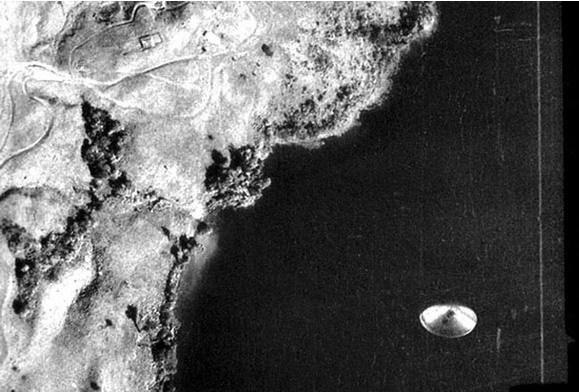
Pictured: the original 1971 aerial survey frame itself — the case's central and only piece of evidence, sourced from Costa Rica's Instituto Geográfico Nacional archive via Wikimedia Commons (attribution-license file, uploaded 2009, long in circulation at this same low native resolution). This is deliberately not the higher-resolution 2022 drum-scan version now circulating, since independent technical reviewers have raised unresolved questions about whether that later file is a faithful scan or shows signs of artificial upscaling — see Conventional Explanation Candidate #4 below.
Theoretical Alignment
Because the case rests entirely on a single still photograph with no witness testimony, it cannot be scored against most UAP theoretical frameworks the way a multi-witness encounter can — there is no reported flight profile, no reported physiological effect, and no reported radar return to compare against any hypothesis's predictions. To the extent it aligns with anything, the extraterrestrial hypothesis (ETH) is the framework most commonly invoked by proponents, on the strength of the object's apparent solidity, metallic sheen, and disc-with-dome morphology, which echoes hundreds of other daylight-disc reports cataloged elsewhere on this site. The psycho-social hypothesis (PSH) is a poor fit almost by definition — PSH explains anomalous perception, and this case has no human perception to explain, only a photochemical event on a strip of film. The interdimensional hypothesis (IDH) is invoked occasionally by researchers pointing to local Costa Rican folklore about objects "emerging from" or "entering" the lake — a detail the Journal of Scientific Exploration authors themselves noted without endorsing — but nothing in the photographic record itself supports or requires an interdimensional interpretation over a simple aerial one.
Background
Lago Cote (also written Lake Cote or Laguna de Cote) is a small, roughly heart-shaped volcanic maar lake in Costa Rica's Guatuso canton, Alajuela Province, tucked between the Arenal and Tenorio volcanoes in the country's remote northern lowlands. Long before it became a footnote in UFO history, the lake held (and still holds) deep cultural significance for the Maleku indigenous people, who consider it sacred and the subject of their own origin and spirit narratives — a detail modern retellings of the case sometimes borrow uncritically as "evidence" of a longstanding local UFO tradition, when the more precise claim is that Maleku oral tradition includes stories of spirits and beings associated with the lake, not necessarily aerial disc craft in the 20th-century ufological sense.
By the late 1960s, Costa Rica's state electricity utility, the Instituto Costarricense de Electricidad (ICE), had identified the Arenal-Cote river basin as a promising site for a major hydroelectric project — the scheme that would ultimately dam the Arenal River in the late 1970s and flood a much larger area to create the modern, greatly enlarged Lake Arenal reservoir, completed in 1979. Before any dam could be engineered, ICE needed accurate topographic and hydrological survey data for the whole basin, including Lago Cote itself, and contracted the work to the government's own mapping body, the Instituto Geográfico Nacional (IGN, the National Geographic Institute). IGN's standard method for this kind of large-area survey was aerial photogrammetry: flying a twin-engine aircraft in straight survey lines at a fixed altitude with a large-format, automatically-triggered mapping camera bolted to the floor of the plane, capturing an unbroken sequence of overlapping frames that could later be stitched into precise topographic maps.
On the morning of September 4, 1971, one such survey flight departed to photograph the Lago Cote area. The aircraft was a twin-engine Aero Commander 680 (sometimes rendered "F680" in Costa Rican press accounts), flown by pilot Omar Arias and crewed by aerial photographer and cartographer Sergio Loaiza, geographer Juan Bravo, and topographer Francisco Reyes. None of the four had any reason to expect anything unusual; this was, by every account, a routine survey flight of a kind IGN had flown many times before over many other parts of the country. It became notable only when the film came back from the darkroom.
Complete Timeline
| Date | Event |
|---|---|
| Sept. 4, 1971, 8:25 a.m. | IGN survey aircraft, flying at ~10,000 ft over Lago Cote, automatically exposes frame #300 of its mapping reel. Frames #299 and #301 show nothing unusual. |
| Sept. 1971 (following days) | Film developed at IGN's San José laboratory; staff notice the anomalous frame. Crew reportedly told not to discuss it publicly. |
| 1979 | Costa Rican ufologist Ricardo Vílchez obtains a copy of the negative and submits it to Ground Saucer Watch (GSW) in Arizona; GSW's computer-enhancement review reports no evidence of fabrication. Costa Rican press publicizes the photo. |
| 1985 | Computer scientist Jacques Vallée travels to Costa Rica, meets Vílchez, and obtains his own copy of the negative. |
| December 1987 | Vallée brings the negative to retired NASA Ames scientist Richard F. Haines in California for formal photogrammetric analysis. |
| 1989 | Haines & Vallée publish "Photo Analysis of an Aerial Disc Over Costa Rica," a 19-page report in the Journal of Scientific Exploration 3(2), concluding the object is real, opaque, and unexplained but that the case must remain "open." |
| 1990 | Haines & Vallée publish a follow-up, "Photo Analysis of an Aerial Disc Over Costa Rica: New Evidence," JSE 4(1), refuting a Lockheed analyst's "pressure mark on film" hypothesis after examining the original negative directly. |
| 1999 | The photograph is reproduced on the cover of France's COMETA report ("Les OVNI et la Défense"), a study by retired French military/aerospace officials that concluded the extraterrestrial hypothesis was the most likely explanation for the best-documented UAP cases. |
| April–May 2021 | Journalist Leslie Kean is profiled in Gideon Lewis-Kraus's New Yorker feature "How the Pentagon Started Taking U.F.O.s Seriously," revealing she keeps a framed copy of the Cote photograph, given to her with chain-of-custody documentation by Costa Rican government contacts. |
| September 2021 | 50th-anniversary retrospectives (IFLScience, Costa Rica Star News, and others) renew popular attention on the photograph. |
| November 4, 2021 | Ricardo Vílchez dies in Heredia, Costa Rica, at age 71. |
| 2022 | Costa Rican attorney and researcher Esteban Carranza — custodian of a contact copy of the negative inherited from his uncle — arranges a high-resolution drum scan by Michael Strickland Photography in Kansas, released via UK-based UAP Media. The scan reignites public debate; some independent technical reviewers separately question whether the widely-shared "high-resolution" version is a faithful scan or shows upscaling artifacts. |
| November 2024 | The Tico Times publishes a retrospective noting roadside "Cote Lake / Alien Zone" signage and the case's ongoing local tourism footprint. |
| 2026 (planned) | The Cote Photo, a documentary by Detroit-based filmmakers Adam Pillon and Megan Woomer featuring Sergio Loaiza speaking at length on camera for the first time, targets a summer 2026 release. |
The Flight and the Frame
The September 4, 1971 survey flight was, by design, unremarkable. IGN's mapping camera — the Zeiss RMK 15/23, a large-format precision instrument built for exactly this kind of photogrammetric work — was mounted through a floor hatch in the belly of the Aero Commander 680, lens pointed straight down, and set to fire automatically at a fixed interval as the aircraft flew a straight survey line over the lake at roughly 10,000 feet. Depending on the source, the interval is given as somewhere between 13 and 20 seconds; what matters more than the exact number is that the camera fired on a timer, entirely independent of anything happening outside the cockpit windows, capturing a continuous, overlapping photographic strip of the terrain below with no human decision involved in when any individual frame was taken.
Sergio Loaiza's job that day was to operate and monitor the camera, not to watch the sky. Neither he, pilot Omar Arias, geographer Juan Bravo, nor topographer Francisco Reyes reported seeing anything unusual during the flight. It was only when the exposed film was developed at IGN's laboratory in San José — standard procedure for every survey mission — that a technician reviewing the strip noticed one frame differed from its neighbors: frame #300 in the sequence showed what appeared to be a bright, metallic, disc-shaped object with a raised central dome, positioned over open water near the lake's shoreline. Frames #299 and #301, exposed only seconds before and after, showed the same stretch of shoreline and water with nothing unusual present. Analysts have consistently pointed to this detail — the object's presence in exactly one frame of an otherwise unbroken automatic sequence — as the case's most distinctive and most difficult-to-explain feature, cutting both ways: it argues against a lingering physical object drifting through multiple frames, but it is equally consistent with a very brief, close, camera-adjacent event (a thrown or falling object, a reflection, a film artifact) as with a genuine aerial craft that happened to be in frame for only one exposure.
Estimates of the object's real-world size vary enormously across sources, and this variance is itself informative. On the negative, the object measures only a few millimeters across; converting that to a real-world size requires knowing the negative's exact photographic scale and the object's true distance from the camera — and the second figure is precisely what cannot be recovered from a single 2-D frame with no independent depth cue, stereo pair, or known reference object of confirmed size next to it. Analysts who assume the object was resting on or very near the water's surface, at roughly the same distance from the camera as the shoreline in frame, arrive at estimates in the range of 80–90 meters (roughly 260–300 feet) in diameter, based on the negative's approximate 1:20,000 photographic scale. Popular articles have cited figures anywhere from 36 meters to over 200 meters, and at least one older secondary compilation cites a figure of 600 feet, a number not traceable to either of the two peer-reviewed Haines & Vallée papers and almost certainly an error or exaggeration introduced somewhere in the case's long chain of retelling. If, instead, the object was close to the aircraft itself — a few dozen feet below the lens rather than down at the water — it could be very much smaller, a distinction the photographic record alone cannot settle and that no analyst, proponent or skeptic, has ever been able to resolve with certainty.
Discovery, the "Gag Order," and Early Costa Rican Ufology
According to Loaiza's own later accounts, once IGN staff and ICE project scientists reviewing the survey material recognized what frame #300 appeared to show, he and his crewmates were instructed not to discuss the photograph publicly. This is a common feature of many "official camera" UFO cases — a low-key, informal instruction to stay quiet rather than any documented, written classification order — and it should be weighed as such: suggestive of institutional discomfort with an anomaly appearing in government work product, but not proof of an organized cover-up, and not something that has ever been corroborated by a surviving Costa Rican government document. The original negative itself was not destroyed or hidden; it was retained in IGN's own archive, which is precisely how it later became available for outside analysis.
The photograph might have remained an internal curiosity indefinitely had it not reached Costa Rica's small but active ufology community by the end of the decade. Ricardo Vílchez Navamuel and his brother Carlos, two of Costa Rica's most prominent UFO researchers from the 1970s through the 2000s (later, separately, chroniclers of Costa Rican contactee Enrique Castillo Rincón), obtained a copy of the negative and, in 1979, submitted it to Ground Saucer Watch (GSW), a U.S. amateur photo-analysis organization based in Arizona and led by aerospace quality-control engineer William Spaulding. GSW's early computer-enhancement techniques were, for their era, a genuinely novel attempt to bring quantitative image analysis to UFO photographs, and the group reported finding no evidence the Cote image had been fabricated. GSW's track record elsewhere in ufology history, however, is decidedly mixed: the same organization's computer enhancement of the 1965 Rex Heflin photographs from Santa Ana, California, famously reported a line suggestive of a supporting string above the object — a finding since attributed by other researchers to image degradation in the multiple-generation photo copies GSW was actually working from, rather than to a real string. GSW's 1979 "authentication" of the Cote photograph should therefore be read as an early, non-authoritative data point in the case's favor, not as a decisive scientific verdict — a distinction popular retellings of the case very rarely make.
Jacques Vallée, Richard Haines, and the Journal of Scientific Exploration
The case's most substantive technical analysis came a decade later, through an entirely separate chain of custody. In 1985, Jacques Vallée — already a prominent UAP researcher and computer scientist — traveled to Costa Rica, met Ricardo Vílchez, heard the story of the photograph, and obtained his own copy of the negative. Vallée circulated the image among contacts in the U.S. government and a California technology company over the following two years but found no one willing to formally assist with analysis. Finally, in December 1987, he brought the negative to Richard F. Haines in California. Haines, who held a Ph.D. in experimental psychology and had spent nearly two decades as a research scientist at NASA's Ames Research Center before retiring from the agency, was by then working independently, applying formal aviation- and vision-science methodology to UAP photographs and reports on his own time — work he would later formalize under NARCAP, the organization he founded in 1999–2000. His analysis of the Cote negative was, in other words, private research by a scientist with genuine NASA credentials on his résumé, conducted years after he had left the agency, not an investigation conducted by, on behalf of, or endorsed by NASA as an institution — a distinction this case file returns to directly in the Conventional Explanation Candidate section, because popular accounts routinely collapse it into a much stronger and inaccurate claim that "NASA verified" the photograph.
Haines and Vallée's 19-page report, "Photo Analysis of an Aerial Disc Over Costa Rica," appeared in the Journal of Scientific Exploration (JSE) in 1989 — the peer-reviewed journal of the Society for Scientific Exploration, a scholarly organization founded in 1982 to apply rigorous scientific method to anomalous and fringe-science claims. The paper reported that the negative showed "no indication that the image is the product of a double exposure or a deliberate fabrication," that the object appeared to be "an unidentified, opaque, aerial object" photographed at a maximum distance of 10,000 feet, with "no visible means of lift or propulsion and no surface markings other than darker regions that appear to be nonrandom." Critically, and contrary to how the paper is frequently paraphrased in popular UFO media, its own stated conclusion was that the case should remain open pending further information — not that a non-terrestrial origin had been established. A 1990 follow-up paper, "Photo Analysis of an Aerial Disc Over Costa Rica: New Evidence," addressed the "pressure mark on film" hypothesis raised by a senior Lockheed photo-interpretation analyst (discussed in detail under Physical & Material Assays above and in the Conventional Explanation Candidate section below) and, after direct examination of the original negative, reported no physical evidence supporting that specific hypothesis.
International Notoriety: COMETA, Kean, and "The Best UFO Photo Ever Taken"
The photograph's profile rose substantially in 1999, when it appeared on the cover of France's COMETA report ("Les OVNI et la Défense: à quoi doit-on se préparer?"), an independent study compiled by a group of retired French generals, aerospace engineers, and intelligence officials working through the Institute of Higher Studies for National Defence and published as a special issue of the magazine VSD in July 1999. COMETA's authors concluded that the extraterrestrial hypothesis was the most plausible explanation for a subset of well-documented UAP cases and recommended the French government take the subject more seriously — a report frequently cited by ETH proponents worldwide, and one that gave the Cote photograph a prominent new international audience as its literal cover image, credited in the report to the Bernard Thouanel collection.
The photograph resurfaced again in the American mainstream press in 2021, when journalist Leslie Kean was profiled in Gideon Lewis-Kraus's widely read New Yorker feature, "How the Pentagon Started Taking U.F.O.s Seriously." The article describes a framed black-and-white print on the wall behind Kean's desk — "an image that looks like the sonogram of a Frisbee" — which Kean says was given to her, along with chain-of-custody documentation, by contacts in the Costa Rican government, and which she has separately called, in her own words on The New Yorker Radio Hour, "probably the best photograph of a UFO ever taken," citing precisely the feature that makes the case distinctive: an unbroken, government-sourced chain of custody rather than a privately submitted amateur photograph. The 50th anniversary of the photograph in September 2021 produced a wave of retrospective coverage (IFLScience, Costa Rica Star News, and numerous other outlets), most of which repeated the "best UFO photo ever taken" framing without much independent scrutiny of what the underlying 1989/1990 JSE papers had actually concluded.
The 2022 High-Resolution Scan and a New Controversy
In 2022, Costa Rican attorney and UAP researcher Esteban Carranza — custodian of an 8x10 contact copy of the negative that his late uncle had obtained from IGN in the late 1970s or early 1980s — arranged for the image to be professionally drum-scanned by Michael Strickland Photography in Kansas, using a Tango drum scanner capable of far higher resolution than any prior reproduction. The resulting file, released through the UK-based research outlet UAP Media, was widely described in press coverage as revealing "more detail than ever" and reignited public and researcher interest, drawing on-record commentary from figures including former AATIP director Luis Elizondo and UAP author Graeme Rendall.
That renewed attention, however, produced its own skeptical counter-current. Independent technical reviewers on forums dedicated to photographic and video anomaly analysis have separately raised the concern that the widely circulated "high-resolution" version of the image displays characteristics — unusually smooth high-frequency detail and magnification behavior inconsistent with a true optical drum scan — more typical of AI-based image upscaling than of a faithful digitization of 51-year-old analog film grain. This is a serious, unresolved technical question rather than a settled one in either direction: it does not by itself discredit the original 1971 photograph, the 1989/1990 JSE analysis (both of which predate the 2022 scan entirely and relied on the original negative or earlier-generation copies), or Carranza's own account of the scan's provenance. It does mean that claims of "new detail" or "new evidence" specifically tied to the 2022 high-resolution file should be treated with real caution until the scan's own processing history is independently documented — which is precisely why this case file's own hero image above uses the older, lower-resolution, long-circulated 2009 Commons file rather than the disputed 2022 version.
The Unmanned Camera Question
What ultimately distinguishes Lake Cote from the great majority of cataloged UFO photographs is the near-total absence of the human perceptual chain that ordinarily has to be evaluated in any eyewitness case: no one decided to point a camera at something they thought they saw, no one's expectations, excitement, or misidentification of a mundane object could have shaped what ended up on film, and no one's memory of the event had to be reconstructed after the fact. In that specific and narrow sense, the photograph is genuinely unusual evidence — it removes an entire category of ordinary explanation (a well-meaning witness misidentifying Venus, a balloon, or an aircraft, and then genuinely believing they saw something else) that accounts for a very large share of UFO reports generally.
But the same feature cuts the other way just as forcefully. An eyewitness sighting, however imperfect, comes with a narrative that can be cross-examined: a described flight path, a duration, a direction of travel, an emotional and physiological reaction, and often multiple independent witnesses whose accounts can be checked against each other. Frame #300 offers none of that. There is no reported trajectory, no reported duration beyond "less than the interval between two exposures," no second sensor, and no second observer of any kind. The case cannot be corroborated the way a multi-witness sighting can be, and it cannot be cross-examined the way live testimony can. It is best understood not as stronger or weaker evidence than a typical eyewitness case, but as evidence of a fundamentally different and more limited kind — strong against certain explanations (witness misperception, motivated storytelling) and correspondingly weak against others (a single-frame camera or film artifact, a brief close-range mundane object that no one needed to consciously register at all).
Key Witnesses
Sergio Loaiza
Loaiza operated the survey camera aboard the September 4, 1971 flight but, by his own consistent account across five decades, saw nothing unusual during the mission itself — his role as "witness" is really that of the equipment operator and the person who first noticed the anomalous frame during film review. He has said the crew was informally told not to discuss the photograph after IGN staff identified it, and in 2026 he is set to speak on camera at length for the first time in the documentary The Cote Photo. His professional role as a career government mapping technician, with no apparent incentive to insert a hoax into a routine multi-hundred-frame survey reel, is central to the case's chain-of-custody argument.
Omar Arias, Juan Bravo & Francisco Reyes
The remaining three crew members aboard the Aero Commander 680 that morning. None reported observing the object during the flight; their significance to the case is entirely retrospective, as government professionals present for a mission whose only anomaly was discovered after the fact in the darkroom, not in the air. No published account attributes any first-hand observation, contemporaneous or otherwise, to any of the three.
Ricardo Vílchez
Vílchez was not present for the 1971 flight but became the case's essential connective figure: he obtained a copy of the negative later in the decade, submitted it to Ground Saucer Watch in 1979, and in 1985 personally relayed the story and a further copy of the negative to Jacques Vallée — the step that eventually led to the Haines & Vallée JSE papers. Without Vílchez's persistence, the photograph likely would have remained an obscure item in IGN's own files rather than becoming an internationally cited case.
The Five Observables Assessment
The Five Observables framework is applied to the performance characteristics reported in this case:
Assessment: The Five Observables framework was built around multi-witness or instrumented encounters describing an object's behavior over time — flight path, acceleration, apparent evasion. A single automatically-triggered still photograph cannot speak to any of that directly, and analysts on both sides of this case have generally avoided strong observable-behavior claims for exactly this reason. What can be said is limited to the object's static appearance: an apparently solid, opaque, metallic disc with a raised central dome, photographed with no visible support structure, wires, or means of propulsion in frame — consistent with, but nowhere near sufficient to confirm, genuinely anomalous flight technology.
Evidence Assessment
Supporting Anomalous Origin
- Government-sourced photograph with a documented, unbroken chain of custody from the Instituto Geográfico Nacional's own archive, rather than a privately submitted amateur photo.
- Captured by an unmanned, automatically-triggered survey camera, removing witness expectation, excitement, or misidentification as possible explanations for the object's presence.
- Formal photogrammetric and negative-level analysis by a credentialed research scientist (Richard F. Haines, formerly of NASA Ames) and a computer scientist (Jacques Vallée), published in a peer-reviewed journal, found no evidence of double exposure or deliberate fabrication.
- The specific "pressure mark on film" hoax hypothesis raised by a Lockheed photo analyst was directly tested against the original negative and not supported by what was found.
- The four-person survey crew had no apparent motive to insert a hoaxed frame into a routine, unrelated civil-engineering survey reel, and consistently reported seeing nothing themselves.
- The object's crisp, high-resolution rendering is consistent with the camera's genuinely high-quality survey-grade optics, ruling out simple low-resolution ambiguity as an explanation.
Supporting Conventional Explanation
- No human being — on the aircraft or on the ground — ever reported seeing the object; the entire case rests on a single photochemical exposure with zero corroborating testimony.
- The object's true distance from the camera, and therefore its true size, cannot be recovered from one 2-D frame with no depth cue, leaving "large aerial craft" and "small object very close to the lens" equally consistent with the image.
- The object appears in exactly one frame of an automatically-firing sequence, which is equally consistent with a very brief camera-adjacent artifact (a thrown object, a reflection, a chip in the optics catching the sun at one specific angle) as with a genuine craft.
- No shadow is visible on the water despite clear, sunny conditions — a detail skeptical technical reviewers argue is inconsistent with a solid object at the claimed altitude, though proponents counter it is consistent with the object resting at or very near the surface.
- Ground Saucer Watch, the first organization to "authenticate" the photograph in 1979, has an independently documented history of unreliable computer-enhancement conclusions on other UFO photographs (notably the 1965 Rex Heflin case).
- The widely circulated 2022 "high-resolution" version has itself drawn credible independent suspicion of AI-based upscaling rather than a faithful optical scan, muddying exactly the "new evidence" claims most responsible for the photograph's recent resurgence.
- Both peer-reviewed Haines & Vallée papers explicitly concluded the case should remain open rather than confirming a non-terrestrial origin — a far more cautious finding than the "NASA verified it's real" framing common in popular retellings.
Why "CREDIBLE"
Lake Cote earns a Credible rating rather than "Verified" because, for all its unusually solid provenance, it remains fundamentally a single ambiguous photograph, not a resolved case. The strongest facts in its favor are genuinely strong: an unbroken government chain of custody, a negative that has been directly examined (not merely copied and re-examined) by credentialed analysts who found no sign of deliberate fabrication, and a specific rival hoax hypothesis (the Lockheed analyst's "pressure mark" theory) that was tested and not supported. Those are real, checkable facts, not vague reassurance. At the same time, the case sits well short of "Verified" because a single 2-D still photograph, by its very nature, cannot establish the one thing that would matter most — the object's actual distance and therefore its actual size — and because it carries no corroborating witness, radar, or second-sensor data of any kind to cross-check against. It also does not sit at "Disputed," the rating this site reserves for cases with one specific, well-documented, high-confidence mundane explanation (a dated balloon launch, a known aircraft) that a case's remaining defenders simply haven't fully answered: no comparably strong single conventional candidate exists here, only several plausible but individually unproven possibilities (camera artifact, close-range mundane object, boat wake) discussed in the Conventional Explanation Candidate section below. "Credible" is the honest middle: real, verifiable evidentiary strengths, a real and still-unresolved ambiguity at its core, and a popular reputation ("the best UFO photo ever taken," "verified by NASA") that has drifted well beyond what the primary analysis actually shows.
Sensor & Instrumentation Detection Profile
The sole "sensor" in this case is the survey aircraft's own mapping camera — a Zeiss RMK 15/23 precision aerial cartographic camera, a roughly 100-pound (45 kg) instrument donated to Costa Rica's Instituto Geográfico Nacional (IGN) by the West German government, floor-mounted in the belly of the aircraft and pointed straight down. It fired automatically at regular intervals (sources describe intervals ranging from roughly 13 to 20 seconds) onto 9-by-9-inch black-and-white aerial film, unrelated to and unsynchronized with anything a human observer might have consciously seen. This is, in effect, an unmanned recording instrument rather than a witness-operated camera — closer in evidentiary character to an automated trail camera or an aircraft's own gun-camera footage than to a tourist's snapshot. No radar station, ground observer, or second camera is known to have recorded anything over Lago Cote that morning; the survey aircraft carried no radar of its own, and Costa Rica in 1971 had no civilian or military radar coverage over this remote, then-undeveloped stretch of northern Alajuela Province. The case therefore has exactly one channel of instrumented data, with zero cross-referencing sensors — a significant limitation that later analysts openly acknowledged.
Environmental & Geospatial Context
Lago Cote sits in the Cote District of Guatuso canton, Alajuela Province, in Costa Rica's sparsely populated northern lowlands, between the Arenal and Tenorio volcanoes. It is a maar-type crater lake roughly 2 square kilometers in surface area, with a heart-shaped outline and water depths averaging around 6 meters. In 1971 the surrounding terrain was remote rainforest and cattle ranching country, well outside any population center, which is precisely why the Instituto Geográfico Nacional was surveying it by air rather than on foot — the flight was mapping land and water resources for the Instituto Costarricense de Electricidad (ICE) ahead of a proposed hydroelectric scheme that would, within the decade, dam the nearby Arenal basin and permanently submerge much of the surrounding lowland under the greatly enlarged Lake Arenal reservoir (completed 1979). The survey aircraft was flying at approximately 10,000 feet on a clear, sunny September morning; September falls within Costa Rica's shorter mid-year dry spell in this region, consistent with the clear conditions described in every account of the flight. No unusual solar, geomagnetic, or seismic activity has been documented for the date, and none of the volcanic activity from nearby Arenal (which was in a dormant phase between major eruptive periods in 1971, prior to its major 1968 eruption's effects having long since subsided) has been proposed by any researcher as relevant to the photograph.
Observer Credibility & Occupational Profile
This case inverts the usual "observer credibility" question, because the four people aboard the aircraft were not, in the conventional sense, witnesses at all — none of them reported seeing the object during the flight, and its presence was discovered only later, when the negatives were developed at IGN's offices in San José. Their professional credentials matter instead for chain-of-custody and hoax-plausibility purposes: aerial photographer and cartographer Sergio Loaiza, geographer Juan Bravo, and topographer Francisco Reyes were career government mapping technicians operating specialized, maintenance-intensive survey equipment for a routine infrastructure-planning contract, flown by an experienced pilot, Omar Arias. None had any apparent motive to fabricate a UFO photograph buried in the middle of a multi-hundred-frame topographic survey reel, and Loaiza has consistently and publicly maintained — including, according to those involved in a forthcoming 2026 documentary, at length for the first time on camera — that neither he nor his colleagues saw anything unusual and that the object's presence startled them when the film came back from processing. The subsequent chain of analysts is more conventionally credentialed: Richard F. Haines held a Ph.D. in experimental psychology and spent nearly two decades as a research scientist at NASA's Ames Research Center before retiring and later founding NARCAP; Jacques Vallée is a computer scientist and astronomer with a long record of peer-reviewed and semi-technical UAP research. Neither, however, examined the object at the time it was recorded — both worked from the developed negative more than a decade after the fact, a meaningful limitation on what "observer credibility" can even mean in this case.
Physical & Material Assays
There is no physical trace evidence associated with this case in the usual sense — no recovered debris, no soil or vegetation anomaly, no radiation reading, because nothing was ever recovered from a landing or close-approach site. The only physical object connected to the case is the photographic negative itself, and it is the negative — not the object it depicts — that has actually undergone material testing. The most direct such test came in the 1990 Haines & Vallée follow-up paper, which addressed a specific hoax hypothesis raised by an unnamed senior photo analyst at Lockheed: that the disc-shaped mark was a physical "pressure mark" or emulsion defect on the film itself rather than an image of a real object. Examining the original negative directly (rather than a copy) under magnification, Haines reported the anomalous area was optically smooth and continuous with the surrounding image — in his words, "smooth as glass" — showing none of the raised or depressed emulsion texture a genuine pressure mark, chemical stain, or handling defect would produce. This is a genuine negative-level material finding, not merely a visual interpretation, and it is the single strongest piece of physical analysis in the case's favor. It does not, however, resolve the separate and more fundamental question of what real-world object, if any, was in front of the lens when frame #300 was exposed.
Historical Precedents & Archive Matches
The Lake Cote photograph belongs to a small, frequently cross-referenced category of "official government camera" UFO photographs, distinct from the far larger body of civilian eyewitness photographs cataloged elsewhere on this site. Its closest structural precedent is the McMinnville UFO Photographs (1950), in which Paul and Evelyn Trent's two farm photographs of a metallic disc remain, more than seventy years later, similarly disputed between genuine-anomaly and hoax interpretations despite repeated photo analysis on both sides — though the Trent case had human eyewitnesses and Cote did not. The 1990 Calvine UFO Incident in Scotland offers a partial parallel from the opposite direction: a diamond-shaped object photographed by named civilian witnesses whose original negatives were handed over to and subsequently lost by UK Ministry of Defence officials, illustrating how even a strong photographic chain of custody can break down once government hands enter the picture — a fate Lake Cote's negative avoided only because Costa Rican researchers obtained copies before any single custodian could suppress them completely. More broadly, the case is frequently invoked by proponents of the extraterrestrial hypothesis specifically because it was captured by government equipment operating on a routine, unrelated civil-engineering task, a pattern researchers argue is harder to dismiss as attention-seeking hoaxing than a privately submitted photograph — a claim examined critically in the Conventional Explanation Candidate section below.
Material Analysis
No physical object, debris, or trace evidence connected to this case has ever been recovered — there was no landing, no close approach with reported physiological or environmental effects, and nothing to test in the way soil, foliage, or metal fragments are tested in ground-trace cases elsewhere on this site. That absence is itself worth stating plainly rather than glossing over: unlike cases such as Trans-en-Provence or the Roswell debris field, Lake Cote offers no metallurgical or isotopic assay opportunity whatsoever, because the case consists of exactly one thing — a photographic negative. The only material analysis ever performed in this case was performed on the film, not on any object it depicts, and that distinction matters for calibrating what the case can and cannot prove.
The negative-level analysis that has occurred is nonetheless genuine and specific. Beyond the 1990 Haines & Vallée refutation of the "pressure mark" hypothesis (detailed above under Physical & Material Assays), the two JSE papers describe examining the negative's grain structure, checking for double-exposure artifacts (overlapping or ghosted imagery that would indicate two separate exposures on the same frame), and comparing the anomalous region's optical density and edge sharpness against the surrounding terrain imagery on the same frame. They reported the object's edges were in focus consistent with the rest of the frame (arguing against it being extremely close to the lens, where focus would typically differ from the ground far below) while also displaying what they described as an unusual "chopped off" appearance along one edge that neither paper fully resolved — a genuine open technical question that later skeptical reviewers, notably contributors to the Metabunk analysis forum, have picked up and argued is inconsistent with any simple disc silhouette viewed from any realistic angle.
Supporting Non-Terrestrial Origin
- Direct examination of the original negative found no double-exposure artifacts and no physical film defect consistent with the specific "pressure mark" hoax hypothesis raised by a Lockheed analyst.
- The object's focus and optical density are broadly consistent with the surrounding terrain frame, arguing against it being an extremely close, out-of-focus artifact on the lens itself.
Supporting Terrestrial Origin
- No physical evidence exists beyond the film itself — there is nothing to subject to metallurgical, isotopic, or chemical testing, which is a significant limitation relative to cases with recovered material.
- The object's unresolved "chopped off" edge geometry, noted but not explained in either JSE paper, remains a legitimate unaddressed technical anomaly that skeptical reviewers argue is more consistent with a partial reflection or artifact than a genuine disc silhouette.
The Conventional Explanation Candidate
Four distinct conventional explanations have been proposed for the Lake Cote photograph over the decades. None has been definitively proven, and none has been definitively ruled out by the available negative-level analysis — which is itself the central reason this case remains rated Credible rather than Disputed or Debunked.
Camera/Lens Optical Artifact
InconclusiveA chip, scratch, or internal reflection within the Zeiss RMK 15/23's optics, illuminated at one specific sun angle during exactly one exposure, could in principle produce a bright, disc-like artifact that would not repeat on adjacent frames taken seconds later at a slightly different aircraft attitude. This candidate is attractive precisely because it explains the single-frame appearance so cleanly. Against it: Haines and Vallée's negative-level examination found the anomalous region's focus and density consistent with a real object in the photographed scene rather than an artifact of the lens system itself, and no equivalent artifact has been documented on any other frame from the same camera before or after. Neither side has been able to fully settle this because no test of the actual camera unit used in 1971 (long since retired) has ever been performed.
Boat / Wake on the Water
UnprovenSome skeptics have proposed the bright shape is a boat, mid-turn or mid-wake, with sunlit spray or a reversing hull producing the disc-like silhouette and central "dome." This candidate is weakened by the object's clean, symmetrical, hard-edged disc outline — a wake or boat hull under motion blur from a 1/300-second-class survey-camera shutter would be expected to show streaking or an irregular, asymmetrical outline, not the crisp geometric edge visible in the photograph, and no boat, dock, or any other watercraft is visible anywhere else on the lake in the same or adjacent frames. No named analyst has published a rigorous version of this hypothesis with matching optical-geometry modeling; it survives mainly as an informally circulated alternative.
Thrown or Suspended Physical Object Near the Aircraft
UnprovenA mundane disc-shaped object — a hubcap, a pot lid, a piece of equipment — tossed from or suspended briefly near the aircraft itself (rather than photographed on the ground far below) would explain both the single-frame appearance and the object's apparent sharp focus, since it would have been close enough to the lens to be in focus without requiring an enormous real-world size. This candidate is speculative and has never been tied to a specific named object, method, or motive by any researcher, and depends on an on-board prankster or accident that none of the four crew members has ever described, despite Loaiza's cooperative, on-record participation in research and, most recently, a feature documentary. It cannot be ruled out from the photograph alone, but it also has no supporting evidence beyond being logically possible.
The 2022 High-Resolution Scan as an AI-Upscaled Artifact
InconclusiveThis candidate concerns not the 1971 event but the modern controversy layered on top of it: independent technical reviewers have raised specific, documented concerns that the widely-shared 2022 "high-resolution" drum-scan file shows image characteristics more typical of AI-based upscaling than of a genuine optical scan of 51-year-old analog film. If accurate, this would not debunk the original 1971 photograph or the 1989/1990 JSE analysis (both of which relied on the original negative or earlier-generation prints, not the 2022 file), but it would substantially undercut any specific "new detail confirms the object is real" claim tied to the 2022 scan, and it is a live, unresolved question this case file treats with explicit caution rather than repeating uncritically.
Taken together, no single conventional explanation candidate rises to the level of a documented, high-confidence mundane account the way, for example, a dated Skyhook balloon launch explains the Mantell case. Each candidate here is a live, unresolved possibility rather than a settled answer — which is exactly why the object's origin remains genuinely undetermined rather than either confirmed anomalous or conventionally explained.
Related Cases
Archive Search Access
No declassified U.S. government document specifically discussing the Lake Cote photograph is known to exist — unsurprising, since the negative itself has always remained a Costa Rican civil-institute (IGN/ICE) record rather than U.S. or allied military property, and no evidence has surfaced that any U.S. agency ever formally investigated it. The general UFO-related U.S. government archives below are provided as honest, directly relevant search access points rather than case-specific citations.
The CIA's own curated FOIA collection of its UFO-related cables, memos, and analyses from the Cold War era. Contains no direct reference to the Costa Rica photograph but is the relevant primary-source starting point for any U.S. intelligence-community UFO record search.
The federal government's central proactive-disclosure search tool, useful for confirming that no U.S. agency holds a record of this specifically Costa Rican civil-survey case before filing any new request.
Further Reading — Recommended Literature
Forbidden Science 3: On the Trail of Hidden Truths
Vallée's own diary-form journals covering 1980–1989, the exact period in which he traveled to Costa Rica, obtained the Cote negative, and brought it to Richard Haines — a first-person window into how the case's central analysis actually came together.
Confrontations: A Scientist's Search for Alien Contact
Vallée's field-investigation account of dozens of international UFO cases he personally examined during the 1980s, written from the same scientist's-eye vantage point that shaped his and Haines's approach to the Cote photograph.
Observing UFOs: An Investigative Handbook
Haines's own methodological handbook on evaluating UFO photographs and witness reports, laying out the same perceptual and photogrammetric standards he later applied — nearly a decade after writing this book — to the Cote negative itself.
UFOs: Generals, Pilots, and Government Officials Go on the Record
Kean's bestselling case for treating UFO reports as a serious journalistic and scientific subject — written by the same reporter who, in a 2021 New Yorker profile, revealed she keeps a framed copy of the Cote photograph as, in her words, one of the best UFO images ever made public.
The UFO Evidence
The foundational NICAP case-evaluation compendium by the same Richard Hall who later rated the Cote photograph "very high reliability" in the NICAP archive — useful context for how mid-century American ufology weighed photographic evidence against witness-based cases.
Essential Viewing
Is This the Best UFO Photo Ever Taken? A Filmmaker Investigates | Lake Cote Photo
UAP Files Podcast interview with documentary director Adam Pillon on the making of The Cote Photo, covering the case's chronology, the 2022 high-resolution scan, and what filming in Costa Rica revealed.
One Of The "BEST UFO PHOTOS EVER" EXPLAINED — Lake Cote Costa Rica UAP (1971)
A skeptically-oriented breakdown of the case's chronology and the conventional-explanation arguments against it, providing a counterweight to the proponent-leaning coverage above.
Sources
- Haines, Richard F. & Vallée, Jacques. "Photo Analysis of an Aerial Disc Over Costa Rica," Journal of Scientific Exploration, Vol. 3, No. 2, pp. 113–131 (1989). scientificexploration.org
- Haines, Richard F. & Vallée, Jacques. "Photo Analysis of an Aerial Disc Over Costa Rica: New Evidence," Journal of Scientific Exploration, Vol. 4, No. 1, pp. 71–74 (1990). scientificexploration.org
- Society for Scientific Exploration. "About the Society & the Journal of Scientific Exploration." scientificexploration.org
- Instituto Geográfico Nacional de Costa Rica (photographer). "UFO photographed over Lake Cote, Costa Rica, September 1971" (original negative reproduction, file description & licensing record). Wikimedia Commons, uploaded 2009. commons.wikimedia.org
- Wikipedia. "Lake Cote." en.wikipedia.org
- Wikipedia. "COMETA report." en.wikipedia.org
- Lewis-Kraus, Gideon. "How the Pentagon Started Taking U.F.O.s Seriously," The New Yorker, April 30, 2021. newyorker.com
- Zabel, Bryce. "The Best UFO Photo Ever Taken?" Point of Contact (Medium), 2021. medium.com
- Mateo, Don. "Costa Rica's Mysterious Lago Cote and Its UFO Sighting History," The Tico Times, November 12, 2024. ticotimes.net
- Zúñiga, Alejandro. "The mysterious Costa Rican UFO," CRC Daily, 2021. crcdaily.com
- IFLScience. "'Best UFO Photo Ever' Gets A High-Resolution Makeover." iflscience.com
- UAP Media (UK). "New High Resolution Scan of 'Extraordinary' UAP Image." uapmedia.uk
- The UAP Observer. "The Lake Cote Photo: The Story Behind the 'Best Official UFO Image' Ever Taken — and a New Documentary." theuapobserver.com
- Metabunk (technical analysis forum). "1971 Lake Cote / Lago de Cote UFO Aerial Photo" (discussion thread). metabunk.org
- Gross, Patrick. "UFOs at Close Sight: the Lago de Cote Photograph, 1971." ufologie.patrickgross.org
- NICAP (National Investigations Committee on Aerial Phenomena archive). "UFO Photo: Lago de Cote, Costa Rica — September 4, 1971," compiled by Fran Ridge, Joel Carpenter & Richard Hall. nicap.org
- CRHoy. "Hace 45 años, un OVNI impresionó a Costa Rica y al mundo." crhoy.com
- La Teja. "Falleció el ufólogo costarricense Ricardo Vílchez." lateja.cr
- Openminds.tv. "Costa Rica UFO Dossier — Pt 1." openminds.tv
- Druffel, Ann. "Reanalysis of the 1965 Heflin UFO Photos," Society for Scientific Exploration conference paper (background source on Ground Saucer Watch's computer-enhancement track record). tustinhistory.com
- Internet Archive. "Ground Saucer Watch News Bulletin," William H. Spaulding (background source on GSW's organizational history). archive.org
- CIA Freedom of Information Act Electronic Reading Room. "UFOs: Fact or Fiction?" collection. cia.gov
- FOIA.gov. Government-wide Freedom of Information Act search portal, U.S. Department of Justice. foia.gov
See something inaccurate? Have additional information or sources?
Suggest an Edit →Last Updated: August 2026