
Loch Raven Dam UFO Incident
Around 10:30 p.m. on October 26, 1958, two young Baltimore-area men driving near Loch Raven Dam in Towson, Maryland, watched a large, glowing, egg-shaped object hovering low over a bridge ahead of them — and then watched their own car die completely, headlights, ignition, and all, as they crept closer. What followed was a flash of white light, a boom like an explosion, a wave of heat on their faces, and an object that shot straight up and vanished in under ten seconds. Both men later found their skin reddened on the side that had faced the object. Baltimore County police responded, the U.S. Air Force opened a case file, and the National Investigations Committee on Aerial Phenomena (NICAP) drove out to run its own tests at the site. Sixty-eight years later, none of it has ever been explained: Project Blue Book closed the file as unidentified, and it remains exactly that.
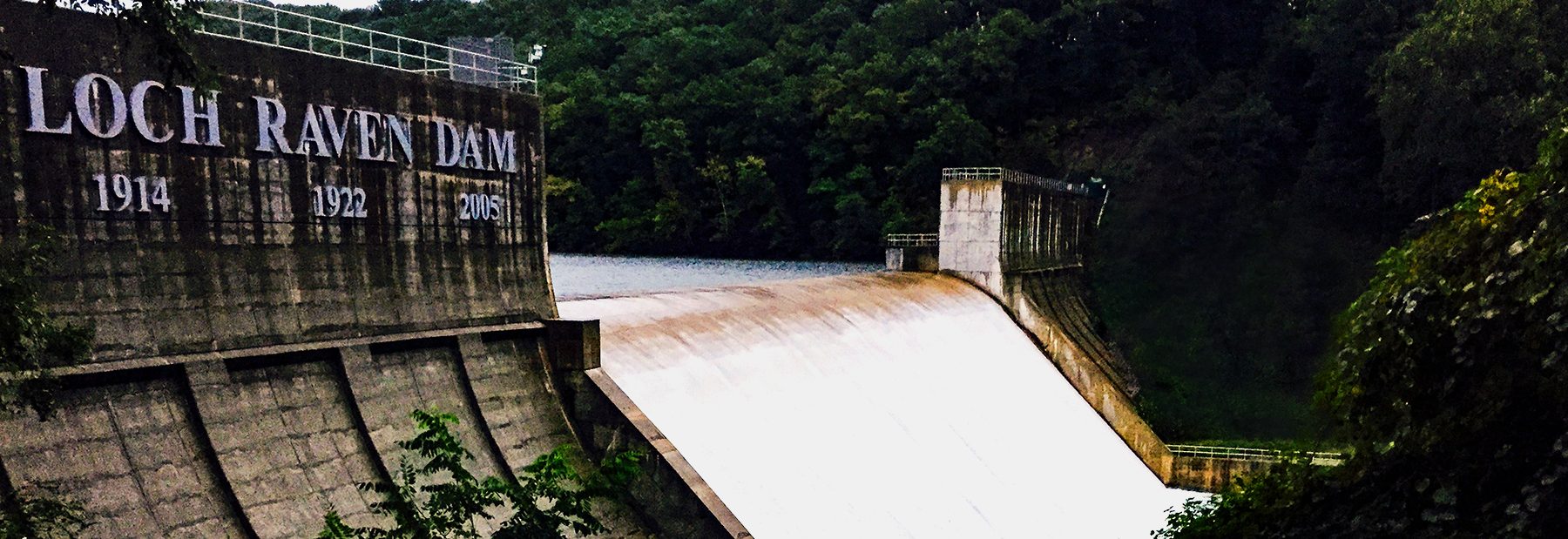
Pictured: Loch Raven Dam, the Baltimore municipal water-supply dam and reservoir near Towson, Maryland, U.S. Geological Survey public-domain photograph — not a photograph of the object or of the specific bridge where the 1958 encounter occurred. No photograph of the object itself is known to exist; neither witness carried a camera, and no press photographer reached the scene before the object departed.
Theoretical Alignment
The Loch Raven Dam case aligns most strongly with a genuinely structured, physical-craft reading (ETH-consistent): a compact, defined object producing a real, measurable effect on a piece of period machinery — a 1950s automobile's low-voltage ignition and charging system — is a signature that recurs across dozens of similarly documented "vehicle interference" cases from this era, most famously Levelland a year later. It retains meaningful alignment with a Psycho-Social reading as well, given the case's thin evidentiary base: only two named primary witnesses, no photograph, no radar return, and forensic tests that NICAP itself could only call inconclusive. The Interdimensional Hypothesis finds little foothold here; nothing in the record suggests any of the trans-dimensional, non-physical, or symbolic elements that define IDH-aligned cases elsewhere on this site.
Background
Loch Raven Dam is a Baltimore municipal water-supply dam and reservoir on the Big Gunpowder Falls river in Baltimore County, Maryland, built between 1912 and 1914 to serve the growing city a few miles to the south. By 1958 the reservoir was already a well-known local landmark, ringed by narrow two-lane roads and several ornamental steel-truss bridges — among them the 1923 Warren Road bridge near the dam itself, of the general type local press accounts of the incident describe simply as "the bridge." The area was, and remains, semi-rural: wooded reservoir shoreline a short drive from the denser Towson and Baltimore suburbs, a combination of isolation and proximity that shows up repeatedly in the site's decades-long, informally documented history of unusual sightings.
October 1958 sat within a genuinely tense stretch of the Cold War. The Soviet Union's Sputnik launches had come barely a year earlier, in October 1957, and the American public's anxiety about the sky — about what might be up there, whose it might be, and what the country's own air-defense network could actually detect — was at a level with few precedents in peacetime U.S. history. The U.S. Air Force's Project Blue Book, tasked since 1952 with cataloguing and investigating public UFO reports, was in one of its busier years; its civilian scientific consultant, astronomer J. Allen Hynek, was several years into what would become a decades-long personal transformation from skeptic to one of the field's most influential researchers.
NICAP itself, the leading private UFO-research organization of the period, had been founded on October 24, 1956 — almost exactly two years before the Loch Raven Dam sighting — by inventor Thomas Townsend Brown. Brown was removed as director within months amid disputes over the organization's finances, and by early 1957 retired Marine Corps Major Donald E. Keyhoe, already a nationally known UFO author, had taken over as director, with retired Rear Admiral Delmer S. Fahrney chairing the board. By late 1958, Keyhoe's NICAP was actively building the nationwide network of volunteer field investigators and case files that would culminate in its 1964 compendium, The UFO Evidence, a copy of which was sent to every member of Congress. Sending investigators to Loch Raven Dam to run tests, rather than simply filing the police and Air Force paperwork, was exactly the kind of hands-on field investigation Keyhoe's reorganized NICAP had made its signature practice.
The Ground Observer Corps that Cohen and Small tried, unsuccessfully, to reach that same night was itself a Cold War institution nearing the end of its life. Revived in 1950 as a civilian volunteer sky-watching network filling the gaps between the nation's radar coverage, and expanded in 1952 into the 750,000-volunteer Operation Skywatch, the GOC's mission was increasingly superseded through the mid-1950s by the improving coverage and detection reliability of ground radar networks, culminating in the Air Force's new Semi-Automatic Ground Environment (SAGE) computerized radar system. By October 1958 the Corps had already been taken off 24-hour continuous alert, and it would be formally disbanded entirely on January 31, 1959 — barely three months after the Loch Raven Dam sighting. The two witnesses' attempt to reach the GOC that night therefore encountered not a fully staffed early-warning network, but an organization already well into its own wind-down, which may help explain why the contact produced no useful corroborating data.
Just as significant to this specific case, though largely invisible to the two witnesses at the time, was what was happening a few miles to the north. The Phoenix Military Reservation Nike missile battery (designated BA-03), roughly three miles from Loch Raven Dam near Jacksonville, Maryland, was part of the Washington-Baltimore Defense Area's ring of anti-aircraft missile sites, operational since 1954 with the original Nike-Ajax interceptor. In 1958 — the same year as the sighting — the site was in the process of being modified to accept the newer, nuclear-capable Nike-Hercules missile, part of an Army-wide upgrade program then underway at a number of Baltimore-area batteries. Neither Cohen nor Small, nor the Air Force investigator who interviewed them, appears to have connected the sighting to this nearby, actively-changing air-defense installation at the time; this case file raises the connection explicitly in its Conventional Explanation Candidate analysis below, as a genuine open question rather than a settled answer.
Complete Timeline
| Date / Time | Event |
|---|---|
| Oct. 4, 1957 | The Soviet Union launches Sputnik 1, setting off a year of heightened American public anxiety about the sky that forms the immediate backdrop to the following year's sighting. |
| 1954–1958 | The Phoenix Military Reservation Nike missile site, roughly three miles from Loch Raven Dam, operates with Nike-Ajax interceptors and begins conversion toward the nuclear-capable Nike-Hercules missile. |
| Oct. 26, 1958, ~10:30 p.m. | Alvin Cohen, 24, and Phillip Small, 27, driving near Loch Raven Dam, see a large egg-shaped object hovering roughly 100–150 feet above a bridge ahead of them. |
| Oct. 26, 1958, ~10:30 p.m. | As their car closes to within roughly 75–80 feet of the bridge (200–300 feet from the object), the engine, headlights, and ignition all fail simultaneously. |
| Oct. 26, 1958, ~10:30–10:31 p.m. | Cohen and Small get out and hide behind their disabled car for roughly 30–45 seconds, watching the object hover. |
| Oct. 26, 1958, ~10:31 p.m. | The object emits a brilliant white flash accompanied by a loud, boom-like sound and a wave of heat, then ascends vertically and disappears from view within 5–10 seconds. |
| Oct. 26, 1958, shortly after | The car's electrical system restores itself unassisted; Cohen and Small drive to report the sighting. A 16-year-old boy and two employees of a nearby lakefront restaurant independently report a similar glowing object and boom at roughly the same time. |
| Oct. 26–27, 1958 | Baltimore County (Towson) police dispatch patrolmen to the scene and file a report; Cohen and Small are examined at St. Joseph's Hospital in Baltimore for reddened skin on the side of their bodies that faced the object. |
| Late Oct. 1958 | The Ground Observer Corps is contacted but provides no useful corroborating data; the case is forwarded to the U.S. Air Force. |
| 1958 | 2nd Lt. Bert R. Staples investigates for the Air Force, interviews the witnesses, and concludes their account is credible even as the object itself remains unidentified. NICAP separately visits the site to conduct its own forensic tests, which prove inconclusive. |
| 1958 (Blue Book file) | Project Blue Book catalogs the case as BBU 6148, later cross-referenced by researchers under Hynek's case-classification scheme as a Close Encounter II ("CE2," physical-effects) report. |
| 2018 | The Baltimore Sun revisits the case on its 60th anniversary, republishing Cohen's and Small's accounts and their most-quoted lines to the press. |
The Drive to Loch Raven Dam
On the night of October 26, 1958, Alvin Cohen, 24, and his friend Phillip Small, 27, were out driving near Loch Raven Dam, a stretch of reservoir shoreline and narrow two-lane roads a short distance north of Towson in Baltimore County. It was an unremarkable evening drive of the kind two young men in the late 1950s might take on any given night — nothing about the outing itself was unusual until, as they approached one of the reservoir's steel bridges, they saw something hovering over it that neither of them could immediately explain.
Descriptions of the object are consistent across the primary retellings: a large, flattened, egg-shaped or oval object, glowing a dim white, hovering roughly 100 to 150 feet above the bridge deck at an altitude estimated at somewhere between 100 and 150 feet, and reported in various accounts as being on the order of 100 feet in length. There was no sound at first, and nothing about its stillness suggested an aircraft in the conventional sense — it simply hung in place over the water crossing, glowing, as the two men's car closed the distance.
The Car Dies
As Cohen drove to within roughly 75 to 80 feet of the bridge — putting the object itself at an estimated 200 to 300 feet away — the car's entire electrical system failed at once. The headlights went dark, the dashboard lights died, the engine cut out, and the ignition gave no response at all, as though, in Cohen's own later description, the vehicle's electrical system "had given out" completely and simultaneously rather than stalling or misfiring in the way an ordinary mechanical failure would. This is the case's single most evidentially significant detail: a instantaneous, total, and later self-reversing failure of a vehicle's electrical system, tied by timing and proximity directly to the approach of an unexplained object, is a specific and repeatable signature — not a vague impression — and one that recurs, sometimes in near-identical form, across a body of independently reported "vehicle interference" cases from the same general period, most famously the 1957 Levelland case in Texas a year later, and continuing into cases like the 1980 Cash-Landrum Incident.
With the car dead in the road, Cohen and Small got out and took cover behind it, watching the object continue to hover for what both men estimated afterward as roughly 30 to 45 seconds. Neither man reported any sound from the object itself during this phase — only its steady, silent, glowing presence over the bridge, and the stalled hulk of their own car between them and it.
The Flash, the Heat, and the Ascent
The stillness ended abruptly. The object emitted a brilliant flash of white light, accompanied by a loud noise both men and later corroborating witnesses described as resembling an explosion or a peal of thunder, and by a distinct wave of heat that both Cohen and Small felt directly on their faces. Within five to ten seconds of the flash, the object shot straight upward and vanished from view entirely. As it departed, the car's electrical system restored itself on its own, without either man touching the ignition or any part of the vehicle — a detail that, taken together with the sudden failure on approach, frames the entire electromagnetic episode as bounded precisely by the object's proximity, beginning and ending with it rather than persisting as a separate mechanical fault.
Cohen's own words, quoted afterward and repeated in nearly every retelling of the case since, capture the immediate, visceral character of those final seconds better than any later summary: "There was no place to run." Small, for his part, gave what has become the case's other most-quoted line, a simple and unusually candid statement of regret rather than excitement: "I am sorry I saw it; I wish I hadn't seen it." Neither statement reads as embellished or performative; both have the flat, almost embarrassed tone of two ordinary young men who had just been through something they could not process into any familiar category.
Physiological Effects and the Hospital Visit
In the aftermath, both Cohen and Small noticed that the skin on the side of their bodies that had faced the object was visibly reddened, as though sunburned or exposed to a source of radiant heat — consistent with the wave of heat both men reported feeling at the moment of the flash. Concerned enough by this to seek medical attention, they were examined at St. Joseph's Hospital in Baltimore. No source consulted for this case file could locate a surviving, detailed medical report specifying a formal diagnosis (radiation burn, ordinary erythema, or otherwise), and this case file makes no claim beyond what is actually documented: two witnesses experienced skin reddening consistent with radiant heat exposure, on the side of their bodies facing the reported object, and sought hospital evaluation for it. This is a real and reasonably well-corroborated detail of the case, not a later embellishment — it appears in the earliest press coverage as well as later retrospectives — but it falls well short of confirmed radiation injury, and this file treats it as exactly that: a genuine, unresolved physiological correlate of the sighting, not proof of any specific causal mechanism.
It is worth noting how specifically 1958 shaped the two men's own choice of words in seeking medical help. By the late 1950s, above-ground nuclear weapons testing by both the United States and the Soviet Union had made "radiation burn" a phrase with real cultural currency in a way it had not carried a decade earlier — the public had absorbed, through years of civil-defense literature, newsreels, and press coverage of test-site fallout, a working folk understanding that a sudden flash of intense light and heat could plausibly be radiological in nature. Whether or not that is what actually happened to Cohen and Small, it is a reasonable and unremarkable explanation for why two ordinary young men, feeling their skin reddening after a bright flash and a wave of heat, went straight to a hospital rather than simply assuming sunburn or windburn from an October night drive. Their decision reflects the specific anxieties of their era at least as much as it reflects anything about the object itself.
Corroborating Witnesses
Cohen and Small were not the only people in the area that night to report something unusual. According to contemporary accounts, a 16-year-old boy and two employees of a lakefront restaurant near the reservoir independently reported seeing a similar glowing object and hearing the same loud, boom-like sound at roughly the same time. None of these secondary witnesses is named in any source consulted for this case file, and their accounts exist only as brief mentions in retrospective coverage rather than as separately documented, standalone statements — a real limitation on how much corroborating weight they can bear. Even so, three independent reports of a glowing object and a loud noise, converging on the same rough time and place as Cohen and Small's considerably more detailed account, is a genuine piece of corroboration that this case file treats as meaningful, while being explicit that "independently reported" here means "mentioned independently in the secondary record," not "formally interviewed and cross-checked by investigators" in the way Cohen and Small themselves were.
The restaurant employees' account is particularly useful precisely because it is the least dramatic of the three: a loud boom and a glow in the sky over the reservoir is exactly the kind of ordinary, low-key observation an employee closing up for the night might mention to a coworker without any of the elaboration or narrative shaping that can creep into an account given directly to a reporter or an investigator days or weeks later. That plainness is itself a small point in the corroborating witnesses' favor, even though it also means their testimony was never developed into anything more detailed than a passing mention.
Police Response and the Air Force Investigation
Baltimore County police out of the Towson precinct dispatched patrolmen to the scene and filed an official report on the incident, which was subsequently forwarded to the U.S. Air Force for investigation — the standard referral pathway for UFO reports involving possible national-security implications during the Project Blue Book era. Cohen and Small also attempted to reach the Ground Observer Corps, the civilian volunteer air-watch network that had been stood up as part of the nation's early-warning air-defense system, though this contact appears to have produced no useful corroborating data of its own.
The Air Force's field investigation was conducted by 2nd Lt. Bert R. Staples, who interviewed both witnesses directly. Staples's own assessment, as later summarized in retrospective coverage of the case, was notably measured: rather than dismissing the account outright, he concluded that given the apparent credibility of the witnesses, "it can be assumed that the sighting did actually occur" — a real event happened, in other words, even if what that event actually was could not be determined. This is a meaningfully different posture than a flat denial, and it is one reason this case file rates the sighting itself as genuinely credible testimony, whatever conclusion one ultimately draws about the object's origin. The initial informal explanation floated to the witnesses at the time — that they had seen a Navy blimp — was rejected by both men and is addressed directly in the Conventional Explanation Candidate analysis below.
NICAP's On-Site Investigation
The National Investigations Committee on Aerial Phenomena, the leading private UFO-research body of the period, separately sent investigators to the Loch Raven Dam site to conduct their own forensic tests — the specific nature of which is not detailed in the sources available to this case file, though the general practice for NICAP field investigations of this era typically involved terrain and site inspection, interviews with witnesses and any local officials, and, where equipment was available, basic radiological or electromagnetic-anomaly checks at the reported location. Whatever tests NICAP actually ran, the organization's own conclusion was that the results were inconclusive — neither confirming nor ruling out any specific physical cause for the vehicle interference or the reported heat and light effects. NICAP's interest in the case, and the fact that it merited a dedicated field visit rather than a desk review of the police and Air Force paperwork alone, is itself a signal of how seriously the organization treated the report at the time.
The case was subsequently cataloged within Project Blue Book's own filing system under the case number BBU 6148. Later researchers cross-referencing the Blue Book archive — a body of work most associated with catalogers like Brad Sparks, Fran Ridge, and Dan Wilson working from NICAP's and CUFOS's own case files — have applied Dr. J. Allen Hynek's later Close Encounter classification scheme to the case retroactively, designating it a Close Encounter II ("CE2") report on the basis of its physical, measurable effects (the vehicle interference and the reported heat) rather than a mere visual sighting. Under one published informal rating scheme for cataloging the strength of electromagnetic-effect Blue Book cases, Loch Raven Dam has been assigned a "Preliminary Rating 5" within Category 3 (E-M, or electromagnetic, cases) — a working researcher's classification rather than an official Air Force finding, but one that reflects how the case has generally been regarded within the specialist community that has kept track of it since.
Key Witnesses
Alvin Cohen
The driver of the car whose entire electrical system failed as the object hovered ahead. Cohen's account — corroborated in every material detail by his passenger, Phillip Small — forms the evidentiary core of the case. His remark to investigators afterward, "there was no place to run," has become the encounter's most quoted line, and captures the specific, cornered helplessness of watching one's own vehicle die in the presence of an unexplained object rather than a more generic expression of fear.
Phillip Small
Cohen's passenger and the second primary witness, whose account of the object, the car's failure, the flash, the heat, and the skin reddening matches Cohen's closely enough that no investigator who has examined the case has proposed the two men were describing different events. Small's own quoted statement — "I am sorry I saw it; I wish I hadn't seen it" — is notable for its almost apologetic candor, a tone that has struck later researchers as difficult to reconcile with a fabricated or attention-seeking account.
2nd Lt. Bert R. Staples
Not a witness to the object itself, but the Air Force officer whose direct interviews with Cohen and Small produced the case's official investigative record. Staples's assessment — that the sighting itself could reasonably be assumed to have occurred, even as the object remained unidentified — is one of the more evidentially significant statements in the entire file, coming as it does from the one party in the case whose institutional incentive, if anything, ran toward minimizing rather than crediting the report.
The Five Observables Assessment
The Five Observables framework is applied to the performance characteristics reported in this case:
Assessment: The object hovered motionlessly for the better part of a minute with no visible means of support, which is consistent with, though not proof of, anti-gravity-type lift — rated speculative here because no instrumented data of any kind exists to distinguish genuine field-based lift from a simple stationary light source. Its departure, by contrast, is well-corroborated as a real instant-acceleration event: both witnesses agree the object went from a complete stop to vanishing from sight within five to ten seconds, a profile distinct from a conventional aircraft's gradual climb-out. No instrumented speed, altitude, or return data exists to support a hypersonic-velocity rating, the object was, if anything, unusually observable (bright, glowing, and watched at close range for nearly a minute) rather than demonstrating any low-observability characteristic, and nothing in either witness's account describes any interaction with water despite the reservoir setting.
Evidence Assessment
Supporting Anomalous Origin
- Two independent, closely matching primary witness accounts, corroborated in broad strokes by three additional, though unnamed, secondary witnesses reporting a similar object and sound at the same time and place
- A specific, repeatable, and instantaneously reversing vehicle electrical failure tied directly to the object's proximity — a signature that recurs across a documented body of independent "vehicle interference" cases from this general period
- Physiological effects (skin reddening consistent with radiant heat) severe enough that both witnesses sought hospital evaluation, rather than a claim added only in later retelling
- The Air Force's own field investigator concluded the witnesses' account of the sighting itself was credible, rather than dismissing it as fabrication or misidentification
- NICAP considered the case significant enough to warrant a dedicated on-site field investigation with forensic testing, rather than a desk review alone
- The case remains formally classified "unidentified" by Project Blue Book to this day — the Air Force never proposed or settled on any specific conventional explanation
Supporting Conventional Explanation
- Only two named primary witnesses, neither with any specialized training as an observer (pilot, police officer, engineer), and no surviving photograph, film, or instrumented reading of any kind
- NICAP's own on-site forensic tests, whatever their specific nature, produced no confirmatory finding — "inconclusive" describes an absence of supporting physical evidence as much as an absence of ruling-out evidence
- The three corroborating secondary witnesses are unnamed and their accounts survive only as brief secondhand mentions in retrospective press coverage, not as separately documented statements
- No surviving medical record specifying a formal diagnosis for the reported skin reddening could be located; "consistent with radiant heat" is a reasonable but unconfirmed characterization
- The sighting occurred at night, near water, in a wooded setting with limited ambient light — conditions that can distort distance and size estimates for genuinely mundane light sources
- The site itself has a long informal history of repeated, loosely-documented "glowing object" reports across subsequent decades (1953, 1978, 1983, 1996, 2000), a pattern more consistent with a recurring local misperception source than with one-off genuine craft visits
Why "Disputed"
This case receives a DISPUTED classification, with a moderate-low confidence score, because its central physical claim — a real, bounded, instantaneously reversing vehicle electrical failure, corroborated by two closely matching witnesses and given credibility by the Air Force's own investigator — is genuinely difficult to explain away, while at the same time the case's overall evidentiary base is thin by the standards of this site's stronger files. There is no photograph, no radar return, no formally documented medical diagnosis, and only two fully named, non-specialist witnesses; the corroborating secondary reports exist only as secondhand mentions rather than independently verified statements. NICAP's own on-site testing could not confirm any physical cause, which cuts in both directions: it neither proves nor disproves an anomalous origin.
Compare this directly to Levelland, a year later and a few hundred miles away, where a nearly identical vehicle-interference signature was reported independently by roughly fifteen motorists over four hours — a scale of corroboration this case simply does not have. Loch Raven Dam's genuine strength is the specificity and internal consistency of its central mechanical claim, set against real, honestly-acknowledged weaknesses in witness volume, physical evidence, and forensic confirmation. That combination — a compelling core claim, a thin surrounding evidentiary record, and a real but unproven candidate conventional explanation in the nearby, actively-upgrading Nike missile site — is exactly the profile of a Disputed case rather than a Credible or an Open one.
It is also worth being explicit about what a Disputed rating is not saying. It is not a judgment that Cohen and Small were lying, mistaken about a mundane light, or exaggerating an ordinary event into something stranger — the Air Force's own investigator, working from a position of no incentive to inflate the case's significance, reached the opposite conclusion about their basic honesty. It is, instead, an honest acknowledgment that a single, internally consistent, and technically plausible account, however well the two witnesses told it and however credible the investigator found them personally, is not by itself sufficient physical evidence to elevate a sixty-eight-year-old case to a higher confidence tier without something more — a surviving photograph, a confirmed radiological finding, a matched independent instrument reading — that this case, unlike some others on this site, simply does not have.
Sensor & Instrumentation Detection Profile
No radar, photographic, film, or infrared record of the object exists. The only instrumented data connected to the case is the pair of NICAP's own on-site forensic tests conducted sometime after the sighting, whose specific instrumentation and methodology are not detailed in any source consulted for this case file, and which the organization itself characterized only as inconclusive. The Ground Observer Corps, the era's civilian air-watch network, was contacted directly by the witnesses but produced no additional sensor or observer data of its own.
Environmental & Geospatial Context
Loch Raven Dam sits in a semi-rural stretch of Baltimore County roughly ten miles north of downtown Baltimore, on the Big Gunpowder Falls, surrounded by wooded reservoir shoreline and a scattering of two-lane roads and steel bridges. Conditions on the night of October 26, 1958, were clear with no storm activity reported, consistent with most sources describing an unobstructed, close-range view of the object. The site sits within a genuinely dense mid-Atlantic Cold War air-defense corridor: roughly three miles from the Phoenix Military Reservation Nike missile battery, and within the broader Baltimore-Washington Defense Area's ring of air-defense installations that also included Fort Meade and several other Nike sites discussed elsewhere on this site in connection with the Washington D.C. UFO Flap of six years earlier.
Observer Credibility & Occupational Profile
Neither primary witness held any specialized professional training relevant to aerial observation — no aviation, military, or law-enforcement background is documented for either Cohen or Small in any source consulted here, and both are described in period coverage simply as young Baltimore-area men out for an evening drive. This is a genuine limitation relative to this site's most heavily credentialed cases, but it cuts less sharply than it might for a purely visual sighting: the case's central claim (the vehicle electrical failure) does not depend on trained aerial-observation skill to report accurately, since "the car completely stopped working and then started again on its own" is a claim well within any ordinary adult's competence to observe and describe reliably. The Air Force's own investigator, 2nd Lt. Bert Staples, found the witnesses credible on exactly this basis.
Physical & Material Assays
No physical trace evidence — ground markings, metallic fragments, soil anomalies, or similar — is documented at the site, and no soil, water, or vegetation sampling from the bridge or its immediate surroundings is described in any source consulted here. The closest the case comes to a physical assay is NICAP's own inconclusive on-site forensic testing and the reported, though not formally diagnosed, skin reddening on both witnesses, discussed in full in the Material Analysis section below.
Historical Precedents & Archive Matches
Loch Raven Dam and its reservoir carry an unusually long informal history of loosely documented "glowing object" reports spanning more than four decades beyond the well-documented 1958 case, though none of these later reports comes close to matching 1958's combination of named witnesses, physical vehicle effects, and formal Air Force and NICAP investigation. In May 1953, five years before the Cohen-Small sighting, two other young men driving near the same bridge reported an orange glowing object described as two saucers facing each other, again accompanied by radio and headlight failure and a "mum-mum-mum" sound lasting roughly ten minutes. In 1978 and again in 1983, separate witnesses — a local fisherman and, later, employees of the Baltimore City Water Department — independently reported a bright light rising from the reservoir's water to a few hundred feet before falling back. In April 1996, a witness identified in secondary sources as Sharif Jameel and two companions reported a glowing oval object accompanied by a humming noise for roughly 40 seconds, and in January 2000 an administrative worker at a nearby medical center reported a disk-shaped object described as "green fire," followed by weeks of eye trouble she attributed to the encounter. NICAP researcher Fran Ridge is on record noting the frustrating lack of good primary source documentation for this broader precedent history despite what he regarded as the underlying case quality — an assessment this case file shares: the pattern is suggestive of something genuinely recurring at this specific location, but almost none of it beyond 1958 is documented to a standard this site could treat as more than informally corroborating context. What stands out across all six reports, spanning 1953 to 2000, is a common structural signature rather than a common object description: nearly every account centers on a bright, glowing light or object seen at close range near the reservoir's water or one of its bridges, several report an unusual sound accompanying it, and at least two (1953 and 1958) report simultaneous vehicle electrical failure. Whether that consistency reflects a genuinely recurring physical phenomenon tied to the specific geography and geology of the reservoir, a purely social phenomenon in which the 1958 case's own local fame primed later observers to interpret ordinary lights through the same interpretive frame, or simply an unremarkable coincidence of six unrelated reports at a large, popular, and frequently visited body of water over nearly five decades, is a genuinely open question this case file does not attempt to resolve.
Beyond Loch Raven Dam's own repeat-sighting history, the 1958 case sits within a well-established national pattern of vehicle-interference reports from the same general Cold War decade — most directly comparable to the November 1957 Levelland case in Texas, where a nearly identical instantaneous engine-and-headlight failure was independently reported by roughly fifteen motorists over four hours, and later cataloged by CUFOS director Mark Rodeghier in his 1981 survey UFO Reports Involving Vehicle Interference, a 441-case worldwide catalog that used Levelland as a cornerstone example. Researcher James McCampbell has separately documented how the point-contact distributors and low-voltage ignition and charging systems standard in 1950s-era automobiles were genuinely susceptible to external electromagnetic field disruption of exactly the kind both Loch Raven Dam and Levelland describe — a real, physically grounded mechanism that neither confirms nor rules out an anomalous source, but does establish that the reported effect itself is technically plausible for period vehicles rather than being an implausible fabrication.
Material Analysis
Loch Raven Dam's physical evidence is limited to two categories, neither of which produced a confirmatory finding: NICAP's own on-site forensic tests, and the physiological skin effect reported by both primary witnesses.
NICAP's Inconclusive Testing
NICAP investigators traveled to the site to conduct forensic tests following the sighting. No source consulted for this case file specifies the exact instrumentation or methodology used — period NICAP field investigations of this kind typically involved a combination of terrain inspection, witness and local-official interviews, and, where portable equipment was available, basic radiation or electromagnetic-anomaly checks at the reported location. Whatever the specific tests were, NICAP's own conclusion was that the results were inconclusive: no confirmed physical trace, contamination, or anomalous reading was reported, but neither was any mundane physical cause identified at the site itself.
The Skin Reddening
Both Cohen and Small reported that the skin on the side of their bodies facing the object was visibly reddened following the encounter, consistent with the wave of heat both men described feeling at the moment of the object's departing flash. They were examined at St. Joseph's Hospital in Baltimore, though no surviving source consulted for this case file specifies a formal diagnosis distinguishing simple heat-induced erythema from any more specific radiological finding. This case file is explicit about that gap: the skin reddening is real, contemporaneously documented, and corroborated by both witnesses independently experiencing the same effect on the same side of their bodies — but it has never been confirmed as a radiation injury specifically, and should not be characterized as one without better surviving medical documentation than currently exists in the public record.
Supporting Non-Terrestrial or Unexplained Origin
- The skin reddening was reported by both witnesses independently, on the same side of the body, matching the side that faced the object — an internally consistent detail rather than a vague, generalized complaint
- The reddening was severe enough that both men sought same-period hospital evaluation, rather than being a detail introduced only in later retelling
- NICAP's decision to conduct on-site forensic testing at all reflects that the organization regarded the case as physically substantive enough to warrant real investigation, not merely testimony collection
Supporting Terrestrial or Mundane Origin
- No surviving medical record specifying a formal radiological diagnosis has been located; "consistent with radiant heat exposure" (i.e., an ordinary heat-induced skin reaction) remains an equally plausible characterization
- NICAP's own tests, whatever they were, produced no confirmed physical trace or contamination finding at the site
- No ground markings, metallic debris, or other classic physical-trace evidence was ever reported at the bridge or its surroundings
The Conventional Explanation Candidate
Three broad conventional explanations have been raised, formally or informally, against the Loch Raven Dam sighting since 1958. None has been established with anything close to confidence, but each deserves a fair, specific hearing rather than a reflexive dismissal or a reflexive acceptance.
The "Navy Blimp" Explanation
According to at least one retrospective account of the case, an informal explanation offered to Cohen and Small at the time was that they had seen a Navy blimp. Both witnesses rejected this explanation, and this case file finds their rejection well-founded on the facts as reported: no Navy blimp operation over inland Baltimore County at 10:30 p.m. on an October weeknight in 1958 has been documented in any source consulted here, and a blimp's flight profile — a large, slow, non-vertically-departing aircraft with a visible envelope silhouette — does not match the witnesses' description of a compact, egg-shaped object that vanished upward in five to ten seconds. Most importantly, a blimp provides no mechanism whatsoever for a car's ignition and headlights to fail completely and then spontaneously restore themselves; airships of this era carried no equipment capable of producing that specific effect at a distance of 200 to 300 feet.
Ball Lightning or Atmospheric Electrical Phenomenon
A more scientifically serious candidate, raised by analogy to the similar 1957 Levelland case (where Dr. Donald Menzel and others proposed ball lightning as the Air Force's preferred conventional explanation), is that Cohen and Small encountered a rare, still poorly understood atmospheric electrical phenomenon capable of producing both a luminous, hovering glow and a localized electromagnetic field strong enough to disrupt a nearby vehicle's ignition system. Ball lightning is a real, if still debated and incompletely characterized, natural phenomenon, and it does offer at least a partial mechanism for both the light and the electromagnetic interference in a single unified explanation. It struggles, however, with several specific details of the Loch Raven Dam account: reported ball lightning events are typically much smaller than the 100-foot dimension both witnesses estimated for the object, rarely persist in a stable, unmoving position for the better part of a minute, and are not typically associated with the kind of loud, boom-like report described here rather than a comparatively quiet fizzle or pop.
Military Test or Exercise Activity (Phoenix Nike Site)
This case file's own research raises a third candidate not discussed in any of the popular retrospective sources consulted: the Phoenix Military Reservation Nike missile battery, roughly three miles from Loch Raven Dam, was in the process of converting from Nike-Ajax to the nuclear-capable Nike-Hercules missile in 1958 — the same year as the sighting. The Nike-Hercules, then entering service across the Army's air-defense network, was a substantial piece of hardware: a solid-fueled interceptor missile roughly 41 feet tall and weighing about 10,700 pounds, with a range of some 87 miles and the ability to carry either a conventional or a nuclear warhead, intended to knock out formations of long-range Soviet bombers before they could reach a target city. The Phoenix site was one of several batteries ringing the Baltimore-Washington Defense Area for exactly this purpose, alongside others such as Granite (BA-79), which underwent its own Ajax-to-Hercules conversion at almost exactly the same time in early 1958.
Nike-era missile testing, launch-crew training, and associated radar and fire-control-system activity could, in principle, produce unusual lights, noises, or localized electromagnetic effects perceptible from several miles away, particularly to observers with no frame of reference for what a missile test or fire-control radar signature actually looks or sounds like from a distance. This case file was not able to independently confirm any specific test-firing, exercise, or fire-control-radar activation at the Phoenix site on the exact night of October 26, 1958 — the site's own conversion-era operational logs, if they still exist, are not digitized or publicly searchable in the sources consulted here. The connection is therefore a genuine, honestly-flagged open question rather than a documented cause: proximity and contemporaneous timing are real, but they do not by themselves establish that anything happening at the Nike site that specific night produced what Cohen and Small saw.
Navy Blimp / Conventional Aircraft
ImplausibleIMPLAUSIBLE. No documented blimp or aircraft activity matches the time and location, and nothing about a conventional airship's flight profile explains the vertical, near-instant departure or, especially, the total vehicle electrical failure and self-restoration.
Ball Lightning / Atmospheric Electrical Phenomenon
InconclusiveINCONCLUSIVE. A real natural phenomenon that offers a partial, unified mechanism for both the glow and the electrical interference, but the reported size, duration, and sound do not comfortably match typical documented ball-lightning events.
Nearby Nike Missile Site Test Activity
InconclusiveINCONCLUSIVE. Genuinely plausible in principle given the Phoenix site's active 1958 missile-system upgrade three miles away, but no specific test, launch, or exercise on this exact date has been documented to independently confirm it.
Hoax or Fabrication
ImplausibleIMPLAUSIBLE. Independently corroborated in broad strokes by at least three additional secondary witnesses, credited by the Air Force's own field investigator, and consistent across both primary witnesses' accounts for the rest of their lives, with no financial or publicity motive ever identified for either man.
Related Cases
Confirmed Documents & Official Records
NARA's official landing page for Project Blue Book records, the parent archive holding the Loch Raven Dam case file (BBU 6148) among roughly 12,600 Air Force UFO investigation files from 1947–1969.
A searchable digitized mirror of the full Project Blue Book archive, browsable by date, location, and case number, including the original Loch Raven Dam file.
Search Government Archives Directly
Further Reading — Recommended Literature
The UFO Experience: A Scientific Inquiry
Hynek's own foundational text, written after years as Project Blue Book's scientific consultant during exactly the period Loch Raven Dam was investigated, including the Close Encounter classification scheme later applied to this case.
The UFO Evidence
NICAP's own landmark 1964 compendium of the cases it considered most persuasive, compiled by the same organization that sent field investigators to test the Loch Raven Dam site in 1958.
The UFO Controversy in America
A detailed institutional history of Project Blue Book, NICAP, and the Air Force's UFO investigation program during the exact era this case was filed and rated.
The UFO Encyclopedia, 3rd Edition
The definitive English-language UFO reference work, useful here for situating Loch Raven Dam within the broader landscape of 1950s vehicle-interference and physical-effects cases.
Watch the Skies! A Chronicle of the Flying Saucer Myth
A historian's account of the entire Air Force UFO-investigation era, drawing on declassified documents to profile major cases case-by-case, including the broader 1958 sighting wave Loch Raven Dam belongs to.
Essential Viewing
No Videos Available
Sources
- "UFO Report." NICAP (National Investigations Committee on Aerial Phenomena) case archive. nicap.org
- Gross, Patrick. "UFOs at Close Sight: The Loch Raven Dam Case, 1958." ufologie.patrickgross.org
- "'No Place to Run': Loch Raven Reservoir's Forgotten UFO, 60 Years Later." The Baltimore Sun, Oct. 24, 2018. baltimoresun.com
- "The Loch Raven Dam Incident, 1958." UFO Casebook Files. ufocasebook.com
- "Loch Raven Reservoir's Forgotten UFO, 60 Years Later." Exonews (syndicated reprint). exonews.org
- "The Loch Raven Reservoir UFO." Astonishing Legends. astonishinglegends.com
- "The 'Forgotten' UFO Incidents of the Loch Raven Dam." UFO Insight. ufoinsight.com
- "The Enigma of the 10/26/58 Loch Raven Reservoir UFO Sighting." Towson Torch. towsontorch.com
- National Archives and Records Administration. "Project Blue Book — Unidentified Flying Objects." archives.gov
- "US, Project Blue Book — UFO Investigations, 1947–1969." Fold3 digitized archive. fold3.com
- "Loch Raven Reservoir." Wikipedia. en.wikipedia.org
- "Nike Missile Washington-Baltimore Defense Area." The Military Standard. themilitarystandard.com
- "Nike Missile Base BA-79, Maryland." The Military Standard. themilitarystandard.com
- "Baltimore County Nukes: A Cold War Nike Missile Site Is Open to the Public." The Baltimore Banner. thebanner.com
- Maryland Department of the Environment. "Phoenix Military Reservation Launch Area" (Brownfield VCP site summary). mde.maryland.gov
- United States Geological Survey. "Loch Raven Dam" (public-domain photograph). usgs.gov
- Rodeghier, Mark. UFO Reports Involving Vehicle Interference. Center for UFO Studies, 1981.
- Hynek, J. Allen. The UFO Experience: A Scientific Inquiry. Henry Regnery Co., 1972.
- Hall, Richard H., ed. The UFO Evidence. NICAP, 1964.
- "Levelland UFO Case," The Omni Ledger case file — comparative vehicle-interference case, November 1957. Internal reference
- "Washington D.C. UFO Flap," The Omni Ledger case file — comparative Cold War-era Baltimore-Washington corridor sighting, July 1952. Internal reference
See something inaccurate? Have additional information or sources?
Suggest an Edit →Last Updated: August 2026