
The Manises UFO Emergency Landing
On the night of November 11, 1979, TAE (Trabajos Aéreos y Enlaces) flight JK-297, a Sud Aviation Super Caravelle carrying 109 passengers from Palma de Mallorca toward Las Palmas de Gran Canaria, was paced by intense, maneuvering red lights near Ibiza that neither Barcelona air traffic control nor military radar at Torrejón de Ardoz could explain. Captain Francisco Javier Lerdo de Tejada diverted and made an emergency landing at Manises Airport, Valencia — the first time in aviation history a commercial airliner had made an emergency landing because of a reported UFO. The Spanish Air Force scrambled a Mirage F1 from Los Llanos Air Base, flown by Capt. Fernando Cámara, who pursued unidentified lights for ninety minutes and reported his own threat-warning and radar-lock systems triggering with no corresponding radar or infrared return. The case reached the Spanish Congress of Deputies within a year and was the subject of a 142-page Ejército del Aire file that stayed classified for fifteen years. When that file was finally declassified in August 1994, it did not close the case: independent researcher Juan Antonio Fernández Peris later proposed that misidentified flares from the distant Escombreras petrochemical complex, combined with unusually bright stars and planets, explained the sightings — an explanation both pilots rejected to their deaths' door and that critics have argued is geometrically and observationally untenable — while the Air Force's own declassified conclusion stopped well short of endorsing it, stating only that the episode "confirmed the existence of uncontrolled traffic in the area, of unknown origin."
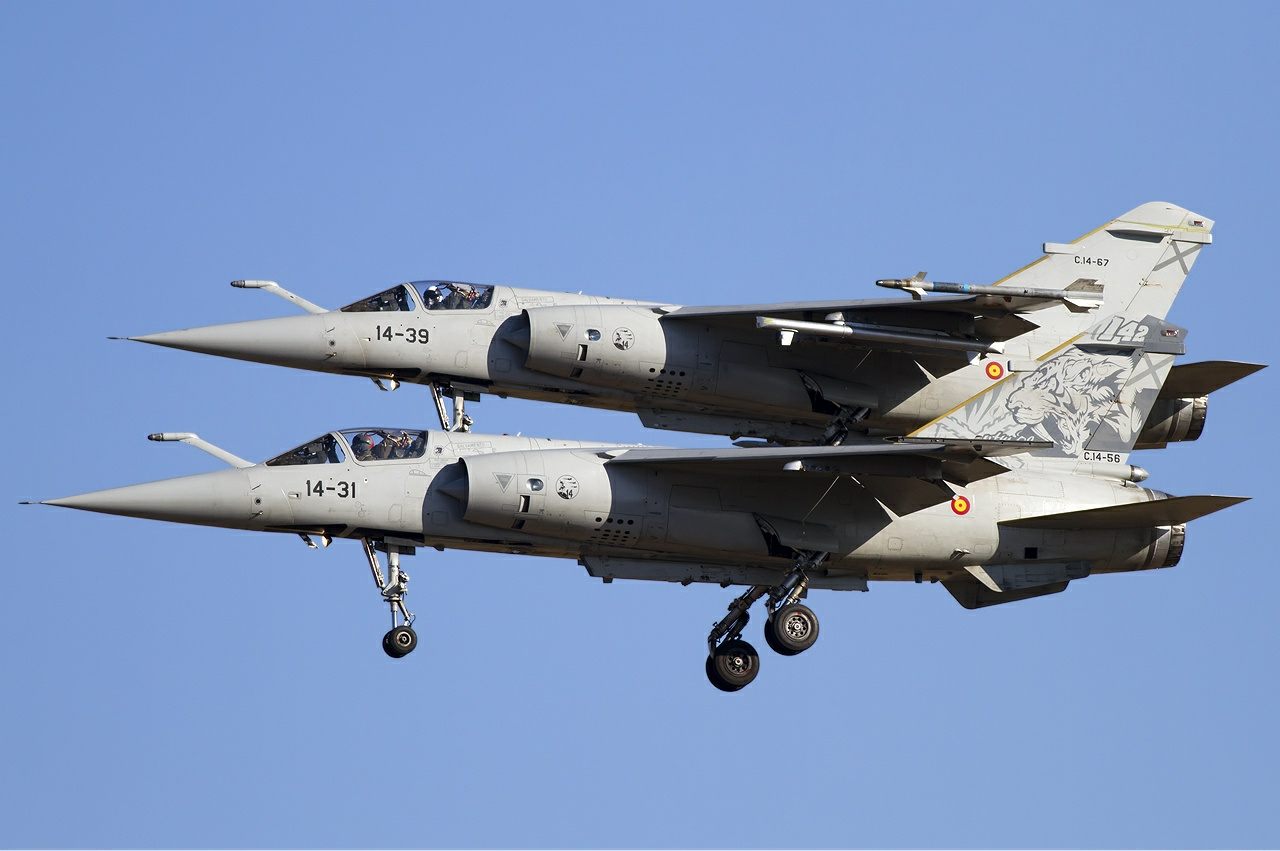
Pictured: a Spanish Air Force Dassault Mirage F1M photographed in 2012 at Los Llanos Air Base, Albacete — home of Ala 14, the same wing and airfield from which Capt. Fernando Cámara's Mirage F1 launched on the night of November 11, 1979. This is not the actual aircraft Cámara flew (a 1970s-era F1CE in an earlier livery) and not a photograph of the incident itself; no photograph of Cámara's specific jet from that night is known to survive in the public record, and no verified photograph of the specific TAE Super Caravelle that operated flight JK-297 that night, nor of the object itself, exists. This image is included under the site's Hero Image Sourcing Protocol as the closest rights-clear, case-relevant photograph available: the real aircraft type and the real intercepting unit's home base.
Theoretical Alignment
Manises earns a moderate Extraterrestrial Hypothesis score for this catalogue — well above Mantell's 8% but below the strongest instrumented Navy cases — because it combines a credentialed military intercept pilot's own instrument anomalies (threat-warning and missile-lock indications with no corresponding radar or infrared return) with a genuine, still-unresolved official government finding rather than a closed case file. It falls well short of the top tier because no radar system ever produced an independently corroborated track of the object matching the crew's or the fighter pilot's visual account, and because the era's technology (chaff, decoy flares, early electronic countermeasures, and a very active U.S. Sixth Fleet presence in the Mediterranean during the Iran hostage crisis) supplies more plausible terrestrial candidates for at least some of what was reported than exist in, say, the Tic Tac or Gimbal cases. The Psycho-Social score is the file's most contested single number: proponents of the conventional explanation have explicitly argued the captain's judgment was compromised by personal stress that night, a claim his co-pilot's independent corroboration and the case's later military corroboration (radar echoes, ground visual sightings, Cámara's own instrument anomalies) work directly against, keeping this file from scoring PSH as low as a pure single-witness misperception case would.
Background
By November 1979, Spain was less than four years removed from the death of Francisco Franco and barely a year into its new democratic constitution — a young parliamentary democracy still assembling the civilian oversight structures that would eventually make a public accounting of a military UFO scramble possible at all. The country's UFO reporting culture, however, was already well established: informal sighting compilations inside Spanish civil and military institutions dated back decades, and the Ejército del Aire (Spanish Air Force) had, like its American and French counterparts, been quietly logging unusual aerial reports for years without any public disclosure framework. Internationally, the autumn of 1979 was an unusually tense moment in the Mediterranean theater: the Iranian hostage crisis, which began on November 4, 1979 — exactly one week before the Manises encounter — had the U.S. Sixth Fleet and allied NATO assets operating at heightened alert across the region, a detail later cited on more than one side of the case's competing explanations.
TAE — Trabajos Aéreos y Enlaces, S.A. — was a Spanish charter airline that, by 1979, operated a small fleet of Sud Aviation Caravelle jets on holiday and inter-island routes connecting mainland Spain, the Balearic Islands, and the Canary Islands, along with occasional longer European charter work. Flight JK-297 on the night of November 11, 1979 was one such routing: having originated further north in Europe with an intermediate stop, the Super Caravelle departed Palma de Mallorca in the evening carrying 109 passengers, bound for Las Palmas de Gran Canaria in the Canary Islands, under the command of Captain Francisco Javier Lerdo de Tejada, an experienced airline captain, with First Officer Ramón Zuazu at his side. Nothing about the routing was unusual, and nothing in the flight's early minutes suggested it would become, within the hour, the first commercial airliner emergency landing in aviation history attributed to a UFO encounter.
Complete Timeline
| Date | Event |
|---|---|
| November 4, 1979 | The Iran hostage crisis begins in Tehran, elevating U.S. Sixth Fleet and NATO alert posture across the Mediterranean theater in the following week. |
| November 11, 1979, evening | TAE flight JK-297, a Sud Aviation Super Caravelle with 109 passengers, departs Palma de Mallorca bound for Las Palmas de Gran Canaria under Capt. Francisco Javier Lerdo de Tejada and First Officer Ramón Zuazu. |
| ~22:00–23:00 | Flying near Ibiza, the crew observes intense red lights approaching rapidly on what appears to be a collision course. Lerdo de Tejada radios Barcelona flight control and military radar at Torrejón de Ardoz; neither can identify the traffic. |
| ~23:00–23:15 | The captain changes altitude to evade; the lights mirror the maneuver and hold position roughly half a kilometer from the aircraft. Deeming further evasion futile, Lerdo de Tejada declares an emergency and requests diversion to Manises Airport, Valencia. |
| ~23:30–23:45 | Flight JK-297 lands safely at Manises. The pursuing lights break off shortly before touchdown; ground personnel, including the airport director and roughly forty staff, report three additional unidentified radar/visual contacts near the field, activating runway emergency lighting when one appears to approach the runway. |
| ~00:40–00:42, November 12 | A Spanish Air Force Dassault Mirage F1 of Ala 14, piloted by Capt. Fernando Cámara, launches on an alert interception mission from Los Llanos Air Base, Albacete. |
| After 00:42 | Cámara accelerates toward Mach 1.4 pursuing a static red light that begins moving at matching speed as he closes; he later describes a "truncated-cone" or bell-shaped object cycling between red, white, and green. His threat-warning receiver and infrared missile-seeker indicate hostile illumination with no corresponding radar or IR return. |
| ~01:00–01:15 | A second contact occurs near Sagunto, Valencia; the object accelerates away. Cámara reports a separate encounter with a distinct white disc-shaped light exhibiting the same sensor interference. |
| ~01:30 | After roughly ninety minutes of pursuit extending toward the Balearic Sea, Cámara returns to Los Llanos with fuel reserves exhausted; his final tracked contact appeared to be heading toward the North African coast. |
| November 12, 1979, ~02:30 | A mechanic in Sóller, Mallorca photographs a bright light over the sea; the image is later published in the newspaper Pueblo on November 21, 1979, and would later be attributed to a lens-flare artifact from the rising sun. |
| November 13, 1979 | The Ejército del Aire opens a formal internal inquiry into the incident. |
| November 17, 1979 | A separate Spanish Air Force interceptor reportedly investigates an unidentified contact near Motril, Granada, later folded into the same broader case file. |
| November 28, 1979 | Multiple additional UFO sightings are reported over Madrid, also later grouped administratively with the Manises file. |
| September–October 1980 | Socialist deputy Enrique Múgica formally questions the Ministry of Defense in the Congress of Deputies; the published response (Boletín Oficial de las Cortes Generales, October 14, 1980) states there is no proof of a physical object, "only of 'lights.'" |
| 1980 | Journalist and ufologist Juan José Benítez publishes Incidente en Manises, the first book-length account of the case, based on contemporaneous interviews with the crew. |
| 1991 | Researcher Vicente-Juan Ballester Olmos submits a formal report to the Air Force General Staff urging Spain to follow other NATO nations in declassifying its UFO files. |
| 1992–1999 | The Spanish Ministry of Defense progressively declassifies 84 Air Force UFO case files (roughly 2,000 pages covering 122 incidents from 1962–1995). |
| August 1994 | The 142-page Manises file (case reference "Avistamiento de fenómenos extraños en Valencia, Motril y Madrid: 11, 17 y 28 de Noviembre de 1979") is declassified by the Ejército del Aire's Estado Mayor, División de Operaciones, Sección de Espacio Aéreo. Its stated conclusion: the traffic "confirmed the existence of uncontrolled traffic in the area, of unknown origin." |
| 1998–2000 | Researcher Juan Antonio Fernández Peris completes El Expediente Manises, an independent analysis of the declassified file proposing that flares from the Escombreras petrochemical complex, combined with unusually bright stars and planets and a strong thermal inversion, explain the sightings; the work receives the Fundación Anomalía's Premio Ricardo Caruncho and is published in 2000 with a prologue by Ballester Olmos. |
| 2009 | Researcher Miguel Ángel Ruiz publishes a detailed critical rebuttal of Fernández Peris's Escombreras theory, disputing its geometry, its dismissal of witness testimony, and its treatment of the case's astronomical claims. |
| 2014 | On the 35th anniversary, Spanish television program Cuarto Milenio features an extended segment with Cámara, who displays the uniform he wore the night of the intercept. |
| November 11, 2019 | The 40th anniversary of the case draws renewed Spanish national media coverage, with Cámara and researchers restating their respective positions largely unchanged. |
The Encounter Over the Mediterranean
By the accounts of both the captain and first officer, nothing distinguished the early portion of TAE flight JK-297 from any other night charter. The Super Caravelle had climbed to cruising altitude after departing Palma de Mallorca and was proceeding on its planned track toward the Canary Islands when, somewhere in the vicinity of Ibiza, the crew first noticed a set of intense red lights in the distance. What began as a routine observation quickly became urgent: the lights closed distance rapidly, appearing to Lerdo de Tejada to be on a direct collision course with his aircraft. His first assumption — a reasonable one for any airline captain — was that another aircraft had strayed into his flight path without clearance. He radioed Barcelona's flight control center and, separately, contacted military radar controllers at Torrejón de Ardoz outside Madrid, requesting immediate identification of the traffic. Neither could provide an answer; by several accounts, ground radar showed nothing in the reported position beyond JK-297 itself, even as the crew continued to watch the lights close in visually.
Unable to obtain any identification and increasingly convinced the traffic posed a genuine collision risk, Lerdo de Tejada attempted a standard evasive response: he changed the aircraft's altitude, the maneuver a pilot would use to break a converging flight path with unidentified traffic. The lights, rather than continuing on an independent course, mirrored the change and settled into a stable position roughly half a kilometer from the Caravelle — behavior far more consistent with something actively tracking the aircraft than with an aircraft on an independent, coincidentally converging path. With 109 passengers aboard and no ability to identify or shake the traffic, the captain made the call that would define the case: rather than continue toward the Canaries, he declared an emergency and requested immediate diversion to the nearest suitable airport capable of handling the Super Caravelle, Manises Airport outside Valencia.
Emergency Landing and Ground Sightings at Manises
Flight JK-297 landed safely at Manises with all 109 passengers and crew unharmed, in itself the least disputed and most consequential outcome of the entire case: whatever the pursuing lights were, they never closed to collision distance, and the emergency diversion — while dramatic — ended without incident. What makes the Manises portion of the case more than a simple "airplane lands safely after a scare," however, is what ground personnel reported independently as the aircraft came in. By several accounts, the pursuing lights broke off their pursuit shortly before touchdown, but radar and visual reports from the airport itself described as many as three additional unidentified contacts in the vicinity, each estimated at roughly 200 meters across — a scale, if the estimate is taken at face value, considerably larger than the red lights the flight crew had been describing throughout the encounter. Airport director Miguel Morlán and a reported forty or so ground staff are described as having observed the activity directly; one object is said to have approached closely enough to the runway that ground controllers activated the field's emergency lighting system, apparently concerned it might be attempting to land or was on a collision path with ground infrastructure. No landing, contact, or physical interaction of any kind occurred; the anomalous returns and sightings simply faded from the area in the time it took the Mirage F1 to be scrambled and arrive on station.
The Mirage F1 Intercept: Fernando Cámara's Account
At roughly 00:40 on the morning of November 12, a Dassault Mirage F1 of Ala 14, piloted by Capt. Fernando Cámara, launched from Los Llanos Air Base in Albacete on a standard air-defense alert-interception profile, directed toward the last reported position of the unidentified traffic. What followed became, by Cámara's own account across more than four decades of consistent retelling, the most technically detailed and most argued-over portion of the entire case. Accelerating to roughly Mach 1.4 in pursuit of what first appeared as a large, static red light, Cámara found that as he closed the distance, the object — rather than remaining stationary or continuing along a predictable path — began moving at a speed matching his own aircraft, holding position ahead of him "without the slightest effort," in his own later phrasing. Visually, he described the object shifting from a point of light into what he characterized as a truncated-cone or inverted-cup shape, cycling through red, white, and green coloration.
The technical crux of Cámara's account, and the detail most frequently cited by researchers on both sides of the case, concerns his aircraft's own sensor suite. He has stated that his radar warning receiver and his infrared missile seeker both indicated the aircraft was being illuminated by an external, continuous-wave radar signal — the same general signature associated with surface-to-air or air-to-air missile guidance systems, and the kind of warning a fighter pilot is trained to treat as a serious, potentially hostile indication. At the same time, his onboard search radar registered no target at all in the direction he could plainly see the light, and his infrared seeker could not achieve a lock despite the object's apparent proximity — an object visible to the naked eye but functionally invisible to two independent onboard sensor systems simultaneously. A second visual contact occurred near Sagunto, north of Valencia, where the object accelerated away and vanished from view; Cámara has also described encountering a separate, distinctly different white disc-shaped light later in the pursuit, exhibiting the same pattern of sensor interference without a corresponding target return. Communications between Cámara and his ground controllers reportedly suffered their own interference, with reported changes of radio channel needed to maintain contact. After approximately ninety minutes of pursuit that carried him out over the Balearic Sea, with his final tracked contact appearing to withdraw toward the North African coast, Cámara broke off and returned to Los Llanos with his fuel reserves exhausted.
Cámara has, in numerous interviews since, explicitly and repeatedly rejected two of the case's most prominent alternative explanations. Asked directly about the possibility that he mistook the flares of the Escombreras refinery complex for the object, he has stated that he knew the refinery's flare stacks well from his own operational flying in the region and had seen them "hundreds of times" from the air, adding that the light he pursued was, in any case, moving in the direction of Zaragoza rather than toward Cartagena and Escombreras. Asked about a separate theory attributing the incident to a contemporaneous NATO exercise (identified in some retellings as CRISEX-79), Cámara has been equally direct in his denial, stating that whatever he encountered was distinct from any exercise traffic he was aware of participating in around that period.
The Congressional Inquiry
Unusually for a UFO case anywhere in the world, Manises produced a formal, on-the-record legislative inquiry within a year of the event. In September and October 1980, Socialist deputy Enrique Múgica Herzog submitted a formal interpellation to Spain's Union of the Democratic Center government, addressed to Defense Minister Agustín Rodríguez Sahagún, asking three specific questions: what kind of apparatus had caused the diversion of the TAE Super Caravelle on November 11, 1979; why three unidentified traffic contacts had reportedly remained in Spanish airspace for more than four hours; and what kind of apparatus had necessitated the alert launch of a Mirage F1 from the Albacete base. The published response, recorded in the Boletín Oficial de las Cortes Generales on October 14, 1980, offered no substantive resolution: the Ministry stated only that there was no proof of the physical existence of any object, only of unexplained "lights." The exchange marked the first time the UFO phenomenon had been formally raised on the floor of Spain's post-Franco democratic parliament, a genuine institutional milestone this file treats as part of the case's evidentiary weight — not because a parliamentary question resolves anything scientifically, but because it demonstrates the incident was taken seriously enough, at the time, to warrant a formal government accounting rather than being dismissed as a curiosity.
Fifteen Years Classified: The 1994 Declassification
For nearly fifteen years, the Ejército del Aire's own internal file on the Manises incident and its associated November 1979 sightings near Motril and Madrid remained closed to public access, its 142 pages held within the Air Force's own archives even as the case grew into what journalist Javier Cavanilles would later call "the most famous UFO case in Spain." That changed as a direct consequence of researcher Vicente-Juan Ballester Olmos's sustained advocacy: in March 1991, Ballester Olmos submitted a detailed report to the Air Force General Staff documenting how the United States, France, and other NATO allies had already declassified significant portions of their own military UFO archives, and formally requested that Spain do the same. The Air Force's Operational Command (Mando Operativo Aéreo) responded by centralizing and, between 1992 and 1999, progressively releasing 84 case files — roughly 2,000 pages covering 122 incidents between 1962 and 1995 — making Spain one of the earliest NATO nations to open its military UFO archive to public and academic review.
The Manises file itself — officially catalogued under a title referencing the sightings at Valencia, Motril, and Madrid across November 11, 17, and 28, 1979 — was declassified in August 1994. Its stated conclusion, in the file's own language, is considerably more circumspect than either the sensational "UFO cover-up" framing sometimes attached to the case or the fully-resolved "solved" framing its most prominent conventional-explanation researcher would later advance: the file states that investigators were unable to determine the origin of the lights, explicitly ruled out the possibility that they belonged to a helicopter given the speeds involved, and concluded that the episode "confirmed the existence of uncontrolled traffic in the area, of unknown origin." The file is described as having also ruled out simple reflection, another fixed-wing aircraft, and the presence of the U.S. Sixth Fleet (with the relevant American command reportedly furnishing a formal letter confirming no vessel was operating in the immediate area at the time), while noting more weakly, and without full confidence, the possibility of stars or other astronomical phenomena. Crucially, the file itself is recorded as acknowledging that radar echoes and ground-based visual contact worked against fully accepting those weaker alternative explanations — meaning the Ejército del Aire's own 1994 declassified conclusion is an open verdict of unidentified traffic, not an endorsement of any specific conventional resolution.
The Escombreras Theory: Fernández Peris's Explanation
The specific, detailed conventional explanation now most associated with the Manises case in general reference works did not come from the Air Force's own 1994 file, but from an independent researcher's subsequent analysis of it. Between 1998 and 2000, Juan Antonio Fernández Peris, an engineer working with the encouragement and eventual prologue support of Ballester Olmos, produced a roughly 200-page study titled El Expediente Manises, examining the newly declassified file in detail. His central conclusion: the lights that pursued flight JK-297 were, in his analysis, flare-ups from the combustion towers of the Escombreras petrochemical and oil-refining complex near Cartagena, more than 100 miles to the southwest of the reported encounter position. Fernández Peris argued that the direction of the lights as observed from the cockpit, and their apparent angular separation, matched the geographic position of the refinery's flare stacks closely; that a strong atmospheric thermal inversion that night, combined with exceptional visibility, would have magnified and distorted the apparent brightness, size, and position of the distant flares; and that airport ground staff, primed by the heightened alert and tension of the preceding hour, subsequently misidentified ordinary stars and unusually bright planets as further anomalous lights. He further proposed that Lerdo de Tejada's own judgment that night may have been affected by personal stress, contributing to a perceptual predisposition to interpret ambiguous stimuli as threatening. Fernández Peris's study won the Fundación Anomalía's Premio Ricardo Caruncho and was published in 2000 with a prologue by Ballester Olmos, who has since credited it publicly with providing what he considers the most credible resolution of the case's central sighting.
Separately, the interference reported aboard Cámara's Mirage F1 has been attributed by some researchers — including within material associated with the Anomaly Foundation's own analysis — to electronic countermeasures from U.S. Navy assets, specifically the helicopter carrier USS Iwo Jima, reported to have been operating in the Mediterranean near the Columbretes Islands during the heightened Sixth Fleet posture connected to the Iran hostage crisis. This specific claim sits in some tension with the Air Force's own declassified file, which is described elsewhere as having received formal confirmation of no Sixth Fleet presence in the immediate area — an inconsistency between two conventional-explanation threads that this file has not been able to fully resolve from the available public record, and flags honestly rather than smoothing over.
The Disputed Rebuttal: Why the Witnesses and Critics Reject It
Both principal military witnesses in this case have rejected the Escombreras explanation directly, specifically, and on the record for decades, not merely in a general or dismissive way. Cámara's rebuttal, described above, rests on personal, first-hand familiarity with the refinery's actual appearance from the air and on the reported object's direction of travel not matching Escombreras's bearing. Lerdo de Tejada and Zuazu, for their part, maintained across contemporaneous interviews and later retrospectives that what they observed exhibited motion — closing distance, changing altitude in apparent response to the aircraft's own maneuvers, and holding a stable relative position — that a fixed, ground-based light source, however atmospherically distorted, cannot produce.
The most systematic published rebuttal of the Fernández Peris theory came in 2009, when researcher Miguel Ángel Ruiz published a detailed critical analysis identifying what he characterized as a series of specific analytical problems with El Expediente Manises. Among his central objections: that the geometry required for a ground-based flare 100-plus miles away to visually match an object the crew described as roughly twice the apparent size of a jumbo jet at under 300 meters' distance is not physically supportable, since Ruiz's calculations placed the refinery's flares at an angular size of only 4 to 34 arcseconds — smaller than the planet Mars appears in the night sky, and orders of magnitude smaller than the crew's reported apparent size; that terrain around the Escombreras valley, with ridgelines in the 170 to 270 meter range, would have obstructed a clear, consistent sightline to the flares from at least some of the witnesses' reported positions; that stars identified by Fernández Peris as sources of the "static" lights (including Sirius, Procyon, Aldebaran, and Rigel) do not produce the sustained, intense red-and-green flashing multiple witnesses described, since ordinary stellar twinkling is a far subtler effect; and that Fernández Peris's own text, in Ruiz's reading, subtly altered witness language describing the object as rising ("sube") into more neutral language describing it as merely "moving" ("moviéndose"), a change Ruiz argued obscured the incompatibility between a ground-fixed light source and witness testimony describing vertical motion. Ruiz also noted that Fernández Peris's analysis did not substantively engage with Cámara's own detailed account of a metallic, color-shifting, structured object — the single most technically detailed and sensor-corroborated testimony in the entire case — a gap Ruiz considered a significant omission rather than an oversight. Ruiz's conclusion was that the Escombreras explanation, while creative and worth taking seriously as a genuine hypothesis, remains "unconvincing," and that the Manises case "continues unexplained." This file's own position, consistent with the Two-Pass Research Rule this catalogue applies to every contested case, treats Ruiz's critique as a serious, substantive rebuttal that has itself never been directly answered point-by-point by Fernández Peris or the Fundación Anomalía in the public record — leaving both the original 1994 official "unknown origin" finding and its most prominent proposed resolution genuinely disputed, rather than treating either side's account as settled.
Key Researchers
- Vicente-Juan Ballester Olmos (b. 1948) — The Spanish researcher whose 1991 report to the Air Force General Staff directly led to the 1992–1999 declassification of Spain's military UFO archive, including the Manises file. Has since publicly credited Fernández Peris's Escombreras analysis as the case's most credible resolution.
- Juan Antonio Fernández Peris — Engineer and researcher whose ~200-page study, El Expediente Manises (2000), proposed the Escombreras refinery/thermal-inversion/astronomical explanation now most associated with the case in general reference works, winning the Fundación Anomalía's Premio Ricardo Caruncho.
- Miguel Ángel Ruiz — Researcher whose detailed 2009 published critique identified specific geometric, terrain, astronomical, and evidentiary-handling objections to the Fernández Peris theory, concluding the Manises case "continues unexplained."
- Juan José Benítez (b. 1946) — Spanish journalist and prominent ufologist whose 1980 book Incidente en Manises was the first book-length treatment of the case, based on contemporaneous interviews with the flight crew.
- Javier Cavanilles — Spanish journalist and author who has characterized Manises as "the most famous UFO case in Spain" in retrospective coverage of the incident.
Cultural Impact
Manises occupies a singular place in Spanish popular culture as, by wide consensus among domestic researchers and journalists, the country's single most famous UFO case — the Spanish-language equivalent, in cultural weight, of what the Mantell or Roswell cases represent in American UFO history. Its status was cemented not by sensational claims alone but by an unusually complete documentary paper trail available almost nowhere else in European ufology: contemporaneous radio transcripts, a formal Congressional inquiry within a year of the event, and, eventually, a full declassified government investigative file rather than the heavily redacted fragments typical of comparable American cases. The long-running Spanish television program Cuarto Milenio, hosted by Iker Jiménez, has returned to the case repeatedly across multiple anniversaries, and Fernando Cámara's continued willingness to discuss his account on camera — including displaying the actual uniform he wore that night during a 2014 broadcast — has kept the case's central instrumented testimony in front of new generations of Spanish audiences largely unchanged from his earliest interviews. The case is also credited, more substantively, with catalyzing Spain's entire military UFO declassification program: without Ballester Olmos's advocacy, itself substantially motivated by unfinished business around Manises, the 84-file, 122-case Spanish Air Force declassification of the 1990s may not have happened on the timeline it did, making this single incident's cultural and institutional footprint considerably larger than its immediate 1979 news cycle.
Key Witnesses
Capt. Francisco Javier Lerdo de Tejada
An experienced airline captain reported to have logged more than 8,000 flight hours, Lerdo de Tejada made the consequential decision to divert a fully loaded passenger jet to an emergency landing after concluding the pursuing lights posed a genuine collision risk his aircraft could not identify or evade. He rejected the later Escombreras explanation for the rest of his life, maintaining that what he observed exhibited motion no fixed ground light could produce.
First Officer Ramón Zuazu
Independently corroborated the captain's account of unidentified traffic closing on the aircraft on an apparent collision course, a detail this file weighs heavily against later suggestions that Lerdo de Tejada alone misjudged an ambiguous stimulus under personal stress. His consistent, independent testimony is one of the case's clearest instances of witness corroboration between two credentialed professionals under active flight duty.
Capt. Fernando Cámara
Launched from Los Llanos Air Base on an alert-interception mission and pursued unidentified lights for roughly ninety minutes, reaching speeds near Mach 1.4. Reported a truncated-cone, color-shifting object and simultaneous activation of his radar-warning and infrared missile-seeker threat systems with no corresponding sensor return — the case's single most technically detailed instrumented account. Has maintained a materially consistent account across more than four decades of interviews and has explicitly and repeatedly rejected both the Escombreras and NATO-exercise explanations.
Miguel Morlán and Manises Airport Ground Staff
Reported observing as many as three additional unidentified radar and visual contacts near the airfield as flight JK-297 landed, with one object approaching closely enough to prompt activation of the runway's emergency lighting system. This ground-level corroboration, independent of both the flight crew and the intercepting fighter pilot, is a structurally important third leg of the case's witness base.
Enrique Múgica Herzog
Not a witness to the encounter itself, but the legislator whose formal 1980 parliamentary interpellation forced the first official government accounting of the case on the record of Spain's post-Franco democratic Congress — an institutional milestone that helped ensure the case could not simply be buried inside classified Air Force files indefinitely.
The Five Observables Assessment
The Five Observables framework, developed by former AATIP director Luis Elizondo, is used across this catalogue to classify UAP encounters by performance characteristics exceeding known technology of their era. Applied to Manises, the framework returns a mixed but genuinely notable result — considerably more supportive than Mantell, in the same range as Gorman, but well short of the top-tier instrumented Navy cases:
Assessment: Anti-Gravity Lift is rated absent: no witness described a visible means of propulsion, only lights and, in Cámara's account, a structured but silent object. Instant Acceleration and Hypersonic Velocity are both rated speculative rather than present, because while the object reportedly matched or exceeded a supersonic Mirage F1's speed with "no apparent effort" and later "accelerated away" near Sagunto, no radar-derived velocity figure exists to independently quantify either claim — the evidence is qualitative pilot testimony, credible but not instrumented. Low Observability is rated present, the strongest single observable in this file: an object visible to the naked eye from both the airliner and the intercepting fighter simultaneously failed to register on the Super Caravelle's radar (per some accounts), on ground/military radar stations, and specifically on the Mirage F1's onboard search radar and infrared missile seeker — a consistent pattern of primary-sensor nulls against confirmed visual contact that closely parallels the Chilean Navy helicopter case's triple radar non-detection. Trans-Medium travel is rated absent; nothing in the case describes any transition between air, water, or space.
Evidence Assessment
Supporting Anomalous Origin
- Two independent, credentialed commercial airline pilots corroborated an object that closed distance, appeared to track the aircraft's altitude changes, and held a stable relative position — behavior a fixed ground light source cannot produce.
- A trained NATO interceptor pilot flying a supersonic fighter on an official alert mission maintained visual contact with a structured, color-shifting object while his onboard radar and infrared missile seeker simultaneously failed to acquire any target.
- Independent ground corroboration at Manises Airport, from the airport director and roughly forty staff, reported separate unidentified contacts near the field at the same general time, a third independent witness pool.
- The Spanish Air Force's own 1994 declassified file, after a formal internal investigation, did not adopt any conventional explanation, concluding instead that the episode "confirmed the existence of uncontrolled traffic in the area, of unknown origin."
- Both principal military-relevant witnesses (Lerdo de Tejada and Cámara) rejected the leading conventional explanation specifically and consistently for the remainder of their careers, citing direct operational familiarity with the proposed alternative source.
- A detailed 2009 published critique identified specific geometric, astronomical, and evidentiary problems with the case's most prominent conventional explanation that have not been directly rebutted in the public record.
Supporting Conventional Explanation
- A specific, researched conventional candidate exists — flares from the Escombreras petrochemical complex, amplified by an atmospheric thermal inversion, combined with unusually bright stars and planets — developed from direct access to the declassified file rather than pure speculation.
- No radar system, civil or military, produced an independently corroborated track of the object matching the crew's or fighter pilot's account; the strongest instrument evidence (Cámara's threat sensors) is consistent with equipment malfunction or externally sourced interference rather than confirmed hostile illumination by an unknown craft.
- A purported piece of photographic evidence from the following morning was investigated and specifically attributed to a mundane lens-flare artifact, illustrating that at least some purported corroborating evidence in the case does not withstand scrutiny.
- Later, more sensational secondary claims in the case's popular retelling (confiscated negatives, DIA acknowledgment of the case, deliberate military hoax sightings by other pilots) are drawn from single uncorroborated sources and have not been independently verified.
- The captain's judgment that night has been specifically challenged as potentially compromised by personal stress, a claim that, while disputed by the co-pilot's independent corroboration, this file cannot fully resolve either way from the available public record.
Why "Disputed"
This file rates the Manises case DISPUTED rather than "Credible" or "Debunked" because the honest state of the evidence sits genuinely between those two poles, and because the case's own official record itself refuses to resolve cleanly in either direction. On the side of continued mystery: two independent, credentialed commercial pilots corroborated an object exhibiting tracking behavior a fixed light source cannot produce; a trained NATO interceptor pilot pursued a structured, color-shifting object for ninety minutes while his combat aircraft's own threat-warning and infrared missile-seeker systems registered anomalous activity with no corresponding target; independent ground witnesses at Manises Airport reported separate unidentified contacts at the same general time; and the Spanish Air Force's own formal 1994 declassified investigation — conducted by the very institution with every incentive to close the file with a mundane answer — concluded only that the traffic was "unidentified... of unknown origin," not that it had been explained. On the side of a mundane resolution: a specific, geographically real conventional light source (the Escombreras refinery flares) was identified by a serious independent researcher working directly from the declassified file, and a purported piece of corroborating photographic evidence was investigated and found to be an ordinary optical artifact, demonstrating that not every strand of the case's popular mythology withstands scrutiny. What keeps this file from moving further toward "Credible" is the absence of any independently corroborated radar track and the real possibility, never fully closed off, that a specific combination of a distant industrial light source, favorable atmospheric conditions, and genuine 1970s-era fighter avionics vulnerabilities produced a dramatic but ultimately terrestrial event. What keeps it equally far from "Debunked" is that the Escombreras theory itself has never been formally adopted by the Spanish Air Force, has been directly and specifically rejected by both principal witnesses with the operational expertise to evaluate it, and has faced a detailed, still-unanswered published rebuttal on geometric and evidentiary grounds. A case whose own government investigators, decades removed from any public pressure and working from full access to classified radar and radio records, could not bring themselves to write down a specific conventional answer is exactly the kind of case this site's "Disputed" rating exists to describe honestly.
Sensor & Instrumentation Detection Profile
This is a genuinely multi-instrument case by the standards of 1979 civil and military aviation. The Super Caravelle's own weather radar reportedly returned unexplained traffic during the encounter; Spain's air-defense radar network, including the Sierra de Aitana station (then and now part of the Ejército del Aire's early-warning radar chain covering the western Mediterranean), and a separate station near Benidorm were consulted, with at least one account describing several unidentified echoes logged at altitude in the same general timeframe, even as Barcelona's civil air traffic control radar reportedly showed nothing beyond the airliner itself. The Mirage F1's own avionics form the case's most technically detailed instrument record: Capt. Fernando Cámara has stated repeatedly across decades of interviews that his aircraft's radar warning receiver and infrared missile-seeker threat indicators activated as though the aircraft were being illuminated by a hostile continuous-wave radar — the signature associated with anti-aircraft missile guidance systems — while his onboard search radar and his AIM-9-type infrared seeker both failed to acquire any corresponding target, even as he maintained visual contact with a bright, color-shifting light. That combination — strong secondary/threat-sensor activity with a simultaneous primary-sensor null — is the case's single most distinctive and most argued-over data point, structurally similar to (though document differently from) the Chilean Navy helicopter case's triple radar non-detection cataloged elsewhere on this site. No photographic or film record of the object itself survives; a widely circulated photograph taken the following morning by a Sóller mechanic was independently analyzed by Ground Saucer Watch and attributed to lens flare from the rising sun, a rare case in this catalogue where a specific piece of purported photographic evidence was investigated and explicitly rejected rather than left ambiguous.
Environmental & Geospatial Context
The initial encounter occurred over open Mediterranean airspace near Ibiza, roughly along the corridor commercial traffic uses between the Balearic Islands and mainland Spain, on a clear night with what multiple sources describe as exceptional visibility. That same clarity is central to the case's leading disputed conventional explanation, since a strong thermal inversion layer over the western Mediterranean that night is cited by researcher Juan Antonio Fernández Peris as the specific mechanism that could have made distant ground-based light sources appear unusually bright, magnified, and displaced in apparent position. Geospatially, the theory requires the crew to have mistaken flares from the Escombreras petrochemical and refining complex near Cartagena — more than 100 miles to the southwest — for a nearby aerial object, a genuinely long sight line that critics of the theory have argued is obstructed by intervening terrain (specifically, ridgelines in the 170–270 meter range around the Escombreras valley) from at least some of the reported observer positions. The broader context also includes an unusually dense concentration of military assets in the theater that autumn: the U.S. Navy's Sixth Fleet maintained an active Mediterranean presence tied to the ongoing Iran hostage crisis, which some researchers have proposed as a source of the electronic interference Cámara's Mirage reported, though the Spanish Air Force's own file is described as having received formal confirmation that no Sixth Fleet vessel was operating in the immediate area at the time. Los Llanos Air Base itself sits roughly 170 km southwest of the Manises/Valencia coastline, a distance the scrambled Mirage F1 covered at supersonic speed within minutes of launch.
Observer Credibility & Occupational Profile
The witness pool spans civil aviation, military aviation, and ground-based airport and air-defense personnel, giving this file an unusually broad occupational cross-section for a European case of its era. Captain Francisco Javier Lerdo de Tejada was, by contemporary accounts, an experienced commercial airline captain with more than 8,000 flight hours; his decision to divert a loaded passenger aircraft rather than continue to Las Palmas represents a materially consequential professional judgment call, not an offhand remark. His co-pilot, Ramón Zuazu, independently corroborated the core account of unidentified traffic approaching on a threatening trajectory, a detail this file weighs heavily against later suggestions that the captain alone misjudged an ambiguous stimulus under personal stress. On the military side, Capt. Fernando Cámara was a trained interceptor pilot flying a first-line NATO-era fighter on an official alert-scramble mission, not a casual observer; his account has remained materially consistent across more than four decades of interviews, including detailed television appearances. Ground witnesses reportedly included Manises airport's director and roughly forty airport staff who observed unidentified aerial activity near the field closely enough to trigger the runway's emergency lighting, and unnamed radar and air-traffic-control personnel at Barcelona and Torrejón de Ardoz whose contemporaneous inability to explain the traffic became part of the official record. Weighed against this is the case's most serious credibility challenge, raised directly by the researcher who investigated the file most thoroughly for the Air Force: Fernández Peris's own analysis explicitly attributes Lerdo de Tejada's reaction partly to personal stress the captain was reportedly under that night, a characterization the co-pilot's independent, consistent account works against, and one critics have specifically flagged as witness discrediting rather than resolving the case's core empirical claims.
Physical & Material Assays
No physical fragment, debris, or recoverable material connected to the object was ever produced in this case; nothing fell, crashed, or was collected. The case's closest approach to physical evidence is negative and secondary: the Super Caravelle's automatic flight recorders and the aircraft's own logs of the diversion and emergency landing (routine aviation records, not evidence of the object itself), the Mirage F1's post-flight maintenance and armament-system logs documenting the anomalous threat-sensor activations Cámara reported, and radar tape or logs from the Sierra de Aitana and Benidorm stations, portions of which are described as having been included in the eventual 142-page declassified file. A single photograph, taken the morning after by a mechanic in Sóller, Mallorca, was submitted as possible physical evidence of the phenomenon but was independently analyzed by the American group Ground Saucer Watch and attributed to a lens-flare artifact from the rising sun, whose position an investigator confirmed matched the light source in the image — a rare instance in this catalogue of purported photographic evidence being tested and specifically rejected rather than left an open question. Later, more sensational accounts have claimed Spanish Air Force officers confiscated and never returned the photographer's negatives; this claim originates from a single secondary retelling and has not been independently corroborated in the documentary record this file could verify, so it is noted here as a disputed claim rather than an established fact.
Historical Precedents & Archive Matches
Manises sits at the head of a short but significant list of Spanish military UFO cases from the same period: an Air Force interceptor reportedly investigated a separate unidentified contact near Motril, Granada less than a week later, on November 17, 1979, and multiple sightings were reported over Madrid on November 28, 1979 — a cluster the Spanish Air Force's own subsequent declassification review grouped together under a single administrative file spanning 1979 to 1994. The case is also the direct trigger for Spain's modern UFO declassification program: researcher Vicente-Juan Ballester Olmos's 1991 report to the Air Force General Staff, documenting how other NATO countries had already opened their UFO archives, led directly to the phased release of 84 Spanish Air Force case files (roughly 2,000 pages spanning 122 incidents between 1962 and 1995) between 1992 and 1999 — making Manises one of only a comparatively small number of European military UFO cases anywhere with a fully declassified official government investigative file open to public and academic scrutiny. Structurally, the case's core dynamic — a credentialed military intercept pilot reporting an instrumented anomaly that a later, non-governmental researcher attempts to resolve with a specific, geometrically testable conventional explanation that the original witnesses reject — closely parallels the Chilean Navy helicopter FLIR video case cataloged elsewhere on this site, down to the shared pattern of an internally divided expert panel and a disputed, unadjudicated resolution attempt arriving years after the original event.
Material Analysis
Manises is, in the end, a case without a single recovered physical object: nothing crashed, nothing was collected, and no laboratory ever tested a fragment connected to the lights or the structured object Cámara described. The case's material record instead consists entirely of institutional and instrumental documentation — the 142-page declassified Ejército del Aire file, TAE's own flight and maintenance logs for the diversion, the Mirage F1's post-sortie maintenance and weapons-system records documenting the threat-sensor anomalies, and whatever radar tape or logs from Sierra de Aitana, Benidorm, and Manises survive within the broader file. The one candidate piece of physical evidence the case did produce — the Sóller photograph — was independently tested and rejected, a genuinely useful negative result that narrows, even if it cannot close, the case's evidentiary possibilities.
Supporting a Genuinely Unusual Physical Event
- The Mirage F1's radar-warning and infrared missile-seeker systems are purpose-built, safety-critical military instruments not prone to spurious activation without some external stimulus, whether a genuine unknown craft or an unidentified terrestrial signal source.
- The consistent pattern of visual contact without a corresponding primary radar/IR return, replicated independently across two separate aircraft (the Caravelle and the Mirage F1) hours apart, is not easily dismissed as a single instrument fault.
Supporting a Mundane Origin
- No physical specimen, fragment, or independently testable material of any kind was ever recovered in this case, in either direction.
- The one piece of purported photographic evidence in the case was tested and specifically attributed to a lens-flare artifact, not an unexplained phenomenon.
- Threat-sensor activations on 1970s-era fighter avionics are a documented vulnerability to a range of mundane electromagnetic sources, including friendly or foreign electronic-countermeasures equipment operating in a theater that was, that specific week, unusually saturated with heightened-alert naval assets.
The Conventional Explanation Candidate: The Escombreras Refinery Flares (Fernández Peris)
The most detailed and most frequently cited conventional explanation for the Manises sightings is researcher Juan Antonio Fernández Peris's 1998–2000 analysis, which proposes that the lights pursuing flight JK-297 were flare-ups from the combustion towers of the Escombreras petrochemical and refining complex near Cartagena, more than 100 miles to the southwest, whose apparent brightness, size, and position were magnified and distorted by a strong atmospheric thermal inversion on a night of exceptional visibility, compounded by ground staff subsequently misidentifying bright stars and planets as further anomalous lights under the tension of the unfolding alert. This candidate deserves serious evaluation: it emerged from the single most thorough independent review of the declassified Air Force file ever conducted, it identifies a real, geographically specific, physically existing light source rather than a vague appeal to "misperception," and it won a respected ufological research prize precisely for the rigor of its documentary analysis.
Where the Escombreras Theory Falls Short
Its central weaknesses are geometric, testimonial, and institutional. Critic Miguel Ángel Ruiz's 2009 published rebuttal calculated that flares 100-plus miles away would present an angular size of only 4 to 34 arcseconds — smaller than the planet Mars appears in the night sky, and orders of magnitude smaller than the "roughly twice the size of a jumbo jet at under 300 meters" scale Lerdo de Tejada reported, a mismatch Ruiz argued the theory does not adequately address. Terrain around the Escombreras valley, with ridgelines in the 170 to 270 meter range, would plausibly have obstructed a clear, consistent sightline from at least some witness positions. The theory does not substantively engage with Cámara's detailed account of a structured, color-shifting object and simultaneous instrument anomalies — the case's single most technically corroborated testimony — and both principal military-adjacent witnesses have rejected it directly and specifically, citing personal operational familiarity with the proposed alternative light source. Finally, the theory's attribution of the captain's judgment to personal stress has been criticized as witness discrediting rather than a resolution of the case's core empirical claims, particularly given the co-pilot's fully independent corroboration.
Astronomical Misidentification (Stars and Planets)
A secondary, complementary candidate — also raised within Fernández Peris's analysis and weakly touched on in the Air Force's own 1994 file — proposes that at least some of the lights reported by ground staff at Manises, and possibly some portion of the initial cockpit sighting, were ordinary stars or unusually bright planets, misidentified under the tension of an unfolding emergency. This candidate is worth taking seriously for the more static, lower-intensity secondary reports, since heightened alertness is a well-documented contributor to misidentifying ordinary celestial objects as anomalous. It struggles against the case's best-documented core evidence in the same way the Skyhook balloon theory struggles against Mantell's Venus candidate: stars do not close distance, do not mirror an aircraft's altitude changes, and do not produce the sustained, intense red-and-green flashing multiple witnesses independently described, which Ruiz specifically distinguished from ordinary stellar twinkling.
Electronic Countermeasures / Military Exercise Interference
A third candidate, addressing specifically the Mirage F1's instrument anomalies rather than the visual sighting itself, proposes that Cámara's threat-sensor activations resulted from electronic countermeasures emitted by U.S. Navy assets in the theater — specifically the helicopter carrier USS Iwo Jima, reported operating near the Columbretes Islands amid the heightened Sixth Fleet posture connected to the Iran hostage crisis — or, in a separate version, from participation in a contemporaneous NATO exercise. This candidate deserves genuine consideration because 1970s-era fighter radar-warning receivers are a documented vulnerability to exactly this kind of interference, and the regional military posture that week was unusually elevated. It runs into a direct documentary conflict, however: the Air Force's own declassified file is described as having received formal confirmation that no Sixth Fleet vessel was operating in the immediate area at the time, and Cámara has personally and specifically denied that his encounter matched any exercise traffic he was aware of participating in.
Escombreras Refinery Flares (Fernández Peris)
InconclusiveA real, specific, geographically grounded candidate with serious unaddressed geometric and testimonial objections.
Astronomical Misidentification (Stars/Planets)
Plausible ImplausiblePLAUSIBLE for isolated secondary ground reports only. IMPLAUSIBLE as an explanation for the core cockpit and Mirage F1 sightings.
Electronic Countermeasures / Military Exercise
InconclusiveAddresses only the Mirage F1's instrument anomalies, not the visual sighting, and conflicts with the Air Force's own Sixth Fleet non-presence finding.
Related Cases
Confirmed Documents & Official Records
The Spanish Air Force's own official case file on the Manises incident and two related November 1979 sightings, declassified by the Estado Mayor's División de Operaciones, Sección de Espacio Aéreo. Its stated conclusion: the traffic "confirmed the existence of uncontrolled traffic in the area, of unknown origin." No stable public direct-download mirror is linked here per this site's sourcing policy; researchers can request access details via the Spanish Ministry of Defense's Virtual Defense Library.
DECLASSIFIED (1994)The formal published record of the first UFO-related question raised in Spain's democratic Congress of Deputies, and the government's on-the-record response that no proof existed of a physical object, only of "lights."
PUBLIC RECORDSearch Government Archives Directly
Further Reading — Recommended Literature
Incidente en Manises
The first book-length treatment of the case, written by one of Spain's most prominent ufologists based on contemporaneous interviews with the flight crew shortly after the event.
El misterio Ovni: Un alto secreto al descubierto
A broader investigation of Spanish and international UFO cases by a veteran Spanish ufology journalist, situating Manises within the wider pattern of Spanish Air Force-documented sightings.
UFOs: Generals, Pilots, and Government Officials Go on the Record
An investigative survey of government- and pilot-sourced UAP cases worldwide, useful for situating Manises' military intercept and declassified-file pattern alongside comparable international cases.
The UFO Encyclopedia, 4th Edition
The definitive English-language UFO reference work, with a cited entry situating Manises among the most significant European military UAP cases of the 20th century.
Above Top Secret: The Worldwide UFO Cover-Up
A global survey of credible military and pilot UFO encounters, including a dedicated chapter on Spanish cases, drawing on FOIA-style document releases comparable to Spain's own Air Force declassification.
Essential Viewing
1979-11-11: Manises UFO Incident (Subtitled)
An English-subtitled walkthrough of the case's core timeline, from the initial cockpit sighting through the Mirage F1 intercept and eventual declassification.
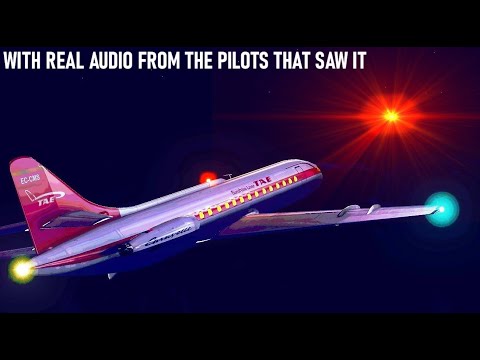
The UFO that Shocked an Entire Continent — TAE Flight 297
An English-language deep dive built around real audio and radio-transcript material from the pilots and controllers involved in the November 11, 1979 encounter.
Caso Manises: Persecución OVNI, Fernando Cámara
A skeptically minded Spanish-language analysis from the "Milenio sin Misterio" channel examining Cámara's intercept account against the case's proposed conventional explanations.
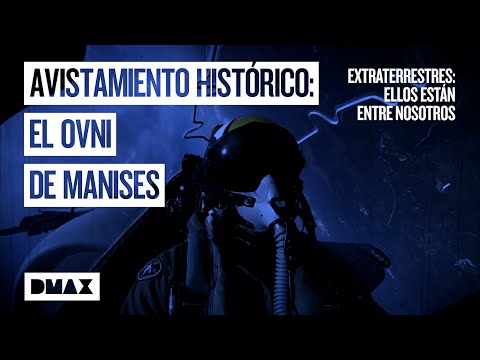
Caso Manises: Así Cuenta un Testigo lo Ocurrido
A DMAX España documentary segment from the series "Extraterrestres: Ellos están entre nosotros," featuring first-hand witness testimony from the case.

Los Secretos Extraterrestres del Caso Manises
A further DMAX España documentary segment examining the case's investigative history and its place in Spanish UFO research.
Sources
- "Manises UFO incident," Wikipedia (comprehensive English-language summary with citations to primary and secondary sources). en.wikipedia.org
- "Incidente ovni de Manises," Wikipedia en español (detailed Spanish-language summary including the declassified file's exact conclusion language). es.wikipedia.org
- Valencia Plaza. "El hombre tras la desclasificación" (profile of Vicente-Juan Ballester Olmos and his role in the 1990s Spanish Air Force UFO file declassification). valenciaplaza.com
- Informe OVNI. "'El Expediente Manises': un análisis crítico" (Miguel Ángel Ruiz's 2009 detailed rebuttal of the Fernández Peris Escombreras theory). informeovni.net
- El Valenciano. "El Enigma del Incidente OVNI de Manises: Años de Misterio Sin Resolver (el expediente desclasificado)." elvalenciano.es
- UFO Insight. "The Flight JK297 UFO Incident – The Manises Case." ufoinsight.com
- Sprague, Ryan. "The Manises UFO Incident: A Close Encounter at 28,000 Feet," Medium. ryan-sprague51.medium.com
- Vázquez, Galán. "The Manises Case," Medium (Caballo de Troy), February 8, 2021 (incorporating research from Bruno Cardeñosa, David Cuevas, Manuel Carballal, and the Manises Air Base Air Force Veterans Association). caballodetroy.medium.com
- NICAP. "The Anomaly Foundation Solves the 'Manises' UFO Case" (hosting the Fundación Anomalía's own summary of the Fernández Peris findings). nicap.org
- Millás, Jaime. "Un 'ovni' forzó el aterrizaje de un Caravelle en Manises," El País, November 13, 1979.
- Cemlyn-Jones, Bill. "'UFOs' force Spanish pilot to land," The Guardian, November 14, 2015.
- Cavanilles, Javier. "Caso Manises, descanse en paz," El Mundo, November 10, 2009.
- Múgica Herzog, Enrique (October 14, 1980). "Causas del desvío del avión Súper-Caravelle de la compañía TAE," Boletín Oficial de las Cortes Generales, Congreso de los Diputados, Spain.
- Ministerio de Defensa, Ejército del Aire, Estado Mayor, División de Operaciones, Sección de Espacio Aéreo. "Avistamiento de fenómenos extraños en Valencia, Motril y Madrid: 11, 17 y 28 de Noviembre de 1979" (1979–1994), declassified case file, Biblioteca Central del Ejército del Aire, released August 1994.
- Fernández Peris, Juan Antonio. El expediente Manises, Santander: Fundación Anomalía, 2000. ISBN 84-607-0825-X.
- Benítez, Juan José. Incidente en Manises, Barcelona: Plaza y Janés, 1980. ISBN 978-84-01-33176-3.
- Cardeñosa Chao, Bruno. El misterio Ovni: Un alto secreto al descubierto: investigaciones y evidencias, Ediciones Nowtilus, 2010. ISBN 978-84-9763-342-0.
- Ballester Olmos, Vicente-Juan. "UFO Declassification: The Spanish Model," FOTOCAT research paper (analysis of the 1992–1999 Spanish Air Force UFO file release program).
- Clark, Jerome. The UFO Encyclopedia, 4th Edition, Visible Ink Press, 2023.
- Wikimedia Commons. "Spanish Air Force Dassault Mirage F1M Lofting-2.jpg," photographed by Chris Lofting, Los Llanos Air Base, Albacete, February 8, 2012 (GNU Free Documentation License 1.2). commons.wikimedia.org
- Escuadrón de Vigilancia Aérea nº5 (EVA 5), Sierra de Aitana, Confrides, Alicante — Ejército del Aire y del Espacio official unit page. ejercitodelaireydelespacio.defensa.gob.es
See something inaccurate? Have additional information or sources?
Suggest an Edit →Last Updated: August 2026