
The Chilean Navy Helicopter UFO Video
On the morning of November 11, 2014, two Chilean Navy officers flying an Airbus/Eurocopter AS-532 Cougar helicopter on a routine daylight patrol along the coast between San Antonio and Quintero, Chile, used a WESCAM MX-15 HD forward-looking infrared (FLIR) turret to record roughly nine minutes of a "flat, elongated structure" pacing their aircraft at a distance the crew estimated at 55 kilometers. Twice during the encounter the object appeared to eject a dense thermal plume the pilot described as "two thermal spotlights-like discharges that did not coincide with the axis of motion." Neither of two ground radar stations nor the helicopter's own onboard radar ever acquired a return on the object, even as both continued tracking the helicopter itself. Chile's Comité de Estudios de Fenómenos Aéreos Anómalos (CEFAA) — the Chilean Air Force's civilian-military UAP investigative body — spent roughly two years and eight contentious committee meetings running the footage past astrophysicists, nuclear chemists, meteorologists, and French photogrammetric analysts before releasing it publicly in January 2017 as an officially unresolved Unidentified Aerial Phenomenon. Barely five days later, independent citizen investigators led by Mick West cross-referenced archived flight-tracking data and identified a specific climbing airliner, Iberia flight IB6830, whose engine geometry, altitude, GPS position, and timing matched the video with striking precision — a rigorously argued conventional explanation that, as of this writing, neither CEFAA nor the Chilean Navy has ever formally accepted or rebutted.
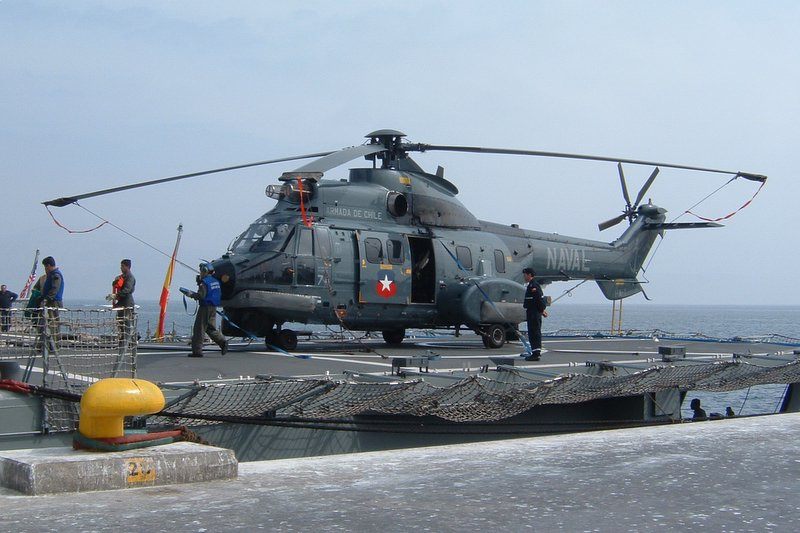
Pictured: a Chilean Navy AS532SC Cougar helicopter — the same type flown on the November 11, 2014 patrol — photographed on a warship's flight deck at Mejillones, Chile during the 2006 UNITAS naval exercise. This is not a frame from the actual FLIR footage or a photo of the specific aircraft involved; the Chilean Navy has never publicly identified the individual airframe or crew, and no still photograph of the actual patrol exists in the public record. The infrared video itself — the case's real visual evidence — is linked in Essential Viewing below rather than reproduced here as a static image.
Theoretical Alignment
This file scores unusually low across all three classic frameworks, because the case's own best-documented feature — the FLIR video itself — is also the feature most directly addressed by a specific, testable terrestrial candidate. The Extraterrestrial Hypothesis draws some support from the object's failure to register on three independent radar systems and from CEFAA's own multi-year inability to reach consensus, but it is undercut by the existence of a named, GPS-corroborated airliner occupying almost exactly the reported position at almost exactly the reported time. The Psycho-Social Hypothesis scores low rather than moderate, atypically for this catalogue, because the primary witnesses were trained aircrew operating sophisticated sensor equipment rather than untrained ground observers under acute stress — a genuine perceptual misjudgment of a distant aircraft's range and altitude is a documented human-factors error, not a "hysteria" narrative. The Interdimensional Hypothesis finds essentially no support; nothing in the video, the radar logs, or any witness statement describes trans-dimensional or portal-like behavior.
Background
Chile occupies an unusual position in the history of government UAP investigation: since 1997 it has operated one of the very few standing, publicly acknowledged national committees anywhere in the world dedicated specifically to studying anomalous aerial phenomena, embedded not as a fringe curiosity but inside its civil aviation authority. The Comité de Estudios de Fenómenos Aéreos Anómalos (CEFAA) was created by DGAC Resolution No. 01599 on October 3, 1997, under the Chilean Air Force's civil aeronautics directorate, in direct response to two consecutive nights of anomalous lights reported by DGAC's own observers at Chacalluta Airport in Arica in late March 1997 — a sighting significant enough, and credible enough given its source, to prompt the Chilean government to formalize what had previously been ad hoc reporting dating back to a 1968 compilation effort inside the old Meteorological Office. CEFAA's first director, Aviation Colonel Enzo Di Nocera García, was quickly succeeded in the role by Brigadier General Ricardo Bermúdez Sanhueza, who led the organization for nearly two decades, from 1997 until 2016, building it into a case-intake body that by the 2020s was processing well over a thousand citizen reports and publishing quarterly findings. It was Bermúdez's CEFAA, in the final stretch of his long tenure, that inherited the November 2014 helicopter video as one of the most sensor-rich cases the committee had ever been asked to evaluate.
The helicopter itself was a Chilean Navy Airbus/Eurocopter AS-532 Cougar — known in Chilean Navy service by the designation SH-32 — a twin-engine medium transport and maritime-patrol helicopter that has served the Armada de Chile for roughly three decades, operated principally by the Navy's general-purpose helicopter squadron, Escuadrón HU-1, based at the Base Aeronaval "El Belloto" outside Viña del Mar. HU-1's core mission is search-and-rescue and maritime patrol along Chile's long, thinly populated coastline, and a routine daylight patrol along the corridor between the port city of San Antonio and the town of Quintero — a stretch the squadron would have flown regularly — was the unremarkable backdrop against which the crew was reportedly also testing a newly installed WESCAM MX-15 HD forward-looking infrared turret, a multi-sensor electro-optical/thermal gimbal increasingly standard on maritime patrol aircraft worldwide for search-and-rescue, smuggling interdiction, and reconnaissance work. It was this testing — not a scrambled intercept or an alerted response to a prior report — that put a high-definition thermal camera on the object when it appeared, which is precisely why the case produced footage of a quality almost never available for a genuinely unanticipated aerial encounter.
Complete Timeline
| Date | Event |
|---|---|
| 1968 | Chile's Meteorological Office, under Col. Sergio Bravo Flores, begins the first informal government compilation of anomalous aerial phenomena reports. |
| March 1997 | DGAC observers at Chacalluta Airport, Arica, report anomalous aerial phenomena on two consecutive nights, prompting formal government action. |
| October 3, 1997 | The DGAC formally creates CEFAA by Resolution No. 01599, under founding director Col. Enzo Di Nocera García, soon led by Ricardo Bermúdez Sanhueza. |
| November 5, 2010 | CEFAA's other landmark case, the "El Bosque" air-show incident, is captured on seven independent videos in Santiago and later investigated as an unexplained high-speed object. |
| November 11, 2014, morning | A Chilean Navy AS-532 Cougar helicopter on routine coastal patrol between San Antonio and Quintero uses a newly installed WESCAM MX-15 HD FLIR turret to record an unidentified "flat, elongated structure" for roughly nine minutes at an estimated 55 km range and 1,370 m (4,500 ft) altitude. |
| November 11, 2014 (during the encounter) | The pilot contacts two separate ground radar stations; neither can acquire the object. The helicopter's own onboard radar also fails to detect it. Radio calls on the interrogation frequency for unknown traffic go unanswered. |
| November 11, 2014 (during the encounter) | The object twice appears to release a dense thermal plume — described by the pilot as "two thermal spotlights-like discharges that did not coincide with the axis of motion" — the more visible instance occurring roughly eight minutes into the recording. |
| Late 2014 | The Chilean Navy turns the footage over to CEFAA for formal evaluation, opening what becomes a roughly two-year investigation. |
| 2014–2016 | CEFAA convenes at least eight committee meetings; astrophysicist Luis Barrera investigates and rules out meteor and space-debris re-entry explanations; French analyst François Louange, working with GEIPAN, proposes a landing twin-jet airliner dumping cabin wastewater, a theory Chilean researchers dispute on radar, meteorological, and flight-schedule grounds. |
| January 5, 2017 | Journalist Leslie Kean publishes the video and CEFAA's findings on The Huffington Post; CEFAA officially declassifies and releases the footage, with Gen. Bermúdez stating, "We do not know what it was, but we do know what it was not." |
| January 6, 2017 | Independent investigator Mick West publicly proposes that the object was a distant airliner leaving an aerodynamic contrail, opening a Metabunk forum thread to crowdsource verification. |
| January 7–11, 2017 | Metabunk forum contributors, working with West, cross-reference archived ADS-B flight-tracking data and identify the specific aircraft as Iberia flight IB6830, an Airbus A340 climbing out of Santiago toward Madrid — a match later described as reached in "five days," against CEFAA's two years. |
| January 2017 onward | The Louange/GEIPAN "landing aircraft" theory and the West "climbing IB6830" theory circulate separately in press coverage; no public statement from CEFAA or the Chilean Navy formally adopts or rebuts either. |
| 2018–2021 | CEFAA formalizes a digital case-management database (2018) and begins publishing quarterly investigated-case summaries (from 2020); the 2014 helicopter case file's classification is not revised in any of these releases. |
| October 18, 2021 | CEFAA is administratively renamed the Sección de Estudios de Fenómenos Aéreos Anómalos (SEFAA) within the DGAC's Communications Subdepartment, continuing the same case-review function. |
| January 2023 | Additional original CEFAA case documents — correspondence, witness intake forms, the GEIPAN report, advisory reports, and flight-track data — are obtained from the DGAC and published by the YouTube channel Omega Click, confirming the file's unrevised "unidentified aerial phenomenon" classification. |
A Routine Patrol Turns Anomalous
By every account CEFAA and the Chilean Navy have released, nothing about the morning of November 11, 2014 was expected to be extraordinary. A Chilean Navy AS-532 Cougar helicopter, most likely operating out of the Navy's general-purpose squadron at Base Aeronaval "El Belloto" near Viña del Mar, was flying a routine daylight patrol along the coastal corridor between the port of San Antonio and the town of Quintero — the kind of maritime surveillance run the squadron flew regularly. The crew, a Navy captain serving as pilot and a Navy technician assigned to operate the aircraft's recently installed WESCAM MX-15 HD forward-looking infrared turret, appear to have been using the flight partly as an opportunity to exercise the camera's new high-definition thermal channel. It was in the course of that routine sensor testing, at an altitude the crew logged at roughly 1,370 meters (4,500 feet), that the technician picked up an unfamiliar thermal signature in the distance — not moving erratically or approaching, but apparently holding a roughly parallel course and a speed the crew judged to be close to their own.
Nine Minutes on Infrared: What the Camera Recorded
What followed was, by any measure, an unusually long and unusually well-instrumented sighting. The crew tracked the object continuously for more than ten minutes, of which roughly nine minutes survive as recorded FLIR video. In the black-and-white infrared image, the object appears as a compact, high-contrast dark shape — consistent with a strong heat signature against a cooler sky background — that the pilot later described in his own words as a "flat, elongated structure." The crew estimated its range at approximately 55 kilometers (roughly 34 miles) and its groundspeed at approximately 130 knots (about 244 km/h, or 152 mph), figures they judged to be closely matching the helicopter's own speed, which is part of why the object appeared to hold a stable position in the camera's field of view rather than rapidly crossing it. Twice during the recording, the object appeared to eject a dense, high-heat-signature plume; the more distinct and widely reproduced of the two instances occurs at approximately the eight-minute mark, rendering on the thermal display as an expanding dark bloom. The pilot's own characterization of these events — "two thermal spotlights-like discharges that did not coincide with the axis of motion" — became the case's signature technical detail, describing plumes that did not simply trail behind the object along its line of flight the way a straightforward exhaust or vapor trail normally would.
Three Radar Systems, No Return
The single most consequential real-time decision the crew made was to seek independent corroboration while the object was still in view, rather than relying on the camera alone. The pilot radioed two separate Chilean ground radar stations and asked them to attempt to acquire the object; neither could produce a return, even though both continued to hold a clean track on the helicopter itself throughout the exchange. The helicopter's own onboard search radar was checked as well and likewise failed to detect anything at the bearing and range where the crew could plainly see a heat signature on their FLIR display. Air traffic control was also queried and reported no authorized flights scheduled in the area the crew believed the object to occupy. Attempts to raise the object on the standard interrogation frequency used for unidentified traffic drew no response. Considered in isolation, this triple radar non-detection is the case's single strongest anomalous data point: it is one thing for a camera to record something ambiguous, and another for three independent radar systems — two ground-based, one airborne — to simultaneously fail against a target visible on infrared at a range and altitude within their normal detection envelope. As later analysis would show, however, this same fact admits a mundane resolution if the crew's own real-time estimate of the object's range and altitude was itself mistaken — a possibility no one, including CEFAA, appears to have systematically tested against archived flight-tracking data during the original investigation.
CEFAA's Two-Year Investigation
The Chilean Navy turned the footage over to CEFAA shortly after the encounter, opening a review that would ultimately stretch across roughly two years and, according to Gen. Ricardo Bermúdez's own later account, at least eight separate, genuinely contentious committee meetings. CEFAA's process brought together an unusually broad bench of specialists: astrophysicist Luis Barrera, tasked with evaluating and ultimately ruling out astronomical explanations such as meteor activity or re-entering space debris on the grounds that the object's duration, controlled and level flight profile, and lack of any ballistic trajectory were inconsistent with either; nuclear chemist Mario Ávila, who personally interviewed the two crew members at their naval base; Air Force photogrammetric analyst Alberto Vergara, who worked to reconstruct the object's three-dimensional form and motion from the two-dimensional thermal footage; Chilean Air Force meteorologist Luis Salazar, who assessed whether atmospheric conditions at the reported altitude could support a condensation-based explanation; a DGAC aeronautic engineer and a digital-imaging specialist from Chile's National Museum of Aeronautics and Space; and, notably, French photo/video analyst François Louange, an independent consultant who has worked since 2007 with CNES's official UAP study group GEIPAN and who applied his own IPACO photogrammetric software to the footage on CEFAA's behalf. No hypothesis considered during those two years commanded a committee consensus. Louange's own report, produced with GEIPAN's input, concluded the object was "probably" a medium-haul twin-jet airliner in its landing phase, its apparent trail the result of dumped cabin wastewater — a finding whose estimated distance, Louange noted, closely matched the Navy crew's own 55 km figure. Chilean researchers on the committee pushed back hard: no radar station, despite direct real-time queries, ever corroborated a landing aircraft at that position; meteorologist Salazar concluded ambient temperature and altitude conditions did not support the specific condensation wake the wastewater theory required; no landing traffic was scheduled on a flight path matching the sighting; and, perhaps most persuasively to the committee, it seemed implausible that an experienced Navy pilot would fail to recognize a landing airliner for what it was. With every specific hypothesis raised and rejected in turn, the committee's eventual finding was not that the case was solved by elimination, but that it remained genuinely unresolved.
The January 2017 Public Release
CEFAA's findings became public in early January 2017, when journalist Leslie Kean — whose earlier reporting had already made her one of the most prominent chroniclers of government-sourced UAP cases — published the footage and CEFAA's official statement on The Huffington Post on January 5, 2017. Gen. Bermúdez, in remarks reported alongside the release, offered what became the case's most quoted line: "We do not know what it was, but we do know what it was not," framing the finding as a systematic elimination of conventional candidates rather than a positive identification of anything exotic. CEFAA's own formal language, later republished across its case documentation, held that "the great majority of committee members agreed to call the subject in question a UAP (Unidentified Aerial Phenomenon) due to the number of highly researched reasons that it was unanimously agreed could not explain it." The release drew immediate, extensive international press coverage — Newsweek, Fox News, IFLScience, Universe Today, and dozens of other outlets carried the story within days — making it, by most measures, the most widely circulated single piece of government-sourced UAP video evidence between the 2011 STS-121 and 2017 Nimitz/Gimbal/GoFast disclosures.
Five Days: The Crowdsourced Rebuttal
What happened next is the detail this file treats as indispensable to any honest accounting of the case, and it is worth stating plainly and in full rather than glossing over. Within roughly 24 hours of the Huffington Post publication, on January 6, 2017, skeptical investigator Mick West — founder of the analysis forum Metabunk and, by that point, already known for detailed technical rebuttals of other viral UAP videos — published an initial assessment proposing that the object was in fact a distant, high-altitude airplane, considerably farther away and higher up than the Navy crew had estimated in real time, that briefly generated a visible aerodynamic contrail as it climbed. Over the following days, West and Metabunk forum collaborators (posting under the handles "Trailblazer" and "Trailspotter," among others) cross-referenced archived ADS-B flight-tracking data from FlightAware and Planefinder against the video's embedded GPS coordinates, camera heading, and timestamp. By January 7–11, 2017 — a span later summarized by both West's own account and a 2022 Skeptoid retrospective as roughly five days — the group had converged on a specific identification: Iberia flight IB6830, an Airbus A340 four-engine widebody departing Santiago for Madrid, whose position, altitude, and timing (14:01:39 UTC) matched the video with a precision the original two-year CEFAA process had never attempted to test.
West's technical case, laid out in detail on the Metabunk forum thread "Explained: Chilean Navy 'UFO' video — Aerodynamic Contrails, Flight IB6830," rests on several independently checkable claims. First, he argued CEFAA's own working assumption — that a single continuous object held a constant ~55 km range and ~1,370 m altitude for the full nine minutes — was itself unverified, and that the footage was more consistent with an aircraft climbing from roughly 15,000 to 25,000+ feet, far higher and, correspondingly, effectively much farther away in slant range than the crew's real-time visual estimate. Second, he demonstrated in Google Earth that IB6830's reconstructed 3-D flight path, viewed from the helicopter's own logged coordinates along its actual camera heading, placed the airliner in essentially the same apparent position and orientation seen in the video. Third, he argued the "two thermal spotlights-like discharges" were aerodynamic contrails — brief clouds of pressure-induced condensation that can form during specific phases of a steep climb, distinct from a simple continuous engine-exhaust trail — and that their "hot," high-contrast appearance in the infrared image was an artifact of thermal contrast against the surrounding cold high-altitude sky rather than evidence the material itself was actually hot. Fourth, he showed that a four-engine aircraft's exhaust plumes, viewed nearly head-on or tail-on from a great distance, would plausibly merge in the thermal image into the two bright, blob-like flares visible in the footage, and he built physical demonstration footage with a candle and an infrared camera to illustrate how distant point heat sources bloom and distort at range. Finally, and most importantly for the radar puzzle, West's altitude correction directly explains why none of the three radar systems acquired the object: ground and airborne controllers searching for a slow-moving contact 55 km out at 4,500 feet were, on this account, looking in entirely the wrong volume of airspace for a commercial airliner correctly squawking its transponder tens of thousands of feet higher and considerably farther away — a plane that would have been perfectly visible on any radar scope tuned to the airspace it actually occupied.
The Aftermath: A Compelling Explanation, Never Formally Addressed
West's identification of IB6830 spread quickly through both skeptical and mainstream press in the days and weeks after CEFAA's release — outlets including Newsweek, Player.One, and the Skeptical Inquirer covered it prominently, and it remains, as of this writing, the most technically detailed independent analysis the case has ever received. What this file must state plainly, in keeping with its obligation to research the skeptical side as thoroughly as the anomalous one, is that this explanation has never been formally adopted, endorsed, or even directly rebutted by CEFAA, the DGAC, or the Chilean Navy. No subsequent CEFAA case-status update, quarterly report, or public statement by Gen. Bermúdez or his successors has revised the file's original "unidentified aerial phenomenon" classification to reflect West's altitude correction or his IB6830 identification specifically; the additional original case documents obtained and published in January 2023 confirm the file's classification remained unchanged years after West's analysis had been publicly circulating. This silence cuts in a genuinely ambiguous direction rather than an obviously damning one for either side. It may simply reflect institutional inertia — a government committee formally closing a two-year multi-expert file rarely revisits it on the strength of an internet forum thread, however rigorous, without a formal referral. It may also reflect a real, if unstated, institutional judgment that West's altitude reassignment — however well corroborated by flight-tracking data — does not fully resolve every detail CEFAA's own committee found troubling, particularly the specific character of the "thermal spotlight-like discharges" as the pilot himself described them, a claim West's contrail explanation addresses but does not, in CEFAA's own file, appear to have been directly tested against by the original investigators. What is not in serious dispute is the technical rigor of West's underlying methodology — GPS coordinate verification, archived ADS-B reconstruction, matched camera heading and timestamp, and physical demonstration of thermal blooming at range — which exceeds, in verifiable specificity, most conventional explanations offered for comparable cases in this catalogue, including the still-uncorroborated Skyhook balloon explanation for the 1948 Thomas Mantell case.
Circumstantial Evidence
- Two independent Chilean Navy officers, both trained aircrew rather than casual observers, jointly witnessed and recorded the object using a purpose-built military-grade thermal imaging system.
- Three independent radar systems — two ground stations and the helicopter's own onboard radar — failed to acquire the object even while continuing to track the helicopter itself, a striking negative data point regardless of its ultimate explanation.
- CEFAA's own multi-disciplinary panel, including a credentialed astrophysicist, nuclear chemist, meteorologist, and photogrammetric specialists, spent roughly two years and at least eight formal meetings without reaching consensus on a conventional explanation.
- A rigorously argued, GPS- and flight-data-corroborated conventional explanation (a climbing Iberia flight, IB6830, leaving an aerodynamic contrail) was developed within days of the video's public release and has never been formally rebutted — but also never formally accepted — by CEFAA or the Chilean Navy.
- A separate, officially considered conventional explanation from French analyst François Louange (a landing airliner dumping cabin wastewater) was explicitly evaluated and rejected by CEFAA's own committee on radar, meteorological, and scheduling grounds.
- No physical trace, specimen, or independently testable material evidence exists in this case; it rests entirely on the FLIR video and the radar non-detection logs.
Key Researchers
- Brig. Gen. Ricardo Bermúdez Sanhueza — Founding director of CEFAA (1997–2016), who oversaw the two-year investigation and announced its findings in January 2017.
- Luis Barrera — Astrophysicist on CEFAA's scientific committee who ruled out meteor and space-debris explanations for the object.
- François Louange — French photogrammetric analyst working with GEIPAN/CNES, who proposed the "landing airliner dumping wastewater" theory within CEFAA's own official case file.
- Mario Ávila — Nuclear chemist and CEFAA scientific committee member who personally interviewed both crew members.
- José Lay — CEFAA's Director of International Affairs, who alongside Gen. Bermúdez discussed the case's findings in interviews accompanying the January 2017 release.
- Leslie Kean — Investigative journalist whose January 5, 2017 Huffington Post article, drawing on years of prior government-UAP reporting, brought CEFAA's findings to international attention.
- Mick West — Founder of the analysis forum Metabunk, who within five days of the video's public release identified the specific airliner (Iberia flight IB6830) and aerodynamic-contrail mechanism now considered the case's leading conventional explanation.
- Brian Dunning — Host of the Skeptoid podcast, whose episode #838 ("The Chilean Navy UFO") remains one of the most detailed English-language retrospective analyses contrasting CEFAA's two-year process with the five-day crowdsourced rebuttal.
Cultural Impact
Within Chile, the November 2014 video cemented CEFAA's international reputation as one of the very few government bodies anywhere in the world to run a standing, publicly transparent UAP investigative program, a status the agency has leaned into in subsequent institutional communications and academic outreach even after its 2021 administrative rename to SEFAA. Internationally, the case became a fixture of the UAP-disclosure conversation of the late 2010s, frequently cited alongside the U.S. Navy's own FLIR encounters as evidence that credible governments elsewhere were independently documenting similar phenomena using similar sensor technology, even as it also became, within the skeptical research community, one of the most-cited case studies in the specific genre of "government investigation misses a basic verification step that citizen researchers later catch" — a pattern explored at length in academic and popular treatments of crowdsourced UAP analysis, including a Skeptical Inquirer feature on curated crowdsourcing methods in UFO investigations built substantially around this case. The footage continues to circulate widely on video platforms nearly a decade after its release, still routinely captioned as "unexplained" by outlets that do not mention West's analysis, and as "solved" by outlets that treat his identification as definitively adjudicated — a split reception this file's own "Disputed" rating is intended to resolve honestly rather than pick a side by omission.
Key Witnesses
Navy Captain (Pilot-in-Command)
An experienced Chilean Navy helicopter pilot who commanded the AS-532 Cougar during the November 11, 2014 patrol, radioed two ground radar stations in real time seeking corroboration, and gave CEFAA's investigators his own detailed characterization of the object as a "flat, elongated structure" producing "two thermal spotlights-like discharges that did not coincide with the axis of motion." His identity has never been publicly released by the Chilean Navy, consistent with its standard practice for active-duty aircrew.
Navy Technician (FLIR Camera Operator)
The second crew member, responsible for operating the helicopter's recently installed WESCAM MX-15 HD infrared turret and the first to detect the object's thermal signature. Along with the pilot, he was personally interviewed by CEFAA investigator and nuclear chemist Mario Ávila. His identity, like the pilot's, has never been publicly disclosed.
Brig. Gen. Ricardo Bermúdez Sanhueza
The retired Chilean Air Force general who founded and led CEFAA for nearly two decades, overseeing the two-year, eight-meeting review of the helicopter video and publicly announcing its findings in January 2017 with the case's signature line: "We do not know what it was, but we do know what it was not."
Luis Barrera
The astrophysicist tasked with evaluating and ultimately ruling out astronomical explanations for the object, including meteor activity and re-entering space debris, on the grounds that its extended duration and controlled, level flight profile were inconsistent with either — one of the most consequential single findings in CEFAA's internal review.
The Five Observables Assessment
The Five Observables framework, developed by former AATIP director Luis Elizondo, is used across this catalogue to classify UAP encounters by performance characteristics exceeding known technology of their era. Applied to the Chilean Navy video, the framework returns a modest, largely negative result — a case built on sensor failure and interpretive ambiguity rather than any documented extreme performance:
Assessment: This is not a maneuvering-performance case. Anti-Gravity Lift, Instant Acceleration, and Hypersonic Velocity are all rated absent because every account — the crew's own real-time description, the video itself, and both competing conventional explanations — agrees the object held a steady course and a speed comparable to the helicopter's own, with no reported burst of speed, sudden maneuver, or acceleration beyond conventional aircraft performance. Trans-Medium travel is rated absent; nothing in the case describes any transition between air, water, or space. Low Observability is the one genuinely contested observable, rated speculative rather than present or absent: the object's total failure to register on three independent radar systems is, taken at face value, consistent with a low-observable signature, but it is equally consistent — per Mick West's analysis — with radar operators searching the wrong volume of airspace for a perfectly ordinary, radar-reflective commercial airliner mistakenly believed to be much closer and lower than it actually was. The Five Observables framework, in other words, cannot itself adjudicate this case; its one plausible "present" candidate collapses entirely depending on which distance-and-altitude estimate is correct.
Evidence Assessment
Supporting Anomalous Origin
- Two trained Navy aircrew, using military-grade sensor equipment, jointly observed and recorded the object for over ten minutes without losing track of it.
- Three independent radar systems — two ground stations and the helicopter's own onboard radar — all failed to detect the object while continuing to track the helicopter itself throughout the same window.
- CEFAA's two-year, multi-disciplinary review, including a credentialed astrophysicist and nuclear chemist, could not reach a consensus conventional explanation despite genuine, sustained internal effort across at least eight formal meetings.
- The object's own reported thermal discharge behavior — plumes the pilot said did not align with the object's axis of motion — is a specific, unusual detail that West's contrail explanation addresses only partially.
- The case remains, as of this writing, formally and publicly classified by a national government UAP investigative body as an unresolved "unidentified aerial phenomenon," never officially downgraded or reclassified.
Supporting Conventional Explanation
- Independent investigator Mick West identified a specific, named commercial flight (Iberia IB6830) whose GPS-tracked position, altitude, heading, and timestamp closely matched the video, using publicly archived ADS-B data.
- West's altitude correction directly explains the radar non-detection: ground and airborne radar searching a low-altitude volume near the helicopter would not have detected a normally radar-visible airliner climbing through a much higher altitude band far beyond the crew's real-time distance estimate.
- CEFAA's own committee never appears to have cross-checked archived commercial flight-tracking data against the sighting time and location during its original two-year investigation — a basic verification step performed by amateur investigators within days.
- A second, independently developed aircraft-based theory (French analyst François Louange's landing-airliner/wastewater-dump hypothesis) was raised inside CEFAA's own official file, indicating the committee itself took the "ordinary aircraft" possibility seriously even before ultimately rejecting that specific version of it.
- No physical evidence of any kind exists to independently corroborate an exotic origin; the entire anomalous case rests on the crew's own real-time distance and altitude estimate, which West's analysis argues was likely mistaken.
Why "Disputed"
This file rates the Chilean Navy helicopter video DISPUTED rather than "Credible" or "Debunked" because the honest state of the evidence sits genuinely between those two poles and resists collapsing cleanly into either. On the side of continued mystery: two trained military aircrew, operating sophisticated sensor equipment, recorded a genuinely unusual thermal signature for over ten minutes; three independent radar systems failed to detect it while tracking the helicopter itself throughout; and a credentialed, cross-disciplinary government review panel spent two years and at least eight formal meetings without reaching a conventional consensus, a level of sustained institutional engagement this catalogue does not see in most disputed cases. On the side of a mundane resolution: an independent citizen investigator, working entirely from public flight-tracking data within days of the case going public, identified a specific, named commercial airliner whose GPS-tracked position, altitude, heading, and timing matched the footage with a level of technical specificity that exceeds nearly every other conventional explanation catalogued on this site — including the still-uncorroborated Skyhook balloon theory for Thomas Mantell and the contested altimeter-glitch theory for Coyne Helicopter. What tips this file firmly toward the skeptical end of "Disputed," rather than toward "Credible," is not that West's explanation has been proven beyond doubt — it has not been formally tested by any government body — but that CEFAA's own original two-year investigation appears never to have cross-checked archived commercial flight data against the sighting's own timestamp and coordinates, a basic verification step private citizens performed within five days using entirely public information. A government UAP investigation that never ran the single most obvious check available to it cannot, on its own unrevised finding alone, carry as much evidentiary weight as its two-year duration and expert panel might otherwise suggest. At the same time, this file does not round the case down to "Debunked," because West's identification, however compelling, has never been run past CEFAA's original crew, replicated by a second independent research group, or formally reconciled with the pilot's own specific description of two discharges "not coinciding with the axis of motion" — a detail addressed but not conclusively resolved by the contrail model. Both the mystery and its best available answer remain, a decade later, genuinely unresolved by anyone with the standing to close the file.
Sensor & Instrumentation Detection Profile
This is fundamentally an instrumented case, which is precisely what makes its resolution so consequential either way. The primary sensor was the helicopter's WESCAM MX-15 HD turret, a multi-sensor electro-optical/infrared gimbal (640×512 cooled mid-wave-infrared imager, plus a higher-resolution 1280×1024 HD thermal channel) mounted for maritime surveillance and search-and-rescue work; the crew was reportedly evaluating the unit's recently installed high-definition thermal channel during the patrol when the object appeared. Three independent radar systems were consulted in real time and after the fact: two separate Chilean ground/coastal radar stations that the pilot contacted directly by radio, and the helicopter's own onboard weather/search radar. All three failed to acquire any return on the object, even though all three continued to track the helicopter itself throughout the encounter — a genuinely striking negative data point given how routinely commercial and military radar in the region tracks aircraft at the ranges and altitudes ultimately proposed by both competing explanations. The crew also attempted radio contact with the object on the interrogation frequency used for unknown traffic and received no response, and air traffic control confirmed no authorized flights scheduled in the immediate vicinity the Navy crew believed the object occupied. No satellite, gun-camera, or acoustic sensor data exists for the case; it rests entirely on the FLIR recording and the negative radar evidence.
Environmental & Geospatial Context
The patrol corridor between San Antonio and Quintero runs along the central Chilean coast in the Valparaíso Region, roughly 90–120 km west and northwest of Santiago, bracketing the major container port of San Antonio to the south and the oil-refining and naval town of Quintero to the north, with the Valparaíso–Viña del Mar metropolitan conurbation and the Chilean Navy's principal Pacific fleet anchorage at Valparaíso itself sitting between them. The Chilean Navy's general-purpose helicopter squadron, Escuadrón HU-1, is based at the Base Aeronaval "El Belloto" near Viña del Mar and flies maritime patrol, search-and-rescue, and liaison missions along exactly this stretch of coastline, making it the natural operating unit for a routine coastal patrol in this corridor, though the Navy has never publicly confirmed the specific unit or tail number involved. Conditions were reported as clear daylight with no storm activity, ruling out the kind of extreme-weather misperception that features in some other coastal UAP cases in this catalogue. The corridor also sits directly beneath one of Chile's busiest domestic and international departure/arrival paths out of Santiago's Arturo Merino Benítez International Airport, a geographic detail that later became central to the case's most serious proposed conventional explanation, since airliners climbing out of Santiago toward the Pacific or descending in from it routinely cross this same airspace at a wide range of altitudes.
Observer Credibility & Occupational Profile
The case's primary witnesses are, by the consistent account of every source that has reported on it, an experienced Chilean Navy captain serving as pilot-in-command and a Navy technician operating the FLIR turret — both trained military aircrew rather than casual observers, and both reportedly interviewed at length by CEFAA's own investigators, including nuclear chemist Mario Ávila. Neither officer's name has ever been made public; the Chilean Navy, consistent with its general practice for active-duty aircrew, withheld their identities even as it authorized release of the footage and their professional observations. This file treats that anonymity as a genuine, if unavoidable, limitation: it is not possible for outside researchers to independently assess either officer's specific flight experience, eyesight, or prior reliability the way this catalogue can for named witnesses like David Fravor in the Nimitz encounter. What can be assessed is the credibility of the institutional response: CEFAA's review was led by Brigadier General Ricardo Bermúdez Sanhueza, the organization's founding director, and drew on a genuinely multi-disciplinary panel — astrophysicist Luis Barrera, nuclear chemist Mario Ávila, Air Force photogrammetric analyst Alberto Vergara, Chilean Air Force meteorologist Luis Salazar, a Dirección General de Aeronáutica Civil (DGAC) aeronautic engineer, a digital-imaging specialist from Chile's National Museum of Aeronautics and Space, and French photo/video analyst François Louange working alongside colleagues from GEIPAN, France's official UAP study group under the national space agency CNES. That is a credentialed, cross-disciplinary bench by the standards of any government UAP program in this catalogue, and its two years of genuine internal disagreement — by Bermúdez's own account, eight contentious meetings — is itself evidence the case was not treated as a formality.
Physical & Material Assays
No physical specimen, wreckage, or recoverable material of any kind exists in this case; nothing was ever recovered from the object or the "thermal spotlight-like discharges" the crew reported. The discharges themselves are visible only as a change in the FLIR video's thermal contrast — a dark, high-heat-signature bloom appearing at roughly the eight-minute mark and at one earlier point in the footage — not as any physical sample collected by the crew or by CEFAA afterward. This absence of recoverable material is not unusual for an airborne FLIR case (it mirrors the U.S. Navy's Gimbal and GoFast videos, cataloged elsewhere on this site), but it does mean every material-evidence question in this file resolves to competing interpretations of the same nine minutes of infrared video and the associated radar logs, rather than to any independent laboratory finding.
Historical Precedents & Archive Matches
The Chilean Navy video is CEFAA's single most internationally publicized case, but it is neither the agency's first nor its only high-profile file. CEFAA was formally created on October 3, 1997 by resolution of the DGAC, following two consecutive nights of anomalous aerial phenomena reported by DGAC observers at Chacalluta Airport in Arica in March 1997 — itself building on informal Chilean government UAP reporting that traces back to 1968, when Meteorological Office director Colonel Sergio Bravo Flores began compiling early sighting reports. CEFAA's other widely cited case is the November 5, 2010 "El Bosque" incident, in which seven independently filmed videos of a Santiago air-show crowd inadvertently captured a dome-shaped, flat-bottomed object executing high-speed passes near performing Air Force jets, undetected by any pilot or spectator in the moment and only discovered later during slow-motion review — a case CEFAA's own astronomers estimated involved apparent speeds near 10,000 km/h and ruled out as a meteor, space debris, bird, or aircraft, though (like the 2014 helicopter case) it has never been independently replicated or confirmed by outside researchers. Internationally, this file's closest structural precedents are the U.S. Navy's own FLIR-recorded encounters profiled elsewhere in this catalogue — the USS Roosevelt Gimbal and GoFast videos and the USS Nimitz "Tic Tac" encounter — all cases where trained military aircrew, sophisticated infrared sensors, and (in the Chilean case) failed radar corroboration combine to produce genuinely hard-to-dismiss footage that nonetheless generated serious, technically detailed conventional counter-explanations from independent analysts, most consistently from the same investigator, Mick West.
Material Analysis
The Chilean Navy video is a purely instrumentation-based case: it contains no material evidence of any kind. Nothing was ever recovered from the object, from either of its two reported "thermal spotlight-like discharges," or from the general area of the sighting, which in any case occurred over open coastal airspace with no practical means of retrieving a sample even had one existed. The case's entire physical evidentiary record consists of the WESCAM MX-15 HD FLIR video file itself — a digital thermal-infrared recording, not a physical artifact — together with the negative results logged by the two ground radar stations and the helicopter's onboard radar. This absence of any recoverable trace evidence sharply distinguishes this file from ground-encounter cases in this catalogue involving soil anomalies, burn patterns, or metallurgical samples, and it means every interpretive question in the case — anomalous or conventional — must be settled from the video and radar data alone, without the possibility of independent laboratory confirmation either way.
Supporting a Genuinely Unusual Physical Event
- The reported thermal discharges were described by the pilot as misaligned with the object's axis of motion, a detail that does not trivially match a simple engine-exhaust trail streaming directly behind a moving aircraft.
- The consistent triple radar non-detection, if the crew's original distance and altitude estimate is accepted at face value, would represent a genuinely unusual signature for an object of the reported apparent size.
Supporting a Mundane Origin
- No physical specimen, fragment, or independently testable material of any kind exists in this case, in either direction.
- Mick West's aerodynamic-contrail explanation specifically accounts for a plume that would appear misaligned with a distant aircraft's course, since a contrail forms and dissipates in pockets tied to pressure and speed changes during a climb rather than trailing in a single continuous line.
- The radar non-detection is fully explained if the object was in fact tens of thousands of feet higher and many kilometers farther away than the crew's real-time visual estimate, exactly as West's flight-data reconstruction proposes.
The Conventional Explanation Candidate: A Climbing Airliner's Contrail (Flight IB6830)
The strongest terrestrial explanation for this case, by a considerable margin, is the one developed independently of CEFAA entirely: Mick West's identification of Iberia flight IB6830, an Airbus A340 climbing out of Santiago toward Madrid, as the object recorded on the helicopter's FLIR camera. This candidate deserves serious evaluation because it is the only explanation in the case built on independently checkable, third-party data — archived ADS-B flight-tracking records rather than any party's recollection or assumption. West's reconstruction placed the aircraft, at the video's timestamp of 14:01:39 UTC, in a position and along a heading that matched the footage when rendered from the helicopter's own logged GPS coordinates in 3-D modeling software; matched the video's "peanut-shaped" twin thermal flares to the four-engine aircraft's exhaust as it would appear compressed by distance; and matched the timing and character of the two "discharges" to aerodynamic contrail formation during specific phases of a steep climb, an effect distinct from ordinary continuous engine exhaust. Most importantly, it resolves the case's single most striking data point — the triple radar non-detection — by showing that ground and airborne radar searching for a slow target 55 km out at 4,500 feet were looking in the wrong volume of airspace entirely for a normally radar-visible airliner climbing through 15,000 to 25,000-plus feet, far higher and farther than the crew's real-time estimate. Its central weakness is institutional, not technical: it has never been run past CEFAA's own committee, replicated by a second independent research group, or addressed in any subsequent CEFAA case-status communication, meaning it remains, formally, an outside analysis rather than an adjudicated finding.
A Landing Twin-Jet Airliner Dumping Cabin Wastewater (GEIPAN / François Louange)
Before West's analysis existed, CEFAA's own investigation had already considered an aircraft-based explanation, commissioned from French photogrammetric analyst François Louange, working with input from GEIPAN, France's official UAP study group under the space agency CNES. Louange's IPACO-software analysis concluded the object was most likely a medium-haul twin-jet airliner in its landing phase, its visible trail the product of dumped cabin wastewater rather than any engine-related emission, and noted his estimated distance closely matched the Navy crew's own real-time figure of roughly 55 kilometers. This candidate deserves credit for representing CEFAA's own committee taking the "ordinary aircraft" possibility seriously well before any outside skeptic weighed in, but it was directly and, on the evidence, fairly rejected by Chilean researchers on the committee: no radar station corroborated any aircraft on a landing approach at that position despite direct real-time queries; meteorologist Luis Salazar found ambient conditions at the assumed low altitude did not support the specific condensation wake the wastewater theory required; no scheduled landing traffic matched the flight path described; and an experienced military pilot seemed unlikely to mistake a landing commercial airliner, a routine and highly familiar sight, for something genuinely anomalous. This candidate is best understood today as directionally correct — it was, after all, the right general category of explanation — while being wrong in its specific mechanics, a distinction West's later climbing-aircraft/contrail model resolves.
Meteor or Re-Entering Space Debris (Ruled Out by CEFAA's Own Astrophysicist)
The third candidate this file evaluates is the one CEFAA's own process most decisively closed off. Astrophysicist Luis Barrera was specifically tasked with assessing whether the object could represent a meteor, bolide, or piece of re-entering space debris, hypotheses that recur across many UAP cases involving bright, fast-moving aerial phenomena. Barrera's analysis ruled this out on straightforward physical grounds: the object was tracked continuously for more than ten minutes in what all observers agreed was a controlled, level flight profile, whereas meteors and re-entering debris are characteristically brief (seconds, not minutes) and follow a ballistic, decelerating-then-terminal trajectory rather than sustained level flight matching a helicopter's own cruising speed. No astronomical catalog or space-debris tracking service has ever been cited as recording a matching re-entry event for that date, time, and location. This candidate's rejection is one of the few points of genuine, well-supported consensus across the entire case, and it is treated in this file as effectively settled.
Climbing Airliner / Aerodynamic Contrail (Flight IB6830)
PlausibleTechnically the most rigorously corroborated candidate in the case, built on independently checkable ADS-B flight-tracking data rather than recollection — Mick West's 3-D reconstruction matched the aircraft's position, heading, and thermal signature to the footage and resolves the triple radar non-detection by showing radar was searching the wrong volume of airspace. Still institutionally unadjudicated: never run past CEFAA's own committee or formally reconciled with the case record.
Landing Airliner / Wastewater Dump (GEIPAN/Louange)
ImplausibleRight general category — CEFAA's own committee took the "ordinary aircraft" possibility seriously via François Louange's analysis — but specifically contradicted by the evidence: no radar station corroborated any aircraft on a landing approach, meteorologist Luis Salazar found conditions didn't support the required condensation wake, and no scheduled landing traffic matched the flight path.
Meteor / Space Debris Re-Entry
ImplausibleRuled out on duration and flight-profile grounds by CEFAA's own astrophysicist, Luis Barrera: the object was tracked continuously for over ten minutes in controlled, level flight, whereas meteors and re-entering debris are characteristically brief and follow a ballistic, decelerating trajectory. No astronomical catalog or space-debris tracking service has ever recorded a matching re-entry event.
Related Cases
Confirmed Documents & Official Records
The Chilean government's own official history of CEFAA/SEFAA, including its October 3, 1997 founding resolution, its investigative methodology, and its organizational leadership through the period of the 2014 helicopter case.
UNCLASSIFIED (public government record)Official DGAC publication describing CEFAA's investigative model, case volume, and public-transparency practices, including its policy of publishing quarterly investigated-case findings since 2020.
UNCLASSIFIEDSearch Government Archives Directly
Further Reading — Recommended Literature
UFOs: Generals, Pilots, and Government Officials Go on the Record
Written by the same investigative journalist who broke the Chilean Navy video's public release, this book surveys other government- and pilot-sourced UAP cases with the same rigorous, records-based approach she brought to the CEFAA story.
UFOs in Chile: Chronicles of Real Encounters
A Chilean journalist's compiled documentary and testimonial history of thirteen major national UFO cases, including CEFAA's formal case history and institutional context for the 2014 helicopter video.
The Chilean Navy UFO Incident (2014)
A case-focused ebook dedicated entirely to this incident, covering the radar and infrared evidence, CEFAA's investigation, and the case's place among other global military UFO encounters.
UFOs, the Absurd, and the Limit of Anthropological Knowledge
An ethnographic study of contemporary Chilean ufology, drawing on years of fieldwork with Chilean skywatchers and researchers, offering cultural context for how a case like this one is received domestically.
UFOs In Central and South American AirSpace
A regional survey situating the Chilean Navy video among other major Central and South American UAP cases, useful for cross-referencing this file's Historical Precedents section.
Essential Viewing
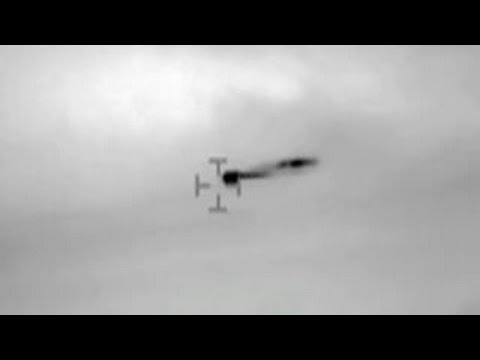
UFO? Chilean Navy Releases Video of Mysterious Flying Object
Fox News' January 2017 television report on CEFAA's public release, covering the crew's account, the radar failures, and General Bermúdez's official statement.
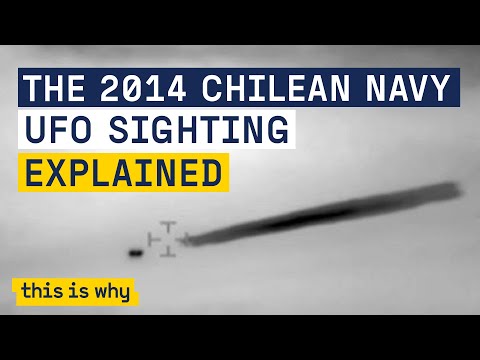
Chilean Navy UFO Sighting Explained | This Is Why
7NEWS Australia's explainer segment walking through the case and the leading conventional-aircraft explanation for general audiences.
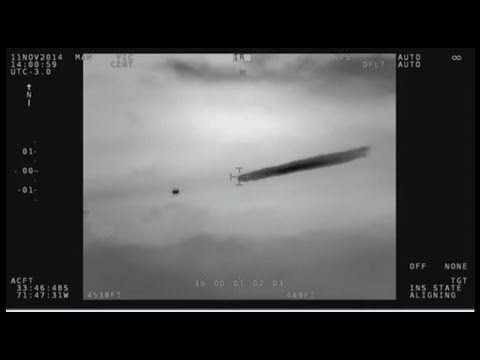
Armada Chilena Confirma Avistamiento de un OVNI en el Año 2014
Spanish-language wire report from Agencia EFE covering the Chilean Navy's official confirmation of the sighting and CEFAA's release.
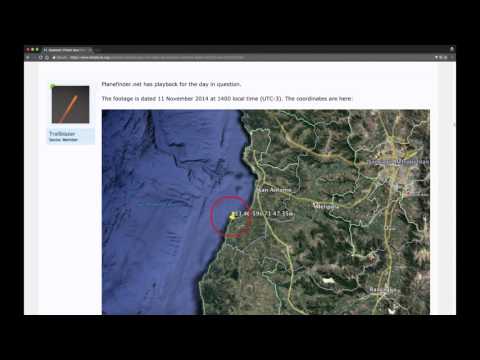
Metabunk Minute — Chilean Navy UFO
Mick West's own 60-second summary of the Metabunk team's flight-IB6830 identification, posted January 9, 2017, four days after CEFAA's public release.
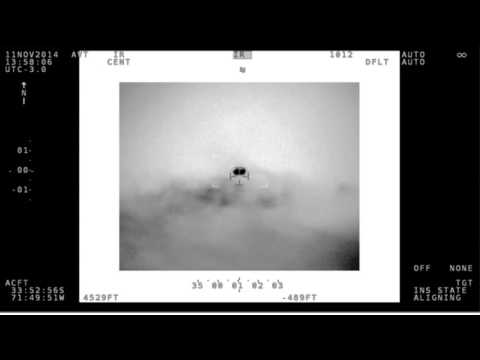
Chile Helicopter UFO — FULL Footage
The complete ~9-minute WESCAM MX-15 FLIR recording as released alongside Leslie Kean's January 2017 reporting — the case's primary visual evidence in full.
Sources
- Kean, Leslie. "Groundbreaking UFO Video Just Released By Chilean Navy," The Huffington Post, January 5, 2017. huffpost.com
- Kean, Leslie. "The Chilean Navy UFO Video: Is It A Plane?" The Huffington Post, January 2017. huffpost.com
- Mick West. "Explained: Chilean Navy 'UFO' video — Aerodynamic Contrails, Flight IB6830," Metabunk forum thread, January 2017. metabunk.org
- Dunning, Brian. "Skeptoid #838: The Chilean Navy UFO," Skeptoid, June 28, 2022. skeptoid.com
- Newsweek. "Chilean Navy Can't Identify Mysterious Aircraft Caught on Video," January 2017. newsweek.com
- Fox News / The Sun. "UFO? Chilean Navy releases video of mysterious flying object," January 2017. foxnews.com
- IFLScience. "Chilean Government Releases An Unexplainable 'UFO Sighting' Video," January 9, 2017. iflscience.com
- SEFAA (formerly CEFAA), Dirección General de Aeronáutica Civil, Chile. Official agency history and founding resolution. sefaa.dgac.gob.cl
- Dirección General de Aeronáutica Civil (DGAC), Chile. "CEFAA: Un Modelo Investigativo de Fenómenos Aéreos Anómalos." dgac.gob.cl
- The Black Vault. "Documents Released on the November 11, 2014, Chilean Navy Helicopter UFO Encounter." theblackvault.com
- Universe Today. "Chilean Government Releases Declassified UFO Video," January 2017. universetoday.com
- SOFREP. "Chilean Government Releases Footage of UFO Captured by Navy Helicopter." sofrep.com
- Player.One. "UFO Sightings 2017: Chile Video Of Mystery Craft Has A Flight Number, No Chemtrails." player.one
- Skeptical Inquirer. "Curated Crowdsourcing in UFO Investigations." skepticalinquirer.org
- IBTimes UK. "UFO sighting by Chile navy in 2014 remains unidentified as per latest government report." ibtimes.co.uk
- ClickOnDetroit / Graham Media Group. "Unexplained UFO video declassified by Chilean Navy," January 11, 2017. clickondetroit.com
- NBC News. "Video from Chile stirs up UFO buzz." nbcnews.com
- Bird In Flight. "Chilean Military Published a Previously Classified Video with a UFO," January 11, 2017. birdinflight.com
- West, Mick. "Metabunk Minute — Chilean Navy UFO," Metabunk / Mick West blog, January 9, 2017 (companion post to the YouTube explainer). metabunk.org
- Wikimedia Commons. "Cougar_chile_unitas_47-06.jpg" (public domain, photographer Evogol, 2006). commons.wikimedia.org
- DVIDS. "A Chilean Navy AS532 Cougar Eurocopter takes off from USS Carl Vinson (CVN 70)," U.S. Navy photo by MC2 Elizabeth Grubbs, July 2024 (background reference on the aircraft type). dvidshub.net
- Armada de Chile. "Historia del Escuadrón de Helicópteros de Propósitos Generales HU-1." armada.cl
- L3Harris / WESCAM. "WESCAM MX-15, Air Surveillance and Reconnaissance" — technical specifications. l3harris.com
- Agencia EFE. "Armada chilena confirma avistamiento de un ovni en el año 2014," January 2017 (wire report).
- Clark, Jerome. The UFO Encyclopedia, 4th Edition, Visible Ink Press, 2023.
See something inaccurate? Have additional information or sources?
Suggest an Edit →Last Updated: August 2026