
St Athan Police Helicopter Chase
In the early hours of June 8, 2008, a three-man South Wales Police Air Support Unit helicopter crew, holding at 500 feet awaiting clearance to land at MOD St Athan, reported a brightly lit, saucer-shaped object closing on their aircraft at speed. The crew took evasive action and followed the object out across the Bristol Channel before breaking off, low on fuel, near the North Devon coast. Within days the story had become international tabloid news; within weeks, South Wales Police's own official statement had contradicted much of the drama, and researcher David Clarke had offered a considerably more mundane explanation.
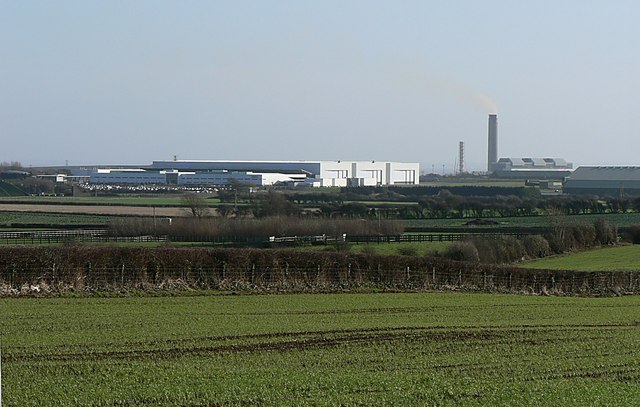
Pictured: the DARA maintenance hangar at MOD St Athan, Vale of Glamorgan, photographed in January 2008 — the base whose air traffic control the helicopter crew was awaiting landing clearance from at the moment of the sighting. This is not a photograph of the reported object itself, which was never captured on film, video, or by any onboard instrument; no photograph of the actual incident is known to exist.
Theoretical Alignment
The case aligns most strongly with the Psycho-Social Hypothesis: a startling, close-range visual misperception (very plausibly a Chinese sky lantern, drifting at low altitude and close range against a dark sky) combined with the adrenaline of an apparent near-miss, then amplified into a national "UFO attack" narrative by a tabloid press eager to run with an unnamed police source's dramatized account. Neither the Extraterrestrial nor Interdimensional Hypothesis frameworks are well supported: the object displayed none of the sustained high-performance kinematics (instrument-verified acceleration, hypersonic transit, trans-medium travel) that anchor the strongest ETH-aligned cases on this site, and nothing in the record suggests dimensional or non-physical phenomena.
Background
MOD St Athan is a large Ministry of Defence installation on the South Wales coast, roughly fifteen miles southwest of Cardiff in the Vale of Glamorgan. Built as an RAF station in the 1930s, by 2008 the site combined a still-active military airfield with the Defence Aviation Repair Agency's (DARA) large aircraft maintenance hangars, various RAF training units, and — critically for this case — the home base of the South Wales Police Air Support Unit, the force's dedicated helicopter squadron providing aerial support for pursuits, searches, and surveillance across South Wales. In 2008 the unit (which would be absorbed into the National Police Air Service, a UK-wide consolidated air support body, in October 2012) operated a twin-engine Eurocopter EC135, a common type across British police forces of the period, fitted with a NiteSun searchlight and forward-looking infrared (FLIR) thermal imaging — standard equipment for night search, surveillance, and pursuit work, and instrumentation that would become directly relevant to how this case was later assessed.
The sighting arrived at a specific moment in British UFO history. In May 2008, the UK Ministry of Defence, working with David Clarke as media consultant and curator, had begun releasing tens of thousands of pages of previously secret UFO desk files to The National Archives — the first of ten scheduled batches that would eventually total roughly 60,000 pages before the project concluded in 2013. The releases generated heavy UK press interest in UFOs throughout the summer of 2008, and by late June a loosely connected wave of sightings across England, Scotland, and Wales — overwhelmingly small, slow-moving orange lights, many later traced to the newly fashionable practice of releasing lit Chinese sky lanterns at weddings and parties — had become tabloid staples, with The Sun running a front-page "Alien Army" headline over a cluster of reports that included this case. The St Athan sighting, involving trained police aircrew rather than a member of the public, stood out from that broader wave and received outsized coverage as a result, appearing in The Sun, the South Wales Echo, The Register, Fox News, and wire coverage that reached audiences well beyond the UK.
RAF St Athan's own history stretches back to 1938, when it opened as one of the largest RAF stations in the country, eventually growing to include two separate airfields and, at its wartime peak, a workforce of several thousand. Its long-running specialization in aircraft maintenance and overhaul continued through the postwar decades and into the site's 2000s-era operation by the Defence Aviation Repair Agency, before the airfield itself transferred to civilian Welsh Government control in 2019 and was rebranded Bro Tathan Business Park, with the adjoining barracks area remaining an active military site under the Special Forces Support Group and other units. In June 2008, however, the base's most operationally relevant tenant for this case was simply the South Wales Police Air Support Unit, whose helicopter used St Athan's runway and air traffic control as its home base for night operations across the force's area.
No official investigator from the Ministry of Defence's small UFO desk — by 2008 reduced to a minimal, largely reactive logging function rather than the active Cold War-era analysis project of Nick Pope's early 1990s tenure — ever attended the scene or interviewed the crew in person. The case exists today almost entirely as a press artifact: an initial, dramatized tabloid account; a subsequent, considerably more measured official police statement that contradicted several of the tabloid's central claims; a skeptical explanation offered publicly within weeks by the same researcher then serving as the National Archives' UFO files consultant; and, a decade later, a single further interview with the pilot that added new descriptive detail while also changing some of the object's reported characteristics.
Complete Timeline
| Date | Event |
|---|---|
| May 14, 2008 | The UK Ministry of Defence, working with David Clarke, begins releasing the first batch of MoD UFO desk files to The National Archives, sharply raising UK press appetite for UFO stories through the following summer. |
| c. June 7, 2008, late evening | A South Wales Police Air Support Unit helicopter crew of three is airborne on routine tasking over South Wales; a newlywed couple in Cowbridge, roughly six miles from St Athan, hold a wedding reception at which, according to later press reporting, around 100 Chinese sky lanterns are released between 11 p.m. and 2 a.m. |
| June 8, 2008, approx. 12:25–12:40 a.m. | Returning to base, the helicopter holds at roughly 500 feet awaiting clearance to land at MOD St Athan. The crew reports a brightly lit, saucer-shaped object approaching rapidly from below; the pilot takes evasive action to avoid a possible collision. |
| June 8, 2008, immediately after | The crew reports following the object as it moved off toward the coast, crossing the Bristol Channel before losing sight of it and turning back, citing low fuel, in the vicinity of the North Devon coast. |
| June 8, 2008, daylight hours | Retired RAF glider pilot George Withrington, roughly ten miles away in St Mellons, Cardiff, separately reports a brief sighting while watching an aircraft pass overhead — a report later noted in South Wales Echo coverage of the same story but never established as connected to the helicopter crew's account. |
| June 20, 2008 | The Sun publishes journalist John Coles's report, dramatizing the sighting as a UFO "attack" on the helicopter followed by a high-speed chase; the South Wales Echo, the Daily Telegraph, and other UK outlets follow within days, and wire coverage carries the story internationally, including to RTÉ and Fox News. |
| June 21, 2008 | South Wales Police issues its own, considerably more measured statement confirming only that its Air Support Unit "sighted an unusual aircraft" and reported it to the relevant authorities, explicitly denying any "attack," any sustained pursuit in the dramatic terms the tabloids described, and any danger to the crew. Inspector Ann Johnson tells the press that, in all probability, the sighting simply confirmed that some ordinary aircraft had been in the area. |
| June 21–24, 2008 | MoD community relations officer for Wales Peter Sinclair tells reporters that no MoD personnel were present at St Athan and that the department has no independent record of the incident, adding he would "really like to know the truth of the story." BBC reporting subsequently attributes the most likely source of the sighting to the Chinese lanterns released at the Cowbridge wedding. |
| June 25, 2008 | An Associated Press wire report quotes David Clarke, then media consultant to the MoD UFO files project, stating that a helicopter pilot seeing brightly lit Chinese lanterns at night "could easily think he was looking at another aircraft" — the most authoritative skeptical assessment the case would receive. |
| August 10, 2018 | The Swansea UFO Network (SUFON) publishes a new interview with the helicopter pilot, a decade after the event, adding descriptive detail (a small, translucent, basketball-sized sphere containing a red and a green light, unaffected by rotor downwash, invisible to the helicopter's own night-vision equipment) that differs in several respects from the object described in the original 2008 press accounts. |
The Sighting and the Pursuit
According to the account first published by John Coles in The Sun on June 20, 2008, and repeated with minor variations across subsequent UK and international coverage, the South Wales Police Air Support Unit's three-man helicopter crew was returning from a routine night patrol and holding at approximately 500 feet, awaiting air traffic clearance to land at MOD St Athan, when a brightly lit object — described in this original account as "saucer-shaped" and "circled by flashing lights" — appeared to close on the aircraft at considerable speed from below. The pilot, believing a collision was possible, banked the helicopter sharply to avoid it. The Sun's account, sourced to unnamed police contacts Coles described only as "well-placed," quoted a crew member as saying that had the aircraft not moved, "it would have been a direct hit."
Rather than simply resuming its approach, the crew is reported to have turned to follow the object as it moved off toward the coast. The pursuit, as originally reported, carried the helicopter out across the Bristol Channel — the tidal estuary separating South Wales from Devon and Somerset — before the crew lost visual contact with the object and, with fuel running low, broke off in the vicinity of the North Devon coast and turned back. No radar station, civilian or military, is known to have logged a corresponding contact, and no other aircraft or ground observer in the Bristol Channel corridor that night is recorded as having reported anything matching the object's reported flight path.
This account was substantially disputed within a day of the story breaking internationally. South Wales Police's own press office, responding to the flood of media enquiries the Sun's story generated, released a statement confirming only that "its Air Support Unit sighted an unusual aircraft. This was reported to the relevant authorities for their investigation" — language conspicuously avoiding the word "UFO" altogether. Force spokespeople went further in follow-up conversations with reporters, explicitly denying that the helicopter had been "attacked," denying that any sustained chase in the dramatic terms the tabloids described had taken place, and insisting the crew had at no point been in genuine danger. Control room inspector Ann Johnson offered the force's preferred, deliberately unremarkable framing: that in today's skies there is a wide range of aircraft of many shapes and sizes, and that, in all probability, the crew's sighting had simply confirmed that one such aircraft — conventional, not anomalous — had been in the area at the time.
This is an unusually stark example of a documented gap between a story's originating tabloid account and the primary source organization's own subsequent, on-the-record description of the same event. It leaves open a genuinely difficult evidentiary question for any assessment of the case: how much of the "attack" and "chase" framing that made the story newsworthy reflects what the crew actually reported through internal channels, and how much reflects embellishment introduced somewhere between an unnamed "well-placed" source and a tabloid newsroom under deadline. South Wales Police never identified which parts of Coles's account it considered accurate and which it considered exaggerated, beyond the blanket denials of "attack," "chase," and "danger" — leaving the case with no single, internally consistent official narrative of what the crew experienced.
The pattern is a familiar one in British tabloid UFO reporting more broadly: a genuinely puzzling but comparatively modest report reaching a newspaper through an unnamed intermediary, then being reframed with dramatic verbs ("attacked," "chased," "zoomed straight at") and unattributed dialogue ("it would have been a direct hit") that the story's own named institutional source never confirms and, in this case, specifically denied. Because The Sun's own sourcing for the story was never made public beyond Coles's description of "well-placed" contacts, there is no way for a later researcher to determine whether the dramatic language originated with the crew themselves in an informal, unguarded moment, with a control-room colleague relaying secondhand gossip, or purely with the reporter's own editorial embellishment of a plainer original tip. This ambiguity is not a minor footnote to the case; it is the central obstacle to assessing it at all, since nearly every other analytical judgment about credibility, instrumentation, and plausibility depends on first establishing what was actually reported before deciding how anomalous it was.
A Second, Later Description
A full decade after the original story, in an August 10, 2018 interview conducted by the Swansea UFO Network (SUFON), the helicopter's pilot gave a considerably more detailed — and, in several respects, different — account of the object than the one that had appeared in the original 2008 press coverage. Rather than a "saucer-shaped" craft "circled by flashing lights," the pilot described a small, translucent, basketball-sized sphere that approached to within roughly three feet of the cockpit window as the helicopter descended, containing what he described as a small red light and a small green light positioned side by side at its centre. He said the object was unaffected by the helicopter's rotor downwash, gave off no detectable heat signature, and was invisible to the aircraft's onboard night-vision equipment despite being clearly visible to the naked eye. In this later account, the object is described as descending toward a farmyard and a nearby road before the crew tracked it toward the coast.
The shift between these two descriptions — a saucer-shaped, light-ringed craft that "attacked" the aircraft in the 2008 tabloid telling, versus a small, gently pacing translucent sphere in the 2018 interview — is itself a significant piece of evidence in assessing the case's overall reliability. It could reflect a 2008 press account that distorted or over-dramatized a more modest original report; it could reflect a decade of retelling reshaping the pilot's own memory of the encounter, a well-documented phenomenon in eyewitness testimony generally; or some combination of both. What it does not offer is a single, stable physical description of the object that has remained consistent from the night of the sighting to the present day, a contrast with cases on this site, such as the Coyne helicopter incident, where cockpit crew testimony given to investigators within hours of the event has held up largely unchanged for decades.
Professional Pilot Reaction
Beyond the mainstream press coverage, the story also drew a distinct third strand of commentary: professional aviators discussing the case among themselves on PPRuNe (the Professional Pilots Rumour Network), one of the largest specialist internet forums for working pilots and aircrew. That discussion is notable less for any new factual detail than for its tone: contributors were broadly skeptical not of the crew's honesty but of the reporting itself, mocking the vagueness of South Wales Police's official statement and noting that accompanying newspaper photographs of "police helicopters" frequently showed the wrong aircraft type entirely (Twin Squirrel helicopters rather than the Eurocopter EC135 the unit actually operated at the time). Several posters raised the possibility of a stray unmanned aerial vehicle from the nearby Aberporth military UAV test range in west Wales having "gone walkabout," while others, independently of any of the mainstream coverage, arrived at the same Chinese-lantern explanation David Clarke would later give more authoritatively. The thread is a useful, independent data point precisely because it comes from people professionally equipped to judge how ordinary aircraft and their lighting actually appear at night, rather than from either tabloid journalists or committed UFO researchers.
Key Witnesses
South Wales Police Air Support Unit Helicopter Crew (unnamed)
The three trained police aircrew who reported the sighting have never been publicly named, consistent with standard UK police practice of not identifying operational officers to the press. Their account is known only at second hand: through the original, dramatized version relayed by an unnamed "well-placed" police source to John Coles of The Sun; through South Wales Police's own subsequent, more measured on-the-record statement, which contradicted several of the tabloid's specifics; and, for the pilot specifically, through a single further interview conducted by SUFON a decade later in 2018, which offered new descriptive detail while also diverging from the object's original 2008 description. No named, first-hand, on-the-record account from any of the three crew members exists in the public record independent of these intermediaries.
George Withrington
A retired RAF glider pilot who reported his own brief sighting during daylight hours on June 8, 2008 — the same date as the helicopter crew's pre-dawn encounter, roughly ten miles away in St Mellons, Cardiff — after something caught his eye "in the corner of my eye" while he was watching a passing aircraft overhead. His aviation background made his account one of the more closely noted secondary reports in South Wales Echo coverage of the story, though no investigator, then or since, has established any direct connection between his sighting and the helicopter crew's report beyond their shared date and general region.
Terry Phillips
A 64-year-old neighbourhood watch coordinator who told the South Wales Echo that he had "seen strange things in the sky over the years" and speculated that the object was "something not from this planet," explicitly dismissing an official balloon or weather explanation. Phillips did not claim to have witnessed the helicopter incident itself; his remarks are evidence of the story's public reception in Cardiff rather than first-hand testimony about the object.
The Five Observables Assessment
The Five Observables framework, drawn from the Advanced Aerospace Threat Identification Program's (AATIP) analytical criteria, is applied to the performance characteristics reported in this case:
Assessment: The case exhibits essentially none of the Five Observables' high-performance signatures. The only candidate is "Instant Acceleration," and even that rests entirely on the crew's unaided visual estimate of a small light's closing speed against a dark sky at night — precisely the kind of judgment most vulnerable to misperception, since a nearby small object (such as a drifting lantern) reliably appears to move far faster, and to close far more rapidly, than a distant large one moving at the same true angular rate. No instrument of any kind measured the object's actual speed, altitude, or heading at any point during the encounter.
Evidence Assessment
Supporting Anomalous Origin
- The primary witnesses were trained police aircrew performing operational duties, not casual observers, and none is known to have had any prior involvement with ufology.
- All three crew members reportedly gave broadly consistent accounts of a close-range object requiring evasive action, at least in the outline conveyed to South Wales Police's own press office.
- The 2018 pilot interview describes an object with an unusual, sustained flight behavior (pacing the aircraft, unaffected by rotor downwash) rather than a single fleeting glimpse.
- The object was reportedly invisible to the helicopter's own night-vision equipment despite being visible to the naked eye, a detail some researchers have flagged as difficult to fully reconcile with a simple lantern.
Supporting Conventional Explanation
- A specific, dated, and independently reported source of approximately 100 Chinese sky lanterns exists for the same night, within a few miles of the sighting location.
- David Clarke, the researcher with the most direct professional access to the MoD's own UFO files at the time, publicly endorsed the lantern explanation within weeks of the story breaking.
- South Wales Police's own official statement directly contradicts the "attack" and sustained "chase" framing that made the story notable in the first place, undermining confidence in the tabloid account's accuracy.
- No radar, photographic, video, or independent ground-witness corroboration of the object exists anywhere in the public record.
- The object's reported physical description changed substantially between the original 2008 press account and the pilot's own 2018 interview, a pattern consistent with retelling and memory drift rather than a stable, well-documented anomaly.
- The Ministry of Defence's own released "UFO Reports 2008" log — the year's actual desk-diary of sightings reported to the department — contains no entry matching this incident's date or location, despite South Wales Police's statement that the sighting was "reported to the relevant authorities."
Why "Disputed"
The St Athan case earns a DISPUTED rating because its evidentiary record is dominated by contradiction rather than corroboration. On the credibility side of the ledger, the report originates with trained police aircrew performing a routine operational flight, a genuine positive signal shared with cases like the Coyne helicopter incident. But nearly everything else about the case's record works against it. The dramatic "attack" and cross-channel "chase" that gave the story its news value were explicitly and specifically denied by South Wales Police's own on-the-record statement — meaning the case's own primary source organization disputes the central narrative that makes it notable, not merely a peripheral detail. No instrument aboard the helicopter itself — not the aircraft's FLIR thermal camera, not its NiteSun searchlight, not its radios, nothing — produced any corroborating trace of the object; by the pilot's own later account, it was invisible to the one system (night vision) most likely to have detected a genuine anomaly at night. A specific, dated, geographically proximate conventional source (a wedding's Chinese lanterns) was identified within weeks and endorsed by David Clarke, the one researcher with direct access to the MoD's own contemporaneous UFO files. And the object's physical description itself is not stable across the record: a "saucer-shaped" craft "circled by flashing lights" in 2008 became, by 2018, a small translucent sphere with two internal lights, a shift that raises real doubt about how reliably the core details have been preserved from the night in question to the present telling. Taken together — credible witnesses, but a self-contradicting record, no instrumented corroboration, a strong dated conventional candidate, and a drifting core description — the case sits well below the "Credible" threshold this site reserves for reports like Coyne's, but its origin with trained aircrew and its genuine, unresolved internal contradictions keep it from the more conclusively closed "Debunked" category.
Sensor & Instrumentation Detection Profile
No sensor of any kind — military, civilian, or the helicopter's own onboard systems — produced a corroborating record of the object. South Wales Police Air Support Unit's Eurocopter EC135 of the period carried a forward-looking infrared (FLIR) thermal imaging turret and a NiteSun high-intensity searchlight, both standard night-operations equipment for UK police helicopters, but no footage or thermal imagery from either system has ever been published or referenced by South Wales Police, the Ministry of Defence, or any subsequent investigator; if either system was used during the encounter, its output has never entered the public record. According to the pilot's 2018 account, the object was specifically not visible through the aircraft's night-vision equipment despite being plainly visible to the naked eye — an unusual detail, since a genuinely warm, self-luminous object of the kind described (with what the pilot called internal red and green lights) would ordinarily be expected to register on infrared or image-intensifying equipment more readily than to the unaided eye at night, not less. No civil or military radar station is known to have logged any contact matching the object's reported track across the Bristol Channel, and no request for radar data appears to have been made by South Wales Police, the MoD, or any independent researcher in the years since. The absence of any instrument trace whatsoever, from an aircraft that was carrying instruments specifically designed to detect exactly this kind of nighttime aerial contact, is one of the case's most significant evidentiary gaps.
This gap is thrown into sharper relief by how central FLIR and NiteSun equipment already were to routine UK police air support work by 2008: both systems existed specifically to give a helicopter crew reliable detection of people, vehicles, and aircraft at night beyond what the unaided eye can resolve, and both were standard fit on the EC135 and similar airframes used by the South Wales Police Air Support Unit and its counterparts nationwide. A genuinely anomalous, structured craft passing within a few hundred feet of a helicopter carrying that equipment would be an unusual thing for that equipment to miss entirely; a small, low-heat, flame-lit lantern passing at a similar distance, whose thermal signature can register unpredictably depending on the sensor's exact field of view and gain settings at the moment of observation, is a far less surprising thing for the same equipment to fail to capture clearly.
Environmental & Geospatial Context
The sighting occurred on a clear, calm early-summer night over the Vale of Glamorgan coastline, conditions good enough for a wedding reception in nearby Cowbridge to release sky lanterns outdoors without apparent difficulty and for those lanterns to remain aloft and visible for an extended period — exactly the kind of still, dry night that favors both a genuine widespread lantern release and, independently, good visual conditions for spotting distant lights against a dark sky. Geospatially, MOD St Athan sits on the open, low-lying coastal plain of the Vale of Glamorgan, directly facing the Bristol Channel and within a regional airspace that, in 2008, combined the base's own military and police helicopter traffic with civilian approaches to nearby Cardiff International Airport roughly ten miles to the east. Prevailing surface winds in the area are predominantly westerly to southwesterly, which would tend to carry lanterns released from Cowbridge (roughly six miles north-northwest of St Athan) on a path broadly consistent with the direction from which the object was reported approaching, though no specific hour-by-hour wind record for the night has been located in this research. The Vale of Glamorgan's coastal geography also means that any object genuinely departing St Athan's airspace toward open water has very few directions to go other than south or southwest across the Bristol Channel itself, simply because the coastline curves directly into open estuary water within a few miles of the base in that direction — a geographic fact equally consistent with a structured craft deliberately withdrawing over water and with a lightweight, wind-borne object continuing to drift on whatever course it had already been carried by the prevailing breeze before the crew ever noticed it. No solar or geomagnetic activity of any note was reported in the relevant space-weather archives for the date, and nothing in the case's own record suggests any electromagnetic environmental factor beyond ordinary VHF/UHF air-traffic-control communications, which appear to have functioned normally throughout.
Observer Credibility & Occupational Profile
The case's central witnesses are, on paper, a credible group: three trained South Wales Police Air Support Unit aircrew engaged in operational night flying, the same broad category of witness — disciplined, professionally trained, without any known prior interest in ufology — that gives cases like the Coyne helicopter incident and the Cosford Incident real evidentiary weight on this site. Unlike those cases, however, none of the St Athan crew has ever been named, interviewed on the record under their own name by a mainstream news organization, or subjected to a formal investigative debrief whose results were published. What exists instead is a chain of secondhand and thirdhand relay: an unnamed "well-placed" source's account reaching print through John Coles; South Wales Police's own institutional statement, issued by its press office rather than by any individual crew member; and, for the pilot alone, a single anonymous-in-substance interview conducted by an amateur research group a full decade after the fact. This chain of intermediaries, and the significant divergence between the object's 2008 and 2018 descriptions, means the crew's underlying credibility as trained observers cannot by itself resolve how accurately their actual, original report has been preserved and represented across ten years of retelling. Secondary witness George Withrington, a retired RAF glider pilot, likewise brings genuine aviation credentials to his own separate same-day report, though his sighting has never been substantively connected to the helicopter crew's account beyond coincidence of date and region.
UK police air support crews of this era were, and remain, drawn from officers who complete dedicated aircrew training beyond their normal police service, including night-flying qualification and instruction in the specific use of onboard FLIR and searchlight systems — training explicitly intended to make them more reliable observers of exactly the kind of ambiguous nighttime aerial contact this case involves, not less. That professional training is precisely why the case's central contradiction matters so much: a crew trained to distinguish a genuine aerial hazard from a misleading light source is a stronger witness than an untrained member of the public would be, but the same training and operational context make South Wales Police's own on-the-record rejection of the tabloid's "attack" and "chase" framing considerably harder to dismiss as institutional damage control rather than as the crew's own more accurate, and more mundane, original account finally reasserting itself over an inflated press retelling.
Physical & Material Assays
No physical evidence of any kind is associated with this case, and none has ever been claimed. There is no debris, no landing trace, no recovered material, and no photograph or video of the object from any source, official or private. The one physical artifact sometimes cited in later retellings — footage referenced on some UFO aggregator sites under similar search terms — belongs to an unrelated, later South Wales Police helicopter infrared clip from a separate incident, and no footage genuinely depicting the June 2008 St Athan sighting has ever surfaced; this research specifically checked and ruled out that conflation before reaching this conclusion. In the complete absence of any recoverable or testable physical trace, this case rests entirely on witness testimony relayed through the press, and any assessment of it must be made on those terms alone.
Historical Precedents & Archive Matches
The St Athan case belongs to a recognizable and fairly common sub-genre within British ufology: the police or military aircrew sighting that is later resolved, or strongly disputed, by a specific misidentified light source rather than remaining a genuine unknown. Its closest analogue on this site is the RAF Cosford / Shawbury sighting of March 31, 1993, in which a Shropshire Met Office observer's dramatic report of a low, hovering triangular craft sweeping a searchlight beam across a field was ultimately traced by David Clarke's own later research to a Dyfed-Powys Police helicopter using its NiteSun searchlight during an unrelated vehicle pursuit nearby — a case in which the exact same class of equipment carried aboard the St Athan crew's own aircraft became, in a different 1993 incident, the misidentified "UFO" itself. The broader June 2008 UK sighting wave that swept up the St Athan story alongside dozens of lesser-known reports (many logged in the MoD's own released 2008 sightings register, overwhelmingly describing small orange lights consistent with lanterns) provides a second, wider precedent: a specific, unusual cultural practice (the sudden mid-2000s popularity of releasing Chinese sky lanterns at British weddings and parties) generating a short-lived nationwide spike in genuinely puzzling sightings, later traced collectively to that single mundane source once researchers began asking the right question. The Pentyrch UFO Incident of February 2016, occurring within fifteen miles of St Athan in the same general Vale of Glamorgan military-aviation corridor, offers a further regional precedent for genuinely puzzling nighttime aerial reports in this specific part of South Wales, though that case's own evidentiary profile and conclusions differ substantially from this one.
More broadly, the sudden popularization of releasing lit sky lanterns at weddings, festivals, and private celebrations produced comparable UFO scares across many countries in the years either side of 2008, each independently resolved once investigators traced the specific event that generated the lights: from clusters of "UFO" reports across England and Scotland in the same June 2008 wave logged in the MoD's own sightings register, to unrelated but structurally identical lantern-driven scares reported in later years in Texas, Utah, and elsewhere, in each case involving trained or credible witnesses, brief but intense local media coverage, and an eventual identification of a nearby, dated celebratory lantern release. The St Athan case fits this broader pattern closely enough — a credible witness, a short-lived intense news cycle, and a specific, geographically and temporally proximate lantern source identified within weeks — that its main point of genuine distinctiveness within the pattern is the professional status of its primary witnesses, not any unusual feature of the object itself.
Material Analysis
As already noted under Physical & Material Assays, this case has no physical evidence whatsoever — no debris, no trace, no recovered fragment, no photograph, no video. The "Material Analysis" the case can actually support is therefore not a laboratory or forensic one but an evidentiary one: an assessment of whether the reported behavior of the object is more consistent with a solid, structured craft or with a lightweight, wind-borne light source. Chinese sky lanterns are small paper-and-wire hot-air balloons, typically 60–100cm tall, lofted by a suspended fuel cell that burns for roughly ten to twenty minutes; released in numbers from a single location, they drift with the prevailing wind at low, variable altitude, can appear to accelerate or change direction as updrafts and their own burn cycle affect them, give off a genuine (if modest) heat signature from their flame that can register unpredictably on different infrared sensor types depending on distance and viewing angle, and are frequently reported by trained pilots and police officers as a "UFO" specifically because their light, motion, and apparent size at a distance mimic a small aircraft closely enough to prompt a genuine, good-faith safety reaction, exactly as this case's crew described.
Supporting Non-Terrestrial Origin
- The pilot's 2018 account describes the object maintaining position relative to the helicopter and being unaffected by rotor downwash, behavior not typically associated with a freely drifting lantern.
- The object was reportedly invisible to the aircraft's night-vision equipment, which some researchers have argued is difficult to reconcile with a genuinely flame-lit lantern at close range.
Supporting Terrestrial Origin
- A specific, dated, nearby source of approximately 100 released sky lanterns exists for the same night, independently reported in press and broadcast coverage.
- Sky lanterns are well documented, worldwide, as producing exactly this class of misidentification — a small, bright, erratically moving light mistaken for a fast-approaching aircraft or "UFO" — including by trained pilots and police officers in numerous other, better-documented cases.
- No debris, trace, or independent instrument reading supports a structured, solid craft interpretation; the entire anomalous-origin case rests on witness impression alone.
- The object's own reported description changed substantially over time, a pattern more consistent with a briefly and imperfectly observed mundane light than with a stable, well-preserved memory of a genuinely unique craft.
The Conventional Explanation Candidate: Chinese Sky Lanterns
The leading conventional explanation, publicly endorsed within weeks of the sighting by David Clarke — at the time the media consultant and curator for the Ministry of Defence's own UFO files project with The National Archives, and therefore among the best-positioned researchers in Britain to assess the case against the full context of that year's reports — holds that the crew encountered one or more Chinese sky lanterns released from a wedding reception in nearby Cowbridge, roughly six miles from St Athan, where press and broadcast reporting later established that a newlywed couple had released approximately 100 lanterns between 11 p.m. and 2 a.m. the same night. It deserves serious evaluation because every element of the timing, geography, and object behavior fits the lantern hypothesis unusually well: a small, drifting, flame-lit light source released in bulk just a few miles upwind of the sighting location, at almost exactly the hour of the encounter, on a night calm and clear enough for a large outdoor lantern release to occur without difficulty and for the lanterns themselves to remain aloft and visible for an extended period afterward. Later BBC reporting specifically attributed the identification to broadcast journalists following up on the story after the initial press flurry, tracing the timing and location of a local wedding lantern release rather than any formal MoD or police forensic investigation — a reminder that, in the absence of any official inquiry into the sighting itself, the case's own leading explanation was arrived at through ordinary journalistic legwork rather than a structured investigative process comparable to, for example, the National Archives' own later curated review of MoD desk files.
The 2008 UK "UFO Wave" Context
A second, related candidate treats the St Athan sighting not as an isolated misidentification but as one data point within the wider, well-documented UK sighting wave of May–July 2008, during which the mid-2000s popularization of releasing lit sky lanterns at British weddings and parties produced a genuine nationwide spike in orange-light UFO reports, many independently logged in the Ministry of Defence's own released 2008 sightings register. This candidate strengthens the lantern explanation rather than competing with it: it supplies an independently documented mechanism (a real cultural fad, arriving in Britain at exactly this time) for why so many credible, level-headed witnesses across the country — including, in other cases from the same summer, other police officers and aircrew — were independently reporting similar small, drifting, hard-to-identify aerial lights within the same narrow window.
Misidentified Conventional Aircraft
A third candidate, offered by South Wales Police's own inspector Ann Johnson in her deliberately unremarkable public statement, holds that the crew most likely observed an ordinary aircraft of some kind — civil, military, or general aviation — whose lights and motion were misjudged under the stress and disorientation of an apparent near-miss at night. This candidate is weaker than the lantern hypothesis specifically because it identifies no actual aircraft, flight, or scheduled movement that can be matched to the reported time and place, and because no radar or air-traffic data has ever been produced to support it; it functions more as an institutional placeholder statement than a substantiated finding. Cardiff International Airport's civilian traffic and the base's own routine military movements mean some level of ordinary aviation activity in the vicinity on any given night is unremarkable, but "some aircraft was probably nearby" is a materially weaker, less falsifiable claim than the specific, dated, and independently corroborated lantern release six miles away.
Deliberate Tabloid Exaggeration of a Minor Report
A fourth, distinct candidate holds that the crew's original report to South Wales Police was itself comparatively minor and unremarkable — consistent with the force's own description of "an unusual aircraft" — and that the "attack," near-collision, and cross-channel "chase" framing originated largely with The Sun's unnamed source and John Coles's dramatized write-up, rather than with the crew's own account. This candidate is supported by South Wales Police's specific, repeated denials of "attack," "pursuit," and "danger," but cannot be fully verified or refuted because none of the three crew members has ever given a full, named, on-the-record account of exactly what they told their own force.
Chinese Sky Lanterns (Cowbridge Wedding)
PlausiblePLAUSIBLE: a specific, dated, geographically proximate source of roughly 100 released lanterns exists for the same night, publicly endorsed by David Clarke, the researcher with the most direct contemporaneous access to the MoD's own UFO files. Fits the timing, location, and general behavior of the report closely, though it cannot fully explain the pilot's 2018 account of an object unaffected by rotor downwash and invisible to night-vision equipment.
Wider 2008 UK Lantern Wave
PlausiblePLAUSIBLE as supporting context rather than a standalone explanation: independently documents the mechanism (a new, fast-spreading cultural practice) that produced dozens of comparable misidentifications nationwide in the same narrow window, strengthening rather than competing with the specific Cowbridge lantern explanation.
Misidentified Conventional Aircraft
InconclusiveINCONCLUSIVE: offered by South Wales Police's own inspector as the force's preferred framing, but no specific aircraft, flight, or radar contact has ever been identified to substantiate it. Functions as an institutional placeholder rather than a demonstrated finding.
Tabloid Exaggeration of a Minor Report
InconclusiveINCONCLUSIVE: consistent with South Wales Police's specific denials of "attack," "pursuit," and "danger," but unverifiable in the absence of any named, on-the-record account from the crew themselves describing what they actually reported to their own force.
Related Cases
Confirmed Documents & Official Records
The department's own year-end log of UFO sightings reported to it in 2008. Contains no entry matching the St Athan incident's date, time, or location, despite South Wales Police's statement that the sighting was reported to the relevant authorities — a notable gap directly relevant to this case's credibility assessment.
UNCLASSIFIED / RELEASEDOfficial finding aid for the DEFE 24 series of declassified MoD UFO files, the same collection David Clarke curated as media consultant during the 2008–2013 release project that provided this case's most authoritative skeptical assessment.
UNCLASSIFIEDArchived snapshot of the National Archives' own announcement of the first MoD UFO file release batch, the project whose press context this case's coverage directly overlapped.
PUBLIC RECORDSearch Government Archives Directly
Further Reading — Recommended Literature
The UFO Files: The Inside Story of Real-Life Sightings
Written by the same researcher who offered this case's leading skeptical explanation, drawing on the National Archives' MoD UFO files project he curated during exactly the period this sighting occurred.
How UFOs Conquered the World: The History of a Modern Myth
Clarke's broader history of the UFO phenomenon in British culture, situating cases like this one within the psycho-social and media dynamics that shape how ambiguous sightings become national news stories.
Britain's X-traordinary Files
Draws directly on official National Archives records, including MoD material from the same UFO files project that shaped how this specific 2008 sighting was publicly assessed.
The UFOs That Never Were
A detailed deconstruction of well-known British UFO cases later attributed to mundane causes — the closest existing published template for exactly the kind of case-by-case skeptical analysis this file applies to the St Athan sighting.
Open Skies, Closed Minds
Written by the MoD's own former UFO desk officer, offering essential institutional context for how the department's minimal 2008-era logging and response function — on display in this case's own gaps — had evolved from its earlier, more active investigative posture.
Essential Viewing
No Videos Available
Sources
- Snowden, Scott. "Cardiff 'copter coppers give chase to UFO," The Register, June 21, 2008. theregister.com
- RTÉ News. "UFO alert: 'Unusual aircraft' seen in Wales," June 20, 2008. rte.ie
- Fox News (wire). "So was it a UFO or not?" June 2008. foxnews.com
- Associated Press / NBC News. "Britain abuzz over UFOs ... or are they lanterns?" June 25, 2008 (quotes David Clarke). nbcnews.com
- Swansea UFO Network (SUFON). "St Athan 2008" (2018 pilot interview by Emlyn Williams). sufon.co.uk
- Mercury Rapids. "South Wales Police Encounter a UFO." mercuryrapids.co.uk
- The Wolfenhowle Press. "A Welsh UFO" (reproducing South Wales Echo reporting by Katie Bodinger, June 20, 2008). thewolfenhowlepress.com
- UK Ministry of Defence. "UFO Reports 2008" sightings register (released via The National Archives). assets.publishing.service.gov.uk
- The National Archives (UK). "UFO Research Guide," 2013. cdn.nationalarchives.gov.uk
- The National Archives / UK Government Web Archive. "UFO File Release, May 2008" (archived snapshot). webarchive.nationalarchives.gov.uk
- Dr David Clarke. Personal/academic website. drdavidclarke.co.uk
- "David Clarke (journalist)," Wikipedia. en.wikipedia.org
- "UFO sightings in the United Kingdom," Wikipedia (documents the June 8, 2008 St Athan/Bristol Channel sighting). en.wikipedia.org
- "MOD St Athan," Wikipedia. en.wikipedia.org
- "South and East Wales Air Support Unit," Wikipedia. en.wikipedia.org
- "South Wales Echo," Wikipedia. en.wikipedia.org
- Wikimedia Commons. Category:RAF St. Athan (hero image source category). commons.wikimedia.org
- Lobb, Mick. "DARA Hangar St Athan with Aberthaw Power Station in the background," Geograph Britain and Ireland, January 24, 2008, via Wikimedia Commons (CC BY-SA 2.0). commons.wikimedia.org
- PPRuNe Forums. "UFO over South Wales" (professional pilot discussion thread). pprune.org
- WhatDoTheyKnow. "UFO sightings — a Freedom of Information request to South Wales Police." whatdotheyknow.com
- The National Archives (UK), Discovery catalogue. "Digital copy of DEFE 24/1925: UFO reports; with redactions." discovery.nationalarchives.gov.uk
See something inaccurate? Have additional information or sources?
Suggest an Edit →Last Updated: August 2026