
The Tully Saucer Nests Sighting
Shortly after 9:00 AM on January 19, 1966, twenty-eight-year-old banana farmer George Pedley was driving a tractor across a neighbor's cane property near Tully, in Australia's tropical far-north Queensland, when a loud hissing sound drew his eyes to a grey, saucer-shaped object rising rapidly from the reeds of Horseshoe Lagoon. It climbed to treetop height, tilted, and vanished to the southwest in seconds. When Pedley walked out into the swamp to look, he found something no one in Australian ufology had described in quite this way before: a near-circular mat of flattened reeds, roughly thirty feet across, pulled cleanly from the mud and swirled in a tight clockwise spiral, floating on water so clear it looked, in the words of later investigators, as though the lagoon floor beneath it had been vacuumed. Over the following days, weeks, and years, more of these "nests" appeared at the same lagoon — some found within hours of Pedley's report, others recurring as late as 1990 — drawing the Royal Australian Air Force, the University of Queensland's botany and physics departments, the CSIRO, and a procession of civilian investigators into a dispute that was never conclusively resolved. Sixty years on, the Tully case endures as one of the physical-trace literature's foundational entries and, more improbably, as the acknowledged inspiration behind the modern crop-circle phenomenon that would sweep rural England a decade later.
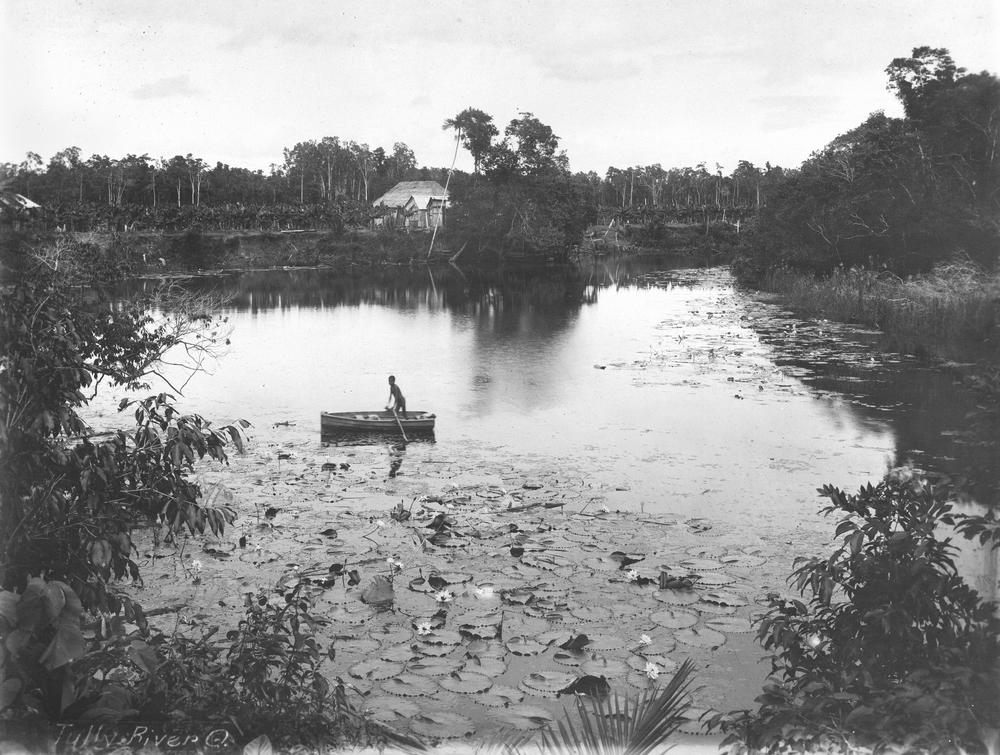
Pictured: Lily Lagoon, a backwater of the Tully River near Tully, Queensland, photographed circa 1910 (State Library of Queensland / John Oxley Library, public domain) — illustrating the swampy lagoon terrain characteristic of the district, not a photograph of the actual Horseshoe Lagoon site. No public-domain or rights-clear image of the 1966 nest itself is known to survive; the original press and investigative photographs remain under third-party copyright.
Theoretical Alignment
Tully is, like Delphos, fundamentally a physical-evidence dispute rather than a witness-testimony dispute, and that shapes its alignment with the standard hypotheses. The Extraterrestrial Hypothesis draws what support it has here almost entirely from the trace evidence rather than from George Pedley's brief sighting itself: a single farmer's ten-to-thirty-second glimpse of a rising disc is an unremarkable entry in the broader UFO literature on its own, but a circular mat of reeds pulled cleanly from lagoon mud, swirled in a tight spiral, and left sitting on water so clear it appeared "vacuumed" is a genuinely unusual, independently examined physical finding that neither the University of Queensland's botany and physics departments nor the CSIRO's own meteorologists were able to fully explain. It is capped at a modest 25% because none of the scientific testing performed on the nest material found anything unambiguously non-terrestrial — no exotic isotopes, no significant radioactivity, nothing beyond ordinary reed and mud chemistry — and because a credentialed government meteorological explanation, however contested, was offered and never definitively falsified. The Interdimensional Hypothesis finds almost no purchase in a case built around a solid-looking, conventionally described disc and an entirely physical, measurable ground trace, earning only a residual score. The Psycho-Social Hypothesis explains Pedley's own brief sighting about as well as it explains any single-witness account, and gains some additional traction from the case's later, well-documented role in inspiring an entire genre of deliberate hoaxing — but it cannot on its own explain a physical mat of reeds that multiple independent, credentialed parties (police, air force officers, university scientists) examined directly and were unable to attribute to any known natural process with confidence, nor can it explain why similar nests kept recurring at the same specific lagoon for more than two decades.
Background
By January 1966, Australian ufology had spent the better part of two decades absorbing a steady trickle of eyewitness reports through the same institutional channel the country would rely on for its entire Cold War UFO history: the Royal Australian Air Force's Department of Air, which maintained a standing questionnaire for reported sightings and referred the resulting files, case by case, to whichever regional command happened to be nearest the report. Between 1960 and 1971 alone the RAAF formally assessed 595 such reports, the overwhelming majority resolved to aircraft, balloons, or celestial misidentification — a bureaucratic apparatus built for exactly this kind of report, but with no scientific mandate, no dedicated investigative staff, and no obligation to reach a public conclusion quickly. George Pedley was a twenty-eight-year-old banana farmer working land at Euramo, a small rural locality a few kilometres south of the town of Tully in Queensland's Cassowary Coast region, an area whose economy revolved almost entirely around banana and sugarcane cultivation in one of the wettest and most tropically lush corners of the Australian mainland. Like the overwhelming majority of people who go on to report a UFO encounter, Pedley had no documented prior interest in the subject and no connection to any UFO research organization before that January morning; he was, by every account, simply driving a tractor to work on a neighbor's cane property when the ordinary business of the day was interrupted.
The property belonged to Albert Pennisi, a local cane farmer whose land bordered Horseshoe Lagoon, a swampy, reed-choked body of water informally known by that name to locals rather than any officially gazetted locality (Queensland's formally registered "Horseshoe Lagoon" is a separate, unrelated place far to the south in the Burdekin Shire). In the days immediately before Pedley's sighting, Pennisi later told newspapers he had experienced a recurring dream, nearly every night for a week, of "a giant dish" descending from nowhere and landing near his property — a detail multiple contemporaneous journalists recorded him describing before the case became a national story, lending it at least some documentary weight even though it can never be independently verified. On the morning of the sighting itself, Pennisi's dog reportedly behaved strangely, bounding toward the lagoon shortly before 6:00 AM, hours ahead of Pedley's own encounter.
Complete Timeline
| Date | Event |
|---|---|
| c. January 12–18, 1966 | Landowner Albert Pennisi reports experiencing recurring dreams, nearly nightly, of a large dish-shaped object landing near his property at Horseshoe Lagoon. |
| January 19, 1966, c. 5:50 AM | Pennisi's dog reportedly behaves erratically, bounding toward the lagoon. |
| January 19, 1966, c. 9:00 AM | George Pedley, driving a tractor across Pennisi's cane property near Tully, Queensland, hears a loud hissing sound and observes a grey, saucer-shaped object rise from Horseshoe Lagoon, climb to treetop height, tilt, and depart to the southwest at high speed within seconds. |
| Same morning | Pedley walks into the swamp and discovers a near-circular, clockwise-swirled mat of flattened, uprooted reeds roughly 30 ft in diameter, along with a nearby clipped grass patch and teardrop-shaped impressions in an adjoining ploughed paddock. He later reports a sulphur-like smell in the area. |
| January 19, 1966, 7:30 PM | Pedley reports the sighting to Tully Police. |
| January 20, 1966, 7:00 AM | Sergeant A.V. Moylan of Tully Police examines the site with Pedley, initially raising and then reconsidering a small-helicopter explanation before contacting RAAF Base Townsville. |
| January 20, 1966 | Farmer Tom Warren and teacher Hank Penning discover two additional, smaller nests roughly 25 yards from the original, one flattened clockwise and the other counterclockwise. |
| January 21, 1966 | RAAF Flight Lieutenant Wallace requests a grass sample from the site; Wallace separately confirms no service or civil aircraft were operating in the area at the time of the sighting. |
| c. late January 1966 | Cane farmer Lou Lardi and his nephew Van Klaphake discover two further, apparently older nests (roughly 12 ft and 8 ft in diameter) with scorched centers and counterclockwise flattening. |
| January 23–24, 1966 | Australian press, including the Sun-Herald and The Sun, publish accounts of Pennisi's premonitory dreams and the growing "saucer nest" story, driving national and international attention. |
| January 24, 1966 | Grass and soil samples reach the University of Queensland's botany (Dr. Langdon) and physics (Mr. G. Taylor) departments for analysis. |
| January 26, 1966 | Sergeant Moylan dispatches his completed sighting report and sample to RAAF channels. |
| February 11, 1966 | Department of Air Secretary A.B. McFarlane issues an official statement attributing the phenomenon most probably to a "willy-willy," downdraft, or waterspout, while acknowledging testing "failed to reveal anything of significance." |
| 1968–1969 | Additional nests recur at Horseshoe Lagoon, part of a pattern of intermittent reappearances the Pennisi family increasingly declines to report publicly. |
| February 8, 1969, c. 5:30 AM | A monitoring device on Pennisi's property is triggered; two new nests are subsequently found, the larger approximately 29 ft 6 in in diameter with clockwise flattening, the lagoon floor beneath appearing swept clean of debris and biological growth. |
| 1972, 1975 | Further nests are documented at the same lagoon, none accompanied by a reported sighting of an object. |
| 1975 | Ted Phillips publishes Physical Traces Associated with UFO Sightings: A Preliminary Catalog (CUFOS), formally cataloguing the Tully case among hundreds of documented international ground-trace reports. |
| 1973 | The RAAF's Department of Defence (Air Office) issues its final public position on the case, again identifying a "willy-willy" or circular wind phenomenon as the most probable explanation. |
| 1978 | English farm hoaxers Doug Bower and Dave Chorley begin fabricating circular flattened-crop formations in Wiltshire, England, later crediting newspaper accounts of the Tully nests as their direct inspiration. |
| June 3, 1981 | Bill Chalker conducts a detailed personal interview with Pedley, correcting media distortions of his original account and reaffirming its core details unchanged after fifteen years. |
| 1981, 1987, 1990 | Further nests are recorded at Horseshoe Lagoon; by 1990 Pennisi reports approximately 22 total nests documented at the property since 1966. |
| 1991 | Bower and Chorley publicly confess to fabricating hundreds of English crop circles, explicitly naming the 1966 Tully case as their original inspiration. |
| 2017 | Chalker publishes a detailed retrospective, "The 1966 Tully Flying Saucer Nest Revisited," consolidating decades of his own field research on the case. |
Tending Cane at Dawn: George Pedley's Sighting
George Pedley's account, repeated with remarkable consistency across more than fifteen years of interviews, begins with nothing more dramatic than an ordinary morning's work. Shortly after nine o'clock on January 19, 1966, the twenty-eight-year-old banana farmer was driving a tractor along a track winding past Horseshoe Lagoon on neighboring cane farmer Albert Pennisi's property, when a loud hissing noise — Pedley later compared it to air escaping rapidly from a tyre — cut through the sound of his own engine. Looking toward the lagoon, roughly twenty-five yards away, he saw an object already airborne at treetop height: grey, saucer-shaped, and, in his own memorable description to Chalker years later, resembling "two saucers, you know, face to face." He estimated it at twenty-five to thirty feet across and eight or nine feet thick at its center, a light grey, non-reflective, dull-surfaced object with no visible portholes, antennas, or other structural detail. "I saw no portholes or antennas," Pedley stated plainly, "and there was no sign of life either in or about the ship." The object rose vertically to an estimated sixty feet, tilted, and then climbed away on a roughly forty-five-degree angle toward the southwest, accelerating to what Pedley described as a "fantastic burst of speed" before vanishing from sight. Accounts of the sighting's total duration vary in Pedley's own retellings across the decades — from as brief as four seconds to as long as thirty — a discrepancy Chalker's own careful 1981 interview treated as an ordinary feature of memory under a startling, adrenaline-charged few seconds rather than evidence of fabrication.
The Nest at Horseshoe Lagoon
What elevated Pedley's brief sighting from an unremarkable, unverifiable daylight disc report into one of the most closely examined physical-trace cases in the UFO literature was what he found when he walked out into the swamp afterward. Where the object had been hovering, the lagoon's reeds — ordinarily standing some two feet above the waterline — had been flattened to the surface of the water across a near-circular area roughly thirty-two feet long and twenty-five feet wide, arranged in a tight, unmistakable clockwise spiral. Investigators who examined the site in the following days, including Sergeant Moylan, specifically noted that the reeds appeared to have been pulled cleanly out of the mud by their roots rather than simply bent or crushed — a detail multiple witnesses considered difficult to reconcile with ordinary wind damage, which typically shears or snaps standing vegetation without uprooting it wholesale. The floating mat of reeds carried a raised, roughly circular protrusion near its center, some six to eight feet across and as much as eighteen inches thick, and investigators found the water beneath and around the nest strikingly clear, without the particulate matter or disturbed mud one would expect from a violent mechanical or meteorological disruption. A short distance north of the main nest, a separate patch of couch grass measuring roughly five by six feet had been clipped cleanly at water level and entirely removed, and in the ploughed paddock adjoining the swamp, a line of small teardrop-shaped impressions — each three to four inches long and about two inches wide, spaced a foot apart in an almost mechanically regular line — ran away from the lagoon's edge. Pedley additionally reported a distinct sulphur-like smell lingering in the area immediately after the object's departure, a detail with no chemical source ever identified.
Sergeant Moylan and the First Official Investigation
Unlike many rural Australian UFO reports that never reached any official channel, Pedley's account was examined by local law enforcement within a day of the sighting, giving the case an early layer of independent, professional documentation many single-witness reports lack. Pedley reported the encounter to Tully Police at 7:30 PM on the evening of the sighting; Sergeant A.V. Moylan met him at the site at seven o'clock the following morning and personally examined the nest before it had been disturbed by the wave of press and public attention that would soon follow. Moylan's own early working theory, recorded in his notes, floated the possibility of a small helicopter having caused the depression — a natural first hypothesis for an investigating officer with no ufological background — but he explicitly acknowledged in his own report that cleared land lay only some two hundred yards to the east, where such an aircraft could have set down far more safely and conveniently than in the dense reed bed close to trees where the nest actually appeared, a detail that visibly weakened his own initial theory even as he recorded it. Moylan contacted RAAF Base Townsville the same day, setting in motion the case's formal referral into Air Force channels; Flight Lieutenant Wallace, coordinating from Townsville, requested a grass sample from the site on January 21 and, separately, confirmed through service and civil aviation records that no aircraft of any kind had been operating over the area at the time of Pedley's sighting — a genuine records check that ruled out one conventional explanation on its own institutional authority rather than by assumption. Moylan's completed sighting proforma and sample were formally dispatched to Air Force channels on January 26, 1966, a week after the encounter.
Grass, Beta Rays, and the University of Queensland
Samples of nest vegetation and soil reached the University of Queensland's botany and physics departments on January 24, 1966, five days after the sighting, at the request of investigators eager for an independent scientific reading before the site itself degraded further. Dr. Langdon of the botany department concluded that the reeds' death was consistent with prolonged submersion in water rather than any parasitic infestation, burning, or exposure to an unfamiliar chemical agent — a conventional, unremarkable finding on its face. Physicist Mr. G. Taylor's radioactivity testing found similarly little of note: only one sample, taken from the nest's center, registered any measurable beta activity, and Taylor judged the reading insignificant, likely falling within ordinary background variation rather than indicating any unusual radiation source. Taken together, the university's formal findings offered no laboratory evidence of anything exotic in the nest material — a result proponents and skeptics alike have cited, for opposite reasons, ever since. What the university's official conclusions did not directly address, however, was a specific empirical anomaly multiple on-the-ground observers, including Pennisi, independently noted: the reeds within the nest turned from green to brown within roughly eight hours of the sighting, a rate of discoloration dramatically faster than the three days typically required for cut or submerged reeds to brown under ordinary conditions in that climate. Neither Langdon's report nor any later published analysis of the case has ever fully reconciled the university's own "death by submersion" conclusion with that specific timing discrepancy, leaving it one of the case's more durable open questions.
The RAAF, the Department of Air, and the "Willy-Willy" Verdict
The Department of Air's formal engagement with the case culminated in a written statement from Secretary A.B. McFarlane on February 11, 1966, roughly three weeks after the sighting. McFarlane's statement was notably candid about the limits of what the investigation had actually established: "Investigations of the area surrounding the reported 'Nests', testing of samples taken from around them… failed to reveal anything of significance." Rather than endorsing any single confident explanation, McFarlane's statement floated several related meteorological possibilities in combination — "down draughts," "willy willies" (the colloquial Australian term for a small, localized whirlwind or dust devil), and waterspouts — as the most probable natural mechanisms capable of flattening reeds into a circular pattern and lifting debris into the shape witnesses had described as a "flying saucer." When the Department of Defence's Air Office issued its final, retrospective public position on the case in 1973, it repeated substantially the same conclusion: that the "most probable explanation" was a willy-willy or circular wind phenomenon. That conclusion, however, was neither unanimous within Australia's own scientific establishment nor delivered with full confidence even by the officials who offered it. In correspondence with the Victorian Flying Saucer Research Society, CSIRO meteorologist Dr. Berson wrote candidly that "we are unable to come to any firm conclusion as to the nature of the object or manifestation reported" — a hedge from the government's own atmospheric-science authority that fell well short of endorsing the willy-willy theory as a settled explanation, even as CSIRO colleagues separately floated severe turbulence from line squalls and thunderstorms as a plausible downdraft mechanism.
A Whirlwind That Left No Path
The willy-willy explanation drew immediate and sustained criticism from multiple directions, not all of it from committed UFO proponents. The most basic objection was meteorological: January 19, 1966 was, by every contemporaneous account, a clear, calm morning with no storm activity of the kind that typically accompanies a genuine severe local whirlwind, and no other wind damage of any kind was reported anywhere in the surrounding district that day. Alf Macdonald, the Stock Routes Inspector for Northern Queensland and a district resident since 1933 with decades of practical experience judging local wind events, stated flatly that the area had not experienced a strong whirlwind capable of producing the observed effect. A more technical objection concerned the physical character of a genuine whirlwind's aftermath: dust devils and willy-willies characteristically leave a visible trail of scattered debris and irregular, messy disturbance as they travel and dissipate, rather than a single, cleanly bounded, tightly spiraled circle with no approach or departure track — precisely the absence Pedley and later investigators repeatedly emphasized. The Victorian Flying Saucer Research Society's own published analysis, titled "The Tully 'nests': How freakish can whirlwinds be?," concluded outright that the atmospheric-vortex hypothesis was untenable given the evidence on the ground, even while acknowledging that the reeds' clockwise rotation was, ironically, consistent with the counterclockwise-to-clockwise handedness convention of cyclonic circulation in the Southern Hemisphere — a detail that cuts both ways, lending superficial plausibility to a wind-based mechanism in principle while doing nothing to explain the clean uprooting, the absence of any debris trail, or the eight-hour browning anomaly. Pedley himself, asked directly about the whirlwind theory in later interviews, was unambiguous: "I've seen wet whirlwinds and dust whirlwinds. If the police believe this, let them. I know what I saw. It wasn't a whirlwind."
More Nests: The Pattern Recurs
What distinguishes Tully most sharply from most other physical-trace cases in this catalogue — including Delphos, whose ring never reappeared after 1971 — is that Horseshoe Lagoon kept producing similar formations for more than two decades after Pedley's original sighting, almost none of them accompanied by any further report of an object in the sky. Within a day of the original discovery, farmer Tom Warren and schoolteacher Hank Penning found two additional, smaller nests roughly twenty-five yards from Pedley's, each about a third the size of the original, one spiraled clockwise and the other counterclockwise. Within the following week, cane farmer Lou Lardi and his nephew Van Klaphake discovered two further nests, smaller still and apparently older, their centers showing what investigators described as scorching and their reeds flattened counterclockwise. A more dramatic recurrence came on February 8, 1969, when a rudimentary monitoring device Pennisi had installed on his property was triggered around 5:30 AM; investigation revealed two fresh nests, the larger measuring roughly twenty-nine and a half feet across with a pronounced clockwise pattern, its floor beneath the water described by investigators as "absolutely free of rubble or reed roots, almost as if it had been vacuumed," with no insect or algae growth and unusually clear water — alongside a patch of scorched, browned tree leaves in a branch roughly twenty-five feet away. A botanist who examined the 1969 formation reportedly concluded there seemed "little likelihood" of a natural or botanical explanation for its development. Nests continued appearing intermittently through 1972, 1975, 1981, and 1987; by 1990, Pennisi told researchers the property had produced approximately twenty-two nests in total since 1966. Crucially, the family grew weary of the attention their property attracted — ridicule as much as fascination — and by their own account increasingly chose not to report later occurrences to the press at all, meaning the true total may well be higher than the documented record shows. This long recurrence cuts in two directions evidentiary reasoning has never fully resolved: for proponents, it suggests Horseshoe Lagoon was the site of a genuinely sustained, if intermittent, anomalous process rather than a single freak event; for skeptics, it suggests the lagoon possessed some ordinary, localized physical or biological characteristic — a persistent wind-funneling microclimate, a recurring aquatic plant or animal behavior, or simply a well-known "reliable" spot that became a magnet for casual copycat pranks once its fame was established — that had comparatively little to do with whatever, if anything, Pedley actually saw on the specific morning of January 19, 1966.
Bill Chalker and the Correction of the Record
Bill Chalker, the chemist who would go on to become one of Australia's most prominent UFO researchers and the first outside investigator granted access to the RAAF's classified UFO files, took up the Tully case seriously beginning in the early 1970s and conducted a detailed personal interview with Pedley on June 3, 1981 — more than fifteen years after the original sighting. Chalker's interview served a specific and valuable function beyond simple re-confirmation: it corrected a number of distortions that had crept into popular retellings of the case during a decade and a half of press coverage, folklore, and secondhand summary. Pedley used the opportunity to push back directly against sensationalized characterizations of his own account, clarifying that he had never claimed to see a "spaceship" in any dramatic sense and that his description had always been more measured than the tabloid coverage suggested. At the same time, Chalker's careful documentation found the core structural details of Pedley's account — the object's shape, size, color, the hissing sound, the direction and manner of its departure, and the nest's basic physical characteristics — essentially unchanged from Pedley's earliest 1966 statements to police and press. Chalker's own long-term assessment of the case, developed across decades of continued field research and consolidated in a detailed 2017 retrospective, treated Tully as a genuine, still-unresolved anomaly rather than either a confirmed extraterrestrial encounter or a settled hoax — a position consistent with his broader, methodical approach to Australian ufology.
Ted Phillips and the Physical-Trace Case Tradition
Ted Phillips, the American investigator who built his career specifically around the argument that eyewitness testimony alone could never resolve the UFO question and that the field's future rested on physically sampled, laboratory-testable ground traces, formally catalogued the Tully case in his landmark 1975 Center for UFO Studies publication, Physical Traces Associated with UFO Sightings: A Preliminary Catalog. Phillips's entry recorded the case's core measurements — the 32-by-25-foot depression, the clockwise flattening to the waterline, the uprooted rather than merely bent reeds — in terms matching the Australian investigators' own contemporaneous documentation closely enough to function as an independent cross-check on the case's basic physical facts. Tully's inclusion placed it among the earliest non-American entries in what Phillips would spend the following decades expanding into an international database eventually cataloguing more than four thousand physical-trace reports from ninety-three countries, and its clean, well-documented, multiply-witnessed recurrence at a single identifiable site made it one of the more geographically and temporally durable cases in his entire collection — a landmark, in the specific sub-discipline of trace-case research Phillips helped establish, comparable in stature to Delphos within the American record.
From Tully to Wiltshire: The Crop Circle Connection
Tully's most unexpected legacy has nothing to do with whether Pedley's account was ever explained, and everything to do with what happened more than a decade later on the other side of the world. Beginning in 1978, English pub regulars Doug Bower and Dave Chorley began quietly flattening circular patterns into cereal crops in the fields around Warminster, Wiltshire, using nothing more sophisticated than a plank, a length of rope, and a wire loop worn on a cap brim to help walk straight lines. When the two men finally confessed publicly in 1991, ending a media sensation that had by then spread across the UK, continental Europe, the United States, and Japan, they specifically credited newspaper accounts of the 1966 Tully "saucer nest" as their original inspiration — a case Bower had personally read about in Australian press coverage before emigrating and later relocating to England, where he found himself living not far from Chorley in Wiltshire. This lineage is a matter of public historical record independent of any conclusion about what actually happened at Horseshoe Lagoon: Bower and Chorley did not fake the original Tully nests, and nothing in the documented record connects them to the case beyond having read about it in the press, but their own account makes Tully, however indirectly, the acknowledged point of origin for the entire modern crop-circle phenomenon — a striking, well-documented irony given that Tully's own physical trace was never demonstrated to be a hoax and, unlike the deliberately mechanical geometric crop-circle formations that followed in England from the late 1970s onward, was never claimed by anyone to have been faked using tools of any kind.
The Wider 1966 Australian UFO Wave
Pedley's sighting did not occur in isolation within Australia's own UFO record for that year. Barely eleven weeks later, on April 6, 1966, staff and roughly two hundred students at Westall High School in suburban Melbourne, more than 2,500 kilometres to the south, watched a disc-shaped object with a purplish hue descend behind a stand of trees for approximately twenty minutes before departing; investigators subsequently found several burnt patches of grass at the site, and multiple witnesses later reported being warned by military personnel not to discuss what they had seen. Other reports clustered around the same period, including an April 2, 1966 photograph taken by an anonymous Melbourne businessman and an April 4 sighting near Burkes Flat, Victoria. Taken together, these cases constitute one of the most concentrated and best-documented UFO "flaps" in Australian history, and Tully's own position as the wave's opening, most physically substantiated case gave the broader 1966 Australian UFO year a level of ongoing research attention — from Bill Chalker's decades of fieldwork to UFO Research Queensland's continued cataloguing — that few single-year clusters anywhere in the world have received.
Legacy: Tully in the Physical-Trace Literature
More than half a century on, Tully occupies a durable and specific niche in the UFO field's own internal hierarchy of evidence, discussed in the same breath as Delphos and Trans-en-Provence whenever researchers survey the strongest available examples of a genuinely reproducible, physically examined ground trace. It appears in Ted Phillips's foundational physical-trace catalog, in Bill Chalker's decades of published Australian ufology research, and in general UFO reference works discussing the origins of the crop-circle phenomenon. UFO Research Queensland, the successor organization to the original Queensland Flying Saucer Research Bureau that helped coordinate the case's first scientific sampling in 1966, continues to treat the case as a foundational entry in its own case files. The Pennisi family's own relationship with the case grew markedly more ambivalent over the decades: early cooperation with police, scientists, and the press gave way, by the family's own account, to a preference for privacy once the site's fame brought years of trespassing sightseers, journalists, and UFO enthusiasts rather than any welcome recognition. What remains, independent of how that private ambivalence is read, is a physical trace that multiple credentialed institutions — a police department, an air force, a university physics and botany department, and a national science research organization — all examined directly within days or weeks of its appearance and none of them, in the end, was able to explain with full confidence.
Circumstantial Evidence
- Sergeant A. V. Moylan independently examined and documented the nest within a day of the sighting, describing physical characteristics matching Pedley's account before press coverage could have shaped his observations.
- RAAF Flight Lieutenant Wallace confirmed through service and civil aviation records that no aircraft of any kind were operating in the area at the time of the sighting, ruling out one conventional explanation on institutional authority.
- Investigators repeatedly noted the reeds had been pulled cleanly from the mud by their roots rather than merely bent or sheared — a detail considered difficult to reconcile with either wind damage or a helicopter's rotor wash.
- The reeds discolored from green to brown within roughly eight hours, dramatically faster than the three days normally required for submerged reeds to brown, a specific timing anomaly the University of Queensland's own "death by submersion" finding never fully addressed.
- CSIRO meteorologist Dr. Berson's own correspondence conceded the science agency was "unable to come to any firm conclusion" about the nest's origin, undercutting any claim that the willy-willy theory was a confident, settled finding.
- The precise geometry — a single tightly bounded, cleanly spiraled circle with no debris trail or approach/departure track — was explicitly judged inconsistent with genuine whirlwind damage by both local wind-damage experts and the Victorian Flying Saucer Research Society's dedicated meteorological critique.
- Similar nests recurred at the same specific lagoon for more than two decades, with a 1969 formation's swept-clean, algae-free lagoon floor independently described by investigators as appearing "almost as if it had been vacuumed."
- Pedley's core account remained materially unchanged across more than fifteen years of retellings, including a detailed 1981 re-interview by researcher Bill Chalker specifically aimed at testing it for drift or embellishment.
Key Witnesses
George Pedley
Twenty-eight years old at the time, Pedley was driving a tractor across a neighbor's cane property near Tully when he observed a grey, saucer-shaped object rise from Horseshoe Lagoon, hover briefly at treetop height, and depart at high speed. The only witness to the object itself, he discovered the flattened, swirled reed nest immediately afterward. He maintained the core details of his account, including his rejection of the whirlwind explanation, consistently across more than fifteen years of interviews, and pushed back directly against sensationalized press characterizations of what he had reported.
Albert Pennisi
The cane farmer on whose land the sighting and nest occurred, Pennisi did not witness the object but corroborated the discovery of the trace and reported experiencing a week of recurring dreams about a dish-shaped object landing near his property in the days immediately preceding the sighting. He continued to document recurring nests at the same lagoon for more than two decades, eventually choosing not to report most later occurrences publicly.
Sergeant A. V. Moylan
The first official investigator on the scene, Moylan examined the nest the morning after the sighting, initially floated and then set aside a small-helicopter explanation after noting more suitable open land nearby, and formally referred the case to RAAF Base Townsville — setting in motion the case's official investigation within a day of the encounter.
Bill Chalker
Australia's foremost UFO researcher and the first outside investigator granted access to the RAAF's classified UFO files, Chalker conducted a detailed personal interview with Pedley in 1981, correcting media distortions of the original account while confirming its core details remained unchanged after fifteen years. His 2017 retrospective consolidated decades of continued field research on the case.
The Five Observables Assessment
The Five Observables framework, developed by former AATIP director Luis Elizondo, is designed to classify witnessed UAP flight performance against the limits of known technology. Tully, like Delphos, is a poor structural fit for that framework: this is a landed, physical-trace case built around a single witness's ten-to-thirty-second glimpse of a rising and departing object, not an instrumented flight-dynamics event with tracked speed, altitude, or maneuvering data. Most of the standard performance observables below reflect what was simply never measured or reported, rather than genuine absence, and the assessment says so honestly.
Assessment: Anti-Gravity Lift is rated speculative rather than present because Pedley described the object already airborne and hovering at treetop height with no visible support — consistent with a genuinely novel lift mechanism, but based entirely on a single, brief visual impression rather than any instrumented measurement. Instant Acceleration is similarly speculative: Pedley described the object's final climb and departure as a "fantastic burst of speed," but no timed or instrumented measurement of its actual velocity exists, and estimates of the sighting's total duration vary considerably across his own retellings. Hypersonic Velocity is rated absent, since no witness made any specific claim of extreme speed comparable to cases involving trained aviation observers or radar corroboration. Low Observability is rated absent, since the object was, by every account, bright, solid-looking, and conspicuous at close range rather than stealthy. Trans-Medium travel does not meaningfully apply, marking instead the case's fundamental category — a landed CE2 physical-trace report — rather than a flight-performance data point. As with Delphos, Tully's evidentiary weight rests almost entirely on what was left on the ground after the object departed, not on any performance characteristic of the object itself while briefly in view.
Evidence Assessment
Supporting Anomalous Origin
- A consistent, unembellished eyewitness account maintained without material change across more than fifteen years, including a detailed independent re-interview specifically probing for drift.
- A cleanly bounded, tightly spiraled circular trace with reeds pulled from the mud by their roots rather than bent or sheared, examined independently by police, air force, and university personnel within days.
- RAAF confirmation that no aircraft were operating in the area at the time, ruling out one conventional explanation on institutional authority.
- An anomalously rapid, roughly eight-hour reed-browning timeline the University of Queensland's own "death by submersion" botanical finding never directly reconciled.
- CSIRO's own meteorologist explicitly declined to endorse the willy-willy theory with confidence, undercutting the impression of a settled scientific explanation.
- A multi-decade pattern of recurring similar nests at the identical lagoon, independently documented by multiple observers over more than twenty years.
Supporting Conventional Explanation
- Only one person witnessed the object itself; no independent corroboration of the sighting exists beyond the physical trace it allegedly left behind.
- A credentialed government explanation — a willy-willy, downdraft, or waterspout — was formally offered by the Department of Air and never conclusively disproven by any controlled follow-up test.
- No scientific test performed on the nest material found anything demonstrably non-terrestrial; radioactivity and botanical results were within ordinary ranges.
- The case's own fame directly inspired an entire genre of deliberate crop-formation hoaxing in England from 1978 onward, illustrating how readily similar patterns can be faked by hand with simple tools.
- Decades of recurring, unwitnessed later nests at the same lagoon — some publicly unreported by the family's own choice — raise a real possibility that at least some post-1966 formations were copycat pranks rather than genuine recurrences of whatever produced the original.
Why "Disputed"
The Tully Saucer Nests Sighting earns a DISPUTED rating on this site's scale because it combines a genuinely unusual, multiply-examined physical trace with a real, credentialed conventional explanation that was hedged rather than confidently proven — and because the case's own extraordinary six-decade afterlife at the same lagoon has made it progressively harder to separate whatever happened on January 19, 1966 from everything that followed. On the strength side: George Pedley's account was calm, consistent, and free of embellishment across more than fifteen years of retelling, including a rigorous 1981 re-interview by Bill Chalker specifically designed to test it for drift; the nest itself was examined independently within days by local police, an RAAF flight lieutenant, and University of Queensland botany and physics departments, none of whom found a fully satisfying natural explanation, and CSIRO's own meteorologist declined to endorse the government's willy-willy theory with any real confidence; and the reeds' anomalously rapid browning and cleanly uprooted, debris-free geometry were never reconciled with the official explanation by anyone, proponent or skeptic. On the other hand, the case rests on a single eyewitness to the object itself; a specific, named, credentialed conventional mechanism — a willy-willy or downdraft — was formally proposed by the Department of Air and has never been conclusively eliminated, only argued against; and more than two decades of recurring, progressively less-witnessed "nests" at the same site, culminating in the case's ironic role as the acknowledged direct inspiration for the deliberately hoaxed English crop-circle phenomenon beginning in 1978, have made it genuinely difficult to know how much of Horseshoe Lagoon's later reputation reflects a sustained anomaly and how much reflects ordinary human imitation once the site became famous. That combination — a physically real, still-unexplained original trace on one side, and an unresolved, credentialed conventional theory plus a documented copycat culture on the other — places Tully squarely in disputed territory: one of the physical-trace literature's foundational cases, but not a closed one.
Sensor & Instrumentation Detection Profile
No radar, camera, or government sensor of any kind recorded the Tully encounter as it happened; Horseshoe Lagoon in January 1966 was remote agricultural swampland with no aviation radar coverage, and Pedley's only "instrument" was his own eyesight from the seat of a moving tractor. Flight Lieutenant Wallace of RAAF Base Townsville, contacted the same week, confirmed through service and civil aviation channels that no aircraft — military or civilian — had been operating in the area at the time of the sighting, ruling out at least one mundane candidate through an actual records check rather than assumption. Every other piece of analytical instrumentation applied to this case, as with Delphos, arrived after the fact and was aimed at the trace rather than the object: a Geiger-counter-style radioactivity test performed by the University of Queensland's physics department under Mr. G. Taylor, which found only a single sample from the nest's center registering slight beta activity, judged insignificant and likely within normal background variation; and a botanical examination by the university's Dr. Langdon, who attributed the reeds' death to prolonged submersion rather than any parasitic infestation, burning, or exotic chemical exposure. That both examinations were performed on vegetation and mud rather than on any recording of the object itself is the case's defining structural fact, precisely mirroring Delphos: Tully is not an instrumented sighting so much as an instrumented aftermath, and whatever the case can actually prove or disprove runs through what scientists found in the swamp, not through any direct measurement of what Pedley said he saw.
Environmental & Geospatial Context
Horseshoe Lagoon sits in the flat, intensely cultivated banana- and sugarcane-growing country around Tully, a small town in Australia's tropical far-north Queensland renowned for having the highest average annual rainfall of any town in the country — a detail Tully itself commemorates today with a giant "Golden Gumboot" monument in the town center. The sighting took place on the property of local cane farmer Albert Pennisi, near the even smaller locality of Euramo a few kilometres south of Tully proper, during the region's wet season, when tropical downpours, line squalls, and localized whirlwinds known locally as "willy-willies" are common enough to have entered everyday rural vocabulary. Witnesses and investigators alike specifically noted that January 19, 1966 itself was clear and calm, without the storm activity that would typically accompany a genuine severe-weather vortex — a detail central to the skeptical dispute discussed later in this file. The lagoon itself was a swampy body of water some hundred feet across at its widest, thickly grown with water reeds standing roughly two feet above the surface, bordered by cane fields, banana groves, and remnant tropical vegetation typical of the Cassowary Coast region. No military installation, airport, or industrial facility sits anywhere near the immediate area; far-north Queensland in 1966 was, and largely remains, thinly populated tropical farmland with little to explain an isolated bright object beyond the ordinary rural aviation, weather, and wildlife of the district.
Observer Credibility & Occupational Profile
The case's evidentiary weight rests on an unusually narrow foundation for a physical-trace case of this stature: a single eyewitness to the object itself, with no one else present to independently corroborate the sighting in the moment. George Pedley, twenty-eight years old and engaged in the utterly mundane task of driving a tractor across a neighbor's cane property, had no history of UFO interest, no connection to any ufology organization, and nothing in his public record to suggest he sought attention — if anything, the opposite: in a 1981 interview with researcher Bill Chalker, Pedley expressed frustration at how sensationalized press coverage had distorted his account, insisting, "I would never have said I saw a spaceship! I saw an object… something going up and that's it." That instinct toward understatement rather than embellishment, sustained across more than fifteen years of retellings, is one of the stronger circumstantial marks in his favor. Property owner Albert Pennisi did not witness the object but corroborated the trace's discovery and, more unusually, reported a week of recurring premonitory dreams about a dish-shaped object landing near the lagoon in the days immediately preceding the sighting — a detail impossible to verify independently and treated cautiously by this catalogue, but one multiple contemporaneous newspapers recorded him describing before the wider story broke, rather than after. Local law enforcement, in the person of Tully police Sergeant A.V. Moylan, examined the physical evidence directly and treated the report seriously enough to escalate it to the RAAF within a day, a level of official engagement uncommon for a single-witness rural sighting. Working against a fully frictionless credibility assessment: Pedley was the only person to see the object itself, no training in aircraft or aerial-phenomena identification is on record for him, and the case's subsequent fame at Horseshoe Lagoon — twenty-two total nests documented at the same site by 1990 — introduced an obvious incentive structure for later, less credible copycat reports that Pedley's own original account had nothing to do with.
Physical & Material Assays
Tully is defined, like Delphos, almost entirely by its physical trace rather than by any instrumented flight data: a sampled, photographed, multiply-examined patch of altered swampland that several independent parties inspected within days of the sighting. The primary nest measured approximately thirty-two feet long by twenty-five feet wide, a near-circular depression in which the lagoon's reeds had been flattened to the waterline in a tight clockwise spiral and, crucially, pulled cleanly out of the mud by their roots rather than merely bent or trampled — a distinction multiple investigators, including Sergeant Moylan himself, considered inconsistent with wind damage, which typically shears or snaps vegetation rather than extracting it whole. The floating mass measured roughly thirty feet across with an apparent circular protrusion near its center some six to eight feet in diameter and as much as eighteen inches deep, and investigators additionally documented a five-by-six-foot patch of couch grass clipped cleanly at water level and entirely removed a short distance north of the main nest, along with a line of small teardrop-shaped impressions — each three to four inches long, spaced a foot apart — in the adjoining ploughed paddock. Samples reached the University of Queensland on January 24, 1966, five days after the sighting: the physics department's radioactivity testing found nothing significant, and the botany department attributed the reeds' death to prolonged submersion, though independent observers on the ground noted that the reeds had turned from green to brown within roughly eight hours of the sighting, dramatically faster than the three days typically required for submerged reeds to brown under ordinary conditions — a specific empirical anomaly the university's own botanical conclusion did not directly address. No debris, fragment, or manufactured material of any kind was recovered; Pedley additionally reported a distinct sulphur-like smell in the area immediately after the object's departure, a detail with no confirmed chemical source.
Historical Precedents & Archive Matches
Tully belongs to the same evidentiary category as Delphos, Kansas and Trans-en-Provence, France: a Close Encounter of the Second Kind in which a briefly witnessed object left behind a measurable, physically examined ground trace. It holds a specific and unusual distinction within that category, however — physical-trace specialist Ted Phillips catalogued the case in his landmark 1975 Center for UFO Studies (CUFOS) publication Physical Traces Associated with UFO Sightings: A Preliminary Catalog, listing it among the earliest and most geographically distant entries in what would become an international database eventually spanning more than four thousand cases across ninety-three countries, making Tully one of the foundational non-American entries in the physical-trace research tradition Phillips spent his career building. Domestically, it sits alongside the Westall UFO Encounter of April 6, 1966 — a multi-witness disc sighting at a Melbourne high school that occurred barely eleven weeks after Pedley's report, during the same extraordinary year of Australian UFO activity — as one of two internationally significant Australian cases from that single twelve-month span. Most unusually among any case in this catalogue, Tully's trace pattern was directly cited, decades later, as the acknowledged inspiration for an entirely different and deliberately fraudulent phenomenon: the modern crop circle, discussed in full below.
Material Analysis
Tully's evidentiary core, like Delphos's, is not testimony but a physically sampled, multiply-examined patch of altered ground. The primary nest — a 32-by-25-foot depression of clockwise-flattened, uprooted reeds — was photographed and sampled within days by Tully Police, forwarded to RAAF channels, and independently tested by the University of Queensland's botany and physics departments. Botanical analysis attributed the reeds' death to prolonged submersion, while radioactivity testing found only a single insignificant beta reading at the nest's center, within normal background variation. Neither test found any material, chemical, or radiological signature suggesting an exotic origin, and no fragment, debris, or manufactured material of any kind was ever recovered from the site. What kept the material evidence from fully closing the case in favor of a mundane explanation was a specific, never-resolved discrepancy: the reeds discolored from green to brown in roughly eight hours, against a normal submersion-browning timeline of about three days, a gap the university's own "death by submersion" conclusion did not directly address. The site's recurrence — at least twenty-two similar nests documented at the same lagoon through 1990, including a 1969 formation whose lagoon floor was independently described as swept clean "almost as if it had been vacuumed" — extended the available physical record far beyond what any single sighting could offer, while simultaneously making it harder to know which later formations, if any, reflected a genuine recurring process versus imitation once the site's fame was established.
Supporting Non-Terrestrial Origin
- Reeds uprooted cleanly from the mud rather than bent or sheared, in a tightly bounded, precisely spiraled pattern with no debris trail — a geometry investigators considered inconsistent with either wind or rotor-wash damage.
- An anomalously rapid, roughly eight-hour browning timeline for the nest reeds, versus the normal three-day submersion-browning rate, never reconciled by the university's own botanical finding.
Supporting Terrestrial Origin
- No radiological, chemical, or material test performed on the nest found anything beyond ordinary background levels or natural composition.
- No debris, fragment, or manufactured material of any kind was recovered from the site at any point across more than two decades of recurring formations.
The Conventional Explanation Candidate: The "Willy-Willy" Whirlwind
The Department of Air's own official position, offered in 1966 and reaffirmed in 1973, holds that a willy-willy — a small, localized whirlwind or dust-devil-type vortex common in tropical far-north Queensland during the wet season — combined with a downdraft or waterspout-like mechanism, flattened the reeds into a circular pattern and lifted debris into the air in a way that could plausibly have been mistaken for a rising saucer. This candidate deserves serious evaluation: willy-willies are a well-documented, entirely real meteorological phenomenon in that exact region and season, require no exotic assumption, and were floated not by a dismissive outsider but by the government agency with direct institutional responsibility for investigating the report.
Where the Whirlwind Theory Falls Short
The theory faces multiple concrete objections that neither the Department of Air nor CSIRO ever fully resolved. Contemporaneous accounts describe January 19, 1966 as clear and calm, without the storm activity that typically accompanies a genuine severe local vortex, and no other wind damage was reported anywhere in the surrounding district that day. Alf Macdonald, the Stock Routes Inspector for Northern Queensland with decades of relevant local experience, stated the area had not experienced a whirlwind strong enough to produce the observed effect. Genuine dust devils and willy-willies characteristically leave a messy, irregular debris trail as they travel, rather than a single, cleanly bounded circle with no approach or departure track; investigators repeatedly emphasized the absence of exactly that kind of trail at Horseshoe Lagoon. The Victorian Flying Saucer Research Society's own dedicated meteorological analysis, "The Tully 'nests': How freakish can whirlwinds be?," concluded the atmospheric-vortex hypothesis was untenable on the physical evidence, and even CSIRO's own Dr. Berson, in correspondence on the case, stopped well short of endorsing it, writing only that the agency was "unable to come to any firm conclusion." Finally, no version of the whirlwind theory has ever explained the anomalously rapid, roughly eight-hour reed-browning timeline documented on the ground.
2. A Small Helicopter
Sergeant Moylan's own first working theory at the scene proposed a small helicopter, whose rotor wash could plausibly flatten reeds into a roughly circular pattern and whose engine noise, heard briefly and at a distance, might account for Pedley's described hissing sound. This candidate has the appeal of requiring no unusual meteorology and no assumption about an unidentified craft at all.
Where the Helicopter Theory Falls Short
Moylan himself noted in his own report that open, cleared land lay only about two hundred yards to the east of the nest — land that would have offered a far safer, more convenient landing site than the dense, tree-adjacent reed bed where the nest actually appeared, undercutting the premise that a helicopter pilot would have chosen that specific spot. No helicopter operator, military or civilian, was ever identified as having been in the area, and RAAF's own aviation-records check found no aircraft of any kind operating there at the time. The RAAF further noted, in weighing the theory generally, that helicopter rotor wash in the Southern Hemisphere tends to produce anti-clockwise flattening patterns, while the original Tully nest swirled clockwise — a detail that, while not by itself dispositive given the ordinary variability of rotor behavior, added to the theory's difficulties rather than resolving them.
3. Deliberate Hoax
Given the case's own later, well-documented role in inspiring Doug Bower and Dave Chorley's English crop-circle hoaxes from 1978 onward, a hoax explanation for the original 1966 nest itself deserves direct consideration rather than dismissal by association. Simple hand tools can, demonstrably, produce circular flattened-vegetation patterns convincing enough to fool investigators for years, as the English crop-circle era later proved beyond doubt.
Where the Hoax Theory Falls Short
No individual has ever confessed to fabricating the original 1966 Tully nest, in contrast to Bower and Chorley's explicit, on-the-record confession regarding their own later and geographically unrelated English formations. Pedley had no documented motive, financial or otherwise, for fabricating either the sighting or the trace, and his account cost him years of unwanted publicity and ridicule rather than any evident reward. The reeds' clean uprooting from the mud, their rapid discoloration, and the swampy, waist-deep, snake-inhabited terrain of Horseshoe Lagoon itself would have made a physically convincing hand-built hoax considerably more difficult to execute undetected than the dry, flat, easily walked English cereal fields where Bower and Chorley later worked. No physical evidence of tools, footprints, or a staged construction process was ever documented at the original site by any investigator.
The willy-willy theory remains the case's most credentialed candidate but was never confidently endorsed even by the government scientists who proposed it, the helicopter theory is undercut by the RAAF's own aviation-records check and Moylan's own siting objection, and no hoax confession or physical evidence of fabrication has ever surfaced for the original 1966 nest, leaving all three candidates genuinely unresolved rather than any one of them settled.
Related Cases
Confirmed Documents & Official Records
The Australian government's own archival authority describing the RAAF's historical practice of formally logging and investigating public UFO reports through the Department of Air — the same reporting chain that handled Sergeant Moylan's referral of the Tully case.
UNCLASSIFIED / PUBLIC RECORDA public mirror of declassified Australian government UFO files released under freedom-of-information requests, drawn from the same RAAF Department of Air record series that received Sergeant Moylan's original 1966 sighting report.
DECLASSIFIED / PUBLIC MIRRORSearch Government Archives Directly
Further Reading — Recommended Literature
Physical Traces Associated with UFO Sightings: A Preliminary Catalog
The foundational CUFOS catalog that formally documented the Tully nest among hundreds of international ground-trace reports, written by the investigator who helped establish physical-trace research as its own sub-discipline within ufology.
The Oz Files: The Australian UFO Story
Written by the Australian researcher who personally re-interviewed George Pedley in 1981 and was granted rare access to RAAF UFO files, with detailed coverage of the Tully case and the government's handling of Australia's UFO reports.
Round in Circles: Poltergeists, Pranksters, and the Secret History of the Cropwatchers
A history of the English crop-circle phenomenon that traces its documented origin back to Doug Bower and Dave Chorley's own account of being inspired by press coverage of the 1966 Tully nests.
The UFO Enigma: A New Review of the Physical Evidence
A Stanford physicist's scientific review of the strongest physical evidence associated with UFO reports, useful context for how the same ground-trace evidentiary standard Tully represents has been evaluated by mainstream science.
The UFO Encyclopedia, 4th Edition
The definitive modern UFO reference work, with an extensively cited entry situating Tully among the small number of internationally significant physical-trace cases and detailing its unlikely link to the crop-circle phenomenon.
Essential Viewing

Tully Flying Saucer (UFO) Nests Queensland 1966
A case retrospective from UFO Research Queensland, the successor organization to the original Queensland Flying Saucer Research Bureau that helped coordinate the case's first scientific sampling in 1966.
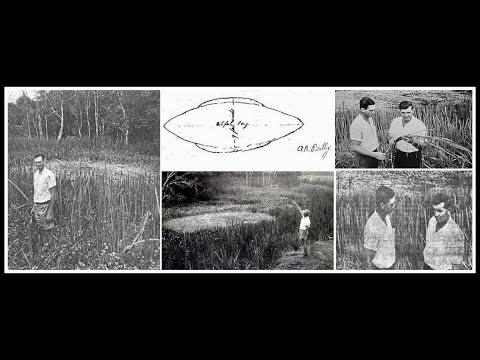
The 1966 Tully UFO Landing & "Saucer Nest" — George Pedley & Albert Pennisi
Archival footage of George Pedley and Albert Pennisi discussing the sighting and the nest in their own words, from the reputable Eyes On Cinema channel.
Global Crop Circle Phenomenon Inspired by UFO Mystery in Far North Queensland?
An ABC Australia news segment (Uncropped) examining the Tully case's documented link to the origins of the modern crop-circle phenomenon.
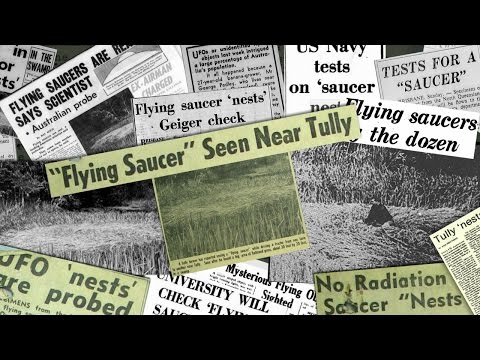
The Mysterious Tully Australia Saucer Nest UFO Incident from 1966
A case-history overview covering Pedley's sighting, the nest's discovery, and the official investigation that followed.
Sources
- UFO Evidence. "The 1966 Tully Saucer Nest - Near Tully, Australia - January 19, 1966." ufoevidence.org
- UFO Evidence. "The 1966 Tully Saucer Nest" (case sub-article). ufoevidence.org
- The OZ Files (Bill Chalker). "THE 1966 TULLY FLYING SAUCER NEST REVISITED." theozfiles.blogspot.com
- Project 1947 Forum. Bill Chalker, "1966 Tully Saucer Nest" (detailed field-investigation account). project1947.com
- UFO Casebook. "The Tully Saucer Nest." ufocasebook.com
- UFO Research Queensland. "The Tully Saucer Nest 1966." uforq.org
- Think About It Docs. "1966: The Tully Saucer Nest." thinkaboutitdocs.com
- Australian Geographic (Tim the Yowie Man). "Saucer hysteria: The case of the Tully crop circle." australiangeographic.com.au
- UFO Insight. "The Tully Nest Affair And The 1966 Wave Of UFO Sightings Across Australia." ufoinsight.com
- Believe Podcast. "The Tully Saucer Nest: An Unsolved UFO Enigma." believepod.com
- National Archives of Australia. "Flying saucers - fact or fiction?" (official blog). naa.gov.au
- Internet Archive. "Australian UFO Files" (digitized National Archives of Australia UFO series). archive.org
- The OZ Files (Bill Chalker). "In search of the mark of the UFO (a tribute to Ted Phillips and UFO physical trace research)." theozfiles.blogspot.com
- Think About It. "1975: Ted Phillips' Physical Trace Catalogue." thinkaboutit.site
- Old Crop Circles. "Australia 1966 Tully." oldcropcircles.weebly.com
- Signal Forum. "The Tully Saucer Nest." signal.forumotion.com
- AUS UFO. "The Tully Saucer Nests." ausufo.wordpress.com
- Strange Strange Strange. "The 1966 Tully Saucer Nest." strangestrangestrange.com
- The Canberra Times. "UFO sightings and our own X-files." canberratimes.com.au
- Wikipedia. "UFO sightings in Australia." en.wikipedia.org
- Wikimedia Commons. "Category: Tully River" (State Library of Queensland historical photograph collection, incl. hero image source). commons.wikimedia.org
- Phillips, Ted. Physical Traces Associated with UFO Sightings: A Preliminary Catalog, Center for UFO Studies, 1975. amazon.com
- Chalker, Bill. The Oz Files: The Australian UFO Story, Duffy and Snellgrove, 1996. amazon.com
- Schnabel, Jim. Round in Circles: Poltergeists, Pranksters, and the Secret History of the Cropwatchers, Prometheus Books, 1994. amazon.com
- Sturrock, Peter A. The UFO Enigma: A New Review of the Physical Evidence, Warner Books, 1999. amazon.com
- Clark, Jerome. The UFO Encyclopedia, 4th Edition, Visible Ink Press, 2023 (entry on the Tully / Horseshoe Lagoon saucer nests).
See something inaccurate? Have additional information or sources?
Suggest an Edit →Last Updated: August 2026