
Wanaque Reservoir Incident
On the night of January 11, 1966, Mayor Harry T. Wolfe, three councilmen, the borough's civil defense director, and multiple sworn police officers stood together at a sandpit above the frozen Wanaque Reservoir and watched a silent, color-shifting object hover, dart, and beam light into the ice for nearly three hours. It was the opening night of a UFO wave that would return to the reservoir at least twice more before the year was out, draw NICAP and APRO investigators north from their usual coastal beats, and leave behind three contradictory military explanations, an alleged witness-intimidation episode, and a photographic record now more disputed than the sighting itself.
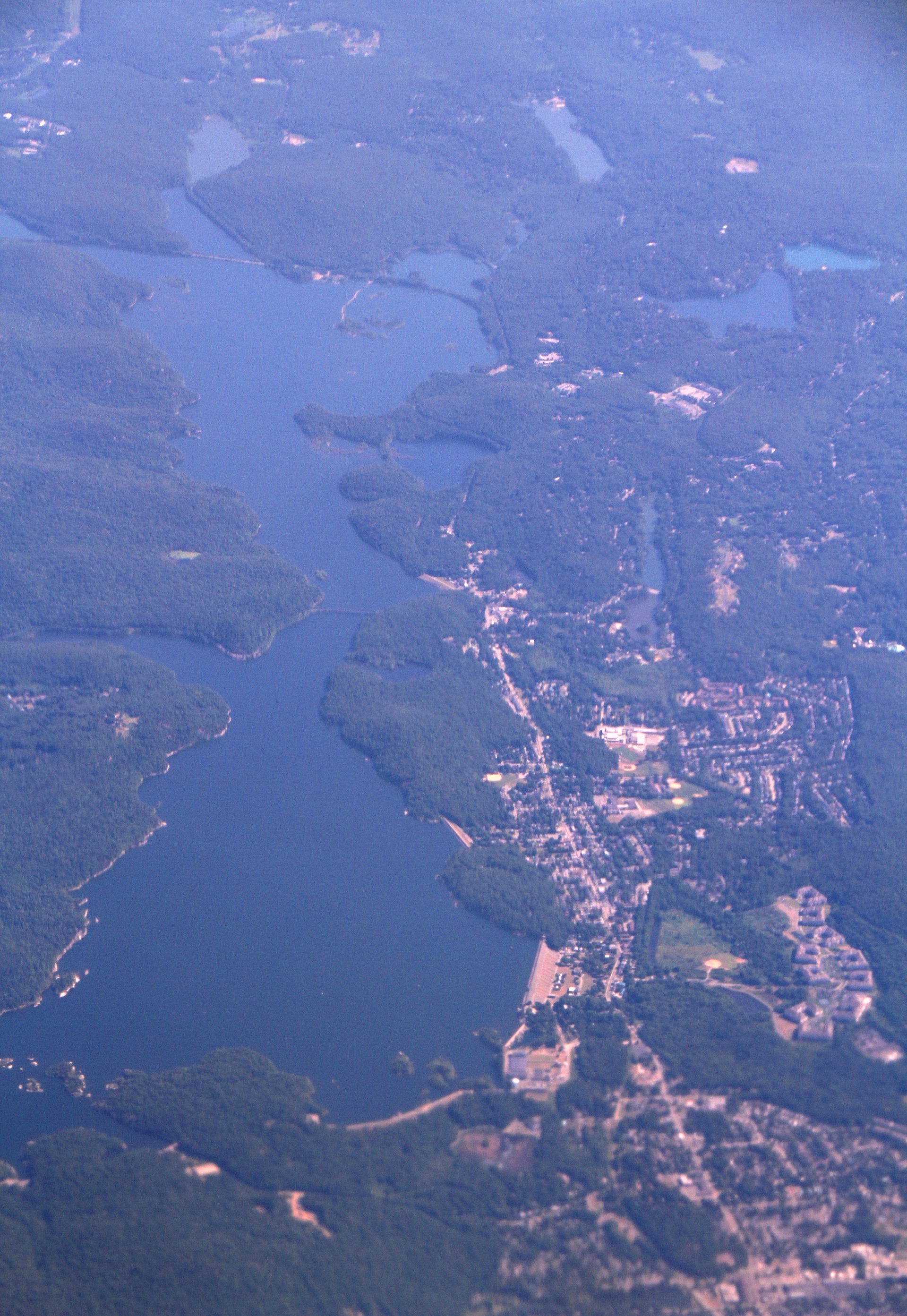
Pictured: an aerial view of the Wanaque Reservoir itself, Passaic County, New Jersey — not the object reported over it. No rights-clear photograph of the 1966 sightings exists: the era's only surviving images are five anonymously-circulated "beam" photographs whose authorship is itself disputed (researcher Anthony Bragalia's 2017 identification of factory worker Claude Coutant as the photographer has been challenged by other investigators, who note the prints match earlier-generation reproductions and that photo-analyst Michael Swords concluded the set was "probably an Augie Roberts hoax") — making them unusable here as an authentic case photo. (CC BY-SA 3.0, Bjoertvedt / Wikimedia Commons)
Theoretical Alignment
The case's mundane candidates carry unusual scientific weight for a 1966 sighting: the Wanaque Reservoir sits almost directly atop the Ramapo Fault system, giving the Psycho-Social/natural-phenomenon framework (misperceived earthquake lights and hoax-amplified rumor cascading through a small borough) real geophysical grounding rather than pure speculation. The Extraterrestrial Hypothesis remains a live but secondary alignment, resting almost entirely on the credibility of the official witnesses rather than on any recovered technology signature; the object's reported behavior (silent hovering, abrupt vertical acceleration, no exhaust or rotor noise) is consistent with ETH craft-performance claims elsewhere in this archive but was never captured on any instrument that could rule out a natural or terrestrial source.
Background
Wanaque is a small borough of roughly 9,000 residents in Passaic County, New Jersey, built around the reservoir of the same name in the foothills of the Ramapo Mountains, about 30 miles northwest of Manhattan. The Wanaque Reservoir itself was completed in 1930 by the North Jersey District Water Supply Commission as one of the largest public water-supply engineering projects in the state's history, a 100-million-gallon-per-day impoundment held back by the earthen Raymond Dam. By January 1966 the reservoir, still owned and patrolled by its own dedicated reservoir police force working alongside the borough's municipal department, was the literal and civic center of the community — which is part of why what happened there on the night of January 11 was witnessed by so much of the town's leadership at once.
The United States as a whole entered 1966 in the middle of an intensifying UFO news cycle. Just weeks after Wanaque's first sighting, a wave of reports from Dexter and Hillsdale, Michigan, would draw Northwestern University astronomer J. Allen Hynek, then Project Blue Book's scientific consultant, into the infamous "swamp gas" press conference that outraged Michigan's congressional delegation (including future president Gerald Ford) and helped trigger the U.S. Air Force's decision to fund an independent, university-run UFO study — the Colorado/Condon Committee, formed later that year. Wanaque's January flap predates the Michigan furor by roughly six weeks and received comparatively little national coverage at the time, but it was tracked in real time by the era's two leading civilian UFO research groups: the National Investigations Committee on Aerial Phenomena (NICAP), headquartered in Washington, D.C., and the Aerial Phenomena Research Organization (APRO), based in Tucson, Arizona. Both organizations dispatched or coordinated field interviews with Wanaque's witnesses within days of the sighting, and both published case summaries in their respective bulletins within months.
The broader geopolitical backdrop mattered too. Early 1966 sat in the middle of the Cold War, roughly three years after the Cuban Missile Crisis and amid an escalating American commitment in Vietnam; low-altitude nocturnal aerial activity near a major metropolitan water supply was not something local and federal authorities could simply wave away as harmless curiosity, whatever they privately believed it to be. New Jersey's own civil defense apparatus, embodied locally by Bentley Spencer's office, existed specifically because of Cold War-era anxieties about surprise aerial attack, which is part of why a civil defense director being personally called out to observe an unidentified light over critical water infrastructure was treated as a serious civic matter rather than a curiosity to be laughed off.
The primary witnesses were, almost without exception, figures whose day jobs required public accountability: Mayor Harry T. Wolfe, councilmen Warren Hagstrom, Arthur Barton, and John Shuttle, civil defense director Bentley Spencer and his deputy Richard Vrooman, and Wanaque and reservoir police officers including Patrolman Joseph Cisco, Sgt. David Sisco, Officer George Dykman, Patrolman Jack Wardlaw, and reservoir guard Charles Theodora, a former Wanaque policeman himself. None were UFO enthusiasts before that night; several went out of their way afterward to tell reporters they had never believed in flying saucers and did not expect anyone, including themselves, to take the story seriously once the initial shock wore off.
Complete Timeline
| Date | Event |
|---|---|
| Jan. 11, 1966, ~6:20 PM | Pompton Lakes dispatcher relays a "glowing light, possibly a fire" report to Wanaque Patrolman Joseph Cisco. Sgt. David Sisco and reservoir guard Charles Theodora climb the Raymond Dam and see a cylinder-shaped object moving in a "rocking chair" motion before it shoots straight up. |
| Jan. 11, 1966, ~7–9 PM | Mayor Harry T. Wolfe, his son Billy, councilmen Warren Hagstrom, Arthur Barton and John Shuttle, civil defense director Bentley Spencer and deputy Richard Vrooman, reservoir employee Fred Steines, and two teenagers converge at a sandpit near the Raymond Dam and watch a pulsating white-red-green light hover, dart, and beam light down into the ice. Wanaque and Pompton Lakes police switchboards log roughly 150 separate citizen calls; the reservoir's public gate is closed to control traffic. |
| Jan. 11–12, 1966, into early morning | Sightings continue intermittently; some accounts place activity as late as 4 AM. Total observed duration of the primary event is estimated at roughly 6:20 to 8:58 PM — close to two and a half hours — with scattered follow-on reports afterward. |
| Jan. 12, 1966, ~6:30 PM | Patrolman Jack Wardlaw sees a "bright white disk," disc-shaped and egg-shaped "at certain angles," near Lilly Mountain in Wanaque's Stonetown section. Sgt. David Sisco again sees the object glide, then "streak faster than a jet," before climbing straight up. |
| Jan. 13–14, 1966 | Scattered early-morning reports continue, including one logged around 1:45 AM on Jan. 14. |
| Jan. 14, 1966 | NICAP investigator Gordon Lore travels to the Wanaque police station and formally interviews witnesses, including Mayor Wolfe and local newspaper editor Howard Ball. |
| Jan.–Feb. 1966 | NICAP publishes an initial case summary in The U.F.O. Investigator, Vol. III, No. 6, cross-referencing Wanaque against a similar January 11 sighting roughly 200 miles away in Myerstown, Pennsylvania. |
| March 10, 1966 | A separate daylight sighting is reported by the Mother Superior of the Mt. Saint Francis Convent near the reservoir, per contemporaneous local coverage. |
| May–June 1966 | APRO publishes its own case writeup, "The Wanaque Reservoir Incident," in the APRO Bulletin. |
| June 1966 | Jim Moseley's Saucer News publishes "The Saucer Flap at Wanaque, New Jersey." |
| Oct. 10, 1966, ~9:00–9:15 PM | Wanaque Reservoir Police Sgt. Ben Thompson observes an extremely bright, erratically-moving spherical object with a protrusion — "like a basketball with the center scooped out and a football thrust through it" — roughly 200–250 yards away over Cooper's Swamp, hovering as low as 150 feet and apparently disturbing water and brush. It departs at high speed when Thompson activates his patrol car's dome light. The same night, Pompton Lakes Officer Robert J. "Bobby" Gordon, his wife Betty, and a neighbor independently see a similar object; police switchboards again log about 150 calls. |
| Mid-to-late Oct. 1966 | An anonymous set of five black-and-white "beam" photographs purportedly showing the object begins circulating among UFO researchers, reaching investigator August C. Roberts. |
| Oct. 15, 1966 | Wanaque Police Chief John Casazza and a companion witness an elliptical, white-light-emitting craft. Per a later witness account, Casazza arranges a meeting between officers Theodora and Thompson and an unnamed Air Force officer at a local high school, after which the officers say they were instructed not to discuss the sightings further. |
| 1967 | The anonymous "beam" photographs are published in Dell's UFO Reports magazine, credited to no named photographer. |
| 1974 | A former serviceman reports observing similar intense blue-white lights, "like jet afterburners," west of the reservoir, with no accompanying engine or rotor noise. |
| 1979 | The nonprofit research group Vestigia, led by Robert Jones, publishes a study proposing that the 1966 lights were "earthquake lights" generated by piezoelectric stress along the nearby Ramapo Fault. |
| Oct. 2017 | Researcher Anthony Bragalia publicly identifies Butler, NJ factory worker Claude Coutant (d. 1986) as the "beam photo" photographer; other researchers, including Vicente-Juan Ballester Olmos and photo analyst Michael Swords, dispute the attribution on chronological and print-generation grounds. |
The January Flap: A Town's Leadership Watches Together
The night began mundanely. Around 6:20 PM on January 11, 1966, a Pompton Lakes police dispatcher relayed a routine-sounding report to Wanaque Patrolman Joseph Cisco: a glowing light near the reservoir, possibly a fire. Reservoir guard Charles Theodora, a former Wanaque patrolman himself, and Sgt. David Sisco climbed to the top of the Raymond Dam to look. What they found was not smoke. Theodora and Sisco described a cylinder-shaped object moving with a slow, deliberate "rocking chair" motion above the ice before it accelerated straight upward and vanished among the stars.
Word spread through the small department fast, and within the hour a genuinely remarkable cross-section of Wanaque's civic leadership had gathered at a sandpit near the dam to see for themselves. Mayor Harry T. Wolfe arrived with his 14-year-old son Billy. Councilmen Warren Hagstrom, Arthur Barton, and John Shuttle came. So did civil defense director Bentley Spencer and his deputy, Richard Vrooman, reservoir employee Fred Steines, and two local teenagers, Michael Sloat and Peter Melegrae. What they watched, by their collective account, was a pulsating light that shifted from white to red to green and back, hovering at a few hundred to roughly a thousand feet, moving with no discernible engine sound, and periodically directing what several witnesses called a beam or bolt of light down onto the frozen reservoir surface. Steines put it plainly: a bolt of light "shot down from it as if attracted to the water." Mayor Wolfe, notably a man not given to hyperbole in his public statements afterward, called the whole episode "terribly strange."
The scale of public reaction that night is itself part of the case's evidentiary weight. Wanaque and Pompton Lakes police switchboards logged roughly 150 separate citizen phone calls in the space of a few hours, forcing the department to close the reservoir's public access gate simply to manage the resulting traffic congestion of curious residents driving out to look. Sightings continued intermittently through the night and into the early hours of January 12, with the most careful chronologies placing the primary window of activity at roughly 6:20 to 8:58 PM — the nearly three-hour duration this case file's placeholder summary and popular press accounts describe. The following evening, January 12, Patrolman Jack Wardlaw saw a "bright white disk" near Lilly Mountain in Wanaque's Stonetown section, describing it as "definitely disc-shaped and at certain angles, egg-shaped," while Sgt. Sisco, on patrol again, watched the object glide and then "streak faster than a jet" before climbing vertically out of sight. Scattered additional reports continued over the following two nights.
By January 14, NICAP investigator Gordon Lore had traveled to the Wanaque police station to conduct formal witness interviews, a rapid-response turnaround unusual for a civilian research organization investigating a small-town case with no obvious national profile. Lore's interviews, along with the borough's own police log entries, became the primary source material for NICAP's own case summary, published within weeks in The U.F.O. Investigator. Local newspaper editor Howard Ball, who covered the story for the regional press and sat in on some of Lore's interviews, later described the sheer administrative disruption of that January week: officers pulled off routine patrol duty to field an unending stream of calls, a police radio channel "going bananas" with reports, and a small-town department suddenly fielding inquiries from wire services well outside its normal jurisdiction.
The October Flap: The Sighting Returns
The reservoir was not finished. On the night of October 10, 1966 — nine months after the January flap, and with public attention to the earlier incident having largely faded — Wanaque Reservoir Police Sgt. Ben Thompson, a six-year veteran of the reservoir force, was on solo patrol near Cooper's Swamp when he saw an extremely bright object roughly 200 to 250 yards away, low over the mountain. Thompson's description was the case's most distinctive: an object "like a basketball with the center scooped out and a football thrust through it," moving in a "definite pattern — first right, then up and down," at times descending to as low as 150 feet, apparently disturbing water and brush beneath it. When Thompson activated his patrol car's red dome light, the object sped away over the reservoir and was gone.
The same night, in nearby Pompton Lakes, Officer Robert J. "Bobby" Gordon, off duty at home, his wife Betty, and a neighbor, Lorraine Varga, independently reported seeing a similar bright object. As in January, the borough's police switchboards were again flooded — roughly another 150 calls in a single evening — suggesting the object, or whatever generated the appearance of one, was visible broadly across the area rather than to a single isolated observer. Five days later, on October 15, Wanaque Police Chief John Casazza and a companion reported their own sighting of an elliptical, white-light-emitting craft — notable both because it added the department's most senior officer to the witness list, and because, according to a much later account from Theodora, Casazza had reportedly witnessed the phenomenon on more than this one occasion without disclosing it to his own patrol officers.
It was in the weeks following the October flap that anonymous photographic prints purporting to show the object — five black-and-white images including a distinctive "light beam" shot — began circulating among UFO researchers, reaching investigator August C. Roberts and eventually appearing in Dell Publishing's UFO Reports magazine in 1967 with no photographer credited. That photographic record, and the decades-long dispute over who actually took it, is addressed in full in the Material Analysis section below.
Witness Intimidation and the Confiscated Photograph
The most unusual thread in the Wanaque record did not surface publicly until 2018, when researcher Anthony Bragalia located and interviewed a retired Charles Theodora, who had been a 20-year-old reservoir patrolman during the 1966 sightings. Theodora told Bragalia he had personally photographed the object on at least one occasion using department equipment — and that Police Chief John Casazza subsequently ordered him to surrender the photograph, telling him it was "government property" because it had been taken with a station-owned camera. Theodora further described being summoned, along with Sgt. Ben Thompson, to a meeting with Chief Casazza and an unidentified Air Force officer at a local high school, after which both men say they were instructed to "forget about it" and never discuss the sightings, or the meeting itself, again.
This account is second-hand by the time it reaches this case file — a single witness's decades-later recollection, reported by one independent researcher, with no surfaced government document corroborating either the confiscation or the meeting. It should be weighed accordingly: it is suggestive, not proof, of official interest or suppression, and it is entirely possible a well-meaning department simply wanted to avoid further disruptive publicity rather than acting on any higher directive. But the underlying pattern — a uniformed Air Force presence, unrecorded and undocumented, advising local officers to stop talking — recurs often enough across other cataloged cases in this archive to be noted rather than dismissed outright, and it is the reason Wanaque's official military "explanations," discussed next, deserve close scrutiny rather than face-value acceptance.
Government Response and the Retracted Explanations
What makes Wanaque's official record genuinely unusual is not that the military offered an explanation — nearly every high-profile UFO case of the era got one — but that it offered three different, mutually exclusive ones in quick succession, and walked back two of them itself. Stewart Air Force Base in Newburgh, New York initially told reporters a helicopter equipped with a bright beacon had been operating in the area on the night in question; Stewart later denied any such flight had occurred. McGuire Air Force Base separately proposed that witnesses had seen a weather balloon released from Kennedy Airport, drifting on prevailing winds — an explanation McGuire itself later contradicted. A Pentagon spokesman, apparently unaware of or unpersuaded by either base's account, offered a third explanation entirely: that witnesses had mistaken a rare close alignment of Venus and Jupiter for something artificial. None of the three explanations addressed the reported downward light beam, the abrupt vertical acceleration, the total silence at close range, or the fact that trained police officers — several with military service of their own — insisted they knew what a helicopter, a balloon, and a planet each looked like.
Patrolman Jack Wardlaw's later, often-quoted response to the helicopter theory captured the witnesses' collective frustration: "If you can't discern a helicopter or hear one, you have to be pretty bad off." Project Blue Book itself, despite the case receiving national wire coverage and two documented flap periods in the same calendar year, conducted no substantial field investigation of its own at Wanaque — a conspicuous absence given the Air Force's public engagement with far less institutionally credible sightings elsewhere that same year. This gap between a case's public profile and its official documentation trail is itself a recurring feature of the mid-1960s Blue Book era, when the program's small staff was already stretched thin managing the fallout from higher-profile cases like the Michigan swamp gas controversy that broke just weeks later.
Aftermath: The Convent Sighting, the 1970s, and Vestigia's Fault-Line Study
The Wanaque record did not end with the October 1966 flap. Local coverage from the period also documents a separate daylight sighting on March 10, 1966, reported by the Mother Superior of the nearby Mt. Saint Francis Convent, an account that receives far less attention than the two major evening flaps but adds a third, independent, and notably non-law-enforcement witness class to the case — a member of a religious community with no evident connection to the borough's police department or municipal government, describing a comparable aerial anomaly in daylight hours. In 1974, a former serviceman living in the area reported observing similar intense blue-white lights — which he compared to "jet afterburners" — over the western side of the reservoir during winter months, again noting a complete absence of engine or rotor noise, suggesting the underlying phenomenon, whatever its true nature, was not strictly confined to the two headline-grabbing 1966 flaps.
The most methodologically serious follow-up came in 1979, thirteen years after the original sightings, when the Byram, NJ-based nonprofit research organization Vestigia published a dedicated study of the case under founder Robert Jones. Vestigia's stated mission was to apply mainstream physical science to unexplained aerial and ground phenomena rather than to assume an exotic origin by default, and its Wanaque analysis proposed that the fault-line running near the reservoir was capable of generating localized electrical fields in stressed, quartz-bearing bedrock, fields that could, under the right atmospheric conditions, ionize surrounding air into a visible, mobile glow. This was not an idle guess: it drew on an already-developing body of seismological literature on so-called "earthquake lights," a subject later given substantial additional support by USGS-affiliated geophysicist John Derr and materials scientist Friedemann Freund, whose peer-reviewed work established that stressed rock crystals really can generate measurable surface electrical activity under tectonic loading. Whether that specific mechanism, rather than a conventional aircraft, a hoax, or something genuinely anomalous, actually produced the Wanaque lights has never been conclusively settled one way or the other — which is precisely why this case file's own credibility rating, discussed below, lands on a disputed middle ground rather than at either extreme.
Scattered, far less documented reports of unusual lights over the reservoir have continued to surface as recently as 1992, though the evidentiary record for these later claims is thin compared to the well-corroborated 1966 flaps and they are noted here for completeness rather than treated as load-bearing evidence in this case file's overall assessment.
Key Witnesses
Harry T. Wolfe
Wanaque's sitting mayor drove to the Raymond Dam sandpit with his 14-year-old son after hearing radio reports and watched the object hover and change color for an extended period alongside three of his own councilmen. As the borough's chief elected official, Wolfe's willingness to go on record with reporters describing the sighting as "terribly strange" lent the case an institutional credibility rare in American UFO history — he had every reason to want the story to quietly disappear and instead corroborated it publicly.
David Sisco
One of the first officers to reach the Raymond Dam on January 11, Sisco watched a cylinder-shaped object move with a "rocking chair" motion before it accelerated straight upward. He saw the object again the following evening, describing it gliding and then "streaking faster than a jet." As a trained patrol officer accustomed to distinguishing aircraft lights from anomalies on night patrol, his back-to-back, two-night sighting is one of the case's strongest single-witness accounts.
George Dykman
Among the police witnesses present during the January 11 sighting, Dykman was blunt in his later comment to reporters: "I've never seen anything like it in my life." His account matches the broader group description of a silent, hovering, color-shifting light, adding independent police corroboration to the civilian and municipal-official testimony gathered the same evening.
Jack Wardlaw
Wardlaw's January 12 sighting near Lilly Mountain of a "bright white disk," disc-shaped and egg-shaped depending on angle, extended the flap to a second consecutive night. He remained one of the case's most publicly vocal defenders in later years, dismissing the Air Force's helicopter explanation with the frequently quoted line: "If you can't discern a helicopter or hear one, you have to be pretty bad off."
Ben Thompson
A six-year veteran of the reservoir police force, Thompson was alone on patrol near Cooper's Swamp on October 10, 1966 when he watched an erratically moving, extremely bright object at close range — by his estimate as near as 150 feet altitude and 200–250 yards distance — before it fled when he activated his patrol car's dome light. His account is the case's most detailed close-range description and, per a later account from colleague Charles Theodora, he was among the officers reportedly told by superiors to stop discussing the sightings after an unidentified Air Force officer's visit.
Bentley Spencer
As the borough's civil defense director, Spencer's professional role required him to assess and report on genuine airborne threats and unusual aerial activity as a matter of routine duty. He was among the group at the Raymond Dam sandpit on January 11 and independently described a bolt of light shooting down toward the reservoir's ice, corroborating reservoir employee Fred Steines's account of the same detail.
Charles Theodora
A former sworn Wanaque policeman working reservoir security, Theodora was among the first witnesses on the dam on January 11 and reported seeing the object on at least three separate occasions across the year. Decades later, in interviews with researcher Anthony Bragalia, Theodora described personally photographing the object and having the photograph confiscated by his police chief as "government property," along with an alleged post-sighting meeting with an unnamed Air Force officer — the case's central witness-intimidation claim.
Robert J. "Bobby" Gordon
Off duty at home on October 10, 1966, Gordon, his wife Betty, and a neighbor independently observed a bright object matching descriptions given by Sgt. Ben Thompson the same night in neighboring Wanaque. As a sworn officer of a separate municipal department, Gordon's account provides cross-jurisdictional corroboration that the October sighting was not confined to a single town's police force or a single vantage point.
The Five Observables Assessment
The Five Observables framework is applied to the performance characteristics reported in this case:
Assessment: Multiple witnesses across both the January and October flaps described the object accelerating from a stationary hover to a vertical departure "faster than a jet" with no visible transition or acceleration ramp — a genuine, repeatedly reported Instant Acceleration observable. Its reported "streaking" departures suggest at least brief Hypersonic-range performance, though no radar or timed-baseline measurement exists to confirm actual velocity, keeping that observable Speculative rather than Present. There is no report of the object exhibiting powered flight without visible lift surfaces in a way that would specifically indicate Anti-Gravity propulsion as opposed to simple silent hovering; nothing in the record describes the object entering water, the ground, or any other medium transition; and far from exhibiting Low Observability, the object was, by design of the case itself, extremely bright and visible to dozens of unaided observers at once — the opposite of a stealth signature.
Evidence Assessment
Supporting Anomalous Origin
- An unusually large number of institutionally accountable witnesses — a sitting mayor, three councilmen, a civil defense director and deputy, and multiple sworn police officers from two municipalities — independently corroborated the same core description across two flap periods nine months apart.
- Reported flight characteristics (silent hover, abrupt vertical acceleration, "streak faster than a jet" departures) were consistent across multiple independent witnesses and multiple separate sighting dates.
- The U.S. Air Force offered three separate, mutually contradictory explanations (a Stewart AFB helicopter, a McGuire AFB weather balloon, and a Pentagon-proposed Venus/Jupiter alignment) and itself retracted two of them, suggesting no single agency ever settled on a coherent account.
- A later witness account describes an unidentified Air Force officer meeting with two officers and instructing them to stop discussing the case, alongside a claim that a photograph was confiscated as "government property" — a suggestive, if uncorroborated, indicator of official interest beyond routine press inquiries.
- The case was independently tracked in real time by both major national civilian UFO organizations of the era (NICAP and APRO), each of which conducted or coordinated witness interviews within weeks of the sightings.
Supporting Conventional Explanation
- The Wanaque Reservoir sits near the seismically active Ramapo Fault, and a dedicated 1979 study by the research group Vestigia proposed a physically plausible, non-exotic mechanism — piezoelectric "earthquake lights" — that would account for a silent, colorful, erratically moving light without requiring a physical craft.
- No radar, camera, or any other instrument corroborated the object on any of its reported appearances, despite a radar unit reportedly being installed at the dam after the January flap.
- The only physical evidence ever publicly associated with the case — the anonymous "beam photo" print set — has a deeply disputed chain of custody, and at least one photo analyst concluded it was "probably an Augie Roberts hoax."
- Witness descriptions of the object's size and shape varied considerably between accounts (an "egg," a "disc," a "cigar," a "basketball with a football through it"), a pattern consistent with multiple observers independently trying to characterize an ambiguous, distant bright light source rather than a single object with a fixed, agreed-upon form.
Why "Disputed"
Wanaque earns a Disputed rating rather than a higher Credible or Verified stamp because its two strongest evidentiary pillars — witness authority and the sheer number of corroborating accounts — are counterbalanced by an equally serious set of weaknesses that a Credible rating would have to explain away. On the positive side, this is genuinely one of the best-corroborated nocturnal-light cases in this archive by witness credentials alone: a sitting mayor, three councilmen, a civil defense director, and multiple sworn officers across two departments watched consistent phenomena on separate occasions nine months apart, and several remained willing to defend their accounts publicly for decades. That is a strong signal. But the case has no instrumented corroboration of any kind — no radar, no verified photograph, no physical trace evidence recovered from the reservoir or its ice — leaving the entire record dependent on unaided visual testimony of an admittedly ambiguous, variably-described bright light at night. Its one claimed physical artifact, the "beam photo" set, is not merely unverified but actively disputed by researchers on its own side of the debate, with a credible hoax explanation on the table. And unlike many purely-visual cases, Wanaque has a specific, testable, scientifically grounded mundane candidate directly on-site in the form of Ramapo Fault seismic activity, a mechanism documented by professional geophysicists elsewhere and never definitively ruled out here. The witness-intimidation and photo-confiscation claims are compelling but remain second-hand, decades-later, single-source testimony. Taken together, this is a case built on unusually strong witnesses describing an unusually poorly-documented phenomenon — exactly the profile of a case that deserves neither dismissal nor uncritical acceptance.
Sensor & Instrumentation Detection Profile
No radar station, gun-camera, or instrumented sensor of any kind tracked the object on any of its documented appearances. The Wolfe administration's own after-action step was to install a radar unit atop the Raymond Dam following the January flap, but no public record has surfaced of that unit registering a return during the October reappearances. The entire evidentiary record rests on unaided human vision at night, supplemented only by the contested five-photograph "beam" print set discussed in the Material Analysis section below — itself never subjected to public negative analysis, chain-of-custody documentation, or a verified original camera.
Environmental & Geospatial Context
The Wanaque Reservoir is a 3-mile-long, 29-billion-gallon impoundment of the Wanaque and Ramapo Rivers behind the earthen Raymond Dam, built beginning in 1920 and delivering water since 1930; by the 1960s it was one of two primary sources for the Passaic Valley Water Commission, then serving several hundred thousand residents across four North Jersey counties. It sits in the Ramapo Mountains of Passaic County, within a few miles of the trace of the Ramapo Fault, an ancient, still-seismically-active normal fault system running from New York through New Jersey into Pennsylvania that has since been the subject of published seismological research into "earthquake lights" — luminous phenomena generated by piezoelectric stress in fault-zone quartz. January 11, 1966 was a clear, calm, sub-freezing night with the reservoir surface iced over; no meteor shower, satellite reentry, or documented military exercise has been identified as coinciding with any of the year's sighting dates.
Observer Credibility & Occupational Profile
Few 1960s American UFO cases can match Wanaque's concentration of institutionally accountable witnesses. The January 11 sighting alone was independently corroborated by a sitting elected mayor, three sitting borough councilmen, the borough's civil defense director and his deputy, and at least three sworn, on-duty Wanaque police officers, several of whom watched the object simultaneously from the same vantage point at the Raymond Dam sandpit. The October flap added a second municipality's sworn officer (Pompton Lakes) and a Wanaque police sergeant who watched the object at close range while on solo patrol. None of these witnesses had a plausible motive to fabricate a sighting that, by their own accounts, disrupted their department's phone lines for hours and drew unwanted regional press attention to their small borough; several, including Patrolman Jack Wardlaw, remained willing to defend their account publicly years afterward. Their collective institutional standing is the single strongest evidentiary factor in the case.
Physical & Material Assays
No physical trace evidence from the object was ever recovered, tested, or independently verified. Witnesses described a beam of light "burning" or melting holes through the reservoir ice, but no borough or utility-commission survey team is documented as having gone out afterward to inspect, photograph, or core-sample the ice sheet for anomalous melt patterns before the thaw destroyed any record of it. The case's only claimed physical artifact — a photograph reservoir guard Charles Theodora says he personally took and that his police chief confiscated as "government property" — has never resurfaced publicly in any government release. See Material Analysis, below, for a full assessment of the separate, publicly circulated "beam photo" print set and its disputed authorship.
Historical Precedents & Archive Matches
Wanaque sits inside the broader national UFO wave of 1966, the same year that produced the Michigan "swamp gas" sightings investigated by J. Allen Hynek and that pushed Congress toward funding the Condon Committee's university-based UFO study. Structurally, the case is one of this archive's clearest precedents for a multiply-witnessed nocturnal-light flap sustained by mundane-explanation whiplash from the investigating authorities, a pattern echoed years later at Rendlesham Forest; the same silent-hover-then-vertical-departure profile recurs in several other cataloged Northeastern U.S. sightings from the mid-1960s NICAP caseload. NICAP's own investigators explicitly cross-referenced Wanaque against a near-simultaneous January 11, 1966 sighting some 200 miles away in Myerstown, Pennsylvania, treating the two as possibly related data points in the same regional wave.
Material Analysis
Wanaque produced no metallurgical samples, no soil or ice-core anomalies collected for testing, and no verified physical artifact of any kind recovered from the object itself. The reported "beam" that witnesses said burned or melted holes in the reservoir ice was never followed up with a survey team, a photograph of the resulting hole, or any measurement of ice thickness before or after — a significant gap given how easy that verification would have been for a borough that owned and patrolled the reservoir itself. That absence of routine, low-cost verification is itself informative: it suggests the phenomenon, whatever it was, was not treated by officials at the time as something requiring physical documentation, only visual description.
The case's sole claimed material evidence is the disputed five-photograph "beam" print set. Its chain of custody, as best reconstructed by researchers, runs from an anonymous submission reaching investigator August C. Roberts sometime after the October 1966 flap to publication, without photographer credit, in Dell's UFO Reports magazine in 1967. In October 2017, independent researcher Anthony Bragalia announced he had traced the photographs to Claude Coutant, a then-46-year-old rubber-mill worker from Butler, NJ who died in 1986, based on two prints obtained through a chain running from Coutant's former fiancée to a woman formerly affiliated with the Star-Ledger to Bragalia himself; the prints carried a handwritten "Winter 1966" notation on the reverse. That attribution was quickly and specifically challenged by other researchers in the field, including Spanish UFO archivist Vicente-Juan Ballester Olmos and Belgian photo-analysis consultant Wim van Utrecht, who identified the prints Bragalia obtained as later-generation reproductions rather than originals, and noted a serious chronological problem: Bragalia's account dated Coutant's photography to "late December 1966," but the photographs had already begun circulating publicly by mid-October 1966, months earlier — making the December origin story impossible as told. American UFO historian Michael Swords went further, concluding the "beam" photographs were "probably an Augie Roberts hoax" outright, pointing to Roberts's documented history of anonymously sourcing and promoting UFO images he would not fully account for. No original camera, negative, or verified first-generation print has ever been produced publicly by any claimant.
Supporting Non-Terrestrial Origin
- Multiple, independent verbal descriptions of a downward-directed light beam interacting with the ice are consistent across witnesses who had no apparent opportunity to coordinate their accounts beforehand.
- If Charles Theodora's account of a confiscated photograph is accurate, it implies at least one piece of physical evidence existed and was deliberately removed from public record by an authority figure — though this cannot be independently verified.
Supporting Terrestrial Origin
- The only photographic evidence publicly associated with the case has a compromised, disputed chain of custody and has been assessed by an independent photo analyst as a probable hoax.
- No trace evidence — scorch marks, melted ice documented on film, soil disturbance, or any recovered material — was ever collected, despite the reservoir being under direct municipal control and easily accessible for follow-up inspection.
- The claimed December 1966 photography date for the "beam" photos is independently established as impossible given the images' documented October 1966 circulation, undermining the single most specific physical-evidence claim in the case.
The Conventional Explanation Candidate
Four distinct terrestrial explanations have been proposed for the Wanaque sightings over the decades, three of them offered by the military itself in real time and one developed later by independent researchers. None fully accounts for every reported detail, but they carry very different degrees of plausibility.
Earthquake Lights (Ramapo Fault Piezoelectric Activity)
In 1979, the nonprofit research organization Vestigia, led by Robert Jones, published a study proposing that the Wanaque lights resulted from seismic pressure along the nearby Ramapo Fault generating an electrical field within quartz-bearing rock, which under the right atmospheric conditions could ionize surrounding air into a glowing, mobile sphere of light. This is not a fringe mechanism: retired USGS geophysicist John Derr and collaborator Friedemann Freund have separately published peer-reviewed research establishing that "earthquake lights" are a real, if incompletely understood, phenomenon produced when crystal defects in stressed rock generate an electrical charge. The Ramapo Fault does run through the immediate region, and the reservoir's setting atop bedrock under constant water-load stress is at least a plausible local trigger. This candidate's weakness is that it has never been independently replicated or peer-reviewed as applied specifically to Wanaque, and it struggles to explain some of the more structured behavioral reports — deliberate-seeming directional movement, a discrete downward-aimed beam, and a consistent egg/disc/cigar morphology across multiple nights — that go beyond what a diffuse ionized-air glow would be expected to produce.
Helicopter or Aircraft Misidentification
Stewart Air Force Base's initial, later-retracted explanation was that a helicopter carrying a bright beacon had been operating over the area. Night-flying helicopters can indeed produce disorienting, colorful, seemingly-hovering lights to distant ground observers, and this remains the single most common mundane explanation for 1960s-era nocturnal-light cases generally. Its critical weakness at Wanaque is that it was offered and then withdrawn by the same base that proposed it, that multiple witnesses were themselves trained police officers experienced at identifying aircraft sounds and lights at night, and that no engine, rotor, or exhaust noise was reported by any witness at any point across either flap — a total absence hard to reconcile with a helicopter operating as low as several hundred feet.
Weather Balloon
McGuire Air Force Base's separate, also-retracted proposal held that a weather balloon released from Kennedy Airport had drifted over the area. Weather balloons can appear to hover, catch and reflect ground or moonlight in ways that suggest color-shifting, and move erratically on shifting winds. This explanation cannot account for the reported instantaneous vertical acceleration ("streaked faster than a jet"), the directed downward light beam, or the object's return on separate, unconnected calendar dates across nine months — a single errant balloon does not explain a recurring, multi-month pattern.
Astronomical Misidentification (Venus/Jupiter Conjunction)
A Pentagon spokesman's proposal that witnesses saw Venus and Jupiter in a close planetary alignment is the weakest of the four candidates. Trained police officers and municipal officials are generally capable of distinguishing a planet, which does not move, hover at low altitude over a specific reservoir, dart erratically, or vanish and reappear on different nights, from an object doing all of those things at once. This explanation also does not address the sustained, close-range October sighting by Sgt. Ben Thompson, who described the object at an estimated 150 feet of altitude and 200–250 yards' distance — distances utterly incompatible with a planetary body.
Earthquake Lights (Ramapo Fault)
InconclusiveScientifically credible mechanism with real geological grounding at this specific location, but never independently verified or peer-reviewed as the actual cause of the 1966 sightings, and does not cleanly explain the reported directional/beam behavior.
Helicopter Misidentification
ImplausibleRetracted by the Air Force base that proposed it; contradicted by the total absence of engine/rotor noise reported by trained police witnesses at close range.
Weather Balloon
ImplausibleRetracted by the Air Force base that proposed it; cannot account for reported instant vertical acceleration or the object's return across multiple, unconnected dates.
Venus/Jupiter Conjunction
ImplausibleCannot account for close-range, low-altitude, erratic movement reported by multiple officers, particularly Sgt. Ben Thompson's October close-approach sighting.
Related Cases
Documentation Status
No confirmed, publicly released Project Blue Book case file or NARA record specific to the Wanaque Reservoir sightings has surfaced to date, despite national wire coverage of the January 1966 flap. This absence is itself notable: Blue Book maintained case files for far less-corroborated 1966 sightings the same year. The three military explanations attributed to Stewart AFB, McGuire AFB, and the Pentagon were relayed through contemporaneous press statements rather than any document that has since been declassified and archived. Researchers seeking to independently verify this gap, or locate any Blue Book microfilm entry filed under Wanaque, Pompton Lakes, or Passaic County, NJ for January or October 1966, can search the archives directly below.
Search Government Archives Directly
Further Reading — Recommended Literature
The UFO Encyclopedia, 4th Edition
The field's standard reference work contains a full entry on the Wanaque Reservoir sightings, situating the case within Clark's broader survey of the 1966 U.S. wave and its official responses.
High Strangeness: UFOs from 1960 Through 1979
Covers exactly the decade in which Wanaque occurred, providing essential context on how NICAP and APRO investigated and categorized flap-period sightings like this one.
Weird N.J.: Your Travel Guide to New Jersey's Local Legends and Best Kept Secrets
The original popular-press treatment that brought the Wanaque story to a wide statewide audience decades after the sightings, drawing on local witness interviews and archival newspaper research.
The UFO Evidence
NICAP's own landmark 1964 compendium, compiled by the same organization whose investigator Gordon Lore personally interviewed Wanaque's witnesses days after the January 1966 sighting; essential for understanding the era's investigative methodology.
UFOs? Yes! Where the Condon Committee Went Wrong
A firsthand account of the scientific and political fallout from the 1966 UFO wave that Wanaque was part of, written by an insider fired from the Air Force-funded Condon Committee investigation it provoked.
Essential Viewing

Stranger Jersey: UFOs over Wanaque Reservoir
A NorthJersey.com (North Jersey Media Group) local-news video segment exploring how Wanaque became the epicenter of New Jersey's 1966 UFO wave.
Wanaque Reservoir Documentary (2002)
Published by the Wanaque Public Library itself, this local-history documentary covers the reservoir's construction and includes coverage of the 1966 sightings from a municipal archival perspective.
1966 UFO Over Wanaque, NJ Explained: Witness Accounts & Investigator Reports
A Podcast UFO audioblog episode walking through the case's witness testimony and the NICAP/APRO investigative record in detail.
Sources
- National Investigations Committee on Aerial Phenomena (NICAP). "UFO Report: Wanaque, NJ — January 11, 1966." Case directory hosting original investigator documents, police statements, and press clippings. nicap.org
- Weird NJ. "UFOs Over The Wanaque Reservoir: The Roswell of the Ramapos." Detailed witness-by-witness account drawn from contemporary 1966 newspaper coverage. weirdnj.com
- UFO Casebook. "1966 – The Wanaque Reservoir Incident." Case summary compiling witness statements and timeline. ufocasebook.com
- NJ Radar. "UFOs Over Wanaque Reservoir: New Jersey's Strangest Close Encounters." njradar.com
- Bragalia, Anthony. "Witness To Wanaque: The Greatest Mass UFO Sighting Never Told," reproduced by The UFO Chronicles, June 2011. Primary modern investigative account, including NICAP investigator Gordon Lore's January 14, 1966 witness interviews. theufochronicles.com
- Bragalia, Anthony. "Returning to Wanaque: Silence Broken." Charles Theodora's account of the alleged confiscated photograph and Air Force officer meeting. ufoexplorations.com
- Bragalia, Anthony. "Witness to Wanaque: The Great Mass UFO Story." ufoexplorations.com
- Podcast UFO. "UFO Over Wanaque, New Jersey." Chronology drawing on NICAP's UFO Investigator and APRO Bulletin coverage. podcastufo.com
- RR0 (Réseau Régional de l'Ovni). "The Many Weird Nights at Wanaque," reproducing 1967 Flying Saucer Menace coverage of the case's chronology, including the March 10, 1966 convent sighting. rr0.org
- Aerial Phenomena Research Organization. APRO Bulletin, May–June 1966 issue, including "The Wanaque Reservoir Incident." Archived scan. openminds.tv
- West Milford Daily Voice. "50 Years Later, Wanaque Reservoir UFO Photographer Identified." Anthony Bragalia's 2017 Claude Coutant attribution claim. dailyvoice.com
- Ballester Olmos, Vicente-Juan. "FOTOCAT Blog," December 26, 2017 entry disputing the Coutant photo attribution and summarizing Michael Swords's "probable hoax" assessment of the beam photographs. fotocat.blogspot.com
- Passaic Valley Water Commission service area overview, NJ Watercheck system finder. njwatercheck.com
- Wanaque Public Library. "Beginning of Construction of the Wanaque Dam." Municipal historical record of the reservoir's engineering, capacity, and construction timeline. wanaquelibrary.org
- Wikimedia Commons. "NJ Wanaque Reservoir IMG 1921.JPG," photographed by Bjoertvedt, CC BY-SA 3.0. Source of this case file's hero image. commons.wikimedia.org
- NBC News. "Bizarre Earthquake Lights Tied to Rifts in Earth." Reporting on peer-reviewed geophysical research into earthquake-light mechanisms, cited in the Ramapo Fault conventional-explanation analysis. nbcnews.com
- Columbia University Earth Institute. "Ramapo Fault" research overview. earth.columbia.edu
See something inaccurate? Have additional information or sources?
Suggest an Edit →Last Updated: August 2026