
Yeni Kent Compound Sighting
Beginning in the pre-dawn hours of June 20, 2007, a night watchman at the Yeni Kent Compound, a seasonal holiday development on the Sea of Marmara near Kumburgaz, Istanbul, began filming brilliant, crescent- and disc-shaped objects hovering, banking, and changing direction low over the water outside his post. Over the following three years, Yalçın Yalman returned to the same stretch of coastline again and again with progressively more capable consumer and infrared-adapted cameras, ultimately amassing more than two dozen recordings — some later examined by TÜBİTAK, Turkey's national scientific research council, whose National Observatory found no evidence a submitted sample had been computer-generated or staged in a studio, while explicitly and repeatedly declining to endorse an extraterrestrial explanation. The case became an international sensation after Yalman presented his footage at the 2009 International UFO Congress in Istanbul, drawing both a government science-body examination unusually rare for any UFO case worldwide and a battery of skeptical technical rebuttals — reflected yacht lights, internal lens artifacts, misread shoreline lamps — that have never definitively closed the file. What makes Kumburgaz simultaneously one of the most examined UFO video cases on record and one of the most structurally fragile is that virtually the entire three-year, multi-dozen-night body of evidence originates from a single filmer, with no independent witness ever coming forward with corroborating footage of their own.
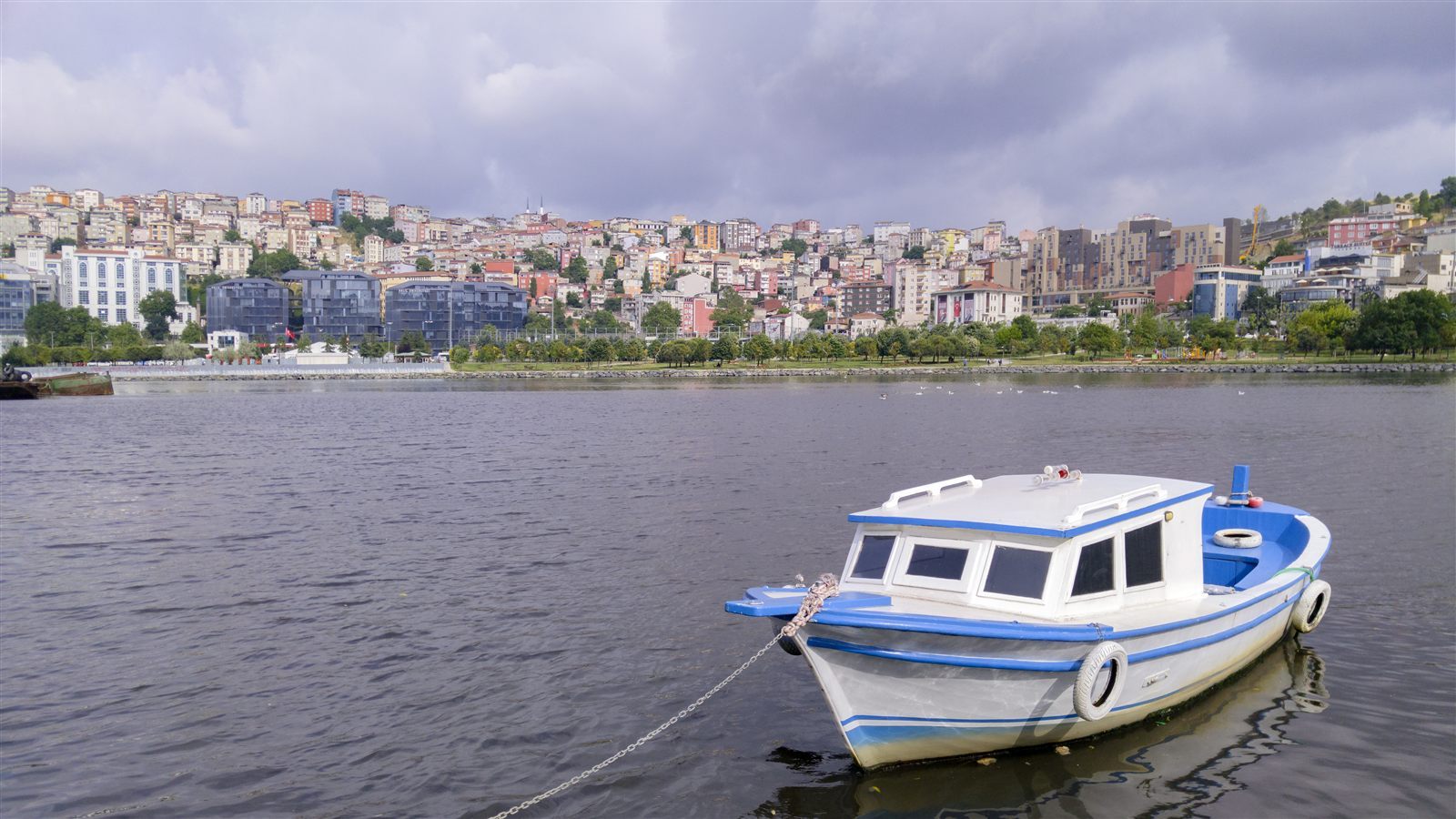
Pictured: a stretch of Istanbul's Sea of Marmara coastline, photographed in 2018 — not a photograph of Kumburgaz, the Yeni Kent Compound, or its shoreline watch post, and not a frame from the disputed video footage that is the entire evidentiary basis of this case. No rights-clear photograph of the Yeni Kent Compound itself or its specific stretch of shoreline is known to be publicly available; this image is included only to orient readers to the region's general coastal geography — the same busy, boat-traffic-heavy inland sea that both proponents and skeptics agree is central to what the footage actually shows.
Theoretical Alignment
Assessment: The Extraterrestrial Hypothesis is scored moderate-low: the footage's alleged porthole silhouettes and structured, metallic-appearing morphology are exactly the kind of detail ETH proponents would expect from a genuine close-range craft encounter, but that same level of claimed close-up detail, sustained over three uncorroborated years by one filmer, is also precisely the profile a fabricated or exaggerated case would be expected to take. The Interdimensional Hypothesis finds essentially no support in the record — nothing in any account describes a discontinuous appearance/disappearance, spatial distortion, or trans-dimensional signature, only ordinary aerial approach-and-hover behavior. This file scores the Psycho-Social/Hoax framework highest of the three, not as an accusation against Yalçın Yalman personally, but because the case's actual structural profile — a single, technically unsophisticated observer with sole and repeated access to an isolated nighttime vantage point, self-selecting when to film, escalating in claimed clarity and content (from indistinct lights to alleged visible occupants) across dozens of unwitnessed sessions with no second recorder ever once independently capturing the same event — is the textbook profile ufology's own literature associates with hoax, self-deception, or a mundane phenomenon (offshore vessel lighting) misinterpreted and then reinforced over repeated viewing.
Background
The Yeni Kent Compound (Yeni Kent Sitesi in Turkish) is a gated, seasonal holiday housing development on the Sea of Marmara coast near Kumburgaz, a small seaside town within Istanbul's Büyükçekmece–Silivri corridor, long popular among Istanbul residents as a summer escape from the city's heat. In 2007, Turkey's small but active domestic UFO-research subculture was centered almost entirely on the Sirius UFO Space Sciences Research Center, a private advocacy and research organization founded by Haktan Akdoğan in the late 1990s (different published sources cite 1997, 1998, and 2001, a minor but genuine discrepancy this file notes rather than silently resolves), which by the mid-2000s had achieved meaningful domestic media visibility through Akdoğan's own weekly television program on UFOs and his subsequent founding of the Istanbul UFO Museum.
Yalçın Yalman worked as the Yeni Kent Compound's overnight security watchman, a role that combined long idle stretches of quiet duty with an unobstructed view across the open water of the Sea of Marmara. According to his own later accounts and those of Sirius researchers who interviewed him, Yalman had a family history of interest in the subject — he described his father also having witnessed an unexplained aerial phenomenon years earlier — and he purchased his own camera equipment specifically in the hope of documenting anything unusual he might observe during his shifts. What began, by his account, as occasional, indistinct lights over the water in June and July 2007 escalated over the following weeks into what Yalman and, later, Sirius researchers described as increasingly detailed, close-range footage of structured, crescent- and disc-shaped objects — and, in some of the more widely circulated segments, what proponents describe as head-and-shoulder-like silhouettes visible through porthole-like openings in the object's surface. Yalman continued filming intermittently through the summer of 2008 and into May 2009, by which point his footage had already reached Sirius, reached Turkish national broadcast media, and reached, briefly, Turkey's own national scientific research council.
Complete Timeline
| Date | Event |
|---|---|
| June 20, 2007 | First documented filming. Night watchman Yalçın Yalman films his first video of bright, indistinct objects over the Sea of Marmara from his post at the Yeni Kent Compound near Kumburgaz. |
| June–August 2007 | Primary 2007 filming period. Yalman records roughly eight separate episodes across the summer, using a Canon GL1 MiniDV camcorder with 20x optical zoom and a Sony VCL-HGD1758 1.7x tele-converter; footage becomes progressively more detailed in its description as the summer goes on, including claimed close-range views of structured, crescent/disc-shaped objects. |
| Aug. 31, 2007 | The primary 2007 filming period, as referenced in later reporting and TÜBİTAK's own review of timecoded material, concludes for the season. |
| Jan. 31, 2008 | Submission to TÜBİTAK. A Turkish television media editor delivers a MiniDV cassette containing roughly 35 minutes of the 2007 footage to TÜBİTAK National Observatory (TUG) for technical examination. |
| Early Feb. 2008 | TÜBİTAK's preliminary report. The National Observatory's Image Processing Unit, coordinated by Istanbul University astronomy lecturer Prof. Dr. Adnan Oktem and signed by observatory director Prof. Dr. Zeki Eker, releases a short preliminary report: the sample shows no sign of computer animation, special effects, or studio-built models, but the observatory explicitly states this does not confirm an extraterrestrial origin, flags internal AM/PM timestamp inconsistencies, and notes that the absence of reference objects prevents determining the true distance, size, or nature of what was filmed. |
| 2008 (date of unveiling reported variously) | Public unveiling. The Sirius UFO Space Sciences Research Center, led by Haktan Akdoğan, presents the Kumburgaz footage at a press conference at Istanbul's Dedeman Hotel, describing it as among the most important UFO images ever captured and stating the footage shows what appear to be two occupants' heads — a claim it characterizes as a world first. |
| May 22 – Sept. 28, 2008 | Extended 2008 filming period. Yalman records approximately 14 further episodes, including a motionless orange/red plasma-type light on June 8–9, a disc-shaped object with possible horizontal movement on June 12, and an elongated object followed roughly 75 minutes later by a light cluster on July 2. |
| May 13–17, 2009 | 3rd International UFO Congress, Istanbul. Organized in part by Akdoğan, the congress draws more than a thousand attendees; Yalman presents his footage publicly for the first time alongside international ufologists, including American podiatric surgeon and UFO researcher Dr. Roger Leir. |
| May 2009 (during congress week) | Further filmed episodes. Additional footage is recorded during the congress period, including a glowing light maneuvering near cloud level on May 14 and a continuous pre-dawn-to-sunrise recording on May 15 showing four orange semicircular lights arranged as an apparent metallic oval craft. Leir and 7–8 others report personally observing an object on site during the congress week, which Leir describes as boomerang-shaped rather than disc-shaped, with three ports and silhouettes he characterizes as resembling classic "grey" alien depictions. |
| Jan. 6, 2012 | Duarte's skeptical report. Chilean researcher Andrés Duarte publishes a ten-page technical analysis concluding that the widely circulated 22-minute segment of Kumburgaz footage most likely shows light reflecting off the windows of a yacht sailing off the Kumburgaz coast, with the alleged "occupant" silhouettes explained as the shadows of the vessel's own crew, distorted by extreme digital zoom and low-light conditions. |
| Sept. 2015 | Lens-reflection analysis. French skeptical researcher Gilles Fernandez publishes a separate technical analysis proposing that the object's core visual signature is consistent with a known photographic artifact — an internal lens reflection of the kind familiar from bright, out-of-focus point-source photography — and that the "alien" silhouettes are attributable to pareidolia rather than any genuine occupant imagery. |
| 2010s (ongoing) | Metabunk community analysis. Contributors to the Metabunk forum, including Mick West, conduct their own independent technical review using astronomical software to model the moon's true position against the footage, proposing that some of the disputed lights are shoreline lamp posts or ship masts misjudged in scale, and separately cross-checking a proposed cruise-ship explanation against AIS vessel-tracking data. |
| 2020s (ongoing) | The case continues to circulate internationally on UFO-interest YouTube channels and podcasts, periodically resurfacing in the wake of unrelated U.S. congressional attention to UAP, with no new corroborating witness, camera, or government finding having emerged since the original 2007–2009 filming period. |
The Filmer and the Compound
Yalçın Yalman's job placed him, night after night, at one of the more unusual private vantage points available to any UFO witness anywhere in the world: an elevated, unobstructed, professionally maintained watch post directly overlooking one of the busiest enclosed seas on the planet, with no supervisor present to observe what he did or did not film during the small hours. By his own account and that of the Sirius researchers who first interviewed him, Yalman purchased his camera equipment specifically to document anything unusual he might see, rather than happening to have a camera on hand when an unplanned event occurred — a detail proponents present as evidence of his seriousness and skeptics present as evidence of predisposition. Over three years he is reported to have progressively upgraded his equipment, moving from a standard MiniDV camcorder and tele-converter combination toward additional zoom adapters and, according to the case's own promotional history, infrared-capable equipment for the darkest pre-dawn sessions — a trajectory consistent with either a genuinely motivated documentarian refining his tools to capture a real recurring phenomenon, or an increasingly practiced operator learning which equipment produced the most visually striking ambiguous footage, and this file does not consider the existing public record sufficient to distinguish cleanly between those two readings.
What the Footage Shows: Shapes, Portholes, and Alleged Silhouettes
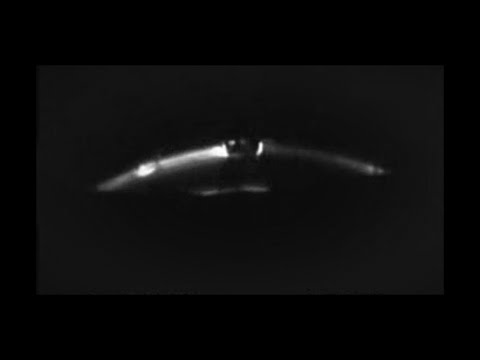
Across the roughly 25–26 individual recordings compiled from the 2007–2009 period, the recurring visual subject is a bright, structured object — most often described as crescent- or disc-shaped, sometimes candidly closer to an irregular, blob-like glow — hovering low and nearly motionless over the water before slowly maneuvering, changing orientation, or drifting out of frame. In the segments most heavily promoted by Sirius and by Yalman himself, close-zoomed footage appears to show darker recessed areas along the object's edge, described by proponents as porthole-like openings, within which still darker forms are said to be visible — interpreted by believers as head-and-shoulder silhouettes of occupants and, in Roger Leir's own account of his 2009 on-site observation, resembling the stereotypical "grey" alien archetype. It is worth stating plainly what this file's own review of the secondary technical literature finds: no independent, methodologically transparent measurement has ever established that these darker regions are discrete three-dimensional forms rather than an artifact of extreme digital zoom on a small, low-resolution light source, compression noise, or ordinary out-of-focus blur interpreted, after the fact and often after repeated group viewing, as a specific and emotionally resonant shape. The skeptical lens-reflection and pareidolia analyses discussed in the Skeptical Investigations section below address this directly, and this file treats their central claim — that ambiguous internal detail within an already-tiny, heavily magnified light source is a weak basis for identifying discrete occupants — as a serious, unresolved, and largely unaddressed objection from the proponent side of the case.
The TÜBİTAK National Observatory Examination
The single most consequential development in this case's history was TÜBİTAK's brief, preliminary engagement with a sample of the footage in early 2008 — and because casual coverage of this case has often overstated what the observatory actually concluded, this file states its findings with deliberate, exact care. On January 31, 2008, a Turkish television media editor delivered a MiniDV cassette containing approximately 35 minutes of the 2007 footage to TÜBİTAK National Observatory. The examination was coordinated at the observatory's Image Processing Unit by Istanbul University astronomy lecturer Prof. Dr. Adnan Oktem, and the resulting short preliminary report was signed by observatory director Prof. Dr. Zeki Eker. Multiple independent Turkish news outlets — Sabah, Memurlar.net, and Hürriyet among them — report a consistent set of findings, released roughly a week after the material's initial television broadcast: the objects visible in the reviewed sample did not appear to be computer animation, special video effects, or a studio-built model or mock-up; some segments showed verifiable, astronomically consistent moonlight; and the term "UFO," in its literal sense of an unidentified flying object, could reasonably be applied to what was filmed.
Every one of those findings was immediately and explicitly qualified by the observatory itself, and those qualifications are just as central to what "TÜBİTAK's finding" actually was as the headline non-hoax result. Director Eker stated directly that classifying the footage as an unidentified flying object "absolutely does not mean" the images depicted an extraterrestrial craft. The report flagged internal inconsistencies in the footage's own timestamps — some segments alternating between AM and PM markings in a way that raised doubts about exactly when individual clips were recorded. Most importantly for any assessment of the footage's evidentiary weight, the observatory stated that the complete absence of any fixed reference object within the close-up frames — no horizon feature, no known-sized landmark, nothing to establish true scale — meant it could not determine the objects' actual distance, altitude, physical size, or fundamental nature from the video alone, and that a fuller understanding would require new, controlled observation at the filming location using dedicated instrumentation, something that, to this file's knowledge, has never subsequently been conducted by TÜBİTAK or any other Turkish government body. Eker is separately reported to have acknowledged that, even accounting for the absence of any detected digital manipulation, "it cannot be proven" that the footage was not staged some other way — through a physical prop, model, light source, or elaborate practical trick rather than computer editing — going so far as to note the material could, in principle, be "someone's joke." No public-facing copy of TÜBİTAK's original written report is known to survive on the observatory's current website; this file cites it via the consistent, cross-corroborating secondary reporting of multiple independent Turkish news organizations rather than a primary document link, and states that limitation honestly rather than overstating what can be directly verified today. Taken as a whole, TÜBİTAK's actual position was a narrow, technically limited, and heavily hedged "not evidently a digital or studio fabrication, but genuinely undetermined in every other respect" — a real and notable finding for a government science body to make about any UFO case, but a considerably more modest one than the "Turkish government confirms UFO" framing that has often attached to it in less careful secondary coverage.
Sirius UFO Space Sciences Research Center and the Public Unveiling
Independent of TÜBİTAK's own limited and hedged review, the footage's international profile was built almost entirely by the Sirius UFO Space Sciences Research Center, Turkey's leading private UFO advocacy and research organization, founded and led by Haktan Akdoğan. Sirius's own science board member, Dr. Seçkiner Görgün, was involved in the organization's internal review of the material, and Akdoğan personally unveiled the footage to Turkish media at a press conference held at Istanbul's Dedeman Hotel, describing the recordings as among the most important UFO images captured anywhere in the world and stating that the footage showed not one object but visible detail resolving into what he characterized as two occupants' heads — a claim he presented as a global first for amateur UFO video. Sirius's promotional materials additionally claimed that footage had been reviewed by unnamed Japanese, Chilean, Brazilian, and Russian technical experts who found no evidence of manipulation; this file has not been able to independently verify the existence, credentials, or specific findings of most of those reviewers beyond Chilean researcher Andrés Duarte — whose actual published conclusion, discussed below, was skeptical rather than confirmatory, directly undercutting rather than supporting the framing in which his nationality is invoked. This file treats the broader "international panel of experts found no manipulation" claim as an example of precisely the kind of overstated secondary framing this case has attracted, and declines to repeat it as established fact.
Roger Leir and the 2009 On-Site Sighting
The Kumburgaz case's public profile reached its peak during the 3rd International UFO Congress, held in Istanbul in May 2009 and organized in significant part by Akdoğan, where Yalman presented his footage to an audience of more than a thousand attendees alongside a roster of international ufologists. Among them was American podiatric surgeon and UFO researcher Dr. Roger Leir, who reported that he and seven to eight other congress attendees personally observed and filmed an object hovering over the water near the same coastline during congress week. Leir's own account, given in multiple later interviews, described the object as boomerang-shaped rather than disc-shaped — comparing it to the "Roswell"-type craft description found in some crash-retrieval lore rather than to Yalman's own crescent/disc descriptions — with three visible ports and, in the central opening, a silhouette he characterized in his own words as resembling a "bumper sticker grey alien." Leir stated repeatedly that he personally watched the object through the camera's own viewfinder and was convinced both that the object was genuine and that the footage was authentic. This file's Observer Credibility section above explains in detail why Leir's involvement functions as a credibility complication rather than an asset: his own defining body of published UFO work — a series of claimed surgical removals of "alien implants" from self-described abductees — was independently examined and rejected by the broader medical, forensic, and skeptical research communities, none of whom found the removed material to be anything other than ordinary biological tissue or debris. An endorsement from a figure whose signature claims were themselves widely debunked does not strengthen the underlying case, and this file declines to present Leir's 2009 testimony as meaningful independent corroboration of Yalman's own three years of solo footage.
The Skeptical Investigations
Osman Demircan: Camera Technique and Institutional Credibility
Prof. Dr. Osman Demircan, an astrophysicist and director of the Ulupınar Observatory at Çanakkale Onsekiz Mart University, offered one of the case's earliest and most direct public rebuttals, arguing that ordinary camera technique — reduced focus, extreme zoom, and deliberate defocusing — is sufficient to transform even a mundane light source such as a street lamp into something that appears anomalous on video, stating publicly that "even a street lamp can be turned into a UFO image" through such methods. Demircan separately criticized the Sirius UFO Space Sciences Research Center directly for promoting the footage's significance without the scientific credentials he argued the claim warranted, and offered a pointed logical objection to the case's central premise: that if extraterrestrial visitors were genuinely and repeatedly present over populated Turkish coastal waters for three consecutive years, the more parsimonious expectation would be contact with government or scientific institutions rather than exclusive, repeated visibility to a single night security guard.
Andrés Duarte: The Yacht Reflection Theory
The case's most detailed and most widely cited skeptical technical analysis came from Chilean researcher Andrés Duarte, who published a ten-page report in January 2012 examining the most widely circulated 22-minute segment of Kumburgaz footage. Duarte's central conclusion was that the segment shows light reflecting off the windows of a yacht sailing off the Kumburgaz coast, with the object's apparent structure produced by the vessel's cabin lighting and window geometry as seen through extreme digital zoom, and the alleged occupant silhouettes explained as the shadows of the boat's own crew moving near those windows, distorted by low light and compression into a shape resonant with a classically imagined alien head. Working from visible reference points in the footage, Duarte argued the camera was oriented southeast to east-southeast, in the general direction of the Güzelce marina, consistent with a vessel transiting or moored in that area. Proponents' strongest counter-argument — that some segments show the object making rapid positional changes, or disappearing and reappearing in a manner inconsistent with a large, slow-moving vessel — has never been resolved through a joint, methodologically transparent frame-by-frame review by both sides, and this file notes that gap as a genuine, still-open weakness in Duarte's otherwise carefully documented explanation.
Gilles Fernandez and the Lens-Reflection Hypothesis
A separate technical explanation, published in 2015 by French skeptical UFO researcher Gilles Fernandez and summarized by UFO Chronicles editor Frank Warren, proposes that the object's core visual signature is a specific, well-documented photographic artifact: an internal lens reflection of the kind familiar to photographers shooting bright, out-of-focus point-source lights at night (the same effect responsible for the ring- or polygon-shaped "orbs" common in amateur concert and fireworks photography). Under this reading, the darker interior regions proponents identify as portholes and occupant silhouettes are explained as pareidolia — Warren's own phrase compares the effect directly to a Rorschach inkblot — compounded by confirmation bias among viewers already primed by Sirius's own promotional framing to expect to see alien figures. This file notes, in fairness to proponents, that Fernandez's own published comparison imagery, while suggestive, does not constitute a controlled replication using the same camera model and lens Yalman actually used, which would be the more rigorous test of the hypothesis.
The Metabunk Community Review
Independent contributors to the Metabunk forum, including researcher Mick West, conducted an open, collaborative technical review of the footage across several threads. That analysis used astronomical simulation software to model the moon's true position against the footage's own claimed filming times, proposing that at least some of the disputed lights are better explained as ordinary shoreline lamp posts or ship masts whose apparent scale was misjudged, and separately noted specific instances in which the person filming appeared to reposition the camera to keep a nearby tree obstructing the view of certain ground-level building lights — a detail some participants read as suggestive of a deliberately composed shot rather than an unplanned, reactive recording of a surprising event. A separate cruise-ship hypothesis floated within the same discussion was directly checked against AIS (Automatic Identification System) vessel-tracking data and found unsupported, since no cruise ship could be confirmed in the area at the relevant times — a useful demonstration that not every skeptical hypothesis proposed for this case has held up equally well, and that the yacht/reflection and lens-artifact explanations remain more evidentially grounded than the cruise-ship variant specifically.
Key Witnesses
Yalçın Yalman
Yalman is the case's only filmer and, effectively, its only witness of record: across roughly three years (2007–2009) he produced more than two dozen videos of luminous objects over the Sea of Marmara from his overnight security post, using progressively upgraded consumer and, later, infrared-capable camera equipment he purchased specifically to document the phenomenon. He presented his footage publicly for the first time at the 2009 International UFO Congress in Istanbul. No independent filmer, co-worker, or resident of the compound has ever come forward with corroborating footage of the same events, a fact this file's Observer Credibility section treats as the case's central, unresolved structural weakness.
Prof. Dr. Zeki Eker
Eker signed TÜBİTAK National Observatory's brief preliminary report on a 35-minute sample of the 2007 footage, submitted January 31, 2008. The report found no evidence of computer animation, special effects, or studio fabrication, while explicitly stating this did not confirm an extraterrestrial origin, flagging internal timestamp inconsistencies, and noting the absence of any reference object prevented determining the objects' true scale, distance, or nature — and that a deliberate hoax using non-digital means "cannot be proven" not to have occurred.
Haktan Akdoğan
Akdoğan founded Turkey's leading private UFO advocacy organization and personally unveiled the Kumburgaz footage to Turkish and international media, describing it as among the most significant UFO images ever captured and stating it showed two occupants' heads — framing this file treats as considerably more confident than the underlying footage or TÜBİTAK's own hedged findings actually support.
Prof. Dr. Osman Demircan
Demircan publicly argued that ordinary camera defocusing and zoom technique can render mundane light sources such as street lamps unrecognizable on video, criticized Sirius for promoting the case without matching scientific rigor, and questioned why a genuine, repeated extraterrestrial presence would remain visible only to a single night watchman rather than to government or scientific observers.
Andrés Duarte
Duarte published a ten-page technical report in January 2012 concluding the case's most widely circulated 22-minute segment shows reflected light from the windows of a yacht sailing off the Kumburgaz coast, with the alleged occupant silhouettes explained as the shadows of the vessel's own crew distorted by extreme zoom and low light.
Dr. Roger Leir
Leir attended the 2009 International UFO Congress in Istanbul and reported personally observing and filming a boomerang-shaped object with visible ports and an alleged "grey" alien silhouette alongside seven to eight other attendees. His involvement is best known outside this case for a separate, widely rejected body of work claiming surgical removal of "alien implants" from self-described abductees.
The Five Observables Assessment
The Five Observables framework, developed to classify UAP encounters by performance characteristics that exceed known technology, is applied here to the behavior described in Yalman's footage:
Assessment: The footage's most frequently claimed anomalous quality is prolonged, near-motionless hover over open water, which this file scores as speculative evidence of anti-gravity-style lift rather than confirmation of it, since a drifting or anchored vessel, or a stationary shoreline light source, can produce a visually similar impression of stationary hovering when viewed through a heavily zoomed lens with no fixed reference point. Reports of sudden directional changes are likewise scored speculative rather than present, since no instrumented measurement of velocity or acceleration exists for any segment of this case — every account is unaided visual estimation from a single, uncorroborated recording. Hypersonic velocity is absent from the record; no witness or analyst, proponent or skeptic, has described the object moving at anything approaching extreme speed. Low observability is unambiguously absent: the entire premise of the case is that the object was bright and visible enough to be filmed repeatedly, in detail, across dozens of separate nights. Trans-medium travel is likewise absent — no account describes any transition between air and water, only aerial hovering above the sea surface. Set against the far more heavily corroborated Greifswald Lights case, where a commercial pilot's professional judgment lent some genuine weight to a claimed deceleration observable, Kumburgaz's Five Observables profile rests entirely on the uncorroborated visual impression of one non-professional observer reviewing his own footage after the fact, a materially weaker evidentiary foundation for any anomalous-performance claim.
Evidence Assessment
Supporting Anomalous Origin
- TÜBİTAK National Observatory's preliminary review found no evidence the sample it examined was computer-generated or studio-fabricated
- The footage spans an unusually long three-year period with a large volume of individually filmed episodes
- Some segments show claimed structured, close-range detail (edges, recessed openings) more specific than a simple point-source light
- No single skeptical explanation accounts for every segment of the full multi-year corpus
Supporting Conventional Explanation or Hoax
- Every one of 25+ videos comes from a single uncorroborated filmer with sole, repeated, unsupervised access to the location over three years
- No independent witness, second camera, or instrumented sensor has ever confirmed any single episode
- TÜBİTAK's own report explicitly stated it could not rule out a non-digital hoax and flagged internal timestamp inconsistencies
- Three independent technical analysts proposed three distinct, evidence-based mundane explanations (yacht reflection, lens artifact, shoreline lamps)
- The filming location directly overlooks one of the busiest shipping lanes in the world, an abundant source of ordinary ambiguous nighttime lighting
- The case's highest-profile secondary "corroborating" witness, Roger Leir, is independently known for a body of UFO claims widely rejected by mainstream science
Why "Disputed"
The Yeni Kent Compound Sighting is classified DISPUTED, with a score reflecting a genuinely rare institutional asset weighed against the single most serious structural credibility problem found on any video-based case in this catalog. On the evidence side, this case holds something almost no other UFO video case in the world can claim: a preliminary, if narrow and heavily hedged, finding from a national government science body — TÜBİTAK National Observatory — that a sample of the raw footage showed no evidence of computer-generated animation or studio fabrication. That is a real, citable, non-trivial data point, and this file has taken care throughout to state it with the same precision TÜBİTAK itself used, rather than either dismissing it or inflating it into the "government confirms real UFO" framing that has often attached to this case in less careful coverage.
Set against that single positive finding is a body of case-specific weaknesses more severe, in combination, than almost any other file on this site. Every one of more than two dozen recordings, spanning three full years, originates from a single filmer with sole, repeated, unsupervised access to the location, and no independent witness, second camera, or instrumented sensor has ever corroborated a single one of those episodes — a profile this file's own credibility framework treats as inherently weaker than even a modest multi-witness case, regardless of the sheer volume of footage produced. TÜBİTAK's own report, read in full rather than in headline form, explicitly declined to rule out a non-digital hoax and flagged internal timestamp inconsistencies in the material it reviewed. Three separate, methodologically distinct skeptical analysts — working independently, using different techniques, and reaching different but non-contradictory conclusions — each proposed a specific, technically grounded mundane explanation (reflected yacht lighting, internal lens artifact, misjudged shoreline lights) for at least part of the footage, none of which has been fully rebutted by proponents. And the case's most prominent secondary "corroborating" witness, Roger Leir, brought with him a body of separate, widely rejected UFO claims that this file treats as weakening rather than strengthening the overall record. A case combining a genuine, rare institutional non-hoax finding with this severe a single-source structural problem, this many independently-arrived-at conventional explanations, and this complete an absence of any second witness across three years, belongs solidly in this site's Disputed range — closer to its lower end than its middle, reflecting that the credibility problem here is more fundamental than the kind of single unresolved technical objection that separates a case like Thomas Mantell from a stronger multi-witness file.
Sensor & Instrumentation Detection Profile
No radar system, air-traffic control log, or independent government sensor of any kind has ever been reported to have detected anything corresponding to this case. The entirety of its evidentiary record consists of consumer-grade video: Yalman's own account and multiple secondary sources describe an initial Canon GL1 MiniDV camcorder (3CCD imaging, 20x optical zoom) fitted with a Sony VCL-HGD1758 1.7x tele-converter, later supplemented across the three-year filming period by additional zoom adapters and, per this case's own promotional history, an infrared-capable camera for low-light sessions — equipment upgraded progressively as Yalman's own interest and public profile grew, rather than fixed from the outset. Promotional accounts describe combined magnification reaching "100x" to "200x," a figure that, if achieved through digital rather than purely optical zoom, is a specific technical vulnerability skeptics have repeatedly flaged: digital zoom magnifies pixel-level sensor noise and lens artifacts along with genuine detail, which is directly relevant to the lens-reflection and pixel-bloom explanations discussed in Conventional Explanation Candidates below. The only instrumented, laboratory-style examination on record is TÜBİTAK National Observatory's (Turkish acronym: TUG) preliminary image-processing analysis of a single MiniDV cassette — roughly 35 minutes of footage from summer 2007 — submitted to the observatory by a television news editor on January 31, 2008 and examined by its Image Processing Unit under the coordination of Istanbul University astronomy lecturer Prof. Dr. Adnan Oktem, with the resulting report signed by observatory director Prof. Dr. Zeki Eker. This is described in more detail in Material Analysis and the Declassified Government Records section below; it remains, more than 17 years later, the only third-party technical assessment of any of the raw footage ever performed by a credentialed scientific institution rather than an advocacy group, a forum community, or a single independent analyst.
Environmental & Geospatial Context
Kumburgaz sits on the Sea of Marmara coast within Istanbul's western Büyükçekmece–Silivri corridor, roughly 45 km west of the city center, an area long popular for summer holiday compounds like Yeni Kent that empty out much of Istanbul's population toward the coast in the warmer months. The Sea of Marmara itself is not open ocean but one of the busiest enclosed shipping lanes on Earth: it is the sole maritime link between the Black Sea (and, beyond it, southern Russia, Ukraine, Georgia, Bulgaria, and Romania) and the Aegean/Mediterranean via the Bosphorus and Dardanelles straits, carrying a constant nighttime traffic of bulk carriers, tankers, ferries, fishing boats, and private yachts, including marinas in the general vicinity such as Güzelce. This maritime context is directly relevant to this file's Conventional Explanation Candidates section: an offshore vessel's running lights, deck lighting, or illuminated cabin windows, viewed at night, at a distance, through a heavily zoomed consumer lens, and without any visible reference object to establish true scale or range, is a mundane light source fully capable of producing an ambiguous, structured-looking bright object low over the water. Istanbul's own metropolitan light pollution, air traffic corridors serving multiple Istanbul-area airports, and routine coastal illumination (piers, marina lights, shoreline lamp posts) further complicate any attempt to establish what any given light in the footage actually was without a contemporaneous, independent second observation point — a corroboration source this case never obtained. TÜBİTAK's own preliminary examination noted that its sample showed verifiable, astronomically consistent moon-phase lighting for at least some of the reviewed footage, but explicitly stated that the absence of any reference object in the close-up frames meant the observatory could not establish the objects' actual distance, altitude, or true physical size — a foundational unresolved gap that every subsequent analysis, believer and skeptic alike, has had to work around rather than close.
Observer Credibility & Occupational Profile
This is the case's single greatest structural weakness, and this file treats it as such rather than minimizing it. Yalçın Yalman was employed as an overnight security watchman at the Yeni Kent Compound — not a pilot, radar operator, scientist, or other professionally trained observer whose occupation would ordinarily lend independent evidentiary weight to a visual account, the kind of credential this site's own framework (see the Roswell and Coyne case files for comparison) treats as materially strengthening witness testimony. No formal background in optics, astronomy, videography, or photographic analysis has been documented for him. Far more significant than his occupation, however, is the case's uncorroborated single-source structure: across three full years and more than two dozen separate filmed episodes, no co-worker, resident, family member (beyond secondhand, unrecorded accounts), or passerby is known to have independently produced their own photograph or video of the same phenomenon from a different vantage point on the same night — despite the Yeni Kent Compound being an occupied residential holiday development, not an unpopulated wilderness outpost. A single individual with sole, repeated, self-scheduled access to the filming location and no external check on when, how, or whether he filmed is a profile this site's own credibility standard (compare the Greifswald Lights case, corroborated across five towns and eight-plus named witnesses, or the multiply-corroborated Coyne helicopter incident) treats as inherently far weaker than even a modest multi-witness case, regardless of how much footage that single individual ultimately produces. The analysts who examined the footage are, by contrast, occupationally credentialed in a way Yalman himself is not: TÜBİTAK National Observatory director Prof. Dr. Zeki Eker is a professional astrophysicist heading Turkey's national observatory; skeptic Prof. Dr. Osman Demircan is likewise a credentialed astrophysicist and observatory director. Haktan Akdoğan, who publicized and promoted the footage internationally, is a self-taught private UFO researcher with no formal scientific credential, heading an advocacy organization rather than a research institution. American ufologist Dr. Roger Leir, who claimed to personally witness a related object during the 2009 Istanbul congress, was a podiatric surgeon whose defining career claim — surgically removing purported "alien implants" from self-described abductees — was widely and specifically rejected by mainstream medical and forensic analysis; this file treats his endorsement as a credibility liability for the case rather than an asset, a rare instance where an added "witness" arguably weakens rather than strengthens the overall record.
Physical & Material Assays
None exist, and this file states that plainly rather than working around it. No debris, no landing trace, no soil or vegetation anomaly, no electromagnetic-interference report, and no physiological effect on any witness has ever been claimed in connection with this case at any point across its three-year span. This is consistent with a purely aerial, over-water phenomenon that at no point was reported to have approached land, but it also means the case's entire evidentiary weight rests on video interpretation alone — unlike cases such as Roswell or Trans-en-Provence, there is no independent physical-science discipline (metallurgy, soil chemistry, radiological assay) available to corroborate or falsify any claim here. The closest thing to a "material assay" this case has ever produced is TÜBİTAK's own image-processing examination of the video data itself, detailed fully in Material Analysis below — an analysis of a video file, not of any physical object or trace.
Historical Precedents & Archive Matches
Within this site's own catalog, Kumburgaz's closest structural analogue is the Greifswald Lights case — another nocturnal, over-water formation of lights subjected to genuine technical analysis and contested between a mundane maritime/military explanation and a residual "unidentified" verdict. The comparison is instructive specifically because of where the two cases diverge: Greifswald drew several hundred witnesses across five separate towns, at least eight independently named and occupationally varied filmers and photographers, and six independent video recordings with cross-corroborating timecodes, while Kumburgaz, despite a comparable multi-year span and an even larger raw volume of footage, rests entirely on one person's camera. More broadly, "boat or ship lights misidentified as a UFO over open water at night" is one of the single most common conventional-explanation categories in the international UFO literature, precisely because enclosed seas and coastal shipping lanes reliably produce exactly the ambiguous, structured-looking, slow-moving light sources that a zoomed, uncorroborated consumer camera cannot easily rule out. Turkey's own UFO-research history prior to 2007 was comparatively thin and centered almost entirely on the private Sirius UFO Space Sciences Research Center, founded by Haktan Akdoğan in the late 1990s; TÜBİTAK's brief, hedged 2008 involvement in this case is a genuinely rare instance of a national science body directly engaging with a UFO report anywhere in the world, though it falls well short of the standing, institutionally resourced investigative programs maintained by France's GEIPAN or Chile's CEFAA, both of which conduct systematic, ongoing case intake rather than a single one-off preliminary review of a submitted cassette.
Material Analysis
Because no physical trace evidence of any kind exists for this case, its entire evidentiary basis is the video record itself — which makes the quality and limits of the technical analysis actually performed on that video unusually important, and unusually worth stating with precision rather than treating as a settled matter either way.
The video corpus. Across 2007–2009, Yalman is reported to have produced more than two dozen individual recordings using a Canon GL1 MiniDV camcorder (3CCD sensor, 20x optical zoom) fitted with a Sony VCL-HGD1758 1.7x tele-converter, later supplemented by additional zoom adapters and, per the case's own promotional history, infrared-capable equipment. Combined magnification is described in promotional accounts as reaching "100x" to "200x" — a figure that, to the extent it relies on digital rather than purely optical zoom, magnifies sensor noise, compression artifacts, and lens flare alongside genuine image detail, a specific and technically well-founded vulnerability that directly underlies both the lens-reflection and pixel-bloom skeptical explanations discussed below. Unlike the Greifswald Lights case's six independently sourced videos with cross-corroborating embedded timecodes, every one of Kumburgaz's 25+ recordings originates from the same single camera operator, meaning no video in the corpus can be used to independently verify or cross-check any other.
TÜBİTAK's image-processing review. The only examination of any of this material by a credentialed scientific institution was TÜBİTAK National Observatory's brief review of a single 35-minute cassette submitted in January 2008, described in full in the Declassified Government Records section above. Its conclusion, precisely stated, was narrow: no evidence of computer-generated animation, special effects, or studio-built models in the sample reviewed, paired with an explicit statement that this did not confirm an extraterrestrial origin, that internal timestamps showed inconsistencies, and that the absence of reference objects made the objects' true distance, size, and nature undeterminable from the footage alone. TÜBİTAK did not, at any point, state that the footage showed a genuine unconventional craft, did not rule out a physical (non-digital) hoax, and explicitly recommended further controlled observation at the site — a recommendation this file has found no evidence was ever acted upon by any Turkish institution.
Independent technical counter-analysis. Three methodologically distinct skeptical analyses have each proposed a different mundane origin for the footage without any of them fully closing the case: Andrés Duarte's January 2012 report attributing the widely circulated 22-minute segment to reflected yacht-window lighting; Gilles Fernandez's 2015 analysis attributing the object's core appearance to an internal lens-reflection artifact with the alleged occupant silhouettes explained as pareidolia; and the Metabunk community's ongoing review proposing shoreline lamp posts or ship masts for at least some segments, while separately ruling out a proposed cruise-ship explanation against AIS vessel-tracking data. None of these three explanations has been directly, jointly tested against the others or against the original raw footage in a single controlled comparison, and each addresses different segments of a three-year corpus rather than the case as a single unified phenomenon — a genuine gap in the skeptical literature this file notes rather than glosses over, even as it finds the cumulative weight of independently-arrived-at mundane explanations, from separate analysts using separate methods, to be a meaningful count against the case's anomalous interpretation.
Supporting a Genuinely Unresolved Origin
- TÜBİTAK National Observatory, a credentialed government science body, found no evidence of computer animation or studio fabrication in the sample it reviewed — a rare, genuine positive finding for any UFO video case
- The observatory confirmed astronomically consistent moonlight in at least some reviewed footage
- No single skeptical explanation has been shown to account for the entire three-year, 25+-video corpus
- Duarte's yacht-reflection theory has not fully addressed proponent claims of rapid positional change in some segments
Supporting a Mundane or Fabricated Origin
- Every recording originates from the same single, uncorroborated camera operator; no video can cross-check another
- TÜBİTAK itself stated a non-digital hoax "cannot be proven" not to have occurred, and flagged internal AM/PM timestamp inconsistencies
- The absence of any reference object means the objects' true size, distance, and nature remain formally undetermined even by TÜBİTAK's own account
- Extreme digital zoom on a low-resolution consumer sensor is a well-documented source of the kind of ambiguous internal detail the "portholes" and "silhouettes" claims rely on
- Three independent skeptical analysts, using three different methods, each independently proposed a mundane explanation without coordinating with one another
- The filming location directly overlooks one of the world's busiest enclosed shipping lanes, providing an abundant, undisputed source of ordinary nighttime maritime lighting
Conventional Explanation Candidates
Four distinct conventional explanations have been seriously proposed for some or all of the Kumburgaz footage, none of them official, none of them mutually exclusive, and none of them fully accounting for the entire three-year corpus on its own.
Candidate 1: Reflected Yacht/Vessel Lighting (Andrés Duarte, 2012)
Duarte's detailed technical analysis of the most widely circulated 22-minute segment concluded the footage shows light reflecting off the windows of a yacht sailing off the Kumburgaz coast, with alleged occupant silhouettes explained as the shadows of the vessel's own crew, distorted by extreme zoom and low light. This explanation is strengthened by the filming location's direct overlook of one of the world's busiest enclosed shipping lanes and by Duarte's own reference-point analysis placing the camera's orientation toward the Güzelce marina area. It is weakened by its narrow scope — addressing one segment of a much larger corpus — and by an unresolved proponent objection that some footage shows positional changes difficult to reconcile with a large, slow vessel.
Candidate 2: Internal Lens Reflection / Pareidolia (Gilles Fernandez, 2015)
Fernandez's analysis proposes that the object's core visual signature is a known photographic artifact — an internal lens reflection from a bright, out-of-focus point-source light — with the "occupant" silhouettes attributed to pareidolia reinforced by prior promotional framing. This candidate is strengthened by its grounding in a well-documented, reproducible photographic phenomenon rather than a case-specific ad hoc explanation, but weakened by the absence of a controlled replication using the same camera and lens combination Yalman actually used.
Candidate 3: Misjudged Shoreline Lights or Ship Masts (Metabunk community analysis)
Independent forum-based technical review using astronomical modeling software proposed that at least some disputed lights are ordinary lamp posts or ship masts along the shoreline, misjudged in scale under extreme zoom. This candidate is strengthened by its use of verifiable astronomical positioning data to check claimed filming times against real moon position, but weakened by being an informal, community-driven analysis rather than a peer-reviewed or institutionally sponsored one, and by covering only a subset of the full corpus.
Candidate 4: Deliberate Hoax by the Filmer
Given that every one of 25+ recordings across three years originates from a single individual with sole, unsupervised, repeated access to the filming location, a deliberate hoax constructed with simple practical means — a light source, a small model, or careful camera technique of the kind Osman Demircan specifically described — remains a live possibility this file cannot rule out, and which TÜBİTAK's own report explicitly declined to rule out ("it cannot be proven" the footage was not a joke). This candidate is strengthened by the case's singular structural vulnerability (one uncorroborated source, escalating claimed detail over time, equipment upgrades tracking public interest) and is neither confirmed nor refuted by any evidence in the public record; no motive, financial or otherwise, has been established, and no direct evidence of staging has been produced by any investigator on either side.
Reflected Yacht/Vessel Lighting (Duarte, 2012)
PlausibleWell-documented technical analysis of the most widely circulated segment, strongly supported by the location's shipping-lane context, though it addresses only part of the full corpus.
Internal Lens Reflection / Pareidolia (Fernandez, 2015)
InconclusiveGrounded in a real, reproducible photographic artifact, but never tested against the specific camera and lens combination actually used in this case.
Misjudged Shoreline Lights or Ship Masts
InconclusiveUses verifiable astronomical positioning data, but remains an informal community analysis covering only some segments of the case.
Deliberate Hoax by the Filmer
InconclusiveExplicitly not ruled out even by TÜBİTAK's own report; the case's uncorroborated single-source structure makes this a live possibility, though no direct evidence of staging or motive has been produced.
Related Cases
Honest Assessment: No Formal Case File or Public Report Copy Survives
This is not a U.S. case with a NARA, CIA, or FBI Vault paper trail, and no Turkish government agency has ever opened or published a standing, dedicated investigative case file on the Yeni Kent Compound Sighting. What exists instead is a single, brief, preliminary technical review performed by TÜBİTAK National Observatory (TUG) — part of Turkey's national scientific research council — at the request of a television media outlet in early 2008. TÜBİTAK's current institutional web presence does not host a public copy of the original written report or any case-specific page referencing it; this file cites the report's contents via consistent, cross-corroborating contemporary reporting from multiple independent Turkish news organizations (Sabah, Memurlar.net, and Hürriyet among them, detailed fully in Sources) rather than a live primary-document link, and states that limitation honestly rather than presenting the citation as more than it is.
Coordinated by Istanbul University astronomy lecturer Prof. Dr. Adnan Oktem and signed by observatory director Prof. Dr. Zeki Eker. Found no evidence of computer animation, special effects, or studio fabrication in the sample reviewed, while explicitly declining to confirm an extraterrestrial origin, flagging internal AM/PM timestamp inconsistencies, and stating that the absence of reference objects prevented determining the objects' true distance, size, or nature.
REFERENCED VIA CONTEMPORARY PRESS REPORTING (no independently verified primary copy located)Search Government & Scientific Archives Directly
Further Reading — Recommended Literature
UFOs: Reframing the Debate
An anthology that moves past the simple believer-versus-skeptic standoff, useful context for a case like Kumburgaz where a genuine institutional non-hoax finding coexists with a severe structural credibility problem rather than pointing cleanly toward one conclusion.
The UFO Encyclopedia (3rd Edition)
A comprehensive reference for situating Kumburgaz within the broader history and taxonomy of internationally reported nocturnal-light and video-based UFO cases.
UFOs Explained
The foundational text of technical, optics- and photography-based UFO skepticism, directly relevant background for weighing the lens-reflection and reflected-light explanations evaluated in this file's Conventional Explanation Candidates section.
The Aliens and the Scalpel
Roger Leir's own account of his separate, widely rejected "alien implant" surgical claims, useful primary-source context for assessing the credibility of his 2009 Kumburgaz on-site testimony discussed in this file's Observer Credibility section.
Watch the Skies!: A Chronicle of the Flying Saucer Myth
A Smithsonian aerospace historian's history of the flying-saucer phenomenon as a social and cultural artifact, useful context for a single-witness case whose claimed detail escalated over a multi-year public-facing filming campaign.
Essential Viewing
Sources
- Sabah. "İstanbul Kumburgaz'da çekilen UFO görüntüsü yeniden gündemde! 15 yıldır sırrı çözülemiyor." Retrospective confirming the January 31, 2008 TÜBİTAK submission date, the "no manipulation detected" finding, and the explicit non-confirmation of extraterrestrial origin. sabah.com.tr
- Memurlar.net. "UFO İddiasındaki Görüntüler, TUBİTAK Tarafından Şüphe İle Karşılandı." Detailed contemporary account of TÜBİTAK National Observatory director Zeki Eker's preliminary findings, including the timestamp-inconsistency and "cannot be proven" hoax caveats. memurlar.net
- Hürriyet. "Kumburgaz'da 'UFO' görüntülendiği iddiası." Contemporary report on TÜBİTAK's examination method and Director Eker's public statements. hurriyet.com.tr
- Hürriyet. "Kumburgaz UFO'su gerçek değil." Coverage of astrophysicist Osman Demircan's skeptical camera-technique explanation and his criticism of Sirius UFO Space Sciences Research Center. hurriyet.com.tr
- Gazete Vatan. "Kumburgaz UFO'sunun sırrı çözüldü!" (Jan. 6, 2012). Original Turkish-press report on Andrés Duarte's ten-page yacht-reflection analysis of the 22-minute Kumburgaz segment. gazetevatan.com
- Milliyet. "Kumburgaz UFO'sunun sırrı çözüldü." Further coverage of Duarte's report and its reception. milliyet.com.tr
- Habertürk. "Kumburgaz UFO'sunun sırrı çözüldü." Additional Turkish-press coverage of the Duarte yacht-window-reflection explanation. haberturk.com
- CNN Türk. "Kumburgaz'da UFO heyecanı." Contemporary report on the original 2007 filming period, Yalçın Yalman's employment at the Yeni Kent Compound, and the Sirius/Dedeman Hotel press conference. cnnturk.com
- Cumhuriyet. "UFO'lar herkesi ikna etti." Coverage including Haktan Akdoğan's public statements describing the footage as convincing skeptics and referencing visible silhouettes inside the object. cumhuriyet.com.tr
- Eurasianet. "Turkey: UFO Believers Seek to Shed 'Quack' Status." English-language journalism on Turkey's UFO-research subculture, the Sirius UFO Space Sciences Research Center, and TÜBİTAK's engagement with the Kumburgaz footage. eurasianet.org
- Metabunk. "2008 UFO Footage From Kumburgaz, Turkey." Open, collaborative technical forum analysis including astronomical-simulation moon-position modeling, AIS vessel-tracking cross-checks, and lamp-post/ship-mast hypotheses. metabunk.org
- The UFO Chronicles (Frank Warren, ed.). "The Kumburgaz, Turkey UFO Case: It's a Lens Reflection!" Summary of Gilles Fernandez's internal-lens-reflection and pareidolia analysis. theufochronicles.com
- Turkey UFO Incident (compiled case archive). "New Details on the 'TUBITAK Report' on the Kumburgaz Case." Supplementary English-language compilation of TÜBİTAK submission and report dates, Adnan Oktem's coordinating role, and camera-equipment specifications; consulted as a secondary compilation and cross-checked against the Turkish press sources above rather than relied on independently. turkeyufocase.blogspot.com
- TÜBİTAK (Scientific and Technological Research Council of Türkiye). Official institutional homepage, consulted to confirm the parent organization's current structure and to verify no public case-specific report page for this incident is presently hosted on its site. tubitak.gov.tr
- YouTube (Eyes On Cinema). "The Kumburgaz, Turkey, UFO sightings of 2007-2009." Case-specific video retrospective, verified live via the YouTube oEmbed API. youtube.com
- Wikimedia Commons. "Istanbul beaches- Sea of Marmara - Tourism in Turkey 16.jpg," photographed by Mostafa Meraji, May 25, 2018, licensed CC BY-SA 3.0. Source of this file's hero image. commons.wikimedia.org
See something inaccurate? Have additional information or sources?
Suggest an Edit →Last Updated: August 2026