
Kolkata UFO Sighting
In the pre-dawn hours of October 29, 2007, a senior private-company executive filming from his tenth-floor flat in the Kalikapur neighborhood of east Kolkata, India captured roughly three hours of handycam footage of a bright, multi-coloured object hanging at about 30° above the eastern horizon that appeared, on tape, to morph from a sphere to a triangle to a straight line before fading with the dawn. Television broadcast of the clip drew hundreds of onlookers to the E.M. Bypass and prompted rapid comment from two credentialed Kolkata scientists: M.P. Birla Planetarium director Debiprosad Duari, who called the footage a probable optical illusion caused by clouds reflecting the city's own lights, refracted by the atmosphere, and Saha Institute of Nuclear Physics astro-particle physicist Kamales Kar, who offered a sharper, narrower technical objection: whatever the object was, "a cosmic body cannot change its appearance so rapidly." The case rests on a single witness's video, seen by the public only as broadcast television footage, with no radar return, no second independent recording, and no physical trace — a thin evidentiary record that this file weighs honestly against Kar's genuinely unresolved objection below.
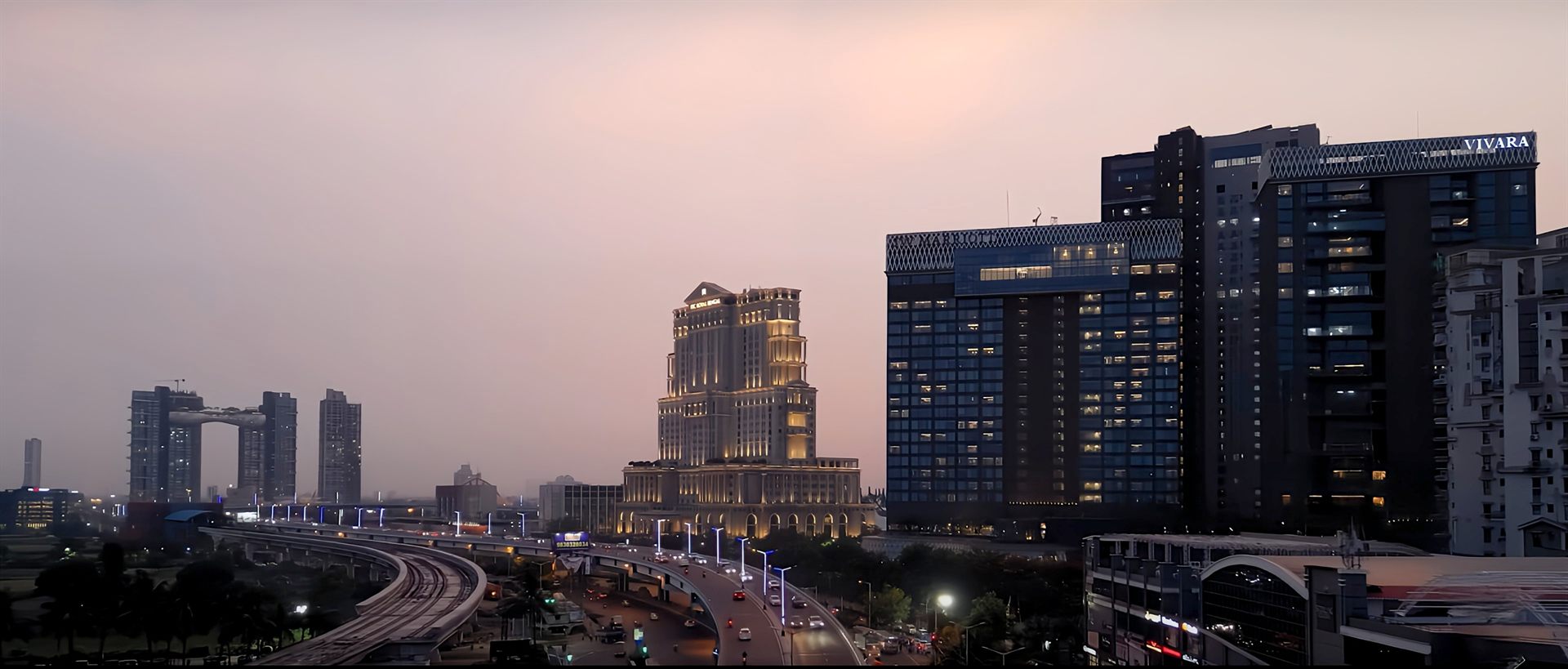
Pictured: the Eastern Metropolitan Bypass (E.M. Bypass), Kolkata, at night — not a photograph of the object itself, which exists only as the original filmer's own handycam footage, last publicly known to have been broadcast on Kolkata television in October 2007 and not held in any public archive this file could locate. The E.M. Bypass is the exact road along which hundreds of Kolkata residents gathered after the broadcast to look for the object themselves, and it runs directly past Kalikapur, the neighborhood the original footage was filmed from.
Theoretical Alignment
Assessment: The Extraterrestrial Hypothesis scores low here because nothing in the surviving record requires it — no structured craft, no occupants, no landing, and no instrument corroboration, only a single video of a distant light. The Optical/Atmospheric Hypothesis — that clouds over east Kolkata reflected the city's own street, vehicle, and building lighting, distorted further by atmospheric refraction into an apparently shape-shifting, multi-coloured glow — is this file's leading candidate, both because it was the explanation immediately and specifically offered by a credentialed planetarium director examining the same broadcast footage the public saw, and because it is the only proposed explanation that does not require the object to have been a discrete physical body of any kind, terrestrial or otherwise. That last point matters directly: astro-particle physicist Kamales Kar's specific technical objection — that "a cosmic body cannot change its appearance so rapidly" — is a real, credentialed rebuttal, but it is a rebuttal to a star-, planet-, or comet-based explanation specifically, not to Duari's cloud-and-refraction theory, which was never built on the premise of a genuine astronomical body in the first place. A meaningful "Unidentified/Undetermined" residue nonetheless survives, because no source located for this file has produced hard confirming data — a contemporaneous weather record, a satellite cloud image, or a second independent recording — that actually nails down what the object was, only what credentialed observers guessed it probably was after the fact.
Background
By late October 2007, India's 24-hour television news environment was in the middle of a genuinely fierce, still-recent competitive expansion — a wave of Hindi- and Bengali-language news channels had launched or scaled up through the mid-2000s, competing intensely for viewers with breaking, visually striking stories, and unusual sky phenomena were a recurring staple of that coverage cycle nationally. Kolkata (formerly Calcutta), the capital of West Bengal and one of India's largest metropolitan areas, has a long institutional relationship with public astronomy: the M.P. Birla Planetarium, inaugurated on the city's Chowringhee Road on July 2, 1963 by India's first Prime Minister, Jawaharlal Nehru, was at the time only the second major planetarium established in the Commonwealth, and by 2007 it functioned as the natural first call for any Kolkata newsroom seeking expert comment on an unexplained sky event. The planetarium's parent body, the M.P. Birla Institute of Fundamental Research, has since been formally recognized by India's Department of Scientific and Industrial Research as a Scientific and Industrial Research Organisation, underscoring that Duari's comments to the press came from within a genuine, institutionally credentialed research body rather than a purely educational or tourist-facing attraction. The city is also home to the Saha Institute of Nuclear Physics, founded on January 11, 1950 by physicist Meghnad Saha and operating under India's Department of Atomic Energy, whose Theory Division has long maintained research strength in nuclear astrophysics and neutrino physics — the specific background that made a Saha Institute physicist a natural second call for the same story. Kalikapur itself, the locality the sighting was filmed from, is an ordinary, densely built residential neighborhood of south-east Kolkata bordering the Eastern Metropolitan (E.M.) Bypass — the arterial road that would, within hours of the broadcast, fill with residents looking skyward for themselves. This is the specific media and institutional environment — a competitive, visually driven 24-hour news cycle, a long-established planetarium with a media-facing director, and a major nuclear-physics research institute a short drive from the sighting location — in which a single resident's handycam footage of an unusual pre-dawn light became a genuine national news story within a single news cycle.
Complete Timeline
| Date | Event |
|---|---|
| Oct. 24, 2007 | Comet 17P/Holmes undergoes a spectacular, globally observed outburst, brightening by roughly half a million times within hours to become naked-eye visible in the constellation Perseus — part of the same general pre-dawn eastern sky the Kolkata object would later be reported in, and later specifically considered and ruled out by Debiprosad Duari as an explanation. |
| Oct. 29, 2007, ~3:20 AM | The sighting begins. A senior private-company executive, filming from his own tenth-floor flat in Kalikapur, east Kolkata, begins recording a bright, multi-coloured object visible at roughly 30° above the eastern horizon. |
| Oct. 29, 2007, ~3:20–5:40/6:30 AM | The filmer continues recording intermittently as the object appears, on tape, to change shape repeatedly — from a round or spherical form, to a triangle, to a straight line — while radiating a shifting range of colours within a halo-like glow, for a combined visible duration later described as approximately three hours. |
| Oct. 29, 2007, near dawn | The object fades from view as daylight strengthens over east Kolkata; no further sighting of it is reported after this point. |
| Oct. 29–30, 2007 | The filmer's footage is obtained by at least one Kolkata television news channel and broadcast to the public, triggering immediate, widespread local attention. |
| Oct. 29–30, 2007 | Crowds gather. Hundreds of Kolkata residents and motorists, having seen the television broadcast, gather along the E.M. Bypass in east Kolkata hoping to spot the object themselves; none is reported to have succeeded, and no independent second recording from this crowd has ever surfaced. |
| Oct. 30, 2007 | Scientific comment and press coverage. M.P. Birla Planetarium director Debiprosad Duari, shown the broadcast footage, calls it "extremely interesting and strange" but proposes it is most likely an optical illusion caused by clouds reflecting the city's own lights, compounded by atmospheric refraction; he separately considers and rejects both a Comet Holmes fragment and the planet Venus as explanations. Saha Institute of Nuclear Physics astro-particle physicist Kamales Kar (reported in press as "Kamalesh Kar") independently states that "a cosmic body cannot change its appearance so rapidly," while cautioning that it is "very difficult to draw any conclusion based on television pictures" alone and that a longer observation period would be needed to reach a firm judgment. TwoCircles.net and SiliconIndia both publish reports headlined "Kolkata scientist punches holes in UFO theory," and the Times of India publishes its own account, "UFO puzzle has city in a tizzy," the same day; both stories are widely syndicated and discussed across Indian print, television, and early social/blog media over the following days. |
| Nov. 2007 (undated) | Kolkata's Pitara Kids' Network publishes a lighter retrospective on the sighting and Kar's comments, noting wryly that with Diwali still more than a week away, the city had nonetheless gotten an early, unexplained show of "celestial fireworks." |
| 2007–present | No further physical evidence, second independent recording, named additional witness, or follow-up scientific investigation of the case is known to have surfaced in the eighteen years since. The case is subsequently cited in general surveys of Indian UFO reports, including the Wikipedia and Bharatpedia "UFO sightings in India" compilations, without new primary evidence being added. |
What Was Filmed: The Kalikapur Footage
Every detail of what was actually observed in the Kolkata case traces back to a single source: roughly three hours of handycam video recorded by the Kalikapur resident named in contemporary press coverage as Farhan Akhtar between approximately 3:20 AM and 5:40 to 6:30 AM on October 29, 2007. Contemporary reporting is consistent on the object's basic reported behaviour even where it differs on smaller details — the recording device is variously described as a "Sony handycam" and, in at least one contemporary blog account, a cell-phone camera, a discrepancy this file cannot resolve given that no outlet appears to have examined the original device directly. What is consistently reported is the object's position — roughly 30° above the eastern horizon, in the same general direction the pre-dawn sky over Kolkata would show Venus as a bright morning object and, further north in Perseus, the still-fading afterglow of Comet Holmes's spectacular five-days-earlier outburst — and its behaviour on tape: a bright core radiating a shifting range of colours, surrounded by a halo-like glow, that appeared over the course of the recording to alter its outline from a rounded, spherical shape, to a triangular one, to what witnesses and reporters described simply as "a straight line," before fading away as the sky brightened toward dawn.
No source located for this file describes the object making any directional movement across the sky comparable to an aircraft's transit, nor any sudden acceleration, nor any interaction with other objects — the entire reported phenomenon is a single light source, roughly fixed in general position over the three-hour window, whose apparent outline and colour were what changed. That distinction matters for how the case should be read: this is not, on its own reported terms, an account of a structured craft maneuvering through the sky, but of a stationary or near-stationary light source whose visual appearance shifted, which is a materially different (and, per the analysis below, more readily explicable) class of report than a maneuvering-craft case.
Media Amplification and the Crowd on the E.M. Bypass
What turned a single resident's three-hour recording into a genuine city-wide news event was straightforward: at least one Kolkata television news channel obtained and broadcast the footage, very likely within the same news cycle given how quickly both the crowd response and the scientific rebuttals followed. Once aired, the footage did two things simultaneously. It drew hundreds of residents and motorists out along the Eastern Metropolitan Bypass — the same arterial corridor running past Kalikapur itself — hoping to see the phenomenon with their own eyes, a crowd response that is itself well-documented across multiple contemporary outlets even though, notably, no member of that crowd is ever individually named or quoted with a specific independent observation in any source this file located. And it prompted Kolkata television and print outlets to seek out expert comment, which is how both Duari and Kar came to be quoted specifically responding to the broadcast footage rather than to any first-hand observation of their own. This sequence — a single amateur recording, rapid television amplification, a public crowd response that itself produced no new evidence, and same-day expert comment working only from the broadcast clip — is a recognizable and recurring pattern in 21st-century UFO reporting worldwide, and this file notes it not to dismiss the case but to be precise about exactly what evidentiary chain the public record actually rests on: one recording, re-transmitted once, examined by two scientists neither of whom is reported to have handled the original tape. It is also worth noting what this amplification pattern did not produce: despite Kolkata having, by 2007, several competing 24-hour Bengali- and English-language news operations actively covering the story, and despite hundreds of residents deliberately gathering along the E.M. Bypass specifically hoping to film the object themselves, no second video, still photograph, or specifically detailed individual eyewitness account from that crowd is preserved in any source this file located. A genuinely still-present or recurring aerial phenomenon, actively searched for by a large, motivated, camera-equipped crowd across at least one further pre-dawn window, would be expected to produce at least some further independent visual record if it were a stable, physically real object rather than a one-time, time-limited effect tied to the specific atmospheric or lighting conditions of that single morning; the total absence of any such further record is itself a modest piece of circumstantial evidence favoring a transient, condition-specific explanation like Duari's over a persistent physical craft.
Key Witnesses
Farhan Akhtar (Kalikapur resident)
A senior executive at a private company, reported by name in contemporary Indian press coverage, who filmed the object from his own tenth-floor flat in Kalikapur, east Kolkata, between roughly 3:20 and 5:40–6:30 AM on October 29, 2007. He is the case's sole named primary witness and the source of its only piece of physical evidence, and no source located for this file establishes any astronomy, optics, or aviation background for him. This file notes explicitly, to avoid any confusion, that this witness shares a name with a well-known Indian film actor and director but is a distinct, unrelated private individual; no source connects the two.
Debiprosad Duari
Duari, an astrophysicist and longtime director at Kolkata's M.P. Birla Planetarium (inaugurated 1963), was shown the broadcast footage and called it "extremely interesting and strange" before offering his own leading explanation: an optical illusion produced by clouds over the city reflecting Kolkata's own street and building lighting, compounded by atmospheric refraction. He is separately reported to have considered and rejected both a fragment of the then newly outburst-brightened Comet Holmes (on the grounds of mismatched altitude and direction) and the planet Venus (on the grounds that Venus could not plausibly appear as bright and as close-seeming as the object did on an ordinary handycam recording) before concluding the footage most likely showed "digital trickery," an optical illusion, or, in one direct quote, "a figment of one's imagination" rather than a real discrete object of any kind.
Kamales Kar (reported in press as "Kamalesh Kar")
Kar, a senior physicist whose long career at the Theory Division of the Saha Institute of Nuclear Physics spanned research in neutrino physics, nuclear astrophysics, and nuclear structure, offered an independent and more narrowly technical comment on the same footage: "A cosmic body cannot change its appearance so rapidly." He paired that specific objection with an explicit methodological caution — that it is "very difficult to draw any conclusion based on television pictures" alone, and that a longer, more direct period of observation would be required before any expert could responsibly reach a firm conclusion. This file treats Kar's quote as the single most analytically important piece of expert testimony in the case, precisely because it is narrow and specific rather than a blanket dismissal, and because — as discussed in Theoretical Alignment and Conventional Explanation Candidates — it rules out one entire category of explanation (a real astronomical body) without addressing, let alone rebutting, the cloud-reflection theory Duari separately proposed.
The Five Observables Assessment
The Five Observables framework, developed to classify UAP encounters by performance characteristics that exceed known technology, is applied here to the behaviour described in the Kolkata footage:
Assessment: None of the five canonical UAP observables is documented in this case, and this file rates all five as flatly absent rather than speculative, which is itself a meaningful data point. No witness or source reports the object moving across the sky at any real speed, let alone hypersonically; no source reports it accelerating suddenly or maneuvering; no source reports any transition between air, water, or space; and far from exhibiting low observability, the object was bright enough to be filmed continuously for roughly three hours and to draw hundreds of onlookers after a single television broadcast. What the case does report — a single roughly stationary light source that appeared, on video, to alter its outline and colour over an extended period — is a genuinely distinct category of report from the maneuvering, high-performance objects the Five Observables framework was built to classify, and this file's low Extraterrestrial Hypothesis alignment score in Theoretical Alignment above reflects that same distinction. A case built entirely around apparent shape and colour change in a single fixed light source is, on its own reported terms, substantially better suited to an optical or atmospheric explanation than to a genuine craft encounter, whatever ultimately caused it.
Evidence Assessment
Supporting Anomalous Origin
- An independently credentialed astro-particle physicist offered a specific, technically grounded objection to a genuine-astronomical-body explanation that has never been directly rebutted
- The reported three-hour duration is unusually long for a simple, single-glance misidentification
- The reported shape sequence (sphere → triangle → straight line) is a specific, repeatable detail rather than a vague description, consistently reported across multiple independent press outlets
- No contemporaneous weather data confirming the cloud cover the leading skeptical theory requires has been located
Supporting Conventional Explanation
- The case rests on a single named witness and a single recording, seen by the public and by both commenting scientists only as a broadcast television copy
- No radar, air-traffic, photographic, or instrumented corroboration of any kind exists, despite hundreds of onlookers gathering specifically to look for the object after the broadcast
- Both a credentialed planetarium director and an independent astro-particle physicist responded with skepticism within the same news cycle, an unusually fast and unanimous expert response
- The reported object was a stationary or near-stationary light source whose apparent shape and colour changed, not a maneuvering structured craft — a report type with well-documented mundane analogues in bright horizon-level light sources viewed through atmospheric turbulence and consumer video autofocus/compression artifacts
- Dense urban lighting directly beneath the reported sky position provides a specific, physically available source for the cloud-reflection theory
- No further evidence of any kind has surfaced in the eighteen years since the sighting, despite the story's wide contemporary reach
Why "Disputed"
The Kolkata UFO Sighting is classified DISPUTED, with a score reflecting a genuinely thin evidentiary record set against one real, unresolved technical objection from a credentialed physicist. On the evidence side, this case is markedly weaker than most disputed cases on this site: a single named witness, a single recording that neither commenting scientist is reported to have examined in its original form, no radar or instrumented corroboration of any kind, no photometric or triangulation analysis ever performed, and no independent second recording despite a television broadcast that drew hundreds of onlookers specifically hoping to see the object for themselves. Compared directly to this site's closest structural analogue, Greifswald — itself rated Disputed at 56/100 on the strength of six independent videos, eight or more named witnesses, and a genuine quantitative photometric investigation — Kolkata offers a small fraction of that evidentiary weight. It is also weaker than this site's Mantell case (Disputed, 38/100), where the underlying event itself — a military pilot's death chasing an unidentified object, confirmed by control-tower personnel and radar — was never in doubt even though its cause remains debated; here, even the basic fact of a genuine discrete object in the sky is exactly what is in dispute.
What keeps this case from resolving cleanly into "Debunked," alongside comparable single-witness misidentification cases on this site such as the Jimmy Carter Sighting (22/100), is that its leading skeptical explanation has not actually been confirmed with hard data the way, for instance, an astronomer's precise ephemeris calculation confirmed Venus's exact position for the Carter case. Duari's cloud-reflection theory is plausible, offered promptly and in good faith by a credentialed scientist, and logically consistent with Kar's separate objection rather than contradicted by it — but no contemporaneous weather record or satellite image confirming the necessary cloud cover was located for this file, which means the explanation remains the best available guess rather than a demonstrated fact. And Kar's own specific, narrow, technically sound point — that no genuine cosmic body can rapidly alter its own shape — is a real piece of expert testimony that has never been directly rebutted by anyone, even though, as this file discusses at length above, it does not actually contradict Duari's non-astronomical explanation. A single-witness case this thin, with a plausible but factually unconfirmed leading mundane explanation and one genuine, still-standing technical objection from a credentialed scientist, earns a low score within this site's Disputed range rather than either a Debunked or a higher Disputed rating.
Sensor & Instrumentation Detection Profile
No radar system, air-traffic-control log, or other instrumented sensor is known to have detected or corroborated the object. The entirety of the case's evidentiary record is a single continuous span of consumer handycam video — reported by different secondary sources as either a Sony handycam or a camera phone, a discrepancy this file cannot resolve from the surviving reporting — shot by one named filmer from his own apartment balcony or window. That footage was subsequently aired on at least one Kolkata television news channel, and it is that broadcast, rather than the original raw tape, that both the public and the two scientists quoted in contemporary press coverage actually saw and evaluated. No source located for this file establishes that either Duari or Kar examined the original, unedited, unbroadcast tape directly, which means the case's single piece of evidence passed through at least one additional layer of compression, editing, and re-recording before either scientist analysed it — a materially different, and materially weaker, evidentiary chain than a case where investigators examine a primary source recording first-hand. No other photograph, video, or instrumented reading of the object by any of the "hundreds" of secondary onlookers who gathered along the E.M. Bypass after the broadcast is known to have surfaced in the eighteen years since, despite the scale of public attention the story received.
Environmental & Geospatial Context
The sighting was reported over east Kolkata, in the flat, low-lying deltaic terrain of the Hooghly River's eastern floodplain, centered near Kalikapur (22.501°N, 88.395°E), a densely built residential locality straddling the Eastern Metropolitan Bypass in what is administratively south-east Kolkata, though contemporary press coverage consistently and loosely described it as "east Kolkata." Kalikapur sits within a few kilometers of the East Kolkata Wetlands, a Ramsar-listed wetland complex, and of one of the densest, most continuously lit urban corridors in eastern India — a genuinely relevant detail for the leading skeptical explanation, since a cloud-reflection theory specifically requires a large, brightly lit urban light source beneath low cloud, and Kolkata's built-up eastern flank, anchored by the traffic and commercial lighting along the E.M. Bypass itself, is exactly that kind of light source. No contemporaneous weather station reading, satellite cloud-cover image, or India Meteorological Department bulletin for the early morning of October 29, 2007 was located for this file, which is a genuine gap: Duari's cloud-reflection explanation is meteorologically plausible for a pre-monsoon-transition Kolkata October night, but this file was not able to independently confirm that cloud cover actually was present over east Kolkata during the specific 3:20–6:30 AM window, and states that gap honestly rather than treating the explanation as confirmed. Astronomically, the same pre-dawn eastern sky that morning was unusually active by the standards of an ordinary night: Comet 17P/Holmes had undergone a spectacular, globally reported outburst just five days earlier, on October 24, 2007, brightening by a factor of roughly half a million within hours to become naked-eye visible in Perseus, and the annual Orionid meteor shower — radiant in Orion, itself rising in the pre-dawn eastern sky in late October — remained active through its full October 2–November 7 window, several days past its own October 21 peak. Duari is reported to have directly considered and ruled out a Holmes Comet fragment as an explanation on the specific grounds that the object's reported altitude and direction did not match the comet's actual position that night, and Venus, then a bright pre-dawn "morning star" in the eastern sky, was separately considered and rejected because a real Venus could not plausibly appear "so close and so bright" on an ordinary handycam recording. This file treats both rejections as reasonable on their face, though neither is independently reproducible from the surviving reporting, which does not preserve Duari's own supporting calculations.
Observer Credibility & Occupational Profile
The case's evidentiary base rests on a single named primary witness, reported in contemporary Indian press coverage as a senior executive at a private company, filming from his own tenth-floor Kalikapur flat. No source located for this file provides further detail on his employer, professional field, or any relevant technical training, and this file treats him as an ordinary, untrained observer whose account should be weighed accordingly — he is not reported to hold any background in astronomy, optics, photography, or aviation that would make him unusually well-equipped to distinguish an actual physical craft from a lighting or atmospheric artifact on his own recording. This is a genuinely thinner witness pool than most cases on this site: unlike Greifswald's eight or more individually named, occupationally varied witnesses including a commercial pilot, or even a single-witness case with corroborating physical evidence, the Kolkata sighting has exactly one named observer whose only public evidentiary contribution is a video that the public itself experienced only as a television broadcast. The "hundreds" of secondary witnesses who gathered along the E.M. Bypass after the story broke were reacting to the broadcast, not independently corroborating the original 3:20 AM sighting, and none of them are individually named or quoted with any specific, checkable observational detail in the sources this file located. Set against that thin primary-witness record, the case's two scientific commentators are both independently identifiable, credentialed professionals speaking in their own institutional capacity: Debiprosad Duari, director of the M.P. Birla Planetarium, and Kamales Kar (rendered "Kamalesh Kar" in most contemporary press coverage), an astro-particle physicist affiliated with the Saha Institute of Nuclear Physics's Theory Division. Their comments, offered independently of each other and not in obvious agreement on the specifics, represent a materially higher standard of expert engagement than most single-witness nocturnal-light cases receive, even though both were working only from broadcast television footage rather than a direct, first-hand technical examination of the source recording.
Physical & Material Assays
No physical trace evidence of any kind — no debris, no ground effect, no recovered material, no biological or vegetative anomaly — was ever reported in connection with this case, consistent with a purely aerial, non-landing phenomenon observed only at a distance. No source located for this file describes any instrumented physical measurement of the object at all: no photometric analysis of brightness, no triangulated distance or size estimate, no frame-by-frame video analysis of the kind Greifswald's MUFON-CES investigation performed on its own photographic corpus. The case's entire physical evidentiary record begins and ends with the original handycam recording, and even that recording's present whereabouts, and whether the original filmer or any institution retains a copy today, could not be established from the sources available to this file. This is a meaningfully weaker physical evidence picture than most disputed cases on this site, and this file states that plainly rather than inflating a single unexamined tape into more than it is.
Historical Precedents & Archive Matches
The Kolkata sighting sits within a well-documented broader pattern of Indian UFO reports that intensified through the mid-to-late 2000s, several of which share this case's basic profile of a single video or photograph, rapid television amplification, and swift, specific skeptical explanation from a credentialed local scientist. Wikipedia's own "UFO sightings in India" compilation situates the Kolkata case within that broader national timeline rather than as an isolated event: flying club members reported a large cigar-shaped object over New Delhi as early as 1951; in 2004, scientists at Samudra Tapu near Chandra Taal in Himachal Pradesh photographed a stationary, snowman-like white object on a distant mountain ridge that India Today speculated could be a spy drone or a weather balloon, a case that shares Kolkata's basic pattern of credentialed observers offering a specific, mundane, but ultimately unconfirmed terrestrial explanation; in June 2013, Chennai residents reported five bright orange lights in the night sky; two months later, in August 2013, Indian Army troops reported detecting several unidentified craft near the Ladakh border; a 2015 Gorakhpur photograph and a separate 2015 Kanpur case, both widely treated by Indian commentators as probable digital editing rather than genuine anomalies, bookend the pattern's more recent, camera-phone-driven era; and in 2023, a sighting over Imphal Airport in Manipur disrupted flight operations for roughly three hours and prompted the Indian Air Force to scramble two Rafale jets, which found nothing. This file's own review of that surrounding record found the Kolkata case to be one of the more thoroughly covered 2000s-era Indian examples precisely because it drew comment from two separately credentialed scientists rather than being dismissed with a single unattributed line, a level of documented expert engagement the 1951, 2013, and 2015 Indian cases in this list largely lack.
Within this site's own catalog, the case's closest structural analogue is not a fellow Indian sighting but Greifswald — another case built on amateur video of a light source that appeared to change form, investigated by a credentialed physicist, and left formally "Disputed" because the leading conventional theory was never fully nailed down with confirming documentation. The two cases differ sharply in the strength of their underlying evidentiary record: Greifswald's MUFON-CES investigation drew on six independent video recordings from eight or more named witnesses and produced genuine, if imperfect, quantitative photometric analysis, where Kolkata offers a single video, a single named witness, and no quantitative analysis of any kind. This file treats that contrast as directly relevant to Kolkata's own credibility rating, discussed fully below.
Material Analysis
Unlike cases such as Greifswald, where a real body of photographic and video material was subjected to documented computer-assisted photometric and triangulation analysis, the Kolkata case's "material evidence" begins and ends with roughly three hours of raw handycam footage that, so far as any source located for this file establishes, was never subjected to any technical analysis at all — not by the two scientists who commented on it, not by any Indian research institution, and not by any independent UFO research organization. This is a genuinely important limitation to state plainly rather than gloss over: the entire public discussion of this case, including the scientific commentary at its center, was conducted on the basis of a broadcast television copy of the footage, not the original recording, and no source describes any frame-by-frame examination, contrast enhancement, blur reduction, brightness photometry, or triangulated distance/size estimate ever being performed on it.
The recording itself. The footage's own reported characteristics — roughly three hours of continuous or intermittent recording of a single, roughly stationary light source at a fixed general position in the sky — are exactly the kind of material that a genuine technical video analysis (frame-averaging to check for a real edge versus a lens-diffraction artifact; colour-channel analysis to check whether the reported "colour changes" track known video-compression or autofocus-hunting artifacts; a fixed-reference comparison against known stars or planets in the same field of view) could, in principle, meaningfully constrain. That no such analysis is known to have ever been performed, by any party, in the eighteen years since the sighting, is itself a notable gap in the case's record, and this file states it as such rather than assuming the absence of analysis somehow strengthens either the anomalous or the conventional reading.
Why a real "cosmic body" is hard to reconcile with the reported behaviour, and why that does not settle the case. Kamales Kar's specific point — that a genuine astronomical object cannot rapidly change its own physical shape — is straightforwardly correct as a matter of basic astrophysics: no star, planet, or comet nucleus visibly alters its own outline from round to triangular to linear over a period of hours, because none of those objects undergo any physical process capable of producing that effect on a human timescale. But that correct physical fact constrains only one specific category of explanation (a literal cosmic body whose own shape was changing), and it says nothing at all about a materially different possibility: that a comparatively ordinary, roughly point-like or diffuse light source — a real star or planet low on the horizon, a distant aircraft's landing lights, or Duari's own cloud-reflected city-light theory — produced an apparent, rather than a genuine physical, shape change, as an artifact of atmospheric turbulence and refraction near the horizon, of the recording device's own autofocus hunting and exposure adjustment in low light, or of video compression re-encoding a bright, saturated, moving point of light during television rebroadcast. This file finds Kar's underlying physics unimpeachable and treats it as good evidence against a literal misidentified star, planet, or comet fragment specifically — but it does not find, and no source claims, that Kar's statement extends to ruling out an optical or video-artifact explanation for an otherwise ordinary, non-shape-changing light source, which is precisely what Duari's own separate cloud-reflection theory proposes.
Supporting a Genuinely Unresolved Origin
- A credentialed astro-particle physicist offered a specific, technically sound objection — that a real astronomical body cannot rapidly change its own physical shape — that has never been directly rebutted by any source
- The object was reportedly visible continuously for roughly three hours, an unusually long duration for a simple misidentification to sustain without some observer eventually resolving it definitively
- No contemporaneous weather record or satellite cloud-cover image confirming the specific cloud conditions the leading skeptical explanation requires was located for this file
- No technical video or photometric analysis of the recording was ever performed by any party, leaving the case's central evidentiary artifact formally unexamined
Supporting a Mundane or Unresolved Origin
- The case has exactly one named witness, one recording, and no independent corroborating photograph, video, or instrumented reading despite hundreds of subsequent onlookers along the E.M. Bypass
- Neither scientist quoted in contemporary coverage is reported to have examined the original recording directly, only a broadcast television copy
- The object's reported behaviour — a single, roughly stationary light source whose apparent outline and colour shifted — is a materially different and more readily explicable class of report than a maneuvering structured craft
- Kar's specific objection rules out a literal misidentified star, planet, or comet, but does not address or rebut Duari's separate cloud-reflection/atmospheric-refraction theory, which never required a discrete astronomical body in the first place
- A dense urban light source (the E.M. Bypass corridor itself) sat directly beneath the reported sky position, providing exactly the kind of ground lighting a cloud-reflection explanation requires
Conventional Explanation Candidates
Contemporary Kolkata press coverage preserves a genuinely useful record of the specific candidate explanations two credentialed scientists actually considered and, in most cases, explicitly rejected, in real time, rather than this file having to reconstruct plausible candidates from scratch. Four candidates are evaluated below: the cloud-reflection/atmospheric-refraction theory Duari himself proposed as most likely; a genuine astronomical body (star, planet, or comet), which Duari specifically considered and rejected and which Kar's physics independently undermines; a meteor or fireball, raised in some secondary coverage but poorly matched to the reported three-hour duration; and a kite, lantern, or other locally-flown lit object, which no primary source located for this file proposed for this specific case but which this file evaluates on its own merits given the general prevalence of lit kites and paper lanterns in South Asian urban settings, particularly around the Kali Puja/Diwali season that, in 2007, fell roughly ten days after this sighting.
Candidate 1: Cloud-Reflected City Light, Compounded by Atmospheric Refraction
Duari's own leading explanation holds that the object was not a discrete physical body at all, but an optical illusion produced by low cloud over east Kolkata reflecting the city's own intense street, vehicle, and building lighting back down toward observers, with atmospheric refraction near the horizon further distorting the reflected light's apparent shape and colour over time. This explanation has the specific advantage of being offered by the one credentialed scientist who was shown the footage closest to the event, working in his own professional capacity as a planetarium director; of requiring no discrete object to be tracked, identified, or ruled out, since it explains the sighting as an emergent lighting effect rather than a misidentified thing; and of being directly compatible with Kar's separate "cosmic body" objection, since a cloud-reflection effect was never a claim about a real astronomical object changing shape in the first place. It is weakened by the absence of any contemporaneous weather record or satellite cloud-cover image confirming that the necessary cloud conditions actually existed over east Kolkata during the specific 3:20–6:30 AM window, and by the fact that Duari's own comments, as preserved in press coverage, describe this explanation in general, qualified terms ("could just be," "appear to be") rather than as a confirmed, specifically dated meteorological finding.
Candidate 2: A Genuine Astronomical Body (Star, Planet, or Comet Fragment)
A literal misidentified astronomical object was directly considered by Duari and specifically rejected: a fragment of the recently outburst-brightened Comet 17P/Holmes was ruled out on the stated grounds that the object's reported altitude and direction did not match the comet's actual position that night, and the planet Venus, then a genuine bright pre-dawn "morning star" in the general eastern sky, was ruled out on the grounds that Venus could not plausibly appear as bright and as close-seeming as the recorded object did on an ordinary handycam. Kar's independent physics objection reinforces this rejection from a different angle: whatever the object was, a real cosmic body physically cannot alter its own shape from round to triangular to linear over a period of hours, which is precisely why this file treats the "it was just a bright star or planet" explanation as the weakest candidate on the list, not the strongest, notwithstanding that it is often the reflexive first guess for this kind of report. This candidate is included here specifically because it was directly raised and directly rejected by name in the primary record, not because this file finds it persuasive.
Candidate 3: Meteor or Fireball
Some secondary coverage raises the possibility of a meteor or fireball, plausible on its face given that the Orionid meteor shower remained active through the relevant window, several days past its October 21 peak. This candidate is poorly matched to the case's own core reported detail, however: an ordinary meteor or fireball is a streak of light lasting at most a few seconds, while every primary source on this case is specific and consistent that the object remained visible, continuously or near-continuously, for approximately three hours. No source located for this file describes any smoke trail, sonic component, or the kind of rapid linear streak-and-fade a meteor produces; the reported phenomenon is instead a stationary or near-stationary source that changed apparent shape over hours, which a meteor's physics cannot produce. This file rates the meteor candidate as poorly supported by the case's own specific, repeatedly reported duration.
Candidate 4: A Kite, Paper Lantern, or Other Lit Object
No source located by this file's research proposes a kite, sky lantern, or similar locally-flown lit object as an explanation specifically for this case, and this file states that plainly rather than implying otherwise. It is nonetheless worth evaluating on its own honest merits, given the broader South Asian context: illuminated kites and paper sky lanterns are a genuine, well-documented feature of festival and celebratory nights across parts of the Indian subcontinent, and the Kolkata sighting fell roughly ten days before Diwali/Kali Puja 2007 (observed November 9, 2007), a season during which fireworks, illuminated decorations, and occasional lit lantern releases are common across Bengal. Against that general plausibility, this specific candidate fits the reported facts poorly: a kite or lantern is subject to wind drift and typically has a limited flight or burn duration of minutes rather than a fixed, three-hour presence at a stable position in the sky, and no source describes any downwind drift, ground-level launch point, or burnout consistent with either object type. This file includes the candidate for honesty and completeness given the task of evaluating it, but rates it as poorly matched to the specific reported duration and stability of the Kolkata object, and notes clearly that no primary source raised it.
Cloud-Reflected City Light + Refraction (Duari)
PlausibleOffered by the credentialed scientist closest to the event; compatible with Kar's separate objection since it never claimed a genuine astronomical body; weakened only by the lack of confirming contemporaneous weather data.
Genuine Astronomical Body (Star/Planet/Comet)
ImplausibleDirectly considered and rejected by Duari on positional grounds, and independently undermined by Kar's physics objection that a real cosmic body cannot change its own shape this rapidly.
Meteor or Fireball
ImplausibleA meteor's few-second duration is fundamentally incompatible with the case's consistently reported roughly three-hour sighting window.
Kite, Sky Lantern, or Similar Lit Object
InconclusiveNot proposed by any primary source for this specific case; plausible in general South Asian festival context but a poor fit for a fixed, three-hour, non-drifting sighting.
Related Cases
Honest Assessment: No Government Investigation or Record Exists
No agency of the Government of India — the Indian Air Force, the Airports Authority of India, the Indian Meteorological Department, or any other body — is known to have opened a formal investigation, issued a public statement, or produced any surviving document specifically addressing this sighting. India has no equivalent to the U.S. Project Blue Book or AARO, no standing civilian or military body tasked with formally investigating individual UFO reports, and no FOIA-equivalent mechanism through which this file could seek out any internal record that might exist. The entire "official" response to this case, such as it is, came from two credentialed scientists at Kolkata cultural and research institutions — the M.P. Birla Planetarium and the Saha Institute of Nuclear Physics — speaking to the press in their own professional capacity, not from any government agency or investigative body. This file states that gap honestly rather than implying an official investigation exists where none does.
Search Government & Institutional Archives Directly
Further Reading — Recommended Literature
UFOs Over India: A Century of Sightings
A dedicated survey of documented Indian UFO reports across the past century, situating the Kolkata sighting within India's own broader, comparatively under-documented national case history.
The UFO Encyclopedia (3rd Edition)
A comprehensive general reference for situating a single-witness nocturnal-light case like Kolkata within the broader taxonomy and history of the UFO phenomenon worldwide.
UFOs Explained
The foundational text of technical, optics- and atmospherics-based UFO skepticism, directly relevant background for weighing Duari's cloud-reflection/refraction theory against the reported footage.
The Demon-Haunted World: Science as a Candle in the Dark
Sagan's own framework for weighing extraordinary claims against mundane explanations, useful context for a case resolved almost entirely on the basis of expert first-impressions of broadcast television footage rather than direct physical examination.
Watch the Skies!: A Chronicle of the Flying Saucer Myth
A skeptical aerospace historian's chronicle of how individual UFO reports become national media events, directly relevant to Kolkata's own rapid single-broadcast-to-city-wide-crowd amplification pattern.
Essential Viewing
No Videos Available
The original handycam footage at the center of this case is known only to have been broadcast once on Kolkata television in October 2007; a reasonable search did not locate any surviving upload of that footage, or any other video specifically and verifiably about this particular sighting, that could be confirmed via the YouTube oEmbed API as genuinely, primarily about the October 2007 Kolkata case rather than a differently dated or differently located Kolkata sky-object video. Consistent with this site's standard for Essential Viewing, no video is embedded here rather than including unverified or off-topic footage.
Sources
- SiliconIndia. "Kolkata scientist punches holes in UFO theory." Contemporary report with the fullest surviving detail on witness, timing, and both scientists' specific quotes. siliconindia.com
- TwoCircles.net. "Kolkata scientist punches holes in UFO theory." Independent contemporary report corroborating the SiliconIndia account, including the filmer's name, exact recording times, and Duari's quotes. twocircles.net
- Deccan Herald. "UFO mystery in Kolkata air." Contemporary national English-language daily coverage of the sighting and scientific response. deccanherald.com
- DNA India. "Did a UFO come over Kolkata?" Contemporary national English-language daily coverage of the sighting. dnaindia.com
- Digit Technology Discussion Forum. "UFO in Kolkata" thread, October 2007. Contemporary public discussion thread preserving period reaction and secondary quotation of the original press coverage. geek.digit.in
- Pitara Kids' Network. "UFO in Kolkata?" Contemporary retrospective account with additional direct quotation of Kamales Kar's comments. pitara.com
- India.com. "Top 5 UFO Sightings in India." General-audience Indian media retrospective including the Kolkata case with additional secondary detail. india.com
- santonu.blogspot.com. "UFO over Kolkata!!!???" Contemporary Kolkata-based personal blog post dated October 30, 2007, discussed here only as a period corroborating account of the public reaction, not as an authoritative news source. santonu.blogspot.com
- Wikipedia. "UFO sightings in India," consulted for general orientation on how this case is situated within the broader documented history of Indian UFO reports, cross-checked against the primary press sources above rather than relied upon independently. en.wikipedia.org
- Wikipedia. "Kalikapur, Kolkata," consulted for the sighting location's precise coordinates and administrative context. en.wikipedia.org
- M.P. Birla Planetarium. "History" page, official institutional site, consulted for the planetarium's founding, 1963 inauguration, and Debiprosad Duari's institutional role. mpbirlaplanetarium.org
- Saha Institute of Nuclear Physics, Theory Division. Staff/alumni listing confirming Kamales Kar's affiliation and career at the institute. saha.ac.in
- Wikipedia. "Saha Institute of Nuclear Physics," consulted for the institute's founding, mission, and research focus, cross-checked against the institute's own staff listing above. en.wikipedia.org
- NASA. "APOD: 2007 October 26 — Comet Holmes in Outburst." Contemporary astronomical documentation of Comet 17P/Holmes's October 24, 2007 outburst, used to independently verify the astronomical background Duari is reported to have weighed and ruled out. apod.nasa.gov
- Wikipedia. "Orionids," consulted for the meteor shower's October 2007 activity window and peak date, used to evaluate the meteor/fireball conventional explanation candidate. en.wikipedia.org
- Wikimedia Commons. "File:EM Bypass Kolkata.jpg," photographed by NalGup20, May 2, 2024, licensed CC BY 4.0. Source of this file's hero image. commons.wikimedia.org
See something inaccurate? Have additional information or sources?
Suggest an Edit →Last Updated: August 2026