
Mahabharata's Brahmastra Weapons
The Mahabharata really does describe a mantra-invoked weapon of last resort called the brahmastra, and Book 10 of the epic really does contain a scene in which two warriors launch it at each other and two sages have to physically interpose themselves to stop the world burning. That much is genuine, well-attested Sanskrit literature. Almost everything else attached to it in popular ancient-astronaut writing is not. J. Robert Oppenheimer's famous line after the Trinity test — "Now I am become Death, the destroyer of worlds" — comes from Bhagavad Gita 11:32 and is not a description of the brahmastra at all; it is Krishna revealing himself to Arjuna as Time. And the verse about a blast that leaves behind barren land, poisoned water, and hair falling out, quoted in dozens of books, is not in the Mahabharata in any translation: this file traces it to a documented 1960 mistranslation of a passage about rats.
Theoretical Alignment
This file scores unusually low for the paleocontact column, and the reason is specific rather than general. On most ancient-astronaut cases — Ezekiel's wheel, for instance — the argument is a genuine interpretive dispute: everyone agrees on what the text says and disagrees about what it means. Here, the single most-quoted piece of evidence for an "ancient nuclear war" is not a disputed interpretation of a real verse. It is a passage that does not exist in the Mahabharata in any translation, whose exact route into print — from a real Sanskrit sentence about rodents, through a 1960 French popular-occult bestseller, into a 1968 paperback, a 1972 sequel, and a 1988 conflation that has since been reprinted in dozens of books — has been traced line by line and is documented below. Strip that quotation out and the paleocontact case is left with the real astra passages, which describe weapons operated by mantra, granted by named deities, withdrawn by celibacy, and neutralised by two sages standing between them. Those are not descriptions of hardware, and no amount of retranslation makes them into descriptions of hardware. The literary-theological reading — that the astras are a narrative device for exploring what happens when warriors reach for a power that belongs to the gods — aligns almost perfectly with the text's own vocabulary and with how the epic itself frames every astra episode. The mainstream Indological reading, which additionally accounts for the composition history, the manuscript recensions, and the specific literary functions of Book 7 and Book 10, aligns better still.
Sensor & Instrumentation Detection Profile
There is no instrumented record of anything described in this file, and there could not be. The relevant "sensors" are the analytical instruments actually applicable to a claim of this shape, and they fall into three categories. First, philological instrumentation: comparative recension analysis, which produced the Bhandarkar Oriental Research Institute's Critical Edition of the Mahabharata from 1,259 manuscripts over forty-seven years, and which lets any scholar check whether a given "quoted verse" appears in the reconstructed archetype at all. Second, bibliographic forensics: tracing a quotation backwards through its citations to its earliest printed appearance, which is exactly how the "falling hair" passage was run to ground. Third, and only for the Mohenjo-daro branch of the claim, archaeological and radiological instrumentation: stratigraphic excavation, skeletal analysis, petrographic examination of the alleged "vitrified" material, and radiation survey. All three have been applied; none has returned a positive result. The third is the only one that could in principle have produced physical corroboration — a genuine fused-glass layer, a radiation anomaly, a mass-casualty horizon — and the excavation record from nine seasons at Mohenjo-daro between 1922 and 1931, plus the later Wheeler and Dales campaigns, contains none of them.
Environmental & Geospatial Context
The epic's war is set on the plain of Kurukshetra in what is now the Indian state of Haryana, roughly 160 km north of Delhi. Kurukshetra is a real, continuously inhabited place with a genuine religious topography of tanks, tirthas, and temples built up around the epic tradition, and the broader Kuru region does correspond to the archaeological Painted Grey Ware culture of roughly 1200–900 BCE. What it does not contain is any archaeological horizon associated with the war the epic describes: no destruction layer, no mass grave, no battlefield assemblage, and certainly no thermal or radiological anomaly. The Sauptika Parva's night-massacre and brahmastra episodes are set at the Pandava camp and on the bank of the Ganges, and the aftermath narrative moves toward Dwaraka on the western coast, where the epic's own final book describes the Vrishni clan's self-destruction — the passage later mistranslated as a nuclear aftermath. The second geography in this file is entirely modern and entirely American: the Trinity test site in the Jornada del Muerto desert of southern New Mexico, where the first fission device was detonated at 05:29 local time on July 16, 1945, and Los Alamos, where the device was designed. The third is Mohenjo-daro in Sindh, Pakistan — a Bronze Age Indus Valley city excavated from 1922 onward and abandoned around 1700 BCE, which has nothing to do with the Mahabharata, is separated from the epic's composition window by well over a millennium, and was grafted onto the ancient-nuclear-war claim only in the second half of the twentieth century.
Observer Credibility & Occupational Profile
The credibility gradient here is exceptionally steep, and it runs in a single direction. At the top sit people whose credentials are directly relevant to the questions at issue. J. Robert Oppenheimer was a theoretical physicist of the first rank and, unusually for a scientist quoting scripture, a genuine student of the source language: he studied Sanskrit under Arthur W. Ryder at Berkeley from 1933 and read the Bhagavad Gita in the original. Ryder (1877–1938) was Berkeley's professor of Sanskrit and head of its Sanskrit department, and published translations of the Panchatantra (1925), the Gita (1929), and several works of Kalidasa. Kisari Mohan Ganguli produced the first complete English prose translation of the Mahabharata (1883–1896), from which nearly every English "ancient nuclear war" quotation is ultimately — and usually badly — derived. George F. Dales (1927–1992) was a professional South Asian archaeologist who directed excavations at Mohenjo-daro in 1964–65 and published the field-defining reassessment of its skeletal record. Below them sit the promoters of the claim, whose relevant credentials are essentially nil: Louis Pauwels was a French journalist and Jacques Bergier a chemical engineer turned popular-science writer; Erich von Däniken was a Swiss hotelier with no training in archaeology, Sanskrit, or physics; Charles Berlitz was a popular writer on mysteries; David Hatcher Childress is a self-published adventure-travel author. None of the four read Sanskrit; all four worked from each other's English paraphrases. The single most important credibility fact in this file is that the chain of custody for the famous "nuclear" quotation runs entirely through people who could not check it against the original, and did not.
Historical & Religious Background
The Mahabharata is the longest poem in world literature: roughly 100,000 verses in eighteen books (parvas), about ten times the combined length of the Iliad and the Odyssey. Tradition attributes it to the sage Vyasa, who is also a character within it; modern scholarship treats it as a composite work that grew from an oral core into a written epic between roughly the 4th century BCE and the 4th century CE. Its narrative spine is a dynastic war between two branches of the Kuru family — the five Pandava brothers and their hundred Kaurava cousins — culminating in an eighteen-day battle on the plain of Kurukshetra that annihilates almost everyone involved. Around that spine the epic accretes an enormous body of didactic, mythological, genealogical, and philosophical material.
The Bhagavad Gita is one of those embedded texts: seven hundred verses in eighteen chapters, occupying chapters 23 to 40 of the Bhishma Parva (Book 6). Its dramatic situation is deliberately narrow. The two armies are drawn up facing each other; Arjuna asks his charioteer Krishna to drive him into the space between them, sees his own relatives and teachers arrayed on both sides, and collapses in despair, refusing to fight. The rest of the Gita is Krishna's answer — a discourse on duty, action, detachment, and the nature of the self and of God, delivered in the frozen moment before the battle begins. The Gita has circulated independently in Indian religious life for centuries, read and commented on as a standalone scripture in a way no other section of the epic is. That independence matters here: most people who know the "destroyer of worlds" line have no reason to know where in the Mahabharata it sits, or that it sits in the Mahabharata at all.
The astras — the "divine weapons" that give this file its subject — belong to a different register of the epic entirely. An astra (Sanskrit for a missile or projectile weapon, as opposed to a shastra, a hand-held weapon) is in the epic's own terms not a device but a body of knowledge: a power associated with a particular deity, transmitted from teacher to student, invoked by a mantra, and directed at a target. To use one, a warrior must know the mantra that arms it, the mantra that aims it, and the mantra that recalls it; the epic repeatedly makes plot out of warriors who possess the first two and not the third. Perhaps twenty-five to thirty distinct astras are named across the poem. Their names are theonyms: the agneya astra belongs to Agni, god of fire; the varuna astra to Varuna, god of waters; the vayavya to Vayu, the wind; the narayana to Vishnu-Narayana. The brahmastra, and its more terrible variant the brahmashira, are associated with Brahma. The epic treats them as instruments of cosmic rather than tactical power — and it treats their use against non-combatants as the single gravest transgression a warrior can commit, which is precisely the moral engine of the episode examined below.
The Kurukshetra war narrative reaches its darkest point after the eighteen days of formal combat are over. In the Sauptika Parva ("The Book of the Sleeping Warriors," Book 10 — one of the shortest books in the epic, at roughly 800 verses), three Kaurava survivors — Ashwatthama, the son of the Pandavas' own weapons-teacher Drona; Kripa; and Kritavarma — attack the sleeping Pandava camp by night and slaughter everyone in it, including Draupadi's five sons. This is a massacre of the defenceless, presented by the epic without mitigation as an atrocity, and it is the immediate cause of the brahmastra confrontation that follows. Book 10's importance to Indian ethical literature comes almost entirely from this: it is the epic's most sustained meditation on what happens when the rules of war fail completely.
Complete Timeline
| Date | Event |
|---|---|
| c. 1200–900 BCE | The historical Kuru kingdom flourishes in the region including Kurukshetra, corresponding archaeologically to the Painted Grey Ware culture — the real substrate behind the epic's setting, though no destruction layer or battlefield horizon matching the epic's war has ever been identified. |
| c. 1700 BCE | Approximate abandonment of Mohenjo-daro in the Indus Valley — a city with no connection whatsoever to the Mahabharata, but later grafted onto the ancient-nuclear-war claim. |
| c. 400 BCE – 400 CE | Composition and redaction of the Mahabharata, including the astra episodes of the Drona Parva (Book 7), the brahmastra confrontation of the Sauptika Parva (Book 10), the Vrishni destruction of the Mausala Parva (Book 16), and the Bhagavad Gita embedded in the Bhishma Parva (Book 6). |
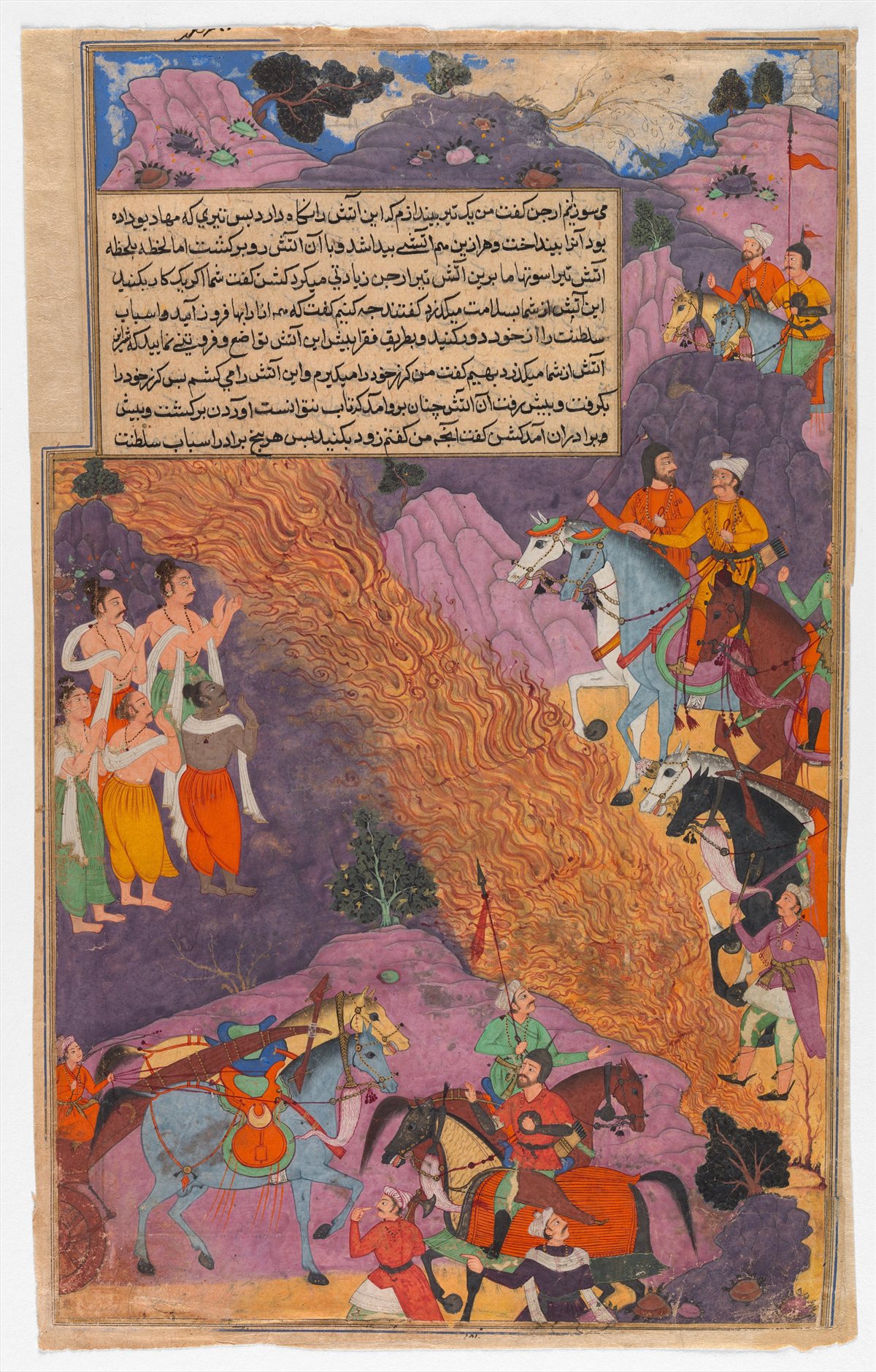
| 1598–1599 | The Mughal court produces illustrated copies of the Razmnama, a Persian Mahabharata commissioned by Akbar; later recensions (including the c. 1616–17 manuscript from which this file's hero image is taken) illustrate the astra episodes directly. |
| 1883–1896 | Kisari Mohan Ganguli publishes the first complete English prose translation of the Mahabharata, a work later widely and wrongly credited to its publisher and financier, Pratap Chandra Roy. This is the version underlying essentially every English-language "ancient nuclear war" quotation — almost always at several removes. |
| 1885 | Sir Edwin Arnold publishes The Song Celestial, the verse translation of the Bhagavad Gita that made the text widely known in English. |
| April 1, 1919 | The Bhandarkar Oriental Research Institute in Pune begins work on a Critical Edition of the Mahabharata. |
| 1922–1931 | Nine seasons of excavation at Mohenjo-daro under R.D. Banerji, Kashinath Dikshit, and John Marshall recover some 37 skeletons or partial skeletons attributable to the Indus period — the entire physical basis of the later "radioactive skeletons" claim. |
| 1929 | Ryder publishes his English translation of the Bhagavad Gita, rendering the crucial line of 11:32 as "Death am I, and my present task / Destruction." |
| 1933 | Oppenheimer begins studying Sanskrit with Ryder at Berkeley. On October 7, 1933 he writes to his brother Frank that he has "been reading the Gita with two other Sanskritists." Ryder gives him a pink-covered copy of the text, which he keeps on the shelf nearest his desk. |
| July 16, 1945 | The Trinity test. The first fission device is detonated in the Jornada del Muerto desert, New Mexico, at 05:29 local time. Oppenheimer's brother Frank, who was present, recalled that what his brother actually said aloud was words to the effect of "It worked." |
| Late 1940s–1950s | The Gita association begins circulating as Los Alamos lore. Robert Jungk's Brighter Than a Thousand Suns (German 1956; English 1958) takes its title from Bhagavad Gita 11:12, cementing the link between the Manhattan Project and the eleventh chapter in popular memory. |
| 1960 | The fabrication enters print. Louis Pauwels and Jacques Bergier publish Le Matin des magiciens (English: The Morning of the Magicians, 1963), citing a garbled "Mausola Purva" and converting the Mausala Parva's line about rats and mice gnawing sleeping men's hair and nails into the claim that survivors' "hair and nails fell out." |
| 1964 | George F. Dales publishes "The Mythical Massacre at Mohenjo-Daro" in the University of Pennsylvania Museum's Expedition (6:3, 36–43), demonstrating that the site's skeletons are not contemporaneous, are confined to the Lower Town, and sit in no destruction horizon. |
| 1965 | Oppenheimer says the line on camera. NBC broadcasts The Decision to Drop the Bomb (NBC White Paper; produced by Fred Freed, narrated by Chet Huntley), in which a visibly ailing Oppenheimer recalls thinking of the verse at Trinity. This is the origin of the recording everyone knows. |
| Sept. 22, 1966 | The BORI Critical Edition of all eighteen parvans is formally completed after forty-seven years and a critical study of 1,259 manuscripts. |
| Feb. 18, 1967 | Oppenheimer dies of throat cancer in Princeton, New Jersey, aged 62. |
| 1968 | Erich von Däniken publishes Chariots of the Gods?, reproducing and further mangling the Pauwels–Bergier material — including turning "Cukra" (itself a corruption of Sakra) into "Gurkha" — and misattributing the Ganguli translation to "C. Roy," the publisher. |
| 1972 | Charles Berlitz publishes Mysteries from Forgotten Worlds, presenting the material as "excerpts" from the Mahabharata with unmarked ellipses joining unrelated passages. |
| 1979 | David Davenport publishes Atomic Destruction in 2000 B.C., alleging a 50-yard "epicentre" of fused and vitrified material at Mohenjo-daro and citing A. Gorbovsky's Soviet-era popular work for a claim of a radioactive skeleton. No excavation report supports either. |
| 1988 / 1992 | David Hatcher Childress reprints the material in Lost Cities of Ancient Lemuria and the Pacific and successors, reformatted as free verse so that it looks like a translation of continuous Sanskrit. This is the version since reproduced in dozens of books, television scripts, and websites. |
| 2012–2014 | Chris White's Ancient Aliens Debunked tests the Mohenjo-daro and "ancient nuclear war" claims against the excavation record; researcher Jason Colavito publishes his line-by-line reconstruction of the quotation's route from Ganguli through Pauwels and Bergier, von Däniken, Berlitz, and Childress. |
| 2023 | Christopher Nolan's Oppenheimer returns the Gita line to mass circulation; Sanskritists including Vasudha Narayanan of the University of Florida publish public correctives on what chapter 11 actually says and what the Gita actually meant to Oppenheimer. |
The Primary Text
Two entirely different passages are routinely fused together in popular accounts of this subject. They come from different books of the epic, describe different things, and were brought into contact with each other only in the twentieth century. This section presents both, separately and in context, from real published translations, so the distinction is unmistakable.
Text A — Bhagavad Gita 11:12 and 11:31–33 (Bhishma Parva, Book 6): Krishna's Cosmic Form
This is the passage Oppenheimer quoted. Its subject is not a weapon. In chapter 11 of the Gita, Arjuna asks to see Krishna's true nature; Krishna grants him "divine sight" and reveals the vishvarupa, the universal form — a vision of all existence contained in a single body, with innumerable faces, arms, and eyes, in which Arjuna sees the warriors of both armies rushing into blazing mouths and being destroyed. Terrified, Arjuna asks who this fearsome being is. What follows is Krishna's answer. The translation quoted here is Sir Edwin Arnold's The Song Celestial (1885), which is in the public domain:
"If there should rise / Suddenly within the skies / Sunburst of a thousand suns / Flooding earth with beams undeemed-of, / Then might be that Holy One's / Majesty and radiance dreamed of!"
[Arjuna, terrified, asks who he is beholding. Krishna replies:]
"Thou seest Me as Time who kills, / Time who brings all to doom, / The Slayer Time, Ancient of Days, come hither to consume; / Excepting thee, of all these hosts of hostile chiefs arrayed, / There stands not one shall leave alive the battlefield! Dismayed / No longer be! Arise! obtain renown! destroy thy foes! / Fight for the kingdom waiting thee when thou hast vanquished those. / By Me they fall — not thee! the stroke of death is dealt them now, / Even as they show thus gallantly; My instrument art thou!"
Bhagavad Gita 11:12 and 11:31–33, tr. Sir Edwin Arnold, The Song Celestial (1885) — public domain
The pivotal Sanskrit of 11:32 is kalo'smi lokakshayakrit pravriddho, lokan samahartum iha pravrittah — literally something close to "I am Time (kala), grown mighty, the destroyer of worlds; I am here engaged in annihilating the worlds." The interpretive fork is the word kala, which means both "time" and "death" in Sanskrit. Most modern translators choose "Time" — Swami Mukundananda, for instance, renders the whole verse "I am mighty Time, the source of destruction that comes forth to annihilate the worlds. Even without your participation, the warriors arrayed in the opposing army shall cease to exist." Arthur Ryder — Oppenheimer's own teacher, whose 1929 translation Oppenheimer would have read — chose "Death," rendering the line "Death am I, and my present task / Destruction." Oppenheimer's famous version, "Now I am become Death, the destroyer of worlds," is closest to Ryder's, but is not identical to it; it appears to be Oppenheimer's own recollection or adaptation, filtered through a King-James-inflected English idiom ("I am become") that Ryder does not use.
Plain-English paraphrase: Arjuna asks to see God as God really is. He gets what he asked for, and it is unbearable: an infinite form containing everything that exists, in which the men on both sides of the battlefield are already being swallowed. He asks, essentially, what are you? Krishna answers that he is Time itself — the force that consumes all things — and that the warriors Arjuna is agonising over are already dead; Arjuna's fighting or not fighting will not change that, because it is not Arjuna who kills them. Arjuna is only the instrument. Nothing in this passage is a weapon, a technology, or an event. It is a theological statement about the relationship between divine action, time, and human agency, delivered before a single arrow has been fired.
Text B — Sauptika Parva 13–16 (Book 10): The Actual Brahmastra Confrontation
This is what the Mahabharata really says about the brahmastra, and it is nowhere near the Gita. The setting is the aftermath of the night massacre. Ashwatthama has slaughtered the sleeping Pandava camp and fled; Bhima, Arjuna, Yudhishthira, and Krishna pursue him to the bank of the Ganges, where they find him sitting among ascetics beside the sage Vyasa. Cornered, Ashwatthama picks up a blade of grass. The translation is Kisari Mohan Ganguli's (1883–1896), the standard public-domain English version:
"Of soul incapable of being depressed, he called to his mind that high weapon (which he had obtained from his sire). He then took up a blade of grass with his left hand. Fallen into great distress, he inspired that blade of grass with proper mantras and converted it into that powerful celestial weapon. Unable to brook the arrows (of the Pandavas) and the presence of those wielders of celestial weapons, he uttered in wrath these terrible words: 'For the destruction of the Pandavas.' Having said these words, O tiger among kings, the valiant son of Drona let off that weapon for stupefying all the worlds. A fire then was born in that blade of grass, which seemed capable of consuming the three worlds like the all-destroying Yama at the end of the yuga."
Mahabharata, Sauptika Parva (Book 10), Section 13 — tr. Kisari Mohan Ganguli (1883–1896), public domain
Krishna reads the situation instantly and tells Arjuna to answer in kind. Arjuna dismounts, salutes his enemy, his brothers, and the gods, and releases the counter-weapon:
"Softly wishing good unto the preceptor's son and then unto himself, and unto all his brothers, that scorcher of foes then bowed unto all the gods and all his superiors and let off his weapon, thinking of the welfare of all the worlds and uttering the words, 'Let Ashvatthama's weapon be neutralised by this weapon!'
That weapon, quickly let off by the wielder of gandiva, blazed up with fierce flames like the all-destroying fire that appears at the end of the yuga. Similarly, the weapon that had been shot by Drona's son of fierce energy blazed up with terrible flames within a huge sphere of fire. Numerous peals of thunder were heard; thousands of meteors fell; and all living creatures became inspired with great dread. The entire welkin seemed to be filled with noise and assumed a terrible aspect with those flames of fire. The whole earth with her mountains and waters and trees, trembled.
Then the two great rishis, Narada, who is the soul of every creature, and the grandsire of all the Bharata princes (Vyasa), beholding those two weapons scorching the three worlds, showed themselves there… Incapable of being overwhelmed by any force, those two illustrious rishis, placing themselves between the two weapons, stood like two blazing fires… neutralising the energy of the two weapons and doing good to all the world.
The two rishis said, 'Those great car-warriors who have fallen in this battle were acquainted with diverse kinds of weapons. They, however, never shot such a weapon upon human beings. What act of rashness is this, ye heroes, that ye have done?'"
Mahabharata, Sauptika Parva (Book 10), Section 14 — tr. Kisari Mohan Ganguli, public domain
What happens next is the passage that comes closest, of anything in the epic, to describing a lingering environmental aftermath — and it is worth reading precisely, because it is far more modest than the popular versions. Arjuna withdraws his weapon; Ashwatthama cannot withdraw his. Vyasa explains why the withdrawal matters:
"That region where the weapon called brahmashira is baffled by another high weapon suffers a drought for twelve years, for the clouds do not pour a drop of water there for this period. For this reason, the mighty-armed son of Pandu, although he had the power, would not, from desire of doing good to living creatures, baffle thy weapon with his."
Mahabharata, Sauptika Parva (Book 10), Section 15 — Vyasa speaking, tr. Kisari Mohan Ganguli, public domain
Unable to recall the weapon and unwilling to surrender the gem in his forehead without a price, Ashwatthama commits the epic's final atrocity: he redirects the already-launched brahmashira into the wombs of the Pandava women, aiming specifically at the unborn child of Uttara, Arjuna's daughter-in-law and the last hope of the Kuru line. Krishna's response, in Section 16, both undoes the act and curses its author:
"The holy one said, 'The fall of this mighty weapon will not be fruitless. The foetus will die. But being dead, it will live again and have a long life! As regards thyself, all wise men know thee for a coward and a sinful wretch! Always engaged in sinful acts, thou art the slayer of children. For this reason, thou must have to bear the fruit of these thy sins. For 3,000 years thou shalt wander over this earth, without a companion and without being able to talk with anyone… The stench of pus and blood shall emanate from thee, and inaccessible forests and dreary moors shall be thy abode!'"
Mahabharata, Sauptika Parva (Book 10), Section 16 — Krishna speaking, tr. Kisari Mohan Ganguli, public domain
Plain-English paraphrase: A defeated warrior, cornered and desperate, converts a blade of grass into the ultimate weapon by chanting over it, and fires it at his enemies with the stated intention of exterminating them. His opponent fires the same weapon back to cancel it. The two energies meet; the sky roars, meteors fall, and the earth shakes. Two sages then walk into the space between the two weapons and stand there until both are neutralised, telling the two warriors that even the greatest fighters who died in this war never turned a weapon like this on human beings. One warrior, who has kept the vow of celibacy required to recall the weapon, withdraws his. The other cannot, and is told that where such a weapon is cancelled, the rain fails for twelve years. Rather than take the death he has earned, he sends the still-live weapon into the wombs of the enemy's women, killing an unborn heir. Krishna revives the child — who will be born as Parikshit and rule for sixty years — and condemns the killer to three thousand years of leprous, friendless wandering.
That is the brahmastra episode. It is a moral catastrophe narrated in moral terms. The weapon is made of grass and mantra; it is disarmed by two men standing in front of it; the ability to recall it depends on sexual continence; its worst consequence is the death of a foetus; and its wielder's punishment is a curse. Whatever else this is, it is not a garbled memory of ordnance.
Textual & Iconographic Analysis
The distance between what these texts say and what they are said to say is unusually large, and unusually well documented. This section takes the four points that matter most in turn.
Krishna's Vishvarupa: What Chapter 11 Actually Describes
The eleventh chapter of the Gita is the text's dramatic and theological summit, and its imagery has been a major subject of Indian painting for centuries — typically showing Krishna with dozens of superimposed heads and arms filling the frame, with a tiny Arjuna kneeling with folded hands at the bottom. The scene is a theophany, structurally comparable to Ezekiel's throne-chariot vision or Job's whirlwind: a mortal asks to see God directly, is granted a special faculty of perception in order to survive the experience, is overwhelmed, and begs for the ordinary form back. Arjuna's closing request in the chapter is essentially "please stop"; Krishna resumes his familiar four-armed and then human form, and Arjuna says he can breathe again.
The "thousand suns" line of 11:12, which supplied the title of Robert Jungk's 1956 history of the atomic scientists, is a simile for the brightness of a divine body, not a description of an explosion. Similar formulations occur throughout Sanskrit religious literature as a stock way of conveying unbearable radiance; Colavito notes that comparable "thousand suns" phrasing appears elsewhere as ordinary devotional description of deities. Reading it as an eyewitness account of a fireball requires ignoring both the immediate context (Arjuna has just been given supernatural sight in order to perceive an infinite form) and the convention.
The consequence for this file is simple and worth stating flatly: there is no weapon in Bhagavad Gita chapter 11. No astra is invoked, no missile is launched, nothing is destroyed in the narrative present. The armies Arjuna sees being consumed in Krishna's mouths are being consumed by Time, in a vision, before the battle starts. Any article, television segment, or caption that presents the "destroyer of worlds" line as the Mahabharata describing the brahmastra has conflated two texts that sit four books apart and share no content.
The Brahmastra in the Sauptika Parva: A Weapon That Behaves Like a Curse
Read on its own terms, the brahmastra of Book 10 has a consistent internal logic, and it is a religious logic rather than a mechanical one. Five features recur, and none of them survive translation into hardware.
- It is instantiated in whatever is to hand. Ashwatthama makes it out of a blade of grass. The physical substrate is irrelevant; what matters is the mantra spoken over it. In other episodes an astra is fixed to an arrow, but the arrow is a vehicle, not the weapon.
- It is a body of knowledge transmitted by a teacher. Arjuna has the brahmashira because Drona taught it to him; Ashwatthama has it because Drona was his father. Vyasa's rebuke turns on this: Arjuna obtained the brahmastra "through thy sire's instructions" and did not thereby fall away from a warrior's duty, whereas Ashwatthama did.
- Recalling it depends on moral and sexual purity. Ganguli's text is explicit: "No person of uncleansed soul can bring it back after it is once let off. Only one that leads the life of a brahmacari can do it. If one who has not practised the vow of brahmacarya seeks to bring it back after having shot it, it strikes off his own head and destroys him with all his equipments." Arjuna can recall his weapon because he is a celibate observer of vows; Ashwatthama cannot because he is not. No physical weapon has ever had a firing solution that depends on the operator's chastity.
- It can be stopped by two people standing in front of it. Narada and Vyasa interpose themselves bodily and neutralise both weapons by their own accumulated spiritual energy.
- Its residue is a moral and meteorological curse, not contamination. The only lingering aftereffect the epic specifies is twelve years of drought in the region where two brahmashiras cancel each other — a failure of rain, framed by Vyasa as a reason for restraint. There is no mention of poisoned water, sickened survivors, deformed births in the general population, or anything resembling fallout.
It is also worth naming the terminological slippage that popular accounts exploit. The epic distinguishes, at least loosely, between the brahmastra and the brahmashira — Vyasa in Section 15 uses both terms in adjacent sentences, treating the brahmashira as the higher and more dangerous of the two. Modern retellings tend to flatten every named astra in the epic into "the Brahmastra," which is how the agneya weapon of Book 7 (discussed below) ends up quoted under the brahmastra's name in books about ancient nuclear war.
Where "Falling Hair" and "Contaminated Water" Actually Come From Fabricated
This is the central finding of this file, and it is worth stating with no hedging: the passage describing a weapon that shatters the sky and leaves barren earth, poisoned water, and survivors whose hair and nails fall out is not in the Mahabharata. It is not in Ganguli. It is not in the BORI Critical Edition. It is not in van Buitenen, or Johnson, or any other scholarly translation. It is a twentieth-century composite, and its assembly can be traced step by step through printed books, largely thanks to the bibliographic work of Jason Colavito, whose reconstruction is cited in full below and whose earlier tracing of a fake Ramayana "quotation" is discussed in this site's companion file on the vimana traditions.
Step one: Pauwels and Bergier, 1960. The French journalist Louis Pauwels and the writer Jacques Bergier published Le Matin des magiciens (translated into English in 1963 as The Morning of the Magicians), a wildly successful compendium of occult and fringe-scientific speculation. In it they cited what they called the "Mausola Purva" — a misspelling of the Mausala Parva, the sixteenth and one of the shortest books of the Mahabharata, which narrates the self-destruction of Krishna's own Vrishni clan in a drunken brawl decades after the Kurukshetra war. Book 16 opens with a long catalogue of evil omens preceding the disaster. One of them, in Ganguli's translation, reads: "At night, the rats and mice ate away the hair and nails of slumbering men." Pauwels and Bergier transformed this into a statement that survivors' "hair and nails fell out" — converting a plague of rodents into radiation sickness by deleting the rodents. In the same passage they took the Mausala Parva's "iron bolt" — a club produced from the pestle that Krishna's son Samba, cursed by sages, gave birth to, which the king had ground to powder and thrown into the sea before it returned as reeds that the Vrishnis used to beat each other to death — and presented it as a projectile weapon.
Step two: von Däniken, 1968. Chariots of the Gods? reproduced the material, adding fresh errors: the deity name Sakra, already corrupted to "Cukra" by Pauwels and Bergier, became "Gurkha," a Nepalese military designation that appears nowhere in Sanskrit literature. Separately, von Däniken quoted a genuinely real passage — "It was as if the elements had been unleashed. The sun spun round. Scorched by the incandescent heat of the weapon, the world reeled in fever" — and attributed it to "C. Roy, Drona Parva, 1889." Colavito established that "C. Roy" is Pratap Chandra Roy, the publisher of Ganguli's translation rather than its translator (Ganguli's name was kept off the covers because he doubted readers would believe one man had done the whole thing). Worse, von Däniken's English text is a translation of a German translation of Ganguli's English — three removes from the Sanskrit — heavily condensed without ellipses and reordered for effect.
The underlying Ganguli sentence is real, and this file quotes it directly from the source, in its actual context, so readers can see exactly what was done to it. It occurs in the Drona Parva (Book 7), Section CCI in Ganguli's sectioning:
"The valiant Aswatthaman, then, staying resolutely on his car, touched water and invoked the Agneya weapon incapable of being resisted by the very gods… Dense showers of arrows then issued from it in the welkin. Endued with fiery flames, those arrows encompassed Partha on all sides. Meteors flashed down from the firmament. A thick gloom suddenly shrouded the (Pandava) host… Rakshasas and Pisachas, crowding together, uttered fierce cries. Inauspicious winds began to blow. The sun himself no longer gave any heat. Ravens fiercely croaked on all sides. Clouds roared in the welkin, showering blood… The very elements seemed to be perturbed. The sun seemed to turn. The universe, scorched with heat, seemed to be in a fever. The elephants and other creatures of the land, scorched by the energy of that weapon, ran in fright, breathing heavily and desirous of protection against that terrible force."
Mahabharata, Drona Parva (Book 7), Section CCI — tr. Kisari Mohan Ganguli, public domain
Three things are immediately visible in the real text that are invisible in the quotation as popularly circulated. First, the weapon is named, and it is not the brahmastra: it is the agneya astra, the weapon of the fire god, which is exactly what one would expect a fire weapon to be called. Second, the passage is embedded in an ordinary epic battle narrative — Ashwatthama is fighting Arjuna, on a chariot, with arrows, in a duel that continues afterwards. Third, the imagery around it is unmistakably the stock apocalyptic vocabulary of Sanskrit epic (rakshasas and pisachas howling, clouds raining blood, ravens croaking), a register the epic uses whenever it wants to signal cosmic disorder. Excise those three contexts and you have something that sounds like a bomb report. Restore them and you have a fire-god's weapon in a mythological duel.
Step three: Berlitz, 1972. Charles Berlitz's Mysteries from Forgotten Worlds repeated the Pauwels–Bergier material with added ellipses, presenting separate and unrelated passages as though they were connected excerpts from a single account.
Step four: Childress, 1988. David Hatcher Childress, in Lost Cities of Ancient Lemuria and the Pacific and its successors, took the accumulated corruptions and reformatted them as free verse, so that they look on the page like a translated Sanskrit poem: "Gurkha, flying a swift and powerful vimana, / hurled a single projectile / charged with all the power of the Universe. / An incandescent column of smoke and flame, / as bright as ten thousand suns…" This is the version that has since been reproduced, by Colavito's count, in more than thirty-five subsequent books, plus an unquantifiable volume of television, video, and web content. Almost none of those reproductions cite a parva, chapter, and verse, because none exists to cite.
The honest bottom line: a reader who goes looking for the "falling hair" verse in the Mahabharata will not find it, because the only real sentence underneath it says that rats and mice chewed on sleeping men. That is not a matter of interpretation. It is a matter of what is printed on the page in the source everyone claims to be quoting.
Oppenheimer's Own Words: The Real Documented History
The Oppenheimer half of this story, by contrast, is largely true — with one important qualification about what happened at the test itself.
Oppenheimer's engagement with Sanskrit was real, serious, and unusual for a physicist. He had encountered Hindu texts in translation as a Harvard undergraduate, but the formal study began in 1933, shortly after he joined Berkeley, when he began working with Arthur W. Ryder, Berkeley's professor of Sanskrit. Kai Bird and Martin J. Sherwin's Pulitzer-winning biography American Prometheus (2005) documents the period: Ryder gave Oppenheimer a pink-covered copy of the Gita, which he kept on the shelf nearest his desk, and Oppenheimer was sufficiently taken with his Sanskrit studies that when his father bought him a new Chrysler that autumn he named the car Garuda, after Vishnu's eagle mount. Oppenheimer wrote to his brother Frank on October 7, 1933 that he had "been reading the Gita with two other Sanskritists." He described the text as "the most beautiful philosophical song existing in any known tongue," handed out copies as gifts, and when asked by Christian Century in 1963 to list the ten books that had most shaped his outlook, included the Gita alongside Shakespeare's Hamlet, Eliot's The Waste Land, and Baudelaire. At Franklin D. Roosevelt's memorial service in April 1945 he quoted his own translation of a different Gita verse. None of this is legend; it is documented in letters, biography, and his own published statements.
What is much less certain is whether he said or thought the "destroyer of worlds" line at 05:29 on July 16, 1945. There is no contemporaneous record of it. His brother Frank, who was at the test, recalled that what Robert actually said was to the effect of "It worked." The physicist and historian Alex Wellerstein, who has examined the provenance of the quotation in detail, notes that the Gita association only begins circulating as Los Alamos lore in the later 1940s, and that the version everyone knows — Oppenheimer, gaunt and hollow-eyed, speaking the line slowly to camera — comes from NBC's 1965 documentary The Decision to Drop the Bomb, produced by Fred Freed and narrated by Chet Huntley, filmed when Oppenheimer was already dying of throat cancer. In that recording Oppenheimer describes the thought as something that "came to mind," not something he announced; the on-camera framing is explicitly a recollection twenty years after the fact. The most defensible statement of the historical position is therefore: Oppenheimer knew the verse intimately and in the original language, associated it with the bomb, and said so publicly on the record in 1965; whether it passed through his mind in the desert that morning is something only he could have known, and the immediate first-hand testimony points to a much plainer sentence.
The reason this matters for a file about the brahmastra is that a great deal of ancient-astronaut writing runs the two things together into a single insinuation: that Oppenheimer, a nuclear physicist who had read the Mahabharata in Sanskrit, recognised the bomb in an ancient description of a weapon. He did not, and he never said he did. He quoted a verse in which a god declares himself to be Time, in a chapter with no weapon in it, four books away from the passages about astras — and he quoted it as a moral statement about his own position, not as a technical identification.
Material Analysis: The Manuscript Evidence
Physical evidence, in the sense this site uses elsewhere for debris, metallurgical assay, or chain-of-custody trace material, does not exist for this case and cannot. What exists instead is one of the most thoroughly studied manuscript traditions in world literature, and it is more than adequate to settle the specific questions this file asks. The Mahabharata survives in two broad recensions, Northern and Southern, in scripts including Sharada, Devanagari, Bengali, Telugu, Malayalam, and Grantha, on birch bark, palm leaf, and paper. In 1919 the Bhandarkar Oriental Research Institute in Pune began the enormous task of reconstructing the earliest recoverable text from that mass of witnesses. Under Vishnu Sitaram Sukthankar (general editor from 1925 until his death in 1943), then S.K. Belvalkar, then P.L. Vaidya, the project collated 1,259 manuscripts and completed all eighteen parvans in 1966 — forty-seven years and roughly 13,000 quarto pages later — a scholarly undertaking comparable in ambition and rigour to the critical editing of the Hebrew Bible or the Greek New Testament. The Critical Edition is the reason it is possible to say with confidence which verses belong to the reconstructed archetype and which are later regional expansions.
Two conclusions follow directly. First, the astra passages quoted above are not marginal, late, or textually doubtful; the Sauptika Parva confrontation and the Drona Parva agneya episode are core narrative material present across the tradition. Anyone who wants to argue about what they mean is arguing about a real, well-attested text. Second, and decisively for this file, the "falling hair and poisoned water" passage has no manuscript existence at all. It is not a variant reading found in some recensions and not others; it is not a verse the Critical Edition relegated to an appendix; it is not in any manuscript, because it was assembled in French and English in the twentieth century out of pieces of Ganguli's prose. The manuscript record is precisely the instrument that establishes this, and it does so unambiguously.
The material record on the other branch of the claim — Mohenjo-daro — is equally clear and is examined in detail below. Nine seasons of excavation between 1922 and 1931, followed by Mortimer Wheeler's 1945 campaign and George Dales's 1964–65 work, produced no vitrified stratum, no fused-brick epicentre, no radiation anomaly, and no mass-casualty horizon. The "vitrification" repeatedly cited in fringe literature refers to small quantities of broken pottery containing frit, which is a normal product of kiln-firing and is present at essentially every Bronze Age ceramic-producing site on earth. Mud-brick structures at the site remain standing to substantial heights, which is not consistent with any blast scenario.
No Government UFO File Exists for This Case
There is no FOIA-releasable investigation of the Mahabharata, no Project Blue Book entry, and no AARO historical report to search. What this file does have is a genuine, checkable institutional trail: the critical edition project at a real research institute, the standard public-domain translation in a stable digital archive, the machine-readable Sanskrit text in a university-hosted corpus, the museum record for the manuscript folio used as this page's hero image, and the peer-reviewed archaeological journal article that dismantled the Mohenjo-daro massacre claim. Every item below is a real, publicly accessible institutional record, and every one of them is checkable by a reader in an afternoon.
The institutional page for the forty-seven-year project that collated 1,259 manuscripts to reconstruct the earliest recoverable text of the epic. The authoritative answer to any question of the form "is this verse actually in the Mahabharata?"
PUBLIC (institutional archive)Complete, free, section-by-section text of the book containing the brahmastra confrontation, from the standard public-domain English translation. Sections 13 through 16 contain every passage quoted in this file's Text B.
PUBLIC DOMAINUniversity-hosted searchable e-text corpus including the Mahabharata in transliterated Sanskrit, which allows any reader to verify directly whether a claimed verse exists in the original language rather than relying on a chain of English paraphrases.
PUBLIC (academic archive)Full museum record for the Mughal manuscript folio used as this file's hero image, showing how the epic's astra episodes were visualised by court painters four centuries ago — as a divine fire raining from the sky onto a chariot battle, not as a device.
PUBLIC (Met Open Access)The field-defining reassessment of Mohenjo-daro's skeletal record by the archaeologist who later directed excavation at the site. The primary published source for every factual statement in this file's Mohenjo-daro section.
PUBLIC (museum digital archive)Search Related Institutional & Textual Archives Directly
The Paleocontact / Ancient-Nuclear-War Interpretation
The claim that the Mahabharata records a real nuclear conflict is younger than most people assume. It has no presence in nineteenth-century Indology, none in the Theosophical literature that first popularised Sanskrit texts in the West, and none in the early twentieth-century Indian nationalist writing that took a keen interest in ancient Indian scientific achievement. It appears, in recognisable form, in 1960 — fifteen years after Hiroshima, and squarely inside the cultural moment that produced it.
The textual line: Pauwels and Bergier to Childress (1960–1988). The quotation's assembly is traced verse by verse in the Textual Analysis section above; what matters here is the shape of the movement it created. Le Matin des magiciens was a phenomenon — a sprawling, largely credulous survey of occultism, forgotten science, and mysterious antiquity that sold enormously across Europe and effectively founded the postwar "réalisme fantastique" genre — and its short Mahabharata section established the template: quote impressive-sounding English fragments, name a parva approximately, and let the reader supply the nuclear inference. Von Däniken welded that template into a general theory of extraterrestrial paleocontact and took it worldwide; Berlitz consolidated; Childress versified. Childress's contribution was formal rather than evidential, and it was decisive: by laying the accumulated fragments out as lines of poetry, he made a nineteenth-century English prose translation, mediated through French and German, read as though it were a direct rendering of Sanskrit verse — effortlessly quotable, and effectively uncheckable, since it carried no verse reference anyone could look up. Von Däniken's parallel treatment of the vimana traditions is examined in this site's vimana file.
Davenport (1979) and the Mohenjo-daro graft. The archaeological half of the claim developed on a parallel track. David Davenport's Atomic Destruction in 2000 B.C. asserted a roughly fifty-yard "epicentre" at Mohenjo-daro where objects had been fused and glassified by heat of around 1,500 °C, and cited the Soviet popular writer A. Gorbovsky's Riddles of Ancient History for the claim that a skeleton from the site showed radioactivity around fifty times natural background. Neither claim traces back to any excavation report or laboratory publication. Grafting Mohenjo-daro onto the epic also requires ignoring the chronology entirely: the Indus city was abandoned around 1700 BCE, while the Mahabharata was composed between roughly 400 BCE and 400 CE about a Kuru-region conflict conventionally placed, if it has any historical kernel at all, in the late second millennium BCE — and Mohenjo-daro lies some 900 km from Kurukshetra, in a different river system, belonging to a civilisation the epic never mentions.
What proponents actually argue. Stripped to its structure, the case has four legs: (1) the texts describe a single weapon of overwhelming destructive power; (2) they describe effects resembling blast, thermal flash, and radiation sickness; (3) an archaeological site in the subcontinent shows physical traces of a high-temperature event; and (4) a nuclear physicist who read the texts in Sanskrit made the connection himself. Leg (1) is true but unremarkable — epics everywhere describe ultimate weapons. Leg (2) rests almost entirely on the fabricated quotation. Leg (3) rests on claims never published in any excavation report. Leg (4) is a misreading of what Oppenheimer quoted and why. The claim does not survive the removal of legs (2) and (4), and legs (2), (3), and (4) all fail independently.
The Mainstream Scholarly Interpretation
Professional Sanskrit studies has, on the whole, not engaged with the ancient-nuclear-war claim at all, for the same reason that professional Egyptology does not publish rebuttals of pyramid-power literature: there is nothing in it to engage with philologically. What the field does supply is a positive account of what the astra passages are and what they are doing, and that account — supplemented by the archaeological literature on the Indus Valley and the bibliographic work of skeptical researchers — functions as the conventional explanation for everything in this file.
Conventional Explanation Candidate 1: The Astras as Theological Narrative Device — HIGHLY PLAUSIBLE
The epic's own internal rules for the astras are consistent and non-mechanical: divine origin, mantric activation, teacher-to-student transmission, moral preconditions for recall, and neutralisation by superior spiritual authority. Their narrative function is likewise consistent. Astras appear at moments when the story needs to dramatise a warrior overreaching — claiming a power that belongs to the gods and discovering he cannot control it. The Sauptika Parva episode is the purest expression: two men fire the ultimate weapon at each other out of grief and rage, and the epic's response is not to describe the damage but to have two sages walk into the middle and ask, in effect, what do you think you are doing? The greatest warriors who died in the war, they say, knew these weapons and never used them on people. Reading this as a garbled memory of ordnance requires discarding the only thing the passage is actually about. Plausibility Rating: HIGHLY PLAUSIBLE.
Conventional Explanation Candidate 2: Post-Hiroshima Reading-Back — HIGHLY PLAUSIBLE
The chronology of the claim is its own best explanation. Nothing resembling the ancient-nuclear-war reading exists before 1945; it appears in print in 1960 and becomes a mass-market idea in 1968. The interpretive apparatus — blast, flash, fallout, radiation sickness, contaminated water, sterility — is precisely the vocabulary that entered general Western consciousness between 1945 and 1960 through Hiroshima reportage, civil-defence literature, and the fallout debates of the 1950s. Applied retroactively to any sufficiently dramatic ancient description of fire and destruction, that vocabulary will find matches, because apocalyptic imagery is a human universal and fire is fire. The demonstrable fact that the strongest single piece of "evidence" had to be manufactured — that a real sentence about rodents had to be rewritten to produce radiation symptoms — is a strong indication that the genuine text was not, in fact, providing the matches the theory needed. Plausibility Rating: HIGHLY PLAUSIBLE.
Conventional Explanation Candidate 3: Ordinary Stock Epic Imagery — HIGHLY PLAUSIBLE
The specific images that sound most "nuclear" to a modern ear are, in Sanskrit literature, formulaic. "Brighter than a thousand suns" is a standard formulation for divine radiance and is applied to deities in devotional contexts having nothing to do with destruction. Fire "at the end of the yuga" — the cyclical conflagration that ends a cosmic age — is the epic's default simile for any overwhelming fire, and Ganguli's text uses it three times in the four sections quoted above. Blood-raining clouds, howling rakshasas, croaking ravens, and a sun that gives no heat are the conventional Sanskrit omen-set for cosmic disorder, deployed dozens of times across the epic in contexts including battles, curses, and the deaths of kings. A reading that treats these as observational reportage would have to treat them as observational reportage everywhere they appear, which would require an implausible number of ancient nuclear detonations. Plausibility Rating: HIGHLY PLAUSIBLE.
Conventional Explanation Candidate 4: The Mohenjo-daro Claim — What the Archaeology Actually Shows
This is the one branch of the claim that made a testable physical assertion, and it is the one that has been tested most thoroughly. The findings are unambiguous, and they are worth setting out in detail because the "radioactive skeletons of Mohenjo-daro" remains one of the most durable pieces of misinformation in the entire ancient-astronaut corpus.
How many skeletons, and where. George F. Dales's 1964 article in the Penn Museum's Expedition establishes the actual numbers: "Nine years of extensive excavations at Mohenjo-daro (1922–31)… yielded the total of some 37 skeletons, or parts thereof, that can be attributed with some certainty to the period of the Indus civilization." Thirty-seven, across nine seasons, in a city that housed tens of thousands. All were found in the Lower Town, the residential district. As Dales pointed out, "Not a single body was found within the area of the fortified citadel where one could reasonably expect the final defense of this thriving capital city to have been made" — the opposite of what a catastrophic attack would produce.
Whether they died together. They did not. "The contemporaneity of the skeletal remains is anything but certain," Dales wrote; the bulk "were found in contexts suggesting burials of the sloppiest and most irreverent nature." Later assessments have put the spread of death dates across as much as a thousand years. A group of individuals who died centuries apart cannot constitute a single-event casualty population, and no reworking of the evidence gets around that.
Whether there is a destruction layer. Dales's summary is the most-quoted sentence in the literature on this question, and it is worth quoting exactly: "There is no destruction level covering the latest period of the city, no sign of extensive burning, no bodies of warriors clad in armor and surrounded by the weapons of war." Half a century of subsequent work has not overturned it. Mud-brick architecture at the site still stands to significant heights, which no blast scenario accommodates.
Whether anything is vitrified. The "vitrified" material repeatedly invoked consists of small quantities of broken pottery containing frit — a glassy phase produced during ordinary kiln firing, present at virtually every Bronze Age ceramic-producing site in the world. No fused-brick "epicentre" of the kind Davenport described appears in any excavation report from the site.
Whether anything is radioactive. No excavation report, laboratory analysis, or peer-reviewed publication has ever reported elevated radioactivity in Mohenjo-daro material. The claim traces to Davenport citing Gorbovsky, a Soviet-era popular writer, for a single skeleton — a citation chain with no primary measurement at either end. Some skeptical accounts additionally suggest the underlying anecdote may derive from a misremembered mid-century report concerning an entirely different specimen from another region. Either way, there is no measurement to examine.
What actually happened to the city. The mainstream picture is prosaic and gradual. Mohenjo-daro was abandoned in stages around 1700 BCE. Mortimer Wheeler proposed repeated flooding and silting followed by rebuilding; Gregory Possehl argued for constant seasonal mini-floods combined with agricultural and resource exhaustion — land worn out by cropping, grazing, and the demand for brick and pottery fuel. Shifts in the course of the Indus and broader climatic drying are also implicated. Wheeler's older "Aryan invasion" reading, of which the "massacre" claim was originally a component, has itself been abandoned by mainstream South Asian archaeology — and it was Dales's 1964 paper that did most to dismantle it. That is worth noting carefully: the skeleton evidence was already recognised as inadequate to support even a conventional military massacre fifteen years before Davenport proposed a nuclear one. Plausibility Rating for the nuclear-vitrification claim: IMPLAUSIBLE. Plausibility Rating for gradual hydrological and environmental decline: HIGHLY PLAUSIBLE.
Physical & Material Assays: What Was Actually Measured
For completeness, the physical-assay record on this case can be stated in a paragraph, because it is short. No sample from any site has ever been published showing fission or fusion products, transuranic elements, elevated caesium-137 or strontium-90, neutron-activation signatures in structural material, or a trinitite-analogue fused-soil layer anywhere in South Asia at any pre-modern date. No thermoluminescence study has reported a thermal event inconsistent with kiln or hearth temperatures at Mohenjo-daro or any comparable site. The one genuinely relevant modern comparison, Trinity site in New Mexico, produced an obvious and permanent physical signature — a field of green glassy trinitite and a measurable radiological anomaly still detectable eighty years later — which is exactly the kind of trace that is conspicuously absent everywhere the ancient claim places a detonation. The absence of that signature is not an argument from silence; it is a negative result on a test the claim itself proposes.
Comparative Analysis
The Mahabharata's divine weapons are frequently presented as uniquely inexplicable. They are not. Ultimate weapons of divine origin, granted to or seized by mortals with catastrophic results, are one of the most widely distributed motifs in the world's epic and religious literature, and the comparison is instructive.
Historical Precedents & Archive Matches
- Indra's vajra (Rigveda, c. 1500–1200 BCE): The oldest layer of Indian tradition already has a divine weapon of overwhelming force — the thunderbolt forged for Indra to slay the serpent Vritra and release the waters. It predates the epics by centuries and establishes the "irresistible weapon of a god" as an inherited Indian literary category rather than something the Mahabharata invented.
- Zeus's thunderbolt and the Cyclopes (Hesiod, Theogony, c. 700 BCE): The Greek parallel is exact in structure: a supreme deity's monopoly weapon, forged by specialist craftsmen, decisive in a cosmic war, and lethal to any mortal who mishandles it (Salmoneus is destroyed for imitating it). No one reads Hesiod as a fallout report.
- The Sodom and Gomorrah narrative (Genesis 19): Fire and sulphur from the sky, total destruction of cities, a survivor turned to a pillar of salt, and smoke "as the smoke of a furnace" the following morning. This passage has been subjected to essentially the same nuclear reading as the Mahabharata passages, by essentially the same authors, with essentially the same result.
- The Ramayana's brahmastra: The same weapon appears in the other great Sanskrit epic, where Rama uses it to kill Ravana and Indrajit uses a brahmastra to bind Hanuman. Its behaviour there is identical in kind to its behaviour in the Mahabharata — mantra-invoked, deity-associated, and morally freighted — which is what one expects of a shared literary convention and not of two independent technical traditions.
- The vimana traditions: The flying vehicles of the same two epics, treated at length in this site's separate file, follow an identical pattern: a real and genuinely ancient literary motif, a modern paleocontact reading layered on top, and one specific twentieth-century document (the Vaimanika Shastra, dictated 1918–1923) that is straightforwardly not ancient. The parallel between that case and this one is close enough to be diagnostic: in both, a real text is used to launder a modern invention.
What emerges from the comparison is that the Mahabharata's astras are not anomalous within world literature; they are a particularly elaborate and morally serious instance of a near-universal motif. The genuinely distinctive feature of the Indian material is not the weapons' power but the epic's insistence on the conditions attached to them — the mantra to recall, the celibacy to recall it, the teacher who must transmit it, the sages who can stand in front of it. Those conditions are the point of the story, and they are exactly what disappears when the passages are excerpted for use as evidence of ancient technology.
Evidence Assessment
As with this site's other ancient files, it is essential to keep separate claims separate. That the Mahabharata contains brahmastra passages is not in dispute. That Oppenheimer knew Sanskrit, read the Gita, and quoted 11:32 on camera in 1965 is not in dispute. What is at issue is narrower: whether the epic's weapon descriptions record real ancient nuclear or high-technology events, and whether the specific evidentiary items advanced for that claim — the "falling hair" verse, the Mohenjo-daro traces, and the Oppenheimer connection — hold up. The lists below concern that narrower question only.
Cited in Favor of the Ancient-Nuclear-War Reading
- The epic genuinely does describe weapons of civilisation-ending power, launched by individuals, whose use is treated as an unprecedented transgression — the Sauptika Parva confrontation is real, dramatic, and not an invention of modern writers.
- The Drona Parva agneya passage ("The very elements seemed to be perturbed. The sun seemed to turn. The universe, scorched with heat, seemed to be in a fever") is a real, verifiable sentence in Ganguli's translation, and does sound strikingly like a thermal event to a modern reader.
- The epic does specify a lingering environmental consequence — twelve years of failed rain in a region where two brahmashiras cancel — which is the closest genuine analogue in the text to a persistent aftermath.
- Oppenheimer's Sanskrit study and his association of the Gita with the bomb are entirely real and documented, which gives the claim an initial surface plausibility that most ancient-astronaut material lacks.
- The Mahabharata is enormous and heterogeneous, and no individual reader can claim exhaustive familiarity with all 1.8 million words — which makes negative claims about what is "not in the text" harder to make casually and easier for proponents to resist.
Cited Against the Ancient-Nuclear-War Reading
- The single most-quoted "nuclear" passage does not exist in the Mahabharata. Its route into print — Ganguli's rats-and-mice omen → Pauwels and Bergier (1960) → von Däniken (1968) → Berlitz (1972) → Childress (1988, versified) → 35+ subsequent books — has been reconstructed step by step from the printed sources.
- The passage that is real describes the agneya weapon of the fire god, not the brahmastra, occurs mid-duel in an ordinary chariot battle, and is surrounded by the epic's standard omen vocabulary (blood-raining clouds, howling rakshasas, a heatless sun).
- The astras' operating rules are irreducibly non-mechanical: made from grass and mantra, transmitted by a teacher, recallable only by the celibate, and neutralised by two sages standing bodily between them.
- Oppenheimer's quotation is Bhagavad Gita 11:32, in a chapter containing no weapon of any kind, four books away from the astra passages. He never claimed to recognise the bomb in an ancient weapon description, and his brother's first-hand account of what he actually said at Trinity is "It worked."
- Nine seasons of excavation at Mohenjo-daro produced 37 skeletons spread across as much as a thousand years, none in the citadel, and — in the excavator's own words — "no destruction level covering the latest period of the city, no sign of extensive burning, no bodies of warriors clad in armor."
- The "vitrification" at Mohenjo-daro is frit in broken pottery, a normal kiln product; the "radioactive skeleton" traces to a popular book citing another popular book, with no measurement at either end.
- Mohenjo-daro is chronologically and geographically disconnected from the epic: abandoned c. 1700 BCE, some 900 km from Kurukshetra, belonging to a civilisation the Mahabharata never mentions.
- The BORI Critical Edition, built from 1,259 manuscripts over forty-seven years, provides a definitive means of checking whether any claimed verse belongs to the text. The "falling hair" passage is absent from it, and from every recension it collates.
- The interpretive vocabulary of the claim (blast, flash, fallout, radiation sickness) is demonstrably a post-1945 import, and the claim itself appears in print for the first time in 1960.
- No professional Sanskritist, Indologist, or South Asian archaeologist has endorsed the ancient-nuclear-war reading in peer-reviewed scholarship.
Why DEBUNKED
This file is rated DEBUNKED rather than DISPUTED or UNVERIFIED, and the distinction is deliberate. The Omni Ledger reserves DISPUTED for cases like Ezekiel's wheel, where the parties agree on the text and disagree about its meaning — a real interpretive argument, however lopsided. That is not the situation here. The load-bearing evidence for the ancient-nuclear-war reading of the Mahabharata is a passage that was manufactured: a real Sanskrit omen about rodents gnawing sleeping men's hair and nails, rewritten in 1960 into a symptom of radiation sickness, then compounded through three further authors until it acquired the shape of verse and the authority of scripture. A claim whose primary quotation has to be fabricated is not a disputed interpretation; it is a debunked one.
The second load-bearing item, the Mohenjo-daro nuclear-vitrification claim, fails on independent physical grounds and had already been undermined by the professional archaeological literature fifteen years before it was made. Dales's 1964 paper demonstrated that the site's 37 skeletons were not contemporaneous, were confined to the residential district, and sat in no destruction horizon; the vitrification is kiln frit; the radioactivity has never been measured by anyone. The third item, the Oppenheimer connection, is a category error — the quotation is from a chapter with no weapon in it.
What is emphatically not debunked, and what this file has tried to set out at length, is the underlying material. The Mahabharata's brahmastra passages are real, textually secure, and genuinely remarkable as literature: an epic that spends four sections on two men who fire the ultimate weapon at each other in grief and are stopped by two unarmed sages walking into the space between them is doing something serious and enduring with the idea of a weapon too terrible to use. Oppenheimer's relationship with the Gita is real, documented in his letters, his biography, and his own on-camera testimony, and it remains one of the most striking instances of a scientist reaching for a religious text to describe what he had done. Both of those things are worth knowing accurately. Neither of them supports the claim this file exists to test, and the popular version that fuses them has to falsify both to work.
Key Figures
J. Robert Oppenheimer (1904–1967)
Scientific director of the Manhattan Project's weapons laboratory and, unusually among physicists, a genuine reader of Sanskrit. He began formal study with Arthur W. Ryder at Berkeley in 1933, read the Bhagavad Gita in the original, called it "the most beautiful philosophical song existing in any known tongue," and listed it in 1963 among the ten books that had most shaped his thinking. In NBC's 1965 documentary The Decision to Drop the Bomb, filmed while he was dying of throat cancer, he recalled that the verse "Now I am become Death, the destroyer of worlds" came to mind at the Trinity test. His brother Frank, who was present at the test, recalled that what he actually said aloud was to the effect of "It worked." Oppenheimer never claimed the Mahabharata described nuclear weapons.
Arthur W. Ryder (1877–1938)
Harvard-trained Sanskritist who joined Berkeley in 1906 and headed its Sanskrit department until his death mid-lecture in 1938. Published widely used English translations of the Panchatantra (1925), the Bhagavad Gita (1929), and Kalidasa's Shakuntala and Meghaduta. Taught Oppenheimer privately alongside enrolled students from 1933 and gave him the pink-covered Gita he kept beside his desk. His rendering of 11:32 — "Death am I, and my present task / Destruction" — is the translation closest to Oppenheimer's famous paraphrase, and his choice of "Death" over the more common "Time" for the Sanskrit kala is the direct ancestor of the line as the world knows it.
Kisari Mohan Ganguli
Bengali scholar who produced the first — and still the only complete public-domain — English prose translation of the entire Mahabharata, issued in parts over thirteen years as The Mahabharata of Krishna-Dwaipayana Vyasa Translated into English Prose. Ganguli initially wanted to publish anonymously; his publisher and financier Pratap Chandra Roy objected, and the compromise arrangement led to years of confusion in which Roy was widely mistaken for the translator. Every English-language "ancient nuclear war" quotation ultimately derives from Ganguli's text, almost always at two or more removes and usually through writers who did not know whose translation they were altering. Von Däniken's citation of "C. Roy" as the translator is a direct consequence of that confusion.
George F. Dales (1927–1992)
American archaeologist specialising in South Asia, who directed the final major excavations at Mohenjo-daro in 1964–65 and taught at Pennsylvania and Berkeley. His 1964 article in the Penn Museum's Expedition systematically dismantled the "massacre" reading of the site's skeletal record: 37 skeletons across nine seasons, not contemporaneous, none in the citadel, most in careless burials, and — in the sentence most quoted since — "no destruction level covering the latest period of the city, no sign of extensive burning, no bodies of warriors clad in armor and surrounded by the weapons of war." His paper was aimed at the conventional Aryan-invasion theory, but it forecloses the nuclear version just as completely.
Louis Pauwels and Jacques Bergier
A French journalist and a chemical engineer turned popular-science writer, whose 1960 bestseller founded postwar Europe's "fantastic realism" genre and introduced the ancient-nuclear-war reading of the Mahabharata to print. Neither read Sanskrit. Their treatment of the "Mausola Purva" — a misspelling of the Mausala Parva — converted Ganguli's line about rats and mice eating sleeping men's hair and nails into survivors whose hair and nails fell out, and introduced the corruption of "Sakra" to "Cukra" that von Däniken later rendered as "Gurkha." Every subsequent version of the quotation descends from theirs.
Erich von Däniken
Swiss author whose bestseller carried the Mahabharata material to a global audience and fused it into a general theory of extraterrestrial paleocontact. His specific contributions to this file's subject were to add the genuine Drona Parva agneya passage (condensed without ellipses, reordered, and attributed to the publisher rather than the translator), and to introduce the "Gurkha" error. He is profiled at greater length on this site in connection with the vimana traditions and Ezekiel's wheel, where the same methodological pattern — quoting translations at several removes without checking them — recurs.
Jason Colavito
American writer on pseudo-archaeology and the cultural history of the ancient-astronaut movement, whose reconstruction of the Mahabharata quotation's route from Ganguli through Pauwels and Bergier, von Däniken, Berlitz, and Childress is the definitive published account of the fabrication. His method is straightforwardly bibliographic — obtain each edition, compare each printing to the one before it, and identify exactly where each alteration entered — and it is the same method by which he traced a widely circulated fake Ramayana "quotation" to a 1945 paraphrase, documented in this site's vimana file.
Five Observables Assessment
Assessment: The Five Observables framework was designed for craft, and its near-total inapplicability here is itself informative. The astras of the Mahabharata are not vehicles and are never described as such; they are energies attached to arrows, blades of grass, or nothing at all, and their remarkable properties are moral and mantric rather than kinematic. What the epic emphasises — that the weapon must be learned from a teacher, armed by mantra, and recalled by a man who has kept a vow — has no observable analogue in the framework at all, because it is not a physical property. The one observable that scores anything above zero on a generous reading is a kind of inverse low-observability: the epic insists these weapons are catastrophically visible, filling the sky with fire, thunder, and falling meteors. On the site's standard scale this file registers as the flattest possible profile, and that flatness is the correct result. A body of text describing supernatural weapons in explicitly supernatural terms should not generate a UAP-style observable signature, and it does not.
Related Cases
Further Reading — Recommended Literature
The Sauptikaparvan of the Mahabharata: The Massacre at Night
A modern scholarly verse translation of Book 10 alone — the book containing the brahmastra confrontation, Ashwatthama's attack on Uttara's unborn child, and Krishna's curse. The single best way to read the primary text of this file in a current, annotated translation.
The Bhagavad-Gita: Krishna's Counsel in Time of War
A widely used scholarly translation of the Gita by a Columbia Sanskritist, with introduction and notes. The most accessible modern route to chapter 11 in full — the vishvarupa vision, Arjuna's terror, and verse 32 — for readers who want to see the whole context of Oppenheimer's line rather than the line alone.
American Prometheus: The Triumph and Tragedy of J. Robert Oppenheimer
The Pulitzer-winning biography and the standard source for Oppenheimer's Sanskrit study with Arthur Ryder, the pink-covered Gita, the Garuda Chrysler, and the documentary record around what was and was not said at Trinity.
The Cult of Alien Gods: H.P. Lovecraft and Extraterrestrial Pop Culture
The book-length version of Colavito's argument about where ancient-astronaut claims actually come from, tracing the movement's literary genealogy through Lovecraft, Pauwels and Bergier, von Däniken, and their successors — the intellectual history behind this file's quotation trail.
The Indus Civilization: A Contemporary Perspective
A standard synthesis of Indus Valley archaeology by one of its leading specialists, covering Mohenjo-daro's excavation history, its material culture, and the current mainstream account of its gradual decline — the evidentiary baseline against which the "nuclear destruction" claim fails.
Sources
- Mahabharata, Book 10: Sauptika Parva, Sections 13–16, tr. Kisari Mohan Ganguli (1883–1896). sacred-texts.com/hin/m10
- Mahabharata, Book 7: Drona Parva, Section CCI (the agneya weapon passage), tr. Ganguli. sacred-texts.com/hin/m07
- The Mahabharata/Book 10: Sauptika Parva, Sections XIII–XVI, Wikisource. en.wikisource.org
- Sir Edwin Arnold, The Song Celestial; Or, Bhagavad-Gîtâ (from the Mahâbhârata) (1885), Project Gutenberg. gutenberg.org/ebooks/2388
- Colavito, Jason. "Tracking Down the Mahabharata Nuclear Bomb Passage from Chariots of the Gods." jasoncolavito.com
- Colavito, Jason. "The Case of the False Quotes." jasoncolavito.com/the-case-of-the-false-quotes.html
- Wellerstein, Alex. "Oppenheimer and the Gita," Restricted Data: The Nuclear Secrecy Blog (May 23, 2014). blog.nuclearsecrecy.com
- Narayanan, Vasudha. "Oppenheimer often used Sanskrit verses, and the Bhagavad Gita was special for him — but not in the way Christopher Nolan's film depicts it," The Conversation (Aug. 16, 2023). theconversation.com
- "'Now I am become Death, the Destroyer of Worlds' — the Bhagavad Gita explained," The Conversation. theconversation.com
- Dales, George F. "The Mythical Massacre at Mohenjo-Daro," Expedition 6:3 (1964), 36–43, Penn Museum. penn.museum
- White, Chris. "Ancient Nuclear Warfare," Ancient Aliens Debunked (2012). ancientaliensdebunked.com
- "Was the Mohenjo Daro 'Massacre' Real?" Ancient Origins. ancient-origins.net
- Bhandarkar Oriental Research Institute — Mahabharata Department (Critical Edition project record). bori.ac.in/department/mahabharata
- "Bhandarkar Oriental Research Institute," Wikipedia (Critical Edition completion, 1966; 1,259 manuscripts). en.wikipedia.org
- "Vishnu Sitaram Sukthankar," Wikipedia (first general editor of the Critical Edition). en.wikipedia.org
- "Arthur W. Ryder," Wikipedia (dates, Berkeley career, 1929 Gita translation, Oppenheimer). en.wikipedia.org/wiki/Arthur_W._Ryder
- "Kisari Mohan Ganguli," Wikipedia (translation history and the Pratap Chandra Roy attribution). en.wikipedia.org
- "Sauptika Parva," Wikipedia (structure and contents of Book 10). en.wikipedia.org/wiki/Sauptika_Parva
- "Mohenjo-daro," Wikipedia (coordinates, excavation history, abandonment c. 1700 BCE, Wheeler and Possehl on decline). en.wikipedia.org/wiki/Mohenjo-daro
- "Kurukshetra," Wikipedia (location, coordinates, Kuru kingdom and Painted Grey Ware correspondence). en.wikipedia.org/wiki/Kurukshetra
- "Brighter than a Thousand Suns (book)," Wikipedia (Robert Jungk, 1956; title from Bhagavad Gita 11:12). en.wikipedia.org
- "American Prometheus," Wikipedia (Bird & Sherwin, 2005; Pulitzer Prize for Biography). en.wikipedia.org/wiki/American_Prometheus
- "NBC White Paper: The Decision to Drop the Bomb" (1965), IMDb production record (Fred Freed, Len Giovannitti, Chet Huntley). imdb.com/title/tt6402350
- "OPPENHEIMER: The Decision to Drop the Bomb (1965)," NBC News official upload. youtube.com/watch?v=-JWxIVVeV98
- "'Asvatthama Fires the Narayana Weapon (Cosmic Fire) at the Pandavas', Folio from a Razmnama," Metropolitan Museum of Art, accession 55.121.31 (Open Access). metmuseum.org
- "Bhagavad Gita 11.32" with commentaries (Sanskrit text and multiple English renderings). holy-bhagavad-gita.org
- GRETIL — Göttingen Register of Electronic Texts in Indian Languages (searchable Sanskrit corpus including the Mahabharata). gretil.sub.uni-goettingen.de
- "Ancient Aliens Debunked" (2012), full documentary, ChannelC². youtube.com/watch?v=NXI6Wb6VfDU
- Bird, Kai, and Martin J. Sherwin. American Prometheus: The Triumph and Tragedy of J. Robert Oppenheimer. Alfred A. Knopf, 2005.
- Miller, Barbara Stoler, tr. The Bhagavad-Gita: Krishna's Counsel in Time of War. Bantam Classics, 1986.
- Johnson, W.J., tr. The Sauptikaparvan of the Mahabharata: The Massacre at Night. Oxford World's Classics, 1998.
- Possehl, Gregory L. The Indus Civilization: A Contemporary Perspective. AltaMira Press, 2002.
Essential Viewing
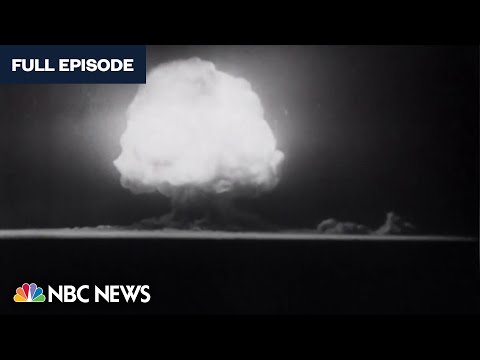
OPPENHEIMER: The Decision to Drop the Bomb (1965)
NBC News' own upload of the 1965 White Paper documentary in which Oppenheimer, dying of throat cancer, recalls the Bhagavad Gita verse on camera — the primary source for the recording everyone has heard, and the best way to hear exactly how he framed it.
Ancient Aliens Debunked (Chris White & Michael Heiser)
The full 2012 documentary, whose "ancient nuclear warfare" segment walks through the Mahabharata misquotations and the Mohenjo-daro vitrification and radioactive-skeleton claims against the excavation record.
See something inaccurate? Have additional sources or a translation correction?
Suggest an Edit →Last Updated: August 2026