
2019 Navy Destroyer Drone Swarm
Over a series of nights beginning July 14, 2019, at least six U.S. Navy warships — including the destroyers USS Kidd and USS Rafael Peralta — operating in Warning Area W-291 off Southern California logged repeated encounters with swarms of unidentified drones that matched their speed, hovered over flight decks, and stayed aloft far longer than commercially available drones of the era. Freedom of Information Act requests by The War Zone later surfaced the underlying deck logs and briefing slides, a leaked night-vision video of "pyramid"-shaped objects over the USS Russell became one of the most widely circulated UAP videos of 2021, and Chief of Naval Operations Admiral Michael Gilday confirmed on the record in April 2021 that the Navy had never identified what they were. A May 2022 congressional hearing resolved the objects' basic category — human-made drones, the triangular appearance a night-vision camera artifact — without ever identifying who was flying them or why.
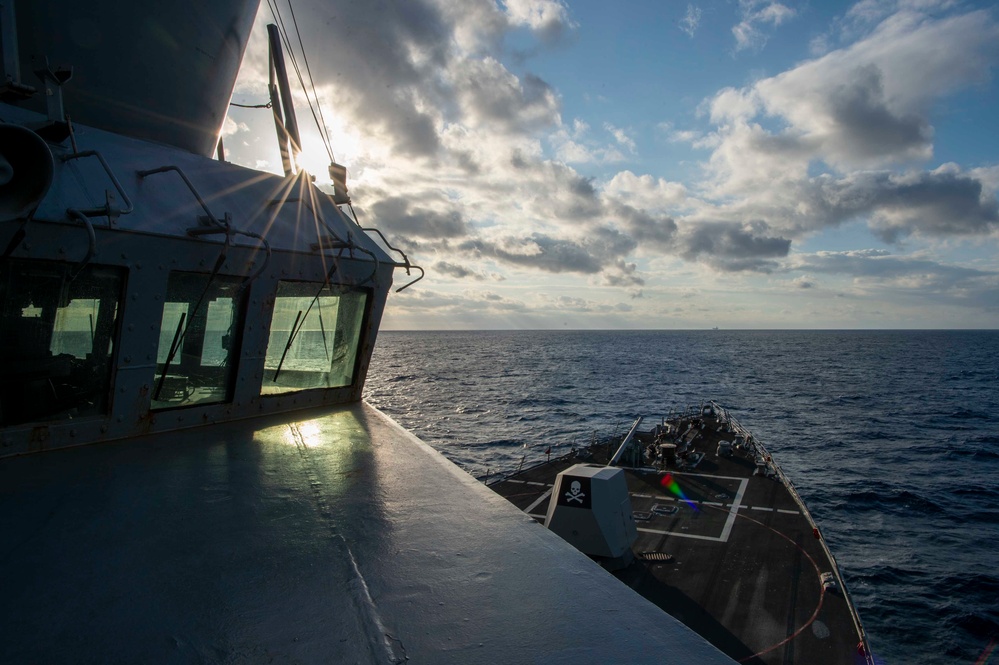
Pictured: USS Kidd (DDG-100), the Arleigh Burke-class guided-missile destroyer whose crew logged the first drone contact of the swarm on the night of July 14, 2019 (official U.S. Navy photo, taken in 2023, public domain) — not a photograph of the drones themselves. The only imagery the Navy has ever released of the objects is a single low-resolution forward-looking infrared frame from a July 17, 2019 USS Paul Hamilton briefing slide, showing three indistinct blurs with no identifying detail, and five short night-vision video clips released in 2022; none is a clear, resolvable photograph of any drone.
Theoretical Alignment
None of the site's three standing theoretical frameworks fits this case well, and that is itself the most important thing to understand about it. The best-supported explanation for nearly every contact — confirmed by the Navy's own Deputy Director of Naval Intelligence in 2022 — is mundane human technology: small unmanned aircraft. That leaves Extraterrestrial and Interdimensional alignment negligible. Psycho-Social scores modestly higher only because one specific, well-documented strand of the case — the "pyramid"-shaped night-vision video that became the most famous single artifact of the whole affair — turned out to be a camera-aperture illusion (bokeh) rather than a true structured craft, a textbook example of perception and instrumentation interacting to manufacture a shape that was never really there. The remainder of the case, radar- and FLIR-corroborated contacts tracked by multiple independent ships over weeks, is not primarily a perceptual phenomenon; it is a real, still-unattributed pattern of technological intrusion.
Background
By the summer of 2019, Southern California's offshore military ranges were already the focus of the wave of encounters that would define the modern American UAP disclosure era. Three years earlier and roughly 200 miles further north, F/A-18 pilots from Carrier Air Wing 17 aboard the USS Theodore Roosevelt's strike group had begun logging the encounters that would become the "Gimbal" and "GoFast" videos; further east, the 2004 "Tic Tac" encounter involving the USS Nimitz had already, by 2019, become the single most consequential UAP case of the century after The New York Times's December 2017 revelations about the Advanced Aerospace Threat Identification Program. The Navy's own internal culture around reporting unexplained aircraft was visibly shifting: in March 2019 the service formally updated guidance instructing pilots and crews to report unidentified aerial phenomena through normal channels rather than staying silent for fear of stigma, and defense reporter Bryan Bender's April 2019 Politico story confirmed those new procedures publicly for the first time.
It was against this backdrop that a U.S. Navy surface action group, built around a rotating set of Arleigh Burke-class guided-missile destroyers, conducted a training exercise inside Warning Area W-291 — a 113,000-square-nautical-mile block of restricted offshore airspace and sea-surface range extending roughly 600 nautical miles southwest from the Southern California coast, entirely over open ocean, roughly 100 to 125 nautical miles off Los Angeles and San Diego. The destroyers involved — USS Kidd (DDG-100), USS Rafael Peralta (DDG-115), USS Russell (DDG-59), USS John Finn (DDG-113), USS Paul Hamilton (DDG-60), and USS Ralph Johnson (DDG-114) — represent some of the Navy's most sensor-rich surface combatants, each built around the AN/SPY-1 phased-array radar and Aegis combat system, and each carrying forward-looking infrared (FLIR) optics and dedicated visual-identification watch procedures. A Ticonderoga-class cruiser, USS Bunker Hill (CG-52), and the littoral combat ship USS Omaha (LCS-12) — whose own, separately cataloged encounter with a submerging spherical object is documented at USS Omaha Underwater Object — operated in the same warning area during the same general period, underscoring that this was a large, multi-ship task-group presence rather than a single vessel's isolated experience.
None of these ships had any reason to expect an extended encounter with unidentified small aircraft. Commercial and hobbyist drone technology in 2019 was well understood by Navy officers: consumer multirotor drones of the era typically carried flight endurance of 20 to 30 minutes and effective control ranges measured in a few miles at most, figures every bridge and Combat Information Center (CIC) watch officer would have known from general awareness of the fast-growing hobbyist and commercial drone market. That baseline expectation is what made the specific, repeated behavior reported across the following two-plus weeks so operationally alarming: multiple simultaneous contacts, sustained flight far beyond consumer endurance limits, and a willingness to approach and shadow warships at close range and low altitude, at night, in a security-sensitive military exercise area.
Complete Timeline
| Date / Time | Event |
|---|---|
| Mar. 2019 | The U.S. Navy formally updates internal reporting guidance for unidentified aerial phenomena, part of a broader institutional shift documented across several of this site's other 2019–2021 Navy case files. |
| Jul. 14, 2019, ~2200 | USS Kidd logs the swarm's first contact: two unidentified aerial vehicles matching the destroyer's speed and bearing, with one hovering directly over the ship's helicopter flight deck for roughly 90 minutes — already well beyond typical consumer-drone endurance. |
| Jul. 15, 2019, 20:39–~23:30 | USS Rafael Peralta sights its own contacts and deploys a "SNOOPIE" (Ship's Nautical Or Otherwise Photographic Interpretation and Exploitation) visual-identification team at 8:39 p.m.; the encounter runs roughly three hours, with as many as four drones shadowing the ship simultaneously. The civilian cruise liner Carnival Imagination, transiting nearby, independently reports five or six drones flying around the Navy vessels. |
| Jul. 16–17, 2019 | USS Paul Hamilton logs a nearly three-hour "UAS swarm" encounter of its own; on July 17, an unredacted Navy briefing slide later released via FOIA documents a single object spotted one nautical mile out, then two (one apparently falling into the water), building to multiple simultaneous contacts by 8:26 p.m. and a formal "UAS swarm" designation by 8:50 p.m., with one object closing to roughly 2,000 feet directly overhead before departing at an estimated 60 knots and later returning. The same night, USS Russell's SNOOPIE team leader narrates "four probable unidentified drones" at roughly 1,000 yards on a night-vision recording — the footage that would later be misread online as showing rigid, pyramid-shaped craft. |
| Jul. 20–24, 2019 | USS Russell conducts counter-UAS exercises, including a live-fire test of its 5-inch deck gun (with at least one recorded misfire) against the intruding contacts; on July 23 a SNOOPIE team spots a drone at an estimated 400 feet of elevation; on July 24 the Navy introduces man-portable "ghostbuster" RF counter-drone jamming equipment to the task group, and, per a separate FOIA release, USS Russell also deploys a shipboard DRAKE counter-drone electronic-warfare system. |
| Jul. 25, 2019 | Further sightings continue across the task group as investigators from multiple agencies begin coordinating a formal inquiry. |
| Jul. 30–31, 2019 (overnight) | The most heavily documented — and most heavily redacted — night of the whole episode. USS Kidd deploys a SNOOPIE team at 2:16 a.m.; USS Paul Hamilton logs four UAS approximately 200 yards off its bow, port, and starboard beams for roughly two hours twenty minutes (0240–0530 local), three visually identified as quadcopters and one displaying four white lights plus a flashing red light while hovering roughly 200 yards up; at 0326 and 0332 local, two separate drones are logged "flashing the bow and bridge of [Paul Hamilton] with what appeared to be a searchlight or photographic device." USS Russell separately logs "one possible UAS" at 4,000 yards showing flashing red, green, and white lights. USS Bunker Hill mans both its SNOOPIE and Small Craft Action Team (SCAT) simultaneously. An unnamed Navy flag officer is recorded aboard USS Russell from July 22 through July 31, for a purpose the released logs do not explain. Deck-log entries specific to this date carry "technical military data" exemption redactions — the only entries of this kind found across the hundreds of pages of logs eventually released. |
| 2020–early 2021 | The incidents remain essentially unreported publicly, known only within the Navy and to a small circle of records requesters. |
| Mar. 24, 2021 | Forbes contributor David Hambling and, in greater depth, The War Zone journalists Adam Kehoe and Marc Cecotti publish the first major reconstructions of the case, built from FOIA'd deck logs cross-referenced against hundreds of gigabytes of civilian Automatic Identification System (AIS) ship-location data to independently verify vessel positions. |
| Apr. 6, 2021 | Chief of Naval Operations Admiral Michael Gilday, asked directly at a Defense Writers Group event in Washington whether the Navy had identified the drones, answers on the record: "No, we have not." He adds he has "no indications at all" the objects are extraterrestrial, and that the incidents remain under analysis through standard joint-force collection channels. |
| 2021 (later) | A leaked cell-phone recording of a Navy night-vision display showing triangular/"pyramid"-shaped objects over USS Russell begins circulating online, publicized by filmmaker Jeremy Corbell and journalist George Knapp; a Pentagon spokesperson confirms the footage is authentic Navy-recorded material under review by the UAP Task Force, without confirming what it shows. |
| Feb. 2022 | Following a successful FOIA appeal by John Greenewald Jr. of The Black Vault — which found the U.S. Pacific Fleet's original document search inadequate and ordered a new one with mandatory 15-day status reports — The War Zone obtains and publishes the unredacted USS Paul Hamilton briefing slide, its low-resolution FLIR frame, and additional deck-log pages. |
| Mar. 2022 | The War Zone publishes an expanded reconstruction covering the July 20–31 counter-UAS response in detail, including the 5-inch gun test, the "ghostbuster" jamming equipment, and the DRAKE electronic-warfare deployment. |
| May 17, 2022 | The House Intelligence Subcommittee on Counterterrorism, Counterintelligence, and Counterproliferation holds the first open congressional hearing on UAP in more than 50 years. Deputy Director of Naval Intelligence Scott Bray presents the USS Russell night-vision footage and testifies the Pentagon is "reasonably confident" the triangular appearance is a bokeh artifact of light passing through night-vision goggles and being recorded by an SLR camera, and that the objects correlate to unmanned aerial systems. |
| Jun. 15, 2022 | The Navy officially releases five unclassified videos of the incidents — two from USS Russell, two from USS Paul Hamilton, and one from USS Ralph Johnson — to Kehoe and Cecotti under continuing FOIA litigation, alongside documents suggesting investigators considered both hobbyist/commercial drone activity and a deliberate, unattributed collection operation as leading possibilities. |
The First Contacts: USS Kidd and USS Rafael Peralta
The night of July 14, 2019 set the pattern for everything that followed. Around 10 p.m., USS Kidd's watch team identified two unidentified aerial vehicles that appeared to deliberately match the destroyer's own speed and bearing — not a passive object drifting on the wind, but something actively tracking the ship's movement. One of the two objects took up a hovering position directly over Kidd's helicopter flight deck, a location of obvious operational sensitivity, and remained there for approximately 90 minutes before the encounter ended. Ninety minutes alone exceeds the flight endurance of the great majority of consumer multirotor drones available in 2019, whose typical battery life ran 20 to 30 minutes; sustaining station-keeping flight for three times that long, while actively shadowing a moving 500-foot warship at 16 knots, was a capability well outside what an off-the-shelf hobbyist platform could easily achieve without either an unusually large, expensive airframe or a support vessel nearby to swap batteries.
The very next night, July 15, USS Rafael Peralta became the second ship to report contacts, deploying its own SNOOPIE visual-identification team at 8:39 p.m. local time. Over the roughly three hours that followed, observers logged as many as four drones shadowing the ship simultaneously, again with no clear explanation for how a hobbyist could sustain that level of coordinated, multi-platform presence through the night. Corroboration came from an unexpected source: the civilian cruise liner Carnival Imagination, transiting the area independently of the Navy exercise, radioed that it, too, could see five or six drones flying around the destroyers — an observation made by crew with no stake in the Navy's investigation and no reason to exaggerate what they saw, which meaningfully strengthens the case that real, physical objects were present rather than a purely internal misperception confined to keyed-up watchstanders.
USS Paul Hamilton and the July 17 FLIR Slide
The single most detailed sequence in the entire case comes from USS Paul Hamilton's July 16–17 encounter, preserved in an official Navy briefing slide that The War Zone eventually obtained in a fully unredacted form via a successful 2022 FOIA appeal. The slide's own timeline is granular almost to the minute: a single object first spotted one nautical mile out; a second object appearing shortly after, one of the two apparently descending and striking the water; multiple simultaneous contacts building through the evening; and, by 8:50 p.m., a formal "UAS swarm" designation entered into the ship's own record. At the encounter's closest point, one object closed to an estimated 2,000 feet directly overhead before abruptly departing at roughly 60 knots — a speed well beyond hobbyist-drone performance envelopes of the period — only to return later in the encounter. Bridge watchstanders visually confirmed red flashing lights on at least one contact.
The slide also carries the only piece of imagery the Navy has ever released of the objects themselves: a single forward-looking infrared frame, of extremely low resolution, showing three indistinct blurs with no discernible shape, structure, or identifying feature. It is, by any honest description, an anticlimactic image relative to the scale of the encounter it documents — a genuinely informative data point in its own right, since it demonstrates that even a modern Aegis destroyer's dedicated FLIR imaging system, aimed directly at the objects during an active encounter, produced nothing better than an unresolvable blur. That same night, USS Russell's SNOOPIE team leader can be heard on a separate night-vision recording narrating "four probable unidentified drones" at approximately 1,000 yards — the raw footage that would later be leaked, misinterpreted online as showing rigid pyramidal craft, and ultimately explained by the Pentagon as a camera artifact (see "The Leaked 'Pyramid' Video" below).
Countermeasures: Guns, Jammers, and the July 30 Redactions
By the fourth week of July, the task group had moved from simply observing the contacts to actively attempting to counter them. USS Russell conducted a live-fire test of its 5-inch deck gun against the intruding objects — recording at least one weapon misfire in the process — and, per a separate document release, also deployed a shipboard DRAKE counter-drone electronic-warfare system. On July 23, a SNOOPIE team logged a drone at an estimated 400 feet of altitude; the following day, July 24, the Navy introduced man-portable "ghostbuster" RF-jamming equipment across the task group, explicitly designed to disrupt a drone operator's command-and-control link. None of these countermeasures is documented as having produced a successful interception, a downed drone, or any recovered wreckage.
The overnight period of July 30–31 produced both the richest and the most heavily redacted single night of documentation in the entire case. USS Kidd deployed a SNOOPIE team at 2:16 a.m.; USS Paul Hamilton logged four separate unmanned aircraft operating roughly 200 yards off its bow and both beams for two hours and twenty minutes, three visually confirmed as quadcopters and a fourth displaying four white lights and a flashing red light while hovering some 200 yards distant. Twice during this window — at 3:26 and 3:32 a.m. — a drone was logged shining "what appeared to be a searchlight or photographic device" directly onto Paul Hamilton's bow and bridge, a detail that, if accurately logged, describes something considerably more deliberate than passive loitering: an object apparently actively illuminating and, plausibly, photographing a U.S. Navy warship's own bridge at night. USS Russell logged a separate contact at 4,000 yards with flashing red, green, and white lights, and USS Bunker Hill manned both its SNOOPIE and Small Craft Action Team simultaneously. An unnamed Navy flag officer is recorded as having been aboard Russell from July 22 through the 31st, for reasons the released records never explain. Uniquely among the hundreds of pages of logs eventually disclosed, the entries specific to this single date carry "technical military data" exemption redactions — a narrower, more specific FOIA withholding category than the general operational-security redactions applied elsewhere, and one that at minimum signals the Navy itself regarded whatever was recorded that night as meriting a different, more protective classification than the rest of the episode.
The Leaked "Pyramid" Video and Its Official Explanation
The single image most people associate with this case is not the low-resolution FLIR blur from the Paul Hamilton slide, but a grainy, cell-phone-recorded video of a Navy night-vision display showing several rigid, triangular or "pyramid"-shaped objects with steady lights, apparently hovering above USS Russell. The clip circulated online through 2021, publicized by filmmaker Jeremy Corbell and journalist George Knapp — the same pairing responsible for surfacing the leaked USS Omaha sphere footage from the same general operating area and period. A Pentagon spokesperson confirmed at the time that the footage was authentic, Navy-recorded material under review by the UAP Task Force, without confirming what the objects actually were — a limited, carefully worded acknowledgment that nonetheless supercharged public interest in the case.
The explanation came at the May 17, 2022 congressional hearing. Deputy Director of Naval Intelligence Scott Bray told the House Intelligence Subcommittee that Pentagon analysts had located a second night-vision recording, made under similar conditions elsewhere, that helped them understand what was producing the triangular shape: not a rigid structured craft, but an ordinary small drone whose point-source lights, when viewed through night-vision goggles and re-recorded with a separate SLR camera, produced a hexagonal or triangular bokeh — an optical artifact of the aperture and lens elements in the imaging chain, not a property of the object itself. Bray stated the Pentagon was "reasonably confident" the objects correlated to unmanned aerial systems. Independently, skeptical researcher Mick West of Metabunk.org reached a closely related conclusion working from the raw footage and camera optics alone, well before Bray's testimony became public, adding that at least one separate set of "drone" contacts logged the same general week — specifically identified by West as USS Russell's own reported contacts on the night in question — corresponded in position and timing to ordinary commercial airliners on final approach to Southern California airports, an angle of view from a moving ship at sea that can make a distant landing light appear to hover in place.
The Black Vault, FOIA, and the Fight for the Full Record
Much of what is publicly known about this case exists only because of a sustained, multi-year Freedom of Information Act effort. Adam Kehoe and Marc Cecotti of The War Zone filed the initial requests that produced the deck logs and cross-referenced them against civilian AIS ship-tracking data to independently verify vessel positions and rule out simple errors in the ship's own self-reported location — a methodologically serious step that goes well beyond simply accepting the Navy's paperwork at face value. Separately, John Greenewald Jr. of The Black Vault filed his own FOIA requests for photographs, timeline slides, and deck logs, and in February 2022 won an appeal after the Navy's own Office of the Judge Advocate General determined that U.S. Pacific Fleet's original search had been inadequate — the Fleet could not even confirm what search terms had been used to look for responsive records the first time. The appeal forced a new, more rigorous search with mandatory 15-day status reports, and it was this renewed search that ultimately surfaced the unredacted Paul Hamilton briefing slide. The pattern across both journalists' efforts is consistent: initial Navy disclosures were incomplete or inadequately searched, and materially more information emerged only after sustained, adversarial FOIA litigation rather than through voluntary disclosure.
Key Witnesses
Admiral Michael Gilday
Not a firsthand witness to the encounters, but the Navy's top uniformed officer, whose April 6, 2021 on-record admission — "No, we have not" identified the drones — remains the case's single most quoted official statement. Gilday also stated he had "no indications at all" the objects were extraterrestrial, directly ruling out one interpretation while conspicuously declining to offer any alternative identification of his own.
Scott Bray
Provided the case's most technically detailed official account, testifying to Congress on May 17, 2022 that the leaked "pyramid" footage showed unmanned aerial systems whose triangular appearance was a night-vision/SLR camera artifact (bokeh), while acknowledging the Pentagon still could not identify the drones' operators, origin, or purpose.
Unnamed SNOOPIE & Bridge Watch Teams
Dozens of trained Navy lookouts, radar operators, and dedicated SNOOPIE/SCAT visual-identification teams across at least six ships independently logged contacts over more than two weeks. None is named in the released, heavily redacted logs, but their collective, cross-corroborated, contemporaneously recorded observations — not a single after-the-fact recollection — form the actual evidentiary backbone of the case.
Adam Kehoe & Marc Cecotti
Their multi-year FOIA campaign, cross-referencing Navy deck logs against independently sourced civilian AIS ship-tracking data, produced the great majority of the public documentary record this case file relies on, including the 2022 official video release.
Jeremy Corbell & George Knapp
Publicized the leaked USS Russell night-vision "pyramid" footage in 2021, prompting the Pentagon's confirmation of its authenticity and, indirectly, the congressional explanation that followed in 2022.
John Greenewald Jr.
Won a February 2022 FOIA appeal that forced U.S. Pacific Fleet to redo an inadequate original document search, directly leading to the release of the unredacted USS Paul Hamilton briefing slide and its FLIR imagery.
The Five Observables Assessment
The Five Observables framework is applied to the performance characteristics reported in this case:
Assessment: This case scores low across the Five Observables framework, and consistently so — which is itself a meaningful data point rather than a gap in the record. No witness or sensor ever reported anti-gravity lift, transmedium (air-to-water or water-to-air) transition, or genuinely hypersonic speed; the fastest documented departure, roughly 60 knots (about 69 mph), is well within conventional small-aircraft performance. "Instant Acceleration" and "Low Observability" are rated speculative rather than absent only because several logged departures were abrupt and because the objects were never successfully tracked to a recovery point or identified operator despite an active, multi-ship, multi-agency effort — but that evasiveness reads much more plausibly as deliberate operator behavior (departing before an approaching countermeasure or visual-ID team could close the distance) than as an exotic low-observable airframe defeating a modern Aegis destroyer's radar and FLIR suite, which the July 17 briefing slide's unresolvable FLIR blur suggests was never seriously challenged to begin with.
Evidence Assessment
Supporting Anomalous Origin
- Multiple independent, trained Navy visual-identification and radar teams across at least six separate ships logged contacts on repeated nights over more than two weeks — a scale and duration of corroboration few case files on this site can match
- Independent civilian corroboration from the cruise liner Carnival Imagination, whose crew had no stake in the Navy's investigation, reported five or six drones on the same night as Navy contacts
- Several encounters (July 14, July 16–17) documented flight durations of 90 minutes to nearly three hours — well beyond the endurance of typical 2019-era consumer drones — and, in at least one case, a 60-knot departure speed
- Active Navy countermeasures — live gun fire, RF jamming, dedicated electronic-warfare systems — never produced a recovered drone, confirmed downing, or identified operator
- The July 30–31 log entries carry a uniquely narrow "technical military data" FOIA exemption not applied to any other date in the released record, suggesting the Navy itself regarded that night's material as sensitive in a distinct way
- Nearly three years after the incidents, the Navy's own Chief of Naval Operations stated on the record that the drones' identity remained unresolved
Supporting Conventional Explanation
- The Department of Defense's own May 2022 congressional testimony confirmed the objects were human-made unmanned aerial systems, not an exotic or non-terrestrial craft
- The case's most famous single artifact — the "pyramid"-shaped USS Russell night-vision video — was independently traced by both the Pentagon and outside skeptical analysts to a camera bokeh artifact, not a structured craft
- At least one set of "drone" contacts was plausibly identified by independent analyst Mick West as ordinary commercial airliners on final approach to nearby Southern California airports, viewed at a deceptive angle from a moving ship
- Consumer and commercial drone technology by 2019 already included high-endurance platforms capable of flight times exceeding several hours and ranges exceeding 100 kilometers, narrowing the technical gap between "hobbyist" and "sophisticated operator" considerably
- No wreckage, component, or physically recovered drone of any kind exists from any of the encounters, despite active Navy efforts to intercept or bring one down
Why "Disputed"
This case earns a DISPUTED rating because its two halves point in genuinely different directions, and neither can simply be waved away. The underlying pattern of contacts is exceptionally well corroborated by the standards of this site: contemporaneous, FOIA-obtained deck logs (not after-the-fact recollection) from at least six independent ships, cross-checked against civilian AIS ship-tracking data, an official Navy briefing slide with a timestamped minute-by-minute account, five Navy-released videos, and on-record acknowledgment from the service's own top officer that the drones were never identified. Few cases on this site carry this volume of genuinely contemporaneous institutional documentation.
Against that, the case's basic category has been substantially resolved, and resolved toward the mundane end of the spectrum. The Department of Defense's own May 2022 congressional testimony affirmed these were human-made drones, and both the Pentagon and an independent skeptical analyst separately traced the case's single most viral artifact — the "pyramid" video — to an optical artifact rather than a genuine structured craft. That is a materially different profile from a case where the observed performance itself remains scientifically unexplained; here, the open question is narrower and more mundane: who was flying dozens of drones around a U.S. Navy exercise for more than two weeks, and why, not what kind of physical object was involved. A "drone swarm" that is officially conceded to be drones, however well-documented and however unresolved the attribution, cannot be scored as high as a case where the craft's fundamental nature remains genuinely contested. Disputed — strong institutional corroboration of the pattern, but a leading, officially endorsed conventional category for the objects themselves, with the real mystery confined to who built and flew them.
Sensor & Instrumentation Detection Profile
The task group's ships carried some of the Navy's most capable surface-combatant sensor suites: AN/SPY-1 phased-array radar and the Aegis combat system aboard every Arleigh Burke-class destroyer involved, forward-looking infrared (FLIR) optics used to produce the single released frame from the July 17 USS Paul Hamilton briefing slide, and handheld night-vision goggles paired with SLR cameras used by SNOOPIE visual-identification teams, which produced the leaked USS Russell footage later explained as a bokeh artifact. Civilian Automatic Identification System (AIS) transponder data, reconstructed after the fact by The War Zone's journalists, provided an independent check on the Navy's own reported ship positions. Despite this genuinely sophisticated sensor array, the only released imagery of the objects themselves — the FLIR frame — shows three unresolvable blurs, and no radar track, gun-camera footage, or higher-resolution imagery of any drone has ever been made public.
The counter-drone response itself generated its own instrumentation record. USS Russell's live-fire test of its 5-inch/62 caliber deck gun against the contacts, and its separate deployment of a shipboard DRAKE counter-drone electronic-warfare system, both depend on the ship's own fire-control and electronic-support sensors to detect, track, and engage a target — meaning the gun and jamming attempts are themselves a form of instrumented data about the contacts' tracked position and behavior, even though neither is documented as having produced a confirmed hit or a disrupted control link. The man-portable "ghostbuster" RF-jamming equipment introduced fleet-wide on July 24 represents a third, distinct sensor/countermeasure modality — passive radio-frequency detection paired with active jamming — whose specific technical results were not detailed in the portions of the record released publicly.
Environmental & Geospatial Context
Warning Area W-291 sits entirely over open Pacific water, roughly 100 to 125 nautical miles southwest of Los Angeles and San Diego, within the Southern California Bight — a region with typically calm summer seas and, on many nights during the encounters, reduced visibility reported as under one nautical mile. The area lies beneath, or near, commercial air corridors serving Southern California's major airports, a detail directly relevant to Mick West's identification of at least some contacts as distant airliners on final approach viewed from a moving ship at an angle that can make navigation lights appear to hover. The warning area is also adjacent to significant civilian and commercial maritime traffic, illustrated by the independent cruise-liner corroboration on July 15 and by Navy suspicion, never proven, that a nearby Hong Kong-flagged bulk carrier, the Bass Strait, may have been involved in facilitating or conducting surveillance of the exercise.
Observer Credibility & Occupational Profile
The case's observer pool is, on paper, about as credentialed as this site's methodology can score: professional U.S. Navy watchstanders, radar and CIC operators, and dedicated SNOOPIE/SCAT visual-identification teams — personnel specifically trained and tasked to identify unknown aircraft — spread across at least six independent warships over more than two weeks, with contemporaneous logging rather than after-the-fact recollection, and an independent civilian corroboration from an unrelated cruise ship. Their collective, cross-corroborated pattern of observation is far stronger than any single witness account. The genuine limitation is that, per the Skeptoid critique the site's own research surfaced, no amount of training fully overcomes the physical constraint that an observer cannot reliably judge the range, size, or true shape of a point-source light at night without independent triangulation — a limitation the "pyramid" video's bokeh-artifact explanation demonstrates concretely, since even trained SNOOPIE personnel narrating in real time described what they saw as structured triangular craft, not a camera artifact, until outside optical analysis explained it after the fact.
Physical & Material Assays
No physical evidence of any kind exists in this case. Despite live gun fire, RF jamming, and a dedicated electronic-warfare deployment over more than two weeks, no drone was ever downed, recovered, boarded, or physically examined by any Navy or FBI investigator. There is no wreckage, no component, no fragment, and no material sample of any kind to test — a genuinely informative absence given the scale and duration of the active countermeasure effort, and one this case file states plainly rather than working around. See Material Analysis below for a fuller discussion of what the case's actual physical evidence — imagery and video, rather than trace material — does and does not show.
Historical Precedents & Archive Matches
This case sits inside the same broader wave of 2019 Southern California naval UAP encounters as the USS Omaha Underwater Object case, which documents a separately notable, radar- and FLIR-tracked spherical object that appeared to descend into the ocean during the same general period in the same Warning Area W-291 operating box — a genuinely distinct incident (a different ship class, a different specific phenomenon, and no reported drone-swarm behavior) rather than the same event under a different name, but plainly part of the same operational moment and possibly the same underlying pattern of activity. Later that same year, in September 2019, a separate and also officially unresolved drone-swarm incursion over the Palo Verde Nuclear Generating Station in Arizona (cataloged at Palo Verde Nuclear Station Drone Swarm) was formally closed "unresolved" by the NRC and FBI, involving confirmed conventional UAS rather than any exotic craft — a close structural parallel to this case's own leading conventional finding. More recently, the 2023–2024 Langley AFB Drone Incursions repeated a similar pattern — sustained, unattributed drone activity over sensitive U.S. military airspace, met with an active but ultimately unsuccessful countermeasure and identification effort — suggesting this case was not an isolated anomaly but an early, unusually well-documented instance of a recurring category of incident that has continued for years since.
Reporting on the wider FOIA record also surfaced an earlier, less thoroughly documented precedent within the very same operational window: in April 2019, roughly three months before the destroyer swarm began, released Navy footage reportedly showed a smaller drone incursion over the guided-missile destroyer USS Zumwalt (DDG-1000), the Navy's most technologically advanced and expensive surface combatant, in the same general Southern California operating areas. The Zumwalt incident never received the same volume of FOIA documentation, congressional attention, or sustained press coverage as the July swarm, and this case file treats it as a genuinely separate, lower-confidence data point rather than as part of the same documented chronology above — but its mere existence, three months prior and in the same waters, is consistent with a longer-running pattern of unattributed drone activity around the Navy's Southern California exercise areas than the well-documented July 14–31 window alone would suggest.
Material Analysis
Because no drone, fragment, or physical component was ever recovered, this case's "material evidence" consists entirely of documentary and imaging material: the deck logs themselves, the July 17 USS Paul Hamilton briefing slide and its single low-resolution FLIR frame, the five officially released 2022 videos, and the earlier leaked USS Russell night-vision footage. Treated as evidence in their own right, these materials are informative less for what they show of the drones themselves — consistently indistinct, low-resolution, and inconclusive at the level of physical structure — and more for what they reveal about the imaging chain that produced them. The bokeh analysis of the "pyramid" footage, confirmed independently by both Pentagon analysts and outside researcher Mick West, is a rare case where the visual "evidence" for an anomalous craft was directly and specifically traced to a mechanism internal to the recording equipment (aperture diffraction in a night-vision/SLR pairing) rather than to any property of the object being recorded — a genuinely different and more conclusive kind of debunking than the usual "distant light, ambiguous shape" verdict applied to most nocturnal light cases.
What the Documentary Record Does and Does Not Establish
The record does establish, with reasonable confidence: that real, radar- and visually-tracked physical objects were present on multiple nights (not a shared misperception, given independent civilian corroboration); that at least some contacts exceeded consumer-drone endurance and speed norms for the period; and that the single most dramatic visual artifact associated with the case (the triangular shape) does not reflect the objects' true form. The record does not establish who built, owned, or piloted any of the drones; whether a single operator or multiple unrelated operators were responsible across the different nights and ships; or whether the July 30–31 "technical military data" redactions reflect a genuinely different, more sensitive finding than the rest of the case, or simply a different FOIA reviewer applying a stricter standard to that particular batch of documents.
Supporting Advanced/Non-Standard Technology
- Multiple encounters documented flight durations (90 minutes to nearly three hours) well beyond 2019-era consumer-drone battery limits
- At least one departure was logged at roughly 60 knots, faster than typical hobbyist multirotor performance of the period
- Coordinated, simultaneous multi-drone "swarm" behavior across several nights implies either a sophisticated single operator or genuine swarm-control software, both more consistent with a resourced state or commercial actor than a casual hobbyist
Supporting Standard Commercial/Hobbyist Technology
- High-endurance commercial drones with multi-hour flight times and 100+ kilometer ranges were already commercially available by 2019, narrowing the technical gap considerably
- Three of the four unmanned aircraft directly visually identified during the July 30–31 USS Paul Hamilton encounter were confirmed as ordinary quadcopters, not an exotic airframe
- The case's single most "advanced-looking" visual signature (the rigid triangular shape) was conclusively traced to a camera artifact rather than to the drones' actual construction
The Conventional Explanation Candidate: Hobbyist or Commercial High-Endurance Drones
The Department of Defense's own preferred framing, reflected in FOIA-released investigative documents, treats at least some of the encounters as consistent with ordinary hobbyist or small-commercial-operator activity — specifically, local recreational drone pilots (fishermen and other boaters operating in the same offshore waters were floated as one possibility in released documents) flying consumer or prosumer multirotor platforms near the exercise out of curiosity, recklessness, or simple ignorance of the restricted airspace. By 2019, "prosumer" and hobbyist-adjacent drones with several-hour endurance and ranges well beyond a few miles were commercially available, meaningfully narrowing the technical gap this case file's own Background section describes between typical consumer drones and the sustained, 90-minute-to-three-hour encounters logged on the water.
Deliberate Foreign or Unattributed Intelligence-Collection Operation
A second, more concerning candidate treats the swarm as a deliberate intelligence-gathering or capability-testing operation by an unidentified — possibly foreign — actor, deliberately probing a live U.S. Navy exercise's sensor coverage, reaction time, and counter-drone response. This candidate draws support from the coordinated, multi-platform, multi-night persistence of the activity; from the specific July 30–31 detail of drones apparently "flashing... a searchlight or photographic device" onto USS Paul Hamilton's own bridge, a behavior more consistent with deliberate observation than idle curiosity; and from Navy suspicion, never proven, that a nearby Hong Kong-flagged bulk carrier, the Bass Strait, may have facilitated or conducted surveillance from a covering vessel. No operator, sponsoring organization, or nationality has ever been publicly confirmed for this candidate.
Misidentified Aircraft or Camera/Sensor Artifact
A third candidate, empirically the strongest for at least one specific and famous strand of the case, holds that some contacts were not drones at all: the "pyramid"-shaped USS Russell footage was conclusively traced by both Pentagon analysts and independent researcher Mick West to a night-vision/SLR camera bokeh artifact rather than a rigid structured craft, and West separately identified at least one additional set of contacts as distant commercial airliners on final approach to Southern California airports, misjudged in range and motion from a moving ship at night. This candidate explains a meaningful share of the total sightings extremely well, but does not account for the directly visually confirmed quadcopters, the radar-tracked multi-object "swarm" designations, or the object that appeared to descend into the water during the July 16–17 encounter.
Undisclosed Navy or Allied Test Asset
A fourth, weaker candidate — raised in skeptical commentary rather than by any official source — speculates that the Navy's own MQ-8 Fire Scout unmanned helicopter, whose performance envelope broadly overlaps some reported behaviors, might account for at least some contacts, whether through an undisclosed exercise element or a genuine internal communication failure between the flying unit and the ships being "swarmed." The Navy and the Fleet Area Control and Surveillance Facility (FACSFAC) responsible for coordinating range activity have specifically denied deploying any of their own assets to explain the contacts, and no documentary evidence in the released record supports this candidate.
Hobbyist / Commercial High-Endurance Drones
InconclusiveINCONCLUSIVE. Plausible for shorter, simpler contacts and consistent with the Navy's own investigative framing, but does not comfortably explain the coordinated multi-drone "swarm" designations, the extended 90-minute-to-three-hour durations, or the deliberate searchlight/photographic behavior logged on Jul. 30–31.
Foreign/Unattributed Intelligence-Collection Operation
InconclusiveINCONCLUSIVE. Explains the persistence, coordination, and apparent deliberate observation of Navy vessels better than a hobbyist theory, and is consistent with genuine Navy suspicion of a nearby foreign-flagged vessel — but no operator, nationality, or sponsoring organization has ever been publicly confirmed.
Misidentified Aircraft / Camera Artifact
PlausiblePLAUSIBLE for the specific contacts it addresses. Both the Pentagon and an independent analyst separately confirmed the viral "pyramid" video was a camera bokeh artifact, and at least one contact was plausibly matched to a distant commercial airliner — though this candidate does not account for the directly visually identified quadcopters or the radar-tracked swarm contacts.
Undisclosed Navy/Allied Test Asset
ImplausibleIMPLAUSIBLE. Specifically denied by the Navy and by FACSFAC, and unsupported by any document in the released record; raised only as skeptical speculation based on general MQ-8 Fire Scout performance overlap.
Related Cases
Confirmed Documents & Official Records
Official transcript of the first open congressional UAP hearing in over 50 years, including Deputy Director of Naval Intelligence Scott Bray's testimony explaining the USS Russell "triangle" footage as a night-vision camera artifact and confirming the 2019 contacts were assessed as unmanned aerial systems.
Publishes the unredacted USS Paul Hamilton briefing slide and its FLIR imagery, obtained via a successful Freedom of Information Act appeal, with a minute-by-minute official Navy timeline of the July 17, 2019 encounter.
Documents John Greenewald Jr.'s successful FOIA appeal, in which the Navy's own Office of the Judge Advocate General found U.S. Pacific Fleet's original document search inadequate and ordered a new, more thorough search.
No agency has ever publicly released the identity, nationality, or operating organization behind the drones themselves, nor any recovered physical component. The Navy's official 2022 videos and the congressional hearing transcript above remain the fullest official acknowledgment on record.
Search Government & Naval Archives Directly
Further Reading — Recommended Literature
Swarm Troopers: How Small Drones Will Conquer the World
Written by the same technology journalist who broke this exact case for Forbes in 2021, this book explains the swarm software, endurance technology, and cost economics that make sustained multi-drone incursions like the one off Southern California technically achievable by a well-resourced but non-state actor.
Skinwalkers at the Pentagon
An insider's account of the Pentagon's AAWSAP/AATIP UAP research program, directly relevant to the institutional and bureaucratic context — the same UAP Task Force review process cited in this case's own 2021–2022 official statements — that this case's evidence moved through.
UFOs: Reframing the Debate
A collection of essays urging researchers to separate a case's genuine, well-documented anomalous pattern from its most viral (and often most explainable) individual artifact — precisely the distinction this case's "pyramid video" bokeh explanation illustrates.
Escaping the Rabbit Hole: How to Debunk Conspiracy Theories Using Facts, Logic, and Respect
By the independent analyst whose optical breakdown of the USS Russell "pyramid" footage anticipated the Pentagon's own 2022 congressional explanation, this book lays out the exact methodology — camera/lens artifact analysis, careful attention to observer viewing angle — applied to this case.
UFO: The Inside Story of the US Government's Search for Alien Life Here—and Out There
Places this case within the wider institutional arc — from the Nimitz encounter through the UAP Task Force to AARO — that shaped how the Navy and Pentagon investigated, and eventually testified about, the 2019 drone swarm.
Essential Viewing

Report Says Mystery Drones Hovered Over Navy Destroyers Off California Coast
NBC News NOW's original 2021 news report on The War Zone's FOIA-based reconstruction of the case, covering the ships involved and the drones' documented capabilities.

Open C3 Subcommittee Hearing on Unidentified Aerial Phenomena
The official House Intelligence Committee recording of the May 17, 2022 hearing where Deputy Director of Naval Intelligence Scott Bray presented the USS Russell footage and explained the "triangle" objects as drones.
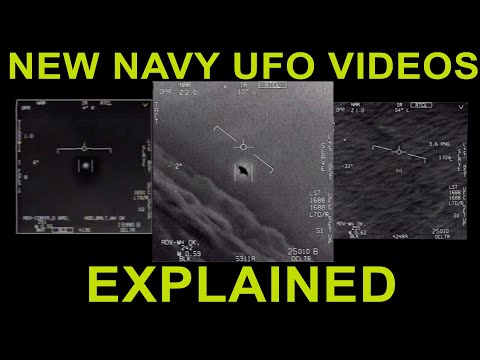
Explained: New Navy UFO Videos
Independent analyst Mick West's technical breakdown of the Navy's 2022 video release, examining the camera optics behind the "triangle" appearance and assessing which contacts best match ordinary aircraft or drones.
Sources
- Kehoe, Adam & Cecotti, Marc. "Multiple Destroyers Were Swarmed By Mysterious 'Drones' Off California Over Numerous Nights." The War Zone, Mar. 24, 2021. twz.com
- Hambling, David. "Mystery Drones Kept Buzzing U.S. Destroyers During Exercises Off California." Forbes, Mar. 24, 2021. forbes.com
- Kehoe, Adam & Cecotti, Marc. "Harassment Of Navy Destroyers By Mysterious Drone Swarms Off California Went On For Weeks." The War Zone. twz.com
- Kehoe, Adam & Cecotti, Marc. "Navy Releases Timeline For Mysterious 2019 'UAS Swarm' Involving Warships Off California." The War Zone, 2022. twz.com
- "Swarmed Navy Destroyer Had Its Bridge Illuminated By Mysterious Drones." The War Zone, Oct. 14, 2022. twz.com
- Kehoe, Adam & Cecotti, Marc. "Navy Destroyer Deployed DRAKE Counter-Drone Electronic Warfare System During 2019 Mystery Swarm Incident." The War Zone. twz.com
- "Navy Releases Videos From Mysterious Drone Swarms Around Warships Off California." The War Zone, Jun. 2022. twz.com
- "Navy Ships Swarmed By Drones, Not UFOs, Defense Officials Confirm." The War Zone. twz.com
- "Drones That Swarmed U.S. Warships Are Still Unidentified, Navy Chief Says." NBC News, Apr. 6, 2021. nbcnews.com
- "Mystery Drones Hovered Over U.S. Navy Destroyers Off California Coast, Report Says." NBC News, Mar. 2021. nbcnews.com
- "Drones That Hovered Around US Warships in 2019 Remain Mystery, Top Navy Officer Says." Fox News. foxnews.com
- "Navy Still Has No Idea What Mysterious Drones That Stalked Its Ships for Days Were." Gizmodo, 2021. gizmodo.com
- Dunning, Brian. "The 2019 USS Kidd Incident." Skeptoid, Episode 777. skeptoid.com
- West, Mick. "USS Kidd (and other Ships) 'Drones' Encounter, 2019." Metabunk. metabunk.org
- West, Mick. "'Pyramid' UFOs in Night Vision Footage Are Bokeh." Metabunk. metabunk.org
- "The Black Vault Granted Important Appeal Relating to 2019 Unidentified 'Drone' Encounters." The Black Vault. theblackvault.com
- House Permanent Select Committee on Intelligence, Subcommittee on Counterterrorism, Counterintelligence, and Counterproliferation. "Unidentified Aerial Phenomena," Open Hearing Transcript, May 17, 2022. congress.gov
- Baldor, Lolita C. "Congress' First Military UFO Hearing in 50 Years Deflates Speculation on Alien Spacecraft." Military.com/Associated Press, May 17, 2022. military.com
- "Pentagon Officials Testify at First Public UFO Hearing in More Than 50 Years." CBS News, May 17, 2022. cbsnews.com
- "USS Rafael Peralta (DDG-115)," Wikipedia — ship background, used lightly for orientation only. en.wikipedia.org
- The Black Vault. FOIA-released U.S. Pacific Fleet deck logs and briefing slides, 2021–2022 (cited throughout via The War Zone's published reproductions).
See something inaccurate? Have additional information or sources?
Suggest an Edit →Last Updated: August 2026