
USS Omaha Underwater Object
On the night of July 15, 2019, radar and infrared sensors aboard the littoral combat ship USS Omaha, operating in a restricted warning area off San Diego, tracked more than a dozen unidentified airborne contacts — one of which was recorded appearing to descend into the Pacific Ocean without recoverable wreckage. Leaked in 2021 by filmmaker Jeremy Corbell and confirmed by the Pentagon as authentic Navy-recorded material, the incident sits at the center of a genuinely unresolved dispute between a documented instrumented "transmedium" anomaly and a well-evidenced rival explanation involving unidentified drones that harassed multiple Navy warships across the same waters that same week.
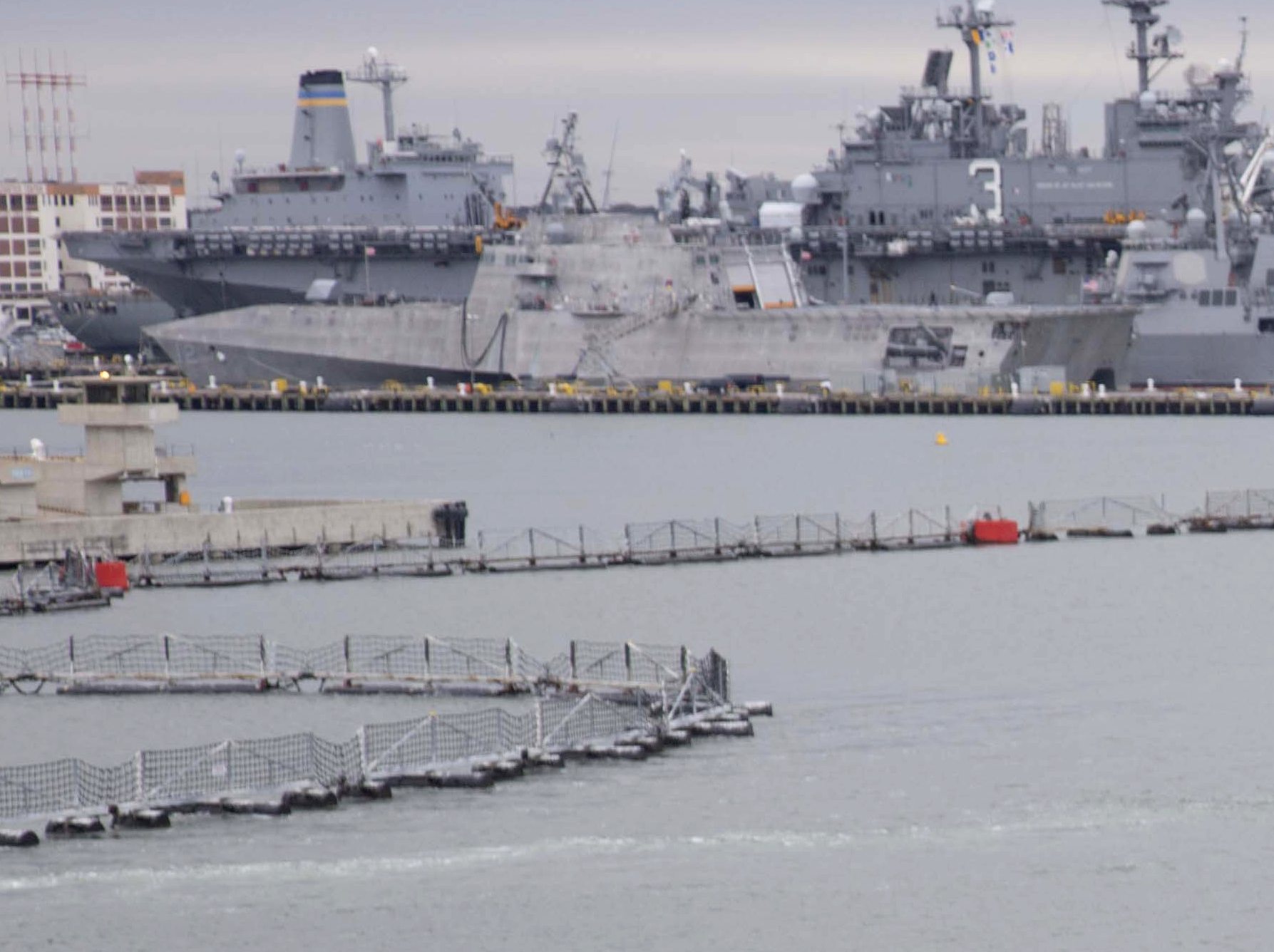
Pictured: USS Omaha (LCS-12), the San Diego-based littoral combat ship whose crew recorded the sensor data at the center of this case, photographed at Naval Station Norfolk in December 2017 — not a frame of the leaked encounter footage itself. No rights-clear, non-watermarked copy of the actual 2019 CIC video or radar imagery is publicly available for reproduction here; the leaked material remains circulated only through Jeremy Corbell's own releases and the news outlets that licensed clips from him.
Theoretical Alignment
The USS Omaha case is most commonly framed under the Extraterrestrial Hypothesis by advocates because of its instrumented "transmedium" signature — an object apparently transitioning between air and water with no visible means of propulsion — but the framework that actually carries the most explanatory weight given the full public record is a terrestrial one: the Advanced Adversary/Domestic Drone Hypothesis, which treats the July 2019 encounters as a probable, still-unattributed unmanned aerial or maritime intelligence-collection operation exploiting a Navy sensor and procedural blind spot. The Psycho-Social framework carries only marginal weight here — the CIC crew were trained radar and thermal-imagery operators cross-referencing two independent onboard sensor systems in real time, not a single overwrought observer — while the Interdimensional Hypothesis finds essentially nothing case-specific to anchor it.
Background
By the summer of 2019, the U.S. Navy was already several years into a quiet institutional shift in how it handled reports of unidentified aircraft near its ships and aircraft. The catalyst had been a string of encounters involving Nimitz Carrier Strike Group pilots off the Southern California coast in 2004, and a second wave involving USS Theodore Roosevelt aviators off the East Coast in 2014–2015, both of which became public through leaked cockpit video and, eventually, New York Times reporting in December 2017. In March 2019, in direct response to a rising number of reports from pilots and, increasingly, from surface ships about unauthorized aircraft entering restricted training ranges, the Navy formally updated its guidance for how personnel should document and report what it began calling "unidentified aerial phenomena" (UAP) rather than the older, more dismissive "UFO." That new reporting culture was barely a few months old when the USS Omaha, an Independence-class littoral combat ship homeported in San Diego, deployed into Warning Area W-291 for a routine training period in mid-July 2019.
The Omaha did not encounter its sphere in isolation. Beginning on the night of July 14, 2019, and continuing intermittently for roughly two weeks, a cluster of Navy surface combatants operating in the same offshore warning area — the destroyers USS Kidd, USS Rafael Peralta, USS Russell, USS John Finn, and USS Paul Hamilton — began logging encounters with small, fast-moving aerial objects, most consistent in general appearance with unmanned aircraft, that approached to within a few hundred feet, matched the ships' speed and heading for extended periods, and in several cases appeared to deliberately illuminate a ship's bridge or superstructure with a light source. The Navy's own after-action documentation, later obtained via FOIA requests and reported in detail by The War Zone, describes swarms of up to six objects operating together, evasive maneuvering that defeated attempts at visual and sensor tracking, and enough institutional concern that the Naval Criminal Investigative Service, an FBI field office, and the Maritime Intelligence Operations Center within the Navy's Third Fleet were all looped into the response. It was into this specific, already-escalating operational environment — ships on heightened alert for unidentified aircraft, sensor operators primed to treat unusual contacts as reportable rather than dismissible — that the Omaha's July 15 encounter unfolded.
The Omaha incident did not become public knowledge until nearly two years later. Corroborating reporting on the broader destroyer swarm surfaced first, in a series of 2019–2021 investigative pieces by The War Zone's Tyler Rogoway and Joseph Trevithick built from FOIA'd ship logs and Navy correspondence, and in an April 2021 New York Times report drawing on interviews with Navy officials. The Omaha's own sensor data and CIC video remained outside that public record until documentary filmmaker Jeremy Corbell, working with veteran investigative journalist George Knapp of KLAS-TV in Las Vegas, began publishing leaked still photographs in April 2021 and the full CIC infrared clip, radar-plot footage, and onboard audio in May 2021 — timed just weeks before the Office of the Director of National Intelligence's congressionally mandated Preliminary Assessment on UAP was due to Congress.
Complete Timeline
| Date | Event |
|---|---|
| Mar. 2019 | The U.S. Navy formally updates internal guidance for how personnel are to report "unidentified aerial phenomena," in response to a rising number of pilot and ship-based reports near training ranges. |
| Apr. 2019 | Politico defense reporter Bryan Bender first reports publicly that the Navy is drafting new formal guidelines for pilots and crews to report unidentified aircraft, confirming the reporting-culture shift already underway. |
| Jul. 14, 2019 (night) | USS Rafael Peralta and USS John Finn, operating in Warning Area W-291 off Southern California, log encounters with multiple unidentified aircraft; Peralta deploys a "SNOOPIE" visual-identification team within minutes. |
| Jul. 15, 2019, ~9:00 PM PDT | USS Omaha's Combat Information Center begins tracking unidentified radar contacts in the same warning area; over the next two hours, operators log as many as fourteen simultaneous unknown tracks moving at roughly 46–158 mph. |
| Jul. 15, 2019, ~11:00 PM PDT | A thermal/infrared camera in the CIC records a self-illuminated spherical object, estimated at roughly six feet in diameter, appearing to slow, hover briefly, and then descend into the ocean surface; CIC audio captures crew reactions ("Whoa, it's getting close," "Whoa, it splashed!"). A submarine is reportedly dispatched to search the area; no wreckage is found. |
| Jul. 16–17, 2019 | USS Paul Hamilton logs a nearly three-hour encounter with a UAS "swarm" of its own in the same operating area, per a later-released official Navy briefing timeline. |
| Jul. 25–30, 2019 | Sporadic further sightings continue across the Navy task group, including a significant event in the early hours of July 30; USS Kidd redeploys its own visual-ID team. |
| Apr. 2021 | The Black Vault (John Greenewald Jr.) files a FOIA request for USS Omaha's July 2019 deck logs and any associated photographs/video; the Navy's response includes deck logs only from July 19–31, 2019 — the days immediately surrounding the reported encounter are absent, along with the ship's routine voice recordings for that period. |
| Apr. 2021 | Jeremy Corbell and George Knapp publish leaked still photographs, attributed to USS Omaha, showing a spherical object over open ocean. |
| May 14–17, 2021 | Corbell and Knapp publish the full CIC infrared video, radar-plot footage, and onboard audio of the July 15, 2019 encounter. Pentagon spokesperson Susan Gough confirms on the record that "the video was taken by Navy personnel" and that the Unidentified Aerial Phenomena Task Force (UAPTF) "included it in their ongoing examinations." |
| Jun. 25, 2021 | The Office of the Director of National Intelligence releases its congressionally mandated "Preliminary Assessment: Unidentified Aerial Phenomena," describing 144 reports (including a "transmedium" category) without naming the Omaha case specifically. |
| Sep. 2022 | The Department of Defense establishes the All-domain Anomaly Resolution Office (AARO), absorbing the UAPTF's caseload, including the Omaha file. |
| 2025 | Former USS Omaha radar specialist Alexandro Wiggins discusses his 2019 service aboard the Omaha publicly, describing himself as a witness rather than a whistleblower and stating he remains "skeptical" of his own observations. |
The July 2019 Swarm: A Wider Pattern
To understand what happened aboard the Omaha on the night of July 15, it helps to see it as one data point inside a genuinely documented, multi-ship pattern rather than an isolated anecdote. Beginning the previous evening, July 14, 2019, the destroyer USS Rafael Peralta logged "a white light hovering over the ship's flight deck," while the nearby USS John Finn separately reported a red flashing light pacing the vessel. That first encounter lasted more than ninety minutes and, according to the ships' own logs later obtained through FOIA requests and reported in detail by The War Zone, involved as many as six objects operating together, in some cases matching the destroyers' speed and bearing for extended stretches. Rafael Peralta deployed a "SNOOPIE" team — Navy shorthand for Ship's Nautical Or Otherwise Photographic Interpretation and Exploitation, a designated visual-documentation detail — within about ten minutes of the first contact. USS Kidd deactivated its AIS transponder and imposed restricted radio communications; USS John Finn did the same.
The following night, July 15, brought a second, longer episode across the same task group. Rafael Peralta's log for that date reads simply, "Multiple UAVs around ship." USS Russell's log entries describe objects moving forward, backward, left, and right at varying altitudes — maneuvering inconsistent with fixed-wing aircraft or simple hobbyist drones drifting on wind. The encounter that night stretched nearly three hours, and notably was not confined to military observers: the cruise ship Carnival Imagination, transiting the same general area, independently reported seeing "five or six" similar objects — a rare instance of civilian corroboration for a military UAP encounter series. It was within this same window, in this same stretch of ocean, that the Omaha's own CIC crew began tracking their own set of unknown contacts.
The pattern continued sporadically for roughly two more weeks. USS Paul Hamilton logged a nearly three-hour encounter on the night of July 16–17, with a Navy briefing slide later placing the first unidentified contact at 7:56 p.m. local time roughly one nautical mile out, escalating to a full "UAS swarm" notation by 8:50 p.m. and an object passing directly overhead at 2,000 feet by 9:11 p.m. before the group broke off at roughly 60 knots. Further sightings continued through July 25–26 and a final notable event in the early hours of July 30, with USS Kidd redeploying its visual-identification team. Then-Chief of Naval Operations Admiral Michael Gilday told reporters in April 2021 that the Navy still had not determined what the aircraft were or who operated them — a striking admission nearly two years after the events, and one that cuts squarely against any claim that this was a solved, mundane case quietly closed out by the service.
Night of the Encounter: Radar, Thermal, and a Splash
The Omaha's own encounter unfolded inside its Combat Information Center — described in the leaked material as staffed that night by a radar watch team and a "VIPER" visual-identification detail, though independent researchers have since raised a legitimate terminology question about that label (addressed below). Starting around 9:00 p.m. Pacific time, radar operators began logging unknown airborne tracks in growing numbers, eventually counting as many as fourteen simultaneous unidentified contacts moving through the surrounding airspace at speeds Corbell's released radar-plot data placed between roughly 46 and 158 miles per hour. That speed range is itself analytically significant: it is well within the performance envelope of small unmanned aircraft and is nowhere near the "instantaneous acceleration" or sustained hypersonic performance reported in higher-profile cases such as the 2004 Nimitz Tic Tac encounter, meaning that whatever explanation ultimately fits the Omaha sphere, it does not require exotic propulsion physics on speed grounds alone.
As the two-hour window wore on, CIC personnel trained a stabilized infrared/thermal camera on one of the radar contacts and began recording. The resulting black-and-white clip — the piece of footage that would become the case's public signature — shows a small, self-illuminated or thermally bright spherical shape moving roughly parallel to the ocean surface, appearing to slow and hover briefly before descending and vanishing at the waterline at approximately 11:00 p.m. Onboard audio captured crew reactions in real time, including the exclamations "Whoa, it's getting close" and, as the object appeared to strike the surface, "Whoa, it splashed!" Corbell has characterized the full night's activity as "a UAP event series that reached a crescendo with one of the unknown targets entering the water" — his own phrase, not an official Navy characterization, but one that has become the case's standard shorthand description across subsequent press coverage. A submarine operating in the vicinity was reportedly directed to search the area for wreckage; none was found, and none has been recovered since.
The Sphere's Size and the Limits of the Video
Reported size estimates for the object — "at least six feet" or roughly two meters in diameter — trace to on-scene personnel's real-time assessment using the thermal camera's field of view and known distance-to-target, not to any independent laser rangefinding or photogrammetric analysis performed after the fact by an outside party. Independent skeptical reviewers, notably analyst Mick West of Metabunk, have pushed back specifically on how much can actually be read from the released clip, describing it as sufficiently low-resolution and grainy that it is not clear precisely what is being filmed in the moments before it passes beyond the visible horizon — a caution worth taking seriously given that the publicly circulated footage has, at every stage, been a compressed, re-recorded, or re-encoded copy of whatever the CIC camera originally captured, rather than a raw, chain-of-custody-verified original file released directly by the Navy.
The Leak: Corbell, Knapp, and the Pentagon's Careful Confirmation
The Omaha's sensor data remained entirely outside the public record for nearly two years. That changed in April 2021, when Jeremy Corbell — a documentary filmmaker previously best known for Bob Lazar: Area 51 & Flying Saucers — began publishing still photographs he attributed to the Omaha encounter, working in partnership with George Knapp, the longtime KLAS-TV Las Vegas investigative reporter who had broken the Bob Lazar story in 1989 and later helped facilitate the 2017 New York Times reporting that first brought the Nimitz and Roosevelt cases to wide public attention. On May 14–17, 2021, Corbell and Knapp published the fuller material: the CIC infrared video itself, an accompanying radar-plot visualization, and onboard audio — timed, deliberately or not, just weeks ahead of the Office of the Director of National Intelligence's congressionally mandated UAP report and a widely anticipated 60 Minutes segment on the subject.
The Pentagon's response, when it came, was narrower than most press coverage of it suggested. Department of Defense spokesperson Susan Gough told reporters: "I can confirm that the video was taken by Navy personnel, and that the UAPTF included it in their ongoing examinations." That is a real, on-record confirmation of two specific facts — that the footage is genuine, Navy-originated material, and that it was formally under review by the Unidentified Aerial Phenomena Task Force — but Gough pointedly declined to go further, offering no comment on whether the object had been identified, whether it was classified as a genuine "unknown," or what conclusions, if any, the UAPTF's examination had reached. Numerous headlines at the time compressed "the video is authentic Navy footage" into "the UFO is confirmed real and unexplained," a distinction this case file treats as important: Gough confirmed provenance, not anomalousness.
The "VIPER Team" and "Combat Information Center" Questions
A close, source-critical read of Corbell's own framing surfaces a genuine open question that deserves inclusion here rather than omission. Independent researchers on the Metabunk forum have noted that Independence-class littoral combat ships like the Omaha are documented, per the Navy's own vessel specifications, as having an "Interior Communications Center" rather than the more heavily protected "Combat Information Center" configuration standard on larger surface combatants — raising a fair question about whether "CIC" is being used loosely (sailors do, in practice, sometimes refer to the ICC informally as the CIC) or whether it reflects imprecision in how the leaked material has been described. The same researchers flagged, as a genuine oddity rather than a smoking gun, that a December 2019 U.S. Navy officer-authored short story published on the Center for International Maritime Security's annual "Fiction Week" — a venue for speculative, explicitly fictional professional-development writing by active-duty officers — happened to feature a fictional USS Omaha operating "Viper" aircraft out of San Diego, months before "VIPER team" entered public discussion of the real incident. Neither point disproves the case; both are legitimate cautionary flags about how carefully the specific terminology in Corbell's framing should be trusted at face value, and are presented here for exactly that reason.
The Missing Deck Logs
The single most consequential post-leak development in this case is not a new claim about the object itself, but a documented gap in the Navy's own paper trail. In April 2021, FOIA researcher John Greenewald Jr. of The Black Vault filed a formal request for "the USS Omaha deck logs, along with all other photographs and videos from the same encounter on and/or around July 15th, 2019." The Navy's response provided deck logs covering July 19–31, 2019 — a real, verifiable gap that excludes the July 14–15 encounter window entirely. Separately, the ship's routine voice recordings, which the Navy maintains as standard practice while a vessel is underway, were also reported absent for the same period. No public Navy statement has ever explained why. The only offered technical context, surfaced in later reporting, is that littoral combat ships of the Omaha's class maintain some records digitally through a Voyage Management System with a limited retention period — meaning it is at least possible the relevant electronic logs were simply never preserved past a routine retention cutoff, rather than deliberately withheld or never created at all. That is a real, non-conspiratorial candidate explanation, but the Navy has not confirmed it as the actual explanation, which leaves the gap formally unresolved rather than formally explained.
This matters directly for how much weight the case can bear. Deck logs and voice recordings are exactly the kind of independent, contemporaneous documentation that would let outside researchers cross-check the leaked CIC video and radar plot against the ship's own official record of the same hours — confirming the encounter's timing, the ship's position, and potentially even the CIC crew's own real-time characterization of events, all without relying on Corbell's framing of the material. Their absence does not disprove the sighting; ships' records go missing or are never properly filed for mundane bureaucratic reasons more often than conspiracy narratives allow. But it does mean the Omaha case, unusually for a modern instrumented UAP encounter, currently has no independently verifiable official documentary record at all covering the exact hours in question — everything the public has seen has been mediated through one investigative team's leaked release.
Congressional and Official Follow-Up
The Omaha case fed into the broader wave of institutional UAP attention that followed the 2021 leaks. The ODNI's June 25, 2021 "Preliminary Assessment: Unidentified Aerial Phenomena" catalogued 144 reports collected by the UAPTF between 2004 and 2021, including an explicit "transmedium" sub-category for objects "described as showing unusual flight characteristics" including apparent descent into or emergence from water — language that fits the Omaha sphere's public description without the report naming the case individually. When the Department of Defense stood up the All-domain Anomaly Resolution Office (AARO) in 2022 to consolidate and professionalize the government's UAP casework, the Omaha file passed into that office's broader caseload along with the rest of the UAPTF's holdings. AARO's subsequent public reporting — its 2024 Historical Record Report and later releases — has consistently found "no empirical evidence" that any case in its inventory represents extraterrestrial technology, while also acknowledging that a meaningful fraction of reports, including some instrumented ones, remain formally unresolved rather than positively explained. The Omaha sphere sits within that unresolved fraction: neither confirmed as anomalous by any government body, nor formally closed out with a named conventional explanation.
The same stretch of ocean resurfaced in the official record again in 2025. On September 9, 2025, the House Oversight Committee's Task Force on the Declassification of Federal Secrets held a public hearing on UAP transparency and whistleblower protection, at which Alexandro Wiggins — by then a senior chief petty officer with 23 years of service — testified in his personal capacity about a separate, later encounter: a February 15, 2023 incident aboard USS Jackson inside the same W-291 warning area, in which he and other watchstanders recorded a self-luminous, "Tic Tac"-shaped object emerging from the ocean to join three similar objects before all four departed with what he described as "high, synchronized, near-instantaneous acceleration." That 2023 event is a distinct case from the Omaha's 2019 sphere and is not itself part of this case file, but Wiggins's testimony is directly relevant here for two reasons: it is the clearest on-record confirmation that the same officer who served aboard the Omaha during its 2019 encounter went on to personally observe and formally testify about a second, independently instrumented transmedium-pattern event in the identical warning area four years later, and his specific policy requests to Congress — standardizing sensor configurations across ship classes and protecting sailors from career consequences for reporting — speak directly to two of the Omaha case's own persistent weaknesses: inconsistent, informally-labeled sensor/team terminology, and a public record that reached the public only through an unofficial leak rather than a protected, formal reporting channel.
Key Witnesses
Alexandro Wiggins
The only USS Omaha crew member from the July 2019 encounter publicly identified by name. Wiggins served as a radar and tactical-airspace-monitoring specialist aboard the Omaha during its 2019 deployment and, in later public interviews given after a separate 2023 encounter aboard USS Jackson brought him into the UAP press cycle, confirmed his earlier role in the Omaha's "swarm" period. Notably, he has explicitly declined the "whistleblower" label for the Omaha encounter, describing himself instead as an ordinary witness, and has stated on the record that he remains personally "skeptical" of his own observations — a self-critical posture that, if anything, adds to rather than detracts from his credibility, since it is the opposite of an advocate overselling a claim.
Unnamed USS Omaha CIC Watch Team
The bulk of the direct percipient testimony in this case comes from Omaha CIC personnel who remain unidentified in the public record. Their radar logs, thermal-camera footage, and captured real-time audio reactions constitute the entirety of the case's primary evidence, but their accounts have reached the public exclusively through Jeremy Corbell's framing of leaked material rather than through independent, on-record Navy-authorized statements or sworn testimony — a real limitation on how much independent scrutiny their specific claims (the "VIPER team" designation, the precise object count and size estimate) have been able to receive.
Jeremy Corbell & George Knapp
Neither Corbell nor Knapp witnessed the July 2019 encounter; both function here as the conduit through which leaked Navy material and secondhand crew accounts reached the public in 2021. Knapp brings decades of consistent, professionally credentialed UAP reporting (including facilitating the 2017 New York Times AATIP story) that lends institutional weight to the material's authenticity; Corbell brings a track record of securing genuine leaked government material but also a consistent editorial preference for extraterrestrial framing in how he presents it, which this case file treats as a reason for independent verification of his specific claims (object counts, "8–10 other ships," size estimates) wherever possible, rather than as a reason to distrust the underlying leaked footage itself.
Susan Gough
Gough's on-record May 2021 statement is the only point in this case's timeline where an accountable U.S. government official formally confirmed any specific fact about the leaked material — that it was "taken by Navy personnel" and under UAPTF review. Her statement is deliberately narrow and should not be over-read as government confirmation that the object itself was anomalous.
The Five Observables Assessment
The Five Observables framework is applied to the performance characteristics reported in this case:
Assessment: The USS Omaha case is unusual within the Five Observables framework for how narrowly it fits: the reported radar speeds (roughly 46–158 mph / 40–138 knots) fall well short of hypersonic performance and show no indication of the instantaneous, inertia-defying acceleration reported in cases like the Nimitz Tic Tac encounter, and no credible claim of anti-gravity lift has been made by any witness or investigator in this case. Low observability is speculative at best — the object was tracked on conventional radar and thermal imaging without apparent difficulty, though its lack of visible wings, control surfaces, or an identifiable propulsion signature keeps this observable from being ruled out entirely. The case's real distinguishing feature is the reported trans-medium transition itself: an object apparently moving from air to water with no visible splash-related debris field, no deceleration consistent with impact, and no wreckage recovered by a subsequent submarine search. That observable is marked "Present (Reported)" rather than simply "Present" because it rests entirely on the crew's real-time visual/thermal interpretation of the object's disappearance at the waterline, with no acoustic, sonar, or physical confirmation that it actually entered the water at all rather than, for instance, passing below the thermal camera's effective detection threshold near the horizon.
Evidence Assessment
Supporting Anomalous Origin
- Radar and thermal/infrared imaging — two independent onboard sensor modalities — cross-corroborated the presence of unidentified contacts in real time, not a single-sensor or purely visual anecdote.
- Pentagon spokesperson Susan Gough issued an on-record confirmation that the footage was genuine, Navy-recorded material formally under review by the UAP Task Force.
- A specific, identified military witness (Alexandro Wiggins) has corroborated serving aboard the Omaha during the reported encounter period, lending the account a real named source rather than pure anonymity.
- The encounter occurred within a broader, independently documented multi-ship wave — logged in the official records of at least five other Navy vessels and briefly corroborated by a civilian cruise ship — that the Navy's own leadership publicly acknowledged remained unexplained as of April 2021.
- No wreckage was found despite an active submarine search, which is consistent with (though does not prove) a genuinely anomalous craft rather than a downed conventional drone that would be expected to leave recoverable debris in relatively shallow coastal waters.
Supporting Conventional Explanation
- Radar-derived speeds (46–158 mph) are entirely within the performance envelope of small unmanned aircraft and show none of the extreme acceleration or hypersonic performance reported in other high-profile Navy UAP cases.
- USS Omaha's own deck logs and voice recordings for the exact encounter window are missing from the Navy's FOIA response, preventing independent verification of the leaked footage against any official contemporaneous record.
- The public record is mediated almost entirely through one advocacy-oriented source (Jeremy Corbell); key specific claims — the "VIPER team" designation, the object count, the "8 to 10 other ships" figure — have not been independently confirmed by the Navy in those exact terms.
- A well-documented, technically plausible rival hypothesis exists: coordinated small unmanned aircraft, potentially adversarial intelligence-collection platforms exploiting Navy sensor and reporting gaps, consistent with the same-week destroyer swarm investigated by NCIS, the FBI, and Third Fleet intelligence.
- No independent secondary sensor platform (a second ship, an aircraft, a satellite pass, or a sonobuoy field) has been released to cross-confirm either the radar plot or the infrared video.
Why "Open"
This case earns an "Open" designation rather than "Credible" or "Disputed" because neither side of the argument is actually resolved on the public record — which is precisely what distinguishes it from cases like Thomas Mantell or the Gorman Dogfight, where a specific, well-documented conventional candidate exists and is simply missing one or two final corroborating details. Here, the Navy's own Chief of Naval Operations publicly stated, nearly two years after the fact, that the service still did not know what the objects were; the leading conventional candidate (coordinated small unmanned aircraft, possibly adversarial) remains a genuinely open NCIS/FBI investigative matter rather than a confirmed, dated explanation; and the anomalous reading rests on real multi-sensor instrumentation but is undercut by a documented, unexplained gap in the ship's own contemporaneous records and by the fact that virtually the entire public account has passed through a single advocacy-oriented source. A case this evenly balanced between "genuinely unexplained instrumented anomaly" and "unattributed but almost certainly terrestrial drone activity" is exactly what the Open designation exists to describe.
Sensor & Instrumentation Detection Profile
The case rests on two onboard sensor modalities cross-referenced by the same watch team inside the Omaha's Combat Information Center: the ship's surface-search/air-search radar suite (an Independence-class littoral combat ship of the period carried the Sea Giraffe 3D air/surface search radar and an AN/KAX-2 electro-optical/infrared fire-control sensor, in addition to the SAFIRE-class FLIR turret referenced in released footage as the "Sapphire" system) and a stabilized thermal/infrared camera used for visual identification of radar contacts. According to the leaked radar plot and CIC audio released by Jeremy Corbell and George Knapp in 2021, radar operators logged as many as fourteen simultaneous unknown airborne tracks over a roughly two-hour window between about 9:00 and 11:00 p.m., with individual contacts moving at reported speeds between roughly 46 and 158 miles per hour (40–138 knots) — speeds consistent with small unmanned aircraft, not with the "instant acceleration" or hypersonic performance reported in cases like the 2004 USS Nimitz Tic Tac encounter. The infrared clip shows a self-illuminated or thermally reflective spherical object, independently estimated by on-scene personnel at roughly six feet in diameter, tracking alongside the ship before appearing to descend and disappear at the ocean's surface. No independent secondary platform — no aircraft, no second ship's radar, no satellite pass, no acoustic sonobuoy field, and no submarine sonar log — has been publicly released to cross-confirm either the radar plot or the infrared clip, which is the single largest instrumentation gap in the case.
Environmental & Geospatial Context
The encounter occurred entirely over open ocean within Warning Area W-291, a roughly 113,000-square-nautical-mile block of restricted military airspace and surface training range that begins about 12 nautical miles off the Southern California coast and extends some 600 nautical miles southwest — a zone the Navy uses specifically because it is remote from civil air traffic and commercial shipping lanes, though not from the region's active commercial fishing and cargo routes. The night of July 15, 2019, the moon was a waxing gibbous, roughly 95% illuminated and set to reach full phase within three days, providing substantial ambient moonlight over calm seas — conditions that plausibly aid a FLIR/thermal sensor at distinguishing a compact aerial object against a dark ocean backdrop, but that do not by themselves explain unusual radar returns. No solar storm, geomagnetic disturbance, or unusual space-weather activity has been identified as coincident with the date. The location sits roughly 150 nautical miles southwest of the sea test range where the 2004 Nimitz Tic Tac encounters occurred, placing both cases within the same general offshore Southern California naval operating and training complex used routinely by the Pacific Fleet.
Observer Credibility & Occupational Profile
The primary observers were active-duty U.S. Navy CIC watchstanders — radar operators, air-tracking specialists, and (per Corbell's account) a designated "VIPER" visual-identification team — trained specifically to distinguish genuine unknown contacts from routine clutter, weather returns, and known friendly or commercial traffic as a matter of their daily job function. One of that watch team's members has since been publicly identified: Alexandro Wiggins, a Navy radar/air-tracking specialist who went on to become a senior chief petty officer and who described himself candidly as "skeptical" of his own observations rather than as an advocate for any particular explanation — a posture that, per this site's general calibration standard, meaningfully strengthens rather than weakens his credibility as a source. Beyond Wiggins, the bulk of the CIC crew remain unnamed in the public record, and their testimony is known only secondhand, through Corbell and Knapp's framing of leaked material and audio rather than through independent Navy-authorized interviews or sworn statements. That secondhand chain is a genuine credibility limitation: professional radar/thermal operators watching their own screens in real time is a strong observer profile in the abstract, but the public record here is mediated almost entirely through one advocacy-oriented broadcaster rather than through the witnesses' own direct, on-record accounts.
Physical & Material Assays
No physical evidence exists in this case. A Navy submarine was reportedly directed to search the area where the object was last tracked; no wreckage, debris, or any other recoverable material was found, and none has surfaced since. There is accordingly nothing to submit for metallurgical, isotopic, or any other laboratory analysis — the entire evidentiary record consists of sensor data (radar plot and infrared video), audio, and testimony. This absence is itself informative: it means the "transmedium" characterization of the object rests entirely on the visual appearance of the infrared clip and the CIC crew's real-time interpretation of it, with no corroborating acoustic, sonar, or recovered-material evidence to independently establish that anything actually entered the water rather than, for example, passing below the sensor's effective detection envelope or the visible horizon.
Historical Precedents & Archive Matches
The USS Omaha case belongs to a well-established sub-genre of "unidentified submerged object" (USO) reports with precedents going back decades — including the 1967 Shag Harbour incident off Nova Scotia and numerous Cold War-era reports of unexplained sonar contacts and high-speed underwater objects tracked by U.S. and Soviet naval forces — but it is unusual within that genre for being instrumented by a modern multi-sensor military platform rather than relying on unaided visual testimony. Within this site's own catalog, its closest archive match is the November 2004 USS Nimitz/"Tic Tac" encounter, which occurred in the same general offshore Southern California training complex and was likewise first instrumented on shipboard radar (aboard the USS Princeton) before being visually confirmed — though Nimitz differed in being confirmed by an independent airborne platform (Commander David Fravor's F/A-18) rather than resting on a single ship's own sensors. The case also sits inside a broader, better-documented archival record: Navy message traffic and ship logs published via FOIA and reporting by The War Zone confirm that at least five other Navy surface combatants — USS Kidd, USS Rafael Peralta, USS Russell, USS John Finn, and USS Paul Hamilton — independently logged unidentified aerial contacts in the same W-291 warning area across multiple nights in July 2019, a genuinely corroborated multi-platform wave that is separate from, but contextually inseparable from, the Omaha's own sphere sighting.
Material Analysis
There is no physical or trace material evidence in this case, and none has ever been claimed by any party. A submarine reportedly searched the last-tracked position of the object; no debris, wreckage, or recoverable material of any kind was found, and none has surfaced in the years since despite the location being well within reach of routine Navy salvage and search capability in relatively shallow, accessible coastal waters compared to, say, a mid-ocean crash. That absence cuts in more than one direction at once: it is cited by some as consistent with a craft capable of genuinely operating underwater and simply departing the area rather than crashing, while skeptics note it is equally consistent with a small consumer or commercial-grade drone that either was recovered by whoever operated it, sank and disintegrated in salt water beyond practical recovery, or was never physically at that exact position to begin with because the sensor read was itself the limit of what was actually tracked. No isotopic, metallurgical, or any other laboratory assay exists for this case because no material was ever recovered to test.
Supporting Non-Terrestrial Origin
- An active submarine search of the last-known position recovered nothing, despite occurring in accessible coastal waters where a downed conventional drone would plausibly leave recoverable debris.
- No known consumer, commercial, or publicly documented adversary drone platform of 2019 is established to be routinely water-submersible in the specific manner described — a controlled, unhurried descent into the ocean rather than a crash.
Supporting Terrestrial Origin
- A small object striking open ocean water at night, in a search area spanning many square miles with imprecise position data, is a genuinely difficult search-and-recovery problem even for a fully conventional downed drone — non-recovery alone does not distinguish between exotic and mundane origins.
- Some purpose-built maritime surveillance drones and sonobuoy-adjacent naval platforms are specifically designed to be recoverable, disposable, or self-scuttling, which would also produce a "no wreckage found" result for an entirely mundane object.
The Conventional Explanation Candidate: Coordinated Small Unmanned Aircraft (Possible Adversary ISR Platform)
The single strongest conventional candidate is that the Omaha sphere, and the broader July 2019 wave it belongs to, involved coordinated small unmanned aircraft — potentially an adversarial or unauthorized commercial intelligence-collection operation testing Navy sensor coverage, reporting procedures, and electronic emissions near an active training range. This candidate is taken seriously by the Navy itself: it was significant enough to draw in the Naval Criminal Investigative Service, an FBI field office, and Third Fleet's Maritime Intelligence Operations Center, and analyst David Hambling's contemporaneous technical review noted that the objects' extended multi-hour endurance and coordinated group behavior across several destroyers ruled out ordinary hobbyist quadcopters, pointing instead toward "something far more deliberate." The reported radar speeds for the Omaha's contacts (46–158 mph) sit comfortably within small-UAS performance, and a small consumer or commercial drone descending onto calm water at night could plausibly present, on a compressed and low-resolution infrared feed, as a compact self-illuminated sphere slowing and disappearing at the surface. What keeps this from being a fully resolved explanation rather than merely the leading one is that the Navy's own leadership stated in April 2021 — nearly two years after the fact — that it still had not determined what the objects were or who operated them, and no specific drone platform, launch point, or operator has ever been publicly identified.
Misidentified Natural Phenomena or Sensor Artifact
Skeptical analyst Mick West has argued that the released infrared clip is sufficiently grainy and low-resolution that its apparent behavior — slowing, hovering, then vanishing at the waterline — cannot be confidently distinguished from a distant, out-of-focus conventional aircraft or a compression/re-encoding artifact of repeatedly copied leaked video, an explanation with real precedent in other Navy UAP cases West has analyzed (including the GoFast video, later closely echoed by AARO's own official resolution). This candidate is plausible specifically as an explanation for why the video's apparent behavior may not accurately represent whatever the CIC camera actually recorded, but it is weaker as a complete account of the case, because it does not on its own explain the independently logged radar tracks showing multiple simultaneous unknown contacts, nor the broader multi-ship wave documented across five other vessels' official logs.
Deliberate Navy or Allied Test/Exercise Asset
A third possibility is that some or all of the July 2019 contacts were an unacknowledged U.S. military or allied test platform — a classified drone program, a contractor demonstration asset, or an exercise-related decoy — operating in the area without the ships' crews being briefed on it, consistent with well-documented historical patterns of classified programs producing genuine "unknowns" for personnel without a need-to-know. Reporting at the time noted the Navy's own drone-testing facility (FACSFAC) denied involvement, and no evidence has emerged of an undisclosed friendly program matching the description. This candidate remains a plausible but currently unconfirmed possibility rather than a demonstrated one.
Coordinated Small UAS / Possible Adversary ISR
Highly PlausibleConsistent with the reported speeds, coordinated multi-object behavior, extended endurance, and the seriousness of the Navy's own NCIS/FBI investigative response — but never confirmed with a named platform, operator, or launch point.
Sensor/Video Artifact or Misidentified Aircraft
InconclusiveA real, evidence-based caution about how much the specific splash-into-water behavior can be trusted from a low-resolution, multiply-recopied leaked clip — but does not by itself account for the independently logged radar data.
Undisclosed Friendly Test/Exercise Asset
InconclusiveHistorically plausible in general terms and specifically denied by the Navy's own drone-testing facility for this event, but with no positive evidence for or against it beyond that denial.
Related Cases
Confirmed Documents & Official Records
The first official U.S. government report on the modern UAP Task Force caseload, cataloguing 144 reports including a "transmedium" sub-category matching the Omaha sphere's public description, without confirming or naming the case individually.
The Pentagon's official historical review of U.S. government UAP involvement since 1945, concluding no verifiable evidence exists that any reviewed sighting represents extraterrestrial technology, while leaving a substantial share of its caseload formally unresolved.
John Greenewald Jr.'s FOIA release of the Navy's actual response: deck logs covering only July 19–31, 2019, with the July 14–15 encounter window and the ship's voice recordings for that period absent from the record.
AARO's public repository of FOIA-released records related to its UAP casework, the ongoing official channel for any future formal release of additional USS Omaha-related material.
Further Reading — Recommended Literature
UFOs: Generals, Pilots, and Government Officials Go on the Record
The foundational journalistic framework this site's own evidentiary standards echo — credentialed radar operators, pilots, and officials on the record — directly applicable to weighing the Omaha CIC crew's own testimony.
Imminent: Inside the Pentagon's Hunt for UFOs
A former Pentagon UAP program insider's account of the institutional apparatus — the UAP Task Force and its successors — that formally received and reviewed the Omaha material after its 2021 leak.
Skinwalkers at the Pentagon
Co-authored by the same investigative journalist who, with Jeremy Corbell, broke the Omaha story publicly; details the classified program apparatus and the same Southern California Navy encounter environment.
The USO Files: The Underwater UFO Mystery
A survey specifically of unidentified submerged object reports and military claims of transmedium activity, situating the Omaha sphere within a much longer documented history of USO encounters.
UFOs & Nukes: Extraordinary Encounters at Nuclear Weapons Sites
A methodological model for evaluating large volumes of military witness testimony about unexplained aerial objects near sensitive installations — directly relevant to weighing the Omaha CIC crew's collective account.
Essential Viewing
Mystery Wire: USS Omaha UFO Video — Knapp & Corbell
George Knapp and Jeremy Corbell walk through the original leaked CIC infrared footage and radar data on the KLAS-TV investigative segment that first broke the story publicly.
Mystery Wire: New USS Omaha Deck Video
A follow-up Mystery Wire segment covering additional released deck-camera material and further discussion of the encounter's timeline and the missing-records controversy.
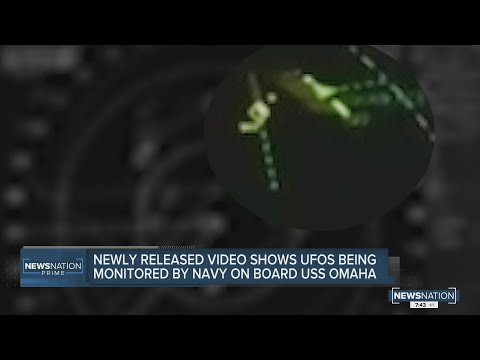
NewsNation: Radar Data Confirms USS Omaha UFO Swarm
NewsNation's segment breaking down the released radar-plot visualization showing as many as fourteen simultaneous unknown tracks around the Omaha on the night of the encounter.
Sources
- Office of the Director of National Intelligence. Preliminary Assessment: Unidentified Aerial Phenomena, June 25, 2021. dni.gov
- All-domain Anomaly Resolution Office (AARO). Historical Record Report, Volume I, March 8, 2024. media.defense.gov
- The Debrief. "Pentagon Confirms Leaked Video Showing 'Transmedium' UFO is Authentic," May 2021 (quoting DoD spokesperson Susan Gough). thedebrief.org
- Greenewald Jr., John. The Black Vault. "USS Omaha Deck Logs, Voice Recordings, Missing During Alleged UAP Encounter Timeframe," 2021 (FOIA release). theblackvault.com
- Rogoway, Tyler & Trevithick, Joseph. The War Zone (TWZ). "Navy Releases Timeline For Mysterious 2019 'UAS Swarm' Involving Warships Off California." twz.com
- Rogoway, Tyler. The War Zone. "Multiple Destroyers Were Swarmed By Mysterious 'Drones' Off California Over Numerous Nights." twz.com
- Metabunk forum (moderated by Mick West). "CLAIM: USS Omaha videos were taken on the ship's 'Combat Information Center' by 'VIPER team,'" investigative discussion thread. metabunk.org
- Hambling, David. Forbes. "Mystery Drones Kept Buzzing U.S. Destroyers During Exercises Off California," March 24, 2021. forbes.com
- gCaptain. "Watch: U.S. Navy Tracks Spherical-Shaped UFO Off California." gcaptain.com
- Mystery Wire (KLAS-TV, George Knapp). "New video from USS Omaha shows unknown aerial sphere vanishing into ocean," 2021. kfor.com (Mystery Wire syndication)
- Mystery Wire (KLAS-TV, George Knapp). "RADAR data confirms: USS Omaha was surrounded by UFO swarm," 2021. mysterywire.com
- Ganjoo, Ridhi. Interesting Engineering. "US Navy sailor claims seeing mysterious flying ships coming out of sea" (Alexandro Wiggins interview). interestingengineering.com
- NewsNation. "UAP sighting off California coast similar to Tic Tac incident recounted by Navy sailor." newsnationnow.com
- NBC News. "Leaked Navy video appears to show UFO off California," 2021. nbcnews.com
- Global News (Canada). "Leaked video appears to show UFO plunging under water off California," 2021. globalnews.ca
- Fox News. "Leaked footage of UFO 'harassing' US warship is 'authentic': Jeremy Corbell." foxnews.com
- Fox News. "Pentagon report on UFOs coming after leaked video." foxnews.com
- Coffee or Die Magazine. "UFOs 'Swarmed' Navy Destroyers Off California, Records Show." coffeeordie.com
- IFLScience. "US Navy Footage Shows Spherical UFO Flying Around Before Diving Into Sea." iflscience.com
- Live Science. "Spherical UFO plunges into the ocean in US Navy footage." livescience.com
- TMZ. "New Footage Shows UFOs Circling U.S. Navy Ship," May 28, 2021. tmz.com
- Center for International Maritime Security (CIMSEC). "Fiction Week" archive, December 2019 (context for the "VIPER"/San Diego naming coincidence flagged by researchers). cimsec.org
- U.S. Navy / Naval History and Heritage Command. USS Omaha (LCS-12) commissioning and deployment records, via Wikimedia Commons image archive. commons.wikimedia.org
- Kean, Leslie & Blumenthal, Ralph. Reporting archive on Navy UAP Task Force cases, The New York Times, 2017–2021 (background on the reporting-culture shift preceding the Omaha leak).
See something inaccurate? Have additional information or sources?
Suggest an Edit →Last Updated: August 2026