
Aerolíneas Argentinas Flight AR674 / Bariloche Incident
At approximately 8:17 p.m. on Monday, July 31, 1995, Capt. Jorge Polanco and the crew of Aerolíneas Argentinas Flight 674 — a Boeing 727 inbound from Buenos Aires with, by various accounts, roughly 100 to 150 passengers — were on final approach to San Carlos de Bariloche's Teniente Luis Candelaria Airport when the airport and much of the city below lost electrical power, and an intensely bright, maneuvering light took up station beside the aircraft for the next seventeen minutes, ultimately forcing Polanco to abort the landing. Known across Argentina as the “Caso Polanco” or “Caso Bariloche,” this file confirms the “Coming Soon” queue placeholder's central claims — a UAP shadowing an airliner for seventeen minutes while the airport and city below lost power, forcing an aborted approach — against a body of documentation genuinely unusual for a Latin American aviation case: a control-tower radio transcript declassified by Argentina's own Ministry of Defense in 2020, corroborating testimony from an independent Gendarmería Nacional aircrew flying nearby, named ground witnesses on the opposite side of the city, and citations in both France's 1999 COMETA report and the United States Department of War's May 2026 declassified UAP file release.
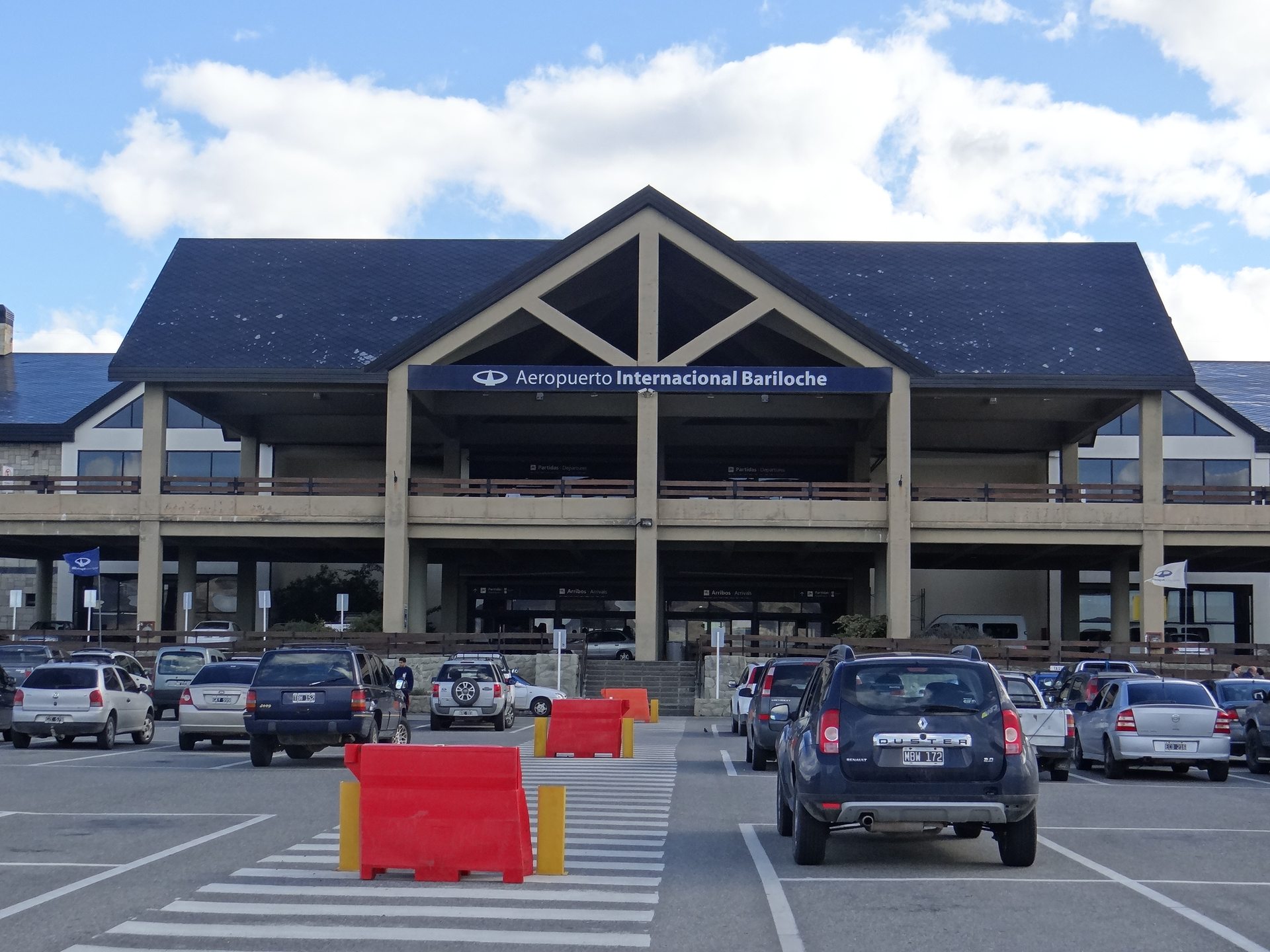
Pictured: Aeropuerto Internacional Teniente Luis Candelaria in San Carlos de Bariloche — the actual airport whose runway lights and control-tower instruments failed during the encounter, photographed in 2014. This is not a photograph of the incident itself, of Flight 674, or of the reported object; no contemporaneous photograph or film of the object is known to exist in any archive consulted for this case file, and this is the closest rights-clear, honestly-captioned image of the actual site this research was able to locate.
Theoretical Alignment
This case earns a meaningfully higher Extraterrestrial Hypothesis alignment than most files in this catalogue, not on the strength of any single witness's account but because of the sheer diversity of independent, differently-positioned observers: an airline cockpit crew, a wholly separate Gendarmería Nacional aircrew flying nearby, a control tower whose own instruments malfunctioned in tandem with the sighting, and named residents on the far side of the city, all reporting overlapping elements of the same seventeen-minute event on the same night. Interdimensional Hypothesis alignment remains minimal, as nothing reported here departs from ordinary three-dimensional flight behavior, however anomalous that behavior's specific characteristics (abrupt stops, vertical acceleration, no apparent inertia) might be. The Psycho-Social/Mundane reading nonetheless carries the most weight in this file's own assessment, both because Argentina's own Air Force investigative body concluded — after a formal, scale-model reconstruction — that a terrestrial light source explains the sighting, and because a second, independent skeptical investigation reached a different but equally terrestrial conclusion; that the two official and unofficial mundane explanations do not agree with each other, and that Polanco himself has publicly rejected both, is treated here as a sign of a case still genuinely unresolved rather than as license to lean further toward the anomalous reading.
Background
San Carlos de Bariloche sits on the southern shore of Lago Nahuel Huapi in the Argentine Patagonian Andes, in Río Negro Province, roughly 1,600 kilometers southwest of Buenos Aires. Founded in 1902 and built up through the twentieth century as Argentina's premier Andean ski and lake-tourism destination, the city depended by 1995 on daily Aerolíneas Argentinas jet service connecting it to the capital, landing at the Argentine Air Force-administered Teniente Luis Candelaria Airport, a facility whose control tower and ground infrastructure at the time were staffed jointly by Air Force personnel and Aerolíneas Argentinas' own ground operations. The airport lies at the base of Cerro Otto and within sight of the Cerro Catedral ski resort, both of which feature prominently in this case's later conventional-explanation debate.
Aerolíneas Argentinas, the national flag carrier, operated Boeing 727 trijets on the Buenos Aires–Bariloche route through the 1990s. In command of Flight 674 on the night of July 31, 1995, was Capt. Jorge Polanco, an eighteen-year veteran of the airline. Argentine press accounts describe the flight's remaining crew as first officer Carlos Atilio Dortona, flight engineer Jorge Allende, and air hostess Ana María Cancela, with a fifth, off-duty Aerolíneas Argentinas captain, Roberto Benavente, reportedly riding in the cockpit jump seat that evening; this case file discloses that it was unable to independently cross-check every one of these names against a single primary crew roster, an honest gap consistent with how this catalogue treats similarly reconstructed 1990s civil-aviation crew lists. Passenger counts likewise vary across the many secondary accounts consulted for this file — some report as few as roughly 100, others as many as 150 — and this file presents that range honestly rather than silently adopting whichever figure reads most dramatically; most Argentine retrospective coverage in the case's thirtieth-anniversary year (2025) settled on a figure near 140 to 150.
By 1995, Argentine ufology already had a substantial public history: sightings reports had circulated in the national press since at least 1947, and the Argentine Air Force had, on and off since the 1970s, maintained some internal apparatus for logging and evaluating reported aerial phenomena, though nothing as formalized as the United States' Project Blue Book had existed on a continuous basis. That would change directly because of this case: the Bariloche sighting is widely credited in Argentina with catalyzing the eventual creation, in 2011, of the Fuerza Aérea Argentina's Comisión de Estudio de Fenómenos Aeroespaciales (CEFAE) — restructured in 2019 into the Centro de Identificación Aeroespacial (CIAE) — the country's first standing, publicly acknowledged body specifically tasked with investigating and publishing findings on reported aerospace phenomena, discussed at length below. The case's persistence in Argentine public memory across three decades, its 2020 declassification as the first UFO-related case file the Argentine government had ever released, and its 2026 reappearance in newly declassified U.S. Department of War files together make it, by a wide margin, the most extensively documented civil-aviation UAP case in Latin American history.
Complete Timeline
| Date | Event |
|---|---|
| 1902 | San Carlos de Bariloche is founded on the shore of Lago Nahuel Huapi; the city later develops into Argentina's leading Andean ski and lake-tourism destination. |
| July 31, 1995, ~20:05 local | Aerolíneas Argentinas Flight 674, a Boeing 727 commanded by Capt. Jorge Polanco, begins its descent toward Teniente Luis Candelaria Airport; the control tower reports a sudden power failure affecting the airport and much of Bariloche. |
| ~20:12–20:15 local | Roughly twelve miles out, Polanco sights an intense white/amber light ahead of the aircraft; the tower confirms no other traffic in the area except a Gendarmería Nacional medical-evacuation aircraft already operating nearby. |
| 20:17 local | Per the later-declassified control-tower transcript, Polanco radios: “Tenemos un objeto a la derecha formándonos… Tiene dos luces intermitentes brillantes… creemos que es un plato volador” (“We have an object forming on our right… It has two bright intermittent lights… we think it's a flying saucer”). |
| ~20:20 local | As Flight 674 descends toward roughly 200–300 feet on final approach, the runway lights fail a second time and the airport's backup generator revs, smokes, and stops; radio contact between the aircraft and tower drops for approximately four minutes. |
| ~20:22 local | Polanco executes a go-around (“escape maneuver”), climbing the 727 back toward roughly 10,000 feet over Lago Nahuel Huapi rather than continuing the approach in the dark. |
| ~20:22–20:31 local | The object reportedly moves behind the aircraft, stops abruptly with no apparent loss of inertia, ascends vertically at high speed, hovers near 3,000 meters, then repositions in front of the aircraft; independently, the crew of the nearby Gendarmería Nacional Cheyenne, Cdrs. Rubén Cipuzak and Juan Domingo Gaitán, report an amber light over the lake moving toward the mountains and stopping abruptly. |
| 20:31 local | The tower reports the airport's power restored; per the transcript, the tower radios “Acabamos de ver la luz otra vez” (“We've just seen the light again”); the object departs toward the Andes/Cerro Otto and Polanco completes a second, uneventful approach and landing. |
| August 2, 1995 | Clarín, one of Argentina's leading national newspapers, publishes the first detailed press account of the sighting, drawing national attention. |
| August 9, 1995 | The Argentine government opens an internal case file (Expediente No. 5374181) on the incident — the record that would remain the country's only formally logged UFO case file for the next 25 years. |
| 1999 | France's COMETA (Comité d'Études Approfondies) study group publishes its independent report on UFOs and national defense, citing the Bariloche case among the international sightings it considers evidentially significant. |
| 2011 | The Fuerza Aérea Argentina formally establishes the Comisión de Estudio de Fenómenos Aeroespaciales (CEFAE), Argentina's first standing body for investigating reported aerospace phenomena. |
| 2015 | On the sighting's 20th anniversary, the independent CAIRP Foundation (psychologist Heriberto Janosch and engineer Virgilio Di Pelino) publishes a skeptical reconstruction attributing the lights to reflectors on snow-grooming machinery operating on the slopes of Cerro Catedral. |
| 2018 | The Argentine Air Force's own investigation formally concludes the sighting was caused by a discotheque spotlight, operated by a named individual, Juan Carlos Rivero, aimed at the base of low clouds. |
| April 4, 2019 | CEFAE is restructured and elevated into the Centro de Identificación Aeroespacial (CIAE), which later reconstructs the 2018 spotlight explanation using scale models. |
| September 18, 2020 | Argentina's Ministry of Defense declassifies the Bariloche case file for the first time in the country's history, following a Freedom-of-Information request by the civilian research group CEFORA (Comisión de Estudios del Fenómeno OVNI en la República Argentina); the release includes the control-tower transcript and 1995 witness statements. |
| 2022 | Three separate Aerolíneas Argentinas crews report similar luminous objects near Choele Choel, Río Negro, reviving discussion of a possible recurring pattern over Patagonian airspace, though these later reports are not part of the 1995 case itself. |
| 2023 | A CIAE internal review team ("Fénix 4") reportedly re-designates the case's status as “under review” rather than fully closed, despite the Air Force's 2018 spotlight finding. |
| May 8, 2026 | The U.S. Department of War launches war.gov/UFO, publishing 162 declassified files on unidentified anomalous phenomena assembled by AARO; the release's section on international investigations cites the Bariloche case via its treatment in the 1999 COMETA report, returning the case to headlines in Argentina. |
| 2026 | This case file is published, confirming the “Coming Soon” queue placeholder's core claims — a seventeen-minute encounter coinciding with an airport/city power failure — while disclosing the genuine variance across sources on passenger count and crew names, and presenting the two competing, non-convergent conventional explanations honestly rather than adopting either as settled. |
The Approach and the First Power Failure
Flight 674 departed Buenos Aires' Aeroparque Jorge Newbery on the evening of July 31, 1995, bound for San Carlos de Bariloche on a routine, frequently flown domestic route. As the Boeing 727 began its descent toward Teniente Luis Candelaria Airport, the control tower reported that the electrical supply serving the airport, and a substantial part of the city of Bariloche itself, had failed — later accounts attribute the outage to a substation circuit protector tripping at approximately 20:17 local time, restored only at 20:31, a fourteen-minute window that maps almost exactly onto the object's own reported presence. Tower personnel would later describe their own instruments behaving erratically during this period — deviating and fluctuating without apparent cause — even as the aircraft's own onboard instrumentation continued to function normally, a detail this file's Sensor & Instrumentation Detection Profile section below treats as a genuinely disclosed, if inconclusive, anomaly rather than either a confirmed technical malfunction or confirmed evidence of an external field effect.
It was against this backdrop — a city already dark, an airport running on emergency power, and a control tower whose own instruments were behaving strangely — that Polanco first noticed an intense light ahead of the aircraft, roughly twelve miles out from the field by his own later account. He radioed the tower; controllers confirmed no scheduled traffic was operating in the sector apart from a Gendarmería Nacional aircraft already known to be in the area on an unrelated medical-evacuation flight, a Piper PA-31T Cheyenne carrying the call sign GN705.
Seventeen Minutes: The Sighting and the Radio Transcript
What happened over the next roughly seventeen minutes is preserved, unusually for a case this old, in the airline's and Air Force's own contemporaneous documentation — specifically the control-tower radio transcript that Argentina's Ministry of Defense would declassify a quarter-century later, in September 2020. At 20:17, per that transcript, Polanco radioed the tower: “Tenemos un objeto a la derecha formándonos y arriba estamos viendo a la otra aeronave… El objeto tiene luces intermitentes brillantes. Este… es… no sé… creemos que es un plato volador” — “We have an object forming on our right, and above we're seeing the other aircraft… The object has bright intermittent lights. This… is… I don't know… we think it's a flying saucer.” The tower, itself tracking a light of its own, would later respond, “Acabamos de ver la luz otra vez” — “We've just seen the light again.”
Polanco's fullest public description of the object, given in numerous interviews over the following three decades, describes something considerably more structured than a distant point of light: “un plato sopero invertido” — an inverted soup plate — roughly 30 meters in diameter, ringed with rotating green lights and topped with a single orange light that “parecía que respiraba” (“seemed to breathe,” i.e., pulsed rhythmically in brightness). Other contemporaneous and later accounts describe the object somewhat differently — as three lights with a red light at the center, or as a single amber-white light “like a huge star” — and this file discloses that variance rather than silently harmonizing the sources into a single tidy description; what is consistent across nearly every account, including the tower's own, is an object exhibiting deliberate, controlled-seeming movement in close proximity to the aircraft for a sustained period, not a fleeting glimpse.
The Escape Maneuver
As Polanco brought Flight 674 down toward roughly 200 to 300 feet on final approach, the runway lighting failed a second time, and, per Polanco's own repeated account, the airport's backup generator “se aceleró al máximo, largó humo y se paró” — revved to maximum, released smoke, and died. Radio contact between the aircraft and the tower reportedly dropped for approximately four minutes during this second, more critical phase of the failure. With the runway now completely dark and no working backup power, Polanco made the decision to abandon the approach: a standard aviation go-around, but one executed, by his own account, under genuinely degraded conditions rather than as routine caution. He climbed the 727 back to roughly 10,000 feet, tracking out over Lago Nahuel Huapi to regroup before attempting a second approach.
It was during this climb-out, per Polanco and per the independently radioed observations of the nearby Gendarmería crew, that the object's behavior became most dramatic: it reportedly moved from its earlier position to a point behind the aircraft, came to a complete stop with no apparent loss of inertia or momentum, then accelerated vertically at high speed before appearing to hover near 3,000 meters — in Polanco's words, as if it “esperaba a que llegáramos” (“waited for us to arrive”) — before ultimately repositioning itself ahead of the aircraft and, at 20:31, departing at speed toward the Andes and Cerro Otto as the airport's power was restored. Polanco completed a second, uneventful approach shortly afterward, landing Flight 674 without further incident and with no injuries reported among the crew or the passengers.
Independent Corroboration From the Air: The Gendarmería Nacional Crew
The single feature that most distinguishes this case from the great majority of single-aircraft airline UFO sightings in this catalogue is the presence of a second, wholly independent aircrew in the same general airspace, flying a different aircraft type, on a different mission, for a different operator — and reporting a broadly matching phenomenon without, on the available record, any opportunity to coordinate their account with Polanco's beforehand. That aircraft was a Gendarmería Nacional (Argentina's federal border-police force) Piper PA-31T Cheyenne, call sign GN705, engaged in an unrelated medical-evacuation flight and positioned, by one account, roughly 600 meters above and to the side of Flight 674's own track.
Commander Rubén Cipuzak, one of the Cheyenne's crew (his surname appears variously as Cipuzak, Zipuzak, and Cipazuk across different secondary accounts, a spelling inconsistency this file discloses rather than silently resolves), described watching, from over Lago Nahuel Huapi, “una luz color ámbar que aumentaba y disminuía en intensidad, desplazándose a gran velocidad hacia la cordillera” — an amber-colored light that increased and decreased in intensity, moving at high speed toward the mountain range. Elsewhere, Cipuzak is quoted describing the object's motion over the lake in terms strikingly similar to Polanco's own account of the later hover: it “se detenía de forma abrupta en el aire, sin señales de inercia ni pérdida de control” — stopped abruptly in mid-air, with no sign of inertia or loss of control. His fellow crew member, Commander Juan Domingo Gaitán, is credited in several accounts as an additional, corroborating witness aboard the same aircraft.
This file's own assessment treats the Cipuzak/Gaitán account as the single strongest piece of corroborating evidence in the entire case, for a specific reason distinct from simple witness-counting: it is testimony from a differently positioned, differently trained, professionally credentialed second flight crew, describing behavior (an abrupt, inertia-free stop) that independently echoes Polanco's own description of the object's later hover near the aircraft — without either crew having had, so far as the declassified record shows, any contemporaneous opportunity to align their stories before both were separately debriefed. That independence is precisely what a single-aircraft sighting like several other cases in this catalogue cannot offer.
Ground Witnesses on the Far Side of the City
Beyond the two aircrews, several named residents of Bariloche reported observing lights or unusual aerial activity that same night from positions on the ground, including, per multiple Argentine retrospective accounts, meteorologist Nicolás Aray, brothers Abel and Pedro Drelevich, and residents Berta and Silverio Cabral. Several of these ground accounts place their observation on a bearing from a different part of the city than the airport's own position — a detail that later becomes directly relevant to evaluating both of the leading conventional explanations, discussed in full in the Conventional Explanation Candidate section below, since a fixed terrestrial light source (whether a spotlight or a ski-slope reflector) located near the airport or the mountain would not naturally account for an object independently observed from a markedly different vantage point across the city. The airport's own control-tower chief, Suboficial (Warrant Officer) Daniel García, and the airport's director at the time, reported variously in different sources as Comodoro or Major Jorge Oviedo, are both credited across multiple accounts as corroborating the basic sequence of events from the ground: the power failures, the tower's own instrument anomalies, and the sustained duration of the sighting.
Declassification, the COMETA Report, and the 2026 Pentagon Files
For a quarter-century after the sighting, the Bariloche case existed publicly only through press coverage, Polanco's own repeated interviews, and informal treatment by Argentine ufology researchers. That changed on September 18, 2020, when Argentina's Ministry of Defense declassified the case's original administrative file — Expediente No. 5374181, opened August 9, 1995 — making it, per multiple Argentine news outlets, the first UFO-related government document the Argentine state had ever formally released. The declassification followed a Freedom-of-Information request filed by CEFORA (Comisión de Estudios del Fenómeno OVNI en la República Argentina), an independent civilian research group, under Argentina's 2016 Access to Public Information Law (Ley 27.275); the released materials included the control-tower radio transcript quoted above, witness statements taken at Bariloche airport on the day of the incident, and internal correspondence responding to later inquiries from civilian researchers.
Separately, and considerably earlier, the case had already drawn international attention through its inclusion in COMETA's 1999 report, “Les OVNI et la défense: à quoi doit-on se préparer?” (“UFOs and Defense: What Should We Prepare For?”), an independent study authored by a group of retired French general officers, engineers, and scientists convened under the auspices of the Institut des Hautes Études de Défense Nationale. According to Argentine press summaries of the report's own treatment of the case, COMETA's authors considered Bariloche evidentially significant specifically because of its combined witness count, the sighting's unusually long duration, the object's reported flight trajectories, and the associated electromagnetic/power-failure effects — the same combination of features this file's own assessment identifies as the case's strongest evidentiary elements.
The case resurfaced most recently on May 8, 2026, when the United States Department of War (the renamed successor to the Department of Defense) launched a dedicated public portal, war.gov/UFO, publishing an initial batch of 162 declassified files on unidentified anomalous phenomena assembled by the All-domain Anomaly Resolution Office (AARO) in coordination with the Office of the Director of National Intelligence, NASA, and the FBI. Within the release's section addressing investigations and reports originating outside the United States, the Bariloche case appears via its citation in the COMETA report — not as a case AARO itself investigated, but as a foreign case AARO's compilers considered notable enough to include in cataloguing how other nations and independent bodies have handled significant UAP reports. Argentine coverage of the 2026 release quoted a researcher describing the Bariloche case as “uno de los casos más importantes del mundo” on the strength of this renewed international citation, a characterization this file treats as a genuine measure of the case's documentary reach rather than as independent confirmation of any particular explanation for what was seen.
Key Witnesses
Capt. Jorge Polanco
Polanco was the pilot-in-command and remains, three decades later, the case's central and most consistent public voice, giving detailed interviews on the case's 25th, 30th, and 31st anniversaries. His account of the object as a solid, structured disc with rotating lights, his radioed in-progress report to the control tower, and his public, specific rejection of both the discotheque-spotlight and ski-slope-reflector explanations as inadequate to what he personally observed are all treated in this file's own assessment as significant, load-bearing elements of the case, even though his account alone cannot resolve it.
Cdr. Rubén Cipuzak
Flying a wholly separate aircraft on an unrelated medical-evacuation mission, Cipuzak independently reported an amber light over Lago Nahuel Huapi that moved at high speed toward the mountains and came to an abrupt stop with no apparent loss of inertia — an account this file's own assessment treats as the case's strongest single piece of corroboration precisely because it originates from a differently positioned, professionally trained second crew rather than from Flight 674 itself.
Suboficial Daniel García
As the airport's tower chief on duty that night, García is credited across multiple Argentine accounts with corroborating the sequence of power failures, the tower's own instrument anomalies, and the sustained duration of the sighting from the ground — an institutional, on-duty vantage point distinct from either aircrew's or the more casual ground witnesses'.
The Five Observables Assessment
The Five Observables framework, drawn from the Pentagon's Advanced Aerospace Threat Identification Program, is applied here to the performance characteristics reported by Flight 674's crew and independently echoed by the Gendarmería aircrew:
Assessment: This case's most distinctive Five Observables signature is the independent, cross-corroborated report of Anti-Gravity Lift and Instant Acceleration: both Polanco (describing the object “waiting” near 3,000 meters) and, separately, Cdr. Cipuzak (describing an abrupt stop “sin señales de inercia ni pérdida de control”) independently characterize the object's motion in terms that specifically evoke hovering flight and instantaneous, inertia-free acceleration — a genuinely rare instance in this catalogue of two differently positioned witnesses converging on the same unusual performance characteristic without an obvious opportunity to have compared notes first. Both are nonetheless rated on witness testimony alone, with no instrumented confirmation of any kind. Hypersonic performance is rated Speculative rather than Present: a roughly 2,000 km/h visual speed estimate appears in some accounts, but eyewitness velocity estimation is notoriously unreliable, and independent skeptical researchers have specifically noted the absence of any reported sonic boom despite a claimed speed in excess of Mach 1.6 — a real, disclosed objection to taking the raw speed estimate at face value. Low Observability is rated N/A rather than Present or Absent because, unlike several other cases in this catalogue (the BOAC Stratocruiser sighting among them), no radar system of any kind was brought to bear on this sighting at the time — there is neither a positive nor a negative radar result to evaluate. Trans-Medium performance is rated Absent, as no water or ground transition was reported or applicable to a purely aerial sighting.
Evidence Assessment
Supporting Anomalous Origin
- Four independently positioned categories of witness — Flight 674's own cockpit crew, a wholly separate Gendarmería Nacional aircrew on an unrelated mission, on-duty control-tower personnel, and named ground residents on the opposite side of the city — all reported overlapping elements of the same event on the same night
- A genuine, declassified contemporaneous document (the 1995 control-tower radio transcript, released in 2020) preserves Polanco's in-progress report rather than relying solely on decades-later recollection
- Two independently positioned aircrews (Polanco's and Cipuzak's) both specifically describe an abrupt stop with no apparent loss of inertia — a distinctive performance detail neither crew appears to have had an opportunity to coordinate on beforehand
- The sighting coincided precisely with a documented, independently timed airport-and-city power failure and control-tower instrument anomalies, an unusual environmental correlation this catalogue has documented in only a small number of other cases
- The case has been judged significant enough for inclusion in two entirely independent international UFO assessments — France's 1999 COMETA report and the United States' 2026 declassified AARO file release — twenty-seven years apart
Supporting Conventional Explanation
- Argentina's own Air Force investigative body concluded, after a formal scale-model reconstruction, that the lights were caused by a discotheque spotlight aimed at low cloud, coinciding with the blackout
- A separate, independent skeptical investigation (the CAIRP Foundation, 2015) proposed a different terrestrial mechanism — reflectors on Cerro Catedral's snow-grooming machinery — noting that most witnesses besides Polanco described only lights, not a solid object, and that no sonic boom was reported despite claimed extreme speeds
- No radar system searched for or detected the object at the time, leaving the case with no instrumented positive or negative evidence of any kind
- No photograph, film, or physical trace of the object exists in any archive consulted for this case file
- Passenger counts and several crew members' names vary meaningfully across the secondary sources consulted for this file, indicating a case whose public record, however extensive, has not been fully harmonized even after three decades and a formal declassification
Why "Disputed"
This case earns a DISPUTED classification with a credibility score of 64/100. That places it modestly above this catalogue's other South American aviation cases — the Ceará Boeing 727 Sighting (Disputed, 41), where CINDACTA's own radar contact was later retracted as an equipment defect, and Araçariguama (Disputed, 34) — and above the single-aircraft BOAC Stratocruiser Centaurus Sighting (Disputed, 61), while remaining well below cases combining credentialed military witnesses with genuine positive instrumented corroboration, such as Coyne Helicopter (Credible, 81).
What lifts this case above BOAC and the other South American aviation files in this catalogue is the specific, rare combination of an independent second aircrew corroborating a distinctive performance detail (the inertia-free stop), a genuine contemporaneous radio transcript rather than a reconstructed one, and a well-documented, precisely timed environmental correlation (the power failure) that neither leading conventional explanation fully accounts for on its own. What holds it well short of “Credible” is the total absence of any instrumented evidence — no radar was ever brought to bear, unlike BOAC's negative three-system search or Coyne's positive altimeter anomaly — combined with two separate, non-convergent conventional explanations (a discotheque spotlight per the Air Force's own official finding, and ski-slope machinery reflectors per an independent skeptical study) that disagree with each other about the actual physical cause, each carrying real, disclosed objections its own proponents have not resolved, and a case status the Air Force's own review body reportedly re-designated as “under review” as recently as 2023 rather than treating as closed. A case this genuinely well-corroborated across independent vantage points, yet this evidentially thin on the one form of proof (radar, photograph, physical trace) that could most directly discriminate between explanations, and whose own official investigators have not converged on a single accepted cause, is precisely the profile this catalogue's scoring reserves for the middle of the Disputed range.
Sensor & Instrumentation Detection Profile
No radar system, military or civilian, is documented anywhere in the source record as having searched for or detected the object during this sighting — a significant limitation distinguishing this case from others in this catalogue such as the BOAC Stratocruiser sighting, where an intercepting fighter and two ground radar stations all actively searched and returned a negative result. The one instrumentation anomaly genuinely documented in this case is indirect: San Carlos de Bariloche's control tower reported its own instruments behaving erratically — deviating and fluctuating without apparent technical cause — during the same window the power failures and the sighting occurred, while Flight 674's own onboard cockpit instrumentation is separately reported to have continued functioning normally throughout. This file's own assessment treats that combination honestly as a genuine, disclosed anomaly rather than either a confirmed electromagnetic-interference effect from an external source or a simple consequence of the same electrical fault that caused the blackout; no engineering investigation of the tower's specific instrument malfunction, distinct from the general power failure, appears in any source consulted for this case file. No photograph, video, or audio recording of the object itself is known to exist; the only surviving primary document is the control-tower's own textual radio transcript.
Environmental & Geospatial Context
The sighting occurred on a cold, overcast winter evening in the Argentine Patagonian Andes — per the declassified Air Force meteorological log for that night, conditions at Bariloche were overcast, approximately 0°C (32°F), with westerly winds near 30 km/h. The approach corridor to Teniente Luis Candelaria Airport runs directly over Lago Nahuel Huapi, a large glacial lake, with Cerro Otto rising immediately to the airport's north and the Cerro Catedral ski resort situated several kilometers further along the same mountain range — a detail directly relevant to this case's competing conventional explanations, both of which locate their proposed light source somewhere within this same compact geography. This file's own research was unable to locate a specific, independently sourced engineering report on the cause of the electrical substation fault that produced the citywide blackout, beyond the general description (a circuit protector trip) repeated across secondary press accounts; that gap is disclosed here rather than papered over. Geospatially, Bariloche in 1995 sat well outside any major military installation, nuclear facility, or dense radar-coverage zone, a contrast with several of this catalogue's Northern Hemisphere Cold War-era cases where nearby defense infrastructure sometimes provides an independent evidentiary channel this case simply does not have available.
Observer Credibility & Occupational Profile
Capt. Jorge Polanco's eighteen years of experience with Aerolíneas Argentinas at the time of the sighting places him within the same broad category of credentialed, professionally trained commercial-aviation witnesses this catalogue treats as carrying real evidentiary weight, comparable to Capt. James Howard in the BOAC Stratocruiser sighting or Capt. Gerson Maciel de Britto in the Ceará Boeing 727 Sighting. What distinguishes this case from either of those, however, is the additional, differently-trained professional witness the case offers in Cdr. Rubén Cipuzak: a Gendarmería Nacional aircraft commander flying an entirely separate aircraft on an unrelated government mission, whose account independently echoes a specific, distinctive detail (the inertia-free stop) of Polanco's own report. Two professionally trained pilots from two different organizations, flying two different aircraft on two different missions, converging independently on the same unusual performance characteristic is a genuinely stronger credibility configuration than this catalogue's more typical single-cockpit sightings, even before considering the further corroboration from on-duty tower personnel and named ground residents.
Set against this strength is a limitation this file discloses rather than minimizes: the passage of three decades between the event and most of the detailed public interviews this file draws on means that much of Polanco's most vivid, specific description (the exact shape, the “breathing” light, the precise sequence of the hover) comes from repeated retrospective retellings rather than a single, fully contemporaneous statement, and this file's own research found meaningful variance across sources even on such basic facts as the flight's passenger count and some crew members' names. The one fully contemporaneous document available — the declassified control-tower transcript — is considerably more limited in descriptive detail than the fuller retrospective accounts, describing “an object… with two bright intermittent lights” rather than the elaborate rotating-green-lights, breathing-orange-light description that appears in Polanco's later interviews. This file's own assessment treats the contemporaneous transcript as the more evidentially reliable anchor and the fuller retrospective accounts as valuable but potentially elaborated over three decades of retelling, a distinction worth keeping in mind when weighing the object's precise described morphology against its independently corroborated behavior.
Physical & Material Assays
No physical trace evidence of any kind exists for this case. The object was never reported landing, and no debris, residue, or material sample connected to it is claimed to exist in any source consulted for this case file. See Material Analysis below for a full discussion of the case's surviving documentary record in place of physical evidence.
Historical Precedents & Archive Matches
Within this catalogue's own collection of South American commercial-aviation UFO cases, the Bariloche incident sits alongside the Ceará Boeing 727 Sighting (February 1982, a VASP Boeing 727 paced for roughly ninety minutes over five Brazilian states) and, at a considerable remove in both era and character, the fatal Araçariguama Sighting (March 1946, São Paulo state). The Bariloche case stands apart from the Ceará sighting specifically on the question of independent aircraft corroboration: where VASP Flight 169's own CINDACTA radar contact was later retracted by CINDACTA itself as an equipment defect, leaving that case's strongest instrumented evidence undermined by the very agency that first reported it, Bariloche has no radar evidence at all to retract, but does have a second, wholly independent aircrew (Cipuzak and Gaitán's Gendarmería Cheyenne) that neither Ceará nor Araçariguama offers.
This case's pattern of a maneuvering light coinciding with electrical disruption also invites comparison with this catalogue's broader cluster of cases reporting apparent electromagnetic effects, a pattern researcher Jacques Vallée has documented extensively across Latin American UFO reports specifically. Unlike several of those cases, however, Bariloche's power failure has never been seriously disputed as a real, independently timed event by any investigator on any side of the case's conventional-versus-anomalous debate; what remains contested is only whether the failure and the sighting share a common cause, are coincidental, or whether the failure itself (via the emergency generator's own malfunction and the tower's disrupted instruments) contributed to misperceptions that then compounded into the fuller sighting account. Within Argentina's own investigative record, the case's near-immediate role in catalyzing the 2011 creation of CEFAE (later CIAE) gives it a institutional legacy this catalogue has documented in only a small number of other cases worldwide, comparable to how the 1952 Washington D.C. National Airport sightings in the United States helped shape the reorganization of Project Blue Book under Capt. Edward Ruppelt.
Material Analysis
There is no physical object, debris, or trace sample connected to this case; “material” here refers instead to the case's actual surviving evidentiary substrate — the 1995 control-tower radio transcript, the 1995 witness statements taken at Bariloche airport, the Air Force's own 2018 investigative finding, the CAIRP Foundation's 2015 independent skeptical analysis, and the case's two international citations (COMETA 1999, the U.S. 2026 declassified AARO files) — since that documentary record is the only tangible evidence this case file's research was able to assess.
The Surviving Documentary Record
This case is unusually well-documented for a Latin American sighting of its era, across several independent lines: Argentina's Ministry of Defense declassified the case's own administrative file (Expediente No. 5374181) in September 2020, including the control-tower transcript and 1995 witness statements, following CEFORA's Freedom-of-Information request; the Argentine Air Force's own CEFAE/CIAE produced a formal, scale-model-based investigative reconstruction, publicly concluded by 2018; the CAIRP Foundation published an independent, differently-conclusioned skeptical analysis in 2015; and the case appears, cited rather than newly investigated, in two entirely independent international compilations (COMETA's 1999 report and the U.S. Department of War's 2026 declassified UAP file release) separated by twenty-seven years. Having a genuine contemporaneous radio transcript, a formal government investigative conclusion, an independent skeptical rebuttal, and two separate international citations all converge on the same basic sequence of events, even while disagreeing sharply about the cause, is a meaningfully stronger documentary foundation than most cases of this vintage and origin can claim.
What Does Not Survive
No photograph, film, radar record, or physical trace of the object is known to exist in any archive consulted for this case file. This case file's own research was unable to directly examine the full text of the declassified Expediente No. 5374181 itself (relying instead on Argentine press outlets' own quotations and summaries of its contents, principally Infobae's 2020 reporting on the transcript), nor could it resolve the discrepancy between press accounts describing the nightclub implicated in the Air Force's spotlight explanation as “Rocket” versus other accounts naming “Cerebro,” a discrepancy disclosed here rather than silently resolved in either direction. Passenger counts (variously 100, 102, 140, or 150 across different sources) and some crew members' exact names and ranks likewise could not be fully harmonized against a single authoritative primary roster.
Supporting Non-Terrestrial or Unexplained Origin
- A genuine contemporaneous document (the 1995 control-tower transcript) independently corroborates the basic timeline and Polanco's in-progress report
- Two independently positioned, professionally trained aircrews converge on the same distinctive performance detail (an inertia-free stop) without an apparent opportunity to have coordinated beforehand
- The Argentine government's own investigative body has, per 2023 reporting, left the case's status as “under review” rather than formally closed despite its 2018 spotlight finding
Supporting Terrestrial or Mundane Origin
- This case file's research could not directly examine the full primary declassified file, relying on press summaries and quotations of its contents
- No photograph, film, or physical trace exists to permit independent modern re-analysis of the object itself
- Two separate terrestrial explanations — the Air Force's official spotlight finding and the CAIRP Foundation's independent ski-slope-reflector analysis — each identify a real, physically present candidate light source within the immediate geography of the sighting
The Conventional Explanation Candidate (CEC): Discotheque Spotlight, Ski-Slope Reflectors, or Genuine Unknown
Unusually for a case in this catalogue, two entirely separate investigative efforts — one official, one independent — each proposed a different specific terrestrial mechanism for this sighting, and neither has persuaded Polanco or fully displaced the other. Each candidate is evaluated on its own merits below.
Discotheque Spotlight (Official Air Force/CEFAE–CIAE Finding)
The Argentine Air Force's own investigative body, working through its CEFAE and later CIAE incarnations, concluded by 2018 — and later reconstructed using scale models — that the lights Polanco and others observed were caused by a powerful spotlight, operated by a named individual, Juan Carlos Rivero, at a Bariloche discotheque (identified as “Rocket” in some press accounts and “Cerebro” in others, a discrepancy this file discloses rather than resolves), aimed at the base of low clouds and coinciding with the citywide blackout. This is the only explanation to have received a formal, named, institutionally-backed investigative conclusion, and it does account for the timing coincidence with the power failure and for the general character of a bright, apparently mobile light against a dark sky. It struggles, in this file's own assessment, against several specific objections Polanco and others have raised: a 1995-era discotheque spotlight would need to project an extraordinary distance to be mistaken, by two separately positioned professional aircrews at different altitudes, for an object holding station beside and then behind a moving airliner; it does not obviously explain the ground witnesses (the Drelevich brothers among them) who reported observing lights from a position on the opposite side of the city from both the airport and the discotheque's presumed location; and a fixed, club-mounted spotlight cannot itself reposition from behind an aircraft to ahead of it, the specific maneuver both Polanco and Cipuzak independently described.
Ski-Slope Snow-Grooming Machinery Reflectors (CAIRP Foundation, 2015)
Working independently of the Air Force and reaching a different specific conclusion, psychologist Heriberto Janosch and engineer Virgilio Di Pelino of the CAIRP Foundation proposed, on the sighting's twentieth anniversary, that the lights originated from reflectors mounted on snow-grooming machinery operated on the steep (18 to 45 degree) slopes of the Cerro Catedral ski resort by two contracted companies, identified in their analysis as “Robles Catedral” and “Lado Bueno Sky y Sol,” using both standard 75-watt halogen units and more powerful rotating lights capable, given the terrain's steep and varied angles, of projecting in multiple directions across the valley. Janosch and Di Pelino specifically noted that most witnesses besides Polanco described only lights rather than a confirmed solid object, and that no sonic boom was reported despite the claimed speeds — both points this file's own Five Observables assessment above treats as genuinely significant. Like the discotheque theory, however, this explanation does not clearly account for the object's reported independent repositioning relative to two separately moving aircraft, nor for the full range of ground-witness bearings reported across the city.
Genuine Unconventional Aerial Object
This reading remains open on the strength of the case's multi-vantage corroboration — particularly the independent convergence of Polanco's and Cipuzak's separately reported inertia-free stop — the genuinely contemporaneous 1995 radio transcript, and the fact that CIAE's own internal review reportedly re-designated the case “under review” as recently as 2023 rather than treating its 2018 spotlight finding as fully closed. It is tempered by the complete absence of radar or physical evidence, and by the existence of two separate, physically grounded terrestrial candidates — either of which could plausibly explain at least part of what was seen, even if neither individually accounts for the full reported sequence. An earlier hypothesis considered by investigators — that Polanco and others had misidentified Venus or Mars — was explicitly discarded after directional analysis showed it incompatible with the reported bearings, a negative result this file treats as a genuine, disclosed data point against the astronomical-misidentification theory specifically, distinct from the still-unresolved question between the two terrestrial-light candidates above.
Discotheque Spotlight (Official Finding)
InconclusiveINCONCLUSIVE. The only formally adopted institutional explanation, and consistent with the blackout's timing, but it does not clearly account for the object's reported repositioning relative to two moving aircraft or for ground witnesses on the opposite side of the city, and Polanco himself has specifically and publicly rejected it.
Ski-Slope Grooming Machinery Reflectors
InconclusiveINCONCLUSIVE. A physically plausible, independently proposed mechanism that explains the absence of a sonic boom and why most witnesses saw only lights, but it does not fully account for Polanco's solid-object description or the two aircrews' independently reported inertia-free stop.
Astronomical Misidentification (Venus/Mars)
ImplausibleIMPLAUSIBLE. An early hypothesis explicitly discarded by investigators themselves after directional analysis showed it incompatible with the reported bearings and behavior; included here for completeness rather than as a live candidate.
Related Cases
Confirmed Documents & Official Records
The Argentine Air Force's own official page for the body that formally investigated this case and issued its 2018 discotheque-spotlight finding, including its history as the successor to CEFAE (created May 6, 2011, partly in response to this case) and its ongoing public sighting-resolution mandate.
The Department of War's own index of its rolling declassified UAP file releases (war.gov/UFO), assembled by AARO with ODNI, NASA, and FBI participation, whose section on foreign and international investigations cites the Bariloche case via its treatment in the 1999 COMETA report.
This case file's own research could not directly examine the full text of Argentina's declassified Expediente No. 5374181 (the original 1995 administrative case file), relying instead on Argentine press outlets' own quotations and summaries of the control-tower transcript and 1995 witness statements it contains, principally Infobae's own 2020 reporting; that limitation is disclosed here rather than presented as direct examination of the primary document.
Search Government & Military Archives Directly
Further Reading — Recommended Literature
Les OVNI et la défense: À quoi doit-on se préparer?
The original French report that formally cites the Bariloche case among the international sightings its authors — retired French general officers, engineers, and scientists — considered evidentially significant, the earliest documented international recognition of this case.
Confrontations: A Scientist's Search for Alien Contact
Vallée's field investigations of Latin American UFO cases, including several reporting associated electromagnetic and power-grid disruptions, provide useful comparative context for evaluating this case's own coincident blackout and instrument anomalies.
UFOs: Generals, Pilots, and Government Officials Go on the Record
Kean's compilation of credentialed aviation and government witness testimony from around the world offers a useful comparative framework for weighing Capt. Polanco's and Cdr. Cipuzak's own professional pilot testimony in this case.
Above Top Secret: The Worldwide U.F.O. Cover-Up
Good's landmark survey of internationally significant UFO cases and official government handling of them provides useful context for situating Argentina's own decades-long path toward its 2020 declassification of this case.
The UFO Encyclopedia, 4th Edition (2-Volume Set)
The standard comprehensive reference for cataloged UFO cases, useful for situating this multiply-corroborated South American airliner sighting within the broader documented pattern of aviation UFO reports worldwide.
Essential Viewing
El OVNI de Polanco | 30 años Caso Bariloche — Documental Exclusivo
A thirtieth-anniversary Spanish-language documentary revisiting Capt. Polanco's account, the control-tower transcript, and the case's investigative history, produced by La Señal (ciencia y misterios).

OVNI Caso Bariloche — Comandante Jorge Polanco
Capt. Polanco's own on-camera account of the sighting, the escape maneuver, and his objections to the official spotlight explanation.
Sources
- Infobae. “La noche que un piloto avistó un ovni en Bariloche y los enigmas que aún persisten: ‘La explicación de la Fuerza Aérea fue absurda’” (Aug. 13, 2025). infobae.com
- Infobae. “Me siguió durante 17 minutos”: el piloto argentino que vio un OVNI contó detalles del hecho” (Sep. 18, 2020). infobae.com
- Infobae. “Acabamos de ver la luz otra vez”: la conversación completa entre el piloto que observó el objeto volador y la torre de control” (Sep. 18, 2020). infobae.com
- Infobae. “‘Nos persiguió durante 17 minutos’: el relato del piloto argentino que vio un OVNI y cuyo caso fue desclasificado por EEUU” (May 11, 2026). infobae.com
- Buenos Aires Times. “Bariloche sighting cited in newly released Pentagon files on UFOs” (May 2026). batimes.com.ar
- La Nación. “El intrigante vuelo de Aerolíneas Argentinas que aparece en los archivos sobre ovnis desclasificados en EE.UU.” (May 2026). lanacion.com.ar
- El Cordillerano. “A 31 años del Caso Polanco: el misterio que puso a Bariloche en el mapa mundial de los Ovnis” (Aug. 1, 2026). elcordillerano.com.ar
- El Cordillerano. “A 30 años del caso Polanco: el OVNI que sorprendió a Bariloche” (Jul. 31, 2025). elcordillerano.com.ar
- El Cordillerano. “Se cumplen 25 años del avistamiento de un OVNI desde la cabina de un avión que aterrizaba en Bariloche” (Jul. 30, 2020). elcordillerano.com.ar
- La Capital. “Desclasificaron documentos sobre el avistamiento de un ovni en Bariloche en 1995.” lacapital.com.ar
- Página 12. “El Ministerio de Defensa desclasificó por primera vez documentos sobre OVNIs en Argentina” (Sep. 2020). pagina12.com.ar
- MDZ Online. “El Caso Polanco: la noche en que un ovni sorprendió a un avión en Bariloche” (Feb. 21, 2025). mdzol.com
- Los Andes. “‘Era un plato volador con luces verdes’: cómo vivió el piloto argentino su contacto con un OVNI en Bariloche.” losandes.com.ar
- La Brújula 24. “El ‘Caso Bariloche’: la historia argentina que aparece entre los documentos sobre ovnis” (May 8, 2026). labrujula24.com
- Visión OVNI (reproducing Heriberto Janosch). “El ‘OVNI’ de Bariloche, 20 años después.” visionovni.com.ar
- Agostinelli, Alejandro. Factor el Blog. “El ‘ovni’ de Bariloche, 20 años después” (Jul. 31, 2015). factorelblog.com
- Argentina.gob.ar / Fuerza Aérea Argentina. “Centro de Identificación Aeroespacial.” argentina.gob.ar
- U.S. Department of War. UFO news release index (War.gov/UFO). war.gov
- Perfil. “OVNIS en Argentina: así trabaja el organismo especializado en analizar los casos nacionales.” perfil.com
- Patrick Gross (ufologie.patrickgross.org). “UFOs at Close Sight: Airmiss in Bariloche, Argentina 1995.” ufologie.patrickgross.org
- Patrick Gross (ufologie.patrickgross.org). “UFOs at Close Sight: The Newspapers, the Bariloche Incident, Argentina, 1995” (reproducing Clarín, Aug. 2, 1995). ufologie.patrickgross.org
- C5N. “A 29 años del OVNI de Bariloche, el avistamiento más famoso de la historia argentina.” c5n.com
- El Extremo Sur. “Caso Bariloche: el primer avistamiento de ovnis desclasificado en Argentina.” elextremosur.com
- Wikipedia. “COMETA report,” for background on the 1999 French study group and its authorship, used only for orientation and cross-checked against primary Argentine press coverage of its specific Bariloche citation. en.wikipedia.org
- Wikimedia Commons. “File:Aeropuerto Internacional Teniente Luis Candelaria (Bariloche).JPG” (CC BY-SA 3.0, SoleFabrizio, 2014), source of this case file's hero image. commons.wikimedia.org
- This site's own case file, “Ceará Boeing 727 Sighting” (February 1982), a comparable South American commercial-aviation UAP case. The Omni Ledger
- This site's own case file, “BOAC Stratocruiser ‘Centaurus’ Sighting” (June 1954), for comparison with a single-aircraft airliner sighting that did include a radar search. The Omni Ledger
See something inaccurate? Have additional information or sources?
Suggest an Edit →Last Updated: August 2026