
BOAC Stratocruiser "Centaurus" Sighting
At approximately 9:05 p.m. EST (0105 GMT) on June 29, 1954, Capt. James Howard and the ten other crew of a British Overseas Airways Corporation Boeing 377 Stratocruiser named RMA Centaurus — Flight 510-196, en route from New York to London with a scheduled refueling stop at Goose Bay, Labrador — watched a single huge, continuously shape-changing object trailed by six or seven smaller companions pace their airliner off the port wing for roughly eighteen minutes and, on Howard's own reckoning, some 80 miles across the Quebec–Labrador border country. Fifty-one passengers on the port side of the cabin watched the same display. This file confirms the "Coming Soon" queue placeholder's core numerical claims — a crew of eleven, fifty-one passengers, an 80-mile pursuit — while correcting its geography: every primary account traces the sighting to the overland approach corridor near Seven Islands (Sept-Îles), Quebec, roughly 150 nautical miles southwest of Goose Bay, not "off the Labrador coast," a description that misleadingly implies an oceanic vantage point the Stratocruiser had not yet reached on its inland routing to the refueling stop.
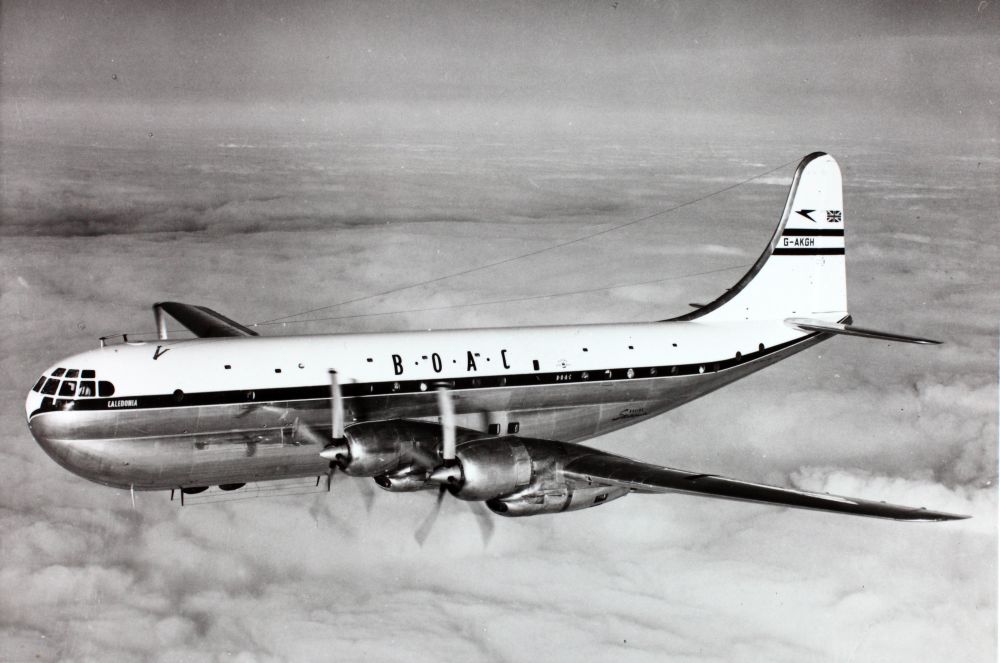
Pictured: a BOAC Boeing 377 Stratocruiser, the same airline and aircraft type as RMA Centaurus (registration G-ALSC), photographed from the Charles M. Daniels Collection, San Diego Air & Space Museum Archive. This is not a photograph of Centaurus itself or of the object(s) reported — no photograph of either is known to exist in any archive consulted for this case file; Captain Howard's own hand-drawn sketch, made for the press within a day of landing, remains the only surviving visual record of what the crew described.
Theoretical Alignment
This case sits closer to the mundane end of this catalogue's spectrum than its extraordinary witness count might first suggest, though it is far from a clean dismissal. The Extraterrestrial Hypothesis reading draws real strength from the sheer scale and consistency of the sighting — eleven professional crew and fifty-one passengers independently describing the same large, structured, continuously changing object holding formation with a 300-mph airliner for eighteen minutes — a duration and witness count that dwarfs almost every other case in this catalogue. It is substantially weakened, however, by the fact that an intercepting fighter's own airborne radar, plus ground radar at Goose Bay and at Thule Air Base in Greenland, all searched the reported area and found nothing but the Stratocruiser itself; a solid, radar-reflective craft at the reported 3-to-5-mile range should, in principle, have registered on at least one of those three independent radar systems. Interdimensional Hypothesis alignment is minimal: nothing in the reported behavior suggests anything beyond a purely optical or, at most, physically atmospheric phenomenon. The Psycho-Social/Mundane reading carries the most weight in this file's own assessment, not because 62 people invented a story, but because the case's two most serious scientific treatments — Gordon E. Thayer's 1969 Condon Report analysis and Martin Shough's 2010 NARCAP reexamination — both independently converge on a rare but physically real superior-mirage mechanism as the best available explanation, even though both authors candidly flag unresolved difficulties with their own theories.
Background
By June 1954, the Goose Bay, Labrador refueling stop was a routine fixture of transatlantic propeller-airliner service. The Boeing 377 Stratocruiser, a double-deck derivative of the B-29/C-97 bomber airframe fitted with a luxurious lower-deck lounge and sleeping berths, had entered British Overseas Airways Corporation service in 1949 as the flagship of BOAC's prestige New York route, but its four Wright R-4360 "Corncob" radial engines — 28 cylinders apiece, notoriously complex and maintenance-heavy — lacked the range to fly New York to London nonstop against prevailing headwinds. Goose Bay, a wartime-built airfield on Lake Melville in central Labrador jointly used by the RCAF and USAF, filled the gap as the standard eastbound refueling point, much as Shannon and Gander served westbound traffic. RMA Centaurus, registration G-ALSC, construction number 15945, was one of ten Stratocruisers BOAC operated under the "RMA" (Royal Mail Aircraft) naming convention; delivered new in 1949, it would remain in BOAC's fleet until sale to the American charter operator Transocean Air Lines in December 1958, flying its last BOAC passenger service into New York that November.
Flight 510-196 departed New York's Idlewild Airport at approximately 5:03 p.m. EST (2103 GMT) on June 29, 1954, carrying 51 passengers on the New York–Goose Bay–Prestwick–London routing. In command was 33-year-old Capt. James Howard, a former RAF wartime bomber squadron leader who by 1954 had logged some 7,500 commercial flying hours and completed 256 prior Atlantic crossings — a level of experience this case file treats, consistent with this site's Observer Credibility standard, as a genuinely strong positive credibility signal. His first officer, Lee Boyd, was likewise a former wartime squadron leader. The remainder of the eleven-person crew, per BOAC's own account and NICAP's case summary, comprised two navigators (one identified in secondary sources as George Allen), two flight engineers, a radio officer, two stewards, and 28-year-old air hostess Daphne Webster; this file's own research was unable to confirm every one of the eleven individual names against a single primary roster, an honest gap this file discloses rather than papers over with invented detail.
The wider context in June 1954 was the first great wave of modern UFO reporting, by then seven years old since Kenneth Arnold's 1947 sighting. The U.S. Air Force's Project Blue Book, reorganized out of the dysfunctional Project Grudge in early 1952 (a reorganization this catalogue documents in its own Fort Monmouth Radar-Visual Incident case file), was in its third year of operation under Capt. Edward J. Ruppelt. Britain's own official interest was more guarded: the Air Ministry had been quietly logging UFO reports since 1950 without any public equivalent of Blue Book, and would not release its files to the National Archives at Kew until decades later. A commercial airliner sighting witnessed by dozens of fare-paying passengers, reported by a decorated former RAF officer, and picked up within 48 hours by wire services on both sides of the Atlantic was, in that context, a genuinely unusual and difficult case for either country's officials to wave away quietly — and, as the record below shows, neither fully did.
Labrador and northern Quebec in 1954 were sparsely populated, heavily forested, and dotted with new Cold War-era radar and airfield infrastructure: Goose Bay itself, the 922nd Aircraft Control & Warning Squadron's station at Cartwright further up the coast, and (considerably further north) the USAF's major base at Thule, Greenland, all sat within the broader early-warning network then being built against a Soviet polar bomber threat. That infrastructure is directly relevant to this case's evidentiary record, discussed in detail below: unlike several of this catalogue's other 1950s cases, active radar coverage genuinely existed nearby and was genuinely brought to bear that night — and came back negative.
Complete Timeline
| Date | Event |
|---|---|
| 1949 | RMA Centaurus (G-ALSC) is delivered new to BOAC as part of its ten-strong Boeing 377 Stratocruiser fleet. |
| 1952 | Project Grudge is reorganized into Project Blue Book under Capt. Edward J. Ruppelt following the Fort Monmouth radar-visual case. |
| June 29, 1954, ~5:03 p.m. EST (2103 GMT) | Flight 510-196 departs Idlewild Airport, New York, for London via Goose Bay, Prestwick; 51 passengers and 11 crew aboard, Capt. James Howard commanding. |
| ~9:05 p.m. EST (0105 GMT, June 30) | At 19,000 feet, roughly 150 nm southwest of Goose Bay near Seven Islands, Quebec, the crew and port-side passengers first notice a large object with attendant smaller objects off the left wing against the sunset sky. |
| ~9:07 p.m. EST (0107 GMT) | First Officer Lee Boyd radios Goose Bay approach control; no other aircraft are reported in the area. |
| ~9:20 p.m. EST (0120 GMT) | An RCAF/USAF F-94 Starfire interceptor, scrambled from Goose Bay and flown by Lt. Col. Al Kramer, closes to visually investigate; its airborne intercept radar shows only the Stratocruiser. |
| ~9:23 p.m. EST (0123 GMT) | As the fighter nears, the objects diminish and disappear from view after roughly 18 minutes of continuous observation; ground radars at Goose Bay and at Thule Air Base, Greenland, are separately checked and report no unidentified return. |
| ~9:45 p.m. EST (0145 GMT) | Centaurus lands at Goose Bay; RAF, RCAF, and USAF intelligence officers interview the crew before the aircraft continues toward Prestwick and London. |
| July 1, 1954 | BOAC's London press office confirms the sighting to reporters, describing an object that "changed shape and formation" and paced the aircraft for roughly 80 miles; the story runs in London dailies and via wire services within days. |
| July 1954 | Science reporter Chapman Pincher publishes an atmospheric-mirror ("reflection of the aircraft") explanation in the Daily Express; Capt. Howard publicly rebuts it. Fate magazine's November 1954 issue later runs a detailed feature, "BOAC's Flying Jellyfish." |
| 1954 (exact date undetermined) | The case is logged in Project Blue Book's files; researcher Brad Sparks later catalogues it as Blue Book Unknown Case 1049. |
| 1969 | Colorado (Condon) UFO Project physicist Gordon E. Thayer analyzes the case for the official Condon Report, concluding it is likely a superior mirage of terrain reflected against the bright sunset sky — while noting it as a phenomenon type he had not previously seen documented. |
| 1970s–1980s | Physicist James E. McDonald and author Timothy Good (Above Top Secret, 1987) separately revisit the case, both disputing that the mirage explanation is fully adequate. |
| 2010 | Martin Shough publishes a detailed reexamination for the National Aviation Reporting Center on Anomalous Phenomena (NARCAP), refining the mirage hypothesis around a specific atmospheric-duct/cloud-refraction mechanism while identifying remaining unresolved features. |
| 2026 | This case file is published, confirming the "Coming Soon" queue placeholder's witness-count and distance claims while correcting its "off the Labrador coast" location description. |
The Sighting: Eighteen Minutes Off the Port Wing
According to Capt. Howard's own account, given to BOAC, to the press, and to RAF/USAF intelligence officers within hours of landing, Centaurus was cruising at 19,000 feet on a steady northeasterly heading when, just after local sunset, First Officer Boyd or another crew member first noticed an object silhouetted against the bright western sky off the aircraft's left (port) side. What followed, and what would make this one of the most widely publicized airline UFO sightings of the 1950s, was not a brief flash or a static light but a sustained, eighteen-minute display: a single large object, its outline continuously and slowly changing — described across various retellings as wedge-shaped, dumbbell-shaped, a sphere with a projection, cigar-shaped, and at one point mushroom-shaped — accompanied throughout by six or seven much smaller objects, sometimes described as dark, roughly circular "dots," arranged in shifting formations around the larger shape. Every crew and passenger account agreed the objects were opaque and hard-edged rather than glowing or luminous, showed no navigation lights, no flames, and no visible exhaust or vapor trail, and maintained a roughly constant bearing and distance — estimated by different crew members at anywhere from three to five miles laterally, though Howard himself allowed the true range could have been considerably greater given the objects' apparent size.
Howard's own description, given repeatedly in interviews over the following days, emphasized the object's scale and the deliberate, almost organic quality of its transformations: he likened the shifting mass of smaller objects to "a swarm of bees" altering the shape of a hive, and insisted the large object's silhouette changed too slowly and too consistently to be an aircraft maneuvering or a simple trick of light. Air hostess Daphne Webster, watching from a cabin window alongside passengers, called it "the most exciting sight I've ever seen, but a little creepy." First Officer Boyd was, if anything, more emphatic than his captain: "What we saw was something solid, something maneuverable, and something being controlled intelligently." Fifty-one passengers seated on the aircraft's port side had an unobstructed view of the same display for the same duration, giving this case a scale of simultaneous, geographically identical witnessing that few if any other cases in this catalogue can match.
The Fighter Scramble
Boyd's radio call to Goose Bay approach control at roughly 0107 GMT — made while the sighting was still in progress rather than after the fact — is one of this case's most significant evidentiary details, since it committed the crew's account to a contemporaneous air-traffic record before anyone had time to compare notes or embellish. Goose Bay controllers, finding no other known aircraft in the reported area, scrambled an F-94 Starfire all-weather interceptor, flown according to Martin Shough's research by Lt. Col. Al Kramer, to investigate. As the fighter closed to visual range roughly thirteen minutes into the sighting, the objects — by every crew account — began to diminish and then vanished entirely within a few minutes, disappearing at almost exactly the moment the intercepting aircraft might have obtained its own independent visual confirmation. Kramer's own radar, an airborne intercept set specifically designed to detect other aircraft at range, registered nothing beyond the Stratocruiser itself throughout the intercept; this case file's own assessment treats that null result as a genuinely significant, if ambiguous, data point, discussed further below.
Landing and Interrogation
Centaurus landed at Goose Bay at approximately 0145 GMT, and its crew was met not by routine ground handling alone but by RAF, RCAF, and United States Air Force intelligence officers, who interviewed Howard, Boyd, and other crew members individually before the aircraft was cleared to continue its journey toward Prestwick and London. That level of immediate, multi-service official interest — on a joint Canadian-American military airfield, involving a foreign (British) civil airliner — is itself a marker of how seriously the incident was taken in the moment, independent of whatever conclusion any later analyst would reach about its ultimate cause.
The Press Storm and the Mirror-Theory Rebuttal
BOAC's own press office in London confirmed the sighting to reporters on July 1, 1954, describing an object that had "changed shape and formation" and had, by the crew's estimate, paced the aircraft for roughly 80 miles — but the airline's spokesman was careful, per multiple contemporaneous accounts, to insist BOAC itself never used the word "saucers," preferring the more neutral "objects" or "unidentified flying objects." The story ran widely and quickly, reaching American readers within days and prompting Fate magazine's detailed November 1954 feature, memorably titled "BOAC's Flying Jellyfish." Science journalist Chapman Pincher, writing in the Daily Express, offered what remains the most-quoted contemporaneous skeptical theory: that a sharply defined atmospheric temperature inversion, of a kind known to stretch for hundreds of miles, could have reflected the Stratocruiser's own shiny fuselage back at the crew as a mirror image, with the reflection appearing to travel alongside the aircraft exactly as reported, and its eventual disappearance explained by "a change of light" as the sun fully set.
Howard publicly and specifically rebutted the mirror theory rather than simply dismissing it, a response this case file's own assessment treats as a meaningfully strong piece of the crew's credibility record precisely because it engaged with the physics rather than retreating to bare assertion. His central objection was that "shadows are thrown away from the light source, not towards it" — a reflection theory, he argued, could not easily account for six discrete, separately moving dark objects arranged around a shape-changing central mass, nor could a simple mirror image explain why the formation's individual components moved independently of one another rather than as a single rigid reflected outline. Scientist and author Arthur C. Clarke, invited to comment publicly at the time, took a more measured position: he judged the case "undoubtedly one of the finest sightings ever recorded from the viewpoint of the authenticity of the witnesses" while still concluding the objects "were obviously not solid bodies" and that, given how many distinct kinds of mirage exist, "speculation is fruitless" without more rigorous analysis than a newspaper column could offer — a position this file's own research finds prescient, since it anticipated by more than a decade the direction Gordon Thayer's and later Martin Shough's formal mirage analyses would actually take.
Two Weaker Official Theories
Alongside Pincher's mirror theory, this case file's research located two additional, considerably weaker explanations that appear in the surviving Blue Book-adjacent record: a brief, undeveloped "Planet Mars" notation in Blue Book's own case material, and a suggestion reportedly floated by British Air Ministry officials that the crew had witnessed a solar eclipse. Both are disclosed here for completeness and both are treated in this file's own assessment as unpersuasive on their face rather than adopted: Mars in late June 1954 offers no plausible mechanism for a shape-changing, formation-flying object pacing an airliner at close range for eighteen minutes, and the one solar eclipse that did occur around this date — June 30, 1954 — was timed and positioned over Scandinavia and continental Europe many hours after, and thousands of miles from, the Stratocruiser's Quebec-Labrador overflight the previous evening. Neither theory appears to have been seriously pursued by any of the researchers or officials who examined this case in depth, and this file's own assessment concurs that neither withstands even modest scrutiny.
Key Witnesses
Capt. James Howard
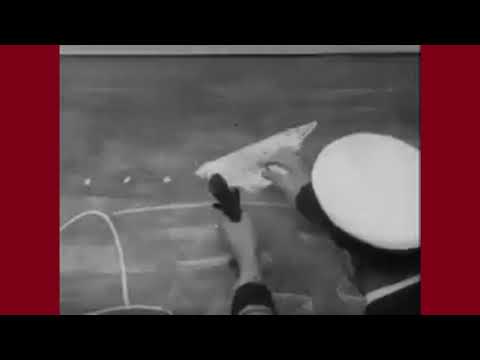
Howard was the pilot-in-command and gave the most widely quoted, most detailed account of the object's shape-changing behavior, sketching it for the press within a day of landing. He engaged directly and specifically with Chapman Pincher's mirror-reflection theory rather than dismissing it outright, a response this case file treats as a genuine credibility signal, while never wavering from his own conviction the objects were solid and controlled.
First Officer Lee Boyd
Boyd independently corroborated Howard's account of the object's structure and behavior and was the crew member who radioed Goose Bay approach control while the sighting was still underway, creating a contemporaneous record of the event rather than one reconstructed only after landing. His own public statement — that the crew had seen "something solid, something maneuverable, and something being controlled intelligently" — remains one of this case's most quoted lines.
Air Hostess Daphne Webster
Webster was among the cabin crew who watched the display from the passenger compartment alongside dozens of the 51 passengers on the aircraft's port side, giving this case a rare degree of simultaneous, non-cockpit corroboration. Her own description — "the most exciting sight I've ever seen, but a little creepy" — is one of the few surviving direct quotes from a cabin-crew rather than flight-deck witness in this catalogue.
The Five Observables Assessment
The Five Observables framework, drawn from the Pentagon's Advanced Aerospace Threat Identification Program, is applied here to the performance characteristics the crew and passengers reported:
Assessment: This case's single most distinctive Five Observables signature is Low Observability, rated Present on genuinely unusual grounds: the objects were plainly, continuously visible to dozens of witnesses for eighteen minutes, yet registered on none of three independent radar systems actively searching for them — the intercepting F-94's own airborne set, Goose Bay's ground radar, and Thule Air Base's ground radar. That combination, visible but radar-null at close range, is a real and disclosed anomaly if the objects were solid, metallic craft, though it is equally consistent with (and arguably better explained by) an optical phenomenon with no material radar cross-section at all — this case file's own assessment leans toward the latter reading without treating it as fully settled. Anti-Gravity Lift is rated Speculative rather than Present: the object held formation with a fast-moving airliner for eighteen minutes with no visible wings, engines, or exhaust, which would be a remarkable lift signature for a solid craft, but nothing in the account describes a hover or a lift-without-forward-motion event specifically. Instant Acceleration and Hypersonic performance are both rated Absent: the objects' reported pace matched the Stratocruiser's own roughly 230-knot cruise, and their eventual disappearance was described as a gradual diminishing rather than an abrupt high-speed departure. Trans-Medium is rated Absent, as no water or ground transition was reported or applicable to an airborne sighting.
Evidence Assessment
Supporting Anomalous Origin
- Sixty-two independent witnesses — eleven professional crew, including two former RAF wartime squadron leaders with a combined 256+ prior Atlantic crossings, plus 51 passengers — watched the identical display from the same vantage for a sustained eighteen minutes, an extraordinarily large and consistent witness base for any single case in this catalogue
- The sighting was reported by radio while still in progress, not reconstructed afterward, and independently prompted a real-time fighter scramble — a contemporaneous institutional response, not a story assembled after the fact
- Multiple crew members gave detailed, mutually consistent, and specific accounts of a structured object exhibiting continuous, deliberate-seeming shape changes and coordinated satellite-object movement, not a vague light or point source
- Both Howard and Boyd specifically and substantively rebutted the leading contemporaneous mirror/reflection theory rather than simply dismissing skepticism, a response consistent with careful, non-sensationalized witnesses
- The case remains an official USAF Blue Book "Unknown" (Case 1049) and was independently revisited, without full resolution, by the government-commissioned 1969 Condon Report
Supporting Conventional Explanation
- Three independent radar systems — the intercepting F-94's own airborne set, and ground radar at both Goose Bay and Thule Air Base — searched the reported area and detected nothing beyond the Stratocruiser itself, a genuine negative result for any solid, radar-reflective craft at the reported range
- Two separate, serious scientific analyses conducted decades apart — Gordon Thayer for the 1969 Condon Report and Martin Shough for a 2010 NARCAP study — independently converged on a superior-mirage mechanism as the most probable explanation, even while each disclosed remaining difficulties with their own theory
- No photograph, film, or physical trace of the object exists; the only surviving visual record is Capt. Howard's own after-the-fact sketch, not a contemporaneous image
- The objects' disappearance, coinciding closely with the moment the intercepting fighter might have achieved independent visual confirmation, is consistent with an optical/atmospheric phenomenon dissipating with changing light conditions at sunset
- At least two of the officially floated explanations (a Mars notation in Blue Book's own files; a British Air Ministry solar-eclipse suggestion) are demonstrably weak on their face, indicating that not every institutional response to this case was rigorous, which tempers how much weight any single official "explained" or "unexplained" label should carry on its own
Why "Disputed"
This case earns a DISPUTED classification with a credibility score of 61/100. That places it above cases resting on a single line of witness testimony with no independent search for corroboration, such as this catalogue's own Chicago & Southern DC-3 Sighting (Disputed, 44) and Fort Monmouth Radar-Visual Incident (Disputed, 46), and above the visually-corroborated but still testimony-only Gorman Dogfight (Disputed, 58) — but it remains well below cases combining credentialed military witnesses with genuine positive instrumented corroboration, such as Coyne Helicopter (Credible, 81).
What lifts this case above the bulk of this catalogue's other testimony-only sightings is the sheer scale and immediacy of its corroboration: 62 simultaneous witnesses, a contemporaneous in-flight radio report, and a same-night fighter scramble together constitute a far larger and more immediately verified evidentiary base than almost any comparably-aged case on file here. What holds it well short of "Credible" is that the one form of evidence actively, deliberately sought that night — radar confirmation, checked across three independent systems — came back negative, and that the most careful scientific attention this case has received, spanning from the 1969 Condon Report to a dedicated 2010 NARCAP reexamination, has consistently gravitated toward a specific, physically grounded (if not fully proven) mirage mechanism rather than toward "unexplainable." A case this well-attested by witness count, yet this actively investigated and still left short of a fully satisfying conventional explanation by two independent, methodologically serious analysts forty years apart, is precisely the profile this catalogue's scoring reserves for the upper-middle of the Disputed range: too substantial, too immediately reported, and too actively (if inconclusively) scrutinized to score as low as a single-witness case with a strong specific mundane candidate, but too clouded by a serious, repeatedly-arrived-at optical explanation and a documented radar-null result to score as a positive detection of something physically anomalous.
Sensor & Instrumentation Detection Profile
Unlike many of this catalogue's early Cold War cases, this sighting genuinely was subjected to active, same-night instrumented search — and that search is itself one of the case's most evidentially significant features. The scrambled F-94 Starfire's own airborne intercept radar, a set specifically designed and tuned to detect other aircraft, tracked nothing beyond the Stratocruiser throughout its approach. Ground-based radar at Goose Bay, and separately at the USAF's Thule Air Base far to the north in Greenland, were also checked in the case's aftermath and reported no anomalous return corresponding to the sighting. This case file's own research did not locate any documented radar contact from the 922nd Aircraft Control & Warning Squadron's station at Cartwright, Labrador, further up the coast, despite some later secondary summaries asserting Cartwright radar had tracked the objects; the more rigorous, source-cited analyses by Martin Shough and by the Condon Report's own Gordon Thayer describe only negative results from Goose Bay, the F-94, and Thule, and this file follows their more carefully sourced account over the uncorroborated Cartwright claim, which it flags here as unconfirmed rather than adopting. No photograph, film, or any other instrumented visual record exists; the entire case rests on unaided human vision from the aircraft's own crew and passengers.
Environmental & Geospatial Context
The sighting occurred just after local sunset over the sparsely populated boreal forest and lake country of the Quebec-Labrador border region, roughly 150 nautical miles southwest of Goose Bay and near Seven Islands (Sept-Îles), Quebec on the St. Lawrence estuary's north shore. At 19,000 feet with a clear western sky at sunset, the crew had an essentially unobstructed view toward the setting sun — the specific viewing geometry (a bright sky to the west, dark terrain and cooling air below and behind) is also precisely the configuration both Gordon Thayer's and Martin Shough's mirage analyses identify as necessary for the kind of superior-mirage or duct-refraction effect they separately propose. This case file's own research was not able to locate a specific period synoptic weather chart for the exact overflight corridor that evening, an honest gap disclosed here rather than papered over; both mirage analyses instead reconstruct the necessary atmospheric conditions (a temperature inversion or duct at a specific altitude band) from general climatological plausibility and the reported optical behavior itself, not from a directly recovered weather record. Geospatially, the area sat within the early-warning radar network then being extended across Canada's northeast against a Soviet polar bomber threat — Goose Bay itself, the Cartwright station further along the coast, and Thule far to the north were all part of this buildup — meaning that, unlike several of this catalogue's other 1950s cases where no radar coverage existed to test a sighting against, real coverage existed here and was genuinely applied, with a negative result.
Observer Credibility & Occupational Profile
The primary witnesses in this case present an unusually strong occupational and numerical credibility profile simultaneously. Capt. James Howard, a former RAF wartime squadron leader with roughly 7,500 flight hours and 256 prior Atlantic crossings, and First Officer Lee Boyd, likewise a former wartime squadron leader, were both career military-trained aviators whose professional judgment on aerial phenomena carries the same weight this catalogue assigns to other credentialed-pilot witnesses, such as Capt. Jack Adams in the Chicago & Southern DC-3 Sighting. What distinguishes this case from a typical two-pilot cockpit report, however, is the additional layer of corroboration from nine further crew members across multiple specialized roles — navigation, engineering, radio, and cabin service — plus 51 passengers with no professional stake in the outcome at all, watching from a different vantage within the same aircraft. That breadth of simultaneous, differently-positioned observation is a genuinely rare evidentiary configuration in this catalogue, where most cases rest on either a single trained observer or a small handful of professionally similar witnesses.
Set against this occupational and numerical strength is a limitation specific to this kind of case: all 62 witnesses were aboard the same aircraft, viewing the same objects from substantially the same angle and the same moving reference frame, rather than from geographically separated, independently sited vantage points. A misperception shared by everyone on one aircraft — whether an optical illusion, an atmospheric effect, or a genuine unconventional object — would necessarily be witnessed identically by all 62 people regardless of which explanation is correct; the witness count here multiplies confidence that something specific and consistent was seen, but it does not, on its own, discriminate between an atmospheric-optical cause and a physically distant, structured craft the way genuinely independent ground-and-air corroboration would. This case file's own assessment treats the crew's professional aviation training as real evidence they were not confusing the display for ordinary air traffic or terrain lighting, while treating the single-vantage-point nature of all 62 accounts as a real, disclosed limit on how much independent triangulation this case can ultimately support.
Physical & Material Assays
No physical trace evidence of any kind exists for this case. The objects were never reported landing or approaching close enough for any debris, residue, or material sample to be recovered, and none is claimed to exist in any source consulted for this case file. See Material Analysis below for a full discussion of the case's surviving documentary and analytical record in place of physical evidence.
Historical Precedents & Archive Matches
This case belongs to a small but well-documented cluster of 1950s multi-crew commercial and military aviation sightings this catalogue has separately filed, including the Chicago & Southern DC-3 Sighting (March 1950, two Arkansas-based airline pilots), the Nash-Fortenberry Sighting (July 1952, two Pan Am pilots over Chesapeake Bay), and, from later the very same year as this case, the Hawker Sea Fury Sighting (August 31, 1954, a lone Royal Australian Navy pilot over Nowra). The BOAC case stands apart from all three specifically on witness count: where those cases rest on one or two trained observers, this one adds 51 additional civilian witnesses in the same aircraft, a scale of simultaneous corroboration this catalogue has not documented in any other single-vantage sighting from the era.
This case's radar-search-with-negative-result profile also invites direct comparison with this catalogue's Fort Monmouth Radar-Visual Incident (September 1951), where a single ground radar operator did obtain a positive, if brief and singular, contact corresponding to a visual sighting. The two cases sit on opposite sides of the same evidentiary question: Fort Monmouth's positive radar return, uncorroborated by any second radar or visual witness of comparable number, versus this case's total absence of any positive radar return despite active search across three separate systems and 62 simultaneous visual witnesses. Neither pattern, this file's own assessment concludes, is straightforwardly more or less credible than the other in the abstract; each simply demonstrates a different, genuinely disclosed evidentiary shape.
Within official record-keeping, this case's persistence as Blue Book Unknown Case 1049 (per Brad Sparks's later cataloguing of Blue Book's own unresolved files) and its independent selection for direct analysis in the 1969 Condon Report place it among a relatively small number of cases that received sustained attention from two entirely separate generations of official and quasi-official U.S. government-linked UFO investigation, fifteen years apart — a continuity of institutional interest this catalogue has documented in only a handful of other files. Blue Book's own overall closing statistics, per the National Archives' own finding aid, list 701 cases as "Unidentified" out of 12,618 total sightings reported to the Air Force between 1947 and the project's 1969 closure — a residual-unknown rate of roughly 5.6 percent. This case's continued membership in that small remainder, across both Blue Book's original review and the Condon Report's independent second look, distinguishes it from the far larger number of contemporaneous 1954 sightings that were closed out with a specific, confidently assigned conventional explanation and never revisited.
Material Analysis
There is no physical object, debris, or trace sample connected to this case; "material" here refers instead to the case's actual surviving evidentiary substrate — the crew's own contemporaneous radio report, Capt. Howard's after-the-fact sketch, the BOAC press statement, the Blue Book case file, and two independent scientific reexaminations conducted decades apart — since that documentary and analytical record is the only tangible thing this case file's research was able to assess.
The Surviving Documentary Record
This case is unusually well documented for its era across several independent lines: NICAP hosts a detailed case summary and directory of source documents; Martin Shough's 2010 study for NARCAP (also mirrored on the Caelestia research site) provides the most rigorous single technical reexamination located for this case file, including a detailed reconstruction of the timeline, radar-search results, and a specific atmospheric-duct mirage mechanism; the 1969 Condon Report itself, via physicist Gordon Thayer's contribution, constitutes an independent, decades-earlier official U.S. government-commissioned analysis reaching a broadly similar (though not identical) mirage conclusion; and Brad Sparks's Blue Book Unknowns catalogue situates the case within Blue Book's own official record as Case 1049. Having a same-night radio report, a contemporary press statement, and two independently authored, methodologically serious scientific analyses forty years apart all agree on the sighting's basic timeline and behavior is a genuinely strong cross-check for a case this old, even though none of the three resolves the case to full scientific certainty.
What Does Not Survive
No photograph, film, or physical trace of the object is known to exist in any archive consulted for this case file; Capt. Howard's own sketch, made for the press within roughly a day of the sighting, is a witness's after-the-fact rendering, not a contemporaneous image captured during the event itself. This case file's own research was not able to directly examine a primary Blue Book microfilm record or an underlying RAF/Air Ministry field-interview report for this case, relying instead on NICAP's and NARCAP's own secondary compilations, cross-checked against contemporaneous 1954 press coverage; the same small residual possibility of transcription drift this site discloses for its other Blue Book-era files therefore applies here as well. Descriptive details vary modestly across secondary sources — the exact number of smaller objects (six or seven), and the precise lateral distance estimate (three to five miles, with some accounts allowing for considerably more) — and this case file presents that variation honestly rather than silently selecting whichever figures read most dramatically.
Supporting Non-Terrestrial or Unexplained Origin
- Three independently authored sources spanning fifty-six years — the 1954 press record, the 1969 Condon Report, and the 2010 NARCAP study — agree on the sighting's core facts and duration
- Sixty-two witnesses, including professionally trained flight crew, described a structured, continuously and deliberately shape-changing object rather than a vague point of light
- The case remains an official Blue Book "Unknown" and was never assigned a single, fully confirmed conventional explanation by any government body that examined it
Supporting Terrestrial or Mundane Origin
- This case file's research could not directly examine a primary Blue Book microfilm image or an underlying Air Ministry field report, relying on secondary compilations
- No photograph or physical trace exists to permit independent modern re-analysis of the object itself
- The two most rigorous scientific treatments of this case (Thayer 1969, Shough 2010), separated by four decades and working independently, both converge on a superior-mirage mechanism as the best available explanation
The Conventional Explanation Candidate (CEC): Superior Mirage, Aircraft Self-Reflection, or Genuine Unknown
This case has attracted more sustained, methodologically serious skeptical analysis than almost any other file in this catalogue — two full scientific reexaminations, forty years apart, plus a contemporaneous 1954 press theory this file's own research finds less persuasive than either. Each candidate is evaluated on its own merits below.
Superior Mirage / Atmospheric Duct Refraction
The leading conventional candidate, and the one this case file's own research finds most substantively developed, comes from two independent sources: physicist Gordon E. Thayer's 1969 analysis for the official Condon Report, and Martin Shough's considerably more detailed 2010 reexamination for NARCAP. Thayer identified several features of the sighting consistent with a superior mirage — specifically, dark terrain reflected against the bright, silvery sunset sky to the aircraft's left, producing an apparent object where none physically existed at that bearing — while explicitly noting he considered it "a phenomenon so rare that it apparently has never been reported before or since." Shough's later, more detailed study refined this into a specific mechanism involving distant towering cumulus cloud formations refracted through an elevated atmospheric duct, and reported that "several significant objections" to the general mirage hypothesis "have been overcome" by this more specific version, concluding mirage represents "by far the least implausible explanation" available. Both authors, notably, disclosed genuine remaining difficulties rather than declaring the matter closed: Shough specifically flagged the sighting's remarkably constant bearing over a full eighteen minutes and the reported bilateral symmetry of the object's changing form as features an atmospheric duct does not straightforwardly explain, and subsequent researchers have noted that comparable rare mirage cases (such as Australia's Zanthus sighting) suggest this signature, while unusual, is not literally unique to this one event as Thayer originally believed. This file's own assessment rates this candidate as the strongest available, while treating "not fully resolved even by its own authors" as an honest, load-bearing qualifier rather than a technicality.
Aircraft Self-Reflection ("Mirror Theory")
Chapman Pincher's contemporaneous 1954 theory — that a sharply defined temperature inversion reflected the Stratocruiser's own shiny fuselage back at the crew as a traveling mirror image — deserves serious evaluation as the first skeptical explanation actually offered, but this case file's own research finds it the weakest of the three candidates considered here. It struggles specifically against Capt. Howard's own, physically grounded rebuttal: a single reflected image of the aircraft does not naturally resolve into six or seven independently moving smaller objects arranged around a separately, continuously shape-changing larger form, and Howard's specific point about shadow/light directionality raises a real physical objection Pincher's own published account never directly answered. This candidate is better understood as an intelligent, physically literate first guess from 1954 that the two later, more rigorous scientific studies effectively superseded rather than confirmed.
Genuine Unconventional Aerial Object
This reading remains open on the strength of the case's exceptional witness count, the crew's specific and consistent structural description, the contemporaneous in-progress radio report, and the fact that Blue Book itself never closed the case as explained, with physicist James E. McDonald and author Timothy Good both later disputing that the mirage explanation is fully adequate. It is tempered by the negative result across three independent radar searches conducted that same night specifically to test for a physical object, and by the convergence — not agreement in every detail, but convergence — of two independently authored, methodologically serious scientific studies on a mirage mechanism rather than a physical-craft explanation. This case file's own conclusion is that "genuinely unresolved, but leaning mundane" is the most honest available characterization more than seven decades after Howard's crew first radioed Goose Bay, rather than a confident resolution in either direction.
Superior Mirage / Duct Refraction
InconclusiveINCONCLUSIVE, leaning plausible. The strongest candidate, independently developed by two scientists forty years apart, but its own authors (Thayer, Shough) disclose genuine unresolved difficulties with bearing constancy and object symmetry.
Aircraft Self-Reflection
ImplausibleIMPLAUSIBLE as a complete explanation. The first skeptical theory offered in 1954, but it does not account for multiple independently moving smaller objects or Howard's specific shadow-direction objection, and was effectively superseded by later, more rigorous mirage analyses.
Genuine Unconventional Object
InconclusiveINCONCLUSIVE. Supported by an exceptional 62-witness base and an official Unknown classification never rescinded, but weakened by a negative, same-night three-system radar search and two independent scientific studies both leaning toward an optical explanation.
Related Cases
Confirmed Documents & Official Records
NARA's own guide to the declassified Project Blue Book records (Microfilm Publication T1206, 94 rolls) that hold this case's underlying file, catalogued by researcher Brad Sparks as Blue Book Unknown Case 1049.
DECLASSIFIEDThe UK National Archives' own guide to more than 200 UFO files transferred from the Ministry of Defence since 2008, the relevant British institutional record for a BOAC-operated, UK-registered airliner's sighting, alongside NARA's American Blue Book holdings.
DECLASSIFIED / PUBLIC RECORDThis case file's research could not obtain a directly legible primary-source scan of the original 1954 Blue Book case file or any underlying RAF/Air Ministry field-interview report; the figures and details presented above are drawn from NICAP's and NARCAP's own case compilations and Martin Shough's dedicated 2010 study, cross-checked against contemporaneous 1954 press coverage and the 1969 Condon Report, rather than from this case file's own examination of the original document image.
Search Government & Military Archives Directly
Further Reading — Recommended Literature
Above Top Secret: The Worldwide U.F.O. Cover-Up
Good's landmark survey devotes detailed attention to the BOAC Centaurus sighting, situating it within his broader argument about official handling of high-witness-count aviation cases.
The World of Flying Saucers: A Scientific Examination of a Major Myth of the Space Age
The leading mid-century skeptical scientist's own case-by-case treatment of shape-shifting and mirage-adjacent UFO reports, useful for situating the aircraft-reflection and optical-mirage theories this case attracted within Menzel's broader analytical framework.
The UFO Files: The Inside Story of Real-Life Sightings
Drawing on the UK National Archives' declassified Ministry of Defence and Air Ministry UFO files, Clarke's history is the essential British-side counterpart to the American Blue Book record for a UK-registered airliner's sighting like this one.
The UFO Encyclopedia, 4th Edition (2-Volume Set)
The standard comprehensive reference for cataloged UFO cases, useful for situating this exceptionally large-witness-count airliner sighting within the broader documented pattern of 1950s commercial aviation reports.
Watch the Skies!: A Chronicle of the Flying Saucer Myth
A rigorously researched, skeptically inclined cultural history of American UFO reporting, useful as a counterweight when evaluating the Blue Book/Condon Report handling of this case against the contemporaneous 1954 press coverage.
Essential Viewing
Sources
- NICAP. "BOAC Case: UFOs Follow British Airliner Over Labrador." nicap.org
- NICAP. "UFO Report" — case directory for the June 29, 1954 BOAC sighting. nicap.org
- Shough, Martin. "Study of an Unusual Phenomenon Observed by BOAC Aircrew over Labrador, Newfoundland" (NARCAP Technical Report, 2010). martinshough.com
- Shough, Martin, hosted analysis. "CAELESTIA: The BOAC Labrador Sighting." caelestia.be
- Shough, Martin, hosted analysis, continued. "CAELESTIA: The BOAC Labrador Sighting (Analysis & Conclusion)." caelestia.be
- Fate Magazine, November 1954. "BOAC's Flying Jellyfish," reproduced by Project 1947. project1947.com
- National Aviation Reporting Center on Anomalous Phenomena (NARCAP). "Study of an Unusual Phenomenon Observed by BOAC Aircrew over Labrador, Newfoundland." academia.edu
- UAP Discovery Forum. "June 29, 1954 — Seven Islands, Quebec — The BOAC Stratocruiser Case / Flying Jellyfish (Blue Book Unknowns)," summarizing Brad Sparks's Blue Book Unknowns catalogue entry (Case 1049) and Gordon Thayer's 1969 Condon Report analysis. uapdiscovery.discourse.group
- Good, Timothy. Above Top Secret: The Worldwide U.F.O. Cover-Up (1987), on the BOAC Centaurus case.
- Menzel, Donald H., and Lyle G. Boyd. The World of Flying Saucers: A Scientific Examination of a Major Myth of the Space Age (1963). Full text of early chapters: gutenberg.org
- Clarke, David. The UFO Files: The Inside Story of Real-Life Sightings (2009), on UK Air Ministry/MoD handling of airliner UFO reports.
- The National Archives (UK). "UFO reports." nationalarchives.gov.uk
- National Archives and Records Administration. "Project BLUE BOOK: Unidentified Flying Objects." archives.gov
- AirHistory.net. "Aircraft Photo of G-ALSC | Boeing 377-10-28 Stratocruiser | BOAC," confirming registration, name, and the June 29, 1954 sighting over Seven Islands, Quebec. airhistory.net
- Wikimedia Commons. "File:Boeing 377 Stratocruiser, BOAC.jpg" (Charles M. Daniels Collection, San Diego Air & Space Museum Archive, public domain), source of this case file's hero image. commons.wikimedia.org
- Wikipedia. "Boeing 377 Stratocruiser." en.wikipedia.org
- YouTube (oEmbed-verified). "1954-06-30: BOAC Captain James Howard Sketches Sighting," Tom Owens UAP. youtube.com
- This site's own case file, "Chicago & Southern DC-3 Sighting" (March 1950), a comparable credentialed-pilot commercial aviation case. The Omni Ledger
- This site's own case file, "Fort Monmouth Radar-Visual Incident" (September 1951), for comparison with a case that returned a positive rather than negative radar contact. The Omni Ledger
See something inaccurate? Have additional information or sources?
Suggest an Edit →Last Updated: August 2026