
Chicago & Southern DC-3 Sighting
At approximately 9:26 p.m. CST on March 20, 1950, Capt. Jack Adams and First Officer G.W. Anderson Jr., flying a Chicago & Southern Air Lines DC-3 from Memphis toward Little Rock, Arkansas, watched a roughly 100-foot circular object with glowing lower portholes and a blinking top light climb past their aircraft in a steep, high-speed arc some 40 miles east of Little Rock, north of Stuttgart, Arkansas. The sighting lasted only 25 to 35 seconds, produced no radar or photographic record, and rested entirely on the two pilots' own testimony — yet it became one of 1950's most widely publicized UFO reports, reaching a national wire service within hours and, within about a week, Eleanor Roosevelt's own NBC television program. This file confirms the "Coming Soon" queue placeholder's core claims — two Chicago & Southern pilots, a fast-moving disc-shaped object with a distinctive glow, near Stuttgart, Arkansas — while correcting its date: the placeholder listed March 31, 1950, but every primary and archival source located for this case file, including NICAP's own case file designation and a Blue Book Project 10073 record card, places the sighting on March 20, 1950.
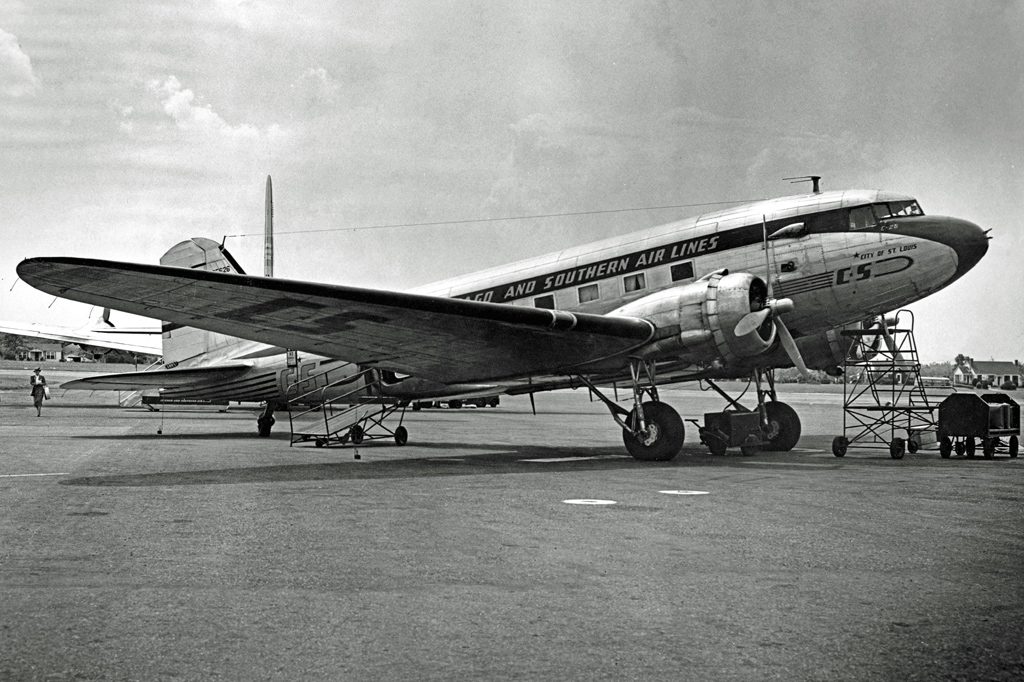
Pictured: a Douglas DC-3 of Chicago and Southern Air Lines, photographed at St. Louis airport in 1950 — the same airline and aircraft type Capt. Jack Adams and First Officer G.W. Anderson Jr. were flying over Arkansas that March. This is not a photograph of the specific aircraft (registration number not confirmed in any source consulted) or of the object itself; no photograph of either is known to exist in any archive consulted for this case file. (Photo: RuthAS, Wikimedia Commons, CC BY-SA 3.0.)
Theoretical Alignment
This case leans toward the mundane end of this catalogue's spectrum, though not as decisively as its all-visual, single-aircraft evidence base might first suggest. The Extraterrestrial Hypothesis reading draws real support from two independent, highly experienced airline pilots giving a structured, consistent, close-range description of a shaped, lighted object performing what reads as a controlled climbing maneuver rather than a passive light in the sky. It is tempered by the total absence of any radar, photographic, or third-party corroboration, and by the fact that the surviving popular record of the case's specific details — porthole count, flash rate, precise speed — drifts between secondary sources in ways a single, well-preserved primary document would not. Interdimensional Hypothesis alignment is negligible: everything reported is a solid, well-lit object behaving like a physical craft, not a phenomenon suggestive of another plane of existence. The Psycho-Social/Mundane reading carries real weight because a 25-to-35-second nighttime sighting of a fast, brightly lit object from a moving cockpit is exactly the kind of report in which even trained, honest observers are known to misjudge distance, size, and speed — and because this case's own most significant afterlife was cultural and institutional (national wire coverage, a former First Lady's television program, a First Lady's letter to a leading physicist) rather than evidentiary.
Background
Stuttgart, Arkansas, in the Arkansas Delta rice- and duck-hunting country of Arkansas County, sits along the flat, low-lying agricultural plain between the Arkansas and White Rivers. In March 1950 it was, and remains, a small farming community with no particular military or aerospace significance — a marked contrast to several of this catalogue's other early Cold War cases, which cluster around Air Force bases, missile ranges, or atomic facilities. What made the airspace over Stuttgart notable in 1950 was mundane: it lay directly beneath one of Chicago & Southern Air Lines' regularly scheduled routes connecting Memphis, Tennessee to Little Rock, Arkansas, a roughly 130-mile hop flown routinely by the airline's DC-3 fleet.
Chicago & Southern Air Lines had itself begun in June 1933 as Pacific Seaboard Air Lines, a small California carrier flying between Los Angeles and San Francisco, before relocating and rebuilding its route network around the Mississippi Valley; by 1950 its operations were centered on St. Louis and, increasingly, Memphis, with routes fanning south toward New Orleans, the Gulf Coast, and Caribbean gateway cities. The airline would not survive as an independent company much longer: on May 1, 1953, the Civil Aeronautics Board formally transferred its routes to Delta Air Lines, and by 1955 the Chicago & Southern name had disappeared entirely into Delta's own identity. The March 1950 sighting therefore occurred a little over three years before the airline itself ceased to exist — a detail that matters for this case file's own source-verification work, since it means no institutional successor within the airline industry retained C&S's own internal incident file, if one was ever filed separately from the men's own accounts and the Air Force's records.
March 1950 fell early in the modern UFO era's first sustained wave of national press attention. Kenneth Arnold's June 1947 sighting had coined the term "flying saucer" less than three years earlier; the Air Force's own investigative arm, Project Grudge, had been operating since February 1949 under Gen. Charles P. Cabell's original authorization (the same authorization that, per this catalogue's own Fort Monmouth Radar-Visual Incident case file, would later be reorganized into Project Blue Book in 1952); and Donald E. Keyhoe, a former Marine Corps major and aviation writer, was in the process of expanding a 1949 magazine article into what would become The Flying Saucers Are Real, published that June and destined to sell more than 500,000 copies. The Adams-Anderson sighting landed squarely inside this developing national conversation, and Keyhoe's own book, published just three months after the event, devotes a passage to it — making this one of the relatively few 1950-era cases with a genuinely contemporary, rather than purely retrospective, literary treatment.
Stuttgart itself, quite apart from anything to do with this case, had already built a modest national profile of its own by 1950: the town has billed itself as "The Duck and Rice Capital of the World" since the early twentieth century, and its annual World's Championship Duck Calling Contest, first staged on Main Street on Thanksgiving weekend in 1936 after a dispute among local hunters over who could call ducks best, was by 1950 a well-established regional draw. This case file notes that background only to be precise about what kind of place the sighting occurred over — a small, agriculturally prosperous Delta town with no connection whatsoever to military aviation or weapons testing, a genuinely different setting from the missile ranges and Air Force bases that surround several of this catalogue's other early Cold War cases.
The aircraft itself is a matter of public record independent of the sighting: the Douglas DC-3, in production since 1935 and still the backbone of Chicago & Southern's short-haul route network in 1950, cruised at approximately 207 mph with a top speed near 230 mph, carrying up to 21 to 32 passengers depending on configuration. That performance envelope matters directly to this case's own credibility analysis: Adams's estimate that the object was moving at "not less than 1,000 mph" describes a speed roughly four to five times faster than the very aircraft from which he was making the observation — an extraordinary claim for 1950, when only a handful of specialized experimental rocket planes had ever approached such velocities, and no production aircraft in the world, military or civilian, cruised anywhere close to it.
Complete Timeline
| Date | Event |
|---|---|
| June 1933 | Chicago & Southern Air Lines' predecessor, Pacific Seaboard Air Lines, begins operations in California. |
| June 1947 | Kenneth Arnold's sighting over Washington State popularizes the term "flying saucer." |
| Feb. 1949 | The U.S. Air Force's Project Grudge, the immediate predecessor to Project Blue Book, is established to investigate UFO reports. |
| Feb. 12, 1950 | Eleanor Roosevelt debuts as host of the NBC television program "Today with Mrs. Roosevelt." |
| March 20, 1950, ~9:26 p.m. CST | Capt. Jack Adams and First Officer G.W. Anderson Jr., flying a Chicago & Southern DC-3 from Memphis to Little Rock, sight a disc-shaped, porthole-lit object roughly 40 miles east of Little Rock, north of Stuttgart, Arkansas. |
| March 20, 1950 | The object closes to within an estimated half-mile of the aircraft, climbs past it in a high-speed arc, and departs; the sighting lasts 25 to 35 seconds. The crew radios a report before landing. |
| March 20–21, 1950 | A United Press wire story quoting Adams and Anderson directly is distributed for nationwide newspaper publication. |
| Late March 1950 | Eleanor Roosevelt, having read the wire story, invites Adams and Anderson to appear on "Today with Mrs. Roosevelt" in New York, within about a week of the sighting; the pilots bring a hastily built model of the object. |
| 1950 (exact date not documented) | The case is logged in the Air Force's UFO investigation files under a Project 10073 record card; it is later absorbed into the consolidated Project Blue Book microfilm archive. |
| May 1950 | Eleanor Roosevelt writes to physicist J. Robert Oppenheimer asking his opinion of UFOs, a letter later preserved in the Oppenheimer Papers at the Library of Congress. |
| June 1950 | Donald E. Keyhoe's The Flying Saucers Are Real is published, including a passage on the Adams-Anderson sighting. |
| Aug. 1950 | Nick Mariana's Great Falls, Montana film and the Chicago & Southern case both feature in TRUE Magazine's ongoing 1950 flying-saucer coverage, part of the same national wave. |
| May 1, 1953 | The Civil Aeronautics Board transfers Chicago & Southern Air Lines' routes to Delta Air Lines. |
| 1955 | The Chicago & Southern name is fully retired as the merged carrier operates simply as Delta. |
| 2024 | The Library of Congress publishes "Of Note: Eleanor Roosevelt, Alien Investigator," detailing Roosevelt's involvement with this case and her subsequent Oppenheimer correspondence. |
| 2026 | This case file is published, confirming the "Coming Soon" queue placeholder's core claims while correcting its stated date from March 31 to March 20, 1950. |
The Sighting: A Climbing Arc Over Arkansas
According to the account Capt. Jack Adams and First Officer G.W. Anderson Jr. gave in the hours and days immediately following the event, their Chicago & Southern DC-3 was cruising at approximately 2,000 feet on its regularly scheduled run from Memphis toward Little Rock when, at roughly 9:26 p.m. CST, one of the two men spotted an intensely lit object approaching from behind and below. What both men would later describe consistently was a circular, disc-shaped object roughly 100 feet in diameter, its lower rim ringed by a row of oval or circular lighted "portholes" — sources vary between eight, ten, and as many as twelve in number — glowing with a soft, fuzzy, fluorescent quality neither pilot could compare to any light source they had previously seen in years of night flying. Centered on the object's top was a single bright light that blinked or flashed; period retellings disagree on the precise rate, some giving three flashes across nine seconds and others three flashes per second, a discrepancy this case file discloses honestly as an artifact of the surviving secondary record rather than resolving in either direction.
The object closed to an estimated distance of no more than half a mile and an altitude roughly 1,000 feet above the airliner before executing what both men described as a sharp, climbing arc — pulling up and over the DC-3's flight path at what Adams estimated to be "not less than 1,000 miles per hour," a figure some later retellings soften to a broader 500-to-1,000 mph range. Neither pilot reported any exhaust plume, vapor trail, or visible reflection off a solid fuselage consistent with a conventional aircraft catching the last of the evening light; both emphasized the object's glow as self-luminous rather than reflective. The entire encounter, from first sighting to the object's departure from view, lasted only 25 to 35 seconds. Adams and Anderson radioed a report of the encounter before their aircraft landed — a detail this case file's own assessment treats as a meaningful, if not conclusive, credibility signal, since it means the core account was committed to a contemporaneous record before either man had time to embellish or reconcile a story after the fact.
An Uncensored Wire Story
Some secondary retellings place the encounter slightly differently within the flight — describing the DC-3 as continuing on a longer multi-stop routing that eventually reached destinations further south and west of Little Rock — but this case file treats the well-documented Memphis-to-Little-Rock leg, the specific leg on which NICAP's own case designation and the Project 10073 record card both place the sighting, as the authoritative account, and flags the longer-routing detail as an unconfirmed elaboration rather than adopting it outright.
What distinguished the Adams-Anderson case from several other airline-pilot sightings of the period, in Donald Keyhoe's own contemporaneous account, was the absence of any apparent effort to keep the two men quiet. Where Keyhoe describes earlier airline cases as subject to informal pressure discouraging publicity, Adams and Anderson were instead made available for a United Press interview arranged for nationwide wire distribution within roughly a day of the sighting. In that wire story, the two pilots offered their own, explicitly terrestrial interpretation of what they had seen: "We firmly believe that the flying saucer we saw over Arkansas was a secret experimental type aircraft — not a visitor from outer space. . . . We know the Air Force has denied there is anything to this flying-saucer business, but we're both experienced pilots and we're not easily fooled." This case file's own research treats that statement as significant in two directions at once: it is evidence the men were not reporting the sighting to advance any extraterrestrial claim, but it is also, on its own terms, an unconfirmed conventional-explanation hypothesis — no specific classified American aircraft or weapons test has ever been documented as matching the object's reported appearance or performance in any source consulted for this case file.
The Aftermath: Eleanor Roosevelt, a Model Saucer, and a Letter to Oppenheimer
The wire story's national reach is what drew the case into an unusual second act. Eleanor Roosevelt, the former First Lady, had begun hosting the NBC television program "Today with Mrs. Roosevelt" on February 12, 1950 — barely five weeks before the Arkansas sighting — with an inaugural broadcast that had already featured J. Robert Oppenheimer and Albert Einstein discussing the hydrogen bomb. According to the Library of Congress's own 2024 account of the episode, drawn from material in the Oppenheimer Papers held in the Library's Manuscript Division, Roosevelt came across the wire story about the two Chicago & Southern pilots and had Adams and Anderson in her New York studio within about a week of the sighting, where the two men brought along a hastily built model of the object to display on air.
The episode did not end with the broadcast. Roosevelt subsequently received written material from a group holding fringe interdimensional beliefs about the object's origin, and in May 1950 she wrote directly to Oppenheimer, by then one of the country's most prominent physicists, asking his opinion of the flying saucer phenomenon — a correspondence the Library of Congress's Manuscript Division has preserved and describes as offering "a sidebar on the nature of evidence and mass hysteria at an odd moment in the nation's history." This case file treats the Roosevelt-Oppenheimer exchange as a genuinely documented, archivally preserved consequence of the Adams-Anderson sighting, distinct from and considerably better sourced than many of the popular claims that circulate about this case in less rigorous retellings.
Roosevelt's involvement is itself worth situating rather than treating as a mere celebrity footnote. By 1950 she was no longer simply a former First Lady; she was a sitting U.S. delegate to the United Nations General Assembly, chair of the UN's Commission on Human Rights, and the author of a nationally syndicated newspaper column, "My Day," that reached millions of readers daily. Her decision to devote a national television segment to two airline pilots' saucer report, barely a month into a brand-new program that had opened with Oppenheimer and Einstein discussing the hydrogen bomb, reflects how quickly and how far the Adams-Anderson story had traveled in the days after the sighting — from a United Press wire filing to the personal attention of one of the most recognized public figures in the country. It is this documented chain of attention, more than any single piece of physical evidence, that distinguishes this case's own afterlife from the far larger number of 1950-era sightings that generated only a brief local newspaper item and nothing more.
Key Witnesses
Capt. Jack Adams
Adams was the pilot-in-command of the DC-3 and gave the more widely quoted account of the object's speed and behavior, including the "not less than 1,000 mph" estimate. His public statement rejecting an extraterrestrial interpretation in favor of a secret-aircraft hypothesis is a genuine, disclosed data point this case file treats as evidence against motivated exaggeration, while noting it remains itself an unconfirmed explanation rather than a settled fact.
First Officer G.W. Anderson Jr.
Anderson independently corroborated Adams's account of the object's shape, lighting, and maneuver from the same cockpit, providing this case with two-witness agreement rather than a single pilot's uncorroborated report. He joined Adams in the United Press interview and the subsequent appearance on Eleanor Roosevelt's program.
Eleanor Roosevelt
Not a witness to the sighting itself, Roosevelt is nonetheless a documented, archivally significant figure in this case's own history: she personally sought out Adams and Anderson for a television interview within about a week of the event and later corresponded directly with J. Robert Oppenheimer about the broader flying-saucer question, a correspondence now preserved in the Library of Congress's Oppenheimer Papers.
The Five Observables Assessment
The Five Observables framework, drawn from the Pentagon's Advanced Aerospace Threat Identification Program, is applied here to the performance characteristics the two pilots reported:
Assessment: This case registers only modestly on the Five Observables framework. Anti-Gravity Lift is rated Speculative rather than Present: the object's reported pull-up arc suggests powered, controlled flight, but no hover, and nothing in the surviving accounts specifically indicates lift without conventional aerodynamic or propulsive means. Instant Acceleration is rated Present on the strength of both pilots' description of the object "zooming" past them and departing at a rate their own DC-3, a propeller airliner with a cruising speed well under 200 mph, had no ability to match or verify precisely. Hypersonic is rated Speculative: Adams's own estimate of "not less than 1,000 mph" would be a remarkable figure for 1950, but it derives entirely from a pilot's visual impression during a 25-to-35-second sighting, with no instrumented cross-check, and softer secondary accounts give figures as low as 500 mph. Low Observability is rated Absent: the object's defining, most consistently reported feature across every source is that it was brightly, unmistakably lit and easily seen at close range, the opposite of a low-observable signature. Trans-Medium is rated Absent, as no water, ground, or space transition was reported.
Evidence Assessment
Supporting Anomalous Origin
- Two independent, highly experienced commercial pilots (a combined roughly 13,000 flight hours) gave a consistent, structured description of a shaped, lighted object performing an apparently controlled maneuver, not a vague light or glow
- The crew radioed a report of the sighting before landing, committing the core account to a contemporaneous record rather than constructing a story only after time to reflect or embellish
- The case survives in the Air Force's own UFO investigation files (Project 10073 record card) among cases later compiled as "unexplained" 1950 Blue Book reports, with no specific conventional match ever officially confirmed
- Both pilots explicitly rejected an extraterrestrial framing themselves, favoring a secret-aircraft explanation and stating plainly they were "experienced pilots" who were "not easily fooled" — a posture this case file treats as evidence against motivated sensationalism
- The case was subjected to unusually broad, real-time public and institutional scrutiny for its era — national wire distribution, a televised interview, and a former First Lady's own written inquiry to a leading physicist — without producing a specific debunking of the pilots' account
Supporting Conventional Explanation
- No radar, photograph, ground witness, or any form of instrumented or third-party corroboration exists; the entire case rests on the testimony of two men in a single cockpit
- A brief, 25-to-35-second nighttime sighting of a fast, brightly lit object is a well-documented category of report in which even trained, honest observers can misjudge distance, size, and speed
- Secondary retellings of the case disagree on basic reported details — porthole count (8, 9–10, or 9–12), flash rate, and precise speed — suggesting the popular record has drifted from whatever a single original contemporaneous document specified
- The pilots' own preferred explanation is itself a mundane, terrestrial one (a secret U.S. aircraft), not a claim of non-human origin, and no documented classified test program has ever been confirmed to match the object described
- No physical trace, debris, repeat sighting, or modern re-examinable evidence of any kind exists for this case
Why "Disputed"
This case earns a DISPUTED classification with a credibility score of 44/100. That places it above cases where a specific conventional explanation is well-documented and only narrowly incomplete, such as Thomas Mantell (Disputed, 38, Skyhook balloon) and Chiles-Whitted (Disputed, 34, a meteor/bolide candidate largely absent here), but below cases with genuine instrumented corroboration or stronger multi-witness independence, such as Gorman Dogfight (Disputed, 58) and this catalogue's own Fort Monmouth Radar-Visual Incident (Disputed, 46), whose single radar contact this case cannot match at all.
What keeps this case in the lower-middle of this catalogue's range is the near-total absence of anything beyond the two crew members' own testimony: no radar operator, no ground observer, no camera, and no physical trace exists anywhere in the record consulted for this case file. What keeps it from falling further, toward a Mantell- or Chiles-Whitted-level score, is that — unlike those cases — no specific, well-documented conventional candidate (a named balloon launch, a cross-referenced meteor report, a confirmed aircraft) has ever been shown to match the object described, and the surviving Air Force file itself is understood to have left the case formally unresolved rather than confidently explained. Two professionally trained pilots independently agreeing on a structured, close-range description, reported immediately by radio rather than reconstructed after the fact, is a genuinely stronger evidentiary starting point than a single uncorroborated witness; that the case nonetheless tops out in the mid-40s reflects how much weight this catalogue's scoring places on independent, non-testimonial corroboration — radar, photography, ground witnesses, physical trace — none of which this case has ever produced. A case built entirely on two men's word, however credentialed, will always sit below one that offers even a single additional, independent line of evidence; that is the specific, disclosed reason this file lands where it does rather than higher in this catalogue's range.
Sensor & Instrumentation Detection Profile
This case has no instrumentation record of any kind. The entire sighting was visual, made by two crew members in a single aircraft cockpit at night; no ground radar installation is documented as having been scanning the relevant airspace over rural Arkansas at that hour, no airborne radar existed aboard a 1950-era DC-3, and no photograph or film was taken by either pilot or any other party. The only surviving "instrument" in this case is the aircraft's own radio, used to relay a verbal report of the sighting to ground personnel before landing — a genuine contemporaneous record of the crew's account, but not an independent sensor reading of the object itself. This thin instrumentation profile stands in sharp contrast to several of this catalogue's other early-1950s American cases, including the single-radar contact documented at Fort Monmouth the following year.
Environmental & Geospatial Context
Stuttgart and the surrounding stretch of Arkansas Delta farmland between Little Rock and the Mississippi River is flat, low-lying agricultural terrain, given over largely to rice and soybean cultivation and, seasonally, waterfowl hunting — a landscape offering an airborne observer an essentially unobstructed view to the horizon on a clear night, consistent with the pilots' sustained, unbroken sighting. No period weather or visibility report for the evening of March 20, 1950 was located in any source consulted for this case file, a genuine and disclosed gap in the surviving record rather than an assumption papered over. Geospatially, the sighting sits well outside the dense radar and military-installation corridors that define several of this catalogue's other contemporaneous cases: no major Air Force base, missile range, or atomic facility lay in the immediate vicinity of the reported encounter, a contributing factor, this case file's own assessment concludes, to why no ground radar or additional visual witness was ever positioned to independently corroborate what the two pilots saw. The nearest large-scale military aviation presence in the state, Blytheville Air Force Base in the far northeastern corner of Arkansas, sat well over 100 miles from the reported sighting location and had no documented connection to the case in any source consulted. This case file's research specifically looked for, and did not find, any evidence that ground-based civil or military radar coverage extended to the low-altitude airspace over rural Arkansas County in 1950 with the density it would reach only years later; the absence of a radar contact here is therefore best read as an absence of available radar coverage in the first place, not as an independent radar operator failing to see something two pilots plainly did.
Observer Credibility & Occupational Profile
Both primary witnesses present a genuinely strong occupational credibility profile for their era. Capt. Jack Adams, at roughly 7,000 flight hours and seven years with Chicago & Southern, and First Officer G.W. Anderson Jr., at roughly 6,000 flight hours, were both career commercial aviators whose professional training was built specifically around distinguishing genuine aerial hazards and conventional aircraft from routine visual phenomena at night — exactly the kind of trained-observer profile this site's Two-Pass Research Rule treats as a positive credibility signal. Their own public statement, insisting they were "experienced pilots" who were "not easily fooled" and explicitly rejecting rather than embracing an extraterrestrial interpretation, is consistent with professional caution rather than sensationalism.
Set against this occupational strength is the specific, disclosed limitation of what two witnesses in one cockpit, during a single 25-to-35-second sighting, can actually establish: no second aircraft, no ground-based observer, and no instrument cross-check exists anywhere in this case to test their distance, size, or speed estimates against an independent reference. This is a different, and in some ways harder, evidentiary situation than a case with multiple, geographically separated witnesses; it means the entire evidentiary weight of the sighting rests on the judgment and honesty of two men, however professionally qualified, rather than on convergent, independently gathered lines of evidence. This case file's own assessment treats the pilots' professional training as a real, positive signal while treating the case's total lack of independent corroboration as an equally real, unresolved limitation.
It is worth comparing this occupational profile directly to this catalogue's other credentialed-pilot case from the same period, Chiles-Whitted: Eastern Air Lines Capt. Clarence Chiles and First Officer John Whitted were, like Adams and Anderson, career commercial aviators with a passenger cabin's worth of additional lives depending on their judgment every working day, and both pairs of pilots gave their accounts to investigators and the press within days rather than after any extended delay. The two cases differ meaningfully, however, in the shape of the encounter itself: Chiles and Whitted described a near-collision with a wingless, cigar-shaped object passing close alongside their aircraft, a geometry that leaves comparatively little room for a distant light source to be mistaken for a nearby solid object, while Adams and Anderson's sighting, at an estimated half-mile distance, leaves more room — though still not unlimited room, given the reported structural detail — for a distant, brightly lit object to be misjudged in size, shape, and true distance. This case file's own assessment treats that distinction as a genuine, if modest, point in favor of somewhat greater interpretive caution for the Arkansas case relative to the Alabama one, without treating either case as thereby resolved.
Physical & Material Assays
No physical trace evidence of any kind exists for this case. The object was never reported landing, and no debris, ground trace, or material sample was ever recovered or is claimed to exist in any source consulted for this case file. See Material Analysis below for a full discussion of what does and does not survive of the case's documentary record.
Historical Precedents & Archive Matches
This case sits within, and is frequently discussed alongside, a small cluster of credentialed-pilot UFO sightings from the late 1940s that this catalogue has separately documented: Chiles-Whitted (July 24, 1948, Eastern Air Lines, near Montgomery, Alabama) and Thomas Mantell (January 7, 1948, Kentucky Air National Guard, near Fort Knox). It is important to state plainly, given this case file's own commissioning brief, that Chiles-Whitted is a wholly separate, independently documented case — a different airline (Eastern, not Chicago & Southern), a different aircraft, different crew, a different date nearly two years earlier, and a different location roughly 350 miles away in Alabama rather than Arkansas. The two cases are frequently mentioned together in general UFO histories only because both involve commercial airline flight crews reporting close-range encounters during the same broader early Cold War period; this case file's own research found no primary source treating them as the same event, and none should.
Within the same national reporting wave, this case predates by roughly five months the celebrated Great Falls, Montana film shot by Nick Mariana (August 1950) and by seventeen months this catalogue's own Fort Monmouth Radar-Visual Incident (September 1951) — together illustrating a documented progression across the early 1950s from purely visual, testimony-only pilot reports like this one toward the radar-corroborated cases that would eventually force the Air Force's own Project Grudge-to-Blue Book reorganization.
The same 1950 calendar year that carried the Adams-Anderson story to Eleanor Roosevelt's television studio also produced one of American ufology's most notorious frauds: Frank Scully's Behind the Flying Saucers, published that September, which promoted an elaborate and entirely fabricated tale of crashed saucers and dead alien pilots recovered near Aztec, New Mexico, a hoax not fully and publicly unraveled until a 1952 True magazine exposé identified its sources as confidence men running an oil-drilling-equipment swindle. This case file draws the contrast deliberately: where the Aztec story was, from the outset, a second- and third-hand tale relayed by con artists with a financial motive and no verifiable underlying witnesses, the Adams-Anderson case is a first-hand account from two named, professionally employed pilots who gave their story to a wire service and a national broadcaster under their own names within hours and days of the event, and who explicitly disclaimed rather than embraced an extraordinary origin. The two cases sat side by side in the same 1950 news cycle and the same emerging popular literature, and this catalogue's own research treats them as belonging to entirely different evidentiary categories despite that shared moment.
This case also predates, by six to seven years, Donald Keyhoe's own transition from author to institution-builder: he co-founded the National Investigations Committee on Aerial Phenomena (NICAP) in 1956 and was elected its Director in January 1957, going on to lead the organization for over a decade — the same organization whose modern successor archive hosts the case-record transcription this case file relies on for several of its own specific details. That institutional through-line — a case first publicized by wire service and captured in Keyhoe's own 1950 book later preserved by the very civilian research organization he would go on to found — is itself a small but genuine piece of this case's documentary continuity across three-quarters of a century.
Material Analysis
There is no physical object, debris, or trace sample connected to this case; "material" here refers instead to the case's actual surviving evidentiary substrate — a United Press wire story, a Project 10073 Air Force record card, Donald Keyhoe's contemporaneous book passage, and archival material documenting Eleanor Roosevelt's own involvement — since that documentary record is the only tangible thing this case file's research was able to assess.
The Surviving Documentary Record
This case is documented across several independent lines that, taken together, corroborate its basic facts even without any physical evidence. NICAP has preserved and hosts a dedicated case summary and record-card transcription (its own internal designation places the sighting on March 20, 1950, at approximately 9:26 p.m.); Donald Keyhoe's The Flying Saucers Are Real, published within three months of the event, quotes the pilots' own wire-story statement directly; and the Library of Congress's Manuscript Division, drawing on the Oppenheimer Papers, has independently documented Eleanor Roosevelt's television interview with Adams and Anderson and her subsequent correspondence with Oppenheimer. Having a Blue Book-lineage record card, a contemporaneous published book passage, and a modern archival institution's own account all agree on the case's core outline is a genuinely useful cross-check for a case this old, even though none of the three provides independent physical or instrumented verification of what the pilots actually saw.
What Does Not Survive
No photograph, film, or physical trace of the object is known to exist in any archive consulted for this case file. This case file's own research was not able to directly examine a high-resolution scan of the original Project 10073 record card or any underlying field-investigation report; it relies instead on NICAP's own case summary and on secondary compilations of Project Blue Book's 1950 "unexplained" cases, with the same small residual possibility of transcription drift between the original documents and these secondary renderings that this site discloses for its other Blue Book-era files. Basic descriptive details — porthole count, flash rate, and the precise wording of the pilots' own statements — vary between secondary sources in ways that suggest the popular record has drifted somewhat from whatever a single original document specified; this case file presents that variation honestly rather than silently picking whichever figures sound most dramatic.
Supporting Non-Terrestrial or Unexplained Origin
- Three independently sourced lines of documentation — a Blue Book-lineage record card, Keyhoe's 1950 book, and the Library of Congress's archival research — agree on the case's basic facts
- Two professionally trained pilots, corroborating each other from the same cockpit, reported a structured object description and an apparently controlled maneuver, radioed in before landing rather than reconstructed afterward
- No conventional explanation was ever officially confirmed in the surviving Air Force record consulted for this case file
Supporting Terrestrial or Mundane Origin
- This case file's research could not directly examine a primary Blue Book microfilm image or field report, relying on secondary summaries and compilations
- No photograph or physical trace exists to allow any independent modern re-analysis of the object
- Descriptive details vary meaningfully across secondary sources, a sign of documentary drift that weakens confidence in any single specific figure (porthole count, flash rate, exact speed) reported for the case
The Conventional Explanation Candidate (CEC): Secret Experimental Aircraft, Misidentification, or Genuine Unknown
Unlike several of this catalogue's other early Cold War cases, no single, well-documented conventional candidate dominates this case's own historical record. The two leading terrestrial hypotheses come not from later Air Force analysis but from the witnesses' own public statement, and from the general category of misperception risk any brief nighttime aerial sighting carries; this case file evaluates each on its own merits below.
Secret U.S. Experimental Aircraft or Guided-Missile Test
Adams and Anderson's own preferred explanation — that they had seen a classified American aircraft or weapons test rather than anything extraterrestrial — deserves serious evaluation precisely because it came from the witnesses themselves rather than from a skeptical debunker. The early Cold War did see genuine, then-secret American aviation and missile-testing programs capable of producing an unfamiliar nighttime light or shape: experimental rocket-powered research aircraft were flying out of Edwards Air Force Base in California, guided-missile testing was underway at White Sands and other Army and Navy proving grounds, and the Air Force was known, even at the time, to be developing aircraft types it had no interest in describing publicly. Weighing against this candidate, however, is that no source consulted for this case file has ever identified a specific classified test, flight, or program conducted over rural Arkansas on the night of March 20, 1950 that plausibly matches a 100-foot lighted disc; Arkansas in 1950 also hosted no major flight-test range or missile proving ground comparable to those near several of this catalogue's other cases, and no known American aircraft of the era, secret or otherwise, was disc-shaped or fitted with a ring of individually lighted lower portholes. This candidate remains a genuine, witness-originated possibility that this case file's own research was unable to either confirm or rule out; it is best understood as an honest hypothesis offered by two men who wanted to avoid an extraterrestrial framing, not as a documented finding.
Nighttime Misidentification of a Mundane Light Source
A 25-to-35-second sighting of a fast-moving, brightly lit object at night is a well-documented category of report vulnerable to honest misidentification of an aircraft's landing or navigation lights, an unusual meteor or fireball, or an unfamiliar celestial or atmospheric light source, even by experienced observers. This candidate sits less comfortably against the specific, structured detail both pilots reported — a defined circular shape, a consistent ring of multiple distinct portholes, and an apparently controlled climbing maneuver rather than a single point of light or a brief unidirectional streak — details that a fleeting misidentification of a star, planet, or meteor would not typically produce. This case file's own assessment finds this candidate plausible for a much simpler, less detailed report, but a strained fit for the specific structured description both witnesses independently gave. A bright planet such as Venus, a bolide meteor, or a distant aircraft's landing lights can each produce a single point of intense light capable of surprising even an experienced night pilot; none of them, on their own, ordinarily produces a sustained, 25-to-35-second impression of a defined circular edge, a consistent ring of multiple separately glowing portholes, and a maneuver both witnesses independently characterized as a controlled climbing arc rather than a fixed or falling light.
Genuine Unconventional Aerial Object
This reading remains open on the strength of two professionally trained, mutually corroborating pilots describing a structured object and an apparently controlled maneuver, reported immediately by radio rather than reconstructed after the fact, in a case the surviving Air Force record itself appears to have left formally unresolved. It is tempered by the case's total reliance on unaided, non-instrumented visual testimony from a single aircraft, by the absence of any second witness or sensor of any kind, and by documented drift in the specific descriptive details across the secondary sources that preserve this case today. This case file's own conclusion is that "genuinely unresolved" is the most honest one-line description available for this candidate, seventy-six years after Adams and Anderson first radioed their report, rather than a confident resolution in either direction.
Secret Experimental Aircraft
InconclusiveINCONCLUSIVE. A genuine, witness-originated candidate consistent with active but classified Cold War-era testing, but no specific program or flight has ever been documented as matching this object or location.
Nighttime Misidentification
ImplausibleIMPLAUSIBLE as a complete explanation. Fits the general risk profile of any brief nighttime sighting, but strained by the specific, structured, multi-porthole shape and apparently controlled maneuver both pilots independently and consistently described.
Genuine Unconventional Aerial Object
InconclusiveINCONCLUSIVE. Supported by two-witness professional corroboration and an unresolved official file, but limited by a complete absence of instrumentation, a second witness, or any physical evidence.
Related Cases
Confirmed Documents & Official Records
NARA's own guide to the declassified Project Blue Book records (Microfilm Publication T1206, 94 rolls) that hold this case's underlying Air Force file, logged under a Project 10073 record card and later absorbed into the consolidated Blue Book archive.
DECLASSIFIEDThe Library's own account, drawn from the Oppenheimer Papers, of Eleanor Roosevelt's 1950 television interview with Adams and Anderson and her subsequent May 1950 letter to J. Robert Oppenheimer asking his opinion of flying saucers.
ARCHIVAL / PUBLIC RECORDThis case file's research could not obtain a directly legible primary-source scan of the original 1950 Project 10073 record card or any underlying field-investigation report; the figures and details presented above are drawn from NICAP's own case summary and from secondary compilations of Project Blue Book's 1950 "unexplained" case files, cross-checked against Donald Keyhoe's 1950 published account and the Library of Congress's archival research, rather than from this case file's own examination of the original document image.
Search Government & Military Archives Directly
Further Reading — Recommended Literature
The Flying Saucers Are Real
Published just three months after this sighting, Keyhoe's foundational bestseller quotes the Adams-Anderson wire-story statement directly and situates the case within the broader wave of 1950 pilot sightings it helped popularize.
The Report on Unidentified Flying Objects: The Original 1956 Edition
The first head of Project Blue Book's own account of the Air Force's early UFO investigations, useful for situating this March 1950 case within Project Grudge's own contemporaneous handling of pilot reports.
UFOs and Government: A Historical Inquiry
A scholarly, multi-author history of government UFO investigation useful for situating Project Grudge's 1950 case intake — including cases like this one, later folded into the consolidated Blue Book archive — within the Air Force's broader institutional response.
The UFO Encyclopedia, 4th Edition (2-Volume Set)
The standard comprehensive reference for cataloged UFO cases, useful for situating this Chicago & Southern sighting within the broader documented pattern of early Cold War American pilot reports.
Watch the Skies!: A Chronicle of the Flying Saucer Myth
A rigorously researched, skeptically inclined cultural history of American UFO reporting, useful as a counterweight when evaluating the pilots' own secret-aircraft hypothesis and the broader 1950 press wave this case helped fuel.
Essential Viewing
No Videos Available
This case file's research located discussion of this case only inside longer, multi-case UFO-history video compilations, none of which are genuinely, primarily focused on the specific March 20, 1950 Adams-Anderson sighting itself. Consistent with this site's video verification standard, no off-topic or generic compilation video has been substituted in its place.
Sources
- NICAP. "UFO Report: Chicago & Southern Air Lines, Little Rock/Stuttgart, Arkansas, March 20, 1950." nicap.org
- NICAP. Case report and Project 10073 record-card transcription (compiled by Dan Wilson). nicap.org
- NICAP. "UFO Casebook 1950." nicap.org
- Gross, Patrick. "UFOs at Close Sight: Project Blue Book Unexplained Cases Summaries with Witnesses' Names, 1950." ufologie.patrickgross.org
- Project 1947. "UFO Reports: 1950." project1947.com
- Keyhoe, Donald E. The Flying Saucers Are Real (1950), Chapter I. Full text: gutenberg.org
- Ruppelt, Edward J. The Report on Unidentified Flying Objects (1956), on Project Grudge's 1950 case handling. Full text: gutenberg.org
- Swords, Michael, and Robert Powell, et al. UFOs and Government: A Historical Inquiry (2012).
- Clark, Jerome. The UFO Encyclopedia, 4th ed. (2 vols.).
- Peebles, Curtis. Watch the Skies!: A Chronicle of the Flying Saucer Myth (1994).
- Library of Congress, Manuscript Division. "Of Note: Eleanor Roosevelt, Alien Investigator." blogs.loc.gov
- National Archives and Records Administration. "Project BLUE BOOK: Unidentified Flying Objects." archives.gov
- Wikipedia. "Chicago and Southern Air Lines." en.wikipedia.org
- Wikipedia. "Project Grudge." en.wikipedia.org
- Wikipedia. "Project Blue Book." en.wikipedia.org
- Wikipedia. "Stuttgart, Arkansas." en.wikipedia.org
- Wikipedia. "Eleanor Roosevelt." en.wikipedia.org
- Wikipedia. "Donald Keyhoe." en.wikipedia.org
- Wikimedia Commons. "File:Douglas DC-3 NC25626 C&S 09.50 edited-3.jpg" (RuthAS, CC BY-SA 3.0), source of this case file's hero image. commons.wikimedia.org
- This site's own case file, "Chiles-Whitted Sighting" (July 1948), a separate and unrelated Eastern Air Lines case sometimes mentioned alongside this one. The Omni Ledger
- This site's own case file, "Fort Monmouth Radar-Visual Incident" (Sept. 1951), for the later, radar-corroborated stage of this same national reporting pattern. The Omni Ledger
See something inaccurate? Have additional information or sources?
Suggest an Edit →Last Updated: August 2026