
Fort Monmouth Radar-Visual Incident
At approximately 11:15 a.m. on September 10, 1951, PFC Eugene A. Clark, a student radar operator demonstrating automatic tracking to a group of visiting Army officers at Fort Monmouth, New Jersey, picked up a fast-moving, low-altitude target his AN/MPG-1 set could not lock onto — a contact he judged, from the set's manual readings, to be moving at roughly 700 mph. Twenty-five minutes later and twenty-some miles south, a U.S. Air Force T-33 jet trainer piloted by Lt. Wilbert S. Rogers, with Maj. Edward Ballard Jr. observing, spotted a dull silver, disc-shaped object below them near Point Pleasant, descending toward Sandy Hook before it hovered, reversed course, and sped away out to sea. When press leaks about the case reached the Pentagon two weeks later, Maj. Gen. Charles P. Cabell, the Air Force's director of intelligence, was furious to discover his own UFO investigation project had gone nearly dormant — a reaction that led directly to Project Grudge's reorganization and, within six months, to the creation of Project Blue Book under Capt. Edward J. Ruppelt. This file confirms the "Coming Soon" queue placeholder's core claims — the date, the roughly 700 mph radar reading, the T-33 pilot's visual confirmation minutes later, and Ruppelt's own account crediting the case as a catalyst for Blue Book — while correcting one conflation in its phrasing: the radar contact itself never resolved a shape, only speed and direction; the "disc" description belongs to the later, separate visual sighting, not to the radar blip.
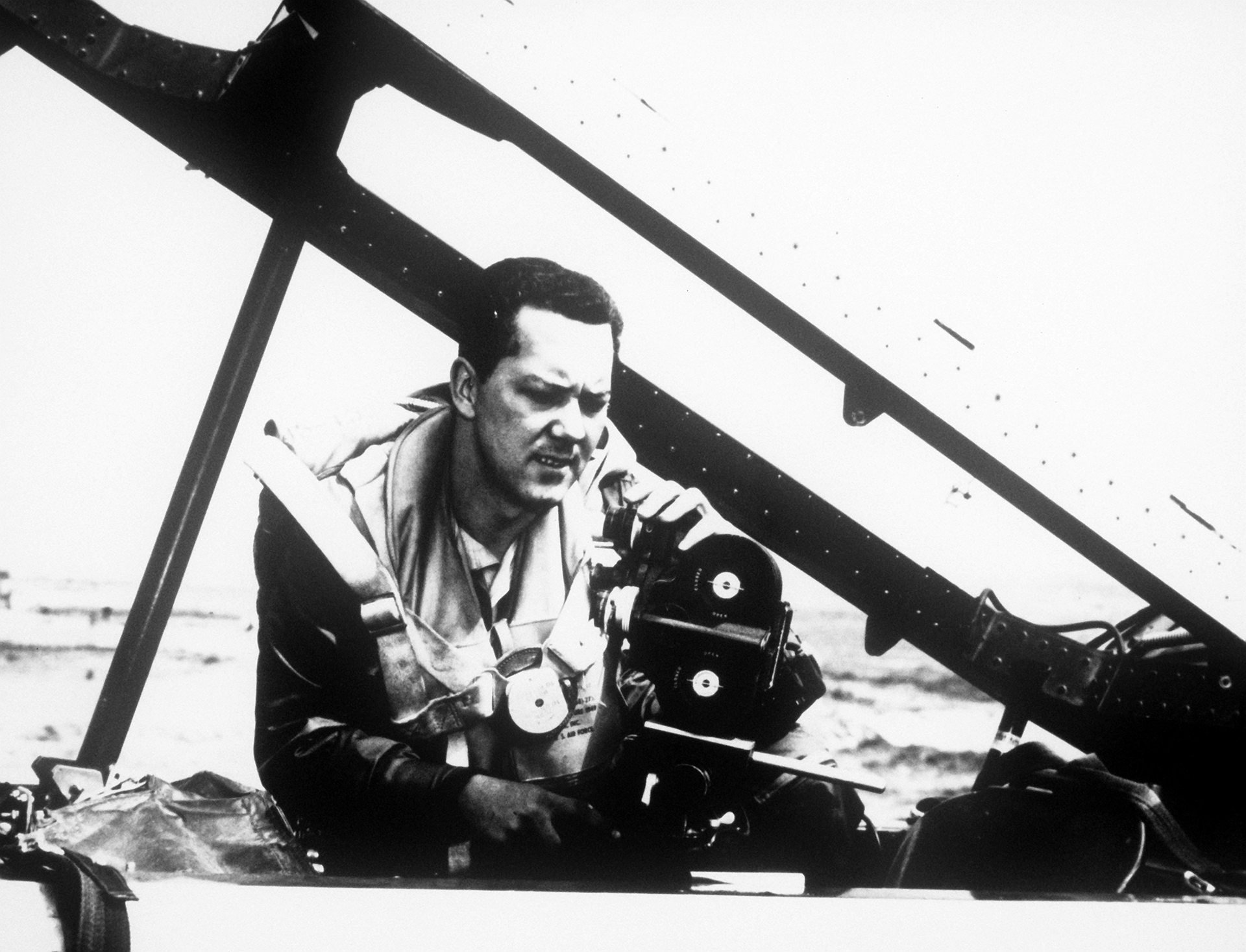
Pictured: a U.S. Air Force T-33 Shooting Star jet trainer, photographed on May 1, 1951 — four months before this case and the exact aircraft type flown by Lt. Wilbert S. Rogers and Maj. Edward Ballard Jr. over Point Pleasant that September. This is not a photograph of the actual aircraft, object, or incident; no photograph of either is known to exist in any archive consulted for this case file. (U.S. Department of Defense, VIRIN HF-SN-98-07317, public domain.)
Theoretical Alignment
This case's theoretical alignment leans toward the mundane end of this catalogue's spectrum, though less decisively than its low overall credibility score might suggest. The Extraterrestrial Hypothesis reading draws genuine support from a disc-shaped object independently seen by two Air Force officers performing a hover-and-reversal maneuver difficult to reconcile with a passive balloon, and from a radar contact fast enough to defeat automatic tracking. It is tempered by a first-instrument radar reading that came from a training set operated by a student, with no plotting record kept, and by an official period investigation that leaned — without fully concluding — toward a balloon explanation for the more dramatic visual sighting. Interdimensional Hypothesis alignment is low: every element reported here is a solid, radar- and eye-detectable target behaving like conventional matter, not a phenomenon suggestive of another plane of existence. The Psycho-Social/Mundane reading carries real weight because Evans Signal Laboratory, adjoining Fort Monmouth, was actively releasing high-altitude research balloons that same morning, and because this case's own most significant legacy is institutional rather than evidentiary: it is best remembered not for what flew over New Jersey, but for the Pentagon reorganization its press coverage set in motion.
Background
Fort Monmouth, New Jersey has been a U.S. Army Signal Corps installation since 1917, when 32 soldiers first arrived at what was then Camp Alfred Vail, named for the New Jersey telegraph pioneer who helped Samuel Morse commercialize the telegraph. The post gained permanent status in 1925 and was renamed Fort Monmouth for Revolutionary War soldiers who died at the nearby Battle of Monmouth Court House. By the mid-twentieth century it had become the Army's principal center for signal, communications, and radar research and training, incorporating the nearby Evans Signal Laboratory at Camp Evans in Belmar — the same radar research site where, in January 1946, the Army's Project Diana experiment first bounced radar signals off the Moon, a landmark achievement in what would become radio astronomy and an early demonstration of just how far this specific stretch of the Jersey Shore's radar expertise reached.
September 1951 fell in the middle of one of the most active and closely watched stretches of the entire early Cold War UFO period. Only weeks earlier, on August 25, 1951, the first of the Lubbock Lights sightings had begun drawing national press attention in Texas. The Air Force's own UFO investigation, Project Grudge, had been established by Gen. Charles P. Cabell in February 1949 specifically to study these reports, but by the fall of 1951 — under project head James Rodgers — it had drifted into near-total inactivity, its reports treated dismissively and, according to Edward J. Ruppelt's later account, its analysis reduced to little more than manufacturing plausible-sounding conventional explanations rather than genuinely investigating anything. It was into this atmosphere — an intensifying national wave of reports colliding with an Air Force UFO project that had all but stopped functioning — that the Fort Monmouth case arrived.
The base's radar school, where this case's first event unfolded, existed to train Signal Corps personnel on the Army's ground radar systems, including the AN/MPG-1, a mobile set originally developed for anti-aircraft searchlight direction and gun-laying training rather than as an operational early-warning instrument. Its "automatic tracking" mode allowed an operator to lock the set onto a target's velocity and let it track hands-free; that mode, this case's central technical detail, was precisely what failed on the morning of September 10, 1951.
Complete Timeline
| Date | Event |
|---|---|
| 1917 | Fort Monmouth is established as a U.S. Army Signal Corps installation. |
| 1941 | Evans Signal Laboratory (Camp Evans), Belmar, NJ, is established as part of the Signal Corps' radar research complex adjoining Fort Monmouth. |
| Jan. 1946 | Project Diana, based at Evans Signal Laboratory, achieves the first successful radar contact with the Moon. |
| Feb. 1949 | Gen. Charles P. Cabell establishes Project Grudge to investigate UFO reports; by 1951 the project has become largely inactive under project head James Rodgers. |
| Aug. 25, 1951 | The Lubbock Lights sightings begin in Texas, part of the same active national UFO-reporting period. |
| Sept. 10, 1951, ~11:15 a.m. EDT | PFC Eugene A. Clark, demonstrating automatic radar tracking to visiting officers at Fort Monmouth, detects a fast-moving, low-altitude target his AN/MPG-1 set cannot lock onto. |
| Sept. 10, 1951, ~11:18 a.m. EDT | The target exceeds the set's tracking capability and disappears north along the coastline; Clark estimates its speed at roughly 700 mph. |
| Sept. 10, 1951, ~11:12 a.m. EDT | Two balloons are released from Evans Signal Laboratory — a detail that becomes central to the case's later conventional-explanation debate. |
| Sept. 10, 1951, ~11:35 a.m. EDT | Lt. Wilbert S. Rogers, piloting a T-33 jet trainer at 20,000 feet near Point Pleasant with Maj. Edward Ballard Jr. observing, sights a dull silver, disc-shaped object below, descending toward Sandy Hook; he dives to pursue. |
| Sept. 10, 1951 | The object reportedly stops its descent, hovers, reverses course, and departs out to sea; Rogers and Ballard estimate its speed and size independently of each other. |
| Sept. 10, 1951, ~3:15 p.m. EDT | A second radar target is tracked at roughly 93,000 feet; this contact is confirmed, with "A-1" confidence, as a balloon deliberately tracked for an informal altitude-guessing pool among base personnel. |
| Sept. 11, 1951 | Two separate SCR-584 gun-laying radars detect a target north of the fort at an estimated "B-29 size"; one operator states it was "definitely not a balloon." |
| Sept. 12, 1951, 3:04 p.m. | An "Operational Immediate" priority teletype summarizing the Fort Monmouth events reaches the Air Technical Intelligence Center (ATIC). |
| Late Sept. 1951 | Press coverage of the case reaches Gen. Cabell's office; he learns Project Grudge has become largely inactive and orders an immediate field investigation. |
| Sept. 28–Oct. 2, 1951 | Lt. Col. N.R. Rosengarten and Lt. Jerry Cummings travel to Fort Monmouth, interrogating Clark, Rogers, Ballard, and other radar and weather personnel. |
| Oct. 1, 1951 | Cabell convenes a Pentagon meeting; Cummings' candid account of Grudge's dysfunction prompts Cabell to order the project's reorganization ("New Grudge"). |
| Oct. 16, 1951 | Rosengarten and Cummings file their field investigation report on the Fort Monmouth events. |
| Nov. 1951 | Cabell reassigns several ATIC officers and places Capt. Edward J. Ruppelt in charge of the reorganized project. |
| Nov. 30, 1951 | Ruppelt files a status report to the Pentagon on the Fort Monmouth case, drawing on Henry Metscher's balloon analysis. |
| March 1952 | The reorganized project is formally renamed Project Blue Book, with Ruppelt as its first head. |
| 1956 | Ruppelt's The Report on Unidentified Flying Objects is published, devoting substantial narrative to this case's role in Blue Book's creation. |
| 1999 | Researchers Michael D. Hall and Wendy Connors interview Lt. Col. Rosengarten directly about the case. |
| 2000 | Hall and Connors publish Captain Edward J. Ruppelt: Summer of the Saucers — 1952, incorporating their Fort Monmouth research. |
| 2026 | This case file is published, confirming the "Coming Soon" queue placeholder's date and core facts while clarifying that the "disc" description belongs to the T-33 crew's visual sighting, not the radar contact. |
The Radar Contact: PFC Clark and the AN/MPG-1
The case began, by all accounts, as a routine training exercise. At the Fort Monmouth radar school on the morning of September 10, 1951, a student operator — identified in the subsequent field investigation as PFC Eugene A. Clark — was demonstrating the AN/MPG-1 set's automatic tracking function for a group of visiting Army officers. Automatic tracking allowed the set, once locked on, to follow a target's velocity without further manual adjustment; it was a capability built around the speeds of conventional propeller and early jet aircraft of the era, not around anything faster. At approximately 11:15 a.m., Clark picked up a low-flying target approaching from the coast. According to Edward Ruppelt's own later account of the moment, Clark told the officers watching over his shoulder that the target was moving too fast for the set to hold — specifically, that this meant it had to be moving faster than a jet.
The target held Clark's scope for roughly three minutes before it outran the set's tracking limits entirely and vanished north along the coastline. Working from the AN/MPG-1's manual-mode readings rather than a locked automatic track, Clark estimated the target's speed at approximately 700 mph — a figure this case file's own research treats as a genuine estimate rather than a precise instrumented measurement, given the set's own failure to achieve lock. What makes the moment more than an isolated trainee's impression is the presence of the visiting officers: several senior personnel independently watched the same anomalous scope behavior unfold in real time, providing a second and third set of eyes on the readout itself, even though none of them could independently verify what, if anything, was physically producing the return. No plotting record was kept of the contact, a limitation the later field investigation attributed to the radar school's role as a training environment rather than an operational tracking station, and one this case file discloses honestly as a real gap in the surviving data.
The Following Day's SCR-584 Contacts
The case did not end with Clark's three-minute contact. That afternoon, at approximately 3:15 p.m., Fort Monmouth's radar registered a separate target climbing to roughly 93,000 feet; this contact was independently and confidently identified — assigned an "A-1" evaluation, the highest confidence rating in the investigators' own scale — as a balloon that base personnel had deliberately released and were tracking for an informal altitude-guessing pool, complete with dollar-stake wagers among the men involved. The following day, September 11, two separate SCR-584 gun-laying radars — a well-proven World War II-era fire-control set, distinct from the AN/MPG-1 training radar involved the day before — detected a target north of the fort at an elevation of roughly 300 to 350 mils and a range of about 30,000 yards. One radar operator, identified in the investigation only as Mr. Meyer, judged the target's radar cross-section consistent with a "B-29 size" aircraft and stated explicitly that it was not a balloon. This second-day contact remains, in the surviving record, an isolated and undeveloped data point: no visual sighting accompanied it, and the field investigators' own report concluded there was not sufficient data to reach any firm conclusion about it.
The T-33 Intercept: Rogers, Ballard, and the "Discus-Like" Object
Roughly twenty-five minutes after Clark's radar contact disappeared from the Fort Monmouth scope, and some twenty-odd miles to the south, Lt. Wilbert S. Rogers was piloting a T-33 jet trainer at 20,000 feet near Point Pleasant, New Jersey, with Maj. Edward Ballard Jr. riding as observer. At approximately 11:35 a.m., Rogers spotted a dull silver, disc-like object far below his aircraft, silhouetted against the ground — itself a detail later analysts have treated as evidence the object was flying well under the T-33's own 20,000-foot altitude, since a target near or above that height would not appear silhouetted against terrain. Rogers and Ballard independently described the object as circular in outline, appearing to shift toward elliptical as it banked, and estimated its diameter at roughly 30 to 50 feet.
Rogers banked the T-33 over and dove to pursue. As he did, the object — which had been descending toward Sandy Hook from an altitude the pilots judged at roughly a mile — stopped its descent, hovered briefly, then reversed course and accelerated away to the south before vanishing out over the Atlantic. Sources consulted for this case file describe the reversal itself inconsistently: some give a 120-degree turn, others a tighter, near-360-degree maneuver; this file discloses that inconsistency honestly rather than picking whichever figure sounds more dramatic. What is consistently reported across every source is the sequence itself — descent, sudden hover, reversal, high-speed departure — and the pilots' own estimate that the object briefly covered somewhere in the range of 35 to 50 miles within about two minutes of observed motion, implying speeds researchers have subsequently calculated at anywhere from roughly 700 to as much as 900 mph depending on the specific distance and timing assumptions used. Rogers pushed the T-33 from approximately 450 to 550 mph attempting to close the distance and could not match the object's own apparent speed.
Both pilots maintained, when later confronted with the balloon explanation ATIC would propose, that they had never seen anything like the object before and were confident it was not a balloon. Lt. Col. Rosengarten, who personally interviewed both men during the October field investigation, later recalled that the pilots reacted to the balloon theory with real indignation, feeling the analysis rested on several mistaken assumptions about what they had actually observed.
The Balloon Explanation and Brad Sparks' Rebuttal
The Army investigation conducted in the days immediately after the sighting had already identified two balloons released from Evans Signal Laboratory at approximately 11:12 a.m. — just minutes before Clark's radar contact and roughly twenty minutes before the T-33 sighting — as a plausible explanation worth investigating. ATIC engineer Henry "Hank" Metscher, a colleague Ruppelt trusted, subsequently developed this into a fuller analysis, arguing that the balloon's position along the pilots' line of sight, combined with the T-33's own changing position and speed, could account for every reported motion of the object without requiring it to be a physical craft performing genuine maneuvers at all. Ruppelt relied on Metscher's work for a status report filed with the Pentagon on November 30, 1951, and the Army's own October 16 field investigation report similarly concluded there was "a strong possibility" the T-33 sighting was of a balloon, citing the balloons' 11:12 a.m. release time and a burst diameter of roughly 39 feet — a figure notably close to the pilots' own 30-to-50-foot size estimate for the object.
Independent researcher Brad Sparks, in a later technical re-examination of the case, has raised several specific and, this case file's own research finds, substantive objections to the balloon explanation. First, and most fundamentally, two balloons were released simultaneously from the same site, while Rogers and Ballard both reported seeing only one object — a basic numerical mismatch the original 1951 investigators do not appear to have directly addressed. Second, Sparks calculates that a balloon ascending at a typical rate of roughly 1,300 feet per minute would have reached an altitude near 27,000 feet by the time of the 11:35 a.m. sighting, well above the T-33's own 20,000-foot altitude and inconsistent with the pilots' report of the object silhouetted against the ground below them. Third, Sparks argues that a balloon at the reported distance would have subtended an angular size of roughly 0.6 arcminutes — below the resolving power of unaided human vision, which he places at approximately 0.7 arcminutes — making it difficult to reconcile with the pilots' detailed, structured description of shape and color. Finally, Sparks contends that an object actively descending and then reversing course under what appeared to be controlled flight does not match the passive, wind-driven behavior expected of a rising balloon.
This case file's own assessment is that Sparks' rebuttal identifies real, substantive problems with the balloon explanation as specifically applied to the T-33 sighting, without being able to fully disprove it: distance and altitude estimates made by pilots in the middle of an unexpected, adrenaline-charged pursuit are themselves a known source of error, and the near-coincidence between the balloons' 11:12 a.m. release and burst diameter and the object's own reported size is difficult to dismiss as pure coincidence. What can be said with more confidence is that the balloon explanation was never as clean or fully demonstrated as the Air Force's public framing sometimes suggested, and that the case's own official 1951 investigators, working with the primary evidence firsthand, went only as far as calling it a "strong possibility," not a certainty.
From Fort Monmouth to the Pentagon: General Cabell and the Birth of Blue Book
The Fort Monmouth case's lasting significance in Air Force UFO history has comparatively little to do with what specifically flew, or didn't fly, over New Jersey that September morning, and a great deal to do with what happened next in Washington. In the days following the sighting, reports of the incident began circulating beyond normal Air Force intelligence channels and reached the press. When Maj. Gen. Charles P. Cabell, the Air Force's director of intelligence and the officer who had personally established Project Grudge in February 1949, learned of the coverage in late September, he sought an update on the investigation — and discovered that Grudge had drifted into near-total inactivity under its existing leadership.
Cabell ordered an immediate field investigation, transmitted with "Operational Immediate" priority, the highest peacetime routing designation available. Lt. Col. N.R. Rosengarten, head of ATIC's aircraft and missiles branch, and Lt. Jerry Cummings traveled to Fort Monmouth from September 28 to October 2, personally interviewing Clark, Rogers, Ballard, and the radar and weather personnel involved. On October 1 (some accounts place the meeting on October 2), Cabell convened a Pentagon meeting to review the case and Grudge's broader state. Cummings, briefing Cabell directly, gave a blunt account of how UFO reports had been handled inside the project — treated dismissively, with analysis amounting to little more than assembling plausible-sounding conventional explanations rather than genuinely investigating anything. Ruppelt's own published account describes Cabell's reaction as genuinely angry, with much of the room visibly affected; Rosengarten's own later recollection, given to researchers Michael D. Hall and Wendy Connors in 1999, was comparatively more measured, recalling the meeting as low-key and Cabell's specific frustration as directed more at the fact of press coverage on the subject than at ATIC's investigative competence as such. This case file presents both recollections rather than treating either as the single authoritative account, since the two come from participants with different vantage points on the same room.
Whichever version of the meeting's tone is more accurate, its practical consequences are not in dispute. Cabell ordered the project reorganized under the informal working name "New Grudge." Several ATIC officers were reassigned in the aftermath: Col. Watson was moved to a posting in Europe, Col. Bruno Feiling was replaced as analysis chief by Col. S.H. Kirkland, and Pentagon liaison Jerry Boggs was replaced by Maj. Dewey Fournet. Capt. Edward J. Ruppelt, an ATIC intelligence officer not previously in a leadership role on the project, was placed in charge of the reorganized effort. By March 1952, that reorganized project had grown from a subordinate function within a larger group into its own formal organization and had acquired the name by which it is remembered today: Project Blue Book. In his 1956 book, Ruppelt frames the Fort Monmouth case as a direct catalyst in this chain of events — not the sole cause of Grudge's problems, which had been building for years, but the specific case whose press exposure forced Cabell's hand and set the reorganization in motion. This case file's own research finds that framing well supported by the documentary record: the timeline from the September 12 "Operational Immediate" teletype through the October 1 Pentagon meeting to Ruppelt's own November appointment is direct, close, and consistently corroborated across Ruppelt's book, the Rosengarten/Cummings field report, and Hall and Connors' independent interview-based reconstruction.
Untangling the Placeholder's "Radar Tracks a Disc" Framing
This case file was commissioned to research a "Coming Soon" queue placeholder describing "Army Signal Corps radar tracks a disc at ~700 mph; a T-33 jet pilot visually confirms it minutes later — a case Ruppelt later credited as a catalyst for Project Blue Book." Two-pass research for this file confirms every load-bearing element of that description as real and well documented: the September 10, 1951 date, the roughly 700 mph radar estimate, a T-33 pilot's visual sighting minutes after the radar contact, and Ruppelt's own book crediting this specific case as the proximate trigger for Project Grudge's reorganization into Project Blue Book. This is a genuine, historically significant case, not a hallucinated queue entry of the kind this site's Coming Soon Queue Verification process has caught and removed elsewhere.
One phrasing in the placeholder does conflate two separate parts of the case, and this file corrects that conflation rather than reproducing it uncritically. The Army Signal Corps radar contact — PFC Clark's three-minute AN/MPG-1 detection — never resolved any shape at all; it was a fast-moving return that defeated automatic tracking, nothing more, and the surviving investigation record and Ruppelt's own account are both explicit that the set provided only speed and direction, not a visual profile. The "disc" description belongs entirely to the separate, later visual sighting by Rogers and Ballard in their T-33, twenty-five minutes afterward and twenty-some miles to the south. The placeholder's phrasing, taken literally, implies the radar itself tracked a disc-shaped target, which is not what any source consulted for this case file supports. This file's own subtitle and metadata grid state the distinction explicitly rather than let the placeholder's shorthand stand as written.
Key Witnesses
PFC Eugene A. Clark
A trainee operator at the Fort Monmouth radar school, Clark was demonstrating automatic tracking for visiting officers when he detected the fast, low-altitude target this case's radar record is built around. His status as a student, and the absence of any plotting record from the contact, are real, disclosed limitations on the data's precision; the presence of multiple senior officers who independently watched the same anomalous scope behavior in real time is a genuine, if partial, offsetting factor.
Lt. Wilbert S. Rogers
Rogers piloted the T-33 that sighted the disc-shaped object over Point Pleasant, banking and diving to pursue it before it hovered, reversed, and departed out to sea. As a commissioned Air Force officer flying a high-performance jet, his professional training in distinguishing aircraft from other aerial phenomena is a positive credibility signal, though the specific distance and altitude estimates he made in a brief, unexpected pursuit are exactly what the balloon-explanation debate turns on.
Maj. Edward Ballard Jr.
Riding as observer in Rogers's T-33, Ballard independently corroborated the sighting's core details — the object's shape, size, and maneuver sequence — providing this case with two-witness agreement inside a single aircraft rather than a lone pilot's uncorroborated account. Like Rogers, he rejected the balloon explanation when it was later proposed to him.
Visiting Army Officers (Unnamed)
Standing behind PFC Clark during his automatic-tracking demonstration, these unnamed officers independently witnessed the AN/MPG-1 scope's anomalous behavior as it happened, providing corroboration for the radar event's basic reality even though none of them could independently verify what was producing the return. No individual names survive for this group in any source consulted for this case file.
Mr. Meyer
One of the operators who tracked the separate September 11 SCR-584 contact, Meyer judged the target's radar signature consistent with a "B-29 size" aircraft and stated it was not a balloon — a data point the original 1951 investigators themselves treated as insufficient, on its own, to reach any firm conclusion.
The Five Observables Assessment
Assessment: This case registers more actively on the Five Observables framework than its modest overall credibility score might imply, though each positive reading carries a real, disclosed caveat. Anti-Gravity Lift is rated Present specifically on the strength of Rogers and Ballard's report that the object stopped its own descent and hovered before reversing — behavior distinct from a balloon's passive drift, if the sighting is taken at face value. Instant Acceleration is rated Present for the same reversal-and-departure sequence, though the exact degree of the maneuver (a 120-degree turn versus a tighter reversal) is inconsistently reported across sources. Hypersonic is rated Speculative rather than Present or Absent: the estimated 700-to-900 mph range is genuinely fast for 1951 civil and most military aircraft and approaches transonic speeds, but falls well short of the multi-Mach figures this site's genuinely hypersonic cases report, and rests on pilot-estimated distance and timing rather than an instrumented measurement. Low Observability is rated Absent: far from evading detection, the object (or objects) registered on radar and was tracked visually by two independent witnesses. Trans-Medium is rated Absent, as no water, ground, or space transition was reported.
Evidence Assessment
Supporting Anomalous Origin
- A radar contact fast enough to defeat an operational automatic-tracking radar, witnessed in real time by multiple military personnel, not merely by the single operator involved
- Two independent, commissioned Air Force officers in the same aircraft corroborated a structured visual description — shape, size, color, and a specific maneuver sequence — rather than a vague light or glow
- The reported hover-and-reversal maneuver is difficult to reconcile with the passive, wind-driven motion expected of a rising balloon, a point researcher Brad Sparks has argued in detail
- Both pilots rejected the balloon explanation when it was formally proposed to them, citing specific errors they believed the analysis contained
- The case is documented not only by later secondary compilation but by a declassified, contemporaneous Army field investigation report naming the specific personnel involved
Supporting Conventional Explanation
- Two balloons were released from Evans Signal Laboratory only minutes before both the radar contact and the visual sighting, and the Army's own 1951 field investigation concluded there was a "strong possibility" the T-33 sighting was one of them
- The radar contact itself came from a training set operated by a student, with no plotting record kept, and the official investigation found insufficient data to reach any firm conclusion about it
- Pilot-estimated distance, altitude, and speed figures made during a brief, unplanned pursuit are a well-documented source of error, and the case's most dramatic numbers (35–50 miles in two minutes; 900 mph) all derive from exactly this kind of estimate
- No photograph, film, or physical trace of either the radar target or the visual object exists in any archive consulted for this case file
- Every specific figure in this case file's radar and balloon-release timeline traces back to a single 1951 investigation and later secondary compilations of it, not to this case file's own independent instrumentation analysis
Why "Disputed"
This case earns a DISPUTED classification with a credibility score of 46/100. That places it below this catalogue's Fort Worth AFB Sighting (Disputed, 60), whose triple-radar corroboration and unresolved official Unknown status outweigh Fort Monmouth's single-site, student-operated radar contact, but above cases where the conventional explanation is essentially conclusive, such as Thomas Mantell (Disputed, 38). It sits in a comparable range to Woomera (Disputed, 52), sharing a similar profile of genuinely dramatic reported behavior offset by real, unresolved data-quality problems.
What keeps this case from climbing higher is a combination of thin instrumentation and an official period investigation that leaned, even if it did not fully conclude, toward a conventional explanation for its most dramatic element. The radar contact rests entirely on a student operator's manual-mode reading from a training set never designed for precision tracking, with no plotting record preserved; the case's own 1951 investigators explicitly found insufficient data to reach a conclusion about it. The T-33 sighting is more evidentially interesting — two corroborating officers, a structured description, a hover-and-reversal maneuver hard to square with a passive balloon — but it unfolded during a brief, adrenaline-charged pursuit of exactly the kind known to produce distance and speed misjudgments, and it happened within minutes of two balloons being released from the very laboratory adjoining the radar site, a coincidence in timing and reported size that Brad Sparks' rebuttal weakens without eliminating. What elevates the case above the weakest end of this catalogue's range is that its significance is genuinely, independently attested across multiple sources with different vantage points — Ruppelt's own book, Rosengarten's later interview, and the Army's contemporaneous field report all agree on the case's basic facts and its consequences, even where they differ on tone and precise numbers. A case this consequential to Air Force UFO history, and yet this thin in its own primary instrumentation and this genuinely contested on its leading conventional explanation, is exactly the profile this site's "Disputed" rating in the lower-middle of its range exists to describe.
Sensor & Instrumentation Detection Profile
This case's instrumentation record is real but comparatively thin next to this site's stronger radar-visual files. The initial September 10 contact was recorded solely by Fort Monmouth's AN/MPG-1, a mobile radar set built for anti-aircraft searchlight-direction and gun-laying training rather than as a precision tracking instrument, operated in this instance by a student whose manual-mode speed estimate (roughly 700 mph) was never independently cross-checked by a second radar or instrument during the contact itself. The afternoon balloon-pool contact at 93,000 feet was tracked by the same general radar infrastructure and confirmed with high confidence as a known, deliberately released balloon. The following day's SCR-584 contacts came from a different, better-proven fire-control radar type, but were themselves never cross-referenced against a simultaneous visual sighting. No infrared, electromagnetic-interference, or radiological sensor data of any kind is documented for any of these events, consistent with the limited sensor suite available to a 1951-era Army post.
Environmental & Geospatial Context
Fort Monmouth sits on New Jersey's northern coastal plain, close enough to the Atlantic shoreline that both this case's key locations — the fort itself and Point Pleasant, roughly twenty miles south — lie within a few miles of open water, consistent with the T-33 object's reported departure out to sea. Fort Monmouth's own technicians checked the day's weather data at the time of the radar contact and found no indication of a temperature-inversion layer, the atmospheric condition most commonly invoked to explain anomalous radar returns via ducting or false targets — a detail this case file's research treats as a genuine, disclosed data point weighing somewhat against a purely atmospheric explanation for the radar contact, though it does not by itself resolve what did produce the return. No specific cloud cover, wind, or visibility data for the T-33 sighting was located in any source consulted; the pilots' own account of a sustained pursuit with a clear visual profile implies reasonably good midday visibility. Geospatially, the case sits within one of the most radar-dense stretches of the Eastern Seaboard for its era — a direct consequence of Fort Monmouth's role as the Army's premier Signal Corps radar research and training center, the same infrastructure that had, only five years earlier, made first radar contact with the Moon from a laboratory a few miles up the coast.
Observer Credibility & Occupational Profile
This case's witnesses present a genuinely mixed credibility profile rather than a uniformly strong or weak one. PFC Eugene A. Clark was, by his own role in the incident, a student rather than a qualified operator — a real, disclosed limitation on the radar reading's precision, though partially offset by the presence of multiple senior officers who independently observed the same scope anomaly as it happened, rather than relying on Clark's account alone after the fact. Lt. Wilbert S. Rogers and Maj. Edward Ballard Jr., by contrast, were both commissioned Air Force officers with professional flight training built specifically around distinguishing genuine aircraft and aerial threats from routine phenomena — exactly the kind of trained-observer profile this site's Two-Pass Research Rule looks for as a positive credibility signal. Their corroboration of each other, from two independent vantage points inside the same cockpit, strengthens the sighting's core details considerably.
Set against this occupational strength is the specific nature of what is actually in dispute: not whether Rogers and Ballard saw something, but whether their distance, altitude, and size estimates — made during a short, unplanned, high-adrenaline pursuit — were accurate enough to rule out a balloon at a greater distance and altitude than they judged in the moment. This is a different, and in some ways harder, credibility question than outright fabrication or misperception of a light as a solid object; it is the kind of estimation error that even trained, honest observers are well documented to make under exactly these conditions. This case file's own assessment treats the officers' professional training as a real positive signal while treating the specific numerical estimates at the center of the balloon debate as genuinely uncertain, not as settled in either direction.
Physical & Material Assays
No physical trace evidence of any kind exists for this case. Neither the radar target nor the visually sighted object was ever reported landing, and the entirety of the case's interaction with the physical world consists of a single ground radar's readings, a two-man airborne visual account, and a second day's separate SCR-584 contact. No debris, ground trace, or material sample was ever recovered or is claimed to exist in any source consulted for this case file. See Material Analysis below for a full discussion of what does and does not survive of the case's documentary record.
Historical Precedents & Archive Matches
This case's most direct precedent, ironically, sits in Fort Monmouth's own institutional history: the Evans Signal Laboratory site adjoining the radar school had achieved the first successful radar contact with the Moon just five years earlier, in January 1946's Project Diana experiment — a striking contrast between that laboratory's landmark technical success at extreme range and its own training radar's inability, five years later, to resolve what a fast-moving target closer to home actually was. Within the same active national reporting period, the Lubbock Lights sightings had begun in Texas barely two weeks before Fort Monmouth's radar contact, part of the same broader 1951 wave of UFO activity that helped create the press environment in which Cabell's office first learned of this case.
The single most direct institutional precedent, however, connects forward in time rather than backward: the same Grudge-to-Blue-Book reorganization this case triggered would be tested again, more publicly and dramatically, less than a year later, when the July 1952 Washington D.C. UFO Flap brought radar-visual reports over the nation's capital directly to President Truman's attention, forcing Ruppelt's newly reorganized Blue Book into its highest-profile early test. Comparing the two cases side by side is instructive: Fort Monmouth's press leak reached a Pentagon director of intelligence and produced an internal reorganization few members of the public ever heard about at the time; Washington's radar returns reached the White House itself and produced the Air Force's largest press conference on the UFO subject to that point. This case file treats Fort Monmouth as the quieter, institutional first domino in a chain that Washington would make unmistakably public the following summer.
Material Analysis
There is no physical object, debris, or trace sample connected to this case; "material" here refers instead to the case's actual surviving evidentiary substrate — the Army's own 1951 field investigation report, Edward Ruppelt's later published and unpublished accounts, and the researcher work that has since cross-referenced them — since that documentary record is the only tangible thing this case file's research was able to assess.
The Surviving Documentary Record
This case is unusually well documented for its era by the standards of this site's other early-1950s files, because it generated its own dedicated, contemporaneous investigation rather than surviving only through later summary. Lt. Col. N.R. Rosengarten and Lt. Jerry Cummings' field investigation, conducted September 28 through October 2, 1951, and filed October 16, 1951, named specific personnel — PFC Clark, Lt. Rogers, Maj. Ballard, and several additional radar and weather staff — and recorded specific technical readings (the AN/MPG-1's manual-mode speed estimate, the SCR-584 elevation and range figures, the balloon release time and burst diameter) that this case file's research located preserved and hosted, in transcribed form, by NICAP. Edward Ruppelt's own 1956 book and his separately preserved private papers and unpublished manuscript — the latter housed with Professor Michael Swords at Western Michigan University and the J. Allen Hynek Center for UFO Studies — provide a second, independent layer of documentation, and researchers Michael D. Hall and Wendy Connors' 1999 interview with Rosengarten himself provides a third, oral-history layer distinct from either the official report or Ruppelt's own writing. Having three independently sourced accounts — a contemporaneous official report, a participant's later published narrative, and a separate participant's recorded interview decades afterward — agreeing on the case's core facts is a genuinely stronger documentary foundation than several of this site's other 1950s-era files can claim.
What Does Not Survive
No photograph, film, or physical trace of either the radar target or the visually sighted object is known to exist in any archive consulted for this case file. This case file's own research was not able to directly examine a high-resolution scan of the original Blue Book microfilm frame for this case, relying instead on NICAP's hosted transcription of the Rosengarten/Cummings report and on Ruppelt's, Hall's, and Connors' published narratives; a small residual possibility of transcription drift between the original 1951 documents and these secondary renderings cannot be entirely excluded, the same disclosed limitation this site applies to several of its other Blue Book-era files. No period New Jersey newspaper coverage of the specific September 10 events was independently located in the sources consulted for this case file, though the case's escalation to the Pentagon was itself driven by press attention reaching Washington through channels this file's research could not fully retrace to a specific original news article.
Supporting Non-Terrestrial or Unexplained Origin
- Three independently sourced accounts — a contemporaneous 1951 field investigation, Ruppelt's own later narrative, and Rosengarten's 1999 recorded interview — agree on the case's basic facts, an unusually strong documentary triangulation for a case this old
- Two corroborating, professionally trained Air Force officers reported a structured object description and a maneuver sequence difficult to reconcile with passive balloon drift
- The radar contact was witnessed in real time by multiple observers, not reconstructed solely from one operator's after-the-fact account
Supporting Terrestrial or Mundane Origin
- This case file's research could not directly examine a primary Blue Book microfilm image, relying on secondary transcriptions and published narratives
- No photograph or physical trace exists to allow any independent modern re-analysis of either the radar contact or the visual object
- Two balloons released minutes before both events, from a laboratory adjoining the radar site, remain a genuine and only partially rebutted conventional candidate for the case's most dramatic element
The Conventional Explanation Candidate (CEC): Evans Signal Laboratory Research Balloons
The two balloons released from Evans Signal Laboratory at approximately 11:12 a.m. on September 10, 1951 — minutes before both the radar contact and the T-33 sighting — are the leading, officially favored conventional explanation for this case's visual event, and this case file treats the candidate seriously precisely because the Army's own 1951 investigators, working with fresh primary evidence and direct access to the witnesses, went only as far as calling it a "strong possibility," not a settled conclusion.
Balloon Misidentification (T-33 Visual Sighting)
This candidate accounts well for the object's reported size (its 30-to-50-foot estimate sits close to the balloons' own roughly 39-foot burst diameter) and for the timing coincidence of a balloon release minutes before the sighting. It sits less comfortably against Brad Sparks' specific technical objections: two balloons released versus one object seen, an altitude mismatch between the T-33's 20,000-foot vantage and where a balloon ascending at a typical rate would have been by 11:35 a.m., the angular-size problem for resolving shape and color at the estimated distance, and the object's reported active hover-and-reversal rather than passive drift. None of these objections individually disproves the balloon candidate, but together they keep it from rising above Inconclusive.
Student-Operator Error or Radar Scope Artifact (Radar Contact)
Separately from the balloon question, the morning's radar contact itself has its own, distinct conventional candidate: a training-radar reading taken by an inexperienced student operator, in manual mode, with no plotting record kept, could plausibly reflect operator error, an unfamiliar but conventional aircraft, or a scope artifact rather than a genuinely fast unconventional target. The Army's own 1951 investigators reached exactly this open conclusion, finding insufficient data either way. This candidate is independent of the balloon explanation for the visual sighting; the two events, though close in time, involve different instruments, different witnesses, and potentially different underlying causes.
Genuine Unconventional Aerial Object
This reading remains open for both events, on the strength of two corroborating trained officers reporting a structured, active maneuver sequence and a radar contact witnessed in real time by multiple observers. It is tempered by the case's reliance on pilot-estimated (rather than instrumented) distance and speed figures, by the radar contact's own unresolved, student-operated data quality, and by the substantive, if not fully conclusive, balloon timing coincidence.
Evans Signal Laboratory Balloon
InconclusiveINCONCLUSIVE for the T-33 visual sighting. Matches the object's estimated size and the release timing closely, but Brad Sparks' technical objections (two balloons vs. one object, altitude mismatch, angular resolution, active vs. passive motion) keep it from being confirmed.
Student-Operator Error / Scope Artifact
InconclusiveINCONCLUSIVE for the radar contact specifically. A real, plausible candidate given the set's training-only role and the absence of a plotting record, but the Army's own 1951 investigators found insufficient data to confirm or rule it out.
Genuine Unconventional Aerial Object
InconclusiveINCONCLUSIVE. Supported by two-witness airborne corroboration and a real-time-witnessed radar anomaly, but limited by non-instrumented estimates and a substantive, unresolved balloon timing coincidence for the visual sighting.
Related Cases
Confirmed Documents & Official Records
NARA's own guide to the declassified Project Blue Book records (Microfilm Publication T1206, 94 rolls) that hold this case's underlying Air Force file, catalogued from the reorganized project this case helped create.
DECLASSIFIEDThe CIA's own declassified-document collection on UFOs, covering the same early-1950s period as this case, including internal Agency material on how the government tracked and responded to the era's UFO reporting.
DECLASSIFIED (various)This case file's research could not obtain a directly legible primary-source scan of the original October 16, 1951 Rosengarten/Cummings field investigation report; the specific figures and personnel names presented above are drawn from a transcription of that report hosted by NICAP, cross-checked against Edward Ruppelt's own published account and Michael D. Hall and Wendy Connors' 1999 interview-based research, rather than from this case file's own examination of the original document image.
Search Government & Military Archives Directly
Further Reading — Recommended Literature
The Report on Unidentified Flying Objects: The Original 1956 Edition
Ruppelt's own foundational account, written by the first head of Project Blue Book, devotes substantial narrative to the Fort Monmouth case's direct role in triggering the reorganization that created the project he would go on to lead.
Captain Edward J. Ruppelt: Summer of the Saucers — 1952
Drawing on Ruppelt's own private papers and a direct 1999 interview with Lt. Col. N.R. Rosengarten, this study provides the most detailed independent reconstruction available of the Fort Monmouth investigation and the Pentagon meeting that followed it.
UFOs and Government: A Historical Inquiry
A scholarly, multi-author history of government UFO investigation from World War II onward, useful for situating Project Grudge's 1951 dysfunction and reorganization within the Air Force's broader institutional response to the phenomenon.
The UFO Encyclopedia, 4th Edition (2-Volume Set)
The standard comprehensive reference for cataloged UFO cases, useful for situating this Fort Monmouth radar-visual case within the broader documented pattern of early-1950s American military UFO reporting.
Watch the Skies!: A Chronicle of the Flying Saucer Myth
A rigorously researched, skeptically inclined cultural history of American UFO reporting, useful as a counterweight when evaluating the balloon explanation this case file weighs against the Fort Monmouth radar and visual data.
Essential Viewing
No Videos Available
This case file's research located no video, documentary segment, or news report found to be genuinely, primarily about the specific September 10, 1951 Fort Monmouth incident, as opposed to generic overviews of Project Grudge, Project Blue Book, or unrelated 1950s UFO cases. Consistent with this site's video verification standard, no off-topic or recycled video has been substituted in its place.
Sources
- NICAP. "Fort Monmouth Incident, Sept. 10, 1951." nicap.org
- NICAP. "The Fort Monmouth Case: A New Look" (analysis drawing on Michael D. Hall & Wendy Connors' research). nicap.org
- NICAP. "Monmouth Case Update," Brad Sparks' technical analysis of the balloon explanation. nicap.org
- NICAP. Transcription of the Rosengarten/Cummings field investigation report, Sept. 10–11, 1951 incidents. nicap.org
- Ruppelt, Edward J. The Report on Unidentified Flying Objects (1956), chapters covering Project Grudge's 1951 reorganization and the Fort Monmouth case.
- Ruppelt, Edward J. The Report on Unidentified Flying Objects, full text. sacred-texts.com
- Hall, Michael D., and Wendy Connors. Captain Edward J. Ruppelt: Summer of the Saucers — 1952 (2000), incorporating a 1999 interview with Lt. Col. N.R. Rosengarten.
- Swords, Michael, and Robert Powell, et al. UFOs and Government: A Historical Inquiry (2012).
- Clark, Jerome. The UFO Encyclopedia, 4th ed. (2 vols.).
- Peebles, Curtis. Watch the Skies!: A Chronicle of the Flying Saucer Myth (1994).
- Wikipedia. "Project Grudge." en.wikipedia.org
- Wikipedia. "Project Blue Book." en.wikipedia.org
- Wikipedia. "Edward J. Ruppelt." en.wikipedia.org
- Wikipedia. "Charles P. Cabell." en.wikipedia.org
- Wikipedia. "Lockheed T-33." en.wikipedia.org
- Wikipedia. "Camp Evans Historic District." en.wikipedia.org
- Wikipedia. "Project Diana." en.wikipedia.org
- InfoAge Science and History Museums. "Belmar Camp Named 'Evans.'" infoage.org
- National Archives and Records Administration. "Project BLUE BOOK: Unidentified Flying Objects." archives.gov
- Central Intelligence Agency. FOIA Reading Room, "UFOs: Fact or Fiction?" collection. cia.gov
- Wikimedia Commons. "File:SSgt Robert E. Williams...T-33 jet plane HF-SN-98-07317.jpg" (U.S. Department of Defense, public domain), source of this case file's hero image. commons.wikimedia.org
- This site's own case file, "Washington D.C. UFO Flap" (July 1952), for the later, more public test of the reorganized Blue Book project. The Omni Ledger
- This site's own case file, "Lubbock Lights Incident" (Aug. 1951), for the concurrent national UFO-reporting wave. The Omni Ledger
See something inaccurate? Have additional information or sources?
Suggest an Edit →Last Updated: August 2026