
Ceará Boeing 727 Sighting
In the pre-dawn hours of February 8, 1982, VASP Flight 169 — a Boeing 727 (registration PP-SNG) that had departed Fortaleza, Ceará, bound for Rio de Janeiro — was reportedly paced for roughly ninety minutes and five Brazilian states by an intensely bright, color-changing light. Captain Gerson Maciel de Britto, a 30-year VASP veteran, calmly announced the object over the intercom and invited his roughly 150 passengers to the left-side windows; Brasília's air-defense radar center briefly reported an unidentified contact, and two other airline crews on the same corridor said they saw a light too. This case file was commissioned to research the "Coming Soon" queue's placeholder description — "Commercial Boeing 727 captain reports massive glowing object, confirmed by ground radar; FAB logs" — and finds a real, famous, and extensively documented event (widely known in Brazil as the "Caso Vôo 169 da VASP," one of the most-witnessed civil-aviation UFO sightings on record) sitting immediately behind it. But the placeholder's own framing needs a real correction, not a rubber stamp: the radar "confirmation" was retracted by the Integrated Center for Air Defense and Air Traffic Control (CINDACTA)'s own operations chief within hours as "a defect in the equipment," an independent 2014 reconstruction in the Journal of Scientific Exploration shows the reported contact's geometry could not have corresponded to the visually observed object at all, and the two other airline pilots who reportedly "confirmed" the sighting did so while themselves identifying the light as the planet Venus. This file lays out the full, contested record — what Britto and his passengers actually reported, what CINDACTA's tapes and Brazil's National Archive actually preserve, and the detailed Venus-plus-atmospheric-mirage case built against it — rather than repeating the placeholder's flattering but unsupported "confirmed" framing.
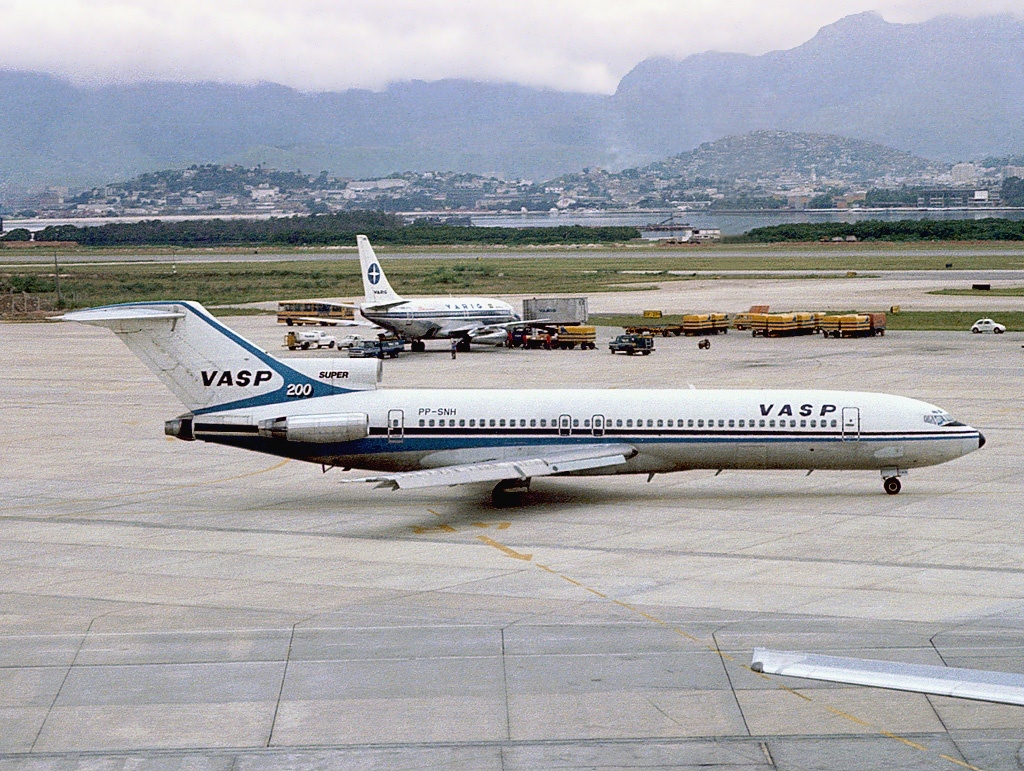
Pictured: a VASP Boeing 727-2A1/Adv, registration PP-SNH — a sister aircraft of the same subtype operated by the same airline — photographed at Rio de Janeiro's Galeão International Airport, the same airport VASP Flight 169 landed at, in November 1984. This is not a photograph of PP-SNG, the specific aircraft flown on the night of the sighting, nor of the object itself. No photograph of the incident aircraft in its 1982 configuration, and no rights-clear reproduction of passenger Lígia Auxiliadora Rodrigues's own case photographs (which were themselves later reanalyzed by researchers, as discussed below), could be located for this case file. Photo by Pedro Aragão, licensed CC BY-SA 3.0 / GFDL via Wikimedia Commons.
Theoretical Alignment
The Extraterrestrial Hypothesis reading draws on this case's genuine strengths: a highly experienced professional pilot's calm, sustained, ninety-minute report; roughly 150 corroborating passenger witnesses; a reported (if contested) radar contact; and two other airline crews who also saw something in the same sky. The Interdimensional Hypothesis has essentially nothing case-specific to attach to — no missing time, no portal imagery, no interdimensional motif of any kind appears anywhere in the record. The Psycho-Social/Mundane reading carries the most weight for reasons this file discloses in full below: the two corroborating airline pilots themselves attributed the light to the planet Venus; CINDACTA's own operations chief retracted the radar contact as "a defect in the equipment" within hours; and a detailed 2014 peer-reviewed reconstruction shows the sighting's timing, color-shifting, and even its apparent early appearance are closely matched by Venus viewed through a documented atmospheric temperature inversion along the route that night. Captain Britto's own prior history of reporting UFO-like phenomena on at least three earlier occasions is treated here neither as proof of a pattern of fabrication nor as independent corroboration, but as a genuinely relevant credibility factor this file's Observer Credibility section addresses directly.
Background
Fortaleza, the capital of Ceará state in Brazil's Northeast, was in 1982 served by Pinto Martins Airport (IATA: FOR), a domestic and international hub roughly 6 km south of the city center. VASP (Viação Aérea São Paulo), one of Brazil's oldest airlines, operated the Fortaleza–Rio de Janeiro corridor as a regularly scheduled overnight service, typically with connecting or continuing service toward São Paulo. Brazilian commercial aviation in this period relied on a network of regional CINDACTAs (Integrated Centers for Air Defense and Air Traffic Control) — military-run facilities, operated by the Brazilian Air Force (FAB), that combined civilian air-traffic-control functions with air-defense radar coverage. CINDACTA I, based in Brasília, was responsible for the airspace VASP Flight 169 crossed as it flew south toward Belo Horizonte and on to Rio de Janeiro.
Brazilian ufology in 1982 was considerably more organized than it had been in the 1940s and 1950s: civilian research groups such as SBEDV, established decades earlier, and the newer, Ademar José "A.J." Gevaerd-led circles that would go on to found Revista UFO magazine later in the decade, were actively collecting and publishing pilot and radar reports. The country's air force itself had, since 1969, operated a formal internal apparatus (initially SIOANI, the System for Investigation of Unidentified Aerial Objects) for collecting military and civilian UFO reports through CINDACTA channels — the same institutional pathway, this case file's research finds, that VASP Flight 169's own cockpit-to-tower transcripts would travel through. This institutional context matters directly to the case: unlike a rural, undocumented 1940s death, VASP-169 generated real-time radio traffic recorded by a military air-traffic facility, giving this case a documentary anchor that many of this site's older Brazilian cases lack.
Captain Gerson Maciel de Britto (1936–2016) had flown for VASP since 1960 and was, by every account, an unusually experienced pilot — sources place his total flight time anywhere from roughly 16,000 to more than 26,000 hours, a range this file's research could not narrow further, though even the low end of that range represents a career several times longer than the minimum needed for airline command. He had reportedly reported unusual aerial phenomena on at least three prior occasions across his career (1964, on a Teresina–Fortaleza route; 1976, near Campo Grande; and 1979, near Governador Valadares), a detail some secondary sources treat as evidence of a consistent, credible pattern of encountering something real, and which this file's Observer Credibility section treats instead as a genuinely double-edged fact: it may indicate an unusually observant pilot operating in airspace that happened to generate multiple real anomalies, or it may indicate a pilot with a pre-existing disposition toward anomalous interpretation of ordinary astronomical or atmospheric phenomena. Both readings are consistent with the same underlying fact, and this file does not resolve which is correct.
Complete Timeline
| Date/Time | Event |
|---|---|
| 1960 | Gerson Maciel de Britto joins VASP as a pilot, beginning a 30-year career with the airline. |
| 1969 | The Brazilian Air Force (FAB) establishes SIOANI, its first formal internal system for investigating unidentified aerial object reports, the same institutional channel that would later carry VASP-169's own radio transcripts. |
| 1964 / 1976 / 1979 | Britto reportedly reports unusual aerial phenomena on three separate earlier occasions, on routes near Teresina–Fortaleza, Campo Grande, and Governador Valadares. |
| Feb. 8, 1982, 01:50 | VASP Flight 169, a Boeing 727-2A1/Adv (registration PP-SNG), departs Pinto Martins Airport, Fortaleza, bound for Rio de Janeiro, carrying an estimated 143–151 passengers and crew. |
| Feb. 8, 1982, ~03:12 | Near Petrolina, Pernambuco, and Bom Jesus da Lapa, Bahia (accounts differ on the exact location), Capt. Britto observes an intensely bright light off the aircraft's left side and announces it over the cabin intercom, inviting passengers to the windows. |
| Feb. 8, 1982, ~03:45 | The aircraft crosses the MOGOL navigation waypoint at flight level 310 (31,000 ft); the object is still reported alongside the aircraft, shifting between red, orange, blue, and white. |
| Feb. 8, 1982, ~04:03 | The aircraft crosses the vertical of Belo Horizonte, Minas Gerais. Britto contacts CINDACTA's Brasília control center, which initially reports no other known air traffic in the vicinity. |
| Feb. 8, 1982, ~04:03–04:19 | A CINDACTA controller reports an unidentified radar contact roughly 8 nautical miles from VASP-169's position, in the 9 o'clock direction, "following precisely" — the case's central, and most disputed, instrumented claim. |
| Feb. 8, 1982, ~04:18 | VASP-169 begins its descent from FL310 toward Rio de Janeiro, dropping to roughly FL120. |
| Feb. 8, 1982, hours after landing | The chief of CINDACTA's Operations Division states publicly that the radar return was "just a defect in the equipment," retracting the earlier confirmation. |
| Feb. 8, 1982, ~04:34–04:37 | The object is last seen near Barra do Piraí, Rio de Janeiro state, before VASP-169 lands on runway 14 at Galeão International Airport at approximately 04:37. |
| Feb. 9–10, 1982 | VASP crews flying the same Fortaleza–Rio corridor on the following two nights separately report luminous objects along the route, though without any corresponding radar detection in the surviving transcripts. |
| 1982 | VASP conducts its own internal review of the incident and, according to every source located, finds no grounds to dismiss the crew's account as fabricated. Astronomer Ronaldo Rogério de Freitas Mourão publicly proposes the object was the planet Venus. |
| 1982 | Britto is invited to Belém Air Command headquarters, where he reportedly meets Operação Prato commander Capt. Uyrangê Hollanda Lima, who allegedly tells him privately that FAB researchers held extensive UFO evidence — an account that survives only in later, secondhand retellings and could not be independently verified for this case file. |
| 2004–2007 | The Brazilian Commission of Ufologists (CBU) leads the "UFOs: Freedom of Information Now" campaign; the Brazilian government begins transferring FAB UFO case files, reportedly including VASP-169's own CINDACTA tape transcriptions, to the Arquivo Nacional (National Archive) in Brasília. |
| 2008 | Aeronáutica (the Brazilian Air Force ministry) begins gradually declassifying and releasing related confidential documents. |
| 2014 | Luiz Augusto da Silva publishes "Unidentified Aerial Phenomena: The VASP-169 Flight Brazilian Episode Revisited" in the Journal of Scientific Exploration (Vol. 27, No. 4), presenting a detailed astronomical and radar-geometry case that the object was Venus viewed through an atmospheric superior mirage, and that the radar contact was an instrumental artifact. |
| 2016 | Gerson Maciel de Britto dies, having never publicly disavowed his 1982 account. |
| 2022 | Rede Omega Centauri republishes and extends da Silva's radar-geometry and astronomical reconstruction, including a detailed minute-by-minute analysis of Venus's calculated position against the flight's known route and altitude. |
| 2026 | This case file is published, replacing the "Coming Soon" queue's placeholder description — which stated the sighting was "confirmed by ground radar" and cited unspecified "FAB logs" — with the full, contested record: a real radar report that was itself retracted as equipment error within hours, and FAB/CINDACTA records that do exist but that document a radio-and-radar log, not an official confirmation of an anomalous object. |
The Sighting: Ninety Minutes Across Five States
By every detailed account this case file's research located, VASP Flight 169 departed Fortaleza's Pinto Martins Airport at approximately 01:50 on the morning of February 8, 1982, a routine overnight domestic service toward Rio de Janeiro. Passenger counts vary across sources from 143 to roughly 151; this file uses the range rather than a single figure, since no boarding manifest has been published and secondary accounts do not agree. Roughly ninety minutes into the flight, as the Boeing 727 cruised at flight level 310 (31,000 feet) near the border area of Petrolina, Pernambuco, and Bom Jesus da Lapa, Bahia — accounts differ on precisely which town the sighting began nearest to — Capt. Britto reported an intensely bright light appearing off the aircraft's left side. According to the most detailed reconstruction located, Britto made an announcement over the aircraft's public address system at 03:12, along the lines of: "Ladies and gentlemen, we are possibly observing an unidentified object of great luminosity, on the left side of the aircraft." Passengers were invited, in an orderly and unhurried fashion by every account, to approach the left-side windows to observe it.
What passengers reported seeing varied in specific description but agreed on the object's basic character: an intensely bright light, changing color continuously between red, orange, blue, and white, at times appearing to approach the aircraft to within an estimated 15 kilometers and at other times receding, and moving at a speed passengers and crew described as sometimes slower and sometimes faster than the Boeing itself. One passenger, Silézia (in some sources "Silésia") Barbosa Paes del Rosso, is quoted describing an object "resembling a flattened chandelier, shining like mercury vapor lamps that illuminate public roads." Another account describes witnesses seeing "eight stars clustered together with a bluish glare," resembling "an incandescent football." Britto himself, in the most dramatic and most heavily scrutinized characterization, reportedly described the object at its closest approach as appearing the size of "two jumbo jets" — a claim this file's Conventional Explanation Candidate section addresses directly, since it is central to whether an astronomical explanation is even physically plausible.
As the flight proceeded south, crossing the MOGOL navigation waypoint around 03:45 and the vertical of Belo Horizonte around 04:03, Britto remained in periodic radio contact with CINDACTA's Brasília control center, requesting confirmation of any other known air traffic in his vicinity. According to the surviving transcripts described in secondary Brazilian sources, CINDACTA initially responded that no other aircraft should be in the area. The case's single most consequential moment came next: a CINDACTA controller is quoted reporting an unidentified radar contact "at eight miles in the nine o'clock position, following VASP 169 precisely." This is the detail underlying the placeholder's "confirmed by ground radar" framing — and, as the next section discloses in full, it is also the detail this case file's research finds was retracted by CINDACTA's own leadership within hours of the flight landing.
The aircraft began its descent from FL310 around 04:18, and the object was reportedly last observed near Barra do Piraí, in Rio de Janeiro state, shortly before VASP-169 landed on runway 14 at Galeão International Airport at approximately 04:37 — bringing the total observation window, on most accounts, to roughly ninety minutes. Notably, at least two other flight crews operating the same general air corridor that night — a Transbrasil crew and an Aerolíneas Argentinas crew — also reported seeing a bright light in the same part of the sky. This detail is frequently cited in popular retellings of the case as independent multi-aircraft corroboration of an anomalous object. This case file's research found that framing to be materially incomplete: by the same secondary accounts that report the sighting, both of those other crews attributed what they saw to the planet Venus, which was rising in roughly the same direction at the same hour that time of year. Their testimony corroborates that something bright was visible in that part of the sky that night; it does not, on its own terms, corroborate that the something was anomalous.
The Passengers Who Declined to Look
Among the roughly 150 passengers aboard was a group of Catholic clergy, most consistently identified across sources as including Cardinal Dom Aloísio Leo Arlindo Lorscheider, Archbishop of Fortaleza from 1973 to 1995 and a real, independently documented historical figure. Secondary sources disagree, sometimes significantly, on exactly which other bishops accompanied him: one detailed account names "Dom José Teixeira, Dom Edmilson Croix, and Dom Pompeu Bessa," a second names "Bishop Dom José Terceiro" and "Bishop Dom Milton," and a third refers to the senior cleric present not as Lorscheider at all but as "Dom Ivo Lorscheiter" — a different, real person, president of the National Conference of Brazilian Bishops (CNBB) and, as it happens, Lorscheider's own first cousin, sharing a near-identical surname. This case file's research could not resolve which set of names is accurate, and treats the confusion itself as informative: it is exactly the kind of detail — a real, verifiable public figure's name, garbled or conflated with a similarly-named relative across retellings — that this site has now encountered multiple times while auditing this "Coming Soon" queue, and it is disclosed here rather than silently resolved in favor of whichever version sounds most authoritative. What is consistent across every account is that Lorscheider (or whichever bishop was actually present) declined to look at the object, reportedly dozing on the opposite side of the cabin and later recalling, in a quote attributed to him, a dismissive reaction along the lines of "since I was on the right side, half asleep, I thought: leave that flying saucer alone."
The CINDACTA Radar Contact and Its Retraction
The placeholder description this case file was commissioned to replace singled out one specific claim: that the sighting was "confirmed by ground radar." This claim traces to a real event — a CINDACTA controller did report an unidentified contact near Belo Horizonte during the flight, and that report was relayed to Britto in real time and is preserved in the radio transcripts later filed with Brazil's National Archive. But "confirmed" considerably overstates what actually happened next. According to multiple independent Brazilian sources, the chief of CINDACTA's own Operations Division stated publicly, within hours of the flight landing, that "it's true that a bright spot appeared on the radar, but it was just a defect in the equipment" — a direct, same-day retraction by the same agency that generated the original report, not a later, distant reassessment by an outside skeptic.
The 2014 Journal of Scientific Exploration reconstruction by researcher Luiz Augusto da Silva, later republished and extended by the Brazilian science-outreach network Rede Omega Centauri, goes further, applying the flight's own documented position, altitude, and timing to the radar contact's reported coordinates. The contact was described as roughly 50 nautical miles south of Belo Horizonte, at 8 nautical miles from VASP-169's own position in the 9 o'clock direction. da Silva's reconstruction found this description to be geometrically impossible given the aircraft's known position: at the time the contact was reported (around 04:19), VASP-169 itself, per its own logged crossing of Belo Horizonte's vertical at 04:03, would already have been roughly 243 kilometers past the city — meaning a contact 50 nautical miles (roughly 93 km) south of Belo Horizonte would have sat some 150 kilometers behind the aircraft, well outside visual range from the cockpit and inconsistent with the "following precisely" description radioed to Britto at the time. da Silva's conclusion, consistent with CINDACTA's own same-day retraction, is that the contact most likely represented a secondary or ghost echo generated by the aircraft's own transponder return rather than an independently tracked second object.
This file treats both pieces of evidence — CINDACTA's own contemporaneous retraction and the independent geometric reconstruction three decades later — as carrying real, and mutually reinforcing, weight. It is a meaningfully different evidentiary picture than "confirmed by ground radar," and this file corrects that framing directly rather than reproducing it. It is also, notably, not the first time this site's Coming Soon queue has been found to overstate an instrumented-detection claim: the Woomera Rocket Range Sighting placeholder required a similar year correction, and this file's own research suggests the queue's authors may have systematically over-read "a radar operator reported a contact" as "radar confirmed the object," when the actual record, in more than one case, shows the reporting agency itself walking the claim back.
Aftermath, Media Coverage, and the Operação Prato Claim
VASP Flight 169 became, by a wide margin, the most publicly discussed civilian UFO sighting in Brazilian aviation history, generating coverage on national television (including, by some secondary accounts, a segment on Rede Globo's Fantástico program) and extensive treatment in the emerging Brazilian ufological press, particularly the magazine that would become Revista UFO, associated with researcher A.J. Gevaerd. VASP itself, according to every source located for this case file, conducted an internal review of Britto's account and found no basis to treat it as fabricated or fraudulent — a genuinely meaningful institutional fact, since an airline has every commercial incentive to distance itself from a sensational, reputation-affecting claim by one of its own captains, not to protect it.
A separate, later claim requires its own explicit disclosure and caveat. According to an account that appears to originate with historian and ufologist Cláudio Tsuyoshi Suenaga — the same Brazilian researcher responsible for recovering the death certificate central to this site's Araçariguama Sighting case file — Britto was invited, sometime after the sighting became public, to Belém Air Command headquarters, where he reportedly met Subofficial João Flávio de Freitas Costa and Capt. Uyrangê Hollanda Lima, the officer who had commanded the FAB's 1977 Operação Prato investigation into the "chupa-chupa" light attacks at Colares Island. Hollanda is said to have told Britto, privately and off the record, that Brazilian military UFO researchers held extensive documented evidence, including radar recordings, and that officers within the program felt genuine "moral concern" about withholding this from the public while requesting anonymity to protect their careers.
This case file treats this specific claim with the real skepticism it warrants, for several disclosed reasons. It survives only in a single, decades-later retelling on an enthusiast historian's blog, not in any primary FAB document, court record, or contemporaneous interview this case file's research could independently verify. Hollanda himself, per his own key-figures entry on this site, died in 1997 by suicide under circumstances that remain debated, following a public 1997 interview in which he broke with FAB secrecy over the separate Colares case — meaning any claim about what he privately told Britto rests entirely on secondhand, unrecorded testimony from a source no longer available to confirm or elaborate on it. This file includes the claim because it circulates prominently in Brazilian ufological retellings of the VASP-169 case and a reader researching this case elsewhere will encounter it, but it explicitly declines to treat it as evidence of anything beyond its own existence as an unverified anecdote.
Key Witnesses
Gerson Maciel de Britto
A VASP pilot since 1960 with (depending on the source) between roughly 16,000 and more than 26,000 flight hours, Britto calmly announced the sighting over the intercom, remained in periodic radio contact with CINDACTA throughout, and never publicly retracted his account before his death in 2016. He had reportedly reported unusual aerial phenomena on three earlier occasions across his career, a fact this file treats as genuinely double-edged for his credibility rather than as either vindication or discrediting on its own.
Lígia Auxiliadora Rodrigues
Took a series of photographs of the object from her cabin window — the case's only known photographic record. A later technical reanalysis, discussed in this file's Physical & Material Assays section below, concluded the images were consistent with reflections of the aircraft's own left-wing navigation lights in nearby passing clouds rather than a distinct external object.
Silézia (or Silésia) Barbosa Paes del Rosso
Provided one of the case's most frequently quoted descriptions, comparing the object to "a flattened chandelier, shining like mercury vapor lamps that illuminate public roads" — a vivid but ordinary-object comparison this file notes cuts in an ambiguous direction for the case's anomalousness.
Cardinal Dom Aloísio Leo Arlindo Lorscheider (identity disputed across sources)
A real, independently documented historical figure — created cardinal in 1976 — who was reportedly among the accompanying clergy aboard Flight 169 and declined to look at the object, dozing through most of the sighting. As disclosed above, secondary sources give conflicting names for the senior cleric present, including confusing him with his cousin, CNBB president Dom Ivo Lorscheiter; this file could not resolve which account is accurate.
Unnamed Transbrasil and Aerolíneas Argentinas flight crews
Both crews reportedly saw a bright light in the same part of the sky that night — frequently cited as independent multi-aircraft corroboration. Both crews, however, are reported to have themselves identified the light as the planet Venus, a detail this file treats as materially undercutting the "confirmation" framing often applied to their sightings.
Ronaldo Rogério de Freitas Mourão
Not a witness to the sighting itself, but the credentialed Brazilian astronomer (Ph.D., University of Paris, 1967; founder of Brazil's Museum of Astronomy) who first publicly proposed, shortly after the incident, that the object was the planet Venus — the seed of the conventional explanation this file's Conventional Explanation Candidate section develops in full.
The Five Observables Assessment
The Five Observables framework, drawn from the Pentagon's own AATIP-era analytical criteria, is applied here to the behavior described by Capt. Britto, his passengers, and the disputed radar contact:
Assessment: No witness at any point described the object performing a sudden, physics-defying acceleration or maneuver; its reported behavior was pacing, approaching, and receding at speeds "sometimes slower, sometimes faster" than the Boeing 727's own roughly 900–975 km/h cruise speed — well within the range of an object simply appearing to change apparent motion as an aircraft's own heading and cloud cover shift, exactly the effect a fixed astronomical object like Venus would produce when viewed from a moving, turning aircraft. Anti-Gravity Lift and Instant Acceleration are marked Speculative rather than Present because nothing in the described motion actually requires them, and Speculative rather than Absent because a genuinely maneuvering craft, if one were present, cannot be ruled out from testimony alone. Hypersonic performance and Trans-Medium travel are rated Absent, since neither was reported by any witness at any point. Low Observability is marked Speculative only in the narrow sense that the CINDACTA radar contact, if it had been real and not an equipment artifact, would imply a partially radar-observable object; given this file's finding that the contact was very likely spurious, this rating should be read as provisional at best.
Evidence Assessment
Supporting Anomalous Origin
- An unusually large number of direct witnesses — a veteran professional pilot, his flight crew, and an estimated 143–151 passengers — observed the same general phenomenon over a sustained roughly 90-minute period, not a fleeting glimpse
- Capt. Britto never retracted or altered his account at any point between 1982 and his death in 2016, despite decades of public scrutiny and skeptical challenge
- VASP's own internal investigation, which had every commercial incentive to distance the airline from an embarrassing claim, found no basis to dismiss the crew's account as fabricated
- A CINDACTA controller did report an unidentified radar contact in real time, independent of the visual sighting, whatever its ultimate cause turned out to be
- Two additional airline crews on the same air corridor that night independently reported observing a bright light, providing at minimum a broad, multi-aircraft base of witnesses to something unusual being visible in the sky
Supporting Conventional Explanation
- CINDACTA's own Operations Division chief retracted the radar contact within hours as "a defect in the equipment," and an independent 2014 geometric reconstruction found the contact's reported position to be physically inconsistent with the aircraft's own logged position at the same time
- Both of the other airline crews cited as independent corroboration themselves identified the light they saw as the planet Venus, not an anomalous object
- A credentialed professional astronomer proposed the Venus explanation within days of the incident, and a subsequent peer-reviewed reconstruction found the sighting's specific timing, color-shifting, and apparent early appearance closely matched Venus's calculated position along the flight's actual route, given a documented atmospheric temperature inversion that night
- The case's only photographic evidence, taken by passenger Lígia Rodrigues, was reanalyzed as reflections of the aircraft's own left-wing navigation lights in nearby clouds, not an independent light source
- Capt. Britto had reportedly reported unusual aerial phenomena on at least three prior occasions across his career, a pattern consistent with either a genuinely observant witness or a pre-existing disposition toward anomalous interpretation
- No physical trace evidence of any kind exists, and the case's single most dramatic size claim — an object "the size of two jumbo jets" — is difficult to reconcile with Venus's known angular diameter at any distance, a tension this file's Conventional Explanation Candidate section addresses directly rather than ignoring
Why “Disputed”
This case earns a DISPUTED classification with a credibility score of 41/100. It sits below this site's Thomas Mantell calibration case (Disputed, 38) on the strength of its conventional explanation but above it on the sheer scale of independent witnesses — a genuinely large number of people, across three separate aircraft, observed something in the sky that night, even though this file's research finds the "something" was very likely a single astronomical object misidentified by multiple observers experiencing similar atmospheric conditions, not an anomalous craft independently confirmed by each crew. It scores considerably below this site's Woomera Rocket Range Sighting calibration case (Disputed, 52), which had a genuinely independent, simultaneously-plotted radar track that has never been retracted by the tracking agency itself; this case's own central radar claim was walked back, by the same agency that generated it, within hours. What keeps the score from falling all the way to this site's lowest Disputed calibration cases (John Sheppard Sighting, 30; Araçariguama Sighting, 34) is the case's genuinely exceptional witness scale and its real-time, contemporaneously recorded radio documentation — a level of immediate, multi-party, radio-logged corroboration those two much more thinly-documented cases entirely lack, even though this case's central "confirmed by radar" claim does not hold up. The placeholder queue's "confirmed by ground radar; FAB logs" description is not supported by this file's research: real FAB/CINDACTA logs exist, and they document a radar contact that the generating agency itself disavowed the same day, not a confirmation.
Sensor & Instrumentation Detection Profile
This case's instrumentation record is more substantial than many of this site's older Brazilian cases, but considerably weaker than the placeholder's "confirmed" framing implies. The central instrumented claim is the CINDACTA ground radar contact, discussed in detail above: reported in real time by a Brasília air-defense controller, retracted the same day by CINDACTA's own Operations Division chief as an equipment defect, and shown by a 2014 independent geometric reconstruction to be positionally inconsistent with the aircraft's own logged flight path at the same moment — a triple layer of doubt (contemporaneous institutional retraction, subsequent technical debunking, and the underlying implausibility of the reported geometry) that this file weighs heavily against treating the radar contact as genuine corroboration.
A separate, less-detailed claim appears in some summary accounts of the case: that "the variations in velocity and position of the object were observed both visually and through the onboard [weather] radar," implying the Boeing 727's own cockpit radar also detected something. This file's research could not corroborate this specific claim against any of the more detailed primary-adjacent accounts (the patrickgross.org case catalog, the Cavok Brasil and Portal do Aviador aviation-industry writeups, or the da Silva/Rede Omega Centauri technical reconstruction), none of which mention an onboard radar return independent of the CINDACTA ground contact. It is presented here, with this explicit caveat, rather than omitted or silently treated as confirmed.
The case's only other instrumented record is photographic: passenger Lígia Rodrigues's series of images and a second, anonymous passenger's photograph, both taken from inside the cabin with ordinary consumer equipment. Neither has been treated by any technical analysis located for this case file as depicting a genuine independent light source; both have been reinterpreted, respectively, as reflections of the aircraft's own navigation lights in nearby cloud and as a twilight/crepuscular lighting effect visible through gaps in cloud cover during the pre-dawn hours. No radiation, electromagnetic, or acoustic instrumentation of any kind was applied to this case at the time or has been applied since.
Environmental & Geospatial Context
VASP Flight 169's route crossed dramatically varied terrain over its roughly 90-minute observation window: the semi-arid sertão backlands of the Pernambuco/Bahia border region near Petrolina and Bom Jesus da Lapa, the highland plateau around Belo Horizonte in Minas Gerais, and finally the coastal, mountainous approach into Rio de Janeiro. This geographic range matters directly to the case's conventional explanation: Venus's apparent position and elevation above the horizon would have shifted meaningfully across such a route and across the roughly 90 minutes of the sighting, in ways a careful astronomical reconstruction (discussed fully below) can actually calculate and compare against the witnesses' own described directions.
Witnesses described a generally clear, partly moonlit sky with intermittent cloud cover — conditions good enough for sustained visual observation but not perfectly clear throughout. Independent meteorological reconstruction using GOES-5 satellite imagery from the period identifies a cold front moving through the region that night, with an associated atmospheric temperature inversion along parts of the flight's route. Temperature inversions of this kind are the well-documented physical precondition for a superior mirage — an optical effect in which light from a real object beyond or below the normal horizon is refracted by a sharp density gradient in the atmosphere, becoming visible earlier, or from a different apparent position, than it otherwise would be. This atmospheric detail is central to the conventional explanation developed below: it offers a specific, dated, physically grounded mechanism for why an object (in this account, Venus) might have appeared unusually early, unusually bright, or in an unusual apparent position relative to where a simple ephemeris calculation alone would place it.
Observer Credibility & Occupational Profile
Capt. Gerson Maciel de Britto is, by any reasonable standard, a highly credentialed primary witness: a 30-year VASP veteran with a very large number of logged flight hours (sources place the figure anywhere from roughly 16,000 to more than 26,000, a range this file could not narrow further), professionally responsible for the safety of everyone aboard, and someone who by every account remained calm, methodical, and in continuous radio contact with air-traffic control throughout the sighting rather than reacting with panic or theatrical drama. Working against a simple appeal to his authority as a trained observer is his own reported history of at least three earlier UFO-adjacent reports across his career (1964, 1976, 1979) — a detail this file treats, as stated above, as genuinely ambiguous rather than as either vindicating or discrediting, since both an unusually perceptive witness and a witness with a standing interpretive disposition toward anomalous readings would produce the same observable pattern.
The co-pilot and flight engineer aboard VASP-169 are named in only one of the sources located for this case file (as Carlos Alberto Goes de Brito and Francisco Cesarino, respectively, per the Rede Omega Centauri reconstruction); this file could not independently corroborate these names against a second source and presents them with that explicit caveat rather than asserting them as settled fact. The roughly 150 passengers aboard represent a mixed-reliability body of testimony typical of any mass civil-aviation sighting: ordinary travelers, most woken from sleep in the pre-dawn hours, whose collective agreement on the object's basic character (a bright, color-shifting light) is meaningful, but whose individual size, distance, and shape estimates vary considerably, exactly as would be expected whether the underlying stimulus was anomalous or a bright, unfamiliar astronomical object misjudged under difficult viewing conditions (a darkened cabin, unfamiliar sky, no fixed reference points at altitude).
The two corroborating airline pilots (Transbrasil and Aerolíneas Argentinas) are trained aviation professionals whose testimony carries real evidentiary weight — but, as emphasized throughout this file, their own stated interpretation of what they saw was Venus, not an anomalous craft, which meaningfully limits how their sightings can be used to support the case's anomalous reading. On the skeptical side, astronomer Ronaldo Rogério de Freitas Mourão (1935–2014) was a genuinely eminent figure in Brazilian science: a National Observatory astronomer since 1956, a Ph.D. from the University of Paris (1967, with the distinction très honorable), founder of Brazil's National Museum of Astronomy (MAST) and a founding member of the Brazilian Astronomical Society, and the author of nearly a hundred books on astronomy. His early Venus proposal was not a casual dismissal by an uninformed outsider. Researcher Luiz Augusto da Silva, whose 2014 reconstruction appeared in the Journal of Scientific Exploration (a peer-reviewed journal published by the Society for Scientific Exploration, which — while not a mainstream physics journal — does apply an external review process, distinguishing it from an uncritical advocacy blog), conducted the case's only detailed, quantitative reconciliation of the flight's documented position, timing, and radar data against calculated astronomical positions and atmospheric conditions.
Physical & Material Assays
No physical trace evidence of any kind exists in this case, and this file states that fact plainly rather than working around it. No object, fragment, residue, or instrumented physical sample was ever recovered, tested, or claimed to have been recovered by any witness, investigator, or agency at any point in the case's history. The closest thing to physical evidence is photographic: Lígia Rodrigues's series of in-flight photographs and a second, anonymous passenger's image. Technical reanalysis of the Rodrigues photographs, per the da Silva/Rede Omega Centauri reconstruction, concluded the images most likely show reflections of the Boeing 727's own left-wing navigation lights bouncing off nearby passing clouds, not an external light source photographed directly. The second, anonymous photograph was separately interpreted as a twilight or crepuscular-ray lighting effect, consistent with the pre-dawn timing and the described gaps in cloud cover. This file's research located a claim, sourced only to a single enthusiast blog rather than any technical publication, that these same photographs actually show both Venus and a separate, distinct object simultaneously — which, if independently verified, would be a serious problem for the Venus explanation. That claim directly conflicts with the peer-reviewed-adjacent technical reanalysis described above, comes from a source with a clear pro-anomalous editorial stance, and could not be corroborated by this file's research against any published version of the photographs themselves; it is disclosed here for completeness, with that explicit reliability caveat, rather than treated as resolving the question either way.
Historical Precedents & Archive Matches
VASP Flight 169 sits within a substantial tradition of pilot-reported UFO sightings involving disputed or later-retracted radar corroboration, both within Brazil and internationally. This site's own JAL Flight 1628 case (1986) involves a strikingly similar structure — an experienced cargo pilot's sustained, multi-witness sighting over a long duration, an initially reported (and subsequently disputed) radar contact, and a credentialed skeptical rebuttal — despite occurring in entirely different airspace (Alaska) under a different national aviation and defense authority. Within Brazil specifically, this case predates by four years the country's single most famous military-corroborated UFO event, Brazil's Official Night (May 19–20, 1986), in which FAB fighter jets were scrambled against multiple simultaneous radar-and-visual contacts across several cities — a case this site rates Credible (a considerably stronger radar/multi-platform evidentiary picture than VASP-169's single, same-day-retracted contact) and one worth reading directly alongside this file for contrast in how differently two ostensibly similar "military radar confirms UFO" claims can hold up under scrutiny. VASP-169 also sits five years after the FAB's own Operação Prato investigation at Colares Island (1977), the program commanded by Capt. Uyrangê Hollanda Lima, whose reported later private conversation with Britto (discussed above, with its own explicit reliability caveat) is this case's only direct documentary thread connecting it to that earlier, better-institutionally-documented episode.
Within the specific sub-genre of "pilot sees light that turns out to be a misidentified planet, viewed under an unusual atmospheric refraction effect," this case has real structural precedent in the broader aviation-safety and astronomical literature on mirages and superior-mirage sightings at altitude, a phenomenon documented outside the UFO literature entirely in contexts ranging from maritime navigation to high-altitude flight observation. da Silva's 2014 reconstruction situates VASP-169 explicitly within this broader, non-ufological scientific literature on atmospheric optics, rather than treating the case as sui generis.
Material Analysis
Because this case generated no recovered physical object, sample, or trace residue of any kind, "Material Analysis" here necessarily concerns the case's photographic record rather than any metallurgical, isotopic, or soil evidence — and this file states that limitation explicitly rather than padding around it. The two photographs taken aboard VASP-169 (by passenger Lígia Rodrigues, and by a second, unidentified passenger) constitute the entirety of the case's documentary visual record beyond eyewitness description and radio transcripts.
Supporting Non-Terrestrial Origin
- No technical analysis located for this case file has definitively and uncontestedly resolved every detail of the photographic record; a competing, unverified claim exists (see Physical & Material Assays above) that the photographs show an object distinct from Venus
- The described color-shifting behavior (red, orange, blue, white) is, on its own, a genuinely unusual visual signature that a purely static astronomical point-source would not typically be expected to produce absent significant atmospheric scintillation or refraction
Supporting Terrestrial Origin
- The most detailed, quantitative technical reanalysis available (da Silva, 2014, and its Rede Omega Centauri extension) concludes the Rodrigues photographs are consistent with reflections of the aircraft's own left-wing navigation lights in passing clouds, not an external object
- Strong atmospheric scintillation and color-shifting are a well-documented, ordinary observational effect for bright astronomical objects low on the horizon, especially through variable cloud and under the documented temperature-inversion conditions present that night
- No physical sample, fragment, or trace residue of any kind was ever recovered, tested, or even claimed by any party at any point in the case's 40-plus-year history
The Conventional Explanation Candidate: Venus Viewed Through an Atmospheric Superior Mirage
The leading conventional explanation, first proposed within days of the sighting by astronomer Ronaldo Rogério de Freitas Mourão and developed in full quantitative detail by researcher Luiz Augusto da Silva's 2014 Journal of Scientific Exploration paper, holds that the object observed was the planet Venus, its apparent behavior distorted by a documented atmospheric temperature inversion along the flight's route that night. da Silva's reconstruction calculates Venus's actual position at each key moment of the flight — finding, notably, that the aircraft crossed the MOGOL waypoint at 03:45, "precisely when Venus would naturally rise at that location at flight altitude" under normal atmospheric conditions. The earlier, 03:12 sighting near Petrolina/Bom Jesus da Lapa, which occurred when a simple horizon calculation would place Venus still roughly 7.8 degrees below the horizon, is explained by the reconstruction as a superior-mirage effect: the documented temperature inversion (confirmed via contemporaneous GOES-5 satellite imagery showing a cold front moving through the region) would have created an atmospheric duct capable of advancing Venus's apparent rise by roughly 12 minutes relative to its normal horizon-crossing time, consistent with the earlier-than-expected first sighting. Under this reconstruction, the object's reported color-shifting (red, orange, blue, white) is explained as ordinary atmospheric scintillation, intensified by the object's unusually low altitude above the horizon for most of the sighting and by intermittent cloud interference.
Instrumental Artifact: The CINDACTA Radar Contact
As detailed extensively above, the reported ground-radar contact near Belo Horizonte is treated by this same reconstruction, and independently by CINDACTA's own Operations Division at the time, as an instrumental artifact rather than a genuine independently tracked object — most likely a secondary or ghost echo generated by VASP-169's own transponder return, given that the contact's reported position was found to be geometrically inconsistent with any real object actually visible from the cockpit at that time.
The "Two Jumbo Jets" Size Claim
The single strongest point of tension against the Venus explanation is Capt. Britto's own reported description of the object's apparent size at closest approach — "two jumbo jets." Venus's true angular diameter, per basic astronomical fact, is roughly 53 arcseconds at its brightest, at or near the theoretical resolution limit of unaided human vision; at the reported 8-nautical-mile closest distance, an object subtending that angular size would correspond to a linear diameter of only a few meters, nothing close to two jumbo jets. This file does not attempt to resolve this discrepancy by explaining it away: it is a real, substantial objection to the Venus hypothesis as literally stated, and this file discloses it rather than omitting it. The da Silva/Rede Omega Centauri reconstruction's own response is that eyewitness size estimation for an isolated bright point-source at night, with no surrounding reference objects, is well documented in the perceptual-psychology literature to be extremely unreliable and prone to dramatic overestimation — a real, if not fully satisfying, explanation for the gap between the astronomical prediction and the witness's own description.
Venus + Atmospheric Superior Mirage
PlausibleMatches the sighting's timing (Venus's calculated rise nearly coincides with the 03:45 MOGOL waypoint crossing), the documented atmospheric temperature inversion that night, the color-shifting behavior, and the corroborating pilots' own stated identification — but does not fully resolve Britto's specific "two jumbo jets" size description without leaning on witness unreliability.
CINDACTA Radar Contact as Instrumental Artifact
PlausibleSupported both by CINDACTA's own same-day retraction ("a defect in the equipment") and by an independent 2014 geometric reconstruction showing the reported contact's position was physically inconsistent with the aircraft's own logged flight path at that time.
Genuine Anomalous Craft
InconclusiveCannot be definitively ruled out from testimony alone, and Britto's own lifelong refusal to retract his account, combined with the case's genuinely large witness base, keeps this reading alive for some researchers — but it requires dismissing both the astronomical timing match and the radar agency's own contemporaneous retraction, and it has never produced any independent instrumented or physical confirmation.
Related Cases
Confirmed Documents & Official Records
The Brazilian National Archive's own official page describing its holdings of declassified Brazilian Air Force (FAB) UFO case files, transferred from CINDACTA and other FAB units beginning in 2007 following the CBU's "Freedom of Information Now" campaign. Brazilian ufology sources report that VASP-169's own cockpit-to-tower radio transcripts and Col. Ronald Eduardo Jaeckel's forwarding memo are part of this same collection; this case file's research could not directly access the archive's internal catalog (which requires registered login) to confirm the specific file number, and discloses that limitation here rather than asserting direct confirmation.
Not a government record, but the case's only peer-reviewed technical publication, applying documented flight data, radar geometry, and astronomical ephemeris calculations to reconstruct the sighting. Included here for its evidentiary weight alongside the government archive material.
Further Reading — Recommended Literature
UFO Danger Zone: Terror & Death in Brazil
A veteran UFO investigator's account of nearly two decades and eleven field trips researching Brazilian UFO cases, providing the broader cultural and investigative context (civilian ufology groups, FAB reporting channels, press coverage patterns) within which the VASP-169 case unfolded.
Confrontations: A Scientist's Search for Alien Contact
Vallée's own 1980s Brazilian field investigations into cases involving death or injury attributed to UFOs situate VASP-169 within a broader pattern of scientifically-minded researchers taking Brazilian ufology's most extreme claims seriously enough to investigate directly, rather than dismissing them outright.
CE-5: Close Encounters of the Fifth Kind
By the founder of NARCAP (the National Aviation Reporting Center on Anomalous Phenomena), whose decades of specialized research into pilot sightings and instrumented aviation encounters provide the methodological framework this case file draws on for assessing a professional pilot's testimony on its own terms.
UFOs: Generals, Pilots, and Government Officials Go on the Record
A comprehensive review of pilot- and radar-corroborated sighting cases worldwide, useful for comparing how VASP-169's disputed radar contact and retraction stack up against genuinely unresolved instrumented cases elsewhere.
The UFO Encyclopedia, 3rd Edition
A comprehensive reference covering the full sweep of documented UFO cases, including declassified material from the United States, Brazil, and other countries, useful for situating VASP-169 within the wider catalog of pilot-reported sightings this site continues to expand.
Essential Viewing
No Videos Available
This case file's research turned up several Brazilian-language video retellings of the VASP-169 case, but none from a channel meeting this site's bar for a highly reputable production source (per the Video Verification & Thumbnail Protocol) — all were small independent or fan-run channels rather than an established documentary or news production. Rather than feature an unvetted source, this section is left honestly empty pending a genuinely reputable video treatment of the case.
Sources
- Gross, Patrick. "UFOs at Close Sight: Flight 169 Incident, Brazil, February 8, 1982." Ufologie.net Case Files. ufologie.patrickgross.org
- "Os documentos também confirmam o Caso Vasp Vôo 169." Revista UFO. ufo.com.br
- "BRASIL: O estranho caso do voo VASP 169." Cavok Brasil. cavok.com.br
- "O estranho caso do voo VASP 169." Portal do Aviador. portaldoaviador.com
- "CASO VASP-169: Reconstituindo o voo, e outros aspectos." Rede Omega Centauri, Dec. 21, 2022. redeomegacentauri.org
- da Silva, Luiz Augusto. "Unidentified Aerial Phenomena: The VASP-169 Flight Brazilian Episode Revisited." Republished analysis, Rede Omega Centauri, Jan. 31, 2022. redeomegacentauri.org
- da Silva, Luiz Augusto. "Unidentified Aerial Phenomena: The VASP-169 Flight Brazilian Episode Revisited." Journal of Scientific Exploration, Vol. 27, No. 4 (2014). journalofscientificexploration.org
- "Voo 169: o misterioso avistamento OVNI com maior número de testemunhas." Aventuras na História. aventurasnahistoria.com.br
- "Você sabia? Conheça a história do óvni que chocou a aviação brasileira e ufólogos." BNews. bnews.com.br
- "Em 1982 o intrigante Voo 169 da VASP." Paulo Dias — Astronomia. pdias.com.br
- "O Vôo 169 da VASP." Saindo da Matrix. saindodamatrix.com.br
- Suenaga, Cláudio. "Os 40 anos do Caso do Voo 169 da VASP e o dia em que o piloto Gerson Maciel de Britto se encontrou com o coronel Uyrangê Hollanda, da Operação Prato." claudiosuenaga.com.br
- "1982: O Caso do Voo 169 da Vasp." Arquivo Confidencial. arquivoconfidencial.blogspot.com
- "História: Voo 169: O misterioso avistamento OVNI com maior número de testemunhas no Brasil." Notícias e Histórias Sobre Aviação. desastresaereosnews.blogspot.com
- Governo Federal do Brasil. "Conheça o fundo sobre OVNIs do Arquivo Nacional." Arquivo Nacional. gov.br/arquivonacional
- Bretones, Paulo S. "Tributo a Ronaldo Rogério de Freitas Mourão." Sociedade Astronômica Brasileira. sab-astro.org.br
- "Ronaldo Rogério de Freitas Mourão (1935–2014)." GPET Física, Universidade Estadual do Centro-Oeste. unicentro.br
- "VASP Flight 168." Wikipedia (cited only to document the distinct, unrelated June 8, 1982 VASP crash near Fortaleza that this case file's research confirms is not the same event as the February 8, 1982 UFO sighting). en.wikipedia.org
- "Arquivo Nacional libera relatos de brasileiros sobre supostos Ovnis." Poder360. poder360.com.br
- "OVNIs no Brasil: arquivos da FAB estão abertos ao público." Revista Oeste. revistaoeste.com
See something inaccurate? Have additional information or sources?
Suggest an Edit →Last Updated: August 2026