
Ängelholm UFO Memorial
On the night of May 18, 1946, a 28-year-old railway worker named Gösta Carlsson claimed he watched a landed, disc-shaped craft and its crew in a forest clearing outside Ängelholm, Sweden. He said nothing publicly for twenty-five years. Then, in 1971, he went public — and in 1972 he had a permanent concrete monument to the encounter built and installed at the site, at his own expense, where it still stands today as a minor national tourist attraction. In the decades between, Carlsson credited the meeting with the formula behind the pollen-extract company that made him a millionaire, while the artifacts he said he recovered from the clearing grew steadily stranger, and steadily less consistent, the longer he kept telling the story.
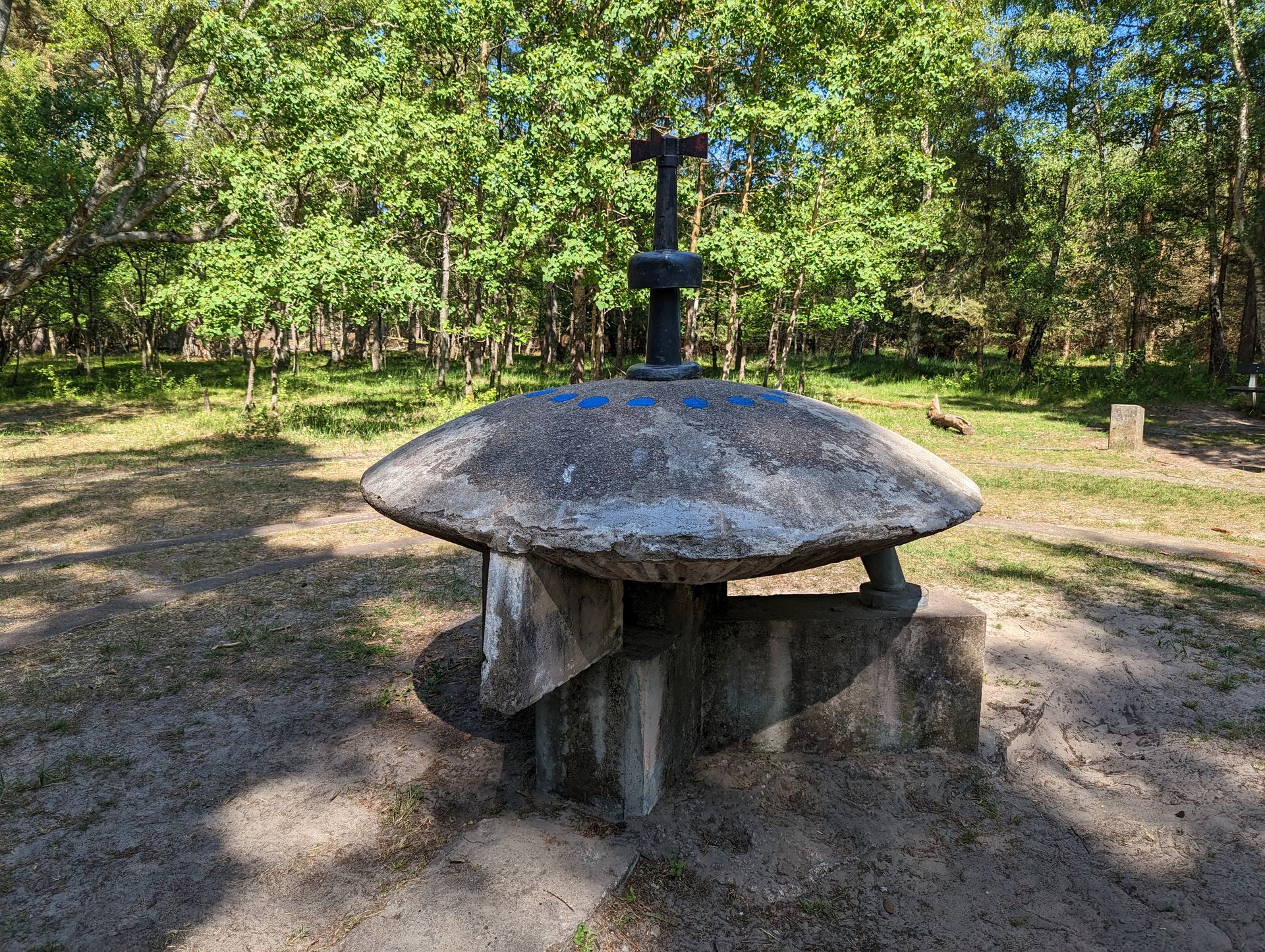
Pictured: the actual Ängelholm UFO memorial as it stands today in Kronoskogen forest — the real, physical concrete monument at the center of this case, photographed in June 2023. It is not a photograph of the alleged 1946 craft itself, which no photograph of any kind is known to exist of; this is the permanent marker Gösta Carlsson had built at the claimed landing site 26 years after the encounter.
Theoretical Alignment
Of the standard theoretical frameworks applied across this site, the Ängelholm case aligns most strongly with the Psycho-Social Hypothesis — not because Carlsson was necessarily lying, but because every independently checkable element of his account (the ground impression, the recovered quartz rod, the shape and inscriptions on his own artifacts) either failed testing or changed between tellings in ways consistent with memory embellishment, confabulation, or conscious myth-building rather than a stable, externally-verifiable physical event. The Extraterrestrial Hypothesis cannot be ruled out on logical grounds alone, since a genuinely uncorroborated single-witness account is not disprovable, but it draws no support from any piece of evidence that has actually been examined.
Background
Sweden in May 1946 was a nation adjusting to an unusual position in postwar Europe: officially neutral throughout the Second World War, materially undamaged by it, and increasingly anxious about the emerging Cold War standoff between the Soviet Union and the West, with which its territory shared a long and, in the north, largely undefended border. That anxiety would crystallize just weeks later, beginning in earnest that same month and running through the rest of 1946, into the "ghost rocket" wave — nearly 2,000 reports of rocket- and missile-shaped objects streaking across Swedish skies, roughly 200 of them corroborated by military radar, and taken seriously enough at the highest levels of the Swedish Defence Staff that a dedicated "Ghost Rocket Committee" was convened in Stockholm to investigate. That wave, covered in full in this site's separate case file on The Swedish Ghost Rockets, is the correct context for understanding how unusually primed the Swedish public was, in 1946 specifically, to notice and report unexplained aerial phenomena — but it is a genuinely distinct phenomenon from what follows here. The ghost rockets were reported nationwide, mostly in flight, mostly unmanned in appearance, and mostly far from Skåne's southwestern coast; nothing in the surviving Defence Staff logs of that wave references Ängelholm, and nothing in Carlsson's own account references rockets, radar, or the broader national panic at all. His story, as he eventually told it, was personal and local in a way the ghost rockets never were: a single man, alone, in a forest he already knew well.
That man was Gösta Carlsson, born November 30, 1918 in Skörpinge, a small community near Ängelholm in the historic province of Skåne, at Sweden's southwestern tip. He was the third of four children in a family of modest means, more drawn to sports, fishing, and birdwatching than to schoolwork, and he completed only the standard realexamen (roughly a junior-high-equivalent diploma) in Ängelholm in 1934 before going to work — first at a country store in nearby Kattarp, and later, for roughly a decade, as a track-clearing laborer for the Swedish State Railways (SJ). His one genuine passion outside of work was beekeeping, which he had taken up as a six-year-old after receiving his first hive, and which he continued to develop as an adult, eventually managing more than thirty colonies and selling honey locally as a side business. By his own later account, and by every biography written about him since, there was nothing before May 18, 1946 to distinguish Carlsson from any other working-class young man in a small Swedish railway town — no prior interest in the paranormal, no history of unusual claims, and no public profile of any kind.
Complete Timeline
| Date | Event |
|---|---|
| May 18, 1946, ~10:45 PM | Walking home to Ängelholm from the beach at Skälderviken through Kronoskogen, 28-year-old Gösta Carlsson says he sees an unusual light and finds a landed, disc-shaped craft and its crew in a forest clearing. |
| Later in 1946 | Carlsson later reports the first of what he described as recurring dreams in which the craft's crew communicated technical and medical ideas to him — a claim that would not surface publicly for another 25 years. |
| 1953 | Carlsson, with brother Eric Carlsson and partner Åke Asplund, founds AB Cernelle to manufacture pollen-based health products, developing the bee-pollen extract "Cernitol." |
| 1963 | Carlsson founds Allergon as a Cernelle subsidiary producing allergen raw materials; the same year, an aerial survey photograph of the Kronoskogen clearing is taken, later cited by researchers as showing ground circles but no evidence of the fin or landing-leg impressions Carlsson would go on to describe. |
| October 13, 1963 | Vegeholms Isstadion, a 7,000-seat indoor ice arena substantially financed by Carlsson's Cernelle fortune, opens for Rögle BK, the hockey club he had begun bankrolling toward Sweden's top division. |
| 1966 | Rögle BK, built up under Carlsson's sustained investment, is promoted to Division 1, then the Swedish top league. |
| 1967 | Cernelle laboratory technician Curt Bergquist sketches the crystal rod and metal mugs Carlsson keeps in his possession — sketches that later become central evidence in researchers' skepticism about the case. |
| Fall 1971 | Carlsson gives his first public account of the 1946 encounter, in an interview with science journalist Eugen Semitjov — 25 years after the claimed event. |
| 1971 | Semitjov visits the clearing with Carlsson and documents a shallow circular ground impression roughly 15 meters across but finds no trace of a keel or landing-leg marks; he separately submits Carlsson's quartz-like rod to Stockholm University's mineralogical department without disclosing its claimed origin. It is identified as ordinary quartz. |
| September 1972 | With permission from landowner Erik von Geijer of Vegeholm Castle, Carlsson has a concrete, 1:8-scale model of the craft — cast from his own sketches — installed at the clearing, along with concrete paths marking the claimed landing impressions and copper plaques. The Ängelholm UFO memorial is complete. |
| 1982 | Carlsson steps back from day-to-day business life and becomes increasingly reclusive, rarely leaving his villa in southern Ängelholm. |
| 1987 | Carlsson gives his first formal recorded interview to the national organization UFO-Sverige, 41 years after the claimed encounter. |
| 1994–1995 | Clas Svahn conducts extensive interviews with Carlsson — over 100 recorded hours in total — and re-measures the surviving rod, finding it now bears rune-like markings absent from Bergquist's 1967 sketch. |
| 1995 | Svahn and Carlsson jointly publish Mötet i gläntan ("The Meeting in the Clearing"), the definitive book-length account, through Parthenon förlag. |
| 1996 | UFO-Sverige holds a national conference in Ängelholm for the encounter's 50th anniversary; organized guided tours of the monument site begin. |
| October 4, 2003 | Carlsson dies in Ängelholm following a stroke, at age 84, having asked for anonymity during his final hospitalization. |
| 2014–2015 | Filmmaker Daniel Ingsten releases Pollenkungen: Del 1 — UFO, the first film in a planned documentary trilogy revisiting Carlsson's story through interviews with people who knew him. |
| 2015 | Bergquist tells Svahn that the metal mugs Carlsson said were destroyed in a 1952 fire had, in fact, survived and were shown to him as late as 1967 — directly contradicting Carlsson's account. A second, expanded edition of Mötet i gläntan is published the same year, alongside a municipally supported clearing and path-restoration project at the monument site. |
| 2021 | Swedish national broadcaster SVT and other outlets mark the claimed encounter's 75th anniversary with fresh coverage of the case and the monument. |
| 2026 | The claimed encounter reaches its 80th anniversary; the monument remains standing in Kronoskogen and continues to draw visitors and organized tours. |
The Walk Home Through Kronoskogen
By Carlsson's account, given first to Semitjov in 1971 and repeated with variations for the rest of his life, he had spent the evening of May 18, 1946 at the beach at Skälderviken and was walking back toward Ängelholm through Kronoskogen — a route he knew well — when, at around 10:45 PM, he noticed an unusual light near the edge of a forest clearing. Approaching to investigate, he said he found a disc-shaped craft resting on the ground, supported on a keel-like fin and a set of telescopic landing legs, with a cabin roughly eight meters in diameter set with oval windows and topped by a periscope-like mast that projected a violet light forming a dome-like glow around the whole vessel. Working in and around the craft, he said, were approximately eight or nine humanoid figures wearing tight-fitting, white or gray metallic flight suits with dark boots, belts, hoods, and what he described as earplugs — beings he consistently described across every telling as looking essentially human, with light-colored hair, rather than as the more overtly alien morphologies common in later abduction literature.
The Guard, the Camera-Like Device, and the Failed Headlamp
One figure, positioned somewhat apart from the others, appeared to be standing guard and raised a hand as if signaling Carlsson to stop and keep his distance. In his own words, later widely quoted, "it was as if I was expected, but not desired." Carlsson said this guard then aimed a device resembling a chest-mounted camera in his direction; almost immediately afterward, the battery in the headlamp he was carrying failed. He interpreted this as a deliberate act by the guard, though he offered no account of how or why a light-emitting device might disable an electric battery. After a period of observation — accounts of its length vary, but it was not brief — the craft's crew appeared to complete whatever repair or activity they had been engaged in, the vessel's legs retracted, and it lifted off and departed, at which point Carlsson approached the now-empty clearing.
What Was Left Behind — The Ring, the Rod, and the Mugs
Carlsson said that on returning to the clearing the following morning, he found ground gouges he measured at roughly 50 feet (about 15 meters) in diameter, along with several small objects apparently left behind by the departed craft's occupants: a gold ring set with a green stone, a transparent rod he described as harder than any known mineral, and two small metal drinking vessels containing an unfamiliar liquid. These three objects — the ring, the rod, and the mugs — would remain the entire physical evidentiary record of the case for the rest of Carlsson's life, and their fate is itself one of the most contested parts of the story. As detailed further below, the rod is the only one of the three ever independently tested, and its own physical description changed materially between the 1967 sketch made by Cernelle technician Curt Bergquist and Svahn's own 1994 re-examination — a discrepancy at the very center of researchers' skepticism about the case.
Twenty-Five Years of Silence
Perhaps the single most unusual feature of the Ängelholm case, compared to most contactee narratives of the same postwar era, is how long Carlsson waited before saying anything publicly at all. Where George Adamski and most American contactees of the 1950s went public almost immediately and built organizations, lecture circuits, and followings around their claims within months, Carlsson told no journalist, no UFO organization, and — so far as the public record shows — almost no one outside his immediate circle about the 1946 encounter for a full quarter-century. During that same period he quietly built one of postwar Skåne's more remarkable business success stories: founding Cernelle in 1953 on the strength of his beekeeping expertise, developing the pollen-extract product Cernitol, founding the allergen-products subsidiary Allergon in 1963, and pouring a substantial share of the resulting fortune into rebuilding the local hockey club Rögle BK into a top-division contender, complete with a new 7,000-seat arena. None of this activity — a decade and a half of visible, verifiable entrepreneurship — carried any public UFO narrative attached to it at the time. The alien-contact origin story for his pollen expertise is something Carlsson began attaching to his own biography only in and after 1971, retroactively, at exactly the point his business success was already an established fact rather than something the claim might have been designed to help create.
Going Public — The Semitjov Interview and the First Site Investigation
That changed in the fall of 1971, when Carlsson gave his first public account of the encounter to Eugen Semitjov, a respected Swedish science journalist and prolific writer on UFO and speculative topics who had won the country's Stora journalistpriset (Grand Journalism Prize) for his popular-science writing. Semitjov's approach set the pattern that later, more skeptical researchers would follow: he did not simply publish Carlsson's account, but went with him to the clearing itself. What he and Carlsson found on the ground was a shallow, roughly circular impression about 15 meters in diameter and about 30 centimeters wide, but less than 2.5 centimeters deep — with no trace of the distinct keel-fin or telescopic-leg marks that Carlsson's account of the craft's landing gear would have implied. Semitjov also took possession of Carlsson's transparent rod and submitted it to the mineralogical department at Stockholm University for independent analysis, deliberately withholding its claimed origin from the researchers who examined it. Their finding was unambiguous: the rod was ordinary quartz, with no unusual physical or chemical properties. This 1971 test result — obtained by a working journalist under blind conditions, using a real university laboratory — is the single most concrete piece of physical-evidence testing that exists anywhere in the Ängelholm case, and it returned a negative result for the anomalous claim. Semitjov was, by the standards of the field, an unusually well-qualified interviewer for the job: a professional science writer and winner of Sweden's Stora journalistpriset (Grand Journalism Prize) for his popular-science journalism, he also spent much of his career as an illustrator, drawing the long-running space-adventure comic strip Allan Kämpe and authoring more than a dozen books on UFO and speculative topics between 1952 and 1986. Despite that career-long engagement with the subject, colleagues and later researchers alike have described him as a working skeptic rather than a believer — someone drawn to documenting extraordinary claims carefully rather than to promoting them, which makes his choice to withhold the rod's origin from the Stockholm University researchers a deliberate methodological safeguard rather than an oversight.
From Beekeeper to "Pollenkungen" — Cernelle, Allergon, and the Alien Formula
Carlsson's own account, as it solidified from the early 1970s onward, held that the beings he encountered in 1946 transmitted knowledge to him — initially, he said, through a series of vivid dreams later that same year — that directly enabled his subsequent pollen-extraction breakthroughs. It was this claim, more than the sighting narrative alone, that gave the case its enduring local nickname: Carlsson became known across Sweden as "Pollenkungen," the Pollen King, and the UFO story became inseparable from his business biography in virtually every account written about him since, including the company's own official materials. Cernelle, founded in 1953 with brother Eric Carlsson and business partner Åke Asplund, commercialized large-scale bee-pollen extraction methods and developed Cernitol, a proprietary pollen-based supplement; a decade later, in 1963, Carlsson founded Allergon as a subsidiary manufacturing raw materials for allergy medications. Both companies proved genuinely and durably successful — as of the mid-2020s, Cernelle and Allergon together report roughly 224 million Swedish kronor in combined annual turnover, decades after Carlsson's death. Whether any of the underlying pollen-processing knowledge was in fact commercially or scientifically novel enough to require an extraordinary origin story is a separate question from whether the businesses succeeded; they demonstrably did, on their own commercial merits, regardless of what explanation their founder offered for how he came by the idea.
Funding Rögle BK — A UFO Fortune Rebuilds a Hockey Club
Carlsson's other major legacy in Ängelholm was entirely secular: his sustained, personal financial backing of Rögle BK, the town's ice hockey club, which he had watched and admired as a young man on his bicycle commutes to work decades earlier. Beginning in the 1963/64 season, Carlsson financed the construction of Sweden's fourth indoor ice hockey arena, Vegeholms Isstadion, investing roughly 1.2 million kronor of his own money to build a 7,000-seat facility that opened on October 13, 1963. He went on to recruit prominent players, most notably Ulf Sterner — one of the first Swedish players to appear in North American professional hockey — and by 1966 had driven Rögle's promotion to Division 1, then the Swedish top league. Plans to build 25 villas in nearby Utvälinge to house players were floated but never fully realized. Players who knew him at the time described him, in interviews given decades later, as "a friendly guy, simple" — someone who might be found fishing casually with friends rather than presiding over his businesses — though several also noted that the public UFO narrative that emerged after 1971 caused real social strain for his family, with his wife reportedly becoming reluctant to leave their home because of the attention it drew.
Building the Monument
The most visible and lasting outcome of Carlsson's public disclosure was not a research paper or a media appearance but a permanent physical structure. In September 1972, with the cooperation of landowner Erik von Geijer of nearby Vegeholm Castle, Carlsson had a concrete, one-eighth-scale model of the craft as he remembered it cast at a factory and installed on a pedestal at the clearing, complete with a rear fin, support legs, and a metal periscope-like device modeled on the mast he described. Concrete pathways tracing the claimed landing impressions were laid in circles around the model, and copper plaques mounted on pillars at the edge of the clearing were inscribed with an account of the encounter, dated to May 18, 1946, and stating that the markings were "cast exactly according to existing impressions in the ground." The result — Sweden's only monument of its kind, and one of only a small handful anywhere in the world commemorating a purported UFO landing rather than a UFO research organization or a general theme — has since been formally registered by the Swedish National Heritage Board (Riksantikvarieämbetet) as a protected cultural-historical remain under the identifier RAÄ Strövelstorp 47:1, a designation that recognizes the monument's own status as a significant piece of 20th-century Swedish popular heritage, independent of any judgment about whether the event it commemorates actually occurred.
Clas Svahn and the Making of Mötet i gläntan
The person most responsible for the modern, detailed record of the Ängelholm case is Clas Svahn, a professional journalist at Sweden's largest newspaper, Dagens Nyheter, and — since 1991 — chairman of the national organization UFO-Sverige. Svahn met and began interviewing Carlsson years after Semitjov's original 1971 exposure, eventually accumulating more than 100 recorded hours of conversation across roughly two decades, and the two men became genuinely close — by Svahn's own account, personal friends, not merely subject and investigator. That closeness did not translate into Svahn accepting the story at face value. The two co-authored Mötet i gläntan — Sveriges mest kända närkontakt med UFO ("The Meeting in the Clearing — Sweden's Most Famous Close Encounter with a UFO"), published by Parthenon förlag in 1995, with an expanded second edition in 2015 and a third edition in 2021. The book remains the single most thorough documentary record of the case, and it is also the source of most of the specific contradictions detailed in this file — contradictions Svahn himself identified, in most cases by cross-checking Carlsson's later statements against Bergquist's earlier sketches and against Carlsson's own earlier interviews.
A Story That Kept Growing
Svahn's central, repeated observation — made in the book itself and restated in interviews around the case's later anniversaries — was that Carlsson's account did not stay fixed over time. Details present in earlier tellings sometimes vanished; details absent from earlier tellings sometimes appeared. The dream-communication claim, for instance, is entirely absent from the earliest surviving accounts of the 1946 event and only becomes a fixture of the story once it needs to explain a business success (the pollen formula) that had, by the 1970s, already been achieved by entirely conventional means over the better part of two decades. Svahn's own summary judgment, given his uniquely long and close vantage point, was that Carlsson's experiences "could just as easily be fantasies in his own head" as anything externally real — while stressing that he did not believe Carlsson was running a calculated, cynical hoax so much as someone for whom, in Svahn's phrase, the story had genuinely "become a part of his reality" over fifty years of retelling it.
The Artifacts That Contradicted Themselves
The clearest documented evidence for this pattern lies in the physical artifacts themselves, cross-checked against Curt Bergquist's independent 1967 sketches. Bergquist, a Cernelle laboratory technician with no stake in the UFO claim one way or the other, sketched the rod Carlsson showed him that year at roughly 7 centimeters long, with no inscriptions, markings, or symbols of any kind visible on its surface. By the time Svahn examined the same object in 1994, it measured close to that same length but now displayed rune-like symbols and star shapes that had simply not existed, by Bergquist's own contemporaneous drawing, 27 years earlier — a change Svahn came to believe Carlsson had made himself. Carlsson's own verbal descriptions of the rod's length varied even more widely across different tellings, ranging from roughly 7 to 12 centimeters — a physically impossible degree of variation for an object he insisted was harder than diamond and therefore incapable of being reshaped. The mugs told a similar story in reverse: Carlsson maintained for decades that they had been destroyed in a 1952 fire at his own laboratory, only for Bergquist to state plainly, in 2015, that he had personally sketched the intact mugs in 1967 — fifteen years after Carlsson said they no longer existed. A further claim, that physicist Erik Tönisson had personally conducted radioactivity tests on artifacts from the site in 1957, was flatly denied by Tönisson's own widow, Cally, who stated that her late husband "never" carried out any such tests.
Carlsson's Final Years and Death
By the 1980s, having stepped back from active management of Cernelle and Allergon around 1982, Carlsson lived an increasingly reclusive life in a yellow brick villa in southern Ängelholm, rarely leaving home except, occasionally, to visit the clearing and monument that bore his story. He continued speaking with Svahn and a small circle of researchers and journalists through the 1990s, but repeatedly promised — and repeatedly failed to deliver — independent laboratory access to his surviving rod; as late as 1995 he pledged to allow renewed testing, then claimed the object had instead been sent to unnamed American researchers reportedly developing a "UFO motor," a claim that was never substantiated and that effectively removed the last physical artifact from any possibility of present-day verification. Carlsson died in Ängelholm on October 4, 2003, following a stroke, at age 84, having asked for anonymity during his final hospitalization — a small, private request that sits oddly, and tellingly, alongside fifty years of increasingly public storytelling about the single most famous night of his life.
The Monument Today
The Ängelholm UFO memorial has long since outlived the question of whether Carlsson's story was true. Now protected as a registered cultural-historical remain by the Swedish National Heritage Board, maintained with periodic municipal support — including a 2015 clearing and path-restoration initiative backed by Ängelholm Municipality's Moderate Party councilors working with the landowner — the monument draws a steady stream of curious visitors, hikers, and organized UFO-themed walking tours, some departing from nearby Cold War-era coastal defense bunkers along the Skåne coastal line. Local guides now routinely describe it as one of the only monuments of its kind anywhere in the world: a permanent, government-recognized physical structure built by a private citizen specifically to commemorate his own personal, uncorroborated close encounter. Whatever else can be said about the underlying claim, the monument itself is entirely real, remains standing in Kronoskogen today, and represents perhaps the single most literal example on this entire site of a UFO case reshaping a real, physical landscape — not through crash debris or government cover-up, but through one man's decision, in 1972, to make his own story permanent in concrete.
Cultural Impact
Beyond the monument itself, Carlsson's story has become a recurring fixture of Swedish popular culture in its own right, entirely separate from the question of whether UFO researchers or historians credit it. In 2018, Sveriges Radio's national youth network P3 produced a dramatized audio retelling, Mysteriet med Pollenkungen ("The Mystery of the Pollen King"), for its Ufopodden series — a fictionalized dramatization built around the real events rather than a documentary account, featuring professional voice actors and an original script, which is itself a measure of how thoroughly the story has moved from a private claim into shared national folklore. Daniel Ingsten's 2014–2015 documentary Pollenkungen: Del 1 — UFO, the first installment of a planned trilogy, took the opposite approach, interviewing surviving associates, family, and researchers who had dealt with Carlsson directly to build as complete a picture as possible of the real man behind the increasingly mythologized public story. Local tourism material in Ängelholm today markets the monument openly as "Scandinavia's only monument to an alleged extraterrestrial visit," a framing that — like the Riksantikvarieämbetet's own heritage designation — treats the site's cultural and historical significance as real and worth preserving regardless of whether the encounter it commemorates ever actually happened.
Key Witnesses
Gösta Carlsson
The case's only witness of any kind, at any point across its entire history. A 28-year-old SJ railway employee and hobbyist beekeeper at the time of the claimed encounter, with no history of unusual claims before 1946 and no public statement about the event for 25 years afterward. His later business success — founding Cernelle (1953) and Allergon (1963), and bankrolling Rögle BK's rise to Sweden's top hockey division — is well documented and genuinely occurred, but the extraterrestrial origin story he attached to it surfaces only in and after 1971, retroactively. His own chief investigator, Clas Svahn, who spent over 100 hours interviewing him and considered him a personal friend, documented recurring inconsistencies in his account and his own refusal, across decades, to permit independent verification of his surviving physical evidence.
Curt Bergquist
A Cernelle employee with no independent UFO claim of his own, Bergquist's role in the case is entirely evidentiary: he personally handled and sketched Carlsson's rod and metal mugs in 1967, creating the only independent, dated record of what those objects actually looked like at that point in time. His sketches — and his later 2015 statement that the "destroyed" mugs had, in fact, survived intact past the date Carlsson claimed they burned — became the single most important piece of documentation researchers used to identify how far, and in what specific ways, Carlsson's account of his own artifacts had drifted from any external record.
The Five Observables Assessment
The Five Observables framework is applied to the performance characteristics reported in this case:
Assessment: Carlsson's account describes a craft that departed on retractable landing legs with no reported burst of speed, no described acceleration profile, and no transition between air, water, or space — a slow, deliberate departure more consistent with a grounded vehicle lifting off conventionally than with any of the high-performance characteristics catalogued elsewhere on this site. Only anti-gravity-style lift is even speculatively present, based solely on Carlsson's description of telescopic legs retracting before a vertical ascent, with no instrumentation of any kind to support it. This is one of the weakest Five Observables profiles of any case in this archive, reflecting the fact that the entire performance record here is a single, decades-elaborated personal recollection rather than an externally measured event.
Evidence Assessment
Supporting Anomalous Origin
- A single, detailed, and largely internally consistent core narrative — the basic encounter, its location, and its approximate time — was maintained by Carlsson across five decades without ever being retracted.
- Carlsson never sought money, publicity, or a following from the claim in the manner of many contactees — he funded the monument himself, gave interviews reluctantly, and became reclusive rather than embracing celebrity.
- Clas Svahn, the researcher who knew him most closely and for the longest period, consistently maintained that he believed Carlsson to be sincere rather than a deliberate, calculated hoaxer.
- The clearing did contain a genuine, physically measurable circular ground impression, documented independently by Semitjov in 1971, rather than nothing at all.
- Carlsson's underlying business achievements — Cernelle, Allergon, and Rögle BK's rise — are real and well documented, giving the surrounding narrative a degree of concrete, verifiable context that many single-witness cases lack.
Supporting Conventional Explanation
- The only artifact ever independently tested — the quartz rod, analyzed blind by Stockholm University in 1971 — was found to be entirely ordinary, with none of the claimed extraordinary properties.
- The ground impression Semitjov documented lacked any trace of the keel-fin or telescopic-leg marks Carlsson's own account of the landing gear would require.
- Independently dated evidence (Bergquist's 1967 sketches) directly contradicts Carlsson's own later descriptions of the rod's markings and the mugs' fate, documenting genuine alteration or fabrication of at least part of the physical record over time.
- Carlsson waited 25 years to disclose the event publicly, then attached to it — for the first time — an explanation for a business success he had already achieved through two decades of conventional entrepreneurship.
- Carlsson repeatedly promised, and repeatedly failed to deliver, independent scientific verification of his remaining evidence across at least two separate decades (the 1970s and the 1990s).
- No second witness, of any kind, at any point in the case's 80-year history, has ever corroborated any element of the sighting.
Why "Personal"
This case is stamped Personal rather than Disputed, Credible, or Debunked because it fits none of those categories cleanly. It is not "Debunked" in the strict sense, because the core claim — that Carlsson saw something unusual in the forest that night — is not, and cannot be, definitively disproven; there was no second witness to contradict him, and absence of corroboration is not the same as active refutation of the sighting itself. It does not rise to "Disputed" or "Credible," categories this site reserves for cases with at least some multiply-witnessed, instrumented, or independently corroborated component, because Ängelholm has none: one witness, zero instrumentation, and a physical evidence trail that, where it was ever actually tested, returned negative results and, where it was not tested, changed in ways that directly contradict independent records of its own earlier state. What remains, honestly assessed, is a single, sincerely told, uncorroborated personal account that grew more elaborate the longer its sole author lived with it — precisely the profile this site's "Personal" stamp exists to describe. The case earns real, if modest, credit for the honesty of its own best-documented investigator: Clas Svahn spent more time and more direct access studying Carlsson than perhaps any researcher has spent on any other single contactee anywhere in this archive, and he came away neither vindicating the story nor calling his friend a liar — only concluding, carefully, that it had become genuinely real to the one person who experienced it, whatever it actually was.
Sensor & Instrumentation Detection Profile
None. No radar station, aircraft, military installation, or second civilian observer reported anything over Ängelholm on the night of May 18, 1946, and Carlsson himself never claimed any other person was present in the clearing. Sweden's 1946 "ghost rocket" wave — which produced roughly 200 radar-corroborated and gun-camera-adjacent reports that same year, cataloged separately in The Swedish Ghost Rockets — generated no report anywhere in its surviving Defence Staff logs that matches Carlsson's location, date, or description of a landed, occupied disc. The two events are contemporaneous and national but are not the same phenomenon, and this case has no instrumentation trail of any kind, military or civilian, foreign or domestic.
Environmental & Geospatial Context
Kronoskogen is a planted coastal pine and beech forest on sandy soil between the town of Ängelholm and the beach at Skälderviken, on the Skagerrak-facing coast of northwestern Skåne. The terrain is flat, low-lying, and was — and remains — sparsely populated woodland used mainly for recreation and, at the time, for haymaking and casual walking paths between the beach and town. It sits roughly 450 kilometers south of the geographic center of the 1946 ghost rocket wave's core reporting zone in Svealand and Norrland, though within the same national wave-year. No military airfield, radar installation, or restricted airspace existed near the site in 1946 or exists there today. No contemporaneous weather record specific to the evening of May 18, 1946 in Ängelholm has been located; late May in coastal Skåne is typically clear and mild, with sunset around 9:00 PM and true darkness following roughly an hour later, consistent with Carlsson's account of encountering a light source in a "gläntan" (clearing) as dusk gave way to night. The wider area does carry one layer of genuine Cold War-era military infrastructure, though it postdates 1946 by more than a decade: a chain of small, camouflaged concrete coastal-defense bunkers built along the "Skåne Line" fortification system during the tense early Cold War years, several of which sit near the beach at Skälderviken and are today used as the starting point for some of the same guided walking tours that lead visitors on to the UFO monument itself. No part of that fortification system existed at the time of Carlsson's claimed 1946 encounter, and no bunker, garrison, or observation post of any kind is documented as having reported anything unusual that night.
Observer Credibility & Occupational Profile
Gösta Carlsson was, at the time of the claimed encounter, a 28-year-old employee of the Swedish State Railways (Statens Järnvägar, SJ), where he worked for roughly a decade in track/yard clearing duties. He had no military, aviation, scientific, or law-enforcement training or background of any kind — his only documented specialized skill at the time was amateur beekeeping, a hobby he had pursued since childhood and which he would later turn into a business. He held no public profile before 1946 and made no public statement about any encounter until 1971, twenty-five years later. Once he did speak, his own investigator and eventual biographer, Clas Svahn of UFO-Sverige, who spent over 100 recorded hours interviewing him across more than two decades, documented — in his own words — that Carlsson gave "different versions of certain parts of the story" over time, refused to permit independent laboratory analysis of his surviving artifact despite repeatedly promising to allow it, would not let researchers handle or closely examine his objects, and declined to share his personal archive or medical records. Historian Dick Harrison, assessing the case from outside the UFO research community, characterized it simply as "alleged but not proven." No other Ängelholm resident, SJ colleague, or family member beyond Carlsson himself is on record corroborating any element of the sighting itself, though several — notably Cernelle lab technician Curt Bergquist — are on record describing and sketching the physical objects Carlsson later displayed, in terms that contradict Carlsson's own later descriptions of those same objects.
Physical & Material Assays
Carlsson said he returned to the clearing the morning after the encounter and recovered three items apparently left behind: a gold ring set with a green stone, a transparent rod he described as harder than diamond, and two small metal drinking vessels. Of these three objects, exactly one was ever submitted for outside scientific testing. In 1971, journalist Eugen Semitjov sent the rod to the mineralogical department at Stockholm University without disclosing its supposed origin; the department's analysis found it to be ordinary quartz, with none of the extraordinary properties Carlsson attributed to it. The ring has never been examined by any outside laboratory or expert on record. The two metal mugs were, according to Carlsson, destroyed in a fire at his own laboratory in 1952 — a claim directly contradicted in 2015 by Bergquist, who told Svahn he had personally sketched the intact mugs in 1967, fifteen years after Carlsson said they had burned. The rod itself was independently sketched by Bergquist in 1967 at approximately 7 centimeters long with no visible surface markings; when Svahn examined it again in 1994, it measured close to the same length but now bore rune-like symbols and star shapes that had not been present in Bergquist's earlier sketch. Carlsson, in various tellings across the decades, also gave the rod's length as anywhere from roughly 7 to 12 centimeters. None of the three objects is available for present-day examination; their current location, by Svahn's own account, is unknown.
Historical Precedents & Archive Matches
The Ängelholm case belongs to a recognizable subgenre within UFO history: the postwar "contactee" narrative, in which a single witness reports not just a sighting but personal contact with, and often a gift or teaching from, non-human occupants, later parlayed into a public identity, a following, or — as with Carlsson — a commercial product line. George Adamski's claimed 1952 meeting with a Venusian near Desert Center, California is the best-known American parallel; both men were private citizens with no scientific or investigative background who transformed a single uncorroborated encounter into decades of public identity and, in Carlsson's case, genuine business success. Within Sweden specifically, the 1946 ghost rocket wave (see The Swedish Ghost Rockets) provided a saturated media and cultural backdrop of aerial-mystery reporting in exactly the same year as Carlsson's claimed encounter, though — as UFO-Sverige's own archive confirms — no ghost rocket report from anywhere in the country in 1946 describes a landed, occupied craft; the wave was overwhelmingly composed of unmanned, high-altitude, rocket- or missile-shaped objects in flight, categorically different from Carlsson's account of a grounded disc with a visible crew repairing it. No Project Blue Book, AARO, or other government case-file record exists anywhere referencing Carlsson or Ängelholm, since the event was never reported to any government body — Swedish or otherwise — at the time or since. Within this site's own archive, the closest structural parallels are the Amaury Rivera Abduction and Travis Walton Abduction cases — each a single central witness whose personal account, unlike a multiply-witnessed radar or gun-camera case, ultimately rests on that one person's own credibility, memory, and consistency over time rather than on externally verifiable instrumentation.
Material Analysis
The material record in this case is unusually thin even by the standards of single-witness contactee cases, and what little exists points away from an anomalous origin rather than toward one. Of the three objects Carlsson said he recovered from the clearing, only the transparent rod was ever submitted to a real, credentialed laboratory: Stockholm University's mineralogical department, in 1971, working blind (without being told the object's claimed origin), identified it as ordinary quartz with no unusual optical, structural, or compositional properties. No isotopic, metallurgical, or radiological testing of any kind was ever performed on the gold ring or the metal mugs; the ring has never been examined by any outside party at all, and the mugs' own history is itself contested — Carlsson said they were destroyed in a 1952 laboratory fire, while Cernelle technician Curt Bergquist stated in 2015 that he personally sketched the intact mugs as late as 1967. The rod itself shows direct, dated physical alteration: Bergquist's 1967 sketch shows a smooth, unmarked surface, while Svahn's 1994 examination of what was represented as the same object found rune-like symbols and stars that did not appear in the earlier sketch. None of the three objects is available for present-day re-examination using modern isotopic or spectrographic techniques; Carlsson himself removed that possibility, first by refusing repeated requests for independent testing during his lifetime and ultimately by claiming, without substantiation, that the rod had been sent abroad to unnamed researchers shortly before his death. The claimed ground impression at the site — a genuine, physically real feature that Semitjov measured firsthand in 1971 — is consistent with ordinary soil settling, erosion, or a pre-existing depression rather than with the specific keel-and-landing-leg configuration Carlsson's own account of the craft would require, since no fin or leg marks were ever found within it.
Supporting Non-Terrestrial Origin
- A real, physically measurable circular ground depression did exist at the claimed site as of 1971, rather than no trace at all.
- Carlsson's basic physical description of the objects (a ring, a hard translucent rod, two metal vessels) remained broadly stable in category, if not in detail, across every telling.
Supporting Terrestrial Origin
- The only object independently tested (the rod) was found, under blind laboratory conditions, to be ordinary quartz.
- The ground impression lacked any trace of the keel-fin or telescopic landing-leg marks the craft's described undercarriage would necessarily have left.
- Independently dated documentation (Bergquist's 1967 sketches) directly contradicts Carlsson's own later description of the rod's surface markings and the mugs' claimed 1952 destruction.
The Conventional Explanation Candidate: A Sincerely-Held, Self-Elaborated Personal Narrative
The leading conventional explanation, and the one Clas Svahn — the researcher with by far the deepest access to Carlsson — ultimately arrived at himself, is not that Carlsson ran a calculated financial hoax, but that he experienced something genuinely vivid and disorienting in Kronoskogen in 1946 (whether a real but mundane event misperceived in poor light, a dream, a momentary hallucinatory or dissociative episode, or some combination), and then, across fifty subsequent years of retelling, unconsciously elaborated and reshaped that core memory into an increasingly detailed and internally motivated narrative — one that came, in Svahn's own words, to feel simply real to Carlsson himself, regardless of its original content. This explanation accounts for nearly every documented feature of the case: the stable core narrative alongside constantly shifting specific details, the retroactive 1971 addition of a dream-communication frame to explain an already-achieved business success, and the artifacts that changed in ways only their own owner could have changed them.
Deliberate Marketing Narrative for Cernelle
A second, not mutually exclusive possibility is that the UFO origin story — whatever its psychological roots — was consciously useful, and therefore consciously maintained, as a piece of brand mythology for Cernelle's pollen products once Carlsson recognized its appeal after 1971. A pollen supplement with an exotic, otherworldly origin story is a more memorable product than one developed through ordinary decades of beekeeping trial and error, and Carlsson had every commercial incentive to let the story grow more colorful, not less, once it began generating free publicity for "Pollenkungen" and his companies.
Misperception of a Mundane Light Source
A third candidate holds that Carlsson genuinely encountered an unusual but entirely mundane light or object in the clearing — ball lightning, a will-o'-the-wisp-type marsh gas ignition, a misidentified vehicle or aircraft light reflecting off mist near the coast, or even a genuine but unremarkable ghost rocket sighting from the wave that would begin in earnest just weeks later — and then, particularly once he began actively retelling the story after 1971, elaborated a brief, ambiguous visual experience into the detailed, populated CE3 narrative it eventually became.
Genuine Non-Human Encounter
The explanation Carlsson himself maintained — that he witnessed an actual non-human craft and crew — remains, as with any single-witness account, formally impossible to disprove outright. But it draws no support from any element of the case that has ever actually been tested: the one artifact examined in a laboratory was mundane, the ground evidence lacked the specific marks the craft's own described undercarriage would require, and the physical record that does exist shows demonstrable, dated alteration inconsistent with objects that were never touched or modified after 1946.
Sincere, Self-Elaborated Personal Narrative
Highly PlausibleConsistent with every documented contradiction in the case and with the explicit, considered conclusion of Clas Svahn, the researcher with the longest and closest access to Carlsson.
Marketing Narrative for Cernelle
PlausibleNot mutually exclusive with sincere belief; explains why the story's public unveiling in 1971 coincided so precisely with Cernelle's established commercial success and continued to grow more elaborate afterward.
Misperceived Mundane Light Source
InconclusiveCannot be confirmed or ruled out at this distance in time; no contemporaneous 1946 record of any kind exists to check it against.
Genuine Non-Human Encounter
ImplausibleNot disprovable in principle, but unsupported by every piece of physical evidence that has actually been tested or independently dated.
Related Cases
Confirmed Documents & Official Records
The only official government record connected to this case: the Ängelholm UFO memorial itself is registered with Sweden's national heritage database as an "övrig kulturhistorisk lämning" (other cultural-historical remain) — a designation recognizing the monument's own significance as a piece of 20th-century popular heritage, entirely independent of any government finding about whether the underlying 1946 encounter occurred.
No Swedish military, police, or civil-defense record of any kind references Carlsson's claim — the event was never reported to any government body at the time or afterward. No U.S. agency (FBI, CIA, USAF/Project Blue Book, or AARO) holds any file referencing Ängelholm or Gösta Carlsson; this was a private, unreported civilian claim with no cross-border, aviation, or national-security dimension of the kind that generates U.S. government paperwork. The search links below are provided as a standard reference for readers cross-checking this and other cases against the U.S. federal UFO-document record.
Search Government Archives Directly
Further Reading — Recommended Literature
Operation Trojan Horse: The Classic Breakthrough Study of UFOs
An early and influential argument that UFO contact narratives — including the kind of dream-mediated "communication" Carlsson later described — draw on the same psychological substrate as older folklore and paranormal contact traditions.
Passport to Magonia: On UFOs, Folklore, and Parallel Worlds
Situates contactee accounts like Carlsson's within a much older pattern of human encounters with otherworldly beings who grant knowledge or gifts — precisely the shape of the "alien-taught formula" claim underlying Cernelle's origin story.
Gods, Spirits, Cosmic Guardians: A Comparative Study of the Encounter Experience
A comparative psychological study of encounter-experience narratives across history, directly relevant to assessing whether Carlsson's decades-long, ever-growing account reflects sincere subjective experience rather than deliberate fabrication.
Watch the Skies! A Chronicle of the Flying Saucer Myth
A Smithsonian historian's skeptical survey of how flying-saucer belief and mythology took shape and spread in the postwar decades, the same period and cultural moment in which Carlsson's own story emerged and grew.
The UFO Encyclopedia, 4th Edition (2-Volume Set)
The field's standard reference work, useful for situating the Ängelholm case within the broader taxonomy of postwar contactee narratives and comparing it directly against Adamski-type cases elsewhere in the literature.
Essential Viewing
Sources
- UFO-Sverige, "Gösta Carlsson" (case summary and encounter details). ufo.se
- UFO-Sverige, "Carlsson, Gösta (1918-2003)" (biographical lexicon entry). ufo.se
- UFO-Sverige, "Semitjov, Eugen (1923-1987)" (biographical lexicon entry). ufo.se
- UFO-Sverige, "Mötet i gläntan" (organizational page on the Svahn/Carlsson book and case). ufo.se
- Svahn, Clas, and Gösta Carlsson. Mötet i gläntan: Sveriges mest kända närkontakt med UFO. Parthenon förlag, 1995 (3rd ed. 2021). Google Books listing
- Rögle BK, "Gösta 'Pollenkungen' Carlsson på Rögles Wall of Fame" (official club biography). roglebk.se
- Rögle BK, "Rögle 90 år — Pollenkungens satsning satte Rögle på världskartan" (club history article). roglebk.se
- Pollenkungen (Cernelle/Allergon), "About Gösta Carlsson" (official company biography). pollenkungen.com
- Pollenkungen (Cernelle/Allergon), "The Documentary" (official page on the Ingsten documentary trilogy). pollenkungen.com
- Hockeysverige.se, "När Pollenkungen skulle göra Rögle till en storklubb: 'Unik satsning'" (business/hockey history feature). hockeysverige.se
- SVT Nyheter (Sveriges Television), "75 år sedan UFO-dramat i Ängelholm." svt.se
- News55, "80 år sedan Pollenkungen träffade utomjordingar i Skåne." news55.se
- Humanism & Kunskap, "Pollenkungen och UFO-monumentet i Ängelholm" (skeptical analysis, with direct quotes from Clas Svahn and historian Dick Harrison). humanismkunskap.org
- Wikipedia, "Ängelholm UFO memorial" (used for monument construction specifications and the RAÄ heritage-registration identifier; cross-checked against the primary UFO-Sverige and Rögle BK sources above). en.wikipedia.org
- Riksantikvarieämbetet (Swedish National Heritage Board), Fornsök cultural heritage database. raa.se
- Wikimedia Commons, "File:UFO Monument, Ängelholm - 20230608 - 06.jpg," photograph by AleWi, CC BY-SA 4.0 (hero image source). commons.wikimedia.org
- Atlas Obscura, "Ängelholm UFO Memorial." atlasobscura.com
- Boing Boing, "The UFO-Memorial Ängelholm is a statue in honor of a reported UFO landing." boingboing.net
- JSN, "I Investigated Sweden's Strangest UFO Mystery (Pollenkungen)," YouTube, 2025 (verified via YouTube oEmbed API). youtube.com
- Bergquist, Curt. Statements to Clas Svahn regarding the 1967 sketches of the rod and metal mugs, as reported in Mötet i gläntan (2015 ed.) and Humanism & Kunskap's summary above.
See something inaccurate? Have additional information or sources?
Suggest an Edit →Last Updated: August 2026