
Apollo 11 UAP Sighting
During translunar coast on their July 1969 flight to the Moon, the crew of Apollo 11 spotted, tracked with a monocular and sextant, and extensively discussed an unidentified bright object near their spacecraft — a real, instrument-examined sighting the crew themselves attributed in real time to their own jettisoned hardware. Decades of secondary retellings inflated it into a "cylindrical UFO" and a "cosmic Watergate" cover-up; the actual declassified transcript, re-released by the Pentagon in May 2026, tells a far more mundane story.
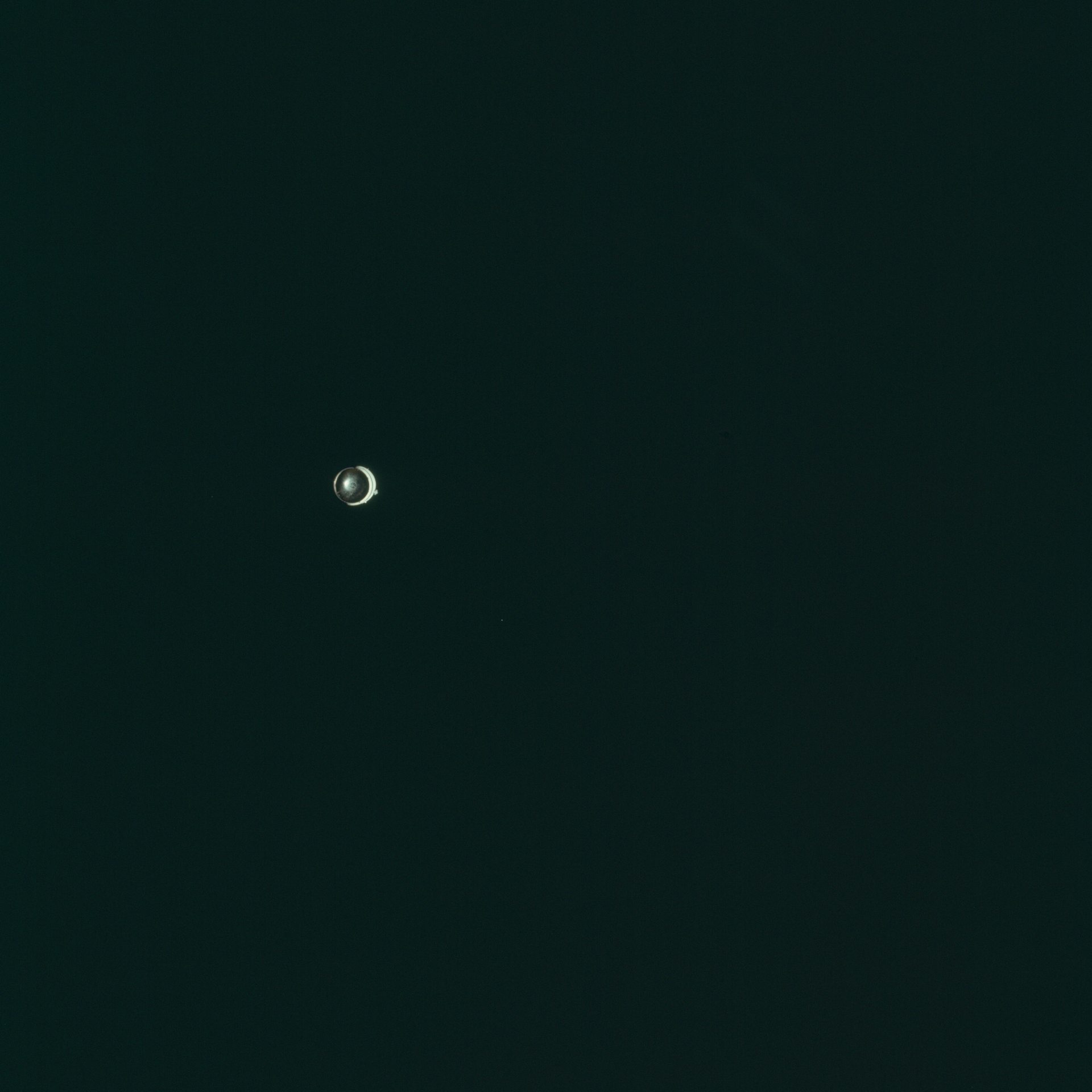
Pictured: NASA photograph AS11-36-5329, the Apollo 11 S-IVB third stage photographed by the crew during translunar coast, July 16–18, 1969 — the leading candidate the crew themselves proposed, then discarded, for the unidentified object described in their debriefing, once Houston's tracking data placed the real S-IVB roughly 6,000 nautical miles away. No photograph of the object actually described in this case exists; it was never captured on film. (Public domain, NASA.)
Theoretical Alignment
This case aligns almost entirely with a Psycho-Social framework — not because the original witnesses misperceived what they saw (the crew's own real-time analysis was notably clear-headed and skeptical of an exotic origin), but because the enduring "Apollo 11 UFO" legend is a textbook case of a mundane, instrument-examined sighting being inflated by later tabloid writers, a fabricated hoax transcript, and a self-styled "NASA insider" into a manufactured cover-up narrative that the primary transcript itself does not support. There is effectively no Extraterrestrial Hypothesis (ETH) alignment: no exotic flight characteristics were ever reported, only an ambiguous point of light the crew themselves suspected was their own hardware.
Background
Apollo 11 launched from Kennedy Space Center's Launch Complex 39A on July 16, 1969 at 13:32:00 UTC, carrying Neil A. Armstrong (Commander), Michael Collins (Command Module Pilot), and Buzz Aldrin (Lunar Module Pilot) toward the first crewed lunar landing. The mission was the culmination of the Cold War-era Space Race, arriving less than a decade after President Kennedy's 1961 pledge to land a man on the Moon "before this decade is out," and was watched live by an estimated 600 million people worldwide. All three crewmen were career military test pilots turned engineers, chosen from NASA's astronaut corps precisely for their technical composure; their public image throughout the flight, and in every recorded transmission, was unfailingly calm, procedural, and unemotional — a fact that later became central to skeptical analysis of what they did and did not say about anything unusual they observed.
Roughly two hours and forty-four minutes into the flight, the S-IVB third stage of the Saturn V rocket reignited for the Translunar Injection (TLI) burn, accelerating the spacecraft out of Earth orbit and onto a trajectory toward the Moon. A little over half an hour later, Collins executed the standard "transposition, docking, and extraction" maneuver: separating the Command/Service Module (CSM) Columbia from the spent S-IVB stage, turning it 180 degrees, and docking its nose with the Lunar Module Eagle, which had ridden to orbit folded inside a protective conical shroud called the Spacecraft/Lunar Module Adapter (SLA). As part of this maneuver, the SLA's four panels were released on hinges and jettisoned by spring-loaded thrusters, springing outward and away from the docked CSM/LM stack; Armstrong himself noted at the time that one of the departing panels appeared to strike the spacecraft's gyro package and S-band antenna on its way out. Because the panels, the S-IVB, and the docked spacecraft were all, at the moment of separation, traveling on nearly identical trajectories at nearly identical velocities, any piece of debris shed in this maneuver — a panel fragment, a scrap of the reflective Mylar thermal insulation lining the SLA, a piece of the spacecraft's own hardware — had every reason to continue drifting in the spacecraft's general vicinity for an extended period afterward, entirely consistent with ordinary orbital mechanics and nothing more.
It was against this specific, well-documented mechanical backdrop — a docked spacecraft trailing multiple recently-jettisoned pieces of its own hardware on a similar trajectory — that the crew's "unusual object" sighting took place. Understanding that backdrop first is essential, because the popular UFO retellings of this case almost universally omit it, presenting the sighting as an inexplicable encounter in empty space rather than what it demonstrably was: a visual puzzle involving hardware the mission itself had just released.
Complete Timeline
| Date / GET | Event |
|---|---|
| July 16, 1969, 13:32 UTC (GET 000:00:00) | Apollo 11 launches from KSC Launch Complex 39A carrying Armstrong, Collins, and Aldrin. |
| GET 002:44:16 | Translunar Injection (TLI) burn of the S-IVB third stage sends the spacecraft toward the Moon. |
| GET ~003:00–003:24 | Collins performs transposition and docking with the Lunar Module; the four SLA panels are jettisoned on hinges, one striking the gyro package/S-band antenna as it departs. |
| GET 004:16:59 | The docked CSM/LM stack is fully extracted and separated from the spent S-IVB stage. |
| GET ~004:57–005:15 | Crew performs a planned observation of the "S-IVB slingshot" venting maneuver, radioing Houston a routine, fully explained description of the stage venting propellant roughly two miles away. |
| "One day out," per the crew's own later description (approx. July 17, 1969) | The crew first notices an unidentified, "sizeable" bright object near the spacecraft and examines it with a monocular; Houston is radioed and reports the actual S-IVB is roughly 6,000 nautical miles distant, appearing to rule it out as the source. |
| Same observation period | Collins views the object through the Command Module's sextant; an out-of-focus view makes it briefly resemble "a hollow cylinder" or "two connected rings," which resolves into an "open-book" shape at a different focus setting. The object is not seen again after this period. |
| Overnight, translunar coast (Aldrin's account places it firmly by the "second night") | Aldrin begins noticing intermittent light flashes inside the darkened cabin during rest periods, a separate phenomenon he investigates further during the return trip. |
| July 19, 1969, ~17:21–17:22 UTC (GET 075:49:50) | Lunar Orbit Insertion (LOI-1) burn; during the approach, the crew separately notes an unusually lit area near the lunar terminator in the vicinity of the crater Aristarchus, speculating it might relate to earthshine or "some sort of fluorescence." |
| July 20, 1969 | Eagle lands in the Sea of Tranquility; Armstrong and Aldrin become the first humans to walk on the Moon. |
| Following lunar ascent, in lunar orbit (post-EVA) | Approaching the Command Module during the Constant Delta Height (CDH) rendezvous phase, Aldrin observes a "fairly bright light source" as Earth rises above the lunar horizon, initially and only tentatively guessing it "could be a laser." |
| July 24, 1969 | Apollo 11 splashes down in the Pacific Ocean; the crew enters quarantine. |
| July 31, 1969 | NASA's Manned Spacecraft Center conducts the formal, then-CONFIDENTIAL Apollo 11 Technical Crew Debriefing, in which the crew discusses the object, the light flashes, and the "possible laser" observation in detail — and in which Aldrin explicitly revises his own initial laser guess, concluding the Earth-orbit light was almost certainly sunlight reflecting off a lake. |
| September 29, 1969 | The tabloid National Bulletin publishes the fabricated "Pepper transcript," a hoax purporting to be a secret, censored Apollo 11 communication — the true origin point of the "NASA covered up an Apollo 11 UFO" mythology. |
| 1975 | The tabloid Modern People publishes writer Otto Binder's invented "moon watchers" quote, falsely attributed to an intercepted ham-radio transmission, claiming the crew saw alien craft "lined up" on a crater rim. |
| 1978 | Former Apollo communications contractor Maurice Chatelain publishes Our Ancestors Came From Outer Space, popularizing embellished retellings of the Apollo 11 sighting and alleging deliberate NASA censorship. |
| 1979–1980 | Aerospace engineer and journalist James Oberg completes the definitive investigation of the case, interviewing NASA officials and confirming there was no restricted channel, no censorship, and no coverup — the entire mission was monitored live by 1,000+ credentialed press representatives. |
| 2005 | Buzz Aldrin discusses the sighting on-camera on the Science Channel documentary First on the Moon: The Untold Story, stating he remains "absolutely convinced" the object was sunlight reflecting off one of the mission's own jettisoned panels. |
| May 8, 2026 | The Department of War (formerly Department of Defense), via the All-domain Anomaly Resolution Office (AARO), re-releases the 1969 Technical Crew Debriefing among roughly 160 files in the "PURSUE" UAP transparency initiative; the document had already been publicly posted on NASA's own history website since at least 2005. |
The Translunar Sighting: What the Crew Actually Said
The core incident behind this case file is documented almost word-for-word in Section 6 of the Apollo 11 Technical Crew Debriefing, conducted at the Manned Spacecraft Center on July 31, 1969, a week after splashdown. In a relaxed discussion of translunar rest periods, one of the crew (the surviving transcript does not cleanly attribute every line to a single speaker in this passage, though Aldrin and Armstrong carry most of it) remarks: "The first unusual thing that we saw, I guess, was one day out or something pretty close to the Moon. It had a sizeable dimension to it, so we put the monocular on it." Asked how they first noticed it, the reply is characteristically plain: they simply looked out the window and there it was. The crew immediately floated the most obvious hypothesis available to them — that it was the S-IVB stage, still visible after the extraction maneuver — and radioed Houston to check. Ground control reported the actual S-IVB was roughly 6,000 nautical miles away at that time, a distance far too great for a piece of rocket hardware to present the "sizeable dimension" the crew described to the naked eye. That single exchange, preserved verbatim in the debriefing, is the most important sentence in the entire case: the crew's own leading conventional hypothesis was tested against real tracking data in real time, and it failed.
Undeterred, the crew kept watching. "Of course, we were seeing all sorts of little objects going by at the various dumps, and then we happened to see this one brighter object going by. We couldn't think of anything else it could be other than the S-IVB. We looked at it through the monocular, and it seemed to have a bit of an L shape to it" — compared by another crewmember, in the same breath, to "an open suitcase." All three took turns examining it while the spacecraft was in Passive Thermal Control (PTC), the slow rotisserie roll used to distribute solar heating evenly across the hull, which brought the object into and out of each window's field of view in turn. Armstrong gave the debrief's most carefully hedged description: "We should say that it was right at the limit of the resolution of the eye. It was very difficult to tell just what shape it was. And there was no way to tell the size without knowing the range, or the range without knowing the size" — a textbook statement of the basic optical problem with any unresolved point source viewed without a scale reference, and one of the clearest first-person acknowledgments of observational uncertainty in this site's entire case catalog.
Instrumented Analysis: When a Point of Light Becomes a Cylinder
Collins then went further than naked-eye viewing, descending to the Lower Equipment Bay to search for the object through the Command Module's optical sextant — the same precision navigational instrument used for star sightings and rendezvous. What he found, in his own words to the debriefing, is the direct origin of this case's popular "cylindrical UFO" label: "So then I got down in the LEB and started looking for it in the optics. We were grossly misled, because with the sextant off focus, what we saw appeared to be a cylinder." Another crewmember offered "or really two rings," to which the reply was "two connected rings." Aldrin pushed back on that specific framing: "No, it looked like a hollow cylinder to me. It didn't look like two connected rings. You could see this thing tumbling, and when it came around end-on, you could look right down in its guts. It was a hollow cylinder. But then you could change the focus on the sextant, and it would be replaced by this open-book shape. It was really weird." The debrief itself immediately supplies the appropriate caveat, in a line too rarely quoted alongside the "cylinder" description: "I guess there's not too much more to say about it, other than it wasn't a cylinder."
That final sentence is easy to miss and is the single most consequential line in the whole transcript for this case file's purposes. The crew's own analysis concluded the "cylinder" they had seen was an artifact of viewing an out-of-focus point of light through an optical instrument, not a description of the true shape of anything. This is consistent with a well-understood behavior of any telescope or sextant with an obstructed optical path: a small, bright, unresolved light source viewed out of focus does not blur into a bigger blob, it defocuses into a ring or annulus, and can appear to shift between a "hollow tube," "two rings," or an "open" shape as focus and orientation change — exactly the shifting, focus-dependent appearance Collins and Aldrin both independently described in real time, using a real instrument, while explicitly noting the shape it was not. Later popular UFO retellings routinely quote "hollow cylinder," "tumbling," and "look right down in its guts" while omitting both this optical explanation and the crew's own explicit disclaimer in the very next line.
The Search for a Mundane Origin
Once the sextant view was in hand, the debrief moves directly into candidate explanations, and every single one proposed by the crew is mundane. Someone raises the LM jettison, days later in the mission timeline but clearly on their minds as a source of debris: "Skipping ahead a bit, when we jettisoned the LM, you know, we fired an explosive charge and got rid of the docking rings, and the LM went boom. Pieces came off the LM. It could have been some Mylar or something that had somehow come loose." Another suggests: "We thought it could have been a panel, but it didn't appear to have that shape at all," while a third proposes the high-gain antenna, noting the crew had experienced antenna problems "about the time" of the sighting: "In the back of my mind, I have some reason to suspect that its origin was from the spacecraft." No alien craft, no exotic propulsion, no anomalous performance characteristic is proposed or implied anywhere in this exchange — only an unresolved debate over which specific piece of Apollo 11's own hardware had likely produced the sighting. The crew explicitly rules out one candidate (the S-IVB, on tracking-data grounds) and converges, without fully settling it, on some form of jettisoned spacecraft debris as the most likely remaining explanation, while candidly admitting they could not pin down the exact piece, its true size, or its true distance from a single ambiguous, briefly-observed light.
Two More Puzzles, Honestly Resolved: Cabin Flashes and the "Possible Laser"
The 2026 document release and subsequent press coverage folded two other, entirely separate observations from this same debriefing into the "Apollo 11 UFO" narrative, and both deserve to be treated with the same rigor and the same result: mundane, and in one case explicitly self-resolved by the crew in the same breath it was raised.
First, Aldrin separately reported a phenomenon with no connection to the translunar object: "I don't know whether I saw it the first night, but I'm sure I saw it the second night. I was trying to go to sleep with all the lights out. I observed what I thought were little flashes inside the cabin, spaced a couple of minutes apart." Investigating further during the return trip, he found he could sometimes see double flashes "separated by maybe a foot" and speculated, correctly as it turned out, that the cause might be "a neutron or some kind of an atomic particle." This is the earliest crewed-spaceflight description of what NASA soon formally studied and confirmed as the Light Flash Phenomenon: high-energy cosmic-ray nuclei and particles passing directly through an astronaut's dark-adapted retina, triggering a visual sensation of light with no external photon involved at all. A dedicated NASA research team (Budinger, Tobias, Lyman, and colleagues) documented and characterized the effect across Apollo 11 through 14 in a 1971 published study, and it has since been confirmed on nearly every long-duration crewed mission since, including Skylab and the International Space Station, where an estimated 80 percent of astronauts report experiencing it. It is real, well-understood space radiation biology — not a light outside the spacecraft at all, let alone a craft.
Second, the "fairly bright light source" and "possible laser" language that dominated several 2026 news headlines comes from an entirely different part of the same debriefing (Section 21.5, "Lunar Orbit"), describing an entirely different event, days later in the mission and in an entirely different direction. Aldrin's full quote reads: "In lunar orbit, following ascent, we did note and mention to the ground that, approaching CDH, when the Earth came up above the lunar horizon, I observed what appeared to be a fairly bright light source which we tentatively ascribed to a possible laser." He continues, in the very same passage: "That seemed to be the best possible explanation until we were coming back in the command module approaching the Earth and were able to observe something that gave about the same appearance. When putting the monocular on the light source, it appeared as though it was the reflection of the Sun from a relatively smooth body of water, such as a lake. I think we've revised our initial conclusion as to what the source of that light was that we saw coming from the Earth. If no one owns up to having beamed the laser toward the Moon at that time, it was more probably a reflection off a lake." In other words: this was sunlight glinting off Earth's own surface, viewed from the Moon, and Aldrin resolved his own tentative "laser" guess into a mundane, if genuinely striking, observation of Earthshine within the same debriefing answer. Several 2026 news accounts (see Sources) reported the "sizeable object" and the "possible laser" as though they were the same sighting, or occurred together; the primary transcript shows they are two unrelated events, in two different mission phases, involving two different bodies (spacecraft debris near the Moon, versus reflected sunlight off Earth), separated by nearly a week — a small but telling example of exactly the kind of conflation this case file's entire thesis is built around.
The Aristarchus Terminator Glow: A Separate, Genuine Curiosity
A third and unrelated observation, closest in the mission timeline to this case's official July 19, 1969 date, occurred as Apollo 11 approached Lunar Orbit Insertion. One crewmember recalled: "As we were coming in on LOI, and I could see the edge of the Moon coming back into the daylight, it appeared to me that at one point… there was one particular area along the horizon that was lit up. I doubt that it was anywhere near Aristarchus. There appeared to be one region that was a little unusual in its lighting." Another crewmember, discussing the region further, called the brightness "a fluorescence," while noting "it certainly did not have any colors that I could associate it with. There was just a higher local illumination level over the surface at that point." This is a legitimate, if minor, entry in the long observational history of Transient Lunar Phenomena (TLP) — brief, localized brightenings or color changes on the lunar surface, most frequently reported, across more than four centuries of recorded astronomy, in and around the crater Aristarchus specifically. NASA's own Winifred Cameron compiled a catalog of nearly 1,500 such historical reports, over a third of them clustered at Aristarchus, and NASA-funded research (cited in Sources) has specifically studied TLP activity in that region using orbital and ground-based data. The leading scientific explanation for genuine TLP activity is subsurface gas outgassing interacting with lunar regolith, not anything anomalous — and, notably, the Apollo 11 crew themselves treated their sighting as an offhand curiosity to check against the mission film later, not as an event requiring any follow-up investigation, further underlining how far removed the crew's own attitude was from the "shocking cover-up" framing later applied to this case.
How a Routine Sighting Became a UFO Legend
None of the primary-source material above supports the version of this story most commonly repeated in UFO literature: that Apollo 11's astronauts saw a "large, cylindrical, rotating, unidentified craft," were debriefed about it in secret, and had the "truth" suppressed by NASA. That version has an identifiable, well-documented origin distinct from anything the crew said. On September 29, 1969, the tabloid National Bulletin published what came to be known as the "Pepper transcript" (after its purported source), a wholly fabricated document claiming to be a secretly recorded, uncensored Apollo 11 communication. Aerospace engineer and space journalist James Oberg's exhaustive 1979–1980 investigation — which included direct interviews with NASA communications officials — identified the hoax's tells immediately: the fake transcript has the crew addressing "Mission Control" (the real callsign was always "Houston"), uses technical jargon no real Apollo transmission ever used, and describes events (such as only two astronauts being present in a scene requiring three) that contradict basic, publicly known mission facts. It was never a leak of anything; it was invented whole.
The myth gained a second life in 1975 when the tabloid Modern People ran a story by writer Otto Binder claiming ham-radio operators had intercepted an "unpublished, off-the-record conversation" in which an astronaut declared "these babies were huge, sir… and I'm telling you there are other spacecraft out there, lined up on the far side of the crater edge. They're on the Moon watching us." No such transmission exists in any recording, log, or transcript; NASA's air-to-ground channels were never restricted, and the "off-the-record conversation" concept is itself fictional — every word spoken on the primary GOSS NET 1 channel throughout the entire mission was picked up live by an estimated 1,000 to 1,500 accredited members of the press monitoring the broadcast in real time, precisely because NASA (unlike, say, a classified military program) had every institutional incentive to maximize public visibility of a mission it was using to win a global ideological contest.
The claim reached its most influential form in 1978, when Maurice Chatelain — who had genuinely worked as a contractor engineer on Apollo's communications and data-processing systems, though not in the senior "NASA insider" role later attributed to him — published Our Ancestors Came From Outer Space, folding an embellished version of the Apollo 11 sighting into a broader ancient-astronaut narrative and explicitly alleging deliberate NASA censorship, a claim widely termed a "cosmic Watergate" by later writers. From there the story propagated rapidly through outlets with little independent fact-checking: Soviet parapsychologist Vladimir Azhazha repeated Chatelain's claims without attribution, the National Enquirer ran versions as straight news, and Charles Berlitz's bestselling 1980 book The Roswell Incident reproduced the fabricated Pepper transcript as though it were genuine documentation. By the time Oberg published his rebuttal, the embellished version had a decade-long head start in circulation and has continued to be recycled, largely unchanged, in UFO literature and video content ever since.
Resolution: What NASA, Oberg, and Aldrin Himself Have Said
The case was never actually a mystery to the people who could have resolved it, because they resolved it themselves, on the record, repeatedly. Oberg's investigation, drawing on direct interviews with NASA officials in 1980, established that the entire Technical Air-to-Ground Voice Transcription was released publicly and without redaction, that no "inhibit switch" or restricted second channel for sensitive communications was ever used on Apollo 11, and that the sheer scale of live, independent press monitoring made any coordinated cover-up practically impossible even if NASA had wanted one. In a 2005 on-camera interview for the Science Channel documentary First on the Moon: The Untold Story, Buzz Aldrin addressed the sighting directly and unambiguously: he stated he felt "absolutely convinced that we were looking at the sun reflected off of one of these panels," while noting that, strictly and technically, "the definition could be 'unidentified'" at the moment of the sighting itself, since the crew could not conclusively determine which piece of debris it was. He added that the crew had explained exactly what they observed at their own 1969 debriefing and had assumed that explanation had been publicly distributed at the time — a debriefing which, as this case file demonstrates, was in fact a real, then-classified government document, just one that took over three decades to attract the kind of public attention its exaggerated retellings had already enjoyed for far longer.
The 2026 "Declassified" Re-Release
On May 8, 2026, the Department of War (the U.S. Department of Defense's rebranded public name, following a 2025 executive order) released roughly 160 UAP-related files through its All-domain Anomaly Resolution Office (AARO) as part of the "PURSUE" transparency initiative, directed by the White House alongside the Office of the Director of National Intelligence. Among them was the same 1969 Apollo 11 Technical Crew Debriefing quoted throughout this case file, along with comparable debriefing material from Apollo 12 and Apollo 17. Outlets including Newsweek, Fortune, and numerous less rigorous websites and video channels covered the release as a revelation, in several cases (as documented above, regarding the "possible laser" language) conflating separate passages of the same document into a single, more dramatic-sounding claim. It is worth being precise about what was and was not new: the underlying document had already been publicly available, in full, on NASA's own history website since at least October 2005 (when NASA HQ's History Office had it professionally scanned and posted), and its contents had already been the subject of Oberg's public investigative writing since 1980. The 2026 release changed the document's formal classification status and its visibility to a much larger, less specialized audience — a legitimate act of "declassification" in the narrow bureaucratic sense — but it did not surface any new fact about the sighting itself, and it did not resolve anything that NASA's own crew had not already resolved, on the record, in 1969 and again in 2005.
Key Witnesses
Neil A. Armstrong
Armstrong contributed the debrief's most technically precise description of the object, explicitly flagging the limits of naked-eye resolution and the impossibility of separating size from range without a scale reference — testimony that reads, in context, as a careful refusal to overclaim rather than a confirmation of anything exotic. He also independently observed the unusual lunar terminator brightening near Aristarchus during the LOI approach, describing it as a minor curiosity to be checked against mission film rather than as an event warranting alarm or further real-time investigation.
Edwin “Buzz” Aldrin
Aldrin was the most active and most quoted crewmember across all three sub-mysteries in this case: he compared the translunar object's sextant appearance to "a hollow cylinder," first reported the cabin light-flash phenomenon later confirmed as a cosmic-ray effect, and reported the "fairly bright light source" near Earth that he initially guessed might be a laser before revising that guess, within the same debriefing answer, to sunlight reflecting off a lake. In a 2005 televised interview he went further than the 1969 debrief and stated his personal conviction that the translunar object was sunlight reflecting off a jettisoned spacecraft panel.
Michael Collins
Collins conducted the case's only instrumented follow-up, descending to the Lower Equipment Bay to view the object through the Command Module's optical sextant. His own account of an out-of-focus point of light resolving into "a cylinder," then "two connected rings," then an "open-book" shape as focus changed is the direct, on-the-record origin of this case's popular "cylindrical UFO" description — and, in the same breath, his own explicit acknowledgment ("it wasn't a cylinder") that the true shape could not actually be determined from that view.
The Five Observables Assessment
The Five Observables framework is applied to the performance characteristics reported in this case:
Assessment: None of the Five Observables associated with genuinely anomalous UAP performance are present in this case, and this file finds no credible basis for classifying any as speculative. The object never maneuvered, never accelerated, and was never tracked well enough by any instrument to characterize a flight path at all — it simply appeared, drifted, and was lost from view, consistent with free-floating debris on a ballistic trajectory rather than a piloted or propelled craft of any kind. It was not "low observable" in any meaningful sense; on the contrary, it was a small, faint, difficult-to-resolve object of exactly the kind that unfiltered sunlight against a black-space background makes intermittently visible and just as easily loses. No trans-medium transition, of course, is even conceptually applicable to an object observed only in vacuum.
Evidence Assessment
Supporting Anomalous Origin
- Three highly trained, technically literate military test pilots agreed the object was visible, "sizeable," and briefly resistant to identification.
- The exact piece of hardware responsible was never conclusively identified, even by the crew's own final analysis — a genuine, acknowledged loose end.
- The object's appearance shifted disconcertingly under sextant observation, which the crew themselves found genuinely unsettling in the moment ("it was really weird").
- The debriefing document was, in fact, marked CONFIDENTIAL at the time, giving the "declassified" framing of the 2026 re-release a kernel of literal truth.
- No photograph of the object exists to independently corroborate or refute any specific candidate explanation.
Supporting Conventional Explanation
- The crew's own leading hypothesis (the S-IVB) was tested against real Houston tracking data in real time and was explicitly ruled out by range, not confirmed as mysterious.
- A well-documented, routine mission event immediately prior — the SLA panel jettison during transposition and docking — put multiple pieces of reflective spacecraft debris on a near-identical trajectory to the CSM/LM stack minutes before the sighting window.
- The "cylinder" appearance is fully and independently explained as a known optical artifact of an out-of-focus point source viewed through an obstructed optical system (the sextant), a conclusion the crew reached themselves in the same conversation ("it wasn't a cylinder").
- No radar, photographic, or any other instrumented data corroborates an anomalous object; the entire case rests on unaided and monocular/sextant visual testimony of an unresolved point of light.
- The object was seen once, briefly, and never again for the remainder of a nine-day mission, consistent with drifting, tumbling debris moving out of visual range — not with a controlled craft maintaining station.
- The specific "cylindrical UFO encounter" narrative attached to this case is traceable to a documented 1969 tabloid hoax (the "Pepper transcript") and a 1975 fabricated ham-radio quote, neither of which has any basis in the real transcript.
- Buzz Aldrin, the crewmember who spoke most extensively about the sighting, has stated on the record since 2005 that he is personally convinced it was sunlight reflecting off the mission's own jettisoned hardware.
Why "Debunked"
This case earns a Debunked stamp, not a more ambiguous Disputed or Unresolved rating, because the primary record does not actually contain an unresolved anomaly once its three separate strands are disentangled and read in full. The translunar object was examined in real time using two independent optical methods, tested against verifiable ground tracking data that ruled out the crew's own leading hypothesis, and produced a "cylindrical" appearance that the crew's own sextant observation and the well-understood optics of defocused point sources jointly explain without requiring anything exotic — and which the crew's own transcript explicitly disclaims as the object's true shape. The cabin light flashes are independently confirmed, well-published space radiation physics unrelated to any external craft. The "possible laser" light source is, in the primary transcript itself, resolved by the crew within the same breath into sunlight reflecting off an Earth lake. What remains genuinely open is narrow and mundane: exactly which piece of Apollo 11's own jettisoned hardware (a panel fragment, Mylar insulation, or an antenna component) produced the translunar sighting cannot be established with certainty from a single brief, unresolved, unphotographed observation — a loose end of identification, not of phenomenon. Meanwhile, the version of this story that circulates most widely — a secretly encountered alien craft, censored by NASA — is traceable to a specific, confessed 1969 tabloid fabrication and a specific 1975 invented quote, propagated by a chain of authors who did not check their sources against the freely available primary transcript. A low score and Debunked stamp reflect that the anomalous version of this case is not merely unproven; it is actively contradicted by the very document its modern promoters cite as their evidence.
Sensor & Instrumentation Detection Profile
Detection was limited entirely to unaided human vision, a monocular, and the Command Module's built-in navigational sextant — the only optical instruments aboard Columbia. No radar, photographic, radiological, or electromagnetic instrumentation ever captured the object; despite an extended period of observation by all three crewmembers in Passive Thermal Control (PTC, the "barbecue roll" rotation used to distribute solar heating), no one aboard attempted or was able to photograph it, and it does not appear in any Apollo 11 in-flight film magazine. This absence of any recorded data beyond testimony is itself a central limiting factor in the case: every other conclusion in this file rests on the crew's contemporaneous verbal description and their subsequent Technical Crew Debriefing testimony, not on any independently reviewable sensor trace.
Environmental & Geospatial Context
The sighting occurred in the hard vacuum of translunar space, roughly one day into the three-day coast between Earth and the Moon, at a distance from Earth variously estimated across the mission at tens of thousands to over a hundred thousand nautical miles. There is no atmosphere, no weather, and no terrestrial geography to assess. The spacecraft was in Passive Thermal Control, a slow rotisserie-like roll that exposed all sides of the vehicle to direct, unfiltered sunlight in turn — a lighting condition that makes small, distant reflective debris flare brightly against the black sky and then fade as the angle changes, exactly the intermittent, hard-to-relocate appearance the crew described. The Moon itself lay ahead of the spacecraft's flight path; a second, unrelated observation recorded in the same debriefing (an unusually lit area near the lunar terminator, in the vicinity of the crater Aristarchus) occurred separately, during the July 19, 1969 approach to Lunar Orbit Insertion, and is addressed in its own section below. Because the event took place in cislunar space rather than at any Earth-bound location, it does not correspond to an entry in this site's Locations directory or the interactive case map.
Observer Credibility & Occupational Profile
The witnesses in this case are, by any reasonable standard, among the most rigorously vetted and trained observers ever to report a UAP encounter. Neil A. Armstrong was a former Navy fighter pilot with 78 combat missions over Korea, a civilian experimental test pilot on the rocket-powered X-15, and commander of Gemini 8's first-ever docking in space. Buzz Aldrin was an Air Force fighter pilot with 66 Korean War combat missions and a Doctor of Science in astronautics from MIT, whose doctoral thesis was on orbital rendezvous techniques later used on Gemini and Apollo. Michael Collins was likewise an Air Force fighter and test pilot who had flown Gemini 10. All three were selected, in part, specifically for calm, methodical, technically literate reporting under pressure; NASA's entire astronaut corps was drawn from a candidate pool that had already been through rigorous psychological and physiological screening. Their own handling of the sighting reflects that training: rather than reacting with alarm, they methodically fetched an optical instrument, radioed Houston for independent tracking data on a known object (the S-IVB) to test a hypothesis, changed instruments and focus settings to try to resolve the ambiguity, and candidly told their formal post-mission debriefing that they could not reach a firm conclusion on exactly which piece of hardware it was — while being unanimous that they suspected a mundane, spacecraft-related origin throughout.
Physical & Material Assays
No physical evidence exists in this case and none could ever have been retrieved. The object was never touched, never approached, never photographed, and no material sample of any kind was recovered from it; it was a distant, ambiguous point of light examined visually and through two optical instruments in transit. Any physical/material assay of the sort performed in ground-based trace-evidence cases (soil sampling, metallurgy, isotopic analysis) is categorically inapplicable here. That absence is not a gap in this file's research — it is definitionally impossible for this class of deep-space sighting, and is one of the reasons this case can never be elevated above testimony-only evidentiary weight regardless of how credible the witnesses are.
Historical Precedents & Archive Matches
Astronaut sightings of jettisoned spacecraft hardware, ice particles, and paint-chip debris ("orbital debris" glinting in unfiltered sunlight) recur across the entire crewed spaceflight record and were already a known phenomenon well before Apollo 11 — Mercury and Gemini crews routinely reported drifting "fireflies" and companions later identified as frost flaking off the spacecraft's exterior. James Oberg, the aerospace engineer who conducted the most thorough investigation of this case, coined the term "space dandruff" for exactly this class of misidentification, and catalogued comparable false "companion object" reports on Apollo 12 and Apollo 17 in the same 2026 document tranche that resurfaced this case (both were explained by their own crews as probable ice or paint fragments from the discarded rocket stage). Within this site's own catalog, the same debris-misidentification-plus-mythology-inflation pattern recurs in the Vancouver Starlink Satellite Train Sighting (2022, mistaken satellites), the Jimmy Carter Sighting (1969, a logged barium-cloud rocket release), and the Captain William Schaffner Incident (1970, a real event later overwritten by an invented tabloid narrative decades after the fact) — all cases where a real, mundane, government-documented event became a "UFO encounter" only in its retelling.
Material Analysis
There is no physical or trace material evidence of any kind associated with this case, and none was ever collected, retained, or submitted for laboratory analysis. The purported object was never recovered, never photographed at sufficient resolution to measure, and no fragment, residue, or sample was ever obtained from it. This is expected and unavoidable for a deep-space visual sighting of this type; it is not evidence that anything was concealed. The only "material" this file can analyze is the documentary record itself — the debriefing transcript, the mission's own hardware-jettison timeline, and the verifiable optics of sextant defocus — all of which point toward mundane spacecraft debris rather than a genuine unknown material or craft.
Supporting Non-Terrestrial Origin
- No physical evidence of any kind exists to support this origin; the case rests entirely on an unresolved visual description.
Supporting Terrestrial Origin
- The sighting occurred within minutes to hours of a documented, routine hardware-jettison event (SLA panel separation) that placed multiple pieces of reflective debris on the spacecraft's own trajectory.
- The crew's own real-time hypothesis testing (radioing Houston for S-IVB tracking data) is itself a form of methodical terrestrial-origin verification, and it pointed toward spacecraft debris once the S-IVB was ruled out by distance.
The Conventional Explanation Candidate: Jettisoned Spacecraft Debris
The most plausible explanation, and the one the crew themselves converged on without ever fully resolving which specific component was responsible, is that the object was a piece of Apollo 11's own recently-jettisoned hardware — most likely a fragment of one of the four SLA panels, a scrap of the reflective Mylar thermal insulation that lined the adapter, or possibly a piece of the problematic high-gain antenna. All three were released or malfunctioning in the same general timeframe as the sighting, all three would have shared the spacecraft's own trajectory and velocity by ordinary orbital mechanics, and all three would reflect direct, unfiltered sunlight unpredictably as they tumbled — consistent with the object's brief, singular appearance and its shifting apparent shape under magnification.
Jettisoned Spacecraft Debris (SLA panel / Mylar / antenna fragment)
Highly PlausibleConsistent with a documented, routine mission event (SLA panel jettison) minutes to hours before the sighting; consistent with the debris's shared trajectory with the spacecraft; consistent with the object's single brief appearance and irregular, tumbling, light-catching behavior. The crew's own final debriefing analysis converges here without fully resolving the exact component.
S-IVB Third Stage (Literal Identity)
ImplausibleThis was the crew's own first guess, and it was tested and functionally disproven in real time: Houston's tracking data placed the actual S-IVB roughly 6,000 nautical miles away at the time of the sighting, far too distant to present the "sizeable dimension" the crew described to the unaided eye.
Sextant Defocus Optical Artifact (explaining the "cylinder" description)
Highly PlausibleAn out-of-focus view of a small, bright, unresolved light source through an optical instrument with a central obstruction commonly produces ring, annulus, or "hollow tube" appearances that shift with focus — matching the crew's own description of the image changing from "cylinder" to "open-book" as they adjusted the sextant, and matching their own explicit conclusion that "it wasn't a cylinder."
Genuine Extraterrestrial Craft
ImplausibleNo maneuvering, acceleration, or exotic performance was ever reported; no instrumentation beyond human vision and two optical devices ever detected it; and the crew's own real-time and post-mission analysis never proposed this explanation. The version of the story that does propose it is traceable to a documented 1969 tabloid hoax and a 1975 fabricated quote, not to the primary transcript.
Related Cases
Confirmed Documents & Official Records
The formal, originally CONFIDENTIAL post-mission debriefing containing the crew's full discussion of the translunar object sighting (Section 6) and the cabin light-flash phenomenon. Publicly hosted since 2005 by NASA's own History Office.
Contains Aldrin's full "fairly bright light source… possible laser" quote and his own immediate revision of it to sunlight reflected off a lake — the passage most frequently misquoted out of context in 2026 news coverage.
The complete, unredacted real-time mission communications record, confirming there was no restricted or "secret" channel for anomalous reports.
Official 2026 landing page for the Pentagon's UAP transparency initiative that re-released the Apollo 11 debriefing, among roughly 160 other historical files, to a broader public audience.
Further Reading — Recommended Literature
UFOs and Outer Space Mysteries: A Sympathetic Skeptic's Report
Written by the aerospace engineer and journalist who conducted the definitive original investigation of the Apollo 11 "UFO" claims, tracing the myth to the fabricated Pepper transcript and Chatelain's embellishments.
Carrying the Fire: An Astronaut's Journeys
Collins's own candid, technically detailed memoir of Apollo 11, written by the crewmember who personally examined the object through the Command Module's sextant.
Magnificent Desolation: The Long Journey Home from the Moon
Aldrin's own memoir, from the crewmember most associated with this case's sightings, addressing decades of public speculation about what he really saw.
First Man: The Life of Neil A. Armstrong
The only authorized Armstrong biography, built on fifty-plus hours of interviews, offering essential context on the crew's technical training and characteristically understated reporting style.
A Man on the Moon: The Voyages of the Apollo Astronauts
Drawing on interviews with nearly every Apollo moonwalker, this history situates the Apollo 11 translunar coast and its minor onboard curiosities within the full arc of the lunar program.
Essential Viewing
No Videos Available
A genuine search across reputable channels (excluding History Channel-style sensationalized programming such as NASA's Unexplained Files) turned up no video dedicated, primarily and rigorously, to this specific case's actual primary-source content. The 2026 news cycle around the Pentagon document release produced a wave of low-quality, clickbait-titled videos that recycle the conflated "possible laser"/"cylindrical object" framing this case file specifically corrects; none met this site's sourcing standard for inclusion.
Sources
- NASA / Manned Spacecraft Center, Apollo 11 Technical Crew Debriefing, Volume 1 (July 31, 1969), Section 6 — the crew's full discussion of the translunar object and cabin light flashes. ibiblio.org Apollo Program archive →
- NASA / Manned Spacecraft Center, Apollo 11 Technical Crew Debriefing, Volume 2 (July 31, 1969), Section 21.5 ("Visual Sightings — Lunar Orbit") — Aldrin's full "possible laser" quote and self-revision. ibiblio.org Apollo Program archive →
- NASA, Apollo 11 – Technical Air-to-Ground Voice Transcription (1969), the complete real-time mission communications record. nasa.gov →
- Eric M. Jones & David Woods (eds.), Apollo 11 Flight Journal — "Day 1, Part 3: Transposition, Docking and Extraction," documenting the SLA panel jettison in detail. apollojournals.org →
- NASA, "The Apollo Lunar Surface Journal and Apollo Flight Journal" (resource overview page). nasa.gov →
- James Oberg, "The Apollo-11 UFO Incidents", investigative report tracing the Pepper transcript hoax, Otto Binder's fabricated 1975 quote, and Maurice Chatelain's embellishments. debunker.com →
- Snopes, "Did Buzz Aldrin 'Reveal the Truth About Aliens' in a Lie Detector Test?" — fact-check of a related, separately fabricated Aldrin/alien claim. snopes.com →
- T.F. Budinger, C.A. Tobias, J.T. Lyman, et al., "Light flash phenomenon seen by astronauts," NASA Technical Reports Server, Doc. ID 19720016426 (1971) — the original scientific study confirming the cosmic-ray retinal effect Aldrin first described. ntrs.nasa.gov →
- Helen Thompson, "50 years ago, cosmic rays may have caused Apollo astronauts to see lights," Science News, May 12, 2023. sciencenews.org →
- NASA Technical Reports Server, "Observations of lunar transient phenomena in the Aristarchus region," Doc. ID 19710051782 — scientific background on the separate Aristarchus terminator-glow observation. ntrs.nasa.gov →
- A. Crotts, "Transient Lunar Phenomena: Regularity and Reality," The Astrophysical Journal 697 (2009). arxiv.org →
- Fortune, "UFO files show Buzz Aldrin saw a 'sizeable' object close to the moon and a 'fairly bright light source' that the Apollo 11 crew felt could be a laser," May 9, 2026. fortune.com →
- Newsweek, "UFO Files Reveal 'Unusual' Sightings by Astronauts on 1969 Moon Mission," May 8, 2026 (byline Joe Edwards & Anna Skinner). newsweek.com →
- All-domain Anomaly Resolution Office (AARO), U.S. Department of War, "UAP Records / Information Papers," official landing page for the May 2026 PURSUE document release. aaro.mil →
- U.S. Department of War, "UFO" declassified-records portal (PURSUE initiative), launched May 8, 2026. war.gov →
- Maurice Chatelain, Our Ancestors Came From Outer Space (Doubleday, 1978) — the primary source of the embellished "cosmic Watergate" retelling this case file assesses and rejects. archive.org →
- Atlas Obscura, "How One Man Has Explained Almost Every Internet UFO Theory," profile of James Oberg's investigative methods and his "space dandruff" terminology. atlasobscura.com →
- SOFREP, "Buzz Aldrin sets the record straight on Apollo 11 UFOs, but says alien life is a 'certainty'" — coverage of Aldrin's 2005 Science Channel interview and panel-reflection explanation. sofrep.com →
- Wikimedia Commons, File:AS11-36-5329 – View of S-IVB-506.jpg, NASA public-domain photograph (source of this case file's hero image). commons.wikimedia.org →
- Wikipedia, "Transposition, docking, and extraction" — used only for quick technical orientation on the maneuver; primary detail sourced from the Apollo Flight Journal above. en.wikipedia.org →
- Wikipedia, "Winifred Cameron" — brief biographical background on the NASA astronomer who compiled the Lunar Transient Phenomena catalog. en.wikipedia.org →
- Michael Collins, Carrying the Fire: An Astronaut's Journeys (Farrar, Straus and Giroux, 1974) — crew-perspective primary account.
- Buzz Aldrin with Ken Abraham, Magnificent Desolation: The Long Journey Home from the Moon (Harmony Books, 2009) — crew-perspective primary account and public UFO-claim response.
- James R. Hansen, First Man: The Life of Neil A. Armstrong (Simon & Schuster, 2005) — authorized biography and mission-conduct context.
- NASA, Apollo 11 Press Kit, Release No. 69-83K (July 1969) — official mission overview, crew assignments, and flight timeline. nasa.gov →
See something inaccurate? Have additional information or sources?
Suggest an Edit →Last Updated: August 2026