
The Aunay-les-Bois Triple-Witness Sighting
In the small hours between June 2 and 3, 2020, three friends sitting around a bonfire in the garden of a countryside holiday home outside Aunay-les-Bois, a farming commune of roughly 140 residents in France's Orne department, watched something none of them could name. One had stepped away toward the wooden garden gate to smoke a cigarette when he looked up and called out that he'd spotted a comet. His partner joined him and immediately disagreed — this was no comet. A third friend, arriving moments later, insisted twice, audibly frightened, that it had to be a plane. For five to ten seconds, all three watched two bluish-white lights of matching brightness, wrapped in a shared halo and trailed underneath by several smaller lights, glide across the sky on a dead-level, perfectly steady path, low over the horizon, in complete silence. It passed behind a line of poplars, briefly reappeared, and vanished to the east. Stunned, none of them moved to follow it, and none managed to raise a phone to film it. They spent the rest of the night separately sketching what they had seen, then compared drawings and spent hours online searching for an explanation among drones, aircraft, weather balloons, satellites, and electrical arcing — without success. GEIPAN, France's official government body for investigating unidentified aerospace phenomena, opened a full investigation: two years of remote analysis, three separate video cognitive interviews conducted during COVID-19 restrictions, a formal radar data request to the French air-defense system CAPCODA, cross-checks against three independent meteor-observation databases, a site visit with angle measurements, and a direct consultation with a French Navy drone instructor about military drone lighting. Every avenue came back empty. GEIPAN rated the account's consistency "good" — while explicitly flagging that some of the witnesses' matching answers appear to have been settled only after they discussed the sighting together — and closed the case Class D: a genuinely unidentified phenomenon.
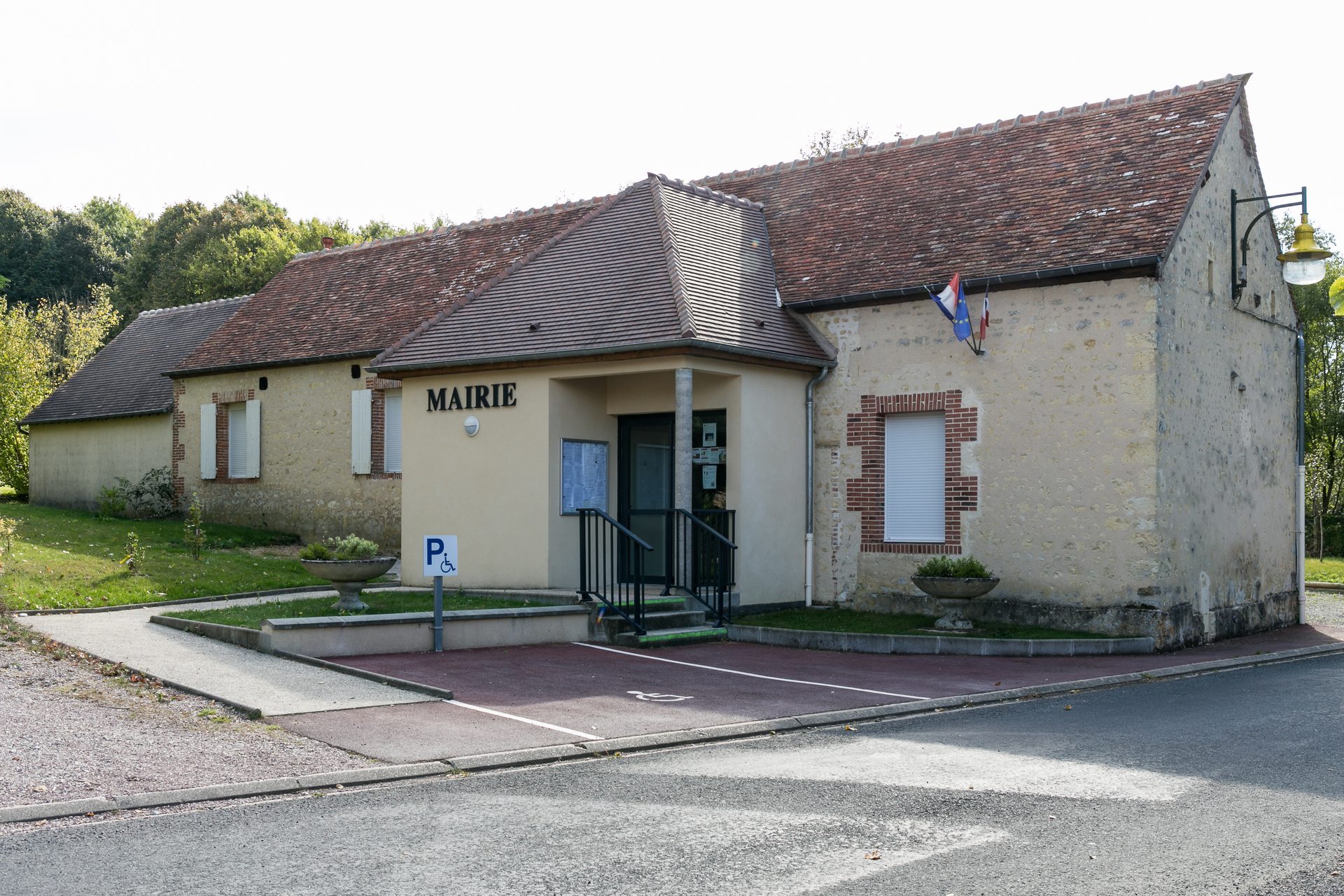
Pictured: the town hall (mairie) of Aunay-les-Bois, Orne, France, photographed in 2018. This is not a photograph of the actual holiday home and garden where the sighting occurred — a lieu-dit several kilometers outside the village center, withheld from GEIPAN's published case file per its standard anonymization practice — nor of the phenomenon itself, of which no photograph or video exists. Photo by Wikimedia Commons contributor Pymouss (2018), released under CC BY-SA 4.0.
Theoretical Alignment
This case's strongest alignment sits with the Extraterrestrial Hypothesis, though at a moderate rather than dominant level, driven mainly by the negative result of GEIPAN's own exhaustive process of elimination: three genuinely independent conventional explanations were tested against real, checkable data — a formal radar request, three meteor-observation databases, and wind data at multiple altitudes — and every one of them failed to reach even a 50% confidence rating in GEIPAN's own scoring. That kind of comprehensive, well-documented failure to explain a physically-described object is the strongest evidence this file offers for something outside the conventional inventory, without itself proving an extraterrestrial origin specifically. Interdimensional framing draws modest support from the case's genuinely ambiguous physical status: GEIPAN's investigators explicitly could not determine whether the object was a single coherent craft or several smaller light sources moving in tight formation, an unresolved ontological status more amenable to speculative frameworks than to a simple identified-craft reading. Psycho-Social framing carries real but limited weight: all three witnesses behaved rationally throughout, independently sketching what they saw before comparing notes and spending hours cross-checking their account against drones, aircraft, weather balloons, and satellites rather than immediately reaching for an exotic explanation — a pattern that argues against fabrication or panic-driven misperception, even as GEIPAN's own noted concern about witnesses conferring on some answers keeps this file from being read as fully independent triple corroboration.
Background
Understanding why three friends' five to ten seconds of confusion around a garden fire turned into a two-year investigation involving a national air-defense radar request and a French Navy drone specialist requires understanding both the quiet Normandy commune where it happened and the specific institutional machinery GEIPAN has built for evaluating an account with no photograph, no video, and nothing beyond three human memories and three hand-drawn sketches.
Aunay-les-Bois: A Small Farming Commune in the Orne Countryside
Aunay-les-Bois is a small commune in the Orne department of Normandy, part of the arrondissement of Alençon, roughly 175 meters above sea level on a modest plateau drained by the Tanche river. Its population, most recently recorded at around 138 residents known locally as Aunais and Aunaises, gives it a population density of only about 16 people per square kilometer — genuinely rural even by the standards of the wider Orne, one of Normandy's most sparsely populated departments. The commune covers roughly 853 hectares of farmland, hedgerow, and small woodland parcels, exactly the kind of countryside where a family might keep a holiday home used only "occasionally," as the witnesses described theirs to GEIPAN's investigators: a traditional Norman longère farmhouse in a lieu-dit a few kilometers outside the village center, surrounded on all sides by fields and animal enclosures for cattle and horses, with woods nearby. This detail matters directly to the investigation: because the witnesses only visited the property intermittently, GEIPAN's field investigators were never able to conduct their site visit and angle measurements in the witnesses' actual company, and instead had to reconstruct the sightline from photographs, verbal descriptions, and a later solo visit by the witnesses themselves.
GEIPAN's Investigative Apparatus, Tested Under Pandemic Conditions
GEIPAN, the Groupe d'Études et d'Informations sur les Phénomènes Aérospatiaux Non-identifiés, operates within the Centre National d'Études Spatiales (CNES) in Toulouse, tracing its lineage to GEPAN, founded there in 1977 by Claude Poher, reorganized as SEPRA in 1988, and re-established under its current name and public-facing mandate in 2005. This particular case arrived during an unusual moment in that history: the COVID-19 pandemic forced GEIPAN's field investigators to conduct all three of this case's formal cognitive interviews by videoconference in August 2021, rather than in person — the first time, per the investigators' own note in the case file, that this specific interviewing technique had been deployed remotely. The cognitive interview is a structured, non-leading recall technique distinct from simply re-asking the original written questionnaire, designed to help a witness surface additional accurate detail without introducing suggestion; GEIPAN's investigators judged the technique successful even conducted over video, finding "excellent" agreement between what each witness had originally written and what they recalled a year later under interview — with one important exception, discussed at length below, that some of the witnesses' matching answers appeared to reflect after-the-fact consultation rather than three fully independent perceptions.
The investigation that followed was substantial for a case with no photographic evidence: a first investigator conducted the initial remote analysis across 2021 and 2022; two investigators then traveled to the property in the witnesses' absence on June 6, 2022, to photograph the site and take angle measurements matching the witnesses' description; GEIPAN formally requested radar data from the French air-defense radar network CAPCODA on August 10, 2020, receiving a response on September 8, 2020; and, in a final step, the witnesses were asked to return to the property themselves to photograph and film their own sightlines, footage GEIPAN's own IPACO image-processing software then used to calculate minimum object size and speed. Few single-episode, no-photo GEIPAN cases in this site's archive have received a comparably resourced multi-year investigation.
Complete Timeline
| Date | Event |
|---|---|
| 1977 | GEIPAN's predecessor, GEPAN, is founded within CNES in Toulouse under Claude Poher. |
| Night of June 2–3, 2020, approx. 00:00–00:05 | Sighting begins. Three friends around a bonfire in the garden of a holiday home outside Aunay-les-Bois spot two bluish-white lights crossing the sky low over the horizon to the south-southeast. One first exclaims "a comet"; a second immediately disagrees; a third repeatedly insists it must be a plane. |
| Same night, ~5–10 seconds total | The object passes behind a line of poplars, briefly reappears, and disappears from view to the east. None of the witnesses moves to follow it or manages to photograph it. |
| Same night, immediately after | The three witnesses independently draw sketches of what they saw before comparing them, then spend the rest of the night researching drones, aircraft lights, electrical arcing, weather balloons, and satellites online without finding a match. |
| June 4, 2020 | Witness T1 completes and signs GEIPAN's technical questionnaire (the file's recorded August 4 signature date is a witness dating error; GEIPAN received the submission June 4). |
| August 4, 2020 | Witness T2 completes GEIPAN's technical questionnaire. |
| August 10, 2020 | GEIPAN formally requests radar data from the French air-defense radar network CAPCODA. |
| September 8, 2020 | CAPCODA returns its radar data to GEIPAN. |
| October 18, 2020 | Witness T3 completes GEIPAN's technical questionnaire, the last of the three. |
| 2021–2022 | A first GEIPAN investigator conducts a remote, desk-based analysis of the case. |
| August 2021 | Cognitive interviews. All three witnesses are separately interviewed by videoconference — the first time GEIPAN conducted this technique remotely — due to pandemic restrictions. Recordings show excellent agreement with the original questionnaires, alongside GEIPAN's specific concern about consultation on certain matching answers. |
| June 6, 2022 | Field investigation. Two GEIPAN investigators travel to the property in the witnesses' absence, take photographs, and make angle measurements reconstructing the witnesses' point of view. |
| After the field visit | The witnesses are asked to return to the property themselves to photograph and film their own sightlines from each of their original vantage points, for use in GEIPAN's IPACO image-processing analysis. |
| Following the full investigation | Final classification. GEIPAN rates the account's consistency 0.72 ("good") and strangeness 0.53, finds no hypothesis reaches 50% probability, and classifies the case « D », catalogued as case ID 2020-06-51034. |
Detailed Narrative
"Regardez, une comète!" — Three Independent First Impressions
GEIPAN preserved each witness's own written account, and the site's investigators explicitly noted that they retranscribed each one "without any modification or correction" specifically to preserve how each witness naturally expressed the event. Witness T1's account begins: "In the night of Tuesday June 2 to Wednesday June 3, between 00:30 and 01:00, three of us adults saw a luminous phenomenon moving across the sky. We were in the commune of Aunay-les-Bois (61), in the garden of a country house in the middle of farm fields and animal enclosures. We observed a luminous phenomenon moving in a straight line from right to left, parallel to the horizon. It passed behind the trees for a few seconds, reappeared, and then left our field of vision. We could see two fairly widely spaced light points that seemed to belong to the same object, with several smaller light points beneath. The color of the lights was slightly bluish." T1 continues: "There was no perceptible engine noise and no wind that evening. The observation lasted around five seconds. The object's speed was constant. The first of us to spot it exclaimed: 'Look, a comet!' I then saw the object myself but it didn't look like a comet (I'd seen one before) and I immediately thought of a flying object given its speed and horizontal trajectory. The third person initially thought of a plane, but we realized it wasn't the usual lights of a plane, and above all the total absence of noise ruled out that option. We then thought of a drone, but the gap between the two lights seemed far too large for that… the object looked fairly large relative to the treetops, but it seemed to be a good way behind them. We then thought of electrical arcing on power lines, but on checking, those lines run in front of the trees, not behind them. In shock, it didn't occur to us to move to follow the object, we were so surprised. We spent a good hour checking online what this object could be, without finding an answer."
Witness T2's independent account describes the same sequence with its own specific detail about who saw what first: "The first of us to spot the phenomenon had walked a little away from us to smoke a cigarette; he was standing in front of the garden's wooden gate with a view over the fields and the treeline beyond. He thought he saw a comet and told us; his partner joined him, exclaiming that it didn't look like a comet, and I then joined them in turn, saying it was probably a plane, and I saw it myself. Then we saw the second point appear from behind the trees that had been hiding it until then. I kept repeating mechanically that it was a plane, but looking more closely I noticed smaller light points aligned underneath, and I thought that it didn't look like the planes I've often had occasion to observe around here — and above all, the place being silent, we're used to hearing them when they fly a bit low, yet the phenomenon was silent. The object finally disappeared from our field of vision; we were sort of stunned, a little puzzled by what we'd just seen, and decided to draw the observation. Comparing our drawings and discussing them, we found we had observed the phenomenon in the same way. We then spent the rest of the evening looking for a rational explanation, looking at various images of drones, atmospheric phenomena, electrical phenomena, farm equipment, planes, etc."
Witness T3, the friend visiting the couple's holiday home that evening, gave the most vivid account of the moment of realization: "We were at the table with friends in the garden of their country house at Aunay-les-Bois (61). Around 00:30, we'd started clearing the table. I walked toward the house and, turning around, I first saw a single white/bluish light. I first exclaimed 'Oh, a comet!' — we'd talked that evening about our friends' sighting of a comet a few months earlier. Seeing the object, [T2] exclaimed 'That's not a comet, that's a goddamn UFO!' It seems [T1] had just come out of the house and said, sounding scared, 'no, no, that's just a plane.' I initially saw only a single blue point, then a second one entered my field of vision. I then understood it was a single set. The object looked enormous to me and seemed fairly close behind the trees, maybe around 200 meters. For me the object consisted mainly of two whitish-blue lights with a luminous halo beneath. The lights disappeared and reappeared behind the trees. We didn't move, none of us managed to get out a phone to film, we were as if hypnotized. In my estimation, the sighting lasted 8 to 10 seconds. We then each drew what we had seen, to compare. And we spent the evening searching online for anything resembling it, without success."
A Rational, Methodical Response to an Irrational Few Seconds
What stands out across all three independent accounts, and what GEIPAN's own investigators repeatedly noted as a point in the witnesses' favor, is how deliberately unspectacular their behavior was after the sighting ended. None reached immediately for an exotic conclusion; instead, each first tried, in sequence, a comet, an aircraft, a drone, and overhead power-line arcing, testing and discarding each against a specific, checkable detail — the absence of a tail for the comet hypothesis, the absent-but-expected aircraft lighting and total silence for the plane hypothesis, the improbably wide gap between the two main lights for the drone hypothesis, and the physical layout of the power lines relative to the treeline for the arcing hypothesis. Only after independently sketching what they'd seen, comparing those sketches, and spending a further several hours searching the internet without success did they contact GEIPAN. As witness T2 put it in her own later cognitive interview: "We tried every possibility we know of but nothing matches what we saw. The absence of engine noise, the color, the trajectory, etc., nothing seems to correspond to anything we know, nor to an atmospheric phenomenon. We think it's a flying object. We're turning to you to try to get an answer" — a closing line that reads less like a UFO enthusiast's excited report and more like a frustrated, methodical process of elimination that had simply run out of road.
GEIPAN's own field investigators drew a specific, carefully qualified conclusion from this behavior in their cognitive-interview analysis: "the general impression that emerges from the study of the questionnaire and interview material is that the witnesses undoubtedly observed together the same phenomenon, physically present, which carries for them a strong sense of strangeness essentially because of its uncommon appearance, but also because of the absence of noise in a particularly silent environment. All three were marked by this observation, T1 and T2 being more emotionally affected, even fearful in T2's case." That final detail is notable: it was T2, not the witness who first thought "comet," who reported the strongest fear response, while T1, who had initially seen a comet and was quickest to reach for a rational drone or aircraft explanation, described himself in his own interview as "indifferent" afterward, feeling nothing extraordinary had occurred. GEIPAN's investigators treated this variation in emotional response across three people who saw the identical event as consistent with genuine, unrehearsed testimony rather than a coordinated story.
Comparing Sketches: A Real Strength With a Real Caveat
Each witness's instinct to draw the object immediately after the sighting, before discussing it with the others, gave GEIPAN's investigators an unusually direct way to check consistency independent of memory or suggestion. Comparing the three sketches, the investigators found strong agreement on the object's core visual structure — two bluish main lights of matching appearance, surrounded by numerous smaller lights and/or a halo of the same color — while also finding genuine, informative small differences: T1 and T2 both described the lights as more purely "bluish," while T3, who initially glimpsed only a single light before the second one emerged from behind the trees, described a "whitened blue." Only T1's sketch depicted the object's disappearance behind the treeline, though all three witnesses mentioned this detail in their written accounts; and T3 uniquely sketched the object as a solid black shape, treating the two lights as visible markers on a single, otherwise-invisible body rather than as free-floating points. GEIPAN's investigators judged the sketches "probably more faithful" than the written testimonies themselves, noting that T2 and T3 completed their formal questionnaires two and four months after the sighting respectively, a gap that leaves room for what the investigators specifically termed "false memories" to creep into the written record even without any intent to mislead.
Against that real strength sits an equally real, explicitly documented caveat. GEIPAN's cognitive-interview analysis states plainly: "we observed excellent agreement in the descriptions given during these interviews regarding the appearance and movement of the observed phenomenon, agreement already verified in the description provided in the initial testimonies, in the [questionnaires], but with certain answers identical in every respect, showing that the witnesses consulted each other before writing the [questionnaires]." The investigators' final conclusion returns to this point directly: "we can only regret that certain information, such as the assessment of the PAN's apparent size, seems to have been determined after mutual consultation." This is a materially different, and more serious, evidentiary limitation than simply comparing sketches for fun after the fact — it means that at least one specific, quantitatively important data point (the estimated 30mm gap between the two lights held at arm's length, used directly in GEIPAN's later size calculations) may reflect group agreement rather than three fully independent measurements, a limitation this site's own analysis carries forward rather than smoothing over.
The Radar Request, the Meteor Databases, and a Genuine Institutional Effort to Disprove the Sighting
Unlike many single-witness GEIPAN files, this case received a real attempt at instrumented corroboration. GEIPAN's formal request to the French air-defense radar system CAPCODA (Centre d'Analyse et de Préparation de la Composante Air, France's integrated civil-military airspace surveillance network) went out on August 10, 2020 and returned data on September 8, 2020. The result was informative mainly by elimination: CAPCODA recorded exactly one aircraft passage anywhere near the relevant time window, traveling from southwest to northeast around 22:00–22:01 UTC — between thirty minutes and a full hour before the witnesses' own estimated sighting window — passing to the west and north of the witnesses' position rather than the southeast-to-east path they described, and flying at roughly 34,000 feet (about 10,300 meters), far too high to match a phenomenon the witnesses judged large relative to a nearby treeline. GEIPAN's investigators treated this as effectively ruling out any recorded aircraft as the source, while also noting that the CAPCODA request itself represents a genuine, and not automatic, investment of institutional effort into a case with no other instrumented evidence to corroborate.
A parallel effort checked three independent databases of meteor and fireball observations: the International Meteor Organization's database, which recorded one bolide seen by thirteen observers over southern France but at 22:14 the previous evening, hours before the sighting and far to the south; the FRIPON automated all-sky camera network, whose Belfort and Dijon stations jointly recorded a second bolide at 00:01:45 — within the relevant window — but confined to a low elevation over the southwest horizon, inconsistent with the witnesses' southeast-to-east path; and the Base des Observateurs Amateurs de Météores, which recorded no event at all matching the date and time. GEIPAN's investigators concluded that an atmospheric-entry event large enough to match the witnesses' description — and it would need to have been large, given the implied minimum dimensions discussed below — should have been visible over a wide area and recorded by at least one of these systems, and that its total absence from all three argued against the hypothesis even though the object's reported bluish color, its apparently elongated form, and its dead-straight horizontal path were all independently consistent with a fragmenting meteoroid.
A French Navy Drone Instructor Weighs In
Of the three hypotheses GEIPAN formally scored, the drone hypothesis came closest to the halfway threshold, and the agency's investigation of it went further than simply calculating angles: they directly consulted a French Navy (Marine Nationale) instructor specializing in military drone operations about the specific question of blue lighting. His answer was unambiguous and specific enough to weigh directly against the hypothesis: blue is not a color used by military drones, with the single exception of certain commercial Parrot-brand models — and even those use blinking rather than steady lights, a detail that does not match any witness's description of a fixed, unwavering glow. The investigators layered a second, independently gathered fact on top of that consultation: during their own June 6, 2022 site visit, they specifically noted that the engine noise of a light touring aircraft flying roughly in the direction of the original sighting was clearly audible from the property despite a contrary ground-level wind — a direct, tested demonstration that a real aircraft or drone passing nearby that night should plausibly have been heard, which the witnesses explicitly stated they did not hear at any point.
Key Witnesses
Witness T1 (identity withheld per GEIPAN's standard anonymization practice)
The first of the three witnesses to notice the object, T1 had stepped a short distance from the group to smoke a cigarette and had a clear line of sight over the adjacent fields toward the distant treeline. His first instinct, "a comet," was quickly revised once his companions joined him and disagreed; he went on to independently propose and then rule out, in sequence, an aircraft, a drone, and overhead electrical arcing, based on specific details of light configuration, silence, and the relative position of nearby power lines. He described himself as "quite interested in strange aerospace phenomena" prior to the sighting and, notably, told investigators the experience had not changed anything in his outlook — he remained comparatively indifferent afterward, feeling that what he had seen, while odd, was nothing extraordinary. GEIPAN's cognitive interview found his account fully consistent with his original written testimony.
Witness T2 (identity withheld per GEIPAN's standard anonymization practice)
T2 described the holiday property as her partner's family home, a longère surrounded by fields and animal enclosures that they visit only occasionally. She was the one who first insisted, on joining T1 at the garden gate, that what they were watching did not resemble a comet. Of the three witnesses, she reported the strongest fear response following the sighting, describing herself in her cognitive interview as having grown up interested in ufology before losing interest as an adult, only for the encounter to reignite it. She told investigators she has spoken to few people about what she saw since, having repeatedly found herself "systematically discredited" when she does — despite her own explicit acknowledgment that whatever she saw is probably explicable, and that three people independently saw the same thing. GEIPAN's cognitive interview found her account fully consistent with her original written testimony.
Witness T3 (identity withheld per GEIPAN's standard anonymization practice)
A friend of the couple visiting their holiday home that evening, T3 gave GEIPAN's investigators the most vivid single line in the case file — her exclamation, on realizing the object she was looking at was not the comet she had half-jokingly guessed, that it was instead "a goddamn UFO." She initially perceived a single light before a second emerged from behind the treeline, and estimated the sighting's duration at the longest of the three witnesses, 8 to 10 seconds. She was, by her own account, more excited than frightened, in contrast to T2's fear, and expressed the case's most direct appeal to GEIPAN for an answer: "We really want to know what this is about." GEIPAN's cognitive interview found her account fully consistent with her original written testimony, and it was her sketch, uniquely among the three, that depicted the object as a single solid dark shape rather than two independent light points.
The Five Observables Assessment
The Five Observables framework, developed by the Pentagon's Advanced Aerospace Threat Identification Program to describe performance characteristics beyond known conventional technology, is applied here for comparative consistency across the site's case files. This brief sighting offers limited data on most axes, but registers one clear, well-supported "Present" rating.
Assessment: The one genuinely strong signal in this case is acoustic. GEIPAN's own field investigators didn't just note the witnesses' report of silence, they went out of their way to test it: during their June 2022 site visit, a real light touring aircraft flying roughly along the same trajectory the witnesses described was clearly audible from the property despite an unfavorable wind, directly demonstrating that a conventional aircraft or drone at a comparable distance should have been heard. That the witnesses, in a quiet rural setting at night with no competing engine noise beyond the ambient sound of grazing cattle, heard nothing at all from an object matching a real aircraft's rough size and distance envelope is a genuinely informative negative result, not simply an assumption. Every other observable reads as absent given the object's own described behavior: constant, moderate, purely horizontal motion with no burst acceleration, no hover, and calculated real speeds that, however uncertain the underlying distance assumption, never approach anything beyond a conventional aircraft's performance envelope at any of the ranges GEIPAN considered plausible.
Evidence Assessment
Supporting an Anomalous Origin
- Three witnesses independently completed GEIPAN's technical questionnaire, drew sketches before comparing them, and separately passed video cognitive interviews that GEIPAN judged "excellent[ly]" consistent with their original accounts
- GEIPAN rated the case's overall consistency 0.72 ("good"), a genuinely high figure among the multi-witness GEIPAN files this site has published
- A formal CAPCODA radar data request found no matching aircraft track anywhere near the correct time, direction, or altitude
- Three independent meteor-observation databases (IMO, FRIPON, BOAM) recorded no atmospheric-entry event matching the sighting's time and direction, despite an event of the implied minimum size plausibly being expected to register on at least one
- A direct consultation with a French Navy drone instructor found the reported steady blue lighting does not match any known military drone configuration, which uses blinking rather than fixed lights
- A controlled real-world test during the June 2022 field visit confirmed a comparable aircraft's engine noise was in fact audible from the property, strengthening the evidentiary weight of the witnesses' reported total silence
- The witnesses' own behavior — methodically testing and discarding a comet, a plane, a drone, and electrical arcing before contacting GEIPAN — is consistent with the rational, non-fabricating profile GEIPAN's methodology treats as most credible
Supporting a Conventional/Mundane or Inconclusive Origin
- GEIPAN's own investigators explicitly flagged that some of the witnesses' matching answers, including the object's estimated apparent size, appear to reflect after-the-fact mutual consultation rather than three fully independent measurements
- There is no photograph, video, or instrument reading of the phenomenon itself, only after-the-fact reconstruction photography and video of the sightline itself
- The sighting lasted only five to ten seconds, an unusually brief observation window even by the standards of this site's other single- and multi-witness GEIPAN files
- The civilian/military drone hypothesis, while ultimately rated below a 50% probability, remained GEIPAN's own second-strongest candidate at 0.475, just short of even odds
- The witnesses' apparent-size estimate implies a minimum real object size of roughly 9 meters if treated as a single craft — a genuinely unusual size for a conventional drone, but one GEIPAN itself notes could instead reflect several smaller drones flying together, "still possible, though judged unlikely"
- Wind data at higher altitudes (850–700 hPa, roughly 1,000–2,500m) blew from a direction only partially compatible with the object's reported path, leaving the wind-borne balloon hypothesis weakened but not as cleanly eliminated as the ground-level wind data alone would suggest
Why "Open"
This case is stamped Open because it combines two things that pull in opposite directions with roughly comparable force: a genuinely well-corroborated, well-investigated account, and an explicit, GEIPAN-acknowledged limitation on just how independent that corroboration really is. On the strength side, three adults, not one, described the same core visual event — two matching bluish lights with a shared halo, moving at constant speed on a dead-level path, in total silence — and did so via a real evidentiary process: separate written questionnaires filed months apart (June, August, and October 2020), sketches drawn before any comparison took place, and video cognitive interviews GEIPAN's own investigators judged to show "excellent agreement" with the original accounts. That evidentiary process was reinforced by real institutional effort rarely seen on a no-photo single-episode file: a formal national radar data request, cross-checks against three separate meteor-detection systems, and a direct expert consultation about military drone lighting. Each of those checks came back clean, and GEIPAN's own numerical hypothesis scoring (0.300 for wind-borne balloons, 0.450 for atmospheric entry, 0.475 for drones) never crossed the 50% threshold the agency itself uses to distinguish a probable explanation from a merely plausible one.
Weighing against that strength is the specific, honestly documented consultation problem: GEIPAN's own investigators state plainly that some of the witnesses' matching answers, most importantly the apparent-size estimate that fed directly into the case's later minimum-dimension calculations, appear to have been settled after group discussion rather than independently measured. That doesn't mean the witnesses invented anything — the investigators remained confident all three saw a real, shared phenomenon — but it does mean the file's numerical size and speed calculations rest on a data point that isn't fully independent triple corroboration, a genuine complication this site's own scoring reflects rather than smooths over. Combined with the sighting's very brief five-to-ten-second duration, which limited how much detail any witness could gather regardless of honesty or attentiveness, and the absence of any photographic or instrumented evidence of the object itself, this case earns a score toward the stronger end of the site's published GEIPAN files without reaching the tier reserved for cases with either hard instrumented corroboration or fully independent multi-witness triangulation.
Sensor & Instrumentation Detection Profile
No photograph, video, or purpose-built instrument recorded the phenomenon itself at the time of the sighting — a real limitation given the object's reported proximity, but one partially offset by an unusually thorough after-the-fact instrumentation effort. GEIPAN's formal CAPCODA radar data request is itself a form of instrumented detection attempt, even though its result was a negative (no matching aircraft track). The FRIPON automated all-sky meteor camera network, whose Belfort and Dijon stations did record a fireball within the relevant time window, functioned as an independent, purpose-built optical detection system whose data GEIPAN was able to check directly against the sighting's reported azimuth and time, ruling it out rather than confirming it. Finally, the witnesses' own later reconstruction photography and video, taken from each of their original vantage points at GEIPAN's request, fed the agency's IPACO (Traitement d'Image et d'Analyse pour la Comprehension des OVNI) image-processing software, which calculated the object's minimum plausible dimensions and speed envelope from the reconstructed geometry — a genuine, if indirect, instrumented analysis of an event no camera captured live.
Environmental & Geospatial Context
The meteorological picture for this sighting comes from the Alençon station, roughly 17 kilometers southwest of the observation site as the crow flies. Between 00:00 and 01:00 local time (22:00–23:00 UTC) on June 3, 2020, the station recorded near-calm winds of just 1 to 1.2 meters per second, oriented between north-northwest and north-northeast; no precipitation; horizontal visibility of 20 kilometers; and no clouds detected by the station's own ceilometer. These are, in short, close to ideal observing conditions, which strengthens rather than weakens the reliability of what the witnesses reported seeing, while also ruling out cloud reflection or precipitation-related optical effects as a contributing factor.
Astronomically, GEIPAN's own Stellarium reconstruction for 00:30–01:00 local time found the Moon visible to the south (azimuth 187°) at roughly 26° elevation — matching the witnesses' own description of a bright, late-waxing Moon and visible Venus and constellations — and, potentially visible after 00:45, Jupiter to the southeast (azimuth 124°) at just 2° elevation, low enough to have been easily missed. Neither object's position corresponds to the reported trajectory, which the witnesses placed arriving from the south-southeast (azimuth corrected by GEIPAN's own site survey to roughly 190°) and departing to the east (90°) at a steady 15° elevation, ruling out any straightforward confusion with a celestial body.
Geographically, no airport sits near Aunay-les-Bois itself; the nearest, Alençon's aerodrome, lies some 20 kilometers to the southwest. The one aircraft CAPCODA's radar data did record near the relevant window flew far too early, on the wrong heading, and at an altitude of roughly 10,300 meters — consistent with high-altitude airline traffic rather than anything resembling the witnesses' account. France's official Géoportail mapping service shows the observation site sits within a drone-restricted zone prohibiting unauthorized flight above 50 meters altitude, with that restriction's southeastern and eastern boundary roughly 1.4 kilometers away; GEIPAN's investigators found no evidence of any nearby installation, farm operation, or private property with a specific, identifiable reason to be operating a drone that night.
Observer Credibility & Occupational Profile
None of the three witnesses' occupations are disclosed in GEIPAN's published file, consistent with the agency's standard anonymization practice. What the file documents in unusual depth, however, is a comparative psychological profile drawn from separately interviewing all three about the identical five-to-ten-second event. GEIPAN's investigators found each witness's account internally consistent between the original written questionnaire and the later cognitive interview, and specifically noted the value of comparing three people's independent emotional reactions to a shared stimulus: T1 described himself as comparatively unaffected and even "indifferent" afterward; T2 reported the strongest fear response of the three and described being repeatedly "discredited" by others when she has mentioned the sighting since; and T3 described a mixture of excitement and genuine unease, and was the only one of the three to explicitly frame the request to GEIPAN in terms of simply wanting an answer, whatever it turned out to be, rather than any particular hope for either a mundane or exotic explanation.
Each witness reported spending real, sustained effort trying to explain what they'd seen before ever contacting GEIPAN — independently sketching the object, comparing sketches, and then spending hours searching online for a matching drone, aircraft light configuration, satellite pass, weather balloon, or electrical phenomenon. T1 described a pre-existing interest in "strange aerospace phenomena"; T2 and T3 both described themselves as more generally interested in astronomy. None described any change in their broader worldview as a result of the sighting beyond a renewed, ongoing curiosity about what they'd actually seen, and two of the three explicitly told investigators they expect and want a rational, scientific explanation rather than a supernatural one. This combination — methodical, self-skeptical behavior immediately after the event, genuine and varied emotional responses rather than a uniform script, and an explicitly stated preference for a mundane explanation over an exotic one — is close to the profile GEIPAN's own methodology treats as most credible, tempered specifically by the one documented instance of the three consulting each other before finalizing certain questionnaire answers.
Physical & Material Assays
This case involves no confirmed physical or trace evidence of any kind. The object never approached the ground closely enough, by any witness's account, to leave a mark, and no soil, vegetation, or ground-trace sample was ever collected or tested. The one piece of physical context GEIPAN's investigators did check directly was a decorative string of garden lights ("guirlande de lumière") burning further off in the same garden that night, which all three witnesses mentioned in their questionnaires as an active light source nearby; GEIPAN's investigators considered and dismissed it as a possible confusion source given its fixed, ground-level position, wholly different color and character, and its consistent presence throughout an evening during which the witnesses reported nothing unusual until the specific five-to-ten-second window in question.
Historical Precedents & Archive Matches
This case's most directly relevant points of comparison on this site are two other multi-witness GEIPAN files, each illustrating a different way corroboration can be complicated even when a sighting is genuinely shared.
Villers-lès-Luxeuil (2019) — A Different Flavor of "Not Fully Independent"
The Villers-lès-Luxeuil Triangle (Open, 50/100) offers the closest structural parallel on this site: a two-witness GEIPAN case explicitly noted as "not fully independent," since one witness followed the other in a separate vehicle and unsuccessfully tried to alert her to an earlier light phenomenon before the shared triangle sighting itself. That case's independence problem is temporal and physical — one witness's attention was drawn by the other's actions in real time. This case's independence problem is different in kind: the witnesses' core visual perceptions appear to have been genuinely simultaneous and separate, but at least one specific data point (apparent size) was settled through discussion after the fact, during the process of completing GEIPAN's own questionnaire, rather than contaminated during the observation itself. Reading the two cases side by side usefully illustrates that "not fully independent" is not a single failure mode in GEIPAN's own methodology, but a spectrum of distinct ways corroboration can be complicated without being invalidated.
Bornel (2014) — Two-Witness Corroboration With Photographic Support
The Bornel Conservatory Fireball (Open, 51/100) presents a genuinely stronger two-witness case by comparison: a retired married couple whose accounts GEIPAN rated at 0.76 consistency, reinforced by actual cellphone photography, however partial, of the phenomenon itself. This case's own consistency rating of 0.72, achieved with three witnesses but zero photographic evidence and the specific consultation caveat noted above, sits close behind Bornel's despite lacking Bornel's photographic corroboration — a comparison that highlights just how much weight GEIPAN's own methodology places on witness count and interview quality even in the total absence of physical or photographic evidence.
Fauville-Évreux (1978) — Radar Data That Cuts the Opposite Direction
The Fauville-Évreux Radar Sighting (Open, 48/100) offers an instructive contrast on the specific question of radar evidence. That case's central evidentiary asset is a real, if unconfirmed and uncorroborated, radar echo — a positive instrument reading that could never be independently verified by a second station. This case's own radar request produced the opposite kind of result: a clean, well-documented negative, with CAPCODA's data able to positively identify the one nearby aircraft in the area and just as positively rule it out as the source given its timing, heading, and extreme altitude. Both cases show GEIPAN making a genuine effort to bring instrumented data to bear on a witness account; here, unlike at Fauville-Évreux, that effort actively strengthened rather than complicated the case for an unidentified phenomenon.
Material Analysis
As with the Physical & Material Assays section above, this case involves no confirmed physical or trace evidence of any kind at the sighting site. No landing marks, soil disturbance, or vegetation damage of any kind were reported or investigated, since the witnesses' own account places the object well above the treeline and never approaching the ground.
Supporting Non-Terrestrial Origin
- No confirmed physical evidence exists to test in the first place, so no terrestrial material-composition finding contradicts an anomalous interpretation either
- Three independent atmospheric-entry and meteor-tracking databases recorded nothing matching the sighting's specific time and direction, despite the object's implied minimum size plausibly being expected to register on at least one automated system
- The object's reported total silence, confirmed as a meaningful negative result by GEIPAN's own controlled real-aircraft audibility test at the same location, does not correspond to any conventional aircraft or drone GEIPAN's investigators were able to identify
Supporting Terrestrial Origin
- The complete absence of any confirmed ground trace is consistent with an object that, by every witness's account, remained well above the treeline throughout the observation and never approached the ground
- The witnesses' size and speed estimates were partly derived from a data point (apparent gap between the lights) that GEIPAN's own investigators flagged as possibly settled by mutual consultation rather than three fully independent measurements, weakening confidence in any calculation built on it, including the minimum-dimension figures used to argue against a single conventional drone
The Conventional Explanation Candidate: Atmospheric Entry, Wind-Borne Balloons, and Drones
GEIPAN's own file organizes its analysis around three principal hypothesis families — a fragmenting atmospheric entry, wind-borne LED balloons, and one or more drones — scoring each on a 0-to-1 reliability scale, none of which reached the 0.50 threshold GEIPAN treats as a working explanation.
Atmospheric Entry (Bolide/Meteor), Scored 0.450
The object's reported bluish coloring, possible elongated form, and dead-straight horizontal trajectory are all independently consistent with a meteoroid fragmenting in the atmosphere. Weighed against this: three separate observation databases (IMO, FRIPON, and BOAM) recorded no matching event at the correct time and azimuth, despite an entry of the implied scale — large enough to be visible with the apparent size witnesses described — plausibly being expected to register on at least one system, especially given the clear, calm June evening's excellent visibility.
Wind-Borne LED Balloons, Scored 0.300
The weakest of the three candidates. Ground-level wind data showed a near-calm breeze from the north-northwest to north-northeast, essentially incompatible with the object's reported south-southeast-to-east path. Wind at higher altitudes (850–700 hPa, roughly 1,000–2,500m) blew closer to west-southwest, marginally more compatible but still badly oblique to the witnesses' line of sight, and would require an altitude and corresponding distance the witnesses never reported noticing. The scenario is further undermined by timing: festive LED balloons are typically used on weekends or during school holidays, neither of which applied to a Tuesday-to-Wednesday night in early June.
Civilian or Military Drone(s), Scored 0.475
The strongest of GEIPAN's three candidates, and the only one to approach even odds, though still short of it. In favor: the object's low elevation, calculated speed range, and light configuration are all broadly compatible with a drone flown a few hundred meters from the witnesses. Working against it: French civil aviation law prohibits civilian night drone flights outright; a direct consultation with a French Navy drone instructor found steady (non-blinking) blue lighting does not match any known military drone configuration; and the witnesses' own angular data implies a minimum single-object size of roughly 9 meters, well beyond any known civilian or military drone, which would require multiple drones flying in tight nighttime formation — a scenario GEIPAN's own investigators judged "possible, but unlikely."
Atmospheric Entry (Bolide)
InconclusiveColor, form, and trajectory are consistent, but zero corroboration across three independent meteor-observation databases weighs against it. GEIPAN score: 0.450.
Wind-Borne LED Balloons
ImplausibleGround-level wind direction is essentially incompatible with the object's path; higher-altitude wind is only marginally closer; timing (a weekday, outside school holidays) argues against festive use. GEIPAN score: 0.300.
Civilian/Military Drone(s)
InconclusiveThe strongest candidate, but still below 50%: a night-flight ban, a mismatched lighting configuration per a Navy drone instructor, and an implausibly large implied single-object size. GEIPAN score: 0.475.
Related Cases
Confirmed Documents & Official Records
The official French government investigation summary: all three witness accounts, the three hypotheses tested, and the final Class D determination.
GEIPAN's full 34-page field investigation report, including all three technical questionnaires verbatim, the cognitive-interview findings, the CAPCODA radar analysis, the IPACO size/speed calculations, and the itemized hypothesis scoring.
GEIPAN's structured summary of witness T1's testimony, sketch, and trajectory reconstruction (see also témoignages T2 and T3 linked from the main case page).
GEIPAN's own published definitions for classifications A, B, C, D, D1, and D2, and its strangeness/consistency (E & C) scoring methodology applied to reach this case's D rating.
Further Reading — Recommended Literature
UFOs: Generals, Pilots, and Government Officials Go on the Record
Kean's survey of credentialed multi-witness testimony and official investigative processes offers useful comparative context for weighing GEIPAN's own three-witness cognitive-interview process in this case.
Eyewitness Testimony
Loftus's foundational study of memory distortion and post-event suggestion is directly relevant to this case's own documented concern about witnesses consulting each other before finalizing key questionnaire answers.
The UFO Experience
Hynek's close-encounter classification framework and emphasis on rigorous, in-person witness interviewing anticipates the cognitive-interview methodology GEIPAN applied, remotely, to all three witnesses in this case.
The UFO Evidence
The foundational documentary approach to cataloging and cross-referencing multi-witness testimony that GEIPAN's own consistency-and-reliability scoring methodology descends from in spirit.
Wonders in the Sky: Unexplained Aerial Objects from Antiquity to Modern Times
A catalog of historical aerial-anomaly reports useful for weighing how this case's paired-lights-with-halo morphology compares to other reported light formations across the historical record.
Essential Viewing
No Videos Available
Sources
- GEIPAN (CNES), "AUNAY-LES-BOIS (61) 03.06.2020", Case 2020-06-51034 — official case summary
- GEIPAN (CNES), Compte Rendu d'Enquête, AUNAY-LES-BOIS (61) 03.06.2020 — full 34-page investigation report (PDF)
- GEIPAN (CNES), Témoignage T1, AUNAY-LES-BOIS (61) 03.06.2020 — witness T1 structured summary
- GEIPAN (CNES), Témoignage T2, AUNAY-LES-BOIS (61) 03.06.2020 — witness T2 structured summary
- GEIPAN (CNES), Témoignage T3, AUNAY-LES-BOIS (61) 03.06.2020 — witness T3 structured summary
- GEIPAN (CNES), official case archive & public portal — geipan.fr
- GEIPAN (CNES), Glossaire du GEIPAN — official classification definitions, A/B/C/D/D1/D2
- GEIPAN (CNES), Son histoire — institutional history: GEPAN (1977), SEPRA (1988), GEIPAN (2005)
- GEIPAN (CNES), "Missions, méthodes et résultats" — investigative structure and field-investigation practices
- International Meteor Organization, Fireball event database, 2020/2678 — cross-checked bolide event ruled out by GEIPAN
- Wikipedia (English), "Aunay-les-Bois" — commune history, geography, and population data
- Wikimedia Commons, File: Aunay-les-Bois - mairie 20180930.jpg, photo by "Pymouss" (2018), CC BY-SA 4.0 — licensing and attribution
- Wikimedia Commons, Category: Aunay-les-Bois — image archive for the commune
- Insee, Dossier complet — Commune d'Aunay-les-Bois (61013) — official French national statistics for the commune
- This site, case-files/villers-les-luxeuil-triangle.html — comparative two-witness GEIPAN case explicitly noted as "not fully independent"
- This site, case-files/bornel-conservatory-fireball.html — comparative two-witness GEIPAN case with photographic corroboration
- This site, case-files/fauville-evreux-radar-sighting.html — comparative GEPAN/GEIPAN case with an unconfirmed instrumented (radar) signal
- This site, case-files/foret-fouesnant-electric-bar.html — comparative single-witness GEIPAN case investigated via cognitive interview
- This site, key-figures.html, entry on Claude Poher — GEPAN founding and early institutional history
- This site, locations/index.html, entry on Toulouse — CNES/GEPAN/SEPRA/GEIPAN institutional headquarters
See something inaccurate? Have additional information or sources?
Suggest an Edit →Last Updated: August 2026