
The Forêt-Fouesnant Electric Bar
Between about 7:20 and 7:40 AM on December 10, 2018, in the dark hour before dawn, a resident of La Forêt-Fouesnant, a coastal commune in the Finistère department of Brittany, was driving down the 300-meter farm lane from her rural home when something over the adjacent field stopped her cold. She described it to GEIPAN as a yellow, sharp-edged "electric bar" with a large, intensely bright fluorescent-green light at its center, gliding low and level toward the east in complete silence. She rolled down her window, cut her radio, and watched: no engine noise, no rotor noise, nothing but a slow, steady drift — until the object seemed to alter course toward her. She drove forward, stopped again, and watched it rotate slowly until it faced her directly, due south, and hang motionless in the air for roughly twenty seconds, "as if to observe me." It then rotated away, resumed its eastward path, and dissolved into the morning mist. Almost a year later, two GEIPAN field investigators traveled to her home, conducted a formal cognitive interview, and physically reconstructed her sightline with a tape measure and a stopwatch. They rated her testimony's consistency good — a rare designation among the single-witness cases on this site — and could not confirm a wind-borne lantern, a reflected agricultural or sky-tracer light, or a drone as the object's source. The witness also reported that her car radio's display panel stopped working the moment the sighting ended, and, in her own words to investigators years later, she had never managed to get it working normally again. GEIPAN closed the case Class D1: an unidentified phenomenon of good consistency.
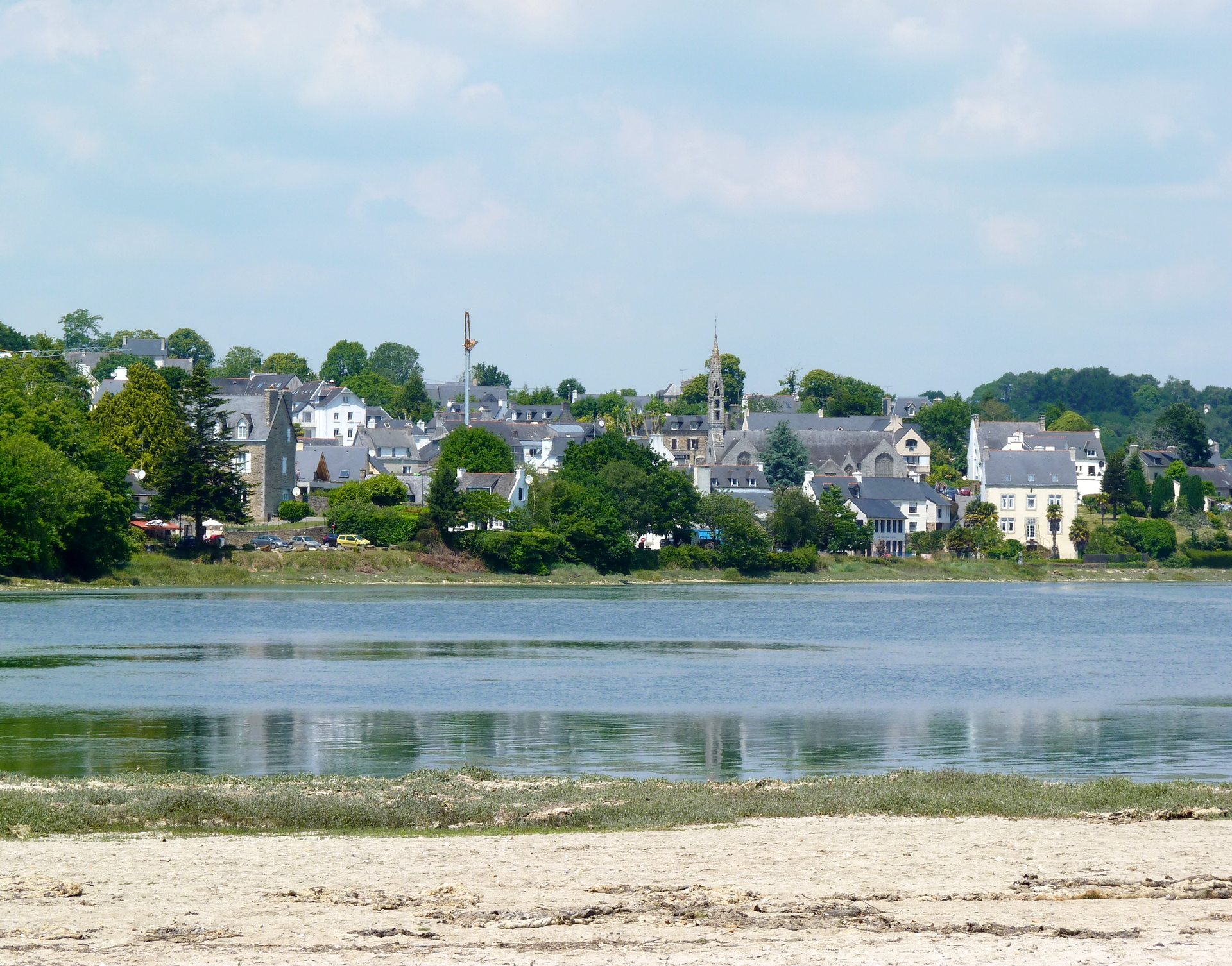
Pictured: a coastal view of La Forêt-Fouesnant, Finistère, France. This is not a photograph of the witness's own farm lane or the adjacent field where the sighting occurred, both located inland in the countryside north of the village center and withheld from GEIPAN's published summary per its standard anonymization practice, nor of the phenomenon itself, of which no photograph or video is known to exist — the witness's own submitted images are annotated photographs and sketches of the surrounding scene, not of the PAN. Photo by Wikimedia contributor Ackles29, taken 2010, released under CC BY-SA 3.0 via Wikimedia Commons.
Theoretical Alignment
This case draws its strongest alignment toward the Extraterrestrial Hypothesis, chiefly on the strength of the object's apparently deliberate, structured behavior: a solid-seeming craft with sharp, well-defined contours that altered its course specifically toward the witness, rotated with evident purpose to face her directly, held a stationary hover for a measured interval, and then rotated away again before departing — a sequence that reads, on its face, more like an intentional maneuver than a passive drift or a projected light effect. The witness's own description of perceiving genuine volume and thickness to the object as it turned, rather than a flat plane of light, reinforces a solid-craft reading over a purely optical one. Psycho-Social framing carries comparatively little weight here specifically because GEIPAN's field investigators, having conducted a direct cognitive interview, explicitly assessed the witness as coherent, unaffected by any prior belief in the subject, and not visibly distressed — the profile GEIPAN itself associates with reliable testimony rather than misperception or fabrication. Interdimensional framing finds modest support only in the object's otherwise unexplained silence and its reported effect on the witness's car radio, neither of which points specifically toward any interdimensional mechanism so much as toward the case's basic, unresolved strangeness.
Background
Understanding why a driver's few minutes on her own farm lane one December morning produced a full field investigation with a cognitive interview, a physical distance-and-angle reconstruction, and a direct phone call to the local farmer requires understanding both the town where it happened and the specific way GEIPAN's investigative process treats a single-witness account it judges worth the effort.
La Forêt-Fouesnant: A Farming Commune Turned Sailing Town
The commune of La Forêt-Fouesnant sits in the Finistère department of Brittany, on the Baie de La Forêt roughly 17 kilometers southeast of Quimper and 7 kilometers west of Concarneau. Its population, recorded most recently at around 3,500 residents known locally as Forestois, has grown steadily and substantially since the 1960s — nearly doubling from 1,778 residents in 1968 — a pattern distinct from the rural depopulation seen in many small French communes, driven largely by the town's transformation into a recreational sailing destination centered on the modern marina of Port-la-Forêt, today one of French competitive offshore sailing's most significant hubs. Away from its harbor, though, the commune remains substantially agricultural: the witness's own home sat in genuine countryside north of the village center, surrounded by cultivated fields and wooded parcels, precisely the kind of working farmland where the sighting occurred, above a field that had been sown with rapeseed roughly three weeks before the encounter. The commune's built heritage includes the eighteenth-century Manoir de Mesmeur, now a golf club, and the parish enclosure of Notre-Dame d'Izel-Vor with its calvary — markers of a settlement with deep roots. None of this history bears directly on one driver's brief encounter before dawn, but it establishes the setting clearly: a real, working agricultural landscape on Brittany's southern coast, not a military zone, and not a location with any obvious institutional source of unusual lighting.
GEIPAN's Field Investigation Apparatus, Deployed in Full
GEIPAN, the Groupe d'Études et d'Informations sur les Phénomènes Aérospatiaux Non-identifiés, operates within the Centre National d'Études Spatiales (CNES) in Toulouse, tracing its lineage to GEPAN, founded there in 1977 by Claude Poher. What distinguishes this case within GEIPAN's own broader caseload is the sheer depth of investigative effort it received relative to its evidentiary base: a single witness, with no photograph or video of the phenomenon itself, nonetheless triggered both a remote desk-based inquiry and, roughly ten months later, a full on-site field investigation. That field visit, conducted October 5, 2019, paired two GEIPAN investigators — one lead, one supporting — who together carried out a formal cognitive interview with the witness and then physically reconstructed her sightline: walking her original route down the farm lane, measuring the real distances to the tree lines and hedgerows she had used as reference points, and using a 50-centimeter ruler held at arm's length to verify the exact same apparent-size estimation method she had used the morning of the sighting. This is a substantially more resourced investigation than the majority of single-witness GEIPAN files this site has published, reflecting the agency's own judgment that the account's internal detail and the witness's evident cooperation justified the effort independent of how thin the file's physical evidence otherwise was.
The cognitive interview itself is a specific forensic-interviewing technique GEIPAN's field investigators use to help a witness recall additional accurate detail without introducing suggestion or leading questions — a methodology distinct from simply re-asking the original questionnaire's items. GEIPAN's own report on this case explicitly credits the technique with surfacing new, more precise detail beyond what the original written questionnaire had captured: refined timing for each of the three observation phases, a clearer description of the object's color intensity and its two distinct components, and the witness's own vivid recollection of perceiving three-dimensional thickness to the object as it rotated to face her — a detail that had not been fully captured in her initial written account.
Complete Timeline
| Date | Event |
|---|---|
| 1977 | GEIPAN's predecessor, GEPAN, is founded within CNES in Toulouse under Claude Poher. |
| December 10, 2018, approx. 7:20–7:25 AM | Sighting begins. Driving down the 300-meter lane from her rural home north of La Forêt-Fouesnant toward work, the witness passes through her gate and, roughly 40 meters on, stops on a clearing to her right. She observes, above a large field, a yellow bar with a bright fluorescent-green light at its center, heading east. |
| December 10, 2018 (Phase 1, ~30 seconds) | The witness lowers her windows, turns off her car radio, and watches the object move slowly and evenly with no engine or rotor noise of any kind. She senses it beginning to deviate toward her position. |
| December 10, 2018 (Phase 2, ~30 seconds) | The witness drives forward roughly 150 meters to place herself parallel to the object, stops, and watches it rotate slowly to face her directly, due south, then hold a stationary hover for roughly 20 seconds "as if to observe" her. She perceives genuine volume/thickness to the object at this moment, and no landing gear, tail, or rear structure of any kind. |
| December 10, 2018 (Phase 3, ~30 seconds) | The witness drives the remaining roughly 150 meters to the end of her lane, stops, and turns to look back. She watches the object rotate again, this time due east, and depart slowly, disappearing into the morning mist. |
| December 10, 2018, immediately after | The witness notices her car radio's display screen no longer shows any information, though sound continues; she reports being unable to get it to function normally again afterward. |
| Following days | The witness stays silent about the sighting for three days, uncertain how to process it; when she eventually discusses it, her social circle reacts with skepticism, but her son encourages her to file a report with GEIPAN. |
| Early 2019 | The witness submits a completed GEIPAN questionnaire with photographs, a plan, and a sketch; a remote, desk-based investigation begins and an investigator is assigned. |
| During the remote investigation | Given the case's assessed strangeness, GEIPAN escalates to a field investigation. |
| October 5, 2019 | Field investigation. Two GEIPAN investigators travel to the witness's home, conduct a formal cognitive interview, and physically reconstruct the sightline with measured distances and a 50cm ruler apparent-size check at each of the three observation points. |
| During the field investigation | An investigator separately contacts the farmer who works the field where the sighting occurred; she confirms neither she nor her son were present that morning, that the next scheduled fieldwork (fertilizer spreading) was not until February 2019, and that they do not operate a drone. |
| Following the full investigation | Final classification. GEIPAN rates the account's consistency C = 0.68 ("good"), finds no single conventional hypothesis reaches a 50% probability, and classifies the case « D1 », catalogued as case ID 2018-12-50686. |
Detailed Narrative
A Silent Yellow Bar Over a Rapeseed Field
The witness's own account, preserved by GEIPAN in her words, begins on an ordinary weekday morning: "Monday morning, December 10, 2018, between about 7:35 and 7:45, pitch dark, sky clear in places and misty elsewhere. I set off down our 300-meter lane, lined with embankments and a few leafless trees, and after passing through the gate, about 40 meters on, I stopped on a clearing to my right (I was heading west) to look above a large field at a yellow bar with a big fluorescent-green light at its center, heading east." Surprised, she rolled down her windows, cut her car radio, kept her headlights on, and watched. "No noise at all in the sky, a very slow and steady movement; I had the feeling it was veering off course and heading a little toward me." She drove forward about 150 meters to bring herself parallel to the object, stopped, and waited, intrigued. "At that point this bar turned slowly toward me, facing me directly, due south, and went stationary as if to observe me (about 20 seconds with absolutely no movement from the bar). I realized this couldn't be a plane — a drone? Rather odd in the middle of the night, coming from nowhere." She decided to continue on, driving the remaining 150 meters to the end of the lane, where she stopped, turned around, and "saw this bar turn again, due east this time, and set off again just as slowly, to disappear into the mist."
GEIPAN's investigators later reconstructed this account into three distinct thirty-second phases, each anchored to one of the witness's three stopping points along her lane. At the first stop, roughly 215 meters from a treeline bounding the field's northwest edge, she watched the object above the field on a level, eastward heading. At the second stop, roughly 155 meters from a treeline bounding the field's north edge, the object was, in her words, "clearly above the field," and it was here that it turned to face her and hovered. At the third and final stop, roughly 360 meters from a treeline bounding the field's eastern edge, she believed she saw the object beyond the field itself, over adjacent woods, before it disappeared.
Color, Texture, and a Perceived Sense of Volume
The witness's description of the object's appearance, refined during the October 2019 cognitive interview beyond what her original written questionnaire had captured, described two distinct components: a rectangular, pale-yellow or amber section of moderate brightness, comparable to a full moon, and a circular, fluorescent-green section of much greater intensity, comparable to a bare light bulb, positioned at the bar's center. She described the object's contours as very sharp and well-defined throughout the observation, though at certain moments she perceived a thin layer of mist drifting in front of it, partially obscuring her view without making it disappear — a detail GEIPAN's investigators treated as evidence the object was a genuine physical presence rather than a projected beam of light, since a light beam would simply illuminate the mist rather than being selectively obscured by it.
The most distinctive single detail the cognitive interview surfaced was the witness's perception of the object's volume during its second-stop rotation: rather than a flat plane or a simple light source, she described sensing genuine depth and thickness to the bar as it turned to face her, and drew a supplementary sketch specifically to illustrate this perception for investigators. She was equally clear about what she did not see: no tail, no rear structure, and no landing gear or anything resembling an aircraft's or drone's undercarriage, at any point in the observation — a negative detail GEIPAN's report treats carefully, noting that it is not actually certain whether a drone's legs or landing gear would even be visible at night in the first place, and explicitly excluding this specific point from its formal hypothesis-scoring table for that reason, even while including it as a qualitative note. No radiance, projection, or halo of any kind was reported, and no noise of any kind came from the object itself throughout the encounter, despite the witness's own windows being down and her car engine running as background noise the entire time.
A Difficult Size Estimate, and an Honest Witness's Own Doubts
The witness gave a specific apparent-size estimate in her original questionnaire: roughly 50 centimeters held at arm's length for the object as seen at her second stop, and roughly 30 centimeters for the object as seen at her third stop. During the October 2019 field reconstruction, investigators verified these exact apparent sizes using a real 50-centimeter ruler held at arm's length at each corresponding location, confirming the witness reproduced the same estimates under direct testing. Applying the standard formula relating apparent size, arm's-length distance, and real object size to real distance, GEIPAN's investigators calculated what those apparent sizes would imply for the object's true dimensions at a range of possible real distances: at the second stop, an object 10 meters away would need to be about 7 meters across to match her estimate; at 50 meters, about 36 meters across; at 100 meters, about 73 meters; at 350 meters, a striking 257 meters. At the third stop, the corresponding real sizes ran from about 4 meters (at 10m) up to about 154 meters (at 350m).
GEIPAN's investigators treated this calculation with real, explicit caution rather than presenting it as a confirmed measurement of a genuinely enormous object. Their own report states plainly that the witness never once, in either the cognitive interview or the general conversation during the field visit, described the object as gigantic, and that she had, on her own initiative, "acknowledged having had great difficulty" estimating its size both while completing the original questionnaire and again during the on-site reconstruction. GEIPAN's conclusion treats a witness overestimation of the object's true size during the second and third observation phases as a real possibility that must be weighed against the alternative — that the object genuinely was as large as the geometry implies at a given distance. This is precisely the kind of honest, self-critical uncertainty GEIPAN's methodology is built to surface rather than paper over, and it is also precisely the kind of admission — a witness openly conceding the limits of her own perception rather than defending an inflated claim — that argues for her basic credibility even where it complicates the case's physical interpretation.
The Radio Malfunction: A Genuinely Odd Detail GEIPAN Could Not Explain
Among the witness's responses to GEIPAN's standard questionnaire is a detail that stands out from the rest of the file for being neither part of the visual sighting itself nor readily explainable by any of the conventional hypotheses GEIPAN went on to test: describing the equipment active in her vehicle during the observation, she noted her car was running, with its headlights and radio on, though the radio's volume was turned down throughout. Then, in her own words: "After the observation, I no longer had a radio display screen, but still had the sound. To this day I haven't managed to get it working normally again." GEIPAN's published report records this detail as part of the witness's raw questionnaire responses but does not attempt to formally analyze it as physical evidence, test it against any specific electromagnetic-interference hypothesis, or treat it as part of its own itemized hypothesis-scoring table — an honest gap in the investigation rather than a claim this site can responsibly fill with invented analysis. What can be said is that the detail is unprompted, specific, persistent (she describes it as an ongoing problem, not a momentary glitch), and reported independently of the visual sighting itself, which gives it a different evidentiary character than a witness's subjective visual impression: either a genuine and unusual coincidence in timing, an ordinary electronic fault the witness has understandably come to associate with a memorable and disorienting morning, or a real effect of some kind connected to the object's presence. GEIPAN's own file does not resolve which of these is correct, and neither does this site's research turn up any further detail beyond what the witness herself reported.
The Farmer's Confirmation, and a Genuinely Ruled-Out Agricultural Source
Because the sighting occurred directly above a cultivated field, GEIPAN's investigators pursued one of the more directly verifiable leads available in this case: contacting the farmer who worked the parcels in question, jointly with her son. The investigator learned that the field had been sown with rapeseed roughly three weeks before the sighting, and that the crop was already visible above the soil by early December — a small, incidental detail confirming the field was an active, cultivated agricultural parcel rather than fallow land. Checking her own records, the farmer confirmed that neither she nor her son had been present on the parcels that morning, that their next scheduled fieldwork (a fertilizer application) was not planned until February 2019, and that their operation does not use a drone of any kind. When the witness was separately asked, during the field reconstruction, whether she had noticed any equipment tracks in the field afterward, she said she had not thought to look, since the object had only passed over the field without ever landing. This direct, verifiable negative confirmation is a genuinely useful piece of the investigation: it does not merely assume no agricultural equipment was present, it checks.
Key Witnesses
The La Forêt-Fouesnant Primary Witness (identity withheld per GEIPAN's standard anonymization practice)
A resident of La Forêt-Fouesnant who, driving to work along her own farm lane before dawn on December 10, 2018, watched a silent yellow "bar" with a fluorescent-green center light glide over an adjacent field, turn to face her and hover, then depart. She stayed silent about the encounter for three days, faced mockery from some of her social circle when she eventually described it, but was encouraged by her son to file a formal report with GEIPAN. Two GEIPAN field investigators who conducted a cognitive interview and an on-site reconstruction with her roughly ten months later described her as consistently cooperative, evidently sincere, and willing to acknowledge the specific limits of her own perception — particularly her own uncertainty about the object's true size. GEIPAN rated her account's overall reliability at 0.85 and its combined consistency at 0.68 ("good"), among the higher ratings given to any single-witness file this site has published. She reported that her car radio's display stopped functioning normally immediately after the sighting and had not been fully repaired by the time of her later interviews with GEIPAN.
The Five Observables Assessment
The Five Observables framework, developed by the Pentagon's Advanced Aerospace Threat Identification Program to describe performance characteristics beyond known conventional technology, is applied here for comparative consistency across the site's case files. This case registers a genuinely mixed profile, with real positive signal in two of the five categories.
Assessment: This case earns a genuine "Present" rating for Low Observability — a rarer designation among the site's published GEIPAN cases — specifically because the acoustic conditions were unusually favorable to detecting engine or rotor noise (open car windows at close range, muted rather than silenced radio, a quiet rural pre-dawn setting) and none was heard at any point across three separate observation phases and roughly ninety seconds of total sky-time. Anti-Gravity Lift is rated speculative rather than present because, while a sustained, motionless hover at low altitude with no visible support is a striking behavior, the witness's account offers no information about how that hover was achieved, only that it occurred. The complete absence of both Instant Acceleration and Hypersonic behavior distinguishes this case from many higher-profile UAP encounters and instead emphasizes a slow, almost deliberate quality to every phase of the object's movement — a profile that, combined with its apparent responsiveness to the witness's own position, reads less like a conventional aircraft's flight envelope and more like a controlled, low-speed maneuver by something aware of its observer.
Evidence Assessment
Supporting an Anomalous Origin
- A specific, internally detailed single-witness account — a three-phase trajectory including a deliberate-seeming turn toward the witness, a stationary 20-second hover directly facing her, and a final turn and departure — corroborated by a formal cognitive interview and field reconstruction that found no inconsistency with her original written statement
- GEIPAN rated the account's reliability at 0.85 and its overall consistency at 0.68 ("good"), among the higher ratings given to any single-witness case this site has published
- The witness reported complete silence from the object at close range under acoustically favorable conditions (open windows, muted radio, quiet rural setting), across all three observation phases
- A direct, verified negative confirmation from the field's own farmer ruled out any agricultural equipment or drone use on the relevant parcels that morning
- The witness reported a genuinely odd, persistent car radio malfunction beginning immediately after the sighting, an unprompted detail independent of her visual account
- The witness voluntarily disclosed her own uncertainty about the object's apparent size, a self-critical admission that argues for her basic credibility even where it complicates the case's physical interpretation
Supporting a Conventional/Mundane or Inconclusive Origin
- This is a single, uncorroborated witness account with no second observer, and no photograph or video of the phenomenon itself — only annotated situation photographs and sketches of the surrounding scene
- The witness's own size-estimate calculations, if taken at face value, imply an object tens or even hundreds of meters across depending on assumed distance — a result GEIPAN itself flags as more likely reflecting witness overestimation than a literal measurement
- A civilian drone hypothesis, while ultimately rated below a 50% probability, remained GEIPAN's own strongest single candidate, and the sighting's early-morning darkness cannot fully rule out an illegally-operated hobbyist craft
- The reported car radio malfunction was never formally tested against any specific electromagnetic-interference mechanism, and GEIPAN's own report does not treat it as confirmed physical evidence
- The object's unusual two-tone coloring and bar-plus-circle shape, while unmatched to any specific drone GEIPAN could identify, does not by itself rule out an unconventional or custom-modified hobbyist craft
Why "Open"
This case is stamped Open rather than Credible, Disputed, or Debunked because that is precisely the outcome GEIPAN's own, unusually thorough investigation produced: a genuinely strong single-witness account — reinforced, not merely asserted, by a formal cognitive interview and physical field reconstruction — that nonetheless could not be matched to any conventional explanation reaching even a 50% probability. The wind-borne object hypothesis (a Thai lantern or novelty balloon) was eliminated on specific, checkable grounds: the object's controlled, three-phase trajectory, including its deliberate-seeming turn to face the witness and its stationary hover, does not match how a wind-driven object behaves, and the recorded wind direction that morning does not match its reported path. The agricultural-light and sky-tracer projection hypotheses were checked directly against real evidence — a phone call to the actual farmer working the field, confirming no equipment was present, and the witness's own report of the object's sharp, well-defined contours holding steady even as mist drifted across it, a poor match for a diffuse projected beam. The civilian drone hypothesis, while the strongest of the four candidates GEIPAN considered, was undermined by the object's unusual bicolor appearance, its unusually large implied size, and French civil aviation rules that prohibit the night flights this sighting's pre-dawn timing would have required, absent a knowing violation GEIPAN could neither confirm nor rule out.
What earns this case a score toward the stronger end of the comparable GEIPAN files this site has published is the unusual depth and rigor of its evidentiary record for a single-witness file: a formal field investigation with a cognitive interview (a resource GEIPAN commits to only a small fraction of its roughly 200 annually investigated cases), a physical reconstruction that verified the witness's own size estimates rather than simply recording them, and a direct, checkable negative confirmation from the one third party — the farmer — who could plausibly have explained the sighting outright. Set against that genuine strength is the case's real, acknowledged weakness: a single uncorroborated witness, no photograph or video of the phenomenon itself, and an implied object size, if taken literally, large enough to strain credulity on its own. GEIPAN's own decision to rate this witness's reliability at 0.85 and consistency at 0.68, and to leave the strongest conventional candidate (a drone) explicitly below the 50% confidence threshold rather than simply defaulting to it, reflects a genuinely careful, non-credulous investigation that nonetheless could not close the file — the precise profile Open is built to describe, weighted here toward its stronger end by the case's unusually well-documented consistency.
Sensor & Instrumentation Detection Profile
This case has no dedicated sensor or radar record of the phenomenon itself — no photograph, no video, and no independent recording device captured the PAN directly. What exists instead is a genuinely substantial body of after-the-fact reconstruction: a physical, on-site distance-and-angle survey conducted with a tape measure and a 50-centimeter ruler during the October 2019 field investigation, regional meteorological station data from Quimper-Pluguffan airport, and a Stellarium astronomical reconstruction confirming the positions of Venus and Mercury and the absence of any visible International Space Station pass. The car radio malfunction the witness reported, while a potentially instrumented data point of real interest, was never tested with any dedicated electromagnetic-field measurement or diagnostic equipment — it exists in the file purely as an unverified secondary report, not as a documented instrument reading.
Environmental & Geospatial Context
The meteorological picture for this sighting comes from the Quimper-Pluguffan airport station, roughly 14 kilometers from the witness's position at an azimuth of 300 degrees. Between 6:00 and 7:00 AM UTC, no precipitation was recorded, a light wind of 2.2 to 2.5 meters per second (roughly 8–9 km/h) blew from the west-northwest (290°), and the sky was 7/8-octas covered at 7:00 AM, with a lower cloud layer at roughly 720 meters (1/8-octas coverage) topped by a denser layer at roughly 1,020 meters (7/8-octas coverage). Horizontal visibility was very good, around 19 kilometers. GEIPAN's own report notes that while the specific cloud types present were not recorded by the station, the low ceiling height limits the possibilities to low-lying cloud forms — cumulus, stratocumulus, nimbostratus, or stratus — and that while this data cannot formally confirm the patchy fog or mist the witness described, it does not contradict it either.
Astronomically, the sighting occurred well before sunrise (8:59 AM that day) with no moon above the horizon. Venus was visible to the naked eye at magnitude -4.82, at 21 degrees elevation to the southeast; Mercury, also to the southeast, sat too close to the horizon (just 4 degrees elevation) to be readily visible. A single satellite pass was identified crossing the relevant window on a west-to-east trajectory, but at a positive (dim) magnitude unlikely to be visible to the naked eye, and the International Space Station was confirmed not visible at the relevant time. GEIPAN's own conclusion on this point is unambiguous: the witness's description of a nearby yellow bar with a moving green center point bears no resemblance whatsoever to any astronomical object, and the timing, hours before sunrise, rules out any solar or twilight-related effect.
Geographically, the sighting occurred over active farmland in genuine countryside north of the village center of La Forêt-Fouesnant, a coastal Breton commune with no nearby military installation. The area's closest identified structures of any note were two large hangars to the northwest of the witness's home, which the investigating officer confirmed by phone with their owner to be caravan winter-storage buildings rather than any facility connected to drone or agricultural-light operations. A model-aircraft flying club does operate south of the commune, but GEIPAN judged the probability of a club member choosing to fly there specifically low, given the location's roughly 11-kilometer distance from the club's own training field, the early-morning weekday timing, and French civil aviation rules that do not permit night drone flights in the first place, whether by a club member or a private individual.
Observer Credibility & Occupational Profile
The witness's occupation is not disclosed in GEIPAN's published case file, consistent with the agency's standard anonymization practice. What the file documents at length, however, is a behavioral and psychological profile assembled directly by two trained field investigators who met her in person: they described her, following the October 2019 cognitive interview, as consistently coherent, showing no particular prior belief in or interest in UAP before her own sighting, and not visibly emotionally shaken during the encounter itself despite describing a period of unease afterward — a tendency to look up at the sky more than she had before, which she described feeling self-conscious about. She stayed silent about the encounter for three days, and when she eventually described it to those around her, she faced open mockery, which she nonetheless withstood, telling investigators plainly that she remained certain about the strangeness of what she had seen even after being teased for it. It was her son, not any external prompting, who encouraged her to formally report the sighting to GEIPAN.
GEIPAN's investigators rated her overall reliability at 0.85 and found nothing during the course of their investigation that cast doubt on her testimony. Her own most direct explanation for why the encounter felt so strange to her, offered in her own words, emphasizes exactly the two qualities GEIPAN's investigation spent the most effort testing: "I justify the strangeness by the absolutely silent and steady movement, as well as by the luminous appearance." She was, by GEIPAN's own account, unusually cooperative throughout — participating fully in both a lengthy written questionnaire and an in-person cognitive interview nearly a year after the fact, walking investigators through her exact route, and voluntarily disclosing her own uncertainty about her size estimates rather than defending them past the point she felt confident in them. This combination — sustained cooperation, self-critical honesty about the limits of her own perception, and an absence of any prior interest in or belief in the subject — is precisely the witness profile GEIPAN's own methodology treats as most credible.
Physical & Material Assays
This case involves no confirmed physical or trace evidence at the sighting location itself. The witness did not examine the field for tracks or disturbance afterward, since the object had only passed over it without ever landing, and no soil, vegetation, or ground-trace sample was ever collected or tested. The one candidate physical effect in the file — the witness's car radio malfunction — involves a real piece of equipment that could, in principle, have been examined by a technician, but GEIPAN's published file does not indicate any such technical diagnostic was ever performed; it exists in the record purely as the witness's own reported, unverified account of a persistent fault beginning immediately after the sighting.
Historical Precedents & Archive Matches
This case's most instructive points of comparison on this site are not other drone or triangle sightings, but two cases built around a genuinely rare category of evidence: an instrumented or electronic malfunction reported in connection with a UAP encounter, rather than a purely visual account.
Tehran 1976 — The Gold Standard for Instrumented Corroboration, and Why This Case Cannot Match It
The Tehran UFO Incident (Verified, case #18) remains the reference case on this site for a UAP encounter accompanied by genuine, multiply-corroborated instrument failure: two Iranian Air Force F-4 Phantom jets independently reported avionics and communications equipment failures while intercepting an unidentified object, with the failures occurring and resolving at specific, radar-tracked moments consistent across both aircraft and cross-checked against ground control. Reading this case alongside Tehran usefully illustrates the enormous evidentiary gap between a single, uncorroborated report of a car radio losing its display screen and a multi-aircraft, multi-system, radar-cross-checked avionics failure recorded by trained military crews in real time. This case's radio malfunction is a genuinely odd, unprompted detail worth taking seriously as testimony — but it is testimony alone, with no second system, no independent witness, and no technical diagnostic record, and it should be weighted accordingly far below Tehran's instrumented corroboration rather than as evidence of comparable strength.
Fauville-Évreux (1978) — A Different Kind of Unconfirmed Instrument Reading
The Fauville-Évreux Radar Sighting (Open, 48/100) offers a closer evidentiary parallel: a case built around a real but ultimately weak instrumented signal — a faint, uncorroborated radar echo recorded by an air base's own radar, never independently confirmed by a second station that could have settled the matter. Both cases share the same underlying evidentiary shape: a real piece of physical/electronic data exists in the file, but it was never independently verified by a second system or a qualified technician, leaving it suggestive rather than conclusive. This case's radio malfunction is, if anything, evidentially weaker than Fauville-Évreux's radar echo, since a radar return is at least a recorded, timestamped instrument output, where the radio malfunction here rests entirely on the witness's own unverified account of a fault she noticed afterward.
Hem (2022), Crozon (2020), and Villers-lès-Luxeuil (2019) — Comparative Drone-Hypothesis Testing
The Hem Ring-Light Triangle, Crozon Peninsula Red Rectangles, and Villers-lès-Luxeuil Triangle cases each independently tested and rejected a civilian-drone hypothesis for their own distinctly shaped, multi-light PANs, using methods ranging from real hobbyist-drone dimension calculations to a direct consultation with a military drone instructor. This case's own drone hypothesis was rejected through a comparable combination of methods — a direct phone call to rule out the one plausible institutional operator (the field's own farmer), a size calculation suggesting an implausibly large craft, and French night-flight restrictions — but, notably, its drone hypothesis was rated the strongest of GEIPAN's four candidates here, unlike in Hem or Crozon, where the drone hypothesis was more decisively undermined by a specific lighting-configuration mismatch. This case's drone hypothesis survives longer in the analysis specifically because its rejection rests more on circumstantial and regulatory grounds (size, timing, the farmer's confirmation) than on a hard technical mismatch like an undocumented lighting configuration.
Material Analysis
As with the Physical & Material Assays section above, this case involves no confirmed physical or trace evidence at the sighting site. The one potential physical effect in the file, the witness's reported car radio malfunction, was never subjected to any technical diagnostic and exists solely as unverified testimony, however specific and persistent. No landing marks, soil disturbance, or vegetation damage were identified, and the witness herself did not examine the field closely afterward since the object never touched down.
Supporting Non-Terrestrial Origin
- No confirmed physical evidence exists to test in the first place, so no terrestrial material-composition finding contradicts an anomalous interpretation either
- The reported car radio malfunction, while unverified, is a genuinely unusual and persistent detail with no obvious conventional explanation offered anywhere in GEIPAN's file
- The object's reported sense of physical volume, sharp contours partially obscured by drifting mist, complete silence, and deliberate-seeming maneuvering do not correspond to any conventional aircraft, drone, or light-projection source GEIPAN's investigators were able to confirm
Supporting Terrestrial Origin
- The complete absence of any confirmed ground trace is consistent with an object that, by the witness's own account, never landed or came close enough to the ground to leave a mark
- The car radio malfunction was never independently verified by a technician or tested against any specific mechanism, leaving open the possibility of an unrelated, coincidental electronic fault
The Conventional Explanation Candidate: Wind-Borne Object, Reflected Projector Light, and Drone
GEIPAN's own file organizes its analysis around three principal hypothesis families — a wind-borne object, a reflected light projection (agricultural equipment or a sky-tracer), and a drone — none of which reached a 50% probability rating in GEIPAN's own assessment.
Wind-Borne Object (Thai Lantern or Novelty Balloon)
Weighed against real recorded wind data: a light wind of under 10 km/h from the northwest at the time of the sighting. The object's initial direction of travel was broadly consistent with that wind, but its subsequent behavior was not: its steady, controlled trajectory, its apparent deviation toward the witness, its stationary hover directly facing her, and its final deliberate turn and departure to the east collectively describe a pattern of controlled maneuvering that a wind-driven object cannot produce. Its reported luminosity, brighter and more structured than a typical paper lantern's glow, was a further poor match.
Reflected Light Projection: Agricultural Equipment or Sky-Tracer
Directly checked and rejected on factual grounds. A phone call to the farmer working the relevant parcels confirmed neither she nor her son were present that morning and that their operation does not use a drone; their next scheduled fieldwork was two months away. A sky-tracer projection, potentially from a nightclub still operating from the previous evening, was considered but found implausible: no nightclub exists near the witness's home, the nearest being roughly 8 kilometers north on the outskirts of Quimper. The witness's own description of the object's very sharp, well-defined contours, and her specific observation of drifting mist passing in front of it without making it disappear, both argue against a diffuse, beam-projected light source.
Civilian or Recreational Drone
The strongest of GEIPAN's three candidates, though still rated well below 50% probability. The object's controlled trajectory, including its stop-and-turn behavior facing the witness, is broadly consistent with a radio-controlled craft, and the passage of mist in front of the object without it disappearing suggests a genuine physical object rather than a light beam — without confirming what kind of object. Working against the hypothesis: its unusual, bicolor bar-and-circle appearance matches no drone lighting configuration GEIPAN could identify; the witness's own size estimates, however uncertain she was about them, imply an unusually large real object; and French civil aviation rules prohibit night drone flights outright, meaning any drone matching this description would represent a genuine violation rather than routine hobbyist activity — possible, but unconfirmed and unconfirmable from the available evidence. A nearby model-aircraft club was considered and judged a low-probability source given its distance, the early weekday timing, and the same night-flight restriction.
Wind-Borne Object
ImplausibleThe object's controlled, multi-phase trajectory and stationary hover directly facing the witness do not match how a wind-driven lantern or balloon behaves.
Reflected Agricultural/Sky-Tracer Light
ImplausibleDirectly ruled out by a phone call confirming no farm equipment was present; no nearby venue could operate a sky-tracer; sharp contours and mist interaction argue against a projected beam.
Civilian/Recreational Drone
InconclusiveThe strongest candidate, but rated below 50% probability by GEIPAN: unmatched lighting configuration, implausibly large implied size, and a legal night-flight ban that would require a knowing violation.
Related Cases
Confirmed Documents & Official Records
The official French government investigation summary: the witness's full account, the three hypotheses tested, and the final Class D1 determination.
GEIPAN's full 23-page field investigation report, including the complete technical questionnaire, the cognitive-interview findings, the on-site size/distance reconstruction, and the itemized hypothesis analysis.
GEIPAN's own published definitions for classifications A, B, C, D, D1, and D2, and its strangeness/consistency (E & C) scoring methodology applied to reach this case's D1 rating.
GEIPAN's own account of its investigative structure, its field-investigation and cognitive-interview practices, and statistical case outcomes.
Further Reading — Recommended Literature
UFOs: Generals, Pilots, and Government Officials Go on the Record
Kean's survey of credentialed witness testimony and official investigative bodies worldwide offers useful comparative context for weighing GEIPAN's own unusually thorough field-investigation and cognitive-interview process in this case.
Wonders in the Sky: Unexplained Aerial Objects from Antiquity to Modern Times
A catalog of historical aerial anomaly reports useful for weighing how unusual this case's specific two-tone "bar and circle" morphology is against the broader historical record of reported craft shapes.
The UFO Evidence
The foundational documentary approach to cataloging and cross-referencing witness testimony that GEIPAN's own consistency-and-reliability scoring methodology descends from in spirit.
The UFO Experience: A Scientific Inquiry
Hynek's own close-encounter classification system and emphasis on direct, in-person witness interviewing anticipates the cognitive-interview methodology GEIPAN applied to this exact case.
The Close Encounters Man: How One Man Made the World Believe in UFOs
A biography of Hynek documenting the emergence of rigorous, in-person case investigation methodology, directly reflected in GEIPAN's field investigation and cognitive interview in this case.
Essential Viewing
No Videos Available
Sources
- GEIPAN (CNES), "FORET-FOUESNANT (LA) (29) 10.12.2018", Case 2018-12-50686 — official case summary
- GEIPAN (CNES), Compte Rendu d'Enquête, FORET-FOUESNANT (LA) (29) 10.12.2018 — full 23-page investigation report (PDF)
- GEIPAN (CNES), official case archive & public portal — geipan.fr
- GEIPAN (CNES), Glossaire du GEIPAN — official classification definitions, A/B/C/D/D1/D2
- GEIPAN (CNES), "Missions, méthodes et résultats" — investigative structure and field-investigation practices
- Wikipedia (English), "La Forêt-Fouesnant" — commune history, geography, and population data
- Wikimedia Commons, File: La forêt fouesnant en 2010.jpg, photo by "Ackles29" (2010), CC BY-SA 3.0 — licensing and attribution
- Wikimedia Commons, La Forêt-Fouesnant gallery — image archive for the commune
- Météo France, Publithèque, Quimper-Pluguffan station, December 10, 2018 — regional wind, cloud, and visibility archive referenced in GEIPAN's investigation
- Insee, Dossier complet — Commune de la Forêt-Fouesnant (29057) — official French national statistics for the commune
- This site, case-files/tehran-1976.html — comparative case with multiply-corroborated, radar-cross-checked avionics failure
- This site, case-files/fauville-evreux-radar-sighting.html — comparative GEPAN/GEIPAN case with an unconfirmed instrumented (radar) signal
- This site, case-files/hem-ring-light-triangle.html — comparative single-witness GEIPAN case with a quantitatively rigorous drone-hypothesis rejection
- This site, case-files/crozon-peninsula-red-rectangles.html — comparative GEIPAN case with a direct military drone-instructor consultation
- This site, case-files/villers-les-luxeuil-triangle.html — comparative two-witness GEIPAN case with a size-based drone rejection
- This site, key-figures.html, entry on Claude Poher — GEPAN founding and early institutional history
- This site, locations/index.html, entry on Toulouse — CNES/GEPAN/SEPRA/GEIPAN institutional headquarters
See something inaccurate? Have additional information or sources?
Suggest an Edit →Last Updated: August 2026