
Buff Ledge Encounter
On the evening of August 7, 1968, two teenage employees of a girls' summer camp on Lake Champlain reported a disc-shaped craft rising out of the water and directing a beam of light at them from the end of their dock. The account went unreported for ten years until recurring nightmares drove one witness to contact a UFO investigator — whose regressive-hypnosis sessions with both witnesses, conducted separately, produced strikingly matching descriptions of an onboard medical examination by small humanoid beings.
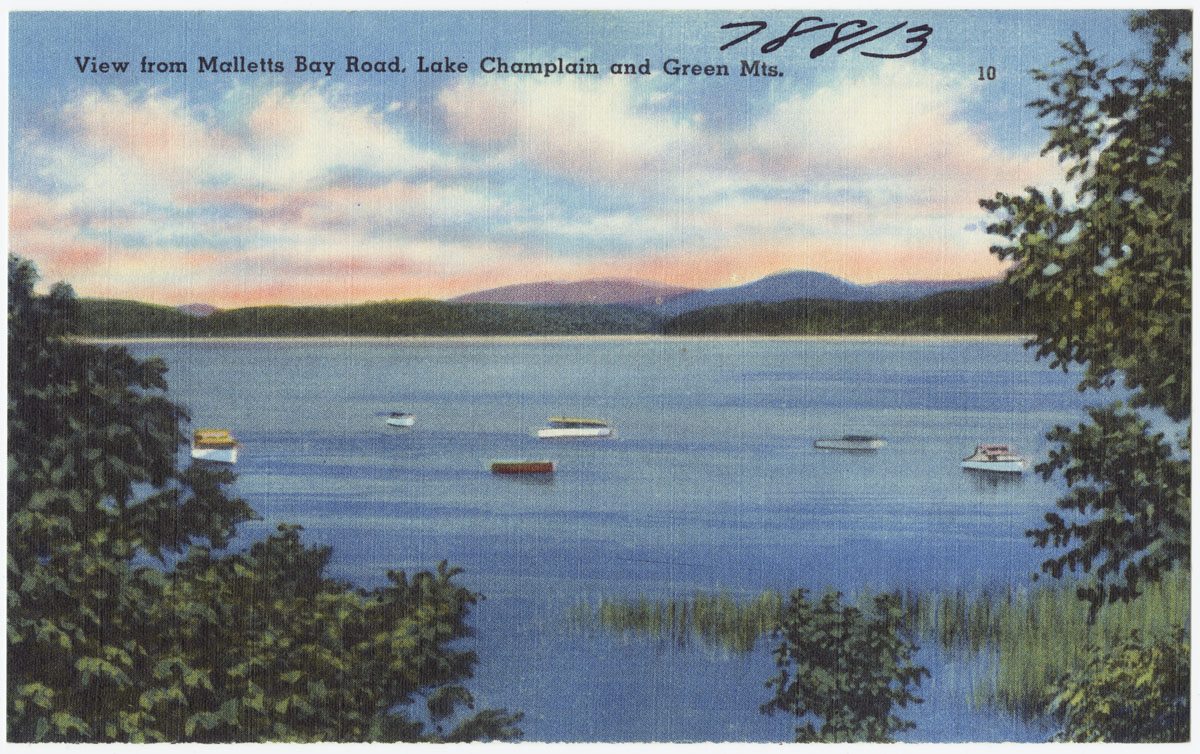
Pictured: a vintage postcard view (c. 1930–1945) of Malletts Bay on Lake Champlain, looking toward the Green Mountains — the same arm of the lake on whose shore Buff Ledge Camp sat, not a photograph of the camp, the dock, or the incident itself. No rights-clear photograph of Buff Ledge Camp's original 1968 dock, or of either primary witness, is known to be in the public domain; Walter N. Webb's own case photographs remain held within his 1994 book and CUFOS's archival files rather than freely licensed.
Theoretical Alignment
The case's entirely testimony-based, hypnosis-mediated evidentiary record makes the Psycho-Social Hypothesis a genuinely strong candidate alongside the traditional Extraterrestrial Hypothesis reading favored by investigator Walter N. Webb; the physically anomalous element reported in both witnesses' pre-hypnosis waking recall — an apparently solid craft submerging into and re-emerging from Lake Champlain — is the strongest single data point weighing against a purely internally-generated explanation, since it does not depend on the hypnosis sessions at all. The Interdimensional Hypothesis receives only marginal alignment; nothing in either witness's account describes the object phasing in or out of visibility, altering local physics, or any of the other markers this site's IDH framework typically weighs, and the craft's described behavior (descent, submersion, hovering, departure) fits comfortably within a conventional-technology-plus-testimony-reliability framework without requiring an interdimensional model to explain it.
Background
Buff Ledge Camp was a private girls' summer camp on the Clay Point peninsula of Malletts Bay, an inlet of Lake Champlain a few miles north of Burlington, Vermont. In the summer of 1968 the camp was run by directors Mary and Maskel Hunt, offering the standard roster of a traditional New England girls' camp — canoeing, sailing, and waterskiing on the lake. Like many camps of its era, Buff Ledge employed local and regional teenagers as counselors, instructors, and maintenance staff for the summer season alongside its camper population. Michael Lapp, sixteen, worked camp maintenance; Janet Cornell, nineteen, taught waterskiing. Neither had any prior connection to UFO research, and by their own later accounts neither had any particular interest in the subject before August 1968.
August 7, 1968 fell on a Wednesday. Most of the camp's staff and campers had traveled into Burlington that afternoon for a swim meet, leaving the grounds unusually quiet. Lapp and Cornell, not needed for the meet, remained behind and were sitting together on the camp's boat dock as the sun began to set over the lake — an ordinary, unremarkable evening until, in both of their later accounts, a bright light appeared low in the western sky and began behaving in ways neither could reconcile with any aircraft, star, or planet they recognized.
The wider cultural moment matters for how the case was later received. Two years earlier, John G. Fuller's The Interrupted Journey (1966) had made the Hills' hypnotically-recovered 1961 abduction account a national bestseller, and by the time Michael Lapp finally reported his own experience a decade later, in 1978, the basic narrative shape of the "missing time" abduction — a close encounter followed by amnesia, later resolved through hypnosis into a memory of onboard medical examination by small humanoid beings — was already a well-established trope in American popular culture. Whether that cultural template shaped what emerged from Lapp's and Cornell's hypnosis sessions, independently of whether anything anomalous happened to them in 1968, is one of the central open questions any serious evaluation of this case has to confront directly rather than sidestep.
Buff Ledge Camp itself no longer operates as a children's summer camp. A 2017 feature in the Colchester Sun found the Clay Point property, at 1422 Clay Point Road, had by then passed to new owners, Jessica Ebert Edelmann and her husband, who converted it into a private equine co-operative community while preserving the original waterfront dock — the same dock where Lapp and Cornell reported the 1968 encounter. The case remains part of local Colchester and Malletts Bay lore, referenced periodically in regional media (including a 2025 New England Legends podcast episode) even though it never received contemporaneous news coverage in 1968 itself.
Complete Timeline
| Date | Event |
|---|---|
| Aug. 7, 1968, dusk | Michael Lapp and Janet Cornell, alone on the Buff Ledge Camp dock while most staff attend a Burlington swim meet, observe a bright light descend toward Lake Champlain. |
| Aug. 7, 1968, dusk (cont.) | The light resolves into a disc-shaped object with a domed top; three smaller lights detach and maneuver over the lake before two depart with a sound Lapp compares to "a thousand tuning forks." |
| Aug. 7, 1968, after dark | The remaining object descends into the lake, submerges, resurfaces, approaches the dock, and directs a beam of light at both witnesses. Their next clear memory is of full darkness and the object departing in a series of rapid flashes. |
| 1968–1978 | Lapp and Cornell lose contact after the 1968 camp season. Lapp reports increasingly intense recurring nightmares over the decade, always involving a struggle to escape an unidentified craft. |
| Oct. 31, 1978 | Michael Lapp contacts the Center for UFO Studies (CUFOS) on Halloween night, exactly ten years after the incident, seeking an explanation for his nightmares. |
| 1979 | CUFOS assigns astronomer and veteran investigator Walter N. Webb to the case. Webb locates Janet Cornell, who had lost touch with Lapp and initially recalls only "seeing lights" over the lake. |
| 1979–early 1980s | Dr. Harold Edelstein conducts separate regressive hypnosis sessions with Lapp and Cornell at Webb's direction; both independently recover closely matching accounts of an onboard medical examination. |
| 1979–1984 (approx.) | Webb's roughly five-year investigation continues, including character evaluations of both witnesses and outreach to other former Buff Ledge staff, several of whom independently recall unusual lights over the lake that same evening; two additional, unnamed former employees separately describe a roughly 20-minute UFO observation earlier that same summer. |
| 1994 | Webb publishes Encounter at Buff Ledge: A UFO Case History through the J. Allen Hynek Center for UFO Studies, concluding he found Lapp and Cornell sincere and consistent. |
| 2017 | A Colchester Sun feature confirms the original Buff Ledge property, by then a private equine co-op, still retains its original dock; the incident remains part of local lore. |
The Initial Sighting
According to both witnesses' earliest, pre-hypnosis waking recollections — the part of the case least dependent on the contested reliability of hypnotic regression — the encounter began with an ordinary-looking light low over the lake to the west. Michael Lapp later said his first thought was that he was looking at Venus, unusually bright and low on the horizon at dusk; Venus is in fact a documented, common source of UFO misidentification precisely because of how bright and stationary it can appear near the horizon. What reportedly broke that explanation was movement: the light did not stay fixed like a planet but began to descend, and as it did, its shape resolved from a point of light into what both witnesses described as a flattened, disc-like object with a raised, apparently transparent dome on top.
From this primary object, according to their accounts, three smaller lights detached and began performing maneuvers over the water — described variously as zigzags and looping patterns unlike any aircraft either witness had seen. Two of the three eventually departed, with Lapp recalling an accompanying sound "like a thousand tuning forks." The remaining craft, rather than flying off, descended toward the surface of Lake Champlain, submerged beneath the water, and then resurfaced — a detail both witnesses maintained consistently and which does not depend on anything recovered later under hypnosis. The object then approached the dock where Lapp and Cornell sat and directed a beam of light at them that Lapp, in later interviews, described as intense enough that he could see the bones of his own hand through it, and which he characterized as having an almost "liquid" quality.
This initial sequence — light, descent, disc shape with dome, sub-object maneuvers, submersion, beam — is significant to any credibility assessment precisely because it belongs to the pre-hypnosis portion of both witnesses' accounts. Unlike the entities, the examination, and the telepathic communication that emerged only under regression a decade later, this part of the story was, by all available accounts, already present in whatever informal recollection Lapp and Cornell carried with them through the 1970s, before Dr. Harold Edelstein's sessions ever began. That distinction matters because it means the case's most basic anomalous claim — an object behaving in ways inconsistent with any conventional 1968 aircraft, and specifically entering and exiting the lake — does not rise or fall with the reliability of hypnotic regression the way the later entity-contact material does.
Missing Time and the Decade of Silence
Both witnesses' next clear waking memory was of sitting on the dock in full darkness, watching the object depart in a series of rapid flashes, with no coherent recollection of how the intervening period had passed. Cornell described a floating sensation; both described the night having grown fully dark in what felt like a much shorter span than should have elapsed. Neither witness reported the incident to police, camp administration, or any newspaper in 1968 — not unusual for two teenagers in an era when reporting a UFO sighting carried real social risk of ridicule, particularly without any physical evidence to point to. The experience surfaced again only through Michael Lapp's nightmares, which grew more vivid and specific over the following decade until, on Halloween night 1978, he finally contacted the Center for UFO Studies.
Contact with Walter Webb and the Hypnotic Regression Sessions
CUFOS assigned the case to Walter N. Webb, already well known within the field as the astronomer who had conducted the first detailed interviews of Betty and Barney Hill in 1961. Webb located Janet Cornell, who had had no contact with Lapp since the end of the 1968 camp season and who, in her own initial conscious recollection, remembered only "seeing lights" over the lake that evening — no memory of an abduction, an examination, or missing time. It was only under separate regressive hypnosis sessions, conducted by Dr. Harold Edelstein starting around 1979, that both witnesses independently produced detailed narratives of being lifted by a beam of light and taken aboard a larger craft.
Under hypnosis, Lapp described being placed on a table aboard the object and examined by two small humanoid beings roughly five feet tall, with large, elongated heads, oversized eyes that wrapped toward the sides of their faces, no visible ears, small openings in place of a nose, mouths without visible lips, and three-pointed, web-like digits in place of fingers, which he described as feeling "damp and clammy" against his skin. He recalled the beings wearing matching skintight suits and communicating with him telepathically, including a reassurance — "we are not here to hurt you" — and a reference to gathering "some kind of energy," though he could not specify what that meant. Cornell's separately recovered account matched Lapp's description of the beings closely, while adding her own distinct sensory details: an intense cold during her examination, and a sensation of her hair being pulled and the back of her neck being pinched or manipulated. Neither witness had access to the other's hypnosis transcripts during their own sessions, and Webb documented the sessions specifically to test whether the two accounts, elicited independently, would converge or diverge.
Webb's Cross-Checking Methodology
What distinguishes Webb's Buff Ledge investigation from many decade-delayed UFO reports is the deliberate structure he imposed on it. Rather than simply hypnotizing Lapp and accepting the result, Webb specifically sought out Cornell as an independent check, tracking her down without help from Lapp (who had lost contact with her) and beginning her sessions without briefing her on the specifics Lapp had already recovered. He also conducted what secondary accounts describe as "character evaluations" of both witnesses — an informal psychological assessment of their honesty, consistency, and susceptibility to fantasy or suggestion, aimed at ruling out an unstable or attention-seeking witness profile before placing any weight on their testimony. Over the course of his roughly five-year investigation, Webb compared the two witnesses' accounts detail by detail, treating points of convergence as the strongest evidence for the case and, by his own account, remaining alert to the possibility that convergence could reflect shared cultural exposure rather than a shared real event. This is a more rigorous process than a simple single-witness hypnosis session, even though it does not resolve the underlying reliability questions that apply to hypnotic regression as a method regardless of how carefully it is administered.
Corroborating Camp Employees
As part of his investigation, Webb also contacted other former Buff Ledge staff from the summer of 1968. Several, according to Webb's account, independently recalled seeing unusual lights over Lake Champlain on the same August evening, without prompting toward the specific abduction narrative Lapp and Cornell had produced under hypnosis. Two additional former employees went further, separately telling Webb they believed they, too, had witnessed a UFO over the lake earlier that same summer — a roughly twenty-minute observation, by Webb's account, that in retrospect mirrored elements of the August 7 event. None of these additional witnesses are named in any publicly available account of the case, and their reports, like Lapp's and Cornell's own, were elicited years after the fact rather than documented contemporaneously in 1968 — a meaningful limitation on how much independent corroborating weight they can be given, even though their existence is a genuine and often-overlooked part of Webb's fieldwork.
The Reliability Debate: What the Science and the Law Say About Hypnotic Regression
Because so much of the Buff Ledge Encounter's specific content — the entities' appearance, the telepathic communication, the examination itself — exists only in testimony recovered under hypnosis, any honest evaluation of the case has to engage directly with what memory science and the legal system have concluded about that method, rather than treating hypnotic regression as a neutral fact-finding tool. The most influential figure in this research was psychiatrist and psychologist Martin T. Orne of the University of Pennsylvania, who spent much of his career studying hypnosis's forensic reliability, including as an expert witness in the "Hillside Strangler" case. Orne's research demonstrated that hypnotized subjects can produce confabulated material — detailed, plausible-sounding, but fabricated memory content — with genuine confidence and no awareness that they are doing so, and that neither the hypnotized subject nor an observer can reliably distinguish confabulation from accurate recall without independent corroborating evidence. Orne concluded that any memory recovered through hypnosis requires independent verification before it can be trusted, and by the mid-1980s had moved to the position that hypnosis should never be used to refresh a witness's memory if that witness might later testify in any legal proceeding, precisely because of how easily the technique can implant false confidence in inaccurate details.
This is not a fringe position. A 1995 review of two decades of American case law by legal scholar Paul C. Giannelli, published in the International Journal of Clinical and Experimental Hypnosis, found that American courts had uniformly rejected the admissibility of a witness's out-of-court statements made while under hypnosis, and split only on the narrower question of whether ordinary testimony could proceed after a witness's memory had merely been "refreshed" by a prior hypnosis session. That narrower question reached the U.S. Supreme Court in Rock v. Arkansas (1987), which held that a state could not apply an absolute, no-exceptions ban on hypnotically-refreshed testimony from a criminal defendant — but the Court's own opinion explicitly acknowledged that "the process of hypnosis can lead to the fabrication of pseudomemories" and that the risk of contamination increases significantly once hypnosis is used specifically to try to recover a memory a witness could not otherwise access. Psychologist Robert A. Baker, in his 1992 book Hidden Memories: Voices and Visions from Within, argued more broadly that hypnosis, suggestion, and ordinary imagination combine to produce many supposedly supernatural or anomalous experiences that feel entirely real to the person reporting them, without requiring any external event to have actually occurred as described.
None of this proves that Michael Lapp's and Janet Cornell's hypnotically-recovered accounts are false. Orne's own guidance was that such memories require independent corroboration, not that they should be dismissed outright — and the Buff Ledge case does have a genuine, if limited, degree of independent corroboration in the two witnesses' matching pre-hypnosis waking recall of the object's basic behavior, plus the other camp employees' independent reports of unusual lights that same evening. What the hypnosis-reliability literature does establish is that the case's most vivid and specific content — the entities' physical description, their clothing, the telepathic dialogue, the examination table — sits in exactly the category of testimony that Orne, the American court system, and researchers like Baker treat as the least reliable, and that any credibility assessment of this case has to weight that content accordingly rather than treating it as equivalent to the witnesses' initial waking-state observations. This site's own Disputed classification and 36/100 score for the Buff Ledge Encounter, detailed further below, are calibrated directly against this body of hypnosis-reliability research and legal precedent rather than against the case's surface-level narrative drama or its undeniable staying power in UFO literature.
Aftermath: Lapp and Cornell After the Investigation
Neither primary witness pursued a public career built around the case. Available accounts describe Michael Lapp going on to pursue modeling and acting work in the years following Webb's investigation, while Janet Cornell settled into life as a mother of four children, largely away from public UFO-research circles. Webb's own book carries sole authorial credit, and there is no indication either witness received royalties, speaking fees, or sustained media attention from its 1994 publication — a detail relevant to assessing possible financial or notoriety-seeking motives, which appear largely absent on the available record. Neither witness is known to have granted extensive follow-up media interviews after the book's publication, leaving Webb's own case history as the fullest first-person record either ever gave.
Key Witnesses
Michael Lapp
Lapp's account anchors the case: he is the primary source for the craft's submersion into and re-emergence from Lake Champlain, the intense light beam, and — under hypnosis a decade later — the detailed description of the onboard entities and telepathic communication. His decade of escalating nightmares was the direct trigger for the entire investigation, and Webb's character evaluation found him a consistent, apparently sincere witness with no evident motive to fabricate; he received no book royalties or public notoriety from Webb's 1994 publication, which was authored and credited to Webb alone. It was specifically his decision to call the Center for UFO Studies on Halloween night 1978, rather than any outside prompting, that set the entire subsequent investigation in motion.
Janet Cornell
Cornell is the case's second primary witness and, methodologically, its most important one: located by Webb independently of Lapp, with no intervening contact between them since 1968 and no conscious memory of an abduction prior to hypnosis, her recovered account's close match to Lapp's own independently-elicited narrative is the strongest single piece of evidence Webb cited for the case's internal consistency. That same fact is also exactly the feature skeptics point to when arguing that shared post-1966 cultural abduction narratives, rather than a shared real experience, could plausibly explain the convergence. By later accounts she went on to raise a family away from public UFO-research circles, never having sought out the case's continued attention herself.
Walter N. Webb
Not a witness to the 1968 event itself, Webb is nonetheless central to the case's evidentiary record as the investigator who spent roughly five years reconstructing it, arranged the hypnosis sessions, canvassed other former camp employees, and ultimately concluded — in his 1994 book Encounter at Buff Ledge: A UFO Case History — that he believed Lapp and Cornell were telling the truth as they had experienced it. His own credentials (32 years at the Hayden Planetarium, training under J. Allen Hynek, and prior lead investigation of the Hill case) lend the case a level of investigative rigor unusual among decade-delayed UFO reports, though his conclusion reflects his own assessment of witness sincerity rather than independent physical confirmation. Webb's 306-page book, published through the J. Allen Hynek Center for UFO Studies rather than a commercial trade press, remains the single most complete primary source for the case and includes full hypnosis-session material not otherwise summarized in any secondary account consulted for this case file.
The Five Observables Assessment
The Five Observables framework is applied to the performance characteristics reported in this case:
Assessment: The one Observable with genuine support independent of the hypnosis sessions is Trans-Medium transit — both witnesses' pre-hypnosis waking recall describes an apparently solid object submerging into and re-emerging from Lake Champlain, a specific and unusual claim that does not require the contested regression testimony to stand on its own. Anti-Gravity Lift and Instant Acceleration are reported only in general, non-quantified terms (a craft that "rose," "hovered," and departed in "rapid flashes") with no instrumented measurement to substantiate genuine defiance of known propulsion physics, so both are rated speculative rather than present. Hypersonic travel is not described at any point in either witness's account, and Low Observability is actively contradicted — the object was, throughout, visually obvious and brightly lit, the opposite of a low-observable signature.
Evidence Assessment
Supporting Anomalous Origin
- Two witnesses independently and consistently described the same basic sequence — a descending light, three sub-objects, submersion into and emergence from the lake, and a light beam — in their initial, pre-hypnosis waking recall, before any hypnotic contamination could occur.
- Cornell's hypnotically-recovered narrative closely matched Lapp's own, despite the two having had no contact with one another for roughly a decade before Webb's investigation and no access to each other's hypnosis transcripts.
- Several other former Buff Ledge camp employees, independently contacted by Webb, recalled seeing unusual lights over the lake that same evening.
- Investigator Walter N. Webb brought genuine astronomical training and prior UFO-investigation experience (including the Hill case) to the inquiry, and explicitly ruled out simple planetary or meteor misidentification for the primary object based on its reported movement.
- Neither witness sought or received public notoriety or financial benefit from the case; Webb's book carries his own authorial credit and neither witness is known to have profited from its publication.
- Webb structured his investigation specifically to test for independent convergence rather than simply accepting a single narrative, deliberately locating and hypnotizing Cornell separately from Lapp precisely to see whether her account would match his without either having access to the other's material.
Supporting Conventional Explanation
- The event went unreported for ten years, and the case's most detailed content — the onboard examination, the entities' physical description, and the telepathic communication — exists only in memory recovered under hypnosis, a technique with a well-documented risk of confabulation and suggestion.
- By 1978, the cultural template of the hypnotically-recovered abduction narrative was already well established via the Hill case and John G. Fuller's 1966 bestseller, raising the possibility that both witnesses' recovered memories were shaped by a shared cultural script rather than a shared real event.
- No contemporaneous 1968 documentation of any kind — no press report, police log, or physical trace evidence — exists to corroborate the sighting independently of the witnesses' own later testimony.
- Michael Lapp's own first impression of the initial light was Venus, indicating the sighting may have begun as, or been influenced by, a genuine astronomical misidentification before other factors entered the account.
- The additional corroborating camp employees Webb references are unnamed in the public record and were, like Lapp and Cornell, contacted and interviewed only years after the fact, limiting their evidentiary weight as independent contemporaneous corroboration.
- Forensic-hypnosis research from Martin Orne and the near-universal exclusion of hypnotically-refreshed out-of-court statements from American courts (per Giannelli's 1995 review) both reflect a mainstream, non-fringe scientific and legal consensus that the specific method used to recover this case's most dramatic content carries a substantial, well-documented risk of producing confident but inaccurate testimony.
Why "Disputed"
The Buff Ledge Encounter earns a Disputed classification because its evidentiary record, while genuinely more carefully investigated than many decade-delayed UFO reports, is built almost entirely on a single family of testimony — two primary witnesses whose most detailed and dramatic content was recovered exclusively through hypnotic regression, a method the forensic-psychology and legal literature has increasingly treated with real skepticism since the 1980s. The consistency between Lapp's and Cornell's independently-elicited accounts is the case's strongest point in favor of a real underlying event, but that same consistency is also fully explainable by shared cultural exposure to an already-established abduction narrative template by the time both were hypnotized in 1979, roughly a decade after John G. Fuller's The Interrupted Journey had made that template a matter of mainstream public knowledge. With no physical evidence, no contemporaneous 1968 documentation, no instrumented data, and a widely-doubted memory-recovery method as the source of its central claims, the case cannot be honestly scored as Credible; but Walter N. Webb's genuine investigative credentials, his multi-year fieldwork, and the partial pre-hypnosis corroboration between the two witnesses keep it well above a Debunked rating, since no specific, dated, evidence-backed conventional explanation for the full sighting has ever been established either.
The comparison to this site's other hypnosis-derived New England abduction cases is instructive. The Betty and Barney Hill Abduction scores higher on this site's own scale in part because it involved two witnesses hypnotized separately by a single credentialed psychiatrist within two years of the event rather than a full decade later, and because Betty Hill's star-map sketch offered at least one piece of physical, checkable content beyond pure narrative testimony. The Allagash Waterway Abduction involved four witnesses rather than two, giving it a broader base of independent testimony even though it, too, relied on delayed hypnotic regression. Buff Ledge, with only two named primary witnesses, a full decade of delay, and no piece of physical or documentary evidence comparable to Hill's star map, sits appropriately below both of those cases on this site's credibility scale while still ranking above cases resting on a single uncorroborated witness or those with a specific, well-documented conventional explanation already established.
Sensor & Instrumentation Detection Profile
No radar, camera, magnetometer, or any other instrumented system recorded any part of the August 7, 1968 event. The case rests entirely on unaided human visual observation, first in the two primary witnesses' own waking memory and, a decade later, in memory recovered under hypnosis. No contemporaneous 1968 photograph, newspaper account, police report, or Federal Aviation Administration record referencing the sighting has ever surfaced, and none is described in Walter N. Webb's own five-year investigation. This is not unusual for a rural, unreported 1968 sighting with no nearby military radar coverage, but it does mean the case offers no independent, non-testimonial data of any kind for later analysis. Even Webb's own subsequent investigation, spanning roughly five years from 1979 onward, produced no instrumented corroboration — his methodology relied entirely on structured interviews, hypnosis sessions, and comparative analysis of witness testimony rather than any technical instrumentation, since none was available to apply retroactively to a decade-old sighting.
Environmental & Geospatial Context
Buff Ledge Camp sat on the Clay Point peninsula of Malletts Bay, a broad, sheltered arm of Lake Champlain on the Vermont shore north of Burlington. The dock where the witnesses sat faced open water to the west, across the lake toward New York's Adirondack range, with the sun setting over the water at dusk in early August — consistent with the witnesses' own account of watching a "glow" appear low over the lake as the sky darkened. Sunset in Colchester, Vermont on August 7 falls at approximately 7:53 PM local time, placing the witnesses' reported sighting window in the same civil-twilight period in which Venus, low in the western sky, is a well-documented source of UFO misidentification — a possibility Michael Lapp himself reportedly raised before the object's behavior became difficult to reconcile with a fixed astronomical body. No military installation, airport, or major aviation corridor sits within the immediate vicinity of Malletts Bay; the nearest airfield of any size, the former Ethan Allen Air Force Base, had already been deactivated by 1968.
Observer Credibility & Occupational Profile
Michael Lapp and Janet Cornell were, respectively, a sixteen-year-old camp maintenance worker and a nineteen-year-old water-ski instructor at the time of the sighting — ordinary summer camp staff with no scientific training, no prior interest in UFOs, and (per Webb's own account) no contact with one another between the end of the 1968 camp season and Webb's re-establishing contact roughly a decade later. Investigator Walter N. Webb carries substantially more independent standing: a professional astronomer who spent 32 years as senior lecturer and assistant director of Boston's Charles Hayden Planetarium, trained under J. Allen Hynek at the Smithsonian Astrophysical Observatory's satellite-tracking program in 1957–58, and the original 1961 NICAP investigator of the Betty and Barney Hill case. Webb's astronomical background is directly relevant to his own dismissal of a simple planetary or meteor misidentification, though it does not by itself validate testimony recovered under hypnosis, a technique outside his professional expertise, administered instead by a separate hypnotist, Dr. Harold Edelstein.
Webb's broader investigative record lends additional, if indirect, weight to how his Buff Ledge fieldwork should be read. Beyond the Hill case, he served for years as a scientific advisor to NICAP working alongside NICAP director Richard H. Hall, investigated the 1957 Levelland, Texas sighting wave and the 1960 Red Bluff, California police encounter, later consulted for the Aerial Phenomena Research Organization (APRO) as its astronomy advisor beginning in 1976, and continued fieldwork into the 1990s, including the May 1995 America West Airlines pilot-observed encounter for MUFON, for which he also wrote a long-running astronomy column, "The Night Sky," in the MUFON UFO Journal. Notably, Webb's own interest in the subject traces back to a personal sighting he documented on August 3, 1951, while supervising at a youth camp in Michigan — an unexplained aerial observation of his own that predates his professional astronomy career and that he has cited as the origin of his decades-long investigative interest. That background does not make him an infallible judge of witness sincerity, but it does distinguish the Buff Ledge investigation from cases where a decade-delayed report was picked up by an investigator with no relevant training or track record.
Physical & Material Assays
No physical or trace evidence of any kind was ever recovered from Buff Ledge Camp or its dock in connection with the case — no burn marks, no soil or vegetation disturbance, no debris, and no equipment malfunction. Because the ten-year reporting delay meant no contemporaneous site examination ever took place, this absence cannot be treated as a rigorous negative finding (a proper 1968 search was never conducted), but it does mean the case contributes nothing to any physical-evidence database. Michael Lapp's only reported physiological effect — intensifying nightmares over the following decade — is a psychological rather than physical symptom, and was itself the direct proximate cause of his eventual 1978 outreach to investigators.
Historical Precedents & Archive Matches
Vermont has a documented, if sparse, UFO-reporting history predating 1968: an 1907 sighting over Burlington by Bishop John S. Michaud, former Vermont Governor Urban A. Woodbury, and A. A. Buell of a "torpedo-shaped" object trailing fire; a 1947 Rutland report by a Mrs. Albert Steele of an oval object with jagged, multicolored edges hovering near a utility building; and a 1965 sighting along Vermont Route 12 by University of Vermont faculty member and state medical examiner Dr. Richard Woodruff and a state trooper, of three fast-moving red-orange objects the Air Force attributed to meteors. More directly, the Buff Ledge case sits in a small cluster of New England hypnosis-based abduction narratives investigated using closely related methodology: Webb's own 1961 investigation of Betty and Barney Hill in New Hampshire established the template of independently-elicited, hypnotically-recovered testimony that he later applied to Lapp and Cornell, and the 1976 Allagash Waterway Abduction in Maine followed a similar pattern eight years afterward. A 2014 Journal of Scientific Exploration essay review by Donderi explicitly treats Hill, Buff Ledge, and Allagash as a linked trio of New England abduction accounts sharing this same evidentiary structure.
The trans-medium element of the sighting — an object apparently entering and exiting a large body of water — also connects Buff Ledge to a broader, if informal, category of lake- and ocean-adjacent UFO reports across North American case files, in which investigators have repeatedly noted witnesses describing objects submerging into or emerging from open water with no visible splash disturbance or surface wake consistent with a conventional vehicle. No formal government archive search (Project Blue Book, FBI Vault, or otherwise) returns any entry for a Vermont sighting on or near August 7, 1968, consistent with the case's decade-long reporting delay well past Blue Book's own 1969 closure — meaning Buff Ledge exists entirely outside the era's official U.S. Air Force UFO-investigation record, unlike contemporaneous 1968 sightings that were reported in real time.
Material Analysis
There is no physical or trace evidence associated with the Buff Ledge Encounter of any kind — no scorched or disturbed ground at the dock, no debris recovered from the lake, no metallurgical or isotopic samples, and no equipment malfunction reported by either witness. This absence is itself informative but must be read carefully: because the case was not reported until ten years after the fact, no contemporaneous physical examination of the site was ever conducted in 1968, when any transient trace evidence (had any existed) would still have been detectable. The absence of physical evidence in this case therefore reflects a total lack of opportunity to look for it, rather than a documented negative search result, and cannot be weighed as strongly against the case as it would be in a case where investigators arrived promptly and found nothing.
Even Webb's own eventual investigation, beginning in 1979, could not retroactively generate physical evidence: soil, vegetation, and water disturbance from a single evening eleven years earlier would have long since returned to baseline, and no photographic record from the camp's own 1968 season depicting anything unusual on the dock or over the lake has ever surfaced. The case's evidentiary record is therefore, and will permanently remain, a purely testimonial one — a limitation shared with the Betty and Barney Hill and Allagash Waterway cases, and one of the reasons this site groups all three under the same general evidentiary caution regarding decade-delayed, hypnosis-mediated abduction testimony.
Supporting Non-Terrestrial Origin
- The submersion-and-emergence sequence, if accurately reported, describes trans-medium performance inconsistent with any known 1968-era conventional vehicle, terrestrial or otherwise.
- Two independently-interviewed witnesses reported the same basic physical sequence of events before any hypnosis was involved.
Supporting Terrestrial Origin
- No physical trace, debris, or instrumented data of any kind exists to test against a terrestrial hypothesis.
- The ten-year reporting gap eliminated any possibility of a contemporaneous physical site examination that might have either supported or ruled out the account.
The Conventional Explanation Candidate: Astronomical Misidentification Escalated by Hypnotic Suggestion
The leading conventional explanation candidate combines two separate, well-documented phenomena rather than one: an initial genuine astronomical misidentification (most plausibly Venus, low and bright over the lake at dusk, matching Michael Lapp's own first impression), followed by a decade-later elaboration and embellishment of that initial sighting under hypnotic regression — a technique with substantial documented risk of producing detailed, confidently-held, but confabulated memory content, particularly once a witness has been exposed to an established cultural narrative template (as both witnesses had been, via the widely-publicized Hill case, by 1978). This combined candidate does not require dismissing the witnesses as dishonest; it requires only that ordinary, well-documented processes of misperception, memory reconstruction, and cultural influence — each independently established in the broader scientific literature on eyewitness testimony and hypnosis — account for the case's content without any actual craft or entities present at all. Weighing this candidate honestly against the anomalous reading is precisely the exercise this case file's plausibility grid below is meant to make explicit rather than leaving implicit.
Cultural Contamination via the Established Abduction Narrative
By the time Michael Lapp contacted CUFOS in 1978, John G. Fuller's The Interrupted Journey had been a bestseller for over a decade, and the basic shape of the hypnotically-recovered abduction narrative — missing time, a beam of light, an onboard medical examination by small humanoid entities with large eyes, telepathic reassurance — was reasonably well known in American popular culture. Skeptics of the case argue that both Lapp and Cornell, independently but from within the same shared cultural environment, could have unconsciously shaped their hypnotically-recovered memories around this template, producing convergent narratives without requiring a convergent real event. This explanation gains additional force from the specific mechanics of hypnosis itself: as Martin Orne's research established, a hypnotized subject does not simply retrieve a stored memory the way a filing cabinet retrieves a document, but actively reconstructs a narrative in response to the hypnotist's questions, their own expectations, and whatever cultural material is available to draw on — and by 1979, when Dr. Harold Edelstein conducted the actual sessions, the "missing time into onboard examination" narrative arc was already a well-worn cultural path for that reconstruction to follow, independent of whether Edelstein asked leading questions (no transcript excerpts from the sessions are available in the secondary literature surveyed for this case file to confirm or rule that out one way or the other).
Simple Fabrication or Hoax
Deliberate fabrication by either or both witnesses is difficult to rule out with certainty in any decade-delayed case, but it fits this one poorly: neither witness sought publicity, financial gain, or public credit, Webb's book is authored and credited to himself rather than to the witnesses, and Lapp's initial motive for coming forward — a decade of worsening nightmares he wanted explained — is not the profile of a witness seeking attention. Webb's own multi-year character evaluation of both witnesses concluded they were sincere. A hoax explanation would also require Lapp and Cornell to have either coordinated a story and then maintained it without contact for roughly a decade before Webb's investigation began, or independently invented closely matching false accounts under hypnosis without any coordination at all — either scenario demands more contrivance than the far simpler cultural-contamination explanation above, which requires no coordination or deception from either witness.
A Genuine, Unexplained Aerial Phenomenon
Because no specific, dated, evidence-backed conventional object or event (a known aircraft, balloon launch, or military exercise) has ever been identified as the source of the original light, a residual possibility remains that the witnesses saw something genuinely unidentified over the lake, with the case's dramatic entity-contact content added or substantially reshaped only later, during the hypnosis sessions. This reading treats the pre-hypnosis waking recall — the descending light, the sub-objects, the submersion into and re-emergence from the lake, the beam — as the most reliable core of the case, while setting aside the hypnotically-recovered examination narrative as a separate question the available evidence cannot resolve either way. Under this framing, the Buff Ledge Encounter would be best understood not as a confirmed abduction but as a genuinely unidentified 1968 aerial sighting that was later elaborated, for reasons that may have nothing to do with deliberate deception, into a considerably more dramatic and specific abduction account once hypnosis entered the picture a decade afterward.
Astronomical Misidentification + Hypnotic Elaboration
PlausibleFits the witnesses' own initial Venus impression, the well-documented unreliability of decade-delayed hypnotic regression, and the absence of any physical evidence — without requiring either witness to be lying.
Cultural Contamination via the Established Abduction Narrative
PlausibleThe close match between the two independently-hypnotized witnesses' accounts is equally consistent with shared post-1966 cultural exposure to the Hill narrative as with a shared real event.
Simple Fabrication or Hoax
ImplausibleNeither witness sought publicity or profit, and Webb's own extended character evaluation found both sincere; this explanation fits the facts poorly.
Genuine Unexplained Aerial Phenomenon
InconclusiveNo specific conventional object has ever been identified for the initial sighting, leaving open the possibility that something genuinely unidentified was seen before the hypnosis sessions shaped its later retelling.
Related Cases
Confirmed Documents & Official Records
No Project Blue Book, FBI, or other federal government file referencing the Buff Ledge Encounter has been located. Because the sighting went unreported until 1978 — a decade after Project Blue Book's 1969 closure — the case was never eligible for contemporaneous Air Force intake or investigation, and no declassified record of it exists in any searched government archive.
NARA's official finding aid for the surviving Project Blue Book case files (1947–1969); searched directly with no Vermont 1968 Buff Ledge or Colchester entry located, consistent with the case's decade-long reporting delay past Blue Book's own closure.
Further Reading — Recommended Literature
Encounter at Buff Ledge: A UFO Case History
The primary source for this case — Webb's own 306-page, five-year investigation, including full hypnosis transcripts for both witnesses. Essential for anyone wanting the case's full evidentiary record rather than a summary.
The Interrupted Journey
The Betty and Barney Hill account that established the hypnotic-regression abduction narrative template Webb later applied at Buff Ledge, and the book most often cited when assessing whether later cases were culturally shaped by it.
Captured! The Betty and Barney Hill UFO Experience
A modern re-examination of the Hill case by Betty Hill's niece and a veteran investigator, useful for understanding how the Hill template — directly reused by Walter Webb at Buff Ledge — has held up under later scrutiny.
Abduction: Human Encounters with Aliens
Harvard psychiatrist Mack's broader study of over sixty hypnosis-investigated abduction accounts, useful context for evaluating Buff Ledge's entity descriptions and examination narrative against the wider abduction-literature pattern.
Hidden Memories: Voices and Visions from Within
A skeptical psychologist's study of hypnosis, suggestion, and cryptomnesia in supposedly supernatural experiences — essential counterweight for evaluating the reliability of the hypnotic-regression method central to the Buff Ledge case.
Essential Viewing
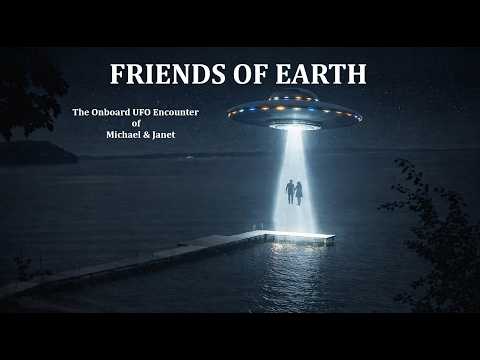
Friends of Earth: The Onboard UFO Encounter of Michael and Janet
UFO researcher and author Preston Dennett walks through Michael Lapp's and Janet Cornell's onboard-encounter accounts as recovered by Walter Webb, directly and specifically about this case.
The What Cast #353 — The Buff Ledge Abduction
A dedicated long-form discussion episode covering the case's full timeline, Webb's investigation, and the hypnotic-regression sessions in detail.
Sources
- Walter N. Webb, Encounter at Buff Ledge: A UFO Case History, J. Allen Hynek Center for UFO Studies, 1994. Internet Archive listing →
- UFO Casebook, "1968 – The Buff Ledge Abduction." ufocasebook.com →
- UFO Insight, "The 1968 Alien Abduction At Buff Ledge." ufoinsight.com →
- Vermont Daily Chronicle, "The Buff Ledge UFO." vermontdailychronicle.com →
- Colchester Sun, "On the Shores of Buff Ledge," local news feature on the camp's history and present-day site. colchestersun.com →
- Seven Days, "From UFOs to Starlink, Vermont Has a Long History of Strange Things in the Sky." sevendaysvt.com →
- Don Donderi, "Three New England Abduction Stories and One New Reality" (essay review), Journal of Scientific Exploration, Vol. 28, No. 2, 2014. journalofscientificexploration.org →
- rr0.org (Répertoire des ressources sur les OVNIS), biographical entry on Walter N. Webb. rr0.org →
- Internet Archive, catalog listing for Encounter at Buff Ledge: A UFO Case History (publisher, ISBN, and physical description). archive.org →
- John G. Fuller, The Interrupted Journey: Two Lost Hours Aboard a Flying Saucer, Dial Press, 1966.
- Martin T. Orne biographical entry, International Society of Hypnosis Encyclopedia of Hypnosis and Suggestion, on forensic hypnosis reliability and confabulation risk. ishhypnosis.org →
- Paul C. Giannelli, "The Admissibility of Hypnotic Evidence in U.S. Courts," International Journal of Clinical and Experimental Hypnosis, Vol. 43, No. 2, 1995. pubmed.ncbi.nlm.nih.gov →
- Rock v. Arkansas, 483 U.S. 44 (1987), U.S. Supreme Court ruling on the constitutional limits of per se exclusion of hypnotically-refreshed testimony. supreme.justia.com →
- Robert A. Baker, Hidden Memories: Voices and Visions from Within, Prometheus Books, 1992.
- National Archives and Records Administration, Project Blue Book finding aid and search portal. archives.gov →
- New England Legends Podcast, "Podcast 423 – The Buff Ledge UFO Abduction," Jeff Belanger & Ray Auger. ournewenglandlegends.com →
- YouTube (oEmbed-verified), Preston Dennett, "Friends of Earth: The Onboard UFO Encounter of Michael and Janet." youtube.com →
- YouTube (oEmbed-verified), The What Cast, "The What Cast #353 – The Buff Ledge Abduction." youtube.com →
- Wikimedia Commons, "View from Malletts Bay Road, Lake Champlain and Green Mts." (Boston Public Library postcard collection, CC BY 2.0) — source of this case file's hero image. commons.wikimedia.org →
- Amazon.com, product listing confirming author, title, and edition for Encounter at Buff Ledge: A UFO Case History. amazon.com →
- Biblio.com, bibliographic listing for Encounter at Buff Ledge: A UFO Case History confirming June 1993/1994 J. Allen Hynek Center for UFO Studies publication. biblio.com →
See something inaccurate? Have additional information or sources?
Suggest an Edit →Last Updated: August 2026