
Cergy-Pontoise Abduction
Before dawn on November 26, 1979, in the Paris new town of Cergy-Pontoise, 19-year-old Franck Fontaine reportedly vanished from a car whose two occupants, Jean-Pierre Prévost and Salomon N'Diaye, had just reported seeing a luminous object hovering above a nearby power station. Fontaine reappeared eight days later, on December 3, 1979, disoriented in a cabbage field a few kilometers away, wearing unwrinkled clothes and claiming no memory of the intervening time beyond a single instant of falling asleep at the wheel. The case became a nationally covered sensation, drew the direct investigative attention of France's official government UFO research body, GEPAN (now GEIPAN), and inspired a bestselling book by science-fiction writer and UFO popularizer Jimmy Guieu. It also, within months, produced a specific pattern that never resolved into an actual extraterrestrial "Grand Contact": Prévost began claiming he personally received telepathic messages from an entity he called Haurrio, self-published a book about it, and organized a mass public rendezvous with the aliens for August 15, 1980, which several thousand people attended and which produced nothing. In June 1983, Prévost gave a radio interview in which he stated plainly that "the Cergy-Pontoise affair is bogus from start to finish. I am solely responsible for it" — admitting he had hidden Fontaine in a friend's Pontoise apartment for the full eight days specifically to generate publicity for his own channeled-contact publishing venture. GEPAN's own official case file concluded the affair was a fraud whose unraveling "discredits the scientific work it attempts to promote." This site treats the case as conclusively resolved: a staged hoax, publicly confessed by its own organizer, independently confirmed as fabrication by France's own government UFO study body.
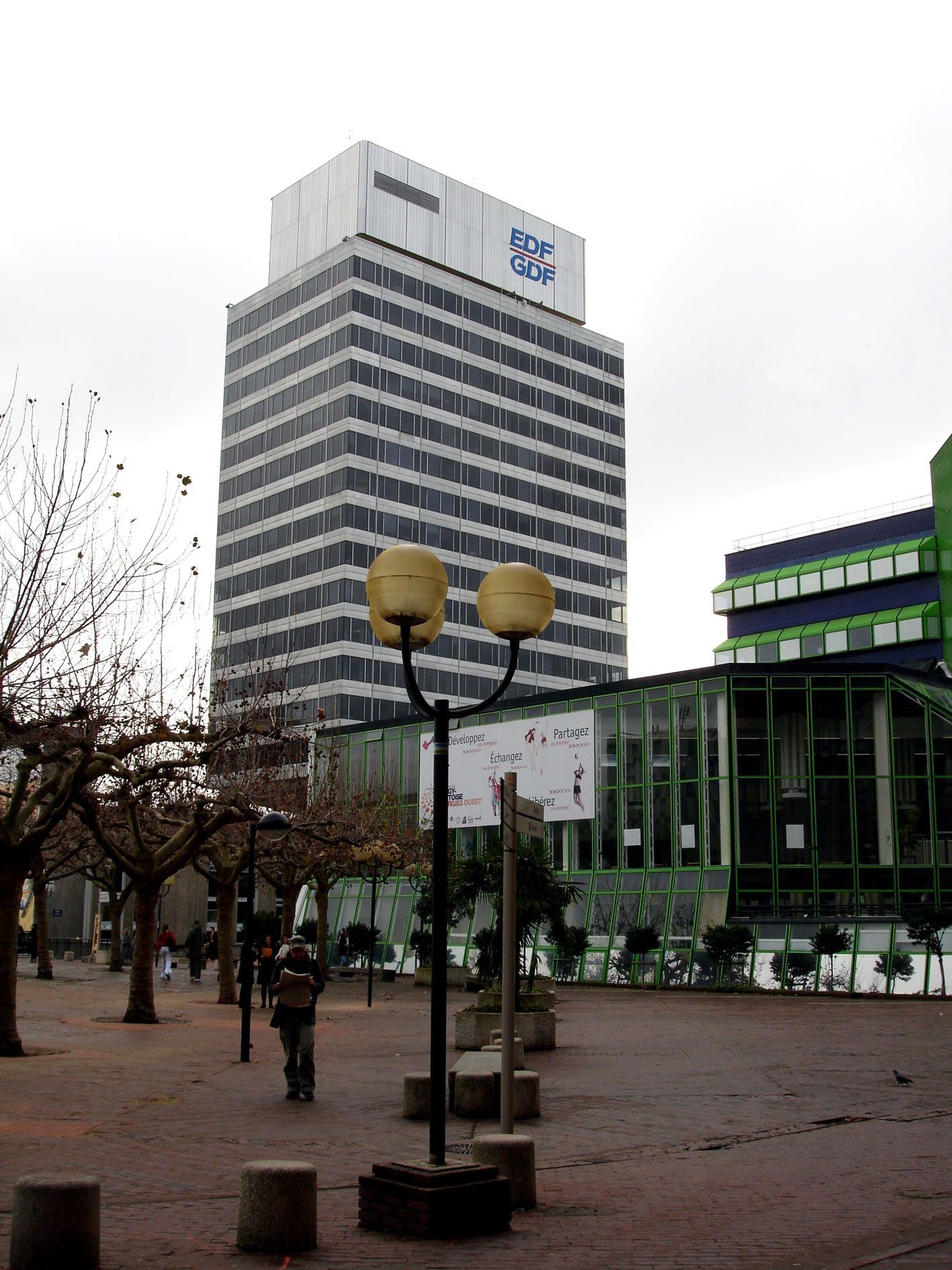
Pictured: the EDF tower in Cergy-Pontoise, Val-d'Oise, France, a landmark of the planned new town where this case took place. This is not a photograph of the actual power station overflight, the car, or the cabbage field involved in the case — no rights-clear photograph of any of those specific sites is known to exist, and since the case is a confessed hoax, no genuine anomalous scene was ever available to photograph in the first place. Photo by Alvar Lavague, via Wikimedia Commons, licensed CC BY 3.0 / GFDL.
Theoretical Alignment
This case aligns almost entirely with the Psycho-Social hypothesis, reflecting a confirmed, confessed hoax rather than any genuine anomalous phenomenon. The residual ETH/IDH allowance reflects only that the story's own content, at face value and before Prévost's 1983 confession, described an extraterrestrial contact narrative; it carries no independent evidentiary weight whatsoever once weighed against the confession itself, the physical evidence that directly contradicted the story (see Material Analysis below), and GEPAN's own official fraud determination.
Background
Understanding how a staged disappearance became a nationally covered UFO sensation, and why it took nearly four years to unravel publicly, requires understanding both the town where it took place and the specific individual who orchestrated it.
Cergy-Pontoise: A New Town Outside Paris
Cergy-Pontoise is one of five planned "villes nouvelles" (new towns) built around Paris beginning in the late 1960s to absorb the French capital's rapid postwar population growth, combining the historic town of Pontoise with the newly built communities of Cergy and several surrounding communes in the Val-d'Oise department, roughly 35 kilometers northwest of central Paris. In 1979 the town was still in an active phase of construction and rapid growth, a demographic and social environment of newly arrived, often young residents without long-established local social ties — a real, documented background feature of the town at the time that this site's research notes as broadly consistent with (though not sufficient on its own to explain) the specific circumstances in which three young men in their late teens and twenties came to spend a November night together in a parked car.
Jean-Pierre Prévost Before Cergy-Pontoise
Jean-Pierre Prévost, 25 at the time of the claimed incident, worked selling televisions and other consumer goods and, per several contemporary and retrospective French accounts, had an existing personal interest in esoteric and paranormal subject matter before November 1979. This site's research found no evidence Prévost held any formal scientific, journalistic, or investigative credential of any kind; his subsequent actions — positioning himself, within months of the claimed abduction, as the actual intended target of the aliens' interest and the sole recipient of their ongoing telepathic messages — are, per this site's own assessment and per GEPAN's official conclusion, most consistent with a person who had already identified an opportunity to build a following around a channeled-contact narrative before the story had even fully run its initial course.
A Wave of French Contactee Culture
The Cergy-Pontoise affair did not occur in a vacuum. France in the 1970s had an active, growing contactee and UFO-religion culture, most prominently embodied by Claude Vorilhon (known as Raël), who founded the International Raëlian Movement in 1974 after claiming his own extraterrestrial contact experience, and who built a real, lasting religious organization around that claim in the same general period. Raëlian followers are documented to have traveled to Cergy-Pontoise for the August 1980 "Grand Contact" rendezvous Prévost organized, drawn by the case's overlapping thematic territory even though Prévost's own venture and the Raëlian movement were separate, unaffiliated organizations. This broader cultural context matters directly to this case: Prévost was not inventing the idea of a UFO-based contactee religious movement from nothing, he was attempting, with far less lasting success, to replicate a model of channeled-contact leadership that a real, contemporaneous French movement had already demonstrated could attract a genuine following.
The French Press and the National UFO Conversation of the Late 1970s
The case also arrived at a moment when French UFO reporting generally was drawing an unusually high level of institutional and press attention. GEPAN itself had only been founded two years earlier, in 1977, by engineer Claude Poher specifically to give the French state a standing, scientifically staffed body for investigating civilian UFO reports — a genuinely unusual step among Western governments of the period, and one that gave any sufficiently dramatic new French case an existing, credentialed investigative body ready to take it seriously rather than dismiss it out of hand. French national newspapers and magazines, including Paris Match, France-Soir, and regional papers such as Le Parisien Libéré, maintained regular UFO coverage through the late 1970s, feeding a public appetite Prévost's own story arrived perfectly positioned to satisfy: a case dramatic enough for national tabloid coverage, yet also serious enough, on its face, to draw a real government science agency's direct attention. This site's research treats this specific institutional environment — a credentialed state UFO-research body actively investigating civilian reports, atop an already UFO-attentive national press — as a significant contributing factor in how quickly and how far the story spread before any of its internal inconsistencies could be examined by anyone outside the three men themselves.
Complete Timeline
| Date | Event |
|---|---|
| Nov. 26, 1979, ~4:15–4:30 a.m. | Jean-Pierre Prévost and Salomon N'Diaye report a luminous, phosphorescent object over a power station near Cergy-Pontoise while loading a car to sell clothes at a market; they report Franck Fontaine vanishing from the vehicle inside dense fog and light. |
| Later that morning | Prévost reports the disappearance to gendarmes; an official investigation begins. |
| Late Nov.–early Dec. 1979 | The story receives extensive French press coverage; the case draws the direct attention of GEPAN (Groupe d'études des phénomènes aérospatiaux non identifiés), the French government's official UFO study body, then under the space agency CNES. |
| Dec. 3, 1979 | Fontaine reappears, found disoriented in a cabbage field near Pontoise, wearing unwrinkled clothes, with no memory beyond falling asleep at the wheel of the car. |
| Dec. 21, 1979 | Fontaine gives an interview to Paris Match describing regaining brief consciousness in what he called a laboratory-like setting among small luminous entities. |
| 1980 | Science-fiction writer and UFO popularizer Jimmy Guieu publishes Contacts OVNI à Cergy-Pontoise, co-credited to Fontaine, Prévost, and N'Diaye, presenting the case as a genuine, ongoing contact event. |
| April 26, 1980 | The three men appear on the French television program Temps X; Prévost undergoes hypnosis on-air, producing a recorded session in which he describes further alleged contact; Fontaine declines hypnosis. The men announce an alien "Grand Contact" rendezvous for August 15, 1980. |
| Aug. 15, 1980 | Roughly 2,000 people, including followers of Claude Raël's International Raëlian Movement, gather at the announced Cergy-Pontoise site awaiting the promised contact. Nothing occurs. |
| Early 1980s | Prévost publishes Le Grand Contact, presenting himself as the aliens' true intended contact and channel for messages from an entity he calls Haurrio; the publishing venture fails financially. |
| June 1983 | Prévost states on French radio (Radio-Korrigan) and to Le Parisien Libéré (published July 7, 1983): "J'affirme que l'affaire de Cergy-Pontoise est bidon du début à la fin” (“I affirm that the Cergy-Pontoise affair is bogus from start to finish”), admitting he organized the entire hoax and hid Fontaine in an acquaintance's Pontoise apartment for the eight missing days. |
| Aug. 15, 1983 | A second, smaller announced rendezvous, tied to Prévost's earlier claims, also produces nothing. |
| 1990s–2000s | Fontaine and N'Diaye continue, in various interviews, to maintain the original account despite Prévost's confession; GEPAN's successor GEIPAN's own retrospective case file classifies the affair a fraud. |
Detailed Narrative
The Reported Disappearance
According to the account Prévost and N'Diaye gave to gendarmes on the morning of November 26, 1979, the two men and Franck Fontaine, then 19, were loading a car in the pre-dawn darkness to travel to a market where they planned to sell clothing. As they prepared to leave, they reported seeing a luminous trail or halo above a nearby power station, followed by a dense, unusual fog enveloping the vehicle along with blinking spheres of light. When the fog cleared, per their account, Fontaine and the car itself were gone; the vehicle was later found abandoned in a cabbage field with its engine stalled. Fontaine himself was not present to be interviewed for eight days.
National Media Attention and the GEPAN Investigation
The story drew rapid, extensive coverage in the French press and prompted a direct investigation by GEPAN, the French government's official civilian UFO study body, then operating under the national space agency CNES and led at the time by engineer Jean-Jacques Velasco's predecessor organization under founder Claude Poher. Investigators, including gendarmerie officers, examined the reported physical scene, tested blood samples from Fontaine upon his reappearance, and physically inspected cabbages in the field where the car and later Fontaine himself were found, reportedly checking for signs consistent with a landed craft or unusual physical disturbance.
The Reappearance
On December 3, 1979, Fontaine reappeared, found disoriented in the same general cabbage-field area near Pontoise where the car had earlier been discovered. He wore the same clothing he had disappeared in, unwrinkled and clean, and still had the same 100 francs in his pocket he had been carrying the night he vanished. His own account of the intervening eight days was strikingly minimal: he stated only that he recalled falling asleep at the wheel and had no memory of anything between that moment and his reappearance, a detail some contemporary investigators noted made it functionally impossible to catch him in a specific factual contradiction, since he simply declined to offer any specific, checkable narrative content for the missing period.
The Paris Match Interview and Escalating Claims
On December 21, 1979, Fontaine gave a widely read interview to the magazine Paris Match, in which he described a brief moment of apparent consciousness during the missing period: waking in what he characterized as a laboratory-like setting, surrounded by luminous entities roughly the size of an orange. This added specific, dramatic content to a story that had, until that point, been built almost entirely around Fontaine's own claimed absence of memory — a pattern this site's research notes recurs across multiple stages of the case, in which each new escalation of specific detail arrived only after the story had already gained a public audience, rather than as part of Fontaine's or the other men's original, contemporaneous statements to police.
Jimmy Guieu's Book and the Television Broadcast
Jimmy Guieu, a well-known French science-fiction author and UFO popularizer with an established public profile, took up the case directly, publishing Contacts OVNI à Cergy-Pontoise in 1980, co-credited to Fontaine, Prévost, and N'Diaye and presenting the story as a genuine and still-ongoing contact event. On April 26, 1980, the three men appeared on the popular French science and futurism television program Temps X, hosted by the Bogdanoff brothers; Prévost agreed to on-camera hypnosis, producing a recorded session in which he described further claimed contact experiences, while Fontaine specifically declined to be hypnotized. This broadcast appearance is the moment the case's center of narrative gravity visibly shifts from Fontaine, the claimed original abductee, toward Prévost, who had begun positioning himself as the entities' actual intended long-term contact.
The Grand Contact and Haurrio
Following the television appearance, Prévost announced that the extraterrestrial visitors had designated him — not Fontaine — as their true contact, and that he was receiving ongoing telepathic messages from an entity he called Haurrio concerning the deteriorating state of the Earth. Prévost founded a small publishing venture to disseminate these messages, culminating in his own book, Le Grand Contact, and announced a public "Grand Contact" rendezvous for August 15, 1980, at which he claimed the extraterrestrials would make open contact. Roughly 2,000 people gathered at the announced site in Cergy-Pontoise on the appointed day, including a number of followers of Claude Raël's separately established International Raëlian Movement, drawn by the overlapping subject matter. Nothing occurred. A second, smaller announced rendezvous on August 15, 1983, also produced nothing. Prévost's publishing venture, per multiple retrospective accounts, failed financially, leaving him in significant personal debt — a real, documented, and mundane consequence directly undercutting any reading of his ongoing claims as a successful, sustained fraud rather than a failed one.
The June 1983 Confession
In June 1983, Prévost gave an interview on the regional French radio station Radio-Korrigan, later reported by the national newspaper Le Parisien Libéré on July 7, 1983, in which he stated without qualification: "J'affirme que l'affaire de Cergy-Pontoise est bidon du début à la fin. C'est moi seul qui suis responsable. C'est moi qui ai tout organisé, tout monté" ("I affirm that the Cergy-Pontoise affair is bogus from start to finish. I alone am responsible for it. It was me who organized everything, mounted everything"). Prévost specifically described hiding Fontaine in an acquaintance's apartment in Pontoise for the entire eight-day period, personally transporting him there and later retrieving him, and stated his motive had been to draw attention to his own channeled messages, which he framed, in his own words, as intended to spread "a message of peace." Fontaine, for his part, offered a memorably ambivalent statement of his own around the same period: "Si c'était à refaire, je raconterais n'importe quoi" ("If I had to do it again, I would tell any story") — a remark this site's research reads as consistent with weary regret at having participated in the deception, without itself constituting as unambiguous a confession as Prévost's own explicit statement.
The Aftermath and Continued Denials
Despite Prévost's public confession, Fontaine and N'Diaye continued for years afterward, in various interviews, to maintain the original account of a genuine abduction, and Jimmy Guieu, whose own book and reputation were directly staked on the case's authenticity, publicly rejected Prévost's confession as itself unreliable. This site's research treats this specific, documented pattern — the case's own confessed organizer admitting fraud while his co-participants continued to deny it — as itself a normal and expected feature of an unraveling hoax rather than as evidence complicating the confession's validity: participants in a staged story often have different personal, financial, or reputational reasons to maintain or abandon it at different times, and Prévost's own confession is corroborated independently by GEPAN's official investigative conclusion, discussed in full below, rather than resting on his word alone.
Related December 1979 Reports and Their Later Disentanglement
Part of what made the case initially seem more substantial than a single family's testimony was a cluster of loosely related sighting reports from the same town in the surrounding weeks — a 14-year-old girl's report of a phosphorescent red-orange object with a dome-like structure on the morning of the disappearance itself; a separate child's report of a landing and a luminous humanoid figure the following day; and a early-December report from a driver named Henri Lucas describing his own vehicle apparently enveloped in a smoke-like cloud. Some of the case's early proponent literature, including portions of Jimmy Guieu's own book, treated these reports as mutually corroborating pieces of a single, larger event. This site's research, consistent with GEPAN's own later, more skeptical review of its original file, treats this clustering with real caution: independent, unrelated sightings reported by different people in the same general area and time window are a common feature of any UFO wave with substantial press coverage, since publicity itself reliably generates a wave of new, often entirely unconnected reports from people primed by the same news coverage to notice and reinterpret ordinary nocturnal lights. Folding these separate reports into a single unified narrative, as some of the case's earliest proponent treatments did, overstates the actual evidentiary independence of what was, in the end, one confessed hoax surrounded by a normal amount of incidental, unrelated regional sighting activity.
A Minority Dissenting Theory: Jacques Vallée's Intelligence-Operation Hypothesis
Prominent French-American ufologist Jacques Vallée, in his own later book-length examination of the case, OVNI: Retour sur l'affaire de Cergy-Pontoise, proposed an alternative reading: that the entire affair, rather than being an independent hoax improvised by Prévost for his own personal and financial benefit, may have originated as a deliberate intelligence-community operation intended to study how a fabricated contact narrative could be used to seed a following or sect for further social-science observation, with French intelligence services allegedly involved in its construction or amplification. Vallée has stated he continues to hesitate between this hypothesis and the straightforward hoax explanation Prévost's own confession describes. This site's research finds Vallée's specific intelligence-operation claim without independent documentary support of its own — no leaked or declassified French government record corroborates it — and treats it as a genuinely interesting minority hypothesis from a credentialed researcher rather than as a competing, equally well-evidenced explanation to Prévost's own direct, specific, and twice-independently-corroborated (by press report and by GEPAN's own separate investigation) confession.
Key Witnesses
Franck Fontaine
Fontaine, 19 at the time, was the person around whose eight-day absence the entire case was built. His own account of the missing period was minimal by design — he claimed simply to have fallen asleep and to remember nothing — and he continued to publicly maintain the abduction account for years after Prévost's 1983 confession, even while later privately acknowledging, in his own words, that were he to do it again he "would tell any story." This site's research treats Fontaine as a knowing participant in the staged disappearance, per Prévost's specific and detailed confession describing hiding him in a Pontoise apartment for the full period, rather than as an independent victim of a hoax organized entirely without his knowledge.
Jean-Pierre Prévost
Prévost, 25 in 1979, was the case's original reporting witness, its principal subsequent promoter, the self-declared recipient of ongoing telepathic contact from an entity he called Haurrio, and, per his own explicit June 1983 statement, the person who "organized everything" and personally hid Fontaine for the eight missing days to generate publicity for his own channeled-message publishing venture. This site's research treats Prévost's own detailed, specific, and twice-published confession as the single most important piece of evidence in the entire case.
Salomon N'Diaye
N'Diaye, also 25, was the second witness present at the original reported sighting and disappearance and continued, per this site's research, to maintain the original account publicly even after Prévost's confession. No source located by this site's research indicates N'Diaye played an active organizing role in the hoax comparable to Prévost's, though his continued public affirmation of the story after 1983 is itself a documented, if unexplained, feature of the case's aftermath.
The Five Observables Assessment
The Five Observables framework describes flight-performance characteristics of an observed craft. Because this case is a confessed, officially confirmed hoax, none of the claimed observations reflect any genuine craft or phenomenon; the ratings below describe only what the fabricated story itself claimed.
Assessment: None of the Five Observables apply meaningfully to this case. The claimed luminous object was never described with any specific performance characteristic beyond hovering and producing fog/light, and since the entire underlying event is a confessed fabrication, this site's methodology does not treat any part of the described craft behavior as evidence of anything beyond what Prévost and his co-participants chose to include in the story they invented.
Evidence Assessment
Supporting a Genuine Anomalous Event
- The three men reported the disappearance to police within hours, a level of immediate, specific commitment to the story consistent with (though not exclusive to) a real experience
- Some contemporary gendarme observations noted dense, unusual fog around the vehicle, a detail some early GEPAN documentation flagged before the fraud determination
- Fontaine's physical presentation on reappearance (unwrinkled clothing, retained money) was consistent with his own account, though equally consistent with a person who had simply been hidden indoors rather than abducted
Supporting a Staged Hoax
- Jean-Pierre Prévost publicly confessed in June 1983, in explicit, specific, and repeated terms, to organizing the entire affair and hiding Fontaine in a Pontoise apartment for the full eight days
- GEPAN, France's own official government UFO study body, independently classified the case a fraud, concluding no physical indicator suggested a genuine phenomenon
- Blood analysis of Fontaine on his reappearance found no support for any claimed physiological effect of weightlessness or unusual environmental exposure
- Cabbages in the field where the car and Fontaine were found, examined for signs of disturbance consistent with a landed craft, proved entirely ordinary — simply abandoned agricultural produce, not physically anomalous
- Prévost's own subsequent actions (positioning himself as the aliens' true contact, publishing self-authored channeled messages, organizing a paid-attention public rendezvous that produced nothing) establish a clear, ordinary financial and reputational motive independent of any genuine contact claim
- The story's specific, dramatic details (the "laboratory," the orange-sized luminous entities) were added incrementally in later interviews rather than appearing in the men's original, contemporaneous statements to police
Why “Debunked”
This case is stamped Debunked and scored a very low 8 out of 100 because it meets this site's own standard for that stamp in full: an actual, demonstrated falsehood, not merely a thin or uncorroborated claim. Unlike this site's Coyame, Mexico Crash Claim file (Disputed, 9/100), which rests on an anonymous, never-identified source and lacks any confession or conclusive resolution, this case has a specific, named organizer — Jean-Pierre Prévost — who gave an explicit, detailed, publicly reported confession describing exactly how, when, and why he staged the affair, corroborated independently by France's own official government UFO study body (GEPAN, now GEIPAN), which concluded on its own separate investigative grounds that the case was a fraud. This combination — a direct organizer's confession plus an independent official government fraud determination — places this case in the same evidentiary category as this site's Aztec, New Mexico Crash Claim file (Debunked, 12/100), which similarly rests on a criminal fraud conviction rather than mere absence of corroboration. This case's score sits slightly below Aztec's specifically because Cergy-Pontoise combines two independent lines of conclusive disproof (the organizer's own confession and a separate official government investigation) where Aztec's resolution rests primarily on one (a criminal fraud conviction), and because this case's physical counter-evidence (the blood analysis, the ordinary cabbages) directly contradicts the story's own specific claims rather than merely failing to support them.
Sensor & Instrumentation Detection Profile
No radar, photographic, or instrumented data of any kind was ever produced for this case. GEPAN's investigators, per this site's research, did consult available military radar records for the region and night in question and found nothing corroborating an unidentified target matching the men's account. No photograph or film of the claimed luminous object or fog exists from any source. The only physical checks performed — blood analysis on Fontaine and physical examination of the cabbage field — were conducted after the fact by GEPAN and gendarmerie investigators specifically to test the claim, and both returned results inconsistent with the story rather than supporting it, detailed further in Physical & Material Assays and Material Analysis below.
Environmental & Geospatial Context
Cergy-Pontoise sits in the Val-d'Oise department roughly 35 kilometers northwest of central Paris, at the confluence of the Oise and Seine watershed, and was in 1979 a still-developing planned new town combining the historic settlement of Pontoise with newly constructed districts. The power station the men described the luminous object hovering above is a real, documented feature of the town's infrastructure from the period; the cabbage field where both the abandoned car and, eight days later, Fontaine himself were found reflects the town's semi-rural fringe character at the time, common to many rapidly urbanizing French new towns of the era, where agricultural land and new residential construction sat in close proximity. This site's research found no evidence of any military installation, radar facility, or other federal facility located in immediate proximity to the claimed sighting location that would independently explain any part of the men's account through conventional means (such as a misidentified military aircraft or exercise); GEPAN's own investigation, per available secondary sourcing, likewise found no such conventional aerial activity documented for the area on the night in question, consistent with there having been no real anomalous aerial event of any kind to explain in the first place. The specific power station the men named is a genuine, identifiable piece of local infrastructure rather than an invented detail, which this site's research treats as a small but real point of narrative craftsmanship on Prévost's part: anchoring an invented story to a real, checkable local landmark, rather than a vague or unverifiable one, is exactly the kind of concrete detail that makes an initial police report seem more credible on its face, whether or not the underlying claim itself is true. The broader Val-d'Oise department in 1979 was itself in a period of substantial construction and land-use change as the new town's development continued, meaning the specific field where the car and later Fontaine were found may well have shifted between agricultural and construction use within just a few years of the case itself — a detail this site's research could not fully confirm for the exact plot in question, but which is consistent with the area's well-documented general land-use history of the period.
Observer Credibility & Occupational Profile
None of the three central participants held any scientific, investigative, journalistic, or law-enforcement credential relevant to evaluating their own testimony. Jean-Pierre Prévost, a 25-year-old salesman with a documented pre-existing personal interest in esoteric subject matter, is, per this site's own assessment and per his own later confession, the case's actual architect; his subsequent, well-documented actions — positioning himself as the aliens' preferred contact, self-publishing channeled messages, organizing a public rendezvous timed to generate maximum publicity — describe a person actively building a personal following and revenue stream around the claim, not a passive, credible eyewitness reporting an event outside his control. Franck Fontaine, 19, presents as a willing participant in the staged deception per Prévost's own specific account of hiding him for the full eight-day period, a reading corroborated by Fontaine's own later, more equivocal remark about willingness to "tell any story." Salomon N'Diaye's specific role and motive remain comparatively less documented than Prévost's; this site's research found no evidence he personally profited from the hoax to the degree Prévost attempted to, though his continued public affirmation of the story after 1983 remains an unresolved detail of the case's aftermath. By contrast, GEPAN's own investigators — operating as credentialed government scientists and engineers under CNES, France's national space agency — brought genuine institutional credibility and methodological rigor to their independent physical testing, and their fraud determination carries considerably more evidentiary weight in this site's assessment than any of the three original participants' own testimony. Jacques Vallée, whose own later minority intelligence-operation hypothesis is discussed above, brings a different but genuinely relevant credibility profile: a credentialed computer scientist and astronomer with decades of independent UFO field investigation across multiple countries, whose willingness to publicly entertain an unconventional reading of this specific case reflects intellectual independence from ordinary proponent/skeptic camp lines rather than any documented personal stake in the case's outcome, financial or otherwise. This site's research treats Vallée's continued hesitation between the intelligence-operation hypothesis and the straightforward hoax explanation as a genuine, good-faith scholarly position, while still weighing it against the considerably more direct and specific evidentiary weight of Prévost's own confession and GEPAN's independent physical findings.
Physical & Material Assays
GEPAN investigators conducted blood analysis on Fontaine upon his reappearance, reportedly checking for any physiological indicator consistent with his claimed experience (such as effects associated with prolonged weightlessness or unusual environmental exposure); the results provided no support for the claimed abduction. Investigators also physically examined the cabbages in the field where the car and later Fontaine were found, apparently checking for signs of physical disturbance consistent with a landed craft; the cabbages were found to be entirely ordinary, simply having been left in the field by the property's owner as it awaited use as fertilizer, with no anomalous damage or disturbance pattern of any kind. No other physical exhibit — no soil sample, no photograph, no fiber or trace evidence — was ever produced supporting any part of the claim. This is a case in which the available physical evidence, rather than being merely absent, was actively and specifically tested and found to directly contradict the story's own claims.
This site's research also notes a broader methodological point the cabbage-field test in particular illustrates well: proponent retellings of the case, including some passages in Jimmy Guieu's own book, treated the presence of allegedly damaged or disturbed vegetation in the field as circumstantial physical support for a landing event, in the same general evidentiary tradition as documented plant-stem and crop-circle analysis used in other, unrelated European close-encounter cases. GEPAN's own direct, on-site examination found nothing of the kind: the cabbages had simply been left in the field by the property owner in the ordinary course of agricultural use, awaiting incorporation as fertilizer, with no burn marks, no anomalous wilting pattern, and no ground-level disturbance consistent with a landed object. This site's research treats the gap between the proponent literature's framing of this detail and GEPAN's own direct physical findings as one of the clearest, most concretely falsifiable examples in the entire case of a specific claimed piece of corroborating evidence turning out, on direct examination by a credentialed government team, to be nothing more than an ordinary, mundane agricultural scene.
Historical Precedents & Archive Matches
Comparison to This Site's Aztec Crash-Claim File
This site's own Aztec, New Mexico Crash Claim file (Debunked, 12/100) documents a structurally comparable case: a dramatic, initially widely believed UFO claim later conclusively resolved through direct evidence of fraud by its own promoters. Both cases share the same basic shape — a small number of individuals building an elaborate public narrative that drew genuine media and institutional attention before unraveling through a specific, documented act of disproof (a criminal fraud conviction for Aztec; a direct organizer's confession plus an independent government fraud determination for Cergy-Pontoise). This site's research treats Cergy-Pontoise's resolution as, if anything, even more thoroughly documented than Aztec's, since it combines two independent lines of conclusive evidence rather than one.
Comparison to French Contactee Culture: The Raëlian Movement
The genuine, lasting International Raëlian Movement, founded by Claude Raël in 1974, five years before this case, provides a useful contrast rather than a precedent: it demonstrates that a real, sustained UFO-contactee religious organization was achievable in the same general French cultural environment during the same general period, while Prévost's own considerably less successful attempt at the same basic model — a self-declared sole contact channeling messages from a named entity, organizing a mass public rendezvous — collapsed financially and was publicly confessed as fraudulent within roughly three years, never achieving anything resembling the Raëlian movement's actual organizational durability. This site's research treats this contrast as informative about why Prévost's venture specifically failed and was confessed rather than sustained: it appears to have been an opportunistic, individually improvised scheme built on top of a single staged incident, rather than a considered, resourced attempt at building a lasting religious or social organization from the outset. Raël's own movement, by comparison, was built from the beginning around a structured cosmology (the Elohim, genetic creation of humanity, an ongoing program of public lectures and a formal membership structure) developed and promoted with considerably more sustained personal commitment over decades; Prévost's Haurrio messages, by contrast, appear in the documented record only for the roughly three years between the original 1979 incident and his 1983 confession, with no indication he attempted to revive or continue the venture in any organized form afterward.
Comparison to Valensole: A Genuine French Single-Witness Case
This site's own Valensole UFO Incident file documents a very different kind of French case from the same broad national UFO-research tradition: farmer Maurice Masse's July 1965 account of a close-range encounter with a landed craft and two small humanoid beings, a case independent French researcher Aimé Michel and later Jacques Vallée both treated as one of the best-corroborated close encounters in continental Europe, resting on a single witness who maintained an entirely consistent account for the rest of his life without any documented financial or promotional motive. The contrast between Valensole and Cergy-Pontoise is instructive for this site's own methodology: both are French cases involving a small number of witnesses and no independent instrumented corroboration, yet one (Valensole) never produced a confession, financial motive, or contradicting physical evidence across six decades of subsequent scrutiny, while the other (Cergy-Pontoise) produced all three within four years. The same general absence of instrumented proof does not, on this site's own assessment, place both cases in the same evidentiary category; the specific, case-by-case pattern of confession, motive, and physical contradiction is what actually distinguishes a case this site treats as Debunked from one it treats as meaningfully more credible.
A Rare Case With Its Own Direct Official Government File
Unlike many UFO cases this site has published, Cergy-Pontoise has its own dedicated official case file maintained by GEIPAN (case reference 1979-11-00685), a genuine rarity for a case ultimately determined to be a hoax rather than a genuinely unresolved sighting, reflecting the scale of the media attention and institutional investigative resources the case drew before its resolution became clear. Most confirmed hoax cases in this site's broader research experience never receive this level of sustained, credentialed government investigative attention at all, precisely because the small scale or limited initial publicity of a lesser claim gives no comparable institutional body reason to engage with it in the first place; Cergy-Pontoise's specific combination of national media saturation and a still-young, eager GEPAN looking to establish its own investigative credibility is what produced this comparatively unusual paper trail.
Material Analysis
This case's material record consists entirely of the two specific physical checks GEPAN investigators conducted: blood analysis of Fontaine, and physical examination of the cabbage field. Both were genuine attempts at empirical verification, and both returned results directly inconsistent with the claimed abduction rather than merely failing to confirm it. No wreckage, no soil trace, no fiber evidence, and no photographic record of any anomalous physical trace was ever produced by any party at any point in the case's history.
Supporting Non-Terrestrial or Genuinely Unexplained Origin
- None identified. Every physical test conducted returned a result inconsistent with the claimed abduction.
Supporting a Staged, Terrestrial Origin
- Blood analysis found no physiological indicator supporting Fontaine's claimed experience
- The examined cabbages showed no anomalous disturbance and were simply ordinary abandoned produce
- The case's own organizer, Jean-Pierre Prévost, confessed in specific detail to staging the entire event, including where and how Fontaine was hidden
- France's own official government UFO study body (GEPAN/GEIPAN) independently classified the case a fraud on its own separate investigative grounds
The Conventional Explanation Candidate: A Deliberately Staged Publicity Hoax
Because this case has a direct, detailed confession from its own organizer, its "conventional explanation" question is less speculative than in most case files this site publishes: the leading candidate is simply the confession itself, weighed against a small number of alternative or complicating readings.
A Deliberate Hoax to Build a Channeled-Contact Following
Jean-Pierre Prévost's own June 1983 confession describes a specific, coherent, and financially motivated sequence of events: report a false disappearance, hide the "abductee" for a set period, use the resulting media attention to position himself as the aliens' true ongoing contact, and monetize that position through self-published books and a promoted public rendezvous. This site's research finds this candidate directly supported by Prévost's own explicit statement, independently corroborated by GEPAN's separate physical-evidence findings (the blood test, the cabbage examination) and by the venture's own documented financial failure, which is difficult to reconcile with any reading of Prévost as a person who either genuinely believed his own claims or who successfully profited from a sustained, cynical long-term fraud.
A Genuine Initial Experience Later Exploited by Prévost
A more limited alternative reading holds that some initial, ordinary misperception (an aircraft light, an atmospheric effect, ordinary ground fog) may have triggered a genuine, non-fabricated initial sighting report, with Prévost only later choosing to fabricate Fontaine's actual disappearance and exploit the sighting's resulting publicity. This site's research finds this reading impossible to rule out entirely, since the original sighting report itself was never physically tested in the way the later disappearance and reappearance were, but notes that Prévost's own confession describes organizing the entire affair without drawing this specific distinction, and that GEPAN's own overall conclusion treated the full affair, not merely the disappearance, as fraudulent.
Jacques Vallée's Intelligence-Operation Hypothesis
As discussed in the Detailed Narrative above, Jacques Vallée has proposed that the affair may have originated as a deliberate intelligence-community exercise rather than an individually improvised hoax. This site's research finds no independent documentary evidence supporting this specific claim, and treats it as a minority, unconfirmed hypothesis from a credentialed researcher rather than as equally supported alongside Prévost's own direct, detailed, and independently corroborated confession.
A Genuine Extraterrestrial Abduction
The literal claim — that Fontaine was genuinely taken aboard an alien craft and returned eight days later — is the account Fontaine and N'Diaye continued to maintain publicly for years after Prévost's confession. This site's research finds it directly and specifically contradicted by Prévost's own detailed confession, by GEPAN's independent physical evidence findings, and by the complete absence of any corroborating instrumented data of any kind, and treats it as conclusively disproven rather than merely unsupported.
Why Fontaine and N'Diaye's Continued Denial Does Not Reopen the Case
A fair reading of this case has to address directly why two of the three original participants never publicly joined Prévost's confession, since a hoax's participants unanimously recanting is generally treated as stronger evidence than a single confession contradicted by continued denial from others. This site's research weighs several specific factors in resolving this apparent tension in Prévost's favor. First, Prévost's confession was not a vague admission but a specific, actionable account of exactly how and where Fontaine was hidden, information only the actual organizer of a staged disappearance would be positioned to know with that degree of detail. Second, GEPAN's own physical evidence findings (the blood test, the cabbage examination) independently corroborate a mundane resolution without relying on Prévost's word at all, meaning the case's fraud determination does not actually depend on resolving the apparent three-way disagreement among the men themselves. Third, Fontaine's own recorded remark about being willing to "tell any story" if he had to do it again reads, in context, considerably more like weary acknowledgment of participation in a deception than like a genuine, ongoing insistence on the literal truth of the abduction account. This site's research treats Fontaine and N'Diaye's continued public affirmation of the original story as an unresolved detail of the case's human aftermath — participants in a failed scheme may have their own separate reasons, financial, social, or reputational, for declining to join a partner's confession — rather than as evidence seriously reopening the question GEPAN's own independent investigation and Prévost's own detailed admission had already resolved.
Deliberate Hoax to Build a Channeled-Contact Following
ConfirmedDirectly supported by Prévost's own explicit confession, independently corroborated by GEPAN's physical evidence findings and the venture's documented financial failure.
Genuine Initial Sighting Later Exploited
InconclusiveCannot be entirely ruled out for the original sighting report specifically, but Prévost's own confession and GEPAN's conclusion treat the full affair as fraudulent.
Intelligence-Community Operation (Vallée)
InconclusiveA genuinely proposed minority hypothesis from a credentialed researcher, but without independent documentary support.
Genuine Extraterrestrial Abduction
RejectedDirectly contradicted by Prévost's own confession, GEPAN's physical evidence findings, and the total absence of any independent corroborating data.
Related Cases
Official Records & Research Guides
The direct successor to GEPAN, France's official government UFO study body under the national space agency CNES, maintains its own dedicated case file classifying the affair a confirmed fraud — a genuine rarity for a hoax case, reflecting the scale of institutional investigation the case drew before its resolution became clear.
GEIPAN's main site, including its searchable database of French UFO case investigations and classifications.
Further Reading — Recommended Literature
Contacts OVNI à Cergy-Pontoise
The original book-length account, published while the case was still presented as genuine — essential for seeing the story's own original claimed content before Prévost's 1983 confession.
Confrontations: A Scientist's Search for Alien Contact
Vallée's own broader investigative work, including his later, separately published examination of Cergy-Pontoise and his minority intelligence-operation hypothesis.
Ovnis, guerre secrète
Written by one of the civilian investigators who worked alongside GEPAN on the Cergy-Pontoise case, offering an investigator's-eye account of the affair's official French investigation.
How UFOs Conquered the World: The History of a Modern Myth
A broad, credentialed history of UFO belief and its overlap with religion and contactee movements, useful context for Prévost's own attempted channeled-contact venture.
The UFO Encyclopedia, 4th Edition (2-Volume Set)
The standard comprehensive reference for cataloged UFO cases, useful for situating Cergy-Pontoise within the broader history of confessed and disproven UFO hoaxes.
Essential Viewing

Sources
- GEIPAN / CNES, Official Case File 1979-11-00685 — France's government UFO study body's own classification of the case as fraud
- Encyclopedia.com, “Cergy-Pontoise Hoax” — summary of the case, the “Haurrio” channeled-contact venture, and Prévost's 1983 confession
- Podcast UFO, “A UFO Abduction in Cergy-Pontoise?” — English-language narrative summary, the August 1980 rendezvous, and Raëlian follower attendance
- RR0.org, “L'affaire de Cergy-Pontoise” — detailed French-language chronology and documentation of the case and its confession
- Vice France, “L'affaire de l'ovni de Cergy-Pontoise” — retrospective feature on the case, the Raëlian movement's involvement, and the confession
- Patrick Gross, UFOs at Close Sight, “Cergy-Pontoise: the newspapers, the hoax in the press, France, 1979” — contemporary December 1979 press coverage
- Extraterrestre.org, “La grande méprise du GEIPAN, 26 novembre 1979” — detailed timeline, named secondary witnesses, and critique of GEPAN's own original investigation
- Oncle Dom, “L'affaire de Cergy-Pontoise” — French-language case summary and the “Haurrio” contact claims
- Paris ZigZag, “Cergy-Pontoise: le mystérieux enlèvement d'un homme par des extraterrestres en 1979” — local Paris-region history feature on the case
- Wikipedia, “Jacques Vallée” — biography and Vallée's intelligence-operation hypothesis regarding this case
- Wikipedia, “Cergy-Pontoise” — background on the planned new town where the case took place
- Google Books, OVNI: Retour sur l'affaire de Cergy-Pontoise — collective retrospective volume on the case, its investigation, and its resolution
- Jimmy Guieu, Franck Fontaine, Jean-Pierre Prévost & Salomon N'Diaye, Contacts OVNI à Cergy-Pontoise (1980) — the original book-length account of the case
- Jacques Vallée, Confrontations: A Scientist's Search for Alien Contact (1990) — Vallée's broader investigative work and minority hypothesis on this case
- Jean-Claude Sidoun, Ovnis, guerre secrète — an investigator's account of the case's official French investigation
- David Clarke, How UFOs Conquered the World: The History of a Modern Myth (2015) — broader history of UFO contactee culture and religious movements
- Jerome Clark, The UFO Encyclopedia, 4th Edition — standard reference for cataloged UFO cases
- YouTube (oEmbed-verified), INA Société, “Franck a été enlevé par des extra-terrestres à Cergy-Pontoise” — original period French television archival footage
- Wikimedia Commons, File: Tour EDF Cergy-Pontoise (France).jpg — hero image source and license (CC BY 3.0 / GFDL, Alvar Lavague)
- This site, case-files/aztec-new-mexico-crash-claim.html — a comparably conclusively resolved fraud case, for comparison
- This site, case-files/coyame-mexico-ufo-crash-claim.html — a contrasting, uncorroborated but unconfessed anonymous claim, for comparison
- This site, locations/index.html, entry on Cergy-Pontoise, France — regional geography and background
See something inaccurate? Have additional information or sources?
Suggest an Edit →Last Updated: August 2026