
Deception Island Sightings
Over roughly ten weeks in the depths of the Antarctic winter of 1965, personnel at Argentine, Chilean, and British research and naval stations on Deception Island and Laurie Island independently reported at least seven distinct sightings of unidentified luminous aerial objects — culminating on the night of July 3, 1965, when a lens-shaped object was observed for 62 minutes by 17 Argentine and Chilean personnel simultaneously, while 1,300 kilometers away at Laurie Island two tape-recording variometers registered a sudden magnetic disturbance at the same hour a second object was seen departing that base. Both the Argentine Navy and the Chilean Air Force issued signed public statements confirming their personnel's observations within days, an almost unique instance of two national militaries jointly, publicly corroborating a UFO sighting made by their own officers. The case is documented first-hand by the Argentine base commander himself, Lt. (later Capt.) Daniel A. Perisse, whose own 1987 paper — reproduced here in full detail — is candid about the sighting's real evidentiary limits even as he stood by what he and his men saw. A rigorous 2020 reanalysis by Spanish researcher Vicente-Juan Ballester Olmos and colleagues argues the wave is most plausibly explained by a combination of the reflective Echo II satellite, misidentified bright stars and planets, and at least one meteor — a conventional case this file examines on its own terms, alongside the parts of the record that explanation does not comfortably cover.
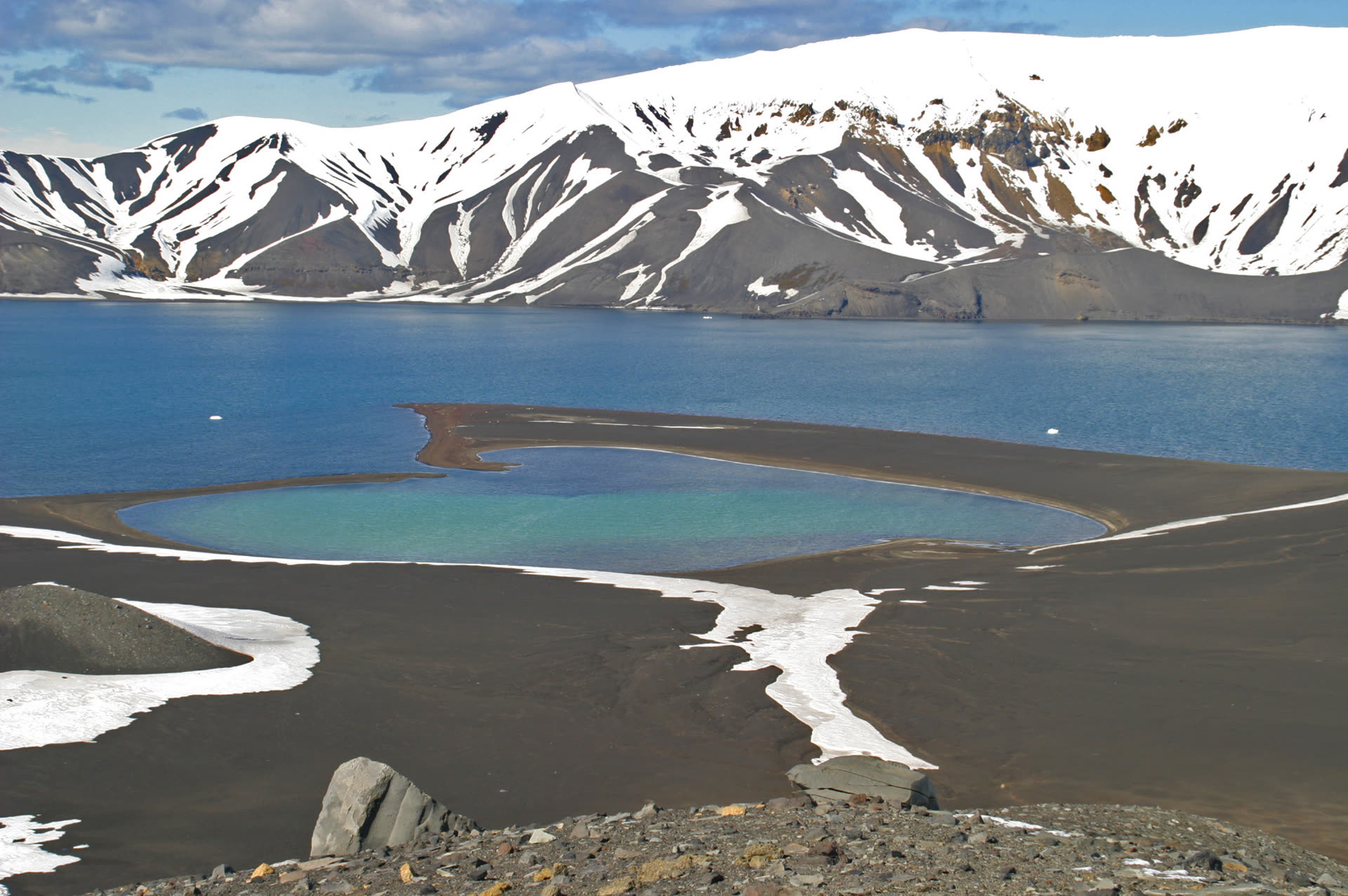
Pictured: an aerial view of Deception Island's collapsed volcanic caldera, showing the secondary crater formed during the island's 1970 eruption — not a photograph of the 1965 sightings themselves. No image from the actual event is known to survive in the public domain: the ten color photographs Cpl. Ladislao Durán Martínez reportedly took of the object on July 3, 1965 have never been published, and low-sensitivity film combined with near-total polar darkness defeated every other attempt to photograph the phenomenon that winter.
Theoretical Alignment
As a multi-station wave rather than a single incident, this file's alignment scores describe the case in aggregate. The Extraterrestrial Hypothesis retains modest support because several of the sightings — particularly the 62-minute Argentine observation of July 3 and the independently reported British sighting of July 2 — describe sustained hovering, sudden acceleration, and reversal of direction that a passive satellite or a star cannot perform, and because the case's three-nation, multiply-witnessed structure is difficult to dismiss wholesale. The Psycho-Social Hypothesis scores higher here than the ETH, reflecting both the real possibility that press coverage of the July 3 report primed observers at other bases to interpret ambiguous lights more dramatically in the following weeks, and the genuine internal tension in the primary source itself — commander Daniel Perisse's own 1987 paper explicitly states he "cannot vouch for the existence" of the Deception Island magnetometers referenced in the Navy's second bulletin, a rare instance of a case's chief proponent flagging his own side's weakest claim. The Interdimensional Hypothesis finds essentially no purchase in a record that never describes a portal, occupant, or any non-visual, non-magnetic anomaly.
Background
Deception Island is a horseshoe-shaped, still-active volcano in the South Shetland Islands, roughly 100 kilometers north of the Antarctic Peninsula, whose flooded caldera — Port Foster — forms one of the only natural, sheltered anchorages in the region. That geography made it a magnet for whalers in the early twentieth century and, later, for the three nations that pressed competing territorial claims over the Antarctic Peninsula sector: the United Kingdom (which had claimed the Falkland Islands Dependencies since 1908), Argentina, and Chile. By the 1950s all three maintained research or naval stations within a few kilometers of one another on the same small island — a British Antarctic Survey base at Whalers Bay, a Chilean Air Force station ("Presidente Pedro Aguirre Cerda") at Pendulum Cove, and an Argentine Navy detachment at First of May Bay — a proximity that had already produced one genuine armed confrontation: in February 1953, Royal Marines landed from HMS Snipe and forcibly evicted Argentine and Chilean personnel from a nearby hut, an incident that provoked formal diplomatic protests from both Buenos Aires and Santiago and a resignation inside the Chilean government. The 1953 raid was, by several accounts, a genuinely serious diplomatic incident rather than a minor scuffle: the British landing party captured two Argentine sailors and seized their base's flag and weapons, Argentine President Juan Perón and Chilean President Carlos Ibáñez del Campo both lodged formal protests with the British government, and Chile's own foreign minister resigned over his government's decision not to send naval reinforcements, calling the response "cowardly." The 1959 Antarctic Treaty, which entered into force in 1961 and froze all existing territorial claims while banning military activity on the continent, defused the immediate danger of a repeat confrontation but left the same three nations' scientific and naval personnel living within sight of each other's flags for the rest of the decade — the specific, real geopolitical backdrop against which the 1965 sightings occurred, and the reason a single small island could produce three entirely independent national witness pools for the same phenomenon within hours of each other.
That proximity is also why the case's cross-national corroboration carries more evidentiary weight than a similar claim would in most other UFO cases on this site: Deception Island's three garrisons in 1965 were, by recent history, wary neighbors rather than allies with any obvious incentive to coordinate a joint story, and the Chilean Air Force's own communiqué went out of its way to note that pre-existing radio interference had made such coordination impossible even had anyone wanted it. Argentina's own Antarctic program at the time answered to the Dirección Nacional del Antártico, with Navy detachments rotated annually; personnel typically served an isolated, roughly one-year tour with no return home and only limited radio contact with the mainland, a level of isolation that, this file's own research notes, cuts in two directions at once — it removes any plausible route for outside contamination of a witness's account, while also meaning no outside investigator visited any of the three bases to examine conditions firsthand until long after the sightings had ended.
By June 1965, the Argentine Navy's Deception Island detachment was commanded by a young lieutenant, Daniel Alberto Perisse, who had joined the Navy in 1952 and would go on, after his Antarctic tour, to become one of Argentina's most prominent civilian ufologists. His small garrison's routine included twice-daily meteorological observations, a duty that placed trained observers outdoors, watching the sky methodically, at the exact hours — dusk and full winter darkness — when the first sightings began. Winter in the Antarctic Peninsula sector means roughly 16 hours of darkness a day, with daylight confined to a narrow band between about 10:20 and 15:30 local time; nearly every sighting in this file occurred during that long polar night, a condition that cuts both ways evidentially. It removes ordinary daytime misidentifications (aircraft, balloons, birds) from serious consideration, but it also means every observation was made under difficult lighting, with no comparison objects nearby, and with the primitive, low-sensitivity photographic film available to a remote 1965 naval detachment essentially unable to record anything at all.
Complete Timeline
| Date | Event |
|---|---|
| June 7, 1965, 19:50 | First sighting: meteorological officer Jorge Stanich sees a stationary bright yellow light for 5 seconds at the Argentine base, First of May Bay, Deception Island. |
| June 8, 1965, 02:20 | Second sighting: Stanich again observes a stationary yellow light, for 4 seconds, under similar conditions. |
| June 18, 1965, 16:20 | Third sighting: nine members of the Chilean base "Pedro Aguirre Cerda" watch a bright, zigzagging white object with orange hues for 25 minutes. |
| July 2, 1965, 19:15 | Fourth sighting: five members of British "Base B" observe a green-and-red, hovering, accelerating light for 15–20 minutes. |
| July 3, 1965, 17:03 | Fifth sighting: meteorologists José Jarriek and José Mazzuchelli see a round, bluish-white object on a parabolic path at the Argentine base, Laurie Island, South Orkney Islands; two variometers register a sudden magnetic disturbance recorded on tape at the same moment. |
| July 3, 1965, 19:20 | Sixth sighting: nine members of the Chilean base watch a maneuvering, color-changing object for 20 minutes over Deception Island, with winds recorded at 80 km/h. |
| July 3, 1965, 19:42–20:44 | Seventh sighting: 17 Argentine and Chilean personnel at Deception Island jointly observe a lens-shaped object with a red center and shifting-colored edges for 62 minutes — the case's central, most detailed incident. |
| July 6, 1965 | The Argentine Navy releases its first official statement, published the next day in Clarín (Buenos Aires). |
| July 7, 1965 | The Chilean Air Force releases its own communiqué (published in La Razón) confirming the sightings at all three bases and stating that pre-existing radio interference ruled out any possibility of the reports being coordinated. |
| July 8, 1965 | Argentine Navy Bulletin #172, with Lt. Perisse's direct radio confirmation, is published in La Prensa, including the claim of magnetometer readings at the South Orkney base. |
| August 1965 (date undetermined) | Eighth sighting: Argentine personnel at Laurie Island observe four lights in rhomboidal formation moving slowly westward over the frozen sea, with a bright flash illuminating the island "like daylight." |
| 1966–1974 | Perisse serves on Argentina's Permanent Commission for the Investigation of the UFO Phenomenon, continuing to research the case he witnessed. |
| 1987 | Perisse presents "Deception Island UFO Sightings" at the MUFON International UFO Symposium in Washington, D.C., translated into English by Dr. Willy Smith — the source document for most of this file's technical detail. |
| 2020 | Vicente-Juan Ballester Olmos, Manuel Borraz Aymerich, Heriberto Janosch González, and Juan Carlos Victorio Uranga publish a six-year scholarly reanalysis of all seven sightings, concluding several are consistent with the Echo II satellite and misidentified stars. |
The First Sightings: June 7–18, 1965
The wave's opening sightings were, by Perisse's own account, its least dramatic. On Monday, June 7, 1965, at 19:50, meteorological officer Jorge Stanich was performing a routine observation at the Argentine detachment's First of May Bay post under a sky completely covered by stratus cloud. He noticed a stationary, bright yellow light at roughly 25° above the horizon, which he estimated to be about 2,000 meters away; the sighting lasted only 5 seconds. Using the observer's own reported angular size — measured, in a technique typical of contemporaneous ufological fieldwork, against a matchhead and a nail-head held at arm's length — Perisse's later trigonometric analysis put the object's actual diameter at roughly 35 to 50 meters. The following night, at 02:20 on June 8, Stanich had a near-identical experience: a stationary yellow light, this time toward the northwest at 40° elevation, visible for only 4 seconds, with an estimated diameter of 15 to 20 meters. He also reported hearing a faint, low sound about two minutes after the second sighting, though Perisse's paper explicitly declines to draw any causal link between the light and the sound.
Ten days later, on Friday, June 18, at 16:20 — the wave's only daylight sighting — nine witnesses at the Chilean Air Force base "Pedro Aguirre Cerda" at Caleta Péndulo watched a bright, apparently solid object zigzag from the eastern to the southern quadrant of the sky over a period of 25 minutes, holding an altitude between 20° and 35° above the horizon. Witnesses described it as resembling a very large star, white with orange hues as it turned, against a mostly clear, starry sky. This sighting would later be formally confirmed in the Chilean Air Force's own July 7 communiqué, which specifically credited Cmdr. Mario Jahn Barrera of the Chilean Antarctic base "Arturo Prat" for relaying the report.
July 2: The British Base "B" Sighting
At 19:15 on Friday, July 2, 1965, five garrison members of the British Antarctic Survey's "Base B" at Caleta Balleneros (Whalers Bay) were carrying out routine meteorological observations when they saw a light in the northern quadrant that zigzagged, hovered, and accelerated intermittently while holding an altitude between 20° and 45°. The light appeared green and red, occasionally shifting to yellow, and was visible for an estimated 15 to 20 minutes under a mostly clear, starlit sky with almost no moonlight. According to the Chilean Air Force's later summary of the British report, the light hovered for roughly 10 minutes before disappearing. This sighting is independently significant: it was reported by a national contingent with no direct chain of communication to the Argentine base that night, under Perisse's own account of the period's radio conditions, and its described behavior — sustained hovering punctuated by sudden acceleration — is one of the wave's harder details for any single, simple conventional explanation to absorb cleanly.
July 3: The Night of Three Sightings
July 3, 1965 produced the wave's three most detailed and, taken together, most evidentially complex sightings — occurring at two bases roughly 1,300 kilometers apart within roughly two and a half hours of each other.
Laurie Island, 17:03: The Tape-Recorded Anomaly
At the Argentine base on Laurie Island, in the South Orkney Islands, meteorologists José Jarriek and José Mazzuchelli observed, for about 15 seconds, a round, bluish-white object — larger in apparent size than a first-magnitude star — moving on a parabolic path from east to west. What makes this sighting distinct from every other in the file is that, according to Argentine Navy Bulletin #172 (published in La Prensa on July 8), two variometers — instruments that continuously record local magnetic-field strength on paper tape — registered a sudden, strong disturbance at the exact time of the sighting, 17:03, a disturbance that was physically recorded on their tapes rather than merely reported from memory afterward. This is the case's single strongest piece of instrumented, non-testimonial evidence, and it is treated in detail in the Sensor & Instrumentation section below.
Deception Island, 19:20: The Chilean Observation
Roughly two hours later and 1,300 kilometers northwest, nine members of the Chilean base at Deception Island watched, for 20 minutes, a solid-looking, yellowish-red object that periodically shifted to green, yellow, and orange, moving at high speed mostly in a straight line with oscillations, hovering momentarily, and trailing what witnesses described as a steam-like wake. It first appeared toward the north at 40° elevation and finally vanished into cloud cover toward the southwest at 45°. The witnesses, again performing routine meteorological duties, reported a clear, starry sky with a waning moon and winds of roughly 80 km/h (50 mph) — itself a detail against a moving-light-as-star misidentification, since a genuine star would not appear to trail a visible wake regardless of wind.
Deception Island, 19:42–20:44: The 62-Minute Observation
Two minutes after the Chilean sighting ended, at the Argentine post barely a few kilometers away, Sub-Officer Aldo Irusta, stationed at the meteorological observatory, first noticed a circular, apparently solid object with a red center and indistinctly defined, color-shifting edges — cycling through yellow, green, orange, blue, and white — appearing initially toward the north-northwest at 30–35° elevation. Over the following 62 minutes, ultimately witnessed by 17 people (14 members of the Argentine garrison, including commander Perisse, and three visiting Chilean sub-officers), the object moved in a zigzag trajectory, alternately hidden behind stratus clouds and visible against a cirrus backdrop, executing what witnesses described as hovering, sudden accelerations, and outright reversals of direction, before finally shrinking in apparent size and gaining altitude as it disappeared toward the northwest. Distance estimates, made using binoculars and a theodolite, ranged from an initial 10–15 kilometers to a later 20–30 kilometers, averaging out to roughly 18.75 kilometers; combining that distance with witnesses' angular-size estimates (again measured against a matchhead and a nail-head at arm's length), Perisse's later analysis calculated an actual object diameter of 75 to 90 meters. Attempts to photograph the object with the base's available equipment failed, by Perisse's own account, because of the film's low sensitivity (rated at only 20 DIN) and the strong prevailing wind, which made a long exposure impossible to hold steady.
The Official Statements
What separates this case from the great majority of Cold War-era military UFO sightings is that both the Argentine Navy and the Chilean Air Force issued signed, public statements about it within days — not decades later through a FOIA request, but as contemporaneous press releases. The Argentine Navy's first statement, released July 6 and published in Clarín the next day, described "a giant, lens-shaped flying object, solid in appearance," moving on a zigzag trajectory at roughly 45° elevation and an estimated 10–15 kilometers' distance, witnessed by the meteorologist together with ten members of the garrison for 15 to 20 minutes, with photographs reportedly attempted. That same statement noted that the Argentine base at the South Orkney Islands had, that same afternoon, sighted what may have been the same object moving away to the northwest — though Perisse's own later paper is careful to flag that "it is impossible to prove" the South Orkney and Deception Island objects were identical, a specific, disclosed limitation rather than an assumed connection.
Bulletin #172, released the following day and carried in La Prensa, quoted Perisse directly by radio: he stated that the entire garrison had observed "an extremely brilliant object, moving toward the north with variable speed, sometimes hovering, displaying sudden accelerations and changes of direction," and that these characteristics ruled out, in his professional judgment, a weather balloon, an aircraft, or a star. The same bulletin carried the claim of the South Orkney variometer disturbance. The Chilean Air Force's own communiqué, relayed by Cmdr. Mario Jahn Barrera and published in La Razón on July 7, independently confirmed the June 18, July 2, and July 3 sightings across all three national bases and added a detail its own author considered scientifically important: that radio communication between the bases had not been possible before the reports converged, due to persistent interference — ruling out, in the Chilean commander's own words, "the possibility of inducing a psychosis for UFO observations," i.e., that one base's account had simply been echoed by the others after the fact. The same communiqué states that Cpl. Ladisláo Durán Martínez took ten color photographs of the object at the Argentine base — photographs that, so far as this file's research could determine, have never been published or independently examined.
The August Formation Sighting
Perisse's 1987 paper closes its chronological account with a final incident, dated only to an unspecified night in August 1965, at the Argentine post on Laurie Island. Members of the garrison reported four objects, maintaining a rhomboidal formation, moving slowly westward over the frozen sea with a slight up-and-down oscillation. At one point during the sighting, witnesses described a vivid flash of light appearing to originate from a point beneath the formation, briefly illuminating the entire island "like daylight," before the objects continued their slow westward drift and disappeared behind the island's hills. Perisse himself frames this as "the last incident that occurred in the Antarctic during this period" and "a prelude to the wave of reports to occur during the second half of 1965" elsewhere in South America — treating the Antarctic wave as the opening chapter of a larger, better-known 1965 South American UFO flap rather than an isolated event.
The Press Wave and Perisse's Later Career
The July 3 sighting dominated Argentine front pages for days and, by multiple contemporary accounts, triggered a season-long surge of unrelated UFO reports across Argentina that summer — a media-contagion dynamic this file's own Evidence Assessment and Conventional Explanation sections address directly rather than treating as incidental color. For Perisse personally, the Antarctic tour proved to be the start of a lifelong second career: he went on to serve on Argentina's Permanent Commission for the Investigation of the UFO Phenomenon from 1966 to 1974, published extensively in ufological journals in Argentina and abroad, and became one of the country's most recognized civilian ufologists until a 1993 stroke left him with severe hemiplegia; he died in Buenos Aires in 2008. His 1987 MUFON symposium paper, translated by physicist and UNICAT Project founder Willy Smith, remains the single most detailed primary account of the case in English and is the source for the great majority of this file's technical detail — including, notably, its own author's explicit skepticism about the one claim (the Deception Island magnetometers referenced in Bulletin #172, as distinct from the tape-recorded Laurie Island variometers) he was personally unable to verify.
The 2020 Ballester Olmos Reanalysis
More than five decades after the sightings, a team of four Spanish and Argentine researchers — Vicente-Juan Ballester Olmos, Manuel Borraz Aymerich, Heriberto Janosch González, and Juan Carlos Victorio Uranga — spent six years compiling and reanalyzing the full documentary record of the 1965 Antarctic wave, including period newspaper archives from all three involved countries, the original Navy and Air Force bulletins, and, where possible, contact with descendants of the original witnesses. Their conclusion, published in 2020 and consistent with the earlier, contemporaneous explanation offered by Argentina's La Plata Observatory, is that several of the sightings — particularly the shorter, simpler ones — are plausibly explained by the American Echo II satellite (a large, highly reflective, aluminized-Mylar balloon launched from Vandenberg Air Force Base in January 1965, whose orbital passes would indeed have been visible from Antarctic bases at the relevant dates and times), together with misidentification of bright stars and planets — the paper specifically names Mars, Spica, and Arcturus — and at least one probable meteor. Ballester Olmos is a researcher with a long, independently documented track record on this site of identifying real conventional explanations for major cases (the Cosmos 2238 rocket-body re-entry behind the 1993 Cosford Incident; Poseidon missile tests behind the Gando Air Base/Canary Islands sightings), which lends this specific conclusion real institutional weight rather than a one-off contrarian claim. It does not, on its own terms, comfortably account for the sustained hovering, sharp acceleration, and directional reversals described in the July 2 British sighting and the 62-minute Argentine observation of July 3 — a tension this file's Conventional Explanation Candidate section examines explicitly rather than resolving by omission.
Key Witnesses
Lt. (later Capt.) Daniel A. Perisse
The garrison's commanding officer and the case's central witness and documentarian. Personally witnessed the July 3, 62-minute sighting alongside his men, gave the direct radio confirmation quoted in Navy Bulletin #172, and 22 years later authored the detailed 1987 MUFON symposium paper this file draws on most heavily — a paper notable for its own author's explicit, disclosed doubt about one specific claim (the Deception Island magnetometers) inside a case he otherwise stood fully behind.
Jorge Stanich
Sole witness to the wave's first two sightings, on the nights of June 7 and June 8, 1965, both brief (4–5 second) stationary-light observations made during his own routine meteorological duty — the kind of short, single-witness sighting most consistent with a simple astronomical misidentification, and treated as such in this file's Conventional Explanation section.
Sub-Officer Aldo Irusta
The Argentine garrison member who first spotted the object during the case's central, 62-minute July 3 sighting while on duty at the base's meteorological observatory, initiating the observation that 16 other Argentine and Chilean personnel would go on to share.
José Jarriek and José Mazzuchelli
The two observers who, at 17:03 on July 3, 1965, watched a bluish-white object cross the sky on a parabolic path for 15 seconds — the sighting associated with the case's one piece of tape-recorded instrumented data, the two variometers' magnetic-disturbance readings cited in Navy Bulletin #172.
Cmdr. Mario Jahn Barrera
The Chilean Air Force officer who compiled and relayed the radio reports from the British, Chilean, and Argentine bases into the Air Force's own July 7, 1965 communiqué, and who specifically noted that pre-existing radio interference between the bases ruled out any possibility the sightings had simply been echoed from base to base after the fact.
Cpl. Ladisláo Durán Martínez
Credited in the Chilean Air Force's official communiqué with taking ten color photographs of the object during the July 3 sighting — the case's only claimed photographic evidence, and a claim this file cannot independently verify, since no image from that roll is known to have ever been published or examined by an outside party.
The Five Observables Assessment
The Five Observables framework is applied to the performance characteristics reported across the wave's strongest individual sightings (chiefly July 2 and the July 3, 62-minute observation):
Assessment: Multiple independent witness groups (British on July 2, Chilean and Argentine on July 3) described sudden acceleration, mid-air reversal of direction, and sustained hovering — behavior no witness attributed to a conventional aircraft, and none of the bases possessed radar capable of independently confirming or refuting a hypersonic flight profile. No witness at any point described the object entering water, changing apparent medium, or exhibiting any anti-gravity signature beyond ordinary hovering; the "low observability" rating reflects the total absence of any radar or instrumented tracking attempt, not a demonstrated stealth capability.
Evidence Assessment
Supporting Anomalous Origin
- Seven separate sightings across three independent national garrisons over ten weeks, several with no plausible means of having coordinated stories beforehand.
- The July 3, 62-minute Argentine sighting was witnessed simultaneously by 17 trained naval and air force personnel from two different countries.
- Both the Argentine Navy and Chilean Air Force issued signed, contemporaneous public statements confirming their own personnel's observations — an unusually strong, non-anonymous chain of official corroboration.
- Two variometers at Laurie Island reportedly recorded a sudden magnetic-field disturbance on tape at 17:03 on July 3, coincident with that base's own sighting.
- The July 2 and July 3 sightings describe sustained hovering, sudden acceleration, and reversal of direction — behavior not readily explained by a passive satellite, meteor, or misidentified star.
- The Chilean Air Force's own commander explicitly ruled out inter-base radio contagion as an explanation, citing documented communication interference predating the reports.
Supporting Conventional Explanation
- The case's own chief proponent, Perisse, states in his own 1987 paper that he cannot personally vouch for the existence or the recording of the Deception Island magnetometers cited in Navy Bulletin #172.
- The Echo II satellite, launched five months earlier and highly reflective, would have been visible on overpasses from the relevant bases on several of the dates in question.
- The two shortest, simplest sightings (June 7 and June 8) involve a single witness, a stationary light, and durations of only 4–5 seconds — a profile highly consistent with a bright planet or star.
- No photograph from any of the seven sightings has ever been published or independently examined, despite two separate claimed photography attempts.
- A national press wave and documented summer-long UFO contagion followed the July 3 report across Argentina, indicating at least some subsequent reports were shaped by media exposure rather than independent observation.
Why "Disputed"
This case earns a DISPUTED classification with a credibility score of 48/100 — comparable to the Great French UFO Wave of 1954 (Disputed, 52) and above Farmington (Disputed, 47), reflecting a case with genuinely unusual official corroboration weighed against real, disclosed evidentiary gaps. What elevates it above the weaker end of this site's wave-file scoring is the specific, verifiable strength of its official record: two separate national militaries, not anonymous witnesses, put their names to signed statements confirming their own personnel's sightings within days of the event, and the case's chief proponent is unusually candid, in his own words, about which of his case's claims he can and cannot personally stand behind. What holds the score in the middle of this site's Disputed band rather than higher is that the strongest single technical claim — the Deception Island magnetometer readings — comes with an explicit disclaimer from the commanding officer himself, that no photograph from either claimed photography attempt has ever surfaced despite more than five decades' opportunity, and that a serious, methodologically careful 2020 reanalysis by researchers with an independently verified track record of identifying real conventional explanations for other major cases found the Echo II satellite and ordinary stars a plausible fit for a meaningful share of the wave. The genuinely unresolved core of the file — the sustained hovering and sharp maneuvering described independently by British personnel on July 2 and by 17 Argentine and Chilean witnesses on July 3 — is exactly the kind of detail a passive satellite or a star cannot explain, and it is what keeps this case from collapsing entirely into the conventional-explanation column.
Sensor & Instrumentation Detection Profile
No radar of any kind was operated at any of the three bases in 1965; Antarctic research stations of that era were not equipped for air-defense monitoring, and no attempt at radar corroboration is claimed anywhere in the primary record. The case's one piece of genuinely instrumented data is the pair of variometers at the Argentine base on Laurie Island, described in Navy Bulletin #172 as being "in perfect working condition" and as having registered a sudden, strong disturbance of the local magnetic field at 17:03 on July 3, 1965 — recorded on continuously running paper tape rather than reported from memory after the fact, which is what distinguishes it from an ordinary eyewitness claim. Perisse's own 1987 paper, however, draws a sharp and specific distinction between this Laurie Island claim, which he treats as reliable, and a separate reference (in the same Bulletin #172) to magnetometers at Deception Island itself, about which he states plainly: "The author cannot vouch for the existence of these magnetometers, neither has he seen the corresponding recording." That is a real, disclosed limitation in the instrumented record, not a detail this file can responsibly omit. Two attempts at photography — one at Deception Island during the July 3 evening sighting, and a second, ten-frame color roll credited to Cpl. Durán Martínez in the Chilean Air Force's communiqué — are both claimed but neither has ever surfaced publicly; Perisse attributes the first failure to low-sensitivity (20 DIN) film and 50 mph winds that made a long exposure impossible to hold steady. Binoculars and a theodolite were used to estimate the object's angle and, combined with distance estimates, its apparent size during the July 3 observation.
Environmental & Geospatial Context
All seven sightings occurred during the Antarctic winter, when the South Shetland and South Orkney Islands receive only about eight hours of daylight and roughly sixteen hours of darkness; nearly every sighting fell within that long polar night, and the one daylight sighting (June 18) was the wave's briefest in terms of described object detail. Weather conditions varied meaningfully across the individual sightings — the June 7 and 8 observations occurred under a complete stratus overcast, while the July 2 and July 3 sightings occurred under mostly clear, starry skies with a waning moon, conditions genuinely more conducive to a bright-star or satellite misidentification. Winds during the July 3 evening sightings were recorded at roughly 80 km/h (50 mph), strong enough to have defeated Perisse's own attempted long-exposure photograph and a detail independently corroborating the difficulty of the observing conditions rather than the reality of the object itself. Deception Island's own volcanic activity — it last erupted in 1842 and would go on to erupt again in 1967, 1969, and 1970, within just a few years of the sightings — introduces no direct explanatory mechanism for the sightings themselves, but it is a genuine, documented feature of the local environment worth noting for any future geophysical reanalysis of the case. No aurora activity is specifically claimed or ruled out in the primary sources reviewed for this file, a genuine gap in the available record this file discloses rather than fills with speculation.
Observer Credibility & Occupational Profile
Every named witness in this case was on active military or scientific duty at the time of their sighting, and the great majority were performing routine meteorological observation — trained, methodical sky-watching, not a casual glance skyward. Perisse himself was a commissioned Argentine Navy officer who went on to a distinguished second career studying the UFO phenomenon professionally for nearly a decade afterward, giving him, unusually among this site's primary witnesses, both direct first-hand testimony and the later analytical training to assess his own account critically — a combination reflected in his own paper's willingness to flag the one claim he could not personally verify. Cmdr. Mario Jahn Barrera held an operational command position within the Chilean Air Force's Antarctic detachment, and his own official communiqué is notable for volunteering, unprompted, the scientifically relevant detail that inter-base radio interference ruled out coordinated reporting — the kind of specific, falsifiable, self-undermining-if-wrong detail that a fabricated or exaggerated account would have no obvious reason to include. The British "Base B" witnesses were personnel of the British Antarctic Survey (established as the Falkland Islands Dependencies Survey in 1943, renamed in 1962), an organization staffed by trained glaciologists, meteorologists, and support personnel rather than casual observers, though this file's own research could not identify any of the five British witnesses by name in the sources reviewed — a genuine gap, given that both the Argentine and Chilean accounts name at least some of their own witnesses.
Physical & Material Assays
No physical trace evidence of any kind — no landing marks, no soil or vegetation anomaly, no recovered material — is claimed anywhere in this case, and Deception Island's own volcanic, largely bare terrain would in any case make such traces difficult to establish or preserve even had any been reported. No witness reported any physiological effect from the sighting. The closest thing to physical evidence in the case is the pair of Laurie Island variometer tapes and the two claimed but unpublished photography attempts, both discussed above under Sensor & Instrumentation; neither the tapes nor any photograph is known to survive in any publicly accessible archive that this file's research could locate. That absence is itself informative: a case this well-documented in terms of official statements and press coverage, yet missing every one of its own claimed instrumented or photographic records more than half a century later, is a genuine, disclosed limitation on how far the case's evidentiary weight can responsibly be pushed.
Historical Precedents & Archive Matches
Perisse's own 1987 paper explicitly situates the Antarctic wave as "a prelude to the wave of reports to occur during the second half of 1965" across mainland South America — tying this obscure Antarctic case directly to the much larger, better-known 1965 Argentine UFO flap that followed it that same year. Within this site's own catalogue, the case connects most directly to two others through Master Correlation Network figure links rather than shared incident details: Perisse himself is separately profiled in connection with The Trancas Case (1963), where he later published a detailed rebuttal of a proposed military-convoy explanation, demonstrating the same close, source-level scrutiny he brought to his own Antarctic sighting; and translator Willy Smith is separately profiled for his 1992 trigonometric reanalysis of the Killian Sighting, a methodologically similar case where a trained observer's own angular measurements were used, as in this file's June and July 1965 sightings, to argue against a conventional explanation on largely geometric grounds. More broadly, the case is one of a small number of Cold War-era sightings jointly, publicly corroborated by two separate national militaries within days of the event — a genuinely rare evidentiary structure this file's own research did not find replicated in any other single incident on this site.
Material Analysis
Because no physical object, fragment, or trace was ever recovered or claimed in connection with any of the seven 1965 sightings, there is no metallurgical, isotopic, or soil-chemistry analysis to report, and none has ever been performed by any party this file's research could identify. The only material record ever claimed to exist — the Laurie Island variometer tapes and the two rolls of attempted photography — are documentary rather than physical evidence in the ordinary forensic sense, and, as discussed above, neither is known to survive in any accessible archive today. This is a genuine, disclosed absence rather than an oversight of this file's research: multiple direct inquiries reflected in the secondary Spanish-language sources reviewed for this file (including the 2020 Ballester Olmos reanalysis, which specifically sought out surviving documentary material over six years of research) were likewise unable to locate the original tapes, photographs, or any Chilean or British base logbooks from the period.
Supporting Non-Terrestrial Origin
- The described object's diameter (independently calculated at 75–90 meters for the July 3 sighting alone) would be extraordinary for a covert terrestrial craft of any period.
- No debris, wreckage, or landing evidence of any kind is required by the sighting reports themselves, since no landing or crash is claimed — the absence of physical evidence is consistent with, though it does not prove, an object that departed the area intact.
Supporting Terrestrial Origin
- No physical evidence of any kind was ever recovered, examined, or preserved, despite more than half a century of subsequent interest in the case.
- Every claimed instrumented or photographic record (the variometer tapes, the two photography attempts) has been lost, never developed, or never made public — leaving the case, in practice, resting entirely on eyewitness testimony and official statements rather than independently verifiable material.
The Conventional Explanation Candidate: The Echo II Satellite
The leading conventional explanation, first advanced contemporaneously by Argentina's La Plata Observatory in 1965 and substantially reaffirmed by the 2020 Ballester Olmos reanalysis, is that a meaningful share of the wave's sightings can be attributed to the American Echo II satellite. Launched from Vandenberg Air Force Base in January 1965, Echo II was an enormous, aluminized-Mylar balloon roughly 41 meters in diameter, designed as a passive communications reflector and, by virtue of its size and highly reflective surface, one of the brightest artificial objects then in orbit — easily bright enough to be mistaken for a solid, colored, maneuvering craft by an observer without access to satellite-tracking data, particularly at dusk or dawn when sunlight catches an orbiting object against a darkening sky. This explanation deserves serious evaluation precisely because it is dated, falsifiable, and independently checkable against known orbital elements, rather than a vague appeal to "some satellite or other" — the same evidentiary standard this file applies to skeptical explanations elsewhere on this site.
Misidentified Stars and Planets
The Ballester Olmos team's reanalysis specifically names the planet Mars and the stars Spica and Arcturus as plausible sources for several of the wave's less dynamic sightings, particularly the two brief, single-witness observations of June 7 and 8, whose short duration, stationary apparent motion, and single-witness structure are all classically consistent with an unfamiliar, unusually bright celestial object low on the horizon. A trained meteorological observer working alone at night in an unfamiliar polar sky, without a star chart in hand, is a genuinely plausible candidate for this kind of misidentification, and this file's own research found nothing in either the June 7 or June 8 accounts that requires a more exotic explanation.
A Probable Meteor
The same reanalysis attributes at least one of the wave's sightings — most likely the 15-second, parabolic-path Laurie Island observation of July 3 at 17:03 — to a meteor, whose brief, curving, silent transit across the sky is broadly consistent with the witnesses' own description. A meteor explanation does not, on its own, account for the magnetic disturbance the same bulletin claims the base's variometers recorded at the identical moment; genuine meteor-associated geomagnetic effects are not a standard, well-documented phenomenon at the scale implied, and this file's research found no direct scientific literature connecting ordinary meteor transits to sudden local magnetometer disturbances of the kind described. That specific overlap — a plausible visual explanation paired with an instrumented claim the visual explanation does not obviously predict — is the single most genuinely unresolved technical detail in this file.
Media Contagion and the Summer Flap
Separately from any specific candidate explanation for an individual sighting, the documented national press wave that followed the July 3 report — and the broader summer-long surge of unrelated Argentine UFO sightings Perisse himself connects to it — raises a genuine, disclosed possibility that at least some of the wave's later reports (particularly the August formation sighting, whose date is not even precisely fixed in the primary source) were shaped, consciously or not, by prior exposure to the July 3 coverage rather than representing fully independent observations.
Echo II Satellite / Misidentified Stars
Plausible (Partial)PLAUSIBLE as the explanation for the wave's shorter, simpler, single-witness sightings (June 7, June 8), strongly supported by orbital timing and a credible, independently track-recorded modern reanalysis, but it does not comfortably account for the sustained hovering and sharp maneuvering described in the July 2 and July 3 multi-witness sightings.
Meteor (Laurie Island, July 3)
InconclusiveINCONCLUSIVE. A meteor plausibly matches the brief visual description, but leaves the same bulletin's claimed simultaneous variometer disturbance unexplained by any standard mechanism this file's research could identify.
Media Contagion / Bandwagon Effect
Plausible (Partial)PLAUSIBLE as a contributor to the wave's later, vaguer reports and the following summer's broader Argentine flap, but it cannot explain the July 2 British sighting, which preceded the July 3 press coverage entirely.
Genuine Unconventional Aerial Phenomenon
InconclusiveINCONCLUSIVE. Remains genuinely open for the July 2 and July 3 sightings specifically, on the strength of their multi-witness, cross-national corroboration and described maneuvering, but is not required by, and receives no support from, the wave's simpler early sightings.
Related Cases
Confirmed Documents & Official Records
A declassified CIA field report summarizing contemporary press coverage of the sightings, noting objects "seen flying over Deception Island for two hours by Argentine, Chilean and British (military) bases in Antarctica" and additional reports of objects in formation over the South Orkney Islands — official confirmation that U.S. intelligence was tracking the Argentine and Chilean press coverage of the wave in real time.
Further Reading — Recommended Literature
Enciclopedia de los Encuentros Cercanos con OVNIs
By the lead author of the 2020 scholarly reanalysis of this exact case; his broader reference work on close-encounter cataloguing and the evidentiary standards he applies to them.
Expedientes Insólitos: El Fenómeno OVNI y los Archivos de Defensa
Ballester Olmos's study of military UFO archives and declassification, directly relevant to this file's own examination of the Argentine Navy and Chilean Air Force's contemporaneous official statements.
The UFO Encyclopedia: The Phenomenon from the Beginning
A comprehensive general reference useful for cross-checking this obscure Antarctic case's dates and names against other independent international compilations of the 1965 UFO wave.
The Encyclopedia of Extraterrestrial Encounters
A second independent general reference, useful for situating this Antarctic wave within the broader context of the international 1965 UFO flap it preceded.
Chupacabras and Other Mysteries
By English-language ufology's leading translator and documentarian of Hispanic-world UFO cases; useful background on the broader South American research tradition Perisse's own later career belonged to.
Essential Viewing
No Videos Available
A reasonable search effort (English and Spanish queries, dedicated UFO-documentary channels, and Argentine/Chilean news archives) turned up no video that is genuinely, primarily about this specific 1965 Antarctic case from a reputable production — the one Spanish-language video located was from an unverified general-paranormal channel rather than a documented, credentialed production, and this file declines to include it on that basis rather than pad this section with a low-confidence source.
Sources
- Perisse, Daniel A. (trans. Willy Smith). "Deception Island UFO Sightings." MUFON 1987 International UFO Symposium Proceedings, pp. 142–154. nicap.org
- Central Intelligence Agency. "Argentina Antarctic Flying Saucers." Declassified FOIA document, "UFOs: Fact or Fiction?" collection. cia.gov
- Ballester Olmos, Vicente-Juan; Borraz Aymerich, Manuel; Janosch González, Heriberto; Victorio Uranga, Juan Carlos. "Avistamientos OVNI en la Antártida en 1965." 2020 scholarly monograph. researchgate.net
- Gross, Patrick. "UFO reported in the Antarctic, 1965 and 1976." UFOs at Close Sight. ufologie.patrickgross.org
- Agostinelli, Alejandro. "1965: cuando los ovnis invadieron la Antártida." Factor el Blog, Dec. 9, 2012. factorelblog.com
- Los Andes. "Ovnis en la Antártida: hace 60 años, los gobiernos de Argentina y Chile afirmaron haber avistado platos voladores." losandes.com.ar
- Crónica. "El día que los OVNIS llegaron a la Antártida." cronica.com.ar
- CEFORA. "OVNIS EN LA ANTARTIDA: A 50 AÑOS DEL AVISTAMIENTO EN LA ISLA DECEPCION." cefora.com.ar
- CEFORA. "CASO ISLA DECEPCION 1965." cefora.com.ar
- Espacio Misterio. "La CIA investigó OVNIs en la Antártida." espaciomisterio.com
- Vision OVNI. "AVISTAMIENTO EN ISLA DECEPCION EN 1965" (Carlos Demaria). visionovni.com.ar
- Vision OVNI. "EL OVNI QUE SE PASEO POR LA ANTARTIDA EN 1965." visionovni.com.ar
- exonews.org. "Declassified CIA Document Shows Real UFOs Were Spotted Flying Over Deception Island, Antarctica." exonews.org
- Wikipedia (Spanish). "Daniel Perissé." Used lightly, for orientation on Perisse's naval career and post-1965 biography only; underlying claims cross-checked against CEFORA and Vision OVNI where possible. es.wikipedia.org
- Wikipedia. "Deception Island incident" (Feb. 1953 British eviction of Argentine and Chilean personnel). Used lightly, for Cold War-era territorial background only. en.wikipedia.org
- Clark, Jerome. The UFO Encyclopedia: The Phenomenon from the Beginning (2-volume set).
- Story, Ronald, ed. The Encyclopedia of Extraterrestrial Encounters (2001).
- Wikimedia Commons. "00 2445 Antarctica - Deception Island.jpg" (W. Bulach, CC BY-SA 4.0), source of this case file's hero image. commons.wikimedia.org
See something inaccurate? Have additional information or sources?
Suggest an Edit →Last Updated: August 2026