
The Emilcin Abduction
Just after dawn on May 10, 1978, a 70-year-old farmer named Jan Wolski was driving a horse-drawn cart back to his farm near Emilcin, a small village in eastern Poland, when he reported being approached by two short, green-faced humanoid beings who climbed onto his cart and directed him to a clearing where a hovering, white, bus-sized craft waited. Wolski said he was led — or lifted — aboard, examined with disc-shaped instruments, offered an unfamiliar food he declined, and released roughly a quarter of an hour later, disoriented and smelling faintly of sulfur. What sets the case apart from most single-witness abduction claims is not the story itself but what happened next: within weeks, sociologist Zbigniew Blania-Bolnar assembled a team of psychologists, physicians, and sociologists from the University of Łódź who spent hundreds of hours testing, cross-examining, and psychologically profiling Wolski rather than dismissing him outright — an investigative seriousness almost unheard of for a Cold War–era Eastern Bloc UFO report. The team concluded Wolski was not lying, not delusional, and not easily suggestible. Decades later, in 2012–13, a competing researcher advanced an elaborate and unproven counter-theory: that a rival ufologist had hypnotically implanted the entire narrative as an act of professional revenge. Wolski died in 1990, still insisting he had told the truth, and in 2005 a memorial — reportedly the first monument anywhere built to commemorate an alleged alien abduction — was erected at the site.
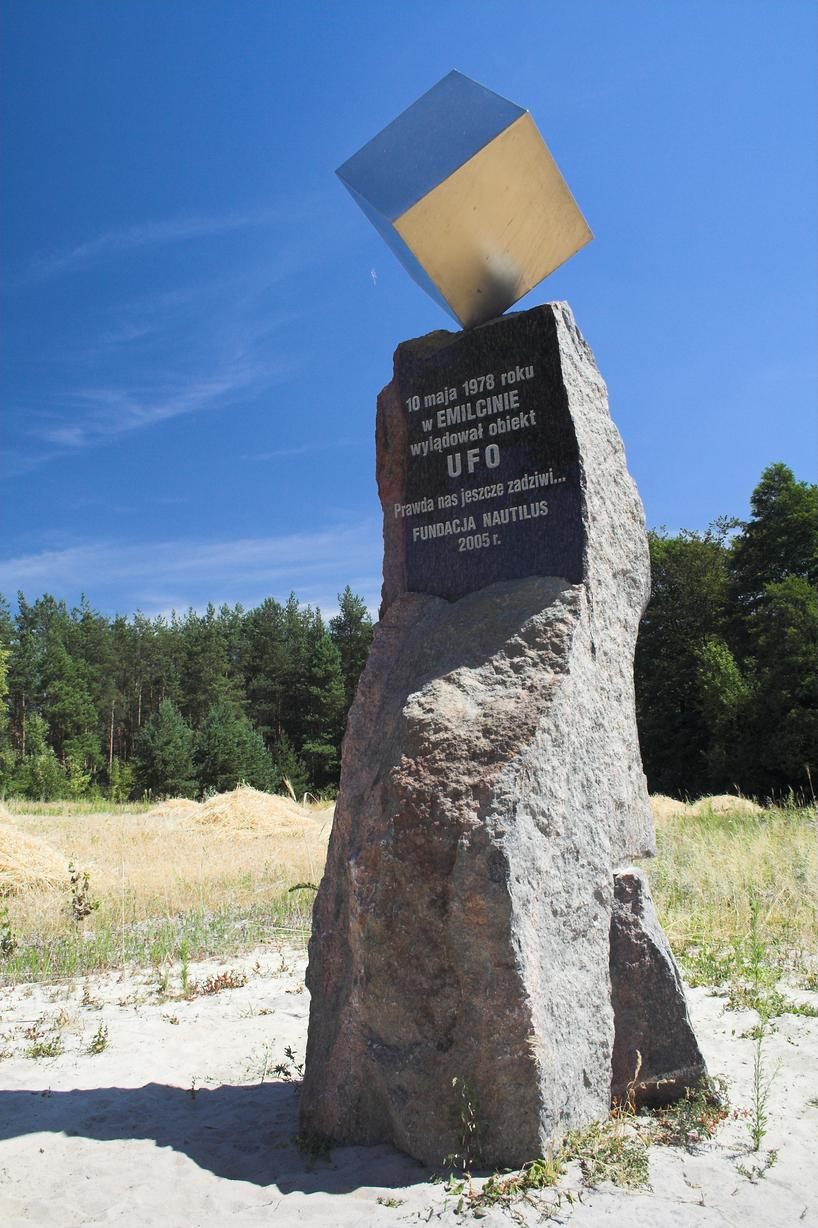
Pictured: the stone-and-steel UFO memorial erected near Emilcin in 2005 by the Nautilus Foundation, at the site traditionally identified as Wolski's landing clearing — not a photograph of the 1978 encounter itself or of Wolski, since no verified photograph of either is known to survive in the public record. This is the closest genuinely case-specific, freely licensed image available: a real photograph of the actual physical monument marking the actual site, rather than a generic stock illustration.
Theoretical Alignment
Emilcin sits at an unusual intersection for this catalogue: a narrative rich in the classic morphology of the 1970s "abduction" wave (small humanoids, a disc-examination procedure, missing time, a food offering) delivered by a single, elderly, uncorroborated witness, investigated with a rigor that is itself part of the story. The modest ETH figure reflects the internal consistency and physiological detail of Wolski's account and the genuine effort the University of Łódź team made to rule out lying, delusion, and obvious suggestibility. The comparatively high Psycho-Social figure is the more decisive number in this file: it reflects not that Wolski was hysterical or part of a crowd event, but that the case's own lead investigator, Zbigniew Blania-Bolnar, later admitted deliberately seeding false confirmatory details into interviews as an authenticity "trap," that a subsequent researcher's audio analysis suggested leading questions shaped at least one corroborating child's testimony, and that a serious, if unproven, hypnotic-implantation hoax allegation surfaced in 2012–13 naming a specific rival investigator. None of this proves fabrication — but it means the psycho-social contamination pathway is substantially more evidenced here than in most cases this site rates higher.
Background
Jan Wolski was born May 29, 1907, and by 1978 had spent his entire life as a farmer in the countryside around Emilcin, a small village in the Gmina Opole Lubelskie district of the Lublin Voivodeship in eastern Poland, roughly 40 kilometers west of the regional capital, Lublin. He was, on the morning of May 10, 1978, seventy years old — nineteen days short of his seventy-first birthday, though many later English-language retellings round him up to "71" at the time of the encounter, a small but recurring discrepancy in the case's popular literature. Poland in 1978 was a communist state under Edward Gierek's government, more than a decade before the fall of the Iron Curtain; UFO research existed there only as an informal, largely amateur pursuit conducted by a handful of enthusiasts, without the institutional government backing enjoyed by contemporaries like France's GEPAN or even the residual public memory of the U.S. Air Force's Project Blue Book. Rural communities like Emilcin's were also thoroughly Catholic and socially conservative, a context that shaped how neighbors initially reacted to Wolski's story — with a mixture of ridicule, gossip, and, notably, an unwillingness by many to dismiss him outright given his known sobriety and lack of any history of exaggeration.
Wolski rose before dawn on May 10, as was his habit, and left his farm at approximately 5:00 AM with a horse and cart, reportedly to graze or breed his mare in a nearby pasture. He returned along a dirt track through wooded countryside a little over two hours later. It was on this return trip — not, as some retellings imply, on an unusual errand — that he reported his encounter. What makes Emilcin distinct within this catalogue is not the initial event but everything that followed: within roughly two weeks, word of Wolski's story reached amateur ufologist Witold Wawrzonek, and soon afterward, sociologist Zbigniew Blania-Bolnar of Łódź, who assembled a multidisciplinary panel from the University of Łódź to formally evaluate the witness — an investigative response with no real parallel elsewhere in Cold War-era Eastern Bloc ufology, and the central reason this obscure rural encounter became, and remains, Poland's single most discussed UFO case.
Complete Timeline
| Date | Event |
|---|---|
| May 29, 1907 | Jan Wolski is born in the Emilcin area, Lublin region, then part of the Russian Empire's Congress Poland. |
| May 10, 1978 — ~5:00 AM | Wolski departs his farm by horse-drawn cart to graze or breed his mare, as was his habit. |
| May 10, 1978 — ~7:20 AM | Returning home along a forest track near Emilcin, Wolski reports encountering two small, green-faced humanoid beings roughly 120 feet away in a meadow. |
| May 10, 1978 — ~7:30 AM | The beings allegedly board Wolski's cart and direct him to a nearby clearing, where he observes a large, white, hovering craft; he says he was led or lifted aboard and examined. |
| May 10, 1978 — ~8:00 AM | Roughly three-quarters of a mile away, six-year-old Adaś Popiołek and his younger sister report seeing an aerial object; their mother reports hearing an unusual, loud, ground-level noise. |
| May 10, 1978 — ~7:50 AM | Wolski arrives home and reports the encounter to his wife, then to neighbors; his sons and neighbors later visit the clearing and report finding trapezoidal footprint impressions, disturbed corn stalks, and small holes in the soil. |
| Mid-May 1978 | Local militia lieutenant Stanisław Plis investigates and publicly concludes that Wolski "fell asleep and dreamed everything," after complaints reach school and local officials about the story's spread. |
| ~May 26, 1978 | Amateur ufologist Witold Wawrzonek becomes the first researcher to interview Wolski directly. |
| Late May–June 1978 | Sociologist Zbigniew Blania-Bolnar learns of the case and travels to Emilcin, beginning what becomes an extended investigation involving repeat visits and interviews. |
| 1978 | Blania-Bolnar assembles a multidisciplinary team from the University of Łódź, including psychologist Dr. Ryszard Kietliński and psychiatrist Dr. Ryszard Krasilewicz, to formally test and evaluate Wolski; the initial phase of research reportedly totals more than 500 hours. |
| July 1978 | Journalists Krystyna Adamska and Henryk Pomorski conduct and tape-record an extensive interview with Wolski, later becoming a key primary source for the case. |
| 1978 | Wolski's account is dramatized in the Polish comic book Przybysze ("The Visitors"), illustrated by Grzegorz Rosiński, and he appears on Polish television to discuss the case, expanding its public reach within Poland. |
| 1978 (later) | The University of Łódź team concludes its assessment, judging Wolski's "objective reality" hypothesis (that something genuinely anomalous occurred) far more probable than deliberate hoax, hallucination, or dream, while stopping short of endorsing any specific extraterrestrial explanation. |
| 1978 | Blania-Bolnar publishes his account of the case in book form as Zdarzenie w Emilcinie ("The Event in Emilcin"), which remains the single richest primary documentary source on the investigation. |
| January 8, 1990 | Jan Wolski dies, months after the fall of the Berlin Wall and shortly before Poland's own post-communist transition is complete, having maintained his account until the end of his life. |
| Autumn 2003 | Zbigniew Blania-Bolnar dies, leaving behind a personal research archive that later becomes central to a posthumous reinterpretation of the case. |
| October 15, 2005 | The Warsaw-based Nautilus Foundation unveils a memorial at the alleged encounter site — a stone marker with a suspended steel cube — reportedly the first monument in the world dedicated specifically to an alleged alien abduction. |
| 2012–2013 | Publicist Bartosz Rdułtowski, reviewing Blania-Bolnar's posthumous archive, publicly alleges the case was an elaborate hoax orchestrated by rival ufologist Witold Wawrzonek, who allegedly hypnotized Wolski and implanted false memories as an act of professional revenge; the claim remains unproven and contested. |
| May 10, 2023 | The 45th anniversary of the encounter draws renewed Polish regional media coverage revisiting the case and its unresolved status. |
The Encounter: A Meeting on a Forest Road
According to Wolski's own account — first given informally to neighbors within hours of the event, then in progressively greater detail to Witold Wawrzonek later that month and to journalists Krystyna Adamska and Henryk Pomorski that July — he was returning home by horse-drawn cart along a dirt forest road a little after 7:00 AM when he spotted two short figures standing in a meadow roughly 120 feet away. He described them as approximately five feet tall, with olive-green skin, high, prominent cheekbones, slanted, entirely dark eyes without visible whites, small vertical slits in place of a conventional nose, and thin, lipless mouths. Their hands were slender and green, with webbed membranes between the fingers; their legs appeared unusually long and curved. Both wore tight, one-piece suits — described variously as black or dark grey, elasticized, and covering the entire body except the face and hands — with a distinctive raised "hump" at the shoulders or upper back.
Wolski said the two beings approached the cart calmly and, without any apparent hostility or urgency, climbed aboard and sat beside him. He recalled that they spoke to each other, not to him, in short, rapid words in a language he did not recognize and could not identify with any known tongue. Wolski later told interviewers he felt no fear during this initial contact — a detail investigators found notable, since genuine terror is a common feature of many contemporaneous encounter reports, and its absence here became one of several data points the University of Łódź team weighed when assessing his emotional and psychological state. Guided by gestures rather than words, Wolski drove the cart to a nearby clearing, where he says he first saw the object: a large, entirely white, seamless craft hovering an estimated one to five meters above the ground (accounts vary on the exact height), oblong in shape and, in Wolski's own comparison, "as long as a bus." He described four black, rod-like protrusions at its corners, spinning continuously and emitting both a faint humming sound and, by some retellings, subtle colored light effects. He specifically recalled that the craft did not cast a shadow on the trees behind it — an anomalous detail he volunteered unprompted in multiple later interviews, according to Blania-Bolnar's own notes.
Aboard the Craft
Wolski said the craft's exterior appeared seamless, as though machined or cast from a single piece of pale, nickel-like material, with no visible windows, doors, rivets, or exhaust ports. Access came via a small lift or platform, lowered on thin cables, which carried him up into the object. Inside, he described a cramped, low-ceilinged chamber with black, glass-like walls that felt denser and colder to the touch than ordinary glass, illuminated by a diffuse light source he could not identify. Single-person benches lined the walls, fastened with dark cables, and two black tubes ran horizontally between opposite walls. Most disquietingly, Wolski reported roughly ten black birds — crows or rooks, by his description — lying motionless but apparently alive on the floor near the entrance, which he interpreted as somehow paralyzed or restrained rather than dead.
Two additional beings, matching the description of the first pair, waited inside. One offered Wolski a food item he described as resembling a small icicle or, in some retellings, something sweet like honey in solid form; he declined it. The beings then indicated, partly through gesture, that he should undress; one assisted him in removing his outer clothing before signaling that he should remove the rest as well — a request Wolski said was accompanied by an expression he could only describe as something between a smile and a grimace. The examination itself involved two grey, disc-shaped instruments fitted with suction-like pads, which the beings passed over his body — front, back, and both sides — producing a low, dull humming vibration as they moved. He recalled the beings showing particular, repeated interest in his leather trouser belt, unbuckling and rebuckling it several times, and performing what he described as a brief, cursory examination of his mouth. One being periodically inserted a small black rod into a socket in the wall, turning it "like a key in a lock," for reasons Wolski could not explain. Throughout the encounter he noted the cabin felt noticeably warmer than the cool outside air, and that a strong, sulfur-like odor filled the chamber — a smell he said clung to his coat for roughly two days afterward, though, like the footprints outside, the coat itself was never independently tested or preserved. After the examination concluded and Wolski dressed again, the beings offered him the unfamiliar food a second time; he again declined, and was escorted, without incident, back down to the ground. He estimated the entire episode lasted about twelve minutes, though Blania-Bolnar and later researchers, noting how much grass Wolski's mare appeared to have grazed while tethered and waiting, speculated the true elapsed time may have run considerably longer — potentially as much as two hours — raising the possibility of missing time Wolski himself never consciously reported.
Immediate Aftermath and the Distant Corroborating Sighting
Wolski arrived home by approximately 7:50 AM and told his wife what had happened almost immediately, then, over the following hours and days, neighbors and eventually the wider village. Independently, and roughly three-quarters of a mile to the west, six-year-old Adaś Popiołek and his younger sister reported seeing an aerial object at around 8:00 AM — consistent in rough timing with Wolski's account, though the siblings' own descriptions (a bus-like craft at roughly barn height, with what Adaś described as a single window and a "pilot" in a dark grey outfit with a green face) emerged only in later interviews, after the case had already attracted local and then national attention, a sequencing that skeptics have specifically flagged as a plausible vector for suggestion. Their mother separately reported hearing an unusual, loud noise around the same time, which she described as seeming to come from ground level rather than the sky. None of the Popiołek family reported any direct contact with the beings or the craft; their account, while broadly consistent with an object having been present in the area that morning, corroborates only that something unusual may have occurred nearby, not any specific detail of Wolski's own experience aboard the craft.
When Wolski's sons and several neighbors visited the clearing later that day, they reported finding several trapezoidal, near-rectangular impressions in the ground — slightly larger than an ordinary human footprint, with a convex sole pressed roughly an inch into the soil — along with uprooted corn stalks, small holes consistent with soil sampling, and a small cluster of black feathers, all reportedly of uniform length. Word of the story spread quickly through the close-knit rural community and, within days, drew a stream of curious visitors, journalists, and eventually local police to the site — a crowd that, by every subsequent account, trampled and destroyed whatever physical trace evidence had existed before anyone thought to cast, photograph, or systematically measure it. This loss is one of the case's most consequential and avoidable failures: even a modest, contemporaneous forensic effort might have settled at least some of the physical questions the case has debated for decades since.
Local Officialdom's First Response
The earliest formal investigation came not from ufologists but from the local militia (police). Lieutenant Stanisław Plis examined the matter after complaints reached school and local officials about the story circulating among children and villagers, and concluded, in terms that have been quoted in nearly every subsequent account of the case, that "the grandfather fell asleep and dreamed everything." This dismissal reflected the reflexive skepticism of a communist-era local bureaucracy more concerned with containing an embarrassing rumor than investigating it, and it was offered without any of the psychological or medical evaluation the University of Łódź team would later apply. Plis's verdict nonetheless represents the single earliest documented conventional-explanation hypothesis in the case's history, and its casual, unsupported nature is itself a useful baseline against which to measure how much more seriously Blania-Bolnar's team would go on to take the same witness only weeks later.
Zbigniew Blania-Bolnar and the University of Łódź Investigation
What separates Emilcin from the great majority of single-witness Eastern Bloc UFO reports is the response of Zbigniew Blania-Bolnar, a sociologist based in Łódź who had already built a modest reputation as an independent UFO researcher by the late 1970s. After learning of Wolski's story — by most accounts through the earlier interview conducted by Witold Wawrzonek — Blania-Bolnar traveled to Emilcin and, rather than simply collecting a statement and moving on, committed to an extended investigation. He assembled a genuinely multidisciplinary panel drawn substantially from the University of Łódź, including psychologist Dr. Ryszard Kietliński, who had trained at the University of Poznań and worked at the Educational-Vocational Counseling Center in Łódź and the Psychometric Workshop of the Polish Academy of Sciences before joining the University of Łódź's Institute of Sociology, and psychiatrist Dr. Ryszard Krasilewicz, whose clinical opinion on Wolski's mental state became one of the investigation's most-cited findings. Reports of the initial research phase alone total more than 500 hours of combined work — an extraordinary commitment of professional time to a single rural witness, and one with essentially no parallel among contemporary Eastern Bloc UFO investigations, most of which amounted to little more than a newspaper reporter's afternoon visit.
The Testing Protocol
The University of Łódź team's evaluation battery, as later described by Blania-Bolnar and by researchers who reviewed his archive, included a Wechsler intelligence-scale administration to establish Wolski's baseline cognitive functioning; a Thematic Apperception Test, a projective psychological instrument used to probe underlying thought patterns and detect tendencies toward fantasy or confabulation; psychogalvanometric measurement — essentially a polygraph-style skin-conductance protocol — applied during repeated cross-examination sessions; an ophthalmological examination to verify normal visual function; and a general clinical physical checkup assessing his overall health, reflexes, and sensory faculties for a man of his age. Beyond the formal testing, the team conducted extensive background verification within the community, interviewing neighbors, family, and local clergy about Wolski's reputation, habits, and history — efforts that consistently reported he had never been seen drunk, did not smoke, had no record of exaggeration or dishonesty, and was regarded as a devout, reliable member of the community.
Findings
The team's conclusions, as reported by multiple secondary sources drawing on Blania-Bolnar's own published account, were emphatic in Wolski's favor on the specific, narrow question of sincerity: he showed, in their assessment, "no ability whatsoever to invent stories," was rated an honest, decent, and fundamentally truthful person, and demonstrated normal sight, hearing, and reflexes along with a general resistance to suggestion. Dr. Kietliński is quoted, in the documentary record later produced about the case, as concluding plainly that "Wolski is telling the truth — or, at the very least, Wolski believed he was telling the truth as he understood it," a carefully hedged formulation that already anticipates the difference between sincerity and objective accuracy. Dr. Krasilewicz's separate psychiatric opinion held that Wolski showed no signs of mental illness and that his account "cannot be called delusions." Taken together, the team reportedly rated the "objective reality" hypothesis — that something genuinely anomalous had occurred, whatever its ultimate nature — at somewhere between 90 and 98 percent probability relative to the alternative explanations of deliberate hoax, hallucination, or ordinary dream, according to figures attributed to the investigation in several secondary accounts of Blania-Bolnar's findings.
It is important to be precise about what this actually established and what it did not. A rigorous psychological and psychiatric clearance of a witness as sincere, sane, and not unusually suggestible is a genuinely meaningful finding — it rules out several common, mundane explanations for fabricated testimony. It is not, however, equivalent to independent verification that the events described actually occurred as reported, and the University of Łódź team never claimed otherwise; their own "objective reality" language was explicitly a statement about the witness's own sincerity and mental state, not a scientific finding about extraterrestrial visitation. That distinction, often blurred in the case's popular retellings, is central to why this file treats Emilcin as disputed rather than credible: an unusually well-tested witness is still, in the end, a single uncorroborated witness describing an event with no independent physical confirmation.
The Investigative Gaps and Methodological Criticism
Even setting aside the later hoax controversy, the University of Łódź investigation has drawn specific, substantive methodological criticism over the decades. Former militia officer Krzysztof Drozd has pointed out that Blania-Bolnar's team never appears to have rigorously obtained and checked flight logs from military airbases in the wider region to rule out a mundane aircraft or helicopter as the stimulus — a basic step that, decades on, still cannot be independently verified either way. More seriously, Blania-Bolnar himself later acknowledged deliberately introducing specific false details into some interviews and public statements — notably claims about webbed fingers and red circular markings on the beings' chests — as a kind of authenticity "trap" intended to help identify people fabricating secondhand or copycat sightings by seeing whether those invented details resurfaced in other testimony. Whatever its intent, this practice inevitably muddies the evidentiary record: once an investigator has knowingly planted false details into the public conversation about a case, any subsequent witness statement that happens to include those details becomes impossible to interpret with confidence, and it raises the uncomfortable possibility that some of what reads as corroboration in the case's literature is actually contamination Blania-Bolnar himself introduced. A separate line of criticism, raised later by researcher Bartosz Rdułtowski, holds that audio analysis of interviews with the young Popiołek children suggests Blania-Bolnar's own questioning style was leading — extracting confirmatory answers rather than neutrally recording spontaneous testimony, a criticism that, if accurate, would weaken the independent corroborative value of the case's only other named witnesses.
The 2012–13 Hoax Allegation: Wawrzonek, Hypnosis, and a Researchers' Feud
In 2012 and 2013, publicist Bartosz Rdułtowski, working through Blania-Bolnar's personal archive after the researcher's 2003 death, advanced the case's most dramatic and most contested counter-narrative: that the entire Emilcin story was an elaborate, deliberate hoax, orchestrated not by Wolski himself but by rival ufologist Witold Wawrzonek — the same amateur researcher who had been the first to interview Wolski, weeks before Blania-Bolnar's own involvement began. Rdułtowski's theory held that Wawrzonek and Blania-Bolnar had a prior professional rivalry, possibly stemming from a bet or dispute over whether false memories could be convincingly implanted through hypnosis, and that Wawrzonek — allegedly humiliated after being hypnotized without his full consent on a 1978 television program about UFO sightings — sought revenge by using hypnotic suggestion to implant the entire abduction narrative in the highly suggestible elderly farmer, specifically to discredit Blania-Bolnar's subsequent investigation of it.
The allegation, however dramatic, comes with serious evidentiary problems of its own that this file will not paper over. Wawrzonek's own family has denied he ever formally studied or practiced hypnosis. No independent evidence has surfaced confirming that the specific 1978 television program Rdułtowski describes as the origin of Wawrzonek's grievance ever actually aired. Rdułtowski himself has publicly acknowledged he lacks direct, conclusive proof that hypnosis was used on Wolski at all, presenting the theory as a plausible reconstruction from circumstantial material in Blania-Bolnar's archive rather than a proven fact. In other words, the 2012–13 hoax theory is exactly as unverified, on its own terms, as the abduction claim it seeks to debunk — a genuinely fascinating research thread, and one this file takes seriously enough to document in full, but not a resolved explanation. Rdułtowski's own eventual conclusion, after his research, was notably modest: that the full truth of what happened in Emilcin may simply never be knowable with confidence from the surviving record.
Wolski's Later Life and Death
Jan Wolski never wavered from his account for the remaining twelve years of his life, even as the story brought him a mixture of minor local celebrity and outright mockery — some neighbors and the wider Polish press occasionally suggesting, without evidence, that he had been drinking or was simply confused. In one frequently quoted late reflection on the entire experience, Wolski told an interviewer, with evident weariness: "You should know that I came to the conclusion that I should have kept my mouth shut about it." He died on January 8, 1990, at the age of 82, just weeks after the definitive collapse of Poland's communist government and months after the fall of the Berlin Wall — a political transformation that would, within a few years, make Western-style open UFO research and international attention to cases like his own far more possible than it had ever been during his lifetime. He did not live to see the 2005 memorial built in his honor, nor the renewed international interest the case has attracted in the English-language UFO literature since Poland's accession to the European Union in 2004.
The Memorial and Modern Recognition
On October 15, 2005, the Warsaw-based Nautilus Foundation — a paranormal-research organization founded in 2001 by journalists Joanna Karwat and Robert Bernatowicz, film producer Małgorzata Corvalan, and director Jarosław Żamojda — unveiled a permanent memorial at the site traditionally identified as Wolski's 1978 encounter, consisting of a natural stone boulder with a suspended, balanced steel cube mounted atop it, bearing an inscription that translates roughly as an assertion that the truth of the event will one day be vindicated. Reportedly the first monument built anywhere specifically to commemorate an alleged alien abduction, it has since become a minor destination for UFO researchers and curious travelers passing through the Lublin Voivodeship, and it remains, alongside Blania-Bolnar's 1978 book Zdarzenie w Emilcinie, the case's most visible enduring legacy. The 45th anniversary of the encounter, in May 2023, prompted a fresh round of regional Polish news coverage revisiting the case's still-unresolved status, underscoring that, nearly half a century on, Emilcin remains an open file rather than a closed one — not clearly explained, and not clearly confirmed.
Key Researchers
- Zbigniew Blania-Bolnar (d. 2003) — The Łódź sociologist who led the central investigation, assembled the University of Łódź evaluation team, and published Zdarzenie w Emilcinie (1978), still the richest primary source on the case, while also later admitting to methodological practices that have complicated the record he built.
- Dr. Ryszard Kietliński — University of Łódź psychologist who administered and interpreted the formal psychological testing battery applied to Jan Wolski.
- Dr. Ryszard Krasilewicz — Łódź psychiatrist whose clinical opinion that Wolski showed no signs of mental illness became one of the case's most frequently cited findings.
- Bartosz Rdułtowski — Publicist whose 2012–13 review of Blania-Bolnar's posthumous archive produced both the case's most serious methodological critique and its most dramatic, still-unproven hoax counter-theory.
- Witold Wawrzonek — The first ufologist to interview Wolski in 1978, and later, decades on, the central figure named in Rdułtowski's unproven hoax allegation.
- Krzysztof Drozd — Former militia officer whose later critique specifically identified the failure to check regional military flight logs as an unaddressed investigative gap in the original inquiry.
Cultural Impact
Within Poland, Emilcin occupies roughly the cultural position that Roswell or the Hill abduction hold in American UFO lore: the default reference point any general audience recognizes, regardless of how closely they have followed the case's actual details. It was dramatized in a 1978 comic book, Przybysze, illustrated by Grzegorz Rosiński, brought Wolski himself onto Polish television in the same year, and has been revisited repeatedly by Polish print and broadcast journalism at nearly every significant anniversary since. The 2005 Nautilus Foundation memorial — reportedly the first monument anywhere built specifically to commemorate an alleged alien abduction — has made the otherwise unremarkable village of Emilcin a minor fixture on informal Polish "strange places" tourism itineraries. Internationally, the case remained relatively obscure in English-language UFO literature for decades, a product both of the language barrier and of Poland's isolation behind the Iron Curtain at the time of the original investigation, only gaining wider Western attention gradually after Poland's 2004 European Union accession made Polish-language source material and travel to the site far more accessible to outside researchers and journalists.
Key Witnesses
Jan Wolski
A 70-year-old lifelong farmer with no prior interest in UFOs, no history of alcohol use, and a reputation among neighbors for honesty and sobriety. Reported being approached by two humanoid beings while driving his horse cart on May 10, 1978, and led aboard a hovering craft for an examination lasting an estimated twelve minutes. Underwent hundreds of hours of psychological, psychiatric, and background evaluation by a University of Łódź team, which concluded he was sincere and not clinically suggestible, though it could not independently verify the events themselves. Maintained his account until his death in 1990.
Adaś Popiołek
Reported, along with his younger sister, seeing a bus-like aerial object at roughly barn height around 8:00 AM the same morning, approximately three-quarters of a mile from Wolski's encounter site. Described a single window and a figure with a "green face" aboard the object. His account emerged only in later interviews after the case had already drawn local attention, and researcher Bartosz Rdułtowski has specifically questioned whether Zbigniew Blania-Bolnar's own interview technique shaped his testimony through leading questions.
Zbigniew Blania-Bolnar
A Łódź-based sociologist and independent UFO researcher who assembled the University of Łódź evaluation team and led the case's central investigation, later publishing his findings as Zdarzenie w Emilcinie (1978), the case's richest primary source. He later acknowledged deliberately seeding false confirmatory details into public accounts as an authenticity test, a practice that has drawn methodological criticism for contaminating the case's own evidentiary record. Died in autumn 2003.
Dr. Ryszard Kietliński
Trained at the University of Poznań and later affiliated with the University of Łódź's Institute of Sociology, Kietliński administered psychological testing to Wolski as part of Blania-Bolnar's team and concluded that Wolski showed no symptoms of mental illness, was resistant to suggestion, and was, in his own carefully hedged words, either telling the truth or sincerely believed he was.
Dr. Ryszard Krasilewicz
Provided the case's formal psychiatric opinion, concluding that Wolski showed no signs of mental illness and that his account "cannot be called delusions" — a clinical finding that became one of the investigation's most frequently cited results, though one addressing Wolski's sincerity and sanity rather than the objective truth of his account.
Witold Wawrzonek
The first researcher to interview Wolski, arriving in Emilcin around May 26, 1978, roughly two weeks before Blania-Bolnar's team began its own investigation. Decades later, publicist Bartosz Rdułtowski accused Wawrzonek of having orchestrated the entire episode through hypnotic suggestion as an act of professional revenge against Blania-Bolnar — an allegation Wawrzonek's own family has disputed and that remains unproven.
Bartosz Rdułtowski
Reviewed Zbigniew Blania-Bolnar's personal archive after the sociologist's 2003 death and, in 2012–13, publicly proposed that the Emilcin case was an elaborate hoax involving hypnotic memory implantation orchestrated by Witold Wawrzonek. Also flagged specific methodological problems in Blania-Bolnar's own interview technique, including leading questions with the young Popiołek witnesses. Ultimately concluded the full truth of the case may never be conclusively established.
Lt. Stanisław Plis
Conducted the case's first formal investigation on behalf of local authorities in mid-May 1978 and publicly concluded, without psychological or medical evaluation, that Wolski had "fallen asleep and dreamed everything" — the case's earliest and least rigorously supported conventional-explanation hypothesis.
The Five Observables Assessment
The Five Observables framework, developed by former AATIP director Luis Elizondo, is used to classify UAP encounters by performance characteristics exceeding known technology of their era. Applied to a single-witness narrative account with no instrumented data, the framework can only be assessed from Wolski's own uncorroborated testimony — a significant caveat that applies to every rating below:
Assessment: Anti-Gravity Lift is rated speculative because Wolski described the craft as silently hovering at a fixed altitude with no visible support structure, but he never described any dramatic ascent, descent, or maneuver that would demonstrate an active propulsion mechanism in action — only a static hover, consistent equally with an unremembered mundane support (even a misperceived stationary object) as with anti-gravity technology. Instant Acceleration and Hypersonic Velocity are both rated absent: no witness, including Wolski himself, ever described the craft departing at high speed or maneuvering abruptly; it was simply present, then reportedly gone by the time others arrived at the clearing. Low Observability is rated absent in the classical stealth sense — the object was, if Wolski's account is accurate, brightly visible in daylight to at least two independent parties roughly a mile apart — though this file notes Wolski's specific, unprompted claim that the craft cast no shadow, an anomalous visual detail that does not map cleanly onto any of the five standard categories but is worth flagging for completeness. Trans-Medium travel is rated absent; no transition between air, ground, water, or space was ever reported. Overall, the Five Observables data is thin and entirely testimonial, offering little independent leverage on the case either for or against an exotic technological explanation.
Evidence Assessment
Supporting Anomalous Origin
- A genuinely multidisciplinary team of psychologists, a psychiatrist, and a sociologist from the University of Łódź spent hundreds of hours testing Wolski and found no evidence of delusion, dementia, dishonesty, or unusual suggestibility — a level of contemporary formal scrutiny almost unmatched among Cold War-era single-witness UFO cases.
- Wolski's account remained substantively consistent across multiple retellings over twelve years, up to his death in 1990, without the kind of dramatic embellishment or escalation often associated with deliberate hoaxes.
- Wolski had no discernible motive: he sought no payment, no publicity beyond what came to him unsought, and by his own later words regretted ever having spoken publicly about the experience.
- A second, independent party — the Popiołek family, roughly three-quarters of a mile away — reported an unusual aerial object and an unusual ground-level noise at approximately the same time that morning.
- Physical trace evidence (footprint-like impressions, disturbed vegetation, uniform feathers) was reported by multiple independent neighbors visiting the site shortly after the event, even though it was never properly preserved for testing.
Supporting Conventional Explanation
- The entire narrative rests on one uncorroborated primary witness; no one else claims to have seen the craft's interior, the occupants up close, or the examination procedure Wolski described.
- Lead investigator Zbigniew Blania-Bolnar has admitted deliberately planting false confirmatory details into the public record as an authenticity "trap," meaning the case's own investigative process introduced contamination that cannot be fully untangled from genuine testimony.
- Audio analysis by a later researcher suggests Blania-Bolnar's own interview technique may have used leading questions with the case's only other named witnesses, the young Popiołek children.
- No flight logs from nearby military airbases are known to have ever been rigorously checked to rule out a mundane helicopter or aircraft, despite this being a basic, feasible investigative step.
- All physical trace evidence was destroyed by trampling before any casting, photography, or laboratory testing could occur, leaving nothing today that can be independently examined.
- A specific, if itself unproven, 2012–13 hoax allegation names a plausible suspect (Witold Wawrzonek) and a plausible mechanism (hypnotic suggestion on a suggestible elderly witness) for a deliberately fabricated account.
Why "Disputed"
This file rates the Emilcin case DISPUTED, with a modest credibility score, because it sits at a genuinely unusual crossing point between two facts that pull in opposite directions and neither of which this catalogue will minimize. On one hand, the University of Łódź investigation represents real, substantive contemporary rigor almost never seen applied to a single rural witness anywhere in Cold War-era Eastern Bloc ufology — a multidisciplinary team of credentialed professionals spent hundreds of hours on formal psychological, psychiatric, and background evaluation, and came away persuaded of Wolski's basic sincerity and sound mind. That is a genuinely different, more careful outcome than the reflexive local-police dismissal ("he fell asleep and dreamed it") the case might otherwise have received, and it is why Emilcin deserves serious documentation rather than casual dismissal as tabloid fodder. On the other hand, sincerity is not the same as accuracy, and every other pillar an evidentiary case would need is either missing or actively compromised here: there is exactly one primary witness and no meaningful independent corroboration of what happened inside the craft; no photograph, recording, radar return, or preserved physical sample survives; the lead investigator has admitted deliberately contaminating the public record with false details as a methodological device; a later researcher's audio analysis raises real questions about leading interview techniques with the case's only other named witness; and a specific, serious hoax allegation — itself unproven, but naming a real person and a real, if unconfirmed, motive and mechanism — has sat unresolved in the Polish UFO research community since 2012. A case this thoroughly investigated psychologically, yet this thin on independent physical or corroborating evidence, and carrying this much documented investigator-side contamination of its own record, is precisely what this site's "Disputed" rating exists to describe honestly.
Sensor & Instrumentation Detection Profile
Emilcin is a purely human-observation case with no instrumented data of any kind. There was no radar coverage of the rural clearing, no photograph or film of the object, no audio recording made during the encounter itself, and no contemporaneous law-enforcement report filed in real time — the local militia (police) only became involved after Wolski told neighbors and word spread through the village. The closest thing to instrumentation in the case's documentary record is the University of Łódź team's own testing apparatus, applied not to the object but to the witness: a psychogalvanometer (a polygraph-style skin-conductance device) used during Wolski's cross-examination sessions, alongside standardized psychological instruments (a Wechsler intelligence scale administration and a Thematic Apperception Test) intended to establish his baseline truthfulness and suggestibility rather than to detect the craft itself. A tape-recorded interview conducted in July 1978 by journalists Krystyna Adamska and Henryk Pomorski is the earliest surviving audio record of Wolski's own voice describing the event, though it postdates the encounter itself by roughly two months.
Environmental & Geospatial Context
No formal meteorological station data for the immediate Emilcin area on the morning of May 10, 1978 is known to survive in the public record, and this file will not manufacture a precise reading where none exists. Witness accounts consistently describe a clear, calm early morning with good natural visibility — Wolski had set out from his farm around 5:00 AM to graze or breed his mare and was returning along a dirt forest track by roughly 7:20 AM, well after sunrise at that latitude and time of year. Geospatially, Emilcin sits in the Lublin Voivodeship's Vistula lowlands, a flat, heavily forested and agricultural area roughly 40 km west of Lublin and 6 km east of the town of Opole Lubelskie — rural terrain with scattered woodland clearings of exactly the kind Wolski described, and no major airfield, industrial facility, or population center in the immediate vicinity that would obviously explain an anomalous light or object through routine air or ground traffic. Critics have specifically flagged that no one, at the time or since, appears to have rigorously checked flight logs from the nearest military airbases for helicopter or fixed-wing activity that morning — a genuine, unresolved gap in the environmental record discussed further under the Conventional Explanation Candidates below.
Observer Credibility & Occupational Profile
Jan Wolski was, by every account gathered about him at the time, an unremarkable and unlikely candidate for a hoax: a lifelong subsistence farmer in his early seventies, practicing Catholic, with no history of alcohol abuse, no prior interest in UFOs or the paranormal, and by neighbors' consistent testimony no reputation for storytelling or attention-seeking. That very ordinariness cuts both ways in assessing his credibility. On one hand, the University of Łódź evaluation team — a genuinely multidisciplinary panel including sociologist Zbigniew Blania-Bolnar, psychologist Dr. Ryszard Kietliński, and psychiatrist Dr. Ryszard Krasilewicz — found no clinical evidence of delusion, dementia, confabulation disorder, or heightened suggestibility, and rated his sensory faculties, reflexes, and general physical condition as excellent for his age. On the other hand, Wolski was elderly, alone, had risen before dawn after what may have been a short night's sleep, was not a trained observer of any kind, and gave his most detailed public account only after weeks of repeated interviews and media attention — a combination of factors that, in isolated-witness cases generally, is well-documented to correlate with both genuine anomalous experiences and, separately, with confabulated or externally-shaped memories. The sole other named witness, six-year-old Adaś Popiołek, saw only a distant object from roughly 800 meters away and never claimed any direct encounter, limiting how much independent corroborating weight his account can carry.
Physical & Material Assays
The case's physical evidence record is thin and, critically, was never properly preserved. Wolski's sons and neighbors reported finding several trapezoidal or near-rectangular footprint-like impressions at the site — pressed roughly an inch into the soil, described as slightly larger than a human footprint with a convex sole — along with disturbed, uprooted corn stalks, small holes suggested to be soil-sampling marks, and a cluster of black feathers of uniform length. None of this was cast in plaster, systematically measured, or photographed before the clearing was overrun by curious visitors, journalists, and eventually local police, who by most accounts trampled whatever evidence existed beyond any useful analysis. No physical sample — soil, vegetation, feather, or otherwise — from the Emilcin site is known to have survived in any laboratory or archive today. This is a significant and honest gap: unlike cases such as Trans-en-Provence or Rendlesham Forest, where imperfect but real physical trace samples were collected and later re-examined, Emilcin's physical record exists only in secondhand written and verbal descriptions from 1978, making independent forensic verification permanently impossible.
Historical Precedents & Archive Matches
Emilcin arrived in the middle of a wider mid-to-late-1970s wave of close encounter and abduction reports across both sides of the Iron Curtain — a period that includes the Travis Walton case in Arizona (November 1975) and, closer to Poland geographically and chronologically, the September 1977 Petrozavodsk Phenomenon in the Soviet Union, a mass sighting event over the Karelian capital that briefly made "UFO" a permissible subject in the Soviet press. Poland's own domestic UFO research culture was younger and more improvised than its Western counterparts — there was no Polish equivalent of NICAP or GEPAN with institutional government backing — which makes the University of Łódź team's decision to apply formal psychological and psychiatric testing methodology to a rural witness genuinely unusual for the region and era, closer in spirit to the multi-witness polygraph protocol later used in the Travis Walton case than to the ad hoc newspaper-driven investigations typical of contemporary Eastern Bloc UFO reports. The case's humanoid morphology — small stature, large dark eyes, minimal facial features, one-piece suits — also sits within the broader "Gray" and quasi-Gray entity typology reported across dozens of 1960s–1980s Western cases, from Betty and Barney Hill (1961) through Pascagoula (1973), lending it a certain narrative familiarity that skeptics have cited as evidence of cultural cross-contamination via Western media reaching behind the Iron Curtain, and that proponents have cited as evidence of a genuinely consistent phenomenon independent of geography or political system.
Material Analysis
No physical material connected to the Emilcin encounter has survived for modern testing of any kind — a genuinely significant gap this file states plainly rather than working around. The trapezoidal footprint-like impressions, disturbed corn stalks, small soil holes, and uniform black feathers that Wolski's sons and neighbors reported finding at the clearing shortly after the event were never cast in plaster, systematically measured, or photographed before the site was overrun by curious visitors, journalists, and eventually local police, all of whom, by every subsequent account, trampled the ground beyond any useful forensic examination. Wolski's own description of a sulfur-like odor lingering on his coat for roughly two days is similarly unverifiable today; the garment itself was never submitted for chemical analysis. No soil sample, vegetation sample, or feather from the site exists in any known laboratory or archive. This stands in sharp contrast to cases this catalogue rates more highly on physical grounds, where at least some trace material was properly collected and has remained available for repeated, independent re-examination using improving analytical techniques over the decades since.
Supporting a Genuinely Unusual Stimulus
- Multiple independent neighbors, not just Wolski himself, reported observing the footprint-like impressions and disturbed vegetation at the site shortly after the event, suggesting something physically unusual was present even if its ultimate nature cannot now be determined.
- The described footprint morphology — trapezoidal, convex-soled, larger than an ordinary human print — does not obviously match any commonly proposed mundane source that has been specifically documented for this site.
Supporting a Mundane or Unverifiable Origin
- No sample of any kind was preserved for laboratory testing, meaning no modern analytical technique can be applied to confirm or rule out any explanation for the physical traces reported.
- The site's rapid contamination by dozens of visitors within days of the event means even secondhand descriptions of the "evidence" may already reflect trampling and disturbance unrelated to the original event.
- No comparably documented physical evidence exists for the craft itself; every claim about its material, propulsion, or interior rests entirely on one witness's uncorroborated verbal testimony.
The Conventional Explanation Candidate: Confabulation, Suggestion & Investigator Contamination
The most parsimonious conventional explanation for Emilcin does not require Jan Wolski to have lied. It holds instead that an elderly man, alone before dawn after a short night's sleep, experienced a genuine but ordinary perceptual event — a misperceived aircraft, an unusual light, or even a period of microsleep or dream-like confusion while driving a slow, familiar route — and that the richly detailed abduction narrative later associated with his name was substantially elaborated afterward through the normal, well-documented psychological process of memory reconstruction under repeated interview, compounded here by an investigator, Zbigniew Blania-Bolnar, who has himself admitted deliberately introducing false confirmatory details into the public conversation about the case as a methodological device. This candidate deserves serious weight precisely because it does not require any dishonesty from Wolski himself — consistent with the University of Łódź team's own finding that he was sincere — while still accounting for the internal consistency, the escalating detail across successive retellings, and the troubling presence of investigator-introduced contamination that makes parts of the record impossible to fully trust.
The 2012–13 Hoax and Hypnotic-Implantation Theory
Publicist Bartosz Rdułtowski's alternative theory — that rival ufologist Witold Wawrzonek deliberately hypnotized Wolski and implanted the entire narrative as an act of professional revenge against Blania-Bolnar — is the case's most dramatic proposed conventional explanation, and the one that, if proven, would most decisively resolve the case as a fabrication. It deserves inclusion here because it is a specific, falsifiable claim naming a real person and a real (if unconfirmed) motive, not vague hand-waving. It falls short of a fully established explanation for exactly the same reason the abduction claim itself does: no direct, conclusive evidence has been produced that Wawrzonek possessed hypnosis training, that the television program said to have motivated his alleged revenge ever aired, or that any hypnotic session with Wolski ever actually took place. Rdułtowski's own final assessment — that the complete truth may never be knowable — is itself an implicit admission that this candidate remains unproven rather than demonstrated.
Aircraft or Helicopter Misidentification
Local officials in 1978 and the general press both floated the possibility that Wolski, and separately the Popiołek children, had misidentified a military or civilian helicopter or aircraft operating in the area that morning. Blania-Bolnar's own investigation reportedly found no record of helicopter flights over the area that day, but critics, including former militia officer Krzysztof Drozd, have specifically noted that this claim was never rigorously verified against actual regional airbase flight logs — meaning the aircraft-misidentification candidate has neither been confirmed nor genuinely ruled out by any documented, checkable record, more than four and a half decades later.
Simple Dream or Microsleep
The case's very first official explanation, offered by local militia lieutenant Stanisław Plis within days of the event, was the simplest possible: that Wolski, riding alone in a slow-moving cart before dawn, briefly fell asleep and dreamed the entire encounter. This candidate is difficult to reconcile with the University of Łódź team's finding of Wolski's excellent baseline physical and cognitive health for his age, and it does not account for the independent, roughly contemporaneous sighting reported by the Popiołek family nearly a mile away — though it remains, in its favor, the explanation requiring the fewest additional assumptions about deliberate deception or elaborate hypnotic manipulation by any third party.
Confabulation, Suggestion & Investigator Contamination
PlausibleBest fits the documented methodological problems in the case's own record.
The 2012–13 Hoax and Hypnotic-Implantation Theory
InconclusiveA specific, serious allegation, but unproven.
Aircraft or Helicopter Misidentification
InconclusiveNever rigorously checked either way.
Simple Dream or Microsleep
Implausible (As a Complete Explanation)Does not account for the independent distant sighting.
Related Cases
Confirmed Documents & Official Records
Poland's national archive of Communist-era security service (SB) and state records. No IPN file specifically referencing the Emilcin case or its 1978 local militia investigation is known to have been publicly identified or released to date; researchers with Polish-language access may search directly here.
UNCLASSIFIED (public search)The CIA's full declassified UFO document collection, including Cold War-era reports on sightings behind the Iron Curtain generally; no document specifically referencing Emilcin or Jan Wolski by name has been identified, but the collection remains the standard first stop for any U.S. intelligence angle on Eastern Bloc UFO activity in this period.
UNCLASSIFIED (declassified)Search Government Archives Directly
Further Reading — Recommended Literature
The UFO Encyclopedia, 4th Edition
The definitive UFO reference work, situating Emilcin within the broader international context of 1970s abduction-era encounters and Cold War-era Eastern Bloc ufology.
UFO's From Behind the Iron Curtain
The earliest English-language survey of UFO reports from Poland, the USSR, and other Eastern Bloc states, establishing the reporting culture and institutional vacuum Blania-Bolnar's team operated within just a few years before Emilcin.
The Soviet UFO Files: Paranormal Encounters Behind the Iron Curtain
A detailed account of Cold War-era UFO reporting and official secrecy across the Soviet bloc, useful regional and political context for understanding why a case like Emilcin received no state institutional investigation of the kind Western cases sometimes did.
Passport to Magonia: On UFOs, Folklore, and Parallel Worlds
Vallée's landmark study connecting modern humanoid-encounter reports to older folkloric traditions, directly relevant to assessing how much of Emilcin's entity and craft imagery reflects a genuinely independent report versus culturally transmitted narrative patterns.
The Abduction Enigma
A critical examination of the alien-abduction phenomenon, including the role of hypnosis, suggestion, and memory reconstruction in shaping abduction narratives — directly relevant to evaluating both Wolski's testimony and the 2012–13 hypnotic-implantation hoax theory.
Essential Viewing
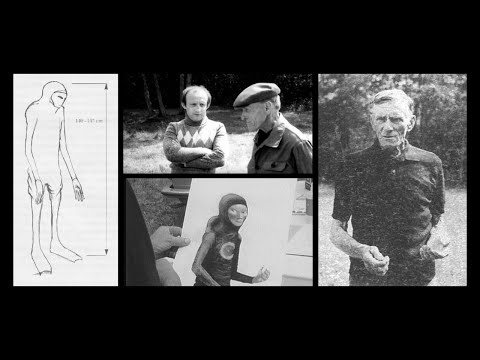
The Emilcin, Poland, UFO Encounter (Eyes On Cinema)
A detailed narrated overview of Wolski's account, the University of Łódź investigation, and the case's place in Cold War-era Eastern Bloc UFO history, from a reputable long-form UFO documentary channel.
Czy ktoś zmanipulował świadka UFO? (National Geographic Poland)
National Geographic's Polish edition examines whether the Emilcin witness was manipulated, weighing the University of Łódź findings against the later hoax and suggestion theories.
Emilcin: Największe UFO oszustwo PRL? (naTemat / Biuro Tajemnic #16)
An investigative segment from established Polish news outlet naTemat's "Biuro Tajemnic" series, directly examining the 2012–13 hoax allegation against the case.

Czy Jan Wolski spotkał kosmitów? Emilcin zbadany "do dna" (Sekielski Brothers Studio)
An in-depth investigative documentary from the studio of noted Polish journalist Tomasz Sekielski, examining the case "to the bottom" — including the original investigation and its later controversies.
Sources
- "Emilcin Abduction," Wikipedia (English). en.wikipedia.org
- "UFO w Emilcinie," Wikipedia (Polish). pl.wikipedia.org
- "Emilcin," Wikipedia (village entry, administrative details). en.wikipedia.org
- "UFO sightings in Poland," Wikipedia. en.wikipedia.org
- Openminds.tv. "Poland's first abduction case is monumental." openminds.tv
- UFO Insight. "Jan Wolski And The Emilcin Alien Encounter." ufoinsight.com
- My Dark Path. "In 1978 a Polish farmer claimed to have been taken aboard an alien spacecraft — examined by aliens." mydarkpath.com
- Astonishing Legends. "Emilcin Abduction." astonishinglegends.com
- CiekawostkiHistoryczne.pl. "Emilcin: hipnoza i fałszywi kosmici. Czy w 'polskim Roswell' doszło do oszustwa?" (2021). ciekawostkihistoryczne.pl
- historia.dorzeczy.pl. "UFO w Polsce? UFO w Emilcinie — Wolski i kosmici." historia.dorzeczy.pl
- Atlas Obscura. "Emilcin UFO Memorial in Opole Lubelskie County." atlasobscura.com
- How and Why's. "Green Aliens Welcomed Polish Farmer On Their Spacecraft And Offered Him Honey-Like Food In 1978." howandwhys.com
- Latest UFO Sightings. "The Emilcin, Poland, UFO encounter and alien abduction of farmer Jan Wolski." latest-ufo-sightings.net
- Cryptid Wiki (Fandom). "Emilcin Aliens." cryptidz.fandom.com
- 3 Seas Europe. "The Polish Monument Marking a UFO Landing." 3seaseurope.com
- Wikimedia Commons. "File:Emilcin-pomnik.jpg" (memorial photograph, CC BY-SA 2.5, photographer "Lukke"). commons.wikimedia.org
- Wikimedia Commons. "Category:Emilcin UFO memorial." commons.wikimedia.org
- Institute of National Remembrance (IPN). Official archival search portal. ipn.gov.pl
- CIA FOIA Electronic Reading Room. "UFOs: Fact or Fiction?" collection. cia.gov
- YouTube (Eyes On Cinema). "The Emilcin, Poland, UFO encounter and alien abduction of farmer Jan Wolski, May 10, 1978." youtube.com
- YouTube (National Geographic Poland). "Czy ktoś zmanipulował świadka UFO? 'Takiej historii nie da się łatwo zmyślić.'" youtube.com
- YouTube (naTemat / Biuro Tajemnic). "Emilcin: Największe UFO oszustwo PRL? Prawda wychodzi na jaw!" youtube.com
- YouTube (Sekielski Brothers Studio). "Czy Jan Wolski spotkał kosmitów? Emilcin zbadany 'do dna'." youtube.com
- Amazon.com. Blania-Bolnar, Zbigniew. Zdarzenie w Emilcinie (Warsaw: Krajowa Agencja Wydawnicza, 1978) — original Polish-language primary source publication, cited via secondary English-language summaries where a direct translation is unavailable.
- Clark, Jerome. The UFO Encyclopedia, 4th Edition, Visible Ink Press, 2023 (general reference for European abduction-era cases and Cold War-era UFO research culture).
- Hobana, Ion & Weverbergh, Julien. UFO's From Behind the Iron Curtain, Souvenir Press, 1974 (context on Eastern Bloc UFO reporting culture predating Emilcin).
See something inaccurate? Have additional information or sources?
Suggest an Edit →Last Updated: August 2026