
The Father Gill Sighting
On the evening of June 26, 1959, Anglican missionary Reverend William Booth Gill and a crowd of mission staff, teachers, and villagers at the Boianai mission station on the northern coast of Papua's Milne Bay watched a large disc-shaped craft with a raised upper deck descend out of the evening sky and hover for nearly four hours, its deck occupied by what appeared to be four human-like figures moving purposefully about their business. When Gill raised his arm and waved, one of the figures did the same; when mission teacher Ananias Rarata waved both arms overhead, two of the figures reciprocated, and for several minutes witnesses and occupants appeared to exchange gestures across several hundred feet of open air. The object returned the following evening with several companion craft, and a written statement describing the encounter was ultimately signed by twenty-five observers, with secondary accounts placing as many as thirty-eight people present at various points across the two nights. Investigated six months later by the Royal Australian Air Force, revisited in person in 1973 by astronomer J. Allen Hynek, and repeatedly named by working ufologists as among the single most persuasive UFO reports on record, the Boianai sightings remain, more than six decades on, one of the most heavily documented multiple-witness close encounters ever recorded — and one that has never been definitively explained.
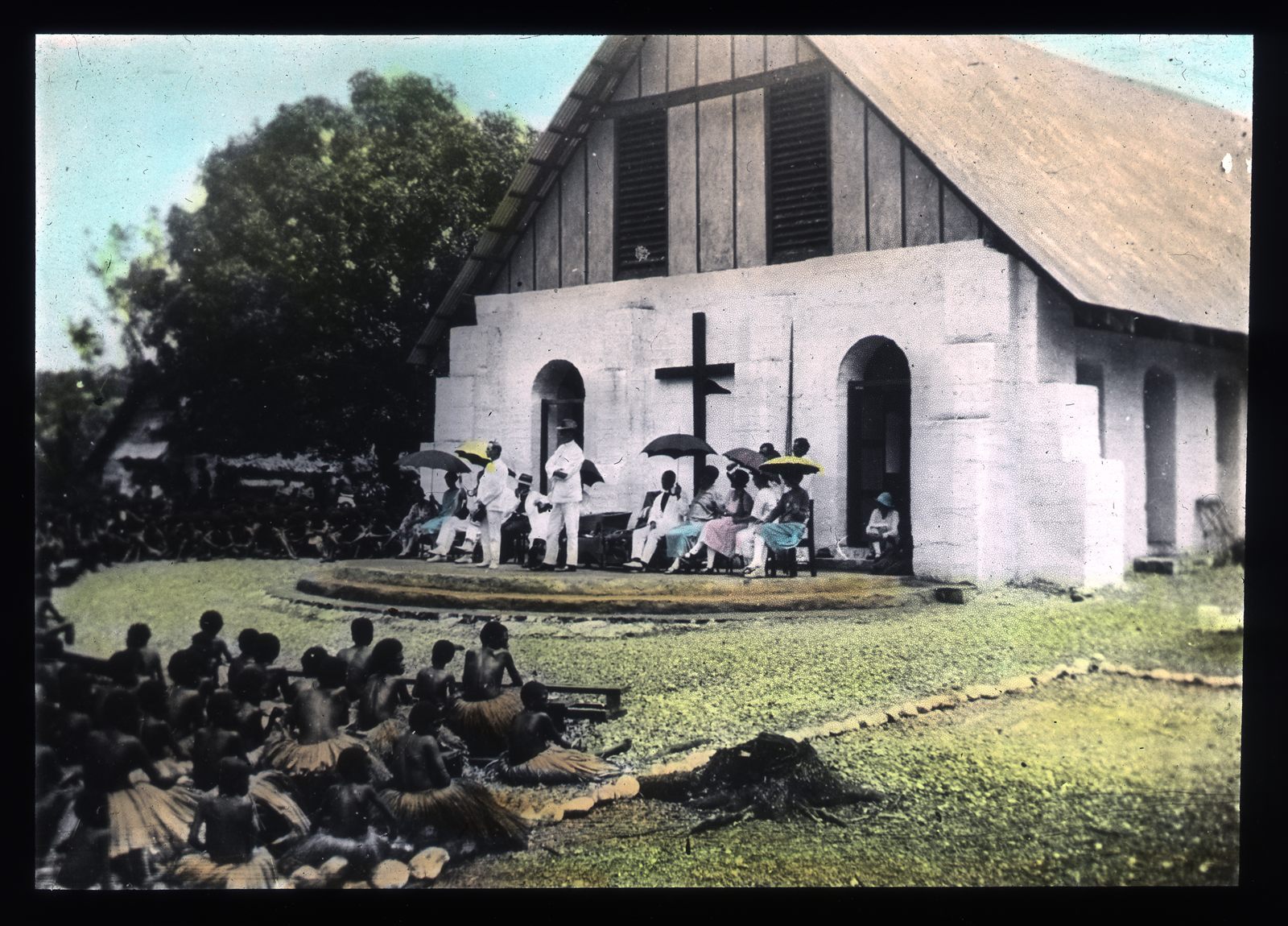
Pictured: All Saints Church at the Boianai Mission Station, Milne Bay Province, Papua New Guinea — the actual mission where the sightings took place, photographed in the early 20th century (Williamson Collection, University of Newcastle, Australia, public domain), decades before the 1959 encounter. No photograph of the object itself, nor of the assembled 1959 witnesses, is known to survive.
Theoretical Alignment
The Father Gill case earns an unusually strong Extraterrestrial Hypothesis alignment for a report with no physical trace, and it earns it almost entirely on the strength of its witness pool: a trained, methodical, deliberately unexcitable missionary priest, corroborated in real time and in writing by twenty-five fellow observers — teachers, medical orderlies, and villagers with no shared incentive to fabricate an elaborate story — describing a structured object with occupants who appeared to respond to deliberate human gestures, sustained across nearly four hours and two separate nights. Hynek's own 1973 field return, in which he located and re-interviewed six of the original witnesses independently and found their accounts unchanged, is a rare instance of a major UFO case receiving genuine long-term follow-up corroboration. The alignment is capped well short of a higher score because the case offers no photograph, no physical trace, and no instrumented measurement of any kind, and because a cluster of genuinely serious, independently developed astronomical explanations — not a single dismissive one — has been argued by credentialed skeptics for more than five decades without ever being definitively confirmed. The Interdimensional Hypothesis finds little foothold in a case built around a solid, mechanically described object with occupants who behaved in physically conventional ways — walking, working, disappearing below deck — rather than any reported teleportation, missing time, or trans-dimensional high strangeness. The Psycho-Social Hypothesis scores meaningfully higher than in most cases in this catalogue because of religious-studies scholar David J. Halperin's serious academic treatment of the sightings as a collective visionary experience shaped by unusually bright planets glimpsed through moving cloud and by the religious expectancy of a mission community in a region with its own deep cargo-cult history — a genuinely substantive psychological framework, even though it has never fully accounted for the consistency of the structural details independently sketched by multiple witnesses or for the RAAF's own acknowledgment of an unidentified light source.
Background
Reverend William Booth Gill was born on January 5, 1928, and trained for the Anglican priesthood at St. Francis College in Brisbane, earning a Bachelor of Arts, a Licentiate in Theology, and an Advanced Diploma in Theology before his ordination in Queensland in 1950. He had already been working in Papua since 1948, first as a teacher and later in mission educational administration, and in 1953 and 1954 he founded St. Francis' Educational Centre in Port Moresby, later serving briefly as a sessional radio broadcaster. By 1959 he was posted to the Boianai mission station in Milne Bay, overseeing a school and medical program serving the surrounding coastal villages alongside a small staff of Papuan teachers and orderlies. He was not new to unusual aerial observations by the time of the main sighting: on April 5, 1959, more than two months earlier, Gill had already logged a fast-moving light over nearby Mount Pudi, an early, minor precursor that he treated at the time with the same measured skepticism he would initially bring to the far larger events of late June.
The Territory of Papua in 1959 was administered jointly with the neighboring Territory of New Guinea under Australian trusteeship, an arrangement that placed formal jurisdiction over any aerial-object investigation not with any local Papuan authority but with the Royal Australian Air Force in Canberra, more than 2,500 kilometres away — a bureaucratic distance that would prove directly relevant to how slowly, and how thinly, the case was ultimately investigated. Missionary stations like Boianai were, in a practical sense, islands of literacy and institutional record-keeping in a region with few other channels through which an unusual event could be documented, cross-signed, and preserved; it is precisely this infrastructure — a resident priest keeping a log, trained teachers able to read and sign a formal statement, and an established church hierarchy through which reports could travel to the outside world — that gave the Boianai sightings a documentary durability most rural UFO reports of the era never achieved.
Complete Timeline
| Date | Event |
|---|---|
| April 5, 1959 | Rev. William Gill logs a fast-moving light over Mount Pudi near Boianai, an early precursor sighting he treats with measured skepticism. |
| June 25, 1959 | Gill privately writes that he remains unconvinced of any extraterrestrial origin for regional reports, suggesting UFOs might be "electric phenomena" or a consequence of atomic testing. |
| June 26, 1959, ~6:45 PM | Gill spots a brilliant white light near Venus in the western sky from the mission grounds; it begins to descend and approach, joined by a growing crowd of mission staff and villagers. |
| ~6:55–7:00 PM | The object resolves into a large disc with a narrower raised upper deck; four human-like figures are seen moving on top, occasionally two, then one, then three, then four, "apparently doing something" to the craft. |
| ~7:00–8:30 PM | The figures periodically disappear below deck and reappear; smaller companion objects are seen in the distance; a shaft of blue light periodically shines upward from the craft at roughly a 45-degree angle. |
| ~10:50 PM | Cloud finally obscures the object for the remainder of the night after roughly four hours of intermittent observation; Gill writes that same night, "there is no doubt whatsoever that they are handled by beings of some kind." |
| June 27, 1959, ~6:00 PM | The large object reappears in a similar position, again with occupants visible and two smaller companion objects nearby; Gill and the assembled witnesses resume observation. |
| ~6:25–6:30 PM | Gill raises his arm and waves; one figure appears to wave back. Teacher Ananias Rarata waves both arms overhead; the two outer figures reciprocate. Multiple witnesses wave together and report all four figures waving in response. |
| Same window | Gill and orderly Eric Kodawara signal with a torch; the object responds with what Gill describes as "wavering motions" but no other detectable reaction; no voice or radio response of any kind is received. |
| ~6:30 PM | Gill breaks off to attend to dinner and evening duties, later noting the group was "not nearly so interested" after failing to persuade the object to land or approach further. |
| ~7:00–7:45 PM | The object, now appearing smaller and more distant, remains intermittently visible before cloud finally obscures it; many witnesses depart for the mission's evening church service. |
| June 28, 1959, ~6:45 PM | Multiple objects — described in some accounts as up to eight — are again observed from the mission, with markedly less sustained activity than the previous two nights. |
| ~10:40–11:20 PM | A loud bang is heard on the mission roof; four craft are reported circling the building at extreme altitude. No damage to the roof is found on inspection the next morning. |
| September 12, 1959 | Peter Norris of the Victorian Flying Saucer Research Society formally alerts the RAAF's Directorate of Air Force Intelligence (DAFI) to the case, describing it as "much-coveted proof that the UFOs are intelligently guided machines." |
| Late 1959 | Fellow missionary Norman Cruttwell reports the case to Flying Saucer Review in Britain, which publishes further detail the following year. |
| November 24, 1959 | Australian MP E.D. Cash publicly asks the Minister for Air whether the government has investigated the Papuan sightings; the Minister replies the government is still "waiting for more evidence." |
| December 18, 1959 | DAFI formally writes to Gill requesting an interview with Squadron Leader F.A. Lang. |
| December 29, 1959 | Squadron Leader Lang interviews Gill in person — roughly six months after the main sighting — but does not travel to Boianai or formally interview any of the other twenty-four signatories. |
| February 22, 1960 | DAFI's internal file concludes it does "not believe that the phenomena observed by the Reverend Gill and his party were manned space vehicles," while separately noting no evidence the object was conventional aircraft. |
| March 1960 | Cruttwell completes his 45-page report, "Flying Saucers Over Papua: A Report on Papuan Unidentified Flying Objects," documenting 79 regional sightings. |
| August 1971 | Cruttwell's report is republished in Britain as Flying Saucer Review Special Issue No. 4. |
| 1972 | J. Allen Hynek discusses the case at length in The UFO Experience: A Scientific Inquiry, treating it as a defining Close Encounter of the Third Kind. |
| 1973 | Hynek travels to Australia and Papua New Guinea, meets Gill in person, and independently re-interviews six of the original witnesses, all of whom confirm their 1959 accounts unchanged. |
| 1977–1978 | Gill lectures on his experience at Northwestern University in Chicago at Hynek's invitation and appears in the documentary UFOs Are Here. |
| 1995 | Skeptical researcher Martin Kottmeyer publishes a detailed squid-fishing-boat and false-horizon rebuttal in Magonia magazine. |
| June 2003 | Gill delivers his final public lecture on the case at a UFO conference in Brisbane, later preserved on video. |
| June 13, 2007 | William Booth Gill dies in Australia at age 79, having never materially altered his 1959 account. |
A Light Near Venus: The Evening of June 26
The main event began, by Gill's own contemporaneous account, in an almost anticlimactic way. Shortly before 6:45 PM on Friday, June 26, 1959, Gill was outside the Boianai mission house when he noticed an unusually bright, sparkling light in the western sky, close to the planet Venus, which he specifically pointed out to those around him as a separate, already-familiar object — a detail investigators on both sides of the case would later treat as significant, since it establishes that Gill was actively distinguishing the phenomenon from a known celestial body rather than simply mistaking one for the other. As he and a rapidly growing crowd of mission staff and villagers watched, the light began to descend, growing larger and brighter, until it resolved into something unmistakably structured: a large, apparently solid disc with a narrower raised section on top, standing on what Gill described as four leg-like supports, hovering at an estimated altitude of three to four hundred feet and a lateral distance he judged at roughly five hundred feet. Gill's field notes describe the object's color shifting from a brilliant white when more distant to a duller yellow or pale orange as it drew nearer, and a distinct shaft of blue light periodically projecting upward from somewhere near its center at an angle of roughly forty-five degrees.
The Figures on the Deck
Within minutes of the object stabilizing at its hovering altitude, witnesses began to make out movement on its upper surface. In Gill's own words, recorded that same evening: "As we watched it, men came out from this object, and appeared on the top of it, on what appeared to be a deck on top of the huge disc. There were four men in all, occasionally two, then one, then three, then four." The figures appeared human in general proportion and moved with apparent purpose, periodically bending or crouching as though attending to some task, then straightening again; twice they disappeared below deck entirely before reemerging. Gill was emphatic in his notes that the object was "solid, certainly not transparent or gaseous," and that the figures were illuminated by both ambient light and a soft surrounding glow rather than being self-luminous. The sighting continued intermittently for close to four hours, the object and its occupants periodically vanishing behind moving cloud and reappearing in roughly the same position, until cloud cover finally closed in for good around 10:50 PM. That night, writing up his notes, Gill set aside the residual skepticism he had expressed only the day before about atomic testing or "electric phenomena," recording instead: "there is no doubt whatsoever that they are handled by beings of some kind."
"They Waved Back": The Evening of June 27
The object reappeared the following evening at almost the same position and roughly the same time, this time accompanied by two smaller companion objects, and again drew a crowd of mission staff. It was on this second night that the case produced its single most famous and most debated detail. According to Gill's account, at around 6:25 PM he raised his arm above his head and waved at the figures visible on the deck — "to our surprise the figure did the same." Encouraged, mission teacher Ananias Rarata waved both arms overhead; the two outer figures did the same. Gill and Rarata then waved together, and, in Gill's words, "all four seemed to wave back." Attempts to escalate the exchange met with more limited success: Gill and mission orderly Eric Kodawara signaled with a torch, and the object responded with what Gill described only as "wavering motions," while shouted attempts at verbal contact drew no response of any kind — "absolutely no response, apart from the waving already described. Neither the men nor their machine made any sound whatsoever." At roughly 6:30 PM, with the object showing no sign of approaching further or landing, Gill excused himself for dinner and evening mission duties, later explaining the group's diminished urgency plainly: "Having had about four hours of this sight on Friday night, we were not nearly so interested when it returned on Saturday night, especially after we were unable to persuade it to land. You must also keep in mind that there was nothing eerie or other worldly about any of this." By around 7:45 PM, cloud had again closed in, and most of the mission community had in any case already turned to the evening's scheduled church service.
A Loud Bang and a Lesser Third Night
Activity on the third evening, June 28, was markedly diminished. Some witnesses reported as many as eight separate objects briefly visible around 6:45 PM, but with none of the sustained, close, structured observation of the two preceding nights. The most striking detail from that night came later, between roughly 10:40 and 11:20 PM, when Gill and others reported a loud bang striking the mission roof, accompanied by claims that four craft were circling the building at extreme altitude. A search of the roof the following morning found no damage, dent, or debris of any kind — an episode that has never been folded persuasively into either the anomalous or the conventional reading of the case, and that most serious investigators, including Gill himself in later interviews, treated with more caution than the two central nights of sustained, close-range observation.
Word Gets Out: Cruttwell, the Press, and a Sensation
Norman Cruttwell, a fellow Anglican missionary based at Menapi and an active amateur naturalist and UFO researcher who had begun collecting reports after his own earlier sighting, was a personal friend of Gill's and quickly became the case's first outside investigator, corresponding with Flying Saucer Review in Britain and beginning the systematic collection that would become his 1960 report. Word reached the Victorian Flying Saucer Research Society (VFSRS) by September 1959, and researcher Peter Norris formally alerted the RAAF's Directorate of Air Force Intelligence (DAFI) to the case, describing it in his own words as "much-coveted proof that the UFOs are intelligently guided machines" — a framing DAFI's own officers initially met with polite deferral, replying only that they had "no official information" but were "making inquiries," inquiries for which, tellingly, no evidence has ever surfaced in the surviving files. When newspaper coverage of Gill's notes broke more widely in August 1959, the story caused what contemporary UFO researchers described as a genuine sensation, and the VFSRS itself would go on to describe the Boianai reports as "the most remarkable testimony of intensive UFO activity ever reported to civilian investigators" — the first case anywhere to place credible, named, multiple witnesses in direct, sustained visual contact with what appeared to be humanoid occupants.
The RAAF's Six-Month Silence
Despite having Gill's Australian correspondence address on file since October 1959, the RAAF took no formal action on the case until political pressure intervened: on November 24, 1959, Member of Parliament E.D. Cash publicly pressed the Minister for Air, F.M. Osborne, on whether the government had investigated the Papuan sightings at all, and received only the reply that officials were still "waiting for more evidence" before issuing any official report. DAFI did not write to Gill requesting an interview until December 18, 1959, and Squadron Leader F.A. Lang did not actually sit down with him until December 29 — six full months after the central events of the case, and without ever traveling to Boianai itself or formally interviewing any of the other twenty-four signatories to Gill's written statement, despite their being readily identifiable and, in several cases, literate mission employees. Lang's resulting two-page assessment hedged carefully in both directions: "Although the Reverend Gill could be regarded as a reliable observer, it is felt that the June/July incidents could have been nothing more than natural phenomena coloured by past events and subconscious influences of UFO enthusiasts. An analysis of rough bearings and angles above the horizon does suggest that at least some of the lights observed were the planets Jupiter, Saturn and Mars." DAFI's internal file closed on February 22, 1960, with the department stating only that it did "not believe that the phenomena observed by the Reverend Gill and his party were manned space vehicles" — a conclusion that pointedly stopped short of endorsing any specific conventional explanation for what dozens of people had actually described watching for nearly four hours.
Hynek, Hendry, and the Center for UFO Studies
J. Allen Hynek, the Northwestern University astronomer who spent more than two decades as scientific consultant to the U.S. Air Force's Project Blue Book before founding the Center for UFO Studies (CUFOS), regarded the Boianai case as one of the most significant in the entire UFO literature, devoting substantial analysis to it in his influential 1972 book The UFO Experience: A Scientific Inquiry. In 1973, Hynek made a long-planned trip to Australia and Papua New Guinea specifically to investigate the case firsthand, meeting Gill in person and independently locating and re-interviewing six of the original 1959 witnesses — a level of long-term, in-person follow-up almost no other major UFO case from the era ever received. Every witness Hynek found supported Gill's account without material variation. CUFOS's chief investigator, Allan Hendry, subsequently undertook the case's most technically careful attempt at an astronomical cross-check, examining whether Mercury or Venus, moving against the horizon and setting at a time provocatively close to the object's own disappearance, could account for some of the secondary lights reported alongside the main object. Hendry's own conclusion was carefully hedged rather than triumphant: the case, he wrote, "couldn't be pushed any farther" without accepting either an extraordinary craft or a planetary explanation "distorted in size and shape by [remarkable] atmospheric distortions" — a genuinely open verdict from the investigator with the deepest technical familiarity with the case's astronomical particulars.
Gill After Boianai
Gill returned to Australia not long after the sighting, teaching at Essendon Grammar School from 1960 to 1961, Camberwell Grammar School from 1962 to 1980, and St. Michael's Grammar School from 1981 to 1987, alongside several years of freelance journalism for Brisbane's Sunday Mail. He spoke about the case periodically for the rest of his life — delivering guest lectures at Northwestern University in Chicago in 1977 and 1978 at Hynek's personal invitation, appearing in the 1977 documentary UFOs Are Here, and giving his final recorded public lecture on the subject at a UFO conference in Brisbane in June 2003. He remained, by every account, genuinely puzzled rather than dogmatic about what he had seen: publicly, he told the ABC only that he accepted "the possibility of life on other planets…. But I've no theory," a studied agnosticism he maintained in most interviews. Privately, according to later research by Australian ufologist Bill Chalker, who interviewed Gill directly in 1978 and corresponded with him for years afterward, Gill occasionally floated an unconventional theological reading closer to his own vocation than to conventional ufology — wondering privately whether the figures might have been angels rather than extraterrestrial visitors, and drawing an analogy to contemporary cosmonauts' own reported glimpses of glowing humanoid forms — though he never advanced this interpretation forcefully or publicly. He died in Australia on June 13, 2007, at age 79, having never confessed to any hoax and never materially altered the substance of his original account.
Circumstantial Evidence
- Twenty-five independent observers, including trained mission teachers and a medical orderly, signed a formal written statement corroborating the sighting within days of the events.
- Gill explicitly identified Venus as a separate, already-familiar object the same evening, directly undercutting theories that treat the primary object itself as a simple misidentification of Venus.
- Multiple witnesses independently reported the same reciprocal waving sequence — Gill's single-arm wave, then Rarata's two-arm wave, then a group wave — a level of gestural detail difficult to attribute to simple suggestion after the fact.
- Hynek's own 1973 re-interviews of six original witnesses, conducted independently and fourteen years after the events, found no material variation from the 1959 accounts.
- The RAAF's own investigating officer rated Gill "a reliable observer" even while proposing a natural-phenomena explanation for at least part of the sighting.
- DAFI's internal file explicitly declined to identify the object as any known aircraft, balloon, or conventional device, closing instead on a hedged non-endorsement.
- CUFOS investigator Allan Hendry's own detailed astronomical cross-check concluded the case "couldn't be pushed any farther" toward either explanation with the data available.
- No hoax confession, contradiction, or retraction from any of the twenty-five signatories has ever surfaced across more than six decades of continued public and scholarly interest in the case.
The Wider Papuan UFO Wave
Boianai was never an isolated data point within its own region. Norman Cruttwell's March 1960 report, "Flying Saucers Over Papua," documented seventy-nine separate sightings collected from across the territory in the surrounding months and years, sixty of them — marked with a question mark in his own report, reflecting Cruttwell's own caution about double-counting — clustered in the immediate Boianai area, drawn from witnesses ranging from Australian government officers to native villagers with no connection to the mission. This wider pattern matters for two different reasons that pull in opposite evidentiary directions. For proponents of the case's anomalous character, it suggests Boianai was not a single freak event but the most intensively documented episode within a genuinely sustained regional pattern of unusual aerial activity, corroborated by witnesses entirely independent of Gill's own mission community. For skeptics, the same cluster is consistent with a media- and rumor-amplified regional "flap," in which a single well-publicized triggering case measurably raises the rate at which ordinary celestial or maritime phenomena get reinterpreted and reported as anomalous — a pattern well documented in other UFO waves from Levelland, Texas in 1957 to the Belgian Wave of 1989–1990. Neither reading has ever definitively displaced the other, and the Papuan wave remains, like the central Boianai sighting itself, a genuinely contested rather than resolved piece of the historical record.
Key Witnesses
Rev. William Booth Gill
A 31-year-old ordained priest with a decade of missionary and educational service in Papua, Gill kept a contemporaneous handwritten log during the sighting and was the first to wave at the figures on the craft's deck. Hynek, who met him in 1973, called him "a painstaking, methodical, and unexcitable person, just the sort to stand calmly by and take notes." He never materially altered his account before his death in 2007.
Ananias Rarata
A trained teacher on the Boianai mission staff, Rarata stood beside Gill throughout the June 27 sighting and was the second person to wave at the figures on the object's deck, reporting that two of the four figures waved back in response. His independent corroboration of the reciprocal-gesture detail is one of the case's most distinctive evidentiary points.
Stephen Gill Moi
A mission assistant on the Boianai staff who observed the object across both principal nights alongside Gill and Rarata, and one of the twenty-five signatories to the formal written statement documenting the sighting.
Norman Cruttwell
A personal friend of Gill's and an active amateur UFO investigator following his own earlier sighting, Cruttwell was the first person outside Boianai to systematically document the case, corresponding with Flying Saucer Review and compiling the 45-page March 1960 report "Flying Saucers Over Papua," which catalogued 79 regional sightings, 60 of them clustered around Boianai.
Squadron Leader F. A. Lang
The RAAF officer who interviewed Gill in person on December 29, 1959 — six months after the sighting, and without traveling to Boianai or interviewing any other witness. His written assessment found Gill "reliable" while suggesting the lights "could have been nothing more than natural phenomena," an assessment neither fully endorsed nor fully rebutted by the department's own final internal conclusion two months later.
The Five Observables Assessment
The Five Observables framework, developed by former AATIP director Luis Elizondo, is built to classify witnessed UAP flight performance against the limits of known technology. Boianai, like other extended, close-range, occupant-focused hovering encounters in this catalogue, is a difficult structural fit: it is a sustained, nearly stationary sighting witnessed by dozens of people over several hours, with no instrumented flight-dynamics data, no witnessed high-speed maneuver, and no tracked departure of any kind on either principal night.
Assessment: Anti-Gravity Lift is rated speculative because the object was described hovering motionless at an estimated three to four hundred feet for hours at a stretch with no visible rotor, wing, exhaust, or other conventional means of support — consistent with a genuinely novel lift mechanism, but based entirely on unaided visual observation with no instrumented altitude or hover-stability measurement. Instant Acceleration and Hypersonic Velocity are both rated absent: no witness on either night described any high-speed maneuver, dramatic departure, or burst of acceleration; the object simply receded, dimmed, or was obscured by moving cloud, never observed to depart at speed. Low Observability is rated absent, and distinctively so: the object was, by every account, extremely conspicuous, bright enough to be tracked continuously by dozens of people over nearly four hours, the opposite of a stealthy or hard-to-detect craft. Trans-Medium travel does not meaningfully apply, since the entire encounter took place in open air with no medium transition of any kind reported. Boianai's observable profile is fundamentally that of an extended, low-altitude hover with occupant activity rather than a flight-performance data point — its evidentiary weight rests on witness density, gesture reciprocity, and duration, not on any demonstrated propulsion characteristic.
Evidence Assessment
Supporting Anomalous Origin
- An unusually large, named, and partly professionally credentialed witness pool — a missionary priest, mission teachers, and a medical orderly — corroborated the sighting in a signed written statement.
- The sighting was sustained and consistent across two separate nights, including a specific, repeated, multi-witness reciprocal-gesture sequence.
- Gill's contemporaneous log distinguished the object from Venus, which he pointed out separately the same evening, directly weakening simple Venus-misidentification theories.
- Hynek's 1973 independent re-interviews of six original witnesses found the accounts unchanged fourteen years on.
- The RAAF's own investigating officer rated Gill a reliable observer and never formally identified the object as any specific conventional device.
- No confession, contradiction, or material retraction has ever emerged from any signatory across more than six decades.
Supporting Conventional Explanation
- No photograph, physical trace, radar return, or instrumented measurement of any kind exists; the entire case rests on unaided visual testimony.
- The RAAF's own field assessment specifically suggested Jupiter, Saturn, and Mars as a partial explanation for at least some of the lights observed.
- Multiple independently developed skeptical theories — Venus combined with myopia, planetary mirages, and a lit fishing vessel — each offer a technically detailed conventional mechanism.
- None of the twenty-five signatories had any training in astronomical observation, and the sighting occurred among a close-knit religious community that may have reinforced a shared initial interpretation.
- The RAAF never formally interviewed any witness besides Gill himself, leaving the other twenty-four accounts less independently tested by any official investigator than Gill's own.
Why "Credible"
The Father Gill Sighting earns a CREDIBLE rating on this site's scale because it combines one of the largest, most disciplined multi-witness pools in the entire UFO literature with a genuine, still-unresolved absence of any conclusive conventional explanation — while stopping well short of the physical or instrumented corroboration that would justify a higher rating. On the strength side: twenty-five named observers, including a trained missionary priest and several literate mission staff with every institutional reason to avoid an implausible public claim, signed a written statement describing a structured object and reciprocal gestures from apparent occupants, sustained across nearly four hours on the first night and independently repeated in a second, distinct wave-and-response sequence the next; Hynek's own 1973 return visit, in which he independently re-interviewed six of the original witnesses fourteen years after the fact and found their accounts unchanged, is a level of long-term follow-up corroboration almost no comparable case has received; and the Royal Australian Air Force's own investigating officer rated Gill "a reliable observer" even as the department's internal file ultimately declined to endorse any specific identification. On the other hand, the case offers no photograph, no physical trace, and no instrumented measurement of any kind; the RAAF's investigation was slow, thin, and limited to a single interview with Gill himself, six months after the fact, without ever formally speaking to the other twenty-four signatories or visiting Boianai; and a genuine cluster of serious, technically detailed conventional explanations — astronomical misidentification of Venus, Jupiter, Saturn, and Mars, a distorting planetary mirage, and a brilliantly lit squid-fishing boat mistaken for a hovering craft against a false horizon — has been developed independently by multiple credentialed researchers across more than five decades, none of which has ever been conclusively disproven, but none of which has ever been conclusively confirmed either. That combination — an exceptionally large and durable witness record on one side, and a serious, still-argued, never-fully-settled skeptical case on the other — places Boianai solidly in credible territory: one of the best-corroborated occupant sightings on record, but not a closed case.
Sensor & Instrumentation Detection Profile
No radar, camera, or automated sensor of any kind was directed at the object during either night; Boianai in 1959 was an isolated coastal mission station with no aviation radar, military installation, or scientific instrumentation within reach, and the entire case rests on unaided human observation. What the case has instead is something closer to an inadvertent, real-time human instrument array: twenty-five to thirty-eight independent observers, several of them literate mission teachers accustomed to recording precise observations, watching the same sky from slightly different vantage points around the mission grounds and comparing notes as the sighting unfolded rather than afterward. Gill himself kept a contemporaneous handwritten log during the sighting, noting timings to the minute as the object approached, receded behind cloud, and reappeared — a discipline that later gave investigators an unusually precise timeline to work against, even in the total absence of any electronic corroboration. When Hynek's Center for UFO Studies later examined the case, staff investigator Allan Hendry attempted to reconstruct the object's reported positions against known planetary positions for the date and time — the closest the case ever came to an instrumented cross-check — and found the fit incomplete rather than conclusive.
Environmental & Geospatial Context
Boianai mission station sits on the northern coast of Milne Bay, on Goodenough Bay, in what was in 1959 the Australian-administered Territory of Papua — a stretch of mountainous coastline roughly twenty-five kilometres west of the larger Anglican mission headquarters at Dogura. The station combined a church, a school, and medical facilities serving the surrounding villages, staffed by a small number of European missionaries and a larger number of trained Papuan teachers and medical orderlies. The sighting occurred over open water and coastal sky to the west-northwest of the mission at roughly thirty degrees elevation, in a part of the world with minimal ambient light pollution and, on a clear tropical evening, an exceptionally dark and legible night sky — ideal conditions both for observing a genuinely unusual light source in detail and for misjudging the distance, size, and behavior of a bright celestial object low over the horizon. Gill's own notes describe intermittently gathering and dispersing cloud throughout both evenings, repeatedly obscuring and revealing the object and its companions — a detail that cuts in two directions at once, since it is central to skeptics' cloud-and-planet explanations and, according to Gill and later investigators, difficult to reconcile with a sustained, structured, apparently solid object whose position relative to the cloud layer remained consistent rather than drifting with it. The Coral Sea region's coastal fishing economy, and specifically the practice of night squid fishing using powerful electric lamps, would later become central to one of the case's most detailed skeptical rebuttals, discussed below.
Observer Credibility & Occupational Profile
The Boianai case's central credibility asset, more than in almost any other case in this catalogue, is sheer numbers combined with occupational sobriety. Rev. William Gill was thirty-one years old in 1959, an ordained Anglican priest with a decade of missionary and educational service in Papua, holding formal theological qualifications and prior experience in educational administration — a man whose entire vocation depended on being regarded by his own church and his own community as level-headed and truthful. Hynek, who met Gill in person in 1973, described him as "a painstaking, methodical, and unexcitable person, just the sort to stand calmly by and take notes" — a characterization consistent with Gill's own contemporaneous log, which reads less like a breathless eyewitness account than a field naturalist's notebook. Alongside Gill stood Ananias Rarata, a mission teacher, and Stephen Gill Moi, a mission assistant, both trained, literate staff members whose own professional standing within the mission gave them every reason to avoid attaching their names to an implausible story; mission medical orderly Eric Kodawara and numerous villagers rounded out the crowd. Twenty-five of these observers ultimately signed a written statement describing what they had seen — an unusually formal act of corroboration for a UFO case of any era, let alone one from a remote Pacific mission station in 1959. Working against a fully frictionless credibility assessment: many of the signatories were villagers without the same educational or professional standing as Gill, Rarata, or Moi, raising the standard (if often overstated) concern about suggestibility within a close-knit religious community reacting to its own leader's evident excitement; none of the witnesses had any training in astronomical observation or aircraft identification; and the RAAF's eventual investigation interviewed Gill directly but never formally interviewed Rarata, Moi, or any of the Papuan witnesses in person.
Physical & Material Assays
The Boianai sightings produced no physical trace, debris, photograph, or recoverable material of any kind, and neither Gill nor any subsequent investigator has ever claimed otherwise. No landing was witnessed on either night despite the object's low altitude and extended hover, and Gill explicitly noted the group's disappointment that repeated signaling never persuaded the object to descend further or land. What exists in place of physical evidence is a strong paper trail: Gill's original handwritten log, kept in real time during the sighting itself rather than reconstructed afterward; the twenty-five-signature written statement compiled in the days that followed; a forty-five-page report, "Flying Saucers Over Papua," compiled in March 1960 by fellow Anglican missionary and amateur naturalist Norman Cruttwell, who separately collected and cross-checked dozens of other Papuan UFO reports from the same period; and the RAAF's own interview record and internal correspondence, later preserved in Australian government files. No soil sample, burn mark, radar return, or any other testable physical residue was ever collected, because the encounter never produced one — the entirety of the case's evidentiary weight rests on contemporaneous testimony and the unusually large number of people who gave it.
Historical Precedents & Archive Matches
Boianai belongs to a small and historically important category of UFO reports: the large-group, multi-night sighting with reported occupants, corroborated in writing by dozens of named observers rather than resting on one or two witnesses. In a 1979 survey of ninety leading ufologists conducted by researcher Ronald D. Story asking for the single strongest piece of UFO evidence available, the Gill case was cited more often than any other — a distinction later UFO researcher Isaac Koi's bibliographic survey work found reflected in the case appearing, by name, in more than ninety published UFO books, making it one of the most extensively discussed sightings in the literature. The case also occupies an unusual dual place in the official record: although it occurred entirely outside the United States, it was informally logged within the U.S. Air Force's Project Blue Book files as Case No. 6411, preserved today on the declassified Blue Book microfilm held by the National Archives and Records Administration. Within Papuan UFO history specifically, Boianai was neither the first nor the last sighting Cruttwell documented: his 1960 report catalogued seventy-nine separate Papuan sightings, sixty of them clustered in the Boianai area alone, situating Gill's own account within a broader, less publicized regional pattern of reports rather than as an isolated event. Structurally, the case is most often compared to later close encounters involving reported occupants, such as the Livingston, Scotland encounter of 1979 and the radar-adjacent cases of the same Cold War decade, though none of those later cases matches Boianai's sheer number of simultaneous, named eyewitnesses.
Material Analysis
The Father Gill case is, by every honest accounting, a testimony-only case: no physical sample, fragment, burn mark, ground disturbance, or photograph of any kind was ever produced by either principal night of observation, and neither Gill nor any subsequent investigator has ever suggested otherwise. The one physical incident associated with the wider event — the loud bang on the mission roof during the lesser third night of June 28 — produced no detectable damage when the roof was inspected the following morning, and most serious investigators, Gill included in later interviews, have treated it as a separate and less well-attested detail than the two central nights of sustained close observation. What exists instead is an unusually well-preserved documentary record: Gill's own handwritten field log, kept in real time rather than reconstructed from memory; the twenty-five-signature written statement gathered from named observers within days; Cruttwell's independently compiled 45-page regional report; and the RAAF's own surviving correspondence and internal assessment, preserved in Australian government files. That paper trail is significant in its own right — multiple contemporaneous, cross-referenced documents rather than a single retrospective account — even though none of it constitutes physical evidence in the laboratory sense.
Supporting a Genuine Anomaly
- Gill's field log was written in real time during the sighting itself, not reconstructed afterward, and records minute-level timing detail consistent across both nights.
- A signed, twenty-five-name written statement was compiled within days, an unusually formal act of documentary corroboration for a 1959 rural UFO report.
- Cruttwell's independent 45-page regional report cross-referenced the Boianai case against 78 other separately collected Papuan sightings.
Supporting a Natural or Mundane Origin
- No photograph, film, physical sample, or ground trace of any kind was ever produced by either principal night of the sighting.
- The one physical incident associated with the case — the June 28 roof bang — left no detectable damage and has never been reliably tied to the object itself.
- All documentary evidence originates from within the mission community itself or from Gill's own personal notes, rather than from any outside or independently instrumented source.
Conventional Explanation Candidates
Three distinct terrestrial explanations have been developed for the Boianai sightings across more than five decades of investigation and critique, each argued by credentialed researchers rather than dismissed as an offhand guess, and each deserving individual evaluation.
1. Astronomical Misidentification: Venus, Planetary Mirages, and Impaired Vision
The most persistently argued candidate holds that Gill and the other witnesses misperceived one or more bright planets — Venus, Jupiter, Saturn, and Mars were all above the horizon that evening — distorted by atmospheric refraction into an apparently large, structured, close object. Squadron Leader Lang's own 1959 RAAF assessment proposed this in general terms; Harvard astronomer Donald Menzel went further, proposing specifically that Gill had viewed Venus without his glasses, that undiagnosed myopia and astigmatism distorted the planet into an apparently structured shape, and that the four figures were out-of-focus images of his own eyelashes; CUFOS investigator Allan Hendry separately examined whether Mercury's or Venus's setting time could account for some of the secondary lights; and skeptic Steuart Campbell proposed a more general planetary-mirage mechanism drawing on multiple bodies across the three nights. This candidate deserves serious consideration because it requires no exotic assumption at all, only a known, if genuinely unusual, atmospheric optical effect.
Where the Astronomical Theory Falls Short
Gill was wearing his correctly prescribed glasses throughout the sighting, a detail confirmed directly by Hynek's colleague Fred Beckman, who traveled to Boianai with Gill and examined the matter in person; more fundamentally, Gill explicitly pointed out Venus as a separate, already-familiar object in the same sky the same evening, directly undermining any theory that requires the primary object itself to be Venus. Neither Menzel's eyelash-image proposal nor Campbell's mirage theory offers a mechanism for how dozens of independent observers, spread across the mission grounds at slightly different vantage points, would converge on the same structured shape, the same reciprocal-gesture sequence, and matching hand-drawn sketches of the object's deck and legs. Hendry's own careful astronomical cross-check, the most technically serious attempt made, concluded only that the case "couldn't be pushed any farther" — a genuinely open finding, not a confirmation.
2. A Brilliantly Lit Squid-Fishing Boat and a False Horizon
The most detailed and technically specific rebuttal came in 1995, when researcher Martin Kottmeyer proposed in Magonia magazine that witnesses had observed a brightly lit squid-fishing vessel — a real and common feature of Coral Sea nighttime fishing, using powerful electric lamps to draw squid toward the surface — its rigging misread as the angled blue light shaft and its working, waving crew misread as the deck figures, the whole scene rendered as an apparently airborne object by a false-horizon optical effect over calm water at night. Kottmeyer supported the theory with his own documented observations of how ship hulls, horizons, and reflected light can merge under specific water and lighting conditions, and he noted that some witness sketches include details — railings, porthole-like features, branching lines that might represent deployed nets — consistent with a vessel rather than a solid aircraft. This candidate deserves serious consideration because, unlike a pure hoax theory, it requires no dishonesty from any witness at all, only an honest misreading of an unfamiliar nighttime scene.
Where the Squid-Boat Theory Falls Short
Gill was explicit that the object sat at roughly thirty degrees of elevation above the horizon, a position inconsistent with any sea-level vessel regardless of optical distortion; no specific squid boat, fishing crew, or maritime operator has ever been identified as having actually been on the water off Boianai on either night; and the theory does not obviously account for the object's reported altitude changes, its consistent structural description across independent sketches, or its behavior over two entirely separate evenings rather than a single misread encounter. Kottmeyer himself acknowledged these gaps candidly, closing his own analysis less with certainty than with a challenge to competing theories: "do you have a better solution?"
3. Collective Vision, Suggestion, and Cargo-Cult-Era Religious Expectation
The most academically developed non-astronomical explanation comes from religious-studies scholar David J. Halperin, who has argued the Boianai sightings are best understood not as either a hoax or a literal spacecraft but as a collective visionary experience — an unusually bright, cloud-obscured astronomical stimulus reinterpreted, amplified, and given shared narrative shape by a close-knit mission community steeped in both Christian expectation and the broader Melanesian cargo-cult tradition of anticipated supernatural visitation. Unlike the outright fabrication theory separately floated by skeptic Philip J. Klass, who found it implausible Gill would break off observation for dinner if a landing seemed genuinely imminent, Halperin's framework does not require anyone to have lied; it requires only that perception and memory, under real social and religious pressure, can converge on a shared account more structured than any individual stimulus alone would produce.
Where the Collective-Vision Theory Falls Short
Halperin's own framework does not fully explain the specific, matching structural details — the raised deck, the four leg-like supports, the blue light shaft — independently sketched by multiple witnesses before any shared narrative had time to fully solidify, nor does it address the RAAF's own field officer rating Gill a reliable, non-fantasy-prone observer, nor Hynek's finding, fourteen years later, that witnesses' accounts had not drifted or elaborated over time in the way a purely socially reinforced collective narrative might be expected to. Klass's hoax variant fares worse still: Gill's own notes record the figures "losing interest" and disappearing below deck before he left for dinner, a detail that undercuts the premise that a landing seemed imminent at the moment he stepped away.
Each conventional candidate offers a genuinely serious, independently developed mechanism for part of the case, but none accounts for the full combination of the object's reported structure, the two-night duration, the specific reciprocal-gesture sequence, and the sheer number of independent, named witnesses, and none has ever been tested to the point of full confirmation or elimination.
Related Cases
Confirmed Documents & Official Records
NICAP's preserved case directory, including analysis by Australian ufologist Bill Chalker and NICAP's Richard Hall, with citations to the Australian Public Records file A703/554/1/30 and Hynek's own published assessment.
UNCLASSIFIED / PUBLIC ARCHIVEThe Australian government's own archival authority describing the RAAF's historical practice of formally logging and investigating public UFO reports, the same process and reporting chain (DAFI) that handled the Gill case.
UNCLASSIFIED / PUBLIC RECORDA public mirror of declassified Australian government UFO files released under freedom-of-information requests, including the A703/554/1/30 file series associated with the Boianai/Gill case.
DECLASSIFIED / PUBLIC MIRROROfficial NARA finding aid for the declassified Project Blue Book microfilm collection, within which the Boianai sighting is informally preserved as Blue Book Case No. 6411 despite occurring outside U.S. jurisdiction.
DECLASSIFIED / PUBLIC RECORDSearch Government Archives Directly
Further Reading — Recommended Literature
The UFO Experience: A Scientific Inquiry
Hynek's foundational study, which devotes extended analysis to the Boianai sightings as a defining Close Encounter of the Third Kind and introduces the classification system this catalogue uses throughout.
The Oz Files: The Australian UFO Story
Written by the Australian researcher who interviewed Gill directly and was granted rare access to RAAF UFO files, with detailed coverage of the government's handling of the Boianai case.
Confrontations: A Scientist's Search for Alien Contact
A field investigator's firsthand examination of close-encounter cases worldwide, useful context for how a serious scientific investigator approaches multi-witness occupant reports like Boianai.
The Encyclopedia of UFOs
Compiled by the researcher whose 1979 survey of leading ufologists found the Gill case cited more often than any other as the field's strongest evidence; includes a dedicated case entry.
The UFO Encyclopedia, 4th Edition
The definitive modern UFO reference work, with an extensively cited entry situating Boianai among the small number of cases combining a large named witness pool with genuine long-term follow-up investigation.
Essential Viewing
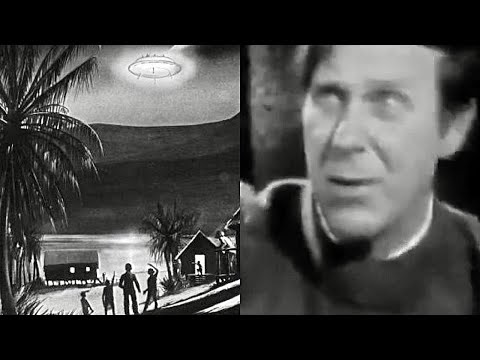
"They Waved Back!" — Father Gill on Witnessing a UFO With Beings
Archival footage of Rev. William Gill describing the reciprocal-waving encounter in his own words, from the reputable Eyes On Cinema channel.
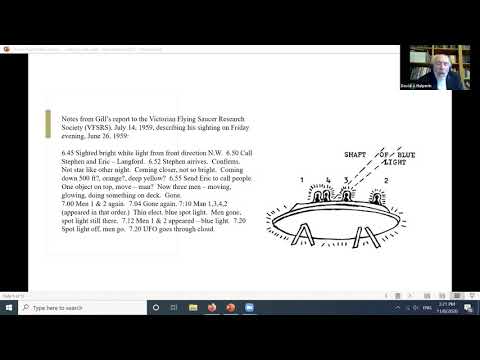
Father Gill and the UFO
Religious-studies scholar David J. Halperin discusses his own "collective vision" psychological reading of the Boianai sightings on his own channel.
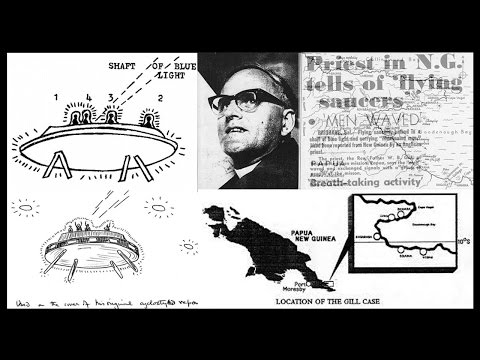
The Father Gill / Papua New Guinea UFO Encounter (1959)
A case-history overview covering the June 26-27, 1959 sightings, the witness statement, and the official investigation.

Father William Gill UFO Documentary: Boianai, Papua New Guinea, 1959
A documentary-style retrospective covering the sighting, its witnesses, and its place in UFO history.
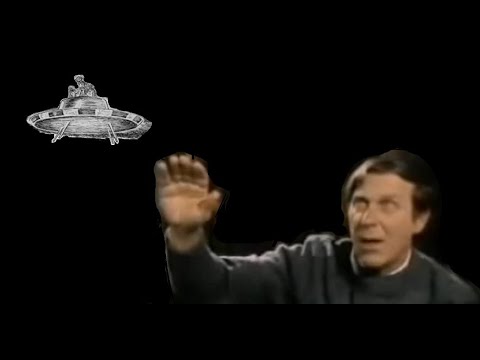
1959-06-26: Rev. Gill UFO Encounter in Papua New Guinea
A dated case-history summary covering the timeline of events and the witnesses involved.
Sources
- NICAP. "Father Gill / Papua New Guinea Sighting" (case directory, incl. analysis by Bill Chalker and Richard Hall). nicap.org
- UFO Evidence. "Father Gill / Papua New Guinea Sighting - Papua New Guinea - June 26, 1959." ufoevidence.org
- The Black Vault. "Father Gill & the 1959 Papua New Guinea UFO Sighting." theblackvault.com
- Patrick Gross (ufology.patrickgross.org). "UFOs at Close Sight: Father Gill Sighting, Papua New Guinea, 1959" (detailed report). ufology.patrickgross.org
- UAP Globe. "The Father Gill Sightings at Boianai (26 to 27 June 1959)." uapglobe.com
- The OZ Files (Bill Chalker). "Reverend William (Bill) Booth Gill (1928-2007)" (obituary/biography). theozfiles.blogspot.com
- The OZ Files (Bill Chalker). "Rev William Gill and the 1959 Boianai Visitants - what he saw and what he believed." theozfiles.blogspot.com
- Project 1947. "'Unusual Aerial Sightings': A Search Through the Australian Government's Records Systems." project1947.com
- Malcolm's Musings. "UFOs Over Boiani - in Father Gill's Own Words." malcolmsanomalies.blogspot.com
- Magonia Archive. "Gill Again: The Father Gill Case Reconsidered" (Martin Kottmeyer's squid-boat analysis). magoniamagazine.blogspot.com
- Duquesne Scholarship Collection. Halperin, David J. "Anatomy of a Vision: A Psychological Approach to the Papua New Guinea UFO Sightings, June 26-27th, 1959." dsc.duq.edu
- PNG Attitude (Keith Jackson & Friends). "Papua or Bust... The Boianai UFO Sightings." pngattitude.com
- The UFO Chronicles. "Official UFO Files for Papua New Guinea Uncovered." theufochronicles.com
- Internet Archive. "Australian UFO Files" (digitized National Archives of Australia UFO series, incl. A703/554/1/30). archive.org
- National Archives of Australia. "Flying Saucers - Fact or Fiction?" (official blog). naa.gov.au
- National Archives and Records Administration (NARA). "Project Blue Book: Textual and Microfilm Records." archives.gov
- Close Encounter Project. "Papua New Guinea Sighting (1959)." closeencounterproject.wordpress.com
- Podcast UFO. "Father William Gill's Flashlight: Papua, New Guinea 1959." podcastufo.com
- Hynek, J. Allen. The UFO Experience: A Scientific Inquiry, Henry Regnery Company, 1972 (analysis of the Papua/Father Gill case). amazon.com
- Chalker, Bill. The Oz Files: The Australian UFO Story, Duffy and Snellgrove, 1996. amazon.com
- Story, Ronald D., ed. The Encyclopedia of UFOs, Dolphin Books, 1980. amazon.com
- Clark, Jerome. The UFO Encyclopedia, 4th Edition, Visible Ink Press, 2023 (entry on the Papua New Guinea / Father Gill case).
- Cruttwell, Norman E. G. Flying Saucers Over Papua: A Report on Papuan Unidentified Flying Objects, March 1960; republished in Flying Saucer Review, Special Issue No. 4, August 1971.
- UFO Insight. "The Boianai Visitants Over Papua New Guinea." ufoinsight.com
- Rowan Callick. "Article for PNG Post-Courier" (Boianai sighting retrospective). rowancallick.com
See something inaccurate? Have additional information or sources?
Suggest an Edit →Last Updated: August 2026