
The Fontiès-d'Aude Health-Effects Case
Sometime between May 25 and May 28, 1995 — GEIPAN's own case file records only that window, not a single exact night — at around 3:30 AM, a couple in Fontiès-d'Aude, a small wine-country village in the Aude department, watched a large, dark object hang motionless above their house. It resembled a helicopter in silhouette, they said, but made no sound, produced no smoke, and left no trail. After a few minutes it swept the ground below with light beams five or six times, then departed at a moderate, unhurried speed. Their dogs, ordinarily vocal, fled inside the house and did not bark once during the entire encounter. About a week later, the dogs began vomiting and suffering diarrhea; the wife felt unwell; the husband was overcome with fatigue; a neighbor was suddenly hospitalized; and grass in the area the beams had swept appeared to wither. Frightened, and hoping to find out whether any of this was connected, the husband called France's civil-protection service. GEIPAN's investigation, filed as case 1995-05-01393 and classified D, could not identify what the couple saw — but it also found, on every single one of the aftereffects the couple reported, no causal link at all: the wife's health problems, GEIPAN's own file concludes, are explained by her ongoing medical treatment and the season's heat; the neighbor's hospitalization is unsurprising given his age; and the withered grass was only one example of a broader pattern of plant degeneration found in multiple places around the property that had nothing to do with the object's lights. "Le phénomène observé n'en reste pas moins inexpliqué," GEIPAN's synthesis states directly — the observed phenomenon remains, nonetheless, unexplained. This is a case, in other words, where the scary side-story was investigated and quietly dismantled, while the actual light in the sky was not.
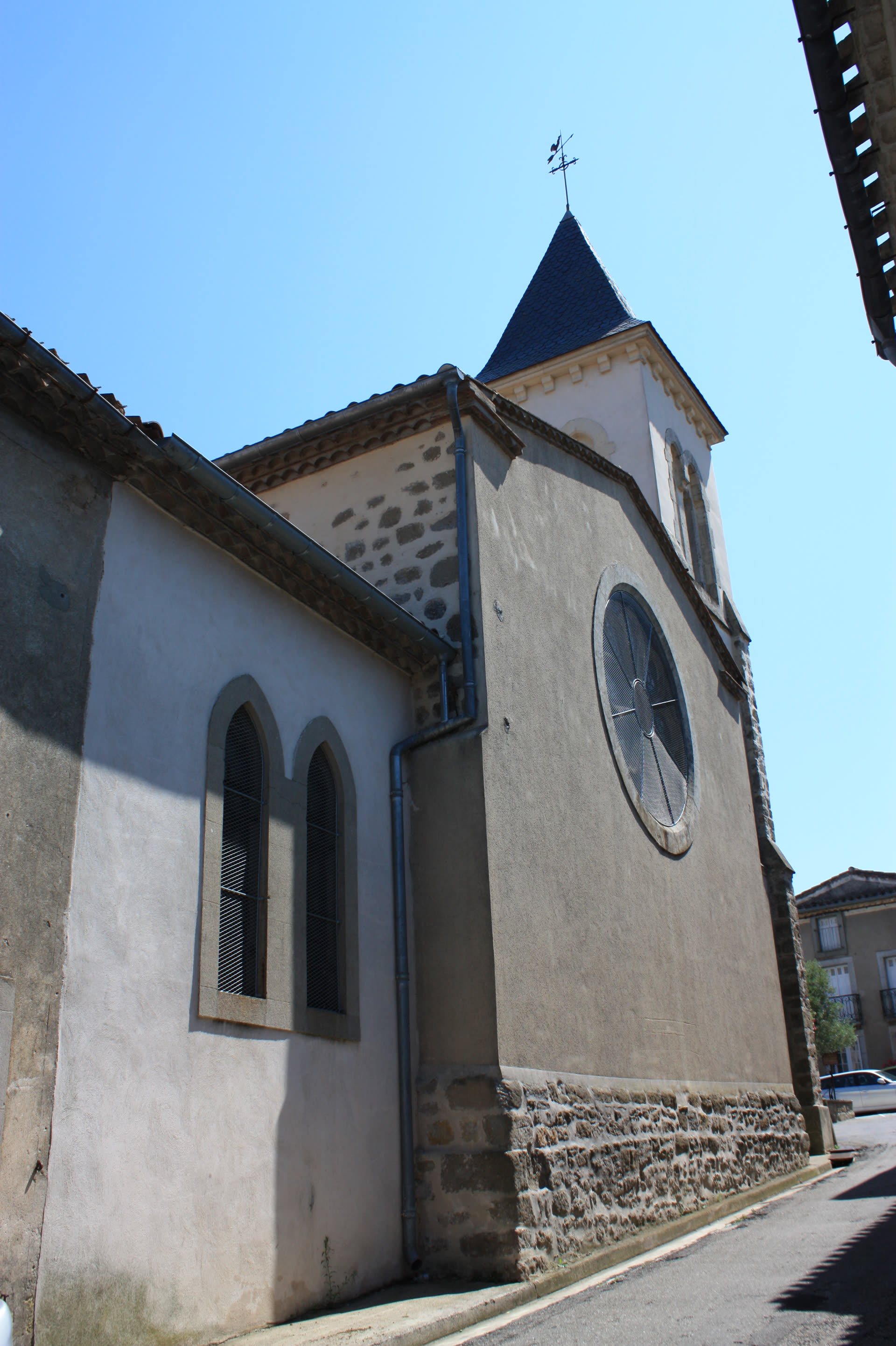
Pictured: the Église Saint-Marcel, the parish church at the center of Fontiès-d'Aude — not the witnesses' own house, whose location within the commune GEIPAN's published file does not disclose, consistent with its standard anonymization practice. No photograph of the object, the couple's property, or the withered vegetation is known to exist in the public record; the entire evidentiary record consists of the couple's own testimony and GEIPAN's field investigation. Photo by Wikimedia Commons contributor Tylwyth Eldar (2018), licensed CC BY-SA 4.0.
Theoretical Alignment
This case's weighting leans more heavily toward Psycho-Social framing than most files in this site's published GEIPAN archive, for a reason specific to its own evidentiary shape: the single most dramatic, most attention-grabbing claims attached to it — the sick dogs, the unwell wife, the hospitalized neighbor, the withered grass — were investigated directly by GEIPAN and found to have no causal connection to the sighting at all, tracing instead to ordinary medical, seasonal, and horticultural explanations. That outcome is itself a meaningful psycho-social data point: it is precisely the pattern researchers describe when a genuinely startling nighttime experience becomes a retroactive organizing narrative for a cluster of unrelated misfortunes that would, under any other circumstance, never have been connected to one another at all. Extraterrestrial framing still draws real, if reduced, support from the core sighting GEIPAN's investigation could never resolve: a large, entirely silent object, producing no smoke or exhaust trail, hanging motionless before repeatedly sweeping the ground with directed light and departing under its own control. Interdimensional framing remains this site's lowest-weighted category across nearly every GEIPAN file it has published, and this case is no exception, resting only on the sighting's unresolved status rather than on anything distinctively otherworldly in what the couple actually described.
Background
Two threads of context matter here: the small Corbières wine-country village where the sighting occurred, and the French government body — GEIPAN, and the civil-protection channel through which this specific report reached it — that investigated it.
Fontiès-d'Aude: A Village on the Corbières' Edge
Fontiès-d'Aude is a small commune of a little over 550 residents in the Aude department of southern France, sitting roughly 9 kilometers east-southeast of the departmental capital, Carcassonne, within the arrondissement of Carcassonne and the canton of Montagne d'Alaric. It borders five communes — Carcassonne, Floure, Montirat, Monze, and Trèbes — and lies at the northern edge of the Corbières massif, a limestone formation that forms part of the long geological bridge connecting the Massif Central to the Pyrenees. Its Mediterranean climate brings hot, dry summers and mild winters, and it sits within a landscape historically defined by viticulture — the Corbières wine-growing region takes its name from these same hills. The commune's population followed the same long rural depopulation-then-recovery arc common across small communes in this part of France: from 190 residents recorded in 1793, it fell to a low point of just 239 by 1975, before more than doubling to around 555–560 by the early 2020s as Carcassonne's own commuter reach extended into the surrounding countryside. Its residents are known as Fontiesois and Fontiesoises. The commune's one nationally protected heritage site is the Croix des métiers (Cross of the Trades), a monument inscribed on France's supplementary list of historic monuments in 1948; its parish church, the Église Saint-Marcel, anchors the small village center pictured above. This site's own research found no record of any prior UAP report specifically associated with Fontiès-d'Aude before 1995, making this case, so far as this site's archive can establish, the village's only entry in GEIPAN's published database. The Corbières wine appellation itself, whose hills rise immediately south and east of the commune, was formally recognized as an AOC (Appellation d'Origine Contrôlée) in 1985, a decade before this sighting, after a long history of viticulture in the area dating back to Roman settlement; the region's characteristic combination of limestone and schist soils, strong Mediterranean sun, and the drying Cers and Tramontane winds that sweep down from the Pyrenees and the Massif Central gives its red wines, predominantly blended from Carignan, Grenache, Syrah, and Mourvèdre grapes, their distinctive character. This site's own research treats the region's active, working agricultural landscape — a patchwork of vineyards tended at all hours during the growing season, sometimes with tractor- or vehicle-mounted work lighting — as directly relevant background for weighing the Conventional Explanation Candidate section below, rather than as incidental local color.
GEPAN, SEPRA, GEIPAN: The Agency Behind the File
The French government's institutional apparatus for investigating unidentified aerospace phenomena traces to 1977, when Claude Poher, an engineer at the Centre National d'Études Spatiales (CNES, France's national space agency, headquartered in Toulouse), founded the Groupe d'Études des Phénomènes Aérospatiaux Non-identifiés (GEPAN). The unit was renamed SEPRA in 1988 and again, in 2005, GEIPAN — the Groupe d'Études et d'Informations sur les Phénomènes Aérospatiaux Non-identifiés — the name and structure that investigated this case. Unlike a number of the sightings in this site's GEIPAN archive, which reached the agency through a direct citizen report or a gendarmerie-filed procès-verbal, this case's own file states that the husband, frightened by the pattern of aftereffects he believed he was observing, telephoned France's Sécurité Civile — the Ministry of the Interior's civil-protection and emergency-response service, the natural point of contact for a private citizen worried about a possible environmental or public-health hazard — specifically to ask whether a connection could be established between the object his family had seen and the string of ailments that followed it. This site's research was unable to confirm the precise administrative path by which that call ultimately reached GEIPAN's own investigators, but the case's presence in GEIPAN's published archive confirms it did.
Complete Timeline
| Date | Event |
|---|---|
| 1793 | Fontiès-d'Aude is recorded with a population of 190. |
| 1948 | The commune's Croix des métiers is inscribed on France's supplementary list of historic monuments. |
| 1975 | The commune's population reaches its historic low point, 239 residents, before beginning a long recovery. |
| 1977 | GEPAN, GEIPAN's founding predecessor agency, is established at CNES under Claude Poher. |
| Between May 25–28, 1995, approx. 3:30 AM | Sighting begins. A couple sees a large, dark, silent object resembling a helicopter hanging motionless above their house near Fontiès-d'Aude. |
| Same night | The object sweeps the ground. It illuminates the ground with light beams five to six times, then departs at a moderate speed; the couple's dogs flee into the house without barking throughout. |
| Approximately one week later | The dogs begin vomiting and suffering diarrhea; the wife feels unwell; the husband reports severe fatigue; a neighbor is suddenly hospitalized; grass in the area the beams swept appears to wither. |
| Date not published | Frightened, the husband telephones France's Sécurité Civile to ask whether the sighting and the aftereffects might be connected. |
| Date not published | GEIPAN conducts its field investigation: interviewing the couple, examining the reported effects, and checking alternative explanations for each. |
| 1995 | Classification. GEIPAN classifies the case D on file 1995-05-01393: the object remains unidentified, but no causal link is found between the sighting and any of the reported aftereffects. |
| June 23, 2021 | GEIPAN's published online case file for 1995-05-01393 is last updated. |
Detailed Narrative
A Couple, a House, and an Object Like a Helicopter
GEIPAN's own case synthesis is spare on scene-setting detail — it does not name the couple, describe their house, or specify which of the four nights between May 25 and 28, 1995 the sighting actually happened on, stating only that it occurred "entre le 25 et le 28 mai 1995, vers 3h30" (between May 25 and 28, 1995, around 3:30 AM). What it does describe with some specificity is the object itself: a large, dark shape hanging above the couple's home, resembling a helicopter in general outline, but stationary — "cet objet est stationnaire" — and, crucially, silent, with no engine noise, no rotor wash, no smoke, and no exhaust trail of any kind. This is the same combination this site's research has flagged as significant in other GEIPAN files: a shape that immediately invites comparison to a known aircraft type, paired with an acoustic and visual signature that same aircraft type could not actually produce. After several minutes of remaining in place, the object "eclaira cinq à six fois le sol" — illuminated the ground five or six times — with beams of light, before departing "à vitesse moyenne," at a moderate, unhurried speed, rather than the abrupt high-speed departures this site's research has documented in several other French cases.
Dogs That Wouldn't Bark
One detail in GEIPAN's synthesis stands out for what it implies about the household's own immediate reaction, distinct from anything the couple later reported about their own health: "les chiens du témoin sont entrés se terrer dans la maison sans aboyer" — the witness's dogs went inside to hide in the house without barking. Dogs reacting to something outside at night by barking loudly is the ordinary behavior GEIPAN's own file implicitly treats as the expected baseline here, precisely by noting its absence; dogs retreating indoors in silence is the anomaly being recorded. This site's own analysis treats this detail cautiously: animal behavior is notoriously difficult to interpret as corroborating evidence in any rigorous sense, since dogs react to an enormous range of ordinary stimuli (an unfamiliar smell, a sudden light, a change in barometric pressure) that have nothing to do with anything anomalous. It is nonetheless a specific, unprompted, non-self-referential detail in the couple's own account, of the kind this site's methodology treats as marginally more informative than a bare assertion of fear or wonder would be on its own.
A Week Later: Illness, Hospitalization, and Withered Grass
GEIPAN's file describes what followed roughly a week after the sighting in a single, dense passage: the dogs, previously described as merely frightened, began "pris de vomissements et de diarrhées" — afflicted with vomiting and diarrhea; the wife "a ressenti des troubles de santé" — experienced health troubles, unspecified in kind; the husband "s'est senti très fatigué" — felt very fatigued; and the witness noticed "une certaine dégénérescence de la végétation à l'endroit où elle a été éclairée par les projecteurs" — a degree of vegetation degeneration in the specific spot the searchlights had illuminated. Separately, and seemingly independent of the household itself, the witness "signale également l'hospitalisation subite d'un voisin" — also reports the sudden hospitalization of a neighbor. Laid out together like this, in the order GEIPAN's own file presents them, this cluster reads as a genuinely alarming pattern: five distinct forms of harm (two humans, a set of animals, a neighbor, and a patch of ground) all following one nighttime sighting within roughly the same week. This site's own research treats the sequencing itself as the single most important fact about this case's aftermath section, precisely because sequencing is not causation — and because, as the next section details, GEIPAN's own investigators tested that exact assumption directly rather than accepting it.
A Call to Sécurité Civile: A Witness Trying to Rule Something Out, Not In
What GEIPAN's file records next is, in this site's own assessment, one of the most quietly credibility-enhancing details in this entire case: the husband did not call a newspaper, a UFO research group, or even directly GEIPAN itself. He called France's Sécurité Civile, the government's civil-protection and emergency-response service, specifically — per GEIPAN's own phrasing — "afin de savoir si un lien peut être établi entre le phénomène observé et les effets constatés sur lui-même, son épouse, son voisin, ses chiens et ses plantes": in order to find out whether a link could be established between the observed phenomenon and the effects noted on himself, his wife, his neighbor, his dogs, and his plants. That is a request for an investigation to confirm or rule out a hypothesis, phrased in exactly that even-handed way, rather than an assertion that the link already existed. This site's own case-file methodology treats this kind of self-consciously uncertain framing — a witness who wants to know the truth rather than one already committed to a specific dramatic interpretation — as a meaningfully positive credibility signal, directly comparable to the restraint this site's research has praised in other witnesses' own quoted statements elsewhere in its GEIPAN archive.
What GEIPAN Found: A Careful Debunking of the Debunkable
GEIPAN's own conclusion is unusually explicit, for a case of this kind, about drawing a hard line between the object sighting and everything that came after it: "L'enquête, si elle ne permet pas d'identifier l'objet observé, ne permet pas non plus d'établir le moindre lien entre l'observation de l'objet et les effets supposés" — the investigation, while it could not identify the observed object, also could not establish the slightest link between the object's observation and the supposed effects. GEIPAN's file then goes further, offering conventional accounts for three of the five specific harms reported, one at a time, rather than issuing a single blanket dismissal:
- The wife's health troubles are attributed to "le traitement suivi par l'épouse du témoin" (her own ongoing medical treatment) combined with "les fortes chaleurs" (intense heat) — a pre-existing medical condition and a seasonal factor, neither one connected to the sighting itself.
- The neighbor's hospitalization is described as "pas surprenante compte tenu de son âge" — not surprising given his age, treating it as an ordinary medical event coincidentally close in time rather than a caused effect.
- The withered vegetation is directly and specifically undermined, not merely dismissed: GEIPAN's own investigators found that "de nombreuses plantes situées ailleurs que dans la zone supposée être sous l'influence de l'objet montrent des signes semblables de dégénérescence" — numerous plants located elsewhere than in the zone supposedly under the object's influence show similar signs of degeneration. That is not an assertion that no cause could be found; it is a finding that the same effect exists in places the object's lights never touched, which is direct evidence against, rather than merely an absence of evidence for, an anomalous cause.
Notably, GEIPAN's own published synthesis offers no specific alternative explanation for the dogs' vomiting and diarrhea beyond its general finding that no link to the sighting could be established — a genuine, honestly-acknowledged gap in the record rather than something this site's own research can responsibly fill in with speculation. Canine gastrointestinal illness has an enormous range of mundane causes (spoiled food, a parasite, a dietary change, an unrelated minor illness), any of which would be unremarkable in a rural household with outdoor dogs, but this site found no indication GEIPAN's investigators identified which, if any, applied here specifically.
The Object Itself: What Actually Remains Unexplained
It is worth stating plainly, given how much of this case's public retelling tends to foreground the health-effects angle: none of the debunking above touches the sighting itself. GEIPAN's own file does not claim to have identified the dark, silent, light-projecting object the couple watched hover over their house for several minutes at 3:30 in the morning. Its own concluding sentence keeps the two questions entirely separate: "Le phénomène observé n'en reste pas moins inexpliqué" — the observed phenomenon remains, nonetheless, unexplained. This site's own analysis treats that final sentence as the case's real headline, and treats the widely-repeated framing of this case as a "UFO health-effects mystery" as a subtly misleading compression of what GEIPAN's own investigators actually found: a mystery object, and a set of separately-investigated, separately-explained non-mysteries that happened to follow it.
Key Witnesses
T1 — The Husband (identity withheld per GEIPAN's standard anonymization practice)
The household's primary point of contact with investigators, and the person who initiated the entire case by calling France's Sécurité Civile to ask whether a link could be established between the sighting and the string of aftereffects his family and a neighbor experienced. GEIPAN's own file records him as reporting severe fatigue in the week following the sighting, an effect its investigation attributes to ordinary causes rather than the object itself. His own framing of the request — asking whether a connection existed, rather than asserting one — is treated in this site's own analysis as a meaningful, if secondary, credibility signal.
T2 — The Wife (identity withheld per GEIPAN's standard anonymization practice)
Co-witness to the sighting alongside her husband, and the household member whose own subsequent ill health became the case's most closely examined claimed aftereffect. GEIPAN's investigation traced her health troubles to her own pre-existing medical treatment combined with seasonal heat, explicitly finding no connection to the object she and her husband had watched above their home a week earlier.
The Five Observables Assessment
The Five Observables framework, developed by the Pentagon's Advanced Aerospace Threat Identification Program to describe performance characteristics beyond known conventional technology, is applied here for comparative consistency across this site's case files. This sighting's defining performance characteristic is a sustained, silent hover directly over an occupied structure — not a dramatic burst of speed, but a prolonged and deliberate-seeming stillness.
Assessment: This case's Five Observables profile is unusual within this site's GEIPAN archive for how little it emphasizes speed or acceleration in either direction: both Instant Acceleration and Hypersonic are rated Absent rather than Speculative, since GEIPAN's own file specifically characterizes the object's departure as moderate rather than abrupt, a genuinely distinguishing feature compared to several of this site's other French cases. Anti-Gravity Lift and Low Observability, by contrast, both earn Speculative ratings on the strength of the same underlying fact: a large, helicopter-shaped object producing none of a helicopter's actual acoustic or visual signatures (no rotor noise, no downwash-driven dust or vegetation movement, no navigation lighting, no smoke or exhaust) while remaining stationary at close range for several minutes. This site's analysis stops short of rating either Present, since no instrumented measurement of the object's true altitude, mass, or means of support exists — the entire profile rests on two witnesses' unaided visual and auditory impressions of a nighttime object neither could get closer to nor measure.
Evidence Assessment
Supporting an Anomalous Origin
- GEIPAN's own field investigation, after examining the couple's account and testing each of the reported aftereffects individually, still could not identify the object itself — this is not a case GEIPAN closed by explanation, but one it left formally classified D, unexplained
- The object's described profile — large, dark, entirely silent, producing no smoke or trail, remaining stationary for several minutes, then repeatedly projecting directed light beams at the ground before departing under apparent control — is difficult to reconcile with any known conventional aircraft operating in that manner at 3:30 AM
- The couple's own request to Sécurité Civile was phrased as an open question rather than an assertion of a link, a self-consciously cautious framing this site's analysis treats as a positive credibility signal rather than sensationalism
- The dogs' documented behavioral change — fleeing indoors and falling silent, rather than the barking response GEIPAN's own file implicitly treats as the expected baseline — is a specific, unprompted detail, even though this site's analysis treats animal behavior cautiously as corroborating evidence
Supporting a Conventional/Mundane or Inconclusive Origin
- GEIPAN's own investigation directly tested and rejected a causal link for every single one of the case's most dramatic claimed effects: the wife's illness (medical treatment plus heat), the neighbor's hospitalization (his age), and — most concretely — the withered vegetation, which GEIPAN found duplicated elsewhere on the property outside any zone the object's lights ever touched
- Only two witnesses exist, and they are a married couple sharing one household and one vantage point — the same non-independence limitation this site's research has flagged in several of its other multi-witness GEIPAN files, here without even the mitigating factor of separate professional training or separate physical locations
- The sighting's date cannot be fixed to a single night; GEIPAN's own file gives only a four-day window, a level of temporal imprecision this site's research has not found in any other case in its published GEIPAN archive
- No photograph, video, radar track, physical sample, or any other instrumented or physical corroboration of any kind exists for the object itself
- GEIPAN's own published synthesis offers no specific alternative explanation for the dogs' illness beyond its general finding of no established link — an honest gap, but one that leaves open the possibility of an ordinary, simply undocumented cause (spoiled food, a minor unrelated illness) rather than confirming an anomalous one
Why "Open"
This case is stamped Open because GEIPAN's own investigation reached a genuine, tested conclusion on the object itself: after examining the couple's account, it could not identify what they saw, and it did not attempt to explain the sighting away by folding it into the (separately debunked) health-effects narrative that grew up around it. That core finding — a real, silent, ground-illuminating object that resisted identification on its own terms — keeps this case genuinely open rather than closed.
At the same time, this site's own scoring for this case sits toward the lower end of its published GEIPAN archive, and for reasons specific to this case rather than a generic discount. First, the witness base is thin even by the standards of this site's other two-witness GEIPAN files: a single married couple, sharing one household, one vantage point, and (almost certainly) extensive discussion of the sighting with each other long before any investigator became involved — a more severe version of the interdependence problem this site's research has already documented in cases like Palau-del-Vidre and Étrelles. Second, the sighting's own date is genuinely unresolved: GEIPAN's file gives a four-day window rather than a single confirmed night, a level of imprecision unmatched elsewhere in this site's GEIPAN archive. Third, and most importantly, this case's own most attention-grabbing evidentiary claims — the health effects that give the case its name — were investigated directly by GEIPAN and found, on every point checked, to have no connection to the sighting at all. A case whose most dramatic corroborating details turn out, on the government's own investigation, not to corroborate anything, should score lower than one whose comparable claims survive scrutiny, even when (as here) the core sighting itself remains honestly unresolved. Weighed together — a genuinely unresolved core sighting, against a weak, non-independent witness base, an imprecise date, and a set of headline claims GEIPAN's own investigators actively disproved rather than merely failed to test — this case is scored near the bottom of this site's published GEIPAN Open archive.
Sensor & Instrumentation Detection Profile
No photograph, video, radar track, or other instrumented recording of any kind exists for this sighting, and GEIPAN's own published file gives no indication that any was sought. This case's entire evidentiary record consists of the couple's own testimony, relayed through France's Sécurité Civile, and GEIPAN's own field investigation — which, unlike several of this site's other GEIPAN files, appears to have been directed primarily at the reported aftereffects (medical, veterinary, and horticultural) rather than at the object itself. This site's own research found no indication that regional air-traffic control, military radar, or any weather-radar archive was checked against the object's reported time and position, a more limited instrumented follow-up than the meteor-camera cross-check performed in this site's Étrelles file or the astronomical-calculation exclusion performed in its Palau-del-Vidre file.
What this sensor profile does include, distinguishing it from a purely visual-testimony case, is an investigation of a different kind: GEIPAN's own file indicates its investigators examined, and in three specific instances directly tested, the physical and medical claims attached to the sighting — checking the wife's own medical records or treatment history closely enough to attribute her symptoms to it, checking the neighbor's age and hospitalization circumstances, and, most concretely, physically surveying vegetation elsewhere on the property to establish that the withering pattern was not confined to the supposedly affected zone. That last check in particular required an actual site visit and a comparison across multiple locations on the property — a real, if narrowly scoped, empirical test, applied not to the object's identity but to the causal claim built around it.
Environmental & Geospatial Context
Geographically, the sighting occurred at the couple's home somewhere within or near the commune of Fontiès-d'Aude, a small village at the northern edge of the Corbières massif, a limestone range connecting France's Massif Central to the Pyrenees, roughly 9 kilometers southeast of Carcassonne. The surrounding countryside is characteristic Corbières wine country: rolling limestone hills, vineyards, and dispersed rural houses rather than dense settlement, with a Mediterranean climate of hot, dry summers and mild winters.
GEIPAN's own published file does not specify the weather conditions on the night of the sighting itself, but its explanation for the wife's subsequent ill health explicitly cites "les fortes chaleurs" — intense heat — as a contributing factor alongside her medical treatment. This site's own research checked that specific claim against the actual historical meteorological record for the Carcassonne area (the nearest station with detailed archived data, roughly 9 kilometers from Fontiès-d'Aude) and found a more complicated picture than GEIPAN's own brief phrase suggests. May 1995 as a whole was recorded as slightly cooler than seasonal norms in the Carcassonne area, averaging around 15.0°C for the month, about 0.6°C below normal. The specific week spanning the sighting's own uncertain date window, May 22–28, averaged a high of 23.8°C — warm, and not unpleasant for late May in southern France, but nothing close to a heat emergency, and notably cooler than the month's actual peak of 27.4°C, which fell on May 8, more than two weeks before the sighting window and well before the "about a week later" period in which the wife's symptoms began. This site's own analysis treats this finding as a genuine complication of GEIPAN's own stated reasoning, not a refutation of it: warm early-summer Mediterranean weather is a real and plausible contributing factor to general malaise for someone already undergoing medical treatment, and this site's research found no basis to reject GEIPAN's underlying medical explanation outright — but the specific phrase "fortes chaleurs" implies a more extreme heat event than the regional record for that exact period actually shows, a nuance GEIPAN's own published summary elides.
Within this site's own published GEIPAN archive, the most relevant points of regional comparison are two other Occitanie cases: the Palau-del-Vidre Black Triangle (2008, Pyrénées-Orientales) and the Flavin Domed Cylinder Sighting (1996, Aveyron), each discussed further in the Historical Precedents section below.
Observer Credibility & Occupational Profile
This case carries none of the occupational credibility markers — law-enforcement training, aviation experience, scientific credentials — that distinguish several of this site's other GEIPAN files. GEIPAN's own file describes the witnesses only as a couple at their own home; no profession, training, or other credential is recorded for either. What this site's own analysis does credit as a positive, if secondary, credibility signal is the specific manner in which the husband brought the case to official attention: rather than approaching a UFO research organization, a newspaper, or asserting a conclusion, he called France's civil-protection service with an open, testable question — whether a link existed between the sighting and the aftereffects — a framing this site's research treats as more consistent with an anxious, honestly uncertain reporter than with someone constructing or embellishing a dramatic narrative.
Working against this case's credibility, in this site's own assessment, is the near-total absence of independence between its two witnesses: a married couple, observing together from their own home, almost certainly discussing what they had seen with each other continuously in the days and week that followed, long before any investigator ever spoke with them. This is the same interdependence dynamic this site's research has flagged in several of its other multi-witness GEIPAN files (see Étrelles and Palau-del-Vidre), but without either of those cases' partial mitigating factors — Étrelles's witnesses were professionally trained gendarmes, and Palau-del-Vidre's were work colleagues rather than spouses sharing a home and, by the time of the aftereffects, a shared and mounting anxiety about their own family's health.
Physical & Material Assays
This is the section where the distinction this case turns on matters most, and this site's own analysis states it as plainly as possible: no physical evidence in this case actually supports an anomalous origin, and the one piece of purported physical trace evidence was directly investigated and found not to be anomalous at all. The couple reported a patch of withered grass in the area the object's light beams had swept — the closest thing to a ground trace in this entire case, and the detail most likely, on a surface reading, to be treated as physical corroboration of the sighting. GEIPAN's own field investigators did not stop at noting the withering; they surveyed the wider property and found "de nombreuses plantes situées ailleurs que dans la zone supposée être sous l'influence de l'objet" showing the same signs of degeneration — numerous plants located elsewhere than in the zone supposedly under the object's influence. That is a genuine negative test result, not merely an absence of a positive one: if the same withering pattern appears in places the object's lights never touched, the withering cannot be evidence that the object's lights caused it anywhere. No soil sample, plant tissue sample, or other specimen from either the affected or unaffected areas appears to have been laboratory-tested for anything beyond this site-survey comparison, so far as this site's research could establish; no metallurgical, isotopic, or trace-chemical assay exists, because no debris, landing mark, or other terrestrial-contact evidence was ever reported. The couple's own animals' illness likewise produced no veterinary sample or diagnosis on record in GEIPAN's published file, leaving that specific claim unresolved rather than either confirmed or debunked.
Historical Precedents & Archive Matches
This case's most useful points of comparison within this site's own published archive fall into two distinct categories: other Occitanie-region GEIPAN cases, and other cases — GEIPAN and non-GEIPAN alike — where claimed physical or physiological effects became central to the case's public reputation.
Palau-del-Vidre and Flavin: The Occitanie GEIPAN Record
The Palau-del-Vidre Black Triangle (Open, case #264, Pyrénées-Orientales, 2008) and the Flavin Domed Cylinder Sighting (Open, case #257, Aveyron, 1996) give this site its two closest regional comparisons within the same broad Occitanie region GEIPAN's own database now uses to categorize Fontiès-d'Aude (itself filed, at the time of the sighting, under the since-superseded regional name Languedoc-Roussillon). Palau-del-Vidre's own two witnesses were work colleagues sharing one delivery vehicle rather than spouses sharing one home, a structurally similar but not identical interdependence problem; Flavin's own case involved a formal gendarme-witnessed sketch and a documented physical hover altitude, giving it a stronger instrumented/documentary record than Fontiès-d'Aude's testimony-only file. Neither of those two cases, however, carries anything comparable to Fontiès-d'Aude's own uniquely elaborate — and uniquely disproven — secondary health-effects narrative, making this case a genuinely distinct addition to this site's regional Occitanie coverage rather than a simple repeat of an established pattern.
Trans-en-Provence: When a Physical Trace Actually Survives Testing
A sharper, and more directly comparable, contrast sits within GEIPAN's own institutional lineage rather than outside it: the 1981 case investigated by GEPAN (GEIPAN's own direct predecessor agency) at Trans-en-Provence, Var, where a witness named Renato Nicolaï reported a landed object on his property and GEPAN's own scientists physically collected soil and plant samples from the exact spot, subjecting them to laboratory biochemical and physical analysis rather than a simple site-comparison survey. That analysis found real, measurable trace effects — altered chlorophyll levels and other biochemical changes in the sampled vegetation, along with mechanical compression marks in the soil — that GEPAN's own investigators were unable to attribute to any conventional cause they could identify, and that have remained a genuinely disputed but not disproven piece of physical evidence in the decades since. Set beside Trans-en-Provence, Fontiès-d'Aude's own vegetation claim looks even weaker than it does in isolation: where Trans-en-Provence's investigators found a specific, localized, laboratory-measurable anomaly confined to the reported site, Fontiès-d'Aude's investigators found the opposite — an ordinary-looking degeneration pattern that was not confined to the reported site at all, appearing just as readily in parts of the property the object's lights never reached. The comparison illustrates, within a single French investigative tradition spanning four decades, both what a physical trace claim looks like when it survives scientific testing and what one looks like when it does not.
Cash-Landrum: When Physical Effects Are Not Debunked
A second, non-GEIPAN comparison sharpens the same point from a different angle: the American Cash-Landrum Incident (Disputed, case #11, December 1980, Texas). There, three witnesses reported acute radiation-like burns, hair loss, and other serious physical symptoms following a close encounter with a diamond-shaped object accompanied by military helicopters — symptoms multiple physicians subsequently treated as consistent with real radiation exposure, a claim that has remained scientifically disputed but never definitively disproven in the way Fontiès-d'Aude's own vegetation claim was. Reading the two cases side by side sharpens exactly the distinction this case's own write-up has tried to keep unmistakable throughout: Cash-Landrum represents a health-effects claim that medical investigation could neither confirm nor rule out, leaving it genuinely disputed; Fontiès-d'Aude represents a health-effects claim that GEIPAN's own investigation actively tested, point by point, and found not to hold up at all. The two cases are often grouped together in popular UFO literature under a loose "UFO health effects" umbrella, but this site's own research treats that grouping as obscuring a real and important difference in how well each case's central physical claim actually survived scrutiny.
The Broader Aude Record
This site's own research did not identify another GEIPAN case specifically within the Aude department already published in this site's archive, making Fontiès-d'Aude this site's first dedicated case file from that department, distinct from (though geographically close to) an unrelated, better-known 1974 gendarme-documented landing case elsewhere in the Aude that falls outside this site's current published scope. Set against the wider pattern this site's GEIPAN archive has documented across other French departments — genuinely unexplained cases remain a small minority of all reports GEIPAN receives, with GEIPAN's own published statistics page indicating only around 3% of its roughly 3,400 classified cases (Type D) remain unexplained after investigation, against 28% perfectly identified (Type A), 39% probably identified (Type B), and 30% unanalyzable for lack of information (Type C) — Fontiès-d'Aude's own combination of a genuinely unresolved core sighting and a thoroughly, specifically disproven secondary narrative makes it a distinctive, cautionary case study in this site's coverage: a clear demonstration that "unexplained" and "everything reported about it is equally credible" are not the same claim, and should never be treated as such.
Material Analysis
As detailed in the Physical & Material Assays section above, this case's one candidate physical trace — withered vegetation in the area the object's lights swept — was directly investigated by GEIPAN and found to be part of a broader pattern of plant degeneration occurring elsewhere on the property, unconnected to the lit zone. No debris, landing impression, soil anomaly, or other terrestrial-contact evidence was ever reported, and no laboratory testing of any material sample connected to this case appears in GEIPAN's published file.
Supporting Non-Terrestrial Origin
- No confirmed physical evidence exists that positively contradicts an anomalous interpretation of the object itself, since the object's identity remains genuinely unresolved
- Two witnesses independently describe an unusual, specific combination — a large, silent, dark, helicopter-shaped object projecting repeated ground-directed light beams — that GEIPAN's own investigation could not match to any conventional aircraft type or activity
Supporting Terrestrial Origin
- The single physical trace claimed in this case — withered vegetation — was directly tested by GEIPAN's own field investigators and found to be part of a wider, ordinary pattern of plant degeneration occurring in locations the object's lights never touched, actively undermining rather than merely failing to support an anomalous cause
- Every other claimed aftereffect this site's research could evaluate (the wife's illness, the neighbor's hospitalization) was independently and specifically attributed by GEIPAN to an ordinary medical or age-related cause unconnected to the sighting
The Conventional Explanation Candidate: Helicopter, Nighttime Vineyard Lighting, and Perceptual Distortion
GEIPAN's own published file does not name a specific conventional candidate for the object itself, focusing its stated investigative effort instead on the reported aftereffects. This site's own research, following the Gap-Analysis approach this site applies to thinly-documented cases, considered three candidates for the sighting itself directly.
A Conventional Helicopter
The couple's own comparison — "pouvant faire penser à un hélicoptère," an object that could bring a helicopter to mind — makes this the most obvious starting candidate. It is also, on the couple's own account, a poor fit: real helicopters operating close to the ground at 3:30 AM produce substantial rotor noise and, typically, navigation and anti-collision lighting, neither of which the witnesses described; nor does a conventional helicopter repeatedly sweep the ground with a searchlight in the specific five-to-six-beam pattern described, though search-and-rescue or agricultural helicopters do sometimes use searchlights in a broadly similar way. This site's research found no record of any documented civil, military, or medical helicopter flight over the Fontiès-d'Aude area in the relevant window, though the absence of a documented flight in a rural area at 3:30 AM is not strong evidence either way, since minor regional flights are not always comprehensively logged in publicly accessible records.
Nighttime Vineyard or Agricultural Work, or Nocturnal Poaching
Fontiès-d'Aude sits within active Corbières vineyard country, and this site's own research considered whether a ground-based vehicle — an agricultural tractor or utility vehicle equipped with work floodlights, potentially engaged in early frost-protection monitoring or irrigation work, or, alternatively, a spotlight used in illegal nighttime poaching ("chasse de nuit"), a documented if illicit practice in rural France — might account for the ground-sweeping light beams. Against this candidate stands the couple's own description of the object as airborne and hovering directly above their house rather than moving along the ground at a distance, a detail this site's research treats as a substantive, if not absolutely conclusive, obstacle to a purely ground-based explanation. It is also worth noting that late May falls well before the Corbières region's main harvest-season night work (typically concentrated in late summer), making a large-scale vineyard operation somewhat less likely at this specific point in the growing calendar, though early-season frost-watch or irrigation checks remain plausible year-round activities this site's research cannot rule out with confidence.
Perceptual Distortion in the Health-Effects Narrative
While this site's analysis has been explicit throughout that the core sighting itself does not appear to be a product of perceptual distortion (two witnesses gave a specific, consistent, detailed account of a discrete nighttime event), the same cannot be said of the case's aftermath. The tendency to retroactively connect a cluster of ordinary, temporally-adjacent misfortunes to a single striking prior event is a well-documented feature of human causal reasoning under anxiety, and this site's research treats it as the single best-supported explanation for why five unrelated developments — a wife's chronic condition flaring, a neighbor's age-related hospitalization, an ordinary bout of canine gastrointestinal illness, general late-May fatigue, and an unrelated pattern of plant degeneration — came to be narrated together as a single, unified "aftermath" in the first place. GEIPAN's own investigation reached functionally the same conclusion for three of the five specific claims it examined.
Conventional Helicopter
ImplausiblePoor fit with the couple's own description of a silent, unlit object; no documented flight identified in the area at the relevant time, though rural flight logging is incomplete.
Nighttime Vineyard Work or Poaching Spotlight
InconclusivePlausible as a source of ground-directed light in this specific wine-growing region, but a poor match for the couple's description of an airborne object hovering directly above their house.
Perceptual/Attributional Distortion (Aftermath Only)
Highly PlausibleThe best-supported explanation for why five unrelated, ordinary misfortunes became narrated as one connected "aftermath" — directly consistent with, and largely confirmed by, GEIPAN's own point-by-point investigation of each claim.
Fabrication or Collusion
ImplausibleWeighed against the husband's own cautious, question-rather-than-assertion framing when he contacted Sécurité Civile; this site's research found no basis in the record to suspect deliberate fabrication of the core sighting.
Related Cases
Confirmed Documents & Official Records
The official French government case summary: the couple's testimony, the point-by-point investigation of each claimed aftereffect, and the final D classification with GEIPAN's own explicit statement that the object itself remains unexplained.
GEIPAN's own published definitions, including the Class D category (unexplained despite the evidence in GEIPAN's possession) applied to this case.
GEIPAN's own account of its founding in 1977 as GEPAN, its 1988 renaming to SEPRA, and its 2005 reorganization as GEIPAN — the agency structure that investigated this case.
Official French national statistics for the commune, including its historical population series from 1793 to the present.
Further Reading — Recommended Literature
Passport to Magonia: On UFOs, Folklore, and Parallel Worlds
Vallée's foundational catalog of centuries of French and international sightings gives direct background for reading this case within a much longer national tradition of reported anomalous aerial phenomena.
CONFRONTATIONS: A Scientist's Search for Alien Contact
Vallée's own field investigations of forty international cases include close attention to claimed physical and physiological aftereffects, directly relevant to weighing this case's own now-debunked health-effects narrative against its genuinely unresolved core sighting.
UFOs and Government: A Historical Inquiry
Includes a dedicated chapter on French government UAP investigation, directly relevant to the GEPAN/SEPRA/GEIPAN institutional framework that investigated this case.
Identified Flying Objects: A Multidisciplinary Scientific Approach to the UFO Phenomenon
A methodologically-focused work directly relevant to weighing witness independence, causal-attribution errors, and the limits of a two-witness household account, all central to this case.
UFOs: Generals, Pilots, and Government Officials Go on Record
A useful contrast case: a collection built around credentialed, professional witnesses whose accounts have withstood scrutiny, against which this case's own thinner, uncredentialed, and partly-debunked evidentiary record can be usefully measured.
Essential Viewing
No Videos Available
Sources
- GEIPAN (CNES), "FONTIES D AUDE (11)", Case 1995-05-01393 — official case summary
- GEIPAN (CNES), official case archive & public portal — geipan.fr
- GEIPAN (CNES), Glossaire du GEIPAN — official classification definitions, A/B/C/D
- GEIPAN (CNES), Son histoire — institutional history: GEPAN (1977), SEPRA (1988), GEIPAN (2005)
- GEIPAN (CNES), Statistiques — official classification statistics (Types A/B/C/D) across GEIPAN's full case archive
- INSEE, Dossier complet — Commune de Fontiès-d'Aude (11151) — official French national statistics for the commune
- Wikipédia (français), "Fontiès-d'Aude" — commune geography, administration, population history
- Wikipedia (English), "Fontiès-d'Aude" — coordinates, population, and administrative data
- Wikipedia (English), "Aude" (department) — departmental geography and context
- Wikipedia (English), "Corbières AOC" and Corbières massif geography — regional wine-country and geological context
- Wikipedia (English), "GEIPAN" — agency overview and institutional background
- Annuaire-Mairie, Statistique Fontiès-d'Aude — commune population and administrative statistics
- HistoMétéo, Chronique météo — Carcassonne, mai 1995 — regional historical temperature record used to check GEIPAN's own "fortes chaleurs" explanation
- Wikimedia Commons, File: Fontiès-d'Aude - Eglise 1.jpg, photo by Tylwyth Eldar (2018), CC BY-SA 4.0 — licensing and attribution
- Wikimedia Commons, Category: Église Saint-Marcel de Fontiès-d'Aude — image archive for the commune's parish church
- This site, case-files/palau-del-vidre-black-triangle.html — comparative Occitanie GEIPAN case
- This site, case-files/flavin-domed-cylinder-sighting.html — comparative Occitanie GEIPAN case
- This site, case-files/cash-landrum.html — comparative health-effects case, contrasted in the Historical Precedents section
- This site, case-files/etrelles-high-speed-object.html — comparative GEIPAN case on witness interdependence
- This site, key-figures.html, entry on Claude Poher — GEPAN founding and early institutional history
- This site, locations/index.html, entry on Toulouse — CNES/GEPAN/SEPRA/GEIPAN institutional headquarters
See something inaccurate? Have additional information or sources?
Suggest an Edit →Last Updated: August 2026