
The Herbert Schirmer Encounter
In the pre-dawn hours of December 3, 1967, 22-year-old Herbert Schirmer, a patrolman with the four-officer Ashland, Nebraska police department, radioed nothing unusual and logged only a terse, half-joking note about a "flying saucer" at the junction of Highways 6 and 63. What followed made the case a landmark of the early abduction literature: an unaccounted-for gap of roughly twenty minutes in his own patrol log, a raw red welt beneath his ear, and, ten weeks later, a hypnotic regression session conducted for the federally funded Condon Committee by Dr. R. Leo Sprinkle of the University of Wyoming, in which Schirmer described being led aboard a landed craft by humanoid beings wearing a "winged serpent" emblem, communicating with him telepathically, and showing him a propulsion system before releasing him with only a fragmentary conscious memory of what had happened. Sprinkle's own clinical judgment was that Schirmer sincerely believed what he described. The Condon Committee's formal, published verdict was the opposite: it had "no confidence that the trooper's reported UFO experience was physically real." Both things are true at once, and that unresolved tension — a credentialed government psychologist's sincerity finding sitting directly beside his own study's institutional rejection of the story as fact — is what keeps this single-witness, hypnotically-recovered case filed as disputed rather than credible or debunked more than half a century later.
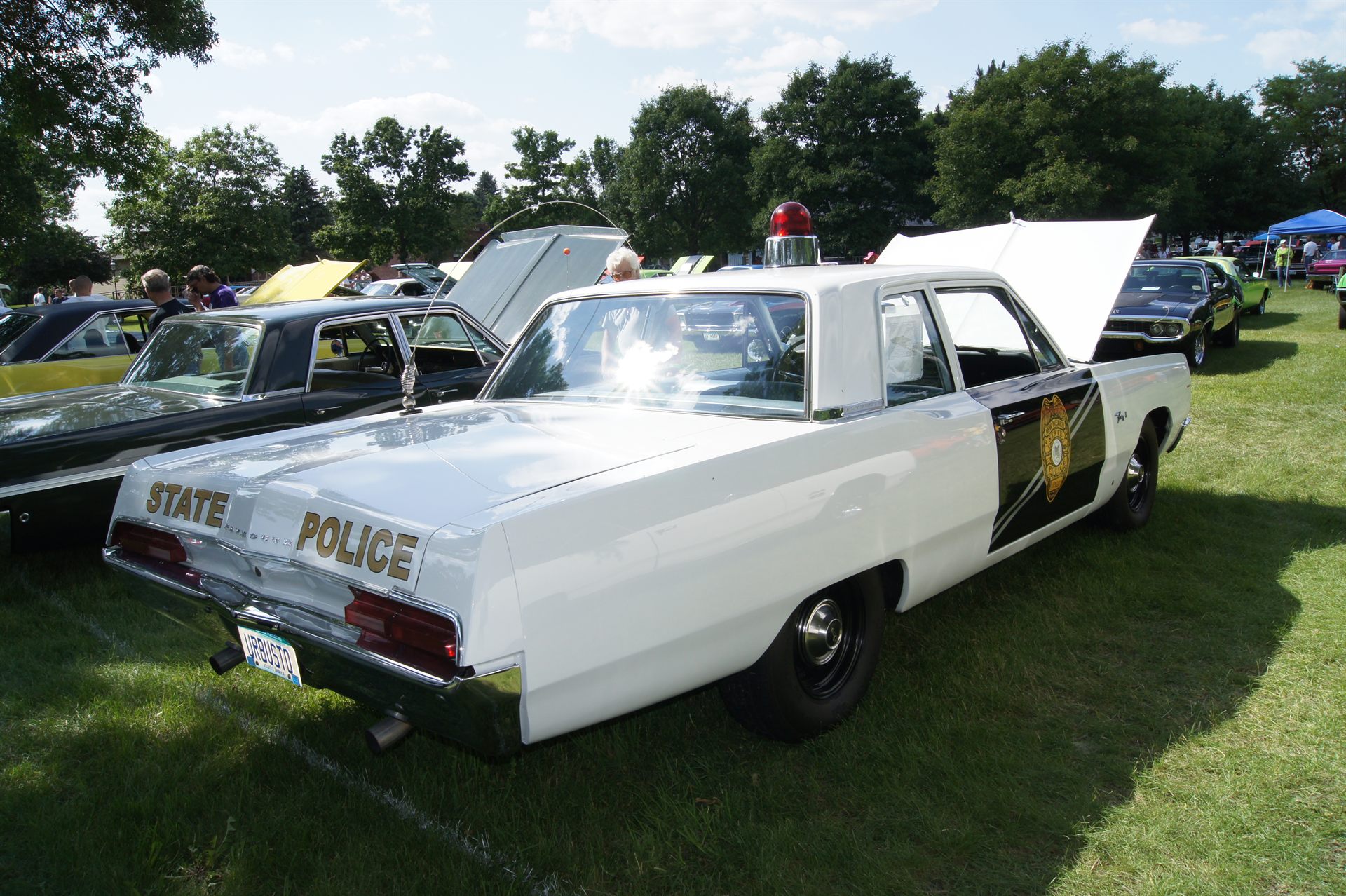
Pictured: a preserved 1967 Plymouth Fury I police cruiser, the same model year of American police interceptor Ashland's small department would plausibly have run that winter — not a photograph of Schirmer's actual patrol car or of the object itself. No photograph of Schirmer's own cruiser, the highway junction as it appeared that night, or the craft he described is known to exist in any public archive; the case's only period visual records are Schirmer's own hypnosis-session sketches of the craft and its occupants, which remain in the Condon Committee's and Sprinkle's private research files rather than freely licensed for reproduction.
Theoretical Alignment
Of the site's abduction-class cases, Schirmer sits closer to the Psycho-Social end of the spectrum than Betty & Barney Hill or Pascagoula, for a specific reason: almost none of the case's most distinctive content — the beings' uniforms, the telepathic tour, the "reversible electro-magnetism" propulsion lecture, the Venus and polar bases — exists in Schirmer's own waking memory or his contemporaneous December 3 statements. It exists only inside a hypnotic regression conducted by an investigator who, by his own later published admission, already believed extraterrestrial contact was real. That does not make the account false, but it does mean the file's ETH alignment score has to be built almost entirely on secondhand, hypnotically-elicited testimony rather than an independently observed physical event, which is the single biggest structural difference between this case and the site's stronger multi-witness or instrumented files. The moderate ETH allowance reflects the waking-state core that several investigators, including the Condon Committee's own field staff, treated as at least sincerely reported: a disc-shaped object, a stalled engine, a welt, and a missing twenty minutes.
Background
Herbert Schirmer was born August 16, 1945, in Meadville, Mississippi, and served in the United States Navy as a seaman from 1964 to 1967, earning the National Defense Service Medal before his discharge. By the time of the encounter he had relocated to Nebraska and was working as a patrolman on the small police force of Ashland, a farming town of roughly 1,500 people in Saunders County, about 25 miles northeast of Lincoln along U.S. Highway 6. Ashland's police department in the late 1960s consisted of only a handful of officers under Chief Bill Wlaschin, and overnight patrol of the surrounding rural highways — checking storefronts, watching for stranded motorists, and covering long stretches of empty two-lane road — was routine, solitary work for a young officer barely out of his teens.
The encounter arrived amid the single most active period of American UFO reporting in a generation. The three years before December 1967 had seen a nationwide sighting wave, congressional hearings in 1966 that led directly to the U.S. Air Force commissioning the University of Colorado's independent scientific study — the Condon Committee, headed by physicist Edward U. Condon — and continuing high-profile cases feeding a genuinely uncertain public mood about the subject. Six years earlier, the 1961 abduction claim of Betty and Barney Hill in New Hampshire had already introduced the American public to the idea that a UFO sighting could conceal a missing-time abduction recoverable only under hypnosis; Schirmer's case, arriving as the Colorado study was actively gathering fresh cases nationwide, would become one of the relatively small number of contemporary reports the Condon Committee itself formally investigated rather than merely reviewed from old files.
Complete Timeline
| Date | Event |
|---|---|
| August 16, 1945 | Herbert Schirmer is born in Meadville, Mississippi. |
| 1964–1967 | Schirmer serves as a seaman in the U.S. Navy, earning the National Defense Service Medal. |
| 1967 | Schirmer is working as a patrolman for the small police department of Ashland, Nebraska, under Chief Bill Wlaschin. |
| December 3, 1967, ~2:30 AM | While on patrol near the junction of U.S. Highway 6 and Nebraska Highway 63, Schirmer sees red lights he initially takes for a stalled truck; approaching, he identifies an oval, polished-metal disc with an encircling catwalk hovering 6–8 feet above the road. |
| ~2:30–2:40 AM | Schirmer stops his cruiser roughly 40 feet from the object; per his later hypnotic account, the engine stalls and the radio goes dead. The object ascends with a bright glow and a siren-like sound and disappears. |
| ~3:00 AM | Schirmer returns to the Ashland police station and logs a brief note: "Saw a flying saucer at the junction of highways 6 and 63. Believe it or not!" He subsequently realizes roughly twenty minutes cannot be accounted for. |
| December 3, 1967 (later that morning) | Schirmer reports a headache, a buzzing sensation, and discovers a red welt approximately two inches long beneath his left ear. Chief Wlaschin visits the site and recovers a small metallic fragment. |
| December 1967 | Schirmer passes a polygraph examination regarding his account. Local and regional press coverage follows; the story reaches the Condon Committee at the University of Colorado. |
| Winter 1967–68 | Schirmer is named chief of the Ashland police department; local reaction to the publicity turns hostile, including vandalism of his patrol car and, by some accounts, his effigy being hanged in town. |
| Early 1968 | The Condon Committee invites Schirmer to Boulder, Colorado for formal interviews and psychological testing, including a Rorschach test, personality inventories, word-association testing, and an IQ assessment. |
| February 13, 1968 | Psychologist Dr. R. Leo Sprinkle of the University of Wyoming, serving as a Condon Committee consultant, conducts a hypnotic regression session with Schirmer, eliciting a far more detailed account involving humanoid beings, a tour of the craft, and telepathic communication. |
| 1968 (weeks following) | Additional hypnosis sessions follow; Schirmer produces sketches of the craft and its occupants under hypnosis. Sprinkle assesses that Schirmer's "emotional reactions suggest that he believes in the reality of the events he describes." |
| Early 1968 | Schirmer resigns as Ashland police chief roughly two months into the role, citing persistent headaches and an inability to stop thinking about the encounter; his marriage subsequently ends. |
| 1969 | The Condon Report, Scientific Study of Unidentified Flying Objects, is published, filing Schirmer's account anonymously as Case 42, "State Trooper Sighting," and concluding project staff had "no confidence that the trooper's reported UFO experience was physically real." |
| 1970s | Freelance writer Warren Smith conducts additional, independent hypnosis sessions with Schirmer and later publishes claims of landing-trace evidence at a field site; colleagues subsequently state on the record that Smith fabricated these findings. |
| 1976 | Schirmer's account is included in a wave of UFO-abduction literature examining hypnotically recovered contact cases of the period. |
| 2008 | Researcher Kevin Randle publishes a detailed critical reassessment of the case's hypnosis methodology, Sprinkle's investigative bias, and Warren Smith's fabrications. |
| 2012–2019 | The case is revived in regional Nebraska culture through a graphic novel by artist Michael Jasorka and a commemorative "Star Snake Dank IPA" from Kinkaider Brewing Co., referencing the winged-serpent emblem. |
| March 6, 2017 | Herbert Schirmer dies, per U.S. Navy Memorial records, having maintained his account without significant embellishment or financial exploitation for nearly fifty years. |
The Initial Sighting
Just after 2:30 on the morning of December 3, 1967, Schirmer was making his usual overnight rounds along the edge of Ashland when he noticed a cluster of red lights ahead near the junction of U.S. Highway 6 and Nebraska Highway 63. His first assumption was mundane: a stalled semi-trailer truck with its running lights on, the kind of routine call any rural patrolman might expect on a cold night. As he drove closer, though, the shape resolved into something else entirely — an oval or football-shaped object with a polished, aluminum-like metallic surface, an encircling walkway or "catwalk," and a row of oval portholes, each about two feet across, glowing with a pulsing red light. Multiple secondary accounts place its size at roughly 20 feet wide and 15 feet tall; the Condon Committee's own case file, while not repeating those exact figures, independently corroborates the catwalk, the row of oval ports, and the polished-aluminum surface description in Schirmer's own words. The object was hovering just six to eight feet above the roadway, tilted slightly, blocking the highway ahead of him.
Schirmer stopped his cruiser roughly 40 feet from the object and reported that, as he did, his engine died and his two-way radio went silent — a detail that, notably, only surfaces in his later hypnotic account rather than his same-night station log, an important distinction discussed further below. He watched the object for what he judged to be a few minutes before it rose sharply, accompanied by a high-pitched, siren-like sound and a burst of light or flame, and shot out of sight. Returning to the station, Schirmer wrote a brief, almost jocular entry in the department log: "Saw a flying saucer at the junction of highways 6 and 63. Believe it or not!" — hardly the language of a man building an elaborate hoax, and precisely the kind of understated, slightly embarrassed phrasing that has struck several investigators, skeptical and credulous alike, as more consistent with genuine surprise than premeditated fabrication.
Missing Time and the Red Welt
It was only after returning to the station that the case's central anomaly emerged. Schirmer's watch and the station clock both read roughly 3:00 AM, yet by his own estimate the entire encounter, from first sighting the lights to the object's departure, had felt like no more than ten minutes. Checking his patrol log against the timeline of his route, he and Chief Wlaschin concluded that approximately twenty minutes could not be accounted for. Compounding the mystery, Schirmer began experiencing a splitting headache and an unusual buzzing sensation in his head, and discovered a raw red welt on the side of his neck below his left ear — roughly two inches long and half an inch wide, running along the path of a nerve line. No conventional cause for the welt was ever identified. Wlaschin personally visited the highway junction that morning and recovered a small metallic fragment from the roadside, which was later forwarded to the Condon Committee for laboratory analysis; the fragment tested as ordinary iron-and-silicon debris with no radioactivity, and investigators judged it most likely unrelated terrestrial waste rather than material from the object.
Schirmer's report quickly drew local and then regional press attention, and he subsequently agreed to a polygraph examination, which he passed with no indications of deception. The physical symptoms, however, did not resolve as quickly as the publicity did. Schirmer continued to report headaches and a nagging, unshakeable preoccupation with the missing time in the weeks that followed — the state of mind that would eventually lead him, at the Condon Committee's invitation, to Boulder, Colorado for a more structured investigation, including hypnosis.
Community Reaction and Personal Cost
Ashland's initial reaction to Schirmer's story was, if anything, an endorsement of his character: the town's confidence in him was strong enough that he was named the department's police chief a short time after the incident, an appointment difficult to square with any theory that his own community privately dismissed him as a fabricator or an embarrassment. That goodwill did not survive sustained regional and national publicity. As the story spread beyond Ashland, Schirmer became a target of ridicule; by multiple secondary accounts, he was hanged in effigy by local residents, his patrol car was vandalized — tires slashed, a windshield broken, and by some accounts dynamited — and prank calls became a persistent nuisance. His marriage did not survive the strain. Only about two months into his tenure as chief, Schirmer resigned from the force, citing headaches and an inability to concentrate on his duties while the memory of the encounter continued to intrude. Whatever one concludes about the underlying reality of what he described, the personal cost of coming forward — a lost marriage, a lost career, and years of public mockery in a small town where he had to keep living — is not the profile of a man who told his story for attention or profit; researchers on both sides of the case's credibility debate have generally agreed on this point even where they disagree on everything else.
The Condon Committee Takes Interest
By early 1968 the Condon Committee — the University of Colorado's Air Force–funded scientific study of UFO reports, headed by physicist Edward U. Condon and already gathering and re-examining cases from across the country — had learned of Schirmer's report and invited him to Boulder for formal interviews. This was a case the Committee investigated essentially in real time rather than one it merely reassessed from old files, giving it an unusually well-documented paper trail by the standards of 1960s ufology: contemporaneous psychological testing, an on-record polygraph result, and a hypnosis session conducted by a credentialed academic psychologist rather than a self-taught hobbyist. Investigators administered a full psychological battery with Schirmer's consent, including a Rorschach inkblot test, standard personality inventories, word-association testing, and an IQ assessment, seeking to establish whether his account reflected a stable, non-delusional personality or something more consistent with confabulation or attention-seeking.
The February 13, 1968 Hypnosis Session
The pivotal session in the case took place on February 13, 1968, when psychologist Dr. R. Leo Sprinkle of the University of Wyoming, serving as the Condon Committee's psychological consultant on the case, placed Schirmer under hypnosis to attempt to recover the missing twenty minutes. What emerged was a dramatically more elaborate account than anything in Schirmer's conscious memory or his same-night log entry. Under hypnosis, Schirmer described his engine dying and his radio cutting to silence as he approached the object; a blurred, glowing white figure then emerged and, through what he interpreted as a mental compulsion rather than any spoken command, prevented him from drawing his service revolver. He was approached by several humanoid beings, roughly four and a half to five feet tall, with gray-white skin, long and narrow heads, flat noses, slit-like mouths, and slightly slanted, cat-like eyes that did not blink. They wore silver-gray uniforms with gloves and close-fitting helmets bearing a small antenna near the left ear, and on the left breast of each uniform was an emblem Schirmer described and later sketched as a winged serpent.
Aboard the Craft: The Tour, the Telepathy, and the Technical Claims
Led aboard the craft by a figure he took to be its commander, Schirmer described being given something like a guided tour, with information conveyed not through spoken language but through a form of telepathic communication he experienced as thoughts appearing directly in his mind. His hosts reportedly told him they came from "a galaxy next to ours," described maintaining bases on other planets — specifically naming Venus — as well as hidden installations on Earth itself, including facilities near one of the poles and off the coast of Florida. He was shown what he understood to be a star map and a propulsion display, and was told the craft's hull was constructed of "pure magnesium" and operated on a principle described to him as "reversible electro-magnetism." Most significantly for the later evolution of abduction literature, Schirmer said the beings described conducting a long-running "breeding analysis" program monitoring humanity, and indicated that some abducted humans were involved in it — one of the earliest explicit appearances of the genetic/hybridization theme in any hypnotically recovered abduction account, predating its later prominence in the 1980s and 1990s work of researchers such as Budd Hopkins. Schirmer's own emotional reaction to his hosts, notably, was not benign: he described them under hypnosis as coercive and controlling, doubted their sincerity, and recalled at least one of them causing him physical pain, apparently with a handheld instrument, before he was returned to his cruiser with only a fragmentary conscious memory implanted or suggested by his hosts — his own explanation, within the internal logic of the account, for why he had no waking recollection of any of it.
Sprinkle's own clinical assessment, submitted as part of the Condon Committee's file, was notably measured rather than credulous on the question of external reality even as it affirmed Schirmer's sincerity: he wrote that "the subject's emotional reactions suggest that he believes in the reality of the events he describes." That is a narrower and more careful claim than "the events actually happened," and it is worth holding onto precisely because so much secondary literature on the case blurs the two together.
Later Sessions and the Warren Smith Controversy
Additional hypnosis sessions followed in the weeks after February 13, during which Schirmer produced hand-drawn sketches of the craft and its occupants. Years later, however, the case's evidentiary record was seriously compromised by the involvement of Warren Smith, an Iowa-based paranormal writer who conducted his own, independent hypnosis sessions with Schirmer outside the Condon Committee's original investigation. Smith subsequently published claims of physical landing-trace evidence — "tripod" marks and swirled grass patterns — supposedly found at a separate field location connected to the case, despite never photographing or otherwise documenting these alleged finds. Researcher Kevin Randle, who worked directly with figures connected to the case, states plainly that Smith fabricated the landing traces, and notes that Smith has a well-documented pattern of invented material elsewhere in his career, including fictional eyewitnesses used in an unrelated Bigfoot article, and later involvement in fabricated Ted Bundy prison diaries and false claims regarding the MJ-12 documents. Compounding the problem, Smith's published transcripts reportedly misrepresented Sprinkle's actual hypnosis technique: where Sprinkle had used cautious, conditional yes/no questions (of the form "was I prevented from taking the gun out?"), Smith's retellings recast Schirmer's hypnotic responses as confident, declarative first-person statements, creating a false impression of certainty in material that was, on Sprinkle's own transcripts, considerably more tentative and investigator-guided. Any serious evaluation of the Schirmer case has to treat Smith's later additions as a separate, discredited layer sitting on top of the Condon Committee's original 1968 material, not as a genuine extension of it.
The Condon Report's Verdict
When the Condon Report, formally titled Scientific Study of Unidentified Flying Objects, was published in January 1969, Schirmer's case appeared without his name, filed anonymously as Case 42, "State Trooper Sighting," within the report's Section IV case-study chapters. The case summary recorded the object's oval portholes, catwalk, and polished-aluminum surface, the roughly twenty minutes of unaccounted time, the metallic fragment's iron-and-silicon composition and negative radioactivity result, and the psychological testing performed with Schirmer's consent. Its conclusion was unambiguous: "Evaluation of psychological assessment tests, the lack of any evidence, and interviews with the patrolman, left project staff with no confidence that the trooper's reported UFO experience was physically real." That verdict sits in real tension with Sprinkle's own separate finding of sincerity, and the anonymization itself is a small but telling detail — the Condon Committee's institutional posture treated the case as a data point in its broader statistical and methodological argument about UFO reports generally, not as an individually notable close encounter deserving the kind of extended narrative treatment given to a handful of its other, more famous cases.
Skeptical Assessment: Hypnosis, Suggestion, and Confabulation
The most sustained skeptical critique of the case comes from researcher Kevin Randle, who has argued the Schirmer investigation is, in his words, a case study in "how not to conduct" a hypnotic regression. Randle's specific objections are procedural rather than a blanket claim that Schirmer lied: he notes that Sprinkle's hypnosis technique relied heavily on leading, closed-ended yes/no questions rather than open-ended recall, a format well documented in the broader psychological literature to increase the risk of confabulation and unconscious "pleasing the operator" — a subject unconsciously shaping answers to match what a hypnotist appears to expect. Randle also points to Sprinkle's own published statement of personal belief that "there is sufficient empirical evidence to support...spacecraft from extraterrestrial sources" as a genuine, acknowledged source of potential investigator bias, even though Sprinkle's actual case notes were considerably more measured than that broader public statement might suggest. Some researchers have additionally noted a resemblance between Schirmer's hypnotically-produced descriptions of the beings and creature designs from the low-budget 1967 science-fiction feature Mars Needs Women; the strength of that specific comparison is genuinely disputed, since accounts differ on exactly when Schirmer could plausibly have seen the film relative to his hypnosis sessions, and it should be treated as a suggestive but unproven line of skeptical inquiry rather than a settled explanation. Randle's own summary judgment is that the case teaches little reliable about the underlying phenomenon and represents confabulation under suggestive hypnotic conditions rather than either deliberate fraud by Schirmer or literal alien contact — a middle-ground reading this file's own credibility rating is built to reflect.
Key Researchers
- Dr. R. Leo Sprinkle (1930–2021) — University of Wyoming counseling psychologist who conducted the February 13, 1968 hypnotic regression for the Condon Committee and went on to become one of the most prolific hypnotists of contactee/abductee cases in the field, later founding the Rocky Mountain Conference on UFO Investigation in 1980.
- Edward U. Condon (1902–1974) — Physicist and director of the University of Colorado UFO Project (the Condon Committee), whose federally funded 1966–68 study filed the Schirmer case anonymously as Case 42 and concluded, project-wide, that UFO study was unlikely to yield further scientific value.
- Roy Craig — Physical chemist and Condon Committee field investigation leader whose broader work on the project's methodology and case-selection process frames how a case like Schirmer's came to be formally investigated in the first place.
- David R. Saunders — Condon Committee psychologist and principal investigator, later dismissed from the project after co-authoring a leaked internal memo alleging the study's conclusions were predetermined; his subsequent book UFOs? Yes! remains a key primary source for understanding the Committee's internal disputes over cases like Schirmer's.
- Kevin Randle — UFO researcher and retired military intelligence officer whose detailed published critique of the Schirmer case's hypnosis methodology, Sprinkle's investigative bias, and Warren Smith's fabrications remains the most thorough skeptical reassessment of the file.
- Warren Smith — Iowa-based paranormal writer whose later, independent hypnosis sessions with Schirmer and unphotographed claims of landing-trace evidence have been identified by multiple colleagues as fabricated, seriously complicating the case's secondary literature.
Cultural Impact
The Schirmer case never achieved the sustained national fame of Betty and Barney Hill or later cases like Travis Walton, but it holds a specific, durable place in abduction history as one of the first hypnotically-recovered accounts to introduce an explicit alien "breeding" or genetic-monitoring narrative, a theme that would become central to the field's later hybridization literature. Regionally, the case has enjoyed a persistent afterlife in Nebraska: a graphic novel by artist Michael Jasorka retold the story for a new generation, and Kinkaider Brewing Co. released a commemorative "Star Snake Dank IPA" referencing the winged-serpent emblem Schirmer described — small but telling signs that a case the federal government's own study explicitly rejected as "not physically real" nonetheless retained enough local cultural weight, fifty years on, to be worth a beer label and a comic book. Schirmer himself gave interviews across the following decades without embellishing his account or attempting to monetize it into the kind of touring lecture circuit some other contactees pursued, a low-key consistency that several researchers — skeptical and sympathetic alike — have cited as one of the case's more genuinely puzzling features.
Key Witnesses
Herbert Schirmer
A 22-year-old U.S. Navy veteran with no prior UFO-reporting history, Schirmer logged his own sighting within the hour, passed a polygraph examination, and maintained his account largely unembellished for nearly fifty years despite the personal cost — a lost marriage, a resigned police chief position, and sustained public ridicule. His only direct, waking-state evidence is the log entry, the welt, and the missing time; the far more detailed abduction narrative exists solely through hypnotic regression conducted by Dr. Leo Sprinkle.
Chief Bill Wlaschin
Schirmer's commanding officer, Wlaschin confirmed that Schirmer passed a polygraph test regarding the sighting, personally visited the highway junction the same morning, and recovered the small metallic fragment later forwarded to the Condon Committee for laboratory analysis. His institutional backing of Schirmer — including naming him chief shortly afterward — is one of the case's stronger circumstantial credibility indicators.
The Five Observables Assessment
The Five Observables framework, developed by former AATIP director Luis Elizondo, is applied here to the performance characteristics Schirmer described, with the significant caveat that almost none of them come from a directly and consciously observed event:
Assessment: Anti-Gravity Lift and Instant Acceleration are both rated speculative because Schirmer's waking-state account does describe silent hovering and a rapid, sudden ascent — but this is a single, uncorroborated observation with no instrumentation of any kind behind it. Hypersonic Velocity is rated absent; nothing in the record describes sustained high-speed flight. Low Observability is rated absent — the object was, if anything, unusually conspicuous, described as brightly lit and stationary on a public highway for several minutes. Trans-Medium travel is rated absent; no transition between air, water, or ground is reported anywhere in the account. Overall, the Five Observables framework returns a thin and largely unremarkable profile for this case, reinforcing that its notability rests almost entirely on the missing-time/hypnosis narrative rather than on any exceptional flight-performance claim.
Evidence Assessment
Supporting Anomalous Origin
- Schirmer logged his own sighting within the hour, in understated language, with no obvious motive to fabricate.
- He passed a polygraph examination and was subsequently trusted enough by his own community to be named police chief.
- The red welt beneath his ear was contemporaneously observed and never conventionally explained.
- Dr. Leo Sprinkle, a credentialed academic psychologist working for a formal federal study, concluded Schirmer sincerely believed the events he described.
- Schirmer maintained his account largely consistently for nearly fifty years despite severe personal and professional cost, with no evident financial motive.
Supporting Conventional/Psychological Explanation
- The case's most distinctive content — the beings, the tour, the telepathy, the technical claims — exists only through hypnotic regression, a technique with well-documented risks of confabulation and suggestion.
- The hypnotist, Dr. Sprinkle, had a publicly stated prior belief in extraterrestrial spacecraft, a genuine and acknowledged potential source of investigator bias.
- The Condon Committee's own formal conclusion was explicit: "no confidence that the trooper's reported UFO experience was physically real."
- Later hypnosis sessions and claimed physical evidence introduced by Warren Smith have been confirmed by multiple sources to include fabricated material.
- No independent corroborating witness, radar contact, or photograph of the object has ever surfaced.
- Psychological testing noted by Condon Committee investigators raised at least some question about the reliability of Schirmer's self-report, per later researcher review.
Why "Disputed"
This file rates the Schirmer case DISPUTED at a comparatively low score rather than credible, verified, or fully debunked, because the honest picture is genuinely mixed rather than resolved in either direction. What is not seriously in question: a young, previously unremarkable police officer reported something on a Nebraska highway in December 1967 sincerely enough to log it immediately, pass a polygraph, and accept a formal federal investigation into his own psychology; his community trusted him enough to promote him; and he paid a real, lasting personal price for coming forward that offers no obvious secondary-gain explanation. What is also not seriously in question, and what keeps this case well below this site's "Credible" threshold: almost the entire narrative that makes the case famous — the beings, the winged-serpent uniforms, the telepathic tour, the propulsion lecture, the breeding-analysis program — exists only inside a hypnotic regression conducted by a psychologist who had already publicly stated a belief in extraterrestrial spacecraft, using a questioning technique later critics have specifically faulted for its leading, closed-ended structure. The Condon Committee itself, the very body that investigated the case in real time with more institutional rigor than almost any contemporary UFO report received, concluded in its own published report that it had no confidence the experience was physically real. Layered on top of that is the confirmed, separate problem of Warren Smith's fabricated landing-trace claims and misquoted transcripts, which have muddied the secondary literature on this case more than on almost any other in the genre. A single uncorroborated witness, a hypnotist's own acknowledged bias, a formal government "no confidence" verdict, and a documented later fabrication scandal is exactly the profile this site's Disputed rating, at the lower end of its range, is built to describe.
Sensor & Instrumentation Detection Profile
There is no instrumented data of any kind in this case. Ashland's police department in 1967 had no radar, no dashboard camera, and no in-car recording equipment; Schirmer's cruiser radio reportedly went dead as he approached the object, according to his own later hypnotic account, meaning even a live radio transmission to dispatch was never made. The only technical "instrument" applied to the case at all was administered after the fact and aimed at Schirmer himself rather than the object: the psychological battery — including a Rorschach inkblot test, standard personality inventories, a word-association test, and an IQ assessment — that Condon Committee staff administered with his consent during the Boulder, Colorado sessions in February 1968. A small metallic fragment recovered from the roadside was the only physical specimen subjected to laboratory analysis; investigators found it was composed primarily of iron and silicon, tested negative for radioactivity, and concluded it most likely represented ordinary terrestrial debris rather than any exotic material connected to the object.
Environmental & Geospatial Context
The encounter occurred on a rural two-lane highway junction in Saunders County, Nebraska, roughly 25 miles northeast of Lincoln and a few miles outside the small town of Ashland itself — flat, sparsely populated farm country with minimal ambient light pollution and virtually no traffic at 2:30 on a December morning. That isolation cuts both ways for the case's evidentiary weight: the open, unobstructed sightline gave Schirmer an unusually clear, close-range view of whatever he saw, but it also means there was effectively no realistic possibility of a second independent witness being on that stretch of highway at that hour, and none has ever come forward on the record. Some later secondary accounts of the case mention unspecified local residents reporting "similar lights" that week, but no named witness, date, or independently documented sighting report has ever been produced to substantiate that claim, and it does not appear in the Condon Committee's own case file. The result is a geospatially isolated single-observer report in almost the purest form the genre produces.
Observer Credibility & Occupational Profile
Herbert Schirmer was, on paper, an unusually credible type of witness for a case this strange: a 22-year-old U.S. Navy veteran (1964–1967) with no prior involvement in UFO reporting, employed as a sworn patrolman on a small-town department, who logged his own sighting in his own department's official record within the hour rather than waiting to tell a dramatic story later. Ashland's police chief at the time, Bill Wlaschin, personally confirmed that Schirmer passed a polygraph examination regarding the sighting, and the town's confidence in him was significant enough that he was named the department's police chief a short time after the incident — a promotion difficult to reconcile with any theory that his colleagues privately regarded him as a fabricator. Working against that credibility, however, is the same structural problem that runs through the whole file: virtually everything beyond the bare fact of a light on the highway and a missing twenty minutes came out only under hypnosis, administered by an investigator predisposed to a literal reading of the material, using a technique the Condon Committee's own broader report was notably skeptical of as a memory-recovery tool. Condon Committee psychological testing, per later researcher Kevin Randle's review of the case file, found Schirmer's word-association responses raised some question about honesty or self-belief and his IQ profile showed low conceptual but comparatively high concrete reasoning — a profile Randle argues is at least as consistent with a psychologically ordinary young man producing elaborate confabulation under suggestive hypnosis as with either deliberate fraud or literal alien contact.
Physical & Material Assays
The case has exactly two pieces of physical evidence connected to Schirmer's own body and one piece connected to the site, and none of it is dispositive. The red welt discovered beneath his left ear — roughly two inches long and half an inch wide, running along what he described as a nerve line in his neck — was examined shortly after the sighting and photographed, and its cause was never conventionally explained, though no laboratory tissue analysis beyond visual examination is documented in the surviving record. The small metallic fragment Chief Wlaschin recovered near the site tested as ordinary iron-and-silicon debris, non-radioactive, and was not linked to the object by any Condon Committee investigator. No landing-gear impressions, burn marks, vegetation damage, or other trace evidence at the actual highway junction were ever documented by the original 1967–68 investigation; a set of "tripod" landing marks and swirled grass patterns later claimed to have been found at a separate field location came only from freelance writer Warren Smith, years after the fact, and Smith's own colleagues have since stated on the record that he fabricated them, discussed in detail below. Taken together, this file's physical evidence is genuinely present but genuinely thin: real, examined, unexplained, and nowhere close to proof.
Historical Precedents & Archive Matches
The Schirmer case sits at an important hinge point in abduction history. It followed the 1961 Betty & Barney Hill case by six years and used the same basic investigative tool — hypnotic regression to recover memory from a period of "missing time" — that Dr. Benjamin Simon had used on the Hills, but with a different and more overtly UFO-committed hypnotist in Leo Sprinkle. Several researchers, including Kevin Randle, have flagged Schirmer's account of an alien "breeding analysis" program monitoring humanity as one of the earliest explicit appearances of the genetic/hybridization theme that would become a dominant motif of abduction literature in the 1980s and 1990s through researchers like Budd Hopkins and David Jacobs — making this case, whatever its ultimate reliability, an important early data point in the evolution of the abduction narrative itself rather than an isolated curiosity. The case's institutional home, the Condon Committee, connects it directly to the same federally funded 1966–68 University of Colorado study that produced this site's McMinnville photographic reanalysis and the Lakenheath–Bentwaters radar-visual file, giving the Schirmer case a documented, if largely dismissive, place in the single most comprehensive government review of the UFO phenomenon ever conducted.
Material Analysis
The case's physical evidence is real but modest. The red welt on Schirmer's neck was examined visually shortly after the encounter and was never conventionally explained, though no biopsy or deeper tissue analysis is documented in the surviving record, and no photograph of the welt has ever been published. The small metallic fragment Chief Wlaschin recovered from the roadside was forwarded to Condon Committee investigators, who identified it as composed primarily of iron and silicon, tested it for radioactivity with negative results, and concluded it most likely represented ordinary terrestrial debris rather than any material connected to the object — a finding no subsequent researcher has seriously disputed. No landing-site trace evidence (burn marks, ground compression, vegetation damage) was documented by the original 1967–68 investigation at the actual highway junction. The one claimed piece of landing-site trace evidence in the case's broader literature — "tripod" impressions and swirled grass at a separate field location — comes exclusively from Warren Smith's later, independent claims, which multiple colleagues have identified as fabricated and which were never photographed or independently verified by anyone else connected to the case.
Supporting Non-Terrestrial Origin
- The red welt was a real, contemporaneously observed physical mark with no identified conventional cause.
- The metallic fragment, while ultimately assessed as ordinary debris, was at least genuinely recovered at the reported site and independently lab-tested rather than simply dismissed.
Supporting Terrestrial/Conventional Origin
- The only lab-analyzed physical specimen in the case tested as ordinary iron-and-silicon terrestrial debris, non-radioactive.
- No landing-site trace evidence was documented by the original, credentialed 1967–68 investigation team.
- The case's one additional claim of physical trace evidence (Warren Smith's landing marks) has been identified as fabricated by multiple sources.
The Conventional Explanation Candidate: Hypnotically-Induced Confabulation Following a Genuine but Misidentified Sighting
The most credible conventional explanation, and the one this file treats as most probable for the case's elaborate content, holds that Schirmer genuinely observed some anomalous light or object on the highway that night — startling enough to log immediately and detailed enough to produce lasting psychological effects — but that the richly detailed abduction narrative (the beings, the uniforms, the telepathic tour, the propulsion lecture) was constructed afterward through the well-documented mechanism of hypnotic confabulation, shaped by Dr. Sprinkle's leading questioning technique, his own acknowledged prior belief in extraterrestrial contact, and broader cultural UFO imagery circulating at the time. This explanation deserves serious weight because it does not require assuming Schirmer lied; confabulation under hypnosis is a well-established psychological phenomenon independent of any UFO context, and it neatly accounts for the sharp gap between Schirmer's sparse, understated same-night log entry and the vivid, technically detailed narrative that emerged only under a hypnotist's guided questioning ten weeks later.
Deliberate Hoax
A deliberate hoax explanation is weak on its own terms and is not favored by this file. Schirmer had no evident motive: he was a previously unremarkable young officer whose story cost him his marriage, his brief tenure as police chief, and years of public ridicule, with no book deal, lecture circuit, or other financial benefit pursued in its aftermath. He also passed a polygraph examination, and his own department, which knew him best, promoted rather than doubted him immediately after the report.
Misidentified Conventional Object (Vehicle, Aircraft, or Light Source)
A misidentification of an ordinary object — a stalled or oddly lit vehicle, low-flying aircraft, or an unusual ground-based light — is plausible for the bare waking-state sighting but struggles against several specific reported details: the object's reported ascent with a bright glow and siren-like sound, its extremely close range (Schirmer stopped only about 40 feet away), and the consistency of his description (catwalk, oval portholes, polished-aluminum surface) across his contemporaneous statement and the separate Condon Committee interview. No specific candidate aircraft, vehicle, or light source has ever been proposed by any investigator, skeptical or otherwise, that accounts for these details as a package.
Psychological/Medical Episode
A psychological or neurological episode — a brief dissociative or micro-sleep event brought on by fatigue during a long overnight patrol shift, potentially compounded by the cold and monotony of rural highway driving — could in principle account for both the missing time and the welt (through an unrelated, mundane physical cause misattributed to the encounter) without requiring either an exotic craft or a deliberate hoax. This candidate is speculative and unproven, since no contemporaneous medical examination beyond visual inspection of the welt is documented, but it remains consistent with the case's later psychological testing, which did not find evidence of a stable delusional disorder but also did not rule out a transient altered state.
Hypnotically-Induced Confabulation Following a Genuine but Misidentified Sighting
Plausible InconclusivePlausible: the best fit for the gap between waking and hypnotic accounts. Inconclusive as a fully proven explanation for the initial sighting and the welt.
Related Cases
Confirmed Documents & Official Records
The official, anonymized case file on the Schirmer encounter within the U.S. Air Force-funded Condon Report, including the object description, metallic-fragment lab analysis, and the Committee's "no confidence" conclusion.
UNCLASSIFIED (public scientific report)Complete section index of the Condon Report, the single most comprehensive government-commissioned scientific review of UFO reports ever conducted, within which the Schirmer case appears as one of the Section IV field-investigated cases.
UNCLASSIFIEDUniversity of Colorado's own retrospective on the Condon Report's funding, methodology, and archival holdings, including where the original project's papers and case files are held today.
UNCLASSIFIEDSearch Government Archives Directly
Further Reading — Recommended Literature
UFOs? Yes! Where the Condon Committee Went Wrong
Written by a Condon Committee insider dismissed from the project, this book documents the internal disputes over cases like Schirmer's and remains essential for understanding how a case could be formally investigated yet institutionally rejected in the same report.
UFOs: An Insider's View of the Official Quest for Evidence
A first-hand account from the Condon Committee's field investigation leader, providing essential institutional context for how cases like Schirmer's were selected, investigated, and written up.
Soul Samples: Personal Explorations in Reincarnation and UFO Experiences
Written by the psychologist who personally hypnotized Schirmer, this book lays out Sprinkle's own research philosophy and stated beliefs about contact experiences — directly relevant to evaluating his investigative approach and potential bias in this case.
The Interrupted Journey: Two Lost Hours Aboard a UFO
The foundational account of the Betty and Barney Hill case, which established the same hypnotic-regression, missing-time investigative template later applied to Schirmer — essential comparative reading for evaluating the reliability of the method itself.
The UFO Encyclopedia, 4th Edition
The definitive UFO reference work, with a detailed, source-cited entry on the Schirmer case situating it within the broader history of hypnotically-recovered abduction accounts.
Essential Viewing
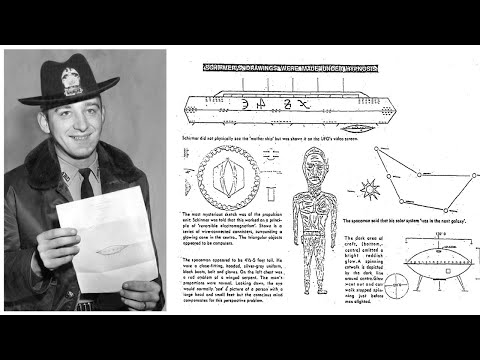
Herbert Schirmer Talks About Being Taken Onboard a UFO
Archival footage of Schirmer himself describing his December 3, 1967 encounter and the abduction narrative recovered under hypnosis.
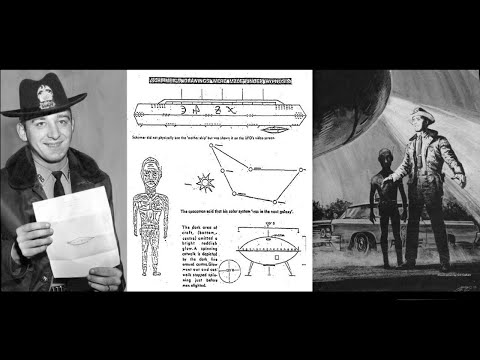
Herbert Schirmer Describes the Inside of the UFO
Archival footage in which Schirmer recounts details of the craft's interior and his encounter with its occupants, drawn from his hypnotically-recovered testimony.

Local UFO Story Revitalized After Beer, Comic Book Comes Out
Nebraska local news coverage (KMTV 3 News Now) of the case's modern cultural revival through Michael Jasorka's graphic novel and Kinkaider Brewing Co.'s commemorative beer.
Sources
- Condon, Edward U., et al. Scientific Study of Unidentified Flying Objects, University of Colorado, 1968/1969, "Case 42: State Trooper Sighting." files.ncas.org
- National Capital Area Skeptics (NCAS). Condon Report full text archive, Table of Contents. files.ncas.org
- University of Colorado Boulder. "One of the Last Government-Commissioned Reports on UFOs: What Does It Say?" CU Boulder Today, June 9, 2021. colorado.edu
- Randle, Kevin D. "The Schirmer Abduction," A Different Perspective (blog), October 2008. kevinrandle.blogspot.com
- Randle, Kevin D. "Leo Sprinkle Has Died," A Different Perspective (blog), November 2021. kevinrandle.blogspot.com
- UFO Evidence. "Police Officer Herbert Schirmer Abduction — Ashland, Nebraska, United States — December 3, 1967." ufoevidence.org
- United States Navy Memorial. "Schirmer, Herbert" — Navy Log service record. navylog.navymemorial.org
- MUFON. "MUFON Saddened by the Passing of Dr. R. Leo Sprinkle," December 7, 2021. mufon.com
- Earthfiles. "In Memoriam" — R. Leo Sprinkle obituary and career summary, November 19, 2021. earthfiles.com
- Legacy.com / Laramie Boomerang. "R. Leo Sprinkle obituary, 1930–2021, Laramie, WY." legacy.com
- Fringe Archives. "Herbert Schirmer UFO Encounter: Nebraska's 1967 Mystery." fringearchives.com
- Believing the Bizarre. "The Herbert Schirmer Alien Abduction." believingthebizarre.com
- Dorchester Times. "The Truth Is Out There: Our Area's UFO Sightings," August 2013. dorchestertimes.blogspot.com
- IBTimes UK. "Did Aliens Brand Him? Nebraska Officer Claims Abduction After Seeing Winged Serpent Logo." ibtimes.co.uk
- Omaha World-Herald. "A Nebraska Cop's Alleged UFO Encounter Lives On, Thanks to a Graphic Novel ... and a Beer." omaha.com
- The Independent (Grand Island, NE). "Artist Tells of Nebraska UFO Story in Comic Book." theindependent.com
- Wahoo Newspaper (Wahoo-Ashland-Waverly). "1967 Alien Abduction Tale Told in Graphic Novel." wahoo-ashland-waverly.com
- Encyclopedia.com. "Sprinkle, Ronald Leo (1930– )." encyclopedia.com
- Archives West / Orbis Cascade Alliance. "R. Leo Sprinkle Papers, 1961–2020" (finding aid, American Heritage Center, University of Wyoming). archiveswest.orbiscascade.org
- Clark, Jerome. The UFO Encyclopedia, 4th Edition, Visible Ink Press, 2023.
- Saunders, David R. & Harkins, R. Roger. UFOs? Yes! Where the Condon Committee Went Wrong, Signet, 1968.
- Fuller, John G. The Interrupted Journey: Two Lost Hours Aboard a Flying Saucer, Dial Press, 1966.
- Sprinkle, R. Leo. Statement, 1968 UFO Symposium. files.ncas.org
See something inaccurate? Have additional information or sources?
Suggest an Edit →Last Updated: August 2026