
The Portage County UFO Chase
Just before dawn on April 17, 1966, Portage County, Ohio sheriff's deputies Dale Spaur and Wilbur "Barney" Neff stopped on Route 224 to investigate what looked like an abandoned car and instead found themselves staring at a huge, brilliantly lit, dome-shaped object rising out of the woods beside them. What followed was one of the strangest police actions in American history: an 85-mile, high-speed pursuit across four counties and a state line, joined along the way by Mantua police chief Gerald Buchert (who independently photographed the object from his own yard), East Palestine patrolman H. Wayne Huston, and Conway, Pennsylvania patrolman Frank Panzanella, before the object finally shot straight up into the brightening dawn sky and vanished. The chase became national news within days. Project Blue Book chief Hector Quintanilla, working without his usual scientific consultant J. Allen Hynek, told the press the officers had spent much of the night chasing the planet Venus and a satellite — an explanation the deputies furiously rejected and Hynek himself only partially endorsed, rating the case a "strong Unidentified" in his own subsequent book. The fallout devastated the men involved: Huston quit the force and left the state, Neff withdrew from public life, and Spaur — hounded by reporters, ridiculed in print, and pressured by Blue Book to sign a statement he did not believe — lost his job, his marriage, and very nearly his sanity before his death in 1983.
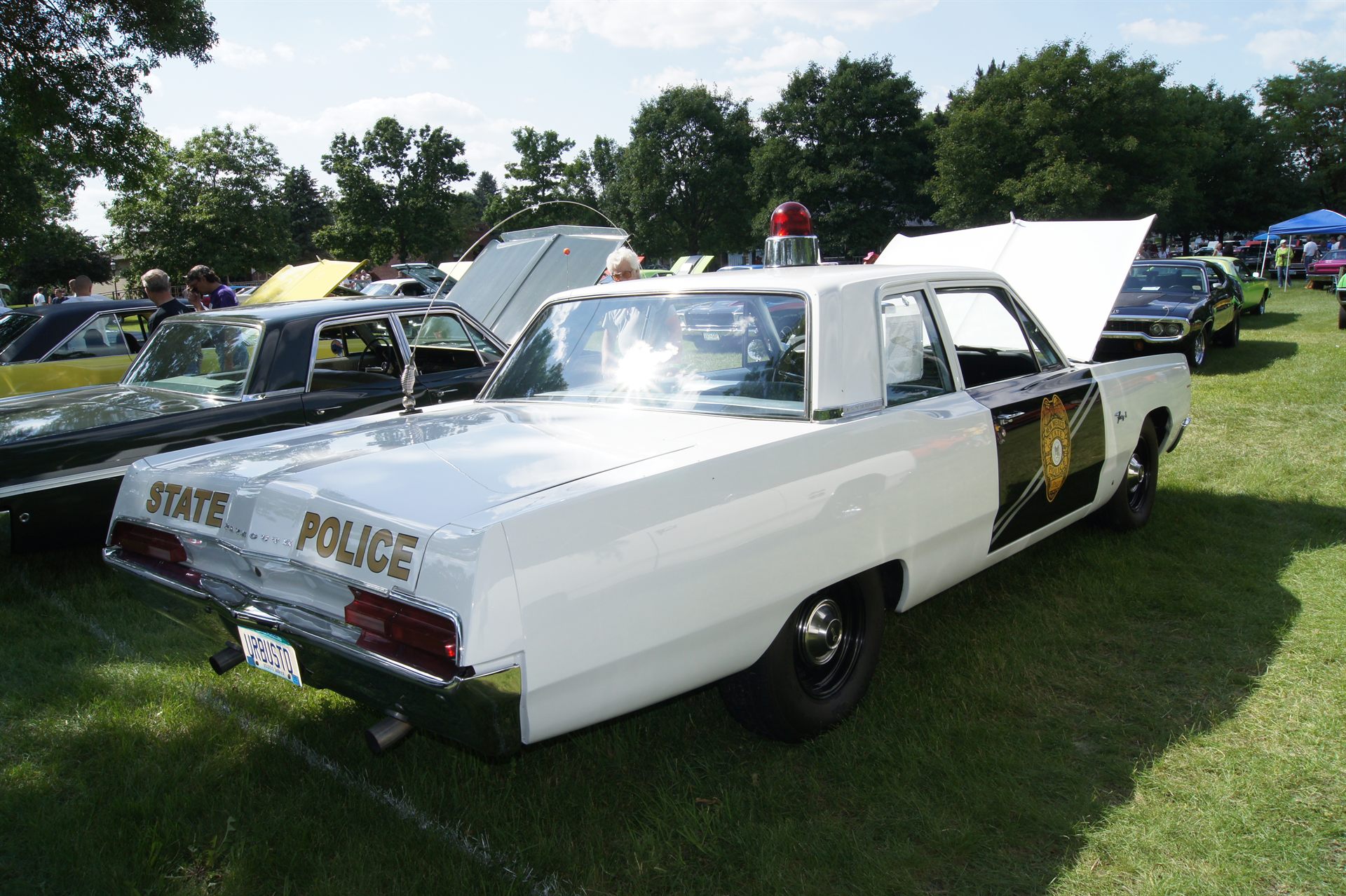
Pictured: a 1967 Plymouth Fury I police cruiser of the general type used by American sheriff's departments in the mid-1960s — not the actual patrol car involved. Chief Gerald Buchert's photograph of the object itself was confiscated for Air Force review and, according to the Air Force, came back "severely fogged"; no version has ever entered the public record in verifiable form.
Theoretical Alignment
Portage County is a genuinely difficult case to score because it is very likely two different phenomena stitched into one 85-mile narrative. The initial encounter — a huge, low, silent object rising out of the trees at close range, hovering over an occupied patrol car, and independently photographed from a different vantage point by Gerald Buchert at almost the same moment — cannot plausibly be the planet Venus, and it is this portion that keeps the Extraterrestrial Hypothesis alignment as high as it is: multiple professionally trained observers, arriving from different directions, described a structured, humming, light-emitting craft at ranges of a few hundred feet or less. But the alignment is capped well short of Exeter- or Coyne-tier scores because the case's own official investigator, chief consultant J. Allen Hynek, and his Blue Book colleague William T. Powers concluded that the later, longer stretch of the pursuit — watched from a moving car at increasing distance as dawn approached — lines up credibly with the real, independently verifiable position of Venus that morning, an object bright enough to be mistaken for a light "playing games" with a moving vehicle. That overlap is exactly why the Psycho-Social Hypothesis alignment is unusually high for this catalogue: an exhausted, adrenaline-charged, hour-long overnight pursuit is close to a textbook setup for perceptual contagion, in which an initial genuine anomaly primes several witnesses to keep reinterpreting an ordinary bright astronomical object as "the same thing" chasing them. The Interdimensional Hypothesis finds essentially nothing to work with: there is no reported occupant contact, missing time, or trans-dimensional "high strangeness," only a conventional (if unidentified) aerial object followed by a very bright planet.
Background
By April 1966, Project Blue Book, the U.S. Air Force's decade-old public UFO-investigation office, was under mounting pressure it had not previously faced. Weeks earlier, astronomer J. Allen Hynek, Blue Book's longtime scientific consultant, had been widely and derisively quoted attributing a wave of sightings near Ann Arbor, Michigan to swamp gas — a genuine phenomenon he had never claimed explained every report, but one the press flattened into a punchline that made "swamp gas" shorthand for official UFO cover-ups. Michigan Congressman and House Minority Leader Gerald Ford had publicly demanded hearings, declaring "the Air Force has been explaining away UFOs for years, and I don't believe the American people generally are satisfied," and the House Armed Services Committee obliged with its first public UFO hearing on April 5, 1966 — twelve days before a Sunday morning shift change in rural northeastern Ohio would hand Blue Book its next, and in some ways more damaging, controversy.
Portage County, Ohio, the county seat of Ravenna, was quiet farm and small-town country roughly thirty-five miles southeast of Cleveland. Deputy Sheriff Dale Spaur, a tall, Korean War-era Air Force veteran known around the department for a lead foot behind the wheel, was working the overnight shift with auxiliary deputy Wilbur "Barney" Neff in patrol car P-13. Sometime after 4:30 AM, a Summit County woman phoned in a report of a bright object in the sky; not long after, the pair was dispatched to check on what looked like an abandoned automobile parked on the berm of State Route 224 between the villages of Atwater and Randolph — a routine, unremarkable call that was about to become the opening scene of one of the most publicized UFO cases in American history.
Complete Timeline
| Date | Event |
|---|---|
| March 1966 | J. Allen Hynek's "swamp gas" remark on a wave of Michigan sightings draws national ridicule and Congressional criticism of Project Blue Book. |
| April 5, 1966 | The House Armed Services Committee holds Congress's first public UFO hearing; Air Force Secretary Harold Brown defends Blue Book's methods. |
| April 17, 1966, ~4:30 AM | A Summit County, Ohio woman phones in a report of a bright aerial object shortly before the Portage County incident begins. |
| ~5:00 AM | Deputies Dale Spaur and Wilbur Neff, dispatched to an apparently abandoned car on Route 224 between Atwater and Randolph Township, see a large, silent, self-illuminated object rise from the woods and approach their cruiser. |
| ~5:00 AM (same time) | Mantua police chief Gerald Buchert independently sees and photographs a similar object from near his own home. |
| Shortly after | The object hovers directly over patrol car P-13, bathing it in intense white light; Neff reportedly considers drawing his weapon before being ordered to stand down. Spaur radios dispatch, and Sgt. Hank Schoenfelt directs the deputies to follow it. |
| ~5:05–5:30 AM | Spaur and Neff pursue the object east on Route 224 and then Route 14 at speeds reported between 80 and 105 mph; the object appears to slow and "wait" when they fall behind, then accelerate away when they close the distance. |
| ~5:30 AM | East Palestine patrolman H. Wayne Huston, alerted by radio traffic, positions near the intersection of Routes 14 and 170, independently sees the object approaching, and joins the pursuit as Spaur and Neff arrive. |
| ~5:35 AM | The pursuing officers cross the Ohio–Pennsylvania state line, continuing east on what becomes U.S. Route 51 into Beaver County, Pennsylvania. |
| ~5:35–6:00 AM | Patrolman Frank Panzanella of Conway, Pennsylvania, who has already been watching the object from an Atlantic service station for roughly thirty minutes, is joined by the Ohio officers as the pursuit reaches Conway and nearby Freedom, Pennsylvania. |
| ~6:00–6:15 AM | As dawn breaks and Spaur's cruiser runs low on fuel, the object accelerates and climbs vertically, disappearing into the brightening sky near the visible positions of Venus and a quarter moon; the chase ends. |
| April 18, 1966 | Local Ohio newspapers, including the Ravenna Record-Courier, break the story; Major Hector Quintanilla makes a roughly 2.5-minute phone call to Spaur, reportedly opening with "tell me about this mirage you saw." |
| April 21, 1966 | Quintanilla places a second, roughly 1.5-minute phone call to Spaur. |
| April 22, 1966 | Quintanilla issues a preliminary Blue Book evaluation of the case. |
| May 11, 1966 | A further Project Blue Book interview session on the case is logged in the official case file. |
| May 17, 1966 | Air Force correspondence regarding the case is sent to Project Blue Book, later filed within Project 10073's official case record. |
| Following weeks | Blue Book's public position hardens into an official explanation: the officers spent part of the night observing an Echo-series satellite and, for the extended latter portion of the pursuit, the planet Venus. Spaur refuses to sign a statement limiting the sighting's duration and disputes the explanation publicly. |
| 1966 | Ohio Congressman William Stanton, dissatisfied with Blue Book's handling of the case, contacts the Pentagon directly; Lt. Col. John Spaulding acknowledges an "error" in not sending an investigator to Ohio immediately. |
| 1966 | NICAP investigator William B. Weitzel conducts an independent field investigation, obtains taped interviews and signed statements from the witnesses, and arranges to record Quintanilla's face-to-face interview with Spaur at the Portage County Courthouse. |
| 1966 | Weitzel's completed report is hand-delivered to Dr. Edward U. Condon, director of the newly formed University of Colorado UFO Project (the Condon Committee). |
| June 1966 | Spaur reports a brief further sighting of the object, which he privately nicknames "Floyd." |
| October 9, 1966 | The Cleveland Plain Dealer publishes an extensive follow-up feature documenting Dale Spaur's deteriorating personal life and marriage in the months since the chase. |
| 1968 | The Condon Committee's final report is published; it does not mention or address the Portage County case despite Weitzel's report having been delivered to Condon directly. |
| 1972 | J. Allen Hynek publishes The UFO Experience: A Scientific Inquiry, rating the Portage County case a "strong Unidentified" rather than endorsing Blue Book's Venus explanation in full. |
| 1977 | Steven Spielberg's Close Encounters of the Third Kind is released; its police-car pursuit sequence is widely cited by researchers and journalists as likely inspired in part by the Portage County chase. |
| April 4, 1983 | Dale Spaur dies of pneumonia following influenza, having spent years working to rebuild his life after the chase. |
| 1986 | Gerald Buchert dies, having remained Mantua's police chief for the rest of his career. |
An Abandoned Car on Route 224
The night had been ordinary. Dale Spaur and Wilbur "Barney" Neff were working the overnight shift out of the Portage County Sheriff's Office, patrolling in cruiser P-13, when a call came in shortly before 5:00 AM directing them to check on a car that appeared to have been abandoned on the berm of State Route 224, on the stretch between the small communities of Atwater and Randolph Township. It was the kind of call either man had answered a hundred times before. As they pulled over to investigate, Spaur noticed a light over the trees on the hill beyond the berm and called Neff's attention to it. Neither man thought much of it at first — a farmhouse light, perhaps, or a distant vehicle's headlamps against the hillside. Then the light began to move, and grow, and it became clear that its source was not fixed to the ground at all.
What rose from behind the treeline, by both deputies' consistent later accounts, was a large, self-illuminated object — described variously as shaped like "an ice cream cone tipped over on its side," with "a pointed stick-like thing on the rear," or as a dome-topped disc roughly 35 to 50 feet across and 15 to 25 feet high. It produced no engine noise, only a steady electrical hum "like an overloaded transformer." As it closed the distance and passed low overhead, both men reported feeling heat radiating from it, and its light was bright enough that looking directly at it was uncomfortable. The object came to a position directly over patrol car P-13, bathing the deputies, their vehicle, and the surrounding road in intense white illumination. Neff, according to several accounts of the encounter, reached for his sidearm and considered firing before being ordered to stand down — a detail that, whatever its outcome, underscores how immediate and threatening the encounter felt to two armed, professionally trained officers in the first minutes of what would become an 85-mile ordeal.
Gerald Buchert's Independent Sighting in Mantua
At almost exactly the same time, several miles away in the village of Mantua, Gerald Buchert — simultaneously Mantua's chief of police and a Portage County sheriff's deputy — heard the same dispatcher's alert go out over the radio calling for units to look for lights in the sky. Buchert drove home, woke his wife, and grabbed his camera. From near his own property, he watched an object he described as resembling two tea saucers joined together, a bright upper half inverted over a darker lower half, hovering near his yard before it moved off. He managed to take at least one photograph before it passed out of sight. Buchert's sighting mattered enormously to the case's credibility, because unlike a corroborating witness summoned to the same location after the fact, he observed and documented a matching object independently, from a different vantage point, before he had any opportunity to compare notes with Spaur and Neff. When the Air Force later took custody of his photograph for analysis, Buchert was reportedly discouraged from releasing it publicly; the Cleveland Plain Dealer nonetheless described its contents in print, and Quintanilla's office ultimately pronounced the negative "severely fogged" and evidentially worthless — a verdict that has never been independently checked, because no verifiable version of the photograph has surfaced since.
Eighty-Five Miles: The Chase Begins
Ordered by Sergeant Hank Schoenfelt to follow rather than let the object go, Spaur and Neff began what would become one of the longest documented UFO pursuits on record. The object moved east down Route 224 and then onto Route 14, and the deputies followed, reaching speeds their own later accounts placed between 80 and 105 mph on rural two-lane roads in the dark. What struck both men most was the object's apparent behavior: rather than simply outrunning them or holding a constant course, it seemed to slow and wait when the cruiser fell behind, then dart forward again as they closed the gap — a pattern Spaur would later describe as "playing a game of cat-and-mouse" with them. Dispatch radio carried their running position reports across the county and beyond, a detail that would prove essential a few minutes later when the pursuit crossed into the jurisdiction of a small-town police department that had never heard of Dale Spaur or Wilbur Neff before that morning.
Crossing Into Pennsylvania: Wayne Huston and Frank Panzanella
H. Wayne Huston, a patrolman with the East Palestine, Ohio police department, had been listening to the escalating radio traffic and positioned his own cruiser near the intersection of Routes 14 and 170, hoping to get a look at whatever the deputies were chasing. He did not have to wait long: Huston independently spotted the object approaching from the west, confirmed it matched the description coming over the radio, and fell in behind Spaur and Neff as they passed his position, adding a third professional witness to a pursuit that had, within half an hour, already crossed multiple township and county lines. The chase continued east, crossing the Ohio–Pennsylvania state line on Route 14 (which becomes U.S. Route 51 across the border) and pressing on through Beaver County toward the towns of Rochester, Freedom, and finally Conway. There, the officers found a fourth independent witness waiting for them: Patrolman Frank Panzanella of the Conway police department, who told investigators he had already been watching the same or a very similar object from an Atlantic service station for approximately thirty minutes before the Ohio cruisers ever arrived — a Pennsylvania officer, with no radio contact with the Ohio pursuit until the very end, independently describing a matching object well before he had any reason to expect one.
Dawn at Conway: The Object Departs
By the time the pursuit reached Conway, the eastern sky was beginning to lighten with the approach of sunrise, and Spaur's cruiser was running low on fuel after nearly an hour and a half of high-speed driving. As the officers regrouped near the service station, the object — by this point described by several witnesses as more distant, and increasingly difficult to distinguish from the brightening dawn sky — accelerated upward and climbed out of sight, ascending, in some accounts, for upward of ten minutes before disappearing entirely. Witnesses in Conway noted that both a quarter moon and a very bright object low in the eastern sky — almost certainly the planet Venus, then near its greatest brilliancy as a morning star — were visible at the moment the pursued object made its final ascent, a detail that would become central to the controversy that followed within days. With their quarry gone and fuel running out, the officers ended the pursuit and began the long drive back to their respective jurisdictions, none of them yet aware that the story was about to become a national sensation.
Major Hector Quintanilla and the Venus Explanation
Word of the chase reached the press almost immediately, and from the press it reached Project Blue Book's headquarters at Wright-Patterson Air Force Base in Dayton, Ohio. Blue Book chief Major Hector Quintanilla handled the case almost entirely by telephone rather than in person: a roughly two-and-a-half-minute call to Spaur on April 18, in which he reportedly opened by asking Spaur to "tell me about this mirage you saw," followed by a second, shorter call on April 21. According to Weitzel's later documentation, Quintanilla also pressed Spaur to sign a statement limiting the sighting's total duration to only a few minutes, an account Spaur refused to accept as accurate. Within weeks, Blue Book's official public position hardened into a specific conventional explanation: the deputies had observed an Echo-series communications satellite for part of the encounter and, for the longer latter portion of the pursuit, the planet Venus — low, brilliant, and, in the official telling, badly misjudged by exhausted men driving at high speed through the dark. Quintanilla denied that any Air Force jets had been scrambled in response to the sighting and maintained that regional radar had shown nothing unusual, claims that were never independently confirmed one way or the other and that the officers themselves flatly disputed, noting they had observed the object, the moon, and Venus simultaneously and could plainly distinguish among them.
What made the Air Force's handling of the case unusually controversial, even by Blue Book's already-contested standards, was procedural rather than purely substantive: normal Blue Book practice called for an astronomical identification of this kind to be reviewed by the program's civilian scientific consultant, J. Allen Hynek, before it was issued publicly. In the Portage County case, by Hynek's own later account, that consultation never happened. Quintanilla's explanation went out to the press essentially unreviewed by the one person on Blue Book's staff with the astronomical training to properly evaluate it — a break from procedure that fed directly into the case's broader reputation as an example of institutional carelessness rather than rigorous investigation.
J. Allen Hynek, William Powers, and a More Cautious Verdict
Hynek, learning of Quintanilla's Venus explanation after the fact, did not simply endorse it. He was openly critical of how the case had been investigated, later describing aspects of Quintanilla's telephone-only interrogation approach as unprofessional, and he made clear that a bright planet low on the horizon could not, by itself, account for the case's opening minutes — a large, structured object rising from treetop height, hovering over an occupied patrol car, and independently photographed from a separate location by Gerald Buchert at nearly the same moment. At the same time, Hynek's Blue Book colleague William T. Powers, a physicist who worked through the astronomical geometry of the sighting in detailed correspondence with NICAP's Weitzel, concluded that Venus's real position in the sky that morning was consistent with what the pursuing officers described seeing during the later, more distant phase of the chase, once dawn was breaking and the object was reported at greater range. The result was neither a full vindication of the officers nor a full endorsement of Blue Book's official position: in his own 1972 book, The UFO Experience: A Scientific Inquiry, Hynek rated the Portage County case a "strong Unidentified" — a verdict that satisfied almost no one, since it was too skeptical for a case the officers insisted was a single continuous encounter, and too charitable toward an anomalous origin for a Blue Book leadership that had already gone on record with a full Venus explanation.
William Weitzel, NICAP, and the Congressional Paper Trail
The most thorough contemporary investigation of the case was conducted not by the Air Force but by William B. Weitzel, chairman of NICAP's Pennsylvania subcommittee, working on behalf of the National Investigations Committee on Aerial Phenomena. Weitzel interviewed the witnesses directly, obtained signed statements and sketches from several of them, and — at Spaur's own request — arranged to record Quintanilla's eventual face-to-face interview with the deputy at the Portage County Courthouse, with fellow ufologist David Webb present as well. The resulting tape and transcript, later partially reproduced in Hynek's own writing, documented an interrogation style several researchers considered heavy-handed for a witness whose only offense was reporting what he had seen while on duty. Weitzel assembled the full body of taped interviews, statements, sketches, and correspondence — including his detailed exchange with William Powers on the Venus calculations — into a comprehensive case report that was made available to Congressional investigators and, when the University of Colorado's UFO Project began its work later that year, hand-delivered directly to project director Dr. Edward U. Condon. Despite that direct delivery, the Condon Committee's final 1968 report never mentioned the Portage County case at all, an omission researchers have cited ever since as evidence of the report's selective and incomplete engagement with the strongest cases available to it.
Congressman Stanton and the Pentagon's Concession
The case also drew direct political attention. Ohio Congressman William Stanton, dissatisfied with how cavalierly Blue Book appeared to have handled a sighting involving multiple sworn officers in his own state, contacted the Pentagon to press for a fuller accounting. In response, Lieutenant Colonel John Spaulding — the same Blue Book officer who, months later, would write the Air Force's effective non-explanation letter in the Exeter case — acknowledged an "error" in Blue Book's initial handling of Portage County, specifically that no investigator had been sent to Ohio to interview the witnesses in person before Quintanilla's telephone-based explanation went to the press. It was a rare, if limited, official concession that the case had not been investigated to the standard the Air Force itself claimed to apply, and it added a Congressional dimension to a controversy that was already testing the patience of a legislature that had, only two weeks earlier, held its first-ever public hearing on the broader UFO question.
The Officers' Ruined Lives
The human cost of the case fell unevenly and, for at least one man, catastrophically. Wayne Huston quit the East Palestine police force in the aftermath and relocated to Seattle, Washington, where he became a bus driver and began going by his middle name, Harold, rather than Wayne — a quiet, permanent retreat from a story he had only glancingly been part of. Neff withdrew almost entirely from public discussion of the case, eventually moving to Florida; asked years later for an interview, he reportedly replied, "I don't look up anymore. I look down. I just want to forget." Panzanella, inundated with phone calls from reporters and curiosity-seekers, ultimately disconnected his home telephone but never recanted his account. Buchert remained Mantua's police chief for the rest of his working life, though the sustained community suspicion and scrutiny took a visible toll, and he kept a private scrapbook of clippings and documentation related to the case until his death in 1986.
It was Dale Spaur who paid the highest price. Encouraged by NICAP to keep speaking publicly about the case even as the other officers went quiet, Spaur bore the brunt of the ridicule that followed Blue Book's Venus explanation. He lost weight, lost sleep, and by that October — according to the Cleveland Plain Dealer's extensive follow-up feature — was living out of a motel room, separated from his wife and two sons, eating peanut butter sandwiches and struggling to hold a job. He was eventually arrested for assault and battery of his wife amid the strain, lost his position with the sheriff's department, and left Ohio for a time to work in the coal mines of West Virginia, where he later suffered a severe accident, falling roughly seventy feet down a mine shaft and breaking his back. He rebuilt his life gradually in the years that followed, remarrying, settling near Cleveland, and eventually running a small bar; he reportedly consulted informally, and briefly, on Steven Spielberg's Close Encounters of the Third Kind before walking away from the production over creative disagreements about how the police-officer character was portrayed. Spaur died of pneumonia following influenza on April 4, 1983. In one of his last recorded interviews, he put it simply: "If I could change all that I have done in my life, I would change just one thing…that saucer."
Legacy: Close Encounters and Cultural Memory
The Portage County chase has become one of the most frequently cited "police UFO chase" cases in American popular culture, and researchers and journalists have long noted the resemblance between its three-cruiser, cross-jurisdiction pursuit and the police-car chase sequence that opens Steven Spielberg's 1977 film Close Encounters of the Third Kind, in which Roy Neary and law-enforcement officers unsuccessfully chase unidentified aerial lights by road. Spielberg has never issued a single definitive statement crediting Portage County alone as the sequence's inspiration — the film drew on multiple real cases and general 1960s UFO lore — but the parallel is close enough, and Spaur's own reported brush with the production close enough, that the connection has become a fixture of how the case is remembered. More substantively, the case is remembered within ufology as one of the clearest illustrations of Project Blue Book's credibility problem in its final years: a case with more corroborating professional witnesses than almost any other in the program's files, handled with a speed and carelessness — a chief investigator who skipped his own program's normal scientific review, an in-person field investigation that NICAP conducted and the Air Force did not, and a Congressional complaint that produced only a partial admission of error — that did lasting damage to public confidence in Blue Book at precisely the moment its future was being decided.
Circumstantial Evidence
- Chief Gerald Buchert independently observed and photographed a matching object from a separate location at almost the same moment Spaur and Neff first saw theirs, before any of the officers had spoken to one another.
- Five professional law-enforcement witnesses across two states and multiple jurisdictions converged on broadly consistent descriptions without prior coordination.
- Patrolman Frank Panzanella observed a matching object in Conway, Pennsylvania roughly thirty minutes before the pursuing Ohio officers arrived, with no radio contact connecting his sighting to theirs until the very end.
- Standard Portage County Sheriff's dispatch radio logs documented the deputies' real-time position reports throughout the pursuit, independently corroborating the chase's timeline and route.
- Blue Book's own chief investigator, Hector Quintanilla, issued the case's official astronomical explanation without the normal prior review of Blue Book's scientific consultant, J. Allen Hynek — a documented procedural departure Hynek himself later criticized.
- Congressman William Stanton's direct complaint to the Pentagon produced Lt. Col. John Spaulding's acknowledgment of an "error" in Blue Book's initial failure to send an investigator to Ohio.
- NICAP investigator William Weitzel's independently gathered taped interviews and signed statements were made available to Congressional investigators and hand-delivered to Condon Committee director Edward U. Condon.
Blue Book's Credibility Crisis and the Road to Condon
Portage County did not happen in isolation from Project Blue Book's broader institutional troubles. It followed within weeks of Hynek's "swamp gas" remark on the Michigan sightings and the House Armed Services Committee's first public UFO hearing on April 5, 1966, and it arrived at a moment when Congress, the press, and a meaningful slice of the public were already primed to view Blue Book's explanations with suspicion. The specific procedural failures in this case — a chief investigator who bypassed his own program's normal scientific review before issuing an astronomical explanation, a field investigation the Air Force never conducted in person while a civilian organization did, and a Congressional complaint that produced only a partial admission of error rather than a fuller accounting — became, in the hands of researchers like James E. McDonald and organizations like NICAP, a recurring talking point in the argument that Blue Book's investigative rigor did not match its public claims. That argument fed directly into the pressure that produced the University of Colorado's Condon Committee later that year — even though, in a final irony the case's defenders have never let go of, the Condon Report itself never so much as mentioned Portage County despite William Weitzel's report having been hand-delivered to Edward Condon directly.
Key Witnesses
Deputy Sheriff Dale Spaur
The first officer to see the object rise from the trees along Route 224, Spaur stayed with the pursuit for its full 85 miles into Pennsylvania and became the case's most public and most damaged figure. He refused to sign a Blue Book statement limiting the sighting's duration, spoke publicly about the case even as other witnesses went silent, and endured job loss, divorce, and years of hardship before rebuilding his life. He died in 1983.
Auxiliary Deputy Wilbur "Barney" Neff
Spaur's partner on patrol car P-13, Neff was present for the object's initial approach and reportedly considered drawing his weapon as it hovered over the cruiser. He stayed with the pursuit throughout but withdrew from public discussion of the case afterward, eventually relocating to Florida and declining most later interview requests.
Police Chief Gerald Buchert
Alerted by the same radio dispatch, Buchert independently observed and photographed a matching object from near his own home at almost the same moment Spaur and Neff first saw theirs, in a location well removed from Route 224. His photograph was taken into Air Force custody and reportedly returned "severely fogged"; no verifiable version has surfaced publicly since. He remained Mantua's police chief until his death in 1986.
Patrolman H. Wayne Huston
Alerted by escalating radio traffic, Huston independently spotted the object approaching his position near the intersection of Routes 14 and 170 and joined the pursuit as it passed. He quit the police force after the case's aftermath, relocated to Seattle, Washington, became a bus driver, and began going by his middle name, Harold.
Patrolman Frank Panzanella
Panzanella had already been observing the object from an Atlantic service station in Conway for roughly thirty minutes before the pursuing Ohio officers arrived, giving the case its fourth, entirely independent professional witness in a second state. Overwhelmed by press inquiries afterward, he disconnected his home telephone but never recanted his account.
The Five Observables Assessment
The Five Observables framework, developed by former AATIP director Luis Elizondo, is used to classify UAP encounters by performance characteristics exceeding known technology of their era. As with other purely visual, non-instrumented sightings in this catalogue, Portage County is an imperfect fit: everything below reflects what five witnesses impressionistically described from a moving vehicle over roughly ninety minutes, not anything independently measured by radar or onboard instrumentation.
Assessment: Anti-Gravity Lift is rated speculative because the object was repeatedly described hovering over the patrol car and at various points along the pursuit route with no visible wings, rotors, or other conventional means of support — consistent with a genuinely unconventional lift mechanism, but based entirely on unaided visual observation under high stress rather than any instrumented reading. Instant Acceleration is rated speculative on similar grounds: the object's "cat-and-mouse" behavior, slowing when the officers fell behind and bolting when they closed the distance, and its final vertical departure at Conway, were reported consistently across multiple witnesses, but no radar or other timed measurement exists to confirm any specific rate of acceleration. Hypersonic Velocity is rated absent, since even the pursuit's most extreme reported speeds — the deputies' own cruiser reaching 80 to 105 mph — describe a chase, not anything approaching supersonic performance. Low Observability is rated absent and distinctively so for this catalogue: the object was, by every account, extremely bright and conspicuous, its light powerful enough to illuminate the road and the interior of the patrol car, the opposite of a stealthy or hard-to-detect craft. Trans-Medium travel is rated absent, as the entire encounter took place in open air with no reported transition between air, water, or any other medium. Taken together, the observable profile is that of a highly visible object exhibiting apparently intelligent, evasive flight behavior at close range for its opening minutes, followed by a much longer stretch of distant, ambiguous observation consistent with either continued pursuit of the same craft or a gradual drift into misidentifying a bright planet.
Evidence Assessment
Supporting Anomalous Origin
- Five independent, professionally credentialed law-enforcement witnesses across two states corroborated the object's basic appearance and behavior with no prior coordination.
- Gerald Buchert's independent, near-simultaneous sighting and photograph from a separate location cannot be explained by Venus, since it involved a close-range object at low altitude near his own home.
- The object's initial approach — rising from treetop height and hovering directly over an occupied patrol car — describes a close-range encounter incompatible with a distant astronomical object.
- Blue Book's own scientific consultant, J. Allen Hynek, declined to fully endorse his own program's official Venus explanation, rating the case a "strong Unidentified" in his own subsequent book.
- Blue Book's chief investigator issued the case's astronomical explanation without the normal internal scientific review, a documented procedural failure rather than a settled finding.
- NICAP's independent field investigation, conducted with more rigor than the Air Force's own telephone-based inquiry, treated the case as substantively unresolved.
Supporting Conventional Explanation
- Venus was near its greatest brilliancy as a morning star and low in the eastern sky at the time and location of the pursuit's later, more distant phase, a real and independently verifiable astronomical fact.
- Blue Book physicist William T. Powers's detailed geometric analysis found the reported position of the object during the extended chase consistent with Venus's actual position that morning.
- No radar, photographic, or other instrumented evidence corroborates the officers' estimates of the object's altitude, distance, or speed at any point in the pursuit.
- Witness descriptions of altitude and distance varied considerably over the course of the encounter and between witnesses, consistent with the kind of estimation drift common in prolonged, high-stress nighttime observation.
- None of the officers had specialized training in aircraft or astronomical identification, and all were operating under significant fatigue and adrenaline during an unplanned, hour-and-a-half overnight pursuit.
Why "Disputed"
The Portage County UFO Chase earns a DISPUTED rating on this site's scale because it combines an unusually large pool of independent, professionally credentialed witnesses with a real, astronomically verifiable partial conventional explanation that neither side has ever fully reconciled with the other. On the strength side: five separate law-enforcement officers across two states, none of whom had met or coordinated with one another before that morning, converged on a broadly consistent description of a close, bright, humming object; Chief Gerald Buchert's independent, near-simultaneous sighting and photograph from a different location cannot be explained by a distant planet; and Blue Book's own chief investigator issued the case's official explanation without the internal scientific review his program's own procedures required, a documented lapse that even the Air Force partially conceded to Congressman Stanton. On the other hand, the case's later, longer pursuit phase overlaps with the real, verifiable position of Venus at peak morning brilliancy that same morning, a coincidence detailed enough that Blue Book's own physicist and, more cautiously, Hynek himself found genuinely persuasive for that portion of the encounter; no radar, physical trace, or independently examinable photograph survives to settle the question either way; and the witnesses' own altitude and distance estimates shifted considerably over the course of an exhausting, adrenaline-charged, hour-and-a-half overnight chase. That combination — a real, multiply-corroborated close encounter very likely embedded within a much longer stretch of ambiguous, possibly astronomical misidentification — is exactly what "disputed" is meant to capture: a case substantial enough to have shaped Congressional and public skepticism of Project Blue Book, but not one that resolves cleanly in either direction.
Sensor & Instrumentation Detection Profile
No radar, camera, or automated sensor system independently tracked the object at any point. This alone separates Portage County from radar-visual cases like Lakenheath-Bentwaters: nothing in the extensive Air Force and NICAP paperwork on this case cites a corresponding Air Defense Command or civil radar return for the April 17 window, a real evidentiary gap rather than a documented negative result, since no one has ever confirmed whether regional radar coverage was even checked. The closest thing to instrumentation the case possesses is the Portage County Sheriff's own radio dispatch log: Deputies Spaur and Neff repeatedly radioed their position to the dispatcher throughout the pursuit specifically so other patrol units could triangulate and intercept, and it was this real-time radio traffic — not any visual coincidence — that pulled in Wayne Huston in East Palestine and, ultimately, Pennsylvania officer Frank Panzanella near Conway. Chief Gerald Buchert's photograph is the case's one piece of would-be documentary evidence, but it functioned as an anti-instrument rather than a corroborating one: Air Force personnel took possession of the negative for review and, according to Hector Quintanilla, it came back "severely fogged" and unusable — a claim that has never been independently verified because the photograph itself has never surfaced in the public record in examinable form.
Environmental & Geospatial Context
The chase unfolded across the rolling farm country of northeastern Ohio in the last hour of full darkness before an April sunrise, running east from rural Portage County through Deerfield, Palmyra, Salem, and East Palestine before crossing into Beaver County, Pennsylvania on Route 51 and ending near Conway and Freedom, Pennsylvania. This is precisely the kind of environment — dark, low-light-pollution farmland along a state highway corridor, with dawn twilight steadily brightening the eastern sky over the course of the pursuit — in which a genuinely bright astronomical object low on the horizon becomes progressively harder to rule out the longer an encounter runs. April 17, 1966 fell during a period when Venus was near its greatest brilliancy as a "morning star," rising in the east several hours before the sun and reaching a magnitude bright enough to cast shadows and to be mistaken, at a glance from a moving vehicle, for a structured light source pacing the car; a quarter moon was also above the horizon. None of this environmental context explains the case's opening minutes, when the object was reported at treetop height and close range rather than near the horizon — but it is essential to understanding why Blue Book's later explanation, however unwelcome to the officers, was not simply invented from nothing.
Observer Credibility & Occupational Profile
Portage County's central credibility asset, like Exeter's, is occupational: nearly every primary witness was an on-duty law-enforcement officer with no history of UFO interest and a professional incentive to avoid attaching his name to an implausible story. Dale Spaur, a Korean War-era U.S. Air Force veteran before joining the Portage County Sheriff's Office, and Wilbur Neff, his auxiliary partner on the night shift, were the first to encounter the object and stayed with the pursuit for its full 85-mile length. Gerald Buchert, simultaneously Mantua's police chief and a Portage County deputy, independently observed and photographed a matching object from near his own home at almost the same time Spaur and Neff first saw theirs — a same-night, same-morning corroboration from a professional witness with no contact with the other deputies until afterward. Wayne Huston of the East Palestine Police Department joined only after independently spotting the object approaching his position from the west, and Pennsylvania patrolman Frank Panzanella had already been watching the same or a similar object from a Conway gas station for roughly thirty minutes before the Ohio officers arrived. None of the five men had met each other, coordinated a story, or sought publicity before that morning; several actively avoided it afterward. Their credibility is real but not unlimited: none had specialized training in aircraft or astronomical identification, all were working a physically and emotionally exhausting overnight pursuit at high speed, and their descriptions of altitude, distance, and speed varied considerably from witness to witness and from the beginning of the chase to its end.
Physical & Material Assays
The case produced no debris, no landing trace, and no laboratory-testable physical sample of any kind, and no participant or investigator has ever claimed otherwise. Its one candidate physical artifact, Gerald Buchert's photograph, was never independently examined by a third party in any verifiable way: the Cleveland Plain Dealer described what it depicted as resembling "two saucers put together, with a light upper saucer upside down over a dark lower saucer," but the Air Force's own verdict — that the negative was "severely fogged" and therefore evidentially useless — has never been checked against the original by any independent photo analyst, because the photograph's current whereabouts and condition are unknown. No vehicle malfunction, radio interference beyond the object's own reported electrical hum, or physiological effect on any witness was ever reported, distinguishing this case from electromagnetic-effects cases like Levelland. The documentary record that does survive is unusually extensive for a 1966 sighting precisely because of the controversy that followed: NICAP investigator William Weitzel's taped recording of Major Quintanilla's in-person interview with the witnesses at the Portage County Courthouse, the deputies' own Air Force Technical Intelligence (FTD) Form 164 reports, and a multi-page technical letter from Blue Book physicist William T. Powers to Weitzel walking through the Venus-position calculations in detail all survive and are cataloged in NICAP's archive.
Historical Precedents & Archive Matches
Portage County belongs to the same police-corroborated sighting category as Exeter and the 1957 Levelland, Texas wave, in which trained officers independently converge on a consistent description of an unusual object — but it is distinguished within that category by its sheer geographic scale: rather than two officers confirming each other at a single field, it strings together five separate professional witnesses across two states over the better part of two hours, more closely resembling a rolling, multi-jurisdiction pursuit than a static observation. It also sits squarely inside the credibility crisis that would define Project Blue Book's final years: it followed within weeks of Hynek's much-mocked "swamp gas" explanation for a wave of Michigan sightings in March 1966, and it fed directly into the same wave of Congressional and public skepticism that produced the House Armed Services Committee's April 5, 1966 UFO hearing and, eighteen months later, the University of Colorado's Condon Committee study. Structurally, its aircrew-adjacent, multi-witness-across-distance profile prefigures later corroborated-instrument cases like the 1973 Coyne helicopter incident, in which professional occupational credibility, again absent any physical evidence, carried the case's entire evidentiary weight.
Material Analysis
Portage County produced no debris, no ground trace, and no recoverable physical sample of any kind, and no witness or investigator has ever claimed otherwise. The case's sole candidate physical artifact is Gerald Buchert's photograph, taken from near his own home at almost the same moment Spaur and Neff's encounter began. Once the Air Force took possession of the negative for review, its fate became a small mystery of its own: Quintanilla's office pronounced it "severely fogged" and evidentially useless, a characterization the Cleveland Plain Dealer's own contemporaneous description of the image's contents — "two saucers put together, with a light upper saucer upside down over a dark lower saucer" — sits somewhat uneasily alongside, since a badly fogged negative would typically yield little describable detail at all. Because no independently examinable version of the photograph has surfaced since 1966, neither the Air Force's dismissal nor a more charitable reading of the newspaper's description can be verified today. Beyond the photograph, the only other quasi-physical record of the case is administrative rather than forensic: the Portage County Sheriff's dispatch radio log documenting the deputies' real-time position reports, which corroborates the pursuit's timeline and route without saying anything about the object's actual nature.
Supporting a Genuine Anomalous Encounter
- Buchert's photograph was taken independently, from a different location, before he had any contact with the other officers, ruling out simple copying or coordination.
- The newspaper's contemporaneous description of the photograph's visible contents does not obviously match a "severely fogged" negative that would show little or no detail.
- The dispatch radio log independently corroborates the pursuit's real-time timeline and multi-jurisdiction route, supporting the basic factual framework of the officers' account.
Supporting a Mundane Origin
- The photograph's current whereabouts and condition are unknown, meaning its evidentiary value cannot be independently tested by any modern analyst.
- A hand-held photograph of a bright light source taken by an amateur photographer at night is a well-documented source of lens flare, motion blur, and other fogging-like artifacts unrelated to any genuinely anomalous object.
- No chain-of-custody documentation for the negative between its confiscation and Quintanilla's public description of it has ever been published, leaving the Air Force's characterization unverifiable but also unrefuted.
The Conventional Explanation Candidate: Venus and an Echo Satellite
Venus / Echo Satellite
Partially Plausible ImplausibleProject Blue Book's official explanation, advanced by Hector Quintanilla and subsequently given partial technical support by physicist William T. Powers's astronomical analysis, holds that the deputies observed an Echo-series satellite pass for part of the encounter and, for the much longer latter portion of the pursuit, the planet Venus — then near its greatest brilliancy as a morning star and low in the eastern sky, exactly the position and brightness that could plausibly be mistaken, from a moving vehicle in the dark, for a light "pacing" the car. This candidate deserves serious evaluation because its central astronomical premise is independently verifiable and was not disputed even by Hynek: Venus really was in that part of the sky, at that brightness, that morning.
Its central weakness is the case's opening minutes. A distant planet, however bright, cannot rise from behind a treeline at low altitude, hover directly over an occupied patrol car close enough to radiate perceptible heat, or be independently photographed from a separate vantage point by Gerald Buchert at almost the same moment Spaur and Neff's encounter began. Venus also cannot account for the object's reported "cat-and-mouse" behavior — slowing when the pursuing cruiser fell behind and accelerating when it closed the distance — a pattern of apparently responsive maneuvering that a fixed celestial body simply does not exhibit, whatever illusions relative motion against clouds or a moving vehicle's own turns might create. Blue Book's own investigation never adequately separated the encounter's close-range opening phase from its more distant, ambiguous later phase, treating the entire 85-mile, hour-and-a-half event as a single continuous misidentification rather than acknowledging — as Hynek himself ultimately did — that the case most plausibly represents two different phenomena run together into one narrative.
Student Hoax or Prank
ImplausibleA far less credible theory, circulated in the months after the case broke, held that the object was some kind of ground-based hoax or prank, with a Kent State University student newspaper item later floating the claim that students had built or staged the "UFO." This candidate has never been substantiated by any investigator, official or independent, and it struggles badly against the case's basic facts: no hoax device has ever been produced or credibly described, and no student prank could plausibly account for a structured object independently observed by five separated law-enforcement witnesses across 85 miles and two states, several of whom had no way of knowing where or when to expect it.
Misidentified Aircraft or Weather Balloon
ImplausibleA third, more mundane candidate proposes a conventional aircraft or a lit weather balloon as the object's true identity, at least for the encounter's early, close-range phase. This candidate has never been endorsed by any investigator who examined the case closely, in part because it fails to explain the object's reported silence beyond an electrical hum (inconsistent with any propeller or jet aircraft of the era), its extremely low initial altitude and hovering behavior over an occupied vehicle, and the absence of any logged, scheduled aircraft or balloon operation in the area that could plausibly correspond to the sighting.
Related Cases
Confirmed Documents & Official Records
National Archives finding aid covering UAP-related textual holdings, including Project Blue Book's Project 10073 case files that contain the Portage County correspondence, FTD Form 164 witness reports, and Air Force internal memoranda on the case.
UNCLASSIFIEDThe National Investigations Committee on Aerial Phenomena's own case directory, indexing William Weitzel's field investigation materials, witness statements, and correspondence with Blue Book physicist William T. Powers.
PUBLIC RECORDSearch Government Archives Directly
Further Reading — Recommended Literature
The Hynek UFO Report
Written by Blue Book's own scientific consultant, whose more cautious "strong Unidentified" verdict on Portage County directly contradicted his own program's official Venus explanation.
Project Blue Book Exposed
A detailed critical history of Blue Book's investigative practices, including the procedural shortcuts and skipped scientific review that made cases like Portage County so controversial.
Watch the Skies!: A Chronicle of the Flying Saucer Myth
A rigorously skeptical, well-documented history of American UFO cases spanning the 1966 Congressional-hearing era, useful context for the Blue Book credibility crisis Portage County exemplifies.
The UFO Encyclopedia, 4th Edition
The definitive UFO reference work, with an extensively cited entry on the Portage County/Ravenna police chase situating it within the broader 1966 Blue Book controversy.
The UFO Controversy in America
An academic history of American UFO investigation with a foreword by J. Allen Hynek, covering the 1966 wave of Congressional and public skepticism toward Blue Book that Portage County helped fuel.
Essential Viewing
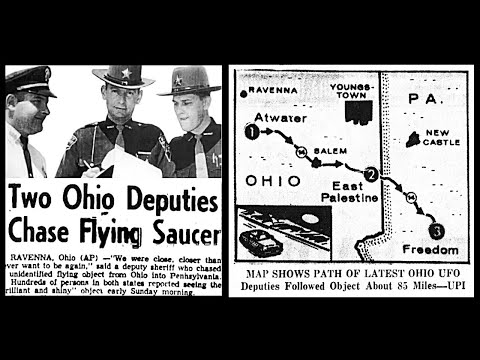
Deputy Sheriff Dale Spaur Talks About the Portage County UFO Chase
Archival footage of Dale Spaur himself describing the encounter, recorded within days of the April 17, 1966 chase.
UFO Case Review: Portage County UFO Chase, 1966
A focused case walkthrough covering the timeline, the witnesses, and the Blue Book controversy.
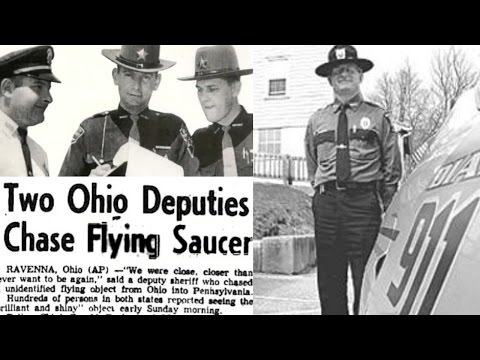
The Portage County Ohio UFO Chase & Police Encounter in 1966
A dedicated overview of the encounter and its aftermath from the FindingUFO channel.
The Portage County UFO Chase, April 17, 1966
A dedicated retrospective on the case from the EyesOnTheSkies channel.
AudioBlog: Portage County UFO Chase
An audio-blog style discussion from Podcast UFO Live Shows covering the case's investigative record.
Sources
- Gross, Patrick. "UFOs at Close Sight: The 1966 Portage County Police UFO Chase." ufologie.patrickgross.org
- Gross, Patrick. "The 1966 Portage County Police UFO Chase — Richard Hall's Account." ufologie.patrickgross.org
- National Investigations Committee on Aerial Phenomena (NICAP). "Portage County, Ohio UFO Chase, April 17, 1966" case directory. nicap.org
- NICAP. "Portage County Document Page" — FTD Form 164 reports, Weitzel-Powers correspondence, Air Force memoranda. nicap.org
- UFO Evidence. "Portage County, Ohio UFO Chase — April 17, 1966" case summary. ufoevidence.org
- UFO Casebook. "The Portage County, Ohio, UFO Chase." ufocasebook.com
- The Ohio Project. "Ohio and the Great UFO Chase of 1966." theohioproject.net
- The Pennsylvania Rambler. "The Great UFO Chase: Part One," February 20, 2022. thepennsylvaniarambler.wordpress.com
- Wolford, Ben. "Seeing a UFO Ruined Dale Spaur's Life," The Portager, via Medium. medium.com
- Cleveland Scene. "Strangers in the Night." clevescene.com
- Cleveland Scene. "50 Years Ago, a Small Town Ohio Policeman Chased a Flying Saucer Into Pennsylvania…And It Ruined His Life," April 2016. clevescene.com
- Podcast UFO. "The Portage County UFO Chase" (episode page and case summary). podcastufo.com
- UFO Insight. "The Portage County UFO Chase." ufoinsight.com
- Anomalien. "Portage County Police Officers Pursue UFO in 1966." anomalien.com
- How and Whys. "Ohio Policeman Dale Spaur Chased Huge UFO For 138 Km In 1966, But It Ruined His Life." howandwhys.com
- Think About It Docs. "1966: Portage County, Ohio UFO Chase." thinkaboutitdocs.com
- Alien-UFO-Research. "Portage County, Ohio UFO Police Chase — 1966." alien-ufo-research.com
- OREohio. "Portage County UFO Chase." oreohio.org
- Wikipedia. "List of UFO Sightings" (Portage County, Ohio entry). en.wikipedia.org
- Wikipedia. "J. Allen Hynek" (Portage County dissent from Air Force explanation). en.wikipedia.org
- Hynek, J. Allen. The UFO Experience: A Scientific Inquiry, Henry Regnery Company, 1972 (Portage County case evaluation).
- Center for UFO Studies (CUFOS). "J. Allen Hynek Biography." cufos.org
- Clark, Jerome. The UFO Encyclopedia, 4th Edition, Visible Ink Press, 2023 (entry on the Portage County/Ravenna police chase case).
- Peebles, Curtis. Watch the Skies!: A Chronicle of the Flying Saucer Myth, Smithsonian Institution Press, 1994.
- Jacobs, David M. The UFO Controversy in America, Indiana University Press, 1975 (foreword by J. Allen Hynek; covers the 1966 Congressional hearings and Blue Book controversies).
See something inaccurate? Have additional information or sources?
Suggest an Edit →Last Updated: August 2026