
The Lake Huron UAP Shootdown
On February 12, 2023, a Minnesota Air National Guard F-16C fired an AIM-9X Sidewinder missile at an octagonal unidentified object flying at 20,000 feet over Lake Huron, near the U.S.–Canada border. It was the third of three unidentified objects destroyed over North American airspace in 72 hours — and the fourth shootdown in nine days, following the downing of a confirmed Chinese surveillance balloon on February 4. A U.S. and Canadian search-and-recovery effort combing the lake's frigid waters was suspended within a week, having found no debris conclusively tied to the object. For more than three years the Pentagon withheld all imagery of the engagement. Then, on May 22, 2026, under the newly created Presidential Unsealing and Reporting System for UAP Encounters (PURSUE), the Department of War released a 46-second infrared cockpit-tape recording of the shootdown — appearing to show a balloon-like object bursting under missile impact, followed by an unexplained second, brighter object that drifts across the frame and vanishes. Former AARO director Sean Kirkpatrick has since stated the three non-balloon objects downed that week were “almost certainly all balloons,” and shoreline debris traced to a weather-equipment manufacturer surfaced in November 2024 — but Canadian authorities never confirmed that debris matched the object actually destroyed over the lake. Nearly three and a half years later, no government agency has definitively identified what a U.S. fighter pilot shot out of the sky over Lake Huron.
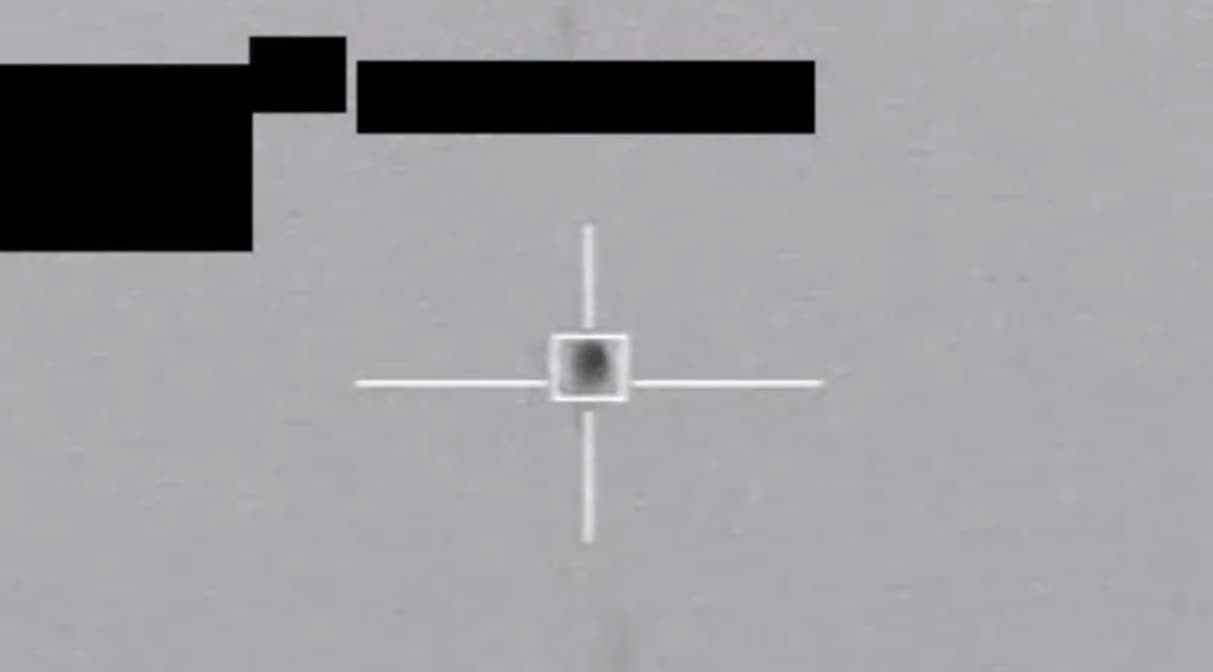
Pictured: an official U.S. Department of War infrared targeting-pod frame from the F-16's gun/missile camera, captured during the February 12, 2023 engagement over Lake Huron and declassified May 22, 2026 under the Pentagon's PURSUE transparency initiative. The small dark shape inside the targeting reticle is the object itself, moments before missile impact; the black bars at upper left redact classified sensor and platform data. This is a genuine frame of the actual object destroyed in this case — not a reconstruction or stock image.
Theoretical Alignment
The Lake Huron object's flight profile — slow, wind-driven, unpowered, operating at an altitude and radar signature consistent with a stratospheric balloon — aligns most strongly with the conventional balloon hypothesis, an assessment reinforced by the 2026 declassified infrared footage and by former AARO director Sean Kirkpatrick's public statements. It scores meaningfully higher on this axis than its sister case, the Yukon shootdown, precisely because actual video evidence exists to evaluate. Extraterrestrial origin was never seriously entertained by investigators, though it was not formally excluded in real time. Foreign surveillance remains a low but non-zero possibility given the geopolitical backdrop of the Chinese balloon incursion earlier that same month.
Background
The chain of events that produced the Lake Huron shootdown began on January 28, 2023, when NORAD detected a large Chinese high-altitude surveillance balloon entering U.S. airspace over Alaska's Aleutian Islands. The balloon — roughly 200 feet tall with a payload the size of three school buses — drifted across the entire continental United States, including sensitive airspace over Montana's nuclear missile fields, before the Biden administration waited for it to clear the coastline and ordered it destroyed off Myrtle Beach, South Carolina, on February 4. Navy divers recovered the balloon's intelligence-collection payload from the Atlantic seabed within days, definitively confirming its origin and mission. The political fallout was immediate and severe: Secretary of State Antony Blinken cancelled a planned trip to Beijing, and members of Congress from both parties demanded to know how a foreign surveillance platform had been allowed to cross the entire country undetected and unchallenged for nearly a week.
Under that pressure, NORAD undertook an unusual and consequential technical fix: it recalibrated its ground-based radar network's “velocity gates,” the filters that routinely strip slow-moving clutter — weather balloons, flocks of birds, drifting debris — out of the operational picture to keep it readable. General VanHerck later acknowledged this had created what he called a “domain awareness gap” that had likely let similar slow, high-altitude objects transit North American airspace undetected for years, possibly decades. Within days of the recalibration, NORAD's radar screens began lighting up with exactly the kind of small, slow contacts the old filters had been designed to ignore. The Alaska object followed on February 10, the Yukon object on February 11, and finally, on the night of February 11 into the morning of February 12, a radar anomaly first logged over Havre, in north-central Montana, tracked east across Wisconsin and into the airspace over Michigan's Upper Peninsula, where it was positively identified by pilots as an octagonal shape trailing what looked like loose strings, with no visible payload attached. The object's altitude — roughly 20,000 feet, well within commercial jet flight levels — was the Pentagon's stated justification for engagement: not a kinetic military threat, officials said repeatedly, but a genuine hazard to civil aviation and a residual, unresolved surveillance concern in the aftermath of the Chinese balloon.
The broader political climate mattered as much as any technical detail. The Biden administration was under sustained bipartisan pressure to demonstrate it could detect and neutralize aerial threats after the embarrassment of the Chinese balloon's week-long transit. In that atmosphere, the threshold for ordering a shootdown against any unexplained radar contact at altitude had fallen dramatically compared to normal peacetime practice. That does not, by itself, establish what the Lake Huron object actually was — but it is essential context for understanding why a fighter jet was scrambled and a missile fired at an object that, whatever it turns out to have been, displayed no hostile or even actively surveillance-oriented behavior at any point during its tracked flight.
Complete Timeline
| Date | Event |
|---|---|
| Jan 28, 2023 | Chinese Surveillance Balloon Detected. NORAD tracks a large high-altitude balloon entering U.S. airspace over the Aleutian Islands, Alaska. |
| Feb 4, 2023 | Chinese Balloon Shot Down. An F-22 destroys the balloon off Myrtle Beach, South Carolina, with an AIM-9X Sidewinder. Its payload is recovered from the Atlantic seabed within days. |
| Feb 4–9, 2023 | NORAD Radar Recalibration. Under congressional and White House pressure, NORAD lowers its radar “velocity gates,” exposing a “domain awareness gap” that had filtered out slow, small objects. New contacts begin appearing across North American airspace. |
| Feb 10, 2023 | Alaska Object Shootdown. An F-22 from Joint Base Elmendorf-Richardson destroys an object over the Beaufort Sea near Deadhorse, Alaska. |
| Feb 11, 2023 | Yukon Object Shootdown. An F-22 destroys a cylindrical object over Canada's Yukon Territory, authorized jointly by PM Trudeau and President Biden. Same night, a radar anomaly is first logged over Havre, Montana — the object later shot down over Lake Huron. |
| Feb 12, 2023 (morning) | Object Tracked Across Wisconsin/Michigan. The Montana radar contact reappears over Wisconsin and Michigan's Upper Peninsula at roughly 20,000 feet, described by observers as octagonal with strings hanging beneath it and no visible payload. |
| Feb 12, 2023 (~12:00 PM EST) | FAA Closes Airspace. NORAD requests a temporary flight restriction over northern Lake Michigan/Huron (NOTAM 3/4885) ahead of the intercept. No commercial flights are delayed. |
| Feb 12, 2023 (~2:42 PM EST) | Object Destroyed. Two 148th Fighter Wing “Bulldogs” F-16C/Ds, launched from Truax Field, Madison, under callsign AESIR, engage the object over Lake Huron. A first AIM-9X Sidewinder misses and falls into the lake; a second AIM-9X strikes and destroys the object, roughly 14 miles from the Canadian border. |
| Feb 12, 2023 (afternoon) | VanHerck Press Conference. At the Pentagon, General Glen VanHerck is asked whether he has ruled out extraterrestrial origin for the three non-balloon objects. He answers: “I'll let the intel community and the counterintelligence community figure that out. I haven't ruled out anything at this point.” |
| Feb 12–16, 2023 | Search and Recovery Operation. The RCMP, Canadian Coast Guard, and U.S. Northern Command conduct an active search of Lake Huron using airborne imagery, surface vessels, and subsurface sensors. Conditions deteriorate to 12-foot swells and 30-knot winds. |
| Feb 13, 2023 | White House Contains ET Speculation. Press Secretary Karine Jean-Pierre states there is “no indication of aliens or extraterrestrial activity.” NSC spokesman John Kirby adds: “I don't think the American people need to worry about aliens, with respect to these craft. Period.” |
| Feb 16, 2023 | Biden Presidential Address. President Biden states the intelligence community's assessment that the three objects were “most likely balloons tied to private companies, recreation, or research institutions,” with “no indication” of Chinese origin or extraterrestrial activity. |
| Feb 16, 2023 | RCMP Suspends Search. The Royal Canadian Mounted Police announces the search is suspended, citing “deteriorating weather and the low probability of recovery.” No debris conclusively tied to the object has been found. |
| Oct–Nov 2023 | Kirkpatrick Signals Future Release. Outgoing AARO director Sean Kirkpatrick states footage from the February shootdowns exists and will eventually be released, explaining that declassification is “prioritized based on the geopolitical environment.” |
| Dec 1, 2023 | Kirkpatrick Departs AARO. Sean Kirkpatrick steps down as AARO's founding director; he later joins Oak Ridge National Laboratory. |
| Nov 2024 | Shoreline Debris Disclosed. Through an Access to Information release, Canadian officials confirm debris and “a module” were recovered from Lake Huron's shoreline and traced to a weather-monitoring equipment company — but the RCMP explicitly declines to confirm the debris matches the object shot down. |
| Feb 19, 2026 | Presidential Declassification Directive. President Trump directs the Department of War and other federal agencies to review and declassify records related to UAP, establishing the PURSUE (Presidential Unsealing and Reporting System for UAP Encounters) initiative. |
| May 8, 2026 | First PURSUE Tranche Released. The Department of War publishes an initial 162 declassified UAP files across multiple agencies. |
| May 22, 2026 | Lake Huron Footage Declassified. As part of a second PURSUE tranche of roughly 60–64 files, the Department of War releases a 46-second infrared cockpit-tape recording titled “USAF ANG F-16C Shoots Down UAP over Lake Huron with AIM-9X, 12 Feb 2023.” The footage shows a balloon-like object fragmenting under missile impact, followed by an unexplained bright object that drifts near the crosshairs before disappearing. |
The Object
Initial Descriptions: Pilot and Congressional Accounts
In the hours immediately after the shootdown, the only public descriptions of the object came from Michigan's congressional delegation and defense officials briefed on the pilots' visual reports. Representative Jack Bergman, a retired Marine Corps lieutenant general and former naval aviator representing Michigan's Upper Peninsula, told reporters the object was an “octagonal structure” flying at approximately 20,000 feet. The Pentagon's own characterization, relayed through spokesman John Kirby, described an object with “strings hanging off” it but “no discernable payload” — a notably different profile from the Yukon object's described 20-foot tether with a suspended package. Kirby confirmed the object “did not appear to have any self-propulsion” and was “not being maneuvered,” and that it flew at an altitude “considerably lower than the Chinese high-altitude balloon” — low enough to pose “a threat to civilian commercial air traffic,” the stated justification for engagement.
The Missed First Shot
Photographic evidence of the two F-16s returning to Truax Field — both marked “DULUTH” on their tails, both missing missiles from their underwing stations — confirmed that at least two AIM-9X Sidewinders were expended during the engagement. Contemporary reporting established that the first missile fired at the object missed and fell into Lake Huron; the second scored a direct hit. A missed first shot against a slow-moving, non-maneuvering target is, on its face, a data point that cuts against the object having any active defensive or evasive capability — consistent with a passive balloon rather than a controlled craft — though it also underscores how difficult a small, low-radar-cross-section object can be to engage even for an advanced infrared-guided missile system.
The Balloon Hypothesis and Kirkpatrick's Assessment
The dominant conventional explanation, publicly advanced with increasing confidence from 2023 through 2026, is that the Lake Huron object was some form of research, weather, or hobbyist balloon — likely carrying a small instrument payload — caught by NORAD's newly sensitized radar filters after having transited undetected for an unknown period beforehand. Former AARO director Sean Kirkpatrick has stated in multiple public appearances since leaving government service that the three non-balloon objects downed February 10–12, 2023, were “almost certainly all balloons,” citing their radar signatures, altitude profiles consistent with prevailing high-altitude wind currents, and thermal signatures. Some reporting has further suggested Kirkpatrick specifically characterized the Lake Huron object as consistent with a small amateur or hobbyist research balloon, though — unlike the Yukon case, where a specific named hobbyist balloon (the Northern Illinois Bottlecap Balloon Brigade's K9YO-15) went missing along a matching trajectory — no specific named balloon, launch, or operator has ever been publicly and conclusively tied to the Lake Huron object. The November 2024 disclosure of shoreline debris traced to a commercial weather-monitoring equipment manufacturer is consistent with, but does not prove, this hypothesis, precisely because the RCMP never confirmed the debris and the shot-down object were the same thing.
The May 2026 Declassified Footage — and the Unexplained Second Object
The 46-second infrared clip released May 22, 2026, is the single most important piece of new evidence this case has produced since the night of the shootdown. It shows the F-16's targeting-pod view of the object — described by different outlets as spherical, diamond-shaped, or balloon-like depending on the exact frame examined — held in the crosshairs before the missile strikes. At roughly the 20-second mark, the object fragments in what the Department of War's own official caption describes as “a kinetic interaction between two distinct areas of contrast, with the initial subject fragmenting in a radial displacement pattern” — a clinical, deliberately non-committal description that several outlets, including The War Zone, have read as consistent with a bursting balloon envelope. That reading is the basis for headlines declaring the object “likely a balloon.”
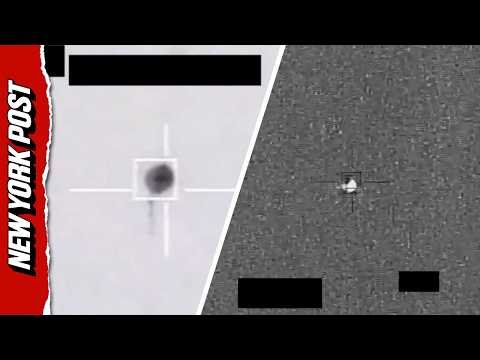
What that framing tends to leave out is the footage's second, stranger detail: seconds after the primary object fragments, a distinct, brighter white circular object appears in frame, drifts near the targeting crosshairs, and then disappears. The Department of War's official release notes explicitly caution that “readers should not interpret any part of this description as reflecting an analytical judgment, investigative conclusion, or factual determination regarding the described event's validity, nature, or significance” — language that applies as much to the unexplained second object as to the primary balloon-fragmentation interpretation. No government statement to date has offered an account of what that second bright object is: debris catching a different thermal profile as it tumbles, a lens artifact or sensor flare, an entirely separate atmospheric phenomenon coincidentally in frame, or something genuinely unaccounted for. This detail — real, present in an official government release, and to date completely unaddressed by any named official — is precisely the kind of loose thread that keeps this case from being cleanly closed even under the balloon hypothesis its own release is cited to support.
It is also worth stating plainly that the object's shape as described by pilots and Congressman Bergman in February 2023 (octagonal, with strings, no discernible payload) is not an obvious visual match for the object's appearance in the 2026 infrared footage (rounder, balloon- or diamond-like). Infrared imagery at range routinely renders angular real-world objects as softer, rounder blobs, so this discrepancy is not by itself strong evidence against the balloon hypothesis — but it is a genuine, unresolved gap between the two principal bodies of evidence in this case, and honest reporting on the incident should not paper over it.
The Military Response
The 148th Fighter Wing's Intercept
The engagement was carried out by the Minnesota Air National Guard's 148th Fighter Wing, nicknamed the “Bulldogs,” normally based in Duluth but temporarily operating out of Truax Field in Madison, Wisconsin, while the Wisconsin Air National Guard's own 115th Fighter Wing transitioned to new F-35 Lightning II aircraft. Two F-16C/D Fighting Falcons launched at approximately 10:30 AM under callsign AESIR, supported by aerial refueling from a KC-135 Stratotanker of the 171st Air Refueling Wing operating out of the Pittsburgh area. Minnesota Governor Tim Walz, whose state National Guard the wing belongs to, publicly praised the unit afterward: “The Bulldogs executed their mission flawlessly, protected the homeland, and got the birds home safe.” Both aircraft returned to Truax Field around 5:30 PM, visibly missing missiles from their underwing pylons — physical confirmation, independent of any official statement, that two AIM-9X Sidewinders had been fired.
Search and Recovery Failure
The RCMP-led search operation, backed by the Canadian Coast Guard and U.S. Northern Command, ran from the day of the shootdown through February 16, 2023 — just four days. It deployed airborne imagery platforms, surface vessels, and subsurface sonar/sensor capability across the estimated debris field, and by the RCMP's own account found nothing conclusively tied to the object before weather conditions (12-foot swells, winds near 30 knots) made continued search operations both dangerous and, per official statements, unlikely to succeed even if extended. This four-day window is considerably shorter than the six-day Canadian Forces ground search in the Yukon, reflecting both the greater physical difficulty of open-water search-and-recovery in winter conditions and an apparent institutional judgment that further effort carried a poor probability of payoff. The Lake Huron search's official failure — like the parallel failures over the Yukon and the Beaufort Sea near Alaska — meant that, of the four objects downed in February 2023, only the Chinese balloon's payload was directly and conclusively recovered and forensically examined.
The November 2024 Shoreline Debris Disclosure
Nearly two years after the shootdown, Canadian officials responding to an Access to Information request disclosed that debris had in fact turned up — not from the underwater search, but washed ashore on Lake Huron's coastline, discovered and reported separately. An RCMP deputy commissioner told media at the time: “Debris was discovered last week…and the RCMP now has possession of it. I understand there is both material and a module.” The recovered module was identified as originating from a company that manufactures weather-monitoring equipment, lending real circumstantial weight to the balloon/weather-platform hypothesis. But the RCMP was explicit on the one point that actually matters for this case file's classification: it never confirmed the shoreline debris was from the object destroyed by the F-16, stating only that after analysis it had been “determined not to be of national security concern.” A find of unconfirmed provenance, disclosed nearly two years after the fact through a records request rather than a formal announcement, is meaningfully different from a confirmed recovery — and this case file treats it as exactly what it is: suggestive, not dispositive.
Key Witnesses
General Glen VanHerck
As the senior military officer responsible for detecting, tracking, and authorizing the engagement of all four February 2023 objects, VanHerck made the era-defining statement of the entire shootdown series at a February 12, 2023, Pentagon briefing convened specifically because of the Lake Huron engagement: “I'll let the intel community and the counterintelligence community figure that out. I haven't ruled out anything at this point.” He also explained the radar velocity-gate recalibration that led directly to the object's detection, describing a “domain awareness gap” in NORAD's prior capability. A four-star general with decades of operational command experience, VanHerck consistently declined to call the objects “balloons” in real time, insisting on the neutral term “objects” because their means of staying aloft had not been determined at the time he spoke.
President Joe Biden
Biden personally ordered the shootdown of the Lake Huron object, along with the Alaska and Yukon objects, citing risk to civil aviation. On February 16, 2023, in a formal address, he stated the intelligence community's assessment that the three non-balloon objects were “most likely balloons tied to private companies, recreation, or research institutions studying weather or conducting other scientific research,” adding that “nothing…suggests they were related to China's spy balloon program or that they were surveillance vehicles from any other country,” and explicitly stating there was “no indication of aliens or extraterrestrial activity.” He defended the shootdown decisions as prioritizing aviation safety.
Representative Jack Bergman
Bergman, whose district includes Michigan's Upper Peninsula bordering Lake Huron, was the first public official to describe the object's shape, telling reporters it was an “octagonal structure.” He publicly stated: “I appreciate the decisive action by our fighter pilots. The American people deserve far more answers than we have.” A retired Marine Corps lieutenant general who spent 40 years in uniform — including as a naval aviator flying both rotary- and fixed-wing aircraft, and later as commanding general of Marine Forces Reserve and Marine Forces North — Bergman's account carries unusual technical credibility among the case's civilian-facing witnesses.
Governor Tim Walz
As governor of the state whose Air National Guard wing carried out the intercept, Walz publicly praised the operation: “The Bulldogs executed their mission flawlessly, protected the homeland, and got the birds home safe.” Walz himself served 24 years in the Army National Guard, retiring as a Command Sergeant Major in 2005, giving his public comments on the 148th Fighter Wing's performance the weight of direct institutional familiarity with Guard operations, even though he was not personally involved in the mission's execution or chain of command.
John Kirby
Kirby, a retired Navy Rear Admiral, served as the administration's primary spokesperson on the technical details of the Lake Huron object, confirming it flew “considerably lower” than the Chinese balloon, showed no self-propulsion, and was not being actively maneuvered. He was also the official who most directly shut down extraterrestrial speculation, telling reporters: “I don't think the American people need to worry about aliens, with respect to these craft. Period.”
Dr. Sean Kirkpatrick
A laser and materials physicist who spent 27 years in federal service, Kirkpatrick led AARO through its first, formative year — a year that began with the February 2023 shootdown series. He is the source of the most consequential post-hoc assessment of the Lake Huron object: his repeated public statement, made after leaving government service, that the three non-balloon objects downed that week were “almost certainly all balloons,” based on radar, altitude, and thermal-signature analysis. Kirkpatrick also publicly explained why footage of the shootdowns took years to declassify, stating that release priority was “prioritized based on the geopolitical environment,” with imagery involving Chinese or Russian military confrontations processed ahead of UAP-related footage.
The Five Observables Assessment
The Five Observables framework, developed by former AATIP director Luis Elizondo, evaluates performance characteristics that would exceed known human technology:
Assessment: The Lake Huron object exhibited none of the anomalous flight characteristics that define a genuine “true UAP” performance profile. It moved slowly with the prevailing wind, showed no propulsion, was not actively maneuvered, and required no unusual missile performance to destroy — if anything, the missed first shot suggests the opposite of an evasive or defended target. The only observable that earns even a speculative rating is Low Observability: the object went undetected by NORAD's pre-recalibration radar configuration for an unknown period, which is adequately explained by its small physical size and low radar cross-section rather than any deliberate stealth design. This case's evidentiary interest lies almost entirely outside the Five Observables framework — in the failure to conclusively recover and identify the object despite an active search, and in the unexplained secondary anomaly visible in the 2026 declassified footage, neither of which the framework is designed to capture.
Evidence Assessment
Supporting Genuinely Unidentified Status
- Object detected by recalibrated military radar, tracked by an F-16's infrared targeting pod, and destroyed by a guided missile — it was unquestionably real, not a sensor artifact or hoax
- No physical material has ever been officially confirmed as belonging to this specific object
- The RCMP explicitly declined to confirm the 2024 shoreline debris matched the shot-down object
- The 2026 declassified footage shows an unexplained secondary bright object that no official has addressed
- A genuine, unresolved discrepancy exists between the object's 2023 pilot-reported shape and its 2026 infrared appearance
- General VanHerck's on-record refusal to exclude any explanation, made specifically in response to a question about this shootdown series
- The object was operating at commercial aviation altitude, a genuine and independently verifiable safety concern regardless of its ultimate identity
Supporting Mundane Explanation
- Object flight characteristics (slow, wind-borne, unpowered, non-maneuvering) are entirely consistent with a balloon
- Former AARO director Kirkpatrick's direct, repeated public statement that the objects were “almost certainly all balloons”
- President Biden's formal intelligence-community assessment: “most likely balloons”
- The declassified infrared footage's fragmentation pattern is read by multiple defense-journalism outlets as consistent with a bursting balloon
- Shoreline debris traced to a weather-monitoring equipment manufacturer, even if formally unconfirmed as matching this object
- NORAD detected the object only after a recalibration specifically designed to catch exactly this class of small, slow contact
- No anomalous performance characteristic — acceleration, maneuvering, hypersonic speed, trans-medium travel — was observed at any stage
- A missed first missile shot is more consistent with a passive, non-evading target than an actively defended craft
Why “Disputed”
The Lake Huron UAP Shootdown earns a DISPUTED classification — distinct from the Yukon object's fully “Open” status — because this case actually has something the Yukon case never produced: real, official, declassified video evidence, and a specific, named, semi-corroborated conventional-explanation candidate advanced on the record by the government's own former UAP investigation chief. That is a meaningfully stronger evidentiary position than a case resting solely on radar tracks and a commander's refusal to speculate. Former AARO director Sean Kirkpatrick's direct statement that the objects were “almost certainly all balloons,” the 2026 infrared footage's apparent balloon-fragmentation signature, and the November 2024 shoreline debris traced to a weather-equipment manufacturer together constitute a real, substantive body of evidence pointing toward a conventional origin.
What keeps this case from a “credible” or “debunked” classification — and what makes “disputed” the honest label — are three specific, documented gaps that remain genuinely open as of this writing. First, no debris has ever been formally, forensically confirmed as belonging to the object destroyed on February 12, 2023; the RCMP's own statement stopped short of that link. Second, the object's appearance in the 2023 eyewitness/congressional accounts (octagonal, with strings, no discernible payload) is not an obvious match for its appearance in the 2026 infrared footage (rounder, balloon- or diamond-like) — a real discrepancy between the case's two principal evidentiary bodies that has gone essentially unaddressed in public reporting. Third, and most tellingly, the declassified footage itself contains an unexplained secondary bright object appearing after the primary fragmentation event — present in an official government release, undisputed as a real visual element of the tape, and to date entirely unaccounted for by any named official or agency. A case where the government's own released evidence contains a detail nobody has explained is not a closed case, however strong the balloon hypothesis is for the primary object.
The broader significance of the Lake Huron shootdown, like its sister cases, extends past the identity of any single object. It is the one member of the February 2023 quartet where the public eventually got to see something — and what the public saw, three and a half years later, argued for a mundane origin while simultaneously introducing a new, unresolved visual anomaly of its own. That combination — real transparency, partial resolution, and a fresh open question — is precisely what “Disputed” is meant to capture.
Sensor & Instrumentation Detection Profile
NORAD's newly recalibrated ground-based radar network first registered the object as a transient contact over Havre, Montana, on the night of February 11, 2023, then lost it before reacquiring a track the following morning as it drifted east across Wisconsin and Michigan's Upper Peninsula at approximately 20,000 feet. Two F-16C/D Fighting Falcons of the 148th Fighter Wing “Bulldogs” (Minnesota Air National Guard), flying under callsign AESIR out of Truax Field in Madison, Wisconsin, were scrambled to intercept, supported by a KC-135 Stratotanker from the 171st Air Refueling Wing. One F-16 locked the object on its onboard AN/AAQ-33 Sniper targeting pod, providing continuous infrared tracking through the intercept. A first AIM-9X Sidewinder, fired at approximately 2:42 PM EST, missed and fell into the lake; a second AIM-9X found its mark and destroyed the object. The Federal Aviation Administration briefly closed airspace over northern Lake Michigan (NOTAM 3/4885) for just under two hours to clear the engagement zone, with no commercial flights delayed or cancelled. The most consequential sensor asset in this case, however, is the one the public did not see for more than three years: the F-16's own infrared targeting-pod recording, which the Department of War declassified on May 22, 2026, as part of the second tranche of PURSUE releases.
Environmental & Geospatial Context
Lake Huron is the third-largest of the Great Lakes by surface area, straddling the international boundary between Michigan and Ontario. The object was engaged over open water roughly 14 miles from the Canadian border, on the U.S. side of the line, in a stretch of lake bordered by Michigan's sparsely populated Upper Peninsula. February conditions on the Great Lakes are harsh: partial ice cover, water temperatures near freezing, and rapidly shifting weather. While conditions were evidently clear enough on February 12 for the F-16's targeting pod to achieve and hold an infrared lock, conditions deteriorated quickly in the days that followed. By the time recovery teams attempted to search the debris field, they were contending with swells reported up to 12 feet and sustained winds near 30 knots — sea states that make both surface search and any subsurface sonar work extremely difficult, and that likely account for a meaningful share of the search's failure independent of anything unusual about the object itself. The lake's depth in the engagement area (Lake Huron reaches depths over 700 feet in its central basin, though the shoreline shelf near the Upper Peninsula is considerably shallower) further complicated any prospective dive or sonar recovery operation.
Observer Credibility & Occupational Profile
As with the Yukon and Alaska objects the same week, the primary observers here are unusually credentialed: NORAD radar operators working recalibrated military-grade detection systems, and Minnesota ANG F-16 pilots of the 148th Fighter Wing, an operational combat unit (not a training squadron) with real-world intercept experience. Authorization for the engagement passed through General Glen VanHerck, commander of NORAD and U.S. Northern Command, and ultimately President Joe Biden, who ordered the shootdown “out of an abundance of caution.” Michigan's congressional delegation provided independent, non-military corroboration in near-real time: Representative Jack Bergman — himself a retired Marine Corps lieutenant general and decorated naval aviator, giving his public description of the object unusual technical weight — confirmed the “octagonal” shape publicly within hours, and Representative Elissa Slotkin, a former CIA Middle East analyst, publicly pressed for a full congressional briefing on the wreckage. Minnesota Governor Tim Walz, himself a 24-year Army National Guard veteran and former Command Sergeant Major, praised the Duluth-based 148th's performance directly. This is, in short, an incident witnessed and publicly discussed almost entirely by people with direct military, intelligence, or command experience — a higher concentration of credentialed observers than almost any purely civilian UAP report on this site.
Physical & Material Assays
No physical material has ever been officially confirmed as belonging to the object shot down over Lake Huron. The Royal Canadian Mounted Police, coordinating with the Canadian Coast Guard and U.S. Northern Command, conducted an active search from February 12–16, 2023, using airborne imagery, surface vessels, and subsurface sensors, and found nothing conclusive before suspending the operation, citing “deteriorating weather and the low probability of recovery.” In November 2024, however, Canadian officials disclosed — via an Access to Information release — that debris and “a module” had in fact been recovered from Lake Huron's shoreline, and that the module was traced to a company that manufactures weather-monitoring equipment, consistent with a lost research or weather balloon payload possibly launched from a National Weather Service radar station in Michigan. Critically, the RCMP explicitly declined to confirm or deny that this shoreline debris was the same object destroyed by the F-16, stating only that after analysis it was “determined not to be of national security concern.” This is the central, precise distinction between the Lake Huron case and the Chinese balloon downed February 4: the balloon's payload was directly recovered from the Atlantic seabed by Navy divers and forensically confirmed as PLA surveillance hardware. No comparable chain of custody exists here. Whatever the Lake Huron object was, its confirmed physical remains — if the shoreline debris even is those remains — have never been produced for independent examination.
Historical Precedents & Archive Matches
The Lake Huron shootdown is the third of four military engagements against airborne objects over North America in a single nine-day span: the Chinese surveillance balloon downed off Myrtle Beach, South Carolina, on February 4; an object shot down over Alaska's Beaufort Sea on February 10; the cylindrical object destroyed over the Yukon Territory on February 11; and, finally, the octagonal Lake Huron object on February 12. These four incidents together represent the most intensive burst of military aerial engagement over North American sovereign airspace since the Second World War, and their only meaningful historical parallel is the Battle of Los Angeles (February 25, 1942), when anti-aircraft batteries fired more than 1,400 rounds at an unidentified object over the city without a single confirmed hit or any recovered material. The 1976 Tehran UFO incident, in which an Iranian F-4 Phantom's weapons systems failed electronically while attempting to engage a maneuvering object, offers a structurally different but thematically related precedent: a credentialed military crew, a real radar and visual contact, and a Defense Intelligence Agency report that rated the case “outstanding” without ever identifying the object. The Lake Huron case shares the DIA report's core pattern — real, tracked, engaged, never fully explained — while differing in one crucial respect: unlike Tehran or the Yukon object, Lake Huron eventually produced actual video evidence, decades sooner than most Cold War-era military UAP encounters ever have.
The Post-2017 Disclosure Context
The Lake Huron shootdown occurred squarely inside a five-year run of unprecedented institutional openness about UAP that began with the December 2017 New York Times report on the Pentagon's Advanced Aerospace Threat Identification Program (AATIP). By 2021 the Office of the Director of National Intelligence had delivered a preliminary assessment to Congress acknowledging 143 UAP reports that could not be explained. In July 2022 the Department of Defense stood up the All-domain Anomaly Resolution Office (AARO) under founding director Sean Kirkpatrick, a laser and materials physicist with a background at the Defense Intelligence Agency's Missile and Space Intelligence Center, to coordinate UAP reporting across every military branch and intelligence agency. The Lake Huron shootdown happened just seven months after AARO's creation — meaning the very first major test of the new office's public credibility was an object it could neither identify in real time nor, for years afterward, show the public any footage of. The gap between AARO's stated transparency mission and its multi-year silence on the actual video evidence became, for critics, a case study in exactly the institutional caution the office was created to overcome.
Airspace Law and the Threshold for Lethal Force
Both the United States and Canada are signatories to the 1944 Chicago Convention on International Civil Aviation, which affirms each nation's complete and exclusive sovereignty over its own airspace. The joint 1958 NORAD Agreement between the two countries authorizes combined air-defense operations, but the Lake Huron engagement itself required no binational political sign-off in the way the Yukon shootdown did — the object was destroyed on the U.S. side of the border by a U.S. Air National Guard aircraft under a presidential order, with Canadian involvement limited to the subsequent joint search once debris was expected to have fallen into shared or Canadian waters. The use of a roughly $400,000–$450,000 AIM-9X Sidewinder — twice, given the missed first shot — against an object later assessed as “likely benign” prompted the same proportionality questions raised after the Yukon and Alaska shootdowns: whether the political imperative to appear decisive in the week after the Chinese balloon embarrassment justified using front-line combat missiles against what may have been an unpowered hobbyist or research balloon costing a few hundred dollars.
AARO's Institutional Walk-Back: From “Cannot Rule Out” to “Almost Certainly Balloons”
The evolution of the official U.S. government position on the Lake Huron object — and its two sibling objects — over the following three years is itself part of the historical record and worth tracing precisely, because it is easy to conflate stages of an evolving assessment with a single, static conclusion. In the immediate aftermath, on February 12, 2023, General VanHerck told reporters at the Pentagon he had “not ruled out anything,” including extraterrestrial origin, for the three non-balloon objects — a remark that dominated headlines for days. Within 24 hours, National Security Council spokesman John Kirby and Press Secretary Karine Jean-Pierre moved to contain the story, with Kirby stating flatly, “I don't think the American people need to worry about aliens, with respect to these craft. Period,” and Jean-Pierre adding “there is no indication of aliens or extraterrestrial activity with these recent takedowns.” On February 16, President Biden went further, calling the three objects “most likely balloons tied to private companies, recreation, or research institutions,” while conceding the intelligence community could not say so with certainty. By late 2023, outgoing AARO director Kirkpatrick was telling audiences that footage would eventually be released and that declassification timing was “prioritized based on the geopolitical environment” — UAP footage, he explained, simply ranked behind imagery involving confrontations with Chinese or Russian military aircraft in the review queue. By 2024, with Dr. Jon Kosloski now leading AARO, Kirkpatrick (by then at Oak Ridge National Laboratory) was stating in public talks that the three objects downed February 10–12, 2023, were “almost certainly all balloons,” based on radar cross-section, altitude, and thermal-signature analysis. That claim went essentially untested by the public for another year and a half — until the May 2026 footage finally gave outside observers something to actually look at.
Material Analysis
The material record for the Lake Huron object is, formally, empty. No physical debris has ever been officially confirmed by the U.S. or Canadian governments as belonging to the object the 148th Fighter Wing destroyed on February 12, 2023. This distinguishes the case sharply from the Chinese balloon downed eight days earlier, whose intelligence-collection payload was recovered from the Atlantic seabed by Navy divers within days and forensically examined in detail. It also distinguishes it, in one specific and important way, from its sister cases: unlike the Yukon and Alaska objects, where the underlying search operations found absolutely nothing at all, the Lake Huron case eventually produced some physical debris — just not debris anyone in government has been willing to formally attribute to this specific shootdown.
The Shoreline Debris and Its Limits
The November 2024 disclosure that debris and “a module” had washed ashore on Lake Huron, and that the module traced to a commercial weather-monitoring equipment manufacturer, is the most concrete physical lead in the entire case. If genuine and if actually connected to the shootdown, it would essentially resolve the object's identity as a weather-monitoring balloon platform, consistent with the broader conventional-explanation consensus that has emerged since 2024. But the RCMP's own public statement stopped well short of that confirmation, saying only that the material had been “determined not to be of national security concern” — a security classification, not an identification, and not a chain-of-custody link to the object destroyed over open water four days after it fell. Debris washing up on a Great Lakes shoreline nearly two years after a missile strike, with no documented recovery location, drift analysis, or forensic serial-number match published, is real evidence but weak evidence as applied specifically to this case.
What the Sensor Data Independently Tells Us
Absent confirmed physical material, the strongest independent evidence remains the sensor data itself: the AIM-9X's successful infrared lock on the second shot confirms the object carried a real, measurable thermal signature — consistent with either solar heating of a reflective envelope or a small electronic payload, and inconsistent with an inert, unheated object. The object's radar cross-section, large enough to register on recalibrated NORAD radar but apparently small enough to have gone undetected on the standard configuration, is consistent with a balloon envelope in the range of a few feet to a few tens of feet across — considerably smaller than the Chinese surveillance balloon, and roughly in line with commercial weather-balloon envelopes. None of this data, however, can distinguish between a genuinely mundane weather platform and any other small, unpowered, radar-quiet object; sensor data alone cannot substitute for recovered material.
Supporting Genuinely Unresolved Status
- No physical material has ever been officially confirmed as belonging to the specific object destroyed on February 12, 2023
- The RCMP explicitly declined to confirm the November 2024 shoreline debris matched the shot-down object
- The 2026 declassified footage contains an unexplained secondary bright object with no official account offered
- The object's 2023 pilot-reported shape (octagonal, with strings) does not obviously match its 2026 infrared appearance (rounder, balloon/diamond-like)
- General VanHerck's real-time refusal to rule out any explanation was a formal, on-record statement, not idle speculation
Supporting Conventional / Balloon Origin
- Object flight behavior (slow, wind-borne, unpowered, non-maneuvering) is entirely consistent with a balloon platform
- Former AARO director Sean Kirkpatrick has stated the three non-balloon objects were “almost certainly all balloons” based on radar/altitude/thermal analysis
- President Biden's intelligence-community assessment: “most likely balloons tied to private companies, recreation, or research institutions”
- The 2026 infrared footage's fragmentation pattern is consistent with a bursting balloon envelope, per multiple defense-journalism analyses
- Shoreline debris traced to a weather-monitoring equipment company is circumstantially consistent, even if formally unconfirmed
- NORAD only detected the object after a radar recalibration specifically designed to catch small, slow, previously-filtered contacts
- No anomalous performance — no acceleration, maneuvering, or trans-medium behavior — was observed at any point
The Conventional Explanation Candidate: Weather or Research Balloon
Three conventional explanations merit serious evaluation for the Lake Huron object, each carrying real supporting evidence and real unresolved gaps:
Weather / Research Balloon (with Instrument Payload)
Highly PlausibleThe object's slow, wind-driven, unpowered flight; its detection only after radar recalibration; the infrared footage's apparent balloon-fragmentation pattern; former AARO director Kirkpatrick's direct public assessment; and the November 2024 shoreline debris traced to a weather-monitoring equipment company together form the strongest circumstantial case in this file. Its principal weakness is the same one that keeps this case from a “credible” or higher stamp: no single piece of that evidence has been formally, forensically linked to the specific object destroyed on February 12, 2023, and the RCMP's own statement stopped short of making that link.
Hobbyist Balloon (Unidentified Operator)
InconclusiveUnlike the Yukon case, where a specific named hobbyist balloon group (NIBBB) publicly noted its own balloon went missing along a matching trajectory, no comparable named hobbyist operator has ever come forward for the Lake Huron object. This variant of the balloon hypothesis remains generically plausible on flight-characteristic grounds alone but lacks the Yukon case's one piece of independent, third-party corroboration.
Foreign Surveillance Platform
Low but Not ExcludedGiven the confirmed, extensive Chinese balloon-surveillance program revealed earlier the same month, foreign origin cannot be dismissed outright as a category. But the Biden administration stated directly that none of the three non-balloon objects showed evidence of intelligence-collection capability, and the object's complete lack of powered flight, maneuvering, or communications emissions makes it a poor fit for a deliberate surveillance platform.
Related Cases
Confirmed Documents & Official Records
Presidential address characterizing the three non-balloon objects, including the one destroyed over Lake Huron, as “most likely balloons tied to private companies, recreation, or research institutions.”
PUBLIC RECORDOfficial transcript containing Kirby's and Jean-Pierre's on-record denials of extraterrestrial origin and technical description of the objects' altitude and lack of self-propulsion.
PUBLIC RECORDOfficial portal hosting the 46-second declassified F-16 infrared targeting-pod recording of the Lake Huron engagement (designation DOW-UAP-PR071), released as part of the second PURSUE declassification tranche.
OFFICIAL / DECLASSIFIEDThe Pentagon office responsible for UAP case resolution, established July 2022 under founding director Sean Kirkpatrick, whose tenure began just months before the February 2023 shootdown series.
OFFICIALSearch Government Archives Directly
Further Reading — Recommended Literature
Imminent: Inside the Pentagon's Hunt for UFOs
The former AATIP director's memoir on the government's UAP investigation programs, including the institutional dynamics that shaped AARO's founding just months before the February 2023 shootdowns.
UFO: The Inside Story of the US Government's Search for Alien Life Here—and Out There
A comprehensive history of U.S. government UAP investigations, providing essential institutional context for how a shootdown series like February 2023's could happen and be handled the way it was.
Skyward: Inside the Take Down of the Chinese Spy Balloon and the Untold Story of the Air Force's Long War With China
An investigative account of the Chinese balloon incident that directly triggered the radar recalibration responsible for detecting the Lake Huron object eight days later.
American Cosmic
A religious studies professor's examination of how technology, belief, and UAP culture intersect in America — useful for understanding the public reaction to events like the February 2023 shootdowns.
UFOs: Generals, Pilots, and Government Officials Go on the Record
The foundational modern book on UAP testimony from credentialed military and government witnesses — the same category of observer at the center of the Lake Huron case.
Essential Viewing
Sources
- The War Zone (TWZ). “F-16 Shoots Down 'Octagonal Object' Over Lake Huron (Updated).” February 12, 2023. twz.com
- The War Zone (TWZ). “Details About Search For Mystery Object Shot Down Over Lake Huron Disclosed.” November 2024. twz.com
- The War Zone (TWZ). “We Finally See The Mysterious Object Shot Down By F-16s Over Lake Huron.” May 2026. twz.com
- The War Zone (TWZ). “Balloons, No UFOs, Found By Satellites, Shoot Down Video Coming Says AARO Chief.” October 2023. twz.com
- The Aviationist. “U.S. F-16 Shoots Down An Unidentified 'Octagon Shaped' Object Over Lake Huron.” February 12, 2023.
- The Aviationist. “Pentagon Finally Releases Footage Of Unidentified Object Shot Down By F-16 Over Lake Huron.” May 23, 2026.
- FOX 2 Detroit. “Search for shot-down UFO debris over Lake Huron suspended due to low chance of recovery.” February 16, 2023. fox2detroit.com
- FOX 2 Detroit. “Declassified UFO files: Video of Lake Huron encounter with F-16 near UP released by Pentagon.” May 2026. fox2detroit.com
- Forbes (Matt Novak). “Yet Another Flying Object Shot Down Near U.S.-Canada Border On Sunday.” February 12, 2023. forbes.com
- Duluth News Tribune. “Duluth-based fighter wing shoots down unidentified object over Lake Huron, Walz says.” February 12, 2023. duluthnewstribune.com
- NBC Montana. “UFO shot down by US fighter jet found on Lake Huron's shoreline.” November 2024. nbcmontana.com
- The White House. “Remarks by President Biden on the United States' Response to Recent Aerial Objects.” February 16, 2023. bidenwhitehouse.archives.gov
- The White House. “Press Briefing by Press Secretary Karine Jean-Pierre and NSC Coordinator John Kirby.” February 13, 2023. bidenwhitehouse.archives.gov
- U.S. Department of War. Pentagon Press Briefing with Gen. Glen D. VanHerck and John F. Kirby. February 12, 2023. war.gov
- Wikipedia. “2023 Lake Huron high-altitude object.” en.wikipedia.org
- IBTimes UK. “The US Shoots Down UAP Over Lake Huron, See 10 Videos From the Pentagon's Second UFO File Dump.” May 2026. ibtimes.co.uk
- All-domain Anomaly Resolution Office (AARO). Official site. aaro.mil
- UPI. “FAA briefly closed airspace over Lake Michigan for Defense Department activity.” February 12, 2023. upi.com
- Global News (Canada). “Yukon, Alaska, Lake Huron UFO search suspended.” February 2023. globalnews.ca
- Patch (Across Michigan). “Pentagon UFO Files Video Shows F-16 Encounter Over Lake Huron In MI.” May 2026. patch.com
- DefenseScoop. “Pentagon's UAP investigation chief to depart Dec. 1.” November 30, 2023. defensescoop.com
See something inaccurate? Have additional information or sources?
Suggest an Edit →Last Updated: August 2026