
The Langenburg UFO / Saucer Nests
On the morning of September 1, 1974, Langenburg, Saskatchewan farmer Edwin Fuhr shut down his swather and watched five metallic, saucer-shaped objects hovering roughly a foot off the ground at the edge of a slough on his land, rotating rapidly before rising silently on a burst of grey vapor and disappearing. What they left behind — five distinct, clockwise-swirled circles of flattened grass, each with a ring of standing grass at its center — was examined the next day by RCMP Constable Ron Morier, who filed an official incident report finding no evidence of a hoax and no conventional explanation for the marks. Fifty years later, in 2024, the Royal Canadian Mint gave the case an unusual form of institutional durability: an official, glow-in-the-dark commemorative silver coin, "Canada's Unexplained Phenomena: The Langenburg Event" — a rare instance of a national government mint issuing a product built entirely around an unresolved UFO sighting.
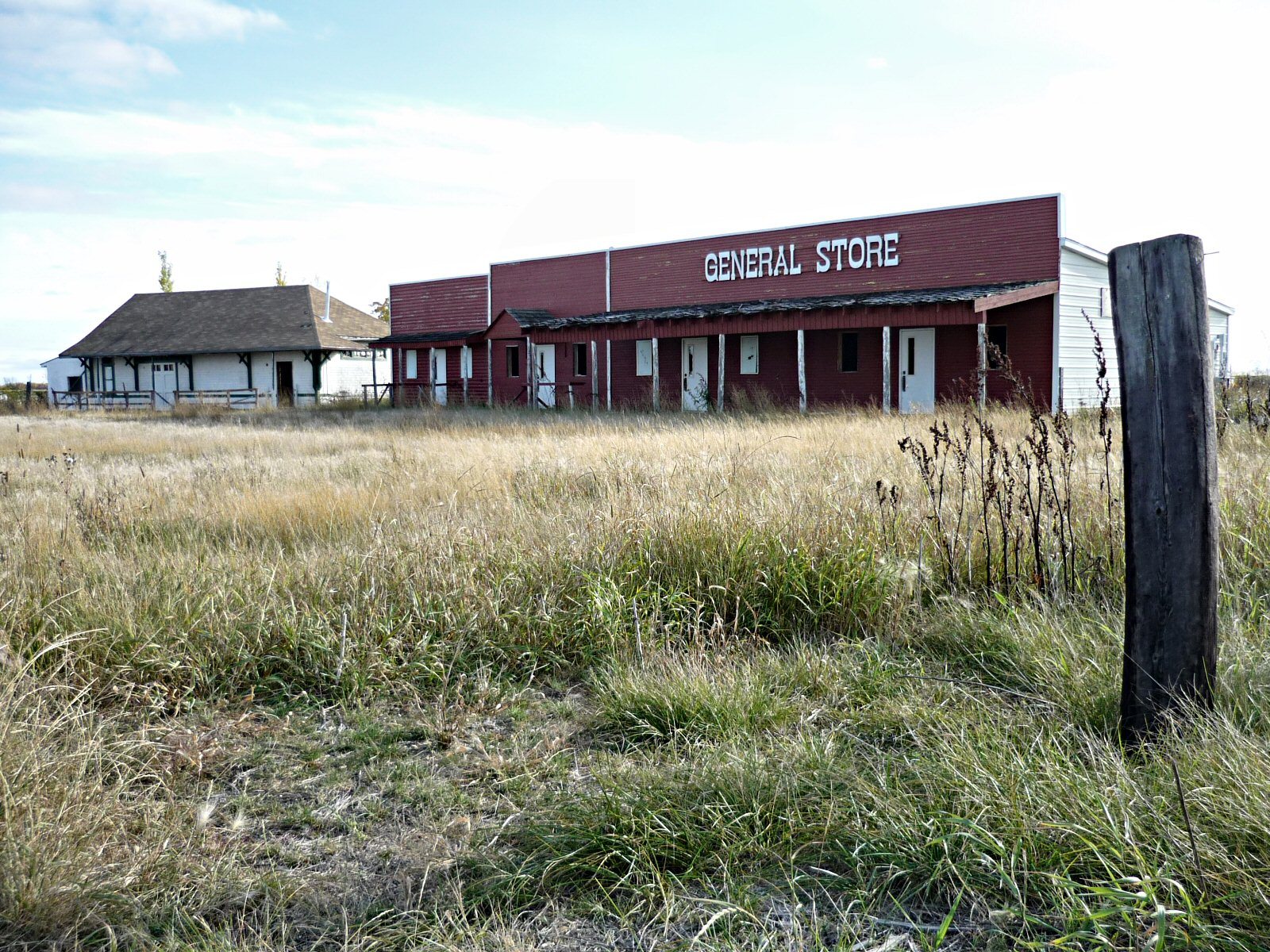
Pictured: the reconstructed pioneer-era general store at Gopherville, a heritage village on the outskirts of Langenburg, Saskatchewan — the town nearest the Fuhr farm, not the actual sighting site or the field where the ground traces appeared. No photograph of the 1974 ground circles themselves or of the objects Edwin Fuhr described is known to survive in any public, rights-clear archive; period images of the traces exist only as small reproductions in newspaper morgues and commercial picture libraries (e.g. the Mary Evans Picture Library's "UFO saucer nest, Langenburg" print), which remain under commercial copyright rather than freely licensed.
Theoretical Alignment
The case splits fairly evenly between a structured-craft reading and a mundane/psycho-social one, without either fully closing the file. A single, apparently sincere, close-range witness describing a detailed, structured, metallic object for a sustained fifteen minutes is a harder case for pure misperception than a fleeting light in the sky, which keeps ETH alignment meaningfully above the floor; at the same time, the absence of any second eyewitness to the objects themselves, combined with several imperfect but real naturalistic candidates for the ground traces, keeps PSH the single strongest framework overall. IDH retains only token alignment, as nothing in the case's own record invokes interdimensional or consciousness-mediated framing.
Background
Langenburg is a small farming town in southeastern Saskatchewan, about 15 km west of the Manitoba border and roughly 70 km southeast of Yorkton, in the Rural Municipality of Langenburg No. 181. Settlers of predominantly German origin began arriving in the district in the mid-1880s after the Canadian Pacific Railway reached the area, and the town itself was incorporated in 1959; by the 1970s it remained, as it remains today, a town of little more than a thousand people surrounded by grain and rapeseed farms on the flat to gently rolling parkland prairie characteristic of this part of the province. Slough-edge wetlands — shallow, marshy depressions that collect runoff and support cattail and tall-grass vegetation — are a routine feature of the local landscape, providing habitat for muskrats, waterfowl, and the kind of unmowed, waist-high grass that would become central to the case.
Edwin Fuhr was 36 years old in the late summer of 1974, a working farmer with no publicly documented prior interest in UFOs and no history of seeking public attention. On the morning of Sunday, September 1, 1974, he was operating a swather — a machine used to cut and lay down a standing crop, in this case rapeseed (canola) — in a field on his own land. It was an entirely ordinary start to an entirely ordinary harvest morning until, at approximately 10:30 a.m., he noticed something at the edge of a slough bordering the field that did not belong there.
The broader national context matters for how the case would later be treated. By 1974, Canada's federal UFO-reporting apparatus had already drifted for two decades into the same posture of institutional disengagement documented across the country's civilian UFO file: the Department of National Defence had passed responsibility for civilian UFO reports to the National Research Council (NRC) years earlier, and NRC scientists such as A.G. McNamara, head of its Planetary Sciences Section, had settled into a standing position that ordinary observational error and known natural phenomena explained the overwhelming majority of reports, with no formal federal investigative body remotely comparable to the U.S. Air Force's Project Blue Book (itself already closed by 1974) tasked with following up individual cases like Langenburg. That meant the actual on-the-ground response to Fuhr's report fell not to any UFO specialist but to the ordinary machinery of local policing: the Royal Canadian Mounted Police detachment in Langenburg itself, and specifically its newest constable.
Complete Timeline
| Date / Time | Event |
|---|---|
| Sept. 1, 1974, ~10:30 a.m. | Edwin Fuhr, swathing a rapeseed field near Langenburg, Saskatchewan, notices five metallic, saucer-shaped objects hovering at the edge of a slough on his land. |
| Sept. 1, 1974, ~10:30–10:45 a.m. | Fuhr shuts down his swather and approaches to within roughly 15 feet, observing the objects rotate rapidly for approximately fifteen minutes before they rise, emit grey vapor, and depart silently. |
| Sept. 1, 1974, later morning | Fuhr's brother-in-law, Carl Zorn, telephones the Langenburg RCMP detachment to ask whether any other UFO reports had come in; Fuhr's brother Leo Fuhr reaches the field and independently describes the five doughnut-shaped ground impressions. |
| Sept. 2, 1974 | RCMP Constable Ron Morier visits the Fuhr farm, personally examines the five circles, photographs and measures them, and files the detachment's official incident report. |
| September–October 1974 | Wire coverage and Saskatchewan press attention (notably the Saskatoon Star-Phoenix) bring thousands of curiosity-seekers to the Fuhr farm, disrupting the harvest and prompting the family to restrict access. |
| 1975 | Physical-trace investigator Ted Phillips catalogs the case in his CUFOS report Physical Traces Associated with UFO Sightings: A Preliminary Catalog; Dr. J. Allen Hynek and Jacques Vallée include it as Appendix A, "A Sighting in Saskatchewan," in their book The Edge of Reality. |
| 2011 | Fuhr gives a lengthy on-record interview, 37 years after the sighting, repeating a materially consistent account of the encounter. |
| September 2024 | The Royal Canadian Mint releases "Canada's Unexplained Phenomena: The Langenburg Event," a 1 oz. pure silver glow-in-the-dark coin, timed to the sighting's 50th anniversary; Leo Fuhr returns to the field with CBC News, telling reporters "seeing is believing." |
The Sighting: Edwin Fuhr's Account
Fuhr's own description of what he saw, repeated with only minor variation across interviews spanning nearly four decades, centers on five separate objects arranged near the edge of the slough, each roughly dome- or saucer-shaped and standing an estimated five feet or so tall. He described their surfaces as looking like polished or "brushed" stainless steel — a specific, consistent material description rather than a vague glow or light — with a dull grey band or "bumper" running around the base of each dome and no windows, portholes, antennae, or other surface features he could identify, apart from what he took to be a short exhaust-like pipe on at least one object. Multiple retrospective accounts describe the objects as grouped with three larger objects arranged together and two smaller ones positioned further out to either side, though the precise arrangement is described with more confidence in some later retellings than in the earliest surviving record, and this case file treats the exact spatial layout as the least certain element of an otherwise consistent account.
What is consistently reported across every version of Fuhr's story is that the objects were hovering only about a foot (roughly 30 cm) above the tall grass at the slough's edge, and that they were rotating — described in several accounts as spinning rapidly, though sources are not fully consistent on the direction, with some retellings specifying counterclockwise rotation and others simply describing rapid spin without a stated direction. Fuhr brought his swather to a stop and approached on foot, by his own account halting at a distance of roughly 15 feet, close enough to see the grass itself moving and bending near the base of the nearest object as it turned. He has described the experience as frightening — in one interview recalling that "if someone had clapped their hands, I would have likely dropped dead" — and reported that his swather's engine would not restart while the objects remained present, though this detail, like the exact object count and arrangement, rests on secondary retellings rather than the surviving primary RCMP report language, and is presented here with that caveat rather than as independently confirmed fact.
After holding roughly this position for what Fuhr and most secondary accounts describe as approximately fifteen minutes, the objects began to ascend. Witnesses to the aftermath (not the ascent itself, which only Fuhr saw) and Fuhr's own account agree that the objects rose in a stepped or staggered sequence rather than simultaneously, emitting a grey vapor or mist from their undersides as they climbed, and departed without any audible sound — a detail repeated so consistently across every version of the story, from the earliest press coverage through the 2011 and 2024 interviews, that this case file treats "silent departure" as one of the more reliably corroborated elements of the entire account, notwithstanding that it still rests on one uncorroborated witness. Several accounts describe a burst of wind accompanying the ascent, sufficient to flatten additional standing crop beyond the immediate area of the five circles, though this detail is likewise better attested in later retellings than in the earliest surviving record.
The Ground Traces
What makes Langenburg unusual among daylight sightings from a single witness is that it left behind a body of physical evidence independent of Fuhr's own testimony, discovered by his own family before the RCMP ever arrived. His brother, Leo Fuhr, was among the first to reach the field and later described finding what he called doughnut-shaped impressions in the grass — a ring of flattened vegetation surrounding a patch of standing grass at the center of each circle, repeated five times across the site in a pattern matching the positions Edwin had described for the five objects. Fuhr's brother-in-law, Carl Zorn, is separately reported to have telephoned the Langenburg RCMP detachment that same day specifically to ask whether the police had received any other UFO reports — itself a small but meaningful piece of corroboration, since it places a second family member reacting to the story, independently of Edwin, on the very day of the sighting rather than only after press coverage began.
The circles themselves are the case's best-documented physical detail, and also its most inconsistently reported one. According to the language of the RCMP's own 1974 incident report, as quoted in later research into the case, investigators recorded "five different distinct circles, caused by something exerting what had to be heavy air or exhaust pressure over the highgrass," with the flattened, swirled portion of each ring roughly 18 inches wide; two of the five circles measured roughly 12 feet in total diameter and the remaining three roughly 10.5 feet. Other, later retellings cite different figures — Leo Fuhr's own description to CBC in 2024 recalled the impressions as roughly eight feet across, while at least one detailed secondary account states a uniform 11-foot diameter for all five — a spread of measurements that this case file reads the same way it reads similar numeric drift in other decades-old, repeatedly-retold cases: as an ordinary feature of oral and journalistic retelling rather than evidence against the traces' basic reality, with the language attributed directly to Morier's own contemporaneous report taken as the more reliable figure where the two disagree. In every version of the story, without exception, the grass at the very center of each circle was left standing upright while the surrounding ring was pressed flat, and the flattened grass was swirled in a clockwise direction as viewed from above.
One further detail deserves an explicit reliability flag rather than being folded silently into the main narrative: a crop-circle catalog site notes that a sixth ring, smaller than the original five and positioned as though continuing their arrangement, reportedly appeared two days after the sighting. This detail does not appear in the CBC, RCMP-report-derived, or Ted Phillips CUFOS-catalog versions of the case consulted for this file, and this case file was unable to independently corroborate it against a more mainstream source; it is presented here only as a claim from that one specific source, not as an established fact of the case.
The RCMP Investigation
The Langenburg detachment's response fell to Constable Ron Morier, then 27 years old and in his first year posted to the detachment — by his own later description, one of the most unusual calls of his career. Morier drove out to examine the site directly, by most accounts the day after the sighting, personally inspecting, measuring, and photographing all five circles rather than relying solely on the family's description. His resulting incident report is the case's single most important primary document: it describes five distinct circles "caused by something exerting what had to be heavy air or exhaust pressure over the highgrass," a description that commits to the traces having a genuine external physical cause without speculating on what that cause actually was.
Morier's own later, on-record comments go further than the clinical language of the report itself. Asked whether the incident could have been staged, he told interviewers "there is no way that this is a hoax," and separately: "whatever was in there, it came out of the air and departed the same way, as far as I could tell." He is on record specifically rejecting the idea that Fuhr himself fabricated the story, describing him as "the last guy in the world" likely to do so, and pointedly asking why any farmer would invite the disruption that followed: "why would he want thousands of people coming to his little place there and trampling all over his yard and his fields?" Those comments do not amount to an official RCMP finding that the sighting was of extraterrestrial or otherwise anomalous origin — Morier never claimed that, and the RCMP as an institution has never issued any broader public statement on the case beyond the original incident report — but they are a serious, credentialed, contemporaneously-recorded assessment that the physical evidence was not staged, from the one investigator who actually walked the site. Colleagues later in Morier's career nicknamed him "Mulder," after the fictional FBI agent in The X-Files, on account of the case following him for the rest of his service.
Scientific and Government Treatment
Unlike the great majority of single-witness UFO reports from this period, Langenburg received real, credentialed, contemporaneous attention outside the RCMP itself. Ted Phillips, the Center for UFO Studies' (CUFOS) principal physical-trace investigator, included Langenburg in his 1975 report Physical Traces Associated with UFO Sightings: A Preliminary Catalog — the first systematic attempt to compile and cross-reference ground-trace UFO cases worldwide, and one still cited today as a foundational reference in that specific sub-field of case research. The same year, Dr. J. Allen Hynek, the Northwestern University astronomer and former scientific consultant to Project Blue Book, and Jacques Vallée, the computer scientist and astronomer who had by then become one of the field's most methodologically rigorous researchers, devoted an entire appendix — "A Sighting in Saskatchewan" — to the case in their jointly authored book The Edge of Reality: A Progress Report on Unidentified Flying Objects, a serious scientific treatment of the UFO phenomenon by two credentialed researchers rather than a tabloid retelling.
Canada's own federal government, by contrast, never opened anything resembling a dedicated investigation of the Langenburg case specifically. By 1974 the National Research Council's Planetary Sciences Section, then headed by A.G. McNamara, had settled into what one detailed academic history of Canada's UFO file describes as a firmly skeptical, close-out posture: an undated internal position paper by McNamara, "UFO's: What Are They?", argued that the great majority of UFO reports were explainable through ordinary observational error and known natural causes, and specifically dismissed ground-trace evidence popularly attributed to UFO landings — broken tree limbs, soil depressions, and "rings of burnt grass" — as generally explainable by mundane causes, including, in his own words, "the action of the fairy-ring mushroom." No document located in the course of this research shows McNamara or the NRC addressing the Langenburg case specifically by name, and this case file does not claim otherwise; what can be said accurately is that Canada's senior federal UFO analyst of the era held a general, official skeptical framework directly applicable to exactly this kind of ground-trace case, one this case file evaluates on its own merits in the Conventional Explanation Candidate section below, without needing McNamara to have personally weighed in on Langenburg for that general framework to be a fair candidate to test.
Media Frenzy and the Fuhr Family's Ordeal
Once wire coverage picked up the story — the Saskatoon Star-Phoenix was among the first major outlets to run it — the Fuhr farm became, for a period of weeks, an unwilling tourist attraction. Multiple accounts describe vehicles lined up along the road to the property and thousands of visitors arriving over the following months, some reportedly traveling from as far as Australia, requiring the family to restrict access to protect the remaining standing crop and their own privacy. Fuhr himself gave a small number of media interviews, including a studio appearance for a Canadian television broadcaster for which, by his own account, he received nothing beyond a complimentary breakfast — a detail repeatedly cited by both Fuhr and Constable Morier as evidence against any profit motive behind the story. One further claim recurs across several retrospective, non-primary accounts of the case: that the late astronaut Neil Armstrong personally telephoned Fuhr to discuss the sighting. This case file was unable to locate any corroboration of that specific claim in any primary source, contemporaneous 1974 report, or credible biography of Armstrong, and treats it as an unverified, likely apocryphal addition that has attached itself to the story over decades of retelling — the same pattern of embellishment that tends to accumulate around any well-known, oft-retold historical UFO case, and one this case file flags explicitly rather than repeating uncritically.
The 2024 Royal Canadian Mint Coin
Fifty years after the sighting, the case received a genuinely unusual form of institutional recognition. In September 2024, the Royal Canadian Mint released "Canada's Unexplained Phenomena: The Langenburg Event," the seventh coin in its ongoing Canada's Unexplained Phenomena series — a $20 face-value, 1 oz., 99.99% pure silver coin, rectangular in format (49.8 mm by 28.6 mm), with a limited mintage of 6,500 pieces at an issue price of $139.95 CAD. The coin's reverse, designed by Canadian artist Steve Hepburn, depicts the encounter from Fuhr's own perspective: seated on his stalled swather with his back to the viewer, watching as five saucer-shaped objects lift off above the tall grass. The coin incorporates full-colour, glow-in-the-dark blacklight paint — activated by an included blacklight flashlight — that illuminates the vapor the objects are shown emitting as well as the circular ground patterns beneath them; the Mint's own product description for the coin characterizes that illuminated ground pattern as "radioactive material deposited on the circular patterns," an artistic and narrative framing choice by the Mint rather than a scientific claim, and one this case file does not treat as evidence that any actual radiation measurement was ever taken at the site (see Physical & Material Assays below for the honest state of that specific claim). The obverse carries the standard effigy of King Charles III, engraved by Steven Rosati.
It is worth being precise about what the coin does and does not represent. The Royal Canadian Mint is a Crown corporation responsible for producing Canada's circulation and collector coinage; issuing a coin about a UFO case is a commemorative and commercial decision reflecting the story's enduring cultural profile in Saskatchewan and across Canada, not a scientific or investigative finding, and the Mint makes no claim in its own marketing materials that the sighting has been explained, confirmed, or officially validated by any arm of the Canadian government. What the coin does represent — and what makes it genuinely notable for this case file's purposes — is a rare, citable, official government institution choosing to build an entire product around a specific, still-unexplained UFO case by name, fifty years after a small-town RCMP constable filed the original report. Coverage of the coin's release by CBC News and CTV News in September 2024 renewed national attention on the case, prompting Leo Fuhr to return to the field with CBC cameras, where he told reporters simply, "seeing is believing."
Key Witnesses
Edwin Fuhr
The case's sole eyewitness to the objects themselves, Fuhr approached to within roughly 15 feet of the hovering, rotating craft and observed them for approximately fifteen minutes before their departure. He has given a materially consistent account across four decades of interviews, sought no financial benefit from the story, and was independently assessed by the investigating RCMP constable as an unlikely hoaxer with no plausible motive.
Leo Fuhr
Among the first family members to reach the field after the sighting, Leo independently described the five doughnut-shaped ground impressions before the RCMP arrived, and returned to the site with CBC News fifty years later following the Royal Canadian Mint's 2024 coin release.
Carl Zorn
Reported to have telephoned the Langenburg RCMP detachment on the day of the sighting to ask whether any other UFO reports had been received — a small piece of independent, same-day corroboration that a second family member was reacting to the story before any press coverage existed.
Ron Morier
The investigating officer who personally examined, measured, and photographed the five ground circles the day after the sighting, filed the case's central primary document (the RCMP incident report), and went on record for decades afterward rejecting the possibility of a hoax. Not an eyewitness to the aerial sighting itself, but the case's most credentialed direct examiner of its physical evidence.
The Five Observables Assessment
The Five Observables framework is applied to the performance characteristics reported in this case:
Assessment: The objects were reported hovering motionless a foot off the ground with no visible support structure for a sustained fifteen minutes, a genuine anti-gravity-adjacent claim, though entirely uninstrumented. Their departure is consistently described as rapid and silent, but no source describes literal instantaneous acceleration or a hypersonic transition, and no trans-medium behavior of any kind was reported. As with many single-witness daylight cases, the strongest observable here is the reported absence of any sound at all during a close-range, sustained, fifteen-minute observation — a detail that, if accurate, is difficult to square with any large mechanical device but is also exactly the kind of detail a single uncorroborated witness's memory could inflate over time.
Evidence Assessment
Supporting Anomalous Origin
- A single witness gave a detailed, materially consistent, sustained close-range account across nearly four decades of repeat interviews, with no documented history of prior UFO interest or subsequent profit-seeking
- A credentialed government investigator (RCMP Constable Ron Morier) personally examined the physical site the day after the sighting and went on record, repeatedly, rejecting the possibility of a hoax
- The RCMP's own contemporaneous incident report independently documents five distinct circles "caused by something exerting what had to be heavy air or exhaust pressure over the highgrass" — official language committing to a genuine external physical cause
- A second family member (Carl Zorn) is reported to have reacted to the story with an independent phone call to the RCMP on the same day, before any press coverage existed
- The case received serious, credentialed scientific attention outside pure ufology — inclusion in CUFOS's 1975 physical-trace catalog and a dedicated appendix in Hynek and Vallée's The Edge of Reality
- The specific clockwise swirl pattern with an undisturbed standing center, repeated identically across all five circles, is a more structured and consistent geometry than most casual accounts of wind damage or animal activity would be expected to produce
Supporting Conventional Explanation
- The sighting itself rests on a single uncorroborated witness; no other person saw the objects, only the aftermath
- No photograph, film, radar return, or laboratory-tested physical sample of any kind exists connecting the traces to an anomalous cause
- The site sits at the edge of a slough — precisely the wet, marshy, tall-grass habitat in which real natural processes (fungal fairy-ring growth, muskrat activity, and localized wind effects) are all genuinely known to occur
- Reported measurements for the circles vary meaningfully across different retellings of the case (roughly 8, 10.5–12, and 11 feet in diameter, depending on the source), a pattern more consistent with an evolving oral retelling than with a single fixed, precisely measured dataset
- Canada's own federal UFO analyst of the era maintained a standing, official position that ground-trace evidence of exactly this general type was explainable by ordinary natural causes, including fungal fairy rings
- Several dramatic secondary details repeated in popular retellings — extreme site radioactivity, a phone call from Neil Armstrong — could not be corroborated against any primary or credible source and show clear signs of embellishment accumulating over fifty years of retelling
Why "Disputed"
Langenburg earns a DISPUTED classification because it sits in an unusually well-populated middle ground: it is far better documented, on the physical-trace side, than the great majority of single-witness UFO reports, yet it never escapes being fundamentally a one-witness case for the sighting itself. The physical traces are real in the sense that matters most for a case file like this one — a credentialed government investigator personally examined them within a day, found no evidence of fabrication, and committed an official report to a genuine external physical cause. That is a materially stronger evidentiary floor than a great many cases on this site ever reach. But "no evidence of a hoax" is not the same finding as "no conventional physical process could have produced this," and this case file's own two-pass research into the conventional side turned up multiple genuinely plausible naturalistic candidates — fungal fairy-ring growth, muskrat activity, and wind-driven vegetation flattening — each of which fits some, but not all, of the documented geometry, as detailed in the Conventional Explanation Candidate section below.
What keeps the case from settling cleanly into either a strongly Credible or a strongly Debunked rating is the same asymmetry visible in the Florence Stadium and Mantell cases elsewhere on this site: the human testimony (Fuhr's detailed, consistent, motive-free account) and the physical trace (real, RCMP-examined, but not laboratory-tested) each carry genuine weight, while neither the anomalous nor the conventional reading fully accounts for every detail on record. A single sincere witness describing a structured, close-range, fifteen-minute encounter is hard to wave away with any one naturalistic candidate alone; a set of naturally-occurring, if imperfect, explanations for a ring-shaped trace at the edge of a wet slough is equally hard to dismiss simply because a national mint later found the story compelling enough to put on a coin. The 2024 Royal Canadian Mint coin, in particular, should be read as evidence of the case's cultural durability and the RCMP's investigation's real historical weight — not as independent government confirmation that anything anomalous occurred, a distinction this case file has been careful to maintain throughout.
Sensor & Instrumentation Detection Profile
No radar, photographic, film, or infrared record of the objects exists from September 1, 1974. The only instrumented documentation connected to the case at all is Constable Morier's own site photographs and physical measurements of the ground circles, taken the day after the sighting — real period documentation, but applied entirely to the aftermath rather than to the aerial event itself, which was witnessed by Fuhr's eyes alone.
Environmental & Geospatial Context
Langenburg sits on the gently rolling parkland prairie of southeastern Saskatchewan, near the Manitoba border, in a landscape dotted with the shallow slough wetlands typical of the region — exactly the kind of marshy, tall-grass habitat that supports both muskrat activity and the specific fungal species responsible for fairy-ring growth. No storm activity, unusual cloud formations, or other notable meteorological event on September 1, 1974 is documented in any source consulted for this case file; the sighting occurred in ordinary daylight on what multiple retrospective accounts describe as a clear, calm early-autumn Sunday morning, though no contemporaneous weather-service record specific to the exact hour and location was located in this research.
Observer Credibility & Occupational Profile
The case's central strength and central weakness are the same fact: it rests on one working farmer with no evident motive to fabricate a story and no documented prior interest in the subject, assessed directly and repeatedly by the investigating RCMP constable as an implausible hoaxer. That is a genuinely credible witness profile as far as it goes — consistent, sober, uninterested in profiting from the story, and independently corroborated in its broad outline (though not in the specific visual details of the objects) by family members who reached the site afterward. It is not, however, a multiply-corroborated witness profile of the kind that strengthens cases like Coyne or Gorman elsewhere on this site: no second person saw the objects themselves, and the case's physical-trace corroboration, however genuine, speaks to something having happened at the site rather than confirming what Fuhr specifically reported seeing.
Physical & Material Assays
No laboratory testing of any kind was performed on soil, vegetation, or any other material from the site in 1974 or since, as far as this case file's research could determine — a meaningful contrast with, for example, the same-day university chemical analysis performed on the "angel hair" sample in the Florence Stadium Sighting. The RCMP's own documentation is limited to visual examination, measurement, and photography of the ground circles themselves, not any chemical, isotopic, or radiological assay. The claim, repeated in several popular retrospective accounts and echoed in the Royal Canadian Mint's own artistic framing of the coin's glow-in-the-dark design, that the site "became extremely radioactive," is not supported by any documented instrumented radiation measurement in the RCMP report, the CUFOS catalog entry, or any other primary source located in this research; this case file treats it as an unverified popular elaboration rather than an established fact, and flags it explicitly as exactly the kind of claim the Two-Pass Research Rule exists to catch rather than repeat uncritically.
Historical Precedents & Archive Matches
Langenburg belongs to a well-established category of Hynek Close Encounter of the Second Kind cases defined by ground-level physical traces without corroborating instrumented data — the same broad category as the Delphos Ring Sighting in Kansas three years earlier, another single-family case centered on a luminous ring of altered ground vegetation that likewise drew both serious physical-trace investigation and a naturalistic fungal-ring counter-hypothesis. Within Canada specifically, it sits alongside the Falcon Lake Incident in Manitoba (1967), the country's other major CE2 ground-trace case, and, more loosely, the Charlie Redstar light-in-the-sky wave that began in rural Manitoba barely six months later — three cases, within a single decade and a few hundred kilometers of each other on the Canadian prairies, that collectively make up a disproportionate share of this site's most seriously investigated Canadian material. Ted Phillips's inclusion of Langenburg in his 1975 CUFOS catalog situates it within a still-larger worldwide dataset of several hundred ground-trace cases collected using a broadly consistent methodology, giving researchers a comparative baseline this case file's own analysis draws on directly.
Material Analysis
The physical evidence at the center of this case is entirely confined to the ground itself: five circular impressions in tall grass at the edge of a slough, each with a ring of flattened, clockwise-swirled vegetation surrounding an undisturbed patch of standing grass at its center. No soil sample, plant sample, or any other physical specimen from the site is known to have been preserved, tested, or archived by any institution, which is itself a significant limitation on how far any modern re-analysis of the case can go — there is, quite simply, nothing left to test beyond Constable Morier's original 1974 measurements and photographs.
The Clockwise-Swirl Puzzle
One specific, genuinely interesting analytical wrinkle recurs in later discussion of the case: several retrospective accounts describe the objects themselves as rotating counterclockwise, while every account of the ground traces describes the flattened grass swirled clockwise. Skeptical researchers examining the case have flagged this as a real inconsistency worth explaining, since a simple, single rotating object pressing directly downward on grass beneath it would generally be expected to produce a swirl pattern matching its own rotation direction, not the reverse. This case file does not treat this as a smoking gun in either direction: the specific claim of counterclockwise object rotation itself rests on secondary retellings rather than the primary RCMP report language, which does not specify a rotation direction for the objects at all, so the "puzzle" may be an artifact of two different pieces of an evolving oral history being stitched together inconsistently over decades, rather than a genuine physical contradiction in the original 1974 event. It is presented here, honestly, as an open question the surviving record cannot resolve either way.
What the Traces Do and Do Not Rule Out
The traces' most analytically significant feature is the combination of a clean, swirled, flattened ring with an undisturbed standing center, repeated near-identically five times. That specific combination is a poor match for the most casual dismissal of the case (a person or persons simply trampling the grass by hand or foot), which tends to produce irregular, non-swirled flattening without the clean concentric geometry described; RCMP Constable Morier's own on-site examination is explicit that he found no footprints, tool marks, or other signs of human tampering. It is a better, though still imperfect, match for at least one of the naturalistic candidates weighed in the Conventional Explanation Candidate section below.
Supporting Non-Terrestrial or Unexplained Origin
- The clean, concentric, clockwise-swirled geometry with an untouched standing center, repeated identically five times, is more structured than casual human trampling, animal foraging, or ordinary wind damage typically produces
- A credentialed on-site government investigator (Morier) found no physical evidence of human tampering — no footprints, tool marks, or mechanical traces — when he examined the site directly
- The RCMP's own contemporaneous report commits to the marks having a genuine external physical cause ("heavy air or exhaust pressure"), rather than dismissing them as an obvious natural feature already present on the land
Supporting Terrestrial (Natural or Mundane) Origin
- No soil, plant, or other physical sample was ever laboratory-tested, so no chemical, isotopic, or biological signature exists to rule out ordinary vegetative or animal causes the way, for example, Florence's chemical analysis ruled out spider silk
- The exact site — the edge of a slough — is precisely the marshy, tall-grass habitat in which real fungal fairy-ring growth and real muskrat activity both independently and routinely occur
- Canada's own federal UFO analyst of the era (NRC's A.G. McNamara) maintained a standing official position that ground-trace evidence of this general type was explainable by ordinary natural causes, including fairy-ring fungus
- Cited measurements for the circles vary across retellings of the case, a pattern consistent with an evolving oral history rather than a single, precisely fixed physical dataset
The Conventional Explanation Candidate: Fungal Fairy-Ring Growth
The single most directly applicable conventional candidate is the same one Canada's own federal UFO analyst of the era invoked for cases of this general type: fairy-ring fungi, a genuine and well-documented natural phenomenon in which certain fungal species spread radially outward through soil from a central point via underground mycelium, altering the growth, color, and density of the grass above in a broadly circular pattern as the ring expands. Real fairy rings can and do appear in exactly the kind of tall, undisturbed slough-edge grass present at the Fuhr farm, and can produce zones of differently textured or differently colored vegetation in a recognizably ring-like shape.
The candidate has real, documented institutional backing — the NRC's A.G. McNamara named "the action of the fairy-ring mushroom" explicitly, in an official capacity, as a standing explanation for exactly this category of UFO ground-trace report — but it also has real, documented limits against Langenburg's specific facts. Fairy rings develop gradually, over a growing season or several, as the underground fungal colony expands outward; they are typically noticed as a pre-existing landscape feature rather than something that visibly appears within the span of a single morning. The RCMP's own report language, by contrast, describes something "exerting what had to be heavy air or exhaust pressure" — language describing a freshly and forcefully pressed-down trace, not a long-established zone of altered plant growth that a witness merely happened to notice for the first time that day. A fairy ring is also a poor fit for the reported crispness of the boundary between the flattened ring and the untouched standing center; real fairy-ring effects tend to grade more gradually across a wider band of affected vegetation rather than producing a sharp, narrow, mechanically pressed-looking edge.
Muskrat Push-Up Nests
The Fuhr farm's own slough-edge setting independently raises a second, distinct naturalistic candidate this case file evaluated directly on its physical merits: muskrats, which are common throughout Saskatchewan's prairie wetlands, build round "push-up" mounds of mud and cut marsh vegetation in shallow water and marshy ground, often reusing and enlarging the same sites across a season. Some casual retellings of the case use "saucer nests" as an informal nickname for the ground traces, and the physical resemblance to a muskrat push-up is an obvious enough visual association that it invites the comparison; however, no source consulted for this case file documents that the nickname itself actually originated from a contemporary muskrat comparison, and this file does not repeat that specific etymological claim as established fact.
On the physical evidence alone, muskrat activity is a poor match for what Constable Morier actually documented. A push-up is a raised mound built up from mud and cut vegetation, not a flattened ring with an untouched standing center; muskrat activity would be expected to leave a raised, disturbed, debris-strewn feature rather than the clean, swirled, pressed-flat geometry described in the RCMP report. The habitat match is genuine and worth noting, but the specific trace geometry documented at the site does not resemble what muskrat activity actually produces.
Wind-Flattened Vegetation ("Crop Lodging")
A third, more general candidate is localized wind damage — what agronomists call lodging when it affects a standing crop, and what a strong, tightly rotating gust (a small dust-devil-type vortex, or a sharp downdraft off the slough) could plausibly do to tall grass at its immediate point of contact. Wind-driven vortices are a real, physically well-understood phenomenon capable of producing localized, sometimes roughly circular or spiral patterns of flattened vegetation, and this candidate has the advantage of requiring no unusual biological process and no assumption about the timeline of when the trace first appeared.
Its central weakness against Langenburg's specific facts is the sheer regularity of the result: five separate, broadly similar-sized circles, each individually exhibiting the identical undisturbed-center/swirled-ring structure, appearing at the same time in the same small area, are a harder single event for ordinary turbulent wind to produce than one irregular patch of flattened crop. A single dust-devil or downdraft occurring five times, in almost the same footprint repeated five times over, in the exact arrangement a witness had just described five hovering objects occupying, is a coincidence this case file cannot rule out but also cannot treat as the most economical natural explanation available.
Hoax or Fabrication
Raised explicitly by some skeptical researchers discussing the case online, the hoax hypothesis holds that the circles could have been produced deliberately — for instance, by a person walking or trampling the grass in a tight circle by hand or foot — and that Fuhr's account of the objects themselves was invented to explain marks he made or was aware of. This candidate has to be weighed seriously in any single-witness case, and this case file does not dismiss it reflexively.
It runs directly against the case's single most credentialed piece of evidence, however: Constable Morier's own on-site physical examination, conducted the day after the sighting, explicitly found no footprints, tool marks, or other signs of human tampering, and Morier went on record repeatedly and specifically rejecting the hoax explanation, both for the traces and for Fuhr's character. No documented motive for a hoax has ever surfaced — Fuhr sought no payment, and the publicity that followed was, by every account including his own, an unwelcome disruption to his farm and his family's privacy rather than a benefit he pursued. The hoax hypothesis cannot be fully excluded on a single uncorroborated sighting, but it is the weakest-supported candidate against the specific, documented physical facts of this case.
Fungal Fairy-Ring Growth
InconclusiveINCONCLUSIVE. A genuine natural phenomenon with real institutional backing as a standing explanation for this category of case, and physically capable of producing circular vegetation patterns in exactly this habitat — but a poor fit for the RCMP report's description of a freshly, forcefully pressed trace and its sharp ring boundary, and offers no explanation for the aerial sighting itself.
Muskrat Push-Up Nests
ImplausibleIMPLAUSIBLE as a match for the documented trace geometry. The slough-edge habitat is genuinely consistent with real muskrat activity in the area, but a raised mud-and-vegetation push-up mound does not resemble the flattened, swirled ring with an undisturbed standing center that Constable Morier actually documented.
Wind-Flattened Vegetation
InconclusiveINCONCLUSIVE. Localized wind vortices are a real, physically plausible cause of circular flattening patterns, but producing five separate, near-identically structured circles in a single small area at once is a harder single event to attribute to ordinary turbulence than one irregular patch of storm-flattened crop.
Hoax or Fabrication
ImplausibleIMPLAUSIBLE. Directly contradicted by the investigating RCMP constable's own on-site finding of no footprints or tool marks, his repeated on-record rejection of the hoax explanation, and the total absence of any documented motive for Fuhr to fabricate a story that disrupted his own farm and family for months.
Related Cases
Confirmed Documents & Official Records
The Mint's own official record of the coin, including its design description and the case narrative the Crown corporation used to justify the release — the closest thing to an official Canadian government institution's own public statement on the case.
An academic history drawing directly on Library and Archives Canada's federal UFO files, including the National Research Council's internal position paper by A.G. McNamara dismissing UFO ground-trace evidence generally as explainable by causes including fairy-ring fungus — the general official framework this case file evaluates against Langenburg's specific facts.
The RCMP's own original September 1974 incident report on the Langenburg sighting is not known to be digitized or published online in full; its language is known to researchers only through direct quotation in later secondary reporting (see Sources below). No federal Canadian agency is known to have opened a dedicated investigation into the case beyond the original detachment-level RCMP report.
Search Government & National Archives Directly
Further Reading — Recommended Literature
The Edge of Reality: A Progress Report on Unidentified Flying Objects
Includes Langenburg as its own dedicated appendix, "A Sighting in Saskatchewan" — the case's first serious treatment by two credentialed scientific researchers, written the year after the sighting itself.
The Canadian UFO Report: The Best Cases Revealed
A national bestseller surveying Canada's best-documented UFO cases from government and civilian files; situates Langenburg within the country's broader documented case history by two of Canada's most established researchers.
Canada's UFOs: Declassified
Draws directly on Library and Archives Canada's declassified UFO files from 1947–1980, the same body of federal records that documents the National Research Council's official skeptical framework applied in this case file's Conventional Explanation Candidate analysis.
The UFO Files: The Canadian Connection Exposed
A deep dive into Canadian government UFO archives covering the same 1970s federal-investigation landscape Langenburg fell into, including other well-known Canadian physical-trace cases.
Confrontations: A Scientist's Search for Alien Contact
Vallée's own personal-investigation methodology for physical-trace, close-encounter cases, from one of the two researchers who gave Langenburg its earliest serious scientific treatment.
Essential Viewing
New coin reignites interest in 50-year-old Canadian UFO story
CBC News: The National's September 2024 segment on the Royal Canadian Mint's Langenburg Event coin and the case it commemorates.
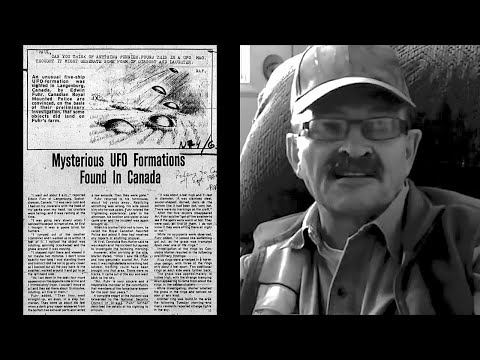
Farmer Edwin Fuhr on witnessing 5 landed UFOs in his field in Langenburg, Canada, September 1, 1974
Eyes On Cinema's direct interview footage of Edwin Fuhr recounting the encounter in his own words.
Unexplained phenomena in small town Saskatchewan 50 years ago: were there UFOs seen in Langenburg?
CBC News Saskatchewan's regional 50th-anniversary retrospective on the case and its lasting local significance.
Sources
- "Commemorative coin rekindles talk of 50-year-old alleged UFO sighting in rural Sask." CBC News, September 2024. cbc.ca
- "UFO sightings." Town of Langenburg, official municipal website. langenburg.ca
- Royal Canadian Mint. "Canada's Unexplained Phenomena: The Langenburg Event — 1 oz. Pure Silver Glow-in-the-Dark Coin." Official product page. mint.ca
- Prisciak, David. "Langenburg UFO sighting commemorated with silver coin." CTV News Regina, September 11, 2024. ctvnews.ca
- "Langenburg UFO 1974." Metabunk forum discussion thread, including quoted RCMP incident report language and skeptical analysis of the ground-trace measurements. metabunk.org
- "#24 — Langenburg's UFO Encounter." Unsolved Canadian Mysteries. unsolvedcanadianmysteries.ca
- "The Langenburg Sighting And The Encounter Of Edwin Fuhr." UFO Insight. ufoinsight.com
- "Farmer Edwin Fuhr's Strange Sighting in Saskatchewan, Canada." UFO Casebook, 2010. ufocasebook.com
- "North America 1974 Langenburg." Old Crop Circles (research catalog). oldcropcircles.weebly.com
- "Langenburg, Saskatchewan." Wikipedia — general municipal background only. en.wikipedia.org
- Hynek, J. Allen, and Jacques Vallée. The Edge of Reality: A Progress Report on Unidentified Flying Objects. Henry Regnery Company, 1975. Appendix A, "A Sighting in Saskatchewan."
- Phillips, Ted. Physical Traces Associated with UFO Sightings: A Preliminary Catalog. Center for UFO Studies (CUFOS), 1975, p. 104.
- Hayes, Matthew. "A History of Canada's UFO Investigation, 1950–1995." PhD dissertation, Trent University, September 2019. digitalcollections.trentu.ca
- "The Langenburg Landings 1974." Order of the Critical Believers forum. criticalbelievers.proboards.com
- "Interview With Edwin Fuhr 37 Years Later — The Langenburg UFO Case." Above Top Secret forum, 2011. abovetopsecret.com
- "Edwin Fuhr and the 1974 Langenburg, Saskatchewan UFO Event." The Canadian Gothic podcast, Curiouscast. thecanadiangothic.com
- "Langenberg, Saskatchewan 1974." The Cosmic Gutter (Substack newsletter). thecosmicgutter.substack.com
- "New coin reignites interest in 50-year-old Canadian UFO story." CBC News: The National, YouTube, September 2024.
- "Farmer Edwin Fuhr on witnessing 5 landed UFOs in his field in Langenburg, Canada, September 1, 1974." Eyes On Cinema, YouTube.
- "Unexplained phenomena in small town Saskatchewan 50 years ago: were there UFOs seen in Langenburg?" CBC News Saskatchewan, YouTube.
- "Langenburg, Saskatchewan." Rural Municipality of Langenburg No. 181 background and 1880s settlement history. en.wikipedia.org
- Royal Canadian Mounted Police. Official departmental website. rcmp.ca
- Library and Archives Canada. Official federal archive. canada.ca
See something inaccurate? Have additional information or sources?
Suggest an Edit →Last Updated: August 2026