
The Long Prairie Incident
On the evening of October 23, 1965, nineteen-year-old radio announcer James "Jerry" Townsend of KEYL Long Prairie was driving his 1956 sedan west on Minnesota State Highway 27 when his engine, headlights, and radio died simultaneously. Coasting to a stop, he found an upright, rocket-shaped silver object some 30–40 feet tall straddling the road on tripod legs. Three six-inch, dark, "beer-can" shaped entities with matchstick limbs emerged, stood motionless as if watching him for several minutes, then withdrew into the object, which climbed away with a humming sound and vanished by extinguishing its own light. Local officers who responded found three parallel strips of an oily residue on the pavement — the case's only physical trace, and one that was never chemically analyzed. Widely nicknamed the "Long Prairie Cans" or the "Tin Can Alien" sighting, the case became a minor national sensation in the fall of 1965 and remains one of American ufology's most vividly strange — and most thinly corroborated — close encounters.
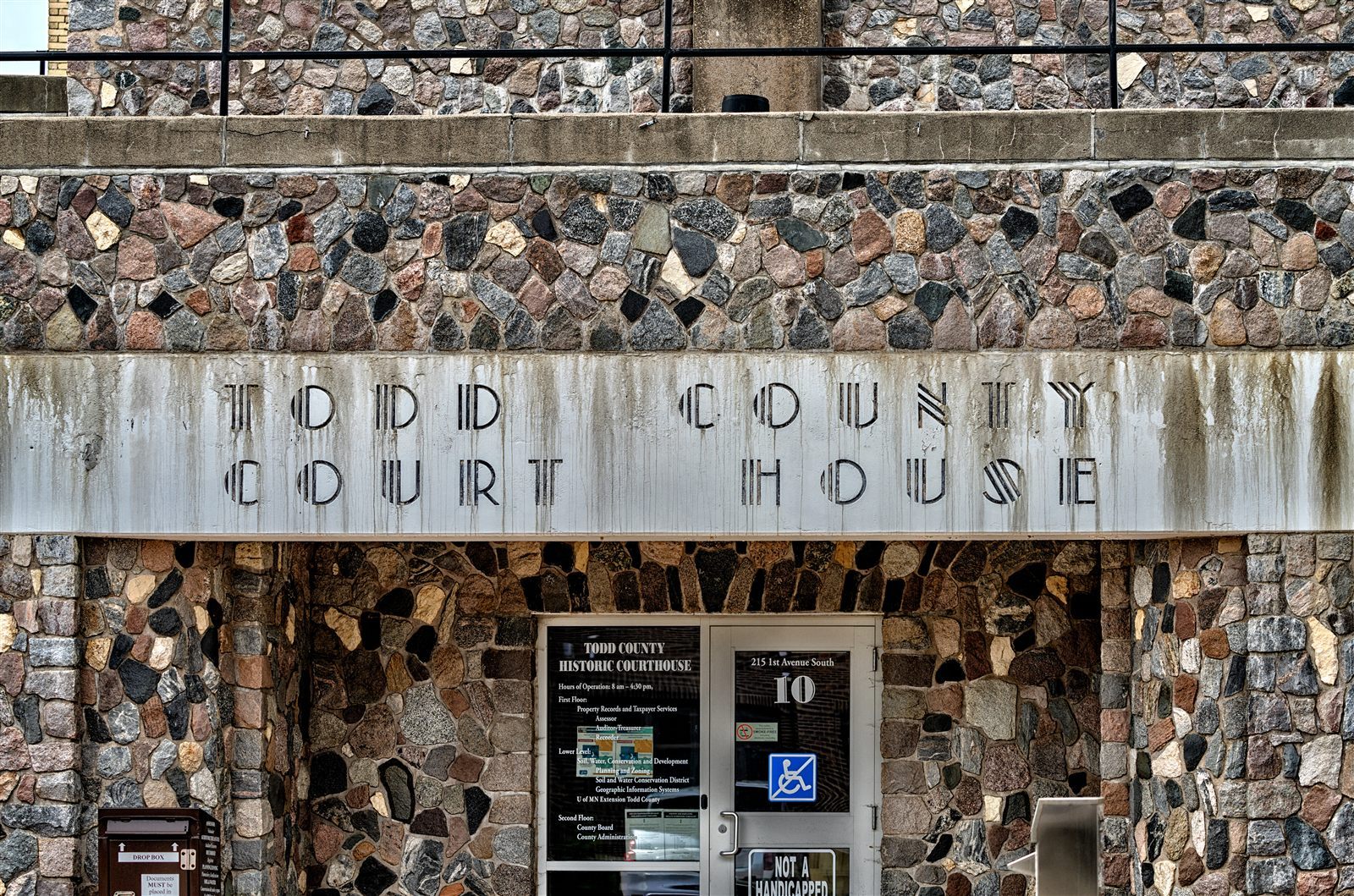
Pictured: the Todd County Courthouse in Long Prairie, Minnesota, seat of the Todd County Sheriff's Office that Jerry Townsend drove to on the night of the encounter and from which Sheriff James Bain and Officer Lavern Lubitz were dispatched — not a photograph of the encounter site itself, the object, or the witness. No photograph of the object, the entities, the roadway trace, or Townsend at the scene is known to exist; the encounter occurred after dark on a rural highway with no other cameras present, and the KEYL studio and the exact stretch of Highway 27 have changed considerably since 1965. Photo by Tony Webster, June 11, 2021, licensed CC BY 2.0 via Wikimedia Commons.
Theoretical Alignment
Assessment: The Extraterrestrial Hypothesis (ETH) struggles with the sheer strangeness of the reported entities — six-inch, eyeless, "beer-can" shaped figures on tripod legs bear little resemblance to the more anthropomorphic occupant reports common in 1965 American ufology, and no coherent technological or biological rationale for miniature robotic-looking beings has ever been proposed. The Interdimensional Hypothesis (IDH) and Psycho-Social Hypothesis (PSH) both align more comfortably: the encounter's dreamlike compression (a three-minute silent standoff, an object that "turns off" its own visibility rather than flying away, entities that seem more like automata than travelers) fits patterns researchers such as Jacques Vallee have argued recur across centuries of "high strangeness" folklore, while the single, young, isolated witness and the total absence of independent physical confirmation leave real room for a psychologically or perceptually generated event, however sincerely reported.
Background
Long Prairie is the county seat of Todd County, a rural community of roughly 1,800 people in 1965 situated in the lake-and-farm country of west-central Minnesota, about 120 miles northwest of Minneapolis–St. Paul. It was, and remains, an unremarkable small town built around agriculture, light industry, and local institutions — a courthouse, a handful of churches, a Main Street, and a small local radio station, KEYL, which had gone on the air a few years earlier and served as the community's primary source of local news and music. It was at KEYL that nineteen-year-old James "Jerry" Townsend worked as a radio announcer, a modest but locally visible job that placed him, quite literally, in the public ear of the community he would soon startle with an extraordinary report.
Long Prairie itself had a longer and stranger history than its sleepy 1965 profile suggested. The townsite was platted in May 1867 and named for the Long Prairie River that runs through it, making it the oldest incorporated town in Todd County. Decades before that, an 1846 federal treaty had established a Long Prairie Reservation for the Ho-Chunk (Winnebago) people, who were relocated there in 1848 and then resettled again in 1855 as white settlement expanded — a history that, while unconnected to the 1965 sighting itself, is a reminder that the area had already seen more than a century of dramatic, sometimes wrenching change by the time Jerry Townsend drove out along Highway 27 that October evening. By the mid-1960s the town's population hovered around 1,800, its economy anchored in dairy farming, small manufacturing, and the kind of institutions — a courthouse, a hospital, a weekly newspaper, and KEYL — that gave a rural county seat its identity.
The autumn of 1965 arrived amid a genuine, well-documented nationwide surge in UFO reports. Historians of ufology generally regard 1965 as one of the most active years of the entire "flying saucer" era, bracketed by a string of widely covered cases: the Exeter, New Hampshire sightings of September 1965 investigated by journalist John Fuller; a cluster of contactee and occupant reports across the Midwest and South that fall; and a rising tide of local newspaper coverage that made "unidentified flying object" a familiar phrase to ordinary Americans in a way it had not quite been before. NICAP's own 1965 chronology, compiled from period newspaper clippings and witness reports, runs to hundreds of entries for that single year. Minnesota was not immune to this atmosphere: October 23, 1965 fell squarely within the state's firearms deer-hunting season, meaning unusually large numbers of rural Minnesotans — hunters, farmers checking on livestock, families driving home after dark — were outdoors and skyward-facing on the very evening Townsend had his encounter, a detail that helps explain why several loosely corroborating reports of aerial lights surfaced from the same county that same night, even though none of them witnessed the close encounter itself.
Nothing in Townsend's background suggested an interest in science fiction, "flying saucer" literature, or the growing UFO subculture of the period. Investigators who later spoke with his colleagues, teachers, and acquaintances consistently described him as a serious, religious young man — he had spent part of that summer as a counselor at a Bible camp — whose on-air job at a small-town station gave him little to gain and a great deal of local ridicule to lose by inventing an outlandish story. It was against this backdrop, on a dark, rural two-lane highway a few miles outside the town where nearly everyone would soon know his name, that Townsend's car came to an inexplicable stop in front of an object he could not identify.
Complete Timeline
| Date | Event |
|---|---|
| 1959 | Radio station KEYL signs on the air in Long Prairie, Minnesota, becoming the small town's primary local broadcast outlet. |
| Summer 1965 | Jerry Townsend, 19, works as a Bible camp counselor before taking a position as an on-air announcer at KEYL. |
| Sept. 3, 1965 | The widely publicized Exeter, New Hampshire sightings occur, part of the broader national UFO wave of which Long Prairie would soon become a Midwestern chapter. |
| Oct. 23, 1965 (~7:00 PM) | Fourteen-year-old Ray Blessing, observing the sky through a telescope from his home, reportedly sees an unusual "inverted sombrero"-shaped, lighted object roughly fifteen minutes before Townsend's encounter begins. |
| Oct. 23, 1965 (~7:15 PM) | The Encounter. Driving west on Highway 27 about four miles east of Long Prairie, Townsend rounds a curve as his engine, headlights, and radio die simultaneously. He coasts to a stop roughly 20 feet from an upright, silver, rocket-shaped object, about 30–40 feet tall, straddling the road on tripod legs. |
| Oct. 23, 1965 (immediately after) | Three six-inch, dark, "beer-can" shaped entities with tripod-like limbs emerge from behind or beneath the object. Townsend, briefly considering ramming the object with his dead car and then approaching on foot, halts as the entities gather and appear to watch him for approximately three minutes. |
| Oct. 23, 1965 (Departure) | The entities withdraw into the object. It lifts off with an audible humming sound, climbs to an estimated altitude of roughly a quarter mile (~400 meters), and vanishes by extinguishing its own lighting rather than flying out of sight. At the same moment, Townsend's car engine restarts and his headlights come back on unassisted. |
| Oct. 23, 1965 (Night) | Townsend drives back to Long Prairie at high speed — contemporary wire reports cite roughly 90 miles per hour — to report the encounter, first to a local judge, who advises him to contact law enforcement. |
| Oct. 23, 1965 (Later that night) | Todd County Sheriff James Bain and Long Prairie Police Officer Lavern Lubitz accompany Townsend to the site and discover three parallel strips of an oily substance on the road surface, about four inches apart and roughly a yard long. No other physical traces are found. |
| Oct. 23, 1965 (Same evening) | Separately, a group of deer hunters in the area report seeing a luminous object ascending from roughly the same vicinity; a distant report attributed to the sheriff of Anoka County, more than 100 miles away, of a similar aerial phenomenon that night is also relayed in period press coverage, though its connection to the Long Prairie object is unconfirmed. |
| Oct. 24–25, 1965 | Wire services and Minnesota newspapers pick up the story; Townsend is interviewed locally and becomes the subject of statewide, then national, press coverage. |
| Late Oct. 1965 | Coral Lorenzen of the Aerial Phenomena Research Organization (APRO) telephones Sheriff Bain, who vouches for Townsend's sobriety, reputation, and visible fright at the time of his report. |
| Late 1965 | The U.S. Air Force's Project Blue Book logs the sighting as case number 10035. Consultant J. Allen Hynek receives written correspondence describing the encounter but does not travel to Minnesota or file a substantive field investigation report. |
| 1966 | Investigator and author Brad Steiger includes an account of the Long Prairie sighting in Strangers From the Skies. |
| 1967 | Coral and Jim Lorenzen publish a detailed account of the case in Flying Saucer Occupants. Journalist John Keel's article for True: The Man's Magazine popularizes the case nationally and helps cement its "Tin Can" nickname. |
| 1969 | Jacques Vallee catalogs the encounter in Passport to Magonia, situating it among his broader survey of high-strangeness humanoid landings. |
| 1977 | J. Allen Hynek references the case's Blue Book disposition in The Hynek UFO Report, his retrospective critique of the Air Force program's investigative rigor. |
| 2000 | Jerome Clark includes a detailed entry on the sighting in Extraordinary Encounters: An Encyclopedia of Extraterrestrials and Otherworldly Beings. |
| July 10–11, 2015 | Long Prairie hosts the Lakes Area Paracon, commemorating the 50th anniversary of the sighting, with presentations by Jerome Clark, Kevin Randle, and Adrian Lee, alongside the town's annual City-Wide Garage Sale and Crazy Days weekend. |
| Present day | The "Long Prairie Cans" remain a fixture of Minnesota UFO folklore and humanoid-encounter catalogs, cited in general UFO histories as one of the strangest, and most singularly under-investigated, American close encounters of the 1960s. |
The Encounter on Highway 27
Jerry Townsend's shift at KEYL had ended, and he was driving his 1956 sedan west along Minnesota State Highway 27, a quiet two-lane blacktop road connecting Little Falls to Long Prairie. It was full dark by roughly 7:15 PM. As he came around a curve about four miles east of town, his engine died without warning. In the same instant his headlights and car radio went dead. He coasted forward, using what momentum remained, and brought the car to a stop roughly 20 feet from an object he could not immediately identify: an upright, silver-colored, metallic-looking structure resembling a rocket or elongated cylinder, standing some 30 to 40 feet tall and about 10 feet in diameter, apparently resting on the tips of three legs or fins that straddled both lanes of the highway.
Townsend's own later account, corroborated in its essentials by every secondary source that quotes him directly, describes a brief moment of practical calculation rather than immediate panic. With his car dead and the road blocked, he considered whether he might be able to nudge or push the object out of the way, first by attempting to restart the engine and drive into it for leverage, and, when the engine would not turn over, by getting out and attempting to push it aside by hand — a strikingly unromantic, almost mechanically minded first instinct for a witness supposedly encountering something otherworldly. It was as he stepped out of the car and approached the front bumper that he first saw movement near the base of the object.
The Entities
Three small figures emerged from behind or underneath the object and advanced a short distance toward him. Townsend described them, in the phrase that would come to define the case in the popular press, as resembling "beer cans" — dark brownish-black cylindrical bodies no more than six inches tall, moving with an awkward, mechanical gait on two thin, "matchstick"-like legs or fins. Whenever they came to a stop, he said, a third leg or fin would extend from the rear of the body to provide stability, giving them a brief tripod stance before they resumed walking. He described short, similarly thin "tripod arms" extending from the sides. Most unsettling to Townsend was their apparent lack of any face: he reported no eyes, no discernible sensory organs of any kind, and yet came away with the distinct and immediate impression that the figures were looking at him, that some form of mutual observation was taking place despite the absence of any visible means for it.
The three entities advanced to a point beneath the object, within a circle of pale, "colorless" light spilling down from its underside, and came to a stop. What followed was less a confrontation than a standoff: Townsend remained near his car, and the three figures remained in their circle of light, for what he estimated at approximately three minutes, neither party approaching the other. Townsend later explained his own restraint in strikingly logical terms: reasoning that whatever had disabled his car's ignition, lighting, and radio simultaneously and without any mechanical cause he could identify was clearly capable of far more than that, he concluded that provoking the beings further, or attempting to interfere with them physically, carried a risk he was not willing to take. "If these creatures were able to turn off my engine," he reportedly said, "they were capable of doing anything to me."
The Withdrawal and Departure
After the roughly three-minute standoff, the three entities turned and withdrew back beneath or behind the object, disappearing from view. Townsend, still standing near his car, watched as the object itself began to stir: a low humming sound built in intensity, and the structure lifted smoothly off the road surface, rising vertically without any visible flame, exhaust, or downward blast that Townsend could describe. It continued climbing, by his estimate, to an altitude of roughly a quarter mile — a little over 400 meters — before it did not so much fly away into the distance as simply go dark, its light extinguishing and the object vanishing from sight against the night sky rather than receding toward any visible horizon.
In the same instant, Townsend's car sprang back to life on its own: the engine caught, and his headlights came back on without him touching the ignition. Shaken, and by his own account far more frightened after the fact than he had been during the encounter itself, he got back in the car and drove the remaining few miles into Long Prairie at what period wire reports describe as roughly 90 miles per hour, arriving in town still visibly rattled.
Reporting the Encounter and the Roadway Investigation
Townsend's first stop in town, by most accounts, was to a local judge he knew personally, who heard his account and advised him to report it immediately to law enforcement rather than sit on it overnight. He then went to, or contacted, the Todd County Sheriff's Office, reaching Sheriff James Bain. Bain, together with Long Prairie Police Officer Lavern Lubitz, agreed to accompany Townsend back out to the site on Highway 27 that same night rather than waiting for daylight, a decision that in hindsight preserved what little physical evidence the case would ultimately yield.
At the location Townsend indicated, the two officers found nothing resembling scorched pavement, crushed vegetation, or a ground depression consistent with a landed object of the size Townsend described. What they did find, however, was harder to dismiss out of hand: three narrow, parallel strips of a dark, oily substance running along the road surface, spaced roughly four inches apart and extending for about a yard. Bain would later tell Coral Lorenzen of APRO by telephone that in his years of law enforcement work on rural roads, he had never seen marks quite like them. Neither officer had the equipment or, evidently, the institutional direction to properly document, photograph, sample, or preserve the trace for later analysis; the marks were simply observed, described from memory in subsequent interviews, and left on a public roadway that would soon see ordinary traffic and weather erase them entirely.
Word of the encounter spread through the small town almost immediately. Because Townsend was a locally recognizable figure — his voice was, quite literally, familiar to KEYL's listeners — his story could not remain a private matter even had he wished it to. Neighbors, colleagues, and, soon, reporters from regional and then national wire services began asking questions, and investigators who later looked into Townsend's background found a consistent picture: teachers, friends, and Sheriff Bain himself independently described him as an honest, sober, religiously serious young man with no history of practical jokes or attention-seeking behavior, a profile that made the sudden, elaborate, and financially unrewarding claim of a UFO encounter difficult for local observers to square with any obvious motive to lie.
Peripheral and Corroborating Witnesses
Several loosely connected reports from the same evening surfaced in the days that followed, though none of them directly corroborates the close encounter itself, and all should be weighed with appropriate caution. A fourteen-year-old identified in secondary accounts as Ray Blessing reportedly used a telescope from his home to observe an unusual, "inverted sombrero"-shaped lighted object in the sky roughly fifteen minutes before Townsend's car stalled on Highway 27 — a report that, if accurately timed and located, would place an anomalous aerial object in the general vicinity shortly before the ground encounter began, though the object Blessing described does not obviously match the grounded, rocket-shaped object Townsend later reported at close range.
Separately, a group of deer hunters in the area — unsurprisingly numerous that week, given the opening of Minnesota's firearms season — reported seeing a luminous object rising from roughly the same part of the county that same evening, a report consistent with, though not independently timestamped against, the departure Townsend described. A more distant claim, relayed in some period press accounts, holds that the sheriff of Anoka County, more than 100 miles to the southeast, observed a similar aerial phenomenon that night; given the distance involved, this is best treated as evidence of a broader regional wave of aerial-light reports that week rather than a direct corroboration of the specific object seen on Highway 27. None of these secondary witnesses were, as far as any surviving record indicates, formally interviewed, cross-examined, or asked to provide sworn statements by Blue Book, APRO, or NICAP investigators — a real and often-noted gap in how thoroughly the case was actually worked at the time, despite the volume of press coverage it generated.
Media Attention and the Investigation's Limits
The Long Prairie story moved quickly from local curiosity to national news item. Wire services carried Townsend's account within a day or two of the encounter, and Minnesota newspapers ran interviews with Townsend, Sheriff Bain, and local residents through the following week. Coral Lorenzen's Aerial Phenomena Research Organization (APRO), based in Tucson, Arizona, took an early interest and documented the case in its bulletin, with Lorenzen personally telephoning Sheriff Bain to assess Townsend's character rather than relying solely on newspaper accounts. The case also reached J. Allen Hynek, the Northwestern University astronomer then serving as Project Blue Book's scientific consultant, who received written correspondence describing the encounter directly from Townsend or an intermediary. Hynek's own later writing on the case, most notably in his 1977 book The Hynek UFO Report, reflects an investigator who found the report interesting enough to retain but never pursued with an on-site field investigation of his own — a pattern he would go on to criticize as characteristic of Blue Book's underresourced, administratively minded handling of civilian reports generally.
Blue Book's official file on the case, logged under case number 10035, ultimately closed with a classification of "psychological," a catch-all label the project used for reports it judged to stem from a witness's perceptual or mental state rather than any external stimulus. No detailed investigative report, on-site interview transcript, or documented rationale for that classification appears to survive in any publicly available Blue Book archive; researchers examining the file decades later have generally concluded that the "psychological" label functioned more as an administrative closure code than as the product of any substantive inquiry, since no Blue Book investigator is known to have traveled to Todd County, examined the roadway trace, or formally interviewed Townsend, Bain, or Lubitz in person.
The case's popular afterlife proved considerably longer than its official one. Journalist John Keel profiled it for True: The Man's Magazine in 1967, an article whose memorable framing helped fix the "Tin Can" nickname in the popular imagination, while investigator Brad Steiger and, separately, Coral and Jim Lorenzen incorporated detailed accounts into their respective books that same period, preserving witness quotations that might otherwise have been lost to fading local newspaper archives. Jacques Vallee catalogued the sighting in his 1969 survey Passport to Magonia, and Jerome Clark gave it a full entry in his 2000 encyclopedia Extraordinary Encounters. Fifty years after the event, in July 2015, the town of Long Prairie itself embraced the story, hosting the Lakes Area Paracon with presentations from Clark, veteran UFO investigator Kevin Randle, and paranormal researcher Adrian Lee, timed to coincide with the town's annual Crazy Days community weekend — a small but telling sign of how thoroughly a single strange evening in 1965 had become part of local identity.
Key Witnesses
James "Jerry" F. Townsend
Nineteen years old at the time of the encounter, Townsend was a working radio announcer at KEYL and, by every account gathered afterward, a serious, religiously devout young man who had spent part of that summer as a Bible camp counselor. He was the only person to directly witness the object at close range and the only person to see the three entities. Sheriff James Bain vouched for his sobriety and honesty to Coral Lorenzen of APRO, and teachers and colleagues interviewed afterward described him consistently as truthful and not prone to exaggeration or attention-seeking. His public, on-air role at a small-town station meant an elaborate hoax would have exposed him to sustained local scrutiny and ridicule rather than anonymous reward, a point often raised in his favor by researchers who examined the case. Working against his account is the fact that no other person witnessed the close encounter itself, and no formal psychological evaluation of him was ever conducted despite Project Blue Book's eventual "psychological" classification of the case.
Sheriff James Bain
Bain accompanied Townsend to the scene on the night of the encounter and, together with Officer Lavern Lubitz, discovered the three parallel strips of oily residue on the roadway — the case's only physical trace evidence. He personally assessed Townsend's character during the initial report and again in a later telephone conversation with Coral Lorenzen of APRO, telling her that Townsend "had a good reputation, was not a drinker," and had appeared visibly frightened. His own on-the-record description of the roadway marks — that he had "looked at a lot of roads" and never seen anything comparable — is significant precisely because it is an independent professional observation, made by a local law-enforcement officer with no evident stake in the outcome, rather than testimony from Townsend himself.
Officer Lavern Lubitz
Lubitz accompanied Sheriff Bain to the site on the night of the encounter and jointly observed the oily roadway trace with him, providing a second independent set of eyes on the case's only physical evidence. Beyond his presence at the scene, no further detailed testimony or biographical information about Lubitz appears in the surviving published record of the case.
Ray Blessing
According to secondary accounts of the case, Blessing was observing the night sky through a telescope from his home in the vicinity when he reportedly saw an unusual, "inverted sombrero"-shaped lighted object roughly fifteen minutes before Townsend's encounter began. His report, while intriguing as a possible precursor sighting of an aerial object in the same general area, was not obtained through a documented, formal interview process as far as any surviving investigative record shows, and the object he described does not clearly match the grounded, rocket-shaped object Townsend later reported at close range.
The Five Observables Assessment
The Five Observables framework, developed to classify UAP encounters by performance characteristics exceeding known technology, is applied here to the flight behavior Townsend described:
Assessment: Townsend described a smooth, vertical liftoff accompanied by a humming sound and no visible exhaust, flame, or downward blast — consistent with, though not conclusive proof of, an anti-gravity or field-effect lift mechanism, and classified here as speculative given the single-witness, non-instrumented nature of the observation. There is no report of instant acceleration or hypersonic speed; the object's climb to roughly a quarter mile of altitude was described as a steady ascent, not a sudden burst. The object's method of disappearance — extinguishing its own lighting at altitude rather than visibly flying out of sight — is a notable low-observability signature, though it is equally consistent with a mundane light source simply being switched off, and is marked speculative rather than present. No trans-medium transition (air-to-water or otherwise) was reported. Separate from the Five Observables framework itself, the case's most striking anomalous signature is the vehicle-interference effect: the simultaneous failure and simultaneous restoration of Townsend's engine, headlights, and radio, a pattern this site tracks independently across multiple cataloged close encounters.
Evidence Assessment
Supporting Anomalous Origin
- Sheriff James Bain personally vouched for Townsend's sobriety, honesty, and visible fear when reporting the encounter
- Teachers, colleagues, and acquaintances independently and consistently described Townsend as truthful with no history of fabrication
- Townsend's public, on-air job at KEYL gave him significant local exposure and reputational risk, and no evident financial or career incentive to invent an elaborate hoax
- Two independent law-enforcement officers (Bain and Lubitz) jointly discovered and described the same unusual roadway trace
- The simultaneous failure and simultaneous restoration of the car's engine, headlights, and radio matches a documented vehicle-interference pattern seen in numerous other, unrelated close-encounter cases
- Multiple secondary, same-night reports of aerial lights and an ascending luminous object from the same general vicinity, while unconfirmed, are at least consistent with an anomalous aerial event occurring in the area that evening
- The entity description is highly idiosyncratic and does not match any pre-existing popular "little green man" template circulating in 1965 media, arguing against simple imitation of known UFO tropes
Supporting Conventional Explanation
- The entire close encounter rests on the testimony of a single direct witness, with no second person present to corroborate the object or the entities
- The only physical trace evidence was never chemically analyzed, photographed, or preserved, leaving its true nature permanently unresolved
- No radar, camera, or other instrumented sensor recorded any anomalous activity that evening
- Project Blue Book's own "psychological" classification, whatever its investigative shortcomings, represents the only period-contemporary official assessment, and no on-site rebuttal investigation was ever conducted to challenge it
- The secondary witnesses (Ray Blessing, the unnamed hunters, the Anoka County report) were never formally interviewed or cross-examined, and none of their accounts precisely matches the grounded, close-range object Townsend described
- Townsend was young (19) and had been alone, driving after dark on an unfamiliar stretch of rural highway, conditions under which fatigue-related perceptual anomalies, while unproven here, cannot be excluded
Why "Disputed"
The Long Prairie Incident is classified DISPUTED because the case combines a witness of genuinely strong, independently vouched-for personal character with an almost complete absence of the kind of corroborating physical or instrumented evidence that would allow a confident verdict in either direction. On one hand, this is not a case that can be dismissed as an obvious hoax: Sheriff Bain's independent vouching for Townsend's sobriety and honesty, his own professional astonishment at the roadway trace, and Townsend's total lack of any evident motive to fabricate an elaborate story that would embarrass him publicly at his own radio job all weigh meaningfully in the account's favor. The vehicle-interference effect, too, sits within a well-documented pattern seen across many otherwise unconnected cases, lending Townsend's account a structural plausibility that a purely invented story would not necessarily require.
On the other hand, this is fundamentally a single-witness case for its most extraordinary content — the entities themselves were seen by no one but Townsend — and its one piece of independently observed physical evidence, the roadway trace, was never tested, sampled, or photographed, leaving its true nature permanently unknowable. No radar or instrumented data exists. Project Blue Book's "psychological" classification, while itself resting on a thin and possibly non-existent investigative foundation, was never seriously rebutted by a competing field investigation from APRO, NICAP, or any other body with the resources to conduct one. The secondary witnesses so often cited alongside the case — Ray Blessing, the unnamed hunters, the distant Anoka County report — were never formally interviewed and do not precisely match what Townsend described. Absent either a rigorous debunking or a rigorous confirmation, Long Prairie remains exactly what its evidentiary record supports: a vivid, sincerely reported, and never adequately investigated close encounter.
Sensor & Instrumentation Detection Profile
No radar, camera, or instrumented sensor of any kind captured the Long Prairie encounter. The nearest air-traffic and military radar coverage in central Minnesota in 1965 was optimized for high-altitude strategic-bomber detection, not a low-level object hovering over a two-lane rural highway; no radar station reported an anomalous track that evening, and none appears to have been specifically queried by investigators at the time. Todd County Sheriff James Bain and Long Prairie Police Officer Lavern Lubitz carried no cameras, Geiger counters, or soil-sampling kits when they responded to the scene; their only instrument was a flashlight. The sole quasi-instrumented data point in the case is the automobile itself: Townsend's 1956 sedan functioned as an inadvertent and crude electromagnetic-interference detector, its engine, headlights, and AM radio all failing simultaneously as the object came into close proximity and all three recovering simultaneously as it departed — a pattern consistent with, though not proof of, the vehicle-interference effect documented in numerous other close-encounter cases of the era.
Environmental & Geospatial Context
Long Prairie sits in Todd County in the west-central Minnesota lake country, a region of rolling farmland, second-growth forest, and small lakes roughly 120 miles northwest of the Twin Cities. Highway 27 east of town runs through sparsely populated countryside, and the stretch where Townsend's car stalled — about four miles east of town near a curve in the road — would have been almost entirely dark after sunset, with no streetlights and few nearby farmhouses. October 23, 1965 fell during Minnesota's firearms deer-hunting season, which explains the presence of the "three hunters" cited in secondary accounts as having independently reported a luminous object in the same general area and time frame; hunters and rural residents were simply more likely than usual to be outdoors, in the woods, or watching the sky near dusk that week. No precipitation, fog, or unusual meteorological activity is mentioned in any surviving account of the evening, and the encounter occurred well after civil twilight, in full darkness, conditions under which a lit or reflective object at close range would have been highly conspicuous against the surrounding treeline.
Observer Credibility & Occupational Profile
Jerry Townsend was, by every surviving account, an unusually credible candidate for a hoaxer. At nineteen, he held a public, on-air position as an announcer for KEYL, Long Prairie's local radio station — a small-town job in which a reputation for honesty was itself professionally valuable, and one that would put him under immediate, unwanted local scrutiny rather than anonymous fame. He was described by investigators as a devoutly religious young man who had spent part of that same summer working as a Bible camp counselor. When Todd County Sheriff James Bain was contacted by Coral Lorenzen of the Aerial Phenomena Research Organization (APRO), he told her that Townsend "had a good reputation, was not a drinker," and had been visibly frightened when he reported the encounter. Teachers and friends interviewed afterward likewise described him as an honest young man with no history of fabrication or attention-seeking. Weighed against this is his youth and inexperience, the fact that he was the case's only direct eyewitness to the entities themselves, and the reality that no independent psychological evaluation of him was ever conducted — Project Blue Book's eventual "psychological" classification of the case appears to have been an administrative label applied without any actual clinical assessment of the witness.
Physical & Material Assays
The only physical trace evidence recovered from the Long Prairie encounter was a set of three parallel strips of an oily, dark residue found on the roadway surface, approximately four inches apart and about a yard long, discovered by Sheriff Bain and Officer Lubitz when they drove out to the site with Townsend later that night. Bain later stated plainly that he had "looked at a lot of roads and never saw anything like them before." No soil, foliage, or asphalt samples were collected for laboratory testing; no chemical analysis, spectrographic examination, or comparison to known automotive or industrial oils was ever performed, as far as any surviving record indicates. This is a significant evidentiary gap: unlike comparable cases such as the Eagle River pancakes, which were sent to the FDA and Air Force labs for chemical breakdown, the Long Prairie trace material was observed, described, and then left to weather away on a public highway, with no chain of custody and no scientific record beyond the responding officers' word.
Historical Precedents & Archive Matches
The Long Prairie case belongs to a broader wave of American close-encounter and humanoid reports that peaked in 1965, a year NICAP's own contemporaneous chronology logs as unusually active nationwide. Vehicle-interference effects — a car's engine, lights, and radio failing in the presence of a nearby object — recur across dozens of cataloged cases both before and after 1965, most famously at Levelland, Texas in 1957 and in the Val Johnson case, a fellow Minnesota vehicle-interference encounter from 1979. The specific image of small, non-humanoid, mechanical-looking entities blocking a lone motorist's path on a rural road also parallels the 1954 Marius Dewilde sighting in France, in which two short, stiff-limbed figures were seen near a landed object on railway tracks. What sets Long Prairie apart from all of these precedents is the sheer novelty of its entity description: no earlier American case in the NICAP or APRO files described anything resembling a six-inch animated "tin can," a detail so idiosyncratic that some researchers have argued it argues against copycat fabrication (there was no existing pop-culture template to copy), while skeptics have countered that its very novelty makes it harder to corroborate against any known pattern.
Material Analysis
The Long Prairie case's physical evidence record is unusually thin for a close encounter that received this much contemporary press attention. The three parallel oily strips Sheriff Bain and Officer Lubitz found on the roadway represent the case's only tangible, non-testimonial evidence — and that evidence was never subjected to any chemical, spectrographic, or comparative laboratory analysis. No sample was collected, no photograph is known to have been taken, and no chain of custody exists; the marks were observed, described in officers' later recollections, and left to be worn away by traffic and weather on an active public highway. This stands in sharp contrast to comparable contact-trace cases such as the Eagle River pancakes (1961), where physical samples were promptly forwarded to the FDA and Air Force laboratories for full chemical breakdown, or the Trans-en-Provence soil trace (1981), which underwent extensive biochemical and physical testing by GEPAN. At Long Prairie, an evidentiary opportunity that a modern investigator would treat as the case's single most important asset was, by the standards of any era, badly under-exploited.
Supporting Non-Terrestrial (or at least Non-Mundane) Origin
- Sheriff Bain, a professional with extensive experience observing rural roads, stated he had never seen marks resembling the three oily strips before
- Two independent officers observed the same trace evidence the same night, ruling out a single witness's misperception of the marks themselves
- The marks' geometry — three parallel lines, evenly spaced, of consistent length — is difficult to attribute to ordinary vehicle fluid leakage or roadway staining
- The trace was discovered at the specific location Townsend described before any officer had seen the object or entities, rather than being "found" after a leading description
Supporting a Mundane or Unresolved Origin
- No chemical analysis was ever performed, so the substance's actual composition — automotive oil, road tar, or another mundane material — is simply unknown
- No photograph of the marks exists, leaving their exact appearance, dimensions, and orientation dependent entirely on the officers' memory and later verbal description
- Parallel oily or tar-based patterning can and does occur on rural roads from ordinary vehicle leakage, construction residue, or maintenance activity, and cannot be ruled out without testing
- The trace's discovery, while independent of Townsend in the sense that two officers observed it, still occurred after Townsend had already directed them to a specific, narrow stretch of road matching his account
The Conventional Explanation Candidates
Three broad terrestrial or psychological explanations have been proposed, explicitly or implicitly, for the Long Prairie encounter over the six decades since it occurred. None of them accounts comfortably for every element of the case.
Candidate 1: Elaborate Hoax by a Young, Attention-Seeking Witness
The most straightforward conventional explanation is that Townsend simply invented the story, perhaps to generate publicity for himself or his radio station, or as an impulsive prank that grew larger than he anticipated once law enforcement and the press became involved. This explanation requires no exotic mechanism and would neatly account for the case's central weakness: the fact that everything beyond the physical roadway trace rests entirely on one person's word.
It runs immediately into the character evidence, however. Sheriff Bain, an experienced law-enforcement officer with no evident motive to protect Townsend's reputation, independently vouched for his sobriety, honesty, and visible fright at the time of the initial report — and it was Bain, not Townsend, who then went on to discover and personally describe the unusual roadway trace, a piece of evidence a hoaxer would either have had to fabricate in advance (risking discovery, since the specific stretch of highway was chosen by Townsend before the officers arrived) or gotten fortuitously lucky about. Townsend's public radio job also cuts against a simple attention-seeking motive: it gave him an existing, legitimate local platform he stood to damage rather than enhance by being caught in an elaborate fabrication, and the record shows no evidence he ever tried to monetize or further publicize the story beyond his initial report.
Candidate 2: Misperception of Mundane Objects Combined with Vehicle Malfunction
A second explanation proposes that Townsend encountered some ordinary object — road maintenance equipment, a utility vehicle, a reflective road sign or marker illuminated at an unusual angle — at the same moment his aging 1956 sedan coincidentally suffered a mundane electrical or mechanical failure, and that fatigue, darkness, and the startling coincidence of the two events combined to produce an exaggerated, misremembered account of "entities" that were in reality some combination of small animals, reflections, or optical artifacts caused by his own headlights failing.
This candidate addresses the encounter's least exotic elements reasonably well — 1956-model automobiles were mechanically unreliable by modern standards, and electrical failures were not uncommon — but it struggles badly with the specifics. No county or state road maintenance was documented on that stretch of Highway 27 that night, no known object matches a 30–40-foot, three-legged, silver "rocket" shape, and this explanation offers no account whatsoever for the independently discovered oily roadway trace, which was found by two officers using their own observation, uninfluenced by any suggestion beyond the general location Townsend indicated.
Candidate 3: Project Blue Book's "Psychological" Classification (Waking Dream / Hypnagogic Episode)
The Air Force's own official disposition of the case implies a third explanation: that Townsend, driving alone after dark at the end of a work shift, experienced some form of transient psychological event — a hypnagogic hallucination, a brief dissociative episode, or a waking dream — that produced a vivid but entirely internally generated experience of an object and entities that were never physically present.
This explanation, taken at face value, would neatly resolve the case's central evidentiary problem by requiring no external cause at all. It suffers, however, from two serious weaknesses. First, it offers no mechanism for the vehicle's simultaneous engine, headlight, and radio failure, an event with a physical, mechanical signature independent of Townsend's perception, unless one separately assumes an unrelated and precisely timed coincidental malfunction. Second, and more fundamentally, no surviving Blue Book record indicates that this classification was reached through any actual clinical or psychological evaluation of Townsend, an on-site field investigation, or a formal interview process — it appears, by the assessment of researchers who have examined the file since, to have been an administrative label applied to close out a case Blue Book had no resources or apparent inclination to investigate further, rather than a reasoned diagnosis.
Elaborate Hoax
ImplausibleDifficult to reconcile with independent character testimony from a sheriff with no stake in the outcome, and with the sheriff's own independent discovery of the roadway trace.
Misperception + Coincidental Vehicle Malfunction
InconclusiveAddresses the case's more mundane elements but offers no account for the object's specific, detailed morphology or for the independently observed roadway trace.
Blue Book "Psychological" Classification
UnprovenNever grounded in any documented clinical evaluation or field investigation, and does not explain the physical vehicle-interference effect or the independently discovered trace evidence.
Related Cases
Confirmed Documents & Official Records
The Long Prairie sighting was logged by Project Blue Book as case #10035 and closed with a "psychological" classification. As of this writing, the case has not been individually digitized in the National Archives' online catalog, but falls within the chronological 1965 case-file run held in the Project Blue Book collection (42 cubic feet of case files; 94 rolls of 35mm microfilm, series T-1206), available for on-site or microfilm research at NARA.
UNCLASSIFIED (administrative case log; no field investigation report located)Search Government Archives Directly
Further Reading — Recommended Literature
Strangers From the Skies
One of the earliest book-length treatments of the 1960s UFO wave, published within a year of the Long Prairie sighting and among the first to place it before a national readership.
Flying Saucer Occupants
APRO's own detailed account of the case, drawn from Coral Lorenzen's direct telephone conversation with Sheriff Bain and among the fullest contemporary sources on Townsend's testimony.
Passport to Magonia
Catalogs Long Prairie among Vallee's broader survey of high-strangeness humanoid and landing cases, situating its "tin can" entities within a much older cross-cultural pattern.
The Hynek UFO Report
Hynek's retrospective critique of Project Blue Book's investigative shortcomings, including cases like Long Prairie that were closed with minimal or no field investigation.
Extraordinary Encounters
A full encyclopedia entry on the Long Prairie case, summarizing decades of published sources and situating it among comparable American humanoid encounters.
Essential Viewing

Sources
- National Investigations Committee on Aerial Phenomena (NICAP). "The 1965 UFO Chronology" — entry for October 23, 1965, Long Prairie, Minnesota (BBU case log). nicap.org
- Gross, Patrick. "UFOs at Close Sight: URECAT-000428 — October 23, 1965, Long Prairie, Minnesota, USA, Jerry Townsend." Case file compiling contemporary press and published sources. ufologie.patrickgross.org
- National Archives and Records Administration (NARA). Project Blue Book Records, Record Group 341, including 1965 case files (case #10035). archives.gov
- Lorenzen, Coral & Jim. Flying Saucer Occupants, Signet, 1967. Chapter account of the Long Prairie sighting based on Coral Lorenzen's telephone interview with Sheriff James Bain.
- Steiger, Brad. Strangers From the Skies, Award Books, 1966.
- Keel, John A. "Who Was That Six-Inch-High Animated Tin Can?" True: The Man's Magazine, 1967.
- Vallee, Jacques. Passport to Magonia: From Folklore to Flying Saucers, Henry Regnery Company, 1969. Catalog entry on the Long Prairie humanoid landing.
- Hynek, J. Allen. The Hynek UFO Report, Dell, 1977. Discussion of Project Blue Book's handling of the case.
- Bowen, Charles (ed.). The Humanoids, Neville Spearman, 1969.
- Clark, Jerome. Extraordinary Encounters: An Encyclopedia of Extraterrestrials and Otherworldly Beings, ABC-CLIO, 2000. Entry on the Long Prairie sighting.
- Baker, Alan. The Encyclopedia of Alien Encounters, Virgin Books, 2000.
- "Commemorating 50th Anniversary of Long Prairie 'Tin Can Alien UFO Sighting.'" Walker Pilot-Independent, 2015, covering the Lakes Area Paracon featuring Jerome Clark, Kevin Randle, and Adrian Lee. walkermn.com
- "A Timeline of Minnesota UFO Encounters." Mpls.St.Paul Magazine. Overview including the Long Prairie and Val Johnson cases. mspmag.com
- "Long Prairie, Minnesota." Wikipedia, background on the town, Todd County, and KEYL radio station (used only for basic town/geography orientation; not relied upon for case facts). en.wikipedia.org
- Bain, James (Todd County Sheriff). Statements to Coral Lorenzen (APRO) and to contemporary press, October 1965, regarding witness character and the roadway trace evidence.
- Contemporary Minnesota and wire-service newspaper coverage of the Townsend sighting, late October 1965 (widely reprinted and quoted in subsequent secondary sources cited above).
- Project Blue Book case log #10035 (U.S. Air Force), October 1965, classification "Psychological," as referenced in NICAP's chronology and multiple published secondary analyses.
See something inaccurate? Have additional information or sources?
Suggest an Edit →Last Updated: August 2026