
The Val Johnson Incident
In the pre-dawn darkness of August 27, 1979, Deputy Sheriff Val Johnson was alone on patrol on a desolate stretch of State Highway 220 in rural Marshall County, Minnesota, roughly ten miles west of Stephen, when he spotted an intense light hovering low over the road ahead. Believing it might be a distressed aircraft, he accelerated toward it — and, by his own account, the light closed the distance in an instant, engulfed his squad car, and struck him "like a 200-pound pillow" as glass shattered around him. He awoke roughly 39 minutes later, alone, disoriented, with his patrol car sitting sideways across the highway more than 850 feet from where the skid marks began. The windshield was shattered from an unusual fracture pattern a Ford technician said he had never seen before; the hood was dented; a headlight and the red emergency beacon were smashed; both antennas were bent. A Warren physician treating Johnson's eyes described burns resembling those suffered by a welder without protective goggles. And when Johnson checked the time, both his wristwatch and the cruiser's dashboard clock — which he meticulously synchronized at the start of every shift — had stopped at the exact same moment, 14 minutes behind the actual time. Johnson never claimed to have seen a craft, let alone an occupant; he told investigators only that something he could not identify had collided with his car. The Center for UFO Studies' chief investigator called it one of the most credible reports he had examined in years; skeptic Philip J. Klass called it a hoax. More than four decades later, Marshall County's own sheriff's office has never closed the file, and Johnson's battered patrol car remains the single most-visited artifact at the Marshall County Historical Society Museum in Warren.
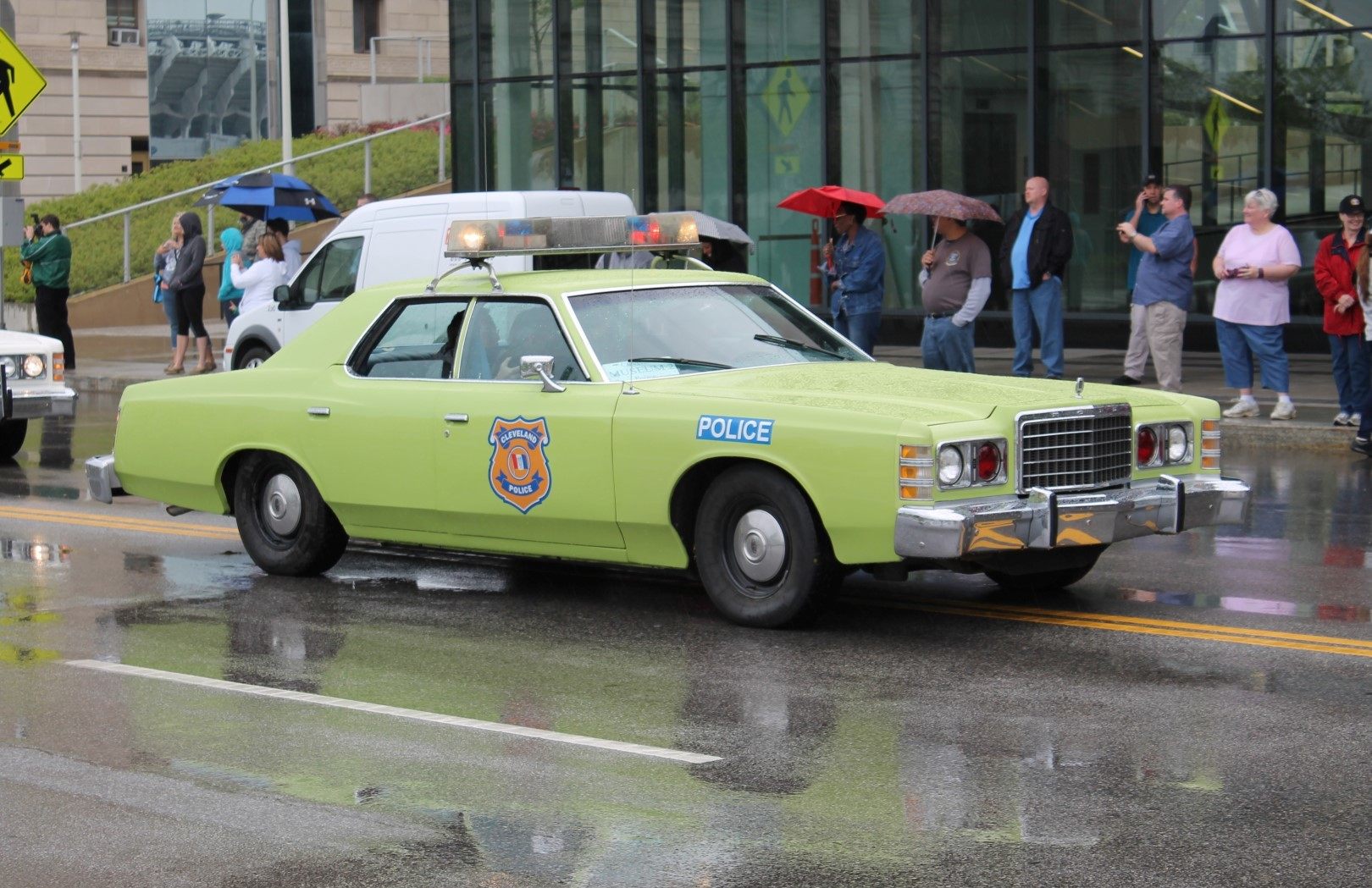
Pictured: a preserved late-1970s Ford LTD sedan in police livery, photographed at a 2015 police memorial parade in Cleveland, Ohio — the same general model of full-size Ford sedan Marshall County's Sheriff's Office ran as a patrol car in 1979, not a photograph of Val Johnson's actual squad car or of the light he described. Johnson's real cruiser — its windshield, hood, headlight, and antennas still bearing the August 1979 damage exactly as investigators documented it — is permanently preserved and on public display at the Marshall County Historical Society Museum in Warren, Minnesota, but no freely licensed photograph of the actual vehicle is known to exist online; the museum's own photographs remain its own property rather than openly licensed for reproduction.
Theoretical Alignment
Val Johnson's case is unusual among this catalogue's "close encounter" files for how little exotic imagery it actually contains: no structured craft, no occupant, no communicated intent — only an intense, mobile light and a violent, unexplained physical impact. That absence of morphological detail keeps its ETH alignment modest rather than eliminating it outright, since the case's genuinely unresolved physical evidence (the fracture pattern in the windshield, the synchronized clock anomaly, the documented eye injury) has never been matched to any confirmed terrestrial stimulus. The comparatively elevated Psycho-Social score reflects a real, still-unresolved possibility raised by the case's most prominent skeptic, Philip J. Klass, who argued the entire event was a fabrication staged by Johnson himself — a claim this file treats seriously below rather than dismissing, even though it was never proven and was directly contradicted by the character testimony of Johnson's own supervisor and colleagues.
Background
Val Johnson was 35 years old in August 1979, a married father who had served as a Marshall County, Minnesota deputy sheriff for roughly two and a half years. Marshall County sits in the extreme northwest corner of the state, in the flat farm country of the Red River Valley near the North Dakota border, with Warren (population roughly 1,600) serving as the county seat and Stephen, a much smaller town, sitting near the rural highway junction where the encounter would take place. Overnight patrol in that part of the state in 1979 meant hours of near-total isolation on empty two-lane highways, with the nearest other law enforcement presence, in Stephen, several miles away. The county's economy, then as now, was almost entirely agricultural — wheat, sugar beets, and small grains grown across flat, glacially leveled farmland — and its total population in the late 1970s numbered only a few thousand people spread across nearly 1,800 square miles, meaning a single deputy's overnight beat could cover an enormous, largely unlit stretch of highway with no backup realistically available within minutes.
The wider institutional context matters to how the case was handled. A decade earlier, the U.S. Air Force had shut down Project Blue Book, its official UFO investigation program, after the Condon Report concluded further government-funded study was not scientifically justified. By 1979, no federal agency had any mandate, budget, or institutional interest in investigating a report like Johnson's; the entire burden of examining a case with this much physical evidence fell to private organizations, principally CUFOS and, more informally, corporate technicians at Ford and Honeywell who agreed to examine the vehicle. Johnson, described by his own supervisor and colleagues as unusually meticulous and level-headed, was an improbable candidate to generate the kind of national tabloid frenzy that followed — a frenzy he himself would later describe as having caused his family "a great deal of emotional strain."
Complete Timeline
| Date | Event |
|---|---|
| December 17, 1969 | The U.S. Air Force formally terminates Project Blue Book following the Condon Report, ending official government UFO investigation a decade before Johnson's encounter. |
| 1973 | J. Allen Hynek founds the Center for UFO Studies (CUFOS) in Evanston, Illinois, the organization that would later investigate the Johnson case. |
| c. 1977 | Val Johnson joins the Marshall County, Minnesota Sheriff's Office as a deputy. |
| August 27, 1979 — ~1:40 AM | On patrol on County Road 5 roughly ten miles west of Stephen, Johnson spots a bright light to the south and turns onto State Highway 220 to investigate, believing it might be a distressed aircraft. |
| ~1:40–1:45 AM | Johnson accelerates toward the light; by his account it closes the distance instantly, engulfs the car, and he hears glass breaking before losing consciousness. |
| ~2:19 AM | Johnson regains consciousness and radios dispatch, sounding "rational but disoriented," reporting that something struck his car and his brakes had locked. |
| ~2:30 AM | Deputy Greg Winslow, dispatched from Stephen, arrives at the scene to find the patrol car stopped sideways across the highway, roughly 854 feet from the start of a 99-foot skid mark. |
| Early morning, Aug. 27, 1979 | Johnson is taken by a Stephen ambulance to a hospital in Warren and separately examined in Grand Forks; a physician treats his eyes for injuries resembling welder's burns. |
| Aug. 28–29, 1979 | The Warren-based Sheaf newspaper publishes an early account; Sheriff Dennis Brekke opens a formal Marshall County Sheriff's Office investigation. |
| September 9–10, 1979 | Wire-service stories ("Officer suffers after encounter with UFO," "Close encounter makes him famous") run in newspapers nationwide. |
| September 11, 1979 | Johnson appears on ABC's Good Morning America to discuss the incident. |
| September–October 1979 | CUFOS investigator Allan Hendry conducts a field investigation; CUFOS devotes its entire September/October 1979 International UFO Reporter double issue to the case, headlined "STOP THE PRESSES!" |
| Fall 1979 | A Ford Motor Company technician examines the shattered windshield and reportedly states, "I have not seen anything like this before. They are extremely unusual." |
| Fall 1979 | Johnson declines both a formal polygraph examination and the National Enquirer's separate offer to pay for a hypnosis session, saying a polygraph "would only satisfy people's morbid curiosity"; he does keep an unsolicited $1,000 Enquirer check for "Best UFO Story of the Year." |
| November 1979 | A Honeywell metallurgical engineer examines the vehicle's damage and concludes only that some form of unspecified "electrical force" was the likely cause. |
| 1983 | Philip J. Klass publishes his hoax theory — that Johnson deliberately damaged his own patrol car — in UFOs: The Public Deceived. |
| 1990s–2000s | The Johnson family relocates from Oslo, Minnesota to Eau Claire, Wisconsin; Johnson largely withdraws from further public comment on the case. |
| 2015 | WCCO-CBS Minnesota airs "Finding Minnesota: Deputy's UFO Encounter"; Minnesota Public Radio publishes retrospective coverage, including a piece connecting the case to the FX series Fargo. |
| 2019 | Warren, Minnesota marks the 40th anniversary of the incident with a public celebration featuring live music, an alien costume contest, and a dramatic reenactment of Johnson's original radio call. |
| 2021 | The Minnesota Historical Society (MNHS) publishes a "MN90" retrospective video and MNopedia entry; KARE 11 airs "Minnesota's Most Notorious UFO Sighting Remains a Mystery Four Decades Later." |
| 2026 | Johnson's patrol car remains on permanent public display at the Marshall County Historical Society Museum in Warren, described by museum staff as the institution's single most-visited artifact; the case remains formally unresolved. |
The Patrol and the First Sighting
Just before 1:40 AM on August 27, 1979, Val Johnson was alone in his Ford LTD patrol car on County Road 5, roughly ten miles west of Stephen, on an otherwise uneventful overnight shift. He spotted a bright light to the south, low over the horizon, and initially assumed it might be an aircraft in trouble — possibly, he thought, something out of Grand Forks Air Force Base, roughly sixty miles to the west. Rather than ignore it, Johnson turned his cruiser onto State Highway 220 and accelerated toward the light to investigate, standard procedure for a deputy who believed he might be responding to a downed or distressed aircraft. He later described the object itself in specific, restrained terms: a bright orb roughly 8 to 12 inches in diameter, hovering some 3 to 4 feet above the roadway — not a structured craft, not a beam sweeping the landscape, but a compact, intensely bright light sitting low over the highway ahead of him.
The Impact and Missing Time
What happened next, according to Johnson's own account, occurred almost instantaneously. As he closed the distance, the light appeared to accelerate toward him rather than the reverse — by his description, it "shot at" the car, engulfing the vehicle and filling the windshield with light in less time than he could react. He recalled the sensation of being struck "like I got hit in the face with a 200-pound pillow," the sound of glass breaking, and then nothing. When Johnson regained consciousness, he was alone, badly disoriented, and unsure how much time had passed. His own later estimate, and the figure most consistently cited in CUFOS's contemporaneous investigation, put his period of unconsciousness at approximately 39 minutes — a substantial, if imprecisely bounded, gap in an otherwise routine night's patrol log, during which his patrol car had somehow traveled and come to rest sideways across the highway, more than 850 feet from where the physical evidence indicates the incident began.
The Radio Call and First Response
At approximately 2:19 AM, Johnson radioed dispatch. Investigators who later reviewed the call described his tone as "rational but disoriented" — coherent enough to report what had happened, but clearly shaken. He told dispatch that something had struck his vehicle and that his brakes had locked. Deputy Greg Winslow, dispatched from nearby Stephen, reached the scene at roughly 2:30 AM and found the squad car exactly where the radio call indicated: stopped at a ninety-degree angle across the highway, its windshield shattered, a headlight and the red emergency beacon smashed, both antennas visibly bent. A Stephen ambulance transported Johnson to a hospital in Warren, and he was separately examined at a facility in Grand Forks, North Dakota — a level of medical follow-up consistent with genuine, documented physical injury rather than a report taken purely on the strength of Johnson's own word.
Medical Examination: The "Welder's Burns"
The physician who examined Johnson's eyes in Warren described the injury in specific clinical terms: irritation and burning consistent with actinic conjunctivitis, the same condition suffered by welders exposed to intense ultraviolet light without proper eye protection. This detail matters to the case's overall evidentiary weight for two reasons. First, it is an injury type with a well-understood, specific physiological cause — brief exposure to an unusually intense light source, not a generic description a fabricating witness would necessarily know to claim. Second, it was documented by a treating physician working from direct clinical examination, not merely reported by Johnson himself after the fact. Combined with a bump on his head consistent with either the reported impact or the car's subsequent uncontrolled movement, Johnson's physical injuries gave the case a medical documentation trail independent of his own testimony.
The Physical Evidence: A Vehicle Examined
The damage to Johnson's Ford LTD patrol car became, and remains, the case's single most examined piece of evidence. The windshield was shattered in a fracture pattern that a Ford Motor Company technician who inspected it reportedly found genuinely unusual — not the radiating, localized starburst typical of a rock or blunt object striking safety glass from outside, according to accounts of his examination. The hood carried a small, circular dent. The driver's-side headlight was destroyed outright. The red rotating emergency-light lens was smashed and partially dislodged from its housing. Both antennas were bent: the roof-mounted whip antenna backward at its base, and the trunk-mounted antenna at roughly a ninety-degree angle — a detail investigators found difficult to reconcile with any single, simple mechanical cause, since the two antennas were mounted in different locations on the vehicle and would not obviously be affected the same way by, say, a single localized impact. Skid marks approximately 99 feet long led to where the car came to rest; glass and light-lens debris were recovered scattered across a path extending roughly 854 feet from the presumed point of impact. No structural component of the vehicle's frame or engine was compromised, and Johnson was able, once he regained his bearings, to drive the car under its own power.
The Fourteen-Minute Clock Anomaly
The detail that has done the most to keep this case in circulation more than four decades later is the smallest one: when Johnson checked the time after regaining consciousness, both his own wristwatch and the patrol car's dashboard clock had stopped, and both had stopped at the same point — 14 minutes behind what independent verification later established as the actual time. This would be a curious but explainable coincidence on its own; a jolt from a collision could plausibly stop a mechanical wristwatch, and a simultaneous electrical disruption could plausibly affect a car's dashboard clock. What makes the detail harder to dismiss is Chief Deputy Everett Doolittle's independent, on-the-record characterization of Johnson as "annoyingly" precise about exactly this kind of thing — meticulously syncing his watch to the dashboard clock, and both to standard time, at the start of every single shift, as a matter of personal habit that predated the incident by years. A man with that specific, well-documented habit ending up with two independently worn/mounted timepieces stopped at the identical 14-minute offset is, investigators at the time argued, a considerably less probable coincidence than it would be for an average member of the public.
The Investigation: CUFOS, Ford, and Honeywell
Allan Hendry, chief investigator for the Center for UFO Studies through most of the 1970s and author of the definitive contemporary methodology text The UFO Handbook, personally investigated the Johnson case within weeks of the incident. CUFOS's official publication, International UFO Reporter, devoted its entire September/October 1979 double issue to the case under the headline "STOP THE PRESSES!" — an unusual editorial decision that reflected how seriously the organization, which investigated roughly a thousand UFO reports during Hendry's tenure and dismissed the overwhelming majority as misidentifications, treated this particular file. CUFOS conducted magnetic field testing on the vehicle, though the results were inconclusive — neither confirming nor ruling out any electromagnetic effect. Separately, a Ford Motor Company crash technician examined the windshield damage and, according to multiple secondary accounts of his report, offered an assessment along the lines of: "I have not seen anything like this before. They are extremely unusual," noting the fracture pattern showed evidence of an external hard-object impact without the crushing or shearing force one would typically expect. Months later, in November 1979, a metallurgical engineer from Honeywell examined the car's damage independently and concluded only that some form of unspecified "electrical force" or "thing" had most likely caused it — a genuinely vague finding that, while it stopped well short of endorsing any exotic explanation, also failed to identify any conventional mechanical cause.
Hendry's own published methodology matters to how seriously his assessment of this specific case should be weighed. In The UFO Handbook, drawn from his work fielding and personally investigating more than 1,300 reports that came in through CUFOS's UFO Hot Line during the late 1970s, Hendry documented that fully 1,158 of those cases — about 88.6 percent — were resolved as ordinary, identifiable stimuli (IFOs): aircraft, stars and planets, meteors, satellite re-entries, weather balloons, searchlights, and the like. Only around 113 cases, roughly 8.6 percent, remained genuinely unidentified after his investigation, and Hendry was candid that a fair proportion even of those were marginal or evidentially thin. Against that base rate, a chief investigator whose ordinary professional habit was identifying the vast majority of reports as conventional nonetheless placing the Johnson case among his more credible unresolved files, and devoting CUFOS's entire flagship publication to it, is a meaningfully different signal than the same conclusion coming from an investigator inclined to credit every report.
National Media Attention and Its Toll
Johnson's story spread quickly beyond Minnesota. Wire-service accounts ran in newspapers across the country in early September 1979, and on September 11 he appeared on ABC's Good Morning America to discuss the incident on national television. He gave interviews to radio programs across the country in the weeks that followed. The attention, however, came at a real personal cost. His wife, Roseanne Johnson, told the Minneapolis Star that the sudden publicity had "completely disrupted our family organization…We have a baby and that takes time. We have one to get off to school and the phone keeps ringing." Johnson himself later described the strain in similar terms, and the family eventually relocated from Oslo, Minnesota to Eau Claire, Wisconsin, partly to escape the ongoing attention. Reporters, UFO researchers, and simply curious members of the public called the Johnson household directly for weeks after the story broke nationally, a level of unsolicited attention that a small-town sheriff's deputy and his young family had no practical way to manage or redirect, since Marshall County's Sheriff's Office itself had no press office or public-information staff equipped to field the volume of inquiries the case generated. Notably, Johnson never leaned into the fame the case briefly offered him — he gave no dramatic embellishments, made no claims of alien contact, and by the 1990s had largely stopped granting interviews altogether, a pattern that has continued into his retirement.
The Refused Polygraph and the National Enquirer Check
Two decisions Johnson made in the weeks after the incident have become central to how skeptics and supporters alike weigh his credibility, and this file treats both honestly rather than resolving them in either direction. Johnson declined to take a formal polygraph examination, telling investigators it "would only satisfy people's morbid curiosity" rather than settle anything meaningful — a decision his supporters read as consistent with a private, reluctant witness who never wanted the spotlight in the first place, and his critics read as a missed opportunity to substantiate his account with an additional, independent form of evidence. Separately, the National Enquirer sent Johnson an unsolicited $1,000 check for "Best UFO Story of the Year," which he kept, while declining the tabloid's further offer to pay him for a hypnosis session and turning down other commercial opportunities that followed. Skeptics have pointed to the Enquirer payment as evidence of a financial motive; defenders note that Johnson neither solicited the tabloid's attention nor pursued further profit from the case once it was offered, a pattern more consistent with a reluctant, minor windfall than with a planned hoax executed for gain.
Key Researchers
- Allan Hendry — CUFOS's chief field investigator throughout the 1970s, who personally worked the Johnson case within weeks of the incident and considered it among the more credible reports he examined during a career spent evaluating roughly a thousand UFO cases, the large majority of which he identified as conventional misidentifications.
- Jerome Clark — UFO historian and author of The UFO Encyclopedia, whose detailed, source-cited entry on the case situates it among the most significant physical-evidence encounters of the late 1970s.
- Philip J. Klass (1919–2005) — Aviation Week senior editor and the era's leading UFO skeptic, whose 1983 book UFOs: The Public Deceived argued the Johnson case was a hoax involving self-inflicted damage, a conclusion this file treats as a genuine, unresolved possibility rather than either dismissing or endorsing outright.
- Dennis Brekke — Marshall County Sheriff at the time of the incident, who opened and led the official Sheriff's Office investigation and personally vouched for Johnson's credibility and sobriety.
Cultural Impact
Minnesota's own state historical apparatus has embraced the case more directly than most states do with their local UFO reports: the Minnesota Historical Society's MNopedia describes it as "one of the most credible" UFO encounters in American history, and produced its own retrospective video and written entry decades after the fact. The Marshall County Historical Society Museum in Warren has preserved Johnson's actual patrol car exactly as investigators found it — shattered windshield, dented hood, bent antennas and all — and museum staff describe it as the institution's single most-visited artifact, drawing visitors specifically to see the "UFO car" long after most other 1970s memorabilia has faded from public interest. The town of Warren marked the incident's 40th anniversary in 2019 with a public celebration, including an alien costume contest and a dramatic reenactment of Johnson's original radio call, a level of civic embrace unusual for a case whose own primary witness has spent decades quietly declining further comment. The case also entered popular culture more obliquely: Minnesota Public Radio has noted its likely influence on the UFO subplot of the FX television series Fargo's second season, set in the same general Upper Midwest milieu the real case occurred in, and MPR ran a dedicated feature specifically tracing the connection between the show's fictional 1979 flying-saucer subplot and Johnson's real, contemporaneous encounter roughly two hundred miles to the northwest of the show's fictional Fargo setting. That a rural Minnesota deputy's overnight patrol report could still be recognizable enough, thirty-six years later, to inform a prestige cable drama's period setting says something about how deeply the case embedded itself in the regional imagination, well beyond the UFO-research community that has kept it in more formal circulation since 1979.
Key Witnesses
Deputy Val Johnson
The case's sole direct witness. A 35-year-old married deputy with roughly two and a half years of service, described by his own supervisor and colleagues as meticulous, sober, and unusually precise about routine details like timekeeping. He reported an intense light that closed distance and struck his patrol car, leaving him unconscious for roughly 39 minutes, with documented eye injuries and a vehicle bearing physical damage that outside technicians could not conventionally explain. He never claimed to have seen a craft or occupant, declined a formal polygraph, and has largely avoided public comment on the case since the 1990s.
Sheriff Dennis Brekke
Led the Marshall County Sheriff's Office's formal investigation into the incident and went on record vouching for Johnson's character and sobriety, stating, "I know Val, and if he said it happened, it happened." His institutional authority as Johnson's direct supervisor, combined with his willingness to publicly stake his own credibility on Johnson's account, remains one of the case's strongest pieces of corroborating character evidence.
Chief Deputy Everett Doolittle
Corroborated Sheriff Brekke's assessment of Johnson's character, specifically describing him as almost "annoyingly" fussy about his patrol log and timekeeping — testimony that directly bears on how the synchronized 14-minute stoppage of Johnson's watch and the dashboard clock should be weighed, since it establishes that meticulous timekeeping was a documented personal habit of Johnson's well before the incident occurred.
Allan Hendry
Personally investigated the case within weeks of the incident as CUFOS's chief field investigator, a role in which he evaluated roughly a thousand UFO reports during the 1970s and dismissed the large majority as conventional misidentifications. He considered the Johnson case one of the most credible he examined during his tenure, and CUFOS devoted its entire September/October 1979 International UFO Reporter double issue to it.
The Five Observables Assessment
The Five Observables framework, developed by former AATIP director Luis Elizondo, is used to classify UAP encounters by performance characteristics exceeding known technology of their era. Applied to the Johnson case, the framework returns a narrow, cautious result — there is simply too little described craft behavior to assess most categories with confidence, and this file does not inflate the scoring to compensate:
Assessment: Anti-Gravity Lift is rated absent: Johnson never described any visible means of support, propulsion, or lift — only a compact light hovering low over the roadway. Instant Acceleration is rated speculative on the strength of Johnson's own account that the light closed the remaining distance to his vehicle far faster than he could react, though this rests entirely on uninstrumented witness testimony with no radar or timed measurement to corroborate the closing speed. Hypersonic Velocity is rated absent, since no velocity data of any kind exists beyond that same subjective impression. Low Observability is rated absent: whatever Johnson encountered was, if anything, unusually conspicuous — visible enough from roughly a mile away to draw his attention and prompt him to investigate. Trans-Medium travel is rated not applicable; no transition between air, water, ground, or space was reported. Taken as a whole, the Five Observables data reflects how little classic "craft" morphology this case actually contains — its evidentiary weight rests almost entirely on physical trace evidence and witness credibility rather than any described advanced flight characteristics.
Evidence Assessment
Supporting Anomalous Origin
- A dense, unusually well-preserved body of physical evidence — shattered windshield, dented hood, broken lights, bent antennas, documented skid and debris fields — that both a Ford technician and a Honeywell engineer examined without identifying a conventional mechanical cause.
- A physician independently documented eye injuries consistent with brief, intense light exposure, not merely self-reported by the witness.
- The witness's own supervisor and chief deputy publicly vouched for his sobriety, character, and specifically his pre-existing, well-documented habit of meticulous timekeeping — directly relevant to weighing the synchronized clock anomaly.
- Johnson never embellished his account toward the sensational; he consistently declined to claim he had seen a craft or occupant, a restraint atypical of a witness inventing a story for attention.
- Both the U.S. Air Force and the FAA confirmed no aircraft were scheduled or reported in the area, ruling out the simplest form of the aircraft-misidentification explanation.
Supporting Conventional Explanation
- The entire event rests on a single, uncorroborated witness; no independent observer saw the light or the moment of impact.
- No radar, camera, or instrumented sensor of any kind recorded the object; every account of its behavior derives entirely from Johnson's own uninstrumented, post-hoc recollection.
- Philip J. Klass, one of the era's most prominent and methodologically serious UFO skeptics, argued the damage and injuries were self-inflicted — a claim never definitively disproven, even if it was also never substantiated with direct physical evidence of staging.
- Johnson accepted a $1,000 National Enquirer payment tied directly to the case, providing at least a modest financial incentive that a hoax theory can point to.
- Johnson's decision to decline a formal polygraph examination, whatever his stated reasoning, forecloses one potentially useful independent form of corroboration that remains permanently unavailable to later researchers.
Why "Disputed"
This file rates the Val Johnson case DISPUTED at a score of 48/100 because it sits in genuine, largely irreducible tension between real strengths and real weaknesses on both sides of the ledger, unlike cases where one explanation clearly outweighs the other. In its favor: this is one of the more physically substantiated single-witness cases in the catalogue, with vehicle damage, medical documentation, and character testimony all still available and consistent with each other more than four decades later, and no outside technician who examined the evidence — not the Ford crash specialist, not the Honeywell metallurgist, not CUFOS's own magnetic testing — ever identified a specific, conventional mechanical cause. Against it: the entire account depends on one uncorroborated witness with no instrumented detection of any kind, and Philip Klass's hoax allegation, however unproven, was never conclusively refuted either, leaving open a genuine possibility that a meticulous, well-regarded deputy nonetheless staged an elaborate fabrication for reasons never established. Unlike a case such as Thomas Mantell, where a specific, well-corroborated conventional explanation is simply missing its final documentary proof, Val Johnson's case has no leading conventional candidate at all — asleep-at-the-wheel, low-flying-aircraft, and hoax theories have each been proposed, and each fails to account for at least some of the documented physical or medical evidence, which is precisely the kind of genuinely unresolved, evenly balanced record this site's "Disputed" rating exists to describe. The 48/100 score itself sits deliberately between the two calibration points this catalogue uses for single-witness, physical-trace cases: above Thomas Mantell's 38 (a real event with a genuinely strong, if undocumented, conventional candidate) because Johnson's case lacks any comparably strong mundane explanation at all, and below multiply-corroborated, instrument-documented cases like Coyne (81) because it ultimately rests on one uncorroborated witness rather than an independent flight crew or radar operator confirming events in real time.
Sensor & Instrumentation Detection Profile
This is fundamentally a single-witness, human-observation case with no radar, camera, or onboard recording of any kind — standard equipment for a rural Minnesota sheriff's cruiser in 1979 did not include any of it. The only "instrumentation" brought to bear on the case came after the fact, in the form of forensic and physical examination: a Ford Motor Company technician's inspection of the shattered windshield glass, an unnamed Honeywell metallurgical engineer's informal examination of the vehicle's damage months later, magnetic field testing conducted on-site by the Center for UFO Studies, and a standard clinical eye examination by the attending physician at the hospital in Warren. Both the U.S. Air Force and the Federal Aviation Administration were asked whether any aircraft had been scheduled to fly, or were reported in the air, over Marshall County in the early hours of August 27, 1979; both agencies confirmed none had been. No radar station, civilian or military, logged any contact matching the object's reported position or behavior.
Environmental & Geospatial Context
The encounter occurred on a flat, sparsely populated stretch of Red River Valley farm country in Minnesota's extreme northwest, at the junction of State Highway 220 and County Road 5, roughly ten miles west of the small town of Stephen and about twenty miles from the North Dakota border. The night was clear, calm, and dry, with no fog, precipitation, or unusual atmospheric activity reported by any nearby station. Rural northwestern Minnesota in 1979 had virtually no ambient light pollution, meaning an intense light source at any distance would have been unusually conspicuous against a dark prairie sky — a detail cited by both the case's supporters (it explains why Johnson noticed it from roughly a mile away and mistook it for a possible aircraft in distress) and, more cautiously, by proponents of a rare-atmospheric-phenomenon explanation, discussed further below. Grand Forks Air Force Base, a Strategic Air Command installation roughly sixty miles to the west across the North Dakota border, was the nearest major military airfield and became the basis for one of the case's more speculative theories, discussed in the Conventional Explanation Candidate section below.
Observer Credibility & Occupational Profile
The case's evidentiary weight rests almost entirely on a single witness, but that witness was an on-duty, credentialed, sworn law-enforcement officer with roughly two and a half years of service at the time — not a casual roadside observer. Sheriff Dennis Brekke, Johnson's direct supervisor, went on record describing him as "highly intelligent," not a drug user, and "nobody's alcoholic," stating flatly: "I know Val, and if he said it happened, it happened." Chief Deputy Everett Doolittle independently corroborated that character assessment, describing Johnson as almost "annoyingly" fussy about his patrol log and his timekeeping — a detail that carries real evidentiary weight, since it means the synchronized 14-minute stoppage of Johnson's own wristwatch and the cruiser's dashboard clock happened to a man whose colleagues specifically vouched for how compulsively precise he was about exactly that kind of detail before the incident ever occurred. Johnson had no prior history of UFO reports or paranormal claims, and his financial incentive to fabricate a story is complicated by the record: he declined the National Enquirer's offer to pay for a hypnosis session and turned down further commercial opportunities, even as he did keep one unsolicited $1,000 check the tabloid sent him for "Best UFO Story of the Year."
Physical & Material Assays
Unlike many single-witness UFO reports, this case left an unusually dense trail of physical evidence, all of it still preserved. The patrol car's windshield was shattered in a pattern a Ford technician who examined it reportedly described as unlike anything he had seen before — not consistent with a simple rock strike or blunt hammer blow. The hood carried a small, circular dent; the driver's-side headlight was destroyed; the red rotating emergency-light lens was smashed and partially dislodged; both antennas were bent, the roof-mounted whip antenna backward at its base and the trunk-mounted antenna at roughly a ninety-degree angle. Skid marks roughly 99 feet long led to where the car came to rest, sideways across the highway, while glass and lens debris were found scattered along a path extending some 854 feet. Johnson himself sustained a bump on his head and eye injuries a Warren physician compared to a welder's burns — consistent with brief, intense exposure to a very bright light source, and formally documented in his medical treatment record rather than merely self-reported. No debris, residue, or material from any external object or craft was ever recovered. Investigators at the time specifically noted the absence of any paint transfer, foreign residue, or embedded fragment anywhere on the vehicle — the kind of trace evidence a collision with almost any physical object, mundane or otherwise, would ordinarily be expected to leave behind, and whose total absence remains one of the case's more genuinely puzzling negative findings.
Historical Precedents & Archive Matches
Johnson's case sits within a specific historical window: it occurred roughly a decade after the U.S. Air Force formally closed Project Blue Book in December 1969 following the University of Colorado's Condon Report, meaning no government body was tasked with investigating it at all. In that vacuum, the investigative work fell to private organizations — principally the Center for UFO Studies (CUFOS), founded by J. Allen Hynek in 1973, whose chief investigator Allan Hendry personally worked the case and devoted CUFOS's entire September/October 1979 International UFO Reporter double issue to it, headlined "STOP THE PRESSES!" Within this catalogue, the case belongs to a recognizable sub-genre sometimes called "vehicle interference" or "car-stop" cases — encounters in which a light or object is reported to directly and physically affect a moving automobile — and it shares its core structure most closely with the 1967 Herbert Schirmer case, another rural, on-duty police officer with missing time and a physical mark, and with the Delphos ring sighting, another case defined by physical trace evidence that outside laboratory analysis could not conclusively explain. The comparison to Schirmer is especially close on the credibility side of the ledger: both witnesses were small-town, on-duty police officers with no prior interest in the UFO subject, both reports were investigated within days by outside researchers rather than months or years later when memory degradation becomes a serious concern, and both left behind independently examined physical evidence — Schirmer's welt-like mark, Johnson's windshield and eye injuries — rather than resting purely on verbal testimony. The comparison to Delphos is closer on the physical-evidence side: in both cases, outside laboratory or technical examination confirmed something genuinely unusual about the trace evidence without ever identifying what specifically caused it, leaving each case's file formally open rather than closed in either direction.
Material Analysis
The Johnson case is unusual for how much physical evidence survives and remains publicly accessible: the vehicle itself, rather than photographs or a written description of it, has been preserved intact since 1979 at the Marshall County Historical Society Museum. That evidence divides into three categories. First, mechanical damage to the vehicle — the shattered windshield, dented hood, destroyed headlight, smashed emergency-beacon lens, and both bent antennas — all of which a Ford Motor Company technician examined and described as unlike any damage pattern he recognized, and a Honeywell engineer later attributed, without further specificity, to some unidentified "electrical force." Second, trace/positional evidence — the roughly 99-foot skid marks and the glass and lens debris scattered across approximately 854 feet of highway, both consistent with the vehicle's sudden, uncontrolled movement but not, on their own, diagnostic of any particular cause. Third, biological/medical evidence — Johnson's physician-documented eye injuries, clinically consistent with brief exposure to an unusually intense light source. No debris, residue, isotopic anomaly, or material sample from any object external to the vehicle was ever recovered or tested; whatever struck Johnson's car, if anything did, left no trace of itself behind.
Supporting a Genuinely Unusual Stimulus
- Independent outside technicians (Ford, Honeywell) who examined the vehicle's damage could not identify a specific conventional mechanical cause, despite genuinely trying.
- The combination of mechanical vehicle damage, positional/trace evidence, and independently documented medical injury is unusually broad for a single-witness case, and all three categories remain mutually consistent with each other rather than contradicting one another.
Supporting a Mundane, If Unidentified, Origin
- "Unusual" and "not conventionally explained" is not the same as "anomalous" — a rare, poorly documented mundane cause (a rare electrical/atmospheric event, or a deliberately staged one) remains within the range of what the physical evidence could support.
- No debris or material from any external object was ever recovered, which is at least as consistent with a self-inflicted or conventional cause leaving nothing to recover as it is with an object that departed without a trace.
The Conventional Explanation Candidate: Fatigue and a Roadside Collision
Fatigue and a Roadside Collision
InconclusiveAmong the mundane explanations proposed for the case, the most commonly cited is also the simplest: that Johnson, alone on an empty rural highway well past midnight, fell asleep at the wheel and drove into a fixed roadside object — a road sign, guardrail, or similar obstruction — with the resulting collision producing the vehicle damage, and his subsequent disorientation and memory gap explained by a head injury and the natural confusion of waking from an unplanned, unwitnessed accident rather than genuine unconsciousness from any external cause. This candidate deserves serious consideration on its face: fatigue-related single-vehicle accidents on rural highways in the small hours of the morning are common and well documented nationally, and a startled, injured deputy waking disoriented after such a crash could plausibly reconstruct a more dramatic narrative than what actually happened, whether through genuine confusion, concussion-related memory distortion, or some combination of both.
It runs into real difficulties when checked against the specific documented evidence, however. No struck road sign, guardrail, or other fixed roadside object was ever identified at or near the scene, despite it being the kind of physical corroboration investigators specifically looked for; no paint transfer, debris, or damage to any external fixed object was ever reported. The vehicle's own damage pattern is also difficult to reconcile with a standard fixed-object collision: a Ford technician's examination found the windshield's fracture pattern unusual rather than consistent with a typical impact, and it is not obvious why a road-sign strike would independently bend two antennas mounted in different locations on the car while leaving the frame, engine, and drivability entirely intact. Most significantly, this theory does not explain Johnson's physician-documented eye injuries, which are specific to intense light exposure rather than to blunt trauma from a vehicle collision, nor does it offer any mechanism for the synchronized 14-minute stoppage of two separate timepieces.
Low-Flying Aircraft or Propeller Contact
InconclusiveA second conventional theory proposes that Johnson encountered a low-flying aircraft — potentially a crop duster, or, in a more speculative variant occasionally raised by researchers, an unlit aircraft involved in cross-border drug smuggling from nearby Canada — and that its wash or a glancing propeller strike produced the vehicle damage. This theory has some surface appeal given the case's rural setting near an international border, but it faces specific, substantial objections. Crop dusters do not operate at night. Both the U.S. Air Force and the FAA confirmed no aircraft were scheduled to fly or were reported in the area during the relevant hours. A genuine propeller strike would likely produce shearing or crushing damage concentrated at a single point of contact, and would very plausibly damage the antenna nearest the strike directly rather than leaving a pattern of damage spread symmetrically across the vehicle. Johnson reported hearing no engine noise at any point, including at the moment of closest approach — a difficult detail to explain away for any powered aircraft operating at the close range the physical evidence implies. As with the roadside-collision theory, this candidate offers no account of the documented eye injuries or the synchronized clock stoppage.
Deliberate Fabrication (The Klass Hoax Theory)
InconclusiveThe most direct challenge to the case's authenticity came from Philip J. Klass, who argued in his 1983 book UFOs: The Public Deceived that Johnson staged the entire incident, deliberately damaging his own patrol car and inflicting his own injuries to generate the national attention, and modest tabloid payment, that followed. This theory cannot be dismissed outright: Johnson did accept an unsolicited $1,000 National Enquirer check, and no independent witness observed the actual moment of impact, meaning the physical evidence is consistent with the damage having been inflicted by Johnson himself rather than by any external cause, light-based or otherwise. Weighing against it, however, is the specific, on-the-record character testimony from Johnson's own supervisor and chief deputy, both of whom knew him personally and professionally and both of whom explicitly rejected the idea that he would fabricate a report; the difficulty of self-inflicting the specific medically documented eye-injury pattern without some genuine light-exposure event; Klass's own theory never identified precisely how Johnson could have produced the windshield's specific fracture pattern, which a professional Ford technician found unusual rather than consistent with any deliberate damage method he recognized; and Johnson's conspicuous refusal of further profit opportunities once the case became a national story, a pattern that sits awkwardly with a hoax theory premised on financial motive.
Unlike cases in this catalogue where a specific conventional explanation accounts for the great majority of the evidence and is missing only a final documentary confirmation, none of the mundane candidates proposed for the Val Johnson case — fatigue/collision, low-flying aircraft, or deliberate fabrication — adequately accounts for the full documented record: the unusual windshield fracture pattern, the symmetric antenna damage, the physician-documented eye injury, and the synchronized 14-minute clock stoppage. That each conventional theory leaves a genuine, specific evidentiary gap, rather than merely lacking a final citation, is precisely why this file keeps the case open rather than treating any single mundane explanation as settled.
Related Cases
Confirmed Documents & Official Records
National Archives finding aid covering the post-Blue Book federal UAP records landscape; the Johnson case itself was investigated entirely outside government channels, since Project Blue Book had already closed a decade earlier, but this guide is the relevant federal-records starting point for the surrounding era.
UNCLASSIFIEDSummary of the full institutional lineage from Project Sign through Blue Book's 1969 closure and the modern AARO, including the private-sector investigative vacuum (filled largely by CUFOS and MUFON) that defined how cases like Johnson's were handled by 1979.
UNCLASSIFIEDSearch Government Archives Directly
Further Reading — Recommended Literature
The Val Johnson Incident (1979)
A dedicated, deep-dive account of the case, tracing Johnson's account, the physical evidence, and the investigation from the original 1979 reporting forward.
The UFO Handbook
Written by the CUFOS chief investigator who personally worked the Johnson case, this is the definitive contemporary methodology text for how "close encounter" reports like this one were actually evaluated in the field.
UFOs: The Public Deceived
Contains Klass's original, detailed argument that the Johnson case was a self-inflicted hoax — the primary skeptical source this file draws on and weighs against the case's supporting evidence.
The UFO Encyclopedia, 4th Edition
The definitive UFO reference work, with an extensively cited entry on the Johnson case situating it among the most significant physical-evidence encounters of the late 1970s.
Watch the Skies!: A Chronicle of the Flying Saucer Myth
A rigorously documented, skeptically minded history of American UFO cases that situates the Johnson case within the broader post-Blue Book, CUFOS-and-MUFON-driven investigative landscape of the late 1970s.
Essential Viewing
Finding Minnesota: Deputy's UFO Encounter
WCCO-CBS Minnesota's news documentary segment on the case, including on-scene reporting and interviews about the physical evidence still preserved in Warren.
MNopedia: Val Johnson Incident
The Minnesota Historical Society's own "MN90" retrospective video on the case, drawing on its official MNopedia research and archival materials.
The Val Johnson UFO Encounter in Warren, Minnesota on August 27, 1979
A detailed narrative walkthrough of the case from Eyes On Cinema, covering the sighting, the physical evidence, and the investigation.
Minnesota's Most Notorious UFO Sighting Remains a Mystery Four Decades Later
KARE 11's 2021 retrospective report revisiting the case, the preserved patrol car, and why it has never been definitively explained.
Sources
- "Val Johnson incident," Wikipedia (comprehensive summary with citations to primary and secondary sources). en.wikipedia.org
- Minnesota Historical Society (MNHS) / MNopedia. "Val Johnson Incident, 1979." mnhs.org
- MinnPost / MNopedia. "What happened to Deputy Sheriff Val Johnson's squad car in 1979?" October 2021. minnpost.com
- Southernminn.com (Owatonna People's Press). "What happened to Deputy Sheriff Val Johnson's squad car in 1979?" southernminn.com
- CBS Minnesota (WCCO). "Finding Minnesota: Deputy's UFO Encounter," reported by Mike Binkley, November 2015. cbsnews.com
- KARE 11. "Minnesota's Most Notorious UFO Sighting Remains a Mystery Four Decades Later," reported by Chris Hrapsky, August 2021. kare11.com
- Minnesota Public Radio (MPR News). "Whatever happened to the Marshall County cop who hit a UFO?" by John Enger, August 26, 2015. mprnews.org
- Minnesota Public Radio (MPR News). "The real-life UFO story behind this season of 'Fargo,'" October 27, 2015. mprnews.org
- Inforum / Park Rapids Enterprise (Forum Communications). "Deputy never claimed to know what he saw outside of Stephen, Minn. — but ufologists have called it one of the most significant UFO sightings ever." inforum.com
- Podcast UFO. "The 1979 Case of Deputy Sheriff Val Johnson," citing the August 29, 1979 Sheaf (Warren, MN) and the September/October 1979 International UFO Reporter. podcastufo.com
- Saucer Co. "The Val Johnson Incident." saucerco.com
- Discovery UK. "UFO Lore: The Val Johnson Incident." discoveryuk.com
- Klass, Philip J. "A Time to Talk Sense About UFOs" (excerpted from UFOs: The Public Deceived), Skeptical Inquirer. skepticalinquirer.org
- Klass, Philip J. UFOs: The Public Deceived, Prometheus Books, 1983, p. 227.
- Hendry, Allan. The UFO Handbook: A Guide to Investigating, Evaluating, and Reporting UFO Sightings, Doubleday, 1979.
- Clark, Jerome. The UFO Encyclopedia: The Phenomenon from the Beginning, Vol. 1, Omnigraphics, 1998.
- Clark, Jerome. The UFO Encyclopedia, 4th Edition, Visible Ink Press, 2023.
- "Close encounter makes him famous," Kingman (AZ) Daily Miner, September 10, 1979.
- "Officer suffers after encounter with UFO," The Nevada Daily Mail, September 9, 1979.
- "Val Johnson incident," Grokipedia (AI-assisted reference summary; consulted for cross-checking secondary details only, not relied upon as a primary source). grokipedia.com
- Wikimedia Commons. "Cleveland Police Ford LTD" (Raymond Wambsgans, CC BY-SA 2.0), used as the case file's representative hero image. commons.wikimedia.org
- "Investigation of UFO reports by the United States government," Wikipedia (institutional history, Project Sign through AARO). en.wikipedia.org
See something inaccurate? Have additional information or sources?
Suggest an Edit →Last Updated: August 2026